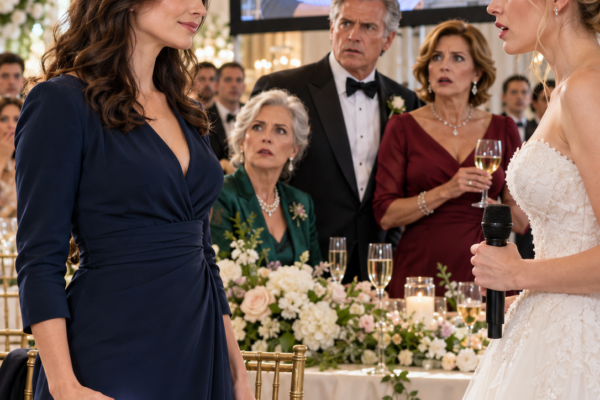
When i walked into the lawyer’s office in my army uniform, my mom looked away. the attorney opened the envelope and said, “this changes everything.” everyone went silent. she never knew what grandpa left behind.
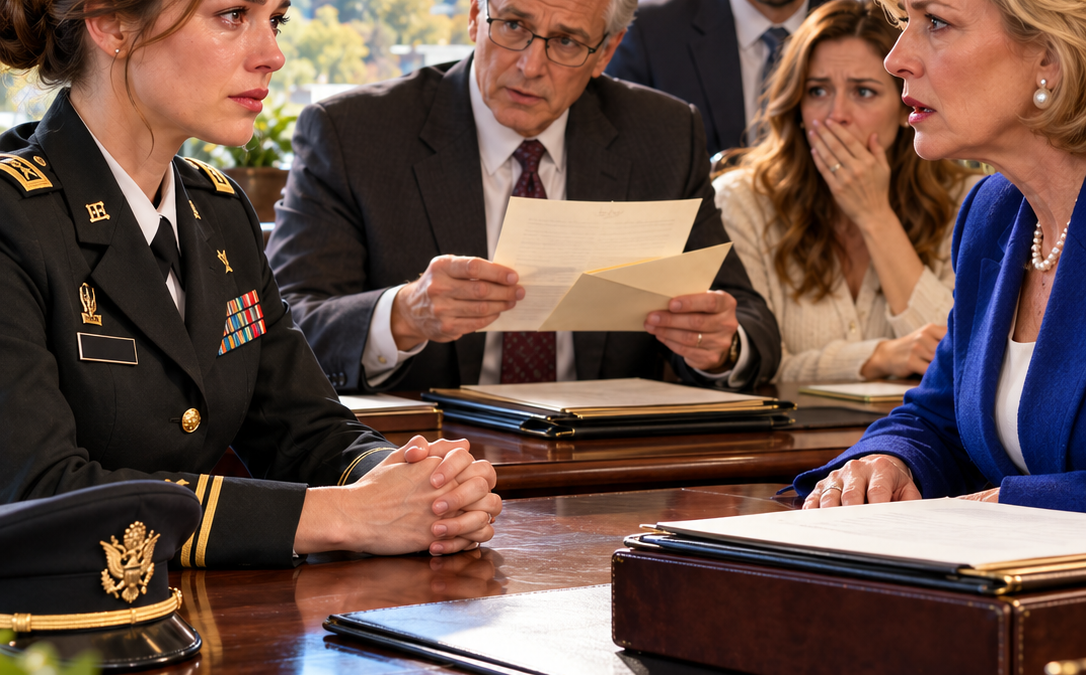
The room smelled like old paper and polished wood. I remember that clearly. The way the air felt thick and still, the way the ceiling fan turned so slowly it barely moved anything at all. I stood in the doorway of Hargrove and Associates for exactly three seconds before my mother looked up from her chair, saw me in my Army dress uniform, and turned her face away as though I were a stranger who had wandered into the wrong building. My sister leaned over and whispered something in her ear. My mother nodded without looking at me again. I sat down on the opposite side of the room, folded my hands in my lap, and waited.
That was the moment I understood that some things between us would never go back to what they had been. But I also understood, for the first time in a very long time, that I was not ashamed of who I had become. Not even a little.
My name is Clare Rener. I am 38 years old, and I spent 14 years serving in the United States Army as a logistics officer, including two deployments to Afghanistan and one extended assignment coordinating humanitarian supply chains in the Horn of Africa. I held the rank of major when I separated from service. I have a Bronze Star with Valor. I have a drawer full of commendation letters that I never show anyone, because that is not the kind of person my grandfather raised me to be.
My grandfather’s name was Thomas Rener. Everyone called him Tom. He built a furniture manufacturing business in Asheville, North Carolina, starting with nothing but a secondhand woodworking lathe and a lease on a building the size of a two-car garage. By the time I was born, he had 40 employees and a reputation for making the kind of furniture that outlasted the people who bought it. He used to say that the two most honest things a person could make were furniture and promises, because both of them had to hold weight.
He said a lot of things like that. I wrote them down in a notebook I kept on my nightstand from the time I was 11 years old until the day I left for basic training. My grandfather believed in me in a way that no one else in my family ever quite managed. He came to every school event. He drove four hours to watch me receive my commission as a second lieutenant. He sent letters, actual handwritten letters on his company letterhead, to every duty station I was ever assigned to. When I called him from Kandahar on a scratchy satellite connection at two in the morning, his time, he picked up on the second ring and talked to me as though we had all the time in the world.
He died in March of last year. Congestive heart failure. He was 81 years old, and he had lived a full and honorable life. I was on a plane from Fort Bragg to Asheville within six hours of getting the call. I got there in time to say goodbye, which is something I will be grateful for until the last day I live.
What happened after the funeral is the part I am still working through.
My mother is Patricia Rener Hol. She remarried when I was 15. My stepfather, Gerald Hol, sells commercial real estate, coaches a youth baseball team on weekends, and is, by almost every outward measure, a perfectly pleasant man. He never did anything cruel to me. He just never did much of anything at all. He watched my mother’s relationship with me from a comfortable distance, the way a person watches weather moving across a valley, present enough to notice it, far enough away to avoid getting wet.
My mother’s primary objection to my military career was never ideological. She was not anti-military. She was anti-disruption. She had a very specific picture of what her daughter’s life was supposed to look like, and it involved a graduate degree in something practical, a husband with a stable income, a house within 30 minutes of Asheville, and grandchildren on a reasonable timeline. The Army fit into none of those categories.
The week I told her I had accepted my commission, she sat at the kitchen table and cried for 45 minutes. Not because she was proud, but because she said I was throwing my future away. Because I was being selfish. Because I had no idea what I was doing to this family.
I was 23 years old. I had a degree in supply chain management from NC State. I had passed every qualification, cleared every hurdle, and earned every credential. I knew exactly what I was doing. I left for training ten days later.
My sister Dana was 17 at the time. She stayed. She went to UNC Asheville, got a degree in marketing, married a man named Brett who works in insurance, had two children in four years, and lives 11 minutes from my mother’s house. She is, by my mother’s accounting, the daughter who got it right.
Dana and I are not enemies. We are something more complicated than that, two people who love each other across a distance that has nothing to do with geography. She did not ask to become the measuring stick. I do not blame her for being one.
But I want to be honest here, because this story does not deserve anything less. The distance between my mother and me was not only about the Army. It was about the fact that I was, from a very early age, more my grandfather’s child than hers. I had his stubbornness, his work ethic, his absolute inability to pretend that something mattered when he did not believe it did. My mother loved me. I know that. But she also spent a very long time wishing I were someone slightly different. And children feel that, even when no one says it out loud.
My grandfather felt it, too. He never said so directly, but it was there in the way he always called me first, in the way he kept my photograph on his desk at the office, in the way he drove four hours to watch me get commissioned when my mother said she had a prior commitment. In all of those things, there was a kind of quiet, steady refusal to let the distance between me and my family define who I was. That was the greatest gift he ever gave me.
And apparently, it was not the only one.
There is something I have not talked about much. Not even with Dana, not even with the friends I made over 14 years of service who knew me better than almost anyone. It is the particular loneliness of coming home.
Not coming home from deployment, though that has its own texture and its own weight. I mean the broader, slower kind of coming home, the return to a civilian world that does not quite have the right-shaped space for you anymore.
You spend years in an environment where your value is defined by what you can do under pressure, where the people around you trust you with their lives and you trust them with yours. Where the work is hard and the purpose is clear and the hierarchy is legible in a way that ordinary life rarely is. And then you separate, and you drive your own car to your own apartment, and you stand in a grocery store in front of 47 varieties of breakfast cereal, and something in you just goes very quiet and very still. And you think, What do I do with all of this now?
I did not have a difficult transition by many measures. I had saved money. I had marketable skills. I had a network. I found consulting work within a few months of separating, advising logistics operations for a regional health care system. The work was interesting enough, the pay was good, and I was, by all external appearances, doing fine.
But fine is not the same as whole.
And the thing about coming home to a family that was never quite sure what to do with you is that their uncertainty confirms your own. You start to wonder, in the quiet hours, whether the life you chose was really worth what it cost. Not the deployments, not the danger. You were always certain about those. But the missed holidays, the relationships that did not survive the distance, the moments when your mother looked at you across a dinner table with an expression you could not decode but that felt unmistakably like disappointment.
You start to wonder if maybe they were right all along. If maybe you were missing something everyone else could see.
My grandfather was the person who stopped that wondering from becoming a conclusion. Not by arguing, not by fighting my case with my mother or insisting she change her mind, but just by seeing me consistently, every time, without revision. By treating my choices as legitimate. By calling on a Tuesday for no reason except to hear how I was doing and to tell me about a customer who had called to say that a dining table he had bought 40 years ago was still standing and still beautiful.
He was my proof of concept. He was the evidence I returned to whenever I needed to remember that there was nothing wrong with me. And then he was gone, and I had to find a way to carry that evidence myself.
I found out about the will three weeks after the funeral. My grandfather’s attorney, a soft-spoken man named Howard Hargrove, who had handled Tom Rener’s legal affairs for over 20 years, called me on a Thursday afternoon while I was in the middle of reorganizing my storage unit in Fayetteville. He said my grandfather had updated his estate documents 18 months before his death. He said there were some provisions I should be aware of before the formal reading, and he thought it would be best if I came to Asheville.
I asked him if everything was in order. He paused for just a beat too long before he said yes.
I drove to Asheville that weekend. I did not tell my mother I was coming. I stayed at a Holiday Inn on the edge of town and walked along the French Broad River for an hour in the cold, thinking about my grandfather and trying to prepare myself for whatever was coming without knowing what it was.
The formal reading was scheduled for a Tuesday. Howard Hargrove had sent certified letters to all parties. My mother called me the Sunday before. She did not say hello.
“I need you to think very carefully about what you’re doing.”
I told her I did not know what she meant.
“Your grandfather was not in his right mind at the end. Whatever he put in those documents, it doesn’t reflect his real intentions. I want you to know that Dana and I are prepared to contest anything that seems irregular.”
I sat on the edge of my hotel bed and looked at the wall. “Mom, I don’t even know what’s in the documents.”
“I think you do.”
Then she hung up.
I sat there for a long time after that. I thought about calling Dana, but I did not. I thought about calling Howard Hargrove, but I did not do that either. I got up, ironed my dress uniform, hung it on the back of the hotel room door, and went to bed.
If I was going to walk into that office, I was going to walk in as exactly who I was.
I want to tell you what it feels like to put on a dress uniform when you have not worn one in a while. It is not a simple thing. You check each element the way you were trained to: the alignment of the nameplate, the placement of the ribbons, the set of the shoulders. Your hands remember what your mind has half forgotten. And as you work through the checklist, something in your posture changes. Not artificially, not performatively. You are simply reminded of who you are when you are at your most intentional.
The uniform does not create that person. It just makes her visible.
I stood in front of the hotel mirror for a moment before I left. I thought about my grandfather. I thought about the commissioning ceremony he had driven four hours to attend, the way he had stood at the edge of the crowd and watched without trying to be at the center of it. Just present. Just there. Just proud in his quiet and absolute way.
I thought about the letter I was about to hear read aloud in a room full of people I loved with complicated love. I picked up my keys, drove to Hargrove and Associates, and stood in the doorway for three seconds while my mother looked at me and then looked away. And I sat down, folded my hands, and waited.
The Hargrove and Associates office was on a quiet street in downtown Asheville, sandwiched between an architectural firm and a coffee shop that had not yet opened for the morning. I arrived eight minutes early. My mother, Dana, and Brett were already there. My mother was wearing a black blazer and pearl earrings. Dana had her hair pulled back. Brett was looking at his phone. No one stood up when I came in. I sat across the room. As I said, I folded my hands. I waited.
Howard Hargrove came out of his inner office at exactly nine o’clock. He was in his late 60s, with silver hair and the careful, measured movements of a man who had spent decades sitting across from people in the worst moments of their lives and had learned to take up as little emotional space as possible.
He greeted each of us by name. His voice was neutral and professional and completely impossible to read. He sat down at the head of the conference table, opened a folder, and looked around the room.
“Before I begin, I want to note that Thomas Rener executed these documents on September 14th of last year, in this office, in the presence of two witnesses and a notary. He was at that time fully competent, fully articulate, and entirely clear about his intentions. I have documented this thoroughly, as is standard in my practice, and I am prepared to provide supporting affidavits should any party require them.”
He said this without looking at my mother, but we all knew who he was talking to. My mother’s jaw tightened slightly. She did not say anything.
Howard opened the folder.
My grandfather’s estate was not simple. There was the house, a four-bedroom colonial on a half-acre in North Asheville that he had lived in for 37 years. There was the business, which he had sold to a private equity group eight years earlier, but from which he still held a significant deferred compensation arrangement. There were investment accounts, a modest art collection, two vehicles, and a piece of land in Madison County, 18 acres of mountain property that had been in the Rener family since 1947.
Howard read through the standard disbursements first. There were charitable donations to three organizations my grandfather had supported for decades: a veterans assistance nonprofit, a local literacy program, and a small rural hospice where my grandmother had spent her final weeks 20 years ago. Each received a specific and meaningful sum.
My mother received the house and its contents, which was the largest single asset by assessed value. She also received one of the vehicles and a portion of the investment accounts. Dana received a specific monetary sum and my grandfather’s art collection, which she had always admired.
Brett received a very nice set of woodworking tools and a handwritten note, which Howard read aloud.
“Brett, thank you for taking care of my daughter. These belong to my father. Use them well.”
Brett looked genuinely moved by this. I revised my opinion of him slightly.
Then Howard turned to a new page in the folder, and his voice shifted. Not dramatically, not in a way most people would notice, but I noticed. It became just slightly more deliberate, the way a person’s voice gets when they are reading something that matters.
“To my granddaughter, Clare Anne Rener…”
My mother made a sound. Very small, like the beginning of a word that she stopped before it formed. Howard did not look up.
“To my granddaughter, Clare Anne Rener, I leave the Madison County property in its entirety. I leave her the full remainder of my investment portfolio after the disbursements listed above. I leave her my company’s original founding documents, my personal journals from 1987 to 2021, and the letter I have asked Howard to read aloud at this time.”
The room was completely quiet.
Howard reached into the folder and removed a separate sealed envelope. He opened it carefully with a letter opener, the way you open something that deserves care. He unfolded two pages of my grandfather’s personal stationery, the same cream-colored paper with the small embossed TR in the corner that I had been receiving letters on since I was 11 years old.
He cleared his throat once, quietly, and began to read.
“Clare, if you are hearing this, then I have gone ahead of you, which means I did not get to say what I needed to say in person. I have been trying to decide for 20 years how to say it. And I think perhaps this is the right way after all, in a room where everyone can hear it, where the record will be clear, where the people I love most will understand all at once what I have always believed.
“You are the finest person I have ever known. Not because you joined the Army, though I am prouder of that than I know how to say. Not because you earned medals or commendations or the respect of people I will never meet, but because you decided, at an age when most people are still figuring out who they are, that you would be exactly yourself. And you never once looked back.
“I know what it cost you. I know what was said and what was left unsaid and what was implied over years of holidays and phone calls and careful silences. I want you to know that I saw it. All of it. And I want you to know that you were never wrong.
“Service is not a consolation prize. It is not what people choose when they can’t think of anything better. It is a calling, and the people who answer it honestly are among the most valuable human beings this world produces. Your country is safer because you were in it. Families who will never know your name are alive because of decisions you made in places they will never visit. That matters. It will always have mattered.
“The land in Madison County belonged to my father, and before him to his father, who cleared it with his own hands. I always meant for it to go to the grandchild who understood what it meant to build something that lasts. I know now that is you.
“I am not leaving you these things to make a point. I am leaving them to you because you have earned them, and because you will know what to do with them, and because I want the world to know, starting with everyone in that room, that I see you clearly. I always did.
“Take care of yourself, Clare. The world needs people like you more than it knows.
“All my love, always,
“Grandpa Tom.”
Howard folded the pages back along their creases, returned them to the envelope, and set the envelope on the table in front of me. I did not trust myself to speak. I looked at my hands and breathed very carefully and told myself I would not cry in this room. I allowed myself exactly four seconds of that. And then I looked up.
My mother was staring at the surface of the conference table. Her expression was something I had never seen on her face before, and it took me a moment to identify it. It was not anger, though I had expected that. It was not grief exactly, though that was part of it. It was the expression of a person who has just heard something they already knew and have spent years refusing to acknowledge.
Dana had her hand over her mouth. Her eyes were wet. Brett had put his phone in his pocket. No one said anything for a very long time.
Then my mother spoke in a voice that was very quiet and very careful.
“He updated this 18 months ago?”
Howard said, “September 14th of last year. Yes.”
“That was after his first hospitalization.”
“It was. As I mentioned, he was fully competent at the time of execution. I have documentation.”
My mother said, “I’m not…”
And then she stopped. She pressed her fingers against her lips for a moment.
“I’m not contesting it.”
Dana looked at her quickly.
“I just… I needed to understand the timeline.”
She turned and looked at me then. Really looked at me for the first time since I had walked into that room. And I saw it, just for a moment. Beneath everything else, something that might have been the beginning of an apology.
Not for the will. For all of it. For 20 years of it.
She did not say anything. Neither did I. But I held her gaze, and I did not look away. After a moment, she gave the smallest possible nod. And I gave one back.
We both understood that we were going to need a very long time, and probably some very difficult conversations, before any of this was truly okay. But we were also both still in the room. And that, I thought, was something.
Howard walked us through the remaining administrative details. There were documents to sign, timelines for asset transfers, and a contact at the title company for the Madison County land. He was efficient and kind and gave each of us exactly as much time as we needed with the paperwork.
When it was over, and Dana and Brett and my mother had gone out to the parking lot, Howard walked me to the door. He shook my hand and held it for a moment.
“Your grandfather talked about you often.”
“I know he talked about all of us.”
“He did. But when he talked about you, he smiled differently.”
He paused.
“I don’t know if that means anything to you.”
I told him it meant everything.
I drove out to Madison County that afternoon. I had looked at the land on a map, but I had never seen it in person. And I wanted to see it before I did anything else. Before I called anyone, before I made any decisions, before I let the practical world of property taxes and timber assessments and legal transfers crowd out whatever this was supposed to be.
The GPS took me up a winding state road and then off onto a gravel lane that climbed steeply through second-growth forest. It was late November, and the trees were bare. Through them, I could see ridgelines layered in blue and gray against a pale sky.
I pulled over where the lane crested a hill and got out of the car. The land fell away below me in a long, gentle slope toward a creek I could hear but not see. There was an old fence line at the bottom, overgrown with blackberry and wild grape, and beyond it a neighbor’s pasture, where a small herd of cattle stood completely still in the cold. Above me, the ridge continued upward through oaks and hickories and patches of pine. A red-tailed hawk circled twice over the far tree line, and then was gone.
I stood there in my dress uniform in the cold November air and looked at the land that had belonged to my great-grandfather and my grandfather and now belonged to me.
I thought about everything my grandfather had built. I thought about the 40 employees and the furniture and the letters on cream-colored stationery and the four-hour drives to watch me receive commissions that my mother could not make time for. I thought about the notebook on my nightstand with all the things he used to say.
The two most honest things a person could make were furniture and promises, because both of them had to hold weight.
I stood there for a long time, long enough that the cold worked its way through my uniform jacket and I could see my breath in the air and my fingers had gone stiff inside my gloves.
I did not move. I was not ready to move yet.
I was trying to memorize it. The exact quality of the light through the bare trees, the sound of the creek below, the weight of the cold and the silence, and the particular feeling of standing on land that your people had stood on before you.
I had stood in a lot of significant places in my life. Forward operating bases and airfields and supply depots and government buildings in cities whose names most Americans could not locate on a map. I had stood in places where the significance was enormous and the beauty was absent entirely. I had stood in places where I was afraid and places where I was proud and places where I was both at once.
This was different from all of those.
This was quiet in a way that had nothing to do with the absence of noise. It was the quiet of something that had been waiting, that had always been there, patient and unhurried, belonging to whoever in the Rener line was ready to receive it.
I thought, I am ready.
And then I thought, I have always been ready. It just took until now for everyone else to see it.
I did not go straight back to the hotel after that. I drove down the mountain slowly and found a small diner on the main road through Marshall, the county seat, and sat at the counter. I ordered coffee and a piece of apple pie that turned out to be the best apple pie I had eaten in years.
The woman who served me was in her 60s, with reading glasses pushed up on her head and a no-nonsense efficiency that I found immediately comfortable. She asked if I was passing through. I told her I had just inherited some land up on the ridge.
She looked at me differently after that. Not with suspicion, but with a kind of recalibration.
“Rener land?”
“Yes.”
She set down her coffee pot.
“I knew Tom Rener. He used to stop in here on his way up to the property. Every spring and fall, regular as anything. Sat right where you’re sitting.”
She looked at the counter for a moment.
“Good man. Real good man.”
“Yes,” I said. “He was.”
She refilled my coffee without being asked and did not charge me for the pie. When I left, I tipped her more than the pie was worth, and she accepted it without comment, which I appreciated.
I drove back to the hotel, sat on the edge of the bed, and called Dana. She answered on the first ring, which told me she had been waiting.
“How is she?” I asked.
“She cried for about an hour after you left. Quietly, in her room. Then she came out and made lunch and didn’t say anything about it.”
“That sounds right.”
“She’s not a bad person, Clare. She just… she handles things badly sometimes.”
“I know.”
“She loves you.”
“I know that, too.”
There was a pause. And then Dana said, “I always admired what you did, you know. I just never said it enough. I think… I think I was afraid that if I said it too loudly, Mom would feel like I was taking sides.”
I sat with that for a moment. It was honest, and it was a little painful, and it explained a lot of things that had confused me over the years.
“I understand that.”
“I’m sorry,” Dana said.
“Me, too,” I told her. For whatever part of it was mine.
We talked for another hour after that, about our grandfather mostly. About the things he used to say and the way he smelled like wood shavings and coffee and the particular laugh he had when something genuinely surprised him, which was rare because not much did.
We talked about the summer Dana and I had both stayed with him for three weeks when we were kids. How he had taught us to use a hand plane and let us stay up too late watching old movies and made us oatmeal every morning without variation or apology, because oatmeal was what he ate and he saw no reason to change on account of guests.
By the time we hung up, it was past ten o’clock, and I was tired in the good way. The way you get tired when you have felt a lot of true things in a single day and your body is ready to stop for a while.
I slept better that night than I had in months.
My mother called me that evening, the evening before I left for Fayetteville. I almost did not answer. Then I thought about what my grandfather said in the letter about being exactly myself, and I decided that the version of myself I wanted to be was the kind who answered.
“Where are you staying?” she asked.
I told her.
“That’s 45 minutes from here.”
“I know.”
There was a pause. Then she said, “I’d like you to come to dinner. Not tonight. Tonight is too soon, but before you go back to Fayetteville.”
“Okay.”
“I have things I want to say to you. That I should have said a long time ago.”
Another pause.
“I don’t know if I’ll say them well, but I want to try.”
I thought about a lot of things I could say in response to that. I thought about 14 years of missed calls and backhanded comments and the way she had turned her face away when I walked into Hargrove and Associates that morning. I thought about every holiday dinner where Dana’s life was discussed in detail and my career was mentioned briefly, with the tone of a polite person describing a distant relative’s unusual hobby.
I thought about all of that.
Then I said, “I’d like that, Mom.”
And I meant it.
We had dinner on Thursday. It was just the two of us. She had asked Dana to give us space, which surprised me, and which I later learned had been Dana’s suggestion, not hers, which surprised me less.
We sat at her kitchen table, the same table I had grown up eating breakfast at. She made pot roast because it was my grandfather’s recipe, and I think she needed the comfort of making something familiar.
She did not say everything she needed to say. I did not expect her to. We are both Reners in our own way, and Reners are not people who undo 20 years of complicated history over a single pot roast on a Thursday in November.
But she said some things.
She said she had always been afraid of losing me and that she had responded to that fear by pushing me away before I could leave on my own. She said she knew that did not make sense. She said she had understood for a long time that she had handled it badly, and she had just not known how to say so without admitting how badly she had handled everything else.
She said she was proud of me. Quietly. Plainly. Without any qualification.
I had been waiting to hear her say those specific words in that specific order for most of my adult life. And when she finally said them, I did not feel the explosion of relief I had always imagined. I felt something quieter than that, a kind of settling, like a load-bearing thing that had been slightly off-center for a long time finally finding its true position.
“I know you love me, Mom,” I said. “I’ve always known that.”
“I haven’t always acted like it.”
“No. But you’re acting like it now.”
She reached across the table and put her hand over mine. Her hand was smaller than I remembered. Her hair was more gray. I looked at her, really looked at her the way I had not let myself look in years.
And I saw someone who was older and tired and trying, in the late-innings way of someone who has finally accepted that the game is still on and there is still time to play it differently.
I turned my hand over and held hers.
We sat like that for a while without saying anything. Outside the kitchen window, the sky had gone dark, and the streetlight at the end of the block had come on. The neighborhood was quiet in the way of suburban neighborhoods on cold November evenings, the particular settled peace of ordinary life continuing its ordinary business.
I had spent a long time being far from this. Not just in miles. In orientation, in the part of myself that had always been straining toward something beyond the familiar.
And sitting there at the kitchen table, holding my mother’s hand, I did not feel that strain. I felt instead the strange and unexpected relief of being exactly where I was, in the specific, irreplaceable moment of it, without needing it to be anything other than what it was.
That, too, was something my grandfather would have understood.
The Madison County property is currently in the process of being formally transferred into my name. I have spoken with a land conservation trust about the lower acreage near the creek, which has old-growth timber and a wetland area that would benefit from protection. I have spoken with a local contractor about restoring the old stone foundation near the ridge. There was a structure there once, a hunting cabin my great-grandfather built, and I think there could be one again.
I am also in the early stages of something I have been thinking about for a long time, since before my grandfather died, since before any of this happened.
I want to create a retreat space for women veterans. A place where people who have spent years being exactly themselves in high-pressure environments can come to figure out who they are outside of those environments.
Madison County is quiet and beautiful and far enough from everything to feel like a genuine change of scene. The land is large enough. The idea is the right size for it.
I do not know yet if it will work. There are grants to apply for and zoning questions to answer and about 400 logistical details I have not figured out yet. But I have spent 14 years coordinating the movement of supplies and personnel across extremely complicated terrain in extremely unpredictable conditions. And if there is one thing I know how to do, it is how to plan a mission with incomplete information and adapt as you go.
My grandfather would have loved the idea. I know that without needing to be told.
I still have the letter. Howard gave me the original in the cream-colored envelope with the small embossed TR in the corner. I keep it in the same drawer as the notebook. Some nights I take it out and read it again, not because I need convincing. I stopped needing convincing a long time ago.
I read it because there is something clarifying about hearing someone say in plain and permanent language that they see you clearly, that they always did, that the distance was never about your worth but about other people’s fear, and that the love was there even when the expression of it failed.
My grandfather was not a perfect man. He was a stubborn, particular, occasionally infuriating man who had strong opinions about joinery and weak opinions about professional sports and an absolute refusal to throw away any piece of paper that had ever passed through his hands.
He was also the person who loved me most consistently and most clearly of anyone I have ever known.
I miss him every day, but I carry him with me in the way he intended. Not as grief, but as instruction, as a standard, as a voice that says, when I am tired or uncertain or wondering whether any of this is worth it, “Be exactly yourself. Do not look back.”
I don’t.