I invited my family to my commendation ceremony. Dad shrugged, “Just a city job.” My sister said, “We’re busy — family dinner.” Mom liked the message. I smiled and said, “That’s fine.” That night, while they ate, dad scrolled his phone and froze: “W-who shared this?”
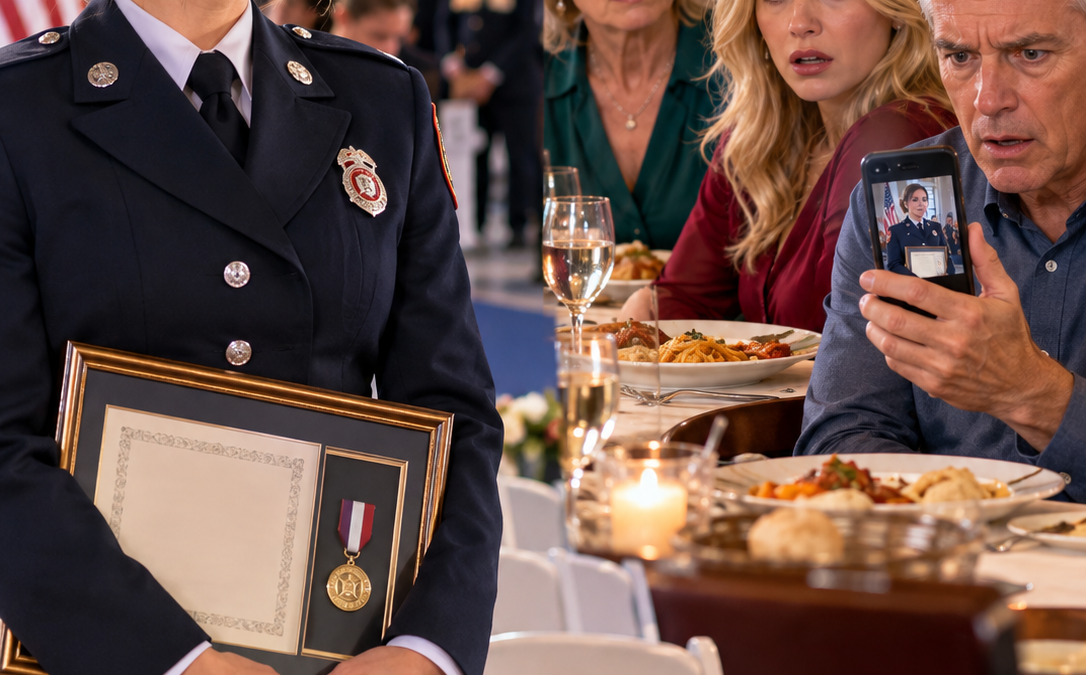
The email came on a Thursday afternoon, and I was still in my dress uniform when I read it. I was sitting in the parking lot of the station, the engine still running, my hands resting in my lap. The commendation letter was folded on the passenger seat beside me. They had called my name in front of the entire department that morning. The chief had shaken my hand twice. A photographer from the county office had asked me to stand by the flagpole outside and smile. And I had smiled. It had felt real, genuinely and completely real, in a way that very few moments in my life ever had. Then I drove home and read the email from my mother, and something in my chest went very quiet. She wrote that they were sorry they couldn’t make it, that my father’s back had been bothering him, that my sister had the kids that weekend, and that things were complicated with everyone’s schedules. She ended it with a row of heart emojis and the words, “So proud of you, sweetheart.” And I sat in that parking lot for a long time, longer than I should have, reading those words over and over, trying to locate something real inside them. I couldn’t.
I want to explain something before I go any further, because I think it matters for the rest of this. I am not someone who grew up feeling invisible. I grew up feeling as though I were standing right in the center of the room, completely visible and somehow still not seen. That is a different thing entirely, and it takes longer to name. My parents were present in the physical sense. They came to birthday dinners and school events and graduation ceremonies when it was convenient, when nothing else was competing for their attention. They asked about my life the way people ask about the weather, not because they needed the answer, but because asking was what polite people did.
My sister was different. She was the one they leaned toward instinctively, the way a plant leans toward light. Not cruelly. Not with any conscious intention I could point to. It simply happened, the way gravity happens, quietly and without announcement. She was the one my mother called first with good news. She was the one my father took to the hardware store on Saturdays when we were kids, and later to the good restaurants when she was grown. She was the one whose accomplishments were lingered over at family dinners, whose problems became group projects, whose life was narrated with a warmth and specificity that mine never quite received. I don’t believe my parents sat down and decided to love her more. I believe they found her easier. She was softer in the ways they understood. She stayed geographically close. She married young, had children young, and built a life that looked like the version they had imagined for both of us.
And then there was me. I had become a firefighter. I know how that sounds to most people. I know that most people hear that and think, “What a thing to be proud of.” And they’re right. I am proud of it. Deeply, quietly, in a way that belongs to me and doesn’t require anyone else’s agreement. But in my family, it didn’t land the way you might expect. My father was a man who believed in stability above most other things. He had worked thirty-one years in insurance and had strong opinions about pensions, predictable income, and career trajectories that moved in straight lines toward retirement. When I told him at twenty-three, sitting across the kitchen table on a Sunday afternoon, that I had been accepted into the fire academy, he looked at me with an expression I had seen before. Not anger. Not disappointment exactly. More like a kind of resigned puzzlement, the face he made when something didn’t compute. Then he said, “That’s a young man’s job.”
He didn’t say it with cruelty. He said it the way he said most things: flat, matter-of-fact, already mentally moving on to the next topic. As though my news were a weather report for a city he didn’t live in and had no plans to visit. My mother asked if I had thought it through. She asked gently, genuinely, in the voice she used when she was worried, which I knew was a form of love. But it felt, in that moment and in every moment like it that followed, like being handed love through a screen door. Present, but not quite reachable. My sister, who was visiting that weekend with her oldest child, said nothing at the table. Later, though, in the hallway on her way to the bathroom, she touched my arm and said, “You know how he is. Don’t let it get to you.” It was her way of being kind and also, I understood later, her way of closing the subject without having to take a position on it.
I went to the academy anyway. I graduated. I passed the physical evaluations that eliminated people twice my size and twice my confidence. I went through the probationary period at Station 7, earned my full position, and learned how to carry weight, move through smoke, and make decisions in the ten seconds before a situation becomes irreversible. I learned how to read a building the way some people read faces: where it was weakest, where it wanted to give, where you could move, and where you absolutely could not. I was good at the work. I wasn’t the loudest voice in the room or the fastest person on the drill floor, but I was steady. And in that job, steady is the quality that keeps people alive when everything else is falling apart.
For three years, I did that work. For three years, my family treated it approximately the way you treat a hobby someone has taken too seriously for too long. Once, after I had described a structure fire we’d responded to, a two-story residential building with a family inside, my father asked whether I had looked into moving into a supervisory or administrative role. “More stable,” he said. “Less physical wear.” I told him I liked the physical part. I told him I was good at it. He nodded in the way that meant he had heard me and had already set the information aside.
My mother worried, which I understood as love. Every visit, she would mention my cousin who had gone into nursing and was doing wonderfully, or another cousin who had gotten into real estate and bought a house. She wasn’t trying to diminish me. She was trying, in the language available to her, to express that she was frightened for me, that she wanted safety for me, that danger was not something she could make peace with, no matter how many years passed. But the effect of it, the cumulative effect of every visit, was a low-grade feeling of not quite being enough in the form I had chosen.
My sister had developed a habit that I noticed slowly and then all at once. She would refer to my job in careful, muted terms when her children were around. She would say I worked for the city. Once, when her youngest, a bright, curious seven-year-old who asked everyone direct questions, asked me at the dinner table if I was a real firefighter, my sister answered before I could open my mouth. “Auntie works with the fire department,” she said, and then she asked her daughter if she wanted more bread.
Auntie works with the fire department. Auntie is a firefighter. Auntie runs into burning buildings and pulls people out while most people are running in the other direction. Auntie was placed on the department’s individual commendation list that year for her response to a gas explosion on the east side of the city, where two families across three floors got out because of decisions she made in under forty seconds, with incomplete information and zero margin for error. Auntie works with the fire department.
I stopped correcting it. After a while, I stopped bringing up the work in any detail. Not because I was ashamed of any of it. I wasn’t ashamed of a single minute. But because I had learned, slowly and then with great finality, that their failure to understand was not temporary. It was structural. Spending energy trying to make them see the work the way I saw it was like pouring water into sand. You could do it indefinitely and never fill anything. Eventually, the pouring itself becomes a kind of wound.
The commendation ceremony was scheduled for a Saturday in September. It was a formal department event, not enormous in scale but significant in meaning. The department held it once a year. It was open to the public, and families were explicitly invited and encouraged to attend. Several colleagues I was close to were bringing their parents, their partners, their children. There would be assigned seating. There would be a reception afterward, with food and introductions and photographs.
I told my family about it six weeks in advance. I sent the date and address and explained what it was and why it mattered. My mother said it sounded wonderful and that she was looking forward to it. My father asked what time it started, which I genuinely took as a positive sign. He only asked for details about things he was considering attending. My sister said she’d try to make it, which I had learned across thirty-four years of shared history was a sentence that translated, almost without exception, to her not making it.
Two weeks before the event, I sent a follow-up message to the family group chat. I included the parking information and noted that seating was first come, first served. My mother replied with a thumbs-up emoji. My sister said she was trying to sort out her husband’s schedule and a soccer conflict involving her older child. My father didn’t reply. The week before, I called my mother directly. She said they were absolutely planning on coming. She mentioned that my father’s back had been uncomfortable lately, but he was managing. I said I would see them there, and I meant it when I said it.
The Thursday before the ceremony, the email arrived. My father’s back. My sister’s kids. Complicated schedules. Heart emojis. “So proud of you, sweetheart.” I wrote back three words: “No worries at all.” Because it was the only sentence available to me that was simultaneously true and something I could survive writing.
The ceremony was held at the main civic center, in the large hall on the second floor with tall windows that caught the September afternoon light and laid it in long, warm strips across the floor. There were perhaps two hundred people there. I knew most of the faces. Captain Deirdre Walsh was receiving a citation for her work on the department’s community response program. Marcus, who had been my training partner three years earlier and had become one of the people I trusted most in the world, was receiving a unit commendation along with the rest of our crew for the spring response season. I was receiving an individual commendation for the east side gas explosion response.
I stood in line with the others and waited. When they called my name, I walked up, shook the chief’s hand, accepted the framed letter and the medal, and stood where they told me to stand for the photograph. I smiled, and it was real. The same realness I had felt in the parking lot before the email, before everything else compressed back down to its usual weight.
Afterward, at the reception, there was bad coffee, very good pastries, and a room full of people I genuinely liked. Marcus’s mother, a small woman in a yellow dress who had driven four hours to be there, hugged me and told me she had heard so much about me from her son that she felt she already knew me. Captain Walsh’s husband shook my hand and said quietly that he still didn’t fully understand how any of us did it. He meant it as a compliment, and I received it as one. An older man I recognized as a retired battalion chief found me by the pastry table and told me about a similar call he had run in 1987 and what he remembered about the sound of a gas-fed fire. I listened to every word.
Then a woman I had never seen before in my life approached me near the windows. She was maybe sixty, wearing a gray cardigan, and she stood in front of me for a moment before speaking, as though she were collecting herself. She said her son had lived in one of the apartments in the building on the east side. She clarified which building she meant. The gas explosion. April. The third floor. She said she just wanted to say thank you. She said it simply, without drama, and then she stepped back and rejoined whoever she had come with.
I stood there by the window for a moment after she walked away, thinking about her face and what she had just said. And I thought, “This is it. This is the part that is real and permanent and cannot be rearranged by anyone’s absence. Not by my father’s back. Not by my sister’s soccer schedule. Not by my mother’s heart emojis sent from a dinner table forty minutes away while I stood at a flagpole and smiled for a county photographer.”
This woman’s son had been on the third floor of a building that was trying to come apart, and he was still here. I had been part of the reason. That fact existed completely independently of whether my family ever understood what I did or chose to show up and watch me receive a piece of paper for it.
I found out about the dinner later that same evening. It wasn’t simply that they’d had complicated schedules or that my father’s back had flared at an inconvenient time. They had made a reservation. My sister had organized it, framing it as a belated birthday celebration for my mother, though my mother’s birthday falls in early March and it was now September. They had gone to the Italian restaurant my sister’s husband preferred, the one with the good bread and the long waits. And by all accounts, they had a perfectly pleasant evening.
The way everything came to light was through my colleague Priya, who documented every department event with the enthusiasm of someone who genuinely loved her job and the people in it. That afternoon, she had posted photographs from the ceremony to the department’s public community page. Group photographs, individual photographs, candid shots from the reception. She tagged several of us. Someone who followed that community page, someone I had never met, someone connected only loosely to someone who knew Priya, recognized the citation in one of the photographs and connected it to the local news coverage from the spring. She shared the post to a neighborhood forum with a note asking whether anyone knew the firefighter from the east side incident.
It moved quickly from there. The east side response had been covered in two local television segments and one longer print piece in the county paper. People remembered it, or recognized it when they saw it again. Within a few hours, the shared post had reached several hundred people across overlapping local groups. My sister saw it because a woman she knew from her daughter’s school happened to follow one of those groups and tagged her directly.
She called me at 9:30 that night. I was on my couch, the television on at low volume. The medal was on the coffee table in front of me, which I understand sounds deliberate, but I had genuinely set it down there when I came in and hadn’t moved it. “I saw the post,” she said. “Okay,” I answered.
There was a silence. I recognized a specific pause she used when she was recalibrating, measuring the distance between what she wanted to say and what she had decided it was safe to say. Finally, she asked, “Why didn’t you tell us it was such a big deal?” I let that land before I answered. “I did tell you,” I said. “Six weeks ago, and again two weeks ago. And then I called.” She hesitated. “I mean about the east side thing,” she said. “About what actually happened. I didn’t realize it was that big a deal, that people knew about it.”
And there it was, clean and clear and exactly what I had always known it would be, if it ever came. Not “I’m sorry we weren’t there.” Not “I’m sorry we went to dinner while you stood at a flagpole alone.” The regret, such as it was, was entirely about visibility. About the fact that strangers had seen something and given it weight, and now the calculation had shifted. Now there was something to account for.
“I mentioned the east side call to Mom and Dad in April,” I said. “About a week after it happened.” She said nothing. “Dad suggested I look into administration,” I added. More silence. “I have to go,” I told her. “I hope dinner was good. Tell Mom happy early March.” I hung up before she could find the next thing to say.
My father called two days later. I watched the phone ring and let it go to voicemail. He left a message one minute and forty seconds long. I checked the timestamp before deciding whether to listen. He said he had seen the news piece, that one of the local segments had resurfaced alongside the community post. He said he was proud of me. He said he hoped I knew that. He said the family cared about me very much and that his back had genuinely been bad that day. His voice was measured and familiar, and entirely without the word “sorry.” Not once in one minute and forty seconds. I kept the voicemail for about a week. Then I deleted it.
I want to be precise about something, because I think precision matters here. I did not post that commendation to make a point. I didn’t post it at all. Priya did, from the ceremony, the way she always did, because she was proud of her colleagues and wanted the community to see the work. I did not arrange for anyone to tag my sister. I did not forward the post to my father. I made no plan. I sat on my couch with a medal on my coffee table and waited for nothing in particular, and the phone rang. That was the entirety of my involvement in any of it.
What I did do, the thing I had actually decided somewhere between the parking lot on Thursday and the couch on Saturday night, was stop trying to be seen by people who had made their choice about how much of me to see.
There is a specific exhaustion that comes from that particular effort, from adjusting yourself year after year to fit the dimensions of someone else’s comfort. I had spent a long time making myself smaller and quieter and less so that they could remain as they were. I had downplayed the danger so my mother could sleep. I had simplified the work so my father wouldn’t have to feel whatever it was he felt when I described it fully. I had let my sister edit me out of her own narration without objecting, because objecting felt like asking for something they had already decided I wasn’t going to get. I had been paying a tax I had never agreed to for recognition I was never actually going to receive.
And somewhere around 9:45 on a Saturday night, with a medal on my coffee table and a conversation I had just ended without apology, I stopped paying it.
I don’t see them as much now. Not as punishment. I have no interest in punishment, and I don’t think withholding yourself from people is the same as teaching them a lesson. I simply stopped being the one who closed the distance. I stopped initiating. I let the space between us settle into whatever it naturally was without me engineering it smaller. It turned out to be quite a lot of space.
My mother calls occasionally, and we have conversations that last about twenty minutes, cover ordinary things, and end pleasantly enough. My father sent a text in February asking how I was doing. I said, “Well.” He said, “Good.” That was the whole of it. My sister and I are polite in the way people are polite when they have run out of pretenses but haven’t yet decided what to replace them with.
What I have instead is Marcus, whose mother drives four hours to stand in a reception hall and hug the people her son trusts. Captain Walsh, who filed the recommendation that got me into a specialist training program I am currently halfway through and finding genuinely challenging in the best way. The crew at Station 7, who argue about the coffee situation with the passion of people who have decided that small things are worth caring about, and who notice, without making it a production, when someone is having a hard shift. A woman in a gray cardigan who came to find me by the window to say thank you.
The framed commendation letter is on the wall of my apartment now, to the left of the window that gets the afternoon light. I don’t look at it every day. Some weeks I don’t look at it at all. But when I do, I don’t think about the ceremony or the community post or my sister’s recalibration on the phone or my father’s one minute and forty seconds of careful words that never once included the one that would have mattered.
I think about forty seconds. I think about a third floor. I think about a woman in a gray cardigan collecting herself before she spoke. I think about what this work actually is, and who it belongs to, and what it means that I chose it and kept choosing it even when no one at my family’s table could see the point.
It belongs to me. It has always belonged to me. I just spent a very long time asking for permission to believe that from people who were never going to give it.
The moment I stopped asking was the moment I finally, fully had it.