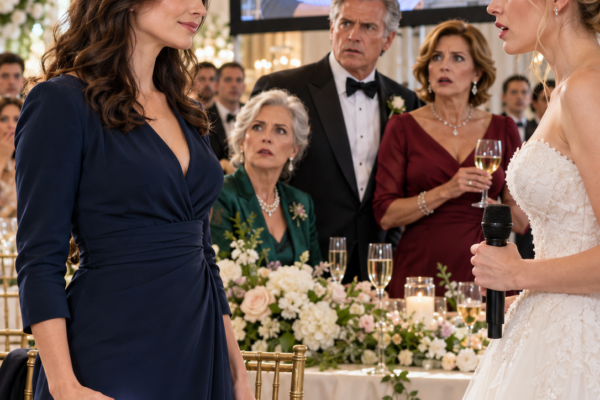
When my grandma — a retired paralegal — died, my mom & aunt inherited her $3.1m property, then they told the developer, “we’re interested,” but the lawyer called and said, “did you read the covenant?” they went silent when the letter said…
I didn’t find out my grandmother had changed everything until my mom called me on a Tuesday morning. And I could tell from the first syllable that she was not calling to talk.
“The lawyer needs us both there on Thursday,” she said. “Don’t be late.”
That was it. No hello. No how are you doing. Just the instruction, delivered the way she had always delivered instructions to me: clean, efficient, with the implicit understanding that my feelings about it were not part of the equation. I stood in my kitchen in Charlotte for a long moment after she hung up, holding the phone against my chest and listening to the refrigerator hum. Outside, the October light was doing that thing it does in the Carolinas in fall, turning everything gold and a little bit sad at the same time. I thought about calling her back and asking what this was about. I thought about texting my aunt. Then I thought about my grandmother, Margaret Louise Whitfield, and I set the phone down on the counter and started making myself a second cup of coffee because I had a feeling I was going to need it.
My grandmother had passed six weeks before that phone call. She had gone quietly, the way she had done most things in her life, without drama, without fanfare, with a kind of dignified stillness that made you feel like she was simply stepping from one room into another. She was eighty-one years old. She had lived in the same house in Asheville for forty-three years, raised two daughters there, buried a husband there, and spent the last decade of her life turning the back acre of her property into a garden that people actually drove from other counties to see in the spring. I had been with her when she died. Not my mother, not my aunt Patricia. Me. That is not a detail I share to make myself look better or to cast them in a harsh light. It is simply the truth, and the truth matters here because it is the foundation of everything that happened afterward.
My mother and my aunt are not bad people. I want to say that clearly before I go any further. They are complicated people, which is a different thing entirely, and my grandmother understood the distinction better than anyone. What they are, if I am being honest, is practical. They had both moved away from Asheville before I was born, my mother to Charlotte, my aunt to Atlanta, and they had built their lives around the logic of forward motion. You don’t look back. You don’t get sentimental. You make decisions based on what is in front of you, not what is behind. My grandmother used to say, with a particular smile she reserved for observations she found both true and unfortunate, that her daughters had inherited her intelligence but not her patience. I always thought that was the most precise thing I had ever heard anyone say about their own children.
I had grown up driving to Asheville every summer. While my friends went to camps or family beach trips or Disney World, I went to my grandmother’s house on Ridgerest Road and spent three months learning things that no school ever taught me. She taught me how to keep a proper kitchen garden, how to read a legal document, and how to hold a conversation with someone you disagreed with without either of you walking away feeling diminished. She had been a paralegal for thirty years before she retired, and she had a mind like a filing cabinet: everything sorted, everything retrievable, nothing ever truly lost. My mother thought those summers were sweet but ultimately unproductive.
“You could be doing something that goes on a résumé,” she told me once when I was about fifteen and had just gotten back from six weeks in Asheville.
I had tried to explain that I had learned about estate planning and medicinal herbs and the particular way grief sits differently in the body than ordinary sadness. My mother had looked at me with an expression I can only describe as affectionate bewilderment and said, “Okay, honey,” and changed the subject. I was the one who moved back to the Carolinas after college. Not to Asheville, but close enough. I visited my grandmother every few weeks. I was there for her hip surgery. I was there for the winter when she had pneumonia and couldn’t get warm no matter how many blankets she piled on. I was there when her doctor started using the word decline in a gentle, careful voice that meant something was coming that we couldn’t stop.
My mother visited when she could, which was three or four times a year. My aunt Patricia visited a little less. They called regularly. They were not absent daughters, but there is a difference between visiting someone and being present with them. My grandmother knew that difference, and so did I. And so, I think, did my mother and aunt, even if they never said it out loud.
When my grandmother passed, I was sitting in the chair beside her bed, holding her hand. It was four in the morning. The hospice nurse had stepped out for a moment. The room was very quiet, and outside I could hear the wind moving through the maple trees she had planted when she first bought the house, trees that were now enormous and indifferent and beautiful. Her breathing changed, and then it didn’t change anymore, and that was all. I called my mother from the driveway, standing in the dark with my keys in my hand and my heart somewhere below my stomach. My mother cried. I cried. We stayed on the phone for a long time, not saying very much. It was one of the few moments in my adult life when the distance between us felt genuinely small, and I held on to it because I knew from experience that it wouldn’t last.
The weeks that followed were logistics. There is so much logistics in grief that the grief itself sometimes has to wait in line: the funeral arrangements, the obituary, the calls to relatives I hadn’t spoken to in years. My mother and aunt flew in and stayed at a hotel downtown, which felt strange to me, the idea of them being visitors in the city where their mother had spent half her life. But I didn’t say anything about it. I was staying at my grandmother’s house, in the room that had been mine every summer, and I was grateful for every night I got to fall asleep smelling the cedar of her closets and hearing the creek that ran along the back of the property.
After the service, after the food that neighbors brought and the relatives who came and went and the careful, exhausted conversations that funerals require, my mother and aunt sat down at my grandmother’s kitchen table and began to talk about what came next.
“The house is going to need to be assessed,” my aunt Patricia said.
She had the same precise quality my mother had, but sharper. She had spent twenty years in commercial real estate in Atlanta, and she looked at every space she entered the way a jeweler looks at a stone, calculating its worth.
“I already have someone I can call.”
“Let’s wait until after we’ve spoken with the attorney,” my mother said.
“There’s no reason to wait. An assessment isn’t a decision. It’s information.”
“It’s a signal,” my mother said.
They looked at each other for a moment in the way that siblings look at each other when they are having a conversation that has been going on their entire lives. I was washing dishes at the sink. I did not turn around.
“The house is worth something,” my aunt said. “The property especially. You know, Ridgerest has been developing. There have been inquiries.”
“What kind of inquiries?” I asked.
And I did turn around then. My aunt looked at me with the pleasant, slightly distancing expression she used when she was deciding how much information I was entitled to.
“A developer reached out about a year ago. Crestwood Partners. They’re doing a residential project in that corridor. They were very interested in properties with creek access.”
“Grandma never mentioned that.”
“No,” my aunt said. “She wouldn’t have.”
Something in the way she said it made me set the dish down very carefully, dry my hands, and leave the room because I didn’t trust what I might say next.
The house on Ridgerest Road was not, as it turned out, a modest inheritance. My grandmother had bought it in 1981 for what seemed at the time like an enormous sum and what seemed now, forty-some years later, like a rounding error. The property was 2.6 acres in a part of Asheville that had gone from quietly residential to genuinely desirable over the past decade. The house itself was in excellent condition because my grandmother had maintained it with the same systematic care she applied to everything. There was also, I learned later, a separate parcel of land, a half-acre lot adjacent to the property that she had purchased quietly in 2019 and never mentioned to anyone except her attorney. Altogether, the estate had been assessed at approximately three million dollars.
I did not know this number when I drove to Asheville on that Thursday morning in October. I knew the house was valuable. I didn’t know how valuable. I drove with the windows down because the air was cold and clean and smelled like wood smoke. I thought about my grandmother and the way she used to sit at her kitchen table in the morning with her legal pads, writing things down in her small, precise handwriting. I tried to remember if she had ever seemed worried about anything. I could not think of a single time that she had.
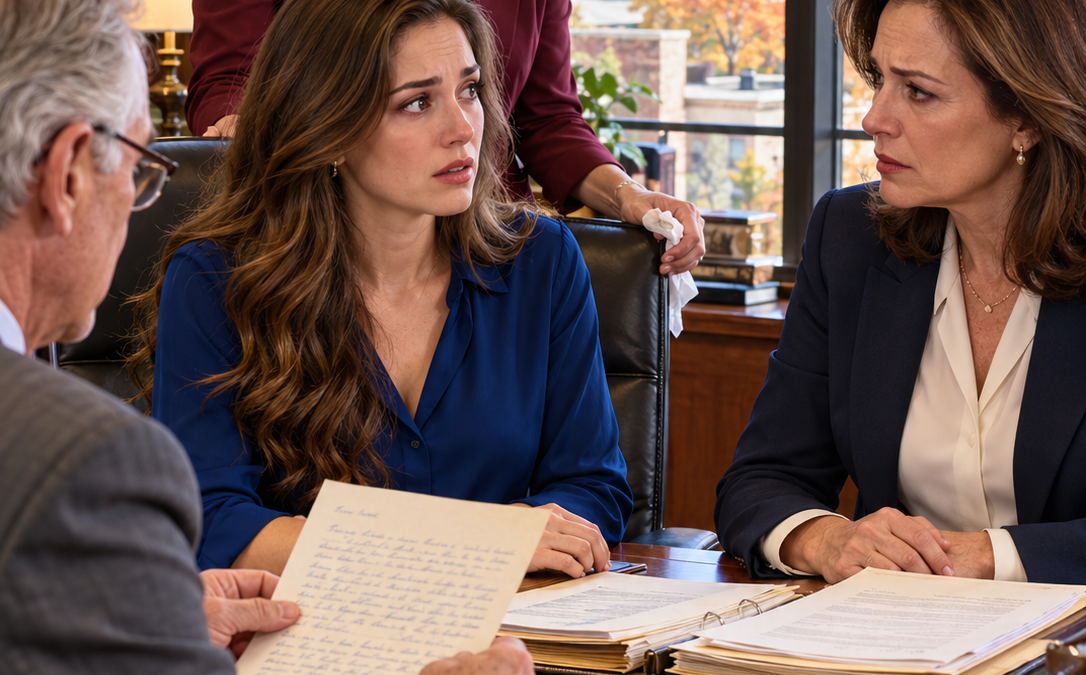
The attorney’s office was downtown, on a street of old brick buildings that had been converted into professional offices. His name was Richard Callaway, and he had been my grandmother’s attorney for over twenty years. He was the kind of man who seemed to have been born already older, somewhere in his sixties, careful, with reading glasses he took on and off in a way that seemed less about vision and more about punctuation. My mother was already there when I arrived. My aunt was beside her. They were sitting very straight in their chairs, which told me something about the mood.
Mr. Callaway offered coffee. Everyone declined. He arranged his papers with the deliberateness of someone who has learned that silence in a room like this does more work than words. Then he looked at the three of us over his glasses and said, “Before I go through the specifics of the will, I want to make sure everyone understands that your mother was very intentional about the structure of this document. She revised it twice in the last three years. The final version was executed eight months ago.”
My mother’s posture, which was already very good, became even more precise.
“Eight months ago?” she repeated. “And we’re only hearing about this now?”
“That was her preference,” Mr. Callaway said, in a tone that indicated this particular conversation was already over.
He walked us through the basic structure of the estate. The personal property, her furniture, her books, her jewelry, her garden tools, was to be divided among the three of us according to a specific list she had prepared, which ran to four pages and was so detailed that it included which of her kitchen knives went to whom and why. That was so entirely like her that I had to press my fingers against the inside of my wrist to keep from crying. She had written a small note beside each item explaining her reasoning, and reading those notes felt like hearing her voice.
The financial accounts were straightforward. A modest savings account was to be split equally between my mother and my aunt. Then Mr. Callaway came to the property.
“The primary residence and the 2.6-acre parcel,” he said, “are conveyed jointly to your mother and your aunt as tenants in common.”
My mother let out a small, barely perceptible breath. My aunt’s hands, which had been folded in her lap, relaxed slightly.
“The adjacent half-acre parcel,” Mr. Callaway continued, “is conveyed to your granddaughter.”
The room did a thing rooms do sometimes when a piece of information lands in them that nobody was prepared for. It got very still.
“Me?” I said.
“To you,” Mr. Callaway confirmed.
My mother turned to look at me. I looked at my hands.
“That parcel,” my aunt said carefully. “Is that the one with the creek access?”
“Yes,” Mr. Callaway said.
“The developer’s offer was specifically contingent on creek access,” my aunt said.
“I’m aware of that,” Mr. Callaway replied.
My aunt looked at my mother. My mother looked at Mr. Callaway. The silence in the room had a texture to it now, something woven and dense.
“There’s more,” I said.
It wasn’t a question. I could tell from the way Mr. Callaway was holding his papers that there was more.
“There is,” he said.
He set down the page he had been reading from and picked up a different document.
“Your grandmother included a covenant that runs with both parcels. It applies to any transfer of either property, sale, gift, or otherwise, for a period of thirty years from the date of her death.”
“A covenant?” my mother said.
“A restrictive covenant. Specifically, it prohibits the use of either parcel for commercial development, subdivision, or any construction that would alter the creek corridor or the existing tree canopy by more than fifteen percent.”
He paused.
“She had it recorded with the county six months ago.”
My aunt made a sound that was not quite a word.
“It’s fully enforceable,” Mr. Callaway said before she could say whatever she had been about to say. “She had it reviewed by two independent property attorneys before execution. It will survive any sale. A buyer would take the property subject to the restriction.”
I watched my mother’s face during this. She had the expression of someone working through a very complex equation while simultaneously trying to look as if she were not working through anything at all. It was the expression I had seen on her face during every difficult conversation of my life, the one that meant she was several steps ahead of the words anyone was saying out loud.
“Crestwood Partners,” my aunt finally said. “Their offer would be effectively void?”
Mr. Callaway confirmed it.
“The development they proposed would not be permitted under the terms of the covenant.”
My aunt stood up. She didn’t say anything. She just stood up, walked to the window, and remained there with her back to the room, looking out at the brick street below.
“There is one more element,” Mr. Callaway said.
I had been watching my aunt. I turned back to him. He set down the covenant document and picked up a letter, a personal letter on my grandmother’s stationery, her handwriting in blue ink on cream-colored paper. He looked at it for a moment, and something passed across his face. Not quite emotion, but the professional shadow of it, the outline of feeling contained by long practice.
“She asked me to read this aloud,” he said. “To all three of you together.”
My mother had not moved. My aunt turned back from the window. I pressed my hands flat against my knees.
He read.
“To my daughters and my granddaughter,
“I imagine this letter is being read in a room where at least one of you is unhappy with me. That is all right. I have been unhappy with myself many times, and I am still here, and so are you, and the unhappiness always turned out to be information rather than an ending.
“I want to explain what I have done and why I have done it. Not because I owe you an explanation, but because I love you enough to give you one anyway, which is different.
“The land matters to me. Not as a number, though I know what the number is. The creek has been running along that property since before any of us were born, and it will run there after we are all gone. And there are herons that nest in the willows every spring, and I have been watching them for thirty years. And I am not willing to be the person who sold those willows to a man who wanted to put a parking structure where they stood. I am not able to be that person. And so I arranged things so that I would not have to be.
“I also want to say something to my daughters. I know that you have worked hard and that the idea of inheriting something and then being told what you cannot do with it feels like a different kind of being told what to do, which is something I know neither of you has ever responded well to.
“I am not trying to control you from beyond the grave. I am trying to leave you something that will still be worth having in twenty years, in the way that the things that are worth having are worth having because they required you to choose them, not just receive them.
“The house is yours. I hope you will sit in it and argue with each other in it and come to agreements you are both proud of. I hope you will let your granddaughter use the land she has inherited in the way that she sees fit, which I expect will be something that would make me smile.
“And I hope that at some point, when you are ready, you will walk to the back of the property and stand at the creek and just stand there for a while without deciding anything. I hope you will do that for me, because I did it for myself for decades, and it is the only piece of advice I have left to give.
“I love you. I was so lucky to have all three of you. Don’t waste that.
“Margaret.”
Mr. Callaway set the letter down. No one spoke for what felt like a very long time. My aunt was crying. Not loudly. She would not do anything loudly, but her face had changed completely, all the careful assessment gone out of it, and she was just a person in a room who had lost her mother and had not fully allowed herself to know it yet. My mother was looking at her hands. I was trying very hard to breathe normally.
“I’ll give you some time,” Mr. Callaway said.
He stood and left the room with the efficient kindness of a man who had done this enough times to know when words were finished and time was the only thing left that could do any work.
The three of us sat there. My aunt made a sound that was almost a laugh.
“She recorded the covenant six months ago,” she said. “Six months. She knew exactly what she was doing.”
“She always knew exactly what she was doing,” my mother said.
“Did you know?” my aunt asked me. “About the covenant?”
“No.”
“About the letter?”
“No.”
My aunt looked at the window.
“She gave you the one piece that mattered most to the developer.”
“She gave me the piece with the herons,” I said, and my voice came out smaller than I intended.
My mother looked up at that. Something moved across her face that I didn’t have a name for. Not guilt exactly, and not quite grief, but something in between. Something that looked like the beginning of a reckoning.
“Did you know about the herons?” she asked me.
“She used to take me out every spring to watch them come back. We’d get up at five in the morning and make coffee and go sit by the creek and wait. She said they always came back to the same place. She said that was the most reliable thing she knew.”
My mother was quiet for a long time. My aunt had sat back down. Outside, someone was walking on the brick street below, their footsteps sharp and regular and slowly fading.
“I already called Crestwood Partners,” my aunt said finally.
Not defensive, just factual.
“Last week. I told them we might be interested in discussing the property.”
“I know,” my mother said.
“She would have known we would do that,” my aunt said.
“Yes,” my mother said. “She would have.”
My aunt pulled a tissue from her bag and pressed it briefly against her eyes, then put it away. The efficiency of grief.
“What do we do now?” she asked.
My mother looked at me. It was not a look I was used to from her. Not the affectionate bewilderment, not the practical impatience, not the three-steps-ahead calculation. It was something more direct than any of those.
“What do you want to do with the land?” she asked me.
I had been thinking about this since Mr. Callaway had read my grandmother’s name on that document and my world had quietly rearranged itself around me. I had been thinking about the creek and the herons, and the mornings with the coffee, and the five o’clock darkness giving way to the pale gray that comes just before light. I had been thinking about my grandmother’s hands in the garden, the way she knew every plant by name, the way other people know their friends.
“I want to keep it,” I said. “I want to put in walking paths. There’s a woman I know who does land stewardship work. She’s been talking about community access programs. I want to see if we can partner with the nature center downtown. Let people come out in the spring to see the herons.”
My mother was quiet.
“I know that’s not—” I started.
“No,” she said. “Don’t.”
She paused.
“It’s what she would have wanted.”
My aunt made that small sound again, the one that wasn’t quite a laugh.
“It’s what she planned,” she said. “Right down to the county filing.”
We sat there together for a while longer. At some point, someone went out and got coffee from the shop down the street. At some point, the conversation shifted from grief to logistics, the way conversations do, and we began to talk about the house and what needed to be done and who would take the first week to go through it properly. My aunt pulled out a notepad. My mother took her reading glasses out of her purse. The ordinary machinery of family resumed, but something had changed. I could feel it in the quality of the silence between things, in the way my mother asked me questions and actually waited for the answer before formulating her response, in the way my aunt at one point looked out the window and said, “I didn’t know about the herons,” in a voice that was genuinely surprised.
“She never talked about them?” I asked.
“Not to me,” my aunt said. “Not once.”
I thought about that. About the years I had spent in Asheville and the years they had spent away, and the things that grow or don’t grow depending on which mornings you show up for. I thought about my grandmother knowing, with the patience and the precision that had defined her entire life, exactly what she was leaving behind and exactly who would take care of it and exactly what it would cost everyone to find their way to that understanding. She had written the covenant into the land. She had written the letter. She had put my name on the piece of the property that connected everything together, knowing that her daughters would have to choose what to do next with full knowledge of who they were and who they could be.
The developer called my aunt three days later. My aunt told him the property was no longer available. He pressed. She said it politely and without elaboration, the second time with slightly less politeness. And that was the end of that.
My mother and I drove to the property the following weekend. We didn’t call my aunt, and I don’t think either of us planned it. My mother simply showed up at the house on Saturday morning with a thermos of coffee and said, “Show me the creek.”
So I took her. We went through the garden, which was mostly dormant now but still had the structure my grandmother had given it: the stone paths, the raised beds, the old arbor that held a wisteria that had been growing there for fifteen years. We went through the back gate, down the slope, along the trail my grandmother and I had walked so many times that the ground still held the shape of it. The creek was running high from the October rain. The willows along the bank were bare now, their branches trailing in the current. The light came through the trees at an angle that made everything look older and quieter than it was.
My mother stood at the edge of the bank and looked at the water for a long time without saying anything. I stood beside her. The cold came up off the creek and wrapped around us, and somewhere upstream a bird was calling in short, emphatic bursts, and the water went on doing what water does, completely unbothered by any of it.
“I kept thinking there would be more time,” my mother said.
“I know.”
“Not just with her. With everything. I kept thinking I’d come back more, once things slowed down. But things don’t slow down. I kept waiting for things to slow down.”
“She knew that,” I said. “That’s not a criticism.”
“It feels like one right now.”
“It’s just true,” I said. “It’s just what happened. She didn’t write that letter to punish you.”
My mother was quiet.
“She wrote it because she still had something to say, and she wanted to make sure you heard it,” I said. “That’s different.”
My mother pressed her lips together in the way she did when she was deciding whether or not to let herself feel something. Then she let herself feel it. She turned her face away from me for a moment, toward the bend in the creek where the willows were thickest, and when she turned back, her eyes were wet, but her voice was steady.
“She was always better at this than I was,” she said. “The long view. Knowing what things would cost later.”
“You’re here now,” I said.
“I’m here now,” she agreed.
We drank the coffee from the thermos standing at the creek bank, and by the time we walked back to the house, the light had shifted to that deep, saturated gold that only happens in October and only lasts about forty minutes and feels, when you’re inside it, like something you should photograph but never quite captures right when you do.
In the weeks that followed, my mother and aunt began the work of deciding what to do with the house. It was slower than I expected and more careful. My aunt flew back to Asheville twice that month, and both times she came by the property and walked through the garden. Once, I was there when it happened. She stopped at the arbor and put her hand on the wisteria and stood there for a moment with her eyes closed. I pretended to be very interested in something on my phone.
They decided not to sell. Not immediately, and not, I think, at all, though neither of them said so explicitly. My mother started asking me about restoration contractors. My aunt asked me to send her the contact information for the land stewardship woman I had mentioned. I sent it to her that evening, and she replied within ten minutes, which was the fastest I had ever received a response from my aunt in my life.
The nature center partnership is still in early conversations, but the woman I had mentioned, her name is Diane, runs a land trust program. She came out in November and walked the creek corridor with me and said it was exactly the kind of property they looked for. She stood in the willows for a long time and said, “You can see where they nest,” gesturing to a particular place where two of the largest willows leaned toward each other over the water, their roots massive and tangled and sunk deep into the bank.
“She watched them for thirty years,” I told her.
Diane nodded as if that were the most natural thing in the world, which it was.
The herons will come back in March. I am already planning to be there at five in the morning, standing at the bank with coffee going cold in my hands, watching the pale gray of the sky at the bend of the creek for the first dark shape of wings moving out of the distance. My mother said she wants to come. I am going to hold her to that.
I have been back in the attorney’s office once since that Thursday in October, to finalize the deed transfer for the half-acre and to sign some documents related to the covenant administration. Mr. Callaway walked me through everything with the same careful thoroughness he must have shown my grandmother when she was planning all of this. At the end, when we were done, he took off his glasses and set them on the desk.
“She was very clear about what she wanted for that land,” he said. “She talked about it every time she came in, for years.”
“Did she think it would work?” I asked. “The covenant, the letter. Did she think it would?”
I gestured vaguely, meaning everything that had happened in that room and afterward.
He put his glasses back on.
“She said she was giving her daughters every possible reason to choose differently than she expected them to choose. She said she thought they were capable of it. She just thought they needed the structure.”
He paused.
“She said you already knew how to choose. She said you just needed the permission.”
I drove home on the highway, and this time I did cry. Not from grief, or not only from grief, but from the feeling of being known by someone who is no longer there to be thanked for it.
The trees on either side of the highway were stripped down to their architecture. All the summer gone, everything bare and clear and honest about what it actually was. I rolled the windows down. The cold air came rushing in. I thought about thirty years of restrictive covenants and herons that come back to the same place, and letters written on cream-colored paper, and the particular patience required to plan something whose full meaning you will not live to see completed.
I thought about what it costs to take the long view when the short view is so much more immediately satisfying. I thought about my grandmother at five in the morning by the creek, coffee in hand, perfectly content to wait.
The willows are still there. The creek is still running. The covenant is recorded with the county.