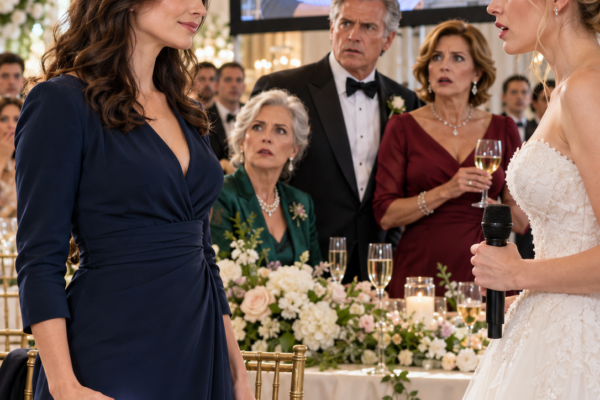
When i walked into the courtroom in my uniform, my mother looked away, my aunt said nothing, but the judge leaned forward and whispered, “is that really dr. merritt?” everyone in that room went still. my own family didn’t recognize who i’d become.
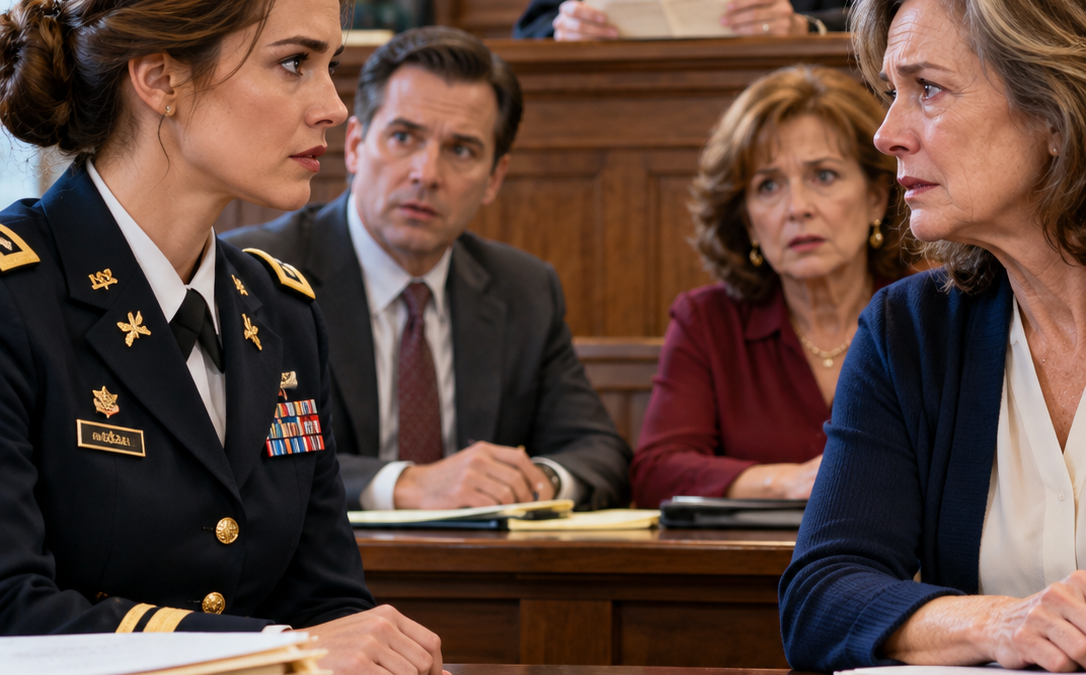
The fluorescent lights in that hallway buzzed the same way they always do in government buildings, steady and indifferent, as though the world had no interest in your heartbreak. I stood outside Courtroom 4B with a manila folder pressed against my chest and my Army dress uniform buttoned to the throat. My hands weren’t shaking. That surprised me.
Three hours earlier, my mother had texted me from the same house where I’d learned to ride a bike, where I’d stayed up late memorizing anatomy textbooks, and where I’d kissed my grandfather goodbye before reporting to Fort Sam Houston twenty years ago.
The message said, “Don’t you dare bring a lawyer into that courtroom. This is family business. You will embarrass us.”
I read it twice. Then I set my phone face down on the passenger seat and drove the rest of the way to Harlan County Courthouse in silence.
My name is Dr. Claire Merritt. I am forty-one years old. For eighteen years, I served as a United States Army combat physician. I did two tours in Iraq, one in Afghanistan, and a final assignment running a forward surgical unit in northern Syria. I came home with a bad shoulder, a medical retirement, and a certainty that the hardest battles I’d ever fight wouldn’t be fought on any map.
I was right about that.
The thing about walking into a courthouse in uniform is that people look at you differently. Not with hostility, and not with worship, either. Just a kind of recalibration, as though they’re mentally reorganizing the story they’ve already written about you. The security guard near the metal detector glanced at my rank insignia and said quietly, “Good morning, Colonel.”
I thanked him. He looked like he meant it.
I found a bench near the window and sat down. Outside, the October sky over eastern Kentucky was the color of old pewter. The dogwood trees lining the parking lot had gone rust-red overnight. I watched a woman help an elderly man up the courthouse steps, one slow stair at a time, and I thought about patience.
My grandmother used to say that patience wasn’t the same as passivity.
“Patience is a weapon,” she’d tell me while shelling butter beans on the back porch. “You aim it at the right moment and pull.”
She had been dead for three years. The argument I was about to walk into was, in one way or another, about her.
She’d owned a small cattle farm outside Harlan. Fourteen acres, a white clapboard farmhouse, a tobacco barn that hadn’t held tobacco since the nineties, and a creek that ran cold and clear all the way into November. She’d worked that land herself after my grandfather passed, well into her late seventies, until her knees gave out and she moved into the spare room at my aunt Dorene’s place.
Before she died, she’d had her will drawn up carefully by a man named Earl Whitfield, a local attorney who’d been doing estate work in Harlan County since before I was born. She left the farm to me. Not to my mother, not to my aunt Dorene, not split between the four of us. To me, specifically, deliberately, and with a handwritten note attached to the will that said, “Claire knows what the land is for.”
I didn’t fully understand what she meant when I first read it. I do now.
My mother called me the day after the will was read. I was still at my rental in Lexington, unpacking boxes from my last posting. She didn’t say hello.
“You need to come home and explain yourself.”
I asked what I’d done wrong. She said the whole family was upset, that Grandmother had clearly not been in her right mind, that Dorene had been the one taking care of her for the last three years and deserved something. She said I’d been gone most of my adult life and had no real claim to property I hadn’t set foot on in decades.
I listened. I let her finish. Then I said, “Grandma was sharp until the end. You know that.”
She went quiet for a second.
Then she said, “You always did think you were better than us.”
I’d heard that sentence so many times over the years that it no longer stung the way it once had. The first time she said it was the summer I left for West Point. I was seventeen. She stood in the driveway with her arms crossed and said the Army would ruin me, that I was throwing my life away on something that had nothing to do with our family, that people like us didn’t do things like that.
People like us.
I’d spent twenty years trying to figure out exactly what she meant.
I grew up in eastern Kentucky coal country, in a small town where the high school football team filled the stands on Friday nights and most conversations eventually turned to who was hiring, who had left, and who had the nerve to think they were too good to stay. My father had worked the mines until they closed. Then he drove a truck. Then he got sick. Then he was gone before I turned fourteen.
My mother raised my brother Dennis and me on nursing shifts and stubbornness. She was strong in the way that people who have had no other choice are strong. I respected that. I still do. But she had a way of measuring the distance between herself and the world and deciding that anyone who moved past a certain invisible line had betrayed her.
I crossed that line the day I accepted the scholarship. I crossed it again when I deployed. I crossed it every year I didn’t come home for Thanksgiving, every Christmas I spent overseas, every promotion I earned that she heard about secondhand because I’d stopped calling as often as I should have.
I’m not innocent in the estrangement. I know that you don’t keep a distance like that without two people doing their part.
There was one Christmas, my second year in Iraq, when I sat in a forward operating base outside Mosul with a satellite phone and a fifteen-minute window to make calls home. I dialed my mother’s number. It rang seven times before going to voicemail.
I left a message that I now can’t remember word for word. Something about being safe. Something about hoping she and Dennis were doing okay.
She never called back.
I told myself the signal was bad. I told myself she was probably working a double shift. I told myself a lot of things that winter that I no longer believe.
Dennis told me years later, offhand, the way he shared most difficult truths, that she had been home that evening. She’d seen my number on the screen. She’d sat there and let it ring because she was angry and didn’t know what to say, and figured silence was safer than the wrong words.
I understood that more than I wanted to.
What I didn’t tell Dennis, what I haven’t told anyone until now, is that I sat with that satellite phone for a long time after the call went to voicemail. I didn’t cry. I’d trained myself out of that by then, or thought I had. I just sat there in the cold with the phone in my hand and a plate of food going stiff beside me, thinking about the fact that I was twelve time zones from home and the distance felt like it had nothing to do with geography.
A young specialist named Torres noticed me sitting there and brought me a cup of coffee without saying anything. He just set it down and walked away.
That small, wordless kindness from a twenty-two-year-old kid from El Paso meant more to me that night than I ever told him.
He was killed four months later.
I think about him still.
Those are the things people don’t see when they look at a uniform. They see the rank, the ribbons, the polished buttons. They don’t see Torres. They don’t see the phone ringing seven times. They don’t see all the ordinary human longing that you learn to carry quietly because the mission doesn’t pause for it.
And neither does time.
But the last time I’d visited Grandmother, the autumn before she passed, she’d sat with me on the porch in the evening and asked me to tell her about Syria. I told her about the mountains, about how the light came through in long, flat planes late in the afternoon, about the kids who’d come to our outpost with injuries their parents couldn’t afford to treat.
She’d listened to every word without interrupting, which was something she’d always done. This woman, who’d never traveled farther than Cincinnati, understood instinctively that the world was large and that largeness deserved respect.
When I finished, she reached over and squeezed my hand.
“You went to do good,” she said. “Don’t let anyone tell you different.”
Three months after she died, I received a certified letter from a law firm in Harlan. My mother and my aunt Dorene were contesting the will on the grounds that our grandmother had lacked capacity at the time it was drafted. Their argument was that she had been in cognitive decline, influenced by medication, and that the estate should be distributed equally among her surviving children and their families.
I read the filing twice. Then I set it down, made a cup of coffee, and sat at my kitchen table for a long time.
I didn’t feel anger. Not at first. What I felt was something closer to grief, the particular grief of watching people you love reduce something sacred to a transaction.
Grandmother had not been in cognitive decline. She had been dying slowly and painfully, and with complete awareness of every day that remained to her. She had made her choices with full clarity.
I had the letter she’d written me to prove it.
Not the note attached to the will, but a longer one. Four handwritten pages that arrived in the mail two weeks before she died, in which she explained exactly why she was leaving the farm to me and exactly what she hoped I’d do with it.
She wanted it to become a place where veterans could come to recover.
She’d read about programs like that, rural retreat centers for people struggling after service, and she’d thought about me all those years away. All that weight I carried home. And she’d decided her fourteen acres could be useful.
She didn’t tell my mother because she knew what my mother would say.
She told me instead.
I sat with that letter for a long time before I decided what to do. I read it so many times the folds went soft. Her handwriting was unsteady in places, the pen pressing harder on certain words as though she wanted them to land with proper weight.
She wrote about my grandfather, who had come back from Korea quieter than he’d left and never quite found the right words for what he’d seen. She wrote about the men and women she’d watched on the news over the years, coming home to a country that thanked them and then forgot them, and how that incompleteness had bothered her for decades.
She wrote that she’d always believed land could hold something, that the right piece of ground could offer a kind of steadiness that no building in a city ever could. And she wrote that she believed I would know what to do with it because I had been both the one who left and the one who came back, and that made me the right kind of person for the job.
She ended the letter with a single line that I’ve read more times than I can count.
“The land remembers everyone who ever loved it. Make sure it has more people to remember.”
I didn’t hire a lawyer right away. I called Earl Whitfield, the man who’d drawn up the will, and he told me he’d testify to Grandmother’s state of mind if it came to a hearing. He said he’d seen the will drafted and signed, and that she’d been perfectly coherent, asking sharp questions about the legal language and making him read certain sections back to her twice to make sure they said exactly what she intended.
Then I called the Army judge advocate I’d worked with during my last posting. She walked me through the process, told me what documents to bring, and explained what to expect.
Then I called my mother.
She didn’t pick up.
I left a message. I said I understood she was hurting. I said I didn’t want this to become a legal fight. I said I was open to talking.
I said, “Call me back.”
She didn’t.
A week later, she sent the text about the lawyer.
That morning, sitting in that courthouse hallway with my folder and my uniform and the ghost of my grandmother’s voice in my head, I wasn’t thinking about winning. I was thinking about her, about the porch, about the way she’d said, “You went to do good,” without any qualification or asterisk attached.
I thought about the fourteen acres, the white clapboard house with the sagging front step, the creek, the barn, all the things she’d worked her whole life to keep, and all the things she’d imagined they could still become.
The door to Courtroom 4B opened, and the clerk called my name.
I stood. I straightened my jacket. I walked in.
My mother was already seated at the plaintiff’s table, with Dorene on her right and a young attorney on her left who had the slightly panicked look of someone who had expected a simpler morning.
She glanced up when I entered.
Her eyes went to the uniform first, then to my face. I watched something move across her expression. Not softness, not exactly, but a shift, like a drawer being opened and then quickly closed again.
Dorene looked at the floor.
The judge was a woman named the Honorable Patricia Baines, maybe sixty, with reading glasses on a beaded chain and a posture that said she had absolutely no tolerance for wasted time. She looked at me when I sat down, glanced at my rank insignia, and then looked back at her papers.
“Good morning,” she said to the room. “We’re here on the matter of the Evelyn Ruth Merritt estate, specifically a petition to contest the validity of the will on grounds of testamentary incapacity.”
She looked at the plaintiff’s table.
The young attorney stood. He presented the argument I’d already read in the filing. Grandmother had been on medication for pain management in her final months. She had sometimes confused names, repeated herself, and shown signs of confusion. He had a letter from Dorene describing three occasions when Grandmother had seemed disoriented.
He submitted it into evidence.
I listened to all of it without reacting. I’d sat through longer briefings in worse conditions. What struck me wasn’t the argument itself, which was thin, and I knew it. What struck me was how rehearsed it sounded, how the words had the hollow quality of something assembled rather than felt.
Dorene stared at the table the whole time the attorney spoke. My mother kept her eyes forward, jaw set, the same posture she’d held through every hard thing I’d ever watched her face.
I almost felt sorry for them.
Almost.
Then Judge Baines looked at me.
“You’re representing yourself?”
“Yes, Your Honor.”
A small pause.
“Go ahead.”
I opened my folder.
I had the will itself, notarized. I had Earl Whitfield’s written statement. I had Grandmother’s medical records from her last six months, obtained with the help of her primary care physician, who had noted clearly and repeatedly that her cognitive function remained intact even as her physical health declined.
I had the four-page letter she’d written me.
And I had a statement from the hospice nurse who had visited three times a week in the final month, a woman named Kora Bentley, who had written two paragraphs describing how Mrs. Merritt had spent one of their last visits explaining the legal details of her estate plan with complete lucidity.
I walked the judge through each document.
I spoke in the same tone I’d used in briefings, in operating rooms, in the field. Clear, measured, without performance.
When I got to the letter, I didn’t read it aloud. I just handed it forward and let the judge read it herself.
I watched Her Honor’s face as she did.
Something changed in it. A quiet settling. The expression of someone encountering something true after a morning of arguments.
Then I said, “My grandmother was not confused about what she owned or what she wanted to do with it. She was clear about that until the end. This contest was filed because her decision was unexpected, not because it was irrational.”
My mother made a small sound at the plaintiff’s table.
I didn’t look at her.
“She had a vision for that land,” I continued. “She wanted it to become a place that could help veterans in recovery. That was not a moment of confusion. That was a decision she made over a period of years, as evidenced by the date on the will and the correspondence with her attorney.”
I set my hands flat on the table.
“I intend to honor that vision.”
The courtroom was quiet.
Judge Baines looked at the documents for a long moment. Then she looked at my mother.
“Mrs. Merritt, do you have any direct evidence that your mother expressed a wish to distribute the property differently?”
My mother opened her mouth. Her attorney touched her arm gently, and she closed it again.
No written documentation. No recorded conversation.
“She said things,” my mother said. Her voice was smaller than I’d heard it in years. “She said things to me over the years. I just always assumed.”
“What she assumed,” I said quietly, “is different from what Grandmother chose.”
Judge Baines looked at me.
“Forgive me,” she said, studying my folder. “Colonel Merritt. You were in the Army?”
“Twenty-two years, Your Honor. Retired eighteen months ago.”
She nodded slowly.
“And the program you mentioned for veterans. Do you have a plan in place?”
I had not expected that question.
I reached into the back of my folder and pulled out a single sheet, a one-page summary I’d put together almost as a note to myself. Organizations I’d contacted, a nonprofit model I’d researched, the rough math of what it would take to get started.
I set it on the table.
“A preliminary one.”
She looked at it for longer than I expected.
When she set it down, her face was settled and unreadable. The face of someone who has made up their mind and is simply letting the paperwork catch up.
“The petition to contest is denied,” she said. “The will stands. The estate transfers to Dr. Claire Merritt as written.”
She looked over her glasses at the plaintiff’s table.
“Counsel, you may file for review at the appellate level if you wish, but I’ll note for the record that the evidence here is unambiguous.”
She closed her folder.
Then she paused and looked at me one more time.
“Dr. Merritt,” she said, her voice dropping just slightly. “My son came home from two tours in Fallujah and spent three years not knowing what to do with himself. A program like what you’re describing, that’s not just property. That’s a purpose.”
She straightened her papers.
“Don’t let it stay on one sheet.”
She stood. The bailiff called the room to rise.
That was it.
I sat for a moment after she left the bench. Not because I was stunned, but because I wanted to feel it properly. The quiet. The weight of something that had been pressing on me for months finally releasing.
My mother stood. She didn’t look at me. She gathered her purse and spoke in a low voice to Dorene, who was already moving toward the door. The young attorney began packing his briefcase with the quiet efficiency of someone hoping not to be spoken to.
I picked up my folder.
The walk out was long enough for me to notice the other people in the hallway. A young couple with a baby. An older man in overalls reading a pamphlet. The same security guard from that morning.
He met my eyes as I passed and nodded once.
I nodded back.
Outside, the morning had broken through. The pewter sky had shifted to something cleaner, pale blue with thin November light coming sideways through the trees. The dogwoods looked almost copper in it.
I sat on the stone steps and called Earl Whitfield.
“It’s done,” I told him.
He exhaled.
“Good,” he said. “Your grandmother would be satisfied.”
I thanked him and hung up.
I sat there for a while longer, not waiting for anything. I just wanted a moment that belonged only to me before the world started asking things of me again.
A pigeon landed on the step below mine, looked at me with one orange eye, and walked away, unbothered.
I almost laughed.
When I finally stood to walk to my car, I heard footsteps behind me.
My mother.
She stopped a few feet away.
Dorene wasn’t with her. She looked smaller outside than she had in the courtroom, or maybe just more real. She was wearing the navy-blue cardigan I’d given her years ago, the one she’d always said was too formal for everyday wear.
She wore it to court.
I didn’t speak first.
She looked at the uniform, then at my face.
“I didn’t know you were going to come dressed like that.”
“I almost didn’t,” I said honestly.
She turned her head slightly, looking out at the parking lot.
“Dorene’s already gone. She’s upset.”
I waited.
“I don’t think Grandmother was confused,” she said finally, in a voice so flat it had to be deliberate. The voice of someone forcing herself to say a thing she’d already decided.
“I just…” She stopped, then started again. “I thought she should have talked to us first.”
“Maybe she thought you’d try to talk her out of it.”
My mother looked at me.
“Would I have?”
“Yes,” I said.
She didn’t argue.
That alone told me something.
The wind moved through the dogwoods, scattering a few last leaves across the pavement. I watched them settle.
“She wrote about you in the letter,” I said. “Grandmother. She wrote that she was proud of you, too. That you’d worked harder than anyone she’d known. She said the farm wasn’t a judgment. It was just a calling.”
I paused.
“She wanted you to know that.”
My mother’s face did something complicated. She pressed her lips together and looked at the sky for a moment.
I didn’t try to fill the silence.
When she looked back at me, her eyes were wet but not spilling. That stubborn restraint she had, it was in me, too.
I recognized it.
“You really going to do it?” she asked. “The veteran program?”
“Yes.”
She was quiet for a moment.
“You’d need help. That farmhouse needs a lot of work.”
I looked at her.
“I know.”
She shifted her purse on her shoulder. A habit I’d watched my whole childhood. Something she did when she was deciding something.
“Dennis’s boy, Marcus. He’s a carpenter now. Doing good work. I could ask.”
I held her gaze.
“I’d appreciate that.”
She nodded once.
She turned to leave. Then she half turned back, the way people do when there’s one more thing they can’t quite carry home with them.
“The uniform,” she said. “You look like her. Your grandmother. Same set to your jaw.”
I said nothing.
I didn’t need to.
She walked away down the steps without looking back. I watched until she reached her car. She sat in it for a moment before starting the engine, and I wondered what she was doing in there, whether she was gathering herself or simply waiting for something to pass.
I knew that feeling well.
I’d sat in a lot of vehicles over the years doing exactly the same thing.
Then she drove away, and I stood there in the thin October sun until the sound of her engine faded into the ordinary noise of the street.
In the weeks that followed, the farm became a project. I drove down from Lexington on weekends and started with the basics: clearing out what had been left behind, making a list of what could stay and what needed to go, calling the county about utility connections, standing in the empty barn in the afternoon light, and trying to hear what it was still capable of becoming.
The barn was in better shape than the house. The bones were solid, the roof sound, the wide plank floor worn but unrotted. I stood in it one afternoon with the doors thrown open and the field visible beyond, the light coming in golden and long, and I could see it clearly for the first time, what it could be.
The house would need more work, but the barn was ready to be something.
That was enough to build from.
The first person who showed up to help without being asked was my brother Dennis. He pulled into the gravel drive on a Saturday in November with his truck bed full of cleaning supplies and said nothing about the court case, nothing about our mother, nothing about the months of silence between us.
He just climbed out, looked at the porch I was repainting, and said, “You need a second brush.”
I handed him one.
We worked side by side for most of the afternoon without talking much, the way people can when they’ve known each other long enough to be comfortable in the same quiet.
At some point, he said, “Mom told me what Grandmother wrote in the letter.”
“Did she?”
“Yeah.” He dipped the brush. “She read it out loud at dinner. Didn’t know I was coming by until after.”
I looked at him.
“How was that?”
He shrugged carefully and was quiet for a while.
“Then she said she thought you probably deserved the farm more than any of us.”
He paused.
“She didn’t say it like that, but that’s what she meant.”
I turned back to the porch boards. The paint was the same white Grandmother had always used. Every board I covered felt like a small restoration of something larger than the house itself.
“She’s not going to apologize,” I said. “Not in words.”
“Probably not,” Dennis agreed. “But she asked me to bring this.”
He reached into his jacket pocket and handed me a folded piece of paper. Inside was a list, Grandmother’s handwriting first, then my mother’s below it in blue ink. Additions. Names of local contractors. A number for the county historical preservation office. A note about a grant program the agricultural extension office ran for rural property restoration.
She’d done research.
I stared at that list for a long moment, at the careful loops of her handwriting, the way she’d underlined the contractor’s name twice, the note she’d added in the margin that said, “Good prices, honest man.”
It was such a small thing.
It was not a small thing at all.
“She said she didn’t know anything about veteran programs,” Dennis said, “but she knows everybody in Harlan County. If you need people, she can find them.”
I folded the list carefully and put it in my jacket pocket.
That evening, after Dennis left, I sat on the restored porch with a cup of coffee and watched the light go out of the sky. The creek ran somewhere below the tree line, steady and unhurried. The barn door swayed gently in the wind. A hawk made wide, slow circles above the eastern field.
I took out Grandmother’s compass. I’d found it in the nightstand drawer upstairs, right where she’d always kept it. Old brass, worn smooth along the edges. The kind of compass you can hold in your palm and feel the weight of.
The needle still moved true.
I turned it in my hand and thought about everything the land had already held. My grandmother’s whole adult life. Her grief, her labor, her stubbornness, her generosity. All the mornings she’d walked the fence line alone after my grandfather died. All the afternoons she’d sat on this same porch watching the same hawk circle.
And now it would hold something new.
I wasn’t naive about what lay ahead. Renovating a farmhouse, obtaining permits, building a program from scratch for veterans who needed the kind of care that doesn’t come in a clinic. All of it would be slow and hard and expensive and uncertain.
There would be setbacks. There always were.
I’d learned that the same way I’d learned everything else important, by going through it rather than around it.
What I had was this: fourteen acres of eastern Kentucky land that a woman had spent her whole life tending, a creek that ran clean, a barn with good bones, a compass that still pointed north, and a family that was, in its own halting and imperfect way, beginning to turn back toward me.
That was enough.
More than enough.
I’d built functional medical units in active conflict zones with considerably less.
I thought about the men and women I’d treated over the years. The ones who’d come to my surgical tent with wounds that were visible and the ones who’d come back stateside carrying wounds that weren’t.
I thought about the particular loneliness of being trained for extreme conditions and then asked to live an ordinary life. How the silence of a civilian morning could feel louder than any firefight.
I thought about what it might mean to offer those people something the land had always offered. Steadiness. Labor. The particular dignity of watching something grow under your hands.
Grandmother had understood that.
She’d watched my grandfather come home from Korea and work it out on this same ground, clearing brush and mending fences, slowly finding his way back to himself. She’d seen what the land could do for a person when a person was willing to let it.
She trusted me to build that deliberately, where he had found it by accident.
When I called my mother that night, she picked up on the second ring.
I’d expected voicemail. The surprise must have been audible because she said, with something almost like warmth, “I do answer occasionally.”
I thanked her for the list.
She said it was nothing.
We talked for eleven minutes, which was longer than we’d talked on the phone in the last five years combined.
She told me about the contractor she’d spoken to, a man named Roy, who’d renovated the high school gymnasium and had good prices. I told her about the creek, how it was still running clear, how I thought it could be part of what made the place feel restorative.
She said she’d always thought that creek was the best thing on the property.
Before we hung up, she said, “Your grandmother talked about you the last year of her life more than she talked about anyone else.”
I didn’t know what to say to that.
“She said you understood what things were for,” my mother continued. “Not just what they were worth. What they were for.”
I held the phone against my ear and looked out the window at the dark tree line.
“I’m starting to understand that, too,” she said. “Maybe too late.”
“It’s not too late,” I said.
She was quiet.
“It’s not too late,” I said again. “I have fourteen acres, and I’m going to need people who know this county.”
Another silence.
Then, very quietly, she said, “I’ll call Roy in the morning.”
After we hung up, I sat in Grandmother’s kitchen for a long time. The table was old wood, scratched and uneven in a way that felt lived in rather than worn out. The window above the sink looked out toward the barn. A single light was still on inside from when Dennis and I had worked late, spilling a warm yellow strip across the gravel.
I thought about the text my mother had sent that morning.
Don’t you dare bring a lawyer.
I thought about standing in that courthouse hallway in my uniform with a folder full of truth that was finally going to be spoken out loud. I thought about Grandmother writing four pages by hand when her fingers were swollen and her energy was thin.
I thought about the judge’s face when she read that letter and the quiet thing she’d said afterward. Not for the record. Just for me.
Don’t let it stay on one sheet.
I wasn’t going to.
Six months later, on a warm April Saturday, the farm looked like a different place.
The porch was repainted, the front step repaired, the yard cleared and seeded. The barn had been cleaned out and fitted with simple furniture: long tables, good chairs, a wood stove in the corner. The creek path had been cleared and lined with flat stones.
Marcus, my nephew, had done work that his great-grandmother would have approved of. Careful and unhurried, each nail driven straight.
That morning, the first small group arrived. Six veterans referred through a nonprofit I’d partnered with out of Lexington. Three men, three women, ages ranging from twenty-four to fifty-two.
Some of them had been home for years and were still figuring out where home actually was. Some had been back only months. All of them had the particular quality I recognized, that careful steadiness people develop when they’ve learned to carry things quietly.
I met them at the end of the gravel drive.
I wasn’t in uniform. I was in jeans and work boots, the same as everyone else.
I shook each hand and said the same thing.
“Welcome. There’s no program here yet. We’re building it together.”
One of them, a woman named Sergeant First Class Pauline Okafor, recently retired from the Army, looked out at the field and the barn and the tree line beyond.
“How much land is this?” she asked.
“Fourteen acres,” I said.
She nodded slowly, the way people nod when they’re computing something privately.
Then she said, “My grandmother had land like this in Nigeria.”
She paused.
“Land remembers.”
I thought of Grandmother’s letter.
The land remembers everyone who ever loved it.
“Mine said the same thing,” I told her.
We stood there for a moment, the two of us, looking at the same field in the same April light. Then she picked up her bag and walked toward the barn, and the others followed.
I watched them go with something I can only describe as the feeling of a long sentence finally finding its period.
My mother arrived at noon with a covered dish and Roy, the contractor, who had agreed to advise on a second phase of repairs at cost.
She set the dish on the porch table without ceremony, looked around at what the place had become, and said nothing for a long moment.
Then she said, “Your grandfather would have liked this.”
I stood beside her.
“I think Grandmother knew that.”
She smoothed the edge of the dish towel.
“I know she did.”
She looked at me sideways.
“She was usually right.”
It was the closest thing to an apology I was ever going to get.
I accepted it completely.
That evening, after everyone had gone, I sat on the porch with Grandmother’s compass in my hand.
The April dark came in soft and slow. The creek ran below the tree line. The barn light was still on.
I thought about Torres, who brought me coffee in the cold and never came home. I thought about all the names I carried that nobody else remembered to say. I thought about the phone ringing seven times in a house in Kentucky while I sat twelve time zones away eating cold food in the dark.
And I thought about how none of it was wasted.
Every hard thing had brought me to this porch, this field, this specific and unhurried quiet. Every distance had made the return mean something.
The needle on the compass pointed north, same as always.
I closed my hand around it and sat with the dark a little longer.
To anyone out there who has been called selfish for following a calling, who has been told that leaving was the same as abandoning, who has watched people they love mistake distance for indifference: Keep your documentation. Keep your compass. Keep going.
The courtroom doesn’t have to be a battlefield. Sometimes it just needs to be a place where the truth shows up in person, puts on something it earned, and speaks plainly.
And sometimes, if you’re patient enough, the people who couldn’t see you find their way to your porch on a Saturday afternoon with a covered dish and a contractor and something that isn’t quite an apology, but is somehow enough.
That’s what real honor looks like.
Not the moment you’re recognized.
The moment you’re finally home.
If this story found you when you needed it, share it with someone who needs it, too. And if you’ve ever served, or loved someone who did, and found that coming home was its own kind of mission, you’re not alone.
You never were.