At my sister’s wedding reception, the screen lit up: “infertile. divorced. failure. high school dropout. broke. alone.” the room erupted in laughter. my sister smirked: “don’t laugh too hard, she might actually cry!” mom swirled her wine. dad smiled: “just a joke, sweetheart.” i reached for my phone, then typed 1 word: “begin.” the room went dead silent.
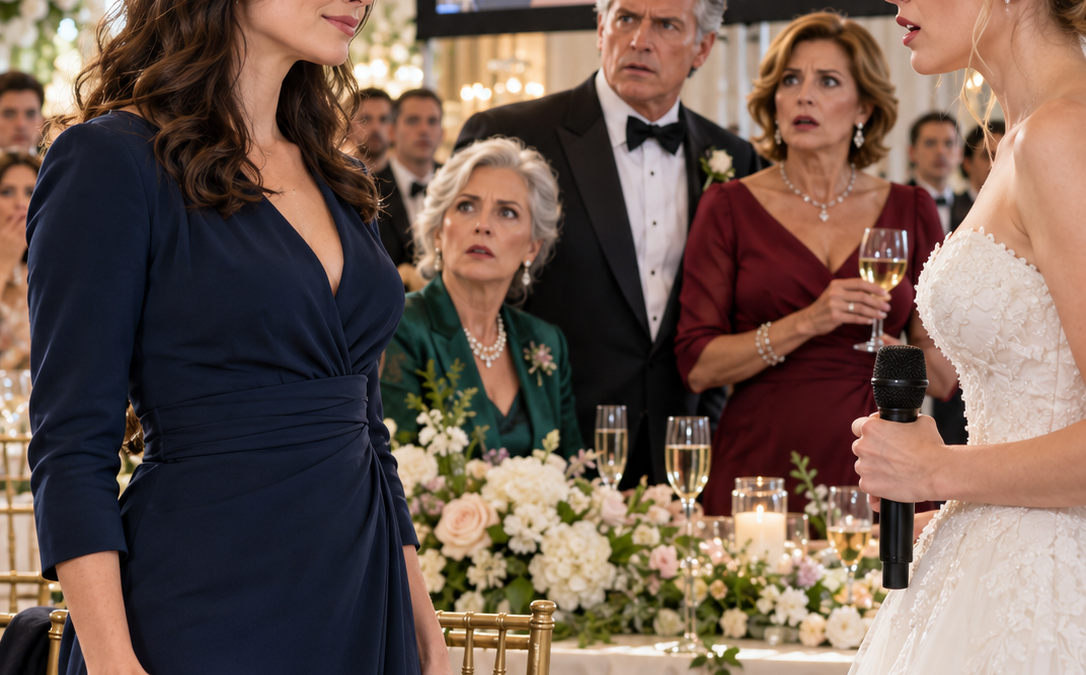
“Infertile. Divorced. Failure.”
The words glowed on a ten-foot screen at my sister’s wedding reception. Two hundred guests laughed.
My father smiled and said, “Just a joke, sweetheart.”
My mother swirled her wine as though she were watching dinner theater. And my sister, the bride, leaned into her microphone and said, “Don’t laugh too hard. She might actually cry.”
I didn’t cry.
I picked up my phone, typed one word—begin—and pressed send.
Three seconds later, the room went so silent you could hear the ice shifting in my mother’s glass.
What happened next didn’t just ruin a wedding reception. It dismantled sixteen years of lies and the family reputation that had been carefully built on top of them.
Before I go any further, I want to ask you to like and subscribe if this story genuinely connects with you. And leave a comment telling me where you’re watching from and what time it is there. I always find it remarkable how far a story can travel and how many people recognize pieces of their own lives in someone else’s.
My name is Olivia Lyndon. I’m thirty-four years old, and to understand what happened at that wedding, I need to take you back four weeks, to the Thursday afternoon when a phone call changed everything.
I was sitting at my desk in Richmond, working on elevation drawings for the renovation of a historic courthouse. My coffee had gone cold, my back ached, and I had been staring at the same set of architectural plans for hours. It was an ordinary Thursday, the kind that usually ended with takeout, a shower, and a few more hours of work at home.
Then my phone lit up.
Unknown number. Virginia area code, but not Richmond. Somewhere smaller. Somewhere I used to know.
I answered, and a woman asked, “Am I speaking with Olivia Lyndon?”
Her voice was careful and professional, the kind of voice people use when they have difficult information to deliver.
“My name is Lisa Rodriguez. I’m a nurse at Shenandoah Hills Care Center. Your grandmother asked me to call you.”
My hand tightened around the phone.
Grandma Ethel. Eighty-four years old. The only person in my family who had ever made me feel as though I truly belonged in it.
“Is she all right?”
“She’s stable,” Lisa said. “But she’s scheduled for hip replacement surgery in three weeks. At her age, there are risks, and she’s been asking for you.”
I closed my eyes.
It had been two years since I’d last seen my grandmother. I had slipped into the care facility on a Tuesday afternoon, deliberately choosing a time when I knew my father wouldn’t be there. We sat together for forty minutes. She held my hand, asked whether I was eating properly, and told me about the garden she used to tend before her knees and hips made it impossible.
For forty minutes, I got to be somebody’s granddaughter again.
Then a staff member mentioned my visit to my father’s office, and Richard Lyndon made sure the front desk received new instructions.
Olivia Lyndon was not on the approved visitor list.
Apparently, even at thirty-four, I needed my father’s permission to love my grandmother.
“There’s something else,” Lisa continued, lowering her voice. “Your father told Ethel that you can visit her, but only if you attend your sister’s wedding first. It’s in three weeks.”
Of course.
Everything with Richard Lyndon came with conditions. Nothing was freely given, not even access to an eighty-four-year-old woman who loved me.
“And Miss Lyndon,” Lisa added, “your grandmother wanted me to tell you one more thing.”
I waited.
“She said they’re planning something at the reception. Something about you. She wanted you to be ready.”
For a moment, I could only stare across my office. On the wall opposite my desk hung a framed certificate recognizing me as Virginia’s Emerging Architect of the Year. Below it sat a photograph of a courthouse restoration I had helped design, its stone columns standing beneath a clear blue sky.
Five years of silence from my hometown, and the first person to reach me wasn’t my mother or father. It was a nurse calling because my grandmother was frightened about what my family intended to do.
To explain why I knew her warning was serious, I have to go back sixteen years.
I was eighteen, sitting at the kitchen table in my parents’ house in Milbrook, Virginia, a town where everybody knew your last name, what your father was worth, and whether your family belonged to the country club.
My father, Richard Lyndon, slid a document across the polished wooden table.
It was a land transfer form.
The property was a two-acre parcel on the edge of town, a beautiful stretch of rolling grass with a narrow creek and one enormous old oak tree. Grandma Ethel had given it to me on my sixteenth birthday. She had signed it over legally, put the documents in my hands, and told me, “This is yours, Olivia. No matter what happens, this is yours.”
I had believed her. More importantly, she had meant it.
Now my father wanted it back.
“Sign it,” he said, tapping the paper with one finger. “I need this parcel for the Oakdale project.”
“Grandma gave it to me.”
“And I’m telling you to give it back.”
I looked toward my mother.
Vivian Lyndon sat at the far end of the table, flipping through a home decorating magazine. She didn’t look up, didn’t ask what the argument was about, and didn’t say a word in my defense.
The sound of turning pages filled the silence between my father and me.
I didn’t sign.
Three days later, Richard canceled my college tuition fund. The account he had supposedly been contributing to since I was born was emptied and redirected without warning. I found out when a letter arrived from the registrar’s office explaining that the expected payment had not been received.
A week after that, my father stood in the foyer with his arms crossed and pointed toward the front door.
“You walk out that door, you don’t come back.”
My little sister, Emily, was eleven years old. She stood at the top of the staircase in her pajamas, watching. She didn’t protest. She didn’t ask him to stop. She just watched as though she were studying something she might need to understand later.
I left with one duffel bag and forty-three dollars in my checking account.
That same night, Richard told the neighbors I had dropped out of school, run off with some boy, and broken my mother’s heart. None of it was true. But in Milbrook, my father’s version of events became the truth simply because he was Richard Lyndon.
He owned property. He employed people. He shook hands with council members and sponsored charity dinners. He knew how to make a lie sound respectable, especially when the person he was lying about wasn’t there to defend herself.
For the first two weeks after I left, I slept in my car.
I found work behind the counter of a gas station outside Charlottesville. The overnight shifts were long, and the fluorescent lights made everything look gray, even at sunrise. I learned which parking lots were safe enough to sleep in and which restrooms I could use to wash my face before another shift.
At nineteen, I earned my GED while waitressing double shifts at a diner that smelled permanently of bacon grease and bleach. My feet hurt so badly by closing time that I sometimes sat in my car for twenty minutes before I could make myself drive anywhere.
Eventually, I applied to community college. Later, I transferred to Virginia Commonwealth University on a need-based scholarship.
I studied architecture because I loved the idea of creating things that lasted. Buildings had foundations. Walls were designed to stand against pressure. A properly built structure couldn’t simply be taken away because someone woke up angry and decided you no longer deserved it.
I graduated at twenty-three.
Nobody came to the ceremony.
I wore my cap and gown, walked across the stage, and shook the dean’s hand while other graduates searched the audience for their families. Afterward, I went home to my studio apartment, sat on the floor, and ate takeout because I didn’t own a dining table.
I told myself it didn’t matter.
But I remember every empty seat I looked toward that afternoon.
At twenty-four, I married Charles Bennett, a man twelve years older than me whom I had met through my father’s old business network before Richard threw me out.
Charles was charming in public. He held doors, remembered birthdays, and knew exactly how to make a room full of strangers believe he was the most attentive husband alive.
In private, he managed my bank account, screened my phone calls, and told me which friends I was allowed to keep. He monitored where I went and made ordinary decisions feel like privileges I had to earn.
He was a smaller, quieter version of my father.
I had mistaken familiarity for safety.
At twenty-seven, I finally got out.
A year later, when I was twenty-eight, a doctor told me I couldn’t have children. It was a medical fact delivered in a clinic waiting room beneath harsh fluorescent lights, with a two-year-old magazine sitting beside me.
There was no dramatic confrontation. No family gathered around me. No comforting speech.
Just a diagnosis, a doctor’s careful explanation, and the long drive home afterward.
I processed it alone.
Somehow, Emily eventually found out. Charles had remained in contact with members of my family after the divorce, which didn’t surprise me. He had always liked having leverage over people, and private information had been one of his favorite tools.
By thirty-four, I was a senior architect at Mercer and Hollis in Richmond. I designed and supervised restorations of historic courthouses, libraries, theaters, and other buildings that deserved to survive another century.
Professionally, I worked under the name T. Mercer-Lyndon. I had kept the hyphenated name because people throughout the architecture world already recognized it.
I wasn’t hiding my life from my family to be dramatic. I had simply stopped performing for people who had already decided I was nothing.
Nobody back in Milbrook knew about my career, my projects, my awards, or the life I had spent sixteen years rebuilding.
And I preferred it that way.
The morning after Lisa’s call, I sat in my office with the door closed. Through the glass wall, I could see my colleague David Miller at his desk, wearing headphones and running cable-management simulations for a museum project.
David was thirty-six, a former Army IT specialist, and probably the most unflappable person I had ever met. He could troubleshoot a failed building system while everyone around him was panicking and still remember to ask whether anybody wanted coffee.
He was also the closest thing I had to family.
Before speaking to him, I called Lisa back.
“How serious is the surgical risk?” I asked.
“At eighty-four, with Ethel’s bone density, the surgeon says there’s a real chance of complications. She’s strong, Olivia, but she isn’t young anymore.”
I pressed my knuckles against my forehead.
Lisa hesitated before continuing.
“She cries your name some nights. She keeps your letters under her pillow.”
That almost broke me.
My grandmother was hiding my letters beneath her pillow like contraband because, in the Lyndon family, loving me was something a person had to do in secret.
I had two options. I could go to Emily’s wedding, endure whatever humiliation my parents and sister had prepared, and possibly see Grandma Ethel before surgery. Or I could stay in Richmond, protect the peace I had worked so hard to build, and risk never seeing her again.
I got up, crossed the office, and knocked gently on David’s glass wall.
He pulled off his headphones.
“I need a favor.”
He listened while I explained the wedding, the threatening slideshow warning, and my father’s ultimatum about the nursing home. He didn’t interrupt. When I finished, he leaned back in his chair and folded his arms.
“If you go,” he said, “you go with a plan. Not with hope.”
“I know.”
“And you’re going?”
“She’s eighty-four, David. She might not make it through surgery.”
He studied me for a moment, then nodded.
“Then we make sure you’re not walking in blind.”
That night, I booked a hotel room in Milbrook for the wedding weekend. I opened my closet and took out a navy-blue dress I had bought for myself. It was beautifully tailored, simple, professional, and elegant without trying to draw attention.
It was the kind of dress I felt comfortable wearing in a room where I was expected to belong.
David had told me to go with a plan, so I started making one.
And for the first time in sixteen years, I was grateful that my family underestimated me.
Three weeks before the wedding, Richard demanded that I attend a family dinner. It was his condition before he would authorize my name at the nursing home front desk.
I drove two hours from Richmond to Milbrook.
The house hadn’t changed.
White columns framed the porch. The lawn was manicured, the hedges trimmed into neat geometric shapes, and an American flag hung beside the front door. Everything about the property was designed to communicate respectability, right down to the last carefully planted flower bed.
Nobody hugged me when I arrived.
Vivian looked me over, her eyes traveling from my face to my waist.
“You look thin. Are you eating?”
I wasn’t thin. I ran three miles most mornings, ate well, and took care of myself. But this was how my mother operated.
Concern was a weapon wrapped in a question nobody expected you to answer honestly.
She could insult your appearance and still expect credit for being worried about you.
At dinner, Richard sat at the head of the table, in the same chair and posture I remembered from sixteen years earlier.
“So,” he said, lifting his fork, “what are you doing with yourself these days?”
“I work at a design firm.”
“Answering phones, I assume.”
I picked up my fork and let the comment pass.
He hadn’t asked because he wanted to know. He had asked because he wanted another opportunity to remind me of the position he believed I occupied in the world.
Emily arrived late, trailing expensive perfume and the familiar air of someone who had never been expected to apologize for making other people wait.
She flashed a four-carat engagement ring beneath the dining room lights, making sure everybody noticed.
After dinner, she pulled me aside in the hallway.
“I need you to wear something understated at the wedding,” she said. “William’s family is very particular.”
She tilted her head, studying me with a smile that didn’t quite reach her eyes.
“Still alone?”
I said nothing.
“No one special?” she pressed.
When I didn’t answer, she gave a small, satisfied smile.
“Some people just aren’t meant for that, I guess.”
Before I left, Vivian handed me a garment bag.
Inside was a pale beige dress, shapeless and two sizes too large. The fabric looked stiff, and the cut would have made almost anyone appear awkward.
“This will be perfect for you,” my mother said.
I looked at the dress, then at her, and understood exactly what she meant.
At the front door, Richard put a heavy hand on my shoulder.
“The Davenports are old money,” he said. “They judge people. One wrong move and this deal dies. Don’t embarrass us.”
I nodded, stepped outside, and got into my car.
I was halfway toward the highway when the name hit me.
Davenport.
I knew that name.
Not from Emily’s engagement ring or Richard’s business talk. I knew it from a project file sitting in my office in Richmond.
On Monday morning, I opened our client database.
Davenport Heritage Foundation.
There it was.
Mercer and Hollis had been contracted to manage the Milbrook Heritage Restoration Project, converting a Civil War-era textile mill into a community arts center. The Davenport Heritage Foundation was providing the funding.
The client contact was Katherine Davenport, chair of the foundation.
William Davenport’s mother.
I sat back and stared at the screen.
I had been the lead architect on the project for six months. Katherine and I had exchanged dozens of emails and participated in three video conferences. She knew my work, my design philosophy, and every significant milestone on our project timeline.
She knew the professional name T. Mercer-Lyndon.
But she had never met me in person. She had never connected the architect handling one of her foundation’s most important projects with the daughter Richard Lyndon had been describing as an embarrassment.
I sat with that discovery for a long time.
I didn’t intend to use it. I wasn’t Richard. I didn’t turn professional relationships into personal weapons.
Still, I filed the information away.
If everything fell apart in Milbrook, at least I knew I wasn’t entirely a stranger to the most influential family in the room.
That evening, David did some research of his own. He called me around nine.
“The reception is at Milbrook Country Club,” he said. “They hired a local AV company for the projector, slideshow, microphones, and sound system. Standard wedding setup.”
“Okay.”
“Here’s the interesting part. The company’s short-staffed. They just posted an opening for a freelance technician to help with the event.”
I sat forward.
“David—”
“I already applied. Got a callback in twenty minutes.”
“You don’t have to do this.”
“Olivia, you’re walking into a room where your family has already loaded a weapon. I’m just making sure you have access to the safety switch.”
By Wednesday, David was officially confirmed as a freelance AV technician for the Davenport-Lyndon wedding reception.
He would have access to the projection equipment, the USB inputs, and the soundboard. He knew how the system worked, and he knew exactly how quickly he could switch between presentations.
I began preparing a slideshow of my own.
Not an attack. Not a collection of cruel photographs or embarrassing stories.
Just the truth.
My graduation. My degrees. My architecture license. My work. My awards. The life I had built while my family was busy telling everyone I had failed.
The title slide read:
The Real Olivia Lyndon.
I saved the presentation on a USB drive and handed it to David that Thursday.
He turned the drive over in his palm before looking at me.
“You’re not going to war, Olivia,” he said. “You’re going to a wedding. But if they fire the first shot, you deserve to be ready to fire the last.”
One week before the ceremony, Richard finally cleared my name at Shenandoah Hills.
Thirty minutes of supervised visitation.
Vivian would accompany me.
Even that small concession had been presented as generosity, as though my father had granted me access to something he owned.
The care center smelled of hand sanitizer and boiled vegetables. The hallway was lined with framed photographs of gardens, family gatherings, and elderly couples smiling at the camera.
Vivian settled herself in a chair outside Grandma Ethel’s room and immediately began texting.
She didn’t come inside.
My grandmother looked smaller than I remembered. Her white hair had grown thinner, and her hands trembled when she reached toward me. But her eyes were exactly the same: sharp, knowing, and completely unwilling to be fooled by appearances.
She grabbed my hand the second I sat beside her bed.
“Let me look at you.”
I leaned closer.
She studied my face, then smiled.
“You’re healthy. You’re strong. I can tell.”
“I’m good, Grandma.”
Her fingers tightened around mine.
“Don’t let them break you again.”
I swallowed.
“You’re the strongest one in this family,” she continued. “You always were.”
Then she glanced toward the doorway, reached beneath her pillow, and pulled out a small envelope.
Lisa had helped her hide it. Apparently, Richard paid the facility to keep him informed about her visitors and anything unusual that happened.
Inside the envelope was a photocopy of a property deed.
The two-acre parcel.
My name was printed clearly on the document.
“That land is yours,” Ethel said. “It always was. Your father never got it transferred. He’s been furious about it ever since.”
I stared down at the paper.
For sixteen years, I had assumed Richard had found some legal way around my refusal to sign. A technicality, a court filing, perhaps even a forged signature. He had money, lawyers, and the kind of influence that made people hesitate before challenging him.
But he hadn’t done any of those things successfully.
The land was still mine.
“He tells people it’s part of Lyndon Properties,” Grandma whispered. “But it isn’t. He never had the right.”
I turned the photocopy over, then back again, trying to absorb what I was seeing.
My father had spent sixteen years telling the town I was a failure who had thrown away every opportunity offered to her. Meanwhile, he had been claiming ownership of property he had never legally acquired.
There was a knock at the door.
Vivian’s voice followed, clipped and impatient.
“Time’s up.”
I folded the envelope carefully and slipped it into my jacket pocket.
Then I leaned forward and kissed Grandma Ethel’s forehead.
“Thank you,” I whispered.
She smiled.
“That’s my girl.”
I walked past Vivian into the hallway. My mother didn’t ask how Ethel was feeling, whether she was frightened about surgery, or whether she needed anything.
She checked her lipstick in the reflection of her phone screen.
“Let’s go,” she said. “I have a fitting.”
I left Shenandoah Hills carrying two things: my grandmother’s blessing and proof that my father had been lying about far more than my reputation.
Six days before the wedding, David sat on the couch in my Richmond apartment with his laptop open.
We reviewed the presentation together.
The first slide showed me standing alone in my cap and gown at graduation. I was smiling into the camera, diploma in hand, even though there was nobody waiting to take me out for a celebratory dinner.
Beneath the photograph, I had written:
“No one came to my graduation. I went anyway.”
The second slide showed my architecture license, framed on my office wall.
“Licensed Architect, Commonwealth of Virginia.”
The third showed me on a construction site, wearing a hard hat and holding blueprints, with a restoration project rising behind me.
“Senior Architect, Mercer and Hollis.”
The fourth slide was a photograph of my award plaque.
“Virginia Emerging Architect of the Year.”
The fifth was nothing but white lettering against a black background.
“You called me a dropout. I have a master’s degree.
You called me broke. I own my home.
You called me a failure. I design buildings for a living.”
David scrolled through the slides twice, reading each one carefully.
“Clean,” he said. “Factual. No insults. Just the record.”
“That’s the point.”
I looked toward the screen.
“I don’t want to attack them, David. I just want the truth to be louder than their joke.”
He closed the laptop halfway.
“You sure you don’t want to include the part about your dad’s Oakdale problem?”
“The land?”
“Yeah. If he’s been claiming that parcel belongs to his company, that’s a pretty significant detail.”
“No.”
David waited.
“I’m not him,” I said. “I’m not going to turn everything I know into ammunition.”
He nodded, accepting that.
“Then what’s the trigger?”
I showed him my phone.
A text message was already drafted, addressed to him. It contained one word.
Begin.
“When I send this, you switch the projector from Emily’s slideshow to mine.”
David had already tested the system during an equipment setup at the venue. The transition would take about three seconds.
“And if their slideshow turns out to be harmless?” he asked.
“Then I never send it.”
He looked up.
“We leave,” I continued. “I visit Grandma Ethel, and we drive back to Richmond. That’s it.”
David was quiet for a moment.
“You know they won’t keep it harmless.”
“I know.”
“Then why wait?”
“Because I need to give them one last chance to be decent. When this is over, I want to be completely sure I didn’t fire first.”
Five days before the wedding, Richard called.
He didn’t say hello.
“Rules,” he announced. “You sit at table fourteen. Back corner. You don’t speak to the Davenports unless they speak to you first. You don’t mention your divorce, your condition, or anything about your personal life. If anyone asks what you do, you say you work reception at a small firm. Clear?”
I stood beside my kitchen counter, looking out at the Richmond street below.
“And after the wedding, I can see Grandma Ethel?”
“We’ll see.”
“That wasn’t our agreement.”
“Depends on your behavior.”
The line went dead.
I stood there for a moment with the phone still pressed to my ear. Even after all these years, Richard could hang up in the middle of a conversation and expect the other person to treat it like a final ruling.
That evening, my phone buzzed again.
Emily had added me to a family group chat with Richard and Vivian.
The first message contained a preview of the wedding slideshow.
I opened it and watched the images load.
The Lyndon Family.
Beautiful photographs of Emily growing up, family vacations, birthday celebrations, and smiling portraits of my parents.
Then a new title appeared.
“And Then There’s Olivia.”
Old photographs of me had been stretched, cropped, and filtered to look as unflattering as possible. Cartoon stickers had been placed over my face. Each photograph was followed by a bold, centered label.
High School Dropout.
Divorced.
Broke.
Alone.
Infertile.
I stared at the final word.
Emily typed beneath the preview.
“Oh my God, this is going to be hilarious! Don’t worry, Olivia. It’s all in good fun.”
Vivian responded a few moments later.
“Keep it tasteful, Emily.”
She didn’t say, “Take it down.”
She didn’t say, “This is wrong.”
She said, “Keep it tasteful.”
As though there were a tasteful way to broadcast your daughter’s private medical history to two hundred strangers.
Richard didn’t respond at all.
I took screenshots of every message and forwarded them to David without adding a word.
Then I opened my laptop.
My own presentation was still on the screen. Five clean, factual slides about a life my family knew nothing about.
I added a sixth.
White lettering against a black background.
“The measure of a family is not how they celebrate their best. It’s how they treat their most vulnerable.”
For a long time, I sat looking at the word infertile on my phone.
I remembered that clinic waiting room. The fluorescent lights. The doctor’s careful voice. The magazine beside me that had been published two years earlier. I remembered going home afterward and trying to understand how a future I had once imagined so easily could disappear in a single conversation.
Then I remembered my sister preparing to turn that private grief into entertainment.
I closed the group chat without responding.
There was nothing left to say to people who believed another person’s body was a punchline.
The wedding day arrived beneath a clear October sky.
Milbrook Community Church stood at the end of a quiet street, its white clapboard siding freshly painted and its steeple catching the morning sun. The parking lot was crowded with BMWs, Land Rovers, and polished luxury sedans. In a town like Milbrook, this was more than a wedding. It was the social event of the season, the kind people would discuss for months.
I wore my navy-blue dress.
The shapeless beige dress Vivian had chosen for me was still hanging in my hotel closet. I hadn’t given it a second thought.
Inside the church, nearly two hundred guests filled the pews. I recognized people from Milbrook’s business community, country club members, town council acquaintances, and families who had known my parents for decades.
In the front row sat the Davenports.
Katherine Davenport wore a deep green jacket. Her silver hair was pinned back neatly, and she held herself with the straight, composed posture of a former dancer. Her husband, John, sat beside her, looking distinguished and reserved.
I took a seat in the last pew.
Nobody greeted me. Nobody offered to move over or asked whether I wanted to sit with the family. It was as though I had been invited to fill a chair rather than to celebrate my sister’s marriage.
Richard worked the center aisle like a politician on the campaign trail, shaking hands, clapping shoulders, and accepting congratulations.
“So proud of my little girl,” I heard him tell a longtime business associate.
He didn’t mean me.
Vivian stood near the altar in a custom ivory dress, speaking quietly to a woman I remembered from her book club.
“Both my daughters are here today,” she said, lowering her voice just enough to make it sound confidential. “Even the difficult one.”
She laughed lightly.
Her friend glanced toward the back of the church.
I pretended not to notice.
Two rows ahead of me sat an elderly woman I didn’t immediately recognize. She had white hair, a floral dress, and reading glasses hanging from a chain around her neck. She turned once, looked in my direction, then returned her attention to the altar.
I thought nothing of it.
The ceremony began.
William Davenport stood at the altar looking genuinely happy. When he spoke his vows, there was a slight tremor in his voice that made the words feel sincere.
Emily spoke hers louder and longer. Much of what she said was about herself, the life she had dreamed of, and everything she believed this marriage represented.
Across the church, I spotted David near a side entrance. He wore a black polo shirt with the AV company’s logo and was adjusting a microphone cable.
Our eyes met for half a second.
He gave me the smallest nod.
Nobody else noticed.
My father continued smiling like a man who owned the town. My mother maintained the polished expression of a perfect hostess. And I sat in the last pew, feeling like a ghost they had deliberately invited back so they could remind everyone she existed.
The reception was held at Milbrook Country Club.
Crystal chandeliers hung above round tables draped in white linen. Tall arrangements of gardenias filled the room with an expensive, heavy fragrance. Behind the head table stood a projection screen approximately ten feet wide and six feet tall, positioned so every guest would have an unobstructed view.
I found my place card at table fourteen.
The back corner.
Right beside the kitchen door.
Every time a server passed through, a burst of clattering dishes, hurried footsteps, and shouted orders came from behind me. The sound made conversation difficult, but I suspected that had been the point.
My tablemates included distant cousins who clearly knew very little about me and an elderly couple who spent the entire appetizer course discussing a recent cruise.
A woman sitting across from me leaned forward.
“And what do you do, dear?”
“I’m an architect.”
“Oh, how nice.”
She turned to the man beside her and started talking about kitchen renovations.
That was the entire conversation.
It was strangely comforting to answer a simple question honestly without explaining myself or waiting for someone to contradict me.
Onstage, Emily took the microphone for the first toast.
She thanked our parents. She thanked the Davenports. She thanked her college friends, her wedding planner, and her florist. She laughed about the stress of planning the perfect wedding and described William as the man who had made all her dreams come true.
Then she looked toward the back of the room.
“And my sister Olivia, who, well, managed to show up today.”
She paused, waiting.
“That’s something, right?”
Scattered laughter followed.
It was the polite kind, the laughter people offer when they aren’t quite sure whether they’re supposed to find something funny but don’t want to appear uncomfortable.
At the head table, Richard clinked glasses with John Davenport.
They leaned toward each other, speaking quietly about numbers. Katherine sat nearby, listening with a measured expression. She held her wineglass close but hadn’t touched it.
I knew that look from client meetings.
She hadn’t committed to whatever Richard wanted. Not yet.
Vivian appeared at my elbow a few minutes later. I smelled her perfume before I saw her.
“Don’t drink too much,” she whispered. “Don’t talk about yourself. And for God’s sake, smile.”
I smiled.
Not because she told me to.
Because the slideshow was scheduled to begin in approximately twenty minutes, and I already knew exactly what it contained.
I sat there at table fourteen with a plate of food I could barely eat, surrounded by a family that wanted me present but invisible.
And before I tell you what happened, I want to ask something specific. Have you ever been seated at the back of a room, literally or figuratively, by people who were supposed to love you? Not the kind of exclusion you could openly question, but the kind everyone insisted was perfectly normal? Tell me in the comments, because what happened next, in front of that screen and those two hundred guests, is the reason I’m telling this story.
The lights dimmed.
Emily’s maid of honor stepped toward the microphone wearing a broad grin. She looked as though she had been rehearsing this moment for a week.
“And now,” she announced, “a special presentation from the Lyndon family.”
The screen flickered to life.
Soft piano music drifted through the speakers. The first images showed Emily as a baby, smiling with tiny pink bows in her hair. Then came her first ballet recital, school photographs, prom night, birthday celebrations, and family vacations.
There was a photograph of Emily fishing with Richard on a lake. Another showed her blowing out candles while Vivian stood behind her, smiling proudly.
Then came a family beach vacation.
Vivian wore a sun hat. Richard stood with his arm around Emily. The ocean stretched behind them, bright blue beneath a cloudless sky.
I wasn’t in a single photograph.
Not one.
Guests cooed appreciatively at the childhood pictures. Katherine Davenport smiled politely. John leaned over and patted William’s shoulder.
The slideshow moved on to photographs of Emily and William together.
At a vineyard. At a football game. At Christmas dinner with the Davenports. Standing beside a lake, wrapped in winter coats, laughing into the camera.
Each picture drew another round of gentle applause.
Then the music changed.
The soft piano gave way to a playful tune and an exaggerated drumroll.
Large letters appeared across the screen.
“And Now, Let’s Meet the Rest of the Family.”
Emily grinned from the head table.
Across the room, she caught my eye and wiggled her fingers in a little wave.
Vivian leaned back in her chair, wearing the satisfied expression of someone waiting for the main course.
My stomach dropped.
Not because I was frightened, but because I knew exactly what came next.
Beneath the table, my phone was already in my hand.
The message to David was ready.
Begin.
My thumb hovered over the send button.
I made myself one final promise.
If the next slide was harmless, if it was merely an old photograph with a gentle caption, if it contained even the smallest scrap of genuine affection, I wouldn’t press send.
I would take the joke, let them enjoy their wedding, and walk away.
I would visit Grandma Ethel and return to Richmond.
I would give them one last opportunity to show that there was something decent left beneath all that polished cruelty.
The screen changed.
My face filled the frame.
It was an old high school photograph, grainy and stretched until my features looked distorted. Across the bottom, in enormous white letters, were three words.
“High School Dropout.”
A bright green check mark appeared beside the caption.
Nervous laughter rippled through the room. Several guests turned their heads toward me.
I kept my expression still.
The next slide appeared.
A cartoon broken heart beside my name.
“Divorced.”
The laughter grew louder, feeding on itself now that people had begun to understand the presentation was supposed to be a roast.
Next came an animated drawing of an empty wallet flapping open.
“Broke.”
Someone at table six snorted into a glass of champagne.
The next slide showed a single place setting. One chair, one plate, one empty table.
“Alone.”
Emily was laughing openly at the head table.
Vivian took a delicate sip of wine, watching the audience as though she were judging the quality of the performance.
Then the final slide loaded.
A clip-art baby appeared on the screen.
A large red X was stamped across it.
And underneath, in enormous white letters, was one word.
“Infertile.”
For one suspended moment, the room went quiet.
It was the shocked kind of silence, the kind that happens when people suddenly understand they’ve been laughing at something they never should have found amusing.
Then a few more laughs broke through.
Uncomfortable laughter, scattered and uncertain, but enough to make the humiliation feel complete.
Emily leaned toward the microphone.
“Don’t laugh too hard. She might actually cry.”
Vivian swirled her wine.
There was a half smile on her face, and her eyes were fixed on me.
Richard caught my gaze from the head table.
“Just a joke, sweetheart,” he called. “Lighten up.”
I looked toward Katherine Davenport.
She wasn’t laughing.
She set her wineglass down with a quiet click. Her jaw tightened as she looked from Richard to the screen and then toward me.
I could feel the blood rushing into my face.
My hands were shaking.
My vision narrowed until all I could see was that single word projected above the wedding guests.
Infertile.
My medical history. My private grief. Something I had been forced to process alone in a clinic waiting room, now displayed for two hundred strangers to laugh at.
That was the line.
They hadn’t merely crossed it. They had broadcast it across a ten-foot screen.
I looked around the room.
Some guests were laughing. Others stared down at their plates. A few pretended to check their phones because they no longer knew where to put their eyes.
Emily was beaming.
This was her favorite part of her own wedding.
Not the vows. Not the first dance. Not the moment she and William had promised to build a life together.
This.
Watching me sit in the wreckage of my own humiliation.
Vivian raised her glass slightly, almost like a silent toast to her success.
Richard had already turned back toward John Davenport, resuming their conversation as though nothing important had happened, as though turning his eldest daughter’s infertility into a public joke were no more significant than telling an amusing story at dinner.
I looked down at my phone.
The message was still there.
Begin.
I thought about Grandma Ethel.
Her trembling hands. The envelope she had pressed into my palm. The way she had looked directly into my eyes and said, “Don’t let them break you again.”
I wasn’t going to break.
My thumb pressed send.
Three seconds passed.
The slideshow froze.
The screen went black.
Emily frowned.
“Um, technical issues,” she said into the microphone.
She waved impatiently toward the back of the room.
“Can somebody fix that?”
Behind the AV booth, David disconnected Emily’s USB drive from the projection system and inserted mine.
His hands were steady.
He had handled much more complicated things under far worse pressure.
The screen lit up again.
White lettering appeared against a dark background.
Simple. Clean. Unmistakable.
“The Real Olivia Lyndon.”
The room went silent.
Not the polite kind of silence that follows an awkward joke.
This was the kind where every conversation stopped at once and every head turned toward the screen.
Richard stood abruptly.
“What is this?”
He looked toward the AV booth.
“Turn it off!”
David didn’t move.
The system controls had been locked, and the only way to shut the projector down immediately was to disconnect its power in a utility closet. David had secured that room twenty minutes earlier.
For the first time in sixteen years, my father couldn’t silence me.
The first slide appeared.
A photograph of me in my cap and gown, standing alone in front of the university seal with my diploma in my hand.
Beneath it were the words:
“No one came to my graduation. I went anyway.”
The first murmurs moved through the room.
A woman at table three put her hand over her mouth.
The next slide appeared.
My architecture license, framed and mounted on the wall of my office.
“Licensed Architect, Commonwealth of Virginia.”
The murmurs grew louder.
Then came a photograph of me at a construction site. I wore a hard hat and steel-toed boots, with rolled blueprints tucked beneath my arm. Behind me stood the exposed framework of a historic courthouse being restored.
“Senior Architect, Mercer and Hollis.”
A man near the front turned in his chair to look at me.
Then another.
Then an entire table.
The next slide showed my award plaque.
“Virginia Emerging Architect of the Year.”
Katherine Davenport’s hand stopped halfway toward her glass.
Her expression changed.
Finally, the fifth slide appeared.
White text against black.
“You called me a dropout. I have a master’s degree.
You called me broke. I own my home.
You called me a failure. I design buildings for a living.”
I stood up from table fourteen.
I didn’t walk toward the stage or grab a microphone. I simply rose from my chair in the back corner beside the kitchen door and looked toward the front of the room.
Richard’s face had turned a shade I had never seen before.
Somewhere between fury and fear.
“This is ridiculous!” he snapped. “She probably faked all of this.”
Emily’s smile disappeared.
“Turn it off!” she shouted. “This is my wedding!”
Vivian sat motionless, her wineglass suspended in midair. All the color seemed to have drained from her face.
Then the final slide appeared.
The one I had added after reading the family group chat.
“The measure of a family is not how they celebrate their best. It’s how they treat their most vulnerable.”
I said nothing.
I didn’t need to.
For once, the truth was speaking loudly enough on its own.
Richard moved quickly.
He stepped out from behind the head table with both hands raised, his familiar public smile already sliding back into place.
It was the smile he used at town council meetings, charity fundraisers, and Rotary dinners. The smile that told people he was reasonable, successful, generous, and completely in control.
“Folks, I apologize for the interruption,” he announced. “My older daughter has always had a flair for drama.”
He chuckled.
Nobody joined him.
“This is clearly a misunderstanding.”
He began walking toward me.
The crowd parted slightly, the way people instinctively move aside when they sense a collision approaching.
His polished shoes clicked against the hardwood floor.
When he reached table fourteen, he leaned close enough that I could smell the expensive cologne he had worn for as long as I could remember.
His voice dropped, but not far enough.
People at the nearby tables could hear him.
“Sit down right now, or you will never see your grandmother again.”
I looked at him.
My father.
Sixty-two years old. Builder of houses. Destroyer of daughters.
For sixteen years, he had treated my love for Grandma Ethel as something he could threaten, ration, and withhold.
I answered in the same quiet voice.
“You’ve used Grandma Ethel as a leash my whole life. That ends tonight.”
His jaw clenched.
“I will call security.”
Before he could turn away, a chair scraped backward at the head table.
William Davenport stood up.
His face was tight, his expression no longer carrying any trace of the happiness I had seen at the altar.
“Wait.”
He looked at Richard, then at me.
“Let her speak.”
Emily grabbed his arm.
“William!”
He pulled free.
“Something isn’t right here, Emily. I want to hear this.”
I felt the room change.
It was subtle but unmistakable, like the instant a crowd realizes that the person expected to remain silent may actually have something worth saying.
Vivian rose from her seat.
For the first time that evening, there was a crack in her voice.
“Olivia, please. You’re humiliating yourself.”
I looked at my mother.
The woman who had flipped magazine pages while my father destroyed my education. The woman who had handed me a shapeless dress and expected me to disappear into the background. The woman who had watched my private pain displayed on a screen and called it tasteful.
“No, Mother,” I said. “For the first time, I’m not.”
At the head table, Katherine Davenport hadn’t moved from her chair, but her eyes were fixed on the screen.
More specifically, they were fixed on the words Mercer and Hollis.
Something in her expression shifted as she began putting the pieces together.
I stepped away from table fourteen.
I didn’t hurry.
I didn’t raise my voice.
I walked between the round tables and flickering candles until I reached the center of the room, where everyone could see me.
Two hundred faces turned in my direction.
The champagne sat forgotten in people’s glasses.
The music had stopped.
“I didn’t drop out,” I began.
My voice was steady, almost conversational, the same voice I used when explaining a project timeline to clients during a Monday morning meeting.
“My father pulled my college tuition when I was seventeen because I wouldn’t sign over land my grandmother had given me.”
Richard opened his mouth.
I continued before he could interrupt.
“I didn’t choose to leave my family. I was told to walk out and never come back. I was eighteen years old with one duffel bag and forty-three dollars in my checking account.”
Katherine’s hand tightened around her wineglass.
“My divorce?” I went on. “I married a man who came from my father’s business circle. He was controlling. I got out. That isn’t failure. That’s survival.”
At table five, a woman brought her napkin to her face. Her husband put an arm around her shoulders.
I turned toward Emily.
“And infertility?”
My sister’s smile had vanished completely.
“That’s a medical condition, not a punchline. And you put it on a screen for two hundred people to laugh at during your own wedding.”
Emily’s lower lip began to tremble.
She opened her mouth, but nothing came out.
I looked toward Vivian.
“You helped design those slides. You also gave me a dress meant to make me invisible.”
Then I turned toward Richard.
“And you told me to sit in the back, stay quiet, lie about my career, and do absolutely nothing that might embarrass you.”
I let the silence stretch.
“The only embarrassment in this room is what you just did to your own daughter.”
Nobody spoke.
A server stood motionless in the kitchen doorway, holding a tray of desserts. The candles flickered beneath the chandeliers, and somewhere near the back of the room, a piece of silverware struck a plate.
Then I heard a chair push backward.
Slowly. Deliberately.
Katherine Davenport stood.
She moved through the room with the calm certainty of someone who had never needed to demand attention because people were already accustomed to giving it to her.
In a way, she owned the room. Half the people in attendance had benefited from a grant, a charitable contribution, a professional introduction, or a board appointment connected to the Davenport Heritage Foundation.
She stopped approximately three feet in front of me.
Her eyes moved from my face to the screen behind us, where my professional credentials were still visible.
“T. Mercer-Lyndon?”
She said the name carefully, as though confirming something she had already suspected.
“You’re the architect on the Milbrook Heritage Project.”
“Yes, ma’am.”
For a moment, she looked at me without speaking.
Then she turned toward Richard, slowly enough that everyone could follow the direction of her gaze.
“Mr. Lyndon.”
Her voice was steady, precise, and completely controlled.
“The woman you just humiliated in front of my family is the architect I hired to restore one of the most important historic buildings in this town.”
I watched the color drain from Richard’s face.
The confident flush disappeared, replaced by a gray, exposed look that made him seem suddenly older.
“I… I didn’t know.”
Katherine didn’t hesitate.
“You didn’t know because you didn’t bother to know your own daughter.”
A ripple of whispers moved through the room.
Heads turned. People leaned toward one another. Someone at table eight pulled out a phone.
Emily jumped up from the head table.
“Babe, this is insane!” she cried. “She’s making all of this up!”
She reached for William’s hand.
He stepped backward.
His hand remained at his side.
Vivian tried next.
She approached Katherine with her hostess smile restored to full strength.
“Katherine, please. This is a family matter.”
Katherine didn’t break eye contact with Richard.
“You made it a public matter, Mrs. Lyndon, when you put it on a ten-foot screen.”
It felt as though the entire room exhaled at once.
Two hundred people silently recalculating everything they thought they knew.
Nobody was looking at the bride anymore.
Richard tried to recover.
He had spent sixty-two years learning how to recover from uncomfortable moments. He knew how to rebuild a smile, adjust a handshake, and redirect a conversation until the original problem seemed to have been somebody else’s misunderstanding.
“Katherine,” he began, in his warmest country club voice, “let’s not overreact. It was a silly joke. You know how families are.”
Katherine looked at him evenly.
“I know how my family is. We don’t put our children’s private medical information on a screen for entertainment.”
Then she turned toward William.
“Son, I think we need to have a conversation privately tonight.”
William nodded.
He had been watching Emily ever since the slideshow changed, and the expression on his face wasn’t anger.
It was something worse.
He was reconsidering the person he had married.
“You told me Olivia was unstable,” he said to Emily. “You said she had issues. That she was jealous of you.”
Emily’s voice cracked.
“She is jealous!”
William stared at her.
“She’s a licensed architect with awards, Emily. And you put the word infertile on a screen at our wedding.”
Richard stepped toward Katherine, lowering his voice to the register he probably used when negotiating multimillion-dollar contracts.
“Let’s talk about the Oakdale partnership. This has nothing to do with—”
Katherine raised one hand.
That was all it took.
“The Oakdale partnership,” she repeated.
There was something almost unpleasant in the way she spoke the name, as though it had suddenly acquired a meaning she didn’t care to associate with.
“Richard, after what I just witnessed, there is no Oakdale partnership.”
His mouth opened.
Nothing came out.
The hand he had raised halfway toward her slowly dropped to his side.
Vivian made a sharp, strangled sound that might have been a sob.
“This can’t be happening.”
She said it to no one in particular, staring down at the tablecloth as though an answer might be written there.
I remained in the center of the room.
I didn’t smile.
I didn’t nod or celebrate.
I simply stood there.
For the first time in my life, standing was enough.
Richard had just lost the Oakdale deal. Emily had lost control of her own reception. And my mother was crying.
Not for me.
Never for me.
For the image.
For the carefully arranged portrait of a respectable family that had just been torn apart in front of everyone who mattered to her.
And there I was, standing beneath the chandeliers, with nobody telling me to sit down.
So I want to ask you something. If this had been your family, would you have pressed begin, or would you have walked away? Leave a one in the comments for begin, or a two for walking away, because what happened after that confrontation was something I hadn’t planned for at all.
Emily was a fast learner.
She had grown up watching Vivian pivot from cruelty to composure in less than five seconds. My mother had mastered the art of becoming the wounded party whenever her own behavior threatened to expose her.
Now Emily used the same tactic.
Her face crumpled.
Not gradually.
All at once, as though someone had flipped a switch.
Tears spilled down her cheeks. She hurried into the center of the room with both hands pressed dramatically against her chest.
“This is my day!” she cried.
Her voice broke at exactly the right moment.
“She always does this! She’s always been jealous of me!”
She turned toward the guests, mascara beginning to streak down her face.
“I invited her because I wanted her here. The slideshow was supposed to be funny! She’s twisting everything!”
A few guests shifted uncomfortably.
I recognized the hesitation.
That tiny moment of uncertainty when people begin wondering whether the person crying the loudest might actually be the victim.
Emily turned toward William.
“You’re choosing her on our wedding day?”
Vivian hurried to Emily’s side and wrapped an arm around her shoulders.
“My baby,” she sobbed. “They’re attacking my baby.”
She looked toward Katherine with wet eyes.
“Can’t you see what’s happening?”
For one brief second, I felt the atmosphere begin to tilt back toward them.
Tears were powerful.
A bride crying at her own wedding was powerful.
I saw uncertainty flicker across several faces.
Then Katherine spoke.
She didn’t raise her voice.
She simply took out her phone, glanced at it, and looked toward the screen still glowing behind us.
“Funny,” she said.
She read the labels aloud, one by one.
“Infertile. Failure. Alone.”
Then she looked directly at Emily.
“Which part was the joke, dear?”
The uncertainty vanished.
The room settled again, like a jury that had briefly considered an alternative verdict and rejected it.
Emily was still crying, but her tears had lost their power.
“She’s ruining my wedding,” she whispered.
I didn’t shout. I didn’t match her volume.
“I didn’t make that slideshow, Emily. You did.”
Katherine wasn’t finished.
She turned back toward Richard, her voice carrying the flat precision of a woman accustomed to managing large charitable investments.
“The Oakdale project. You told us the land was fully consolidated under Lyndon Properties.”
Richard stiffened.
“It is.”
“Every parcel accounted for?”
“Yes.”
I hadn’t planned what happened next.
I hadn’t rehearsed it with David or added anything about the Oakdale property to my presentation.
But when Katherine said the words fully consolidated, something clicked into place.
The envelope.
The deed Grandma Ethel had pressed into my hand.
The proof that Richard had never acquired the property he claimed was his.
“Actually,” I said, “it isn’t.”
The room turned toward me.
I reached into my jacket pocket and pulled out the folded photocopy.
“The center parcel. The two acres my grandmother gave me when I was sixteen. It’s still in my name. I have the deed right here.”
Richard’s face went rigid.
Not the public rigidity of a man forcing himself to remain composed, but the private kind I remembered from the kitchen table sixteen years earlier, when I refused to sign his transfer form.
Katherine looked at the paper.
Then at Richard.
“You were planning to build on land that belongs to your estranged daughter without her consent? Without telling us?”
Richard’s voice came out tight.
“She was supposed to sign it over years ago.”
“I was eighteen,” I said. “You tried to force me. I said no, and you threw me out.”
I folded the deed carefully and returned it to my pocket.
“And you’ve been telling people the land was yours ever since.”
John Davenport stood for the first time.
He buttoned his jacket, a small, deliberate motion that somehow communicated more than a speech could have.
Katherine met Richard’s eyes one final time.
“Mr. Lyndon, I think we’re done here.”
Richard turned toward me.
His voice dropped into something raw and small.
“You ungrateful—”
William stepped forward.
“Enough.”
His voice was sharp and final.
“That’s enough, Mr. Lyndon.”
Something inside Vivian seemed to fracture.
She had spent nearly forty years maintaining the smile, the posture, and the flawless hostess persona that convinced people the Lyndons were a family worth admiring.
But now the Davenports were preparing to walk away.
The deal was dead.
And the room was looking at her family in exactly the way she had spent her life trying to prevent.
She turned on me.
The polish disappeared completely.
“You think you’re better than us now?” she demanded, her voice shaking. “You think your little slides change anything? You were nothing! You had nothing when you left this house!”
I looked at her.
“You’re right. I had nothing because you made sure of that.”
“I did what was best for this family!”
“You did what was best for the image. There’s a difference.”
Vivian turned toward the guests, searching for an ally.
Her eyes landed on familiar faces. Country club friends. Book club members. Women she had lunch with for twenty years.
She tried the social smile again.
“This is so embarrassing,” she said with a little laugh. “Family drama. You know how it is.”
Nobody smiled back.
Then a voice rose from the back of the room.
It belonged to the elderly woman I had noticed at the church, the one wearing reading glasses on a chain.
She stood slowly, gripping the edge of her table for balance.
“I’ve known Ethel Lyndon for fifty years.”
Her voice was thin but carried clearly through the silent room.
“She would be ashamed of what you three did tonight.”
She picked up her clutch purse and began walking toward the exit.
Her heels clicked against the floor.
Measured. Unhurried. Final.
A moment later, another couple stood.
Then a man from table nine.
Nobody made a speech.
Nobody demanded an explanation.
They simply left.
Vivian sank into the nearest chair.
Her hand found her wineglass, but she didn’t lift it.
For the first time that evening, she looked exactly her age, perhaps older.
The room was beginning to empty, and nobody was pretending it had all been a harmless joke anymore.
The reception hall looked different now.
Empty chairs were scattered among the remaining guests. Half-finished plates sat untouched on the tables, and the gardenias were beginning to wilt beneath the heat of the chandeliers.
Emily sat alone at the head table.
William stood near the side door with his mother. Richard remained in the middle of the room, his arms hanging at his sides, staring at the floor.
I looked at what was left.
My family.
This room.
Sixteen years of silence ending between dessert plates and half-empty champagne flutes.
I didn’t go to the microphone. I didn’t need to. In a room that quiet, my voice carried perfectly well.
“I didn’t come here to ruin your wedding, Emily.”
My sister slowly raised her eyes.
“I came because Grandma Ethel asked me to. Because even after everything, she still believes this family can be better.”
Emily lowered her head again.
“I don’t hate any of you,” I continued, looking from my sister to Vivian and then to Richard. “But I’m done being your punchline. I’m done trying to earn the right to exist in this family.”
Richard finally looked up.
His eyes were red.
I had never seen that before.
“If you want me in your lives, it starts with respect. Not conditions. Not performances. Respect.”
Nobody answered.
I returned to table fourteen and picked up my clutch. I straightened my navy-blue dress, the one I had bought for myself, the one my mother hadn’t chosen.
“And if you can’t do that,” I said, “then this is goodbye.”
I walked toward the exit.
Past Richard, who didn’t look up.
Past Vivian, who was staring at the tablecloth.
Past Emily, who turned her face away as I approached.
I had nearly reached the door when a voice stopped me.
“Miss Lyndon.”
I turned.
Katherine Davenport stood near the coat check. She had already put on her green jacket, and her car keys were in her hand.
“Monday morning,” she said. “My office. We have a project to finish.”
For a moment, I simply looked at her.
Then I nodded.
She nodded back.
And I walked out into the October night.
The parking lot was half-empty. Most of the people who had left early were already gone, their expensive cars replaced by stretches of dark pavement beneath the overhead lights.
I sat in my car without starting the engine.
My hands rested on the steering wheel as I stared at the country club entrance.
I had imagined that leaving would feel victorious. That I would walk away with my head high, feeling as though I had finally won something.
Instead, I felt exhausted.
Sixteen years of swallowing words, avoiding confrontations, and pretending I didn’t care had ended in one evening. The adrenaline was leaving my body, and beneath it was an ache I couldn’t quite name.
There was a soft tap on the passenger window.
David stood outside, still wearing his AV company polo shirt. He held two paper cups of gas station coffee.
I unlocked the door.
He slid into the passenger seat and handed me one.
“You okay?”
I looked down at the coffee.
“No.”
David didn’t say anything.
I wrapped both hands around the warm cup.
“But I’m better than I’ve been in years.”
He leaned back in his seat.
We sat in silence for a while.
Through the windshield, I could see people trickling out of the country club. Couples walked quickly toward their cars. One man loosened his tie as he crossed the parking lot. A woman stood beside a silver sedan, speaking urgently into her phone.
Nobody was laughing.
My phone buzzed.
A message from William.
“I’m sorry for what my wife’s family did. Emily and I need to talk. I don’t know where this goes.”
I read it twice.
Then another message arrived.
Lisa.
“Your grandmother saw everything. Someone’s niece was livestreaming the reception to a family group chat. Ethel watched the whole thing. She’s laughing. She keeps saying, ‘That’s my girl.’”
I closed my eyes.
I could picture her in that nursing home bed, watching her granddaughter stand up in a room full of people who had tried to make her invisible.
Laughing.
Proud.
The thought warmed something inside me that no amount of public vindication ever could.
Another message appeared.
This one was from Katherine Davenport.
“I’ve informed my team about the Oakdale land situation. Richard will not be building on your property. We’ll find another partner for future development.”
I stared at the words.
For sixteen years, I had believed my father could take anything he wanted as long as he applied enough pressure. Now a woman whose professional judgment he respected had told him he wouldn’t be touching the land Grandma Ethel had given me.
I typed a short reply to Katherine.
“Thank you.”
Then I answered Lisa.
“Tell Grandma I love her.”
To William, I wrote, “I’m sorry, too. For all of it.”
I didn’t respond to Richard, Vivian, or Emily.
There was nothing I could say that hadn’t already been said in that room.
David glanced toward me.
“Where to?”
“The hotel. Then home tomorrow.”
He started the car and pulled out of the parking lot.
In the rearview mirror, the country club grew smaller until its lights disappeared behind the trees.
Milbrook was a small town, and small towns did what they did best.
They talked.
During the week after the wedding, the town began rearranging itself around what had happened.
I heard most of it secondhand from Lisa and David. David, it turned out, had a remarkable talent for monitoring small-town Facebook groups without getting drawn into their endless arguments.
Vivian was removed from the Milbrook Autumn Gala Planning Committee.
There was no formal announcement, no public explanation, and certainly no dramatic confrontation. Just a quiet email from Katherine Davenport’s assistant.
“We’re restructuring the committee this year. Thank you for your past contributions.”
For a woman who had spent decades measuring her worth through social invitations and committee appointments, that message must have hurt more than she would ever admit.
Vivian called three board members.
None of them answered.
Richard lost two business partners within the first ten days.
A property developer in Staunton withdrew from a joint venture, citing concerns about alignment and future business priorities. A local contractor who had worked with Lyndon Properties for fifteen years sent a polite letter explaining that he would be pursuing other opportunities.
Lyndon Properties didn’t collapse.
Richard was too established, too connected, and too deeply embedded in the local economy for that.
But the cracks were visible.
And in a town where reputation functioned like currency, visible cracks could become expensive very quickly.
Emily and William were having problems of their own.
William asked her to attend couples counseling.
Emily refused.
She called the suggestion an insult, insisting that he was overreacting to a harmless family joke.
By the second week, William packed a suitcase and moved into the guesthouse at his parents’ property.
They weren’t divorced.
But they weren’t living together, either.
The book club Vivian had hosted every third Thursday for eleven years quietly relocated to somebody else’s living room.
Nobody told her until after the decision had been made.
I didn’t follow any of these developments in real time.
I was in Richmond, back at my desk and drafting table, surrounded by architectural plans, restoration reports, and structural drawings.
I had a courthouse renovation to finalize and a heritage project to present.
My life hadn’t stopped because Milbrook had finally discovered what the Lyndons were capable of.
One afternoon, David sat across from me at lunch, scrolling through his laptop.
“Somebody posted a photograph of the wedding slideshow on the Milbrook community Facebook page.”
I looked up from my sandwich.
“Which slideshow?”
“Theirs.”
He turned the screen toward me.
Someone had photographed the enormous screen at the reception, with one of the humiliating labels displayed across it.
The caption read:
“This happened at the Davenport-Lyndon wedding. Shame on the Lyndons.”
The post was drawing reactions and comments from people who had attended the reception and others who had only heard about it afterward.
David closed his laptop.
“You didn’t do this to them.”
“I know.”
“They did this to themselves. You just stopped covering for it.”
I took another bite of my sandwich.
It tasted better than anything I had been served at table fourteen.
Three weeks after the wedding, I was working late on a Tuesday evening.
Blueprints for the Milbrook Heritage Project covered my desk. Katherine’s foundation wanted the revised presentation ready before the end of the month, and I had been reviewing the restoration plans for the textile mill.
My phone rang.
Richard.
For a moment, I considered letting it go to voicemail.
Then I answered.
He didn’t begin with an apology.
He began with an offer.
“The land,” he said. “Name your price. Let’s end this like adults.”
I leaned back in my chair.
“The land isn’t for sale.”
“Olivia—”
“It was Grandma Ethel’s gift to me. It stays mine.”
His voice hardened.
“You’re destroying this family over a piece of dirt.”
I looked at the blueprints spread across my desk.
“No, Dad. You destroyed this family over a piece of dirt sixteen years ago when you chose a parcel of land over your daughter.”
Silence.
A long, heavy silence that seemed to live inside the phone line like static.
Finally, he spoke.
“I did what I thought was right.”
“So did I. And here we are.”
Another pause followed.
Then his voice changed.
It became softer, almost human.
For one brief second, I wondered whether he was finally going to say something I had needed to hear for sixteen years.
Instead, I spoke first.
“Grandma Ethel is no longer your bargaining chip.”
He didn’t answer.
“I’ve contacted Shenandoah Hills directly. I’m listed as her secondary emergency contact now. I can visit whenever I want.”
I kept my voice steady.
“You don’t get to use her against me anymore.”
I heard him breathe in and out.
It was the sound of a man discovering that the last piece of leverage he possessed had been taken away.
“You always were the stubborn one,” he said.
“I learned from the best.”
I waited.
For an apology.
A confession.
Even the smallest acknowledgment that he had done something wrong.
I waited for a crack in the wall he had spent sixty-two years building around himself.
Instead, he hung up.
I lowered the phone and placed it on my desk.
My hands weren’t shaking.
My heartbeat was normal.
There had been a time when a phone call from Richard Lyndon would have sent me spiraling for days. I would have replayed every word, wondered whether I had sounded too harsh, questioned whether I was being ungrateful, and found myself apologizing in my imagination for things I hadn’t done.
That time was over.
I picked up my pencil and returned to my blueprints.
Two weeks after Richard’s call, I was making coffee on a Sunday morning when my phone lit up with Emily’s name.
I let it ring three times before answering.
Old habit.
Bracing myself.
But the voice on the other end didn’t sound like the Emily I knew.
Not the sister who wiggled her fingers at me from the head table. Not the woman who had put the word infertile on a ten-foot screen and laughed.
This voice was flat.
Tired.
Stripped of the performance she had spent her entire life perfecting.
“William moved out,” she said. “Mom won’t stop crying. Dad won’t talk to anyone.”
I sat down at my kitchen table.
I didn’t interrupt.
For a while, I could hear her breathing.
Then she spoke again.
“The slideshow was wrong. I know that.”
I waited.
“I…”
She stopped.
Started again.
“I don’t know why I did it. I’ve been doing things like that my whole life, and nobody ever told me to stop.”
I looked out the kitchen window.
“Because they were too busy doing it to me.”
A shaky breath came through the phone.
“Yeah.”
Silence settled between us.
Then she said something I never expected to hear.
“I don’t know who I am without being the favorite.”
Of all the things my sister had said to me in twenty-seven years, those might have been the most honest words she had ever spoken.
I could have been cruel.
I could have reminded her of every birthday when she received presents while I was forgotten, every holiday when she was celebrated while I was erased, every time she repeated our parents’ lies because they made her feel important.
I could have listed every time she twisted the knife, every insult she had disguised as a joke, and every opportunity she had taken to remind me that she belonged to the family and I didn’t.
I could have told her exactly what her cruelty had cost me.
But cruelty was their language.
It wasn’t mine.
“Then maybe it’s time you figured that out,” I said.
She was quiet.
“Without me as the punching bag.”
Another silence.
Then she asked, so softly I almost missed it, “Can we start over?”
I looked down at my coffee.
“I don’t know.”
Her breathing caught.
“But we can start with you talking to someone. A professional. Not Mom. Not Dad. Someone who will actually tell you the truth.”
The pause that followed was long enough for me to wonder whether she had hung up.
Then she whispered, “Okay.”
Neither of us said, “I love you.”
Neither of us said goodbye.
We simply remained on the phone for a few more seconds, listening to each other breathe.
Then the line went quiet.
I set the phone down and looked out the window.
Morning sunlight lay pale gold across the trees outside my apartment.
I didn’t cry.
I was tired, but somehow lighter than before.
There was no miraculous reconciliation, no sudden transformation, and no guarantee that Emily would become a different person.
But for the first time, she had said something true without immediately finding a way to make it somebody else’s fault.
I didn’t know what would come of that.
And I didn’t need to.
The following Saturday, I drove to Shenandoah Hills.
No phone call to Richard.
No request for permission.
No thirty-minute time limit.
No Vivian sitting outside the room checking her lipstick and waiting to escort me away.
I simply got into my car and went.
Lisa met me at the front desk with a smile that suggested she had been looking forward to my visit.
“She’s in the sunroom today,” she said. “Strong morning.”
“How’s she feeling?”
“Wonderful, actually. She watched your slideshow video again at breakfast.”
I laughed softly.
“Again?”
“Fifth time. She made me replay the part where Katherine Davenport said, ‘You didn’t bother to know your own daughter.’ She clapped.”
I shook my head, smiling.
Lisa pointed down the hallway.
“Go on. She’s waiting for you.”
The sunroom was warm and bright.
Potted ferns lined the windowsills, and sunlight poured through the glass, illuminating the polished floor and the armchairs arranged around small tables.
Grandma Ethel sat in a wheelchair beside the window.
A crocheted blanket covered her lap, and her white hair caught the morning light.
When she saw me, her entire face opened into a smile.
Not a polite smile.
Not a hostess smile.
The real thing.
The kind that begins in the eyes and slowly fills every line and crease of a face that has lived long enough to understand what matters.
I crossed the room and sat beside her.
She caught my hand immediately.
“You stood up,” she said.
I smiled.
“In that room full of people, you stood up.”
I squeezed her fingers.
“You taught me how, Grandma.”
She looked pleased with that answer, though I could tell she was trying not to show too much pride.
Then she settled back in her chair.
“Now tell me about your buildings.”
“My buildings?”
“Yes, your buildings. Your work. Your life. Tell me everything.”
I laughed.
“That could take a while.”
She tightened her grip on my hand.
“We have time.”
So I told her.
I told her about getting my GED, the nights I worked at the diner, and the community college classes I took while trying to stay awake after double shifts.
I told her about transferring to Virginia Commonwealth University and walking across the stage at graduation with nobody in the audience waiting for me.
I told her about my first design project, a small library in a town most people had never heard of, and how proud I had been to see the finished building.
I told her about the courthouse restorations, the theaters, the awards, and the apartment where I kept my drafting table beside the window.
She listened to every word.
She asked questions about the buildings, the people I worked with, and the places I had traveled for projects. She wanted to know whether I liked my colleagues, whether I ate proper meals, and whether I had friends who treated me kindly.
I told her about David.
I told her about the weeks when I had slept in my car and the years when I sometimes ate cereal for dinner three nights in a row. She listened with sadness when I described those early struggles, then laughed with me at the absurd little details I could finally find funny.
We talked until the sunlight shifted across the room.
Nobody knocked on the door.
Nobody announced that our time was over.
Outside the window, an oak tree spread its branches across the lawn. It was old and gnarled, its roots buried deep in the earth, its limbs reaching outward with the stubborn confidence of something that had survived decades of storms.
It reminded me of the oak tree standing on the two-acre parcel Grandma Ethel had given me when I turned sixteen.
Some things couldn’t be signed away.
Three months later, I was back at my desk in Richmond on a Monday morning, coffee in hand.
A new framed rendering hung on the wall.
It showed the Milbrook Heritage Project as the restored textile mill would look when construction was complete.
Red brick.
Tall arched windows.
A courtyard open to the sky.
The old industrial building would become a community arts center, a place where children could take classes, local artists could exhibit their work, and people who had lived in the area for generations could gather inside a structure their ancestors had once worked in.
Katherine Davenport’s foundation had approved the final design the previous week.
The following month, I was scheduled to present it to the Milbrook Town Council.
I would stand in front of some of the same people who had watched my family humiliate me at a wedding, and I would show them what I was actually building.
Not what my father claimed I had failed to become.
Not the life my mother had invented for me.
Not the woman Emily had tried to reduce to a series of cruel labels.
The real work.
The real plans.
The real person.
My two-acre parcel remained untouched.
I hadn’t decided what I wanted to do with it yet.
Sometimes I imagined building a small house there.
Nothing extravagant.
Just something simple and beautiful, with a porch facing the creek and enough room for Grandma Ethel to sit outside on a warm afternoon.
I could almost picture her there, wrapped in a blanket, complaining that I had planted the wrong kind of flowers.
Maybe someday.
I was in no hurry to decide.
For the first time in my life, I had something that belonged to me without anyone else’s conditions attached.
Grandma Ethel’s surgery had gone well.
The hip replacement was successful, with no complications. She was in physical therapy now, walking with a frame and complaining regularly about the food at Shenandoah Hills.
I visited every two weeks.
We talked about her garden, my projects, the weather, and whatever she had been reading.
We didn’t talk about Richard.
We didn’t need to.
Those visits were peaceful in a way I hadn’t known family could be.
Richard hadn’t called again.
Vivian sent me one text message.
“I’m sorry.”
Two words.
No explanation.
No acknowledgment of what she had done, no attempt to discuss the years she had spent watching my father hurt me, and no follow-up.
I read the message.
I didn’t respond.
I wasn’t ready.
I might never be.
And I had finally reached a place in my life where I understood that I was allowed to feel that way.
Emily had started therapy.
William had moved back in a month earlier, on the condition that they continue counseling together.
I didn’t know whether their marriage would survive. I didn’t know whether Emily was capable of changing the patterns she had spent her entire life learning from our parents.
But she was trying.
Lisa told me Emily had visited Ethel at the nursing home the previous week.
It was her first visit in more than a year.
She brought flowers.
Grandma Ethel said Emily looked different.
Quieter.
I didn’t know exactly what that meant yet, but it was something.
David and I were working on another project together, a historic schoolhouse in the Shenandoah Valley.
Small budget.
Big heart.
The kind of restoration that reminded me why I had chosen architecture in the first place.
I loved taking something people had stopped seeing and showing them that it still had value. I loved the patient process of understanding what had been damaged, discovering what could be repaired, and making sure the structure would stand for another generation.
I understood that work better than most.
I still ate breakfast alone most mornings.
Coffee, toast, the news.
Sometimes I sat by the window and watched the city wake up while reviewing my schedule for the day.
But I had learned something important.
Alone wasn’t the same as lonely.
I had learned the difference when I stopped sitting at table fourteen.
One October morning, I stood in front of my bedroom mirror.
I wore a navy blazer over a crisp white blouse. My hair was pulled back neatly, and my work bag sat beside the dresser.
On top of the dresser lay an invitation to the upcoming Milbrook Town Council presentation.
My name was printed in clean black type.
Olivia Lyndon.
Senior Architect.
Not T. Mercer-Lyndon.
Not Charles’s name.
Not a professional hyphenation I had continued using because it was familiar to clients.
Just mine.
I picked up the invitation and ran my thumb slowly across the letters.
For years, I had wondered what it would take for my father to acknowledge that I had built a good life.
A bigger project?
A better job?
A more impressive award?
A house, a marriage, a family that looked acceptable to people like him?
I had spent so much time imagining the day he might finally look at me and feel proud that I hadn’t noticed the more important question.
Why was I still waiting?
Six months earlier, I had sat in the last row of a church and watched my father shake hands like he owned the world.
Four months earlier, I had stood in a banquet hall while my body, my marriage, my education, and my private grief were turned into entertainment for two hundred guests.
Today, I was driving back to Milbrook.
But I wasn’t going to the old house.
I wasn’t going to ask Richard for anything.
I wasn’t going to beg for a seat at anyone’s table.
I was going to the textile mill.
The building I was helping restore from the foundation up.
Brick by brick.
Beam by beam.
The same way I had rebuilt everything else.
I set the invitation down and looked at myself in the mirror.
They had called me infertile.
Divorced.
A failure.
A dropout.
Broke.
Alone.
I was some of those things.
And none of them defined me.
My inability to have children didn’t make my life less valuable. My divorce didn’t mean I had failed at love. The years I struggled financially didn’t erase the career I had built. Living alone didn’t make me unwanted.
And being rejected by my family didn’t make me unworthy of belonging somewhere else.
For sixteen years, I had carried their words around as though they were facts.
As though the opinions of people who had never bothered to know me were somehow more reliable than the life I experienced every day.
I didn’t have to carry them anymore.
You don’t need your family’s permission to have a life worth living.
You just need to stop asking for it.
I picked up my keys and walked out the door.
The October sun was sharp and clean, the way it gets in Virginia when the leaves are changing and the air smells of woods, dry grass, and cold mornings.
I drove west toward Milbrook.
Toward the textile mill I was restoring for a town that didn’t know my entire story yet, but would.
The road stretched ahead of me.
The mountains rose blue in the distance.
I thought about the little girl I had once been, watching my father’s face at the kitchen table and believing that keeping him happy was the only way to remain safe.
I thought about the eighteen-year-old who walked out of that house with forty-three dollars and nowhere to sleep.
The nineteen-year-old studying for her GED after a double shift.
The twenty-three-year-old eating graduation dinner alone on the floor of a studio apartment.
The twenty-seven-year-old finding the courage to leave a controlling marriage.
The twenty-eight-year-old sitting in a clinic waiting room, quietly mourning a future she would never have.
And the thirty-four-year-old standing in a crowded wedding reception, finally refusing to let other people tell her who she was.
They were all me.
Every version.
Every mistake, every loss, every difficult decision, every small act of courage that nobody else had been there to witness.
I hadn’t become somebody new that night at the wedding.
I had finally allowed myself to be the person I had been building all along.
The road curved through the Virginia countryside, and the morning light flashed between the trees.
For once, I wasn’t driving toward Milbrook with a knot in my stomach.
I wasn’t rehearsing excuses or preparing to defend myself.
I wasn’t worried about whether Richard would approve of my clothes, my career, my marriage, or my choices.
I had plans waiting on my desk.
A foundation that trusted my work.
A friend who stood beside me when I needed him.
A grandmother who loved me without conditions.
And a future I was free to create.
I wasn’t going home.
I was going to work.
That’s my story.
And if you’ve made it all the way to the end, I think some part of it probably belongs to you, too.
Maybe you’ve spent years trying to prove your worth to people who decided long ago they weren’t going to see it. Maybe you’ve mistaken peacekeeping for love or silence for loyalty. Maybe you’ve been made to feel selfish simply because you asked to be treated with respect.
I don’t want you to tell me only how this story made you feel.
I want to ask what you might do differently after hearing it.
Set one boundary this week.
Just one.
It doesn’t have to be dramatic. It doesn’t have to involve a confrontation in front of two hundred people. It can be a quiet decision that you stop accepting something you know is hurting you.
Because sometimes the most important moment in your life isn’t when somebody finally admits they were wrong.
It’s when you realize you no longer need them to admit it before you can move forward.
If you chose begin earlier, hit subscribe. I’ll be sharing another story soon, one that may make you rethink what you believe about family loyalty. You can also check the description for more stories like this one.
Thank you for being here, for listening, and for staying with me until the end.
It means more than you know.








