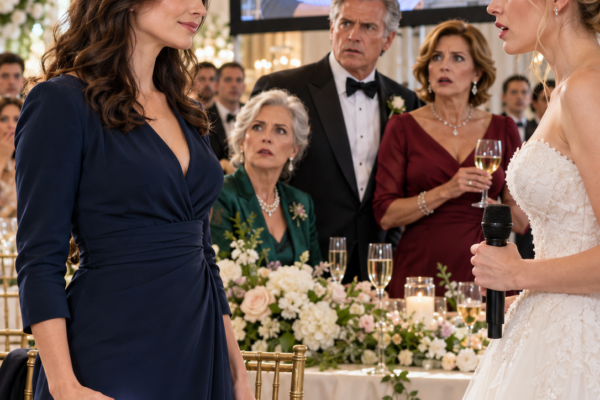
My sister’s husband told my parents i dropped out of law school – a lie that cost me 8 years with them, they missed my bar passage, my wedding, and never met my daughter, last month, he faced federal fraud charges, when i walked in – my mom’s mouth fell open, my dad’s eyes filled with tears.
My mom called me a disappointment on a Tuesday morning.
I was twenty-two years old, standing in the kitchen of the house I had grown up in, still wearing the clothes I had traveled in overnight. She said it the way people say things they’ve been holding inside for a long time—quietly, without even looking up from the counter.
I didn’t say anything back. That was probably my first mistake.
The phone call that started everything had come three days before that Tuesday. I was finishing my second year at Georgetown Law, surviving on coffee and four hours of sleep, when my phone buzzed at 1:14 in the morning. My sister’s name appeared on the screen.
I almost didn’t answer.
My sister, I’ll call her Dana, only called when she needed something or when something was wrong. We hadn’t spoken in six weeks.
“Mom’s asking about you,” she said when I picked up.
“Okay,” I replied. “What about me?”
There was a pause I didn’t understand yet.
“She’s asking why you’re not in class anymore.”
I set down my highlighter. “What do you mean, not in class anymore?”
“She said someone told her you withdrew from Georgetown. That you’ve been living off campus somewhere and didn’t want anyone to know.”
I felt the floor tilt slightly beneath my chair.
“Dana, that’s not true. I’m sitting at my desk right now. I have a property law exam in nine days.”
Another pause. Longer this time.
“I’m just telling you what she said.”
“Who told her that?”
She didn’t answer. And in the silence, I already knew.
My sister had a husband named Patrick. Patrick had a sister. That sister, I’ll call her Renee, had been in my year at Georgetown for exactly one semester before transferring out.
Renee and I had never been close. We moved in different circles. We were polite when we passed each other in the law library, but that was the extent of it. I had no idea what I’d done to make her dislike me, but I’d felt it. The way she looked at me. The way she went quiet when I walked into a room where she’d already been talking.
Renee had gone home for the holidays, and apparently, over dinner, she’d told her family that she’d heard I had dropped out. That I couldn’t handle the workload. That I’d been falling apart.
And somehow, that story—secondhand, unverified, coming from someone who had no reason to be watching my life closely—made its way through Patrick to Dana, and from Dana to my mother.
My mother believed it immediately.
She didn’t call me. She didn’t text. She didn’t email. She sat with that story for three days before Dana thought to mention it to me.
And in those three days, my mother had apparently rearranged her entire understanding of who I was.
That was the part I couldn’t recover from. Not for a long time.
Not that she’d heard something false. Not even that she believed it. But that she hadn’t called to ask me herself.
I drove home that weekend because I thought it would be simple to fix. I thought I would walk in, sit down, show her my enrollment confirmation on my laptop, and we’d laugh about it—or at least feel the awkward relief of a misunderstanding resolved.
That’s not what happened.
My mother was in the kitchen when I arrived, and she barely turned around. My father was sitting at the table with his coffee, looking at me with an expression I can only describe as careful, as though he were trying to figure out how to handle me.
“I’m enrolled,” I said before I’d even taken off my coat. “I’m in school. I don’t know what Renee told you, but it’s not true.”
My mother turned then.
She had that look she’d perfected over the years. The one that meant she’d already made up her mind and was now patiently waiting for me to stop talking.
“Renee said you’d say that,” she told me.
I stared at her. “She said I’d say that I’m enrolled in the school I’m enrolled in?”
“She said you’d try to cover it.”
I looked at my father. He looked down at his coffee.
There’s a particular kind of helplessness that comes from being accused of something by someone who has already decided that whatever evidence you bring will only prove the accusation.
I had my enrollment confirmation. I had my student ID. I had emails from my professors dated that very week.
None of it mattered.
Because Renee had apparently told my mother to expect exactly this—that I would show up with explanations, with documents, with a very convincing case. And my mother, who had raised me, who had watched me study at that kitchen table for eighteen years, chose to believe the warning over the daughter standing in front of her.
The word disappointment came out about forty minutes into the conversation.
I left two hours later.
I drove back to D.C. in the dark, telling myself I’d give her time to come around.
I gave her time for eight years.
That sounds extreme. It felt extreme living through it. But here is what actually happened.
I went back to school. I finished my property law exam and got a B+. I finished my second year and started my third. I graduated from Georgetown Law on a warm May afternoon, looked out at the crowd of families filling the seats, and searched for my own family’s faces.
They weren’t there.
I’d sent them an invitation six weeks in advance, the same way I’d been sending cards and letters every few months since that Tuesday in the kitchen.
Birthday cards. A Christmas card every December, with my address printed clearly at the top. First my apartment in D.C., then an apartment in Chicago, and eventually a house in a suburb of Philadelphia, where I settled after passing the bar in two states.
They received the graduation invitation. My father confirmed that years later.
They received it, read it, and chose not to come.
My mother had told my father that attending would send the wrong message. That it would suggest they approved of what I was doing, whatever she had decided that was.
I sat through my own graduation ceremony with my roommate’s family on one side of me and an empty row on the other.
I cried in the car on the way home. Then I made myself stop, and I didn’t let myself do it again for a very long time.
The cards kept coming back unopened.
Not all of them. That was the strange part.
Some arrived and were clearly opened because I’d occasionally get a one-line response from my father.
Got your note. Hope you’re well.
Nothing more.
But from my mother, nothing. Just silence, sometimes accompanied by a postal forwarding stamp.
I passed the bar. I got a position at a midsize firm in Chicago. I made junior partner in four years, which was faster than almost anyone in my cohort.
I worked cases I was proud of. Family law. Custody disputes. A few pro bono cases that went places I hadn’t expected.
I met a man named James at a conference in Atlanta.
He was patient in a way that surprised me. The kind of patient that isn’t passive but deliberate. He chose to slow down, to ask questions, to sit with things.
We got married at a small venue outside Philadelphia. Sixty people attended. His family filled most of the seats. On my side, I had three friends from law school and my old roommate, who cried during the vows and made me cry, which I’d sworn I wouldn’t do.
I sent my parents an invitation to the wedding.
It came back unopened.
I told James about it that night after the reception, sitting on the edge of the hotel bed with my shoes off. He didn’t say anything for a moment.
Then he said, “I’m sorry that happened to you.”
Not they don’t deserve you. Not forget them.
Just that.
And it was the right thing to say because there was nothing else to say.
Three years later, we had a daughter. We named her Clara.
I sent my parents a birth announcement. I included a photograph of Clara’s face at eight days old, with James’s hand curved around her head.
That one didn’t come back.
But no one called.
I want to explain something about those eight years because I know how it sounds from the outside.
People ask, and they do ask eventually, why I didn’t do more. Why I didn’t show up at the house. Why I didn’t call my mother directly and force the conversation.
I tried.
Not once. Multiple times.
The first time was three months after that conversation in the kitchen. I drove back, knocked on the door, and waited. My mother opened it, told me she wasn’t ready to talk, and closed it again.
The second time was a year after that, when I called my father’s cell phone. He picked up and said quietly, “Your mother’s standing right here,” as though that answered my question.
There was a letter I wrote in year three that was six pages long.
I laid out everything. The timeline. The facts. The evidence I’d accumulated. The enrollment records, the bar passage notices, the firm announcements.
I wrote it carefully. I wrote it like a legal brief because that’s what I knew how to do.
I mailed it certified, with a return receipt.
The return receipt came back signed.
No response.
By year five, I’d stopped trying to explain and started trying to simply exist.
I sent cards because it felt like holding a door open. Not forcing anyone through it, just keeping the hinge from rusting.
I don’t know what I was waiting for.
Something to shift. Some moment when the story Renee had told would fall apart on its own.
That moment came.
It just took longer than I expected, and it didn’t come from me.
I got the call from Dana on a Thursday afternoon in October.
I was in my office reviewing depositions. Clara’s school photograph was tacked to the corner of my monitor. James’s travel mug was still on my desk from that morning.
“Patrick’s in trouble,” Dana said.
I put down the deposition.
“What kind of trouble?”
She took a long time to answer.
“He’s being investigated. His firm. It’s a federal thing.”
Patrick’s firm was a financial advisory company he’d built over ten years. He managed investment portfolios for private clients, some of them quite wealthy.
The investigation, Dana told me in fragments over the next few minutes, involved allegations of securities fraud. Clients whose funds had been moved in ways they hadn’t authorized. Numbers that didn’t match. Transfers leading back to accounts the clients had never heard of.
“Why are you telling me this?” I asked.
“Because,” she said, and her voice changed, growing smaller, “because they’re going to need lawyers. And Patrick said—he said maybe you could…”
“Dana, I know you want me to defend your husband in a federal fraud case.”
“I know how that sounds.”
I looked at Clara’s photograph on my monitor.
Eight years old. Gap-toothed. Wearing a yellow sweater she’d picked out herself because she said it looked like sunshine.
I thought about the empty seats at graduation. I thought about the wedding invitation. I thought about a birth announcement that had been received and never acknowledged.
“I’ll think about it,” I said.
I didn’t mean it, but I needed to get off the phone.
I called James that night and told him everything. He listened without interrupting, which was one of the things I loved most about him.
When I finished, he asked, “What do you actually want to do?”
“I don’t know,” I admitted. “Part of me wants to say no and never speak to any of them again.”
“And the other part?”
I didn’t answer right away.
The truth was more complicated than anger, which was inconvenient.
The truth was that I had a mother I hadn’t spoken to in eight years. The truth was that my daughter had grandparents who didn’t know her name. The truth was that whatever Renee had said over that holiday dinner, whatever damage it had done, it hadn’t been authorized by me.
And somewhere inside me, there was still a person who wanted to walk into a room and be seen clearly by the people who were supposed to know me best.
Not forgiven. Not welcomed back with open arms and an apology.
Just seen.
“I’m not going to defend Patrick,” I told James.
“Okay,” he said.
“But I think I need to go.”
He understood what I meant. He usually did.
The case went federal faster than Patrick’s initial lawyers had anticipated.
By January, it had been assigned to the Eastern District of Pennsylvania.
A colleague of mine, a woman I’d worked alongside for three years, sharp and methodical and very good in front of judges, was appointed as part of the prosecution team.
She called me when she saw the defendant’s last name, knowing Dana and I shared it.
“Conflict check,” she said. “You have any involvement in this?”
“None,” I answered. “He’s my sister’s husband. I’ve had minimal contact with that side of the family for years, but thank you for asking.”
“You want to be there for support or whatever?”
I thought about that for a moment.
“I might come. I’ll let you know.”
I decided to go for reasons I didn’t fully understand yet. Or maybe I did understand, and I wasn’t ready to say them out loud.
I drove to Philadelphia on the morning of the first major hearing.
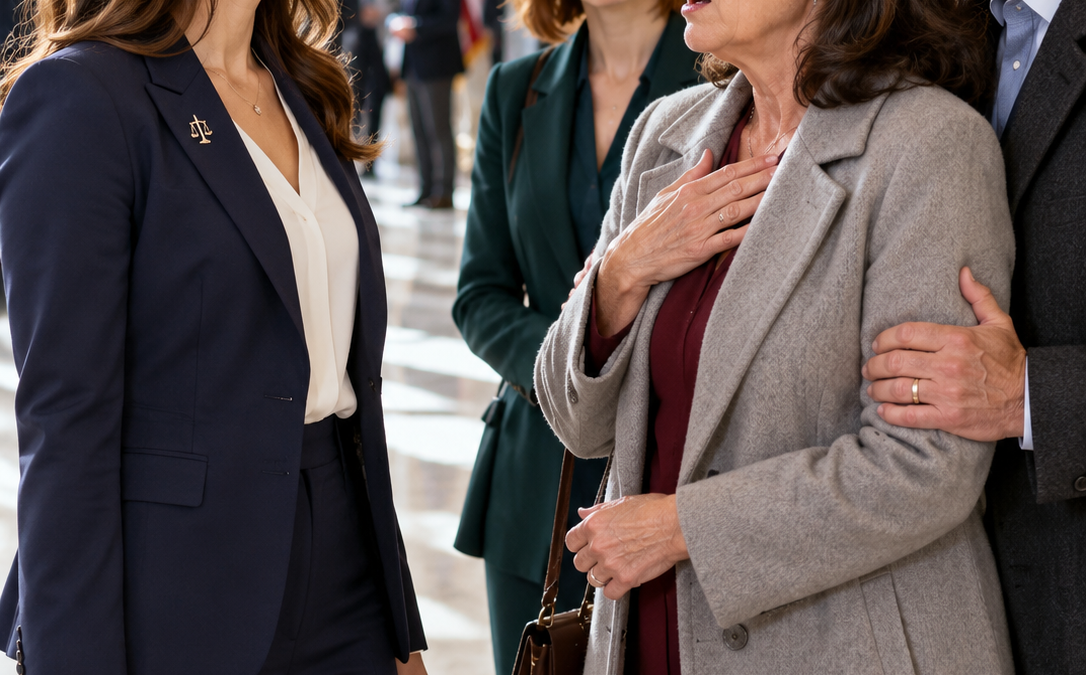
I wore my good suit, dark navy with slim lapels. The one James says makes me look like I’m about to deliver a closing argument whether I want to or not.
I wore my bar pin, small and silver, the kind of thing most people wouldn’t notice but that means something if you know what you’re looking at.
I got to the courthouse early.
I knew the building. I’d worked cases there twice before. I knew which elevator was faster, which hallway echoed, and which coffee was drinkable.
I walked in like I belonged.
Because I did.
I didn’t know my parents would be there.
It hadn’t occurred to me, though it should have. Of course Dana would have brought them. Of course they’d come for Patrick.
I turned the corner into the hall outside the courtroom, and there they were.
My father in a dark coat. My mother in the gray wool one she’d owned since I was in high school. Dana standing beside her with her arms crossed.
My mother saw me first.
I watched it happen.
The recognition. The confusion. The recalibration.
She looked at me the way you look at something that doesn’t fit where you’ve placed it. The way your eyes take an extra half second to process something unexpected.
I was wearing a suit. I was wearing a bar pin. I was carrying a leather document case that cost more than my first month’s rent in Chicago.
I looked like exactly what I was.
Her mouth opened slightly.
My father grabbed her arm.
Dana said my name. It came out like a question.
I had prepared, in some loose way, for a version of this. I’d thought about what I might say, how I might hold myself, whether I would acknowledge them or walk past.
What I hadn’t prepared for was the specific quality of my mother’s face in that moment.
Not just surprise, but something underneath it.
Something that looked, for the first time in eight years, like doubt.
“Hello,” I said to all three of them.
My mother began, “What are you—” and stopped.
“I’m here for the hearing,” I said. “I know some people on the prosecution side.”
I watched her process that.
Prosecution side.
Not Patrick’s team. Not there to help.
I was there as myself. As a known quantity. As someone the lawyers nodded to when I walked in.
“You’re a lawyer,” my mother said.
Not like a question. More as though she were saying it for the first time and meaning it for the first time, and didn’t know what to do with the weight of it.
“I’ve been a lawyer for six years,” I told her. “I made junior partner in Chicago in year four. I’m with a firm in Philadelphia now. I passed the bar in Pennsylvania and Illinois.”
I wasn’t saying it to impress her.
I was saying it because she needed to hear the complete shape of the thing.
Not just that Renee had been wrong, but how wrong, and for how long, and what had been happening in all the years she’d chosen not to look.
My father was very still.
His eyes were red at the rims. I hadn’t noticed that at first.
Dana spoke softly.
“I didn’t know how to tell them.”
I looked at her.
“You knew?”
She looked away.
“Patrick mentioned you’d passed the bar a couple of years ago. I didn’t—I didn’t know how to bring it up.”
And there it was.
Not just Renee’s original lie. Not just my parents’ silence.
But Dana, who’d known for two years and had said nothing, now standing in a courthouse hallway, unable to look at me.
I took a breath and let it out slowly.
The doors to the courtroom opened.
I sat three rows behind the prosecution team.
I had no official role in the proceedings. I was there as a private citizen, as someone who knew the attorneys, as someone who wanted to witness one specific moment arrive.
I kept my document case on my lap and my eyes on the front of the room.
My parents sat on the other side of the aisle, four rows back, with Dana between them.
I could see my mother’s profile from where I sat.
She didn’t look at Patrick once during the preliminary session. She kept turning her head slightly in my direction. Not all the way. Just enough.
Patrick’s lawyers presented their initial motions. The prosecution responded.
It was procedural, mostly the kind of hearing that matters enormously in terms of what happens next but looks from the outside like a lot of paperwork being formally acknowledged.
I’d been part of enough of them to read the room.
Patrick’s team was nervous.
The prosecution was not.
At one point, my colleague caught my eye from the front of the room and gave me a small nod.
Professional. Collegial. The kind of acknowledgment that happens between people who trust each other’s work.
My mother saw it.
I didn’t look at her after that.
I didn’t need to.
I could feel the shift in the air from across the aisle. The reorientation. The accumulation of evidence that could no longer be set aside.
Her daughter in a navy suit, acknowledged by a prosecutor in a federal courtroom.
Her daughter, who had supposedly dropped out of law school before she’d even finished.
Her daughter, who had been sending Christmas cards from Philadelphia for three years and who had evidently been building a life that no one in that family had bothered to ask about.
The hearing ended after two hours.
I stood when the judge left the bench. I gathered my things and was almost to the door when I heard my name.
My mother’s voice behind me.
I stopped.
I turned around.
She looked smaller than I remembered, though I knew she wasn’t.
It’s just what time does. It recalibrates scale.
I’d spent eight years with her existing as a very large absence, and here she was, five feet four inches tall in a gray wool coat, standing in the emptying hallway of a federal courthouse.
“I didn’t know,” she said.
“I know you didn’t,” I replied. “But you could have.”
Her chin moved, something working in her jaw, trying to find its shape.
“Renee said—”
“I know what Renee said.”
I kept my voice level. I had a lot of practice keeping my voice level.
“I also know that I drove home three days later and stood in your kitchen with my enrollment confirmation. I know that I sent you a six-page letter in certified mail and the return receipt came back signed. I know that I mailed you a graduation announcement and a wedding invitation and a photograph of your granddaughter.”
My mother blinked.
“Granddaughter?”
“Clara,” I said. “She’s eight years old. She likes the color yellow and chapter books and strawberry ice cream. She asks me sometimes why she doesn’t have grandparents on my side. I’ve been trying to figure out what to tell her.”
My mother’s hand came up and covered her mouth.
My father had come to stand beside her. His eyes were doing that red-rimmed thing again, and now I understood it.
He’d been crying, or close to it, since the moment he’d seen me in the hallway.
He was a man who had received my letters. He’d signed the return receipt. He was a man who had known, in some quiet and uncomfortable part of himself, that something was very wrong and had not done enough to fix it.
“I’m sorry,” he said. His voice was rough. “I should have—I should have pushed harder. I should have picked up the phone.”
“Yes,” I told him. “You should have.”
No softening.
No it’s okay. No I understand. None of the things that would have made it easier for all of us but would have been untrue.
Dana was hovering at the edge of the group, close enough to hear everything and far enough away to claim she wasn’t part of it.
I looked at her.
“You knew for two years.”
“I was afraid,” she said. “Of Patrick. Of what he’d say. Of—I don’t know. Everything.”
“I’m not asking you to explain it right now,” I told her. “I’m just telling you that I know.”
She nodded. Her eyes were wet.
I looked at my mother again.
She hadn’t said she was sorry yet.
I noticed that.
She’d said she didn’t know, which was partially true and partially a choice. And she hadn’t quite found her way to taking responsibility for that choice yet.
Maybe she would. I didn’t know.
I’d learned over eight years of lawyering that people almost never say the right thing in the moments when the right thing is most needed.
They say the available thing. The partial thing. The thing they can manage under pressure.
“I need to get back to my office,” I said. “I have a client call at two.”
My mother hesitated.
“Can we—will you come for dinner sometime?”
I thought about Clara. I thought about the yellow sweater and the gap-toothed smile and the question about grandparents that I hadn’t answered yet.
“I’ll think about it,” I said.
And this time, I meant it.
I drove back to my office and sat at my desk for a while without doing anything.
James called at 12:30 to check in.
I told him what had happened in as few words as I could manage because if I used too many words, I was going to cry in my office, which I was absolutely not going to do.
“How are you feeling?” he asked.
“I don’t know yet,” I said. “Like something shifted. But I don’t know into what.”
“That sounds right,” he said.
I looked at Clara’s photograph.
The yellow sweater. The sunshine.
That evening, I picked her up from school, drove her home, and made dinner.
While we were eating, she told me about something that had happened at recess involving a disagreement over the rules of a game that I only half followed.
She was very serious about it.
James asked clarifying questions.
I ate my dinner and watched the two of them, feeling something in my chest that was not quite grief and not quite relief, but something adjacent to both.
After Clara was in bed, James and I sat in the kitchen, and I told him everything.
The whole shape of it.
The hallway. My mother’s face. My father’s voice. What Dana had said.
He listened all the way through.
“What are you going to do?” he asked.
“I think I’m going to call her,” I said. “My mother. I think I’m going to set up a dinner somewhere neutral. Not her house, not mine. Somewhere we can leave when we need to.”
“And Clara?”
“Not yet,” I said. “Maybe eventually. But not until I know what I’m bringing her into.”
James nodded.
He reached across the table and put his hand over mine.
That was enough.
Here is what I want to say to whoever is listening to this.
I am not telling this story to celebrate what happened in that hallway. I am not telling it because my mother seeing me in a navy suit and a bar pin is some kind of ultimate justice.
It isn’t.
A suit is just a suit. A pin is just a pin.
Patrick’s case is going forward without me. And whatever happens there will happen whether I was in that courthouse or not.
I am telling it because I spent eight years believing that if I could just accumulate enough evidence of being real—enough cards, enough letters, enough certified mail—eventually someone would have to look at it.
And for eight years, that didn’t work.
What finally created the crack wasn’t the evidence.
It was my mother standing in a hallway and seeing me in a context she couldn’t argue with.
Not because my achievements are what I’m worth, but because she finally had to see me as a person with a continuous life that had been happening without her permission, without her knowledge, and without her presence.
You don’t need a courtroom for that.
You don’t need a federal case or a bar pin or a lawyer’s suit.
But sometimes the moment arrives in a form you didn’t plan for. And sometimes it arrives in a courthouse hallway in October. And sometimes you’re ready for it even though you thought you weren’t.
The dinner happened in early December.
We met at a restaurant in Center City that I’d been to twice before for client meals.
Neutral territory. White tablecloths. Loud enough that the silences didn’t stretch.
My mother ordered the salmon. My father ordered whatever my mother suggested.
Dana didn’t come. I hadn’t invited her yet.
We were not there yet.
We talked for three hours.
My mother said she was sorry approximately forty-five minutes in. She said it in a small, careful voice.
And it wasn’t a perfect apology.
It was hedged. It was partial. It implied things without stating them.
But it was a beginning.
My father apologized more directly.
“I believed your mother, and she believed Renee, and I should have done more. I am sorry.”
That one landed differently.
I told them about Clara. I showed them pictures.
My mother looked at the photograph of Clara wearing her yellow sweater for a long time without speaking.
“She has your eyes,” she finally said.
“I know,” I replied.
I drove home that night.
James was awake, reading in bed. He looked up when I came in, and I sat on the edge of the mattress.
“I think I’m going to be okay,” I said.
“I know,” he answered. “I’ve thought that for a while.”
Clara met her grandmother for the first time on a Sunday in February.
We met at a park near our house.
My mother brought a book. A chapter book with a yellow cover, the kind of thing she’d clearly researched and chosen carefully.
Clara looked at the book, then looked at my mother.
“This is one of my favorites,” she said.
My mother smiled.
It was the most unguarded thing I’d seen her do in probably twenty years.
I stood a few steps back and watched them, feeling something inside me begin to untangle.
Not all the way.
You don’t untangle eight years of silence in a Sunday afternoon at a park.
But something.
Enough to keep going.
That’s all I needed.
Enough to keep going.
If you’ve been holding a door open for someone who hasn’t walked through it yet, keep the hinge oiled.
Not because they deserve it. Not even because you owe it to them.
But because sometimes the version of yourself you’ll be when they finally arrive is worth everything it costs to stay.
I am not the person my mother heard about at a holiday dinner when I was twenty-two.
I never was.
I am a lawyer and a wife and a mother and a woman who has sat with her own silence long enough to know its shape.
My name is mine.
My life is mine.
It was always mine.
Nobody needed to hand it back to me.
It just took a while for everyone else to see what was already there.