I represented myself in court. My brother laughed. “You’re too dumb to understand the law. Pathetic,” he said. Mom agreed. I opened my binder. Started reading. After my first exhibit… The judge went silent…
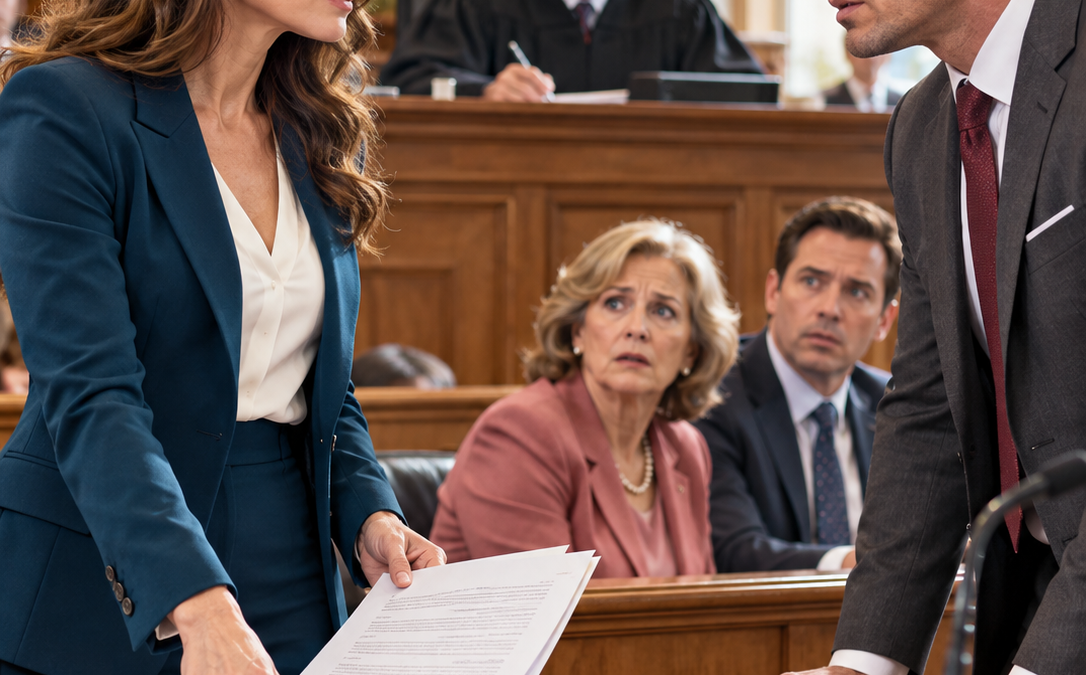
My mom called me the morning of the hearing to tell me I was making a fool of myself. She didn’t say good luck. She didn’t ask if I’d eaten breakfast or slept the night before. She just spoke in that flat, tired voice she reserves for moments when she’s already decided how something is going to end.
“Rachel, please don’t embarrass this family in front of a judge.”
Then she hung up before I could answer.
I stood in the parking lot of the Cuyahoga County Courthouse in Cleveland, Ohio, holding my phone against my chest and breathing in air that smelled of exhaust and the sharp cold of early October. My heels were the ones I’d bought for my sister-in-law’s wedding four years earlier. My blazer was the one I’d worn to job interviews when I was twenty-six. Beside me stood a rolling cart, the kind teachers use, stacked with three binders and a banker’s box full of documents I had spent the last eleven weeks organizing, tabbing, and cross-referencing.
I looked like either the most prepared person in that parking lot or the most desperate one. From inside the courthouse, my brother’s attorney probably would have looked out and seen the second.
I want to tell you who I actually am, because it matters to everything that happened next. It matters because nobody in that courtroom, except me, knew it when we walked in.
I had been a forensic accountant for the federal government for fourteen years. Before that, I’d spent three years at a private audit firm specializing in financial fraud detection. It was the kind of firm corporate boards called when they suspected their own chief financial officer of wrongdoing and needed someone who could follow money through twelve layers of shell accounts without leaving a trace of their own footprints.
I had testified as an expert witness in eleven federal cases. Once, I spent eight months reconstructing the complete financial records of a construction company that had deliberately shredded everything. I rebuilt those records using backup bank statements, vendor invoices, a handwritten ledger that one conscientious employee had kept out of personal habit, and a single spreadsheet an administrative assistant had accidentally saved to her personal cloud drive instead of the company server. That case resulted in three federal convictions.
I had sat across from defense attorneys who had been practicing law longer than I’d been alive. I had calmly explained complex financial transactions in language twelve jurors could understand, showing exactly how money had moved, where it had ended up, and why every document in my binder supported an accounting of the facts that could withstand scrutiny.
I was not a lawyer. I had never pretended to be one. But I knew evidence. I knew how to build an argument from documents the way a stonemason builds a wall: one piece at a time, each piece load-bearing, nothing decorative, nothing that couldn’t hold its weight when someone pushed against it.
I knew that the most powerful thing you can put in front of a factfinder isn’t necessarily a compelling story. It’s a paper trail that moves in only one direction and cannot be argued away, no matter how expensive the attorney on the other side happens to be.
Nobody in my family knew any of this about me. Not because I was hiding it. It simply never surfaced in the way Daniel’s work surfaced.
Daniel was a real estate attorney at a well-regarded firm in the Cleveland suburbs. He wore suits that fit precisely and drove a car my mother would point to at family dinners, saying with something close to reverence, “That’s what hard work looks like.”
He had given my mother her first grandchild at thirty-one. He coached the kids’ soccer team on Saturday mornings and arrived at every holiday gathering carrying wine that people commented on and remembered. He was fluent in the language my family spoke: visible achievement, physical presence, the kind of success that translates instantly in a room full of people who are proud of you.
My work didn’t translate that way.
Forensic accounting required explanation, and the explanation required context about federal procurement law, audit standards, and evidentiary chains of custody. By the time I finished, people were ready for dessert. Somewhere in my late twenties, I’d learned to let the conversation stop at “She works for the government” and move on.
I had made a private peace with being the comma in my family’s story, the pause between the parts that actually mattered. I had built a life in Columbus that I was genuinely proud of, quietly and completely, and I had largely stopped needing my family to see it.
That part cost me more than I acknowledged for a long time. I see that more clearly now than I did then.
Growing up, Daniel was always the obvious one. He was two years younger than me and somehow always seemed older, louder in the right rooms, quieter in the strategic ones, naturally fluent in the social currencies that bought him trust and admiration.
He knew how to make my father laugh until he had to set down his fork. He knew how to make my mother feel consulted, valued, essential to whatever plans were being made. He knew how to be the son people pictured when they said, “Someday, this will all be yours.”
And he had inhabited that role for so long, and so naturally, that I think he’d genuinely stopped noticing it was a performance.
I had noticed. I’d noticed for years. But noticing and naming are different things, and in families, you learn early which observations are safe to speak aloud and which ones you file away in the part of yourself that doesn’t need anyone else’s acknowledgment to know what it knows.
I left Cleveland at twenty-three for a government position in Columbus, and I built something there. A career. An apartment I furnished slowly and deliberately until it felt like mine. A set of colleagues who respected my work. A handful of friendships that had survived a decade and a half, multiple moves, and all the changes that came with them, friendships made stronger by their endurance.
I came home for Thanksgiving and Christmas and the occasional birthday weekend, and I watched my brother gradually become the gravitational center of my parents’ daily lives. He was the one whose calls came every day, whose children were in the kitchen on Saturday afternoons, whose name was spoken with that particular warmth people reserve for someone physically woven into the fabric of their days.
I told myself that was natural. Proximity creates closeness. I had chosen distance, and the trade-off was mine to live with.
I believed that, mostly.
What I didn’t let myself fully see was how much that distance had cost me in the one currency that would eventually matter in a courtroom: my parents’ instinctive deference to the child who had stayed.
My father was different.
He saw me in a way that didn’t require proximity to sustain itself. He called me on Tuesday evenings, specifically Tuesdays, because he said the week needed a midpoint and Sunday was already full of other people’s calls. He asked about my cases without fully understanding them, and he remembered the details the following Tuesday, which is more than most people do with things they understand perfectly well.
He had a habit of listening while I explained something technical and then summarizing it back in his own words, not to prove that he’d understood, but to check that he had. I found that more respectful than almost anything else a person can do with someone else’s expertise.
Once, during a visit, we were sitting on the back porch after dinner, watching the yard grow dark in the way Ohio yards do in September. He turned toward me and said, “Rachel, you pay attention to things in a way most people don’t. Not just the facts. The shape of the facts. The way they fit together, or don’t.”
He paused before continuing.
“That’s going to matter someday in ways you can’t see from here.”
I thought he was just being a father. I wrote it down anyway in the notes app on my phone, because I write down things that matter to me. Something about the way he’d said it made me understand that it wasn’t idle praise.
My father had built Hartley Commercial Services over thirty-one years. Commercial cleaning. Office buildings, medical facilities, government spaces, industrial accounts, overnight crews. It wasn’t glamorous work. It wasn’t the kind of business that got profiled in regional magazines. It was the kind of business that operated invisibly and perfectly, that everyone depended on and nobody thought about until it didn’t happen.
My father thought about it every day.
He drove the same truck for twelve years because he believed every dollar he could keep in the business was a dollar that protected someone’s job. He knew all nineteen of his employees by name, knew their children’s names, and knew the particular circumstances of their lives. He knew who was putting a child through community college, who had a mother in a care facility, and who was one bad month away from a crisis and needed the payroll to clear without fail.
It always cleared. In thirty-one years, the business never missed a week.
One winter, a longtime crew chief suffered a cardiac event, and the medical costs began to overwhelm his family. My father quietly subsidized the employee’s insurance premium for four months out of his own pocket. He told no one.
I found out years later from Gloria, the bookkeeper, who mentioned it casually while talking about something else, as though it were simply a thing my father did. In that moment, I understood that it was. It was the kind of person he was when nobody was watching.
My father had a will. He’d written it eight years before he died, with the help of a local estate attorney he’d used for business contracts, and it was neither complicated nor ambiguous.
The business was to go to Daniel and me in equal shares. Fifty-fifty. Managed jointly or sold jointly, with profits split evenly.
He had told us both, separately and together, in conversations and in the document itself, that equal was what he wanted, equal was what he intended, and he expected us to find a way to make it work.
He believed in fairness with the same quiet conviction he brought to everything. It wasn’t a philosophy he debated. It was simply how he moved through the world.
He died eighteen months ago, on a Tuesday morning in March, from a heart attack. He was sixty-seven years old, and there hadn’t been enough warning for any of us to brace ourselves.
The weeks that followed were the worst of my life, and in some ways, the most clarifying. Grief does something to your understanding of what is actually essential. It strips away the decoration and shows you what had been holding everything up all along.
I drove to Cleveland and stayed for two weeks. I helped my mother with the arrangements. I sat with her in the evenings in the house that had always had my father in it and was now being asked to figure out what it was without him. I watched her move through the rooms with the careful, slightly lost quality of someone navigating a space that had been rearranged in the dark.
Daniel came when he could. He was managing his practice, his household, his children’s spring soccer season, and the thousand obligations of a life that hadn’t paused for grief the way mine had. He showed up for the wake, the funeral, and the dinner afterward, and he was present in the visible ways people remember and reference later.
He spoke at the service. He held my mother’s arm in the parking lot afterward. He did the things that got seen.
I did the things that happened after everyone went home.
I sorted my father’s office. I organized three decades of business files, vendor contracts, insurance policies, the original operating agreement, and payroll records going back to the early years, when he’d done them by hand in a spiral notebook.
I made calls to the business bank about continuity of operations, to the insurance company about the coverage transition, and to the accountant about the tax year. I handled the specific, technical, unglamorous work of keeping a business intact during the period when its owner had just died and everyone was too sad to think clearly.
I did it because I knew how, and because my father’s nineteen employees had families, and the payroll needed to keep clearing.
I went back to Columbus in April. I called my mother every Sunday. I sent flowers on what would have been my parents’ thirty-ninth wedding anniversary. I managed my grief the way I manage most difficult things: by staying useful, keeping moving, and trusting that the feeling would eventually find somewhere to go.
I had no idea what Daniel was doing while I was keeping moving.
The call from Gloria came on a Thursday evening in early August.
I was sitting at my kitchen table with a case file open when my phone lit up with a Cleveland area code I didn’t immediately recognize. When I answered and she said her name, I knew from the quality of her voice that something was wrong.
Gloria Simmons had been my father’s bookkeeper for nineteen years. She worked out of a small office attached to the main warehouse, and she knew the business’s finances the way a ship’s navigator knows a coastline, not from maps alone, but from years of direct experience. Every anomaly memorized, every pattern understood.
My father had trusted her with everything. She’d come to his funeral and cried in the back row, where she thought no one would notice. Afterward, she’d sent my mother a handwritten card that my mother kept on the kitchen windowsill for two months.
Gloria told me she’d been asked to update the business ownership records. The documents she’d been given, she said, didn’t include my name anywhere.
She had asked Daniel about it. He’d told her the matter had been handled at the estate level and that she should proceed with the update. But Gloria hadn’t done it yet. Something about it felt wrong to her, and she thought I should know before she did anything.
I asked her to send me what she had. She sent it within the hour.
I read the amendment three times that night.
It cited a clause concerning inactive partners, a provision giving the active managing partner the right to assume full operational and ownership authority if the other partner had been absent from business management for more than ninety days.
That clause had not existed in the original operating agreement. I knew because I had a copy. My father had given one to each of us when he wrote his will.
The amendment was a single page. It had been signed by my mother in her capacity as executor of my father’s estate, notarized, and filed with the county recorder’s office eleven weeks after my father died.
I sat with it for a long time.
I wasn’t panicking. I was doing something more useful than panicking. I was reading it the way I read documents in federal cases, looking for the structure, the sequence, and the places where the narrative on the page diverged from the reality I knew existed outside it.
I opened a new spreadsheet and started a timeline.
I drove to Cleveland the following weekend and went to the county recorder’s office first thing Monday morning. I pulled every filing associated with Hartley Commercial Services from the previous eighteen months and photographed everything.
Then I called Gloria and asked her to give me access to the business’s complete financial records, access to which I was entitled as a co-owner of record.
Daniel had not yet completed the ownership transfer because Gloria had quietly delayed processing the update. She confirmed that to me later with the matter-of-fact calm of a woman who had worked for my father long enough to know what he would have wanted her to do.
I took everything home to Columbus, spread it across my dining room table, and worked.
I worked four full weekends, Saturdays and Sundays, starting at eight in the morning and sometimes continuing until midnight, with coffee, a legal pad, and the same methodology I brought to a federal audit.
I pulled every document. I built a master timeline in my spreadsheet. I cross-referenced every date on every page against every other date. I flagged each place where the story told by the paperwork didn’t match the story told by the underlying records.
I color-coded the findings by category. I numbered each one and documented its source.
I found three significant problems.
The first was the notarization.
The amendment carried a notarization date of May 14, but I had a note on my phone from a call with my mother on May 20. The note was timestamped because I date my notes by habit.
During that call, my mother had mentioned, in the completely unremarkable way she mentions things she considers unimportant, that Daniel had just come by the day before with some papers.
“Administrative things, he said. I signed where he pointed.”
Yesterday, from May 20, meant May 19.
The notarization read May 14.
A five-day discrepancy in a notarization isn’t something you can simply dismiss as a clerical error. A notarization records the date the document was executed in the notary’s presence. If my mother signed on May 19, the stamp should have read May 19.
If it read May 14, one of two things had happened. Either my mother had misremembered the date by five days while she was in the depths of her grief, which was possible, or the notarization date had been falsified, which was a crime.
I spent an entire Saturday afternoon building the case for each possibility. I listed every piece of evidence bearing on the question.
The column supporting falsification was considerably longer, and every item in it was documented.
The second problem was the money.
Between June of the year my father died and the following February, a period of eight months, the business made seven separate payments totaling $39,840 to a payee described in the books as a management consulting expense.
I traced the payee through the bank records to my brother’s personal account.
There was no consulting agreement in the business files. There was no invoice for any of the seven payments. There was no partner authorization, no resolution, and no written description anywhere of what services had been provided, when they’d been provided, or who had approved them.
The third problem was the context that made the second problem worse.
Daniel was already drawing a manager’s salary from the business. It was written into the original operating agreement, the same salary my father had drawn for himself, adjusted for current rates.
Daniel was entitled to that salary. My father had built it into the structure intentionally because he understood that managing a business was real work and deserved compensation.
But you cannot draw an authorized management salary and simultaneously bill as an outside consultant for the same management function. That’s one job described two different ways and charged twice.
The salary was documented and legitimate. The consulting fees were undocumented and had been run through the books as operating expenses, reducing the business’s reported profit and, therefore, reducing the share that should have been split between us.
It wasn’t accidental. The structure was too deliberate to be accidental.
I had called Daniel the evening after I first saw the amendment. I kept my voice completely level. I told him I’d seen the filings and thought there might be a mistake.
He was quiet for a moment. It was the particular silence of someone deciding which version of a response to use.
Then he said, “Rachel, a will and a business operating agreement operate under entirely different bodies of law. They’re not the same document doing the same thing. You might want to talk to someone who can explain how that distinction works.”
I told him I would look into it.
“Good idea,” he said.
He said it with the patient, faintly tired certainty of someone explaining something simple to a person who lacked the foundation to understand it.
I recognized that tone.
I’d heard versions of it throughout my professional life, from opposing counsel in federal cases, from executive defendants who believed their positions made them immune to scrutiny, and from men in expensive suits who had built their confidence on the assumption that the person across from them would eventually become overwhelmed and withdraw.
They were always surprised when I didn’t.
Daniel thought I would talk to a general practice attorney, be told how expensive and uncertain business litigation could be, calculate the cost against the probable outcome, and walk away.
He thought that because he’d watched me walk away from things my entire life. He’d watched me leave Cleveland, leave the family orbit, leave the Sunday dinners and soccer games and the slow accumulation of daily presence that had translated, over the years, into my mother’s instinctive trust.
He believed I was someone who withdrew when things became complicated.
He didn’t know what I’d been doing for fourteen years in Columbus. He didn’t know what I was capable of when I had the documents, the time, and a reason that mattered.
He found out.
I filed suit the following month, pro se, representing myself without an attorney.
Not because I lacked the resources to hire one. I had a stable government salary, savings, and professional relationships with several litigation attorneys who would have taken my call that same day.
I filed it myself because I understood the evidence better than any attorney could have in the available time. I had spent fourteen years building exactly this kind of case, and I knew precisely what needed to be shown and in what order.
And because some part of me, a part I’m still not entirely able to explain, needed to stand in that room and speak those words with my own mouth.
My father’s business. My father’s wishes. My father’s thirty-one years.
I was going to carry those things into that courtroom myself.
I spent the three weeks before the hearing preparing the way I prepare for everything important. I read the applicable sections of the Ohio Revised Code, the laws governing business entities, the scope and limits of executor authority, fraudulent transfer statutes, and the specific provisions governing notarial acts and the consequences of falsification.
I read the relevant case law and printed the cases I intended to cite, marking the applicable passages. I condensed my timeline into a single, clean page a judge could absorb in ninety seconds.
I made an exhibit list containing twenty-two items. I prepared an opening statement and timed it. I anticipated the fifteen most probable objections from opposing counsel and wrote out my responses to each one.
I ran through the full presentation twice in my apartment, speaking aloud to the wall above my desk and adjusting the pacing the way you adjust anything you intend to perform under pressure.
I wasn’t nervous.
I was prepared, which is better than not being nervous because preparation lasts.
My mother called me two days before the hearing. She said Daniel had told her I didn’t understand how business law worked. I said I was learning.
She said I was going to lose, damage the family, and regret it. I told her I loved her and that I would call afterward.
“Please don’t do this,” she said.
“Goodbye, Mom.”
Then, on the morning of the hearing, she called again.
That was the call.
“Please don’t embarrass this family in front of a judge.”
And then she hung up.
I stood in the parking lot with my rolling cart, Walt’s coffee, and the October cold, thinking about my father sitting on the back porch in September.
“The truth holds its ground if you give it enough help.”
I thought, I’ve given it everything I have.
And then I walked inside.
There were four people in the gallery. Gloria, who had driven forty minutes to be there. A courthouse regular who attended civil hearings for reasons of her own. Walt, sitting in the back row with his thermos and flannel shirt, carrying the steady, quiet loyalty of a man who had been my father’s closest friend for thirty years.
And my mother, sitting on Daniel’s side, not looking at me when I came through the door.
Daniel’s attorney was everything his website suggested: polished, unhurried, comfortable in courtrooms the way certain people are comfortable in rooms where they have always won.
He moved first with a procedural motion to dismiss based on improper service of notice.
It was a standard play in cases involving pro se litigants. It catches people who haven’t read the procedural rules carefully.
I had read them very carefully.
I had served the notice three ways: certified mail with tracking, through a process server with an affidavit, and with a date-stamped clerk’s confirmation. I had anticipated this exact motion during my preparation and decided to make it impossible to sustain.
I handed the judge the documentation.
He reviewed it.
“Motion denied. Let’s proceed.”
Daniel’s attorney presented his case with the smooth efficiency of two decades of practice. The amendment was valid. The executor’s authority was sufficient. The inactive partner clause reflected standard business practice.
The consulting fees, he argued, represented equitable compensation for extraordinary management responsibilities following my father’s death.
He had a business consultant’s declaration. He had case citations he delivered from memory.
I wrote my notes and waited.
When it was my turn, I stood and said, “Your Honor, I’d like to begin with Exhibit A.”
I walked through the timeline.
I showed the notarization date. Then I played seventeen seconds of my mother’s recorded phone call. Advance notice of the recording had been given in my filing, a written transcript had been provided, and I had complied fully with Ohio’s one-party consent law.
I let the judge hear my mother’s own voice saying Daniel had come by “yesterday” with papers, during a phone call made on May 20.
Then I showed him the original operating agreement. The relevant section required both partners. The amendment had only one.
I showed him the consulting fee table. Seven rows. Seven amounts. One column marked “Undocumented” seven separate times.
I showed him the salary records and the consulting records for the same period, side by side.
Same role. Two payments. One documented, one not.
I showed him the client and revenue data for the fourteen-month period. The numbers were steady, unremarkable, consistent with a trained crew operating exactly as my father had built them to operate, with or without extraordinary management intervention from above.
Then I said, “Extraordinary compensation requires extraordinary documentation. There is none here. What there is is $39,840 that left this business without authorization, without a supporting paper trail, and arrived in my brother’s personal account.”
I paused.
“In my professional experience, that pattern has a name.”
I didn’t say the name. I didn’t need to.
I wrapped up in four minutes.
I told the judge what I was asking for. I told him about my father, his truck, his thirty-one years, his employees, and what he’d said he wanted done with the business he’d built.
Then I sat down.
The courtroom was very quiet.
The judge said he would issue a written ruling within thirty days. He also said my pro se submissions were among the most thorough he had seen in a civil matter of this type.
Daniel’s attorney said nothing.
Daniel was staring past the far wall. He was an attorney. He knew exactly what it meant when a judge said something like that at the end of a hearing.
Walt held the door for me on the way out. In the parking lot, he poured coffee into the lid of his thermos, handed it to me, and said, “Your dad would have loved every single second of that.”
I couldn’t find my voice. I just nodded.
The ruling came twenty-six days later.
Every primary point was decided in my favor.
The amendment was voided. My ownership was restored. An independent accounting was ordered. The consulting fees were to be repaid with statutory interest within ninety days.
The notarization discrepancy was explicitly cited. The judge wrote that it could not be reconciled with the available record and that the burden of explaining it had not been met.
I read the ruling three times at my kitchen table.
Then I made tea.
Then I sat with my father for a while, in the way you sit with someone who is gone: in memory, in gratitude, in the particular quiet of having done the thing you know they would have wanted done.
I waited two days before calling my mother.
“I didn’t know what I was signing,” she said. “He told me it was administrative.”
“I know, Mom.”
“I should have called you first before I signed anything. I should have called you.”
“Yes,” I said.
There was a long silence, one of those silences that seems to have a decade’s worth of things inside it.
“Your father always said you were the one who paid attention to things,” she finally said.
“He told me that, too.”
“I’m sorry, Rachel.”
Three words.
I held them carefully, the way you hold something fragile that someone hands you when you weren’t expecting it.
“I know, Mom,” I said.
Daniel called the following week.
He said the ruling was disappointing. He said he intended to comply. He said he hoped we could find a path forward.
Then, more quietly, he said, “I underestimated you.”
“I know you did.”
I didn’t say it with anger. It was simply the plain acknowledgment the statement had earned.
We agreed on terms: an independent manager for operations, shared account access, and quarterly reports. Nothing would move without both signatures.
He agreed without argument.
I think by then he understood what it had cost him to underestimate me once, and he had no interest in discovering what a second time might look like.
Gloria is still the bookkeeper.
When she heard about the ruling, she sent me a card.
“Your father hired good people and raised at least one, too.”
That card has been on my refrigerator for fourteen months, and I have no intention of taking it down.
The business is doing well. My share of the annual profit isn’t a number that changes everything about my life, but it is my father’s.
It represents the thirty-one years, the truck, the employees whose children’s names he knew, the payrolls that never missed a week, and the insurance premium he secretly paid for a man who needed it.
It belongs to me because he said so, and I’m the one who made sure it stayed that way.
My mother and I talk more now than we ever did before any of this happened.
There are still things between us that haven’t been fully said. There are conversations we’re working toward in the slow way people work toward difficult things when the relationship matters enough to be careful with.
But last month, she called me on a Sunday.
She called me. Not the other way around.
We talked for an hour and twenty minutes about nothing particularly important. She laughed twice, genuine laughter, and so did I.
That is not nothing.
In a family that has been through what ours has been through, that is, in fact, quite a lot.
My father used to say, “The truth has a way of holding its ground if you give it enough time and enough help.”
He said it simply, without making a production of it, the way he said most things that actually mattered to him. He trusted the meaning to arrive when it needed to.
It arrived.
There’s one more thing I want to say, and I want to say it carefully because I mean it for a specific person.
Someone who might be sitting somewhere right now with a stack of documents and a situation that has been described to them as too complicated, too expensive, too technical, too tilted against them, or simply not worth the effort.
Someone who has been told by a confident, well-dressed person that they don’t understand how these things work and should probably let it go.
You know more than they think you do.
You know the timeline of your own life. You know what was said, when it was said, and who said it. You know what your mother told you on the phone on a Tuesday evening in May.
And you know what date is stamped on the document.
You know, with the certainty of someone who was actually there, that those two dates are not the same thing.
You know where the money went because you lived through the period when it was leaving. You know what your father said he wanted because you were in the room when he said it, and you wrote it down, and it mattered to you then, and it matters to you now.
That is enough to start.
The documents don’t lie if you know how to read them. And reading them isn’t a gift you either have or don’t have. It’s a method.
It’s patience and sequence and the willingness to sit with a spreadsheet on a Sunday night and follow every thread all the way to where it ends.
It’s asking the question, Does this date match that date?
It’s asking, Where did this money go?
It’s asking, Does the story the paper tells match the story I know to be true?
That is available to you. It has always been available to you. The tools are less important than the willingness to use them. The credentials matter less than the attention you bring to the work.
My mother called me the morning of the hearing to tell me I was embarrassing the family.
I walked into that courthouse with a rolling cart, three binders, a Bluetooth speaker, and a one-page timeline that told the truth in the order it had actually happened.
The judge called my submissions among the most thorough pro se filings he had seen.
My brother called it underestimating me.
Walt said my father would have loved every second of it.
My father, I think, would have called it exactly what it was.
Tuesday evening calibration applied at full scale.
Paying attention, writing it down, and showing up to say it out loud when the moment finally came.
That was all it ever was, in the end.