“You’re fired! security will throw you out!” the new ceo—my former daughter-in-law—sneered on her first day, I calmly handed her my id and smiled: “don’t miss the board meeting in 2 hours, it’ll be interesting,” she had no idea I quietly owned 73% of the entire corporation!
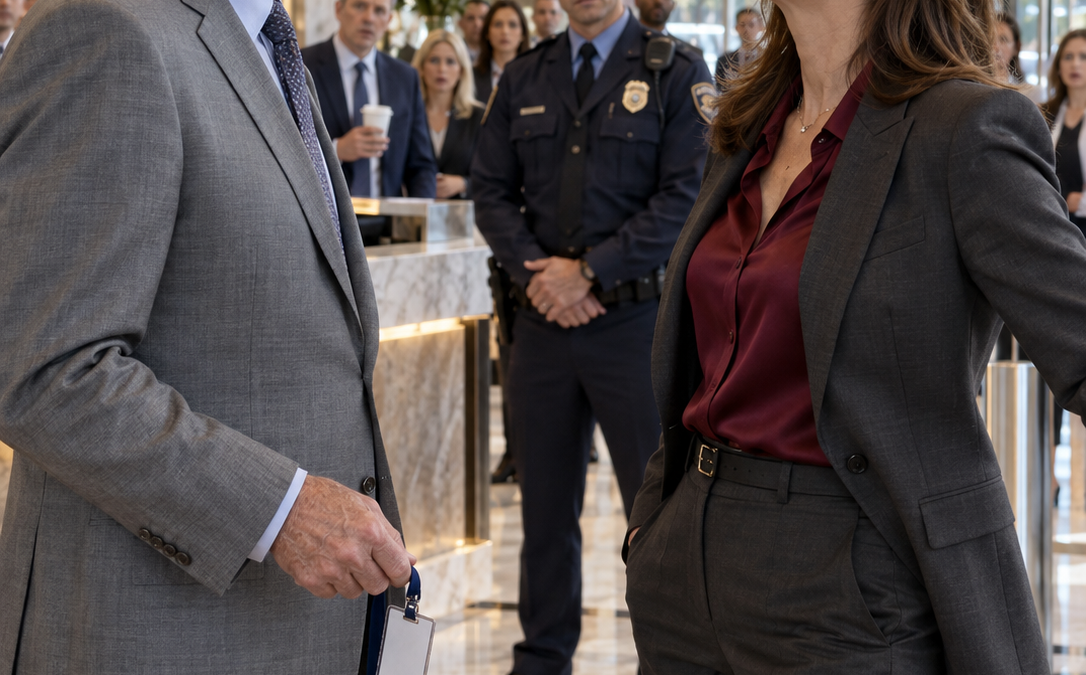
The first thing I felt wasn’t anger. It was the cold of the marble floor coming up through the soles of my shoes as three hundred people watched my own daughter-in-law tell security to walk me out of the company I’d built with my bare hands. Nobody in that lobby knew what I knew. Nobody knew that in 107 minutes, every assumption they had about power in that building was about to collapse. I just smiled, took off my badge, and said the only thing that mattered. “Don’t miss the board meeting.”
I’d walked into that lobby more mornings than I could count. Forty years of them, if I’m honest, going back to when the floor was concrete instead of marble, when the elevator groaned instead of gliding, when Reedstone Industries was four men in a warehouse in a part of Texas nobody bothered driving through unless they had to. I remember what it smelled like back then. Diesel, freshly cut steel, and coffee that had been sitting on the burner too long. I remember what it smells like now, too. Glass cleaner and ambition. Different company, same bones.
That Tuesday morning, I came in the way I always did, quiet and early. My badge still worked. It still said Hudson Reed, Senior Adviser in small gray letters beneath my photograph. A photograph that was nine years out of date because nobody had bothered to update it, and I’d never asked them to. I like being underestimated. I’ve built half my life around it.
The lobby was full when I stepped off the elevator. Not full by accident, but full because word had gone out that the new CEO was arriving for her first official day. Everybody who wanted to be seen standing in the right place at the right time had found a reason to be near the front doors at eight o’clock in the morning. I saw the flowers first. Somebody had ordered an arrangement the size of a small tree. Then I saw her.
Clare Bennett stood near the reception desk in a charcoal suit that fit her like it had been tailored that week, which it probably had. She looked good. She always looked good. That was never the problem. She had her chin up, her shoulders back, and the particular stillness of a woman who had rehearsed a moment in her head so many times that actually living it almost felt like déjà vu.
She saw me before I’d finished crossing the floor. I watched something move behind her eyes. Not surprise, exactly. She’d known I still had a badge. What she hadn’t expected, I think, was that I’d actually use it that day of all days. She had a speech ready for the room, and somewhere in the drafting of it, I’d apparently become a line she needed to deliver.
“Mr. Reed,” she said, her voice carrying across the lobby. She made sure of that. “You’re fired. Security will escort you out.”
I want to tell you I felt something sharp in that moment. Betrayal, maybe, or humiliation, the kind of thing that would make a good story all on its own. But mostly, what I felt was tired. Tired the way you get when you’ve watched a storm building on the horizon for years and it finally, finally arrives. There’s a strange relief in that, even if the storm is aimed straight at you.
Nobody in that lobby moved. You could hear the espresso machine behind the reception desk, still hissing through its cycle. Somebody’s phone buzzed in a blazer pocket and got silenced fast, almost guiltily, as though even that small sound might make things worse. I reached up and unclipped my badge. Nine years out of date, that photograph. I set it on the reception counter gently, the way you’d set down something you didn’t want to break.
“I’ll go,” I said. Then, because I couldn’t help myself, because forty years of building something teaches you exactly when to plant a flag, I added, “But don’t miss the board meeting in two hours. It’s going to be very interesting.”
She laughed. Not cruelly, but genuinely, as though I’d made a small joke at my own expense, an old man trying to save face on his way out the door. I understood why she laughed. From where she was standing, she had just watched the founder of Reedstone get stripped of his last shred of relevance in front of the entire executive floor. Why would she think anything I said still carried weight?
She didn’t know about the trust documents in Margaret’s office. She didn’t know about the voting agreements signed the year Reedstone went public, agreements that had outlived two CFOs, three general counsels, and one very painful divorce. She didn’t know that the organizational chart she’d been handed on her first day was, in the most literal sense, a work of fiction. Accurate on paper, meaningless in practice.
She knew Reedstone Industries the way you know a house you’ve only seen from the street. I knew it the way you know a house you built with your own hands, right down to which floorboard creaks, which wall isn’t quite plumb, and where the bodies are, so to speak, buried.
Clare turned to the security guard by the door, a young man named Marcus who had started three years earlier and who I happened to know had a daughter starting college in the fall. Reedstone’s tuition assistance program was quietly covering her education. Marcus looked at me, then at Clare, and didn’t move.
“That’s all right, Marcus,” I said. “I know the way out.”
I walked through that lobby one more time, past the flowers, past the faces trying not to stare, and out through the glass doors into the Texas morning. The heat hit me the way it always does that time of year. Thick, immediate, the kind of heat that makes you understand why this state builds everything to last.
My phone rang before I’d made it to the parking lot. Daniel Brooks, chairman of the board, my friend of thirty-one years, since before either of us had gray in our hair or grandchildren to worry about.
“Hudson,” he said. No greeting, straight to business, the way he always was. “Everything’s ready for the meeting.”
I checked my watch. The second hand was moving the way it always moved, steady and indifferent to whatever storms human beings decided to build around it. One hour and forty-seven minutes.
I got into my truck, an old one, the kind that makes people assume things about a man that aren’t true anymore. I sat there for a moment with the engine off, looking back at the building that carried my name on nothing but a brass plaque nobody read anymore.
I thought about Ethan. I always do in moments like that. I thought about the letter in the box at home, the one I hadn’t opened in longer than I should admit. And I thought about Clare, not the woman who had just fired me in front of three hundred people, but the girl she used to be. The one who used to call me twice a week just to talk, back before grief turned into something else entirely.
Then I started the truck and drove toward the only meeting that was going to matter that day.
People assume the hardest thing about a family business is the money. It isn’t. The hardest thing is that everyone at the table remembers who you used to be, and none of them will let you forget it. Half the time, you can’t forget it yourself.
To understand what happened in that boardroom, you have to understand what happened years before it, long before Clare ever sat behind a CEO’s desk, back when she was just Ethan’s wife and I was just a man trying to hold a family and a company together with the same two hands.
I met Clare the year Ethan brought her home for Thanksgiving. She was twenty-six and sharp as a tack, the kind of sharp that made you sit up a little straighter when she walked into a room. She’d grown up without much. A single mother, two jobs, the kind of scarcity that either breaks a person or forges them into something unbreakable. Clare had been forged.
I liked her immediately. My late wife, God rest her, used to say Clare reminded her of me at that age. She didn’t mean it as a compliment, exactly. She meant it as a warning.
I brought Clare into the company myself. Gave her a seat at meetings most executives twice her age never got invited to. I wanted her to feel like she belonged to something, because I understood what it was to grow up feeling like you belonged to nothing.
Ethan and Clare, for a few years there, people used to talk about them like they were the future of Reedstone. The next generation. I let myself believe it, too. But belief has a shelf life when two people want different things from the same company.
Clare had ideas. Aggressive ones. She wanted us to take on debt and expand fast, acquire smaller competitors before they could become threats, and trim the workforce in places she considered inefficient. Some of those places employed men and women who’d been with me since the warehouse days. She wanted decision-making pulled out of the family’s hands, entirely professionalized and modernized.
On paper, some of it wasn’t wrong. I want to be fair about that, even now. But I hadn’t built Reedstone on spreadsheets alone. I’d built it on the idea that the people who showed up for you got looked after. Debt or no debt, efficiency or no efficiency.
Ethan was caught in the middle of all of it, and I think that’s the part I regret most. He loved his wife. He loved his father. He kept trying to build a bridge between two people who both believed they were right. Bridges like that have a way of collapsing under the weight of everyone walking across them at once.
Then Ethan died.
I won’t dwell on that morning any longer than I have to, because even now, years later, there are places in my chest that haven’t healed and probably never will. A heart attack. Forty years old. No warning. No goodbye. Just a phone call that changed the shape of everything that came after it.
Grief does strange things to blame. Clare needed somewhere to put hers, and I was standing right there. She started saying I’d controlled Ethan so completely that he’d lost his own voice in that company, that the stress of trying to please me had worn down a heart that should have had forty more years in it.
I never argued with her about it. Not because she was right, but because arguing with a grieving woman about the cause of her husband’s death felt like a cruelty I wasn’t capable of.
“I lost my son,” I told her once, the only time I tried to explain myself. “I don’t want to lose someone else from this family, too.”
She left anyway. Packed up an office she’d occupied for six years and walked out of Reedstone without so much as an exit interview. I didn’t stop her. Some part of me thought space might heal what words couldn’t.
Years passed. Clare built herself a career at a rival firm, and she built it well. I’ll give credit where it’s due. She became known in the industry as someone who could walk into a struggling company and turn it around through sheer force of will. A reputation like that gets noticed.
When Reedstone hit its own rough patch, a governance crisis and some infighting on committees that should have been focused on the business instead of themselves, the board went looking for exactly the kind of turnaround executive Clare had become.
I didn’t block it. That surprised people who thought they knew me. But what none of them understood, what Clare herself never understood, was that her appointment had already been approved months earlier by a small group of controlling shareholders. And the final say in that group still belonged to me.
Because here’s the truth I’d kept quiet about for longer than I probably should have. I didn’t hold 73 percent of Reedstone under my own name. Not directly. Over the years, I’d moved my ownership into a structure my lawyers had built back during the company’s IPO. A family holding company, a voting trust, two trusts set up for future generations. Layers of paper that made public filings show a man with a modest stake in the company he founded.
On paper, I looked like a footnote in my own story. In reality, the voting control had never left my hands. Seventy-three percent, concentrated, quiet, and waiting.
I hadn’t built that structure out of paranoia. I’d built it because I’d watched other family companies get torn apart by outsiders who smelled blood the moment a founder’s name started looking small on a capitalization table. I wanted Reedstone protected long after I was gone. Protected from people who’d never sat in that warehouse with diesel in the air. Protected, and God forgive me for admitting this, even from my own family if it ever came to that.
I never imagined the family member I’d need protection from would be the young woman I once considered a daughter. But there I was, driving toward a boardroom with an hour and forty-some minutes on the clock, carrying a secret that was about to change everything Clare Bennett thought she knew about the company she’d just walked into like she owned it.
I imagine her first morning felt like a homecoming in its way. I wasn’t there to see it, but I’ve run companies long enough to know the choreography of a new CEO’s first hours, and I could picture Clare moving through it with the same certainty she’d carried since the day she walked into that lobby.
She moved into the corner office before lunch. I heard later that she had the furniture changed out entirely. My old desk, the one I’d sat behind for decades, was replaced with something sleeker, something that photographed better. I didn’t blame her for that. A person’s entitled to make a space her own. It was the rest of it that told me where her head really was.
She brought in her own management team within the first few hours. People she trusted, people from her old company, people who owed her their careers rather than owing anything to Reedstone’s history. Again, not unreasonable on its own. New leaders bring their own people. But the speed of it, the hunger in it, told a story about a woman who believed the war was already over and the only thing left to do was claim the spoils.
Then came the purge.
By the end of that first week, she’d let go of the head of human resources, a woman named Patricia who’d been with us for twenty-two years and had personally handled every difficult conversation this company had ever needed handled with grace. She fired a longtime vice president who’d mentored half the department heads currently running Reedstone’s divisions. She dismissed my old assistant, a kind, sharp young man named Tobias who’d organized my calendar for eleven years and knew where every skeleton in every filing cabinet was buried.
And she let go of two directors who’d been, in her words, “too loyal to Hudson Reed to be useful going forward.”
She said that to a room full of people. I know because three different employees called to tell me. Each of them was careful, each of them a little afraid, the way people get when they’re not sure which side of history they should be standing on.
“Reedstone needs a future,” Clare told them. “Not a living museum for Hudson Reed.”
I understand why she said it. I even understand, in some buried part of me, why she believed it. But it stung all the same, hearing it secondhand while sitting alone in a house that had gotten too quiet since my wife passed and my son followed her a few years later.
A living museum.
I turned that phrase over more than once that week, wondering if there was truth buried in it that I hadn’t wanted to see. But here’s the thing about getting older that nobody warns you about. You stop reacting the way you used to.
I didn’t call a lawyer. I didn’t fire off a statement. I didn’t call any reporters who might have loved a quote from the wounded founder. I didn’t say a single unkind word about Clare to anyone who asked, and plenty of people asked.
Instead, I went down to the basement and pulled out an old cardboard box I hadn’t opened in years. Inside were the bones of everything. The original shareholder agreements, the paperwork from when we set up the holding company, power-of-attorney documents, board minutes going back three decades, and photographs of the warehouse before it became anything worth fighting over.
Near the bottom was a letter.
Ethan’s handwriting was unmistakable, even after all that time. That particular slant he’d had since he was a boy learning cursive at the kitchen table.
Dad, if anything happens to me, don’t let my death destroy what you built.
I sat on the concrete floor of that basement longer than I want to admit, letter in hand, and let myself feel something I hadn’t allowed myself to feel in longer than I should have.
Meanwhile, up in that gleaming office, Clare was making a mistake that would bring everything to a head faster than either of us expected.
She decided to sell off one of Reedstone’s core divisions to an investment fund. A deal worth more money than most people see in three lifetimes, the kind of transaction that reshapes a company’s entire identity. It was bold. It was fast. And it required approval from a controlling group of shareholders that Clare believed, with total confidence, no longer existed in any meaningful form.
She was wrong.
One man in that building knew exactly how wrong she was.
Ryan Cole had been Reedstone’s CFO for six years. Before that, he’d worked directly under me for almost a decade. He understood the real shape of our ownership structure better than almost anyone alive, Margaret included.
When Clare brought the deal to him for financial modeling, he ran the numbers, built the projections, did everything his job required of him, and said nothing about the one detail that mattered more than any of it.
It was Clare herself who finally asked the question late one evening. The office had emptied out around them, papers from the deal spread across her new desk like a battlefield map.
“Who actually controls the remaining shares?” she asked him.
Ryan didn’t answer right away. I imagine he chose his words carefully, the way a man does when he knows something is about to change and doesn’t want to be the one blamed for the shape it takes.
“I think you should ask Mr. Reed,” he said.
Clare laughed, that same easy, dismissive laugh I’d heard in the lobby a week earlier.
“Hudson doesn’t have any power left.”
Ryan looked at her for a long moment.
“Are you sure about that?”
Two hours after Clare told security to walk me out of my own company, I walked back into that building through a different set of doors. The private entrance most employees don’t even know exists, the one that leads straight to the boardroom on the top floor.
The room was already full when I got there. Every seat was occupied, and there was the kind of tension in the air you can feel on your skin before anyone says a word.
Clare sat at the head of the table in the CEO’s chair, her back straight, a folder open in front of her. She looked like a woman who believed she was about to formalize a victory she had already won in the lobby that morning.
I walked in with nothing. No badge, no assistant trailing behind me with papers, no title anyone could see. Just an old man in a gray suit who’d been doing this longer than most people in that room had been alive.
Clare looked up at me, and something flickered across her face before she settled back into certainty.
“I don’t think you have any reason to be here,” she said, loud enough for the room to hear, the same way she’d made sure the lobby heard her that morning.
Daniel Brooks stood up before I’d even taken a seat. Thirty-one years of friendship carries a certain weight, and Daniel has never once let me carry hard moments alone.
“Actually,” he said, “Mr. Reed has quite a few reasons.”
Margaret Reed opened a thick folder at the far end of the table. I’d known Margaret since she was a young associate at the firm that helped me structure Reedstone back before it went public. In the years since, she’d become not just our general counsel, but one of the only people alive who understood the full architecture of what I’d built.
She laid it out plainly, the way good lawyers do. No drama, just facts stacked one on top of another until the picture became undeniable.
Hudson Reed did not hold 73 percent of Reedstone Industries under his own name. But Hudson Reed controlled the voting trust that did. The shares had been distributed across several legal entities over the years, a holding company and two family trusts, for reasons of estate planning and long-term protection.
Voting authority across all of them, however, had never been divided. It remained concentrated and unified, and Clare Bennett had never, at any point, been granted control over that group of shareholders.
I watched something drain out of Clare’s face as Margaret spoke. Not anger yet. Something closer to disbelief, the particular vertigo of realizing the ground you’ve been standing on was never quite as solid as you thought.
“So he’s still the controlling shareholder?” Clare asked, her voice having lost some of its earlier edge.
“Yes,” Margaret said simply.
On the screen behind her, a single line appeared in stark black text.
Total voting control: 73%.
The room went quiet in a way I don’t think I’ll ever forget. Not the tense, waiting quiet from earlier. Something heavier. The kind of silence that settles over a room when everyone realizes the story they thought they were living in has a different author than they believed.
Clare turned to look at me directly, and for a moment I saw past the CEO, past the tailored suit, past the certainty she’d walked in with. I saw the young woman who used to call me on Sunday afternoons just to talk, back when she still believed she belonged to this family.
“You hid this from me,” she said.
It wasn’t quite an accusation. It was closer to grief.
“I didn’t hide it,” I said, and I meant it as gently as I could manage in a room full of witnesses. “You just never asked.”
It was true. I think some part of her knew it was true, even as it landed like a blow. In six years of marriage to my son, in all her time working inside those walls, Clare had never once asked me directly what I actually owned. She’d assumed, the way people do when assumptions are more comfortable than questions, that my public filings told the whole story.
Here’s the thing I need you to understand about that moment, because I think it’s the part most people get wrong when they imagine how this should have gone. I had 73 percent of the voting power sitting in my hands right there in that room. Every person at that table was waiting to see if I’d use it to end her the way she’d tried to end me that morning.
I didn’t.
“I’m not here to get revenge,” I told her.
I watched her search my face for the lie in that sentence, because I think by then she’d have believed almost anything about me except mercy. She didn’t find one, because there wasn’t one to find.
Instead, I set a different folder on the table in front of her. Not the shareholder documents, but something else entirely. A summary Ryan Cole and I had put together quietly over the previous forty-eight hours, from the moment I’d learned what kind of decisions she’d been making since taking the chair.
Termination approvals. A pending asset sale that hadn’t gone through proper board channels. Contract cancellations with vendors who’d worked with Reedstone for decades. Insurance terms altered without full review. A trail of decisions made at a speed that suggested a woman who believed no one above her could stop what she was building.
I slid the folder toward her.
“Before we talk about what happens next,” I said, “I think you should see exactly what you’ve done in the last two days.”
Clare opened that folder slowly, the way you open something when part of you already suspects what’s inside will hurt. I watched her go through it page by page.
I want to be honest about what I felt in that moment, because it wasn’t triumph. I’d braced myself for triumph. Half expected it, the way you brace for weather you know is coming. It never arrived.
What I felt instead was something closer to sorrow, watching a woman I used to love like a daughter confront the shape of her own first two days in power.
The list was not small.
She’d canceled contracts with three vendors who’d supplied Reedstone since before she’d ever set foot in the building. Relationships built on decades of trust, gone in a single afternoon of cost-cutting enthusiasm.
She’d let go of key personnel whose institutional knowledge could not be replaced by anyone she’d brought in from her old firm, however talented they were. She’d begun structuring a major asset sale, moving quickly toward a deal that would have reshaped the company’s core identity without ever bringing it before the full board for proper review.
She’d committed the company to a significant debt obligation to fund the acquisition strategy she’d always believed in, the same strategy that had put her at odds with me years earlier. She’d altered insurance terms in ways that exposed the company to risks nobody in finance had signed off on.
I want to be clear about something, because it matters to how the rest of this story goes. There was no fraud in that folder. No embezzlement, no criminal intent, nothing Margaret could have taken to a prosecutor even if I’d wanted her to, which I didn’t.
What was in that folder was simpler, and in some ways harder to reckon with. It was the record of a capable, intelligent woman moving faster than her authority allowed, mistaking the absence of visible resistance for the absence of any check on her power at all.
“I could use this,” I told her, nodding toward the folder, toward the 73 percent still sitting quietly behind everything I said. “I could use the voting control right now to remove you from that chair before this meeting ends.”
She looked up at me. There was fear in her eyes, but underneath it was something more complicated. Almost relief, like part of her had been waiting for the other shoe to drop since the moment she’d had me escorted out that morning.
“So why haven’t you?” she asked.
I sat down across from her for the first time since I’d walked into that room. I took my time answering, because some answers deserve more than a quick reply.
“Because there was a time I thought of you as my daughter,” I said.
The room had gone quiet enough that I could hear the air conditioning cycling through the vents. Clare didn’t say anything. I don’t think she trusted her voice in that moment, and I understood that better than she probably realized.
I hadn’t planned to tell her what I told her next. I’d carried it for years, kept it folded away the same way I’d kept those trust documents folded away. Protected, private, mine alone to hold. But something about watching her face in that meeting, stripped of the armor she’d walked in wearing, told me it was time.
“Before Ethan died,” I said, “he knew things weren’t right between the two of you. He came to me. Told me the marriage was struggling.”
I paused, feeling the weight of the next part even before I said it.
“He told me you weren’t a bad person, Clare. He said you were just terrified of losing everything again. That you’d spent your whole life building yourself out of nothing, and some part of you never stopped believing it could all be taken away in an instant.”
I watched her come undone at that, quietly, the kind of crying people do when they’re trying very hard not to, especially in front of a room full of colleagues.
I’d never told her that conversation existed. I’m not entirely sure why I’d kept it from her for so long. Grief does strange things to a man’s judgment. Makes him hoard the last words of the people he’s lost, like they might run out if he shares them too freely.
She wiped her eyes, and when she looked back at me, there was something raw in her voice.
“Then why have you always fought against me?”
“Because I watched you try to build a life where you’d never need anyone again,” I said. “And I’ve lived long enough to know that kind of life eventually turns into a very lonely victory.”
Nobody in that boardroom moved. Daniel had his hand pressed to his mouth. Margaret was watching Clare with an expression I hadn’t seen on her before, something maternal breaking through decades of professional composure.
Here’s the part that surprised even the people who thought they knew me best. I told Clare I didn’t want her gone from Reedstone. I wanted her to stay as CEO, but not the way she’d been running things for the past two days. Unchecked, unquestioned, operating like the only voice in the building that mattered was her own.
I laid out what that would require.
The pending asset sale needed to be unwound immediately. The employees terminated outside proper process needed to be offered their positions back, with full back pay for the time they’d lost. The true structure of voting control, my control, needed to be disclosed transparently to the board and, in appropriate form, to the shareholders at large.
Going forward, there would be an independent oversight committee with real authority, not a rubber stamp, standing between any CEO and decisions of that magnitude.
Clare sat with all of it in silence for a long moment, the folder still open in front of her, her own two days laid bare on the table between us. I could see the decision working behind her eyes. Watching her, I understood that whatever she chose next wasn’t going to come easily. Not from a woman who’d spent her whole adult life refusing to owe anyone anything.
She refused before I’d even finished laying out the terms.
I watched her close that folder, straighten her spine, and rebuild the armor I’d just spent twenty minutes watching crack open. It happened fast, the way it does with people who’ve learned to survive by never staying vulnerable for very long.
“I don’t need you to save me,” she said, standing up from the table.
I understood that reflex better than she probably realized. I’d spent my own life building something so nobody could ever again make me feel small. I recognized the shape of that same instinct in her, even dressed up in different words, even thirty years younger than mine.
“I’m not saving you,” I told her, staying calm, staying seated while she gathered herself to leave. “I’m protecting a company my son loved.”
It landed the way I knew it would. Not as cruelty, but as truth. And truth has a way of hurting worse than anger ever could.
She didn’t respond. She just walked out of that boardroom, past Daniel, past Margaret, past a dozen executives who didn’t know where to look. The door closed behind her with a sound too quiet for a moment that heavy.
I didn’t chase her. Some things a person needs to sit with alone.
What I didn’t know, what none of us knew that afternoon, was that Clare would spend the next several days doing something I hadn’t expected. She went digging. Not for ammunition against me. Not at first, anyway. She went looking through old records, old filings, trying to understand exactly how deep that structure of mine ran, trying to find the edges of a story she’d apparently never bothered to ask about before.
Somewhere in those files, she found something that changed the shape of everything between us.
After Ethan died, there had been a tax matter connected to his shares in the company. A complicated one, the kind of thing that happens when a man passes suddenly without every piece of his estate planning fully buttoned up.
I’d handled it quietly. Paid what needed to be paid, worked with Margaret to make sure the obligation was resolved cleanly, and made certain that Clare’s financial interest in what Ethan had left behind wasn’t diminished by a bureaucratic mess she’d never even known existed.
I never told her.
I want to be honest about why. Part of it was pride, the old-fashioned kind that doesn’t like announcing its own good deeds. But if I’m being fully honest with myself, part of it was also that I didn’t think she’d believe me. By that point, we’d been on opposite sides of an invisible war for long enough that any kindness from me would have looked to her like another kind of manipulation.
She found the paperwork late one night, according to what she told me later. She was sitting alone in an office that used to be mine, going through old files with the particular loneliness of someone trying to reconstruct a story she’d gotten wrong for years.
She started to see it differently after that. Not all at once. Understanding like that rarely comes all at once. But piece by piece, she began to realize that I hadn’t taken anything from Ethan’s legacy. I hadn’t blocked her path into the company out of spite. I’d protected the very inheritance she believed I’d tried to steal from her, and I’d done it without asking for credit, without asking for anything at all.
What I’d never done in all those years was explain myself.
That was my failure, and I’ve made my peace with owning it.
She came to find me a few days later, not at the office, but out at the old plant, the first real facility we ever built. It had long since been replaced by newer buildings, but I’d kept it standing because I couldn’t bring myself to tear it down.
I go out there sometimes when I need quiet. I think some part of me hoped she might come looking for me somewhere that still smelled like where this all started.
She found me standing near the loading dock, hands in my pockets, looking at a building that had outlived its usefulness and somehow still meant everything to me.
“Why didn’t you tell me?” she asked.
Her voice had none of the sharpness from the boardroom. Just something tired, something honest.
“Because sometimes people don’t want to hear the truth from someone they’ve already decided to hate,” I said.
She looked down at the gravel between us for a long moment. When she looked back up, her eyes were wet.
“I tried to make you lose everything.”
She said it without an excuse. Without a defense. It was just an admission, plain and unadorned, the kind that costs a person something to make.
“I know,” I said.
“You don’t hate me for it?”
I thought about Ethan. Then I thought about the letter in that box at home, the conversation he and I had before he died, and the years I’d spent since burying my grief in silence instead of words.
I thought about how much time two people can waste guarding themselves against each other when what they actually need is exactly the opposite.
“I already lost my son,” I told her. “I don’t want to lose someone else, too.”
She didn’t say anything after that. She just stood there in the gravel lot outside a building neither of us had set foot in for years. And for the first time since Ethan’s funeral, I felt something between us that wasn’t a wall.
The board reconvened the following week, and this time there was none of the theater that had defined our first meeting. No badges tossed on counters, no ultimatums delivered for an audience. Just a room full of people trying to figure out how to build something sturdier than what had come before.
The vote went the way I’d hoped it would, though I want to be honest. I didn’t know for certain it would go that way until the moment it did.
Clare stayed on as CEO, but the company around her had changed shape in ways that would outlast either of us.
Any sale of major assets now required full board approval. No exceptions, no matter how urgent the opportunity seemed. The true structure of voting control, my control, was disclosed openly. No more shadows in the filings. No more fiction dressed up as fact.
The CFO’s office and an independent audit committee were given real teeth, the kind of authority that could have stopped what nearly happened before it ever got that far. Every employee let go outside of proper process was offered their position back, with the company making good on what they’d lost in the meantime.
And Clare would work alongside me going forward. Not as someone reporting to a subordinate adviser, but as someone accountable to a majority shareholder who had every intention of staying involved.
After the vote, she found me in the hallway outside the boardroom.
She had my old badge in her hand, the one I’d set on the reception counter that first morning. The one that apparently nobody had thrown away.
She held it out to me.
I didn’t take it.
“I don’t need that badge anymore,” I told her.
“Then what do you want?” she asked.
There was something genuinely open in the question. Not the guarded version of Clare I’d been dealing with for years, but something closer to who she’d been before grief and ambition had hardened her.
I looked past her down the hallway to where a photograph of Ethan still hung near the elevators. Something the facilities team had never taken down, and something I’d never asked them to.
“I want us to run this company, for the first time, for the people who actually work here,” I said. “Not for either of our egos.”
She didn’t answer right away, but she didn’t argue either. After everything, that felt like its own kind of answer.
A year passed after that.
Reedstone found its footing again, steadier this time, built on a foundation that could actually hold weight instead of one balanced entirely on my willingness to stay quiet.
Clare grew into the kind of CEO I think she’d always had the capacity to be, once the fear driving her had loosened its grip a little. More careful, more willing to ask questions instead of assuming she already had the answers.
I still attended board meetings. Still kept my seat at that table. But I stopped reaching for control the way I once had.
The company didn’t need a founder hovering over every decision anymore. It needed people who trusted each other enough to disagree honestly and still show up the next morning.
Clare and I didn’t become father and daughter again overnight. I want to be honest about that, because I think stories like ours get flattened too easily into something neater than real life actually offers.
What we built instead came in small pieces. A phone call here, a dinner there. The kind of slow rebuilding that doesn’t make for dramatic television but is, I’ve come to believe, the only kind of healing that actually holds.
One of those small pieces happened on a quiet afternoon almost exactly a year after that first boardroom confrontation.
Clare asked if I’d come with her to visit Ethan’s grave.
I hadn’t been in months, the kind of avoidance grief teaches you without ever announcing itself as avoidance.
We drove out together, mostly in silence. She set a small bundle of flowers at the base of his headstone while I stood beside her with my hands in my pockets, the same way I’d stood outside that old plant the day she found the truth about the tax matter.
“He wouldn’t have wanted us to keep fighting,” she said.
“No,” I agreed. “But maybe he wanted us to learn how to forgive each other.”
She reached over and took my hand, and we stood there together for a long while. Two people who’d spent years treating each other as enemies in a war that neither of us had actually wanted to fight.
I looked at his name carved into that stone, and I thought about something I hadn’t let myself think clearly in years.
I’d spent so long believing that holding on to 73 percent was what kept me safe, what kept anyone from ever taking away what I’d built with my own hands. And in a way, it did keep the company safe.
But somewhere along the way, I’d let that same instinct convince me that safety and isolation were the same thing.
They’re not.
I understand that now, standing in a cemetery with my son’s name above me and my former daughter-in-law’s hand in mine.
Holding on to a company, it turns out, is the easy part. Holding on to a family after pride has already done its damage, that’s the fight that actually matters.
If this story moved something in you, if it made you think about your own family, your own pride, or the people you’ve held at arm’s length longer than you probably should have, I’d love to hear about it.
Drop a comment and let me know where you’re watching from tonight. We share stories like this one every single day, so if you don’t want to miss the next one, go ahead and hit subscribe.
Let’s keep walking through these stories together.








