“Who asked you to speak?” my sister snapped. my father turned to me: “let her finish.” so i went quiet. then the admiral set down his glass. he looked straight at me. “commander whitaker…” the room went dead silent.
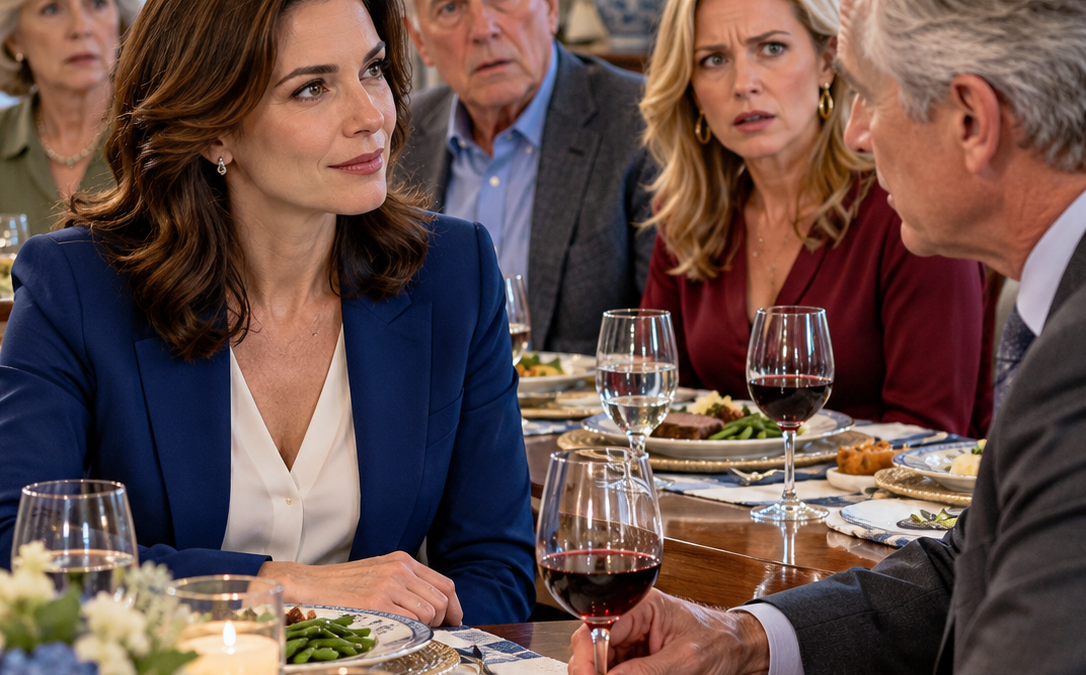
“Who asked you to speak?”
My sister didn’t raise her voice. She didn’t have to. Allison had a way of saying something cruel in the same tone other people used to ask for more bread. My father looked at me across the table. He did not tell her to back off. That part mattered.
Rear Admiral Thomas Keane sat three seats away, one hand resting near his wineglass. He had been listening to my father talk for almost ten minutes about a naval engagement that had happened the year before. I had been listening, too, mostly because I had nowhere polite to go. My mother had spent the afternoon making roast beef, potatoes, green beans, and enough food to support a small amphibious landing. Walking out before dessert would have created a second incident report, so I stayed in my chair.
My father, Robert Whitaker, was seventy-four and had been retired from the Navy for years. He had also never completely stopped being a Navy captain. Retirement had removed the uniform. It had not removed the briefing voice.
“You look at the sequence,” he was saying. “The destroyer changes position after the tactical picture is already developing. That tells you something.”
Admiral Keane gave a small nod. Not agreement. Just the kind of nod people use when they want you to keep talking without encouraging you too much.
My father took it as agreement. Of course he did.
Allison leaned forward. She was forty-six, an attorney, and very good at what she did. She was also very good at sitting beside my father and making his opinion sound like a conclusion reached by a committee.
“So you think the commanding officer reacted late?” she asked.
“I think the commanding officer reacted instead of anticipated.”
There it was. My father’s favorite kind of sentence. Short, clean, final.
Allison glanced at Admiral Keane. “That seems pretty basic.”
Keane looked at her. “Basic things can become complicated quickly.”
She smiled. “Sure, but command is command.”
I looked down at my plate. That was when I knew this conversation was going to get worse. My mother, Margaret, knew it, too. She started moving food around with her fork, even though she had stopped eating five minutes earlier.
Dad kept going. “The ship had a job in the screen. It was in position. Then the situation changes, and suddenly it moves. You don’t wait for the problem to become obvious.”
Keane said nothing.
“The CO should have seen it sooner,” Dad continued. “That’s what experience is for.”
I took a sip of water. Allison noticed. She always noticed when I was trying not to say something.
“You disagree?” she asked.
I looked at her. “I didn’t say anything.”
“You made the face.”
“What face?”
“That face you make when you think Dad is wrong.”
Dad sighed. “Allison, again?”
Not a warning to her. More like a request to keep the family entertainment within reasonable limits.
I set my glass down. My father looked at me.
“Well?”
I could have let it go. I had let worse things go. That had become a habit in our family. Allison would explain me. Dad would correct me. Mom would look uncomfortable. I would decide the argument wasn’t worth the energy.
Everybody got what they wanted. Nobody had to change.
“I don’t think that’s what happened,” I said.
Allison leaned back. Dad’s eyebrows moved slightly.
“What do you mean?”
“The public account doesn’t show the whole tactical picture.”
My father gave me the patient look he had used on me since I was sixteen.
“Dana, public reporting never shows the whole tactical picture.”
“I know.”
“Then you understand my point.”
“No. I understand why you reached it.”
That got Allison’s attention. Dad put down his fork.
“And I think the conclusion is wrong.”
There was a quiet second. My mother looked at me now. Keane did, too. My father leaned back in his chair.
“Based on what?”
I should tell you something about my father. He loved that question.
Based on what?
It sounded reasonable, professional, fair. But in our house, it usually meant, Give me your evidence so I can tell you why it doesn’t count.
“The ship had information you don’t have from the public summary,” I said.
Dad almost smiled. “That is always true.”
“Yes.”
“So again, what are you basing this on?”
“The movement wasn’t hesitation.”
Allison gave a short laugh. I looked at her. She held up one hand.
“Sorry.”
She was not sorry.
Dad continued. “You’re assuming intent from movement.”
“No.”
“Then what are you saying?”
“I’m saying the ship repositioned because the defensive picture was changing.”
“That’s exactly my point.”
“No, Dad. Your point is that the CO noticed too late.”
“And you believe otherwise?”
“Yes.”
He looked toward Keane as if the admiral might referee this for him. Keane did not help. My father turned back to me.
“You’ve had your own command. You know how this works. Sometimes the hardest thing after an event is admitting a commander should have acted sooner.”
I felt something tighten behind my ribs. Not anger. Not yet.
“You’re right about that.”
Allison gave me a look that said, Good. We’re done.
I continued. “But that isn’t what happened here.”
Her expression changed.
“Dana, the ship wasn’t late? You don’t know that.”
“I do.”
Allison laughed again. This time she did not bother pretending it had slipped out.
“You do?”
“Yes.”
“From what? A report?”
I said nothing. She looked at Dad.
“See? This is what I mean.”
My father rubbed two fingers against his temple.
“Allison, let her finish.”
For half a second, I thought he was actually helping me. Then he looked at me.
“But make your point, Dana. We don’t need a seminar.”
There it was. My sister interrupted me. I was the one being told to keep it short.
Some family traditions survive everything.
I looked toward Admiral Keane. His expression had changed, only a little. He was no longer watching my father. He was watching me.
Allison kept talking. “You had one command tour, Dana. That doesn’t make every Navy conversation your briefing room.”
“I didn’t say it did.”
“You’re doing it right now.”
“I’m correcting one fact.”
“You’re turning dinner into an argument.”
“No. I said the ship wasn’t late, and Dad disagrees. That doesn’t make him right.”
My father’s jaw tightened. “Dana.”
Allison leaned toward me.
“Seriously, who asked you to speak?”
The table went quiet. My mother stopped moving her fork. Dad looked irritated, but mostly at me. I had seen that look before. It said I was supposed to make this easier. Smile. Drop it. Let Allison have the last word, because Allison always knew how to end a disagreement in a way Dad preferred.
I looked down at my plate.
“Fine.”
Keane set his wineglass on the table. The sound was small. Still, everybody heard it.
He didn’t look at Allison. He didn’t look at my father. He looked directly at me.
“Commander Whitaker.”
Allison stopped moving. My father’s eyes shifted toward him.
Keane waited until I looked up. Then he said, very calmly, “Do you want to tell them whose ship they’re talking about?”
My father turned toward me. For once, he had no answer ready.
I held my father’s stare, and for a second, I was seventeen again, standing in the same house with a Navy ROTC letter in my hand.
Back then, Allison was already good at being the daughter my father understood. She was three years older than me. She liked debate, student government, and anything with a podium. She could walk into a room, figure out who mattered, and make that person feel interesting.
My father loved that. He called it confidence.
When I asked too many questions, he called it attitude.
That was our basic family math. Allison was capable. I was difficult.
Nobody sat us down and announced those roles. You just hear the same description often enough, and eventually everybody starts acting like it’s official.
When Allison won a regional debate competition, Dad called my uncle in Ohio that night. He gave him the whole story: what the final topic was, how Allison handled cross-examination, which judge complimented her afterward.
A year later, I won a statewide history competition. Dad looked at the certificate and asked how many students had entered.
I told him.
He nodded. “Not bad.”
That was it.
My mother, Margaret, waited until he left the kitchen. Then she touched the blue ribbon and said, “I’m putting this on the refrigerator.”
“Dad hates stuff on the refrigerator,” I said.
“I know.”
She put it there anyway.
That was Mom. Small acts of rebellion, usually when Dad was in another room.
We lived in Hampton Roads, so the Navy was everywhere. You could see gray hulls from the road. You could hear jets overhead. Half the adults at school events either wore a uniform, used to wear one, or were married to someone who did.
Dad had been a surface warfare officer. By the time I understood rank, I also understood that Captain Robert Whitaker liked being called Captain Robert Whitaker, even at a backyard cookout.
He had served on several ships and commanded one earlier in his career. Ship plaques covered one wall of his study. His old combination cover sat in a glass case like it might be recalled to active duty.
I loved hearing his sea stories.
That was the problem.
I didn’t just admire them. I asked questions. Why did the ship maneuver that way? Why did the captain choose that option? What happened when two officers disagreed?
Dad would answer the first question. By the third, he usually said, “You’re missing the point.”
Allison never missed the point. She knew the point was that Dad wanted to finish the story.
When I was fifteen, he took us to Norfolk for an event connected to an old shipmate. I remember standing near the waterfront and watching a destroyer come in.
Nothing dramatic happened. No band, no cheering crowd. Just sailors working lines, people on the pier doing their jobs, and a gray ship moving exactly where it was supposed to move.
I watched longer than everyone else.
Allison noticed.
“Oh, no,” she said.
“What?”
“You’re thinking.”
“I do that sometimes.”
“Dangerous habit.”
Dad came over and asked what we were looking at. I pointed toward the ship.
“What does it take to get command of one of those?”
He looked at me. Not the ship.
“You don’t start by asking about command.”
“I know. You start by learning the job.”
“I know that, too.”
His face tightened. “Then why ask?”
“Because I wanted to know.”
Allison stepped in. “She’s not challenging you, Dad.”
I looked at her. “I wasn’t.”
She gave me the look older sisters give when they believe they have just prevented an international incident.
On the drive home, Dad talked about the difference between wanting responsibility and wanting status. The lecture lasted twenty-two minutes. I know because Allison timed it. She showed me her phone when he wasn’t looking.
I almost laughed.
That was the strange part about us. Allison could be funny, protective even. She also had a habit of translating me for people who had not asked for translation.
By high school, she had turned that habit into a skill.
At dinner, someone would ask what I wanted to study.
Allison would say, “She’s still figuring it out.”
I would say, “Actually—”
Then Dad would ask Allison about law school applications.
Conversation over.
The truth was, I had already applied for a Navy ROTC scholarship. I told Mom first.
We were standing in the kitchen when the acceptance letter came. She read it twice. Then she looked at me and smiled.
“You knew this was what you wanted for a while.”
“Yes.”
“Does your father know?”
“No.”
“Does Allison?”
“No.”
Mom folded the letter. “You should tell them.”
I looked toward Dad’s study. “I will.”
I waited six days.
Not because I was afraid he would say no. He couldn’t. I was eighteen, and the scholarship was mine.
I waited because I knew exactly how a good thing could become an evaluation in our house.
Finally, after dinner, I put the letter in front of him. Dad read the first page, then the second. He looked up.
“Surface warfare?”
“Yes.”
“That’s a harder road than you think.”
“I know.”
“No, you don’t.”
Allison was sitting at the other end of the table. Mom was near the sink. Nobody said anything.
Dad tapped the paper once.
“Why this?”
“Because I want ships.”
“That’s not an answer.”
“It is to me.”
His expression changed. Not angry. Disappointed that I had not given him an answer he considered serious enough.
He pushed the letter back across the table.
“Well, if you’re going to do it, don’t do it halfway.”
That was my congratulations.
Mom hugged me later. Allison came into my room while I was packing. She sat on the edge of the bed and watched me roll T-shirts into a duffel bag.
“You know Dad,” she said.
“That seems to be the family consensus.”
She ignored that. “You don’t always have to prove him wrong.”
I stopped packing. “I’m not trying to prove him wrong.”
Allison shrugged. “Okay.”
She meant she did not believe me.
I zipped the bag.
Before sunrise, I carried it downstairs, hugged Mom, shook Dad’s hand because that was easier than hugging him, and found Allison by the front door.
She moved aside.
“Call Mom,” she said.
“I will.”
“And try not to argue with every officer you meet.”
I looked at her. “No promises.”
That got a laugh out of her.
I put the duffel in the trunk, got behind the wheel, and pulled away while the house was dark. The highway opened up in front of me, and for the first time I could remember, nobody in the car was explaining me to anyone.
That felt strange. Also good.
Mostly good.
I went through college on the ROTC scholarship, earned my commission, and entered the surface warfare community with enough confidence to be dangerous and not enough experience to know it.
The Navy fixed that quickly.
My first ship taught me that wanting responsibility and being ready for it were not the same thing. Dad had been right about that. I hated admitting it.
I was a junior officer with a new uniform, fresh qualifications to earn, and a strong belief that preparation could solve almost anything.
Then I stood watch at two in the morning and discovered the ocean had not read my study guide.
One night, we were operating in crowded water with the weather getting worse. Nothing dramatic. No missiles, no explosions. Just traffic, bad visibility, and too many small decisions arriving at the same time.
I had the watch. A contact changed course. The officer beside me asked for my recommendation.
I had one. I just wanted another thirty seconds to make sure it was perfect.
The executive officer happened to be on the bridge. He waited. I kept checking information.
Finally, he said, “Lieutenant Junior Grade Whitaker, are you planning to make a recommendation tonight?”
I gave it. He approved the action. Then he turned to me.
“You had that answer thirty seconds ago.”
“Yes, sir.”
“Why didn’t I hear it?”
“I wanted to confirm—”
“With what?”
I had no good answer.
He nodded once. “You won’t always get certainty before you owe the ship a decision.”
That sentence bothered me for days, mostly because it was useful.
I had grown up believing that being corrected meant losing ground. On the ship, I started learning something else. Sometimes correction meant somebody expected you to get better.
Master Chief Gabriel Ortiz helped with that lesson.
Ortiz had been in the Navy longer than I had been legally allowed to drive. He was not warm. He was not inspirational. He also had absolutely no interest in my feelings when they interfered with the work.
A few days after the bridge incident, he found me reviewing notes in the wardroom.
“You’re still mad about the XO?”
“I’m not mad.”
He stared at me.
Ortiz had a very efficient stare. It could save several minutes of conversation.
“Fine,” I said. “I didn’t like being corrected in front of everybody.”
“Was he wrong?”
“No.”
“Then learn faster than your pride.”
He picked up his coffee and left.
That was mentorship, Navy style. No hug, no quote printed on a coffee mug. Just enough truth to ruin your afternoon.
I learned. I qualified. I made mistakes that did not make me special, and I survived the embarrassment of discovering that other people sometimes knew more than I did.
That was useful, too.
The more responsibility I got, the less interested I became in looking impressive. Looking impressive is expensive. You spend too much time protecting it.
Knowing your job works better.
I became a division officer, then a department head. I spent long days learning equipment, people, maintenance schedules, inspections, and the thousand small things that never appear in recruiting commercials.
I also learned crews could tell very quickly when an officer was pretending. You could bluff your way through a family dinner. A ship was less forgiving.
At home, Allison’s life was moving fast, too.
She went to law school, passed the bar, and joined a respected firm in Virginia. Then she got good enough that people stopped introducing her as Robert Whitaker’s daughter.
Dad loved that. So did I.
That part matters.
My sister was not pretending to be successful. She was successful. She worked hard. She handled pressure well. She could remember names, details, birthdays, job titles, and exactly which story to tell at a dinner without making anyone uncomfortable.
I once forgot the name of a man I had worked beside for four months. Allison remembered the wife of a city councilman she had met once at a fundraiser.
Different skill sets.
Dad understood hers better.
Whenever I called home, he wanted updates. Just short ones.
“How’s the ship?”
“Good.”
“Qualified yet?”
“Yes.”
“Good.”
Then Allison would get on the phone and tell him about a case. He asked questions. Real questions.
What did the client want? What was opposing counsel arguing? What did the judge say?
I noticed the difference. I told myself I did not care.
That was mostly true on weekdays.
Holidays were harder.
At Thanksgiving one year, I called from the ship. Allison answered.
“Hey, sailor.”
“Hey, lawyer.”
“You eating?”
“If we use the word loosely.”
She laughed. “Dad says the stuffing came out perfect.”
“Dad has never made stuffing.”
“He supervised.”
“Of course he did.”
For a few minutes, we sounded like sisters again.
Then Dad took the phone.
“You keeping busy?”
“Yes.”
“Good. Busy sailors don’t get stupid.”
That was apparently his holiday message.
I smiled anyway. “Happy Thanksgiving, Dad.”
“You, too.”
The call ended. I stood there staring at the bulkhead for a second, then went back to work.
That became the pattern.
I stopped bringing home anything that required explanation. A new qualification became work’s going well. A difficult inspection became busy week. A strong evaluation became nothing at all.
Allison filled the empty space.
If relatives asked what I was doing, she answered.
“Dana’s on another ship.”
“Dana’s working staff right now.”
“Dana’s doing her Navy thing.”
None of it was exactly false. That made it harder to object.
Years passed. I made lieutenant commander, then commander. I became an executive officer and discovered there is no faster way to understand a commanding officer than to spend every day one office away from one.
Good decisions looked less dramatic up close.
Most of them were built from preparation, advice, timing, and the willingness to own whatever happened after the order left your mouth.
Ortiz, by then a master chief I trusted enough to annoy regularly, caught me hesitating during a maintenance casualty that threatened to disrupt a major schedule.
The team had options. None were perfect.
People were waiting.
I asked one more question.
Ortiz looked at me.
I knew that look.
I made the call. We shifted the plan, isolated the problem, and kept the situation from becoming worse.
Afterward, I found him near the passageway.
“You had something to say.”
“No, ma’am.”
“That has never stopped you before.”
He took a sip of coffee.
“You finally stopped waiting for the room to agree with you.”
I stared at him. “That was almost nice.”
“Don’t get used to it.”
A few months later, my phone rang while I was walking toward the pier. The assignment news was official. Executive officer, a job that put me directly on the path toward command.
I called my mother first.
She went quiet when I told her. Then she said, “Dana, that’s wonderful.”
I smiled. “Thanks, Mom.”
“You’re going to tell your father?”
I looked at his name in my contacts. My thumb hovered over it.
Sailors were already moving along the pier ahead of me, and somebody was shouting about a line that needed to be shifted.
“I will,” I said.
I put the phone back in my pocket and walked toward the ship.
I was halfway up the brow when Mom called again.
“Dana.”
I stopped near the quarterdeck. “Yeah?”
“You said you’d tell him.”
“I know.”
“That sounded like ‘I know, Mom,’ which usually means you’re not going to do it.”
I smiled. “You know me too well.”
“That is literally my job.”
I looked toward the ship. “All right. I’ll call him tonight.”
I did.
Dad congratulated me on becoming executive officer. He even sounded pleased.
“That’s a serious job,” he said.
“It is.”
“You’ll learn a lot watching the CO.”
“I already am.”
“Good. Pay attention.”
I almost laughed.
There was my father. Even when I moved forward, he found a way to place himself one step ahead of me.
Still, the call went better than I expected.
For a while, that was enough.
My relationship with Allison was harder to measure. She never attacked my career directly. That would have been too obvious.
Instead, she became the person who explained it.
At family dinners, someone would ask me where I was stationed.
Allison answered. “Dana’s shoreside for a while.”
I would say, “For now.”
She would smile. “See? Navy answer.”
Everybody laughed. Nothing terrible happened.
That was why it worked.
A single joke is harmless. A hundred small jokes can turn into a job description.
Allison was good at that.
She did it with Dad, too. If he asked what I was working on, she would say, “She’s back in the planning world.”
If a cousin asked whether I was going to sea again, Allison would say, “Eventually. She likes making us guess.”
Sometimes the answer was close enough. Sometimes it was wrong.
I corrected her less and less.
That was on me.
The easier choice became the automatic one.
Let it go. Change the subject. Get through dinner.
Allison’s own career kept getting stronger. She made partner at her firm. She handled difficult commercial cases. She started sitting on nonprofit boards and showing up at Navy League events, because Hampton Roads had a talent for putting lawyers, retired officers, defense contractors, and elected officials in the same hotel ballroom.
She was good in those rooms.
Very good.
I watched her once at a reception and realized she remembered the name of a retired admiral’s wife after meeting her one time six months earlier.
I could not remember where I had left my coffee that morning.
Again, different skill sets.
Dad admired hers. He liked hearing Allison talk about negotiations and clients. He would lean forward, ask follow-up questions, challenge her sometimes, then listen to the answer.
With me, his questions often became comparisons.
“What class is your ship?”
I would answer.
“We had an older setup when I was in.”
Or, “How are your people handling maintenance?”
I would start explaining.
“We never had enough maintenance money either.”
The conversation always found its way back to his Navy.
I stopped fighting it.
Then I was selected for command.
That news was different.
Even I could not reduce it to work’s busy.
I called Mom, then Dad, then Allison.
Dad was quiet for a second after I told him.
“Command at sea?”
“Yes.”
“What ship?”
I gave him the name. He repeated it. Then he said, “Congratulations.”
No correction. No lecture.
Just that.
I waited.
He added, “Big responsibility.”
There he was.
But I took it.
“Thanks, Dad.”
Allison called me later.
“So, you finally get your ship.”
“That is one way to put it.”
“What’s the other way?”
“That the Navy has made a terrible administrative error.”
She laughed. “Now, that sounds like you.”
For a few minutes, we were fine.
She asked when the change of command would be. I told her. She said she would check her calendar.
Dad said the same thing.
Neither came.
There were legitimate reasons.
Allison had a trial schedule that shifted. Dad had already committed to a reunion with former shipmates. Mom wanted to come, but travel had become harder on her knees, and I told her not to make herself miserable just to sit in folding chairs near a pier.
Nobody abandoned me. Nobody betrayed me.
Life happened.
I understood that.
I still noticed the empty seats.
The morning of the ceremony was windy. My crew stood in formation. Orders were read. The outgoing commanding officer spoke.
Then responsibility transferred.
There is no clever version of what that feels like.
You look at a warship and understand that hundreds of people are now waiting for your decision to be good enough.
Not perfect.
Good enough. Fast enough. Informed enough.
The engineering plant, weapons, navigation, maintenance, training, safety, discipline, families waiting at home.
None of it cared whether Robert Whitaker thought I had command presence.
That helped.
After the ceremony, Mom called.
“I saw the pictures already. One of your friends sent them.”
“That sounds like a security problem.”
She ignored me.
“You looked happy.”
“I was terrified.”
“You didn’t look terrified.”
“That’s because the Navy paid for the uniform.”
She laughed.
I sent her one photograph I liked. It showed me near the brow with the ship behind me.
Mom forwarded it to Dad.
I found that out later.
He was in his study when she showed him. He glanced at her phone and said, “I’ll look at it later.”
He forgot.
Mom did not bring it up again.
At the time, I did not know any of that.
I only knew Allison texted me that evening.
How did your big day go?
I sat in my cabin and stared at the message.
I typed: It was incredible. I wish you could have seen the crew. I don’t think I understood how heavy this would feel until today.
I read it.
Deleted it.
Typed again.
Long day. Good people. Still processing.
Deleted that, too.
Finally, I wrote: Good.
She sent back: Glad to hear it.
That was the whole conversation.
I told myself she could have asked another question.
She could have.
I could have given her more than one word.
Both things were true.
The next time I came home, a family friend congratulated me over dinner.
“Captain of your own ship now.”
Before I could answer, Allison smiled.
“Commanding officer. Her rank is commander.”
Technically correct.
Dad nodded. “People mix that up all the time.”
The friend looked embarrassed.
I said, “It’s fine.”
Allison turned to me. “What? I was helping.”
“I know.”
And I did know.
That was the problem.
She probably believed it.
Later that night, Mom asked why I had gone quiet.
“I wasn’t quiet.”
She gave me the same look Ortiz used when I lied badly.
“Fine,” I said. “Allison does this thing where she makes everything smaller by explaining it.”
Mom sat beside me at the kitchen table.
“Have you told her that?”
“No.”
“Why?”
“Because then we’ll spend an hour arguing about whether she does it.”
Mom almost smiled. “That does sound like Allison.”
I picked up my glass.
“So I save an hour.”
Mom did not laugh.
Neither did I.
My phone buzzed with a message from the ship.
I read it once, stood up, and reached for my keys.
The message was short.
Return to the ship.
I was already moving before I finished reading it.
By the time I reached the pier, the crew had shifted into that different kind of focus you feel before anyone says the word serious.
People spoke less. They moved faster.
Nobody needed a speech.
We were operating with a larger naval formation in a region where the threat level had been high for days. That alone did not make every contact an emergency. It just meant nobody got lazy.
The combat information center was already building the picture when I came in.
My tactical action officer gave me the update.
Multiple airborne tracks.
Some were known. Some were not.
The air defense team was working identification and coverage.
I listened, asked questions, and looked at the display.
The first thing I learned as a junior officer was that information arrives in pieces.
The second was that people still expect decisions before the pieces feel complete.
Our destroyer was in a position that gave us a solid defensive posture.
That mattered.
It also was not the only thing that mattered.
The formation had a high-value unit farther behind us, and the threat picture was shifting in a way that could create a weak sector if we stayed exactly where we were.
The team saw it.
Not one person. Not me alone.
The TAO called out the concern first. The air defense officer backed it with what she was seeing. Navigation confirmed what a reposition would require. Engineering gave us the maneuvering limits.
Everybody had part of the answer.
My job was to decide what we were going to do with it.
“What do we gain if we move?”
The TAO pointed to the coverage change.
“Better geometry on this side, ma’am.”
“What do we give up?”
“More exposure here.”
He did not soften it.
Good.
I hated softened answers.
I asked the air defense officer about her confidence.
High enough to recommend the move.
Not certainty.
Recommendation.
There is a difference.
I looked at the timeline.
We did not have long.
Nobody said ninety seconds. Nobody started a countdown. The tactical window was simply getting smaller while we talked.
I could keep the ship where she was.
That was not a stupid option.
It was defensible. It protected my crew better in one part of the threat picture and kept us where the formation had originally expected us to be.
Or we could reposition.
That improved coverage where the formation was becoming weaker.
It also put us closer to the problem.
I asked one more question.
“Any reason not to execute now?”
The bridge came back first.
“No, ma’am.”
Engineering followed.
“No restriction.”
The TAO looked at me.
“Recommend reposition.”
That was enough.
“Do it.”
The order moved through the ship.
The bridge changed course. Combat systems adjusted. Engineering answered the demand.
The ship turned.
Nobody cheered.
Nobody announced that history was being made.
A sailor somewhere was probably still trying to find a wrench.
That is usually closer to reality.
The next several minutes were busy.
Tracks updated. Weapons coverage shifted. The formation adjusted.
The air defense team called information faster than anyone outside that room would have understood.
I kept asking for what mattered.
Not every detail.
Just what changed the decision.
A threat crossed into a range that made everyone more alert. An intercept happened farther out. Another track changed.
Then fragments from an engagement came down close enough to damage equipment topside.
The report reached me quickly.
No injuries.
That was the part I heard first.
I asked for confirmation.
“No injuries.”
Good.
Damage could be fixed.
People were harder.
We stayed in position.
That choice mattered, too.
Moving into risk and immediately pulling back would have defeated the point.
So we held.
The crew kept working.
One of the younger sailors in CIC was reading a checklist with a voice that shook just enough for me to notice.
She never missed an item.
That stayed with me.
People imagine courage as a person sounding fearless. Most of the time, courage sounds like someone whose hands are shaking while they keep doing the job correctly.
The situation settled gradually, not dramatically.
There was no single second when everyone knew it was over.
Reports just started becoming less urgent.
The picture got cleaner.
The room got quieter.
Then came damage checks, equipment status, personnel accountability, and everything else that follows when adrenaline has no more useful place to go.
I walked the ship later, not because commanders are supposed to make a dramatic tour.
I wanted to see people.
I wanted to know what the reports sounded like when they belonged to actual sailors standing in front of me.
The topside damage was limited.
Annoying.
Repairable.
A chief showed me the affected area and said, “Could have been worse.”
“That is not a maintenance strategy.”
He smiled. “No, ma’am.”
I found the sailor from CIC later.
She looked about nineteen, maybe twenty.
“You did well in there,” I told her.
She looked embarrassed.
“I was scared, ma’am.”
“So was everybody with a functioning brain.”
That got a small laugh.
Then I added, “You stayed on the checklist.”
“Yes, ma’am.”
“That’s the job.”
She nodded.
I moved on.
The review with Rear Admiral Keane came later.
He was direct.
I liked that about him.
He had the larger operational picture, which meant he knew things I had not known in the moment, and I knew things he had not seen from my ship.
That is how command works.
Nobody owns the whole picture.
He asked, “Why did you move?”
I gave him the tactical reason.
He listened.
Then he said, “You had better self-protection from the original station.”
“Yes, sir.”
“You understood that before you moved?”
“Yes, sir.”
“And you moved anyway?”
“Yes, sir.”
He looked at the display for a second.
“But the formation was better covered after the move.”
“Yes, sir.”
He nodded once.
“All right.”
That was it.
No medal speech.
No dramatic handshake.
We went through the rest of the review. What worked. What did not. Where communication could have been cleaner. What we would change next time.
The decision held up.
So did the crew.
Months later, an unclassified summary of the engagement circulated through professional channels.
It was accurate as far as it went.
That was the problem.
It did not include every reason behind every move, because of course it didn’t.
My father found it.
He read the sequence.
The destroyer repositioned after the threat picture began to change.
That was enough for him.
Allison was at the house when he brought it up.
Dad tapped the page with one finger.
“That commanding officer was reacting late.”
Allison looked over.
“You can tell that from this?”
Dad leaned back.
“I know what I’m looking at.”
He read the line again and kept talking.
Dad kept talking, and Allison kept listening.
That was how the opinion became permanent.
By the time I finished my command tour, he had repeated the same argument enough times that Allison could make it for him.
I came back to Hampton Roads between assignments.
A few weeks later, Allison called.
“Dad’s doing dinner Saturday.”
“That sounds dangerous.”
“It’s dinner, Dana.”
“With Dad. That is not a contradiction.”
She ignored me.
“Admiral Keane is coming.”
That got my attention.
“Thomas Keane?”
“Yes. You know him?”
“I’ve met him.”
That was technically true.
Allison heard exactly what she expected to hear.
“Of course you have. Everybody in Hampton Roads has met everybody in Hampton Roads.”
Not exactly.
Keane had been the flag officer responsible for our formation during the deployment.
He had reviewed my decisions after the engagement.
He knew my ship.
He knew my crew’s performance.
I knew exactly which movement my father had spent months criticizing.
I considered telling Allison.
Then I didn’t.
Not because I wanted a surprise. I just did not want to turn Dad’s dinner into one more discussion about my career.
Keane had recently retired and was in the area for a professional event.
Dad knew him through surface warfare circles and had admired his career for years.
Allison had helped arrange the dinner.
That part mattered to her.
She liked being the person who could make something happen.
I arrived at my parents’ house a little before six.
Mom was in the kitchen. Dad was opening wine. Allison was fixing place cards, even though there were six people at the table and every person there had successfully located a chair before.
“You’re moving mine?” I asked.
“Yes.”
“Why?”
“You were next to Dad.”
“Is that illegal now?”
“You’ll talk Navy all night.”
I looked at her.
“You invited an admiral.”
“Exactly.”
She moved my card farther down the table.
I laughed.
“What?” she asked.
“Nothing. I’m admiring the command presence.”
She gave me a look.
“Very funny.”
The doorbell rang.
Dad straightened his jacket before answering.
I noticed that he was seventy-four years old, retired for years, and still cared what Thomas Keane thought of him.
I understood that better than I wanted to.
Keane came in carrying a bottle of wine.
Dad greeted him warmly. Allison stepped forward next. She was polished, relaxed, completely at home.
Then Keane saw me.
His expression shifted.
Not dramatically.
Just recognition.
“Commander.”
I smiled.
“Admiral.”
Dad glanced between us.
“You two know each other?”
Keane started to answer.
“We’ve crossed paths professionally,” I said.
That was not a lie.
It was also doing a lot of work.
Keane looked at me for a second, then nodded.
“Small world.”
Dad accepted that.
Allison definitely accepted it.
She was already guiding everyone toward the living room.
Keane ended up beside me for a moment while Dad went to get glasses.
“How long have you been back?” he asked quietly.
“About three weeks.”
“Settling in?”
“Trying.”
He smiled.
“Post-command is strange.”
“So I’m discovering.”
He glanced toward Dad.
“Does he know?”
“He knows I had a command.”
“That wasn’t my question.”
I looked at him.
“No.”
Keane waited.
I added, “It’s his night. I’d rather keep it that way.”
He studied me for half a second.
“Understood.”
That was it.
No secret plan. No agreement to embarrass anybody.
He respected the boundary.
Dinner started well.
Mom had made roast beef. Dad told old Navy stories. Keane told one about getting seasick early in his career, which I suspected he used whenever retired officers became too impressed with themselves.
Allison was excellent.
She asked Keane about retirement, asked about an old colleague, and mentioned a Navy League event without making it sound like she was dropping names.
She knew how to run a table without appearing to run it.
Dad loved watching her do it.
At one point, Keane turned toward me.
“How are you finding life after command?”
I opened my mouth.
Allison answered first.
“She’s adjusting to being back on land.”
Keane looked at her, then at me.
I shrugged.
“Apparently.”
Allison laughed.
“You know what I mean. I usually find out eventually.”
Mom hid a smile behind her glass.
Conversation moved on.
A few minutes later, Keane asked what I missed most about the ship.
Dad jumped in.
“The crew. It’s always the crew.”
He looked at me.
“Right?”
“Mostly,” I said.
Then Dad started talking about his own command experience.
Keane listened politely.
I ate my potatoes.
That was the second time somebody answered for me.
I noticed.
Keane noticed, too.
Allison probably did not.
After the main course, Dad brought up the engagement.
I knew where he was going.
As soon as he mentioned the region, Keane knew, too.
He put his fork down.
Dad described the public sequence, the formation, the developing air threat, the destroyer repositioning.
His version was not stupid.
That made it worse.
He had enough facts to build a reasonable theory. He just did not have enough facts to know the theory was wrong.
“The movement tells you the CO was behind the picture,” Dad said.
Keane did not respond.
Allison leaned forward.
“So you think the ship should have moved earlier?”
“Yes.”
Dad pointed lightly toward the table.
“A commanding officer has to anticipate. If you wait until the problem is visible to everybody, you waited too long.”
Allison nodded.
“That makes sense.”
I kept eating.
Dad continued.
“The CO reacted instead of anticipated.”
There was the sentence again.
Keane looked at me.
I looked back.
He said nothing.
He had promised nothing, but I knew what his silence meant.
My choice.
I put down my fork.
“The public account doesn’t show the whole picture.”
Dad turned toward me.
“It never does.”
“I know.”
“Then you understand why we’re talking about what we can see.”
“What you can see isn’t enough to say the CO was late.”
Allison sighed.
Not loudly.
Just enough.
Dad looked at me.
“You disagree?”
“Yes.”
“Based on what?”
“The ship had a different tactical picture.”
Dad leaned back.
“You’re assuming that?”
“No.”
Allison smiled as if I had wandered into a subject above my pay grade.
“Dana, you weren’t even there.”
I looked at her.
Keane stopped moving entirely.
Dad reached for his wine.
“Actually—” I began.
Allison raised a hand.
“Don’t.”
I kept looking at Allison’s raised hand.
She had used that gesture on me since we were kids.
Stop. Not now. Let me handle it.
I put my fork down.
“The ship wasn’t late.”
Dad exhaled through his nose.
“Dana.”
“What?”
“You’ve made your point.”
“No, I haven’t.”
Allison leaned back.
“There it is.”
I looked at her.
“There what?”
“That thing you do.”
“You’re going to have to narrow it down.”
Mom looked at her plate.
Keane stayed still.
Allison said, “You get into one Navy conversation, and suddenly nobody else is allowed to have an opinion.”
Dad gave me a tired look.
“You had one command tour. That does not make every operational discussion yours.”
“I didn’t say it did.”
“You’re acting like it does.”
“I’m correcting one fact.”
Allison laughed.
“What fact?”
“That the commanding officer did not react late.”
Dad’s voice got firmer.
“And you know that how?”
I looked at him.
“Because the ship had information you don’t have.”
He shook his head.
“Every commanding officer has information people ashore don’t have. That doesn’t automatically make the decision good.”
“I didn’t say it did.”
“You keep saying that.”
“Because you keep arguing against things I didn’t say.”
Allison pushed her chair back an inch.
“Oh, for God’s sake.”
Mom looked up.
“Allison.”
“No, Mom. She does this every time.”
I almost smiled.
Every time was ambitious.
I had barely spoken for most of dinner.
Allison pointed toward Dad.
“He spent years doing this.”
“So did I.”
“One command tour.”
There was the phrase again.
Not command.
One command tour.
Just small enough to fit where Allison wanted it.
“Yes,” I said. “One.”
Dad stepped in.
“Allison, let her make her point.”
Then he looked directly at me.
“Dana, keep it brief.”
I stared at him.
Allison had interrupted me three times.
I had been given a time limit.
That was so familiar I almost let it pass.
Almost.
“Dad, you’re talking about a decision made with a tactical picture you haven’t seen.”
“I understand that.”
“No, you understand that in theory. You’re still judging the decision as if the public timeline is enough.”
His jaw tightened.
“I spent more years at sea than you’ve spent in command.”
“I know.”
“I commanded sailors before you were old enough to drive.”
“I know.”
“So don’t talk to me like I don’t understand incomplete information.”
“I’m not.”
Allison cut in.
“Yes, you are.”
I turned to her.
“No. I’m talking about this event.”
She gave me a flat look.
“You weren’t there.”
I took a breath.
“Yes, I was.”
Allison frowned.
Dad did, too.
I had finally said it plainly.
For half a second, nobody moved.
Then Allison shook her head.
“No, you weren’t.”
I almost laughed.
Not because it was funny, but because there are only so many ways to respond when someone corrects you about where you were physically located.
Before I could explain, Allison leaned toward me.
“Who asked you to speak?”
The room stopped.
Not literally.
The refrigerator kept humming. Somebody’s fork touched a plate.
But nobody at the table said anything.
Allison’s expression told me she knew the sentence had landed harder than she meant it to.
She did not take it back.
Dad looked irritated at me.
That hurt more than the words.
He said, “Let’s not turn this into something.”
I looked at him.
“I’m not.”
“Then drop it.”
There it was.
The family solution.
Allison throws the punch.
Dana lowers her hands.
I looked down.
“Fine.”
Keane set his glass on the table.
The small click made Dad turn.
Keane did not look at him.
He looked at me.
“Commander Whitaker.”
His voice was quiet. Professional.
The same tone he had used during reviews when nobody in the room needed reminding who was responsible for what.
I looked up.
“Yes, sir.”
Allison’s face changed.
Not much.
Just enough.
Keane waited a beat.
“Do you want to tell them whose ship they’re talking about?”
Dad stared at him, then at me.
“What?”
I did not answer right away.
Keane did not rescue me from the silence.
He had done enough.
Dad looked between us.
“Whose ship?”
I said, “Mine.”
He blinked.
Allison stopped breathing for about a second.
Then she said, “What do you mean, yours?”
“The destroyer in the report.”
“No.”
I looked at her.
“Yes.”
Dad leaned forward.
“That was your ship?”
“Yes.”
“You were the commanding officer?”
“Yes.”
He knew I had commanded a destroyer.
That was not the surprise.
The surprise was that the anonymous officer he had spent months criticizing had been sitting across from him the entire time.
Allison looked at Keane.
“You knew?”
“Yes.”
Dad turned to him.
“You were there, too?”
Keane answered carefully.
“I was the flag officer responsible for the formation.”
The color in Dad’s face shifted.
Not dramatically.
Just enough that I noticed.
He sat back.
Keane continued.
“I can’t discuss every detail that informed the decision. I can tell you the movement was not hesitation.”
Dad said nothing.
“The ship’s team saw a developing problem. They built the picture. Commander Whitaker made the decision. Her crew executed it.”
He looked at my father.
“The public account does not give you what she had in front of her.”
Dad opened his mouth.
Closed it.
Keane added, “You’re evaluating the decision with less information than the commanding officer had when she made it.”
No speech about bravery.
No dramatic praise.
No salute at the dinner table.
Thank God.
That would have killed me.
Dad looked at me again.
“That was your ship?”
“Yes.”
He sounded like he needed the answer twice.
Allison recovered first.
“You never told us.”
I looked at her.
“You knew I had command.”
“Not that ship.”
“You knew the name.”
“I don’t memorize every ship name you mention.”
“That’s fair.”
She looked surprised by the answer.
Then angry.
“But you knew we were talking about you.”
“Yes.”
“And you just sat there.”
“I corrected the facts.”
“You let us keep going.”
I tried to speak.
Her face hardened.
“You could have said that was your ship.”
“I could have.”
“Why didn’t you?”
I looked at Dad, then back at her.
“Because I wanted to see whether either of you would let me finish one sentence first.”
Dad pushed his chair back slightly.
“That’s enough.”
Allison stared at me.
Keane glanced toward Mom, then folded his napkin.
Dinner continued for another twenty minutes because apparently our family could survive anything if dessert had already been made.
Nobody talked about the engagement again.
When Keane finally stood to leave, Dad walked him to the door.
I stayed near the dining room.
Allison waited until the front door closed.
Then she turned to me.
“You enjoyed that.”
“No.”
“Don’t lie to me.”
“I’m not lying.”
“Don’t lie to me.”
Allison’s voice was low now.
That was worse.
When she got loud, at least you knew where the anger was. When she got quiet, she started choosing words like exhibits.
“I’m not lying.”
“You sat there while Dad talked about that ship.”
“Yes.”
“You knew it was yours.”
“Yes.”
“And you let him keep going.”
“I corrected him.”
“After how long?”
I looked at her.
“That’s what you’re angry about?”
“I’m angry because you made us look stupid.”
Dad came back from the front hall.
“Allison.”
She turned toward him.
“No. She did.”
I felt something in me settle.
Not calm.
Closer to exhaustion.
“You were talking about my decision like I wasn’t qualified to understand it.”
Dad held up a hand.
“Let’s lower the temperature.”
I almost laughed.
That sentence had done a lot of work in our family.
Usually after Allison raised the temperature.
“I’m fine,” I said.
“You don’t look fine.”
“I’m not the one yelling.”
Allison stared at me.
“I’m not yelling.”
“Good progress, Dana.”
That came from Dad.
Of course it did.
I looked at him.
Allison had accused me of humiliating the family. I made one sarcastic comment.
He corrected me.
Some systems are very reliable.
Dad said, “You proved your point.”
“I wasn’t trying to prove a point.”
“Then what were you trying to do?”
“Speak.”
Nobody answered that.
Mom was still sitting at the table.
She had not touched dessert.
Allison crossed her arms.
“You could have told us before tonight.”
“You knew I commanded a destroyer.”
“That’s not the same thing.”
“No, it isn’t.”
She frowned.
I kept going.
“You knew my ship’s name.”
“I don’t memorize every hull number you mention.”
“I never asked you to.”
“Then stop acting like I failed some test.”
“I’m not.”
“Yes, you are.”
Dad rubbed his forehead.
“Both of you need to stop.”
Then he looked at me.
“Dana, you could have said something.”
There it was again.
I looked at him.
“I did.”
“Not tonight. Before tonight.”
“You knew I had command.”
“I knew you had command.”
“You knew where I deployed, generally. You knew the name of my ship.”
“I heard it.”
I waited.
Dad looked uncomfortable.
I said, “You knew the title. You never asked what happened out there.”
His face changed.
“That’s not fair.”
“Why?”
“I asked about your work.”
“You asked if the ship was running.”
“That counts.”
“It does,” I said, nodding. “But you never asked what command was like.”
He opened his mouth.
I kept my voice even.
“You never asked what scared me. You never asked what I got wrong. You never asked what my crew was like. You never asked what happened on that deployment.”
“That doesn’t mean I didn’t care.”
“I didn’t say it did.”
“Then what are you saying?”
“I’m saying you always had more to tell me about my career than you had to ask.”
The room got quiet again.
Dad looked away first.
Allison stepped in.
“So now this is Dad’s fault, too?”
I turned to her.
“It’s not a trial.”
“You’re making accusations.”
“No. I’m answering questions.”
“You always do this.”
I laughed once.
“Apparently, I also never speak. Pick one.”
Mom finally said, “Enough.”
Everybody stopped.
Not because she was loud.
Because she almost never used that tone.
Dad looked at her.
Margaret put both hands flat on the table.
“Dana told me.”
Allison blinked.
“Told you what?”
“About the ship. About taking command. About the deployment.”
Dad stared at her.
“You knew that was her ship?”
“Yes.”
He looked genuinely confused.
“Why didn’t you tell me?”
Mom held his eyes.
“I did.”
Dad shook his head.
“No, you didn’t.”
“Yes, Robert. The week she took command.”
He frowned.
Mom continued.
“She sent me a picture from the ceremony. I showed it to you in your study.”
Dad looked toward the hallway like the room might help him remember.
Mom said, “You were going through reunion emails.”
His face tightened.
“I don’t remember that.”
“I know.”
She did not say it angrily.
That made it hurt more.
“You looked at the phone and said you’d look later.”
Dad went still.
Mom picked up her water.
“You never did.”
Nobody moved.
I remembered the picture.
The ship behind me.
Wind pulling at my uniform.
I had sent it to Mom because I thought she would like it.
I had not known she tried to show Dad.
Allison looked at me.
“You sent Mom pictures.”
“Yes.”
“You never sent them to me.”
“No.”
“Why not?”
I looked at her.
“You want the honest answer?”
“Yes.”
“I didn’t think you cared.”
Her face went hard.
“That’s convenient.”
“It’s not convenient at all.”
Mom turned toward me.
“And I should have said more.”
I looked at her.
She did not look away.
“When your father forgot, I should have brought it up again.”
Dad started to speak.
Mom raised a hand.
“No.”
He stopped.
That may have been the first time in twenty years I had seen her do that.
She looked back at me.
“When Allison answered for you, I should have stopped it.”
My throat tightened.
I hated that.
I preferred anger.
Anger was easier.
Mom said, “I told myself I was keeping the peace.”
I looked down at the table.
“You were.”
She waited.
I added, “Just not for me.”
Her face folded a little.
Not crying.
Just hurt.
I knew that landed harder than any apology would have.
Allison pushed away from the table.
“So what? I’m the villain now?”
“No.”
“That’s what this sounds like.”
“I didn’t say that.”
“You don’t have to.”
I looked at her.
“Allison, this isn’t about you not knowing one detail about one deployment.”
“Really? Because an admiral just corrected me in Dad’s dining room.”
“You corrected me first.”
She stared.
I kept going.
“You didn’t know what happened, and you were still comfortable telling everyone what my experience meant.”
“That is not what I did.”
“It is.”
“I was talking about the report.”
“You told me I wasn’t there.”
“I didn’t know you were.”
“That’s the point.”
She looked at Dad.
He did not help her.
For once, he looked too tired to choose a side.
Allison turned back to me.
“You always make it impossible to know anything about you.”
I said nothing.
She pressed on.
“You disappear for months. You call and say everything’s fine. You get some huge job and send Mom one picture. Then you act shocked when people don’t know what’s happening in your life.”
That hit because parts of it were true.
I said, “You can be angry with me.”
She laughed.
“Thank you for permission.”
“But you don’t get to tell people who I am.”
Her expression changed.
I could see the answer forming.
She grabbed her purse from the chair.
“Maybe if you ever let anyone know you, we wouldn’t have to guess.”
She walked toward the front door.
I stayed where I was, because the worst part was not that she said it.
The worst part was that some of it belonged to me.
I sat with that sentence for a while.
Not because Allison was right about everything.
She wasn’t.
But she was right about one thing.
I had gotten very good at disappearing without leaving the room.
That night, I did not stay at my parents’ house.
I drove back to the hotel near Norfolk where I had been staying between assignments. I took off my shoes, put my phone on the desk, and then stood there for about five minutes doing absolutely nothing useful.
Very impressive leadership.
My phone buzzed twice.
Mom.
Then Dad.
I did not answer either one.
I needed quiet before I could tell the difference between what had been done to me and what I had done to protect myself from it.
For years, I had called silence discipline.
Sometimes it was.
Sometimes it was just avoidance wearing a nicer uniform.
Allison had answered questions for me because she liked controlling the room. Dad had let her because he trusted her version of things. Mom had stayed quiet because conflict made her uncomfortable.
All of that was real.
But I had also trained them.
Every time Allison guessed wrong and I said nothing, I made guessing easier.
Every time Dad reduced something important to a sentence and I let it go, I taught him that one sentence was enough.
That didn’t make their behavior my fault.
It did mean I had choices left.
That part was harder to admit.
The next morning, Dad called again.
This time, I answered.
“Hey.”
There was a pause.
“Morning.”
Another pause.
My father had never been afraid of silence until he had to fill one he did not control.
“How long are you in town?”
“Another week.”
“All right.”
I waited.
He said, “Your mother wants dinner Sunday.”
“Okay.”
“You coming?”
“If Allison is okay with me speaking.”
He sighed.
“Dana.”
“I’m kidding. Mostly.”
He was quiet again.
Then he said, “I handled last night badly.”
That was more than I expected.
I did not rescue him from saying the rest.
He did not say the rest.
Progress comes in disappointing sizes.
“I’ll see you Sunday,” I said.
“Good.”
We hung up.
Nothing was fixed.
That mattered, too.
Real families do not get repaired because one retired admiral ruined dessert.
Over the next few months, things changed in a way small enough that an outsider probably would not have noticed.
Dad started calling me directly.
Not every week.
Not suddenly.
He just stopped asking Mom or Allison where I was and what I was doing.
One afternoon, he called and asked about my post-command assignment.
I gave him the short version.
He started to explain how staffs used to operate when he was active.
Then he stopped himself.
“Sorry.”
I waited.
He cleared his throat.
“What’s it like now?”
That was new.
I answered.
Another time, Allison was at my parents’ house when Dad asked if I would be home for Thanksgiving.
Allison said, “She probably—”
Mom interrupted.
“Ask Dana.”
Apparently, rebellion had reached the Whitaker household.
Allison did not enjoy it.
She also did not argue.
That was new, too.
We avoided each other for a while.
Not dramatically.
There were no blocked numbers, no family group chat war.
We just became very efficient at attending the same events without being alone together.
Then one Saturday after lunch at my parents’ house, I found Allison in the driveway near her car.
She was putting a folder into the back seat.
I was headed toward mine.
She closed the door.
“Dana.”
I stopped.
“I really didn’t know that was your ship.”
“I know.”
She looked annoyed.
“Why do you keep saying that?”
“Because I believe you.”
“That somehow makes it worse.”
“I’m talented.”
She almost smiled.
Almost.
Then she looked away.
“You could have told me.”
“I tried that night.”
“I mean before.”
I nodded.
“I know what you mean.”
She waited.
I said, “Would you have listened?”
Allison looked back at me.
Her mouth opened.
Nothing came out.
That was answer enough.
She folded her arms.
“You always looked like you didn’t need anybody.”
“I needed people.”
“You didn’t act like it.”
“No.”
That was true.
She looked down the street.
“You left and built this whole life nobody really knew anything about.”
“I called.”
“You gave updates. There’s a difference.”
“Yes.”
I thought about it.
“Fair.”
Her eyebrows lifted.
“You’re agreeing with me?”
“Don’t get excited.”
That got a small laugh.
Then she said, “I didn’t think I was making you smaller.”
“I know.”
Now it was her turn to hear those words differently.
She looked at me.
I said, “That doesn’t mean you weren’t doing it.”
She nodded once.
Not an apology.
Not yet.
Maybe not ever in the way people imagine apologies should happen.
But she did not argue.
That was something.
“So what now?” she asked.
“I don’t know.”
“Helpful.”
“I’m off duty.”
She rolled her eyes.
I continued.
“But I’m not going back to pretending it’s fine when it isn’t.”
Allison looked at me for a long second.
“Okay.”
Trust did not come back because she said okay.
I did not expect it to.
Trust is boring that way.
You build it by doing the same decent thing repeatedly until the other person stops waiting for the old thing to happen.
Dad was learning that, too.
A few weeks later, I was sitting in my parents’ kitchen after dinner. Mom had gone upstairs. Allison was not there.
Dad poured himself coffee and asked, “How long were you actually in command?”
I told him.
He nodded.
“What was the crew like?”
I looked at him.
He noticed.
“What?”
“Nothing.”
“You’re making the face.”
I laughed.
Apparently, Allison had not invented that one.
Dad sat across from me.
“I’m asking.”
“I know.”
So I thought about where to start.
The obvious answer was hundreds of sailors, different departments, different personalities.
That was too easy.
Dad waited.
He did not fill the silence.
Finally, he said, “I’d like to hear about the ship.”
He paused.
“From you this time.”
I looked down at my coffee.
Then I started with the crew, because that was the only honest place to begin.
Dad listened.
Really listened.
He asked about the chiefs, the junior officers, the young sailors who had barely been out of high school when they joined us.
He did not interrupt.
That was new.
At one point, he started to correct something I said about how we handled watch rotations.
Then he stopped.
“Sorry,” he said. “Go ahead.”
So I did.
For years, I thought that was what I wanted.
I thought peace would come when my father finally admitted I knew what I was doing. I thought I would feel different when Allison stopped speaking for me. I thought one perfect moment would settle everything.
It didn’t.
That dinner with Admiral Keane changed our family, but it did not erase the years before it.
Dad did not become a different man overnight.
Allison did not suddenly become the sister I wished I had.
Mom did not get to undo every time she stayed quiet.
And I did not get to pretend I had handled everything perfectly, either.
That part matters.
I had spent years calling my silence discipline.
Sometimes it was.
A lot of the time, I was just tired of explaining myself.
There is nothing wrong with walking away from a pointless argument. There is nothing weak about refusing to fight every time someone misunderstands you.
But there is a difference between choosing peace and making yourself smaller so everyone else can stay comfortable.
I had crossed that line more than once.
I let Allison answer for me because correcting her felt exhausting. I let Dad reduce my career because arguing with him never seemed worth it.
Then I got angry when they believed the version I had stopped challenging.
That did not excuse them.
It just meant I still had responsibility for my own voice.
That was probably the hardest lesson.
You do not need to win every argument.
You do need to know when somebody is writing your story for you.
If a family member keeps answering questions meant for you, say, “I can answer that.”
If somebody keeps reducing what you have done, correct the fact once. Calmly. Clearly.
Then let their reaction tell you what kind of relationship you are actually dealing with.
You also do not need a rear admiral sitting at the table to prove you are worth listening to.
Keane did not make me a commander when he said the word. He did not create my experience.
He did not give me the years at sea, the mistakes, the qualifications, the bad watches, the good crews, or the decisions I had to own.
He only confirmed something my family had not taken the time to understand.
That felt good.
I would be lying if I said it didn’t.
There was some satisfaction in watching Allison realize she had just told me I was not present for an event I had commanded through.
I am human.
I enjoyed at least five percent of that.
But revenge was not the part that stayed with me.
What stayed with me was what happened after.
Dad started asking instead of telling.
Mom started speaking when she disagreed.
Allison stopped automatically explaining me to other people.
And I stopped making it so easy for everyone to guess.
That was the real change.
Not humiliation.
Not winning.
Not watching somebody else lose.
If you have lived inside a family role for years, you probably know how hard those roles can be to change.
Maybe you are still treated like the irresponsible one, the difficult one, the selfish one, the one who always does this.
Sometimes people keep reacting to a version of you that stopped existing years ago.
You cannot force them to update their opinion, but you can stop living according to it.
You can set boundaries without making a speech. You can correct something without starting a war. You can forgive someone without giving them the same access they had before.
And you can understand why someone treated you badly without pretending the treatment was acceptable.
Allison had her own reasons.
Dad had his.
Mom had hers.
I had mine.
Understanding those reasons helped me.
It did not erase the damage.
That is another thing I learned.
Understanding is not the same as permission.
And forgiveness is not the same as going back to the way things were.
Sometimes the healthiest ending is not a perfect family.
Sometimes it is a family that finally stops pretending nothing is wrong.
If you are watching this because you like revenge stories, family revenge stories, military stories, or family drama, I think that is what makes these stories matter.
The best revenge is not always destroying someone who hurt you.
Sometimes it is refusing to let them define you anymore.
Sometimes it is building a life you respect, even if the people who doubted you never fully understand it.
And sometimes it is sitting across from your father over coffee while he finally says, “Tell me about the ship. From you this time.”
If this story stayed with you, subscribe to the channel. We tell more military stories, family revenge stories, and family drama about people who were underestimated, dismissed, betrayed, or pushed aside, and what happened when they finally stopped asking for permission to be taken seriously.
And if you have ever had to take your own story back from someone in your family, you already know this.
Being recognized feels good.
Knowing who you are before they recognize you feels even better.








