While i was rushing back from a business trip, my mom and sister stormed into my wife’s hospital room demanding my credit card for my sister’s $80,000 party. when my exhausted wife refused, my sister attacked her. then my mother grabbed our newborn and threatened the unthinkable. my wife screamed for security, but when i finally burst through those doors…
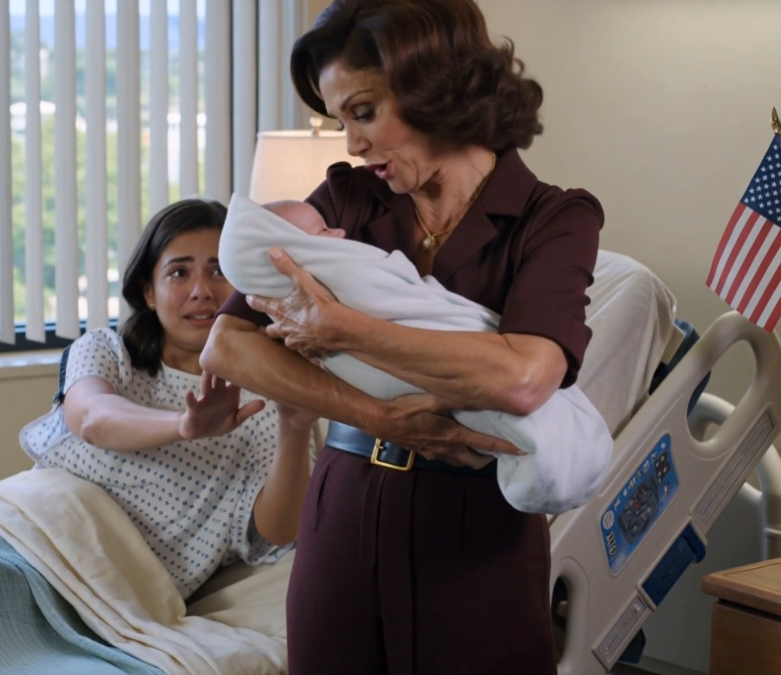
The version of my mother who once made me ride a city bus for two years to fund my sister’s dance costumes is the exact same woman who stood in a hospital recovery room and calculated out loud that a newborn was worth less to her than $80,000 and a rented sports car. And it took watching her do it in real time, with my own daughter in her arms, for me to finally understand that the smaller version of that cruelty had been sitting in plain sight my entire childhood, just wearing a gentler disguise.
Before I walk you through exactly how two grown women tried to steal from a newborn’s college fund and destroyed themselves doing it, hit subscribe if this is your first time here at Line and Legacy. Drop a comment telling me where you’re watching from tonight. And let’s go back to the exact hour the nightmare actually started.
I was doing 85 in a 65 zone, hydroplaning slightly every time I overcorrected, the cheap all-season tires on my rental car complaining every time I took an on-ramp too fast. I had landed at Denver International 20 minutes earlier after a chaotic, unplanned trip to Seattle, the kind of trip I had argued against taking for three straight days before I finally lost the argument. My dress shirt was soaked through at the back. My hands were locked on the wheel hard enough that the imitation leather had pressed a red line across both palms.
I spent the entire flight doing the thing engineers do when there’s nothing left to fix: running failure paths one after another, looking for the branch where everything turns out fine. My wife, Vivian, had gone into labor three weeks early while I was two states away, and every instinct in my body was telling me I had made the wrong call getting on that plane.
I left the rental car running in the ambulance bay, threw the keys at a valet who hadn’t even reached for them, and ran through the sliding doors before they’d finished opening. The smell hit me first, the bleach and the recycled air, and that particular hospital quiet that sits underneath every other sound in the building. I ignored a security guard shouting for me to sign in at the front desk, found the stairwell, and took the concrete steps two and three at a time, my dress shoes slapping hard on every landing for four flights.
Room 412. That was the number the charge nurse had texted me right before I lost signal on the tarmac in Seattle.
I was maybe ten yards from the door when I heard the scream, and it stopped me cold in the hallway. I know what pain sounds like. I’d been in the room when Vivian had a wisdom tooth removed under local anesthetic and heard her grit through it without a sound. This wasn’t that. This had no floor under it. It was the sound of someone watching something be taken from them in real time.
I did not turn the handle. Some older, less rational part of my brain had already decided that if I stopped long enough to turn a handle, I would be too late for whatever was happening on the other side of that door. So I hit it with my shoulder instead, at full stride, and it slammed into the interior wall hard enough that the sound echoed down the hallway behind me.
What I saw in that room is the kind of image that does not fade with distance. It gets sharper.
Vivian was propped up in the hospital bed, her face drained of every bit of color, an IV line taped to her right forearm, pulled taut enough that a thin line of blood had already bloomed dark against the white tape holding the needle in. She was leaning as far over the bed rail as her body would let her, one hand out, reaching for something that wasn’t there anymore, her eyes wide with a kind of fear I had never once seen on her face in five years together.
Standing over her, close enough that her shadow fell across the blanket, was my younger sister, Odette. Her expression was the one I’d grown up watching from across a dinner table, the specific look of someone who has never once been told no and is furious to be hearing it now.
And by the bathroom door, holding my hours-old daughter the way you’d hold a duffel bag you were about to run out of a burning building with, stood my mother, Margarite. She wasn’t cradling Norah. She wasn’t supporting the back of her neck the way you’re taught in every single prenatal class. She had her gripped under the arms, at a distance from her own body. And Norah was crying, that thin, breathless newborn wail that goes straight through a person.
My mother was looking down at my bleeding wife with an expression that had absolutely nothing behind it. No warmth, no alarm, nothing a mother is supposed to have. I stood in that doorway for maybe half a second, chest heaving, trying to make my brain process a scene that made no logical sense. And in that half second, I understood that the worst thing my family had ever done to me was not actually the worst thing they were capable of.
I thought the miserable childhood was the ceiling. I had absolutely no idea it was the floor.
To understand how two women I share blood with ended up standing in a hospital room holding my child for ransom, you have to understand the house I grew up in, because none of this started 14 months ago. It started decades earlier, in a nice colonial on a quiet street where the roles were assigned early and never once renegotiated.
I was the responsible one, the fallback plan, the kid you didn’t have to worry about because he’d figured it out himself. My younger sister, Odette, was the one everything orbited. It wasn’t a dynamic you had to squint to see. It was closer to a law of physics in that house. Whatever Odette wanted, Odette got, regardless of cost. And whatever I needed, I earned, fought for, or learned to live without.
My father, Desmond, was a man who had perfected the art of being present and absent at the same time. He spent most of his evenings in the detached garage, methodically maintaining a riding mower that rarely left the shed and checking his retirement account on a laptop that was older than I was, carefully avoiding whatever was happening in the living room.
To a kid looking for someone to intervene, his silence didn’t read as neutrality. It read as a vote. He watched my mother route every available dollar and every ounce of attention toward my sister for 20 years and never once raised his voice about it. And I used to think that made him a coward. Now I think it just made him a second casualty who never noticed he’d been hit.
Thanksgiving at our house felt less like a holiday and more like a shareholder meeting. My mother would stand at the head of the table, tap her wineglass with a spoon, and announce Odette’s newest expense to the extended family like it was a line item everyone had agreed to fund. A new car for her sixteenth birthday because she needed to be safe getting to school. A summer in Europe at 19 because she needed to find herself.
And then, in the same breath, without missing a beat, my mother would turn to me and loudly praise how independent I was for covering my own state college tuition through part-time jobs and loans, as if that had been my choice rather than the only option on the table.
The memory that finally made the whole shape of it click for me happened when I was 16. I had spent eight months working the fryer and stocking shelves at a grocery store, saving toward a used car so I could stop depending on my mother’s moods to get to school and my shifts on time. I kept the cash in an old shoebox in the back of my closet. Four hundred and twelve dollars, which to anyone else might not sound like much, but to me it was every early morning and every missed weekend I traded for it.
I came home from school one Tuesday, walked into my room, and found the box sitting open on my bed, empty except for a grocery receipt and a few loose pennies at the bottom. I found my mother in the kitchen slicing tomatoes at the counter like nothing in the world was wrong. And when I asked her where my money was, she didn’t even look up.
She told me Odette had qualified for a regional dance competition and needed a costume paid in full that morning, and my mother had been short on cash. She said it the way you’d explain a scheduling conflict. Then she looked at me and said the sentence I would hear again, almost word for word, more than 15 years later at the worst possible moment.
“Family sacrifices for family, Dominic. You don’t need a car right now anyway.”
I rode the city bus in the freezing cold for two more years while Odette drove the car my parents bought her outright for her eighteenth birthday. And that was the exact blueprint for the rest of my adult life. My money, my time, and my energy were considered shared family property. Hers, whenever she had any, stayed hers.
I learned to keep my finances private after that. I stopped mentioning raises or promotions at family dinners. I built a wall, and I got very good at maintaining it, right up until I met Vivian.
Vivian was grounded in a way I didn’t know people could be grounded. She came from a loud, occasionally chaotic, but genuinely loving family in Ohio, and she did not understand the transactional nature of my mother’s affection the first time she encountered it, because nothing in her own life had prepared her for it.
When I brought her home for the first time, my mother treated her like an auditor she hadn’t agreed to let in the building. My mother didn’t contribute a cent to our wedding, which was fine because Vivian and I wanted to pay for it ourselves so nobody could hold it over us later. That didn’t stop her from trying to run the event from a folding chair at the family table.
During the reception, while Vivian and I were finally sitting down to eat for the first time all day, I looked over and found my mother with a calculator app open on her phone, doing the math on the floral arrangements and the plated dinners out loud to my aunt Karen, complaining that we had set an unreasonable standard for whatever Odette eventually decided to do. She managed to make my wedding day about my sister’s hypothetical future wedding.
And Vivian reached under the table, took my hand, and squeezed it. For the first time in my adult life, I understood what it felt like to actually be on a team.
I tried exactly once to reach my father directly about all of it, back when I was 19 and home from college for a weekend, working up the nerve for two full days before I finally walked out to the garage and found him elbow-deep in the mower engine the way he always was. I asked him as plainly as I could manage whether he ever noticed the difference in how he and my mother treated me versus Odette, and whether it ever bothered him.
He didn’t stop working on the mower. He wiped his hands on a rag, looked at the carburetor instead of at me, and said that my mother had her ways of doing things, and that it was easier for everyone if I just let her handle the family stuff.
I stood there for a minute, waiting for something else, some acknowledgment underneath the deflection, and it never came. And I remember walking back into the house understanding with a kind of quiet finality that my father had made his peace with being a bystander decades earlier and had no intention of stepping out of that role for anyone, including his own son standing six feet away asking him to.
The shoebox wasn’t even the incident that hurt the most. It was just the one that finally made the pattern impossible to unsee.
Two years later, the week of my high school graduation, I came home with the announcement cards I’d bought with my own money and found out my parents wouldn’t be attending. Odette had a regional dance recital scheduled for the exact same afternoon, three hours away, and my mother had already committed to driving her, hair and costume and everything, weeks in advance.
I asked carefully whether there was any way to split the day, since my ceremony started at ten and hers wasn’t until four. My mother told me I was being dramatic, that I’d have plenty of other milestones in my life, and Odette only got one shot at this particular recital, as if a high school graduation were a recurring event you could catch next season.
My father didn’t argue the point either way. He just said he’d see if he could get away from work, and then didn’t.
I walked across that stage and looked out at a crowd of other families, and found Vivian there. She wasn’t my wife yet. She was just a girl I’d started seeing a few months earlier who’d shown up anyway with a bouquet of grocery-store carnations because she said nobody should cross a stage without someone there for them.
I still have those flowers pressed in a book somewhere.
My own parents sent a card two days later with $40 in it and a note that said they were proud of me. And I remember standing in the kitchen reading it and understanding, with a kind of flat, exhausted clarity that a 13-year-old shouldn’t have to reach, that I would spend the rest of my life either accepting that arrangement or eventually walking away from it. And there wasn’t going to be a version where they simply changed on their own.
There’s one more memory from that stretch of my life that I think about more than almost any other, mostly because of how small it looked from the outside. When I was 14, an orthodontist told my parents I needed braces for a crossbite that was bad enough it was already affecting how I chewed on one side. My mother sat across from the receptionist, looked at the estimate, and said we’d have to think about it.
And we never revisited it. Not once. Not even when the same orthodontist mentioned it again at my sister’s own checkup a year later, and my mother told him I’d decided against it, which was news to me since nobody had ever actually asked.
Four years after that, Odette wanted cosmetic veneers for a modeling portfolio she never once used professionally, and my parents paid for the full set in cash. No discussion, no thinking about it required.
I didn’t put those two moments side by side until I was an adult sitting in my own dentist’s chair, getting a chipped molar looked at, and the dentist casually mentioned that the crossbite I’d clearly had as a teenager had reshaped how unevenly my jaw had grown. And I sat there in that chair, 30 years old, and felt something in my chest that I can only describe as grief for a 14-year-old who’d been told, essentially, that his physical discomfort wasn’t worth the price of admission.
In the same house where a photography portfolio for a hobby was an obvious, uncontested yes.
For a few good years after the wedding, Vivian and I kept a comfortable, deliberate distance from my family. We moved two towns over, paid our own bills, and built a life that didn’t require anyone’s approval. I climbed the ladder at Corexa Dynamics, the tech firm I’d worked at since college, and we bought a modest fixer-upper with a yard big enough for a dog we kept saying we’d get.
That quiet stretch ended on a Tuesday morning when Vivian walked out of the bathroom holding a plastic test with two lines on it, crying the good kind of tears, and I broke down completely, which is not something I do. Thirty-two years of keeping my guard up, and the idea of building something that ran on the opposite of everything I grew up with just took the legs out from under me.
We were having a baby.
In my own naive optimism, I actually thought this news might unlock something in my mother, some buried instinct that had nothing to do with money. I called her on my lunch break, pacing outside my building with a stupid grin I couldn’t get rid of.
“Mom, are you sitting down? Vivian’s pregnant. You’re going to be a grandmother.”
There was a pause on the line long enough to let all the air out of the moment.
“Well, that’s certainly news,” she said in a voice with nothing behind it. “Listen, since I have you, have you talked to your sister? She’s finalizing plans for her twenty-eighth birthday. She wants to make it a birthday and pre-engagement party rolled into one.”
Odette was not engaged. She was dating a guy who didn’t have a job and mostly played video games on her couch. My mother had bypassed the existence of her first grandchild in under ten seconds to talk about a party for a relationship that didn’t exist yet.
“Mom, did you hear me? Vivian’s pregnant.”
“I heard you, and congratulations, obviously, but Odette needs our focus right now. This is important for her. She found an incredible venue, and they need a deposit by Friday or she loses the date.”
I hung up. I didn’t argue. I walked back to my desk and stared at my monitor for an hour. And that was the moment I understood with total clarity that no amount of good news was ever going to fix what was wrong in that family.
What I didn’t understand yet was how far they were willing to go to get what they’d already decided they were owed.
The demands started small and picked up speed fast. First, it was texts, links to caterers charging $200 a plate for finger food, links to florists who specialized in imported orchids. Then it became daily calls from my mother painting Odette as a woman going through something, someone who just needed a boost from her successful brother, even though the worst hardship Odette had faced that year was her favorite coffee shop closing.
I said no repeatedly. Told them Vivian and I were saving for a nursery and a college fund because we intended to actually be responsible about this. Every no dropped the temperature in that family a few more degrees.
It came to a head at a Sunday dinner, everyone gathered around an overcooked chicken, the air already thick with something unspoken.
“I found the perfect centerpiece for the party,” Odette announced, waving her fork like she was unveiling something. “A vintage Porsche 911, white with red leather, parked right at the entrance with a velvet rope around it. It’ll be the best photo op of the year.”
I waited for her to laugh. She didn’t.
“Odette, do you have any idea what it costs to insure and rent a car like that for a weekend?”
“It’s completely reasonable for the impact it’ll have,” my mother said smoothly, pouring more wine. “And honestly, the whole package, venue, catering, the band, the dress, the car, comes to about $80,000. With your promotion, Dominic, you could easily bridge the gap.”
Eighty thousand dollars. They said it the way other people say eighty. Money that was supposed to go toward our unborn child’s future so my sister could take pictures next to a rented car.
“Are you out of your minds?” I stood up so fast the chair scraped hard against the floor. “I have a child coming. I have a mortgage. I’m done being your bank.”
“You always do this,” Odette snapped, slamming her hand on the table. “You make everything about you and your boring life. It’s my year, and you can’t even help your own flesh and blood.”
I didn’t say another word. I got Vivian’s coat, took her hand, and we walked out into the cold. We didn’t speak to that side of the family for a month. I actually let myself believe the silence meant they’d given up. I was about to find out exactly how wrong that assumption was.
Part of why they believed the $80,000 request might actually work was that two years earlier, I’d made the mistake of caving once, partially, just to make a smaller version of the same fight stop. Odette had wanted $5,000 to cover a photography package and a designer dress for a friend’s destination wedding she was in. After three weeks of daily calls from my mother describing how humiliated Odette would be showing up underdressed, I transferred half of it, $2,500, just to buy myself some quiet.
I told myself at the time it was a one-time thing, a boundary with an asterisk on it. What I actually did was teach them that the boundary had a price, and that if they pushed hard enough and long enough, it would move. Every subsequent request started a little higher than the last one on the theory that I’d eventually settle somewhere in the middle, the way you price a car you expect to negotiate down.
When the $80,000 figure first came up, I don’t think my mother expected me to hand over the whole amount. I think she expected me to talk them down to something like fifteen or twenty thousand and consider it a win. And when I refused to negotiate at all this time, when I said the actual word no instead of my usual How much do you actually need?, that was the first time in years they’d run into a version of me that didn’t come with a discount built in.
And I think that refusal, more than anything else, is what pushed them from asking to planning.
The pressure during those weeks didn’t stay contained to phone calls between me and my mother. At some point, she added me to a family group chat that already had eleven people in it, most of them second cousins and family friends I hadn’t spoken to in years, with a message that just said, “So excited for O’s big twenty-eighth. Everyone’s pitching in for the venue.”
There was also a digital invitation that listed suggested contribution tiers like it was a wedding registry, with my name already typed into the top tier before I’d agreed to anything. I left the group within a minute of seeing it, and within the hour, I had three separate texts from relatives I barely knew, gently checking in to see if everything was okay between me and my mother because apparently she’d told the group I was going through a difficult time and might need some grace regarding the family obligations.
She had turned my refusal into a rumor about my mental state before I’d even had the chance to explain myself to a single person in that chat. It was a specific kind of manipulation I hadn’t fully appreciated until I watched it happen to me from a distance, in writing, timestamped and impossible to later deny.
The month of silence that followed the dinner wasn’t completely silent. About two weeks in, a padded envelope showed up at our house with no return address. Inside it was a single printed photo of Odette at eight years old, sitting on my lap at a birthday party, with a handwritten note on the back in my mother’s handwriting that just said, “We used to be a family. Don’t throw that away over money.”
No apology, no acknowledgment of the actual conversation that had happened at the table, just a photograph chosen specifically to make me feel like the one doing the damage. Vivian found me standing in the kitchen holding it for a long time. She didn’t tell me what to feel about it. She just asked what I wanted to do.
I put it in a drawer instead of the trash because some old, stubborn part of me still wasn’t ready to throw away every piece of evidence that we’d ever been anything else. I didn’t call. I didn’t write back. And when three more weeks passed without another word from either of them, I made the mistake every person in my position eventually makes, which is mistaking silence for surrender instead of recognizing it correctly as reloading.
The week before everything happened, Vivian had spent an entire Saturday organizing the nursery closet by size, tiny onesies sorted into bins labeled newborn, three months, six months, a level of preparation that made me tease her gently about running the household like a supply chain. She’d laughed and said someone in this house had to be ready for anything, given how the last few months of family phone calls had gone.
She told me later that some part of her, some instinct she couldn’t fully explain, had felt uneasy about me leaving for Seattle even before labor started. Not because she doubted the trip was necessary, but because she had a specific, nagging sense that our family’s silence over the past month hadn’t been peace. It had been the kind of quiet that happens right before someone decides to stop asking and start acting.
I wish I had trusted that instinct as much as she did.
Three weeks before Vivian’s due date, a crisis hit at work that had nothing to do with any of this and somehow ended up making everything possible. A regional data center in Seattle had a hard failure, the kind that takes down redundant systems along with a primary because someone built a single point of failure into the architecture years before I got there. Our biggest client’s entire platform went dark.
My CEO, Franklin Draper, a blunt man who valued outcomes over comfort, called me into his office and slid a folder across the desk.
“This is a critical infrastructure failure, Dominic, and you’re the only lead engineer who knows the stack well enough to untangle it before we lose the account. I need you on a flight tonight.”
“Franklin, Vivian’s due in three weeks. I can’t leave her right now.”
“It’s a 48-hour trip. Fly in, patch the servers, fly home.”
He pulled a heavy platinum corporate card out of his desk drawer and set it down between us.
“This is fully authorized for whatever you need to move fast. Book a private charter if you have to. Just fix it.”
I called Vivian from the hallway, my heart going a mile a minute, and she told me to go. Her mother was already staying with us. Our hospital bag had been packed by the door for two weeks, and her obstetrician had told us just the day before that there was plenty of runway left.
What I did next is the one decision in this entire story I will never fully forgive myself for.
On my way to the airport, I stopped for coffee with my cousin Preston, the one relative on my mother’s side I actually still trusted, mostly because he’d spent his whole childhood rolling his eyes at the same theatrics I’d grown up under. I was stressed, and stressed people talk too much. So I told him about the emergency trip, told him how anxious I was about leaving Vivian this close to her due date.
I still don’t know exactly why I said it out loud, except that fear makes people careless. I told him the exact name of the hospital she was registered at in case he wanted to check in on her while I was out of pocket.
“Don’t worry about a thing, man. I’ve got your back,” Preston said.
And I believed him, because up until that exact moment, I’d never had a reason not to.
What I didn’t know was that Preston was quietly buried in credit card debt he’d never told anyone about, and he resented my career and my stability more than he’d ever let on. The second I boarded that flight, he called my mother and told her everything: that I was out of state, that Vivian was alone, and exactly where they could find her if she went into labor early.
I landed in Seattle, turned my phone off airplane mode, and had 42 missed calls waiting for me before I’d even reached the jet bridge. Vivian’s water had broken three weeks early. She was already in active labor.
I didn’t leave the terminal. I walked straight to the nearest counter, put Franklin’s platinum card down on the desk, and bought the next seat on the next flight back to Denver. Then I sat through a four-hour wait and a two-and-a-half-hour flight, completely unable to do anything but run the same failure scenario over and over in my head, the one where I wasn’t there in time.
And while I sat in a metal tube in the sky praying to a God I hadn’t spoken to in years, my mother and my sister were watching a clock, waiting for the exact window they needed. They knew I was gone. They knew Vivian was alone and exhausted. And they had already decided, days before this, exactly what they were going to do about the $80,000 they believed they were owed.
Preston had ordered a plain black coffee and paid for mine, too, which in hindsight felt like a small, deliberate kindness designed to make what came next easier for him to live with. We sat at a sticky little table by the window of a shop two blocks from my office, and he asked, genuinely enough sounding, whether Vivian was doing okay, whether I was sleeping, whether I was scared about the trip.
I told him more than I should have, the way you do with someone you’ve mistaken for safe. That I hadn’t wanted to take this trip at all. That Vivian’s doctor had said there was runway left, but that runway had a way of running out early in this family’s luck. That I was terrified something would happen while I was two states away and unreachable.
He nodded along at all the right places, asked which hospital, said something about how it would put my mind at ease to know someone local could swing by and check on her, and I told him practically everything, without a single flicker of suspicion. Up until that exact conversation, Preston had never once given me a reason to guard myself around him the way I guarded myself around everyone else in that family.
I found out much later from Vanessa’s investigator that he’d called my mother from the parking lot of that same coffee shop before I’d even finished my drink.
Franklin had hired me straight out of a rough first job at a smaller firm back when I was 24 and still figuring out that competence alone doesn’t protect you from being underpaid if you never ask for more. He’d been blunt with me about that exact fact in my very first review, which is part of why I trusted him enough to get on a plane the same night he asked.
Vivian taught fourth grade at an elementary school twenty minutes from our house, a job she loved with a kind of steady, unglamorous devotion that had nothing to do with recognition. She’d already arranged three weeks of substitute coverage in advance of her due date, which meant that when labor started early, at least one part of our life didn’t collapse along with everything else that week.
I think about that a lot, actually. How much of what held us together during the worst of it was just two people who’d built redundancy into their own lives on purpose. Coverage plans and emergency contacts and a marriage that didn’t depend on either of us being perfect at the same time.
Somewhere over eastern Oregon, I got a text from a coworker on the infrastructure team asking whether I’d finished the failover configuration before I left the data center. I remember staring at that message for a full minute with something close to disbelief because the servers I’d flown two states away to fix twelve hours earlier were, at that exact moment, the least real thing in my entire life.
I typed back three words, “Family emergency. Handle it,” and put the phone face down on the tray table so I wouldn’t watch it not update with any news from Denver.
I’d called Vivian’s mother from the gate before boarding and gotten nothing but a rushed, breathless update.
“She’s pushing. They’ve moved her to delivery. I have to go.”
Then the call had cut out, and there was nothing to do after that except sit in a middle seat between two strangers, running through every version of a night I hadn’t been present for.
I remember praying in the specific bargaining way people pray when they haven’t done it in years, promising a God I wasn’t sure was listening that I would never take another business trip, never leave her alone again, never once let my job matter more than this if He just let both of them be alive and unharmed when I landed.
I didn’t know yet that the danger waiting for them wasn’t medical. I didn’t know that the real threat to my family that day wasn’t a complication in the delivery room, but two people I’d known my entire life, sitting in a parked car three miles from that hospital, waiting for the exact moment my seat belt light turned off.
I’ve had to piece together exactly what happened in that room from three sources: Vivian’s own account once she was steady enough to give it, the hospital’s internal security log, and the reluctant, shaking testimony of a young nurse named Meredith Voss, who saw more of it than anyone.
Vivian’s labor was brutal. Twelve hours of it, complicated enough that the staff had to intervene twice. She went through all of it without me there to hold her hand, which is a fact I will carry for the rest of my life, whether or not she ever blames me for it. And she has never once blamed me for it.
At 3:14 in the morning, our daughter Norah was born. By the time the sun came up, Vivian was past ordinary exhaustion, running on nothing but adrenaline and the fierce, overwhelming love she felt holding our daughter against her chest for the first time.
Around ten that morning, Vivian’s mother kissed her forehead and went down to the cafeteria for coffee and to call relatives with the good news. That’s exactly when the door opened. No knock, no nurse checking in. My mother, Margarite, and my sister, Odette, walked into that recovery room like they’d been invited.
Vivian tensed immediately and pulled Norah in tighter, her body understanding the danger before her exhausted brain caught up to it.
“Well, look at this setup,” my mother said, glancing around the private suite without once looking at her own granddaughter. “Must be nice to afford the upgrade while the rest of us make do.”
Odette didn’t even pretend to care about the baby. She stood at the foot of the bed, arms crossed, scrolling her phone like she was bored at a bus stop.
“What are you doing here?” Vivian asked, her voice thin and shaking. “Dominic isn’t here. You need to leave.”
“We know he isn’t here, dear,” my mother said, pulling a chair right up to the bed, close enough to erase any space Vivian had left. “That’s exactly why we came today. We need to have a little talk, woman to woman, without Dominic getting emotional about money.”
Vivian felt something cold drop straight through her.
“The venue called this morning,” my mother continued conversationally, the way you’d mention a grocery list. “They need the full deposit today. Eighty thousand. Since Dominic’s being so difficult about his obligations, we need you to handle it.”
“Handle what?” Vivian said. “I gave birth six hours ago. I don’t have $80,000.”
“Don’t play dumb,” Odette snapped, finally looking up from her phone, her eyes flat. “We know about the corporate card. Preston told us Dominic flashed it at the airport. You’ve got access to everything on his phone. Just run the charge. Call it a business expense. He’s smart. He’ll figure out how to bury it later.”
They were standing in a hospital room asking my wife, hours postpartum, stitched and bleeding, to commit federal fraud so my sister could rent a sports car for a photo op.
“Are you both out of your minds?” Vivian said, finding a reserve of steel she didn’t know she had left in her. “I’m not touching his card. That’s theft. Get out of my room.”
My mother’s face went cold, the polite mask gone in an instant.
“You don’t want to make an enemy of me, Vivian,” she said, leaning in close. “Dominic will always choose his blood eventually. You’re just the wife. If you don’t authorize that payment right now, I will make sure your life in this family is a living hell.”
“My life in this family is already hell because of you,” Vivian fired back, tears of pure fury in her eyes now. “He chose me. He chose this baby. Now get out before I call security and have you dragged out of here.”
Vivian’s free hand had been inching toward the call button clipped to the bed rail this whole time, slowly enough that she hoped neither of them would notice.
And Odette noticed.
“Don’t,” Odette said.
She reached across, pulled the entire remote unit off the rail, wire and all, and dropped it on the floor out of reach. Something about the casual efficiency of that one motion, the way she did it without even raising her voice, told Vivian more clearly than anything else in the room that this had been planned in advance, not improvised in a moment of anger.
“You don’t get to call anyone until we’re finished talking,” my mother said, her tone almost gentle, which was somehow worse than if she’d been shouting. “This doesn’t have to be difficult, Vivian. You just need to be smart about this the way Dominic never learned how to be. Pick up your phone. Open the banking app. It’s a few taps.”
“I’m not doing that,” Vivian said again, quieter this time, because her voice was starting to give out from the effort of staying calm in front of a baby she couldn’t reach. “You are holding my daughter. Put her down and get out, and I will forget this ever happened.”
“You’ll forget it happened?” my mother repeated, almost amused. “That’s sweet. No, dear. I don’t think you understand your position here yet.”
That was the moment it snapped. Odette lunged across the bed for Vivian’s phone on the side table, and Vivian twisted her body to shield Norah. In doing that, her arm caught the metal bed rail. Odette, furious she’d missed the phone, grabbed Vivian’s arm, the one with the IV taped into it, and yanked it back hard.
Vivian screamed as the tape tore and the needle dragged against the vein, and blood bloomed fast across the white sheet.
That’s the sound I heard from the far end of the hallway, the one that had no floor under it.
But the assault wasn’t even the worst thing that happened in that room. In the chaos, while Vivian cried out and grabbed at her own bleeding arm, my mother reached over the bed and lifted Norah straight off her mother’s chest, not to comfort her, but to hold her up and out of reach like a piece of leverage.
Vivian stopped breathing entirely. The pain in her arm disappeared, replaced by something that had no name.
“Give me the card details,” my mother said, her voice dropping into something completely flat. “Give them to me right now, Vivian, or I walk out of this hospital with her, and you can spend the rest of your life fighting me for custody in family court. Let’s see how strong you are when you don’t know where your daughter is.”
That’s the sentence that pulled the scream out of Vivian, the one I heard from ten yards down a hallway I hadn’t even reached yet.
Quick pause before you keep reading. If you’ve made it this far, drop a comment with the number two so I know you’re still with me. Because what happens in the next two minutes of this story is the part I still can’t believe actually happened in a maternity ward.
And that scream is exactly what sent me through that door with my shoulder instead of my hand.
I told you what I saw when I came through that door. My mother holding my daughter like cargo. My sister looming over my bleeding wife. Blood already soaking into the sheet. What I didn’t tell you yet is what happened in the next 90 seconds, because I needed you to understand everything that came before it first.
The paralysis lasted less than a second. Then something older than thought took over.
I crossed that room faster than I have ever moved in my life, shouldered past Odette hard enough that she stumbled into the guest chair in the corner and went down with a sharp, theatrical gasp. I didn’t even turn to look at her because my eyes were locked entirely on my mother and the small, wailing bundle in her hands.
My mother’s head turned, and the smug certainty on her face dissolved into something closer to actual shock.
“Dominic,” she stammered. “You’re supposed to be in Seattle. Preston said—”
I didn’t let her finish the sentence. I didn’t give her the chance to start rewriting what I had just watched. I stepped into her space, put my hands around both of her forearms, and said four words in a voice I didn’t recognize as my own, low and even and completely without room for negotiation.
“Let go of my daughter.”
She looked up at me, and for the first time in 32 years, I watched real fear land on my mother’s face because she understood in that instant that the version of me who used to swallow every insult and hand over every dollar didn’t live in this room anymore.
She let go.
I pulled Norah against my chest, and the relief of feeling her breathing, warm and unharmed, nearly took my knees out from under me. But I didn’t have the luxury of falling apart yet. I turned my back on my mother, shielding Norah with my body, and got to Vivian’s side. She was hyperventilating, one hand clamped over her bleeding arm. And the second she saw Norah safe against me, a shudder of pure relief went through her whole body.
“I’ve got her,” I said into her ear, my voice cracking. “I’ve got both of you. They are never touching either of you again.”
“How could you treat your own mother this way?” Odette shrieked from the corner, recovering her balance and immediately reaching for the victim role, which had always been her first and only strategy in any conflict. “We were just having a civil conversation with Vivian, and you come in here like a lunatic and assault me.”
I turned to face them slowly, Norah still pressed tight against my chest, and pointed a finger at my sister.
“If you say one more word to me, if you take one step toward my wife or my daughter, I will put you through that window, Odette.”
Something in my tone made her mouth snap shut so fast her teeth clicked.
“Dominic, lower your voice,” my mother interjected, already reaching for her old composure, the upper-middle-class matriarch voice she used at every family function. “Vivian is emotional. It’s the hormones. She’s misunderstood a simple conversation about a deposit. We only needed a small advance from your account. We were going to pay it back.”
“You tore a medical line out of her arm,” I said, gesturing at the blood soaking into the sheet. “You threatened to walk out of this hospital with my newborn daughter to force her into wiring you $80,000. There is no misunderstanding here. You are not a mother. You are dangerous.”
The door burst open again before either of them could answer, and the head of hospital security, a broad-shouldered man named Dean Ashworth, came in with two uniformed guards and a visibly shaken young nurse trailing behind him.
“What’s going on in here?” Ashworth demanded. “We got a panic alert from this room and multiple reports of a physical altercation.”
Odette, right on cue, burst into loud, performative tears.
“Thank God you’re here. She attacked me. She lost her mind. My mother had to grab the baby just to keep it safe from her.”
It was such a complete inversion of what had actually happened that for a second I couldn’t even respond. Odette was betting, the way she always had, that whoever cried loudest and claimed victimhood first would win the room, regardless of the physical evidence sitting right in front of everyone.
Ashworth didn’t flinch, and he didn’t look at Odette first. He looked at me.
“She’s lying,” I said, steady despite the adrenaline still flooding my system. “That woman physically assaulted my wife and tore out her IV trying to grab her phone. That woman took my newborn daughter off her mother’s chest and threatened to leave the hospital with her unless my wife handed over a corporate credit card.”
“This is a disgusting fabrication,” my mother snapped, her face flushing red. “We are a respectable family. Remove this hysterical man and his unstable wife immediately.”
Ashworth turned to the nurse.
“Meredith, you were stationed right outside. What did you see?”
My mother shot Meredith a look that promised absolute ruin if she said the wrong thing. But Meredith looked at the blood on the sheet, looked at the newborn pressed against my chest, and found her nerve anyway.
“I heard shouting,” she said, her voice unsteady but clear. “I looked through the door window. I saw the younger woman grab the patient’s arm and yank it backward hard enough that the IV tore out. Then I saw the older woman reach over the bed, take the baby, hold her up, and say she’d walk out of the hospital with her if the patient didn’t hand over the credit card information right then.”
The silence that followed was total. Odette’s crying stopped like someone had cut the power. My mother’s mouth opened, and nothing came out. Their entire version of events had just been dismantled by a neutral third party with no reason to lie.
“All right,” Ashworth said, his tone shifting instantly into something official.
He unclipped the radio from his belt.
“I need Denver PD dispatched to maternity, room 412. We have a confirmed assault and attempted extortion involving a minor.”
“Police?” my mother said, the first crack of real panic breaking through the mask. “That’s completely unnecessary. We’re family. We can handle this privately like we always do.”
“Handling it privately is exactly how you got away with this for 32 years,” I said, looking her dead in the eyes. “You’re not my family anymore. You’re criminals, and you’re going to answer for it.”
The police arrived fast, and it changed the reality in that room permanently. My mother and sister were walked out of the maternity ward by two officers, holding their designer bags up in front of their faces as they passed the nurses’ station in front of the entire floor.
I watched the elevator doors close on them and felt, for the first time in my life, absolutely no guilt about any of it.
But the day wasn’t finished trying to test me.
About an hour after the police left, a man in an expensive tailored suit walked into our recovery room, introduced himself as Dr. Julian Whitlock, senior director of public relations and risk for the hospital network, and closed the door softly behind him like he was about to deliver bad news gently.
“Mr. and Mrs. Sinclair, I can’t tell you how sorry we are for the disruption to your experience today,” he began in the smooth, overrehearsed voice of a man whose entire job is making expensive problems disappear quietly. “I’d like to talk about how we move forward. A public incident involving assault and an attempted abduction on our maternity floor is damaging for everyone, including your family’s privacy. We’d like to offer you a complimentary stay in our VIP suite and waive your entire bill, assuming we can handle this internally and you decline to press formal charges.”
I stared at him. He was blatantly offering to buy our silence to protect the hospital’s brand.
“My wife was assaulted while recovering from childbirth under your roof,” I said, stepping closer. “Your security let two unauthorized people walk into a private recovery room unchecked. You are not waiving anything, and you are going to be named personally in the civil suit my attorney is drafting right now. If you so much as look at Nurse Voss the wrong way for telling the truth, I will make sure the medical board hears every detail of this conversation.”
Whitlock went pale, backed out apologizing, and we never saw him again.
Detective Renata Marlo arrived shortly after to take our statements, a sharp, unhurried woman who photographed the bruising already forming on Vivian’s arm and documented the torn IV site without rushing a single step. She listened without interrupting as we described the $80,000 demand, the corporate card, and the threat about family court.
“We have more than enough for assault and battery against your sister and terroristic threats against your mother,” she said, closing her notebook. “But the demand for a corporate card tied to a business account raises this to a different level entirely. I need to run this further up the chain.”
I sat on the edge of Vivian’s bed that night, exhausted, holding her uninjured hand while Norah finally slept in the bassinet beside us, and I genuinely believed we’d hit the bottom of it.
I was wrong. The real depth of what they’d done hadn’t even surfaced yet.
At exactly 8:15 the next morning, my phone rang with a number I recognized as the fraud division for the bank that handled Corexa Dynamics’ corporate accounts.
“Mr. Sinclair, this is Nathan Cole, senior investigator with corporate security and fraud. I’m calling about your platinum account ending in 4409. We flagged a suspicious credit application and an attempted wire transfer under your credentials.”
I was sitting in an uncomfortable hospital chair with cold coffee, barely awake.
“I haven’t applied for anything. I’ve been at the hospital for two days straight.”
“We’re aware of your location, sir. Nine days ago, an application was submitted authorizing an $80,000 wire transfer to an event management company in Denver. It used your full legal name, your Social Security number, and correctly answered all three of your security questions.”
The coffee cup in my hand actually shook.
Nine days ago. Nine days before any of this happened at the hospital, before I’d even left for Seattle. This wasn’t a decision made in a moment of desperation. It was planned.
“Did it go through?” I asked, my heart hammering.
“No, because that account is tied to federal defense contract infrastructure. Any unverified transfer over $50,000 to an unknown vendor automatically triggers a manual security hold. We froze it immediately, but the applicant tried repeatedly over the following week to push it through. When that failed, they requested a physical replacement card be rushed to a residential address.”
He paused before continuing.
“We traced the IP used for the original application to a home in the Denver suburbs.”
He read off my parents’ exact address, every digit correct, and in a horrible, sickening flash, I understood exactly how they’d gotten what they needed.
Three months earlier, at a Thanksgiving dinner I’d almost skipped, I’d brought a folder of tax documents and old paperwork to shred in my father’s office shredder. I’d left it sitting on the kitchen counter for twenty minutes while I helped him with a leaking pipe in the garage.
In that window, someone had photographed everything in that folder.
“Nathan,” I said, my voice shaking with a mixture of horror and something close to relief. “I did not authorize that transfer. My identity was stolen by the residents of that exact address. I need everything you have forwarded directly to Detective Renata Marlo at Denver PD.”
“Understood, Mr. Sinclair. Because this account is tied to federal defense funding, this is no longer a local bank fraud matter. This is federal wire fraud and aggravated identity theft, and the FBI’s financial crimes division will be notified within the hour.”
I set the phone down slowly.
Vivian looked at me, reading the color draining out of my face.
“Dominic, what happened?” she asked, her voice tight with worry.
“They didn’t come here for a credit card,” I said quietly. “They stole my entire identity nine days ago. When the wire failed, they came here to force it through by hand. This isn’t assault charges anymore, Vivian. This is a federal case. They just handed themselves a prison sentence.”
I found out later that the hospital had quietly commended Nurse Voss for her actions that day, and that Dean Ashworth had personally recommended her for a lead position on the maternity floor the following year, which felt like the smallest possible piece of justice in a story with almost none of it to spare.
I made sure, through a card and a gift basket that felt embarrassingly inadequate for what she’d actually done, that she knew how much her 90 seconds of honesty had mattered to us.
In the weeks after the fraud call, I kept coming back to something almost embarrassingly simple for my own field: the idea that logs don’t lie. A server can be lied to by a person, but the record of what actually happened underneath the lie is always sitting there in the logs somewhere, timestamped, waiting for someone to bother pulling it.
That’s what the IP trace was. That’s what Meredith’s testimony was. That’s what the bank’s automated fraud hold was. A system built without a single ounce of emotional investment in my family story, refusing to move $80,000 simply because the numbers didn’t reconcile the way a legitimate transaction should.
For most of my life, the people closest to me had counted on me never checking the logs. The moment I finally did, none of their explanations survived contact with the actual record of what they’d done.
Vivian’s mother came back from the cafeteria fifteen minutes after the police had already come and gone, still holding two cups of coffee that had gone cold in her hands. And the look on her face when she walked into that room and saw the blood on the sheet and the bandage on her daughter’s arm is not something I can describe without my throat tightening even now.
She set the coffee down without a word, climbed onto the narrow strip of mattress beside Vivian, and just held her. And I stood there holding Norah and let the two of them have that minute without saying anything because there wasn’t anything useful I could have added to it.
Corexa’s legal department called that evening, having already heard from the bank’s fraud division, and informed me almost apologetically that the platinum account had been flagged and frozen pending the federal review, and that I should expect a temporary card in its place within a few business days.
I remember thanking the woman on the phone for the update and then sitting in the dark hospital room afterward with Norah asleep on my chest, feeling the strange, disorienting quiet that follows a disaster once all the official machinery has finally started moving on its own without needing anything else from me.
Vivian slept in short stretches that night, waking every twenty minutes to check that Norah was still breathing, still there, still hers. I didn’t sleep at all. I sat in the chair by the window with our daughter’s whole weight against my chest, watching the parking lot lights outside, and made a promise to her out loud, quietly, that she would never once in her life have to wonder whether the people who loved her actually did.
Two federal agents came to our house nine days after the hospital incident, polite and thorough, and walked me through exactly how the case would proceed. They explained that the fraudulent application had left a digital trail clean enough that they rarely saw cases this well documented this early, since most identity theft cases involve strangers who know how to cover their tracks, not family members who assumed they’d never be questioned in the first place.
They asked for copies of the Thanksgiving folder’s contents from three months earlier, cross-referenced the exact documents against what had been used in the fraudulent application, and confirmed within a week that every single data point matched.
A local news station picked up a sanitized version of the story about a month later. No names used at either family’s request, just a segment about identity theft originating within a family and a warning to viewers about leaving sensitive documents unattended, even inside their own homes.
I remember watching it air with Vivian on the couch, Norah asleep between us, feeling a strange, hollow kind of vindication that our worst month had become someone else’s cautionary tale.
We were discharged four days after Norah was born, later than a normal delivery would have kept us, mostly because the hospital wanted to monitor Vivian’s arm for infection after the IV had been torn out with that much force, and because Detective Marlo had asked us to stay local for a few extra days in case investigators needed anything else in person.
Walking out of that building with Norah, buckled into a car seat for the first time, felt like a strange kind of victory lap through a battlefield, past the same nurses’ station where my mother and sister had been marched out in handcuffs days earlier, past the gift shop where I’d bought Vivian a single overpriced bouquet the morning after the birth because I hadn’t had time to get her anything before the emergency trip.
The replacement corporate card arrived by courier that same afternoon, a small, almost comically mundane envelope sitting on our kitchen counter next to a stack of unopened baby congratulations cards from people who had no idea what our first week as parents had actually looked like.
I remember standing in our own kitchen, the one with none of my mother’s fingerprints on it, watching Vivian settle into the rocking chair we’d bought together, Norah asleep against her chest, and feeling for the first time in days like the floor under my feet was solid again.
Nothing about that first night home was easy. Vivian woke up twice, checking for a phantom knock at the door, and I found myself standing at the nursery window at three in the morning, watching the empty street, half convinced a car might pull up that shouldn’t.
But nobody came. Nobody had the address anymore. Not legally, not within a thousand feet of it.
And somewhere around four in the morning, I finally understood that the quiet in that house wasn’t the same dangerous, reloading silence from the month before the party dinner. It was just an ordinary, exhausted, brand-new family, finally alone with each other the way we were always supposed to have been from the very beginning.
The fallout moved fast once it started, and I did not lift a finger to slow it down.
I hired an attorney named Vanessa Cade, a woman who specialized exclusively in family financial exploitation and high-stakes civil litigation, and paid a retainer out of our own savings without a second thought because I wanted every resource available pointed at building an airtight case around Vivian, Norah, and everything we owned.
Vanessa moved fast. Within the first week, she’d filed an emergency motion to freeze any assets tied to my mother and sister ahead of a civil suit, and she’d brought in a forensic accountant to reconstruct exactly how much money had actually moved from me to them over the years.
Not just the $80,000 from the hospital, but everything, going all the way back to a car repair I’d quietly paid for at 22 because my mother said it was an emergency.
The number the accountant came back with once it was all laid out in a spreadsheet with dates and receipts was $214,000 across 16 years, a figure that made me sit at my kitchen table for a long time without saying anything because I had genuinely never once added it up.
Vanessa filed the civil suit for $2.44 million, covering the documented damages, Vivian’s medical bills, emotional distress, and punitive damages tied specifically to the assault and the attempted extortion of a postpartum patient.
She told me plainly, in the flat way good attorneys tell you things, that we would very likely never collect the full amount because there wasn’t $2.44 million of equity sitting in my parents’ modest house. But the judgment itself, the number on paper, mattered more than the collection because it would follow them for the rest of their lives, regardless of what they managed to hide.
While Vanessa coordinated with the federal investigators, the rest of my extended family finally decided to weigh in on a mess they’d ignored for 30 years.
My aunt Karen, my mother’s older sister, called me four days after the hospital incident. Karen had always positioned herself as the reasonable moral center of the family, the one who showed up to smooth things over.
“Dominic, sweetheart, this has gone entirely too far,” she said, her voice dripping with a warmth I knew was manufactured the second I heard it. “Your poor mother is facing real jail time. Odette cries every day. You need to drop these charges. Family doesn’t put family in a courtroom. Think about your father’s health. Think about the shame this brings on all of us.”
I let her talk, recording the call on an app Vanessa had told me to install the day I hired her.
“Karen,” I said finally, my voice flat. “My mother threatened to kidnap my newborn daughter. My sister put my wife in the hospital. There is no version of this where I drop the charges.”
“You’re being incredibly selfish,” Karen snapped, the warm act dropping instantly. “If Odette doesn’t get that party, she loses her standing with everyone who matters to her. And frankly, your mother promised me $10,000 out of that budget to help cover my divorce attorney. If you don’t release that money and drop this, you’re ruining my life, too. You owe us this.”
I actually laughed, a short, humorless sound. The moral center of the family was perfectly fine with my wife being assaulted and my identity being stolen as long as she got her $10,000 cut of the proceeds.
“Don’t contact me again, Karen,” I said, and blocked her number on every device I owned.
It wasn’t until weeks later, going through old family photos with Vivian one night, trying to understand how any of this had started, that I got a version of the story nobody in my family had ever told me directly.
My grandmother, my mother’s mother, had done to my mother almost exactly what my mother had done to me, just with a different sibling in the golden-child seat. Karen had been the favorite growing up. The trips, the tuition, the wedding paid in full, while my mother had worked two jobs through her twenties to put herself through school with no help from anyone.
Nobody in that family had ever once acknowledged what had been done to her.
It didn’t excuse a single thing my mother did to me or to Vivian or to my daughter. It didn’t make the threats or the fraud or the blood on that hospital sheet any less deliberate. But it did explain, in a way that made the whole shape of the family finally make sense, why she’d spent her entire adult life building the exact same unfair system for her own children that had been built around her, as if repeating it made it retroactively fair instead of just passing the debt down another generation.
The courthouse smelled like old carpet and floor polish, and the gallery benches were the same uncomfortable wood as every institutional room I’d ever sat in waiting for something important to be decided by someone else.
Vivian wore the same navy blazer she’d worn to job interviews years earlier, and she held my hand through the entire proceeding hard enough that I could feel her pulse in her palm. I remember looking around that room and noticing how ordinary it all was. Fluorescent lighting, a water-stained ceiling tile in the corner, a court reporter typing without ever once looking up.
I remember thinking that nothing about this room matched the size of what had actually happened to us, and then realizing that was probably exactly the point. Justice mostly happens in rooms too plain to match the crime, one procedural sentence at a time.
The preliminary hearing happened three weeks later in a heavy, wood-paneled courtroom downtown. Vivian and I sat in the front row of the gallery with Vanessa beside us. My mother and Odette were led in by their attorneys, looking nothing like the women who had walked into that hospital room like they owned it.
Odette was in a wrinkled suit, her hair unkempt, crying quietly into a tissue. My mother had aged what looked like a decade in three weeks. They’d spent that time out on bail genuinely believing they were facing local misdemeanor charges, the kind you could cry your way out of in front of a sympathetic judge. They had no idea what was actually walking through the courtroom doors behind them.
The local prosecutor stood to present the updated charges. And at that exact moment, the doors at the back of the room opened, and Franklin Draper walked in wearing a suit sharper than anything that courtroom had seen all week.
He’d come voluntarily to testify on behalf of the company. He took the stand and looked at my mother and sister with open contempt.
“The corporate account in question is not a standard business expense account, Your Honor,” he said, his voice carrying easily through the room. “It is directly integrated with our federal defense contracting division and monitored under federal cybersecurity protocols. The individuals at that table did not simply attempt to defraud my employee. They submitted a fraudulent application using stolen identity credentials across state lines and attempted to authorize an $80,000 transfer from a federally linked account. That is aggravated identity theft and wire fraud at the federal level.”
I watched my mother’s face go gray. Odette stopped crying entirely and stared at Franklin like she’d just watched the floor disappear from under her.
“Furthermore,” Franklin continued, unmoved, “the subsequent physical attempt to force the card out of Mrs. Sinclair at the hospital constitutes attempted extortion. Our legal team is fully cooperating with the FBI, and we will support the maximum charges available under federal law.”
Before the judge ruled, Odette’s attorney asked for a brief moment for his client to address the court. Odette stood up, dabbing at her eyes with a tissue, and delivered what was clearly a rehearsed statement about being a young woman who had made an impulsive mistake in a moment of stress, about how much she loved her niece, about how this had all spiraled out of proportion because of a family disagreement over party planning.
She never once used the word extortion. She never once mentioned the blood on the sheet or the newborn held up in the air like a bargaining chip.
The judge, a stern woman with reading glasses pushed low on her nose, listened to the entire statement without interrupting, then looked directly at Odette over the top of them.
“Miss Sinclair, I’ve read the incident report, the medical records, and the nurse’s sworn statement three times each,” she said. “Nothing in what you’ve just told me resembles a disagreement over party planning. I’d encourage you to spend some of the time ahead of you thinking honestly about what actually happened in that room, because the version you just gave this court is not going to serve you well in front of a parole board.”
Odette sat back down fast, and for the first time since I’d known her, she didn’t have a single word to say back.
The judge brought the gavel down, and the local misdemeanor charges were immediately superseded by a federal indictment. They weren’t looking at probation anymore. They were looking at mandatory minimums in a federal facility.
My mother turned to look at me from the defense table and mouthed the words, “Please, Dominic, help us.”
I looked back at her without a single flicker of anything and shook my head once. I was done saving people who had never once considered saving anyone but themselves.
Vanessa walked me through the plea negotiations in plain language a few weeks before the final hearing, sitting across from me at her office with a folder of federal sentencing guidelines open between us.
The federal prosecutor had offered my mother and sister a chance to plead down from the maximum exposure, which for the wire fraud and identity theft charges alone could have run into the double digits if a jury convicted on every count. Vanessa explained that prosecutors usually preferred a clean plea to the expense and uncertainty of trial, especially with evidence this thorough.
“They’re not doing this out of mercy,” she told me, closing the folder. “They’re doing it because the case against your mother and sister is basically unlosable, and pleading guilty is the only lever they have left to pull for a lighter number.”
I asked her more than once whether there was anything I could do to push for a harsher outcome, and she looked at me steadily and said that my job wasn’t to author their punishment. My job was to make sure Vivian and Norah were protected for the rest of their lives, and that the federal system, left alone to do its job, would take care of the rest without needing my hand on the scale at all.
The federal system moves slowly, but when it finally lands, it lands completely.
Four months later, faced with an overwhelming pile of digital evidence, IP logs, the fraudulent application, Nurse Voss’s testimony, Vivian’s medical records, my mother and sister were pushed by their own attorneys into plea deals rather than risk a full trial and decades behind bars.
Odette, who had never worked a single day of her privileged life, was sentenced to three years in a federal minimum-security facility for her role in the identity theft and the physical assault on Vivian. She went from planning an $80,000 party to wearing a jumpsuit in under half a year.
My mother, the architect of the entire operation, received five years for wire fraud, attempted extortion, and the documented threats she made regarding custody of my daughter.
My father, Desmond, the man who had silently enabled every version of this for 32 years, called me two days after sentencing, his voice small and shaking, asking if I could help him hire a real estate attorney to sell the house fast because the legal defense fees had wiped out what was left of his retirement.
I told him exactly what he’d told me my entire childhood whenever I needed him to step in. I said nothing at all, and I hung up the phone.
But the single most important thing to come out of that courtroom wasn’t the sentences. It was the permanent multistate restraining order Vanessa secured on our behalf.
The federal judge granted a lifetime order barring my mother, my sister, my father, and any extended family member from coming within a thousand feet of me, Vivian, Norah, our home, or either of our workplaces. Any contact at all, a letter, a call, a message routed through a third party, would trigger immediate additional criminal charges.
We cut the entire infection out at the root, permanently, with no back door left open for any of them to come back through later.
Outside the courthouse that afternoon, while marshals led my mother toward a transport vehicle, she twisted around one last time and called my name across the parking lot, her voice smaller than I had ever heard it.
“Dominic, I’m still your mother.”
I stood there holding Vivian’s hand, Norah asleep in a carrier against my chest, and I thought about the shoebox and the graduation and the wedding reception and a hospital room with blood on the sheets.
And I said the only true thing I had left to say to her.
“You were,” I said. “A long time ago. I hope the next five years give you enough time to figure out what happened to that version of you.”
I didn’t wait to see her reaction. I turned around, and we walked to the car, and I did not look back at that parking lot again.
The civil suit eventually settled out of court for $460,000, most of it covered by a forced sale of my parents’ house and what remained of my father’s retirement accounts. Every cent of it, on Vanessa’s advice and without a second of hesitation from me, went straight into an irrevocable trust in Norah’s name that neither Vivian nor I can touch for anything other than her education and her medical care until she turns 25.
I didn’t want that money anywhere near our regular accounts. I wanted it locked somewhere none of us could ever be tempted to think of as ours, sitting there instead as proof that something taken from a family could eventually be converted into the exact opposite of what it was meant to do.
Preston reached out once about five months after the sentencing. A long, rambling voicemail about how he’d never meant for it to go that far, how he’d just mentioned a name and a city and had no idea what they’d do with it, how he hoped I could eventually find a way to forgive him.
I listened to the whole thing twice, and then I deleted it and added his number to the same block list as the rest of them, because intention has never once untorn an IV line, and I was done making room in my life for people who needed me to manage the consequences of their choices for them.
That same winter, Vivian’s family hosted their first Thanksgiving since Norah was born at her parents’ house two states away. And I remember standing in their kitchen watching her father argue cheerfully with her brother about a football game while her mother handed me a spoon and put me to work on the mashed potatoes without asking whether I knew how to make them, simply assuming I’d figure it out or ask, the way you’d hand a job to someone you already trusted belonged in the room.
Nobody tallied anything on a calculator that night. Nobody announced anyone’s expenses to the table like a shareholder update. I stood in that kitchen with a wooden spoon in my hand, watching my daughter get passed from aunt to uncle to cousin like the most ordinary, unremarkable good thing in the world, and understood maybe for the first time, all the way down, what an actual family dinner was supposed to feel like.
We threw Norah’s first birthday party two months before the sentencing hearing in our own backyard, with exactly fourteen people there. All of them chosen because we wanted them there, not because a seating chart demanded it.
Vivian’s parents flew in for it. A handful of close friends came. Franklin showed up with an absurdly oversized stuffed elephant and stayed for three hours longer than I expected a CEO to stay at a one-year-old’s party, laughing with Vivian’s father about something on the grill.
There was no calculator anywhere near that backyard. Nobody announced anybody’s expenses.
Norah smashed a small vanilla cake with both fists, got frosting in her eyebrows, and shrieked with a kind of pure, uncomplicated joy that made half the adults in that yard tear up a little, including me.
I was standing at the edge of the patio with a plate I hadn’t touched, thinking about a different version of that exact day that had almost happened instead. One where the people responsible for planning parties in my family had decided her first year of life was worth less than a rented sports car.
Cutting an entire family out of your life leaves a strange kind of silence behind, and I won’t pretend every day of it has been easy. There are still moments, a commercial about a big, loud family Thanksgiving, a coworker complaining about their mother calling too much, when I feel a sharp pull of grief for the family I deserved and never actually got.
But then I look at the family I actually built instead.
Vivian’s arm healed into a thin, pale line just below the crook of her elbow, and she says she likes having it there, a small, permanent reminder of exactly how much she was willing to take for our daughter. She is, without a doubt, the most fiercely protective mother I have ever watched in action. And she has built our home into the one thing neither of us had growing up: a place where nobody keeps score.
Norah is fourteen months old now, loud and stubborn and constantly moving, with Vivian’s sharp eyes and my terrible habit of setting my jaw when I’m concentrating. She runs across our backyard shrieking with laughter, completely unaware that on the day she was born, two grown women tried to use her as collateral.
She doesn’t flinch at loud voices. She has never once had to earn our attention.
I got the promotion Franklin promised. I’m a senior director of infrastructure now, and we finished funding Norah’s college account before she turned six months old, which matters to me more than almost anything else in this story, because it means nobody in her life will ever be able to hold tuition over her head the way mine was held over me.
Therapy has done more for me in the last year than I expected it to, honestly. Mostly because I went in assuming I needed help processing one specific bad day, and it turned out I needed help unlearning a belief I’d been carrying since I was about ten years old.
The belief that my worth to the people around me was measured entirely by what I was willing to hand over.
My therapist, a patient man named Dr. Okafor, who has heard this story from me in about four different versions now, once asked me what it would feel like to give something to someone and simply want nothing back. Not gratitude, not fairness, not a scoreboard evening out somewhere in the future.
And I remember genuinely not having an answer for him because I’m not sure I’d ever once done that with my own family.
I’ve been practicing it with Vivian and Norah instead, in small, deliberate ways. And it is a strange kind of muscle to build at 32, learning that love doesn’t need an invoice attached to make it real.
Vivian and I are stronger now than we were before any of this happened, which surprised our marriage counselor a little when we told her, because trauma is just as likely to fracture a couple as it is to bond them. And she said the difference usually comes down to whether both people were already on the same side of the fight before the crisis hit.
And we were, from the very first night in that recovery room.
We’ve already talked about what we’ll tell Norah when she’s old enough to ask why she doesn’t have a grandmother or an aunt on my side. And we’ve agreed on something simple: that we’ll tell her the truth in pieces sized to whatever age she is when she asks.
That some people who share your blood will still choose themselves over you every single time, and that loving someone the right way was never actually about the last name you happen to share with them. It’s about whether they show up for you when it costs them something to do it.
Vivian says that’s the whole lesson stripped down to one sentence, and I think she’s right.
Though I’ll admit I still catch myself sometimes checking the mail for another photograph with no return address, half expecting the reloading to start again before I remember that a permanent restraining order isn’t the kind of boundary you have to keep testing to trust.
There’s a particular kind of quiet that settles over a house once every legal proceeding is finally closed. No more court dates on the calendar. No more calls from Vanessa’s office needing a signature or a statement. And it took Vivian and me a few months to stop bracing for the next phone call, the way you keep flinching at a noise long after the actual danger has passed.
We repainted the nursery that winter, not because anything was wrong with the color, but because I wanted to be the one standing on the ladder with a roller in my hand, doing something ordinary and constructive in the same room where I used to lie awake replaying the sound of Vivian’s scream.
Norah doesn’t remember any of it, obviously, and she never will unless we choose to tell her one day on our own terms, in our own words, at an age we get to pick instead of one forced on us by someone else’s manipulation.
What she’ll grow up knowing instead is a house where nobody keeps a ledger, where a birthday is planned around what she actually wants rather than what impresses an audience, where asking for help isn’t a transaction that gets remembered and cashed in later.
I think about my own childhood a lot these days, not with the raw anger I carried around for most of my twenties, but with something closer to a quiet, clinical sadness for the kid who thought $412 in a shoebox was ever going to be enough to buy himself a way out.
It wasn’t the money that got me out in the end. It was refusing one single time to negotiate the price of my own boundaries and watching the entire rotten structure fall down under its own weight the moment it stopped being able to count on my silence.
About a month after the sentencing, I found the old shoebox in a bin of things from my childhood bedroom that Vivian’s mother had helped us clear out years ago and that we’d never gotten around to throwing away.
Four hundred and twelve dollars once lived in that box. And someone I trusted took it from me without blinking and told me, “Family sacrifices for family.”
I cleaned the box out, lined it with felt, and it sits on Norah’s dresser now. Every single month, Vivian and I put something into it together before we transfer the real amount into her account.
Not because she needs the ritual, but because I need it.
Because I needed to know that a shoebox in this house could hold something, and nobody would ever be allowed to empty it out from under her.
Last week, watching her sleep with her fist curled around the edge of her blanket, I said it out loud without even planning to.
“Family sacrifices for family.”
I meant every word of it this time, and I said it to someone who will never once have to wonder if it was true.
If there’s one thing I want you to take away from all of this, it’s that blood doesn’t come with a warranty. It doesn’t automatically earn someone unlimited access to your bank account, your patience, or your child.
People will use the word family like a master key, expecting every single door in your life to open for it while never once offering you the same key back.
You are allowed to run a full audit on the people in your life. And if something doesn’t reconcile, you’re allowed to cut the connection permanently, no matter whose name is on the other end of it.
Protecting your spouse and your children from the very same rot you grew up in isn’t betrayal. It’s the only maintenance that actually matters.
I used to think love and money were supposed to stay in completely separate categories, that bringing up a dollar amount somehow cheapened a relationship. And I don’t believe that anymore.
Money is just one of the clearest instruments we have for measuring whether a relationship is actually reciprocal or whether it only ever flows in one direction. And if you find yourself constantly auditing your own generosity while nobody on the other end has ever once opened their books to you, that imbalance was never actually about the money at all.
It was always about respect and about whether the people who are supposed to love you see you as a person or as a resource.
Thank you for staying with me through this whole story tonight. If it hit you the way it hit me writing it out, hit that like button. Subscribe to Line and Legacy for more stories exactly like this one, and tell me in the comments below: Have you ever had to draw a hard line with your own family to protect the people who actually deserve your loyalty?
I read every single comment on these stories, and I mean that literally. So don’t be shy about sharing your own version of this fight, because odds are somebody else reading this thread needed to hear that they’re not the only one who’s had to choose their own family over the one they were born into.








