While I was away on business, I got a call that my wife had an accident. At the hospital, a nurse whispered, “You can’t go in. Her husband and child are already with her.” I walked away. The next morning when she woke up, she lost everything…
You spend your whole life building walls to keep the bad guys out. And the person who gets past every single one of them is sleeping next to you.
I build firewalls for a living. I get paid a stupid amount of money to sit in server rooms in Charlotte and Denver and Phoenix, tracing every possible way a stranger could break into a billion-dollar company and steal what isn’t theirs. I’m good at it. I’m good at it because I don’t panic. I isolate the threat. I trace the entry point. I patch the hole before anyone even knows there was a breach.
Turns out, I never thought to run that audit on my own house.
I was in Charlotte the week everything fell apart, working on an overhaul for a regional bank’s data center. The kind of job that pays for the kitchen renovation Laura had been talking about since spring. Tuesday afternoon, I was standing in a server room that felt like the inside of a refrigerator, arguing with a facilities guy about rack spacing, when my phone started buzzing in my back pocket.
I almost didn’t answer it. That’s the part I can’t get past. I almost let it go to voicemail because I didn’t recognize the number.
“Mr. Dale, this is Sunflower Medical Center in Overland Park. I’m calling about your wife, Laura Dale. She’s been in a car accident.”
I don’t remember hanging up or walking out of that server room. I remember standing in the parking garage with my laptop bag still over my shoulder, calling the airline, and a woman with a calm customer-service voice telling me the next flight to Kansas City wasn’t for three hours.
Three hours is a long time to sit with your own imagination.
I don’t remember much of the flight, either. I remember the guy next to me asking if I was okay, and I remember saying “Fine” in a voice that clearly meant I wasn’t. He didn’t ask again.
I remember landing at KCI and running, actually running, my laptop bag banging against my hip as I hurried to the rental car counter. Then I was driving south on I-435, doing eighty in a Ford Escape that smelled like pine air freshener and somebody else’s cigarettes.
Overland Park at six in the evening is soccer moms and minivans and guys in polos grilling in their driveways. Normal life was happening all around me while I drove through it like the whole world had gone quiet except for the sound of my own heartbeat.
I know every turn on 135th Street. I know it because I’ve driven Laura to that hospital before. Once when Owen had croup so bad he couldn’t breathe right. Once when she thought she’d broken her wrist gardening. I know the exact building, the exact parking garage, the exact double doors that lead into the ER waiting room.
None of that muscle memory prepared me for what waited on the other side of them.
Welcome to Dad’s Raw Revenge. Get comfortable. This story is going to take you somewhere. Hit that like button and drop a comment below letting me know where you’re watching from. Trust me, you’re going to love it here.
The woman at the front desk had kind eyes and a laminated badge that said Denise. I remember that detail with a clarity that scares me now, the way your brain locks onto small, useless things when the big thing is too much to hold.
“I’m looking for my wife, Laura Dale. She was in a car accident. They called me.”
“Let me check on that for you, hon.”
Denise typed something, frowned slightly, picked up a phone, said a few words I couldn’t make out, and hung up.
“Someone’s going to come talk to you, okay? Just have a seat.”
Someone’s going to come talk to you is not a sentence that has ever once meant something good.
A nurse came out a few minutes later, younger than me, wearing scrubs with cartoon dogs on them. The kind of print you’d expect on a kid’s pajamas, not on someone about to change your life. She had a clipboard pressed against her chest like a shield.
“Mr. Dale?”
“That’s me. Is she okay? Can I see her?”
The nurse’s face did something complicated. Something that tried to be professional and couldn’t quite get there.
“I’m sorry, sir. You can’t go in right now. Her husband and her son are already with her.”
I stood there for a second, waiting for the rest of the sentence. Waiting for the part where that made sense.
“I’m sorry, what?”
“Her husband and child. They’re with her right now. The doctor’s in there, too.”
“I’m her husband.”
I said it flatly. Not angry. Not yet. Just a correction, like I was fixing a typo in an email.
The nurse blinked at me, looked down at her clipboard like the answer might be printed there, then looked back up.
“I’m… Let me double-check that for you.”
She didn’t move. She just stood there, and for one long second, her eyes flicked past my shoulder toward the double doors that led back into the treatment bays. Something in her face shifted from confused to careful.
I turned around and looked through the little square of reinforced glass in the door behind her.
And there he was.
A guy I barely knew. A guy I’d met maybe twice. Once at Laura’s office holiday party two years ago, where he’d made a joke about eggnog being adult chocolate milk and everyone had laughed too hard. And once at a birthday thing for one of her coworkers, where I’d shaken his hand and forgotten his name inside of ten minutes.
Mike. Mike something.
Laura worked with him. Marketing, creative, whatever. I never paid close attention to the details of her office because why would I? It was her world, not mine.
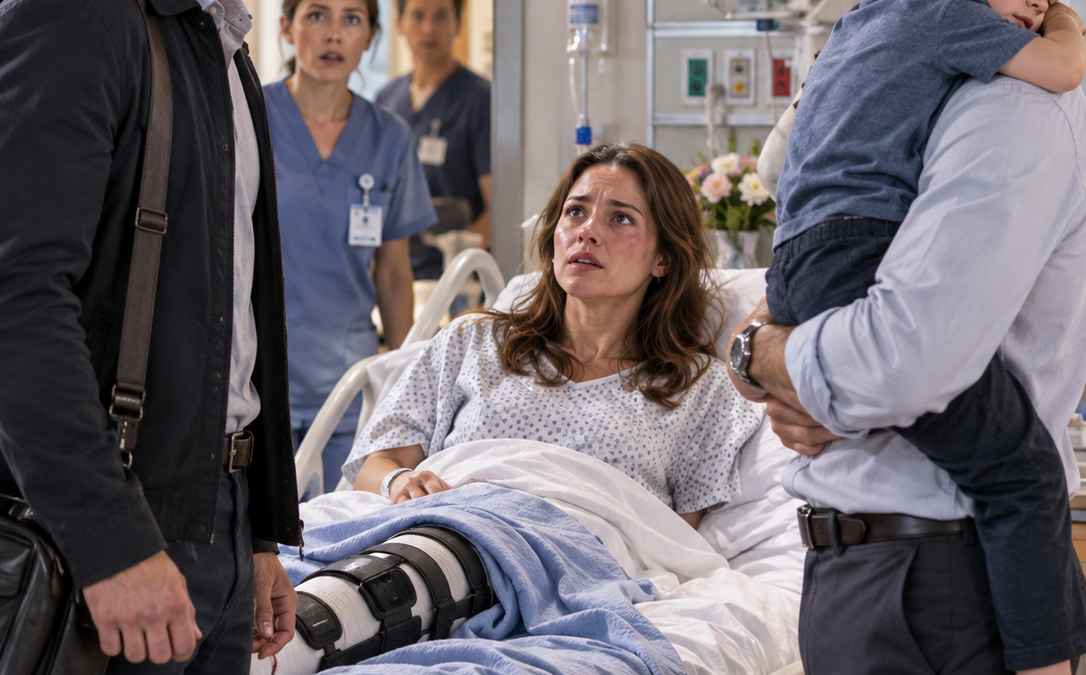
He was standing at the foot of Laura’s hospital bed.
And on his hip, settled there like it was the most natural thing in the world, like it was a place his body already knew, was Owen.
My son. Four years old. Thumb halfway to his mouth, head resting on this man’s shoulder the way he rests his head on mine when he’s tired at the end of a long day.
Not scared. Not confused.
Comfortable.
I felt something in my chest go very quiet and very cold, like a server room dropping to sixty-eight degrees.
My brain, the part of me that had spent fifteen years finding patterns in things that don’t want to be found, started doing something I couldn’t stop.
Cataloging. Filing.
That’s not how a kid holds on to a stranger.
“Sir?”
The nurse was talking to me again.
“Sir, I’m so sorry. There’s a major issue with the intake protocol. The gentleman who arrived with her in the ambulance provided an emergency contact number that matched the one on file, and he’s currently listed as her spouse. We’re trying to rectify it now.”
He rode with her.
Of course he did.
He was probably in the passenger seat when it happened.
“No,” I heard myself say, quiet and dead flat. “No, it’s fine. I think… I think I’ve got the wrong room.”
I don’t know why I said that. I knew it wasn’t the wrong room. I knew exactly whose room it was. But something in me wasn’t ready to stand in that hallway and argue for a truth I wasn’t sure I wanted yet.
I turned around and walked back to the waiting room. I sat down in a plastic chair that had absolutely no business being that uncomfortable.
And I did not go back to that desk.
Here’s the thing nobody tells you about shock. It doesn’t look like crying. It doesn’t look like screaming. It looks like a grown man sitting very still in a hospital waiting room for six hours, staring at a vending machine and not eating anything out of it.
I watched families come and go. A teenage boy with a cast on his arm, laughing with his buddies about how gnarly the break looked on the X-ray. An elderly couple, the husband patting his wife’s hand every few minutes like a metronome. A woman crying quietly into her phone in the corner, saying, “No, no, he’s stable. He’s stable,” over and over like she was trying to convince herself.
Nobody came to update me.
I wasn’t on the list.
I knew that now in the specific and humiliating way you know something once you’ve had it confirmed by a hospital intake system.
I sat there with my laptop bag still over my shoulder like an idiot, like I might get called into a meeting. Every twenty minutes or so, the image would surface again.
Mike’s hand on the bed rail. Owen’s head on his shoulder. The word husband coming out of a nurse’s mouth like it belonged to somebody else.
I pushed it down every single time.
I told myself the same thing on a loop.
You’re exhausted. You’ve been traveling all day. You’re scared out of your mind, and your brain is doing what scared brains do. Building monsters out of nothing.
I’ve spent my whole career trained to spot an anomaly the second it appears in a system. Small, quiet, easy to miss if you’re not looking for it. That’s exactly how the real threats get in.
I know that better than almost anyone.
I know it.
And I still didn’t let myself look.
Around eleven, a different nurse came out. Older, tired eyes, the kind of nurse who’s seen every version of a bad night this hospital has to offer. She told me Laura was stable, that she’d taken a hit to the head and had a fractured femur, that she was sedated and wouldn’t be lucid until morning, and that I should go home and get some rest.
“Are you family?” she asked, glancing at her chart.
“I’m her husband,” I said again.
Third time that night.
It was starting to sound less like a fact and more like something I was trying to convince myself of.
She looked at me a beat too long.
“Come back in the morning. Shift changes at seven. Things get sorted out then.”
Things get sorted out then.
I drove home to a house that felt too big and too quiet. Past Owen’s dark bedroom window. Past the kitchen table where Laura and I ate dinner four nights a week like a normal, boring, happy family.
Then I sat in my car in the driveway for a long time before I went inside.
I didn’t sleep. I lay in bed in a house that suddenly felt like it belonged to someone else, staring at the ceiling. And I made myself a promise that I now know was already a lie the second I made it.
Tomorrow you go back. Tomorrow this all gets explained. Tomorrow you find out it was a scheduling mix-up, a mistaken chart, a coworker who happened to be nearby and offered to help with Owen so Laura’s mother didn’t have to drive an hour. Tomorrow it makes sense.
I believed that for almost exactly twelve more hours.
I had no idea that the sun coming up that morning wasn’t bringing me an explanation. It was bringing me the first day of an investigation I never asked to start. One that would end with me sitting on my office floor doing math I didn’t want to do, staring at a piece of paper that would tell me exactly how long I’d been the only person in my marriage who didn’t know the truth.
The worst part about being trained to notice patterns is that once you start seeing one, you can’t unsee it.
It doesn’t matter if the woman in the pattern is your wife.
At seven that morning, I was back at Sunflower Medical Center before the sun had fully cleared the parking garage. This time, the desk was staffed by someone new. A different face, a different clipboard, and none of the tension from the night before.
“Laura Dale? Let me look. Oh, yeah. There was a mix-up on the intake form last night. I’m so sorry about that. You’re good to go back.”
A mix-up.
Two words doing an awful lot of work.
Mike wasn’t there. Owen wasn’t there. Laura’s mother, Bethany, had picked him up sometime after midnight, according to the chart.
When I walked in, Laura was propped up in bed, her leg in a brace, a bruise blooming purple along her jaw. And when she saw me, her whole face crumpled with relief.
“Steve.” Her voice cracked. “Steve, I was so scared. I didn’t know if they’d reached you.”
“I’m here.”
I sat down, took her hand, and I meant it. Every part of me that still loved her meant it.
“I love you. I was so scared. I was so scared.”
I said it, and it was true.
And underneath it, quiet as a hum, was another sentence I wasn’t ready to say out loud yet.
I was so scared. And I still am, just not for the reason you think.
I walked out of that room forty minutes later feeling like a criminal. Not because of anything Laura did. Because of what I’d let myself imagine about her while she was unconscious in a hospital bed.
What kind of man does that? I thought, pulling out of the parking garage. What kind of man builds a case against his own wife while she’s got a fractured femur?
I told myself I was done with it. I told myself the truth, whatever it was, would show itself in its own time, and I didn’t need to go digging for it.
It lasted about six days.
We brought her home that Friday. I turned the office into a makeshift bedroom because the stairs were out of the question. Moved the desk into the garage, dragged the guest bed in, hung a shower chair in the downstairs bathroom.
I learned how to help a grown woman out of a wheelchair without hurting either of us. I drove her to physical therapy on 63rd Street three mornings a week. I made Owen pancakes every single morning because that was our thing, mine and his. And some habits you hold on to tighter when everything else feels loose.
I was doing everything right.
I want that on the record.
I was doing everything a husband is supposed to do.
And every single night, lying next to her in a bed that used to feel like the safest place in the world, I’d close my eyes and see the same thing.
Mike’s hand on the rail.
Owen’s head on his shoulder.
Small things started collecting. I want to be honest about how small because that’s the part nobody tells you.
It’s never one big thing.
It’s fifty small ones.
Her phone, which used to sit face up on the counter while she charged it, now lived face down every time. No exceptions.
Bethany came by on a Tuesday with a casserole, chicken and rice, her specialty, and mentioned completely innocently that nice young man from your office was such a help that first night, Laura, carrying Owen around, keeping him calm.
Laura’s fork stopped halfway to her mouth.
Just for a second.
Just long enough for me to notice.
“Which coworker?” I asked, keeping my voice easy, curious. Nothing more.
“Mike,” Bethany said. “Sweet boy. You should thank him.”
Laura changed the subject to the casserole.
A few nights later, Owen was half asleep on the couch, and out of nowhere, in that flat little voice kids use when they’re too tired to filter anything, he said, “Is the other guy picking me up from school again tomorrow?”
“What other guy, bud?”
“The other guy from Mommy’s office.”
I sat very still.
“What’s his name?”
“Mike.”
He said it like it was the most normal word in the world, like it belonged in his mouth.
I didn’t sleep that night, either.
I found the jacket by accident, looking for a suitcase in the back of our closet. A men’s jacket, navy, size large.
I’m a medium.
When I asked Laura about it, she barely looked up from her physical therapy exercises.
“That’s an old one of yours from, like, four years ago.”
I’ve never owned that kind of jacket in my life.
I didn’t say that.
I just filed it away next to everything else.
Her calendar had a rhythm to it now that I hadn’t clocked before, because why would I have? Tuesdays and Thursdays, late meetings, home after seven every single time, consistent as a server ping.
And then one evening, while her phone buzzed on the counter, face down like always, I caught a flash of the lock screen before it went dark.
A name. Just the letter M.
And underneath it, four words.
Can’t wait for Thursday.
It was nothing.
I told myself grief and fear make people see things that aren’t there. And fear makes people see things that aren’t there.
I told myself I was turning into the kind of man I never wanted to be. The kind who audits his wife like she’s a system he doesn’t trust.
I told myself all of that.
And then I went looking anyway.
I wasn’t even looking for it.
I was digging through the file drawer in what used to be my office, hunting for Owen’s insurance card for a pediatrician visit, when I pulled out the folder with his hospital birth records.
My eyes snagged on a single line.
Blood type: O negative.
I froze.
I’m AB positive. I’ve known that since I started donating blood in college.
It is a fundamental, textbook biological impossibility for an AB-positive father to produce an O-negative child.
My brain instantly went into audit mode.
I worked the timeline backward from his January birth date. Conception happened in April. She had already been working at Howerin for nearly a year by then.
I pulled up my old travel logs from that April.
I was in San Diego for two weeks straight on a massive defense contract.
I wasn’t even in the state when Owen was conceived.
I didn’t confront her. Not yet.
I told myself I needed to be sure. Not suspicious.
Sure.
The kind of sure that doesn’t leave room for a man to spend the rest of his life wondering.
There’s a fertility and paternity clinic two towns over in Lenexa, tucked into a strip mall between a nail salon and a Chinese takeout place.
I went in on a Wednesday during my lunch break and paid three hundred dollars in cash for a discreet paternity kit. I told the woman behind the counter I was just being thorough.
She nodded like she’d heard that sentence a thousand times from a thousand men just like me.
While I waited on the results, I didn’t stop.
I couldn’t stop.
I pulled our joint bank statements and found small cash withdrawals. Sixty here, eighty there. Always on a Tuesday or a Thursday. Always ATMs near her office.
I looked up Mike Carlton on Facebook and found what I was looking for in about four minutes.
Photos of Laura at a bar downtown I’d never heard of. Photos from a work trip to Kansas City that she said was just her and Danielle from accounting.
And buried in his tagged photos from three years back, Mike grinning, holding a baby.
My son.
Or the boy I’d believed for four years was my son.
Mike lived forty-five minutes away in a one-bedroom apartment complex off I-35 in Lenexa. Modest place. Not the home of a man building a family.
The home of a man keeping an option open.
I felt like a thief in my own life.
I remember thinking that while scrolling through pictures of my wife at one in the morning, while she slept twenty feet away in a bed I’d helped her into.
Taking things that weren’t mine to take.
But once you start looking, you can’t unsee what’s in front of you.
The results came a few days later.
A plain white envelope, no branding, sitting in a stack of mail on the kitchen counter like it was nothing. Like it wasn’t about to tell me who I actually was to the boy I’d been making pancakes for every single morning for four straight years.
I carried it out to the garage, sat down on an overturned paint bucket, and held it for a full hour before I opened it.
I want you to understand something about that hour.
That hour was the last hour of my life where I still got to believe I was Owen’s father.
I knew, sitting there, that once I opened that envelope, there was no version of the future where that was still true.
So I sat with it.
I let myself have the last hour of the lie because I knew it was the last good thing I was going to feel for a long time.
Then I opened it.
Probability of paternity: 0%.
I want to tell you I screamed.
I want to tell you I put my fist through the garage wall, that I felt something violent and loud crack open in my chest.
But that’s not what happened.
What happened was worse.
I felt nothing.
And then, a second later, I felt everything at once, like someone had reached into my chest and scooped out four years in a single motion, leaving a hollow space exactly the shape of a little boy’s laugh.
I kept driving her to physical therapy that week. I kept making pancakes.
I told myself I was waiting until she was strong enough to hear it. That I was being kind, being patient, the man my whole life had trained me to be.
But that wasn’t the real reason.
And some part of me knew it even then.
I just wasn’t ready to let go of a life I thought was mine.
Not yet.
Every time Bethany came by bringing soup, calling me sweetheart the way she’d done since the day I married her daughter, telling me how proud she was of the way I was holding this family together, I felt the ground shift a little more under both of us.
Because she had no idea what I now knew.
And every kind word she said to me was a countdown to the moment I’d have to take it all away from her, too.
I didn’t know yet how I was going to do it. I only knew I couldn’t keep washing her daughter’s hair in that shower chair, keep smiling over pancakes, keep pretending the math in that folder didn’t exist.
Something in me had already decided.
It just hadn’t told the rest of me yet.
There’s a specific kind of quiet that happens right before you burn your own life down. It doesn’t feel like anger.
It feels like clarity.
The water was running warm over Laura’s hair, and I had her head tipped back into the shower chair the way I’d done a dozen times that month, working shampoo through her hair with the same hands that had held that DNA envelope for an hour in the garage.
She was laughing about something. Some story about a physical therapist who kept calling her “champ” like she was twelve.
I let her finish the story before I said it.
“Are you cheating on me?”
Her laugh cut off midbreath.
Not slowly.
Like someone had hit a switch.
“What? Why are you asking me that?”
“Just answer the question, Laura.”
“No. Why are you asking me that?”
“I saw Owen’s medical file, Laura. I know about the blood type.”
She went completely rigid under my hands.
I kept my hands moving through her hair, calm and steady, the same way I’d trace a breach through a server log. She went very still beneath my hands.
The water kept running.
Somewhere outside, a dog was barking at nothing.
“Steve…”
“How long?” I asked, keeping my voice dead level.
She didn’t answer immediately.
The silence stretched, filled only by the spray.
“I asked you a question, Laura. How long?”
My voice cracked. Not from sadness, but from the sudden, violent surge of adrenaline. I was shaking so hard I had to grip the shower wall to stay upright.
“Six months,” she whispered, her voice barely cutting through the sound of the rushing water. “We started seeing each other six months before I got pregnant. It wasn’t… It was never supposed to be serious. It was just…”
Her voice broke apart.
“It just happened. And then it kept happening. And I didn’t know how to stop it. And then I was pregnant. And I didn’t know whose.”
“You knew.”
I said it quietly, flatter than I felt.
“You knew exactly whose.”
I stopped rubbing the shampoo, my fingers resting heavily on her head.
“Now tell me, who is Owen’s father?”
My voice was shaking as if I were ready for the answer.
To be honest, I wasn’t.
But I wanted to know.
“It’s Mike. Mike Colton, my ex from college. He works with us,” she said, her voice trembling.
“Mike? Your ex from college? The one who was supposed to be ancient history is the same Mike Colton at your office?”
She started crying, the kind of crying that comes with your hands shaking. She reached for my arm, and I let her hold it because some old, stupid, loyal part of me still couldn’t stand to watch her hurt.
“I wanted two lives,” she said. “I wanted the good parts of both. I know how that sounds. I know it was a mistake, Steve. I know.”
“A mistake lasts a night, Laura. Six months before you got pregnant isn’t a mistake. It’s a lifestyle choice.”
My voice was dead level.
“You wanted a stable husband, a suburban house, the family vacations, and the safety net. You kept the heavy lifting of a marriage here and outsourced your excitement to a one-bedroom apartment in Lenexa.”
I turned off the water, leaving the bathroom completely silent.
“You got the fantasy. I got the mortgage. We’re done.”
I finished helping her, got her into bed, tucked the blanket around her leg brace the way the physical therapist had shown me, turned off the light, and said nothing else.
That night, I slept in Owen’s room on the floor next to his bed, listening to his little sound machine hum out fake ocean waves.
I watched him sleep with his mouth open, one arm flung over his stuffed dinosaur, completely unaware that the ground under his whole world had already started cracking.
He had no idea.
He’d never know how close I came to finding out too late.
And I’d never forgive myself for the choice I already knew I was going to have to make.
The next morning, something in me had changed.
Not anger.
I want to be clear about that because anger burns hot and fast, and I didn’t have that in me anymore.
What I had was quieter, steadier, present in a way I hadn’t let myself be in weeks.
I made Owen pancakes, chocolate chips the way he likes them, shaped badly like a dinosaur because that’s the bit we do every morning.
I walked him out to the bus stop at the end of our cul-de-sac and watched him climb on with his backpack half falling off one shoulder. I waved until the bus turned onto Antioch Road and disappeared.
My heart cracked clean in half standing there in my driveway in my socks, because some part of me already knew this might be one of the last mornings I got to be Daddy.
And he didn’t even know to say goodbye to it.
I didn’t call a lawyer that day.
I called Bethany.
“Hey, sweetheart,” she said, warm as always.
No idea what was coming.
“Everything okay?”
“I need to come over. I need to talk to you without Laura.”
There was a pause on the line, just long enough for me to know some instinct in her had already picked up on something.
“Come over anytime, sweetheart. I’ll put coffee on.”
She had two mugs waiting when I got there and a plate of the shortbread cookies she always kept in a tin on her counter.
She sat across from me at her kitchen table like she had a hundred times before.
And I told her everything.
The hospital. The nurse. Mike’s hand on the bed rail. The birth certificate. The math. The clinic in Lenexa. The DNA.
She didn’t say a word until I finished.
Then she reached across the table and took my hand, and I broke down in a way I hadn’t let myself do once through this entire thing.
Not at the hospital. Not with the envelope. Not in the shower with Laura crying against my arm.
I broke down at that kitchen table because Bethany Carr was looking at me like I was the one who’d been hurt.
Because I was.
“I raised her better than this,” she said finally, her voice cracking. “I don’t know where I went wrong.”
She squeezed my hand hard enough to hurt a little.
“You’ve been like a son to me, Steve. You still are. That doesn’t change. Not because of this.”
She didn’t defend Laura. She didn’t make excuses. She just held my hand across that table like I was the one who needed holding.
And somehow that made it so much worse because it meant I was losing her, too.
A mother who never had to be mine, who chose to be anyway for eight years.
“I’ll take Owen,” she said quietly. “Laura can’t do this alone. And I won’t have that boy caught in the middle of what’s coming. He’ll be loved. I promise you that.”
I believed her.
I still do.
I walked out of her house that afternoon knowing I’d just said goodbye to the only family that ever really felt like mine, even though technically none of it ever really was.
If you have been listening for a while, drop your thoughts in the comments. Hit the like button while you’re at it, and be sure you’re subscribed.
Laura noticed the withdrawal almost immediately.
That’s the thing about someone who spent years reading a room for a living. She could feel the temperature drop the second I stopped fighting for us.
“You talked to my mom,” she said, cornering me in the kitchen two days later.
Not a question.
“I did.”
“That’s… Steve, that’s a family thing. We could have sorted that out between us.”
“Your mother is family, too, Laura.”
I kept my voice level.
“Or did you forget that when you decided to hand her grandson to another man in a hospital room while I was still in the air?”
She didn’t have an answer for that.
She never did. Not once, for anything that actually mattered.
I moved into the guest room that night. She stood in the doorway watching me carry my pillow down the hall, like watching me might stop it from happening.
“Are you leaving?”
“I don’t know.”
“Do you still love me?”
I thought about lying.
It would have been so much easier to lie.
“I’m trying to figure that out.”
She crossed the room and reached for me, fingers curling into my shirt the way they used to when we were still just a normal couple with normal problems.
And I let her.
I didn’t pull away.
I just didn’t reach back.
I watched something in her face collapse as she understood in real time that she was losing me one small non-response at a time.
For the first time since the hospital, I didn’t feel guilty watching that happen.
I just felt tired.
Tired in a way sleep wasn’t going to fix.
The morning after that conversation in the shower, the financial safety net she’d relied on for eight years vanished.
I didn’t ask for permission. I moved my direct deposit to a sole account, transferred exactly half of the remaining household utility funds to our joint checking, and left her to figure out how to cover her own lifestyle.
When she cornered me about the missing balances, crying that she couldn’t balance the books, I didn’t look up from my laptop.
I told her simply, “I’ve paid the premium on this life for eight years while you invested your real self somewhere else. The account is closed, Laura. Figure it out.”
She didn’t argue because there was no defense left to make.
There were smaller things, too. Quieter, almost embarrassing in how much they hurt.
One night, I caught myself pulling four plates down from the cabinet out of pure muscle memory. One for me, one for Laura, one for Owen, one that used to be for the family we thought we were.
I stood there holding that fourth plate for a long moment before I put it back in the cabinet.
Small. Visual. Devastating.
Nobody tells you divorce arrives in pieces like that.
A plate you don’t set anymore.
A chair nobody sits in.
The papers came on a Thursday.
Fitting, given what Thursdays had apparently meant in our house for the last four years.
I laid them out on the kitchen table: the petition for divorce and the court-ordered paternity fraud motion.
In our state, being the husband means you’re legally on the hook for a child that isn’t yours until a judge says otherwise.
I wasn’t going to let a family court force me to fund their secret family for the next fourteen years. Nor was I going to drag Owen through a toxic custody battle for a point of pride.
The motion didn’t just sever my legal ties. It legally compelled Laura to name Mike as the biological father, shifting the financial and legal responsibilities of parenthood squarely onto the man who earned them.
Laura’s hands shook as she read them.
She got to the paternity page and looked up at me, eyes already wet.
“What happens to Owen?”
“He was never my son, Laura.”
I said it as gently as I knew how, which wasn’t very gently at all, because there’s no gentle way to say a true thing that big.
“And staying would be a lie. To him, to me, to all of it.”
She started crying in earnest then, reaching for my hands across the table, begging in a way I never thought I’d hear from a woman who ran multimillion-dollar product launches for a living.
“I’ll do anything, Steve. I’ll fix this. I’ll never see him again. I’ll go to therapy. I’ll… Please, just don’t do this.”
And there it was.
Not I’m sorry I hurt you.
Not I’m sorry I lied to you for four years.
Just Please don’t make me face what I did.
“You’re not sorry you did it,” I said. “You’re sorry you got caught.”
She didn’t argue.
She couldn’t, because it was true, and we both knew it.
I left on a Sunday morning in late October, the kind of crisp Kansas morning where the maples along our street had gone every shade of orange and red, like the whole neighborhood was putting on a show for an audience that wasn’t watching anymore.
I packed two suitcases and loaded them into the car myself.
No help.
No goodbyes rehearsed.
Owen found me in the driveway.
“Daddy, where are you going?”
That word.
It broke something in me clean in half every single time.
And this was going to be one of the last times I ever got to hear it aimed at me.
I knelt down to his level right there on the cold concrete and told him I had to go away for a while.
“When are you coming back?”
I wanted so badly to tell him the truth.
That his mother made choices that broke us. That I wasn’t his father. That none of this was his fault and all of it was hers.
I wanted to say all of it.
But he was four years old.
He didn’t deserve to carry that weight.
Not yet.
Not ever, if I could help it.
“I love you more than anything in this whole world,” I told him instead. “I want you to remember that, no matter what.”
He hugged me around the neck the way he always did, and I let myself cry for the first time in front of him.
Quiet, quick, wiped away before he could really see it.
Then I stood up, got in the car, and drove away without looking in the rearview mirror.
If I’d looked back, I would have stayed.
And staying would have been a lie.
So I kept driving, one mile at a time, away from everything I ever thought I wanted.
Three months later, Laura called.
I almost didn’t pick up.
“I lost the house,” she said. “I’m working part-time at the Howerin satellite office. Apparently, the scandal of the divorce and the paternity disestablishment was too much liability for the main office. They moved me off the director track.”
“And Mike?”
A short, bitter laugh.
“Gone. The second things got hard, he was gone. Guess he never wanted the responsibility in the first place.”
A pause.
“Is there any chance for us, Steve? Any chance at all?”
“No.”
“Did you ever love me?”
“I loved who I thought you were.”
“I never wanted to hurt you,” she said, and her voice cracked on it.
“I know,” I told her. “But wanting isn’t the same as trying. And you never tried.”
“I’m sorry,” she said one more time.
The same two words she’d been saying since the shower, since the kitchen table, since the driveway.
“I know you are.”
I meant it, too.
I think she really was sorry, just not for the right thing.
She was sorry for the consequences.
She was never sorry for the choice.
I hung up.
I didn’t call her again, and she stopped calling me not long after that.
I moved to Colorado about a year later, taking a director-level position at a firm outside Denver.
A fresh start in a state where nobody knew the shape of the life I used to have.
I don’t date much. I go to work. I go for runs in the foothills. I exist in a kind of quiet I never had time for when I was busy being a husband and a father to a boy who was never mine to keep.
A letter showed up one afternoon, forwarded from my old address.
No return address on the envelope.
Inside was a piece of construction paper folded in half, a little crumpled from the trip.
A crayon drawing.
A stick-figure man.
A stick-figure boy holding hands.
At the top, in the giant, shaky block letters of a five-year-old who was just learning how to spell his own name, it read:
“I miss you, Daddy. Please come back.”
I cried.
I understood without anyone telling me that Bethany had sent it and that she’d made sure Laura never knew.
I keep it folded in my wallet.
I can’t look at it very often.
I can’t throw it away, either.
I don’t regret leaving.
I regret that any of it had to happen in the first place. That a woman I loved for eight years decided somewhere along the way that she deserved two lives instead of one.
And that a little boy got caught in the wreckage of a choice he never made.
I’m not angry anymore.
Some nights, I’m not even sad.
I’m just quiet in the way you get when you’ve finally stopped waiting for an apology that means something.
Laura wanted to be the woman who had everything. The husband, the house, the secret, the fantasy on the side that made her feel young and reckless.
She built that whole life out of the good parts of two men.
And in the end, she lost every single one of them.
The house. The career track. The man who promised her something better and vanished the second it got hard.
She has none of it now.
And me?
I have peace.
Real peace.
The kind that doesn’t come with an asterisk.
And I think, in the end, that’s worth more than anything she managed to keep.
I’m done being the background in somebody else’s story. Done being the safety net, the man who shows up and pays the mortgage and never gets seen.
Freedom turned out to be the only revenge I ever actually needed.
I don’t know if Owen will ever understand why I left. I don’t know if he’ll grow up hating me or forgetting me or wondering his whole life why I didn’t fight harder for him.
I hope someday somebody tells him I did fight.
I fought every single day to be the father he deserved.
I just didn’t know until it was almost too late that I was fighting for a boy who was never mine to keep.
If you enjoyed this story, hit that like button, subscribe, and drop a comment below. Let me know where you’re watching from.
I will see you on the next one.








