Told my daughter-in-law i had an early flight and turned in. at 1 am, my door lock clicked. she dug through my suitcase, zipped something inside, then whispered on her phone: “the target took the bait. alert airport security at 6am.” i lay still, breathing steadily as if fast asleep. the next morning…
At one o’clock in the morning, my daughter-in-law unlocked my bedroom door with a key I had never given her. I kept my eyes nearly closed and my breathing slow and steady, the way a man does when he wants someone to believe he’s asleep. Through the narrow space between my eyelids, I watched her unzip my suitcase and push something small deep into the lining. Then she crossed to the window, raised her phone to her ear, and whispered, “The target took the bait. Tip off airport security at six.” I was the target. I was sixty-four years old, and I had a flight in five hours. By sunrise, I would have to decide what kind of man I was going to be.
Let me back up, because nobody wakes up one morning and suddenly discovers a stranger sitting at the family dinner table. It happens slowly. Little things change, one after another, and you find reasons to overlook them because the alternative is too painful to consider. You tell yourself you’re being patient, that you’re keeping the peace, that family deserves the benefit of the doubt. And by the time you finally recognize what has happened, you realize how much of it you allowed. That’s the part that still keeps me awake at night.
My name is Levi Bennett. I’m sixty-four, a widower, and I spent thirty-two years working as an electrical engineer in Ohio. That profession taught me something most people never have much reason to learn: things rarely fail all at once. First comes a flicker, a faint vibration, a low hum that wasn’t there the week before. Most people ignore the hum. I spent my working life getting paid to listen for it. Margaret passed away four years ago this November, and the house on Maple Ridge Lane grew quiet in a way I had never imagined a house could. I filled that silence by making myself useful to our son. Daniel is thirty-eight now, a steady, hardworking man who manages accounts for a medical supply company in Columbus. I’ve always been proud of him.
Then Vanessa came into his life, and for a while, I honestly believed the Lord had sent our family something good. She called me Dad. She brought pecan pie to Thanksgiving dinner and asked how my blood pressure was doing. She remembered birthdays and made Margaret laugh, which counted for more with me than anything else. When she and Daniel found a brick colonial in Dublin and came up short on the down payment, I lent them eighty-five thousand dollars. We shook hands over it at my kitchen table, with the understanding that they would pay it back when they could. Margaret would have wanted it that way. At least, that was what I told myself, and at the time, I believed it.
Somewhere during the last year, the pies stopped coming, and the questions began. Vanessa would lean against my kitchen counter, smiling in that easy way of hers, and ask where I kept my important papers, which bank held my savings, or whether a man my age ought to be traveling alone. She called it concern. I thought it was nosiness, but I let it pass because Margaret had made me promise, on her last good afternoon, that I would keep this family together. Then, last spring, Vanessa asked me for another twenty thousand dollars to cover what she called a business setback. I refused. Her smile remained exactly where it was, but something behind her eyes closed like a vault door. A week later, I overheard her telling Daniel in my driveway that his father was becoming rigid and suspicious, the way old men sometimes did. I stood behind the screen door with a dish towel in my hand and decided, once again, that I hadn’t heard a thing.
That brings me to a Thursday in October. I had a 7:40 flight out of Columbus the following morning, bound for Pittsburgh, where I planned to visit Walt Hendris, an old friend recovering from hip replacement surgery. Daniel was attending a work conference in Cincinnati and wouldn’t return until Saturday. Vanessa drove over that evening carrying a casserole and offered to sleep in the guest room so she could take me to the airport at five. It sounded thoughtful enough. During dinner, though, I caught myself counting how often she steered our conversation back to my trip. Four times. I noticed it, filed it away, and said nothing. Before bed, I packed my old gray Samsonite suitcase and placed it on the bench at the foot of my bed. Two shirts, a pair of good slacks, my pill organizer, and a paperback novel. Nothing unusual. I closed the zipper, called good night to Vanessa down the hall, and turned the old brass lock on my bedroom door. It was something I hadn’t done in years, and I couldn’t have explained why I felt the need that night.
The sound that woke me was almost too faint to hear, a little metallic whisper, the kind of click a man might miss if he hadn’t spent his career listening to relays and switches. The clock showed a little after one. I opened my eyes just enough to see the brass lock turning slowly, patiently, before the door eased inward against a narrow wedge of hallway light. A spare key. Margaret had kept one hanging on a nail in the pantry for thirty years, and it had never occurred to me to move it. Vanessa slipped into the room in her socks and stood for nearly a full minute studying the shape of my body beneath the quilt. I made my breathing long and even, the way I’d learned to do during those final hospital nights with Margaret. My heart hammered against my ribs, but I kept my chest rising and falling as though nothing in the world had disturbed my sleep.
Vanessa crossed to the bench without making a sound. I heard the zipper whisper open. She paused, listening, then lifted the lid. Through my eyelashes, I watched her reach into her cardigan pocket and take out a small bundle wrapped in clear plastic. She pressed it deep into the pocket behind the suitcase’s inner lining, making sure it was tucked well out of sight. Then she closed the zipper and smoothed the lid with the same gentle motion a mother might use to straighten a child’s blanket. She walked to the window, dialed a number with her thumb, and waited with the blue light of her phone illuminating her face from below. When she spoke, her voice was barely louder than a breath. “The target took the bait. Tip off airport security at six.” There was a pause while she listened. Then she added, “He’s asleep. Just make sure it’s done.”
The door clicked shut behind her, and her footsteps faded along the hallway. I didn’t move. I lay there counting slowly to three hundred, the way I used to after tripping a breaker, waiting to see whether the system would settle down or surge again. In the darkness, I went back through the past year. The questions about my papers. The questions about my savings. The sudden concern over my traveling alone. What hurt most wasn’t the fear. It was remembering Vanessa at my table that first Thanksgiving, standing there with a pie knife in her hand, smiling as she called me Dad. I wondered whether she’d meant even a single word of it.
When the house had been silent for a long time, I finally sat up. The suitcase was a darker shape against the surrounding darkness, sitting on the bench as patiently as a stone. I didn’t know what Vanessa had hidden inside its lining. I knew only that it wasn’t a prank, a misunderstanding, or any innocent mistake. My daughter-in-law had turned my luggage into a trap, and she expected me to walk straight into it. What she didn’t know was that I had spent thirty-two years solving problems before they became disasters. I sat on the edge of the bed, my bare feet resting on the cold floorboards, and let my memories return in their own order. When a system fails, you don’t begin with the component that’s smoking. You trace the fault backward until you find the place where the circuit first went wrong.
Vanessa had entered our lives eight years earlier at a Sunday dinner Daniel had been nervous about for an entire week. She was working as a pharmaceutical sales representative then, a sharp, funny woman who arrived carrying a lemon cake she’d baked herself. Within ten minutes, she had Margaret laughing. My wife liked her, but later that evening, while we were drying dishes together, Margaret said something I’ve never forgotten. “That girl watches a room before she walks into it.” I told her that was called having good manners. Margaret simply said, “Maybe,” and handed me another plate. For years afterward, I thought about that one word. I think about it now, too, because the truth is that there was something real in Vanessa, and that makes everything that happened harder to understand.
She once sat with me on the back porch and told me about her father’s tire shop in Toledo. She was twelve when men arrived with a flatbed truck and took away the equipment. She remembered standing at the window, watching them load everything her father had worked for. “I never want to be that scared again, Levi,” she told me. I believed her then, and I believe her now. In fact, I suspect that was the most honest thing she ever said to me. I’ve come to understand that fear like that can turn into a hunger, and hunger, if you feed it long enough, can consume everything within reach.
After Margaret died, I leaned on Daniel and Vanessa more heavily than I had intended. I rewired their garage, repaired their garbage disposal, and drove to Dublin every Sunday without keeping track of the hours or the favors. At Margaret’s graveside, they stood on either side of me, each holding one of my arms. I remember looking at the ground where we were about to leave her and thinking that, whatever else happened, at least I wasn’t alone. Maybe I wasn’t alone then. I still want to believe that part was true.
The change began about two years earlier, when Vanessa quit her job to start an online business selling subscription boxes for home organization. Daniel told me about it with that particular mixture of pride and worry a husband feels when he wants his wife to succeed but can’t quite understand the numbers. There was inventory to purchase, advertising to pay for, and a warehouse unit off Route 161. Fourteen months later, the business folded. Daniel called it a learning experience. What he didn’t know was what I’d seen one afternoon while working beneath their kitchen sink. A stack of envelopes with red stamps on them sat beside the toaster. When Vanessa caught me looking, she quickly swept them into a drawer and told me they were junk mail. I’ve read plenty of junk mail in my life. It doesn’t come stamped like that. Still, I kept my mouth shut. Daniel’s pride was already wounded, and I figured a grown man ought to be allowed to find his own way toward the truth.
That winter, the requests started, each one wrapped in kindness. First, Vanessa suggested opening a joint bank account. “Just a family account, Dad,” she explained. “That way, if anything ever happens to you, we can handle things without all the red tape.” I told her I preferred to keep my accounts in my own name. She smiled and dropped the subject, only to bring it up again a month later in a softer voice. Around the same time, Daniel began mentioning things during our phone calls that didn’t sound like thoughts he’d arrived at himself. “Vanessa says you’ve been forgetting things lately.” I’d missed one dentist appointment in March. Any man alive has forgotten a dentist appointment, but I could hear how the story had grown as it traveled from one conversation to another, until a single missed cleaning had somehow become evidence of a pattern.
Then came August. I stopped by their house to return Daniel’s drill while he was outside taking a phone call. His desk drawer stood open about an inch, and inside I noticed a manila folder with my name written on the tab. It contained copies of my property deed, my pension statement, and a summary of my life insurance. When I asked Daniel about it that evening, he didn’t seem at all surprised. “Vanessa’s helping organize the family records, Dad. You left a stack of papers here a while back.” Maybe I had. That was the trouble. There was always an explanation, and every time one appeared, I was tired enough to want to accept it.
Three weeks before that Thursday, Vanessa stopped by for coffee and mentioned that I ought to consider moving my savings out of First Federal in Westerville before it merged with a larger bank. I set my cup down. I had never told Vanessa, Daniel, or anyone else where my money was kept. She laughed at my surprise and pointed out that I had a pen from the bank in my kitchen drawer. Another tidy explanation. At work, we used to have a saying: one anomaly is noise, two might be coincidence, but five is a signal you’d better respect. I’d been hearing the hum for a year. I just kept turning up the radio.
There’s something about losing a spouse that people who haven’t been through it rarely understand. On Margaret’s last good afternoon, we sat together on the sun porch while she held my hand and said, “Promise me you’ll keep our boys together.” She always called Daniel and me her boys, as though the two of us were one stubborn unit she’d spent a lifetime trying to manage. I promised her I would. Somewhere along the way, though, I allowed that promise to teach me the wrong lesson. I decided keeping the peace meant swallowing every small insult, ignoring every uncomfortable question, and calling my own silence generosity. Vanessa didn’t see a patient man. She saw a door that wouldn’t lock, and I’d spent a year proving her right.
I remembered another dinner from two weeks earlier. We were eating lasagna, and Daniel had gone to the kitchen to refill the iced tea. Vanessa reached across the table and patted my wrist the way someone might pat a nervous dog. “People your age shouldn’t have to worry about money,” she said. “It’s better when someone younger handles things for you.” Her voice was so warm, so full of what sounded like affection, that I’d thanked her. Sitting there in the dark, I could hardly believe it. I’d actually thanked her. That memory brought something into focus inside me. It wasn’t rage. Rage is loud and wasteful, and it blows fuses. What I felt was colder and steadier, like an electrical current finally finding its way to ground.
I stood, ignoring the complaints from my knees, and looked at the suitcase waiting on the bench. Vanessa had left it looking smooth and innocent. I wanted to know exactly what she’d put inside, why she’d done it, and who had been listening on the other end of her phone. But I wasn’t going to find out by following the path she’d laid for me. She had written a story in which an old man panicked, stumbled, or wandered blindly into a mistake. I had no intention of playing that part.
Down the hall, a floorboard creaked in the guest room. Someone else was awake. Shortly after two, I heard Vanessa coming down the stairs. Her steps were careful and light, and she skipped the fourth step from the bottom, the one that had groaned since 1994. A moment later came the refrigerator door, the sound of a glass being set on the counter, and, after a long pause, the soft scrape of the back door opening. A woman who had finished one phone call was stepping onto the porch to make another. I didn’t go to the window. There is a difference between a man who wants to know what someone is doing and a man who wants to be caught watching. At that moment, I needed to be neither.
I waited until the back door closed and the stairs creaked again, until the guest room latch clicked and the old house settled back into the thick silence it kept at night. Then I gave it another twenty minutes before switching on my bedside lamp. I did what I would have done at a failed substation: I documented everything before touching anything. I photographed the suitcase from the doorway, from the foot of the bed, and from directly above, the lid still closed exactly as Vanessa had left it. The photographs were timestamped around 2:34 and 2:35 in the morning. Thirty-two years of writing incident reports had taught me that memory is an unreliable witness, while a camera is a patient one.
Only then did I lift the lid, taking care to handle the zipper as little as possible. My shirts lay exactly where I’d folded them. So did the paperback and the pill organizer. The only thing that had changed was a zippered pocket inside the lid, a pocket I had never used. I eased its tab open with the tip of a ballpoint pen, folded back the flap, and shone my phone’s light into the opening. What I found was smaller than I’d feared and worse than I’d hoped.
Inside lay a clear plastic bag, doubled over and sealed with tape. It contained several dozen white pills without any markings I could recognize and without a pharmacy label. Beside it was another tightly sealed bag holding a pale, powdery substance. I’m not a chemist, and I couldn’t have identified either substance by looking at it. But I knew what an ordinary man’s luggage was supposed to contain, and I could picture exactly what an airport security officer might think upon discovering those packages. I imagined the suitcase being opened in front of a line of strangers at seven in the morning, the officer reaching inside, the people behind me stepping away. The entire scene appeared in my mind as clearly as a wiring diagram.
A sixty-four-year-old widower in handcuffs. His son away on business. His name appearing in the newspaper. His daughter-in-law sitting at a kitchen table somewhere, sighing sadly as she told anyone willing to listen that she’d been worried about his memory for months. Who would doubt her? My hands began to tremble. I put the pen down and let them shake until they stopped. Then I took three additional photographs, positioning the pen beside the packages for scale. I didn’t tear anything open, smell the contents, or touch the bags. When I had finished, I used the pen to close the pocket, lowered the suitcase lid, and left everything on the bench where I’d found it.
I turned the brass lock on my bedroom door once more and sat down on the bed. For the first time in my life, I was alone in my own house with someone who might be trying to destroy me, and I had no idea what to do next. So I called the only man I trusted to help me think clearly. Frank Miller and I had known each other since 1987, when his law firm hired mine to provide expert testimony after a grain elevator fire. He’d practiced criminal defense in Columbus for forty years, and ever since his stroke, he slept about four hours a night and called it an advantage. He answered on the second ring. “Levi? Who died?” “Nobody yet,” I told him. Then I explained everything in order, the way I’d report an electrical failure. The spare key, the suitcase lining, the whispered phone call, and the packages I’d discovered. He didn’t interrupt once. When I finished, I heard him exhale slowly through his nose.
“Listen closely,” Frank said. “You’ve done two things right, so keep doing them. You haven’t touched that stuff, and you haven’t confronted her. Don’t go down that hall. Don’t take her phone. Don’t go digging through her purse, and don’t call anyone she knows. Anything you grab on your own becomes your problem instead of hers. And that suitcase doesn’t go into a car. It sure as hell doesn’t go to the airport.” I told him I wasn’t planning to fly anywhere. “Good. I’m calling Dana Whitfield. Best criminal lawyer I know who’s still working. She owes me a favor, although she’s pretending to have forgotten about it.” He told me to stay where I was and ended the call. Dana called me shortly before four, sounding as though she’d already been awake for several hours. She asked her questions in a flat, quick rhythm. Who had keys to the house? Who had access to my bedroom? When had I packed? Had anyone watched me? She had me read the timestamps from my photographs and instructed me to send the images only to her. I was to leave the suitcase in the locked bedroom and make certain nobody went near it.
“Once it’s light, you’ll call the authorities and report exactly what you saw,” Dana said. “Not what you believe is in those bags, not what you think Vanessa intended. Just what you saw. I’ll make a call ahead so the right person handles it.” She paused before adding, “And Mr. Bennett, until then, act as though it’s any other morning. If she believes her plan is working, she’s more likely to keep making mistakes.” After we hung up, I spent the next hour at my dresser gathering documents that belonged to me. I found Vanessa’s text messages asking for money, including the one from spring about her business setback. I located the copy of the eighty-five-thousand-dollar cashier’s check and the handwritten note Daniel, Vanessa, and I had signed at my kitchen table. I placed everything into a folder, arranging the papers the way a man does when he finally admits how serious the thing he’s holding has become.
At a quarter to five, I carried a mug of coffee downstairs and sat at the kitchen table, watching the windows slowly change from black to charcoal gray. Upstairs, the shower started, followed by the hair dryer. Ordinary household sounds, part of a perfectly ordinary morning that was lying to me. My phone buzzed against the wooden tabletop. It was a message from Daniel, sent from his hotel in Cincinnati. “Dad, Vanessa says you’re flying out early. Please call me when you land.” I read it three times. Her fingerprints seemed to be on every word. She’d already told my son where I would be. I couldn’t stop wondering how much he knew. Was he lying awake in that hotel room, fully aware of what his wife intended to do? Or was my boy being used the same way I was, moved across a board without even knowing there was a game?
I looked at the clock above the stove. Ten minutes past five. In less than an hour, someone would pick up a phone and tell airport security to watch for an elderly man carrying a gray suitcase. Vanessa came downstairs at twenty past five, wearing a neatly pressed blouse, her hair still damp at the ends. She leaned toward me and kissed the air beside my cheek. “Morning, Dad. Did you sleep?” She held a travel mug in one hand and my car keys in the other. She’d taken them from the hook without asking, the way someone does when they’ve quietly decided that another person’s house partly belongs to them. “Like a rock,” I answered. “Old men earn their sleep.” She laughed a little too brightly and began pouring herself coffee.
I watched her rinse a mug and realized that wanting to hate somebody and being able to hate them are two entirely different things. A few hours earlier, I’d seen her smooth the lid of my suitcase as tenderly as a mother tucking in a child. Now she stood at my sink, humming softly to herself. It would have been easier if she’d looked like the person I had discovered in my bedroom. People who do things like that rarely do. “We should leave by five-thirty,” she said. “Security at Columbus is a zoo on Fridays.” I turned my coffee cup a quarter turn on the table. “About that. Walt called last night after you went upstairs. He’s running a fever, and his daughter wants me to hold off a day or two. I might switch to a later flight. Might even rent a car and drive to Pittsburgh instead. Who knows?”
I’d invented the phone call, and the lie left a bad taste in my mouth. But I wasn’t concentrating on the words coming out of my mouth. I was watching Vanessa’s hands. They stopped moving around the sponge for only a moment. “Oh,” she said, then recovered quickly. “But your bag’s already packed. You should still go to the airport. Even if you change flights, you can check it there. You hate rushing.” I nodded. “I do hate rushing.” She turned toward me with the faintest crack in her smile. “I’ll drive you over right now.” “Let me finish my coffee first, honey.” Her eyes shifted toward the clock above the stove. It was 5:34. At 5:41, she looked at it again.
I’ve stood in control rooms watching a gauge climb slowly toward the red. I know what someone looks like when they’re waiting for a number to reach a certain point. At 5:52, Vanessa announced that she needed to check something upstairs. I heard her enter the guest room and close the door. At exactly six, her voice came through the ceiling, low and hurried. I couldn’t make out the words, only the clipped, tight rhythm of a woman reading from a schedule. When she returned downstairs, I was standing in the front hall with my reading glasses on and my folder tucked beneath one arm. Dana’s office had called at 5:45 to tell me that a detective would meet me at the house. They’d advised me to let Vanessa leave on her own if she was willing. As it turned out, I didn’t have to arrange anything.
Vanessa snatched up her purse and announced that she’d just remembered a nine o’clock call about the liquidation of her business. She needed to get back to Dublin, which was twenty minutes away. Was I absolutely sure I’d be all right driving myself? I told her I’d manage. She hesitated at the doorway and glanced past my shoulder toward the stairs. “Your suitcase,” she said. “I’ll bring it down in a little while,” I answered, holding the door open for her. Whatever she saw in my face, it wasn’t what she’d been hoping to find. She walked to her car without another word. I stood at the window and watched her taillights disappear behind the maple tree at the end of the driveway.
Detective Carla Reyes of the Westerville police arrived at 6:50 in an unmarked sedan. She brought a young evidence technician named Pruitt, a camera, and a stack of paper evidence bags. Reyes was about fifty, with reading glasses pushed into her gray-streaked hair and the patient eyes of a woman who had heard every possible version of every possible story. I took them upstairs, unlocked the bedroom, and showed them the suitcase exactly as I’d left it. I handed Reyes my phone so she could examine the photographs and their timestamps, then repeated my account of the spare key, the lining, and the whispered conversation. I told her only what I had personally witnessed, exactly as Dana had instructed.
“You think it’s narcotics?” Reyes asked. “I think it’s something that doesn’t belong in my luggage,” I replied. “Without a label, I wouldn’t know a Tylenol from a Tic Tac.” She almost smiled. “Good answer.” Pruitt photographed the suitcase again and carefully removed the packages with gloved hands and a pair of tweezers that made my ballpoint pen look like a barbaric instrument. Reyes explained, without trying to soften the news, that testing would take several days. She couldn’t tell me whether charges would be filed or when anyone might be arrested. An old man’s word and a handful of photographs were a beginning, she said, but they weren’t a complete case. “Don’t contact your daughter-in-law about this. Don’t contact anyone connected to her. If anything happens, call me directly.”
I’d expected to feel triumphant when the police took the packages away. Instead, I felt as though I were standing in a dark room with someone else’s hand on the light switch. At 7:41, one minute after my flight’s scheduled departure, my phone rang. Vanessa’s name appeared on the screen. “Dad, where are you? Did you make your flight?” The cheerfulness in her voice had grown thin and strange. “No, honey. I told you things changed. I’m still home.” Silence followed. Then her voice returned in an entirely different register, flat and furious. “Why didn’t you call me? I was about to turn around. I’ve been sitting here worrying.” “I didn’t want to bother you.” “You didn’t want to bother me?” She stopped, and I heard her draw a long, deliberate breath. “Fine. Okay. I’ll let Daniel know.” She hung up before I could answer.
In thirty-three years of marriage, Margaret had never once hung up on me in anger. I’d also never been frightened by the sound of a telephone ringing, but that morning had changed both the meaning of silence and the meaning of a voice on the line. Daniel called at nine. I was sitting at the kitchen table, staring at the grain of the wood. “Dad, Vanessa texted me that you were on your way to the airport, and then she said you weren’t picking up. What’s going on? Are you okay?” I told him I was fine, but there was something serious I needed to deal with. I’d explain everything when I could do it without making matters worse. “You’re scaring me,” he said. “I know, son. I’m sorry. Just trust me for a day or two.” After a long silence, he said, “Okay.”
At 11:15, an unfamiliar number appeared on my phone. The area code was 412, from Pittsburgh. I answered, and a man’s voice, thick and unhurried, came through the receiver. “Hey, I’m supposed to be meeting you today. Just checking you’ve got the package.” My pulse seemed to slow, the way it sometimes does when a problem suddenly begins to make sense. I kept my voice level. “I think you’ve got the wrong man.” There was nothing on the line but breathing and distant traffic. Four seconds passed, maybe five, before the call ended. I sat there holding the phone, trying to understand what I’d just heard. The tip to airport security had been intended to get me caught. But this man in Pittsburgh hadn’t expected me to be arrested. He’d expected me to arrive.
Dana Whitfield’s office occupied the second floor of a building above a dry cleaner on High Street. The stairs smelled of starch and old carpeting. I arrived at noon with my folder beneath my arm. Dana was a compact woman in her late fifties, with a gray bob, reading glasses hanging from a beaded chain, and a legal pad already half-filled with notes. She didn’t offer me coffee. She offered me a chair and a roll of butcher paper. “Walk me through your year,” she said. “In order, with dates.” So I did what I used to do after a major outage. Together, we built a fault tree on her conference room wall.
March: the missed dentist appointment and the first remarks about my memory. Spring: the twenty thousand dollars Vanessa had requested and I’d refused. August: the folder bearing my name in Daniel’s desk drawer. Three weeks earlier: Vanessa’s unexpected knowledge of my bank. Then came the previous night, the spare key, the suitcase lining, the whispered phone call, and finally the man with the Pittsburgh number that morning. When Dana stepped back from the wall, the sequence no longer looked like a series of unrelated family disagreements. It looked like a pattern, and I’d spent my working life learning to distinguish one from the other.
“Here’s what I can’t tell you,” she said. “I can’t tell you what’s in those bags, who was on the other end of Vanessa’s phone, or how deep any of this goes. Detective Reyes will answer some of those questions. Some we may never know. But I can tell you that a story told in the proper order is very difficult to knock down.” She asked about the money I’d lent Daniel and Vanessa, so I took out the note we’d signed at my kitchen table. Eighty-five thousand dollars, with repayment due when their finances allowed. I’d always considered that phrase an act of kindness. Dana read it twice and told me it was a very loose way to lend someone a fortune. I admitted she was right. Then she asked whether either of them had ever raised the possibility of changing the loan’s terms. I told her no. She wrote something on her legal pad anyway.
Daniel drove straight from Cincinnati and pulled into my driveway a little before three. He was still wearing his conference lanyard, and his face had the pale, grayish color of putty. He came through the kitchen door without knocking, something he’d stopped doing years earlier, and stood there like a schoolboy waiting outside the principal’s office. I’d made a fresh pot of coffee out of habit, but neither of us touched it. “Dad, I’ve tried calling Vanessa six times. Her phone goes straight to voicemail.” He swallowed and looked at me. “Please tell me what happened.” I told him carefully, following the instructions Dana and Detective Reyes had given me. The key. The lining. The photographs. The detective arriving at my house. I said nothing about what I believed Vanessa intended. I told him everything I’d actually seen.
While I spoke, I studied my son’s face. A man who has been lying to himself looks different from a man hearing something terrible for the first time. Daniel looked like both. When I finished, he dropped heavily into a kitchen chair. For a long time, he stared at the table. Then he said, “She told me you were slipping.” I nodded. “I know.” He continued slowly, as though each word had to be dragged from somewhere deep inside him. Vanessa had told him I’d left the stove on, paid the same bill twice, and gotten angry when she’d pointed it out. She’d even claimed I’d called her by Margaret’s name at dinner. His voice cracked when he mentioned his mother. “I thought she was protecting me from something I didn’t want to see.”
“Did you ask me about any of it?” I asked. He opened his mouth and closed it again. “Daniel, when was this business with the stove supposed to have happened?” He stared down at the table. “Last Christmas Eve. She said you left a burner on after dinner.” “You were in my living room that night,” I reminded him. “You sat there for three hours drinking eggnog with your cousin Pete.” I kept my voice steady because it was the only way I could keep talking. “The duplicate bill happened in 2011. Your mother caught the mistake, and we laughed about it for a month. And I have never once called Vanessa by your mother’s name.”
Something seemed to drain out of him, slowly, like air escaping from a tire. He reached into his jacket pocket, pulled out a folded sheet of paper, and slid it across the table. It was a loan modification form from a mortgage broker I’d never heard of. The document would convert the eighty-five thousand dollars Daniel and Vanessa owed me from a debt into a gift. There was a line for Daniel’s signature and another for mine. Vanessa had left it on his desk three weeks earlier with a sticky note attached. “Sign when Dad’s having a good day.” I read those words three times. Beside them, in Vanessa’s neat handwriting, she’d drawn a little heart.
“I didn’t sign it,” Daniel said quickly. “I told her I wanted to talk to you first, but she said I was being cruel. She said if I really loved my father, I’d make things easier for him.” I looked up from the paper. “But you didn’t talk to me.” “No.” “Why not?” It took him a long time to answer. His hands rested flat on the table, broad knuckles just like mine. “Because if I asked you, Dad, and you were fine, then I’d have to wonder why my wife was telling me otherwise. And I wasn’t ready for that.”
I’d been angry for a day and a half, and I thought I’d exhausted every bit of it. I was wrong. I felt it rise again, not toward Vanessa this time, but toward my own son. “You didn’t doubt me, Daniel. You just didn’t want to check. Those are two different insults, and the second one is worse.” He flinched but made no attempt to argue. Strangely enough, that was the first thing that gave me hope there might still be something left for us to rebuild.
My phone rang a little after four. It was Dana, with Detective Reyes also on the line. They hadn’t established a complete picture yet. The pills and powder had been sent to the state laboratory, and the results would take days. But the 412 number belonged to a prepaid phone, and a name connected to that number in public records had a fraud conviction from seven years earlier. Dana emphasized that none of it proved what had happened. She also told us Vanessa’s failed business had accumulated unpaid judgments from vendors and a lien. My daughter-in-law had been drowning financially, and I had been the only life raft in sight. I put the phone down. Daniel was watching me with the expression of a man waiting for a verdict.
“Dad,” he asked quietly, “do you think she was trying to frame you?” I’d waited nearly two days for that question, and now that it had finally come, I discovered I didn’t want to answer with more certainty than the facts allowed. “I think somebody put something in my suitcase without my permission,” I said. “And I think your wife knows a great deal more than she’s telling us.” My phone buzzed again. Dana. I put her on speaker. “Mr. Bennett,” she said, “there’s something you and Daniel both need to hear. The man who called you gave Detective Reyes a statement this afternoon, and one detail doesn’t match the story your daughter-in-law has been telling Daniel at all.”
Dana’s voice came through the small speaker as steadily as a metronome. The man had initially refused to identify himself, but once Detective Reyes explained what the investigators knew, he’d decided he would rather cooperate as a witness than risk becoming a defendant. According to his statement, Vanessa had contacted him, not the other way around. She’d described her father-in-law as a confused elderly man who had agreed to carry a package to Pittsburgh as a favor. She’d warned him that I might not remember agreeing to the arrangement. Then she’d told him Daniel knew all about it. I felt as though the kitchen floor had tilted. Across the table, my son went completely still.
“That part is her claim,” Dana continued. “Whether this man believes it, and whether there’s any truth to it, are things Detective Reyes will have to investigate. But it means your wife told him you were involved, Daniel. Maybe she wanted him to feel safe. Maybe she wanted two names to point toward if something went wrong instead of just one.” Daniel stood so abruptly that his chair scraped across the floor. “That’s a lie, Dad. I swear to God, I never—” “I know, son,” I said before he’d even finished. He lowered himself back into the chair, trembling. For two days, I’d been trying to decide whether my boy was a villain or a victim. I finally understood that he was neither, not entirely. He was a man who had made himself comfortable by choosing not to know, and somebody had used that comfort like a crowbar.
When the call ended, we remained at the table for a long time. The kitchen clock ticked above the stove. Outside, a neighbor started a leaf blower, ran it for a few minutes, and shut it off. Finally, Daniel said, “I’m going to call her.” I reminded him that Detective Reyes had advised against contact. “She said you shouldn’t,” I told him. But he already had his phone in his hand. “She’s my wife, Dad. I need to hear her voice say it.” I considered stopping him. Then I thought about Margaret. She would have let him make the call, because some truths are things a man has to walk toward on his own two legs. “Put it on speaker,” I said. “And Daniel, don’t accuse her of anything. Just ask questions and listen.”
Vanessa answered on the fourth ring. I could hear traffic in the background. “Danny, finally! Baby, I’ve been so worried. Your father is acting so strange.” Daniel asked where she was. “At my sister’s. I needed some air. Honey, I think he’s having an episode. He wouldn’t go to the airport. He wouldn’t tell me why. He’s—” “Vanessa,” Daniel interrupted, “did you go into Dad’s room last night?” There was a pause. Only a beat, but I would have heard it in a coal mine. “What? Of course not. Why would I?” Daniel explained that the door had been locked and that I believed somebody had used the spare key. “Then he’s confused, Danny. That’s exactly what I’ve been trying to tell you.” Her voice became warm and wounded, reasonable in the way it always did when she wanted somebody to feel guilty for doubting her.
“Sweetheart, he’s sixty-four and grieving. He’s seeing things. You know how he’s been. Please don’t let him make you doubt me.” I’d heard that same voice ask me to pass the gravy boat a hundred times. Daniel closed his eyes. Then he asked why she’d told him I was already flying out when my flight hadn’t even departed. She insisted she’d only texted because I had said I was leaving. Daniel reminded her that her message had arrived at 4:50 that morning, before I’d mentioned anything about Walt or possibly changing my plans. Silence followed, the longest silence I’d ever heard from that woman. When she finally spoke, her voice had become softer, almost tender. “You’re repeating what he tells you. Can you hear yourself, Danny? I love you. I’m the only one thinking about your future. Come to my sister’s place, and we’ll talk. Just us.”
My son stared at the phone. I could almost see the decision moving across his face, the way weather moves across an open field. “I’m going to stay with my father tonight,” he said. “Danny—” “I’ll call you tomorrow.” He ended the call and sat motionless for several seconds. Then he covered his face with both hands and made a sound I hadn’t heard from my big, careful, thirty-eight-year-old boy since he was nine and we’d buried his dog beneath the apple tree. I didn’t try to find the right words. I walked around the table, put my hand on the back of his neck the way I used to when he was small, and left it there. It didn’t repair anything. Anyone who tells you an embrace can fix betrayal has never lived through one. But it gave us a place to begin.
Over the next two days, Daniel and I began the unglamorous work of sorting through what had happened. He slept in his old bedroom, and we ate frozen pizza off Margaret’s good plates because neither of us had the energy to cook a proper meal. He told me things in pieces, usually late in the evening, usually while keeping his hands busy with some small chore. He’d noticed money moving through his and Vanessa’s accounts that he couldn’t explain, but he’d never asked enough questions. In January, he’d discovered a statement for a second credit card and accepted whatever explanation she’d offered. “I knew, Dad,” he admitted one night while scrubbing a pan at the kitchen sink. “Not all of it. But I knew something was wrong, and I’d rather have been blind than brave.” I looked at him for a moment. “That’s the most honest thing you’ve said to me in a year.” He gave a bitter little laugh. “Is that supposed to make me feel better?” “No,” I told him. “It’s supposed to help you get started.” He laughed again, a wet, cracked sound, and then we stood together in the kitchen, two stubborn men surrounded by the belongings of a woman neither of us had ever stopped missing.
Dana helped us establish some boundaries. I wouldn’t prevent Daniel from speaking to his own wife, but I wouldn’t share information Detective Reyes had given me about the investigation. Daniel agreed to hire a lawyer of his own, somebody who wasn’t Dana and could advise him independently. Meanwhile, Reyes called occasionally with updates that rarely amounted to much. The laboratory was backed up. The man with the 412 number was cooperating, but cooperation, she reminded us, wasn’t the same thing as proof. His old fraud conviction made him a witness any competent defense lawyer would enjoy tearing apart. “We don’t build a case on one man’s word,” she said. “We build it on what we can verify. Phone records, messages, and money.” It was that last word that finally gave Daniel something solid to follow.
On Sunday night, he sat at my kitchen table with his laptop and a pot of burnt coffee between us. I watched his shoulders sink a little farther with every few minutes of scrolling. There were payments to a company called Meridian Recovery, others to a private lender in Cleveland, and cash advances in amounts large enough to make me close my eyes. Nearly sixty thousand dollars in debt, none of which had been disclosed to him. Then he opened a spreadsheet stored on a shared drive. Its title was written in Vanessa’s tidy way: “Dad Timeline.” Daniel turned the laptop toward me. The spreadsheet contained columns labeled “Competency Concerns,” “Documents to Obtain,” “Power of Attorney,” and “Target: November.”
“She wasn’t going to wait for you to die,” Daniel whispered. “She was going to have you declared unfit.” I read the columns twice. Their neatness was almost worse than the words themselves. Someone had sat down, thought through my life, and reduced my independence to a series of tasks with a deadline. In that moment, I saw Margaret sitting on our sun porch again, asking me to keep the family together. For the first time, I understood something I should have known all along: keeping a family together doesn’t mean holding perfectly still while someone else takes it apart. “Print that,” I told Daniel. Then I picked up my phone and called Dana.
The meeting took place at my kitchen table the following Tuesday evening, and I want to be clear about one thing: I didn’t want it. Dana hadn’t wanted it either. She’d sat in my living room on Monday night, holding her glasses in one hand, and explained that family confrontations usually accomplished one of two things. Either they produced a confession, or they gave the other person a chance to rehearse a better story. In her experience, the second outcome was much more common. Detective Reyes had been equally blunt. She couldn’t forbid Daniel from speaking to his wife, but she didn’t want us revealing details about the investigation or making recordings that might create legal complications later. Still, Daniel had asked me for the meeting. “I’ve been lied to by the person I sleep next to for two years,” he said. “I need to hear what she says when she’s looking at me.”
I couldn’t think of a good argument against that. I’d spent a year looking across the same kitchen table at my own son without asking him a straight question. I wasn’t going to deny him the opportunity to ask one now. Dana finally agreed to attend as my counsel, with one strict rule: I would speak only about things I’d personally witnessed. The spreadsheet, the Pittsburgh phone number, and the statement from the man who’d called me would remain in her briefcase. Those matters belonged to Detective Reyes and the investigators. I accepted the condition, although I knew it would be difficult to sit across from Vanessa without telling her everything we had discovered.
Vanessa arrived at 7:10, ten minutes late, wearing a camel-colored coat and the confident expression of a woman who had already decided how the evening would unfold. She kissed Daniel on the cheek. He allowed it without moving toward her. She acknowledged Dana with the kind of polite nod someone might give a waiter, then took her seat without looking at me. When she finally raised her eyes, they were soft and wet, her expression full of wounded concern. I’ll admit it was a performance worth admiring. “I want to say first that I’m not angry,” she began. “Levi, I think you’ve been under tremendous strain since Margaret passed. I really do. I believe this whole thing started as a misunderstanding, and I’d like to help clear it up before anyone says something they can’t take back.”
“Go ahead,” Daniel said in a voice I barely recognized. Vanessa folded her hands on the table. “All right. Your father says I went into his room that night. Fine. I did. I’d left my reading glasses on his dresser that afternoon when I brought up fresh towels. I didn’t want to wake him, so I used the spare key, picked up my glasses, and left. That’s the whole thing.” I kept my hands flat against the tabletop. On Sunday, she’d told Daniel over the phone that she’d never entered my bedroom at all. I watched my son recognize the contradiction. He didn’t leap on it or raise his voice. He simply let it sit between us, like an unwanted dish nobody was willing to touch. “Then you didn’t touch the suitcase?” he asked. Vanessa looked genuinely offended. “Why would I touch a suitcase?”
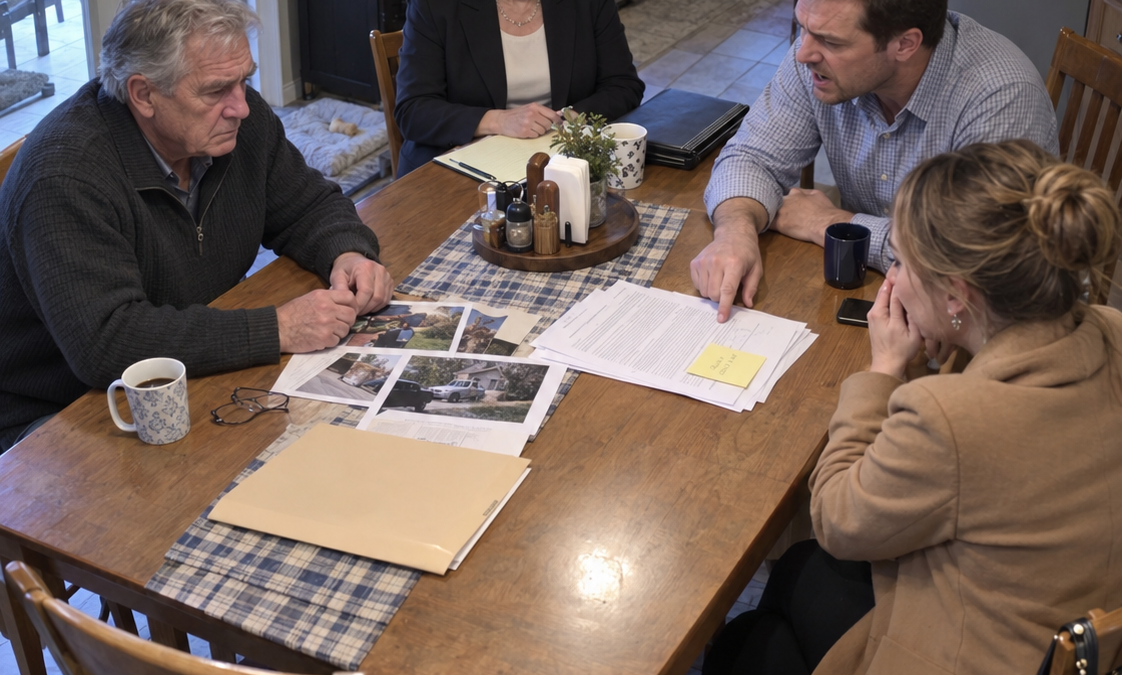
Without saying anything, I slid my folder across the table. Dana had instructed me to bring the photographs and speak as little as possible. Inside were printed images with their timestamps visible in the corners. One showed the suitcase closed at 2:34 a.m. Another showed the opened pocket a few minutes later, with my ballpoint pen positioned beside the packages for scale. I’d arranged the sheets in chronological order, exactly as I would have presented a fault report at work. Vanessa studied them for a long time. For one brief instant, I saw something move across her face before she concealed it. It wasn’t guilt. It was arithmetic. She was calculating what the photographs could prove and what they couldn’t.
“These don’t prove anything,” she said quietly. “Anyone could have put those things there. Levi, you were alone in this house for hours. For all anybody knows, you staged the whole thing.” She held up one hand. “I’m not saying you did. I’m saying a jury, or anybody looking at this, would see an old man with a camera and a grudge.” I felt Dana become very still beside me. This was the moment she’d warned me about, the moment when the other person picked up the weapon you’d handed them and turned it against you. I looked directly at Vanessa. “You’re right,” I said.
She blinked. “Those photographs don’t prove who put anything in the suitcase. I never said they did. That’s not my job, and it isn’t yours. The people whose job it is are working on it.” I kept my eyes on hers and my voice steady, because my voice was the one thing in the room I could still control completely. “I’m not here to convict you, Vanessa. I’m here to tell you where things stand.” She tried to redirect the conversation, but Daniel had his own questions. He wanted to know why she’d texted him at 4:50 that morning saying I was already on my way to the airport when nobody knew whether I’d leave. First she said she’d assumed. Then she claimed I’d mentioned it. Finally, she suggested she’d been half asleep and mixed up the days. Three different explanations in ninety seconds, none resembling the others.
Daniel asked about the loan modification form she’d left on his desk, the one with the sticky note telling him to get my signature when I was having a good day. For the first time that evening, Vanessa went pale beneath her makeup. “I was helping your father,” she insisted. “He’s been forgetting things, Daniel. Everyone sees it but you.” My son didn’t raise his voice. “Name one thing he’s forgotten,” he said. “A real one, with a date.” Vanessa opened her mouth, but nothing came out. In the silence, I could hear the low mechanical hum of our old refrigerator, the one I’d been meaning to replace since Margaret’s last Christmas.
“Here’s what’s going to happen,” I said at last. My voice came out gentler than I’d expected, which somehow made the words feel harder. “You won’t come into this house again unless you’re invited. You won’t contact my bank, ask anybody about my accounts or my paperwork, or sit down with a notary on my behalf. I’m not lending another dollar to anybody until all of this has been sorted out. I’d rather tell you that to your face than say it behind your back.” For several seconds, Vanessa stared at me without moving. Then I watched the woman who used to bring pecan pie to my Thanksgiving table disappear right in front of me. It reminded me of watching a transformer fail. There wasn’t always a flash or a shower of sparks. Sometimes all you noticed was a change in the hum.
“You selfish, controlling old man,” she said, almost conversationally. “You sit on your money like it’s Margaret’s grave, and then you wonder why nobody can stand being around you. Your son is drowning, and you’re sitting there holding a lifeboat in your lap. You never wanted me in this family. You’ve been waiting for me to fail from the beginning.” A year earlier, those words would have worked. I would have searched through every memory, trying to identify whatever I’d done to make her feel unwelcome. But I didn’t move. “That’s enough,” Daniel said. She turned toward him. “Danny—” “Not one more word about my father.”
He stood up, and I suddenly noticed how tall my son had become. Or perhaps I noticed how long he’d been stooping beneath something neither of us had wanted to name. “I lent you my trust,” he told her, “and you spent it. I love you, Vanessa, and I’m not going to pretend I don’t. But loving somebody doesn’t give you the right to manipulate them or put a man in danger because he told you no.” She stared at him for a long moment. Then, with deliberate care, she rose, buttoned her camel coat, and picked up her purse. At the doorway, she turned back toward us. Her voice was low and almost kind. “You’ll both regret this. I promise you that.”
I didn’t follow her outside. I didn’t immediately call the detective, send an angry message, or do any of the small, cruel things my wounded pride suggested. I listened to her heels striking the front walk, the opening and closing of her car door, and the engine carrying her away. Dana exhaled slowly. “That was about as clean as these things ever go,” she said. Then, because she was Dana, she added, “Which doesn’t mean it’s over.” She went onto the porch and called Detective Reyes. When she returned, she said the detective had listened, thanked us, and promised nothing. The laboratory was still processing the evidence. Certain details were being checked. Justice, as it turned out, had no interest in keeping my schedule.
After Dana left, Daniel and I washed the dishes without speaking. Later, sitting over the last of the burnt coffee, he asked a question without looking at me. “Will you ever forgive me? For not seeing it, for not asking?” I considered his words carefully because he deserved an answer I’d actually thought about. “Forgiveness isn’t the same as pretending nothing happened,” I told him. “You can still be my son. You always will be. But trust has to be rebuilt, one honest choice at a time.” For the first time in many months, my boy didn’t reach for an excuse. He lowered his head and said, “I understand, Dad.” I believed him. But I also knew that belief was only the first board in a bridge that would take a long time to build.
Three weeks later, Dana called early on a gray Monday morning. The laboratory results were back, and Detective Reyes wanted both Daniel and me to come to her office. Another name had surfaced in the investigation, she said, and there were developments we needed to hear in person. Reyes’s office smelled of burnt coffee and copier toner. She didn’t make us wait. After we sat down, she folded her reading glasses and placed them on the desk. “The laboratory results are in,” she said. “The pills are counterfeit, pressed to resemble prescription tablets. The powder is a controlled substance. Taken together, the quantity goes well beyond what anyone would reasonably carry for personal use.” She paused to let the information settle.
“If an airport security officer had opened that pocket, Mr. Bennett, you would have spent a very long weekend answering questions. Your name might have reached the newspapers before anyone had properly examined the evidence.” Daniel gripped the edge of his chair. I kept my hands folded in my lap, where nobody could see what they were doing. Reyes explained that the other name investigators had uncovered belonged to Terrence Hail, a Cleveland man with two previous arrests for distribution offenses. Hail had supplied the man in Pittsburgh, whose name was Ray Doyle. Doyle was the caller who had contacted me from the 412 number on the morning I was supposed to fly.
Doyle had provided investigators with additional information, but Reyes was particular about explaining what actually supported the case. It wasn’t simply his statement. A store security camera in Westerville had recorded Vanessa buying a prepaid phone with cash. Phone records showed forty-seven calls between her number and that phone over a three-week period. Investigators had also identified a transfer from Vanessa’s bank account to Hail, described as “inventory,” made the week before she borrowed against her sister’s car. Those transactions and records had given investigators a timeline that could be checked independently. “One man’s word is a story,” Reyes told us. “Cameras and bank records are a timeline.”
Dana leaned forward. “What about charges?” Reyes said the prosecutors were drafting them. Conspiracy, possession with intent to distribute, and possibly additional offenses, depending on what the grand jury decided. She looked directly at me. “It won’t be quick. There will be motions, arguments, and a defense attorney who may claim you staged everything.” I told her I’d already heard that accusation. She gave me the faintest smile. “It rarely holds up well against an independently documented timeline.” I thanked her. I’d imagined that having the evidence confirmed would bring some enormous feeling of vindication. Instead, I was tired in a way I couldn’t explain, the same kind of exhaustion that follows a storm after it has finally crossed the county and left the damage for daylight.
Vanessa was arraigned in late November. I didn’t attend. Dana went and told me afterward that Vanessa had worn a gray suit, kept her eyes forward, and barely moved while the judge read the charges. At one point, Dana said, her expression changed for an instant, and she looked like the twelve-year-old girl who’d stood at a window in Toledo watching strangers take away her father’s livelihood. Then the expression vanished, and the familiar mask returned. Vanessa pleaded not guilty. Her lawyer described the entire affair as a family misunderstanding brought about by an elderly man’s confusion. I read those words in the newspaper and discovered, to my surprise, that they didn’t hurt anymore.
Words only have power over you when you still need the speaker’s approval. That doesn’t mean I felt nothing for Vanessa. I remembered the girl on my porch who’d told me she never wanted to be frightened again. I remembered how she’d made Margaret laugh and how carefully she’d carried that lemon cake into our house. A person can be responsible for terrible choices and still have been a frightened child once. Both things can be true. Both things saddened me, and I finally stopped trying to make one truth cancel out the other.
Daniel hired his own attorney, a quiet man named Marcus Webb, who spent three meetings explaining which portions of the debt legally belonged to Vanessa and which had ended up in Daniel’s name. My son moved into a rented apartment near his office, and the brick colonial in Dublin went on the market. He called me from the empty living room on the day the real estate sign appeared out front. “It’s just walls,” he said. After a pause, he added, “I’m sorry, Dad. I keep saying that.” I stood by my kitchen window, looking toward the maple tree at the end of the driveway. “Say it as often as you need to,” I told him. “Just make sure you keep doing the other part, too.”
And he did. In December, he arrived one Sunday with an envelope and placed it on my kitchen table. Inside were five hundred dollars in twenty-dollar bills. “Toward the eighty-five thousand,” he said. “I know it isn’t much.” My first instinct was to push it back across the table and tell him to keep it. He had rent to pay, debts to untangle, and a life to put back together. But Dana had already warned me not to do that. She’d told me that accepting his repayment wasn’t cruelty. It was allowing him to take responsibility for something he’d promised to do. A man needs to carry his own weight if he’s ever going to stand upright again. So I accepted the envelope, wrote the date and amount in the margin of the original loan note, and made my son a sandwich. We didn’t mention the money again that afternoon.
As for me, I changed what needed changing. A locksmith named Hal came to the house and replaced every lock. After he’d finished, I went into the pantry and removed the old nail where Margaret’s spare key had hung for thirty years. It had rusted around the head and fought me harder than it should have. I needed a claw hammer and more patience than I’d expected to pull it free. I stood there holding that bent, rusty nail for a long moment. It was such a small thing, something nobody visiting the house would ever have noticed. Yet it had helped open the door to everything that happened. I dropped it into the trash and closed the pantry.
Dana prepared a new estate plan. My health care proxy went to Walt’s daughter Joanne, a nurse I had known and trusted for years. I retained control of my financial decisions, with Frank and Dana as the only other names listed where appropriate. I moved my savings, changed every password, and arranged for alerts on all my accounts. I checked the deeds, the insurance documents, and the records I’d once left scattered around the house. When the work was finished, I closed the folder that had traveled with me for months like a stone beneath my arm. For the first time in a long while, I wasn’t making decisions out of fear or trying to anticipate what Vanessa might do next. I was simply taking care of my own life.
Then I finally went to Pittsburgh. I drove instead of flying, and I took the old gray Samsonite suitcase with me. It had a new zipper, but it was still the same suitcase, and I wasn’t about to let Vanessa take even that small piece of my ordinary life away. Walt met me at his front door, leaning on a cane and complaining about physical therapy before I’d even stepped inside. We spent three days sitting on his porch, arguing about the Cleveland Browns, the Pittsburgh Steelers, and which of us had the worst knees. We discussed the weather, old friends, and how ridiculous it was that getting out of a chair had become an accomplishment worth mentioning. Nobody asked me where I kept my money. Nobody questioned whether I was capable of traveling alone. Nobody watched me as though I were a problem waiting to happen.
When I returned home, I found myself looking for small things to repair. I fixed Mrs. Alvarez’s toaster, the Hendersons’ porch light, and an old lamp from the church basement that hadn’t worked since the Carter administration. On Saturdays, I began volunteering at the repair café at the community center. People brought in broken appliances, radios, lamps, and household gadgets, and we did our best to repair them instead of throwing them away. Some things needed a new wire or a simple replacement part. Others had been neglected for years, and a few were beyond saving. I liked the work. It made sense to me in a way much of the previous year hadn’t.
One Saturday, a young woman brought in an old radio that had belonged to her grandfather. The casing was scratched, the tuning dial was stiff, and nothing happened when she switched it on. I spent the better part of an hour examining it, cleaning what needed cleaning, and finding the source of the fault. When I finally turned the knob, the speaker gave a faint crackle, followed by a low hum. Then music came through. The young woman stood perfectly still for a moment before tears filled her eyes. She said it sounded exactly the way she remembered from her grandfather’s house. I looked away politely and pretended to be occupied with my tools. I hadn’t felt that useful in years.
People have asked me what hurt most about the whole ordeal. They usually expect me to say it was the suitcase, the imagined airport arrest, or the knowledge that my daughter-in-law had tried to turn the authorities against me. Those things frightened me, of course. I won’t pretend otherwise. But none of them was the part that stayed with me when the house grew quiet at night. It was the pie. It was remembering Vanessa standing in my kitchen at Thanksgiving, holding a pie knife and calling me Dad. It was the realization that I’d spent years mistaking a performance for a promise, and that I’d allowed the desire to keep my family together to become an excuse for not protecting myself.
One morning in late autumn, I sat on the front porch with a mug of coffee and the newspaper folded beside me. The maple trees along Maple Ridge Lane had turned the color of old copper. The air was cold enough to make the coffee steam, and the neighborhood was quiet except for the occasional passing car. On the little table beside my chair stood Margaret’s photograph, the one we’d taken at the lake. Her hair was blowing across her face, and the camera had caught her halfway through a laugh. I’d always loved that photograph because she looked as though she had just heard something wonderful and couldn’t wait to tell me about it.
I sat there looking at her for a while before I spoke. “I used to think keeping a family together meant giving people endless chances,” I said quietly, so only she could hear. “I was wrong, Maggie. Sometimes loving your family means refusing to let them destroy you.” The wind stirred the last dry leaves along the front walk. I picked up my coffee and watched them move across the porch. There wasn’t anything left to say that morning, and for once, the silence didn’t feel empty.
I didn’t celebrate what had happened to Vanessa. Her trial was still months away, and nobody could tell me exactly how it would end. Daniel and I had years of rebuilding ahead of us, and there were conversations we still hadn’t learned how to have. I knew some things between us would never be quite the same. But he was trying, and so was I. For the first time in a very long while, the choices in my life belonged to me again. I could decide where to go, whom to trust, when to help, and when to say no. I could open my own front door without wondering who might have a key. And sitting there on that cold morning, with Margaret’s photograph beside me and the trees turning copper along Maple Ridge Lane, I realized that a cold morning had never felt so good.
If this story stayed with you, I’d love to hear where you’re watching from. Leave a comment below and tell me whether you’ve ever had to draw a line with someone you love. If you believe kindness isn’t weakness, share this with someone who needs to hear it, and subscribe so you don’t miss the next story we bring you. We’ll keep walking through these together, one honest chapter at a time.








