The night i lost my job, dad started packing my things. “your brother needs this house more than you do.” my brother shouted: “who’s going to pay for my porsche now?” mom backed him. i said nothing about the company in my name and the beach house. hours later,…
, everything changed.
My name is Silas. I’m 35 years old, and for 15 agonizing, backbreaking years, I was the invisible life-support system keeping my entire family alive. I funded their existence, paid their bills, solved their problems, and quietly absorbed every financial disaster they created, all while they treated me as though I barely existed.
That completely one-sided arrangement finally imploded on a freezing Tuesday evening.
They threw me out of my childhood home on the very night I lost the biggest commercial real estate contract of my life.
I had just walked through the front door, bone-tired, soaked from the rain, and terrified about how I was going to make payroll for my 12 employees by Friday. I wasn’t looking for a financial miracle. I wasn’t expecting anyone to fix my problems. I had simply hoped for one small moment of human comfort from the people who had raised me—a warm meal, a sympathetic ear, or perhaps someone asking whether I was all right.
Instead, my father had already pulled the flattened cardboard moving boxes out of the garage.
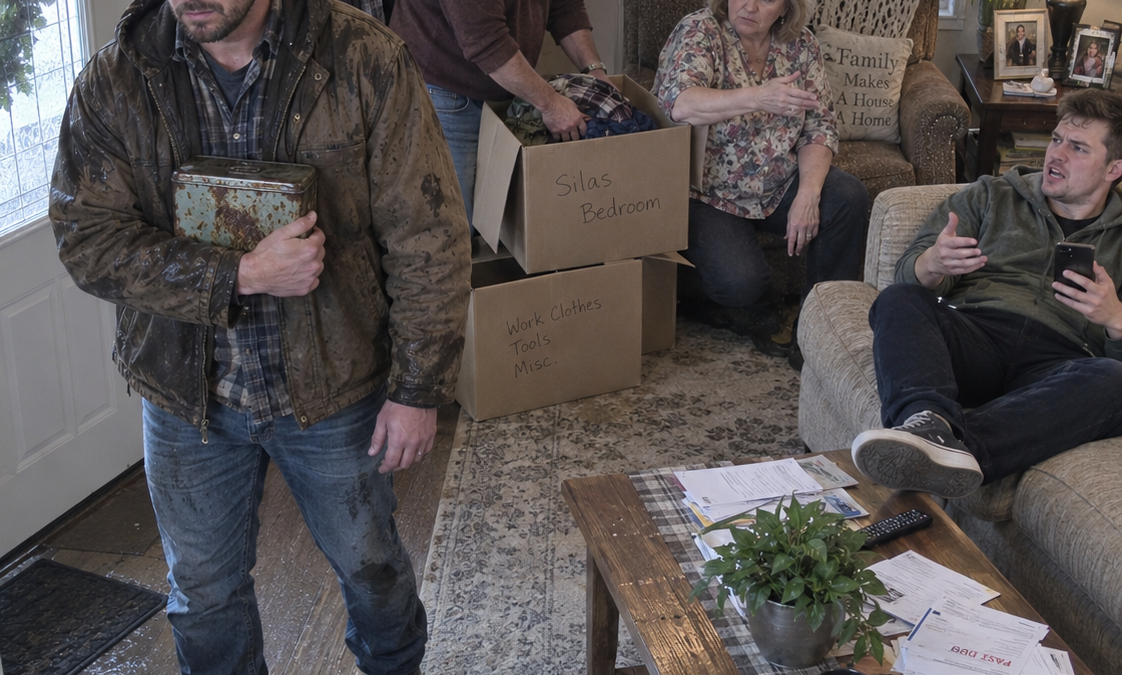
He looked me straight in the eye, without the slightest hesitation, and told me my younger brother, Preston, needed my bedroom more than I did. Preston was getting married, and he and his fiancée needed somewhere to store their wedding registry gifts.
While my own father methodically packed my heavy canvas work shirts into a box, Preston sat on the living room couch, completely unbothered, furiously texting on his phone. He paused only long enough to complain about who was going to pay the enormous monthly installments on his luxury Porsche now that my income was supposedly compromised.
My mother, the woman who had given birth to me, gently patted his hand and assured him that he had nothing to worry about.
“Silas will figure something out. He always lands on his feet.”
With that single sentence, she reduced me from a human being to a disposable machine whose only purpose was to keep everyone else’s life running smoothly.
They humiliated me in the middle of our living room, right in front of our impossibly nosy neighbor, Mrs. Higgins, treating me like a broken ATM they had finally decided to drag to the neighborhood dumpster.
But there was one enormous, earth-shattering detail they didn’t know.
They had absolutely no idea that I was the sole legal owner of the million-dollar coastal property my mother had recently been bragging about to her friends.
And now, as they face financial ruin, foreclosure, and a devastating fraud lawsuit that could have ended in federal criminal charges, they’re begging me for the very mercy they denied me that night.
Before I explain exactly how I dismantled their perfect little lives, I need to go back. A night like that doesn’t come from nowhere, and I want you to understand the whole shape of what happened, not merely the ending.
The drive from the coastal town of Mara Bay to my hometown of Mil Haven usually took three hours. That evening, however, a massive coastal storm had transformed the highway into a treacherous river of standing water. I gripped the steering wheel of my heavy-duty Ford work truck so tightly that my knuckles turned white. My lower back screamed every time I pressed the clutch.
My company, Tightline Property Restoration, had just suffered a catastrophic blow.
We had spent six months preparing for a multimillion-dollar resort restoration contract. We had purchased materials, hired additional crew members, and turned down smaller projects to keep our schedule clear. That morning, the primary investor abruptly pulled out and filed for corporate bankruptcy.
Just like that, the contract vanished.
That single project represented roughly a quarter of our annual revenue.
I wasn’t driving home to ask my family for a bailout. I knew perfectly well they didn’t have a dime to their names. They never did. I only wanted to walk into a warm house, sit at the worn kitchen table, eat a hot plate of food, and perhaps, for the first time in a decade, have someone look at me and genuinely ask how my day had gone.
But privacy had never existed in my family, particularly when malicious gossip was their primary currency.
News traveled fast when your brother’s entitled fiancée, Sierra, had a loudmouthed cousin working at the main lumber supply yard in Mara Bay. Somehow, they knew my contract had fallen through before my truck tires even reached the cracked pavement of their driveway.
When I pushed open the heavy wooden front door, the silence inside was deafening.
The cramped living room felt suffocating. The air was thick with the overpowering artificial sweetness of Beatrice’s cheap vanilla candles and something far more unpleasant that I would soon recognize as betrayal.
Nobody rushed to greet me. Nobody looked up with even a fraction of concern.
Preston, 27 years old and entirely useless, was sprawled across the good sofa, his expensive designer sneakers resting directly on the glass coffee table beside a stack of unpaid utility bills. He was frantically scrolling through the expensive smartphone whose unlimited data plan I paid for every single month.
My mother, Beatrice, sat rigidly in her favorite floral armchair, sipping sweet iced tea as though it were a perfectly ordinary Sunday afternoon. Her face was a carefully arranged mask of indifference.
My father, Roland, was already moving down the narrow hallway, his arms filled with the unmistakable brown cardboard boxes we kept in the garage.
And Mrs. Higgins, the neighborhood gossip who lived exactly two houses down, was conveniently perched near the front window. She held a ceramic coffee mug in both hands, pretending to be fascinated by the rain striking the glass while practically aiming her ears toward our family.
Beatrice slowly set her sweating glass on the mahogany side table.
She didn’t ask whether I was all right. She didn’t ask whether my business would survive the quarter or whether I wanted a moment to breathe and change out of my soaked clothes.
Instead, she looked at my muddy work boots, raised her eyes to my exhausted, pale face, and asked a question that stopped my heart.
“How exactly do you plan to keep up with Preston’s car payments this month, Silas? Especially now that you’ve messed up your business?”
Her voice was colder than the rain outside.
I stood motionless in the entryway, feeling exhaustion settle into the marrow of my bones. In a voice barely louder than a rasp, I explained that the commercial client had gone under. I told her I would have to restructure my entire business model by Monday morning just to keep my hardworking crew employed and food on their tables.
Then I told her that a luxury car payment was the absolute least of my concerns.
Preston immediately slammed his phone facedown against the glass coffee table.
The crack was loud enough to make Mrs. Higgins jump.
He threw his hands into the air and began whining about how his precious credit utilization ratio would collapse if the Porsche was repossessed. He acted as though my devastating financial crisis were nothing more than a deliberate personal attack on his extravagant lifestyle.
“Are you serious right now?” he shouted, his face turning blotchy red. “Sierra and I are looking at mortgage rates next month! If you let my credit drop, you’re ruining my future. You’re ruining my marriage!”
He wasn’t worried about the 12 families depending on my company for their paychecks. He wasn’t worried about whether I had eaten, slept, or survived the drive through the storm.
He was worried about his credit score.
Then Roland emerged from my bedroom.
My bedroom. The room I had moved back into 18 months earlier specifically to care for him after he suffered a massive widowmaker heart attack. The room where I had stayed awake until three in the morning sorting his medical bills, fighting with his insurance company, and organizing his daily medications while everyone else slept.
He held a cardboard box filled to the brim with my belongings—heavy flannel shirts, work boots, and my favorite books.
He couldn’t even bring himself to look me in the eye. He stared at the wooden floorboards, cleared his throat, and explained that Preston and Sierra needed a proper room to plan their upcoming wedding and store their gifts.
According to him, it simply made logical sense for them to take my space. After all, I was apparently about to struggle financially, while Preston and Sierra needed a stable environment in which to begin their lives together.
Beatrice immediately joined in, using the soft, gentle, intensely manipulative voice she had perfected over decades.
“Silas, honey, you have to be reasonable.”
She looked at me with a sickening imitation of sympathy.
“Your brother needs this house more than you do right now. You’re strong. You’re a survivor. You’ll figure things out on your own, just like you always do.”
Then she actually called Preston sensitive.
She claimed he needed a foundation for his future, and that the most meaningful way I could provide one was by leaving.
I looked at the three of them.
I looked at my father, the man who had taught me to swing a hammer when I was ten years old. Now those same hands were packing my entire life into a disposable cardboard box without shedding a single tear.
I looked at my mother, who had demanded that I sacrifice my twenties and thirties to support her household, now discarding me the moment she believed my wallet was empty.
And I looked at Mrs. Higgins, whose eyes were wide with barely concealed delight. I could practically see her composing the story she would gleefully repeat at the next homeowners’ association meeting, broadcasting my humiliating eviction to the entire subdivision.
I didn’t argue.
I didn’t scream, throw anything, or demand gratitude for the thousands upon thousands of dollars I had spent keeping a roof over their heads.
In that single terrible moment, I understood something I should have learned years earlier.
You cannot reason someone into loving you. And you absolutely cannot purchase loyalty from people who see you as nothing more than a walking bank account.
I walked straight past Roland, my shoulder brushing against his, and reached into the top of the cardboard box he was carrying.
Resting on my folded clothes was a rusted vintage sewing tin that had belonged to my grandmother, Hattie. I picked it up and held the cold metal tightly against my chest.
Then I reached deep into the pocket of my work jacket and felt the heavy, jagged metal of a particular key ring pressing into my palm.
It was a key ring I had never explained to anyone in that house.
And I certainly wasn’t going to start explaining it now.
I turned to face them one final time. The air in the room seemed completely dead.
“You’re not throwing me out,” I said, my voice stripped of emotion. “I’m choosing the door. And once it closes behind me, it will never open for any of you again.”
Beatrice scoffed and rolled her eyes.
“Oh, don’t be so dramatic, Silas.”
Roland simply went back to sealing the cardboard box with brown packing tape.
I walked out into the freezing night.
The heavy wooden door clicked shut behind me with a sound that seemed absolutely, irrevocably final.
By the time I merged onto the dark, rain-slicked coastal highway toward Mara Bay, I wasn’t crying. At least, that was what I told myself. Tears were for people who still had something left to lose.
I gripped the steering wheel, stared ahead at my headlights carving a narrow path through the darkness, and began doing calculations in my head.
I was figuring out exactly how quickly I could pull the financial foundation out from beneath the house they had just kicked me out of.
But I don’t want you to think that cold calculation arrived instantly and fully formed, the way it might sound when I tell the story now.
Somewhere around mile 40, with the windshield wipers slapping uselessly against the sheets of rain, something inside my chest finally gave way.
I had to pull onto the gravel shoulder because I genuinely couldn’t see the road anymore.
Not because of the storm, but because my eyes had blurred with tears, despite everything I had just told myself about crying being reserved for people with something left to lose.
I sat in the darkness, the hazard lights ticking steadily, rain hammering against the truck’s roof. And I cried the way I hadn’t allowed myself to cry since I was perhaps nine years old—ugly, shaking sobs, entirely alone on the side of a highway three hours from anywhere that had ever felt like home.
I wasn’t crying about the money. I want to be clear about that.
I was crying for the ten-year-old version of myself who used to stand in that same living room, hoping someone would ask him how his day had gone. For the little boy who had never quite stopped hoping, even at 35, even after everything, even as he walked out of that door with a rusted tin box pressed against his chest.
Grief doesn’t always resemble sadness. Sometimes it looks exactly like rage with the volume turned all the way up.
It took me 20 minutes on the shoulder of that highway to understand that the calm I eventually found wasn’t the absence of grief.
It was simply what remained once the grief had finally passed through me.
To understand the absolute insanity of what my family did that night—and why my response became so meticulously precise—you have to understand the 15-year, completely one-sided tab I had been running for them.
I was the eldest son in a profoundly dysfunctional, emotionally starved family. In our household, that title translated directly into one thing: I was the designated unlimited emergency fund.
Before Preston was born, Beatrice had suffered two traumatic late-term miscarriages. Those tragedies fundamentally changed something inside her, twisting her maternal instincts into something dark, possessive, and suffocating.
When Preston finally arrived, premature but breathing, she built an impenetrable fortress around him.
He became the unquestioned golden child, the fragile miracle. My parents constructed their entire universe around protecting him from the slightest inconvenience. Somewhere in that deeply flawed process, Beatrice decided that I was the strong one.
I was made of solid stone. I required no nurturing, no attention, and certainly no financial support.
Preston never had a traditional college fund.
He had my personal checking account.
I remember sitting at the Thanksgiving dinner table when I was 22, having just secured my first real commercial contracting job with a decent salary. I was so proud of myself. After years of struggling, I finally had something worth celebrating.
Beatrice barely acknowledged my promotion before launching into an elaborate discussion about Preston’s approaching high school graduation.
She proudly announced to our extended family that he would attend a private university out of state, one that cost more per semester than Roland earned in an entire year.
When I foolishly asked how they planned to pay for it, she stared at me across the turkey and gravy.
“Family helps family, Silas. Do you really want your little brother to start his adult life crippled by debt?”
Then she cried.
For three days, she wept at the kitchen table and refused to eat until I finally went to the bank and transferred my entire savings account to cover Preston’s first year of tuition.
Three semesters later, Preston dropped out because, as he put it, the classes were “too stressful for his mental health.”
I was left paying off the accumulated student loans while he slept until noon every day.
I still remember the exact balance in that savings account before I emptied it.
I had been building it since I was 14, mowing lawns, hauling scrap metal, and eventually working weekends behind the counter of a hardware store while my classmates were doing whatever normal teenagers did on their Saturdays.
Eleven thousand, four hundred and twenty dollars.
I remember that number the way some people remember a childhood telephone number. It remains lodged somewhere in my mind, even though it shouldn’t matter anymore.
I had been saving for a down payment on my first reliable work truck. Not the rusted wreck with the cracked windshield that I eventually bought because there was nothing left after Preston’s tuition check cleared.
I drove that unreliable truck for two years longer than I should have, nursing its temperamental transmission through two winters because the money that should have replaced it had gone toward a semester and a half of a business degree Preston never finished.
He never thanked me.
It wasn’t exactly the truck I resented. That understanding came much later, once I finally allowed myself to feel what those years had cost.
What hurt was that nobody in my family had ever once asked what I had given up to make that tuition payment possible.
Nobody wondered what I might have wanted for myself at 22. They only wondered what they could persuade me to sacrifice next.
For years, I lived a carefully constructed double life.
During the grueling workweek, I was building Tightline Property Restoration from the ground up. I started with a single badly rusted pickup truck, a cracked windshield, and a borrowed nail gun.
I took on the worst salt-eaten, storm-damaged coastal properties—the jobs no reputable contractor wanted to touch.
I worked 90-hour weeks. My hands were permanently blistered, my lungs seemed constantly filled with drywall dust, and my weekends practically ceased to exist.
Over more than a decade of relentless, backbreaking labor, I transformed Tightline into a highly profitable, respected commercial restoration enterprise. We had a fleet of trucks, a dedicated crew, and major commercial contracts.
But to my family, three hours inland in the stagnant, working-class town of Mil Haven, I was nothing more than a struggling blue-collar construction worker living paycheck to paycheck.
I deliberately allowed them to believe that lie.
Every time I showed even the smallest sign of financial success, a new emergency appeared as though someone had summoned it.
Suddenly, Preston desperately needed a high-end laptop for his entry-level marketing job. Or Beatrice absolutely had to remodel the entire kitchen with granite countertops because the old Formica was depressing her and triggering her anxiety.
If they had known my actual net worth, they would have drained every last dollar until I had nothing left but the clothes on my back.
I want to explain what those early years actually felt like from the inside, because from a distance, building a successful business can sound like a straightforward story about working hard and refusing to quit.
It wasn’t that simple.
It was lonely in a way I still haven’t found the right words to describe.
I remember one particular February, perhaps four years after starting the company, when we were restoring a flood-damaged strip mall that had been sitting waterlogged for three weeks before the insurance adjuster finally cleared us to begin.
The mold was so thick in some units that we needed respirators merely to walk through the doors. I spent six straight days coming home smelling of bleach and rot, no matter how long I stood beneath the shower.
The skin across my knuckles cracked open from constant scrubbing and the winter cold.
I never told a single person in my family that the job existed. I didn’t tell them about the respirators, the black mold creeping up the drywall like something from a nightmare, or the afternoon when I genuinely thought I might pass out from the fumes and had to sit on the curb with my head between my knees until the world stopped spinning.
That Friday, I drove the three hours back to Mil Haven because Beatrice had called and insisted I attend Sunday dinner.
I sat at the kitchen table eating pot roast while Preston complained that his new work laptop had a scratch on its lid.
Beatrice fussed over whether the scratch might affect its resale value someday.
Nobody asked why my hands looked the way they did. Nobody asked why I kept flexing my fingers beneath the table, trying to ease the aching stiffness that would trouble me for most of that year.
I think that disconnect, more than any single dramatic betrayal, was what truly wore me down over those 15 years.
It wasn’t one enormous wound.
It was the slow, grinding accumulation of a thousand small moments when the people who were supposed to know me best never bothered to look closely enough to notice that anything was costing me at all.
There were good moments, too, scattered throughout those years. I don’t want to pretend that the entire decade was uninterrupted misery, because that wouldn’t be honest either.
Declan and I used to celebrate every new contract, however small, with cheap beer and greasy takeout on the tailgate of whichever truck happened to be closest.
We would toast to nothing in particular except the simple, uncomplicated fact that we had survived another month.
In some ways, those evenings felt like the closest thing I had to a real family.
Just two exhausted men eating fried food from Styrofoam containers in a gravel parking lot, genuinely happy for each other in a way nobody back in Mil Haven ever seemed capable of being happy for me.
Driving home afterward, I used to wonder whether that was simply what adulthood was supposed to feel like. Whether everyone quietly carried two separate lives—one they showed their blood relatives, and another they actually lived.
It took me a long time, and a cardboard box full of my own work shirts, to understand that most people don’t live that way.
And those who do usually have a very good, very sad reason for it.
The trap truly tightened 18 months before that freezing Tuesday when Roland collapsed in the driveway, clutching his chest.
I received the panicked phone call while standing on a high steel beam at a commercial job site.
I dropped my tools, climbed down, drove three hours inland while exceeding nearly every speed limit, and essentially never left.
I want to describe that drive because I think it says something important about who I was beneath all the resentment I had been quietly accumulating.
I don’t remember much of those three hours. I remember gripping the steering wheel and praying, actually praying for the first time in years, to a God I wasn’t entirely sure I still believed in.
I bargained the way frightened people do in moments like that.
Take anything from me. Just don’t take him yet. Not like this. Not with so much still unsaid between us.
I remember pulling into the hospital parking lot and running across the asphalt in my steel-toed work boots, my heart hammering harder than it ever had on any job site.
I found Beatrice in the waiting room.
She wasn’t crying or shaking. She was on the phone with Aunt Monica, describing the ordeal in the breathless, theatrical tone she reserved for situations that might generate sympathy for herself.
When she saw me, she looked up.
“Oh, good. You’re here. Can you talk to the doctor? I can’t handle medical details. They upset my stomach.”
Then she returned to her conversation.
That image stayed with me for a long time afterward.
My father was somewhere behind a set of double doors, possibly dying, and my mother’s first instinct upon seeing me was to hand me a task rather than hold her son for even 30 seconds of shared fear.
I didn’t process how strange that was until much later.
In the moment, I simply did what I always did.
I found the doctor. I asked the questions. I made the decisions nobody else in the family seemed capable of making.
Somebody had to.
And it had never once occurred to any of them, in all 35 years of my life, that the somebody didn’t always have to be me.
Someone had to manage the overwhelming flood of hospital bills. Someone had to address the property taxes that had quietly fallen dangerously behind because of Roland’s secret gambling habits and a massive gap in their homeowner’s insurance.
Beatrice didn’t work, claiming her nerves couldn’t handle employment.
Preston spent his modest salary on designer sneakers, craft beer, and expensive dinners with Sierra.
So I packed up my life, moved back into my claustrophobic childhood bedroom, and took the entire weight of their survival onto my shoulders.
Those 18 months deserve more than a passing mention, because they were, in their quiet way, among the hardest months of my adult life. In some respects, they were harder than starting a business with nothing.
I would return from a full day managing crews on job sites, sometimes two or three hours away, then spend my evenings on the telephone with insurance adjusters who seemed to speak in deliberately confusing jargon designed to delay or deny claims.
Other nights, I sat at the kitchen table with a legal pad, calculating which bills could wait another two weeks and which needed to be paid immediately.
I learned more about cardiac rehabilitation protocols and Medicare supplement plans than any construction contractor should reasonably know.
I organized Roland’s medication into pill containers and programmed individual alarms on my phone because he kept forgetting his blood thinners.
Sometimes I called him from a job site while standing on a half-demolished roof in the middle of a coastal wind, simply to remind him to take his pills.
I did all this while Beatrice sat in the next room watching television, occasionally calling out that I needed to lower my voice because the noise was giving her a headache.
Preston came and went as he pleased, treating the house like a hotel with room service, never once asking whether there was anything he could do to help shoulder the burden I was carrying alone.
I even foolishly cosigned a predatory lease for Preston’s ridiculous status-symbol Porsche.
I remember that day perfectly.
We stood in the sterile, over-air-conditioned showroom of the luxury dealership while Beatrice cried hysterically, clutching her pearls and putting on a full theatrical performance for the salesman.
She insisted Preston needed a reliable, safe vehicle for his commute and claimed that driving an ordinary sedan would irreparably damage his professional image and self-esteem in the corporate world.
I knew that if Preston defaulted on those enormous payments, it would destroy the pristine credit score I depended on to secure commercial bonds for my restoration business.
I signed the paperwork anyway, telling myself it was temporary.
That has always been my fatal flaw.
I fix things.
When I see a collapsing roof, my first instinct is to step underneath and hold it up with my own back, completely ignoring the fact that the people living inside are the ones actively swinging sledgehammers at the foundation.
I finally returned to my real life, my office in Mara Bay, well past midnight.
The rain had stopped, leaving a dense, salty fog rolling in from the dark ocean.
My business partner, Declan, was still at his enormous oak desk, the harsh glow of two computer monitors illuminating his face as he aggressively worked through the numbers to salvage payroll after the resort contract collapsed.
Declan was a big, bearded man who didn’t sugarcoat anything.
He took one long look at my pale face, my soaking canvas jacket, and the single rusty tin box in my hands, and he knew exactly what had happened.
For more than a decade, Declan had warned me that I was setting myself on fire to keep my ungrateful family warm. He had watched me wire money week after week, slowly hollowing myself out.
“You finally walked away from the parasite tank,” he said, his voice a low, steady rumble in the quiet office.
“They threw me out, Deck.”
I sank into the worn leather chair opposite him.
“They needed the room for Preston’s wedding registry gifts. They literally packed my life into boxes while I stood there.”
Declan didn’t offer empty sympathy. He didn’t pat my hand or promise that everything would be all right.
He simply nodded toward the rusty tin box I had placed carefully on his desk.
“So,” he asked, “what are we doing about it?”
I want to say more about Declan here, because throughout this story he often appears as little more than a source of one-liners and moral support.
He deserves more than that shorthand.
Declan and I met 14 years earlier on a framing crew. We were both 21, both broke, and both working for a contractor who paid late and cut corners on safety equipment.
We were actually fired together after refusing to work on scaffolding that hadn’t been properly inspected.
We spent the first week of unemployment sitting in his beat-up Camaro in a fast-food parking lot, arguing about whether we should start our own outfit instead of going back to risking our lives for someone else’s negligence.
Declan had a wife back then, Priya, who left him two years after we started the business. She had grown tired of the brutal hours and financial uncertainty.
I remember him appearing at the office the morning after she moved out. He didn’t say a word about what had happened. He simply got to work.
Without either of us discussing it directly, I understood that we were both, in our different ways, men who had learned to carry things alone rather than burden anybody else with their weight.
That shared understanding was, I think, the real foundation of Tightline, more than any business plan.
We never needed to perform strength for each other because we had already seen each other at our worst—soaked, exhausted, broke, and frightened.
Neither of us had run.
Declan noticed long before I was willing to admit it that my relationship with my family had curdled into something closer to exploitation than love.
At first, he raised the subject carefully, indirectly, asking whether I had received a thank-you for my latest wire transfer and watching my face when I inevitably said no.
Then he would change the subject.
Over the years, as the transfers grew larger and more frequent, his questions became more direct.
Eventually, perhaps five years before that night, he sat me down in the same office and spoke plainly.
“Silas, I need you to hear me say this once, clearly, and then I’ll drop it if you want me to. You’re bleeding yourself dry for people who wouldn’t cross the street to help you if the roles were reversed. I’ve watched you do it for a decade. I’m not going to watch you do it for another one.”
I didn’t listen.
I made the same excuses I had been making to myself for years.
They’re my family. It’s temporary. Roland is sick. Preston will figure himself out eventually.
Declan didn’t argue.
He simply nodded the way he always did when he disagreed with me but had decided the argument wasn’t his to win, then returned to his spreadsheet.
Some part of that conversation must have lodged itself inside me, quietly waiting for the night I would finally be ready to hear it.
When I walked into that office soaked to the skin, carrying Nana Hattie’s sewing tin, and Declan said I had finally walked away from the parasite tank, I understood he wasn’t gloating.
He was relieved.
It was the particular relief of a man who had spent years watching a friend slowly drown and had finally seen him climb out of the water.
I didn’t answer immediately.
Instead, I reached across the desk, popped the stiff metal latch on Nana Hattie’s sewing tin, and carefully removed a stack of faded, yellowing Polaroids.
They showed a beautiful white house sitting on a sandy coastal dune, with a broad wraparound porch overlooking the crashing Atlantic waves.
Nana Hattie was the only person in that toxic family tree who had ever loved me for exactly who I was, rather than what my wallet could provide.
When I was a teenager, she used to pull me aside, slip a crumpled twenty-dollar bill into my pocket, and tell me that I wasn’t the strong one.
I was simply the only one who bothered to show up.
She and my grandfather had purchased that beautiful coastal house the year they married. But when a brutal economic recession struck decades earlier, Roland made terrible investments and came to them for a bailout.
They lost the house to foreclosure.
It broke her spirit.
Now she was 80 years old, living in a cramped, musty back room of my parents’ house. Her entire world had been reduced to a worn recliner and a single dusty window overlooking a brick wall.
I want to tell you more about Nana Hattie, because in the shortened version of this story, she can sound like a convenient plot device, a source of motivation and moral justification.
She was so much more than that to me.
When I was seven, still small enough that the world seemed mostly frightening and unpredictable, Beatrice went through one of her worst periods.
There were weeks of slammed doors and long silences I didn’t understand at the time. Only much later did I recognize the shape of her grief over the miscarriages she had suffered before Preston’s birth.
During those weeks, Nana Hattie fed me breakfast every morning before school.
She sat beside me at the kitchen table while I struggled through my multiplication tables. She never made me feel like a burden simply because I needed help with something as small as long division.
She had a particular way of humming while she worked, an old melody whose name I never learned.
Even now, I can’t hear anything in that minor key without feeling seven years old again, safe at a kitchen table that, for a few hours every day, seemed to belong to me too.
She used to tell me stories about the house on the dune while she sewed, patching my school uniforms or hemming trousers Beatrice never had the patience to alter herself.
She described the precise color the October sunrise turned the water, an almost impossible shade of rose gold she swore she had never seen anywhere else.
She told me about my grandfather building the porch railing by hand one summer, cursing at a stubborn plank while she brought him sweet tea and laughed from the doorway.
And she described standing on that same porch in the days after they lost the house, watching the bank’s sign go up in the yard.
She had quietly sworn to herself that she would stand on that porch again before she died.
By the time she told me that story, it sounded more like an elderly woman’s impossible wish than anything resembling a plan.
I don’t think she ever imagined the wish could come true.
And when I stood at a county auction at 29 years old, my hands shaking, I certainly didn’t tell myself I was there to fulfill it.
I told myself I was simply making a smart real estate investment.








