The day my father-in-law was discharged from the hospital, everyone on my wife’s side of the family suddenly claimed they were too busy, i drove over 200 kilometers to pick him up, the moment he got into my car, he leaned closer and whispered, “don’t take me home, drive straight to the lawyer’s office…”
The day my father-in-law was discharged from the hospital, everyone on my wife’s side of the family suddenly claimed they were too busy. So I drove more than 200 kilometers to pick him up.
The moment he got into my truck, he leaned closer and whispered, “Don’t take me home. Drive straight to the lawyer’s office.”
When my 82-year-old father-in-law climbed into my truck after leaving the hospital, he gripped my forearm harder than I’d ever imagined a man his age could. His voice was barely louder than a breath.
“Don’t take me home.”
He glanced over his shoulder toward the hospital entrance before looking back at me.
“Drive to my lawyer’s office before my family realizes I’m gone.”
For a second, I honestly thought the stroke had confused him.
I want to back up just slightly to the discharge process itself, because I think the small details of that morning matter more than I realized at the time. The discharge nurse had run through the usual list of instructions: medication schedules, follow-up appointments, warning signs to watch for. Harold had answered every single question sharply and precisely, even correcting her once when she misstated the dosage of his blood pressure medication.
There was nothing in that entire process that suggested a man whose judgment had been compromised. If anything, I remember thinking, as I walked beside his wheelchair toward the hospital exit, that he seemed unusually alert. He watched the hallway and the nurses’ station in a way that struck me as slightly odd, though I didn’t fully understand why at the time.
I looked into his eyes. They were clear, steady, and scared.
I shifted my old 2018 Ford F-150 into drive and pulled away from OhioHealth Riverside Methodist Hospital in Columbus without another word.
I had no idea that simple drive would cost me my marriage, my reputation, and nearly everything I’d spent 30 years building. But it would also uncover the truth about the family I’d married into and the only man in that family who had ever truly treated me like a son.
My name is Michael Carter. I’m 58 years old, and I spent most of my life fixing heating and air conditioning systems around central Ohio. Nothing glamorous, just honest work that kept people warm through freezing winters and cool during those sticky July afternoons when the humidity made you sweat before you even stepped outside.
My hands still carried tiny scars from sheet metal and old furnace cabinets. I never minded. A day’s work always helped me sleep.
I’d been married to Linda for 30 years. We had a comfortable little ranch house outside Columbus. No mansion, no vacation home in Florida, no luxury cars. Just a paid-off mortgage, two aging pickup trucks, and enough saved for retirement if we stayed careful.
That had always been enough for me.
Apparently, it was never enough for Linda’s brothers.
I should say more about how I ended up in this family in the first place, because I don’t think anything that happened later makes sense without understanding how much of an outsider I always was and how little I minded that for most of 30 years.
I met Linda at a county fair outside Lancaster back when I was 26 and still working under another man’s HVAC license, saving toward my own contractor’s certification one paycheck at a time. She was standing in line for a pork tenderloin sandwich, laughing at something her friend had said, and I remember thinking, with the kind of certainty a young man doesn’t usually earn, that I was going to marry her.
Her family treated me the way you’d treat a stray dog that had wandered onto the porch. Not unkindly, exactly. Just a little wary, a little unsure whether feeding me once meant I’d be back for good.
I was back for good. It took them considerably longer than it took me to accept that.
I remember our first real conversation clearly. We were sitting on a hay bale near the livestock tent while her friend wandered off to look at prize-winning quilts, both of us a little sunburned from the afternoon, talking for nearly two hours about nothing in particular and everything that mattered.
She told me she was studying to become a teacher, that she’d grown up on that same farm we’d still be discussing decades later, and that her father worked harder than anyone she’d ever known and never once complained about it.
I told her about the trade I was learning, about the particular satisfaction of walking into a freezing house and leaving it warm two hours later. A small, concrete kind of good in a world that didn’t always offer much of it.
She laughed at something I said, and I remember thinking, sitting there in the fading light with dust from the midway drifting past us, that I had never once in my life felt as certain about anything as I felt about wanting to know this woman for the rest of my days.
I got my own contractor’s license two years into our marriage, financed by a small loan from a local credit union and a great deal of overtime. I started Carter Heating and Air out of the bed of a used pickup truck with maybe $400 worth of tools and a phone number printed on cheap magnetic signs I stuck to both doors.
Linda worked as a receptionist at a dentist’s office for the first several years, and between our two incomes, we barely managed to save enough for a down payment on the ranch house we still lived in.
I built that business one referral at a time, the old-fashioned way. I fixed furnaces for people who told their neighbors, who told their cousins, who eventually became the backbone of a business that, 30 years later, still ran mostly on word of mouth rather than advertising.
I was never going to be Rick, standing in a glass office talking about margins and market share. I was going to be the man whose truck people recognized in their driveway before they even saw the logo.
And for most of my life, that was exactly enough.
Rick Bennett was the oldest of Linda’s brothers. He owned a commercial landscaping company and loved reminding people how successful he was. Dennis, the younger brother, sold commercial real estate and somehow managed to turn every family dinner into a speech about investment opportunities.
Whenever they talked to me, it was with the same polite smile people use when speaking to someone they don’t expect much from.
“The HVAC business still keeping you busy, Mike? You ever think about getting into something bigger?”
After 30 years, I could practically finish their sentences.
Linda rarely defended me.
I remember one particular Thanksgiving, maybe a decade back, when Dennis had asked that exact question at the table, loudly enough for the whole family to hear. He followed it up with something slightly sharper than his usual condescension.
“You know, Mike, some men our age start thinking about legacy. What exactly are you going to leave behind besides a bunch of fixed furnaces?”
I remember the silence that followed, everyone waiting to see whether I’d take the bait.
I simply said, calmly, that a warm house on a cold night was a pretty decent thing to leave behind, actually, and went back to my dinner.
Harold, sitting at the head of the table, caught my eye across the room in that moment and gave me the smallest, most approving nod I think I ever received from him at a holiday table.
I didn’t understand at the time just how much that small nod would come to mean to me years later.
Linda usually changed the subject. I convinced myself that was enough.
The only person who never made me feel small was their father, Harold Bennett.
I’ve thought a great deal, especially in the years since Harold’s death, about how a man could raise sons who turned out so differently from the father who raised them. And I don’t think I’ve arrived at a full answer.
Harold told me once, on that same porch, that he’d worked himself nearly to exhaustion in the years after the war, building the farm up from almost nothing. By the time Rick and Dennis were teenagers, the family had enough money that neither boy ever had to work a summer the way Harold himself had worked every summer of his own youth.
“I gave them what I never had, Michael,” he told me. “And I think it cost them something I never meant to take away.”
I didn’t understand what he meant at the time.
I understand it better now, having watched exactly what that particular kind of comfortable inheritance did to two men who never once had to build anything themselves before they expected to inherit something enormous.
My own father, for what it’s worth, installed drywall his entire working life and never once owned more than a used truck and a modest three-bedroom house outside Newark, Ohio.
He died when I was 24, before I’d even met Linda, and I’ve often wished he’d lived long enough to meet Harold. Two working men who would have understood each other immediately and completely without needing more than a handshake and a few sentences about the weather.
I think some part of why Harold and I fit together so easily, right from that very first cup of porch coffee, was that he reminded me of my own father in every way that mattered, minus the small, specific tragedy of my father never having lived long enough to become the kind of grandfather Harold eventually became to my own children.
My mother remarried when I was 30, to a kind, quiet man named Elwood who ran a small print shop downtown. Though he never once tried to replace my father’s memory, he taught me a version of the same lesson Harold later taught me on that porch: that a man’s worth has almost nothing to do with what he accumulates and almost everything to do with how he treats the people who depend on him.
I’ve been lucky, I think, in the particular string of quiet, decent men who shaped how I understood what it meant to be a husband and a father. None of them wealthy, none of them famous, all of them absolutely certain about the handful of things that actually mattered.
Harold simply became the last, and in some ways the most important, name on that particular list.
He never cared what kind of truck I drove or how expensive my watch wasn’t. Whenever I visited the farm near Lancaster, he’d wave me toward the porch.
“Coffee’s fresh.”
That was usually his entire greeting.
Some men talk because they like hearing themselves. Harold talked only when he had something worth saying.
The Bennett farm itself had a history worth setting down, at least briefly, because I think it matters to understanding exactly what Harold was protecting when he built that trust.
His own father had homesteaded that land back in the 1930s, scraping together the down payment during the worst years of the Depression. Harold had grown up doing exactly the kind of work he later told me he’d spared his own sons from.
Up before dawn, home after dark, the whole family’s survival tied directly to those same 200 acres for three generations running.
He inherited it outright at 26, married Eleanor two years later, and spent the following five decades slowly expanding it, adding equipment, improving the soil, and building the same red barn that still stands there today, plank by plank, with his own hands over two summers.
That farm wasn’t simply an asset to Harold. It was the physical record of his entire life’s labor, and I think that’s precisely why watching his own sons discuss it in terms of lot prices and utility easements cut as deeply as it did.
Those quiet mornings on his porch became some of my favorite memories.
I want to describe a few of them properly because I think they’re the actual foundation everything later was built on, more than any single dramatic scene.
Harold would sit in the same weathered rocking chair every time, the wood worn smooth in the shape of 30 years of the same body settling into it the same way each morning.
He’d ask me about the work I’d done that week. Real questions, the kind that expected a real answer rather than polite small talk. What had gone wrong on a job, how I’d fixed it, whether the customer had been fair about paying for the extra hours.
He never once, in all those years, asked me what I made or what I was worth.
He asked what I’d built, which is a very different question, and one nobody else in that family ever thought to ask.
There was one particular morning, maybe 15 years back, that I’ve thought about more than almost any other since everything happened.
I’d driven out to the farm alone, Linda staying home with a head cold, and found Harold in the barn instead of on the porch, wrestling with a stubborn tractor engine that refused to turn over.
I spent three hours with him that morning, hands black with grease, tracing a fuel-line problem back to a cracked gasket neither of us had expected.
We didn’t talk about much of anything important while we worked, just the kind of easy, comfortable silence two men share when they’re both good with their hands and neither needs to fill the quiet with conversation.
When we finally got the engine running, Harold sat back on an overturned bucket, wiped his hands on a rag, and said simply, “You know, Michael, my own boys have never once gotten their hands this dirty helping me with anything.”
I didn’t know what to say to that at the time.
I understand now that it was the truest thing he ever told me about the difference between the son-in-law he’d gotten and the sons he’d raised.
Twelve days before that hospital discharge, Harold had suffered a mild stroke while feeding cattle. Thankfully, one of the neighbors found him quickly, and the doctors expected a good recovery.
Every day, I asked Linda if she wanted to visit. Sometimes she said her brothers were already there. I never questioned it.
The morning Harold was discharged, our family group text came alive before sunrise.
Rick couldn’t leave because of an emergency shareholders’ meeting. Dennis had a golf tournament with potential clients. Linda said she’d promised months ago to lead the women’s ministry meeting at church.
I learned months later, during the discovery process for the probate hearing, that Rick’s emergency shareholders’ meeting that particular morning had, in fact, been a routine quarterly call he could have easily rescheduled or simply dialed into from his car during the drive to Columbus.
Susan found the calendar invitation among the documents Thomas Avery eventually turned over, timestamped and unremarkable. Nothing urgent about it at all.
I don’t share that detail to relitigate an old grievance. I share it because it captures, in one small, verifiable fact, exactly the kind of quiet dishonesty that had apparently been running underneath that family’s daily life for years before I ever noticed it clearly enough to name it.
Then came the final message.
“Mike’s retired enough. He can make the drive.”
Nobody asked. They simply decided.
I looked at Linda. She was pouring coffee like the conversation was over.
“I’ll go,” I said.
She nodded without looking up.
“Thanks.”
That was it. No apology. No offer to come along. Just thanks.
I stood in that kitchen a moment longer than necessary, waiting, I think, for something more than a single word. Some acknowledgment that a hundred-mile round trip on short notice was actually an inconvenience rather than simply the obvious, expected outcome.
It didn’t come.
I’ve thought since about how small that moment was, how easy it would have been to miss entirely if you weren’t looking for it, and how it turned out to be a perfect, compressed example of the exact pattern that had quietly governed our marriage for years without either of us naming it clearly.
I did the driving. Other people did the deciding. And gratitude, when it came at all, arrived in a single word, tossed off while pouring coffee, never quite landing with the weight the moment actually deserved.
So I left before daylight and drove the hundred-plus miles toward Columbus. The radio stayed off most of the trip.
I like driving in silence anyway. It gave me room to think, or maybe to avoid thinking.
Now Harold sat quietly beside me as the truck hummed down Interstate 70.
Five minutes past ten.
Neither of us spoke.
Finally, he reached over and pressed the button that locked all four doors.
Click.
The sound seemed unusually loud inside the cab.
He slipped a small digital recorder from the pocket of his flannel shirt. It looked old, the kind reporters carried twenty years ago.
“I need you to hear something.”
He pressed play.
Static filled the truck, then voices.
Rick’s voice came first.
“If we split the south field into residential lots, we’ll make twice as much.”
Dennis laughed.
“No point waiting forever. Dad probably won’t make another Christmas anyway.”
Another laugh.
Then Rick again.
“We should start talking to developers now.”
Someone coughed. A hospital monitor beeped softly in the background.
Then silence.
Harold clicked the recorder off.
“I was awake.”
I couldn’t find words. The highway stretched ahead while my mind stayed inside that hospital room.
“I pretended to be asleep,” Harold said quietly. “They never noticed.”
I tried to picture that hospital room in the days before, Rick and Dennis standing beside their father’s bed, believing him unconscious or sedated enough not to register what they were saying, casually discussing splitting his land into residential lots while a heart monitor beeped steadily in the background.
I understood, sitting in that truck, that Harold had been carrying that image alone for nearly two weeks by the time he finally played it for me.
Replaying it, by his own account, every single day, alone, with no one to share the weight of it.
I don’t think I fully grasped in that moment just how much silence a man can carry before it finally becomes too heavy to hold by himself.
His weathered hands rested on the recorder.
“I’ve listened to that conversation every day since.”
I swallowed.
“I’m sorry.”
He looked out the passenger window.
“So am I.”
Another mile passed before he spoke again.
“I’ve waited twelve years for today.”
That sentence hit me almost harder than the recording.
“Twelve years?”
He nodded.
“I’ll explain.”
Attorney Susan Miller’s office occupied the second floor of a brick building just a few blocks from the courthouse downtown.
She greeted Harold by name. No surprise, no confusion.
I learned more about Susan over the following months than I knew that first afternoon, pieces gathered across dozens of later conversations once she’d become something closer to a friend than simply the attorney managing Harold’s affairs.
She’d grown up on a small dairy farm two counties over, the only one of five siblings who’d left agriculture entirely, going first to Ohio State and then to law school in Columbus with a specific intention, she told me once, of representing farming families who couldn’t otherwise afford the kind of careful, patient estate planning that protects land across generations.
Her own father had lost a portion of the family farm decades earlier in a bitter, protracted dispute between her uncles after her grandfather’s death, a dispute that had permanently fractured that side of her family.
She’d built her entire practice, in a real sense, around preventing exactly that kind of destruction from happening to other families.
Harold, she told me, was one of the first clients who ever fully let her do the job the way she’d always wanted to do it: meticulously, years in advance, rather than scrambling to react after a crisis had already begun.
She’d been expecting us.
That was my first clue this hadn’t been arranged overnight.
Her conference room overlooked Broad Street. She offered coffee. Neither of us touched it.
Instead of immediately discussing a will, Harold reached into his jacket and laid a small brass key on the table.
Susan unlocked a fireproof cabinet behind her desk. She removed a thick, sealed envelope, dust coating the top.
“This has been here seven years,” she said.
Seven years.
I stared at Harold.
“You planned this seven years ago?”
He smiled sadly.
“I hoped I’d never need it.”
Susan slid the envelope toward him.
Inside were handwritten notes, property records, letters, and dates, carefully organized.
Not panic. Preparation. Years of it.
“I started writing after my wife died,” Harold said softly. “I noticed things changing.”
He glanced at me.
“Not all at once. A little at a time.”
He paused.
“People don’t usually become greedy overnight.”
Susan quietly excused herself, leaving us alone.
Harold folded his hands.
“Michael, do you remember all those fishing trips we kept postponing?”
I laughed once.
“Sure. You were always busy.”
He shook his head.
“No, I wasn’t.”
I frowned.
“What do you mean?”
“I invited you more than once. I never got your answer.”
My stomach tightened.
“I never got the invitations.”
“I know.”
The room suddenly felt smaller.
Harold let out a slow breath.
“There are things Linda doesn’t know.”
He stopped, then corrected himself.
“And there are things she chose not to know.”
I stared at him.
He wasn’t angry. He sounded tired. Very tired.
Then he said the sentence that stayed with me long after that day ended.
“By tonight,” he whispered, “everyone in my family is going to hate you.”
Outside, my phone vibrated again.
Linda. Then Rick. Then Dennis.
I turned the phone facedown on the table.
For the first time in 30 years, I realized I might not know my own family nearly as well as I thought I did.
Before we left, Harold told me a little more about the fishing trips, and I think it’s worth setting down exactly what he said because it explained something I’d spent years quietly wondering about without ever asking directly.
He said he’d called our house at least four times over the previous three years, always on a weekday morning when he knew I’d likely be between jobs, inviting me out to the lake for a few hours the way we used to do more often before his knees got bad.
Each time, he said, Linda had answered, told him I was busy, and never once passed along the message.
I sat with that for a long moment, running back through my own memory of those years, trying to recall a single moment when Linda had mentioned Harold calling.
I couldn’t find one, not because my memory was faulty, but because the message had simply never reached me at all.
I asked him quietly why he thought she’d done that.
He was quiet himself for a while before answering.
“I don’t think it was malicious, Michael,” he finally said. “I think somewhere along the way, she started believing her brothers’ version of things, that time with you was somehow less valuable than time with them. That keeping the peace meant keeping us a little apart. I don’t think she ever sat down and decided to do it on purpose. I think it just became easier over the years not to pass certain things along.”
That explanation didn’t make it hurt less.
It did, oddly, make it easier to understand later, once I finally had to reckon with exactly what my marriage had quietly become without either of us fully choosing it.
I want to describe Susan Miller a little more because she became such a central figure in everything that followed and because I think her competence deserves more than a passing mention.
She’d handled Harold’s affairs since his wife Eleanor passed, and I later learned she’d turned down two separate approaches from Rick over the years.
Each time, he’d tried carefully and indirectly to get a read on his father’s estate plans through her rather than through Harold directly.
She never once told Harold about those approaches until years later, respecting client confidentiality even toward a son who wasn’t her client.
But she told me, once everything was finally out in the open, that those two conversations with Rick had told her almost everything she needed to know about which of Harold’s children could be trusted with sensitive information and which couldn’t.
Eleanor Bennett had died nine years before any of this happened, and I only really came to understand, piecing it together over the following months, how much her death had reshaped Harold’s entire relationship with his children.
She’d been the one who kept the family gathered, the one who insisted on Sunday dinners even when Rick and Dennis grumbled about scheduling, the one whose gentle, persistent warmth had papered over a great deal of the quiet distance that existed underneath.
Harold told me once, on that same October porch where he later handed me the sealed envelope, that Eleanor’s final words to him hadn’t been about herself at all.
She’d made him promise, in her last lucid hour, that he wouldn’t let the farm become the thing that finally broke the family apart.
I think Harold spent nine years trying, genuinely trying, to honor that promise, softening his own growing suspicions about Rick and Dennis, giving them chance after chance to prove her faith in them hadn’t been misplaced.
The recording in that hospital room was, in the end, the moment even Harold’s patience finally ran out.
By the time we left Susan Miller’s office, it was almost two in the afternoon.
The drive back to Lancaster felt much longer than it had that morning.
Harold didn’t ask me what I was thinking. He probably already knew.
I kept replaying two things in my head: Rick laughing about selling the farm, and Harold’s quiet words.
“There are things Linda doesn’t know, and things she chose not to know.”
Those two sentences refused to leave me alone.
About twenty miles outside Columbus, I finally broke the silence.
“Harold?”
He looked over.
“Did Linda know about that recording?”
He shook his head.
“No.”
“Did she know her brothers were talking to developers?”
“I don’t believe so.”
I waited, but he rested one hand on the dashboard.
“She stopped asking questions years ago.”
The answer hurt more than I expected. Not because it accused Linda of anything, but because I knew it was true.
Some people lie. Others simply stop wanting to know the truth.
We pulled into the gravel driveway just after four.
Three vehicles were already parked outside the farmhouse: Rick’s black GMC Yukon, Dennis’s silver Lexus, and Linda’s Subaru Outback.
The moment my truck rolled to a stop, Rick stormed out of the house.
I heard his boots crunching across the gravel before I opened my door.
“Where the hell have you been?”
His voice echoed across the yard.
“You’ve been gone six hours!”
Dennis wasn’t far behind.
“We’ve been calling all day!”
Neither one of them walked over to Harold. Neither one asked how he was feeling.
Their eyes stayed on me.
Harold slowly opened the passenger door.
The brothers immediately softened their expressions.
“Dad,” Rick said, forcing a smile. “We were worried sick.”
Harold leaned heavily on his cane.
“No,” he said calmly. “You were curious.”
Rick blinked.
“What?”
“I went exactly where I needed to go. Nothing more.”
I watched Rick’s face during that exchange, the particular flicker of confusion and irritation that crossed it before he managed to smooth his expression back into something more presentable.
He wasn’t a stupid man, and I think some part of him understood, standing in that driveway, that his father had just called him out plainly in front of witnesses for a concern that had nothing to do with genuine worry.
He didn’t press further in that moment.
I think he was, at that point, hoping the whole thing might simply blow over if he didn’t push too hard too fast.
Harold offered no explanation. He simply walked toward the porch.
I grabbed his overnight bag and followed him.
Behind me, Rick muttered something under his breath. Dennis folded his arms.
Neither of them looked happy.
Inside the house, Linda met us near the kitchen.
She hugged her father carefully.
“I’m glad you’re home.”
Harold smiled.
“So am I.”
She turned toward me.
“Can we talk later?”
Her voice was polite.
Too polite.
I nodded.
“Sure.”
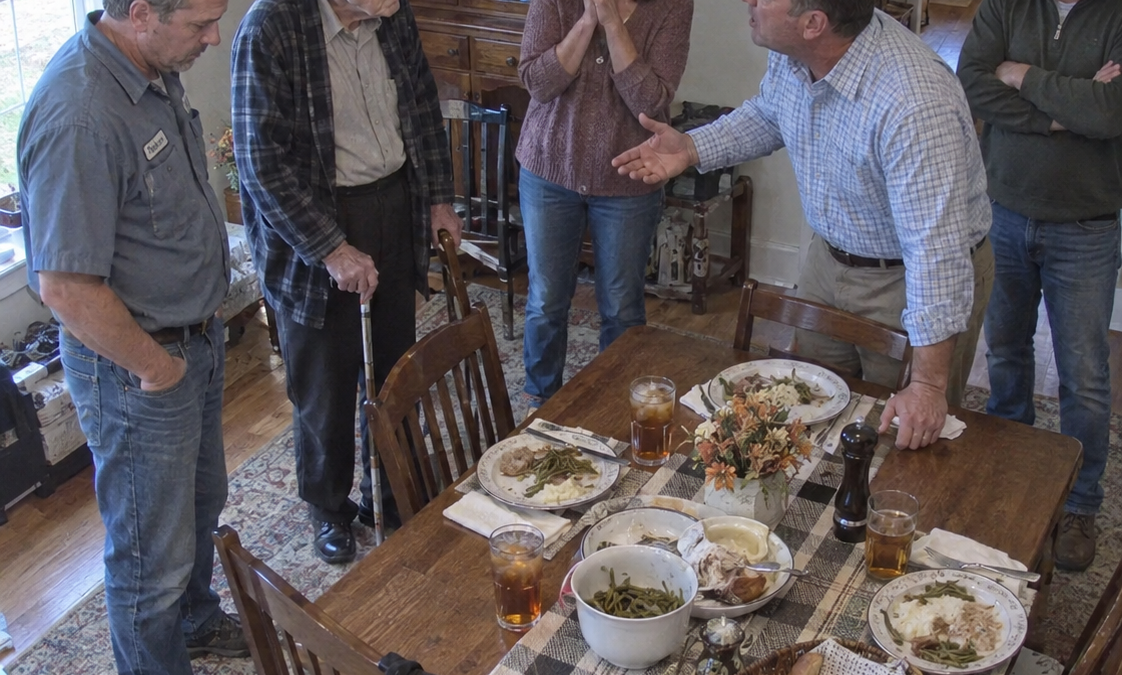
Dinner felt like sitting inside a room full of strangers.
Forks scraped against plates. Someone poured iced tea.
I remember looking around that table, the same table where I’d eaten probably a hundred Sunday dinners over 30 years, and feeling like I was seeing the room for the first time, or perhaps seeing it honestly for the first time.
Linda’s mother’s china was still in the cabinet, exactly where Eleanor had kept it. The faded photograph of Harold and Eleanor on their wedding day hung slightly crooked on the wall behind Rick’s chair, the way it had hung crooked for as long as I could remember, nobody ever quite getting around to straightening it.
Everything looked the same as it always had.
Nothing about that room felt the same at all.
Nobody spoke for nearly five minutes.
Finally, Rick cleared his throat.
“So,” he said, looking directly at me, “where exactly did you two go?”
I took a bite of mashed potatoes before answering.
“Out.”
Dennis laughed.
“Out where?”
Harold answered before I could.
“I asked Michael to drive. He drove. That’s all anybody needs to know.”
Rick forced another smile.
“Dad, if something important happened, we’re your children.”
Harold looked him straight in the eye.
“Then perhaps you should have come to the hospital.”
The room went silent.
Dennis suddenly became very interested in his green beans. Linda stared at her plate.
No one spoke again until dinner ended.
That night, I couldn’t sleep.
Around eleven-thirty, I walked downstairs for a glass of water.
As I stepped into the garage, I froze.
The light inside my truck was on.
Linda stood beside the driver’s seat.
I stood in the doorway for a moment before saying anything, watching her.
And I want to be honest about what I felt in that particular silence, because it wasn’t only anger.
It was a strange, disorienting grief, watching the woman I’d shared a bed with for 30 years treat my own truck like a crime scene, methodical and careful in a way that told me this wasn’t an impulsive moment of worry.
This was someone who had planned exactly what she was looking for and exactly where she expected to find it.
She didn’t hear me.
She was searching through the center console methodically. The glove compartment, registration folder, receipts, even the small compartment where I kept spare reading glasses.
“What are you doing?”
She jumped.
The flashlight in her hand slipped onto the seat.
“I…” She hesitated. “I was looking for something.”
“What?”
She looked away.
“The receipt.”
“What receipt?”
“The lawyer.”
For several seconds, neither of us moved.
“You followed me?”
“No.” She folded her arms. “Rick said Dad probably changed something.”
“So you searched my truck.”
“I needed to know.”
I took a slow breath.
“You could have asked.”
“I am asking.” Her voice cracked. “What did Dad sign?”
Harold had made me promise. No matter what happened, no matter who asked, I couldn’t tell.
“I can’t answer that.”
Linda stared at me.
“You can’t know, or you won’t?”
“They’re the same thing.”
She shook her head slowly.
“I’ve never kept secrets from you.”
I almost reminded her about the fishing trips, about the invitations I’d apparently never received.
Instead, I simply said, “I gave Harold my word.”
She walked past me without another sentence.
A bedroom door closed upstairs.
It sounded louder than it should have.
The next morning, my phone rang before eight.
Susan Miller.
“Good morning, Michael.”
“Morning.”
“I wanted you to know your father-in-law completed everything.”
Everything.
Such a small word. Such enormous consequences.
“The trust is now effective,” she said.
She paused.
“I also wanted to thank you.”
“For what?”
“For showing up.”
I frowned.
“I only drove him.”
“No. You did something much harder than that.”
Before hanging up, she added, “Things may become uncomfortable for a while.”
That turned out to be the understatement of the year.
By Thursday, the rumors had already begun.
Lancaster isn’t a large town. News doesn’t travel. It explodes.
At Miller’s Hardware, where I’d been buying furnace parts for twenty years, conversation stopped when I walked in.
At the diner on Main Street, two men lowered their voices as I passed.
Sunday morning at church felt even worse.
The Bennett family had attended the same church for generations. People smiled politely, but something had changed.
After the service, an older gentleman I’d known for years stopped beside me.
“Mike,” he hesitated, “I hope none of what folks are saying is true.”
“What are they saying?”
He looked uncomfortable.
“That you convinced Harold to cut his children out.”
I felt like someone had punched me in the stomach.
“I’d never do that.”
“I didn’t think so. But people are talking.”
Of course they were.
Rumors always traveled faster than facts.
A few days later, I noticed a gray SUV parked across from our house.
The same SUV appeared outside one of my service calls, then again near the grocery store.
At first, I thought I was imagining things until I saw the driver taking pictures.
He wasn’t very good at hiding it.
I walked across the parking lot. He started his engine immediately and drove away.
I stood there in that grocery store parking lot for a long moment afterward, watching his taillights disappear onto the county road, feeling something shift in my chest that I hadn’t expected.
Anger, mostly, but underneath the anger, something closer to disbelief.
I had spent 30 years quietly earning a reputation as a man who did honest work and kept his word. And here was a stranger in a rented SUV, paid by my own brother-in-law, treating me like a suspect in some crime that had never actually happened.
That evening, I called Susan.
“I think someone’s following me.”
She sighed.
“I was afraid of that.”
“You knew?”
“Rick hired a private investigator.”
I rubbed my forehead.
“Why?”
“He believes you manipulated Harold.”
“I fix air conditioners for a living. I’ve never manipulated anybody.”
“I know. But grief and greed often sound alike.”
Susan told me more about the investigator during that same call, information she’d apparently learned through her own professional channels, since private investigators in a county as small as ours tend to be known quantities to the local legal community.
His name was Gary Puit, a retired sheriff’s deputy who’d built a modest second career doing background work for divorce attorneys and contested estate cases.
Susan told me, with a note of something close to amusement in her voice, that Gary had a reputation locally for being thorough but not especially subtle, and that whatever Rick was paying him, he was getting exactly the kind of surveillance that would make his target aware he was being watched.
Susan suspected that might have been at least partly the point.
“Fear works on people, even when the surveillance itself turns up nothing,” she told me. “He’s not necessarily trying to catch you doing something wrong, Michael. He might just be trying to make you nervous enough to do something wrong.”
I actually met Gary Puit once, months later, entirely by accident at a hardware store outside Lancaster.
He recognized me before I recognized him and, to my genuine surprise, approached me directly rather than pretending not to notice.
“I want you to know I never found a single thing on you, Mr. Carter,” he said somewhat awkwardly, holding a box of nails he clearly hadn’t come in to buy. “Whatever Rick was hoping I’d dig up, it wasn’t there.”
I told him I appreciated him saying so, and he nodded, looking genuinely uncomfortable, before adding one more thing.
“For what it’s worth,” he said, “I’ve done this kind of work for twenty-some years. Most of the time, when a client’s this convinced there’s dirt to find and there just isn’t any, it’s not really about the person they’re investigating. It’s about something they don’t want to admit to themselves.”
I’ve thought about that observation more than once since, wondering exactly what Rick had been trying not to admit to himself throughout that entire ordeal.
Two nights later, Susan asked me to stop by her office after hours.
She locked the front door behind me.
Without saying a word, she placed a thick folder on the conference table.
“I think you should see this.”
Inside were copies of emails, draft contracts, property valuation reports, and maps of Harold’s farmland divided into housing lots.
One document caught my eye.
“Letter of Intent Pending Probate.”
The date at the top made my chest tighten.
Three months before Harold had even suffered a stroke.
“They were planning this before he got sick.”
Susan nodded.
“Rick had already begun confidential discussions with a regional developer.”
I kept turning pages.
There were emails discussing road access, utility easements, estimated profits.
Someone had even written, “Once probate clears, this should move quickly.”
I sat with those pages for a long time, Susan letting the silence stretch without pushing me to react faster than I was able to.
One email in particular stopped me cold.
A message from Rick to the developer’s project manager, sent on what I recognized with a sick lurch in my stomach as Harold’s actual birthday that year, the same day we’d all gathered at the farmhouse for cake and candles.
Rick had apparently stepped out during that party, ostensibly to take a work call, and had used the time to confirm a preliminary survey date for the property.
I remembered that evening clearly.
I remembered Harold blowing out 81 candles, slower than he used to, and remembered thinking nothing of Rick’s absence from the table for those twenty minutes.
I hadn’t known, sitting there eating cake, that I was watching a man’s own son quietly finalizing the paperwork to sell the ground out from under him.
Probate.
They were planning their father’s funeral before he’d even become seriously ill.
I leaned back in my chair.
“I thought Harold overhearing that conversation in the hospital was the beginning.”
Susan looked at me sadly.
“No, Michael.”
She tapped the folder.
“This started years ago.”
I left her office carrying nothing. She wouldn’t let me take copies. Too risky.
But I carried something much heavier.
The realization that the family I’d trusted for three decades had been living a very different story than the one I believed.
And somehow, I had only just stepped into the middle of it.
The first person to stop trusting me wasn’t Rick.
It wasn’t Dennis.
It was my own wife.
I wish I could tell you there was one huge fight that changed everything.
There wasn’t.
It happened the way old houses fall apart. One loose board, one cracked window, one leak nobody fixes, until one day you realize the place you called home isn’t holding together anymore.
For the next two weeks, Linda barely spoke to me unless she had to.
She left before I woke up. She went to bed before I came upstairs.
Thirty years of marriage had turned into polite conversations about groceries and utility bills.
“Did you pay the electric?”
“Yes.”
“Your doctor’s appointment is Thursday.”
“I know.”
Nothing more.
One evening, I found her sitting alone on the back porch.
The sun was dropping behind the maple trees, painting the yard orange. She held a cup of coffee she wasn’t drinking.
I sat beside her.
Neither of us spoke for a while.
Finally, I asked quietly, “Do you really believe I’d steal from your father?”
She kept staring at the backyard.
“I don’t know what to believe anymore.”
That answer hurt more than if she’d simply said yes.
“You know me.”
“I thought I did.”
I nodded slowly.
“So did I.”
She finally looked at me.
“Why won’t you tell me what happened that day?”
“Because I promised him.”
“I’m your wife.”
“I know.”
“You should trust me.”
“I do.”
“Then prove it.”
I looked down at my hands.
Hands that had fixed furnaces, replaced compressors, carried our children when they were little. Hands that had never signed a dishonest invoice.
“I can’t.”
She stood.
“So your promise to my father matters more than your marriage?”
I answered before I had time to soften the truth.
“No. My promise matters because your father is the only person who asked me to keep one.”
She stared at me, neither angry nor shocked, just wounded.
She walked inside.
The screen door slapped shut behind her.
I stayed on the porch until it grew dark.
Three days later, the rumors became expensive.
I was doing fewer repair jobs now that I’d eased into retirement, but I still handled maintenance contracts for several longtime customers.
One of them called.
“Mike.”
His voice sounded embarrassed.
“I’m going with another company.”
“No problem.”
“I’ve heard some things. I figured I just don’t want any trouble.”
After we hung up, I sat in my truck for nearly ten minutes without starting it.
The money didn’t bother me.
I want to name that customer because his eventual reaction became one of the small, quiet redemptions of that whole difficult year.
His name was Walt Ferris, and I’d serviced his family’s HVAC system for nearly twenty-two years, going back to when his kids were in elementary school and he could barely afford the parts, let alone the labor.
I’d carried a balance for him more than once without ever mentioning it again.
When the trial and the full story finally made their way through the same gossip channels that had once carried the rumors, Walt called me directly, no preamble, and said, “Mike, I owe you an apology, and I owe you a service contract renewal, in whatever order you want them.”
I told him the apology would do just fine.
He insisted on both.
Anyway, he’s been a customer again for two years now, and neither of us has ever mentioned that canceled contract since, which felt to both of us like the right way to let it stay quietly behind us.
By the end of that difficult week, two more customers had canceled, then another.
Not because I’d done bad work.
Because someone had convinced them I couldn’t be trusted.
I want to be honest that this particular stretch tested something in me that 30 years of hard, honest labor had never once tested before.
I’d built Carter Heating and Air on the simple premise that good work, done honestly and consistently, would always eventually speak for itself.
Watching that premise fail, watching decades of careful reputation-building get undone in a matter of weeks by rumors I had no way to directly refute, taught me something uncomfortable about how fragile trust actually is, even trust that’s been earned the slow, patient way rather than bought or performed.
I don’t think I fully processed how much that period shook my basic understanding of how the world worked until much later, sitting with Dr. Reeves, unpacking exactly why watching my customer base quietly erode had frightened me almost as much as the family conflict itself.
Some part of me, I realized, had always believed hard work was a kind of armor.
That stretch taught me it’s more like a foundation.
Sturdy. Essential. But not, on its own, protection against every storm.
Sunday was worse.
Church had always been the one place where people knew me simply as Michael. Not the HVAC guy, not Harold’s son-in-law, just Michael.
That morning, I walked into the fellowship hall carrying a plate of donuts like I had dozens of times before.
Conversations slowed.
Not stopped. Slowed.
There’s a difference.
People smiled. They nodded. Then they quietly returned to conversations I wasn’t part of.
I want to describe that particular Sunday in more detail because I think it captures something important about how small-town suspicion actually works, quietly rather than dramatically.
Nobody confronted me directly.
Nobody accused me to my face.
It was subtler than that, and somehow worse for being subtle.
A slight change in the length of eye contact. A conversation that wrapped up a beat too quickly when I approached. The particular hollow feeling of standing in a room full of people who’d known me for two decades and watching them recalibrate, in real time, how much of that history they were still willing to trust.
I sat through the sermon that morning barely absorbing a word of it.
And I remember thinking, with a kind of tired clarity, that this was probably close to what Harold must have felt for years, watching his own sons slowly recalibrate their affection for him against what they thought they stood to inherit.
An old friend named Carl finally pulled me aside.
“I probably shouldn’t say this.”
“Then don’t.”
He smiled weakly.
“I think you deserve to know.”
He lowered his voice.
“Rick’s been telling people Harold changed everything because you isolated him.”
I laughed, not because it was funny, but because it was unbelievable.
“I drove the man home from the hospital.”
“I know. But most folks don’t know the whole story.”
“Neither do I.”
Carl squeezed my shoulder.
“I’m sorry.”
So was I.
I want to mention briefly that not every friendship survived that stretch, and I think it’s honest to say so rather than pretend the story was simply a tale of universal community loyalty once the truth finally came out.
A man named Gordon, who I’d hunted with every November for close to fifteen years, quietly stopped returning my calls sometime during those difficult months and never fully resumed the friendship, even after the verdict came down and the truth was plainly established.
I don’t know exactly why.
Maybe he’d said something unkind about me during those weeks that he was too embarrassed to walk back.
Maybe some friendships are simply more fragile than we want to believe, worn thin by nothing more dramatic than a season of gossip and an unwillingness to ask directly instead of assuming.
I mention Gordon not out of bitterness, but because I think it’s important to be honest that not every relationship gets repaired just because the facts eventually come out in your favor.
Some doors, once they close, simply stay closed, and you learn slowly to stop checking whether they’ll open again.
The next blow came on a Tuesday.
I stopped by the bank to renew the line of credit attached to my small business account.
Nothing unusual.
The manager had known me for fifteen years. He invited me into his office.
He looked uncomfortable before we even sat down.
“Michael, I’m afraid underwriting wants additional documentation.”
“For what?”
“They’re concerned about potential litigation.”
I frowned.
“What litigation?”
“There appears to be a pending inheritance dispute involving your name.”
I closed my eyes for a second.
Rick.
It had to be Rick.
“I haven’t even inherited anything.”
“I understand. My hands are tied.”
He told me, almost apologetically, that someone, he wouldn’t say who, had contacted the bank’s compliance department directly, flagging a potential legal complication associated with my accounts.
I didn’t need him to say Rick’s name out loud.
I knew exactly who had the motive and exactly who had the patience to think of a tactic that specific and that quietly damaging.
It wasn’t a lawsuit.
It wasn’t even a real legal threat. Not yet.
It was just enough friction applied to just enough corners of my life to remind me constantly that someone was actively working to make my life harder.
One phone call at a time.
Walking back to my truck, I realized something.
Rick wasn’t trying to win.
He was trying to exhaust me financially, emotionally, and socially.
If enough people questioned my character, maybe I’d eventually give up.
That evening, I packed a small overnight bag.
Linda stood in the hallway watching.
“You don’t have to leave.”
“I think I do.”
She folded her arms.
“For how long?”
“I don’t know. I don’t want us saying things we’ll regret.”
She looked as though she wanted to say something.
Instead, she simply nodded.
I drove to a small roadside motel outside Lancaster.
Nothing fancy, just a clean room with faded carpet and an air conditioner that rattled every time it started.
Ironically, I spent twenty minutes fixing the loose front panel before I unpacked.
Old habits.
The motel gave me something I hadn’t had in weeks.
Silence.
That night, I sat on the edge of the bed staring at the television without turning it on.
Maybe I’d been wrong.
I want to describe that room a little more because I ended up spending nearly six weeks there, longer than I ever expected when I first packed that small overnight bag, and it became, in its own strange way, a kind of refuge.
The owner, a widow named Doris who ran the place mostly alone, noticed within the first few days that I wasn’t there for the usual reasons people stayed at a roadside motel outside a small Ohio town.
She never once pried.
She just left a thermos of coffee outside my door most mornings without being asked, the kind of quiet, unglamorous kindness I was starting to realize was rarer than I’d ever fully appreciated before that year.
I fixed her ice machine one afternoon out of simple boredom and gratitude, and she knocked five dollars off my nightly rate for the rest of my stay without either of us ever discussing it directly.
Small kindnesses exchanged quietly, without ceremony.
I think that’s closer to how Harold lived his whole life than anything I could have written down in a single sentence.
Doris came to the Harvest Festival the following September, the first year I hosted it, driving out in a small sedan with a homemade apple pie balanced on the passenger seat.
She found me near the cider stand and told me simply that she’d followed the whole story in the local paper after I’d finally moved out of her motel, and that she’d been rooting for me the entire time without ever once saying so out loud during those six weeks.
“I didn’t want to make you feel like a charity case, Michael,” she said. “You already had enough people treating you like something you weren’t.”
I hugged her, which surprised us both, and she’s come to every harvest festival since, always with a different pie, always finding me early in the afternoon to ask how the farm’s doing.
Back in that motel room, though, I kept wondering whether I should have taken Harold home.
Maybe none of this was my responsibility.
Around midnight, I picked up my truck keys.
I actually walked outside and started the engine.
My plan was simple.
Drive back. Tell Susan I was done. Tell Harold to find someone else.
“This isn’t my family,” I whispered to myself.
I backed out of the parking space.
Then my phone rang.
Harold.
I almost let it go to voicemail.
Instead, I answered.
“Hi, Harold.”
His breathing sounded heavier than usual.
“Can you come?”
“Of course.”
“I don’t have much time.”
That night, I was sitting beside his bed at the farmhouse.
The house was quiet. Rick and Dennis had gone home. Linda wasn’t there.
Harold looked older than he had just a week earlier.
Illness can steal years from a person overnight.
He smiled faintly.
“I figured you’d come.”
“I almost didn’t.”
“I know.”
That surprised me.
“You know?”
He chuckled softly.
“I’ve lived a long time, Michael. I know what quitting sounds like.”
He asked me to help him onto the back porch.
The October air was cool. The fields stretched out beneath a sky full of stars.
For several minutes, we simply listened to crickets.
Then Harold spoke.
“Twelve years ago…”
He paused to catch his breath.
“Rick’s company was collapsing.”
I remembered some of that period myself, even before Harold filled in the parts I hadn’t known.
Rick had overextended badly, taking on a large municipal contract that required equipment and crews he didn’t yet have the capital to support.
He’d assumed the contract’s revenue would arrive in time to cover the upfront costs.
It didn’t arrive in time.
Two smaller clients defaulted the same quarter, and Rick found himself, within a matter of months, facing the genuine possibility of losing the entire company he’d spent a decade building.
I understand now, with the benefit of everything I’ve since learned about him, that this financial collapse and the desperate rescue that followed it may have quietly shaped the very entitlement I came to resent in him years later.
The sense that money could always eventually be conjured from somewhere if the situation grew dire enough, that a safety net existed even when he couldn’t see exactly where it came from.
I don’t offer that as an excuse for what he later tried to do to his own father.
I offer it because I think understanding where a person’s worst instincts come from is different from forgiving what they do with them.
“I remember,” I said. “Not all of it.”
Harold looked toward the barn.
“I needed ninety thousand dollars.”
“You didn’t have it.”
“No.”
I nodded.
“I loaned it to you.”
“You saved Rick.”
I shrugged.
“I didn’t save him. I just helped.”
I want to explain what that $90,000 actually meant to me at the time because I don’t think I fully appreciated it myself until years later.
It was 2011, and Carter Heating and Air was coming off two brutal winters where slow-paying commercial clients had nearly sunk the business twice.
Linda and I had maybe $110,000 total between retirement savings and a small college fund we’d started for our daughter.
Harold called me directly, not Linda, on a Tuesday evening, his voice tight in a way I’d never heard from him before.
He asked if I could help him help Rick, without Rick ever knowing where the money actually came from.
He didn’t want his son knowing he’d needed rescuing, and he especially didn’t want Rick knowing a father-in-law with a pickup truck and a modest HVAC business was the one holding the rope.
I withdrew almost everything without telling Linda the full amount, only that we were helping her father with something private, and I drove a cashier’s check out to the farm myself two days later.
Harold cried when I handed it to him, the only time in 30 years I ever saw him do that.
He made me promise right there at his kitchen table that I’d never tell Rick, never tell Linda the full story, and never once bring it up as leverage for anything.
I kept every part of that promise for twelve years.
And I’ll admit there were nights, especially during Rick’s more condescending comments about my business, when keeping quiet took more discipline than I like to admit.
Harold smiled.
“You emptied almost half your retirement account.”
“I knew you’d pay me back.”
“I did last year.”
Neither of us mentioned the promise we’d made.
Rick had never known.
Linda had never known.
Harold turned toward me.
“Do you know why I never told anyone?”
“Because I asked you not to.”
“That was part of it.”
He looked down at his hands.
“My wife made me promise before she died. She said…”
He stopped for a moment.
“Never let money become the thing that tears this family apart.”
His eyes filled.
“I kept hoping they’d remember who they used to be.”
He looked at me.
I asked him gently what exactly had finally changed his mind, what had made him stop hoping and start planning instead.
He was quiet for a long moment, looking out at the dark fields before he answered.
“It wasn’t one single thing, Michael.”
He said it was watching Rick’s face the day he asked him to co-sign a business loan two years after I’d already quietly saved his company once without him ever knowing it was me.
It was watching Dennis miss his own daughter’s college graduation because a listing appointment ran long.
It was a hundred small moments stacked up slowly until one day he looked at his own sons and realized he didn’t recognize the men standing in front of him anymore.
“And then it was watching you, every single one of those same years, show up for things nobody was paying you to show up for. That contrast is what finally changed my mind. Not one moment, just the accumulated weight of watching two very different kinds of men grow older right in front of me.”
He paused.
“I was wrong.”
He reached inside his flannel jacket.
Slowly, carefully, he handed me a sealed envelope.
My name was written across the front in neat handwriting.
“Don’t open it.”
“I won’t.”
“Not unless they leave you no choice.”
He squeezed my wrist.
“If you open it too soon…”
He took another slow breath.
“They’ll destroy you before the truth has a chance.”
I slipped the envelope inside my jacket.
We sat there another few minutes.
Neither of us spoke.
As I stood to leave, Harold called my name one last time.
“Michael.”
“Yes?”
“No matter what happens…”
His voice was barely audible.
“Thank you for showing up.”
I drove the twenty minutes back to the motel in a silence that felt entirely different from the silence I usually preferred on those long drives.
I remember gripping the wheel tightly, glancing more than once at the sealed envelope sitting on the passenger seat where Harold used to sit, thinking about the weight of everything he’d just handed me, both literally and otherwise.
I didn’t open it that night or any night in the weeks that followed.
I kept it in the inside pocket of whatever jacket I happened to be wearing, close enough to my chest that I could feel it there most days.
A small, constant physical reminder of exactly what I’d promised to protect and exactly how much I still didn’t know about what it contained.
Driving back to the motel that night, I realized something I hadn’t wanted to admit.
This had stopped being about land or money or even a will.
It had become a promise.
And for the first time in my life, keeping that promise might cost me everything.
I should mention my own children during this stretch because they mattered a great deal to how I got through those weeks, even though they don’t appear much in the parts of the story that involve the farm directly.
Linda and I have two grown kids, Amanda and Justin, both out of the house by then.
Amanda was married and living in Cincinnati. Justin was finishing a nursing program up in Cleveland.
I called Amanda the week the rumors started spreading through Lancaster, mostly because I needed to hear a voice that hadn’t already made up its mind about me.
She listened to the whole thing without interrupting, the way she’s always been able to since she was a teenager.
And when I finished, she said something I’ve held on to since.
“Dad,” she said, “I’ve watched you fix things for other people my entire life without ever asking for credit. I don’t need Uncle Rick’s version of events to know who you actually are.”
Justin, when I finally told him, was angrier on my behalf than I let myself be on my own.
He offered more than once to drive down and say something to Rick directly, an offer I gently talked him out of every time.
Having two grown children who never once doubted me, even while their own mother struggled to, was one of the few steady footholds I had during that entire stretch.
Amanda drove down from Cincinnati the week before Harold’s condition finally worsened for good, wanting to meet the man she’d heard me talk about for years but had somehow never gotten to know well herself, having moved away for college right around the time my visits to the farm had become more frequent.
She sat with him for an hour, the two of them talking quietly while I stood in the doorway.
When she came out, her eyes were red.
“He told me I should be proud of you, Dad,” she said. “He said not many men would have driven a hundred miles for someone else’s father, let alone carried what you carried afterward.”
I didn’t have anything to say to that in the moment.
I just hugged my daughter in that hospital hallway and let both of us have a minute we badly needed.
Harold Bennett died on a cold December morning.
There wasn’t anything dramatic about it.
No last-minute miracle. No final speech.
I’d visited him three days earlier, sitting in the same hospice room where the family had first learned his condition had worsened past what the doctors could meaningfully treat.
He’d been sleeping most of that visit, waking only briefly, and in that brief window, he’d looked at me with the same clear, steady eyes I remembered from the truck ride out of the hospital months earlier.
“You kept your word, Michael,” he said quietly. “That’s all I ever needed to know about a man.”
I told him I’d keep keeping it.
He nodded and closed his eyes again.
And that was, as it turned out, the last real conversation we ever had.
I’ve thought about that exchange more times than I could count since, grateful in a way I can’t fully explain that his final clear words to me were about trust rather than about the farm or the trust document or anything material at all.
The hospice nurse told me he passed quietly before sunrise, with a Bible resting on the nightstand and an old photograph of his late wife beside the bed.
I stood at the funeral wearing the same dark suit I’d worn to my daughter’s wedding years earlier.
It fit a little tighter now.
Funny how grief and age both have a way of changing a man.
The church was full.
Neighbors, farmers, people Harold had helped over the years without ever talking about it.
Rick and Dennis stood together near the front.
They greeted people with practiced smiles.
Every few minutes, someone walked over to offer condolences.
I noticed something.
Neither brother mentioned their father.
They talked about the farm. The future.
“There’s a lot to take care of.”
“Dad left quite a responsibility.”
They made it sound like a business conference, not a funeral.
I stood near the back watching them work that receiving line the way I imagined they’d work a business luncheon, shaking hands, nodding gravely, occasionally allowing a rehearsed catch in their voices at exactly the right moment.
I don’t think either of them was being consciously dishonest in that performance.
I think by that point the performance and the actual grief had become so intertwined in both of them that neither brother could fully separate one from the other anymore.
A sad thought that occurred to me standing in that back pew, watching two men bury their father while somehow still managing to network through the reception line.
An elderly woman named Mrs. Castellano, who’d taught Sunday school at the church for close to forty years and had known Harold since before either of them were married, stopped me near the back pew before the service began.
She pressed my hand between both of hers, her grip surprisingly strong for a woman well into her eighties, and told me something I’ve held on to since.
“Harold used to tell me you were the son he got to choose, Michael,” she said. “He said, ‘Blood gives you children. Character gives you family.’ I don’t think he ever told his own boys that distinction applied to them, too.”
I didn’t trust myself to answer her without my voice breaking, so I simply nodded and thanked her.
She patted my hand once more before moving on to greet someone else.
I stayed toward the back.
That seemed easier for everyone.
Linda walked over just before the service began.
She looked exhausted. Her eyes were red.
“I heard you’re still staying at the motel.”
“I am.”
She nodded.
“I never wanted it to come to this.”
“Neither did I.”
She hesitated.
“I don’t know how to fix it.”
I answered honestly.
“I don’t either.”
Pastor Whitfield’s eulogy, delivered a few minutes later, was gentle and general, the kind of remembrance meant to comfort a full room rather than address any particular family tension directly.
But there was one passage that I noticed several people around me visibly react to, a moment where he departed slightly from his prepared remarks and spoke instead about a conversation he’d once had with Harold at a men’s breakfast years earlier.
“Harold told me once,” he said, “that a man’s legacy isn’t measured by what he leaves behind. It’s measured by who he trusted to protect it once he was gone, and whether that trust was well placed.”
I don’t think that was an accident, coming from a pastor who’d almost certainly heard some version of the family’s unfolding legal dispute through the same small-town channels everyone else had.
I caught Susan’s eye across the sanctuary during that line.
She gave me the smallest, most controlled nod I’ve ever seen a person give.
Three weeks later, Rick filed a petition in probate court.
He claimed Harold had lacked the mental capacity to create the trust and update parts of his estate plan.
He also accused Susan Miller of allowing undue influence by me.
That phrase became the center of everything.
Undue influence.
According to Rick’s attorney, I had manipulated an elderly man into changing legal documents for my own benefit.
The irony would have been funny if it hadn’t been my life, because the truth was almost embarrassing.
I hadn’t asked Harold for a single thing.
The hearing took place in the Fairfield County Courthouse on a gray morning in January.
Snow covered the sidewalks outside.
Inside, people filled nearly every bench.
Farmers Harold had known for decades. Church members. A few local reporters.
In small towns, courtrooms become community theaters whenever families start fighting over land.
I sat in the hallway outside the courtroom for nearly twenty minutes before proceedings began, watching the benches fill up through the small window in the door.
Face after face.
Carl from church. Two men I’d fixed furnaces for going back fifteen years. Ben Walker, still in his work boots, having apparently come straight from the fields.
Walt Ferris was there too, sitting near the back, having driven in from the far side of the county specifically for the hearing, though he hadn’t yet spoken to me since he’d canceled his contract.
I noticed Mrs. Castellano, the Sunday school teacher, seated near the front, hands folded in her lap, and Doris from the motel, of all people, tucked into a corner seat, apparently having decided that six weeks of quietly leaving coffee outside my door earned her a place in the gallery too.
I didn’t expect that kind of turnout.
And I remember feeling something complicated watching it happen, grateful and terrified in roughly equal measure, aware that whatever happened in that room over the next several hours would be witnessed by nearly everyone whose opinion of me had mattered for the past three decades.
Susan leaned toward me before proceedings began.
“Remember, I’m listening. Don’t argue. Answer only what’s asked.”
I nodded.
“I understand.”
The bailiff called the room to order.
The judge entered.
Everything suddenly became very quiet.
Rick’s attorney spoke first.
He was polished, confident.
His name was Bradley Kesler, a Columbus litigator Rick had apparently retained at considerable expense.
The kind of lawyer whose suits fit a little too perfectly and whose confidence read, to me at least, less like conviction and more like practiced performance.
Susan told me afterward that she’d faced Kesler twice before in unrelated matters, and that his particular specialty was less about the strength of his evidence and more about the strength of his delivery.
Betting, correctly more often than not, that a confident enough story delivered smoothly enough could carry a case even when the underlying facts were thin.
I understood, watching him work that courtroom, exactly why Rick had hired him.
He was good at exactly the kind of theater Rick needed if the actual facts weren’t going to cooperate.
I learned months later, from a passing comment Susan made over coffee, that Kesler had actually advised Rick against pursuing the case at all during their very first consultation.
He’d warned him that the evidentiary bar for proving undue influence in a case this well documented was unusually high, and that the financial risk of losing, both in legal fees and in reputation, was considerable.
Rick had insisted anyway, apparently telling Kesler that he wasn’t willing to simply let the farm go without a fight, whatever the odds.
I think about that detail sometimes, the fact that even Rick’s own hired advocate had quietly doubted the wisdom of the entire challenge from the very beginning, and Rick had pushed forward regardless, driven by something that had stopped, somewhere along the way, being about the actual likelihood of winning.
Kesler was the kind of lawyer who never seemed to look at his notes.
He painted a simple story.
An elderly man suffered a stroke.
A son-in-law isolated him.
A new trust appeared.
The family lost control of property that had belonged to them for generations.
Then he pointed directly at me.
“Mr. Carter benefited enormously.”
That wasn’t even true.
But saying it confidently made it sound believable.
When Susan stood, she didn’t rush.
She carried one folder to the podium.
“Your Honor,” she said calmly, “the evidence tells a very different story.”
The first witness was Harold’s neurologist, a soft-spoken man named Dr. Patel, who’d treated Harold for nearly six years.
The doctor explained that Harold had experienced a mild stroke affecting movement, not judgment.
He walked the court through the specific clinical distinction in some detail, explaining that the stroke had affected a region of the brain associated primarily with fine motor coordination on Harold’s left side.
The standard cognitive battery administered the day before he signed the trust documents, a full Mini-Mental State Examination along with a more detailed capacity assessment specific to financial and legal decision-making, had shown scores entirely within the normal range for a man of Harold’s age.
He reviewed the cognitive evaluations performed the day before Harold signed the trust.
“Mr. Bennett answered every question correctly.”
“Were you concerned about dementia?”
“No.”
“Confusion?”
“No.”
“Impaired decision-making?”
“No.”
Rick’s attorney tried to challenge him, pressing on whether stress or medication could have temporarily affected the results, whether a man recovering from any stroke might present differently on a good day than a bad one.
The doctor never wavered.
He explained patiently that the capacity assessment had, in fact, been administered twice on two separate days a week apart, specifically to rule out exactly the kind of day-to-day variability Rick’s attorney was suggesting, and that both results had been essentially identical.
For the first time that morning, I saw Rick shift in his chair.
Susan then took the stand herself and explained her standard procedures.
She had met privately with Harold, no family members present.
She had asked him the same questions twice on different days.
His answers matched.
She had insisted on independent witnesses.
Two legal assistants from her office had watched every signature.
Not me.
I simply drove Harold to the appointment.
Rick’s lawyer frowned.
That argument had just disappeared.
I silently thanked Susan.
Harold had planned even that.
Then came the recording.
Susan held up the small digital recorder Harold had carried in my truck.
“I’d like the court to hear Exhibit Twelve.”
The room filled with static.
Then Rick’s voice.
“If we split the south field…”
Dennis laughed.
“Dad probably won’t make another Christmas.”
No one moved.
Even the court reporter looked up for a second.
I watched Rick during those thirty seconds of playback more than I watched anyone else in the room.
He stared straight ahead at the judge’s bench, jaw tight, refusing to look at me, at Linda, or at anyone seated behind him.
Dennis, beside him, had gone the color of old paper.
His eyes fixed somewhere on the floor as if he could will himself out of the room entirely.
When the recording ended, the silence felt heavier than the audio itself.
Rick’s attorney stood immediately.
“Private recordings can be misleading.”
Susan nodded.
“They can. Which is why this isn’t our strongest evidence.”
She wasn’t bluffing.
Next came printed emails and text messages.
Susan projected one onto a courtroom screen.
“Letter of Intent Subject to Probate.”
Three months before Harold entered the hospital.
Property maps, estimated lot prices, discussions about utility access.
One message from Rick read, “Once Dad’s gone, we’ll move quickly before neighbors complain.”
I heard someone in the gallery quietly whisper, “Oh my God.”
The judge removed his glasses.
He spent several minutes reading every page himself.
And I remember the specific discomfort of watching a room full of my neighbors sit in total silence while a judge silently absorbed, page by page, the exact scale of what Rick had been quietly planning.
Nobody coughed.
Nobody shifted in their seats.
It felt for those several minutes less like a courtroom and more like a congregation watching a sermon land exactly where it needed to.
Rick still refused to give in.
“He never sold anything. He only explored possibilities.”
Susan smiled politely.
“I agree. Which is why I’d like to call Mr. Thomas Avery.”
An older man with silver hair walked to the witness stand.
I recognized him immediately.
Rick’s former accountant.
He had retired the previous year.
After taking the oath, he looked directly at the judge.
“I’ve struggled with whether to come today.”
“What changed your mind?” Susan asked.
“Harold deserved better.”
He explained that Rick had instructed him months earlier to prepare tax projections based on proceeds from selling the farm.
I asked him once, weeks later after everything had settled, why exactly he’d finally decided to come forward when Rick had been, by his own account, a steady client for nearly a decade.
He told me he’d known Harold personally, going back to church potlucks and 4-H fundraisers decades earlier, long before he ever did a single tax return for Rick’s landscaping company.
And that watching Rick’s attorney publicly accuse a man like me of manipulating Harold had been more than his conscience could sit quietly through.
“Some loyalties,” he told me, “are supposed to outlast a client relationship. This was one of them.”
He also told me something I hadn’t expected, sitting across from him at his kitchen table weeks after the trial over coffee he insisted on brewing himself.
He said losing Rick as a client hadn’t cost him nearly as much sleep as he’d expected it to once he’d made the decision to testify.
What cost him sleep, he said, was the month leading up to that decision, watching a man he’d done business with for ten years plan to profit from his own father’s death with the same cold efficiency he’d bring to any ordinary transaction.
“I don’t do this work to help people get rich off dying relatives, Mr. Carter,” he told me. “I do it to help families keep what they’ve built. Rick forgot the difference. I couldn’t forget it for him.”
Then came the sentence that changed the room.
“I was also asked to review paperwork involving a refundable deposit from a development company.”
Rick’s attorney jumped to his feet.
“Objection!”
The judge looked over.
“On what grounds?”
“Hearsay.”
Susan calmly handed over certified financial records.
The judge reviewed them.
“Overruled.”
Mr. Avery continued.
“The money was placed in escrow pending probate. Not an illegal sale, but proof that Rick fully expected to sell land that wasn’t yet his.”
By then, Rick looked pale.
Dennis wouldn’t even meet anyone’s eyes.
I thought it was over.
It wasn’t.
Before Susan called me to the stand with the envelope, Kesler had already cross-examined me briefly earlier that morning, trying to establish the narrative he needed about undue influence.
He asked me repeatedly, in slightly different phrasing each time, whether I had discussed the contents of Harold’s estate plan with him before that day in Susan’s office.
I answered honestly every time that I hadn’t, that I’d had no idea what Harold intended until we were sitting in that conference room together.
He asked whether I stood to benefit financially from the trust.
I told him truthfully that I didn’t own any part of the farm, that my role was strictly as trustee, a distinction he tried unsuccessfully to blur for the judge’s benefit.
He finally asked, with a note of theatrical incredulity in his voice, whether I expected the court to believe an HVAC repairman had simply been handed responsibility for a multimillion-dollar estate out of pure sentiment.
I answered him plainly.
“I expect the court to believe exactly what the evidence shows, sir. I didn’t ask for this. I was asked. There’s a difference, and the paper trail proves which one actually happened.”
He didn’t have much of a follow-up to that.
Susan looked toward me.
“Mr. Carter.”
She held up a familiar envelope.
“I believe Mr. Bennett left this in your care.”
My heart started pounding.
I walked slowly to the witness stand.
For weeks, I’d carried that sealed envelope everywhere, never opening it, never even holding it longer than necessary.
Now I carefully broke the seal.
Inside were several handwritten pages.
The paper shook slightly in my hands, not because I was nervous, but because I already missed the man who’d written them.
I looked toward the judge.
“May I read this?”
He nodded.
“You may.”
I took a breath.
“My children.”
The courtroom became so quiet I could hear the heating system humming above us.
“If you’re hearing these words, I’m gone. I loved each of you more than you will ever know. But love cannot survive without honesty.”
I turned the page.
“Rick, you measured this farm in dollars while I was still measuring my remaining days. I have watched you build a successful company, and I am proud of the work ethic underneath it, even now. But somewhere along the way, you started believing that what a thing is worth and what it means are the same question. They have never been the same question. Not for this land and not for this family.
“Dennis, you missed moments that can never be rescheduled. I don’t say that with anger, only with grief. There were birthdays, ball games, ordinary Tuesday dinners where an empty chair told me more about your priorities than any phone call ever could. I hope someday you learn what your brother and I both learned too late: that presence is the only currency that actually compounds.
“And Michael…”
I had to stop for a second.
My voice caught.
I cleared my throat.
“The only man who never asked me for anything is the one person I trusted with everything that truly mattered. Not because he married into this family, but because he showed up when everyone else found an excuse.”
I lowered the letter.
No one spoke.
Then something happened I never expected.
Linda slowly stood from the back row.
Her attorney looked surprised.
Even Rick turned around.
She faced the judge.
“Your Honor,” her voice trembled, “I need to say something.”
The judge nodded.
“Go ahead.”
She looked at me first, then at her brothers.
“For thirty years,” she whispered, “I let other people tell me what kind of husband Michael was.”
Tears rolled down her face.
“I never stopped long enough to see him for myself.”
Rick snapped.
I remember that with a clarity I don’t have for most of the rest of that day, watching my wife of 30 years stand up in a room full of our entire community and finally publicly choose truth over the comfortable silence she’d kept for so long.
I hadn’t asked her to do that.
I hadn’t even hoped for it. Not really.
Having long since stopped expecting her to break ranks with her own family in any visible way, watching her do it anyway, unprompted, in front of everyone whose opinion had mattered to both of us for decades, felt like watching thirty years of quiet, accumulated hurt finally find somewhere honest to land.
Linda didn’t even look at Rick.
“He never asked my father for money. He never asked for the farm. He never asked for anything.”
Then she took a slow breath.
“I was wrong.”
The judge folded his hands.
Several long moments passed before he finally spoke.
I want to describe those several long moments because they felt, sitting in that courtroom, considerably longer than they probably actually were.
The room had gone entirely silent, the kind of silence where you become aware of your own heartbeat, of the particular quality of winter light coming through tall courthouse windows, of Susan’s hand resting lightly on the table beside mine, steady and confident even as the rest of us waited.
I looked once at Linda, three rows back, and found her already looking at me, her face open in a way I hadn’t seen in months.
“The evidence clearly demonstrates that Harold Bennett acted knowingly, voluntarily, and with full mental capacity.”
The judge looked toward Rick.
“The trust shall remain in full force.”
His gavel struck once.
It wasn’t loud.
But after months of lies, it sounded like truth.
The judge added a few more sentences before adjourning, addressing Rick and Dennis directly in a tone that had shifted from the careful neutrality he’d maintained throughout the proceedings.
“I would encourage the petitioners,” he said, “to consider carefully what has been revealed in this courtroom today, not merely about the legal merits of this case, but about the character of the father they’ve lost and the manner in which they chose to honor or fail to honor his memory during this proceeding.”
It wasn’t part of the formal ruling.
I don’t think it needed to be.
Several people in the gallery told me afterward that it was the part of the hearing that stayed with them longest.
When people hear the ending of this story, they usually ask the same question.
“So, did you inherit the farm?”
The answer surprises them every time.
No, I didn’t.
At least not in the way most people imagine.
About two weeks after the court hearing, Susan Miller invited me back to her office.
The winter snow had finally begun to melt, leaving muddy fields and patches of brown grass all over Fairfield County.
She slid a thick binder across the conference table.
“The judge signed the final order this morning.”
I nodded.
“So what happens now?”
She smiled.
“Exactly what Harold wanted.”
She opened the binder to the trust documents.
“The farm belongs to the Bennett Family Trust.”
I kept reading.
Ownership would remain with the trust itself.
No individual family member could force a sale.
No one could borrow against it.
No one could divide it into housing lots without meeting conditions so strict they were practically impossible.
Then I reached the page with my name.
“Successor Trustee: Michael Carter.”
I looked up.
“I don’t own any of this.”
“No. But you’re responsible for protecting it.”
“Until when?”
“For as long as you’re willing.”
Susan walked me through the actual mechanics of what that responsibility would look like in practice.
And I remember feeling a specific kind of vertigo listening to her list it all out, aware that I was being handed a job I’d never once trained for or asked to hold.
Annual accountings filed with the court, property tax payments managed on schedule, lease agreements reviewed and renewed.
A fiduciary duty, she explained carefully, that legally required me to act in the trust’s best interest, even above my own.
A legal standard higher than almost anything else in Ohio law, higher, she pointed out, than most business relationships people navigate their entire lives without ever having to think about.
I asked her, half joking and half not, whether Harold had considered that I’d spent thirty years fixing furnaces, not managing trusts.
She smiled and told me that was exactly why he’d chosen me.
“People who’ve spent their whole lives doing careful, unglamorous work tend to take fiduciary duty more seriously than people who’ve spent their lives chasing bigger opportunities, Michael. He wasn’t looking for a financial expert. He was looking for someone who wouldn’t cut corners when nobody was watching.”
I leaned back in my chair.
Harold hadn’t given me land.
He’d given me responsibility.
Some people would have considered that a burden.
To me, it felt like the greatest compliment I’d ever received.
Rick and Dennis weren’t completely disinherited.
Harold hadn’t wanted revenge through money.
He wanted accountability.
Each son received a modest inheritance, just enough to acknowledge they were his children.
But because they challenged the trust in bad faith and violated the no-contest provisions, they lost the opportunity to control the property.
That hurt far more than losing dollars.
Rick appealed once.
His attorney quietly advised him to stop.
The evidence was overwhelming.
A few months later, I heard his landscaping company had lost two commercial contracts.
I learned the details of that loss secondhand through Ben Walker, who’d heard it from a mutual acquaintance in the county’s agricultural extension office.
One of the contracts had been a five-year maintenance agreement with the county parks department, the kind of steady, reliable business that keeps a landscaping company afloat through slow seasons.
The parks director had apparently made the decision not to renew after a board member, a woman who’d sat three rows behind me at the hearing, mentioned what she’d witnessed in that courtroom.
Rick never called to ask why.
I don’t think he needed to.
Not because of anything I did.
Word had spread.
Business owners don’t like shaking hands with someone they don’t trust.
Dennis stayed in real estate, but several local farmers stopped returning his calls.
I heard through the same slow channel of small-town gossip that eventually tells you everything whether you want to hear it or not, that Dennis had tried, about eight months after the hearing, to quietly rebuild some of those relationships, showing up at a county agricultural fair with a booth and a stack of business cards.
Nobody stopped by.
Again, I never celebrated it.
Small towns have long memories.
I ran into Dennis exactly once during that stretch, at the same hardware store where I still buy furnace parts, both of us reaching for the same aisle at the same time.
He looked older than his years, thinner, the easy confidence that used to define every family dinner noticeably absent.
We exchanged a stiff, wordless nod, and he left without buying whatever he’d come in for.
I stood there a moment afterward holding a box of filters, feeling something considerably more complicated than satisfaction.
I think I felt mostly a kind of tired sadness for the version of Dennis that might have existed if he’d simply chosen, at any point across those difficult months, to be honest instead of greedy.
That version of him might have kept a father, a family, and a reputation.
Instead, he’d kept none of the three.
I want to be honest that there was a period, roughly the first month after the verdict, when some small, ungenerous part of me did take a certain grim satisfaction in watching Rick and Dennis’s reputations quietly unravel.
I’m not proud of that feeling, and it didn’t last.
Harold hadn’t built that trust to punish his sons publicly.
He’d built it to protect something he loved from people who’d stopped loving it the right way.
And I came to understand, the longer I sat with everything that happened, that there’s a real difference between justice finally catching up to someone and a person actively wishing harm on them.
I tried, as the months passed, to let go of the second thing while still holding on to the first.
People eventually decide for themselves who deserves their confidence.
The farm itself became my first priority.
I wasn’t a farmer.
I knew enough to admit what I didn’t know.
So instead of trying to run everything myself, I met with Harold’s longtime neighbor, Ben Walker.
Ben had worked the adjoining fields for years.
We sat in his pickup one windy afternoon, looking across Harold’s land.
“You interested in leasing it?” I asked.
He smiled.
“I was hoping you’d ask.”
We worked out a fair agreement over coffee at the kitchen table.
No complicated contracts, just honest numbers and a handshake before Susan drew up the paperwork.
Ben told me something that first afternoon that I’ve thought about often since, sitting in his truck with the heater rattling against the cold.
“Harold used to say, ‘The land doesn’t care who owns it, Michael. It only cares who tends it.’ I think he was trying to tell you something with that trust, whether he ever said it plainly or not.”
I didn’t have an answer for that at the time.
I think I understand it better now, a year into actually being responsible for keeping those fields the way Harold would have wanted them.
Ben and I have grown genuinely close in the two years since that first conversation in his pickup, closer than I ever expected a business arrangement to become.
He calls most Sunday evenings just to talk through the coming week, share weather forecasts, mention a fence post that’s starting to lean.
Neither of us has ever said out loud that these calls have become something closer to friendship than logistics, but I think we both know it.
He came to Harold’s funeral in a suit that clearly hadn’t been worn in years, and he was one of the first people at the harvest festival every single September since, always arriving early to help set up chairs before anyone else showed up.
I think Harold would have appreciated that kind of quiet, consistent loyalty more than almost anything else that’s happened to the farm since he passed.
The fields stayed green.
The fences stayed repaired.
The old red barn received a fresh coat of paint for the first time in nearly fifteen years.
Every time I drove past, I thought Harold would have approved.
Spring turned into summer.
Then one Saturday in September, I decided to do something Harold had talked about for years but never quite managed.
We organized a community harvest festival on the farm.
Nothing fancy.
A local church youth group ran a bake sale. The volunteer fire department grilled hamburgers and hot dogs. Kids took hayrides through the back fields.
An old bluegrass band played under a white tent. Neighbors brought homemade pies.
Someone even set up a table where veterans could share old photographs and stories.
I remember standing near the entrance early that morning, watching the first cars turn into the gravel driveway and feeling a kind of nervous anticipation I hadn’t expected.
This was the first time I’d hosted anything at the farm as its actual steward rather than simply as Harold’s son-in-law helping out for an afternoon.
Some part of me worried the whole thing would feel forced, an imitation of something Harold would have done better and more naturally.
It didn’t feel that way at all once people actually started arriving.
Carl showed up early to help me set up folding tables, the same Carl who’d quietly warned me about Rick’s rumors months earlier.
He clapped me on the shoulder and said simply, “Harold would have loved this, Mike,” before heading off to help unload chairs.
I choked up a little at that, more than I expected to, standing in a gravel driveway at eight in the morning, surrounded by folding tables.
I spent most of the afternoon helping children feed a pair of stubborn goats that seemed determined to eat everyone’s shirt sleeves.
For the first time in a long while, the farm sounded alive again.
Not because it was making money.
Because it was making memories.
That evening, just before sunset, I noticed a black SUV slow down on the county road.
Rick.
He never turned into the driveway.
He simply sat there for a few seconds.
From where I stood, I could see children laughing near the pumpkin patch, older couples rocking in folding chairs, neighbors talking the way neighbors used to.
Then Rick quietly drove away.
No one waved. No one yelled.
Most people didn’t even notice he’d been there.
Sometimes being forgotten hurts more than being hated.
Linda came to the festival too.
She arrived alone.
I spotted her standing near the apple cider stand, looking uncertain, almost like a guest in a place that used to feel familiar.
I walked over.
“I’m glad you came.”
“So am I.”
For a moment, neither of us knew what to say.
Finally, she smiled a little.
“I heard the goats escaped twice this morning.”
“They did. They’re smarter than they look.”
She laughed.
It was the first genuine laugh I’d heard from her in months.
Later that afternoon, we sat together on the old porch where Harold and I had shared so many cups of coffee.
Pastor Whitfield had a hand in getting us both to that porch, more than I fully realized at the time.
He’d pulled me aside quietly after a service, maybe two months into the separation, and told me in his usual understated way that he’d been counseling Linda for weeks, and that he thought I ought to consider doing the same.
Not necessarily with him, but with someone.
I resisted at first, the same old instinct that had made me resist therapy my whole life, the assumption that a man who fixed his own problems with his own hands shouldn’t need to sit in an office talking about his feelings.
He didn’t push.
He just said quietly, “Michael, you can fix a furnace with your hands. Some things need different tools.”
I started seeing a counselor named Dr. Reeves in Columbus about two weeks later.
And I’ll admit now something I wouldn’t have admitted at the time: it helped more than I expected, mostly by giving me a place to say out loud how frightened I actually was underneath all the calm I was trying to project for everyone else’s benefit.
“I’ve been going to counseling,” Linda said quietly.
“I know. The pastor mentioned it.”
“He said he saw you there too.”
“I’ve got plenty to work on.”
She nodded.
“So do I.”
I asked her carefully what counseling had actually helped her see.
She was quiet for a long moment before answering, watching the last of the afternoon light move across the fields.
“I think I spent thirty years being the peacekeeper in my own family,” she finally said. “Every time Rick or Dennis said something unkind about you, I told myself changing the subject was kinder than confronting it, that I was protecting the peace. I understand now that I wasn’t protecting anything. I was just letting the unkindness accumulate somewhere I didn’t have to look at it directly. And it landed on you every single time for thirty years while I told myself I was being the reasonable one.”
I didn’t say much in response.
I just reached over and took her hand, the first time either of us had touched the other in longer than either of us wanted to admit.
She told me more over the following weeks, pieces of it emerging slowly in the particular way real reckoning tends to happen.
Never all at once, never in a single tidy conversation.
She’d started therapy, she said, half expecting to spend most of the sessions defending her brothers, and had instead spent the first two months simply naming out loud to a stranger patterns she’d never once said aloud to herself.
The way she’d learned, as the only daughter among three siblings, that her value in that family depended on smoothing things over rather than telling the truth.
The way that early lesson had quietly hardened into thirty years of choosing comfort over honesty, even when the person paying for that comfort was the man she’d married.
There wasn’t a dramatic apology.
No speeches.
No promises that everything would magically return to normal.
Real life rarely works that way.
Healing isn’t one decision.
It’s hundreds of small ones.
A phone call. Dinner together. Learning to listen instead of assuming.
By Thanksgiving, we were spending weekends together again.
Not because the pain had disappeared, but because we finally stopped pretending it never existed.
We moved slowly.
That felt honest.
I want to say something about the trust itself and what it’s actually meant, practically, to be responsible for it these past two years, because I don’t think the paperwork alone captures what the job really involves.
Being successor trustee means I spend a certain amount of every month on things nobody sees.
Reviewing Ben Walker’s lease payments. Walking the fence each season to catch problems before they become expensive ones.
Meeting with Susan twice a year to make sure every filing stays current and every provision Harold built into that document stays airtight.
It is, in some ways, not so different from thirty years of HVAC work.
Nobody notices a furnace that’s running properly.
They only notice the one that breaks down in January.
I’ve tried to run the farm the same way I ran my business.
Quietly. Competently. Without needing anyone to see the maintenance in order to trust that it’s being done.
Susan and I still meet regularly, and our relationship has become something closer to friendship than the strictly professional arrangement it started as.
She told me once, over coffee at her office, that Harold’s file was one of the most carefully constructed pieces of estate planning she’d handled in twenty-five years of practice.
Not because the legal mechanisms were unusually complex, but because of how precisely he’d anticipated exactly how his sons would eventually react, building safeguards years in advance of needing them.
“He knew his own children better than they knew themselves,” she told me. “That’s rarer than you’d think. Even among parents who love their kids deeply, most people can’t see clearly enough into the people they raise to protect against exactly what those people will eventually do. Harold could. I think that’s the loneliest kind of clarity a father can have, and I think it cost him more than any of us, even me, ever fully understood.”
I asked her once, near the end of one of those coffee meetings, whether she thought Harold had ever hoped he was wrong, whether some part of him had spent all those years quietly preparing for a betrayal he genuinely hoped would never come.
She was quiet for a long moment before answering.
“I think every single provision in that trust was written by a man hoping he’d never need to use it, Michael,” she said. “That’s the saddest part of estate planning that most people never think about. The best plans are the ones nobody ever wants to see activated. Harold built the best plan I’ve ever seen, and I don’t think there was a single day of the seven years it sat in that fireproof cabinet that he wasn’t quietly praying it would simply gather dust forever.”
A few weeks before Christmas, I visited Harold’s grave.
The cemetery overlooked rolling farmland dusted with early snow.
The wind carried the smell of pine and wood smoke from nearby houses.
I brought something simple.
An old pair of worn leather work gloves.
Years earlier, Harold had forgotten them in my truck after we’d repaired a broken fence together.
I’d kept them ever since.
I laid them gently against the headstone.
Linda came with me that particular visit, standing a step behind me, her hand resting lightly on my shoulder the way it hadn’t in longer than either of us wanted to admit.
She hadn’t said much on the drive out, and she didn’t say much standing there either.
Just let me have the moment the way I’d learned slowly over that whole difficult year to let her have hers.
I glanced back at her once, and she gave me a small nod, the kind that doesn’t need words attached to it.
The kind two people who’ve weathered something enormous together learn to exchange instead of speeches.
“Still showing up,” I said quietly.
The wind answered with nothing more than the rustling of dry grass.
Somehow, that was enough.
I stood there a good while longer than I’d planned to.
Long enough that the cold started working its way through my coat. Long enough to notice how quiet a cemetery gets in early winter.
No birds. No traffic.
Just the occasional creak of bare branches somewhere behind me.
I thought about the first morning of all this, gripping the wheel of my truck outside that hospital, having no idea that a single locked door and a small digital recorder were about to rearrange the entire shape of my life.
I thought about the motel room with the rattling air conditioner, the nights I genuinely considered simply walking away from all of it, telling Susan to find someone else, telling Harold I couldn’t carry what he was asking me to carry.
I’m glad, standing at that grave, that I didn’t.
Not because of the farm.
And not because of anything I gained from any of it.
Because walking away would have meant Harold spent his final months trusting the wrong man.
And I don’t think I could have lived with that, even if every single other consequence of staying had turned out worse than it did.
People sometimes think revenge is about watching someone suffer.
I don’t believe that anymore.
Harold taught me something different.
Real justice isn’t taking away what someone owns.
It’s revealing who they are when everyone is finally paying attention.
Rick and Dennis weren’t defeated because they lost control of a farm.
They defeated themselves long before that.
Every selfish choice. Every excuse. Every opportunity they ignored to simply sit beside their father while he was still alive.
That was the real loss.
I think about that distinction often now, the difference between losing something and losing yourself in the process of chasing something else.
Rick and Dennis lost a farm eventually, but that loss was never really the point.
Not for Harold, and not, I’ve come to believe, for the actual moral of this story.
What they lost first, years before any courtroom or any trust, was the version of themselves capable of sitting quietly on a porch with their father and asking him real questions about his life.
I got to keep that version of a relationship with Harold for thirty years.
Not because I was owed it, but because I showed up often enough, consistently enough, for long enough that it simply grew into something real between us.
That, more than any legal document, is the actual inheritance I walked away with.
The farm is just where I keep proving I still deserve it.
It’s been almost three years since that morning in the truck now.
And I want to close this out by telling you honestly what an ordinary Tuesday looks like these days, because I think it says more about how everything actually settled than any single dramatic scene could.
I’m up before six most mornings.
Same as always.
Coffee brewing while the sky is still gray outside the kitchen window.
Linda and I have moved back into the same routine we’d had for decades, though it’s a gentler version now.
Less assumed.
More chosen.
We ask each other real questions at dinner instead of trading logistics, the way she once described wanting from me during those hardest weeks.
I still keep the HVAC business running at a smaller scale, mostly loyal, longtime customers now, a handful of new referrals each year from people whose names I recognize because they mention a name first.
Justin finished his nursing program and works now at the same hospital where this whole story began.
OhioHealth Riverside Methodist.
A coincidence neither of us fully processed until he mentioned it casually over dinner one evening, describing a routine shift on a floor two levels above where I once wheeled Harold out to my truck.
He told me a little sheepishly that he thinks about that morning sometimes when he’s walking those same hallways, wondering how many other patients on that floor are quietly protecting a secret nobody else in the building has any idea exists.
I told him that’s probably more patients than either of us would guess, and that the least any of us can do, in whatever hallway we happen to be walking, is pay close enough attention to notice when someone needs a locked door and a quiet drive somewhere safe.
I drive out to the farm two or three times a week.
Sometimes just to walk the fence line.
Sometimes to sit with Ben Walker over coffee and talk about the coming season.
Poppy, our granddaughter, Amanda’s daughter, is old enough now to toddle after the goats we still keep on the property, mostly for the sake of keeping the harvest festival tradition alive each September.
I watched her chase them across the same grass where Harold once told me, “The land doesn’t care who owns it, only who tends it.”
And I understood, watching her small, unsteady legs carry her toward two very patient, very tolerant goats, that whatever Harold actually built with that trust was never really about me at all.
It was about making sure there would still be a farm, still be a family, still be a porch with fresh coffee waiting for whoever came next.
Rick and I have spoken exactly twice since the trial.
Both times brief, both times civil in the careful, distant way two men manage when there’s simply too much history to pretend nothing happened, but too much time invested in not making things worse to say everything that could still be said.
The second of those two conversations happened at a gas station outside Lancaster, purely by chance, both of us filling up at adjoining pumps on an ordinary Saturday morning.
He nodded at me first, and I nodded back.
After a moment, he said quietly, not quite meeting my eyes, “I was wrong about you, Mike. I don’t expect that to fix anything. I just wanted you to hear me say it once.”
I told him I appreciated him saying it, and I meant that honestly.
Even though I also understood, standing there in that gas station lot, that four words at a fuel pump couldn’t undo eighteen months of what his family had put me through.
Some debts, I’ve come to believe, simply exist as an ongoing balance rather than a single payment, and I’ve made my peace with carrying that particular one indefinitely.
Dennis I haven’t spoken to at all.
Though Linda tells me he sends a card at Christmas now addressed to her, never mentioning me by name, which I’ve decided to take as its own small, incomplete kind of progress rather than an insult.
I don’t know if either of them will ever fully reckon with what they did or tried to do in those final months of their father’s life.
I’ve stopped needing them to, for my own sake if nothing else.
Harold forgave slowly, patiently, for as long as he possibly could.
And there’s a version of that patience I’ve tried to carry forward.
Even now, though, I’ll admit mine runs out faster than his ever did.
I think in the end that’s the truest thing I can tell you about how this whole ordeal actually resolved itself.
Quieter and less tidy than any single dramatic scene from that year might suggest.
There was no final reconciliation dinner where everyone cried and forgave each other completely.
There was no moment where Rick and Dennis suddenly became the brothers-in-law I might have wished for.
What there was instead was simply the slow, unglamorous work of a family rebuilding itself around the people who’d actually shown up, while making peace with the fact that not everyone would.
Linda and I are stronger now than we were before any of this happened.
Not despite what we went through, but because we finally learned the hard way exactly what real honesty between two people actually requires.
That’s not the ending I would have chosen walking out of that hospital with Harold’s hand gripping my forearm.
It’s the one I got.
I’ve come to believe it might be the better one.
Anyway, I want to say something directly to anyone reading this who’s ever found themselves the outsider in a family that never fully let them in.
The son-in-law, the daughter-in-law, the stepchild, the person who married into something and spent years quietly earning a place that should have simply been given.
I don’t think love should have to be earned the way I spent thirty years earning mine in that family.
But I also think there’s a particular kind of dignity in choosing deliberately to keep showing up anyway.
To keep being decent to people who don’t always deserve it, not because you’re weak, but because your own character doesn’t depend on their recognition of it.
Harold saw that in me long before I ever fully saw it in myself.
I hope if you’re the quiet one in your own family, someone eventually sees it in you too.
Even if it takes them thirty years and a hospital parking lot to finally say so out loud.
I keep those same worn leather work gloves Harold once forgot in my truck in a small wooden box on my workbench now, alongside a few other things that matter more than their dollar value ever could.
My father’s old drywall trowel.
A photograph of Linda and me from our wedding day.
The digital recorder Harold carried in his flannel pocket.
Its batteries long dead. Its small red light never blinking again.
I don’t need any of them to remember what happened.
I think I’ll carry every piece of that year with me regardless, the way you carry anything that finally taught you who you actually are underneath everything you’d always assumed about yourself.
But I like having them close anyway.
Some lessons deserve a physical place to live, something you can reach out and touch on the mornings when the whole ordeal feels more like a dream than something that actually happened to an HVAC repairman from central Ohio.
As for me, I drove more than 200 kilometers that morning because everyone else claimed they were too busy.
Looking back, it wasn’t the longest drive I’d ever made.
It was simply the most important.
If this story reminded you of someone who quietly stood beside you when life became difficult, I hope you’ll take a moment to let them know they mattered.
And if you enjoy stories about family, second chances, and justice that feels earned, I’d be honored if you joined me again for another one.








