“Stop milking this for attention,” my brother snapped, yanking my iv line at the family barbecue; “you’re not dying,” my cousins laughed as i collapsed; dr. morrison, my cardiologist of 9 years, was standing right behind him; he caught me, checked my pulse, and spoke seven words that made my brother go pale.
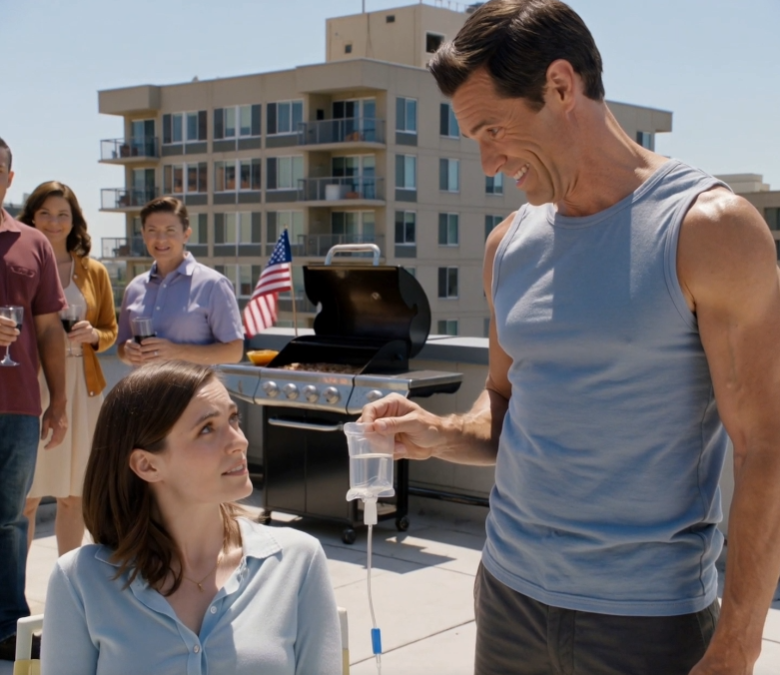
“Stop milking this for attention.”
My brother snapped the words as he yanked my IV line at the family barbecue.
“You’re not dying.”
My cousins laughed as I collapsed.
Dr. Morrison, my cardiologist of nine years, was standing right behind him. He caught me, checked my pulse, and spoke seven words that made my brother go pale.
“You just committed felony assault. I’m a witness.”
But let me start from the beginning, because the story of how my family dismissed my heart condition for years—and how one violent moment at a barbecue changed everything—requires context.
I’m Emma, thirty-two years old, and I was diagnosed with severe cardiomyopathy when I was twenty-three. My heart muscle had weakened to the point where it couldn’t pump blood efficiently. Simple tasks like climbing stairs left me breathless. Standing for more than ten minutes caused dizziness and chest pain. My ejection fraction, the measure of how much blood my heart pumps with each beat, was at thirty percent. A healthy heart pumps at fifty-five to seventy percent.
The diagnosis came after I collapsed at my college graduation.
My parents were embarrassed. My brother Marcus, who was twenty-five at the time, told everyone I’d probably just been partying too hard.
“Drama queen,” he said with that smirk I would come to know so well.
The tests revealed the truth: idiopathic cardiomyopathy. My heart was failing, and no one knew why.
I was put on a strict medication regimen—beta blockers, ACE inhibitors, diuretics—and told to avoid stress and physical exertion. I was also fitted with a portable IV system for periodic medication infusions that helped stabilize my heart rhythm.
My parents’ reaction wasn’t concern. It was inconvenience.
“You’re too young to be sick,” Mom had said, as if my age could override medical reality. “Maybe you just need to exercise more.”
My cardiologist, Dr. Richard Morrison, had actually laughed bitterly when I told him that.
“Exercise more, Emma? Your heart is operating at less than half capacity. Exercising more could literally kill you.”
But my family didn’t want to hear it. Over the next nine years, they developed a narrative that was easier for them to accept. I was faking. I was lazy. I was manipulating everyone for attention and sympathy.
Marcus was the worst.
He’d gotten his MBA and landed a high-paying job at a tech company. He lived in an expensive downtown loft, drove a Tesla, and made sure everyone knew how successful he was. I, meanwhile, worked remotely as a medical transcriptionist, a job I could do from home at my own pace without the physical demands of an office environment.
“Still working from home?” Marcus would say, making air quotes whenever the family gathered. “Must be nice to lounge around all day.”
I tried explaining my condition dozens of times. I’d shown them my medication list. I’d offered to have them speak with Dr. Morrison. They refused.
“Doctors will say anything if you pay them enough,” Dad had said once.
Mom’s approach was different but equally painful. She’d sigh dramatically whenever I mentioned my health.
“Everyone has problems, Emma. Some of us just don’t make our whole personality about it.”
The portable IV system was my family’s favorite target. Every few days, I needed to connect to it for a two-hour infusion of medication that helped regulate my heart rhythm and prevent dangerous arrhythmias. The medical equipment company had set me up with a discreet system: a small pump about the size of a paperback book that I could wear in a shoulder bag, connected to a PICC line in my upper arm.
Marcus called it my prop.
“Academy Award-worthy performance,” he’d say whenever he saw it. “Do you practice your sick-person walk in the mirror?”
What my family didn’t know—what they had refused to learn because they’d never actually attended a single one of my appointments—was that Dr. Richard Morrison wasn’t just any cardiologist.
He was the chief of cardiology at St. Catherine’s Hospital, one of the leading heart-failure specialists in the country, and a professor at the state medical school. He’d been treating me for nine years. He’d seen me through three separate hospitalizations for acute heart failure. He’d adjusted my medications countless times, ordered dozens of echocardiograms and stress tests, and had twice considered putting me on the transplant list before my condition stabilized enough to avoid it.
Dr. Morrison knew everything about my family’s dismissal of my condition. I’d cried in his office more than once about it.
“Emma,” he told me during one particularly difficult appointment, “I’ve documented everything. Every test, every result, every progression of your disease. If you ever need me to validate your condition to anyone—family, employer, legal authorities—I have nine years of irrefutable medical evidence.”
I’d thanked him, but I never imagined I’d actually need it.
I had accepted that my family would never believe me, never support me, never see me as anything other than an attention-seeking faker.
I was wrong about needing that evidence.
While my family mocked my limitations, I’d been building something they knew nothing about.
Working from home as a medical transcriptionist had taught me the healthcare industry inside and out. I transcribed thousands of medical reports, learned the terminology, understood the workflows, and identified major inefficiencies in how medical documentation was handled.
Three years earlier, I had developed a software platform that used AI to assist with medical transcription and documentation. It learned from corrections, adapted to different medical specialties, and reduced documentation time for physicians by sixty percent.
I’d started small, licensing it to a few local practices, but word spread fast in the medical community. The previous year, a major healthcare technology company had acquired my platform for eighteen million dollars.
I’d kept seven million after taxes and investment payouts.
I’d also stayed on as a consultant, earning another three hundred thousand dollars annually.
I hadn’t told my family any of this.
Why would I?
They would either claim I’d somehow faked my way into success or try to guilt me into funding their lifestyles. Marcus was already constantly dropping hints about his temporary “cash-flow problems.” Mom had been suggesting I help with their mortgage now that Dad’s business was struggling.
They thought I was barely scraping by on transcription work.
They had no idea I had seven million dollars in investments, owned my home outright, and was considering early retirement at thirty-two.
I wasn’t hiding it to test them. I was protecting myself.
My health had already taught me that I couldn’t rely on them for support. I didn’t need to give them another reason to use me.
The text from Marcus came on a Tuesday morning.
Family barbecue at my place Saturday, 2 p.m. Don’t flake.
I stared at my phone.
I hadn’t been to a family gathering in eight months. Not since Thanksgiving, when Mom had loudly announced to everyone that I’d barely touched my food, presenting it as evidence that I was starving myself for attention.
I should have said no, but Dr. Morrison and I had just adjusted my medications, and I’d been feeling slightly better.
Maybe I thought this time could be different. Maybe if I showed up, participated, and proved I was trying, they’d ease up.
I texted back.
I’ll be there. Might need to sit frequently.
Marcus’s response came almost immediately.
Of course you will. 🙄
I should have known better.
I had an appointment with Dr. Morrison on Friday, the day before the barbecue. It was routine, a quarterly checkup with blood work and an echocardiogram.
“Your ejection fraction is up to thirty-eight percent,” Dr. Morrison said as he reviewed the echo results. “That’s significant improvement, Emma. The new medication protocol is working.”
Thirty-eight percent still wasn’t normal, but it was better than I’d been in years.
“I’m going to a family thing tomorrow,” I told him. “A barbecue at my brother’s place.”
Dr. Morrison’s expression shifted slightly. He knew about my family.
“Are you sure that’s wise? Stress isn’t good for your condition.”
“I’ll be careful. I’m bringing my portable IV. I’m due for an infusion around that time anyway.”
He nodded slowly, then seemed to make a decision.
“Emma, I want you to have my personal cell number. If anything happens—anything at all—you call me immediately. I don’t care what time it is.”
He wrote his number on his prescription pad and handed it to me.
“I mean it. Your family’s treatment of you concerns me from a medical standpoint. If you feel unsafe, or if they interfere with your medical care in any way, that’s a serious issue.”
I tucked the paper into my wallet.
“Thank you, Dr. Morrison. Really.”
“And Emma?”
I looked back at him.
He was staring at me seriously.
“What they’re doing—dismissing your documented medical condition, mocking your legitimate medical needs—that’s medical abuse. You know that, right?”
I’d never heard it stated so plainly.
“I… I guess I’ve never thought of it that way.”
“Think of it that way,” he said firmly, “because that’s what it is.”
Saturday arrived with perfect weather: seventy-eight degrees, sunny, with a light breeze.
Marcus’s apartment building had a rooftop terrace where he’d set up the barbecue. By the time I arrived at 2:15, about twenty family members were already there—my parents, aunts, uncles, cousins, and Marcus’s girlfriend, Brittany.
I had timed my portable IV infusion to start at 2:30. The medication took two hours to run, and I needed it to prevent arrhythmias. I’d worn a loose button-up shirt over a tank top so the IV line wasn’t visible, with the pump tucked into a small crossbody bag.
“Look who actually showed up,” Marcus announced when I stepped onto the terrace.
Several people turned to look.
“Hi, everyone,” I said, managing a smile.
I made my way to an empty chair near the edge of the terrace. Mom appeared beside me almost immediately.
“You’re not going to sit the whole time, are you? It’s a party, Emma. Socialize.”
“I will, Mom. I just need to pace myself.”
She sighed dramatically and walked away.
At 2:30, I discreetly connected my IV line and started the infusion. The pump hummed quietly in my bag. I’d done this hundreds of times. It was as routine to me as taking a pill.
For the first hour, everything was fine.
I talked with my cousin Rachel about her new job. I congratulated Uncle Tom on his retirement. I even managed to eat a little—a small plate of pasta, salad, and fruit.
Then Marcus started drinking.
By 3:45, he was on his fourth beer and holding court near the grill, telling a story about his latest business trip. I was sitting quietly, my IV infusion at about the ninety-minute mark, when I heard him say my name.
“Unlike my sister, who’s perfected the art of doing absolutely nothing.”
Several people laughed.
I kept my eyes down.
“Marcus, come on,” Brittany said quietly.
He ignored her.
“No, seriously, Emma. What exactly do you do all day besides sit around with your little medical…” He gestured toward me with his beer bottle.
“I work from home, Marcus. You know that.”
“Work,” he said, making air quotes as he walked toward me. “Right. Medical transcription. Because that’s such a demanding job.”
My heart rate was climbing. I could feel it—that familiar flutter and the slight pressure in my chest. Stress was one of the worst triggers for my arrhythmias.
“Marcus, I’m not doing this right now,” I said quietly.
“Doing what? Having a conversation?”
He was standing right in front of me now.
“You know what I think? I think you’ve been milking this sick-girl thing for years because it’s easier than actually working.”
“That’s not—”
“What even is that?”
He pointed at my crossbody bag, where the IV pump was humming.
“Another prop? What’s in there?”
“It’s my medication. Marcus, please leave it alone.”
He reached for my bag.
“Marcus, don’t.”
He yanked the bag off my shoulder.
The IV line, still connected to my arm, went taut. I felt a sharp pull at the insertion site.
“Let’s see what you’re really—”
He unzipped the bag and pulled out the IV pump. His eyes widened when he saw the medical equipment.
“This? You’re seriously doing this here? At a family barbecue?”
“Marcus, please. I need that.”
“Stop milking this for attention!” he shouted.
Before I could react, he yanked the IV line.
The PICC line tore partially out of my arm. Pain shot through my upper arm, and the medication infusion stopped immediately.
My heart, which had been relying on that medication to maintain a regular rhythm, responded almost at once.
I felt the arrhythmia begin—that terrifying sensation of my heart suddenly beating wildly out of sync. The terrace tilted. My vision darkened at the edges.
“You’re not dying,” Marcus was saying, but his voice sounded distant.
People were laughing.
Someone—my cousin Jeff—said, “Wow. The performance is getting better.”
My legs buckled.
I was collapsing, unable to control my body, my heart now racing dangerously fast—over 180 beats per minute. The lack of oxygen reaching my brain was immediate.
I didn’t feel myself hit the ground.
Instead, I felt strong arms catch me.
Then I heard a voice I knew very well, calm and carrying absolute authority.
“I’m a doctor. Everyone step back. Now.”
Dr. Morrison—my cardiologist—was at Marcus’s barbecue, catching me as I collapsed.
The world slowly swam back into focus.
I was on the ground, Dr. Morrison supporting my head and shoulders, his fingers pressed to my wrist as he checked my pulse.
“One-eighty, maybe one-ninety,” he said quietly. “Emma, can you hear me?”
“Yes,” I whispered.
He looked up at the crowd, and his expression turned cold.
“Who touched her IV line?”
Marcus had gone pale.
The IV pump and the torn line were still in his hand.
“I… I didn’t think—”
Dr. Morrison stood slowly after helping me sit up. Then he rose to his full height.
He was fifty-eight, distinguished, with silver hair and the kind of presence that commanded immediate respect.
He looked directly at Marcus and spoke seven words that drained the remaining color from my brother’s face.
“You just committed felony assault. I’m a witness.”
The terrace went completely silent.
Dr. Morrison continued, his voice calm but carrying across the entire space.
“I’m Dr. Richard Morrison, chief of cardiology at St. Catherine’s Hospital. I’ve been Emma’s cardiologist for nine years. That IV line you just ripped out was delivering antiarrhythmic medication that prevents her heart from going into dangerous, potentially fatal arrhythmias.”
He held up his phone.
“I’ve been recording this gathering for the past twenty minutes, including your assault on a disabled person.”
Marcus’s mouth opened and closed soundlessly.
The IV equipment slipped from his hand and clattered to the ground.
“Emma has severe cardiomyopathy,” Dr. Morrison continued, addressing the entire crowd now. “Her heart is operating at thirty-eight percent ejection fraction. She requires multiple daily medications, regular infusions, and strict monitoring to prevent heart failure. This is not opinion. This is documented medical fact based on nine years of continuous treatment, dozens of diagnostic tests, and three hospitalizations.”
Mom stepped forward.
“Now, wait a minute. We don’t know who you—”
“I’m exactly who I say I am.”
Dr. Morrison cut her off and pulled out his hospital identification badge.
“Dr. Richard Morrison, MD, FACC, Chief of Cardiology. Would you like to verify my credentials? I can provide you with nine years of Emma’s medical records, which document in excruciating detail the progression of her disease, every medication adjustment, every test result, and every hospitalization.”
Dad’s face had gone red.
“Emma never told us.”
“She tried to tell you countless times,” Dr. Morrison said sharply. “I know because she has cried in my office about it. About her family calling her a faker. About her brother mocking her medical equipment. About feeling completely unsupported while managing a life-threatening chronic illness.”
Aunt Linda spoke up.
“But she seems so normal.”
“Most cardiac patients do,” Dr. Morrison said. “Heart disease is often invisible. That’s why conditions like Emma’s can constitute an invisible disability. The fact that Emma has learned to manage her condition and live a relatively normal life is a testament to her strength and her strict adherence to her treatment protocol—a protocol your family has apparently been mocking and interfering with.”
He turned back to Marcus.
“What you just did, forcibly removing medical equipment from a patient, constitutes assault. The fact that you did it to someone with a documented disability makes the situation more serious. The fact that your actions triggered a medical emergency means you caused bodily harm.”
Marcus finally found his voice.
“I didn’t know.”
“You didn’t know because you never asked. You never attended a single medical appointment. You never spoke to a single one of her doctors. You made assumptions based on absolutely nothing, and then you physically assaulted her based on those assumptions.”
Dr. Morrison crouched beside me again and checked my pulse.
“Emma, your heart rate is still around one-sixty. We need to get you to the hospital now. I’m calling an ambulance.”
“No,” I said quietly. “Your car is faster.”
He nodded.
“Can you stand with help?”
He helped me to my feet, supporting most of my weight.
The crowd parted silently as we moved toward the exit.
Marcus suddenly stepped forward.
“Emma, I’m sorry. I didn’t mean—”
Dr. Morrison turned toward him with such fury that Marcus actually stepped back.
“You don’t get to apologize to her right now. You don’t get to minimize what you just did. You assaulted a disabled person, caused a medical emergency, and endangered her life. The police will be receiving my report and the video evidence within the hour.”
“The police?” Mom gasped.
“Yes. The police. What happened here is a crime.”
Brittany, Marcus’s girlfriend, suddenly spoke up. Her voice was shaking.
“I tried to stop him. I told him to leave her alone.”
Dr. Morrison looked at her and nodded.
“Then I suggest you make a statement to the police when they contact you. You might be the only witness who actually tried to prevent this.”
We reached the elevator.
As the doors began to close, I saw my entire family standing frozen on the terrace, their faces a mixture of shock, confusion, and dawning horror.
The elevator doors closed on that scene, and I’ve never forgotten the image.
Dr. Morrison drove me to St. Catherine’s Hospital, where I was admitted for monitoring. My heart rate eventually stabilized, but it took four hours and additional IV medications. The damaged PICC line had to be removed and replaced, a painful procedure that left my arm badly bruised.
While I lay in a hospital bed with electrodes monitoring my heart, Dr. Morrison kept his promise.
He filed a police report.
He provided the video recording of Marcus yanking my IV line. He provided my complete medical records showing nine years of documented heart disease, photographs of my injuries, the damaged PICC-line site and bruising, and the medical equipment itself.
He gave a witness statement as a medical professional documenting the assault and its immediate medical consequences. He also provided a written statement explaining why forcibly removing essential medical equipment from a cardiac patient constituted reckless endangerment.
The police arrived at the hospital to take my statement at 7:00 p.m.
There were two officers, one woman and one man. Both were professional, and both were clearly disturbed by what they had learned.
“Ms. Chin,” the female officer said, “we need to be clear about something. This isn’t just family drama. This is assault and battery on a disabled person, which is a felony in this state. The fact that the assault involved forcibly removing medical equipment makes the situation even more serious. We’re taking this very seriously.”
I gave my statement.
They photographed my injuries and took possession of the damaged IV equipment as evidence.
“We’ll be arresting your brother within the next twenty-four hours,” the male officer said. “Given the video evidence and Dr. Morrison’s testimony, the DA is confident about prosecution.”
After they left, I lay in the hospital bed exhausted and emotionally drained.
My phone had been buzzing constantly with texts and calls from family members.
I turned it off.
Dr. Morrison appeared in the doorway around 9:00 p.m.
“How are you feeling?”
“Tired. Sore. But okay.”
He pulled up a chair beside my bed.
“Emma, I need to tell you something. In my twenty-five years as a cardiologist, I’ve seen a lot of patients struggle with family dynamics around invisible illness. But what I witnessed today was beyond anything I’ve seen before. The casual cruelty. The complete dismissal of documented medical reality. The physical violence.”
He shook his head.
“You’ve been enduring medical abuse for years.”
“I keep telling myself they just didn’t understand.”
“They chose not to understand,” he corrected gently. “Understanding was available to them at any time. They could have attended an appointment. They could have spoken to you. They could have read even a single page of your medical documentation. They chose not to because your illness was inconvenient for their narrative about you.”
I felt tears beginning to form.
“I just wanted them to believe me.”
“I know. And I’m sorry it took something this dramatic for the truth to become undeniable.”
My phone buzzed again.
I turned it back on because I wanted to check for messages from Dr. Morrison’s office.
Instead, I saw a text from an unknown number.
This is Brittany, Marcus’s girlfriend. I’m so sorry. I broke up with him. I saw everything. I’ll testify if you need me to.
I showed it to Dr. Morrison.
He nodded approvingly.
“Good. Witnesses matter.”
Marcus was arrested Sunday morning at 9:00 a.m.
The police showed up at his apartment with the video evidence, medical documentation, and witness statements from both Dr. Morrison and Brittany.
He was charged with felony assault and battery on a disabled person, reckless endangerment, and destruction of medical equipment.
The news spread through the family like wildfire.
My phone exploded with messages.
Mom: Emma, please. You have to drop the charges. He’s your brother. He didn’t mean it.
Dad: This is going too far. He made a mistake. Don’t ruin his life over this.
Aunt Linda: Family doesn’t send family to jail. Be the bigger person.
Cousin Jeff: You’re really going to press charges? We all saw you overreacting.
I didn’t respond to any of them.
Instead, I called my lawyer.
Yes, I had a lawyer. I’d retained one after selling my software company, and I forwarded everything to her.
She called me back within an hour.
“Emma, these messages are gold. They’re evidence of a family pattern of dismissing your medical condition and pressuring you to accept abuse. Save everything.”
The preliminary hearing was set for three weeks later.
Marcus’s lawyer tried to negotiate a plea deal: community service, anger-management classes, restitution for the medical equipment.
The DA rejected it.
“Your client assaulted a disabled person on video,” the DA told Marcus’s lawyer during a meeting my attorney attended. “He ripped out medical equipment that was preventing a cardiac emergency. He caused that cardiac emergency. Dr. Morrison’s testimony alone is devastating, but we also have video, witness statements, and the victim’s nine-year medical history documenting the condition your client claimed was fake. We’re going to trial.”
Marcus’s lawyer tried a different approach.
He requested a meeting with me directly, suggesting I might be willing to drop the charges to keep the family together.
My lawyer’s response, sent in writing, was simple.
“My client declines to meet with you. The assault was documented, unprovoked, and caused serious medical harm. The state is prosecuting this case with or without my client’s cooperation because it possesses independent evidence. However, my client fully supports the prosecution and will testify if required. Additionally, my client is considering a civil suit for medical costs, pain and suffering, and emotional distress.”
That last part was my lawyer’s idea.
“Hit them where it really hurts,” she’d told me. “Your brother has assets. Make him understand that his actions have real consequences.”
Two days after that letter was sent, I received a call from an unknown number.
It was Marcus.
“Emma, please,” he said, his voice breaking. “I could go to prison for five years. My career is over. My company put me on leave. Brittany left me. I’ve lost everything. Please, I’m begging you. Tell them it was a misunderstanding.”
I took a breath.
“Marcus, I spent nine years telling you I had a serious heart condition. I showed you my medications. I explained my limitations. And you spent nine years calling me a faker, mocking my medical equipment, and telling everyone I was lazy and attention-seeking. On Saturday, you physically ripped medical equipment out of my arm and triggered a cardiac emergency that could have killed me. That’s not a misunderstanding. That’s assault.”
“I didn’t know it was real.”
“You didn’t know because you refused to know. Dr. Morrison told you that at the barbecue. He’s told the police and the DA, and he’ll tell a jury that I tried to get you to understand dozens of times. You chose not to believe me. You chose to create a narrative where I was a liar and a manipulator. Then you acted on that false narrative with violence.”
“Emma, I’m your brother.”
“My brother would have believed me. My brother would have supported me. My brother wouldn’t have spent nine years mocking my medical condition and then physically attacked me.”
He was crying now.
“What do you want me to do?”
“I want you to face the consequences of your actions. I want you to take responsibility for assaulting a disabled person. I want you to understand that dismissing someone’s documented medical condition and then physically harming them is a crime.”
“I’ll lose everything.”
“I almost lost my life, Marcus. My heart went into arrhythmia because you ripped out the medication that prevents exactly that. Dr. Morrison said that if he hadn’t been there—if I hadn’t received immediate medical intervention—I could have died. So, yes, you’re losing things. But I’m still here to see it.”
I hung up.
The trial date was set for two months later.
In the meantime, my family intensified their pressure campaign, but they made one crucial mistake.
They did it all in writing.
Text messages. Emails. Facebook comments.
Everything was documented. Everything went to my lawyer.
Mom emailed me:
Emma, you’re tearing this family apart. Your father and I didn’t raise you to be vindictive. Marcus made one mistake and you’re going to ruin his entire life. Where’s your compassion? Where’s your forgiveness?
Dad texted:
If you go through with this trial, don’t bother coming to any more family events. You’ll have chosen legal revenge over your own family.
Aunt Linda commented publicly on a Facebook post about chronic illness:
Some people use their illnesses as weapons against their families. Sad to see.
My lawyer actually laughed when I showed her that one.
“Please tell me she doesn’t know about the trial.”
“She knows.”
“Then she just created impeachable evidence that your family has a pattern of publicly dismissing your medical condition. Thank her for me.”
The trial lasted three days.
The prosecution’s case was overwhelming.
On day one, Dr. Morrison testified for four hours.
He brought my complete medical file—nine years of documentation. He explained cardiomyopathy in detail. He walked the jury through every test result, every hospitalization, and every medication adjustment.
Then he showed them the video of Marcus yanking the IV line and explained, frame by frame, what had been happening medically.
“When Mr. Chin removed that IV line,” Dr. Morrison told the jury, “he interrupted a medication infusion that was actively helping prevent cardiac arrhythmia. The result was immediate and medically predictable. Emma’s heart entered a dangerous arrhythmia, reaching approximately 190 beats per minute. Without immediate intervention, the event could have resulted in cardiac arrest.”
The prosecutor asked him, “In your medical opinion, was Emma Chin faking her condition?”
Dr. Morrison’s answer was devastating.
“Absolutely not. You cannot fake an echocardiogram. You cannot fake blood-test results. You cannot fake a heart rate of 190 beats per minute. Emma has severe, documented, life-threatening heart disease. That is medical fact.”
On day two, the prosecution played the video.
The jury watched Marcus mock me, yank my bag away, pull out the IV pump, and rip the line from my arm.
They watched me collapse.
They heard people laughing.
Then they heard Dr. Morrison’s voice.
“You just committed felony assault. I’m a witness.”
Brittany testified next.
She described watching Marcus drink and become increasingly hostile toward me. She described trying to stop him. She described the aftermath—my collapse and Dr. Morrison’s intervention.
“Did you believe Emma was faking her condition?” the prosecutor asked.
“No,” Brittany said firmly. “I work in healthcare. I recognized the medical equipment. I tried to tell Marcus to leave her alone, but he was drunk and angry.”
On day three, I testified.
I described nine years of dismissal, mockery, and emotional abuse surrounding my medical condition. I described my attempts to educate my family. Then I described the barbecue and what happened.
The defense attorney tried to portray me as oversensitive.
“Isn’t it true that your family was simply concerned about you?”
“Concerned people attend medical appointments,” I replied. “Concerned people speak to doctors. Concerned people don’t rip medical equipment out of their family member’s arm.”
“But you never explicitly told your brother not to touch your medical equipment.”
“I told him for nine years that I had a serious heart condition. I showed him my medications, my medical equipment, and my limitations. The fact that he needed explicit instructions not to physically assault me says everything about how he viewed me.”
Marcus testified in his own defense.
It went badly.
He claimed he thought I was faking. He claimed he’d been trying to help me by exposing my lies.
The prosecutor dismantled him.
“Mr. Chin, did you ever attend a single medical appointment with your sister?”
“No, but—”
“Did you ever speak to a single one of her doctors?”
“No, but I didn’t think—”
“Did you ever read any of her medical documentation?”
“She never offered.”
“She testified that she tried to show you multiple times. Were you lying when you said under oath that she never offered?”
Marcus stammered.
“I… I don’t remember.”
“You don’t remember. But you do remember that she was faking?”
“I thought—”
“You thought. Based on no medical evidence, no expert consultation, and no documentation. You thought—and based on that thought, you physically ripped medical equipment from her body.”
The jury deliberated for two hours.
Guilty on all counts.
Marcus was sentenced to eighteen months in prison, three years of probation, five hundred hours of community service at a cardiac rehabilitation center, mandatory anger-management and addiction counseling, and restitution for all my medical costs—$14,700.
But the sentencing wasn’t the end.
The judge addressed my family directly.
Several of them had attended the trial, sitting behind Marcus and glaring at me.
“I want to address the family members in this courtroom,” Judge Reynolds said. “I’ve watched you throughout this trial. I’ve seen your reactions to the evidence. I’ve read the text messages and emails submitted to this court showing your attempts to pressure Ms. Chin into dropping charges, and I’m appalled.”
She looked directly at my parents.
“A young woman spent nine years managing a life-threatening illness while her family mocked her, dismissed her, and accused her of faking. When her condition was finally validated in the most dramatic way possible—when a leading cardiologist testified to her documented medical reality—some of you still could not accept it. Some of you still pressured her to protect her abuser.”
Mom’s face turned bright red.
“Let me be very clear,” Judge Reynolds continued. “What happened to Emma was medical abuse. It was emotional abuse, and it culminated in physical assault. If any of you continue to harass her, I will not hesitate to issue restraining orders. She owes you nothing. Not forgiveness. Not reconciliation. Nothing.”
The gavel came down.
That was eight months ago.
Marcus served his sentence.
My parents haven’t spoken to me since the trial. Most of my extended family chose sides.
They’re not mine.
I’m okay with that.
Because what they still didn’t know—what came out only after the trial through filings connected to my lawyer’s civil suit—was that the struggling medical transcriptionist they’d mocked for years had actually sold a software company for eighteen million dollars.
When my lawyer filed the civil suit for emotional distress, she had to disclose aspects of my financial status.
The number became public record.
My mother finally called me after she found out.
“Emma, why didn’t you tell us you had money?”
Not Are you okay?
Not We’re sorry.
Just: Why didn’t you tell us you had money?
“Because my worth isn’t measured in dollars, Mom. It never was. But you couldn’t see that. You could only see what you had already decided I was—a faker, a burden, a liar. So you never looked deeper.”
She started to cry.
“We could have been so proud of you.”
“You could have been proud of me for surviving a life-threatening illness with grace and determination. You could have been proud of me for building a career despite my limitations. You could have been proud of me for creating something valuable. But you weren’t. You were embarrassed by my medical equipment and annoyed by my limitations.”
“Emma, please. Can we start over?”
“No, Mom. We can’t. Because you still don’t understand what you did wrong. You’re not sorry you dismissed my medical condition for nine years. You’re not sorry Marcus assaulted me. You’re just sorry you missed out on being connected to someone successful.”
I hung up.
I haven’t answered since.
But I have built a real family—one that chose me and that I chose back.
Dr. Morrison and I have dinner once a month. He’s become a mentor and a friend.
Brittany, Marcus’s ex-girlfriend, and I are close now. She works in nursing, and we volunteer together at a chronic-illness support group.
My business partners from the software company—the people who believed in my idea when I was just a sick girl with a dream—are some of my closest friends.
And I’m engaged now.
His name is David.
I met him at a cardiology support group two years ago. He has a congenital heart defect. He understands limitations. He understands medications. He understands the fear of sudden cardiac events.
He also understands success.
He’s a civil engineer who designs sustainable infrastructure. He’s brilliant and kind, and when I told him about my family and the trial, he said something I’ve never forgotten.
“You survived them. That’s proof you can survive anything.”
We’re getting married in three months.
Dr. Morrison is walking me down the aisle.
My family isn’t invited.
I’m not sad about that anymore, because I learned something important through all of this.
Family isn’t about blood.
It’s about who shows up when you collapse. It’s about who believes you. It’s about who catches you.
Dr. Morrison caught me when I fell that day on the terrace, and he kept catching me through the trial, through the aftermath, through the rebuilding.
That’s family.
The rest is just biology.








