“She couldn’t handle flight school,” my sister announced to a room full of family, veterans, and business partners, she was about to sign away our grandfather’s land when the doors opened, i walked in with two navy pilots beside me—and fresh gold wings pinned to my uniform.
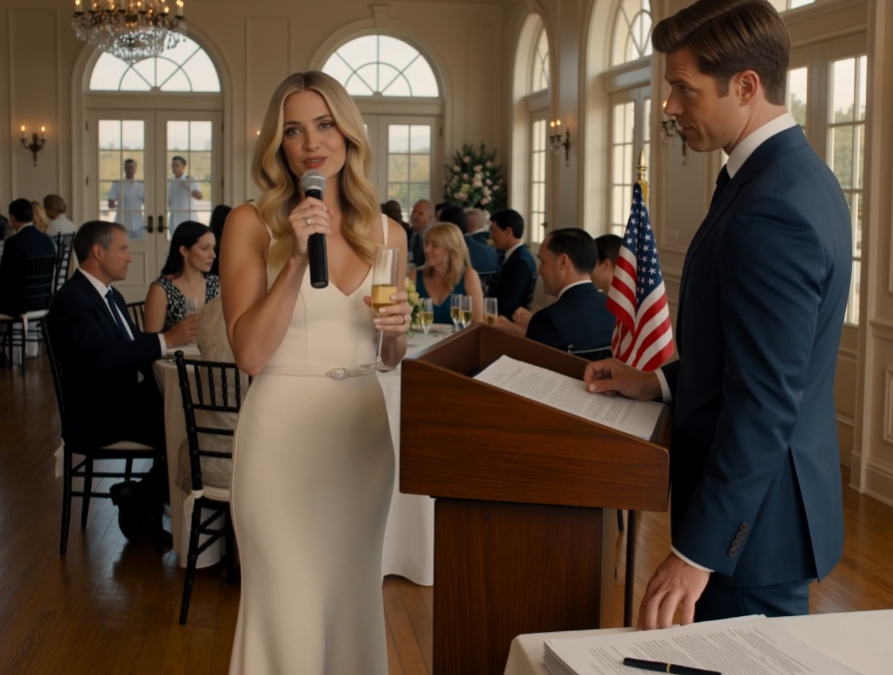
My sister threw a party the day she thought I had failed out of flight school.
She didn’t call it that to our faces, of course. She called it a sympathy celebration. She rented out the upper deck of the Charleston Yacht Club, hired a private catering crew, and invited every real estate investor in the county, along with half of my grandfather’s old friends from the local VFW post. For three solid weeks, she had controlled the entire narrative, walking through our hometown like a grieving saint. She told everyone that flying military aircraft was simply too brutal for a girl, that my nervous system had collapsed during night training, and that the Navy had no choice but to send me home. She looked people straight in the eye, wiped away imaginary tears, and collected sympathetic hugs as though they were trophies.
People bought her drinks. Local developers offered their condolences. She turned my supposed failure into her own personal marketing campaign, and the funny thing about liars is how quickly they become careless. Kendra was so busy writing my tragedy that she forgot to check whether the body was actually dead. She certainly hadn’t expected the two men sitting in the parking lot with me.
The air conditioning in my Ford F-150 rattled as we sat outside the yacht club. The South Carolina heat was thick enough to chew, ninety-two degrees with ninety percent humidity. Salt air rolled in from the harbor, carrying the combined smells of low tide, fried shrimp, and expensive motor oil. Inside the truck, everything smelled of starch and fresh shoe polish. Miller sat in the passenger seat, quietly cleaning his fingernails with the tip of an old pocketknife. Hayes was sprawled across the back seat, snoring softly with his combination cover tilted over his eyes.
Both men were wearing exactly what I was wearing: crisp service dress white uniforms with high-standing choker collars, bleached fabric so sharply pressed that the creases looked capable of slicing open envelopes, and solid brass buttons running down the front. Gold lieutenant junior grade stripes marked our shoulder boards. Above our left breast pockets, catching the harsh afternoon sunlight, gleamed the gold wings of naval aviators.
My phone vibrated against the center console. It was a group text from a cousin I hadn’t spoken to in six months, containing a photograph of the entrance to the yacht club ballroom. Kendra had erected a massive welcome banner on an easel. In bright blue block letters, it read, “SUPPORTING MORGAN: A FAMILY MOVES FORWARD TOGETHER.” Directly beneath it sat a donation bucket for local veterans.
You almost had to admire the nerve. She wasn’t merely mocking me in public. She was using my name as a tax write-off. Beside the banner stood an oversized portrait of our late grandfather, Walter Vance, looking stern in one of his old cockpit photographs from the Vietnam War. Kendra had surrounded the frame with cheap fairy lights, turning a decorated naval aviator into a prop for her performance.
Miller glanced at my screen and clicked his knife shut with a dry snap. He didn’t raise his voice. He never did. “Your sister has serious mental problems,” he said.
I reached down and turned the truck key, cutting the engine. The dashboard went dark. Hayes didn’t even flinch. He shifted his boots against the floor mats and muttered, “She’s charging people fifty bucks a head for pulled pork and lies, and we’re sitting out here letting her finish her drink.”
I looked into the rearview mirror. My hair was secured in a regulation bun. Eighteen months of skipped meals, four-hour sleep cycles, and pulling six times the force of gravity in a pressurized cockpit had sharpened my cheekbones. My eyes were slightly sunken, but they were clear. Completely clear.
When people spend their entire lives pretending to be high class, they forget what real pressure looks like. Kendra had never faced real pressure. Her biggest daily crisis was a client backing out of a closing on a beach house.
Through the tinted windshield, I studied the ballroom windows on the second floor. Silhouettes of well-dressed guests moved around the open bar while the soft thump of smooth jazz drifted across the asphalt between rows of parked Mercedes and BMWs. Near the railing stood Kendra, holding a flute of champagne and wearing a dress that cost more than two months of my flight pay. She was leaning close to a man in a navy blazer whose immaculate haircut practically screamed private equity.
Wyatt. My former fiancé.
The man who had sworn he would wait for me while I attended ground school in Pensacola. The man who moved his clothes into Kendra’s guest room the moment he heard I was having trouble in the cockpit. He was laughing at something she’d said, his hand resting casually on the small of her back.
Eighteen months earlier, that same hand had slipped an engagement ring onto my finger at my grandfather’s kitchen table. Wyatt had told me our family land was sacred, that he respected Walter’s military service more than anything in the world. He promised that while I went down to Florida to earn my wings, he would help my mother manage the forty acres of coastal marshland Granddad had left behind.
That was the script. That was the sweet Southern boy act.
Wyatt didn’t care about the land. He cared about the zoning permits, and Kendra was the one with the broker’s license. They thought I was five hundred miles away, hiding in some cheap motel room off Interstate 10, too ashamed to show my face in the town where the Vance name actually meant something. They thought they had time to get the papers signed before anybody started asking difficult questions.
I reached beside my seat and picked up the leather portfolio Uncle Marcus had handed me forty minutes earlier at a diner off Highway 17. Its edges were worn, but the embossed seal of the county probate court was unmistakably fresh. Inside that folder was the legal reality Kendra and Wyatt had spent three months trying to bury beneath cheap speeches and counterfeit tears.
I checked my watch. Wednesday, 4:45 p.m. According to the invitation on my phone, the main toast was scheduled for five o’clock sharp. That gave Kendra fifteen minutes to get good and loud, fifteen minutes to dig herself a hole so deep that no ladder would be long enough to get her out.
Miller reached into the back seat, retrieved his combination cover, and settled it squarely on his head, making sure the gold chin strap was centered. Hayes sat upright, cracked his knuckles, and adjusted his necktie. The silence inside the cab wasn’t nervous. It was the same calm we shared in the ready room before walking out to the flight line. When you know you have clearance and fuel, you don’t rush the takeoff. You taxi into position and let the engines spool up.
I opened the truck door. The blast of humidity struck my face like a wet wool blanket, and my dress shoes clicked sharply against the pavement as I stepped down. The sun was dropping toward the Ashley River, staining the clouds deep purple and orange. Behind me, two more doors closed with solid, heavy thuds.
Hayes fell into position on my left. Miller took my right. We didn’t speak or glance around to see who might be watching. We squared our shoulders and walked toward the double glass doors beneath the yacht club awning. A couple in seersucker suits stopped in midconversation, staring at the gold insignia on our chests.
The lobby smelled of expensive floor wax and old money. Thick carpeting muffled our steps as we approached the spiral staircase leading to the private ballroom. Near the coat check, a teenager in a black vest stood holding a stack of laminated name tags. His mouth fell open when he saw us. One glance at our shoulder boards and officer stripes was enough to make him step aside without asking for invitations.
At the top of the stairs, the heavy oak doors stood open a few inches. A burst of microphone feedback screeched through the gap, followed by the polite, expectant laughter of sixty guests. Then came my sister’s voice, smooth and practiced, dripping with the breathy theatrical sorrow she’d spent weeks rehearsing.
She tapped the microphone twice. “Everyone, if I could just have your attention for a moment,” she began, speaking softly enough to make people lean forward. “We all know why we’re here tonight. We all know the heartbreak our family has been carrying these past few weeks. My little sister tried. She really did. But the military isn’t for everyone. Some people just aren’t built for the sky.”
Miller caught my eye. His mouth twitched into a cold, flat smirk, but he didn’t move. Neither did Hayes.
I placed my right hand against the heavy brass push bar and leaned forward just enough to feel the cold metal through my white glove. Inside, the room had fallen silent, hanging on every word my sister spoke. Kendra cleared her throat, preparing to deliver the grand punch line of her speech, completely unaware of the shadow falling across the carpet behind her.
Eighteen months before Kendra rented that ballroom, our grandfather had still been alive, spending his afternoons in a worn leather recliner beside the screened porch.
Walter Vance had spent thirty years in naval aviation. He’d flown A-6 Intruders off carrier decks in the Gulf of Tonkin, taken antiaircraft fire over the jungle, and earned a Distinguished Flying Cross for bringing a burning aircraft home on one engine. By seventy-eight, his skin resembled weathered saddle leather and his hands trembled, but his eyes were still a pilot’s eyes: cold, sharp, and completely intolerant of excuses.
His home sat on forty acres of Lowcountry marshland and live oaks draped in Spanish moss. The property had belonged to the Vance family since 1922. To Walter, that dirt was sacred ground. To Kendra, it was a prime commercial development opportunity waiting for a zoning change.
For five years, hardly a Sunday dinner passed without Kendra bringing up the property taxes. She would reach into her designer tote, produce glossy brochures, and slide architectural renderings of luxury waterfront condominiums across the dining table, sometimes right past the platter of fried chicken.
“Granddad,” she would say in a voice dripping with artificial sweetness, “you’re sitting on seven million dollars. You can’t even walk down to the dock anymore. Why are you hoarding mud when you could have a penthouse in downtown Charleston?”
Walter never took the bait. He would lift his glass of iced tea, look straight through her makeup, and say, “Dirt doesn’t depreciate, Kendra, but greed rots your teeth.”
He didn’t say it cruelly. He stated it as a fact, which infuriated her even more.
Kendra thrived on emotional leverage. She loved creating drama in which she could play the suffering daughter trying to save the family from financial ruin. Our mother, Evelyn, usually sat between them, nervously shredding paper napkins into tiny strips. Mom was a gentle woman who had spent thirty years shrinking in the shadows of stronger personalities. Kendra’s temper terrified her, and Walter’s silence intimidated her just as much.
Then Walter got sick.
Congestive heart failure doesn’t care about flight records or combat decorations. Within three months, the man who had once lifted hundred-pound boat engines was confined to his bedroom, dependent on an oxygen concentrator. The strength seemed to drain from him by the day, leaving behind the stubborn eyes and commanding voice of the pilot he had always been.
Two nights before he died, the house was deathly quiet except for the steady mechanical hum of the oxygen machine drifting down the hallway. Kendra had already left for the evening after spending two hours cornering the hospice nurse with questions about powers of attorney. Wyatt, still my fiancé then, was downstairs drinking Walter’s twenty-year-old bourbon and texting his golf buddies.
I sat in a wooden chair beside Granddad’s bed, reading articles aloud from Naval Aviation News, when his withered hand suddenly shot out and closed around my wrist. His grip was surprisingly strong.
“Key,” he rasped. “Behind the clock.”
I reached behind the brass alarm clock on his nightstand and found a small iron key. It opened the heavy oak drawer at the top of the nightstand. Inside was a battered velvet jewelry box, its navy-blue covering faded almost to gray. I handed it to Walter, but he didn’t open it immediately. He rested it against his chest as carefully as though it were a flight checklist.
“Morgan,” he said, his voice dropping into a low growl, “your sister wants to pour concrete over every memory this family has. She wants to sell this marsh to city bastards who’ve never held an honest job in their lives. She thinks money makes you somebody.”
He flipped open the lid.
Resting on the crushed silk inside was his original set of gold aviator wings from 1968. But they weren’t whole. The left wing had been neatly severed, sheared clean through the center shield.
It was the naval tradition of the broken wing. When an aviator earned their wings, the person they trusted most could break the insignia in half. The pilot carried one half into the cockpit on every combat mission, while the other remained at home with the person who held the line. If the pilot survived service and came home for good, the pieces could be soldered together again.
Walter picked up the broken left half and pressed the cool metal into my palm, curling my fingers around it.
“Your grandmother kept the other half until the day she was buried,” he whispered. “This piece flew twenty-two missions over the North. It never touched dirt before the wheels hit the deck.”
His hand tightened around mine.
“You take this, Morgan. Don’t let her turn this dirt into a parking lot. You earn the other half. You bring it back to this house, or you let Uncle Marcus give the whole damn acreage to the Navy Relief Society. Do not let her sell my life for a commission check.”
He died forty-eight hours later.
At the wake, Kendra was already circling like a gull over a shrimp boat. She had invited Wyatt’s father, who ran the commercial lending desk at the largest regional bank in Charleston. Wyatt stood beside her wearing a black mourning suit that looked as though it had been purchased that morning.
While neighbors carried casseroles through the front door, Kendra pulled me into Walter’s study. She didn’t hug me or ask how I was holding up after sitting beside Granddad when he took his last breath. Instead, she laid a blue-backed legal document on his mahogany desk.
“Sign this, Morgan,” she said smoothly. “It’s an authorization appointing me as the estate’s sole personal representative. Uncle Marcus is seventy-two and half senile. He’s going to drag probate out for years. If I handle it, Wyatt can secure the construction bridge loan by November. We split the developer fee three ways between Wyatt, me, and Mom. You can pay off your student loans and finally buy some decent clothes.”
I studied the paperwork, then turned toward Wyatt. He was leaning against the bookshelf, casually examining Walter’s medals as though he already owned them.
“Did you know about this?” I asked.
Wyatt gave me the rehearsed Southern-charm grin that had worked so well on me in college.
“Babe, let’s be practical,” he said, stepping closer and placing a heavy, possessive hand on my shoulder. “Your granddad was a legend, sure. But forty acres of marsh in Mount Pleasant? That’s generational wealth. What are you going to do with it? You’re an ensign in the Navy. You’re shipping out to Pensacola in six weeks. You can’t mow a lawn from an aircraft carrier.”
He squeezed my shoulder as if he were comforting an unreasonable child. “Let Kendra do what she does best. Take the check. We can put a down payment on a place on Daniel Island before the wedding.”
I looked down at his hand, then at Kendra, whose manicured fingers were tapping impatiently against Walter’s desk. Inside my pocket, I could feel the jagged edge of Granddad’s broken gold wing. I curled my fingers around it and looked my fiancé directly in the eye.
“I’m not signing a single page,” I said quietly. “Uncle Marcus is the executor. The land stays in trust until my flight contract is finished.”
Kendra’s sweet expression vanished. Her eyes narrowed into thin, venomous slits.
“You’re being childish, Morgan,” she hissed. “You think you’re actually going to pass flight school? You’re twenty-four years old. You get carsick on the ferry, and you think you’re going to strap into a jet and be Walter Vance? They wash out seventy percent of people with your test scores. You’re going to waste two years playing G.I. Jane in Florida while the real estate market peaks, and then you’ll come crawling back here with nothing.”
Wyatt didn’t defend me. He didn’t tell her to back off or remind her that I was the woman he intended to marry. He simply removed his hand from my shoulder, sighed in exasperation, and exchanged a look of mutual, patronizing pity with Kendra. The expression turned my stomach to ice.
“Just let her go, Kendra,” Wyatt muttered, shaking his head. “She needs to get this out of her system. When she fails her first checkride, she’ll see reason.”
Six weeks later, I threw two duffel bags into the bed of my truck and drove south on Interstate 95 toward the Florida Panhandle. Wyatt didn’t bother coming outside to see me off. He sent a text from the golf course explaining that he had a tee time with a commercial appraiser.
On the passenger seat lay my naval service records and my grandfather’s broken wing, carefully wrapped in an oily rag. I carried with me the bitter, suffocating certainty that the people who claimed to love me were already counting down the days until my destruction.
When I crossed the gate at Naval Air Station Pensacola, humidity hung heavily over the bayou, thick with the smells of JP-5 jet fuel, wet pine needles, and the steady, thunderous roar of T-6 engines screaming through the clouds.
Pensacola in July doesn’t care about your feelings.
By ten in the morning, the tarmac at Naval Air Station Pensacola could feel like a hundred-and-ten-degree griddle. The air remained thick and stagnant over Pensacola Bay, heavy with swamp decay, diesel exhaust, and the sharp tang of ozone. Aviation Preflight Indoctrination, known to everyone simply as API, was designed for one purpose: strip away your civilian ego, reduce your physical stamina to raw bone, and expose every tiny crack in your nervous system before the Navy trusted you with an eight-million-dollar training aircraft.
My class began with forty-four student naval aviators: thirty-six men and eight women. On the first day, our Marine instructor stood at the front of the classroom wearing a uniform so sharply creased it looked stamped out of sheet metal. He didn’t introduce himself or ask where we’d come from. Instead, he pointed toward the redbrick walls of the Aviation Survival Training Center.
“Seventy percent of the people who leave this program don’t leave because they lack intellect,” he barked, his voice cracking across the concrete floor like a whip. “They leave because their animal brain panics the moment the water closes over their mouth. If your mind flinches in the tank, you will kill yourself in the cockpit.”
Every morning began at 0430 with four-mile formation runs through the sand dunes. We carried twenty-pound rubber training rifles above our heads until our shoulder muscles burned like acid. Then came the pool, and the pool wasn’t about swimming. It was combat water survival under simulated wartime conditions.
We swam laps in full flight suits, steel-toed flight boots, and tactical harnesses. Waterlogged fabric dragged against our limbs like wet cement. We treaded water for forty minutes at a time with our hands locked behind our heads, fighting the heavy chop generated by industrial wave machines while cadre instructors screamed obscenities from the concrete ledge.
By the end of the second week, three men from the Naval Academy had already quit. One broke down in the locker room after swallowing two lungfuls of chlorinated water. Another packed his bags quietly at midnight, unable to stop the violent trembling in his hands.
Every time somebody surrendered their packet and walked away, I remembered Wyatt leaning across Walter’s mahogany desk, sneering about my carsickness. Whenever my calf muscles tightened into rock-hard knots during the mile-long fin swim, I pictured Kendra’s manicured fingernails tapping those condominium blueprints.
I wasn’t merely swimming against the clock. I was swimming away from their suffocating pity.
Then came the beast.
In the aviation community, it was known as the Dilbert Dunker, and it was the closest thing to an intentional nightmare the military had ever engineered. The device was a stripped-down cockpit frame mounted on steep, forty-five-degree steel tracks suspended above a fifteen-foot-deep indoor pool.
You strapped yourself into the seat with a five-point harness, lowered blackout goggles over your eyes, and placed your hands against a simulated instrument panel. Then the machine released with a deafening metallic screech, sending you plunging twenty feet down the tracks at twenty miles an hour before slamming you into the water with enough force to rattle your teeth.
The instant the carriage submerged, it flipped upside down, rotating a full 180 degrees until you were hanging completely inverted beneath the surface. Water rushed up your nose with violent pressure. The chlorinated darkness pressed against your eyeballs. You couldn’t see your hands, couldn’t breathe, and couldn’t tell which way was up.
You had to wait until all forward motion stopped before you were permitted to move. If you panicked and released the harness too early, the safety divers failed you immediately.
My first run was pure terror. The impact knocked the breath clean out of my lungs. I hung upside down by my harness straps while disorientation spun my thoughts like a carnival ride. My lungs screamed for oxygen, and the instinct to thrash toward what my brain insisted was the surface nearly overwhelmed every shred of training I possessed.
I clamped my teeth against my lower lip until I tasted blood.
Keep your reference point, Vance, I told myself in the black water. Find the emergency canopy lever with your right hand. Follow the frame. Release the harness. Push. Kick. Clear the fuselage.
I broke the surface coughing and sputtering, gasping for air as I fought to keep my head above the water. The cadre instructor checked his stopwatch, tapped his clipboard, and pointed toward the steel ladder.
“Pass,” he grunted without looking up. “Reset and do it again.”
Five more times. Blindfolded, inverted, submerged.
By three that afternoon, my shoulders were covered in deep purple bruises from the harness straps. My sinuses burned from the chemicals, and my knees trembled so violently that I had to lean against the locker room wall just to pull on a dry flight suit.
I dragged myself back toward the student barracks across the compound. The identical redbrick buildings stood stark and quiet beneath the Florida sun. Outside the mailroom, a metal shelving unit held the civilian letters delivered by the yeoman. I wasn’t expecting anything. Wyatt hadn’t answered my messages since I’d crossed the Florida border, and my mother rarely wrote letters.
But tucked into slot thirty-two was an envelope bearing a Charleston postmark. The handwriting on the front was small and shaky. It was from my mother.
I took it to my bare little room, sat on the edge of the twin cot, and tore open the envelope. There was no greeting or question about my health. The letter went straight to its purpose.
“Morgan, Kendra came over for dinner on Tuesday with Wyatt. They brought a lot of legal papers, sweetheart. Kendra says everyone at the country club is already talking about how you’re struggling down there. She told Uncle Bill that you barely made the physical standards and that you’re embarrassing yourself. Wyatt said you always had a stubborn streak, but that it’s unfair to hold up the family estate just to prove a point.
“Kendra found a wonderful developer from Charlotte. They’re offering $8.2 million for the marshland. Wyatt says if you just sign the power-of-attorney release, he’ll make sure you get your fair share of the money. He says he still cares about you, Morgan, but you’re being cruel to everyone who loves you.
“Please just come home. Nobody will judge you for quitting. Women aren’t meant to fly those machines anyway.”
I stared at the wrinkled sheet beneath the harsh fluorescent bulb overhead. My mother hadn’t written those words, not really. They were Kendra’s words, dictated over sweet tea and warm biscuits while Wyatt sat in my grandfather’s chair, nodding along like a faithful dog.
They weren’t simply waiting for me to fail. They were actively constructing the narrative of my humiliation before I’d even touched the controls of a real airplane. They were telling the whole town that I was a broken girl hiding from reality.
I didn’t cry. The exhaustion that had been crushing my spine twenty minutes earlier evaporated, replaced by a cold, venomous clarity. I folded the letter neatly, took Walter’s broken gold wing from my nightstand, and drew its jagged metal edge straight through the paper, slicing the sheet in half.
Four months later, I walked onto the tarmac at NAS Whiting Field in Milton, Florida, carrying my primary flight training orders. Across the flight line stood a long row of sleek orange-and-white T-6B Texan II turboprops, their four-bladed propellers turning beneath the blistering Gulf Coast sun with a low, menacing hum.
Whiting Field was where dreams went to die on paper. The airfield sat north of Pensacola, surrounded by red dirt, humid pine woods, and airspace packed with hundreds of training aircraft buzzing like hornets.
In primary flight training, the T-6B Texan II was an absolute beast: eleven hundred shaft horsepower, an ejection seat capable of punching you through the canopy at zero altitude, and a glass cockpit loaded with digital flight displays. If you fell two seconds behind that aircraft, it would leave you in the dust before you even realized you’d made a mistake.
The syllabus was relentless. We flew two sorties a day, surrounded by four-hour ground evaluations during which instructor pilots dissected our emergency procedures until somebody stumbled over a single word. My instructors were seasoned fleet aviators with thousands of flight hours. They didn’t need to raise their voices. They simply sat in the rear cockpit with an ink pen, waiting for your hands to hesitate. Miss a frequency change, and they made a note. Hold altitude fifty feet off baseline, and another mark appeared on the page.
By the fourteenth week, exhaustion had settled into my marrow. My fingertips perpetually smelled of hydraulic fluid, and the skin across the bridge of my nose had been rubbed raw by the tight rubber seal of my oxygen mask. Every flight maneuver was scored against a brutal grading scale: above average, standard, or unsatisfactory.
An unsatisfactory was known throughout the training wing as a down. One down was an official warning. Two could put you before a review board. Three meant your military aviation career was over. Your flight orders would be shredded, and you’d be reassigned to a desk in Norfolk, sorting supply manifests.
Then came the night instrument checkride.
The briefing began at 1900 hours. On the weather radar, the Gulf of Mexico resembled a sprawling bruise of dark crimson and orange. A late-season frontal boundary was tearing inland, bringing severe convective turbulence, low-level wind shear, and cloud ceilings descending to four hundred feet above the trees.
Lieutenant Commander Ross, a dry-humored former F/A-18 pilot with skin like sandpaper, sat across from me in the briefing room. He flipped through my flight log without once looking at my face.
“Standard instrument departure,” he said, his voice as flat as a carpenter’s level. “Take an approach into Mobile. Simulated single-engine missed approach, then a holding pattern over Brewton on instruments before returning to Whiting for a full-stop landing. Keep your scan tight. It’s dirty soup out there tonight.”
We walked out to aircraft 408. The flight line was slick with rainwater, and the turboprop sat humming beneath the halogen ramp lights, its exhaust heat rippling through the wet darkness. I completed the walkaround inspection in three minutes, checking the pitot tubes, tire pressure, and flight-control hinges before climbing the narrow metal ladder into the cockpit.
I settled into the seat and tightened the five-point harness until the nylon straps dug into my collarbones. Then I reached into the left breast pocket of my flight suit. My fingertips brushed the cold, sharp edge of Walter’s broken gold wing, pinned securely behind my military identification card.
“Whiting Tower, Shooter Four-Zero-Eight, cleared for takeoff, Runway One-Four.”
Holding the centerline, I pushed the power management lever forward. The Pratt & Whitney engine shrieked as eleven hundred horsepower drove my spine against the ejection seat. Runway lights blurred into two brilliant white streaks. We lifted off at eighty-five knots, gear up and flaps up, climbing through three hundred feet.
Two seconds later, the world vanished.
We plunged straight into the belly of a thunderstorm cloud. It was as though somebody had thrown a black velvet hood over the cockpit glass. Rain hammered the reinforced windshield with the ferocity of buckshot. Lightning detonated somewhere beyond our left wingtip, flooding the instrument glass with a violent violet flash before plunging us back into absolute darkness.
The aircraft shuddered violently, rising fifty feet in an updraft before dropping like a stone.
Scan the instruments. Airspeed. Attitude. Altitude. Heading. Vertical speed.
My eyes moved across the digital screens in a mechanical, endless diamond pattern. Turbulence tossed the eight-thousand-pound airframe like a tin toy inside the thick clouds. With no external horizon, the human inner ear begins to lie, creating one of aviation’s most dangerous conditions: spatial disorientation.
The fluid in your inner ear shifts during a turn, creating the false sensation that you’re flying wings-level when you’re actually in a twenty-degree spiral toward the ground. My vestibular system insisted the aircraft was banking hard to the right. Every human instinct I possessed urged me to yank the stick left and level the wings. But the electronic artificial horizon showed a ten-degree bank to the left.
The machine said one thing. My inner ear swore the exact opposite.
Trust the instruments, Vance. Never fly by the seat of your pants.
I fought the urge to correct an attitude that existed only inside my head, forcing the nose back onto the navigation radial. Sweat poured down my forehead and stung my eyes beneath the helmet visor. We descended through three thousand feet for the simulated nonprecision approach into the satellite field.
Rain hammered louder. The radio crackled with static as air traffic control issued rapid-fire vector changes. I leveled off at eight hundred feet and intercepted the inbound heading. Then the simulated emergency arrived.
From the rear seat, Ross reached forward and pulled the circuit breaker for the primary flight display.
The screen went black.
“Standby instruments only.”
I had to transition immediately to the tiny three-inch mechanical backup gauges tucked low on the center console. In the violent turbulence, my scan faltered. I drifted half a dot left of the approach course. The crosswind spiked to twenty-five knots, pushing the nose out of alignment, and I was ten seconds late turning toward the final fix.
Ten seconds in an aircraft traveling at a hundred and forty knots amounted to nearly a quarter mile. I was too high, too fast, and too far outside the descent corridor.
“Missed approach,” Ross said over the internal intercom. His voice was calm, flat, and utterly devoid of pity. “Climb to two thousand. Execute the missed approach procedure and take us back to Whiting.”
The flight home passed in dead silence, broken only by the rhythmic hiss of the oxygen regulator and, finally, the heavy thump of our tires striking the wet, grooved concrete at Whiting Field. I taxied the aircraft into its parking chocks, shut down the engine, and raised the canopy. Cool, humid night air rushed into the cockpit.
Ross didn’t look at me as he unfastened his harness. He pulled his green kneeboard from his thigh, clicked his pen once, and drew a thick, definitive red line across the grading box on my master flight record.
“Down,” he said, climbing out onto the wing root. “Missed approach parameters exceeded on the final approach segment. You let the aircraft get ahead of you in the soup. Lieutenant, you’re grounded pending formal review tomorrow morning.”
Twelve hours later, I stood rigidly at attention inside the squadron commander’s office. Three senior officers sat behind a polished wooden table, their expressions carved from gray stone. The Fleet Naval Aviator Evaluation Board had assembled. Spread across the blotter were my personnel jacket, checkride failure form, and flight logbook.
Commander Higgins, the training wing commodore, studied me over the rims of his gold reading glasses. His voice carried the quiet weight of thirty years of naval command.
“You violated stabilization criteria during a night instrument approach, Lieutenant Vance,” he said, tapping the red ink with a weathered finger. “In the fleet, under combat conditions, that mistake leaves a smoldering hole in the deck of an aircraft carrier.”
I kept my eyes fixed on the bulkhead behind his head. “Yes, sir.”
“We looked at your academic standing,” Higgins continued, turning a page. “Your aerodynamics scores are in the top five percent. Your navigation exams are flawless. Your peers rank you near the front of the flight line. But this down puts your progression in jeopardy.”
He allowed the words to settle before continuing.
“The board has a choice to make today. We can process your packet for administrative separation and reclassify your designator to surface warfare, or we can recycle you back through the instrument block. That means four weeks in the penalty box. Total communications blackout, remotely supervised simulator flights, and three consecutive evaluation sorties. You pass all three with an above-average grade, or you surrender your helmet on the tarmac.”
He leaned forward slightly. “Do you understand these parameters?”
“Yes, sir,” I answered without hesitation. “I request the recycle.”
Higgins settled back into his leather chair and studied my face for five long seconds. Then he removed his signing pen from his pocket.
“Approved,” he said, scrawling his signature across the docket. “You have four weeks, Lieutenant. If you wash out on the next checkride, don’t bother coming back to this office.”
Thirty minutes later, the squadron duty officer escorted me to the administrative annex, where I was ordered to surrender my civilian electronics. Under the flight evaluation protocols, my phone, laptop, and personal vehicle keys would be locked inside an iron cage until the requalification board concluded.
“You get one five-minute welfare call from the quarterdeck landline to inform your next of kin about your duty status,” the yeoman explained, sliding a heavy black plastic receiver across the laminate desk. “After that, Vance, you’re off the grid until the board clears you.”
I picked up the cold receiver and dialed the one South Carolina telephone number I knew by heart. The dial tone hummed in my ear like an open radio frequency. Three rings passed, slow and hollow, before the connection clicked open.
Faint sounds of clinking glass and silverware came through the line.
“Hello?”
It was Kendra, not my mother. Her voice carried that polished Southern belle inflection she reserved for entertaining people who owned boats longer than fifty feet.
“Kendra, it’s Morgan,” I said. My throat felt as though someone had scraped it with steel wool. “Let me talk to Mom.”
“Morgan!” Her tone shifted instantly into exaggerated concern. “Where are you calling from? Mom’s upstairs lying down with a migraine. She’s been beside herself for days. Why are you calling from a government switchboard number? What happened?”
I stared at the scuffed baseboards in the quarterdeck hallway. Two enlisted sailors passed carrying a crate of logbooks, their boots squeaking against the tile. I kept my voice flat, professional, and level.
“I had an incident during my night instrument checkride,” I explained, watching the wall clock’s red second hand move forward. “I got a down on my approach parameters. The board put me into a four-week recycle stage. I have to repeat the instrument block and fly three consecutive checkrides under evaluation.”
“Recycled?” Kendra repeated loudly, clearly projecting the word toward whoever happened to be sitting nearby in our family kitchen. “You mean you failed? You got kicked out of the program?”
“No, Kendra. Listen to me.” I tightened my grip on the receiver until my knuckles turned white. “It means a recycle. I have four weeks of remedial flying and simulator work. But under squadron evaluation rules, I’m on strict communications blackout. My cell phone is locked in the administrative arms room. I can’t call, I can’t text, and I won’t have outside internet access until my final checkride is approved. Tell Mom not to worry. Tell her I’m still on the flight schedule.”
A long, calculating silence followed. Through the receiver, I could hear the faint mechanical hum of an ice maker cycling in the kitchen. When Kendra spoke again, her false concern had vanished. In its place was the razor-sharp condescension she reserved for people she considered beneath her.
“Morgan, stop it,” she whispered, her voice dropping into a venomous, conspiratorial purr. “Just stop embarrassing yourself. You got washed out. Why can’t you admit it like an adult? Everybody here knows you aren’t cut out for this. You’ve been down there playing soldier for months while the rest of us are trying to handle real-world responsibilities.”
She paused just long enough to make the next words sting.
“You failed your test. They’re taking away your plane. Just go to the front office, sign the resignation papers, and take the bus home. There’s zero shame in knowing your limits.”
“I’m not resigning,” I said through clenched teeth. “I have thirty days to clear the board. Tell Mom what I said.”
“Oh, Mom knows, Morgan.” Kendra laughed softly, a dry, cutting sound that made my pulse spike. “In fact, Wyatt and I were just looking over the probate filings with her five minutes ago. Wyatt’s right here, actually. Let me put him on. He can explain the numbers to you, since you seem to have trouble understanding basic reality.”
Before I could object, the receiver rustled. A hand covered the mouthpiece, followed by muffled voices. Then Wyatt’s voice came through, smooth, lazy, and completely untroubled.
“Hey, Morgs,” he said casually, as though we were meeting for tacos after a college class. “Look, babe, Kendra told me about the phone call. It sucks about the flight test, really, but you gave it a shot. Nobody expects a girl to muscle an aircraft through hurricane weather anyway.”
I said nothing, and he continued with the same easy confidence.
“The important thing now is getting you out of that contract cleanly so we can wrap up Walter’s estate.”
“We?” I asked.
The word dropped between us like lead.
“Yeah,” Wyatt answered without the slightest hesitation or shame. “Kendra and I are handling the transitional deed together. I’ve been staying out at the marsh house with your folks this past month to help manage the maintenance. It just made sense. You’re five hundred miles away, locked in some barracks room, and Kendra needed somebody on the ground who understands land development loans.”
He was speaking as if we were discussing an ordinary business arrangement, rather than the systematic dismantling of everything my grandfather had worked to preserve.
“We’re listing the front twenty acres on Monday, Morgan. The developer from Charlotte put down a half-million-dollar earnest deposit. When you come home next week, your cut will be waiting in an escrow account. You can buy yourself a nice little condo in West Ashley and start over.”
“You moved into Walter’s house?” I whispered.
“It’s practical, Morgan.” Wyatt sighed, his patience clearly wearing thin. “I needed to be close to the property, and Kendra didn’t want your mom alone out here. Look, you made your choices. You chose to run off to Pensacola to chase a dead man’s ghost, and you washed out. Life moves on. People adapt. We’re adapting. Don’t be bitter about it.”
In the background, Kendra’s voice chimed in, playful and sharp.
“Wyatt, babe, hand me that legal pad. The notary’s pulling into the driveway.”
“Thirty seconds, Lieutenant,” the yeoman said quietly from the administrative desk, tapping his digital wristwatch.
I pulled the receiver away from my ear for a moment and took a deep, steady breath of air that smelled of military floor wax. Then I pressed the plastic back against my mouth.
“Wyatt,” I said.
My voice held no anger, no trembling, and no grief. It carried the same dead, crystalline certainty my grandfather used whenever he told somebody a fuel leak was beyond containment.
“Yeah?” Wyatt replied.
“You touch Walter’s desk, you touch that land, and I will take every single dime you’ve ever borrowed from your daddy’s bank. I am not washed out. I am not quitting. And when I come back to South Carolina, you’d better not be standing on that porch.”
“Morgan, don’t be hysterical,” Wyatt began.
Kendra cut him off with a laugh that carried straight into the receiver. “Keep dreaming, little sister. We’ll send you an invitation to the closing party.”
The line went dead with a harsh, decisive click.
For three seconds, I stood there holding the plastic receiver in my fist while the silence of the quarterdeck closed around me. The yeoman gently took the phone, unplugged its cord from the wall jack, and locked the unit inside the bottom metal drawer of his desk.
He looked up, saw the expression on my face, and cleared his throat awkwardly before sliding a blue plastic badge across the counter.
“Room 214 in the evaluation barracks, Lieutenant,” he murmured, avoiding my eyes. “Restricted status. Flight operations begin at 0500 tomorrow on the flight simulator line. Good luck.”
I picked up the badge, turned on my heel, and marched out into the blinding Florida sunshine. Heat slammed against my skin, but inside my chest everything had frozen into solid, unyielding iron.
Twelve hours later, I was strapped into the multiaxis tactical flight simulator at Whiting Field, my hands locked around the throttle and control stick in absolute darkness. The simulated canopy closed around me as I prepared to fly my first remedial instrument profile. Sixty miles away, naval aviators were lining up on the tarmac for tactical formation drills across the southern skies.
The simulator bay at Whiting Field had no windows. It smelled of ozone, scorched circuit boards, and industrial hydraulic fluid. For twenty-eight days, my entire universe shrank to the dimensions of an eight-by-eight-foot fiberglass dome mounted on pneumatic stilts.
Inside that dark capsule, simulator technicians threw every conceivable disaster at my instrument panel: catastrophic engine fires at three hundred feet, dual hydraulic failures over open water, electrical bus blowouts, and fog so dense that visibility dropped to zero.
I didn’t blink. I didn’t hesitate. I flew eighteen simulator profiles and passed every single one.
By the time I stepped back onto the real flight line for my three mandatory evaluation checkrides, my hands moved across the cockpit switches with cold, mechanical precision. The evaluating flight officers watched for a flinch, but they found none. I held every assigned altitude to within five feet and touched down on the runway centerline on every sortie.
When Commodore Higgins signed my final clearance chit, he handed me my advanced flight training orders to NAS Corpus Christi.
“You fly like someone who has nothing left to lose, Vance,” he said. “That makes you dangerous. Don’t let it kill you.”
Advanced training in South Texas was a completely different animal.
We transitioned to the twin-turboprop T-44C Pegasus, learning multiengine tactics, complex formation flying, and international airspace navigation over the vast, sun-bleached expanse of the Gulf Coast.
That was where I met Miller and Hayes.
Miller came from Chicago. Quiet, analytical, and obsessed with flight manuals, he could calculate fuel-burn rates in his head while trimming the rudder in a crosswind. Hayes was a farm boy from outside Des Moines, broad-shouldered and relaxed, capable of holding formation so tightly off your wingtip that the navigation lights seemed close enough to touch.
In the civilian world, people judge you by your family name, your clothes, or the neighborhood where you grew up. In a military multiengine flight crew, none of that garbage matters. There are only two questions worth asking: Can you hold your heading, and can you keep the person in the other seat alive when the cockpit fills with smoke?
We flew together five days a week. We ate powdered eggs at 0430 and studied tactical navigation until midnight, our eyes burning beneath bare fluorescent lights.
When Hayes caught a vicious stomach bug forty-eight hours before our cross-country navigation examination, Miller and I spent three hours hauling him through simulated profiles until he could recite emergency procedures in his sleep. When Miller blew a tire during a high-speed landing rollout in heavy crosswinds, I slammed the reverse thrust and worked the differential brakes to keep the airframe from skidding into the grass.
By the third month of advanced training, we were no longer three officers sharing a duty roster. We had become a single operational unit. We moved in unison and knew one another’s scan patterns without having to look over our shoulders.
Then came the tactical low-level formation sortie over the King Ranch training area.
It was a Tuesday afternoon. The Texas sky was a pale, washed-out blue beneath a ninety-eight-degree sun. I was lead pilot in aircraft 512, while Miller and Hayes flew off my starboard wing in aircraft 514, stepped down twenty feet.
We were cruising at two hundred and fifty knots through a designated low-altitude corridor, five hundred feet above the scrub brush.
“Vance Lead, this is Two,” Hayes’s voice crackled through my headset, easy and relaxed. “Two hundred feet of separation. Looking good. Let’s tighten it up on the next waypoint turn.”
“Copy, Two,” I answered smoothly, rolling 512 into a thirty-degree left bank to follow the contour of a dry riverbed. “Initiate turn in three, two, one.”
The maneuver was clean. Both twin-engine aircraft carved through the turbulent boundary layer like razors. We rolled out level above a vast stretch of caliche roads and rusted oil derricks.
Then the radio exploded with static.
“Mayday, mayday, mayday! Vance Lead, this is Two! We have a catastrophic left-engine chip-detector warning! Master caution light illuminated! Oil pressure dropping through zero!”
I snapped my head to the right. A thick, dark plume of vaporized synthetic oil trailed from the engine nacelle of Miller and Hayes’s aircraft. Even through the canopy glare, I could see their propeller blades shuddering as the governor struggled to feather the dying engine.
At five hundred feet above the ground, an engine failure in a multiengine aircraft is not a drill. It is an immediate countdown to impact.
Their airplane yawed violently left, the dead engine dragging against the slipstream like an anchor.
“Two, throttle back! Feather left prop immediately!” I ordered, shoving my own power levers forward to maintain visual contact. “Miller, step on the good rudder. Don’t let the nose drop!”
“Left engine feathered!” Miller’s voice came through strained and breathless as he fought the heavy rudder controls. “We’re losing airspeed! One-ten knots and decaying! We can’t clear the ridgeline back to base!”
I scanned the terrain below. Scrub oaks, cattle fences, drainage ditches, limestone roads, and, three miles south, an abandoned private agricultural airstrip with cracked asphalt and overgrown weeds.
“Two, follow my lead!” I barked over the emergency tactical frequency. “Turn hard right, heading one-eight-zero. I’m dropping down to clear your landing path and mark the winds. Drop your gear when you’ve got the numbers. I’ll talk you onto the deck.”
I threw 512 into a steep descending spiral, positioning my aircraft directly ahead of their crippled plane. Crossing the threshold of the overgrown runway at ninety knots, I visually confirmed that the tarmac was clear of cattle and heavy brush. Every three seconds, I called out ground winds, density altitude, alignment, and corrections.
Miller and Hayes brought the heavy twin down through the wind shear. Their remaining engine wailed under maximum continuous power. The right main tire slammed onto cracked asphalt, throwing up a puff of smoke, and the aircraft bounced violently before the nose finally settled.
Hayes stood on the right toe brake, fighting the yaw until the aircraft rolled to a safe halt five hundred feet from the end of the strip.
I circled overhead until the base search-and-rescue helicopter appeared on the horizon, then brought my own aircraft down behind them. When the engines finally spooled down and the propeller blades stopped turning, the only sound was the hot South Texas wind whistling through the dry mesquite trees.
Miller climbed down from the crew hatch, his flight suit soaked black with sweat and his face pale as paper. Hayes emerged behind him, removed his helmet, and quietly vomited into the grass.
Then he wiped his mouth with the back of his flight glove, looked up as I approached from my aircraft, and let out a breathless, booming laugh that echoed across the empty runway.
“Well, Lieutenant,” Hayes said with a grin, although his hands still trembled from the adrenaline crash, “that was one hell of an approach brief. Remind me never to fly with anybody else for the rest of my career.”
Miller approached with a very different expression. His eyes were dead serious. He reached out, grabbed my shoulder, and squeezed hard enough to hurt.
“You saved our lives up there, Morgan,” he said quietly. “That wasn’t luck. That was you.”
I looked at both of them standing on the sunbaked asphalt. Here were two men who knew everything about my flying and nothing about the lies being spun five hundred miles away in South Carolina.
Out here, nobody cared who owned what land or what stories a realtor was telling her wealthy clients. In the sky, you survived on skill and loyalty alone.
Three weeks later, the personnel officer at Training Air Wing Four posted the official final qualification scores on the glass bulletin board outside the ready room.
Morgan Vance — Commodore’s List, Number One in Composite Formation Tactics and Multiengine Instrument Procedures.
Directly below my name were Miller and Hayes, ranked second and third.
We stood shoulder to shoulder in the squadron ready room, staring at the typed roster beneath the buzzing fluorescent lights, while the squadron duty officer entered carrying a heavy cardboard box stamped with the gold seal of the Chief of Naval Air Training.
The atrium inside the National Naval Aviation Museum in Pensacola was cavernous, filled with the soft rustle of dress uniforms and the click of polished shoes against terrazzo tile. High overhead hung vintage combat airframes: an SBD Dauntless, an F4U Corsair, and an A-6 Intruder suspended in a steep dive, its canopy catching the morning sunlight.
Beneath them stood rows of folding chairs crowded with families. Wives held crying infants. Fathers in seersucker suits wiped their eyes with linen handkerchiefs. Mothers snapped photographs with digital cameras.
I sat in the third row between Miller and Hayes. Our service dress white uniforms were pristine, buttoned tightly to the neck, the gold buttons cold against our chests.
When Captain Thornton, the training wing commodore, stepped behind the oak lectern, the room fell silent. He spoke about duty, about carrier landings at night in heavy seas, and about the two-and-a-half-inch piece of stamped, lead-free brass that represented eighteen months of physical terror, sleep deprivation, and unrelenting discipline.
When my name sounded over the public-address system, I stood and walked toward the stage. My back was straight, my chin level with the horizon.
There was no family member waiting beside the ceremonial steps to pin the insignia onto my tunic. Families had to register two weeks in advance, and my mother had never responded to the base protocol office.
Captain Thornton didn’t ask questions. He picked up the velvet backing board holding the gold insignia, pushed the twin clutch pins through the heavy white fabric above my left breast pocket, and pressed the metal flat against my chest.
Then he snapped a crisp, razor-sharp salute.
“Congratulations, Lieutenant Vance,” he said, his voice carrying clearly across the auditorium. “You are officially designated an unrestricted naval aviator. Fly safe. Bring your people home, and honor the wings.”
I returned his salute with textbook precision, turned on my heel, and marched back down the steps. The weight of that small brass insignia against my chest felt heavier than a seventy-pound survival pack.
After the dismissal order echoed through the museum rafters, Miller, Hayes, and I walked outside toward the flight line courtyard near the giant anchor display. Florida’s coastal humidity wrapped around us, but none of us loosened our collars.
Hayes reached into his trouser pocket and pulled out a small pair of wire cutters wrapped in an oily rag.
“Tradition is tradition,” he muttered, his broad face suddenly serious.
We conducted the ceremony of the broken wing beside the bronze statue of a naval aviator. Miller held his newly pinned gold insignia while Hayes placed the hardened steel jaws of the cutters against the center shield between the two outspread wings. He squeezed until the metal snapped with a clean, sharp crack.
Hayes did the same with his own insignia, handing the severed left half to Miller for safekeeping.
Then it was my turn.
I unpinned my brand-new gold wings from my chest, but instead of letting Hayes cut them, I reached into the breast pocket of my choker-white jacket. My fingers closed around the battered velvet box Walter had given me on his deathbed.
I opened the box and removed Granddad’s original half-wing from 1968. The metal was dull, slightly tarnished by decades of salt air, but the anchor and feathers were identical to those on my new insignia.
I held my own wings in one hand and Walter’s broken relic in the other.
Miller looked down at the pieces in my palm, his mouth tightening.
“That’s your grandfather’s,” he said quietly.
“Yeah,” I replied. “He carried that half through North Vietnam. He told me to earn the other half or let the family name die with the dirt.”
Hayes gave a low whistle and shook his head.
“Well, Lieutenant, you earned it. Now let’s go see what your lovely family has been doing while you’ve been dodging thunderstorms.”
We crossed the road to the administrative annex to retrieve our personal property. The yeoman on duty unlocked the steel cage and handed me my civilian leather duffel bag. Inside was my personal phone, cold and lifeless, its battery completely drained after six weeks in a metal locker.
We went to the base coffee shop, where I plugged the phone into a wall charger near the back booths. The screen stayed black for three agonizing minutes before finally flickering to life with a glowing white logo.
Then the notifications hit the processor like an avalanche.
Forty-seven text messages. Fourteen missed calls. Six voicemails.
I ignored the messages from former college acquaintances offering polite condolences about my military situation. I skipped two texts from Charleston real estate agents asking whether I was finally ready to liquidate my share of the marsh property.
The fourth voicemail was from Uncle Marcus, Walter’s younger brother and the estate’s designated attorney. Its timestamp showed four o’clock the previous afternoon.
I pressed the phone to my ear.
Uncle Marcus’s voice sounded old, raspy, and furious.
“Morgan, pick up this damn phone the second you get your hands on it,” he growled through the speaker. “Kendra pulled a fast one with the Charleston County Probate Court yesterday morning. She filed an emergency petition for an interim administrative order, claiming you’ve been administratively discharged from active duty, failed flight qualification, and abandoned all fiduciary responsibilities to the family trust.”
Paper rustled in the background as he continued.
“She brought an affidavit signed by your mother declaring Evelyn legally incompetent to handle estate decisions due to medical distress. That gave Kendra temporary single-signature authority as sole trustee.”
My jaw tightened so violently that my molars ached.
“She’s not waiting, Morgan. Wyatt arranged a private closing agreement with Palmetto Horizon Investments, that developer group out of Charlotte. They’re executing the purchase agreement for the entire forty-acre marsh property tonight at five, during their big engagement gala at the Charleston Yacht Club.”
I gripped the phone more tightly.
“Wyatt’s father’s bank has already cleared the bridge loan escrow. Kendra has a notary public scheduled to stamp the deed transfer right there at the party, in front of the board of directors. If she signs that deed with that fraudulent court order before I can file a formal injunction on Monday, the developer records the title, and we’ll spend the next ten years in civil litigation trying to get Walter’s land back.”
Marcus’s voice dropped into a hard, urgent growl.
“If you’re breathing, if you’re alive, get your ass to South Carolina before five o’clock.”
I lowered the phone to the laminated tabletop. The screen remained lit, displaying Marcus’s contact card. Across the booth, Miller and Hayes were watching me. Hayes chewed a dry toothpick while Miller sipped black coffee, his eyes tracking every movement of my face.
“What’s the damage?” Miller asked, his voice flat.
“They’re selling Walter’s land at five today,” I said, staring through the coffee shop window at the gray tarmac outside. “They filed court papers claiming I washed out and deserted the family. Kendra is signing the deed of sale at her engagement party at the Charleston Yacht Club in four hours.”
Hayes stopped chewing. He spat the toothpick into an empty paper cup with a sharp ping. He didn’t look surprised. He looked like someone who had just received tactical fire clearance over a hot landing zone.
“How far is Charleston from Pensacola?” he asked, leaning forward on his elbows.
“Four hundred and eighty miles,” I answered, my fingers tapping against the glass screen of my phone. “Seven hours driving at the legal limit.”
Miller checked the black sports watch on his left wrist. It was 12:15.
“Speed limits are an administrative suggestion when you’re executing an operational emergency,” he said calmly, sliding his coffee cup aside and rising to his feet. “My truck’s outside with a full tank of diesel, fresh oil, and three sets of clean service dress whites on hangers in the back seat.”
Hayes stood beside him, rolling his shoulders until the fabric of his uniform pulled tight across his chest.
“Let’s go crash an engagement party,” he grunted.
We grabbed our gear, walked through the double glass doors, and threw our bags into the bed of Miller’s heavy-duty truck. The diesel engine roared to life as we cut across the base exit toward the interstate ramp.
The highway became a blur of gray asphalt, pine trees, and blinding summer heat. Miller kept the heavy-duty diesel cruising at eighty-five miles an hour, his radar detector occasionally chirping from the dashboard.
Nobody spoke during the first three hours. In naval aviation, when an emergency checklist comes out, idle chatter stops. You monitor the gauges, calculate fuel consumption, and manage the timeline. Conversation has no place in the middle of an operation.
Outside Savannah, Georgia, we pulled into a rest stop along Interstate 95. We had twenty minutes.
In the tiled public restroom, beneath harsh fluorescent tubes that buzzed like angry wasps, we stripped off our damp civilian travel clothes and changed into our service dress white uniforms. The choker collars were stiff, pressing against our throats with unforgiving discipline. The white fabric hung immaculate and unyielding.
Miller inspected the placement of my rank insignia on the hard shoulder boards, measuring the distance from the edges with his thumbnail. Hayes reached over to straighten the miniature gold aviator wings pinned above my ribbons, making sure the anchor was perfectly vertical.
We inspected one another with the meticulous, unforgiving eyes of officers preparing to step onto an inspection quarterdeck.
We weren’t civilians heading into a family argument.
We were an active-duty flight crew conducting an interception.
At 1600 hours, we crossed the bridge into Charleston. The Ashley River glittered beneath the afternoon sun like crushed glass. I directed Miller to a brick diner three miles from the harbor, where Uncle Marcus was already waiting beside his battered Buick.
Marcus climbed out with a thick manila folder tucked beneath one arm. His hair was disheveled from the humidity and his seersucker tie sat slightly crooked, but his eyes held the sharp, predatory gleam of a veteran trial attorney who had just discovered an opening in his opponent’s defenses.
He stopped dead when the three of us stepped out of Miller’s truck. His gaze dropped to the gold wings gleaming on my white tunic. Slowly, a fierce grin spread across his wrinkled face.
“Walter would’ve traded fifty acres just to see that pin on your chest,” Marcus said, his voice gravelly and raw.
“What do we have, Marcus?” I asked, cutting straight to the point.
He slapped the folder against his palm.
“An emergency cease-and-desist petition signed by Judge Holloway twenty minutes ago, combined with a formal notice of criminal fraud. Kendra filed a forged medical waiver claiming your mother was incapacitated, and she submitted a false discharge statement claiming you’d been dropped from naval service for disciplinary reasons. She used those fraudulent documents to secure interim authority over the trust.”
Marcus opened the folder, revealing page after page of official court documents.
“Palmetto Horizon Investments brought their lead counsel and a certified notary to the party. They plan to execute the deed transfer before five so they can record it the minute the county office opens Monday.”
“Is Wyatt involved in the paperwork?” Miller asked quietly from behind me.
“Up to his neck,” Marcus spat. “Wyatt’s bank issued the bridge loan commitment letter based on that fraudulent title. He signed as the executing loan officer. If this deed gets signed, Wyatt collects a six-figure syndication bonus, and Kendra gets her three-percent broker commission straight out of the development escrow.”
I looked at the papers, then at the gold wings on my chest.
“Let’s go.”
The drive to the Charleston Yacht Club took twelve minutes. The driveway was lined with polished German luxury sedans, vintage convertibles, and full-size SUVs. Valet attendants in black vests hurried back and forth beneath the Spanish moss, opening doors and carrying keys.
We bypassed the valet line entirely and parked Miller’s truck directly in the drop-off zone, behind a dark green Jaguar that belonged to Wyatt’s father.
Miller cut the engine. Absolute silence settled over the cab.
“Patrol base rules,” Hayes muttered from the back seat, cracking his knuckles with a dull pop. “What’s our formation, Lead?”
“Straight line,” I answered, adjusting the white fabric at my cuffs. “Standard boarding-party protocol. Nobody raises their voice. Nobody touches anyone. Marcus presents the paperwork. We provide the truth.”
“Understood,” Miller said, adjusting his combination cover until the visor rested exactly two fingers above the bridge of his nose.
We climbed out into the crushing coastal heat. Our black, high-gloss dress shoes struck the brick pavers in crisp, synchronized unison.
Clack. Clack. Clack.
The sound cut through the ambient hum of idling engines and the muffled jazz drifting from the second-story terrace. The two young men working the valet stand froze. One held a clipboard, his mouth parting slightly as he followed the three sets of choker whites and gold officer stripes catching the sun.
I didn’t ask for a key, and he didn’t ask for an invitation. He simply pressed his back against a brick column and cleared the walkway.
We passed through the heavy double glass doors into the main lobby. The interior was air-conditioned down to sixty-eight degrees, carrying the smells of lemon wood oil, expensive perfume, and dry martinis. Polished marble reflected our white trousers like a mirror.
A club manager wearing an immaculate navy blazer and a brass name tag stepped out from behind the mahogany reception desk. He raised his hands in polite hesitation.
“Excuse me, officers,” he began uncertainly. “If you’re looking for the harbor patrol liaison office—”
“Private function upstairs,” I said without breaking stride. “Room Four.”
The manager glanced at my shoulder boards, took in the gold insignia, and caught the unblinking, deadpan stares of Miller and Hayes flanking me. Whatever objection he had been preparing vanished. He stepped back behind the reception desk and allowed us to pass.
We reached the foot of the sweeping grand staircase curving toward the ballroom. Uncle Marcus walked half a pace behind my right shoulder, clutching the legal docket against his ribs.
From the landing above came the sound of a microphone humming through the public-address system, followed by a scattering of polite laughter and the unmistakable chime of a silver fork tapping the rim of a crystal glass.
“Ladies and gentlemen,” a voice echoed down the stairwell, clear, amplified, and full of practiced charm.
Wyatt.
“We appreciate you all coming out on this beautiful Charleston evening to celebrate with Kendra and me. Before we invite our partners from Palmetto Horizon to the stage for the formal signing, Kendra has a few words she’d like to share about family resilience and what it truly means to carry a legacy forward.”
I reached the second-floor landing.
The heavy double doors of the ballroom stood propped wide open, revealing eighty people in cocktail attire, drinks in hand, their faces turned toward a raised dais draped in white linen at the far end of the hall.
Kendra stood behind the microphone wearing an ivory designer dress. Diamond earrings flashed beneath the chandeliers, and she held a crystal flute of champagne in her left hand.
Miller and Hayes fell into position beside me, three feet apart, shoulders squared and chins raised. We moved together across the threshold, a silent wall of immaculate white uniforms.
Our dress shoes struck the hardwood floor with a report like the hammer of a firearm falling on an empty chamber.
The silence was instantaneous and suffocating. It spread outward from the grand entrance like a shock wave, killing conversations in mid-sentence. Forks froze halfway to mouths, and laughter died in throats. The smooth acoustic jazz drifting from a corner speaker suddenly seemed absurdly loud until somebody near the back scrambled to disconnect it, leaving only the low hum of the central air conditioning.
We advanced four abreast down the center aisle, Miller to my left, Hayes to my right, and Uncle Marcus beside Hayes with the court docket pinned against his forearm.
Our dress shoes struck the hardwood in a measured, heavy cadence.
Clack. Clack. Clack.
Kendra stood frozen behind the podium. The smile plastered across her face didn’t simply fade. It fractured, twisting into a rigid, paralyzed grimace. The microphone picked up her sharp, shuddering intake of breath and amplified it through the wall-mounted speakers for all eighty guests to hear.
Wyatt stood two paces to her right, holding a fresh leather binder embossed with the Palmetto Horizon Investments logo. The color drained from his face until he looked almost white as the linen tablecloths. His Adam’s apple bobbed violently, once and then twice.
He took an instinctive half step backward, retreating behind a floral centerpiece like an errand boy caught stealing change.
My mother sat at the head table directly below the dais. She wore a lavender dress that was two sizes too large, her thin shoulders hunched and her eyes red-rimmed and glassy.
When she saw the service dress whites, when she recognized the face beneath my peaked cover, the water glass slipped from her hand.
Crystal tumbled onto the white tablecloth, scattering ice cubes across the silver platters.
Nobody moved to pick them up.
“Morgan?” Kendra squeaked into the microphone, her voice an octave higher than normal.
Feedback shrieked through the speakers as she fumbled with the stand.
“What? What are you doing here? You’re supposed to be—”
“Supposed to be where, Kendra?” I asked.
My voice wasn’t loud. I didn’t yell or strain my throat. It was the same level, resonant projection I used in the cockpit to call out engine limitations over high-frequency radio traffic, cold enough to strip paint from a hangar door.
Uncle Marcus stepped forward and cleared his throat with a dry, abrasive rattle that commanded the attention of the entire room.
He walked straight to the signing table, where a silver-haired man in a bespoke gray suit sat holding a gold fountain pen. The man was the managing partner of Palmetto Horizon Investments.
Marcus slammed the heavy blue-backed folder directly on top of the open sales contract.
The slap of paper against polished oak echoed through the ballroom like a pistol shot.
“Notice of formal injunction,” Marcus announced, his voice carrying the authority of forty years practicing law in Charleston. “Issued thirty-five minutes ago by the Ninth Judicial Circuit Court. Emergency stay of execution on all deeds, conveyances, and title transfers regarding the Walter Vance estate.”
The developer frowned and pulled his hand away from the fountain pen as though the documents had suddenly become red-hot.
“What is the meaning of this?” he demanded. “We were informed that the military heir was administratively separated and had surrendered all claims to the parcel.”
“You were lied to, Counselor,” Marcus said flatly. “Kendra Vance and loan officer Wyatt Jenkins submitted a forged medical affidavit and a fraudulent declaration of military abandonment. Lieutenant Morgan Vance is currently on active duty, fully qualified, and holds primary testamentary authority under Paragraph Four of Walter Vance’s 1994 trust agreement.”
Marcus placed one weathered finger against the court seal.
“Any signature executed on this land today constitutes a Class C felony.”
The developer looked from Marcus to Kendra, then to Wyatt. His jaw hardened into a thin, furious line.
He quietly capped his fountain pen, stood, and motioned for his two associates to follow him.
“We are done here,” he said, disgust dripping from every word. “Deal’s dead. Call our corporate counsel on Monday, Mr. Jenkins. If my earnest money is compromised, we will sue your bank into receivership.”
“Wait, Mr. Sterling, please!” Wyatt stammered, rushing after the developer with both hands outstretched. “It’s just a misunderstanding. Morgan washed out. She got recycled. The paperwork is just delayed!”
“Shut your mouth, Wyatt,” Miller said from my left.
Miller didn’t move his hands from behind his back. He simply stepped forward six inches, his frame towering over Wyatt by nearly a head, his dark eyes fixed on the man’s collar.
Wyatt flinched and snapped his mouth shut so quickly that his teeth clicked together.
I walked up the two carpeted steps onto the dais.
Kendra backed away until her hips struck the white banquet table, knocking over an untouched bottle of Dom Pérignon. Champagne spread across the linen, soaking into the fabric as her chest heaved beneath the ivory silk of her dress.
“You told this town I washed out,” I said, stopping three feet from her face. “You told our mother I was an embarrassment. You told Walter’s friends that the military had to lower its standards just to let me sit in a cockpit, and that my body broke the moment the weather got rough.”
“Morgan, listen to me,” Kendra whispered, her eyes darting frantically toward the front rows.
Prominent county commissioners and country club board members were staring at her with dawning horror.
“We can talk about this in the hallway,” she pleaded. “You’re making a scene. Think about the family name.”
“The family name?” I asked, releasing a short, humorless breath. “You don’t give a damn about the family name. You cared about six hundred thousand dollars in development commissions and a waterfront condo.”
Her gaze flickered toward the signing table, where the abandoned documents lay beneath Marcus’s court order.
“You wanted me to fail so badly you could taste it,” I continued. “Because as long as I was a failure, you could pretend Walter’s blood ended with your real estate listings.”
I raised my right hand toward my breast pocket. Kendra’s eyes followed the movement, dropping to the crisp white fabric.
Her gaze locked onto the two-and-a-half-inch insignia pinned above my medals: twin gold wings spreading outward from a fouled anchor and center shield, polished until they caught the chandelier light like a mirror.
Then I reached into my pocket and removed the battered velvet jewelry box.
I opened its worn brass catch and took out Walter’s tarnished, broken half-wing from 1968. The jagged metal where the pin had been sheared decades earlier glinted beneath the lights.
With steady, unhurried fingers, I unpinned my brand-new gold aviator wings from my chest. I laid Walter’s antique half-wing across the palm of my white glove and aligned its broken brass edge against the matching lines of my own insignia.
The pieces fit together with microscopic precision, forming a complete span of gold wings nearly five inches across my hand.
I stepped to the podium, leaned into the live microphone, and looked down at my sister.
“Walter carried this half through twenty-two combat missions over the Gulf of Tonkin,” I said, my voice amplified across the silent ballroom and out toward the quiet harbor. “He kept the land because he knew some things cannot be bought with cheap developer checks.”
Kendra stood motionless, staring at the metal resting in my hand.
“You thought you could bury his legacy under pulled pork and fake sympathy. But a pilot doesn’t pull the rip cord just because the clouds get thick.”
I lowered my hand and set the two gold wings squarely in the center of her oversized engagement cake, pressing them through the pristine white frosting and burying the blue cursive lettering that read:
Kendra and Wyatt — Moving Forward.
The frosting split with a soft, wet sound.
“The land stays in the trust,” I said quietly into the silence. “You have seventy-two hours to get Wyatt’s luggage off the front porch, or Uncle Marcus files the criminal fraud charges with the county sheriff at 0900 on Tuesday.”
Kendra sank slowly into the folding chair behind her. She buried her face in her hands, her manicured fingers trembling violently as the first quiet sobs of complete public humiliation broke through her throat.
Wyatt was already gone. He’d slipped through the kitchen service door with his head down, abandoning her as completely as he’d abandoned me.
I turned on my heel, stepped down from the dais, and walked past my mother’s table.
Evelyn looked up at me with tears spilling down her cheeks. Her lips quivered as she reached one frail hand toward my sleeve.
I didn’t stop. I didn’t take her hand.
Some bridges don’t burn with fire. They simply rot away from neglect, and once they collapse, you don’t try to cross them again.
As we reached the heavy double exit doors, an elderly man in a dark blue blazer stood from the fourth row. A silver submariner pin gleamed on his lapel. He straightened his spine, snapped his heels together on the hardwood, and raised his right hand in a sharp, trembling military salute.
“Congratulations, Lieutenant Vance!” he barked across the quiet ballroom.
I didn’t smile. I raised my white-gloved hand and returned the salute, holding the angle for two precise seconds before lowering my arm to the seam of my trousers.
Then we pushed through the oak doors and descended the grand staircase, our shoes clicking against the marble as we left behind the shattered remains of an engagement party that had never really been intended to celebrate anything except greed.
Outside, the parking lot air was still thick with salt and diesel exhaust, but taking that first breath on the asphalt felt completely different.
The humidity hadn’t changed. The temperature was still hovering in the nineties. Yet the invisible weight that had pressed against my chest since the day Walter died had vanished, completely evaporated into the evening breeze.
We tossed our flight caps onto the dashboard of Miller’s truck, opened the doors, and stood for a moment in the quiet hum of Charleston Harbor.
In life, you can spend so much time chasing the approval of people who share your last name. You exhaust yourself trying to fit into a mold built by people who would rather watch you break than see you fly higher than their own bitter expectations.
We grow up believing that blood is an unbreakable covenant, an automatic guarantee of loyalty and love. But reality has a brutal, honest way of stripping that illusion away.
Blood defines your biological ancestry. It doesn’t define your honor, your integrity, or who stands beside you when the cockpit fills with smoke.
Family isn’t born from convenience or shared DNA. Family is forged in the fire of shared sacrifice. It’s the people who pull you out of the water when your lungs are burning, the ones who watch your six when an engine fails at five hundred feet, and the ones who drive five hundred miles in uniform to make sure nobody robs you of your dignity.
Walter understood that long before I did. He had spent a lifetime trusting his survival to people who didn’t share his name but who understood what it meant to hold the line. He had tried to teach me that lesson with a broken piece of brass, and it had taken eighteen months of exhaustion, betrayal, fear, and flying to understand what he meant.
The wings on my chest were never going to restore the family I’d once believed I had. They couldn’t make my mother stand up for me, turn Wyatt into an honorable man, or teach Kendra to value something more than money. But they represented something none of those people could take away.
I had earned them.
Every hour in the simulator, every punishing swim, every sleepless night studying emergency procedures, every terrifying second flying blind through violent weather had brought me to that moment. No signature, fabricated affidavit, or cruel rumor could erase the work I’d done.
And when toxic people try to write your tragedy to feed their own greed, you don’t have to fight them with petty arguments or endless explanations. Sometimes you stay quiet, put your head down, and do the brutal, unglamorous work in silence.
Then you let your earned wings do the talking.
If this journey hit home for you tonight, take a second to give it a thumbs-up. Stories of military honor, family betrayal, and hard-won justice reveal the harsh reality of overcoming deceit and proving that earned respect can triumph over empty appearances.
When family drama threatens to drag your name through the mud, remember that resilience can be the ultimate payback. Share a time when you had to stand your ground and prove the people who doubted you wrong through action rather than words.
And don’t forget to subscribe to the channel for more unforgettable stories of military honor, resilience, family betrayal, and the kind of justice that comes from refusing to surrender.








