“Pay $1,850 rent or get out,” my daughter-in-law said coldly. my son never looked up from his phone. friday morning, a rusted-out truck came for me — she laughed and asked if it was my ride to the nursing home. i just smiled. when my son found out where i’d gone, his face turned pale. he finally learned… who his father really was.
My daughter-in-law handed me a piece of paper. On it was a number: $1,850 in rent every month. She told me it was a very generous rate for the room I was staying in. What she didn’t know was this: I had bought that house two years earlier. Then I’d signed it over to her and my son as a gift. And my son was standing less than three feet away, scrolling through his phone. He never looked up. He never said a word. I looked at the number on that paper, and I smiled, because in that moment, I understood something that hurt more than being charged rent by my own family. My son had forgotten who I was.
For eight months, I had let those two believe I was just a 67-year-old man with almost nothing left. I knew they thought I was broke. I knew they thought I was living off them. And I said nothing. I told myself it was a test, but I was lying to myself. It wasn’t a test. It was where I went to hide from my own loneliness. And that silence ended up costing me more than anything they ever did to me.
My name is Hollis Ren. I’m 67 years old, and I’ve built wooden boats my entire adult life.
It was a Tuesday morning in October, in the kitchen of a colonial house in Falmouth, just outside Portland, Maine. Gray light came through the windows. Denika was standing at the counter in her leggings, holding a protein shaker, her phone faceup beside her. She was already dressed for the studio. She’d rehearsed what she was about to say. You could hear the rehearsal in her voice.
“Hollis, we’ve been talking. Either you start contributing something, or you find another arrangement. We can’t keep carrying a fourth adult.”
A fourth adult. As though I were an appliance drawing current.
I looked down at the paper. Eighteen hundred and fifty dollars a month, plus half the utilities.
“That’s under market,” she said. “Honestly, you’re getting a deal.”
And I want you to understand what I did in that moment, because I’ve thought about it a thousand times since. I smiled. Not a big smile, just a small one at the corner of my mouth. The kind that shows up when something you’ve been half suspecting for months finally stands up and shows you its face.
“That’s a fair number,” I said. “I’ll need until Friday to sort a few things.”
Her eyes actually brightened. She’d been braced for a fight. She had a whole second paragraph ready, and she never got to use it. I could almost see her setting it down, like a tool she’d carried out for nothing.
“Friday’s fine,” she said. “And, Hollis, the TV at night. Some of us have to be up at five.”
Then she turned her back on me and started rinsing her shaker.
My son Perry had been standing at the end of the kitchen island the whole time. Forty-one years old, six feet three inches tall, working in medical device sales and good at it. He drove an Audi Q7. He never looked up from his phone.
That’s the part that stayed with me. Not her. Him.
If you’ve ever been in a room where the person who was supposed to speak for you suddenly found something very interesting to look at instead, you already know the specific sound that silence makes. It’s not loud. It’s more like a door closing three rooms away.
I went upstairs and sat on the edge of the bed in the room they were about to charge me for.
Here’s the piece nobody in that house had bothered to think about. I had paid off their mortgage. All of it. Two hundred and eighty-four thousand dollars, wired in March of the year before last, after Denika’s fitness studio went sideways and Perry called me at eleven o’clock at night sounding like a man standing in water.
I didn’t loan them the money. I didn’t put a lien on anything. I paid it, and I put the deed in both their names, and I never brought it up again. Not once. Because bringing it up would have made it a debt instead of a gift.
The wire came from an account at a company they’d never heard of. They thought Denika’s father had helped with the down payment. She told people that at parties. I stood there and let her.
So on that Tuesday morning, I was being charged $1,850 a month to sleep in a house I had bought and handed over free and clear.
I didn’t say any of that to her. I want to be honest about that. I had the words right there in my mouth, and I let them go past. Not because I’m noble, but because I wanted to see how far it would run.
That afternoon, I made one phone call.
Odell Prey picked up on the second ring, and I could hear a planer running somewhere behind him.
“Hollis!” His voice went up. “It’s been a while, boss.”
“Odell, is the loft apartment still empty?”
“Over the paint shop? Of course it is. Nobody’s touched a thing.”
He paused.
“You all right?”
“I need it by Friday.”
Another pause. Longer this time.
“You want me to come get you?”
“Bring the truck,” I said. “I’ll be there at eight.”
That was it. That was the whole call. Twenty-two seconds, with thirty-one years of knowing each other underneath it.
On Thursday, Perry came home at 4:40 in the afternoon. That never happened. That man had not walked through the front door before seven o’clock in a decade.
I was in the back bedroom packing. And I’ll tell you something about packing at 67. It goes faster than you’d think. A life doesn’t take up much room once you’ve stopped trying to hold on to it. Two boxes and a canvas duffel bag. That was it.
“Dad.”
He sat on the corner of the bed and started working his hands together the way he’d done since he was six.
“We should talk.”
“I’m listening.”
“Denika thinks maybe the number was aggressive.”
“Does she?”
“She said fourteen hundred. And forget the utilities.”
I folded a flannel shirt and set it in the box.
“That’s generous,” I said.
“So you’ll stay?”
And I looked at him. I mean, I really looked at my son for the first time in probably a year.
When did he get so small?
Not his frame. He was bigger than me. It was something behind the eyes. Something that had been letting air out slowly for a long time, and I’d been standing too close to notice.
“No,” I said. “I don’t think I will.”
His face changed.
“Are you being serious right now? Where exactly are you going to go? You don’t have income. Your pension’s what, twenty-two hundred a month? You want to end up in some state-funded place in Lewiston?”
“I’ll manage.”
“You’re being stubborn. Denika is trying to meet you halfway, and you’re acting like a kid.”
I zipped the duffel bag.
“Perry,” I said, “do you know what the last thing your mother said to me was?”
He blinked.
“What? I was in the room, Dad.”
“You were in the hallway. You’d gone to get coffee.”
He didn’t argue.
“She said, ‘Don’t let them shrink you, Holl. Not even the ones you love.'”
I hadn’t known what she meant at the time. I’d thought it was the medication talking. She’d been on oxygen for three years by then, and there were whole afternoons when she wasn’t really with me.
“I understand it now.”
“That’s not fair,” Perry said. “We took you in.”
“You took me in,” I repeated.
And here’s the closest I came to losing it, so I’ll give it to you straight.
“Do you remember where the money came from that cleared your mortgage?”
“Denny’s dad.”
“He didn’t put in a nickel,” I said. “Ask him. Go on and ask him tonight.”
My son sat there on the corner of that bed with his mouth slightly open, doing arithmetic he did not want to be doing.
Then he said quietly, “Are you saying you want it back?”
“No,” I said. “I don’t want it back. I gave it to you, and it’s yours, and I’d do it again. I just want you to know what it cost.”
He left the room. He didn’t slam anything. Somehow, that was worse.
Friday morning, eight o’clock, I heard gravel crunching outside. I looked out and saw Odell’s flatbed F-350 at the curb, mud up the rocker panels, a strap rack behind the cab, and one headlight ring rusted through.
Denika glanced out the kitchen window with her shaker in her hand.
“Is that your ride to the home?” she asked.
“Something like that.”
“Well, he’s punctual. I’ll give him that.”
She took a drink from her shake.
“Make sure you get everything. We’re converting that room. Already planned it out. No sense wasting the square footage.”
Perry came downstairs in a T-shirt and sweatpants.
“Dad, we can still work this out.”
“It’s worked out.”
Odell knocked. When Denika opened the door, she looked him up and down the way she looked at everything, pricing it, deciding whether it warranted her attention.
Odell Prey was seventy years old, six feet one, with hands like a couple of catcher’s mitts. He was wearing a Carhartt coat older than my son’s marriage.
“I’m here for Mr. Ren,” he said.
“Yeah, he’s all set,” Denika said, already turning around. “Perry, measure that room today. The equipment’s coming Monday.”
Odell picked up both boxes at once. I took the duffel.
“One more thing,” Denika said from the kitchen doorway. “We’re gutting the basement in the spring. Anything of yours down there is going in the dumpster. Just so you know.”
The basement.
The basement where I’d set up a workbench when I first moved in. Where my hand planes were, the set my father gave me in 1978, the ones with his initials scratched into the totes. Where I’d been slowly restoring a half-model of a boat I built in 1994, because working on it kept my hands from shaking at night.
She didn’t know what any of it was.
That’s the thing. She wasn’t being cruel about those things specifically. To her, it was just clutter belonging to the fourth adult.
“There’s nothing down there I need,” I said.
That was a lie. I’d loaded my father’s planes into the truck at six that morning while both of them were asleep.
Odell held the door for me. Through the back window as we pulled away, I could see Perry standing on the front step with his hands in his sweatpants pockets, watching us leave. Denika had already gone back inside.
“Where to, boss?” Odell asked.
“Home,” I said. “Take me home.”
We went north and east out of Falmouth, up Route One, past the outlet stores and the lobster shacks that were already closed for the season. Then we turned onto the peninsula road, where the pavement got worse and the trees began closing in.
Ninety minutes. Odell didn’t ask me a single question the entire way. That’s why he’d been with me thirty-one years.
It was late October, and the tamaracks were turning gold along the edges of the marshes. June used to make me pull over for that. She’d be out of the truck with her camera before I could even put it in park.
We came around the last bend, and the water opened up in front of us.
Then there was the sign at the head of the private road.
Howard Point Boat Works. Est. 1991.
Denika had asked me once, maybe two weeks after I moved in with them, what I used to do for work.
I told her I worked with wood.
That was true. That was completely true.
What I did not mention was that Howard Point sat on eleven acres of deepwater frontage. That we had three sheds, a spar loft, a fifty-ton travel lift, and nineteen people on payroll year-round. That we built custom cold-molded sloops between thirty-two and fifty-four feet and restored old ones. That our waiting list stretched three and a half years into the future.
What I did not mention was that June and I started the place in 1991 with a $52,000 loan we were terrified of, and that between the land, the sheds, the tooling, and the order book, it was worth somewhere around nine million dollars.
I didn’t mention a lot of things.
And I want to stop right here and be honest with you, because this is the part of the story where most people would cheer, and I’m telling you not to. Not yet.
Because letting them believe I was broke wasn’t strength. It wasn’t some clever test.
I’ve had two years to sit with it, and here’s the truth.
I was hiding.
I moved in with my son eleven months after his mother died because I couldn’t stand being in our house without her. And I couldn’t stand being at the yard without her either.
She’d run the office for twenty-six years. Her handwriting was still on the door of the paint locker.
I went to Falmouth to be near my kid, and I never once said that out loud. Not to him. Not to anyone.
I never said, “Perry, I’m drowning. I’m sixty-seven years old, and I don’t know how to be in a room alone anymore.”
Instead, I showed up quiet and small and useful and let them draw their own conclusions. Then I got angry when the conclusions they drew were insulting.
That’s on me. A good chunk of this is on me.
Hold on to that. We’ll come back to it at the end, because it’s the whole reason I’m telling you any of this.
Odell pulled up beside the paint shop, where the loft stairs ran along the outside of the building.
That apartment was supposed to be ours, mine and June’s, for when the big house got to be too much. We’d finished it the winter before she got her diagnosis. She picked the flooring. I never lived in it.
After she died, I stayed in the big house because the house was full of her, and I needed that. I’d learned by then that you can’t fill one hole by falling into a different one.
Ilse Nordquist met us at the bottom of the stairs. She’d run the office and the shop store for fifteen years. She’d brought chowder to my kitchen every Sunday for four months after the funeral and never once made me talk.
She didn’t say welcome back. She just put her arms around me and held on for about eight seconds. Then she let go and picked up one of the boxes.
“Fridge is full,” she said. “There’s haddock chowder in the freezer. Don’t you dare put crackers in it.”
I laughed for the first time in probably three weeks.
“You sure about this, Hollis?” Odell asked at the door. “Out here on your own?”
“I’m not on my own,” I said. “I’m home.”
That first week, I worked.
I went into the shed at six-thirty every morning and put my hands on wood, fairing a hull with a longboard until my shoulders burned. That’s the kind of work where you close your eyes and go by feel, because your eyes will lie to you about a curve, but your palm won’t. My hands remembered everything. Bodies are strange like that.
Cyrus Budro, who’d been my lead joiner since 2003 and who had never once in twenty-three years told me I’d done something well, watched me fair a section of the transom.
“You’ve gone soft,” he said.
“Eight months in a recliner in Falmouth.”
“It shows.”
That’s Cyrus’s way of saying he missed me.
I didn’t call Perry. Not once that week.
He called me in week two, and I let it go. He called the next day and the day after that. I picked up on the fourth call.
“Dad, where are you? I’ve been calling for a week.”
“Been busy.”
“Busy with what? Are you eating? Do you have heat?”
“I’m fine, Perry.”
“Where are you living? Just tell me that.”
“Somewhere I can afford the rent,” I said.
There was silence on the line.
Then he said, “Look, I’ve been thinking. Maybe we handled the whole thing wrong.”
“Maybe you did.”
“So come back. No rent. Forget the rent. Just come back.”
“Why?” I asked.
That stopped him cold. I could hear him breathing into the phone, trying to find the sentence.
“Because you’re my father,” he finally said.
“That’s the first true thing you’ve said to me in about a year,” I told him. “But it isn’t enough yet.”
And I hung up on my son.
Then I sat down on the floor of a boat shed and put my head in my hands for a while.
Nobody tells you that a boundary hurts you as much as it hurts the other person. It does. It just hurts you in a cleaner way.
In week three, Denika called.
She had never once called me directly in nine years of marriage.
“Hollis, hi. Listen, I know things got weird with the rent conversation. I was under a lot of pressure, and I took it out on you, and that wasn’t fair.”
“Thank you for saying so.”
“So you’ll come home?”
“No.”
“Why not? I just apologized.”
“Denika,” I said, “can I ask you something? Do you know what I did for work?”
“You worked with wood. Cabinets or something?”
“Something like that.”
“Well, anyway,” she said.
And I heard the pivot coming from a mile away.
“Actually, there’s something I wanted to run by you. I’m getting into a wellness franchise. Territory rights for southern Maine. It’s a ground-floor thing, and I need about forty, maybe fifty thousand to secure it. I’d pay you back with interest, obviously. You’ve got savings, right? Everybody your age has savings.”
I almost laughed.
I want to be clear that I did not laugh, because she was actually afraid. I could hear it underneath the brightness in her voice.
The studio had gone under. There were personal guarantees on the lease. Her father had declared bankruptcy twice while she was growing up and moved that family four times before she finished high school. She had spent her entire adult life sprinting away from being the one left holding the bag.
That’s not an excuse for anything she did, but it’s the truth about her. And I’d rather tell you the truth than hand you a cartoon.
She wasn’t greedy. She was terrified.
And terror in a person like that comes out looking exactly like contempt.
“I’m not the right investor for you,” I said.
“You don’t believe in me.”
“I’m sure it’s a fine business,” I told her. “But I don’t lend into a family.”
“That’s ridiculous. Family’s supposed to help each other.”
“I agree with you completely,” I said.
And I hung up.
In week four, an envelope arrived at the yard with a law firm’s name printed in the corner. A Portland outfit. Inside were two paragraphs of careful language about the family’s concerns regarding my recent decisions and my capacity to manage my own affairs, followed by an inquiry as to whether I would consent to an evaluation.
They were trying to have me declared incompetent.
I read the letter standing at the mailbox at the head of the road, with my truck still running.
I want to describe what that did to me, because the rent hadn’t done it, and the whole dog-and-pony show in the kitchen hadn’t done it, but this did.
My legs went out from under me. I actually had to sit down on the tailgate.
Sixty-seven years old. I’d built a business, raised two kids, buried one of them and my wife. And my surviving son had signed his name to a piece of paper suggesting my mind was going because I’d declined to fund his wife’s franchise.
I called Reva Sandival. She’d handled the yard’s legal work since 1998.
“They’re fishing,” she said. “Nobody grants that without cause. Have you done anything in the last year that a court could read as diminished capacity?”
“I moved out of my son’s house and said no to a loan.”
“That’s the most competent thing I’ve heard all week,” Reva said. “Do you want me to answer it?”
“Not yet,” I told her. “Give it some line.”
Week five came around, and on a Saturday afternoon in early November, I was in the office with Ilse, going through the spring build slots, when I saw an Audi Q7 coming up the private road.
And I want to slow this all the way down now, because this next hour is the whole thing.
It was launch day. We were putting a forty-two-foot cold-molded sloop in the water. Eighteen months of work, a build for a family from Marblehead.
There were about sixty people gathered on the apron between the sheds. Champagne, folding chairs, the travel lift straddling that hull with the slings underneath her, and paint so deep and glossy you could see the sky reflected in it.
Ilse had set out the good glasses. Somebody’s kid was running around the gravel in a life jacket for no reason at all.
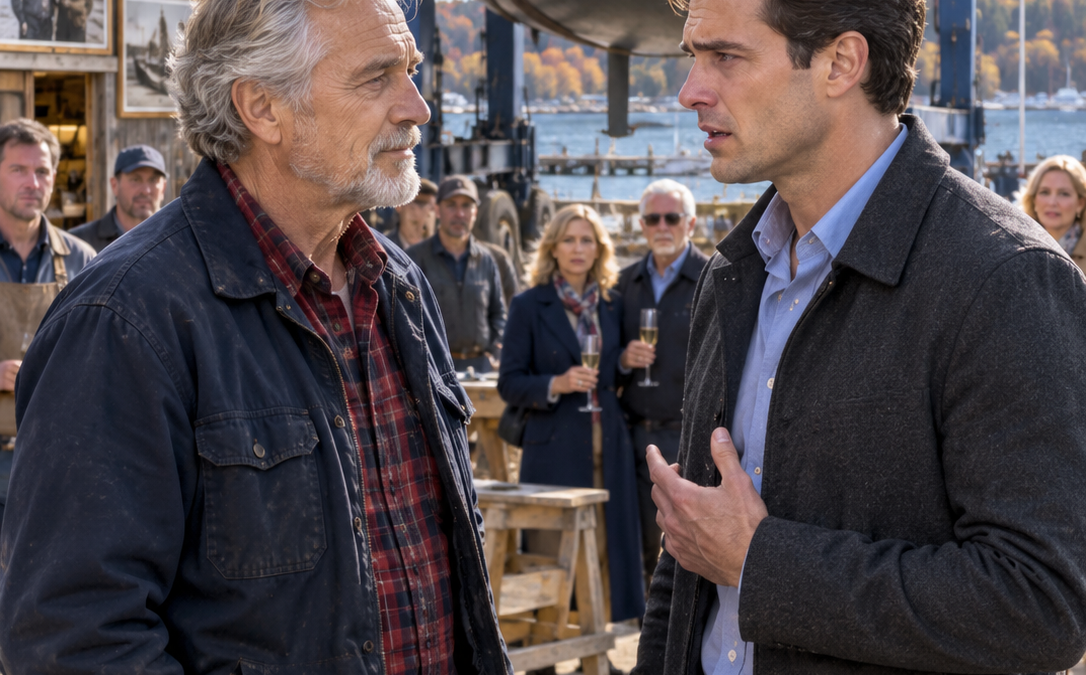
Perry parked at the end of the row, got out of the car, and stopped.
He just stopped right there in the gravel with the driver’s door still open behind him.
He looked at the travel lift. He looked at the boat. He looked at sixty people in good coats holding champagne on a Saturday in November, and at the shed doors standing open behind them, where two more hulls sat under work lights.
Ilse got to him first.
“Can I help you?”
“I’m looking for Hollis Ren.”
“And you are?”
“His son,” Perry said.
Ilse’s face didn’t change one bit, but something moved behind her eyes. She had been at the funeral. She had watched me walk out of that place eleven months later. And she knew exactly how long it had been since anybody named Ren had come up that road looking for me.
“I’ll see if he’s free,” she said.
She came into the office and closed the door behind her.
“He’s out there,” she told me. “Want me to send him off?”
“No,” I said.
Then I sat down.
“Give me fifteen minutes. That family paid for a launch, and they’re going to get one.”
And this is the part I need to be honest about. It wasn’t strategy. It wasn’t cruelty.
I sat in that office with my hands flat on the desk, and I could not stand up, because if I walked out there right then, I was going to say something I couldn’t take back, right in front of a client’s family on their day.
So I sat there and looked at the photograph on the wall by the door.
June, in 1993, wearing a wool sweater with sawdust in her hair, holding a clipboard and laughing at something outside the frame.
It was twenty-two minutes, actually. Not fifteen.
I went outside when the sloop was hanging in the slings over the water, the bottle had been swung, and everybody was cheering.
I shook the owner’s hand and told him she’d outlive all of us, which was true.
Then I walked over to the shed wall where my son was standing.
He wasn’t looking at the boat. He was looking at the photographs.
Thirty-four years of them, framed and hung along that wall in no particular order. June and me at our first launch in 1993, both of us looking about eleven years old. The two of us at a trade show in Newport. The Downeast Craftsmanship Medal from 2011, displayed in its frame. A photograph of the whole crew in front of Shed Two after we’d finished a fifty-four-footer for a client in Norway.
And one of Bo, nineteen years old, standing on the float holding an oar, squinting into the sun.
“That’s Mom,” Perry said.
He didn’t turn around.
“Yes.”
“She looks…”
“She was,” I said.
He turned to face me, and his eyes were wet. He was fighting it hard.
“What is this place, Dad?”
“It’s the yard. Your mother’s and mine.”
“You own this?”
“I do.”
He looked back out at the water, at the sixty people, at a boat with a quarter of a million dollars’ worth of labor in her sitting in slings in the afternoon sun.
“How much is it worth?” he asked.
And there it was.
“Does it matter?” I asked.
“Dad, you let me think you were broke. You let Denika treat you like a…”
He couldn’t finish the sentence.
“You treated me that way,” I said. “Both of you. On your own. I never asked either of you for a dollar in my life.”
“You should have told us.”
“Why?” I asked.
He didn’t have an answer.
“So you’d have been kinder? So you’d have respected me based on square footage?”
He looked away.
“Perry, if the only thing standing between me and being called a fourth adult in your kitchen is a balance sheet, then it was never respect. It was pricing.”
He put his hand over his mouth. There were people forty feet away laughing, champagne being poured into glasses, and the sound of the lift machinery moving the boat toward the water.
“Your mother and I started this with fifty-two thousand dollars we didn’t have,” I said. “We sold her car. We took a second mortgage on a condo in South Portland we could barely cover. We worked three jobs between us the first two years while we got the first shed up. We lost money for six straight years, Perry. Six.”
He was looking at me now.
“Your mother did the books at the kitchen table at eleven o’clock at night with you asleep down the hall, and she never once said, ‘Let’s quit.'”
“I didn’t know any of that,” he said.
“You never asked.”
He flinched like I’d hit him.
And here’s where I did the thing I’d been holding inside for eight months. I did it quietly, which I think made it worse.
“Let me ask you something,” I said. “When’s the last time you called me for no reason? Not to move something, not because Denika wanted you to check on something. Just to talk.”
He opened his mouth, but nothing came out.
“When’s the last time you asked me about your mother? About what it’s like in a house at three o’clock in the morning when the oxygen concentrator isn’t running anymore because there’s nobody to run it for?”
“Dad…”
“When’s the last time you asked me anything about myself at all?”
And he broke right there.
Standing against a shed wall with champagne being poured thirty feet away, my forty-one-year-old son put his hands over his face and came apart.
I let him.
I didn’t touch him. I want to tell you I did, but I didn’t.
“I paid off your house,” I said. “Do you know why?”
He shook his head.
“Not because you needed it. You and Denika clear two hundred and forty thousand dollars a year. That debt was decisions, not luck. I paid it because it was the last big thing I could do that your mother would have wanted. And because I thought if I put a paid-off house under you, you might stop running and build something.”
I looked straight at him.
“Instead, you charged me rent to sleep in it.”
“I didn’t know,” he said. “Denika told me her father…”
“Her father hasn’t got it. Go look at the closing documents. The wire came from Howard Point Holdings. That’s this. That’s me.”
He sat down hard on an overturned crate, as though his legs had finally quit.
“Why didn’t you just tell us?” he asked. “Why would you let it go that far?”
And this was the question. The whole question.
I’d had eight months to get an answer ready, and the one I gave him was the true one instead of the good one.
“Because I was lonely,” I said.
He looked up.
“Because your mother died, and I couldn’t be in our house, and I couldn’t be in this yard. And I came to Falmouth hoping that if I sat in your kitchen long enough, my son might get curious about me.”
I paused and had to look out at the water for a second.
“I was hoping you’d ask,” I said. “I sat in that house for eight months waiting for you to ask me a single question, and I never once opened my mouth and told you what I needed.”
He was listening now. Really listening.
“So no, you’re not the only one who failed here. I hid. I let you both build a wrong idea of me because a wrong idea felt safer than saying, ‘I’m your father, and I’m alone, and I’d like you to know me.'”
He was crying so hard he couldn’t talk.
“What do you want from me?” he finally managed.
“I want you to go home,” I said. “I want you to sit down and figure out what kind of man you actually want to be, because you’re forty-one, and you’re running out of practice years. And then, if you still want a relationship with me, we’ll build one. But it’ll be level ground, Perry. I’m not a wallet, and I’m not a burden. I’m your father.”
“I’m sorry,” he said.
“I know you are,” I told him. “But sorry is a word. I need to see a shape.”
He drove off down the private road, and I stood there watching until the dust settled.
Then Ilse came over and put a plastic cup of champagne in my hand without saying anything. We stood together and watched them motor that sloop off toward the mooring field in the last of the light.
Two months went by. The yard went quiet the way it always does in January. We shut the big doors and worked on interiors under the lights.
I hired an apprentice, a twenty-six-year-old named Nell Barkquist, fresh out of the boatbuilding program in Eastport. She had better hands at twenty-six than I had at thirty-five, and she reminded me so much of June during that first week that I had to go stand outside twice.
Perry didn’t call.
Denika called once in December to ask whether I’d reconsidered investing in the franchise. I said no. She hung up without saying goodbye, and I stood there listening to the dial tone, thinking that she was going to be all right, that one. She was a survivor, and she would land on her feet. I hoped she would do it somewhere far from my son.
In February, Perry came up the road again.
No warning this time. He just knocked on the loft door at eight o’clock on a Sunday morning.
He looked thinner, older around the eyes.
“Can I come in?”
I stepped aside and let him through.
He stood in the middle of that apartment and looked around at the plain floor June had picked, the books, my father’s planes arranged on the shelf, and the window facing the water.
“This is nice,” he said.
“It suits me.”
He stood there another moment before turning toward me.
“Dad, Denika and I separated in December. I moved out.”
He said it fast, as though he needed to get the words out before he lost his nerve.
“When it became clear there wasn’t going to be any money, there wasn’t much left holding it together.”
He looked down at the floor.
“That’s not her being a monster. That’s just what we were. We were a business arrangement that stopped clearing its costs.”
“I’m sorry,” I said.
And I meant it, which surprised me a little.
“The house,” he said. “I want to give it back. It’s yours. I don’t want it. Not because I don’t deserve it, though I don’t. Because I can’t be in it. Every room in that place is a room where I let somebody talk about you like that and said nothing.”
“What will you do?”
“I’ve got an apartment in Woodfords. I sold the Q7. I’m paying down the actual debt, the stuff I made myself. And I’m in counseling.”
He sat down without being asked, which I took as a good sign.
“She asked me to describe my relationship with you,” he said. “The counselor. And I sat there for a full minute and couldn’t do it. I know facts about you. I know you build boats. I didn’t know one single thing about who you are.”
Then he said the thing I’d been waiting twenty-one years to hear.
“It started with Bo.”
I didn’t move.
“We don’t talk about Bo,” he continued. “Twenty-one years, and I can count the conversations on one hand. I was seventeen. He was twenty. He went off that float at night in April, and nobody was watching. And I spent about fifteen years deciding that was your fault and Mom’s fault for being at the shop all the time, because it was easier than it being nobody’s fault.”
“Perry…”
“Let me get through it.”
He put his hands on his knees and leaned forward.
“And then Mom got sick, and I couldn’t be around that either. So I worked more. And after she died, having you in my house every day was like being handed a bill for all of it.”
He swallowed.
“And then Denika said we should charge you rent. And I let her. And I want to tell you why. And it’s ugly.”
“Go ahead.”
“Because it was the first time in my life you needed me,” he said. “And it felt so good. I let her humiliate you to keep the feeling.”
Nobody said anything for a while.
There wasn’t a sound in the apartment except the low hum of the refrigerator and the wind moving along the outside of the building.
“I’ve always needed you,” I said finally. “Just never for money. And I never told you that either, so we’re even on that one.”
Outside, two eiders came in past the float and settled onto the water.
Perry followed them with his eyes. Then he turned back toward me.
“I want to work here,” he said.
“You don’t know a thing about boats.”
“I know. But I know systems. I’m good at scheduling, and I’m very good with customers. Maybe I’m useful somewhere.”
He hesitated, looking around the apartment again.
“And mostly, I want to be near something that lasts. And I want to know what you and Mom made before you’re not here to show me.”
I looked at my son for a long time.
He meant it. I could see that he meant it.
But I could also see how thin that kind of clarity could be, how quickly it could burn off when the work got cold and boring and somebody started yelling at you.
“One condition,” I said.
“Anything.”
“You start on the floor. Sweeping, sanding, hauling stock, and whatever Cyrus tells you. You don’t touch the business side. You don’t sit in my office. And you don’t say the word Ren to a customer. You learn what a boat costs in hours before you learn what it costs in dollars.”
“How long?”
“Until Cyrus says otherwise. Could be a season, could be two years. And Cyrus does not like me, so don’t expect help.”
“I’ll do it.”
“Shop opens at six,” I said. “In February. In an unheated shed. And every man on that floor is going to give you hell because you’re the owner’s kid.”
“I can take it.”
“We’ll see,” I said.
He got to the door and stopped with his hand near the frame.
“Dad, that article in the trade magazine. It said you and Mom started with fifty-two thousand dollars in a shed with a dirt floor. Is that real?”
“Yes.”
“Where does a couple in their thirties get fifty-two thousand dollars in 1991?”
“They sell a car and mortgage a condo and work three jobs and don’t sleep for two years,” I said. “It was the stupidest decision we ever made and the only one that mattered.”
“You risked everything.”
“We wanted to build something that would still be here after us.”
“Did you?”
I looked out the window.
Shed Two. The travel lift. Nell Barkquist’s truck already sitting in the lot on a Sunday because she couldn’t stay away from the place.
“Yes,” I said. “We did.”
He showed up the next morning at 5:48 in a pair of boots that had never had a mark on them.
Cyrus put him to work sanding a bulkhead, then made him do it again, and then a third time.
I watched from the loft window while my forty-one-year-old son got told his work wasn’t good enough by a man who was right.
It might not take. I know that.
He might last three weeks. That’s a real possibility, and I’ve made peace with it.
But maybe not.
Maybe this time he’ll stay long enough to learn something that can’t be bought, borrowed, or handed to him.
So here’s what all this taught me, and it’s not what you think it’s going to be.
Everybody who hears this story wants the lesson to be, “Never let people take you for granted.”
That’s fine. It’s true. It’s on a coffee mug somewhere.
But that’s not what I learned.
What I learned is that I spent eight months in my son’s house waiting to be asked a question I could have answered without being asked.
I was lonely, and I never said the word. Not once. Not to him, not to Odell, not to Ilse, not to anybody.
I let people build a whole wrong idea of who I was because being misjudged felt safer than being known and still not chosen.
And here’s the trap in that, because it’s a real trap.
If you hide who you are and then people treat you badly, you get to feel righteous. You get to say, “That’s who they really are.” It’s very satisfying, and it costs you years.
But you can’t be loved for something you never showed anybody.
The mistake I made wasn’t being generous. It wasn’t even keeping the money quiet. Plenty of good people do that.
The mistake was that I substituted a favor for a sentence.
Every time I wanted to say, “I miss you,” I paid for something instead. A mortgage. A car repair. A dinner.
It’s so much easier to write a check than to say a true thing out loud with your face showing.
So here’s the one thing I’d ask you to actually do. It’ll take you about nine seconds, and it’ll be harder than almost anything else you do this week.
Think of the person you’re always doing things for.
And instead of doing the next thing, say the actual sentence underneath it out loud, with no request attached to it.
“I miss you.”
“I’m lonely.”
“I’d like you to know me.”
“I’m scared.”
Don’t attach an ask. Don’t attach a favor. Just put the true thing in the room and let it stand there.
If they meet you there, you’ve got something real for the first time. And if they don’t, well, at least you’ll finally know what you’re dealing with. You won’t have spent eight months in a back bedroom finding out the slow way.
And here’s the question I’d like you to sit with tonight. It’s the one I sat with in that boat shed with my head in my hands.
Who in my life actually knows the truth about me?
And if the answer is nobody, whose choice was that?
Because I promise you, it wasn’t only theirs.
Now, I’d like to hear from you. And I do read these.
If you think I got it right by walking out, saying no to the loan, and making Perry start on the shop floor, comment the number one.
If you think I was too hard on him, that he’s my son and he’d already lost his brother and his mother, comment two.
And if you think I brought a lot of this on myself by hiding who I was for eight months, comment three.
I’ll be honest with you. Some nights, I think three is the right answer.
Tell me where you’re watching from, too, and what time it is where you are. It still gets me, the thought of a story from a cold shed on the Maine coast ending up in somebody’s kitchen on the other side of the world.
And if you’ve ever sat in somebody’s house being treated like a line item and said nothing because saying something would have meant admitting how much you needed them, tell me about it down there.
You don’t have to use your name.
Somebody scrolling past tonight needs to know they’re not the only one who ever went quiet to keep the peace.
If any of this reached you, do me one favor before you go. Subscribe. Not for a number on a screen, but for the next person who needs to hear that being underestimated isn’t always somebody else’s crime.
Sometimes it’s just the bill for eight months of not speaking up.
And that bill can be paid off at any age.
Take care of your people, and go say the true thing.
This is a fictional story inspired by real emotional experiences, fully rewritten and reimagined in coastal Maine to create original content. Any resemblance to real people or events is coincidental.








