“Oops, we forgot your seat,” my sister giggled. mom pointed me toward the exit. i smiled. “don’t worry. looks like we both forgot something.” before the cake was cut, my sister was in tears, begging me to come back…
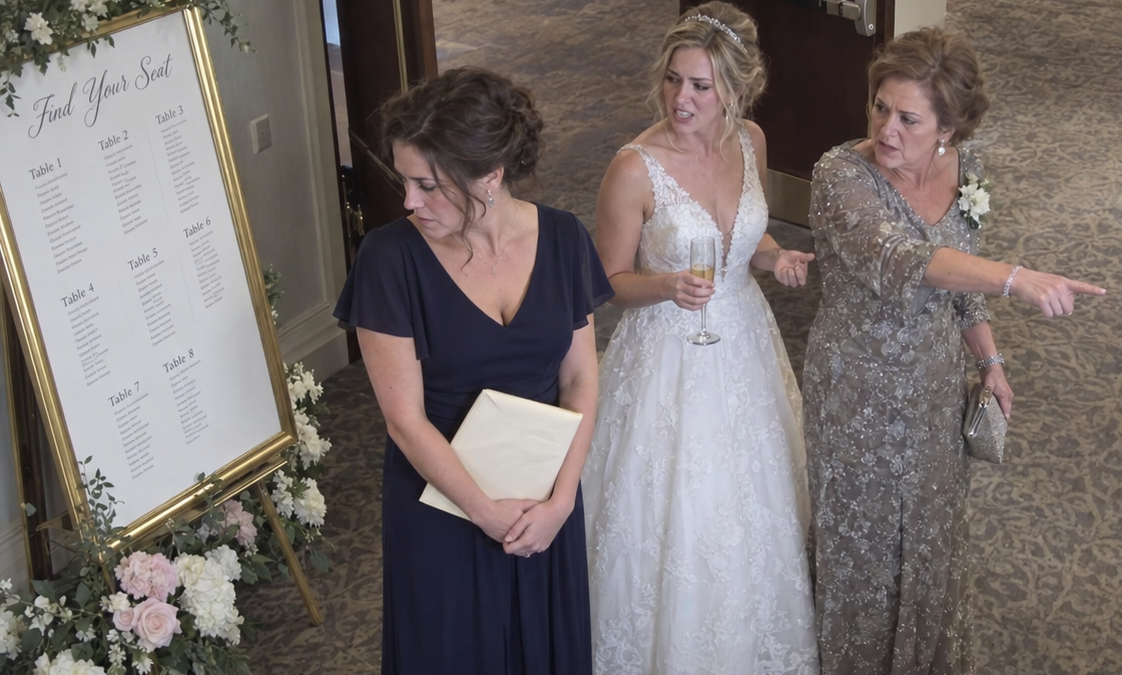
Oops, we forgot your seat.
My sister giggled. Mom pointed me toward the exit.
I smiled. “Don’t worry. Looks like we both forgot something.”
Before the cake was cut, my sister was in tears, begging me to come back.
“Oops. We forgot your seat.”
My sister giggled, tapping her manicured nail against the gold-framed seating chart at the ballroom entrance. The sickly sweet perfume of thousands of white roses hung heavy in the warm hotel air. Through the open double doors, the clinking of heavy silverware against fine china and the low hum of wealthy guests drifted toward me.
I stood there and let the humiliation wash over me. The thick, cold satin of the envelope in my right hand grounded me, the way a life raft grounds someone who has already accepted that they might drown.
I was thirty-nine years old. I worked as a regional payroll compliance manager, auditing corporate ledgers and tracking missing millions for healthcare systems across four states. I spent my days finding the exact place where a number stopped telling the truth. I was not a confused child standing lost in a hallway. I was a woman who had built her entire career on the simple, stubborn belief that every discrepancy had an origin, and every origin could be found if you were patient enough to look.
Yet here I was, in a corridor that smelled like money and roses, looking at a seating board that had systematically erased my existence from the family that raised me.
My reflection stared back at me from a gold-veined mirror hanging beside the chart. A woman in a navy dress, her hair pinned up for an occasion that no longer seemed to include her. For one strange, suspended second, I almost didn’t recognize the calm on my own face.
Mom stepped up beside Brooke. Her expensive silk dress rustled as she moved, the kind of rustle that cost more than my monthly mortgage payment. She pointed a sharp, manicured finger toward the exit signs glowing red at the end of the corridor.
“You should probably head home, Amanda,” Mom said softly.
Her tone carried that practiced, reasonable edge she had perfected over four decades. It was the voice of a woman who wanted to sound like the victim while standing directly on top of the person she was hurting.
“We don’t want to make Brooke’s special day heavy with any of your unnecessary drama.”
I did not cry. I did not ask why I was being thrown out of a celebration I had helped fund with three years of quiet, invisible sacrifice.
Instead, I looked directly at the bride.
I smiled. “Don’t worry. Looks like we both forgot something.”
Brooke’s smile faltered. Her eyes dropped to my hand. The gold foil on the envelope caught the light from the crystal chandelier overhead, but it was the black ink stamp in the corner that held her attention—the thick, circular seal of the domestic relations court.
“Where were you last week?” Brooke asked.
Her voice lost its giggly, innocent register completely, dropping into something flatter, colder, and far more alert.
“Somewhere you should have gone sixteen months ago,” I told her.
Mom quickly stepped between us. She let out a loud, forced laugh for the benefit of two passing bridesmaids in matching blush gowns.
“Oh, Amanda is just feeling a little left out,” Mom announced to the empty space around us, as though narrating a scene for an audience that hadn’t arrived yet.
She grabbed my arm, her manicured nails digging painfully into my bare skin.
“Leave. Right now.”
Over Mom’s shoulder, I could see Daniel standing near an elaborate ice sculpture shaped like two intertwined swans, already beginning to weep thin rivers of condensation onto the white tablecloth beneath it.
The groom.
He was laughing with his groomsmen, holding a tall glass of champagne, looking handsome and completely relaxed in a way that made my chest ache.
He had no idea the woman he was about to marry was still legally tied to someone else.
I want you to understand something before I go any further, because it matters for everything that comes after.
I did not come to that wedding to destroy it.
I came because I had spent three years, $63,000, and every ounce of trust I had left trying to save my sister from a mistake she had already made twice.
I came because somewhere in the back of my mind, even after everything I had found on that county court website two weeks earlier, some small, foolish part of me was still hoping I was wrong.
That there was an explanation. That my family, whatever its faults, would not let me walk into that hallway and hand a groom evidence of fraud unless it was absolutely, unforgivably necessary.
It was necessary.
I want you to know that, too, before the story gets worse.
Because it does get worse. Layer after layer, the way rot always does once you finally cut into the wood and discover how deep it runs.
Clare, the hotel’s wedding planner, hurried over before Mom could push me toward the exit. She had a clipboard pressed tightly against her chest and a wireless headset hooked over one ear. She was the kind of woman who had learned to smile through catastrophe because the alternative was unemployment.
“Brooke, I am so sorry to interrupt,” Clare said breathlessly. “I need the final authorization for the premium bar extension and the after-party transportation. The hotel requires the card on file to be swiped one more time before the reception officially begins.”
“Amanda is handling it,” Brooke said smoothly, not even looking at the planner.
She kept her eyes locked on my envelope, the way you might watch a snake when you weren’t sure whether it was venomous.
Clare turned to me, offering a polite, strained smile. She extended a payment terminal toward me like an offering.
“I haven’t approved those charges,” I said.
My voice was steady and loud enough for Mom to hear.
“And I am not the primary signatory on the venue contract. You’ll need to collect the remaining $17,500 from the bride and groom.”
Brooke’s head snapped toward me. The color drained from her cheeks, leaving behind a shade of white that had nothing to do with her wedding dress.
“You would not embarrass me over money in front of everyone.”
“This stopped being about money months ago, Brooke.”
I turned my back on them and walked away from the ballroom doors. The heavy floral carpet muffled my footsteps as I headed toward the lobby elevators.
Brooke did not stay to answer the wedding planner. She chased after me, catching up just as I reached the elevator bank and pressed the down button.
The giggles were completely gone. The confident bride who had laughed at my missing seat only ninety seconds earlier was nowhere to be found.
She gripped her cascading bouquet so tightly that the thick green stems bent and cracked against her knuckles.
“Don’t give Daniel that envelope,” she whispered, glancing frantically over her shoulder.
“Why?” I asked, keeping my eyes fixed on the brass doors in front of me. “You told me there was nothing in it I didn’t already know. You said it was just standard legal paperwork.”
Brooke swallowed hard, her breath catching.
Mom was calling her name from down the hall, waving her back for family portraits, her voice bright and brittle.
“Just this once,” Brooke whispered. “Please.”
The elevator arrived with a soft, clear ping.
I stepped inside, turned around, and watched the heavy metal doors slide shut on my sister’s terrified face.
The soft ping of the elevator shifted in my memory, blending into the sharp chime of Mom’s oven timer at a Sunday dinner six months earlier.
We had been sitting around the dining room table, the same table where I had eaten a thousand meals as a child, the one with the water ring near the head chair that none of us had ever bothered to sand out.
Daniel sat across from me, passing a heavy ceramic bowl of roasted potatoes with the easy warmth of a man who had never once had to wonder whether he belonged somewhere.
“I really want to thank you, Amanda,” Daniel had said, smiling. “Brooke told me how much you helped her through the divorce two years ago. I know lawyers are incredibly expensive, and you stepping up like that means everything to us.”
I had stopped chewing.
Two years ago.
That timeline simply did not make sense.
I possessed a mind built for compliance and auditing, a mind that could not let a wrong number sit unexamined, even at a family dinner.
And I clearly remembered paying a substantial legal invoice for Brooke just eleven months earlier. An invoice I had written a check for myself, standing at my own kitchen counter. My own pen. My own signature.
I did not confront them right there at the dining table. I set my silver fork down quietly on my napkin.
“When did you see the final decree, Daniel?” I asked.
Brooke jumped in before he could even draw a breath.
“Oh, the paperwork was finished forever ago,” she said cheerfully, quickly pouring more wine into his glass to distract him.
Under the table, a sharp kick struck my shin.
Mom.
The silent, deeply familiar signal demanding my absolute compliance. The one I had been trained to obey since I was nine years old, when I learned that peace in that house was purchased with silence, and silence was always my currency to spend.
I took a slow sip of ice water, nodded once, and let the conversation move on to wedding cake flavors.
Lavender honey. Salted caramel. Something with edible gold leaf that cost eleven dollars a slice.
Later that same night, sitting alone at the small desk in my quiet condo, I opened my laptop and pulled up my financial spreadsheet.
I had named the file Family Support in the plainest, most bureaucratic language I could find, because I did not track the money out of malice.
I tracked it because my family had a relentless habit of rewriting history whenever Brooke needed rescuing. And I had learned the hard way, more than once, that memory in our family was a negotiable currency, subject to revision whenever it became inconvenient.
I scrolled down to the legal fees column.
$18,000 paid directly to a family law firm over the course of three years.
I found the date of the very last invoice, opened my web browser, and navigated to the public county court portal.
I typed in my sister’s legal married name.
Brooke Reed.
The screen loaded slowly, the little spinning wheel turning over and over on a government website that hadn’t been redesigned since 2011.
I read the case summary once.
Then I leaned closer, rubbed my tired eyes, and read every single line again.
There was no final judgment recorded anywhere in the document.
The very last entry on the public docket was a dismissal.
The judge had thrown the entire case out for failure to prosecute.
I placed both hands flat on my cool wooden desk. I counted the days, tracing the timeline backward from the current date.
Brooke had accepted Daniel’s proposal and started planning an elaborate hotel wedding long after her divorce case had already died quietly in a courtroom.
Unnoticed.
Unresolved.
Unfinished.
My sister was about to marry Daniel in a ballroom full of wealthy guests.
The court still listed her as Mason Reed’s wife.
I did not sleep that night.
I lay in the dark, staring at the ceiling, replaying every phone call, every dinner, every casual mention of the divorce over the past sixteen months. I searched for the moment I had missed the truth, the moment she had first started lying to my face while I had been too busy, too trusting, and too tired from working sixty-hour weeks to notice.
Three years earlier, my sister had stood beneath the flickering porch light of my old rental apartment. Rain soaked the shoulders of her denim jacket. A single oversized pink suitcase rested against her leg, its wheels already caked with mud from wherever she had dragged it before arriving at my door.
It was June of 2023.
Brooke did not knock. She simply waited there until I happened to look out the front window and saw her standing motionless in the downpour, like a woman who had run out of places to go and had finally, reluctantly, arrived at the one door she had always known would open.
When I opened it, she stepped inside, shivering, leaving a trail of water across the hardwood floor.
“Mason took everything,” she whispered, staring at her wet shoes. “He controls the accounts. I have absolutely nothing left.”
I did not demand the ugly details of her failing marriage. My sister needed a safe place, so I dragged her heavy suitcase into the spare room, the one I had been slowly turning into a home office, and moved my desk into the corner without complaint.
We sat at my kitchen table drinking lukewarm tea because I hadn’t thought to reheat it, and I outlined exactly what I could do.
Six months of support.
I would pay her landlord directly. I would write the checks for a family law attorney. There would be no cash transfers, and she had to find a steady job.
“Thank you,” Brooke sniffled, wiping her eyes with the back of her sleeve. “Just until I get on my feet.”
Two days later, my mother let herself into my apartment using the spare key I had foolishly given her years earlier, back when I still believed trust was something you extended by default rather than something that had to be earned and re-earned every single time.
Mom set her designer purse on the counter and folded her arms.
“Six months is an arbitrary timeline, Amanda,” she said.
Her voice carried that gentle, disappointed tone she had perfected over decades. The tone that could make a grown, financially independent woman feel like a scolded child in the span of eleven words.
“Your father told you to look out for her before he died. He knew Brooke was fragile.”
“Dad taught us to help people stand up,” I replied, washing a coffee mug in the sink so I wouldn’t have to look at her. “He didn’t teach us to carry them forever.”
Mom sighed loudly, shaking her head.
“You have always been so cold.”
Brooke sat at the table, perfectly silent, letting the guilt trip hang in the heavy air between us like smoke that wouldn’t clear.
I dried my hands on a towel. The familiar pressure settled tight in my chest.
I still remembered exactly how the pattern had started, if I’m honest, tracing it all the way back to a Tuesday afternoon when I was seventeen, standing in the school counselor’s office holding an acceptance letter to a six-week language program in France.
It was the kind of opportunity that came around only once in a graduating class.
Mom sat across from the counselor’s desk and explained, in that same gentle, reasonable voice, that the family simply couldn’t cover both the program deposit and Brooke’s orthodontist bill that same month.
And wouldn’t it mean more to me, really, to know my little sister’s teeth would be straight for her whole life rather than spend six weeks on teenage sightseeing I’d barely remember by thirty?
I signed the withdrawal form myself.
I told myself it didn’t matter.
In the twenty-two years since, I have never once forgotten the exact shade of blue the acceptance letter was printed on.
At twenty-three, I had been engaged for eleven months to a man named Peter, who worked in commercial real estate and told corny jokes at every dinner party.
I had a wedding fund sitting quietly in a savings account.
$4,300 I had built up one paycheck at a time.
Peter left three weeks before the wedding, for reasons that still didn’t entirely make sense to me even now. Something about not being ready, a realization that somehow hadn’t occurred to him until the invitations had already been mailed.
Two weeks after that, Brooke totaled her first car in a grocery store parking lot.
Mom asked, almost before I had finished crying over my own canceled venue deposit, whether I might consider using what was left of the wedding fund to help Brooke get back on the road.
Since I wasn’t going to need it for a wedding anymore anyway.
I remember the particular cruelty of that sentence landing during the same week I was already grieving. How efficiently my family managed to convert my heartbreak into an opportunity to ask me for something.
I had felt that pressure at seventeen, giving up my spot on a summer study-abroad trip so the family could afford Brooke’s orthodontist bill. I had felt it again at twenty-three, moving what was left of my wedding fund toward paying off Brooke’s first car after she totaled it in a parking lot, just weeks after my own engagement ended.
But when Brooke appeared at my door in June 2023, I did not break my own rule.
I signed a check for the lawyer’s retainer fee and handed it to my sister, making it payable only to the firm.
That same evening, I opened a blank spreadsheet on my laptop.
I titled it Family Support.
I logged the date, the check number, and the exact purpose. Every month, I recorded the rent payments, the credit card minimums, and the legal invoices.
The money flowed out of my account, but it went straight to the vendors, never into her hands.
Because Elena, even back then, before she became my attorney in any formal sense, when she was just a friend from college who happened to practice family law, had told me something over cheap wine in her studio apartment years earlier.
“Never give a struggling person cash. Give them paid bills. Cash disappears. Paid bills stay paid.”
While Brooke spent her days complaining about the unfairness of the job market, applying halfheartedly to three positions a week and rejecting two job offers for reasons that kept shifting, I spent my nights at that small desk.
I worked my corporate payroll job during the day, learning the architecture of fraud from the inside—how a stolen dollar hides itself inside a legitimate ledger, how a forged signature sits one pixel off from a real one if you know exactly where to look.
After dinner, I studied for advanced compliance certifications.
I declined weekend spa trips with my sister. I skipped family dinners to finish practice exams at my kitchen table, surrounded by flashcards and cold pizza.
“You really don’t know how to enjoy life,” Mom told me over the phone one evening, her voice thick with performed concern. “You work too much. It makes you unapproachable.”
She did not know the certifications came with a massive salary increase.
I kept my new income completely hidden, the way a person learns to hide a garden from deer. Not out of shame, but out of the certain knowledge that anything visible and growing would eventually be eaten.
My college friend Elena, who worked as a civil attorney downtown, gave me one piece of crucial advice over coffee one gray Tuesday morning.
“Build an emergency fund at a completely different bank,” she said, stirring her coffee slowly and watching me over the rim of her glasses, like she already knew exactly what my family was. “And never mention the balance. Not once. Not even by accident.”
By August of 2025, the late nights finally paid off.
I purchased a two-bedroom condo near the city center using my own savings.
No cosigner. No family loan. No strings that anyone else could later claim to have tied.
Mom visited the new place exactly once.
She walked through the modest living room, criticized the lack of yard space, ran one finger along my windowsill as though inspecting a hotel room she intended to complain about, and then held out her hand.
“I will need a spare key for family emergencies.”
“The building manager has an emergency protocol,” I told her, leaning against the front door. “He keeps the master key.”
Brooke laughed from the kitchen island, examining the label on a bottle of olive oil as though it personally offended her.
“Are you afraid someone is going to steal your little box of an apartment?”
“No,” I said quietly.
I opened the door and waited for them to leave.
When they stepped out into the hallway, I pulled the heavy wooden door shut. The deadbolt engaged with a loud, satisfying click.
For the first time in my life, I stood in a home that did not contain my sister’s unpaid bills or my mother’s quiet judgments.
Or so I thought.
I should tell you about my father, because his name kept getting used as a weapon long after he no longer had a voice to object to how it was spent.
Dad died when I was twenty-six and Brooke was twenty-two.
A sudden heart attack in the garage on a Wednesday evening, while he was looking for a socket wrench he never found.
I was the one who found him.
I was the one who called the ambulance, who rode in the front seat of my own car following it to the hospital with my hands shaking so badly I nearly ran a red light on Fifth Street.
I was the one who sat in a fluorescent waiting room for forty minutes before a doctor in blue scrubs came out and told me, in the gentlest voice a stranger has ever used with me, that there was nothing more they could do.
Brooke was at a concert three states away and didn’t get the news until the following morning.
Mom was the one who decided not to interrupt her trip.
I learned about that decision a full day later, standing in a funeral home and picking out a casket by myself because Mom said she couldn’t bear to look at the catalog and Brooke still hadn’t landed.
At the funeral reception, Mom stood up and told a room full of relatives that Dad’s dying wish, whispered privately to her in his final years, was that I would always look out for Brooke.
That I was the strong one.
The capable one.
The one who could handle things.
I remember standing near the coat check in my black dress, twenty-six years old, hearing my dead father’s supposed last wishes recited to two hundred people for the first time and wondering why he had never once said any of that directly to me in twenty-six years of actually knowing him.
I never found proof that conversation happened.
I’m not certain it did.
What I know for certain is that from that day forward, your father wanted you to take care of her became the single most effective sentence in my mother’s vocabulary.
Deployed at exactly the moments I tried to set a boundary.
Retired the instant the boundary succeeded anyway.
I spent years unable to argue with a dead man’s supposed wishes.
Because how do you cross-examine a ghost? How do you ask a man in a casket whether he actually said the words being used to bankrupt you?
It took me a long time, most of my thirties if I’m honest, to realize that even if my father really had said something like that, softened by illness and worry in a private moment near the end of his life, it would have meant something closer to don’t let your sister fall apart.
Not fund her indefinitely, no matter how many times she lies to your face.
Grief had been weaponized into an open-ended invoice, and I had spent years paying it without ever once seeing the itemized bill.
I kept a photograph of him on my nightstand. The two of us at a lake when I was maybe nine, both squinting into the sun, him with one arm slung easily around my shoulders.
I looked at that photograph the night I found the dismissal on the county docket.
And I asked him out loud, alone in my bedroom, whether this was really what he had wanted for me.
He didn’t answer.
Obviously, dead fathers don’t answer.
But somewhere in the silence of that empty room, I finally gave myself permission to stop assuming the answer was yes.
The financial boundary worked until Brooke started planning her wedding to Daniel.
She constantly complained about vendors and confusing spreadsheets, eventually asking me to review her budget the way she used to ask me to check her math homework, assuming correctly that I would do it more carefully and competently than she ever would herself.
She emailed me a filtered list of bank transactions, a document she had clearly cleaned up before sending, the way you might tidy a house before a landlord’s inspection.
I sat in my secure, locked condo and opened the file.
I scrolled past floral deposits and catering estimates, past a line for a $600 veil and another for calligraphy invitations.
Then my eyes caught a peculiar line item.
A deposit had hit Brooke’s account in March of 2025. The description clearly listed the family law firm we had hired for her divorce.
They had issued a refund for unbilled hours.
$8,600.
My fingers hovered over the keyboard.
I checked the very next line on the spreadsheet.
Exactly two days after the law firm returned the money, a debit appeared.
It was the initial deposit for the historic hotel ballroom.
$8,500.
Brooke had looked me in the eye more than once and sworn every cent of my retainer went toward finalizing her complicated divorce.
I highlighted the two rows on the screen. I saved a copy of the file directly to my secure local drive, the way I would save evidence in any workplace audit.
Quietly, without announcement, before the person under investigation had any reason to suspect they were being watched.
The money that should have ended Brooke’s first marriage had paid for the room where she planned to start the second.
“The final $17,500 for the venue requires a simple condition,” I told Brooke over the phone the next morning, keeping my voice as flat and procedural as I would with any vendor who owed my company a reconciliation.
My sister gasped, a sharp intake of air that usually preceded a tantrum.
“You have absolutely no right to dig through my private life, Amanda!”
“Because you used your divorce to ask for my financial help,” I reminded her, “I just need a copy of the certified final judgment for my records before I authorize the wedding payment.”
Two hours later, an email arrived in my inbox.
The attached file bore the name Final_Divorce_Decree_Certified.pdf.
The glare of the computer monitor illuminated my dark living room as I opened the document.
My daily corporate job involved hunting for missing healthcare funds, meaning I spent forty hours a week looking for numbers that did not belong, stamps that had been recreated one generation too many times, and signatures that curved half a degree wrong.
The file number matched the court records perfectly.
But the clerk’s stamp looked terribly blurry compared to the sharp black text of the surrounding paragraphs.
The margins shifted slightly on page three, leaving an awkward gap near the bottom, the kind of gap that appears when a page has been rebuilt around an image rather than typed fresh.
More importantly, the date of the judgment was listed as three weeks after the dismissal date I had seen on the public docket.
A sudden memory pulled my attention away from the dates.
I navigated to an archived folder and opened a temporary support order my sister had forwarded me a year earlier when she needed rent money.
Placing the two windows side by side, the truth became painfully obvious.
The stamp on the temporary order possessed the exact same pixelated blur on the left edge as the new decree.
I did not alter the file, nor did I confront her immediately.
I saved the original email to a secure folder and wrote down the discrepancies on a yellow legal pad the same way I logged discrepancies at work.
Date. Time. Description.
Because I had learned that suspicion without documentation is just an opinion.
And opinions get argued away by people who are better at arguing than they are at telling the truth.
My cell phone vibrated against the desk, startling me in the quiet room.
Mom was calling.
“Brooke is crying uncontrollably,” the woman who raised me said the moment I answered. “Why are you punishing your sister for finally finding happiness?”
“Did you actually see the certified judgment, Mom?”
She completely ignored the question, pivoting instantly to her favorite weapon.
“Your father would be heartbroken to see you treating family like an auditor treats a suspect. You need to think about our reputation and stop this foolishness.”
Instead of arguing, I pressed the end button and set the phone facedown.
Mom would always protect her youngest daughter.
So I needed undeniable proof, something that couldn’t be reframed later as a misunderstanding.
Something with a timestamp.
I opened a new message window and typed a very specific request to Brooke before I authorized the remaining payment.
Confirm in writing that your first marriage legally ended and the attached document is the certified final judgment.
When the reply came through twelve minutes later, it contained exactly what I needed.
Yes, I am legally divorced. Release the payment and stop creating problems.
I printed the thread immediately.
My sister had just locked her lie in ink, completely unaware that she had handed me the exact leverage I required.
The hissing of an espresso machine filled the noisy coffee shop across the street from the county courthouse the next afternoon.
I slid the printed email and the suspicious PDF across a small wooden table.
Elena adjusted her glasses, reading through the pages with the practiced silence of a civil attorney who had seen a thousand families do a thousand ugly things to each other and had long since stopped being surprised by any of them.
“Listen to me carefully,” my friend said, tapping a silver pen against the paper. “Do not post anything online. Do not threaten her, and do not call her employer. You are going to walk across the street, get the official record, and let the paper trail do the talking.”
Elena took a slow sip of her black coffee, her eyes scanning the blurry court stamp one more time.
“You will not get all your money back, Amanda. A judge will consider some of those early payments a gift. But you can stop the bleeding, and you can protect Daniel from marrying into a fraud.”
Leaving my half-empty cup on the table, I walked out into the crisp autumn air.
The courthouse lobby hummed with the quiet urgency of lawyers and security guards. The metal detector beeped twice before a bored guard waved a businessman through.
The clerk’s office smelled faintly of old paper and floor wax.
I stepped up to the thick glass counter, paid a small fee, and requested the certified case summary for Brooke Reed.
The man behind the partition stamped a heavy seal onto a crisp sheet of paper and slid it through the metal slot at the bottom.
He offered no legal advice, just a tired nod as he called the next number.
Carrying the document back across the street, I sat down across from Elena and placed the certified docket next to the PDF my sister had emailed me.
The dates were undeniably contradictory.
The official court record confirmed a dismissal sixteen months earlier, and there was absolutely no final judgment on file.
Elena studied the two conflicting documents for a long moment.
Then she looked up, her expression completely serious.
“If this was altered, your sister did not just lie about a divorce. She used the lie to make you pay.”
That sentence sat in my chest for the rest of the day, heavier than anything Mom had ever said to me.
It wasn’t the lie itself that undid me.
It was the arithmetic of it.
The $18,000 in legal fees I had paid toward a divorce that had, at some point, quietly stopped being real, while my sister kept collecting checks for a fight that no longer existed.
My fingers moved rapidly across the keyboard as I deleted my saved billing profiles from every wedding vendor portal.
Turning off the automatic payments for my sister’s credit cards took only three clicks, and I immediately changed the passwords on all my personal banking accounts.
Next, I drafted a polite email to Clare.
I explained clearly that I was not the contracting party for the venue and that any new charges required separate authorization from the couple.
The wedding planner replied ten minutes later with a brief confirmation, professional and unbothered in the way people who work weddings for a living learn to be about everything.
My office phone rang later that afternoon.
The regional director called to officially offer me the position of regional payroll compliance manager, complete with a substantial salary increase, effective the following pay period.
I sat in my cubicle with the phone still warm against my ear and felt almost nothing.
The way you feel almost nothing about good news when your hands are already full of bad news you haven’t told anyone about yet.
I did not call my mother.
I did not text my sister.
Instead, I met Elena for dinner at a quiet Italian restaurant and celebrated over fresh pasta, the two of us talking about anything except Brooke for exactly ninety minutes.
It felt, at the time, like the longest vacation I had taken in years.
The extra money would funnel directly into my emergency fund and retirement accounts.
My family had always viewed my income as a shared resource meant to fix their ongoing crises, while treating Brooke’s bank account as her untouchable personal achievement.
Something sacred that could not be questioned, even as mine was treated like a communal well anyone could draw from.
That era was permanently over.
I didn’t announce it.
I just stopped participating in it, one canceled automatic payment at a time.
The security buzzer in my condo echoed through the quiet hallway the following evening.
Stepping up to the wall panel, I pressed the camera button.
Mom stood on the concrete front steps of the building, her breath visible in the cold evening air.
The woman who raised me clutched her expensive handbag and looked severely annoyed at being made to wait.
She had the same expression she wore at every line, every delay, every inconvenience that had ever dared interrupt her sense of how the world should treat her.
I pushed the intercom switch and offered to meet her for coffee the next morning.
“Just let me upstairs right now,” her voice cracked through the small plastic speaker. “We need to talk like family, and I do not have a spare key.”
“That was not an oversight,” I said smoothly.
Tears welled up in her eyes on the grainy video feed.
Real or performed, I genuinely could not tell anymore, and that uncertainty itself told me something about how far things had already gone.
I stepped away from the panel, walked into my kitchen, and left the heavy wooden door firmly locked.
Elena drafted a strictly neutral letter to Mason Reed.
The very next morning, the attorney asked solely for a copy of the final decree or any related court documents, carefully mentioning nothing about the upcoming wedding or any potential fraud.
It was a clean, surgical request, the kind that gives nothing away and asks for everything.
Sitting across from the polished wooden desk in Elena’s office, I finally voiced my biggest fear.
I admitted that Mason might be an abusive, controlling husband, intentionally dragging out the process to hold his estranged wife hostage.
That perhaps the version of the story I had been told for three years was closer to true than I wanted to believe.
And that maybe I was about to become the villain in a story where Brooke really was the victim.
“We are going to rely strictly on the paperwork,” Elena advised, sealing the letter inside a crisp envelope. “We do not trust anyone’s emotional performance.”
While I waited for Mason’s response, Brooke showed up at my office unannounced, something she had never done in six years of my working there.
I saw her through the glass wall of the conference room before she saw me.
She stood at the reception desk in sunglasses despite the overcast afternoon, and my stomach dropped so fast I had to set down the coffee mug in my hand.
I met her in the small kitchenette instead of at my desk, where the printed timeline and Mason’s forwarded emails were still sitting open in a browser tab I hadn’t thought to close.
“You can’t just come here,” I said, keeping my voice low, aware of Priya two desks away, pretending not to listen.
“Mom said you’re digging through my divorce records,” Brooke said, sliding her sunglasses up into her hair.
Her eyes were red-rimmed, though whether from crying or something else, I genuinely couldn’t tell anymore.
“Why would you even think to check the court docket, Amanda? Nobody just thinks to do that.”
It was, I realized later, the closest she ever came to asking the right question.
Not Is it true?
But How did you find out?
I told her truthfully that I reviewed every legal expense I had ever paid for as a matter of habit, the same habit that kept my department’s books clean.
And that a discrepancy in a filing date wasn’t exactly buried treasure once you knew where to look.
She studied my face for a long moment, as though trying to calculate exactly how much I already knew.
Then she put her sunglasses back down and left without saying goodbye.
I sat back down at my desk fifteen minutes later, my hands still faintly unsteady, and closed the browser tab.
That was the closest she ever came to catching me before I was ready to be caught.
And it left me with the distinct, uncomfortable feeling that some part of my sister already suspected exactly what I would find and had simply been hoping I wouldn’t look.
I genuinely hoped Mason would turn out to be the villain in this story.
I wanted badly for there to be a version of events where my sister was simply trapped, where the blurry stamp had an innocent explanation, where I would look back on this whole ugly week as an overcautious auditor seeing fraud in ordinary paperwork delays.
That fragile hope shattered into pieces exactly three days later.
The response arrived through official legal channels.
Mason’s attorney provided a copy of the proposed settlement alongside a very clear explanation of the timeline.
Mason had actually signed the agreement willingly years earlier.
Brooke had been the one who refused to provide a full debt disclosure to the court.
After months of complete silence from her side, the judge had no choice but to dismiss the case entirely.
The attorney also attached a printed email exchange from sixteen months earlier.
My eyes scanned Mason’s printed message.
He had warned her in plain text.
We are still legally married until a judge enters a final judgment.
Brooke’s reply sat right beneath his warning.
I know. I will handle it.
I carried the heavy stack of documents into my living room and cleared my small dining table.
Placing Mason’s printed warning next to the recent email where my sister swore she was legally divorced, I studied the dates closely.
Exactly sixteen months separated the two messages.
This was not a clerical error.
It was certainly not a misunderstanding caused by a confusing legal system.
I typed up a chronological timeline of events, printed two copies, and locked the master set inside a fireproof safe hidden in my bedroom closet.
Brooke knew.
She had known for sixteen months.
And every dollar she asked me for after that came with a lie attached.
Elena’s conference room smelled of lemon polish and expensive leather, providing a sharp contrast to the worn canvas jacket draped over the chair across from us.
Mason Reed did not look like the controlling monster my sister had described for three years.
The commercial electrician simply looked completely exhausted, carrying a heavy manila folder that he placed gently in the center of the large wooden table.
The way a man sets down something he has been carrying for a very long time and is relieved to finally put anywhere else.
He did not ask for my sympathy, nor did he offer any apologies for the past.
Mason just wanted his name legally detached from a woman who was about to marry someone else.
He had a callus on his right thumb from twenty years of running conduit, and he kept turning his wedding band, still on his finger.
I noticed it.
He caught me noticing and slid it off without a word, setting it on the table between us like evidence of its own kind.
“I want to be clear about something before we start,” Mason said, his voice low and even. “I didn’t come here to hurt Brooke. I came here because I found out three weeks ago that a mortgage company ran my name through a credit check I never authorized, tied to a joint application I never signed. Somebody used my Social Security number on a document, and I want to know how.”
The room went very quiet.
Elena set down her pen.
“Walk us through what you found,” she said.
Mason opened the manila folder and slid out a printed credit alert, the kind that arrives in an email at two in the morning and ruins the rest of your week.
A soft inquiry dated six weeks earlier from a regional bank’s mortgage division.
His name.
His Social Security number.
An application listing him as a coborrower on a property he had never seen.
I felt something cold settle low in my stomach.
This was not simply a woman who had let paperwork lapse out of laziness or fear.
This was a woman who had, at some point, decided that the fastest way through a problem was to borrow someone else’s identity and hope nobody ever compared notes.
My attorney friend opened the folder further and extracted a thick stack of papers.
Mason had brought the proposed settlement agreement, the early financial discovery emails, and a genuine copy of the temporary support order from their initial court hearings.
The moment Elena placed the genuine temporary order next to the printed document my sister had emailed me, the entire room went perfectly silent.
The case file number sat in the exact same position on both pages.
The court clerk’s stamp carried the identical pixelated blur on the left edge.
A small scratch on the courthouse scanner glass had transferred a tiny black speck onto both documents.
The same speck in the same place on two documents supposedly created a year and a half apart by two different clerks in two different sessions.
Brooke had taken a temporary financial order, altered the text to read as a final judgment, and presented it to me as proof of a dissolved marriage.
Elena tapped her silver pen against the wood, stating clearly that a forensic document examiner would need to formally verify the alteration later, but the visual evidence was overwhelming.
Mason leaned forward and explained exactly why the divorce case had died.
He had actually signed the proposed settlement willingly, eager to move on with his life, ready to split what little they had and walk away without a fight.
Brooke, however, had completely refused to submit her mandatory financial disclosure to the judge.
The delay was not born of laziness or confusion.
My sister carried over $86,000 in secret credit card debt accumulated across multiple hidden retail accounts, most of them opened in the eighteen months before their marriage even ended.
Cards Mason had never known existed until a debt collector called his mother’s landline looking for a woman he hadn’t lived with in over a year.
She knew a proper asset division would drag those ugly numbers directly into the public record.
More importantly, she knew Daniel would run a background check before they applied for a joint mortgage.
Brooke planned to use her new husband’s pristine credit score to secure a luxury suburban home, then quietly fix her previous marriage paperwork after the honeymoon, filing the real divorce retroactively once the harder financial work—the loan, the closing, the signature that mattered—was already done.
“She used my identity to prequalify for something,” Mason said quietly, staring at his own hands. “I don’t know what yet, but somebody at that bank ran my credit, and it wasn’t me who asked them to.”
Elena promised to file a formal identity theft report on his behalf that same afternoon, separate from anything involving Brooke’s wedding, separate from anything involving me.
I remember thinking, sitting in that leather chair, that I had walked into Elena’s office believing I was chasing one lie.
I was leaving having learned there were at least three.
Returning to my quiet condo later that evening, I sat on my sofa and stared at the blank television screen.
The silence pressed heavily against my ears, thick and total.
The particular silence of an apartment where you live alone and have just learned something you cannot unlearn.
I needed to know exactly how deep the complicity ran in my family.
So I picked up my cell phone and dialed the house where I grew up.
Mom answered on the second ring, her voice coated in that familiar layer of forced cheerfulness, the tone she used on telemarketers and in-laws and, apparently, daughters she suspected were about to accuse her of something.
I did not yell, and I did not reveal the mountain of printed evidence sitting on my dining table.
I simply told the woman who raised me that I had pulled the certified court docket and it contained no final judgment for the divorce.
The line went dead quiet for ten full seconds.
A car drove past my window outside, its headlights sweeping across my living room wall before Mom finally spoke.
“Paperwork can be fixed after the honeymoon, Amanda.”
My lungs felt completely empty.
I gripped the plastic edge of the phone tightly.
“Does Daniel know?”
Mom let out an exasperated sigh, the kind she usually reserved for stubborn children dropping food on her clean carpet.
“He does not need every ugly detail from your sister’s past. You are making a massive issue out of a simple filing delay.”
I ended the call right then.
My thumb hovered over the screen as I opened our text message thread.
I needed her admission locked in text, just like Brooke’s email.
I typed a single, direct sentence.
You know she is still legally married.
Three agonizing minutes passed before the gray chat bubble appeared, followed by a new message.
I know this family needs you to stop making it worse.
My phone vibrated again almost immediately, but the new notification came from my sister.
Brooke did not offer an apology, nor did she attempt to explain the missing court docket.
She simply demanded the final vendor payment because the hotel coordinator was threatening to cancel the premium bar package.
Mom says you will calm down and pay like always. Send the confirmation number tonight.
I read the words three times.
The sheer audacity of the demand cleared away the last remaining traces of my lingering guilt.
I typed a quick response asking exactly why she believed I would authorize a massive payment for a fraudulent wedding.
Because you always do when it matters.
That single sentence illuminated my entire thirty-nine years of existence.
My sister did not value my love.
My mother did not respect my hard work or my independence.
They simply loved the fact that I functioned as an endless financial shock absorber for their terrible decisions.
My money and my silent obedience were the required currency to maintain my designated seat at their table.
Moving over to my desk, I pulled out a yellow legal pad and drew three vertical lines down the page.
I created a strict battle plan based entirely on facts.
Column one contained the undeniable evidence.
Column two listed the people who absolutely needed the truth.
Daniel occupied the very top slot because the groom deserved to know he was about to sign a fraudulent marriage license.
Clare, the hotel planner, simply needed to know I was permanently withdrawing my financial backing.
The regional bank where Brooke worked did not belong on the list yet because I refused to use my sister’s career as a weapon.
Mason’s identity theft report went in its own separate column, one I would not touch, one that belonged to him and his attorney and no one else.
Finally, Mom would receive zero updates, stripping her of any ability to warn the bride or intercept the documents.
I folded the yellow paper carefully, placed it inside my fireproof safe alongside the court records, and spun the heavy metal dial.
The lock clicked into place with a definitive, satisfying thud.
Picking up the spare key to my condo from a ceramic bowl by the door, I ran my thumb over the jagged metal edge, incredibly grateful that I had never surrendered it to them.
My phone screen lit up one last time on the dark desk.
Brooke’s last message was only five words.
Mom says you always pay.
My cousin Renee called two days later, and I almost didn’t answer.
Renee had a way of positioning herself as neutral that usually meant she had already picked a side and simply hadn’t told you which one yet.
She was Mom’s sister’s daughter, five years younger than me, the kind of relative who showed up at every holiday with a casserole and a carefully rehearsed opinion.
“I heard you’re trying to ruin Brooke’s wedding,” Renee said, skipping any greeting entirely.
“I’m trying to keep Daniel from committing a felony he doesn’t know about,” I said. “There’s a difference.”
“Aunt Carol says you’ve always been jealous of Brooke, that you never got your own wedding, so now—”
“Renee,” I said, cutting her off before she could finish repeating whatever script Mom had handed out at the last family barbecue. “Did you know Brooke is still legally married to Mason?”
There was a pause on the line, the particular pause of someone recalibrating in real time.
“That’s not—I mean, Brooke said the paperwork got delayed because Mason was being difficult.”
“Mason signed his half eighteen months ago. Brooke never filed her financial disclosure. I have the court docket. I have the case number. You’re welcome to look it up yourself. It’s public record.”
I gave her the case number.
I did not raise my voice once.
Renee went quiet for a long moment.
When she spoke again, some of the rehearsed certainty had drained out of her voice.
“I didn’t know that,” she admitted. “Nobody told me that part.”
“Nobody tells anybody the part that makes them look bad,” I said. “That’s kind of the whole problem.”
She didn’t call back to apologize, and she didn’t call back to accuse me of anything else, either.
She simply disappeared from the conversation entirely, the way people in my family tended to do whenever the facts stopped cooperating with the story they preferred.
I added her silence to my mental ledger and moved on.
I didn’t have time to convert every relative.
I only had time to protect the one man who was about to sign his name to something he didn’t understand.
At work that same week, my own compliance instincts kept bleeding sideways into my personal life in a way that unsettled me more than I wanted to admit.
I was three weeks into a healthcare vendor audit, chasing $400,000 that had quietly vanished from a hospital system’s supply budget over eighteen months, funneled through a shell vendor with a P.O. box instead of a warehouse.
My director, a soft-spoken man named Walter who had trained me a decade earlier, stopped by my desk on Wednesday afternoon and found me staring at two documents side by side on my monitor.
Not the hospital invoices, but Brooke’s fake decree and Mason’s real temporary order, still open in a separate tab I had forgotten to close.
“You look like you’re auditing your own family,” Walter said, half joking, setting a cup of coffee on the corner of my desk the way he always did when he thought I’d been at my computer too long.
“Something like that,” I said.
I didn’t elaborate, and he didn’t push, because that was the kind of workplace we had built together. One where nobody had to explain the parts of their life that didn’t belong in a cubicle.
Priya, who sat two desks over and had transferred in from the claims division only a few months earlier, was harder to deflect.
She caught me rereading the same paragraph of Mason’s forwarded email four times on Thursday afternoon and simply set an unopened bag of pretzels on my desk without comment.
The office equivalent of a hand on the shoulder.
Later that week, over a shared lunch in the break room neither of us particularly wanted to eat alone, I told her a stripped-down version of what was happening.
A family wedding.
A legal document that didn’t add up.
Nothing more specific than that.
“You don’t have to tell me the rest,” Priya said, peeling the lid off a container of yogurt. “But for what it’s worth, whatever it is, you look like someone doing the right thing and hating every second of it. Those two things aren’t a contradiction. I just want you to know that, in case nobody in your family is saying it.”
I didn’t cry at my desk that week, but it was close.
Nobody in my family had said anything close to that in longer than I could remember.
Her comment stayed with me because she wasn’t wrong.
I had spent a decade training my eyes to find the exact place where a number stopped telling the truth.
I had simply never expected to point that training at my own mother’s kitchen table.
Ten days before the wedding ceremony, the morning sun cast long, pale shadows across my living room floor.
I sat at my dining table, ignoring the cold coffee in my mug, and opened a blank email draft.
The rhythmic tapping of my fingers on the keyboard sounded unusually loud in the quiet apartment.
I added my sister to the recipient line, then carefully copied Mom.
My message contained no emotional accusations and absolutely zero threats.
I simply stated that the final $17,500 payment required a certified final judgment from the court before Tuesday.
Furthermore, I clarified that this was a standard contract requirement and that they remained the primary signers on the venue agreement.
Hitting Send felt like dropping a heavy stone into a deep well.
I waited for the splash.
It arrived exactly forty minutes later.
Brooke replied all, completely ignoring the deadline constraint and attaching the exact same blurry document she had sent previously.
I am legally divorced. Release the payment.
My sister had just locked the cage from the inside.
Later that afternoon, Elena spread a collection of manila folders across her large mahogany conference table.
The civil attorney’s office smelled faintly of lemon polish and old books.
We needed to curate a specific packet for the groom, removing anything that looked like a petty family squabble.
My lawyer friend moved with practiced precision, stacking only the undeniable proof on the polished wood.
First went the chronological timeline we had typed together.
Next came the certified court docket showing the dismissal, followed by the fraudulent file Brooke had submitted as proof of divorce.
Finally, we added Mason’s printed warning and my sister’s email demanding the money.
No bank statements showing my years of financial support made the cut.
We did not include a single emotional letter.
“He just needs the facts,” Elena murmured, sliding the neat stack of papers into a thick cream envelope. “If you overwhelm him with your family history, he might write you off as a jealous sibling trying to ruin the big day.”
I picked up a black marker and wrote Daniel Mercer across the front in block letters.
Below his name, I added a simple instruction.
Please read before signing the marriage license.
My stomach tightened as I sealed the flap, but I placed a duplicate set of documents into my leather tote bag and left a third copy in Elena’s secure filing cabinet.
Elena had taught me over the years that anything important enough to matter was important enough to exist in more than one place.
Taking control meant giving Daniel a chance to hear the truth privately.
So I drafted a brief email to him on Wednesday morning.
I requested a short meeting before the ceremony, specifically before any legal paperwork was finalized by the officiant.
His response arrived almost immediately, warm and accommodating as always.
He agreed to meet me at the hotel following his breakfast with the groomsmen.
That small window of hope slammed shut four hours later.
My phone vibrated on the kitchen counter, displaying a text message from Brooke.
The bride informed me that Daniel had experienced a sudden scheduling conflict and I was strictly forbidden from bothering him on the morning of the wedding.
She claimed he needed time to relax with his friends.
I stared at the glowing screen, fully aware that she had likely intercepted the plan or convinced him to skip the meeting entirely.
I did not argue.
Instead, I pivoted to a secondary strategy.
The best man, Nathan, would be standing right next to the groom all morning.
He would become my courier.
I had met Nathan exactly twice before.
Once at an engagement party, where he’d spent most of the night talking to me about his fantasy football league because nobody else would listen.
And once at a rehearsal dinner, where he’d quietly refilled my water glass without being asked.
The kind of small, unremarked kindness that tells you more about a person than anything they say out loud.
I decided, on instinct more than evidence, that he was someone who would actually deliver an envelope rather than lose it in a jacket pocket for three days.
The promised retaliation arrived on Thursday evening.
My phone rang while I was packing my garment bag in the bedroom.
Mom’s name flashed across the display, and I answered on the third ring, bracing myself for the inevitable storm.
“Brooke told me you were trying to corner Daniel on Saturday,” Mom said.
Her voice carried a low, dangerous frequency that usually made my throat go dry.
“If you bring any of your ridiculous court drama to that hotel, we will not have a seat for you at the reception.”
My heart rate did not spike.
My hands remained perfectly steady on the zipper of my dress bag.
I looked around my quiet, secure condo.
“The invitation stands, Mom. I just need to speak with Daniel before they sign the legal paperwork.”
“Listen to me very carefully,” the woman who raised me whispered. “If you ruin this day, you will not have a family to come back to.”
A strange calm settled over my shoulders, completely washing away decades of conditioned anxiety.
“Then you have misunderstood what I built when I left your house,” I replied.
I ended the call, set the phone down on the mattress, and let the silence of my own home comfort me.
The threat to erase me from the seating chart was not an empty one.
But it no longer carried the power to destroy me.
Friday morning demanded immediate action, so I logged into my credit card portals and systematically dismantled the financial safety net I had unwittingly provided.
I canceled the authorization for the premium bar extension, revoked the payment profile for the after-party transportation, and removed my card from the honeymoon suite reservation.
Crucially, I did not issue any fraudulent chargebacks for services they had already consumed.
I simply stopped the bleeding on the uncommitted funds.
An email from Clare, the hotel wedding coordinator, arrived shortly after lunch.
She confirmed the cancellation of my payment guarantees, noting professionally that the bride and groom would now bear responsibility for the remaining balance.
I printed her confirmation email and slid it into my work briefcase.
My legal obligations were officially severed.
That evening, sitting alone with a bowl of soup I barely touched, I called Elena one last time before the weekend, mostly because I needed to hear a steady voice say the plan out loud again.
“You’re allowed to feel sick about this,” Elena said. “That doesn’t mean you’re wrong to do it.”
“I keep thinking about the flower girl,” I admitted. “Brooke’s future stepdaughter from Daniel’s side. She’s six. She’s been practicing her walk down the aisle for a month. Brooke told me that at the dress fitting like it was the cutest thing in the world.”
“None of what happens tomorrow is that little girl’s fault,” Elena said gently. “And none of it is yours, either. You didn’t create the lie. You just refuse to keep paying for it.”
I didn’t sleep well that night.
I kept picturing the six-year-old in her tiny lavender dress, scattering petals down an aisle that might not lead anywhere by the time the ceremony was supposed to end.
Saturday morning dawned cold and gray, the middle-of-October chill seeping through the glass of my bedroom window.
As I stood in front of the tall mirror, my phone buzzed violently on the nightstand.
Brooke had sent a text message.
Come early. Bring the check. Do not make today about you.
I smoothed the fabric of my dark blue dress, appreciating the structured fit and the deep pockets.
Walking into the closet, I opened my fireproof safe and retrieved the thick cream envelope.
The gold foil seal caught the overhead light.
I slipped the heavy packet into the inner pocket of my coat, feeling its weight pressed gently against my ribs.
A weight that felt less like a burden by that point and more like ballast.
Typing my response took only a few seconds, my fingers moving steadily across the glass screen.
I will come early. I am bringing what you asked me to forget.
I walked to the front door, picked up my purse, and stepped out into the quiet hallway.
Before walking toward the elevator, I held my spare condo key in my palm for a long beat, feeling the sharp metal ridges press into my skin.
It represented the ultimate boundary, a physical manifestation of the peace I refused to surrender to them ever again.
Brooke asked me to bring the check.
I brought the court record instead.
The bridal suite on the seventh floor smelled intensely of burning curling irons and sweet champagne.
I knocked once on the heavy wooden door, pushed it open, and stepped into absolute chaos.
Bridesmaids scattered across the carpet like startled birds, one of them holding a tray of half-eaten strawberries, another kneeling to fix the hem of a dress that had come loose at the seam.
Brooke sat in a high chair facing a massive lighted mirror, wearing a white silk robe.
Mom hovered right behind her, adjusting a sparkling veil, her fingers moving with the surgical precision of a woman who had spent her whole life perfecting the presentation of things that weren’t quite what they appeared to be.
Walking straight to the makeup counter, I pulled the thick cream envelope from my coat pocket and set it down next to a tube of expensive lipstick.
“You have one hour before the ceremony starts,” I said quietly, keeping my voice low enough that the makeup artist in the corner could not hear. “Tell Daniel the truth before you sign the legal paperwork, and I will walk away.”
Brooke glanced at the court seal on the envelope.
Her painted smile vanished completely.
“The case technically ended, Amanda. The final entry is just a bureaucratic formality.”
“The docket says dismissed,” I corrected her, leaning slightly forward. “And Mason explicitly warned you that you were still married sixteen months ago. You chose to ignore him.”
The bride’s flawless complexion turned a sickly shade of gray at the mention of her first husband’s name.
Mom immediately stepped between us, her hands fluttering in the air like defensive shields.
“We will sort out the old paperwork after the honeymoon,” the woman who raised me whispered fiercely. “Do not do this today.”
Brooke did not cry.
The fragile-victim act she had played for three years disappeared in a heartbeat, replaced by a cold, calculating stare that made her look exactly like Mom.
“Daniel does not need to know about some old legal delay,” my sister hissed, gripping the padded arms of her makeup chair. “If you try to ruin this for me, I will tell everyone here that you are just a pathetic, jealous spinster. I will make sure the entire extended family knows you tried to destroy my wedding because you could never find a man of your own.”
I looked at the woman I had spent tens of thousands of dollars trying to save, and I felt absolutely nothing.
No anger.
No grief.
The emotional well had finally run dry.
“The deadline remains the same,” I said, my voice perfectly steady. “Before he signs the license.”
Brooke snapped her fingers, calling her bridesmaids back into the room.
“Amanda is leaving,” she announced loudly.
She expected me to leave the documents behind in my defeat.
Instead, I picked up the cream envelope, slid it safely back into my coat pocket, and walked out the door.
The ceremony took place in the hotel courtyard beneath a massive canopy of white flowers.
I did not sit in the second row, where the immediate family usually gathered.
My sister had already altered the seating chart, placing me far in the back among distant cousins and awkward plus-ones.
I sat there quietly watching them exchange vows.
I did not stand up to object.
I refused to turn a legal boundary into a theatrical spectacle.
I watched the flower girl in her lavender dress scatter white petals down the aisle exactly as she had practiced, her small face fixed in the serious, determined concentration of a child who had been told this moment mattered.
I watched Daniel take Brooke’s hands and say words he believed with his whole chest.
That he would honor her.
That he would protect her.
That he had never been more certain of anything in his life.
I sat with the envelope pressed against my ribs, and I let him finish.
Because a courtyard full of guests was not the place to end a lie.
A signing room was.
When the guests moved toward the ballroom for cocktail hour, I slipped down a side hallway.
I found Nathan, the best man, standing near the coat check holding a tray of drinks.
“Nathan,” I said, offering a polite smile. “Daniel left this in the bridal suite earlier. Could you give it to him right before they sign the license in the private room?”
The groomsman took the thick envelope, nodding happily, completely unaware of the explosive material inside.
Walking away, I pulled out my phone and sent a single text message directly to the groom.
Please read the envelope Nathan brings you before signing any legal document.
Approaching the ballroom entrance a few minutes later, the heavy scent of white roses flooded the main corridor.
The gold-framed seating chart stood exactly where I knew it would be.
I scanned the alphabetical list, noting that my name had been completely erased from the display.
Brooke stepped up beside me, holding a tall glass of champagne, flanked by Mom and a few giggling bridesmaids.
“Oops, we forgot your seat.”
My sister giggled, tapping her manicured nail against the glass board.
Mom pointed a sharp finger toward the exit signs.
“You should probably head home, Amanda.”
One of the bridesmaids let out a soft laugh, but the sound died instantly when she realized I was not blushing or running away in tears.
I turned to face the bride.
“Don’t worry,” I said, my voice cutting cleanly through the hallway noise. “Looks like we both forgot something.”
I did not wait for Brooke to reply, nor did I stay to watch her realize the envelope was no longer in my pocket.
I simply turned my back and began walking toward the main hotel lobby.
Clare, the hotel wedding coordinator, intercepted me near the grand staircase before I could reach the front doors.
Her headset light blinked frantically against her ear.
“Amanda,” the planner said breathlessly. “Brooke said you are authorizing the final $17,500 for the venue balance and the premium bar right now.”
I stopped walking, opened my leather tote bag, and pulled out the printed confirmation email Clare had sent me yesterday.
I handed the paper directly to her.
“I am not the contracting party,” I explained clearly. “I withdrew my financial guarantees yesterday afternoon.”
Brooke caught up to us, her heels clicking aggressively on the marble floor.
“She promised verbally!” my sister demanded, pointing a shaking finger at me. “Charge her card on file right now!”
I looked directly at the bride, fully aware that a dozen wedding guests were standing near the coat check, listening to every single word.
“My gift depended on a legal divorce,” I stated, my voice echoing slightly in the cavernous lobby. “You confirmed one that doesn’t exist.”
A heavy, suffocating silence dropped over the gathered crowd.
Guests exchanged confused, horrified glances.
Brooke stood completely frozen, her mouth opening and closing without producing a single sound.
While my sister stood paralyzed in the lobby, the heavy wooden doors of the private signing room suddenly swung open down the hall.
I watched Daniel step into the corridor.
The live band inside the ballroom was playing something standard and cheerful, but the groom looked violently ill.
His face was completely drained of color.
In his left hand, he clutched the cream envelope I had given Nathan.
In his right, he held the official state marriage license application.
I knew exactly what must have happened behind those closed doors.
He had read the certified docket.
He had seen the fake PDF.
And then he had looked down at the government form Brooke had filled out weeks earlier.
She had been forced to write a specific date of divorce on that application to get the license approved by the state.
Daniel ignored the whispering guests.
He bypassed the wedding planner entirely.
Marching straight up to the bride, he held up the government application, his hands shaking with barely contained fury.
“Brooke,” the groom asked, his voice loud enough to carry. “Who is Mason Reed?”
The heavy silence in the grand lobby broke when Daniel turned abruptly and walked toward the private signing room.
He did not yell.
Brooke stumbled after her fiancé, her white gown dragging across the polished marble floor while Mom hurried closely behind.
Nathan, the best man, gestured for the officiant and me to enter the small mahogany-paneled office before pulling the heavy wooden doors firmly shut.
Inside the enclosed space, the air felt stifling and completely still.
A single window let in a thin bar of gray afternoon light that fell across the glass table where, moments earlier, two people had planned to sign the most important document of their lives.
Daniel dropped the cream envelope onto the glass table, picked up the state marriage application, and looked directly at my sister.
“I need you to tell me the exact date your first marriage ended,” the groom said.
His voice was stripped of all its usual warmth.
Brooke swallowed hard, gripping the edge of a leather chair.
She provided a date in late May, her eyes darting nervously toward Mom.
“That’s fascinating,” Daniel replied, holding up the government application. “Because you wrote a completely different date in August on this sworn legal document, and the certified court docket in this envelope lists a dismissal from April of last year. That makes three different dates, Brooke.”
Mom immediately stepped forward, placing a comforting hand on the bride’s trembling shoulder.
The woman who raised me offered a practiced, reassuring smile.
“The court systems are just terribly slow these days, Daniel. Amanda is blowing a simple clerical delay vastly out of proportion because she feels left out.”
I did not raise my voice to argue.
I stood near the closed doors and stated one simple fact.
“The certified public docket contains no final judgment.”
Daniel pulled his phone from his tuxedo pocket, snapping clear photographs of the fraudulent decree, the actual docket, and the marriage application.
He announced that he was sending the images directly to his family attorney for immediate review.
The officiant, an older man with kind eyes and a gray beard who had married nearly six hundred couples over thirty-one years, according to the small laminated card he’d handed out at the rehearsal dinner, cleared his throat and stepped away from the glass table.
He picked up his gold pen and capped it with a sharp click.
“I have officiated a great many weddings,” he said quietly to no one in particular. “And I have learned that a document like this one”—he nodded toward the application in Daniel’s hand—”is not something I can legally sign around. I’m sorry. I truly am.”
He stated clearly that he could not legally finalize any marriage license while the bride’s capacity to wed remained in question.
Gathering his leather portfolio, the minister stepped back against the wall, his expression somewhere between professional composure and genuine sadness for the six-year-old flower girl he could still hear laughing somewhere out in the ballroom.
Panic finally shattered Brooke’s frozen demeanor.
“You cannot just walk away!” my sister cried, reaching desperately for Daniel’s sleeve. “We already stood out there in the courtyard. We already said our vows in front of everyone!”
The groom stepped backward, easily avoiding her grasp.
“You let me stand in front of my entire family and make a legal vow based on forged documents,” he said quietly. “This paperwork is stopping right now.”
Leaving the bride sobbing into her hands, Daniel opened the heavy doors and walked out to find his parents.
The lavish reception began unraveling immediately.
Through the open doorway, I could see the massive five-tier wedding cake sitting completely untouched on its silver pedestal, the little sugar-paste roses already beginning to wilt in the warm room.
The live band stopped playing mid-song, packing their brass instruments back into velvet-lined cases while confused guests slowly began moving toward the valet stand, whispering to each other in that particular hush that follows a disaster nobody fully understands yet.
Clare, the hotel wedding coordinator, slipped into the private room a moment later.
The planner clutched her clipboard, looking incredibly uncomfortable.
She informed the room that Daniel had officially revoked his payment authorization for the entire event, and she noted that I had already withdrawn my financial backing.
The master contract still held the couple fully responsible for the remaining balance.
Daniel’s attorney would handle his portion regarding the misrepresentation, leaving the bride facing a mountain of immediate debt.
Mom turned toward me, her eyes pleading.
“Just cover it tonight, Amanda. We can sort out the details tomorrow, but please do not let them humiliate your sister.”
I looked at the woman who had spent decades conditioning me to absorb every family disaster.
“That is how we got here.”
Turning my back on them, I walked out of the suffocating room and headed down the long, empty hallway toward the exit.
The thick carpets muffled my footsteps, but the frantic clicking of high heels soon echoed behind me.
Brooke chased me down the corridor, catching my forearm just before I reached the main lobby.
My sister was crying genuinely now, her perfect makeup ruined, black streaks running down toward her jaw.
She grabbed my hand, begging me to come back to the ballroom.
She pleaded with me to tell Daniel the court simply updated its records slowly, and she begged me to pay Clare before the hotel management involved the police.
I gently detached her fingers from my skin, feeling nothing but a profound sense of exhaustion.
“Which lie do you want me to pay for, Brooke?” I asked, my voice echoing slightly against the high ceiling. “The wedding, or the husband you never divorced?”
“Just this once,” the bride whispered, fresh tears spilling down her cheeks.
“There has never been a just once with you.”
I kept walking, pushing through the heavy glass doors into the cool evening air.
The valet stand had already filled with guests requesting their cars early.
A line of confused wedding attendees stood in formal wear in the parking lot, checking their phones for rides.
Before I reached the parking garage, my phone vibrated in my coat pocket.
Brooke had left a voicemail.
I pressed the speaker button, letting the audio play quietly as I stood near a concrete pillar.
“Tell Daniel you misunderstood,” my sister’s recorded voice demanded, her tone shifting seamlessly from desperation back to manipulation. “I will fix the divorce after the honeymoon. Please pay Clare tonight.”
A shadow moved to my left.
Daniel stood a few feet away, still in his tuxedo jacket, holding a warm, untouched glass of champagne he must have picked up on his way out and forgotten he was carrying.
He had come outside to escape the crowd.
And he had heard every single word echoing from my phone speaker.
The groom did not yell.
He walked past me, pulling his phone to his ear.
I heard him leave a message for Brooke, stating calmly that their engagement was permanently over and all future communication would go through his lawyer.
Then Daniel added a devastating detail.
He mentioned that she had also used that same fraudulent decree in the employee mortgage paperwork they had prepared for their new house, meaning the document would likely be reported to her corporate compliance department.
Daniel stopped at the edge of the valet stand, looking back into the hotel lobby, where the unopened wedding cake sat in the empty room, visible through the glass doors like a monument to a day that had stopped being real about forty minutes earlier.
“I’m giving every copy of this document to my lawyer,” he said, mostly to himself.
Then he walked toward the parking garage without looking back.
Two weeks passed before things began to settle.
Though settle is perhaps too gentle a word for what actually happened, which was more like watching a building continue to collapse in slow motion long after the initial explosion.
Mason hired a new attorney and filed a legitimate divorce petition, legally demanding full disclosure of all hidden marital debts.
He separately pursued the identity theft report Elena had helped him file the week before the wedding.
Daniel moved with equal precision.
The former groom permanently dissolved the joint wedding accounts, terminated the suburban house purchase, and requested his ring back through his attorney.
A formality Brooke apparently ignored for eleven days before finally mailing it back in a padded envelope with no note.
Brooke dragged her oversized pink suitcase right back into my mother’s guest bedroom, the same one she had unpacked into three years earlier, the same one I had once helped move a desk out of to make room for her.
There is a particular kind of grief in watching someone return unchanged to the exact place they started, having cost everyone around them everything in between.
Sitting in my quiet condo, I watched the days turn into weeks.
I paid absolutely zero bills.
Not the ones from the hotel.
Not the ones from the florist who called twice asking about an unpaid balance.
Not the credit counselor’s fee Mom eventually needed.
I felt the old guilt tug at me exactly twice during those first two weeks.
Both times late at night, both times passing within an hour, like a muscle cramp that used to be constant and had finally started to fade.
By the middle of November, the legal terminology shifted completely.
Elena called me on a Tuesday morning with a major update from Daniel’s legal team.
His attorney had hired a forensic document examiner, a precise, soft-spoken woman named Dr. Patel, who specialized in questioned documents for the district attorney’s office, to review the court files.
The expert officially confirmed that the clerk’s stamp and the judicial signature block on the fake decree had been digitally copied directly from the old temporary support order.
The scratch mark from the courthouse scanner glass, she noted in her report, was reproduced pixel for pixel in both documents.
A signature no human hand could fake and no coincidence could explain.
The word forgery formally entered the legal correspondence.
Around that same time, Brooke’s chief civil attorney sent Elena a warning letter of his own.
An oddly aggressive two pages, implying that if I continued interfering in Brooke’s personal affairs, I could be named in a countersuit for tortious interference and emotional distress.
Elena laughed out loud, reading it over the phone to me.
“That’s not a legal threat,” she said. “That’s a man hoping you don’t know what tortious interference actually requires. You didn’t interfere with a valid contract, Amanda. You declined to fund one built on a lie. There’s no case here, and he knows it. Or he will the second a judge asks him to explain it out loud.”
She sent back a two-line reply citing the exact statute that made his letter meaningless, and I never heard about it again.
But I remember sitting with that letter in my hand for a full evening before Elena’s response came through, feeling the old fear creep back in.
The fear that even with every document in order, someone could still find a way to make me the villain of this story simply by being louder about it than I was.
The financial picture, once compliance actually started pulling every thread, turned out to be worse than even Mason had realized.
The $86,000 in hidden credit card debt he described in Elena’s conference room was, according to what eventually surfaced during the bank’s internal audit, closer to $104,000 once two additional retail accounts and a personal loan taken out under a slightly misspelled version of her own name were factored in.
Diane Okafor’s team found that particular account by accident, cross-referencing a former address.
And it was that loan, more than the forged decree, more than the falsified benefits form, that ultimately convinced the bank’s legal department to refer the entire file to its fraud division rather than simply terminate her and move on.
That revelation triggered a massive domino effect.
Brooke had foolishly submitted that exact same altered document to her employer while applying for an employee discount rate on her new mortgage.
When Daniel canceled the house purchase and flagged the paperwork, the regional bank initiated a strict internal audit.
My sister was immediately placed on unpaid administrative leave pending a corporate investigation.
I learned the details of that investigation secondhand through Elena, who had learned them from Daniel’s attorney, who had learned them from a compliance officer at the bank named Diane Okafor.
A woman I had never met, but who apparently ran her department with the same unforgiving precision I brought to my own job.
Diane’s team had cross-referenced the fraudulent decree against every document Brooke had ever submitted for internal verification purposes and found the same altered file used twice.
Once for a company benefits update listing her marital status, and once for the mortgage discount application.
Two separate falsified filings, both traceable to the same forged PDF, both now sitting in a folder somewhere with Brooke’s employee ID number stapled to the front.
There was a strange, uncomfortable kind of professional recognition in hearing the details secondhand.
The sense that somewhere across the city, a stranger doing my exact job had opened the exact same kind of file I might have opened myself in a different life and arrived, through nothing but patience and cross-referencing, at the exact same conclusion I had.
Brooke called my cell phone that evening.
Her voice was completely hysterical.
“You are actively destroying my entire career!” she screamed through the speaker. “The compliance office is auditing my entire client portfolio because of you!”
“I did not put that altered document into your employment file,” I replied calmly.
I ended the call and blocked her number.
Three months after the shattered reception, the financial reality finally caught up with them.
The historic hotel, the luxury travel agency, and multiple credit card companies sent aggressive demand notices.
Brooke was forced to sell her luxury sport utility vehicle just to cover the minimum monthly payments on her secret debts.
A fact I learned only because Renee, of all people, texted me a photograph of a For Sale sign taped in the SUV’s rear window while it was parked outside Mom’s house.
There was no caption at all.
I didn’t respond, but I saved the photo anyway.
Some part of me needed the proof that gravity still worked.
Mom quickly realized her own retirement savings could not sustain a second adult indefinitely.
The woman who raised me called on a Sunday morning, her voice thick with exhaustion, asking if I could provide a small temporary loan to keep the collection agencies away.
I opened my laptop and emailed her the contact information for a certified credit counselor.
I did not send a single dollar.
“You have become incredibly cruel,” Mom whispered into the phone.
“Support no longer means payment,” I told her quietly.
Desperation soon bred a completely different strategy.
Brooke logged onto her social media accounts and posted a massive essay detailing her victimization.
She accused me of extreme jealousy, claiming I had maliciously manipulated court records and stolen her promised wedding funds at the absolute last minute.
She wrote nearly nine hundred words, tagging distant relatives, framing herself as a woman betrayed by her own sister’s envy, and never once mentioning Mason’s name, the forged stamp, or the $86,000 in hidden debt.
Several distant aunts called my cell phone within hours, demanding explanations and accusing me of breaking our family apart.
One uncle I hadn’t spoken to in four years sent a single-line text.
Real shame, what you did to your sister.
I read it twice and did not reply.
Elena responded by drafting a swift cease-and-desist letter.
The legal notice demanded that my sister stop spreading defamatory claims regarding stolen money or forged documents, warning of a formal civil suit for defamation if she continued.
Brooke, apparently unwilling to test whether Elena was bluffing, took the post down eleven hours after receiving it.
I chose a more personal approach for the family.
Instead of arguing in the comments section, I invited three key family elders to a private afternoon meeting at my condo.
My aunt Carol, my late father’s older brother Frank, and my grandmother’s remaining sister, a sharp, unsentimental woman everyone called Aunt Ruth, who had outlived two husbands and, by her own account, had no patience left for nonsense.
I placed the certified court docket, the chronological timeline, and the printed email from Brooke right on my small dining table, along with Dr. Patel’s forensic summary and a printed copy of the credit alert Mason had shown us in Elena’s office.
The older relatives read the papers in complete silence, passing pages back and forth without speaking.
The only sound was the occasional creak of my dining chairs.
Aunt Carol was the last to speak and the first to cry, dabbing at her eyes with a folded tissue she pulled from her purse.
“I believed her,” she admitted quietly, not looking at anyone in particular. “At the barbecue, when she said you were jealous, I told two other people that. I owe you an apology I don’t know how to give properly.”
“You don’t owe me an apology,” I said, surprising myself with how easily the words came. “You owe yourself the habit of asking to see the paperwork before you repeat the story next time. That’s really all I’d ask of anyone in this family from now on.”
Uncle Frank set down the forensic report last, rubbing his jaw.
“This isn’t a family disagreement,” he said finally. “This is fraud with a family’s name attached to it.”
Aunt Ruth didn’t say much of anything until she was putting her coat back on at the door.
She paused with one arm in the sleeve and looked at me directly.
“Your grandmother would have handed her the bill herself,” she said. “Family doesn’t mean unlimited. It never did. Somebody just convinced you it was supposed to.”
No one made jokes about my difficult personality or my cold nature ever again.
Not in front of me.
And as far as I could tell from the way conversations shifted at the two holiday gatherings I attended that year, not much behind my back, either.
The quiet realization in their eyes was worth more than any public apology.
My sister’s final act of defiance arrived via certified mail exactly four months after the wedding.
Brooke sent a formal demand letter through a cheap civil attorney, officially claiming I owed her $17,500 for a broken verbal contract.
She desperately wanted the venue money she was now legally forced to pay.
Elena simply laughed when she read the printed document in her office.
My attorney friend tapped her silver pen against the paper, pointing out that Brooke had explicitly agreed to my written conditions regarding a legal divorce in her own email.
We agreed to schedule a formal mediation session to avoid a lengthy and unnecessary civil trial.
I spent the two weeks before the mediation doing something I hadn’t expected.
Rebuilding the entire timeline a third time.
This time, not for Elena.
Not for Daniel.
But for myself.
I printed every document chronologically into a single binder with tabbed dividers, the way I would prepare for any workplace audit review.
Somewhere in that process, sitting alone at my kitchen table at eleven at night with a binder full of my own family’s worst decisions, I stopped feeling like a woman defending herself.
I started feeling like exactly what I was.
An auditor closing a very long, very personal case file.
Brooke walked into the downtown mediation center wearing a conservative gray suit and clutching a crumpled tissue.
She fully believed her tears and emotional performance would somehow overrule the cold, hard evidence sitting securely in my leather briefcase.
Brooke brought me to mediation to prove I had broken a promise.
She had just placed her own lie into the official record.
The downtown mediation center offered absolutely no comfort, featuring only a sterile glass table and four rigid ergonomic chairs beneath fluorescent lighting that made everyone in the room look slightly ill.
Elena sat beside me, calmly organizing the printed ledger, the email condition thread, the certified court docket, and the bank routing numbers that traced the refund from the law firm to the venue deposit.
She laid each document out in the exact order she intended to reference it, the way a surgeon lays out instruments before an operation.
Brooke sat directly across from us.
My sister twisted a shredded tissue between her fingers, her eyes darting nervously around the room.
Her chief civil attorney, a young man who looked like this might be his first contested mediation, kept glancing at his own folder as though he wasn’t entirely sure what was in it.
He looked completely exhausted before the session even began.
The mediator, a retired judge named Harold Weiss with sharp gray eyes and the unhurried patience of a man who had heard every excuse a human being could invent, adjusted his reading glasses.
He reviewed the printed email where my sister explicitly confirmed a legal divorce in order to release the final wedding payment.
“Ms. Reed,” Judge Weiss said, tapping the email with one finger. “You wrote, and I’m reading directly, ‘Yes, I am legally divorced. Release the payment and stop creating problems.’ Is this your email address? Did you send this message?”
Brooke’s attorney leaned over and whispered something.
My sister hesitated, then nodded stiffly.
“Yes, but I believed it was true at the time.”
“The certified county docket,” Elena said, sliding it across the table, “shows a dismissal for failure to prosecute sixteen months before this email was sent. There is no final judgment on file to this day. Ms. Reed was informed of the dismissal directly by her first husband in writing, which I’d like to enter as Exhibit Three.”
She slid Mason’s printed warning across the table.
Judge Weiss read it, then looked up over the rim of his glasses at Brooke, waiting.
The older man did not care about complex family dynamics or tears.
He only cared about actionable, documented misrepresentation.
Brooke tried to cry anyway.
She claimed the $17,500 was a guaranteed wedding gift promised years in advance, and that my sudden withdrawal had caused her severe emotional distress, financial ruin, and public humiliation in front of two hundred guests.
“Ms. Reed,” Judge Weiss said, not unkindly, but without softness either. “A gift conditioned on a fact—in this case, a completed legal divorce—is not an unconditional gift under contract law. Your sister’s email from three weeks prior to the wedding explicitly states the payment was contingent on a certified final judgment. You responded in writing confirming that condition was met. It was not met.”
He paused and looked directly at her.
“I don’t need to determine your emotional state. I need to determine whether a binding promise was broken, and by whom.”
The retired judge tapped the printed email with a heavy silver pen.
He pointed out that her own written words tied the payment directly to a legal condition she had willfully fabricated.
He warned her attorney that a public courtroom would not look kindly upon altered government documents and reminded him, almost gently, that a forensic examiner’s report already existed in the file, ready to be subpoenaed if this matter proceeded any further than this room.
Brooke’s attorney asked for a ten-minute recess.
When they returned, his shoulders had the particular slump of a man who had just delivered bad news to a client who didn’t want to hear it.
Within two hours, the undeniable paper trail forced a complete surrender.
We reached an ironclad settlement agreement.
My sister officially withdrew her demand letter, fully acknowledging on the record that she had zero legal claim to the venue money.
Furthermore, she agreed to a strict payment plan to reimburse a portion of the original legal fees she had obtained under false pretenses.
$11,000, paid in monthly installments over three years, enforceable as a civil judgment if she missed even one payment.
Taking back every single dollar of the $63,000 I had spent over three years was impossible.
But Elena secured an enforceable legal victory, and more importantly, a signed document that put Brooke’s own admission on permanent record.
She had known about the dismissal.
She had altered the temporary order.
And she had lied in writing to secure my payment.
When we walked out of the mediation center into the gray afternoon light, Elena squeezed my shoulder once.
“That’s as close to closure as the legal system gets,” she said. “The rest of it isn’t something a judge can give you.”
I nodded.
For the first time in months, I didn’t feel the old tightness in my chest when I thought about my sister’s name.
We stopped at a small diner near the parking garage afterward, the kind of place with sticky vinyl booths and coffee that had clearly been sitting on the burner too long, and ordered nothing more complicated than grilled cheese sandwiches.
Neither of us said much.
There wasn’t much left to say that the settlement agreement hadn’t already said more precisely than either of us could.
I remember watching the traffic through the window, ordinary people driving home from ordinary days, and feeling for the first time in what felt like a very long year, something close to ordinary myself.
Consequences rippled outward rapidly over the following weeks.
The corporate investigation at the regional bank concluded swiftly.
Human Resources officially terminated Brooke’s employment, citing the altered court documents submitted in her internal mortgage application and the falsified marital status attestation on her benefits paperwork.
Diane Okafor’s final report, which I never saw directly but heard described secondhand, apparently ran to fourteen pages and used the word willful six times.
Without a steady corporate income or Daniel’s pristine credit score, Brooke faced a brutal new financial reality.
She applied, according to Renee, to eleven jobs in the first month after her termination and heard back from none of them.
A fact that surprised no one who understood how thoroughly a falsified-document termination follows a person through reference checks in the financial industry.
Mason finalized the actual divorce through a ruthless settlement process that dragged every hidden retail credit card debt into the public light.
I heard through Elena that the final judgment, the real one this time, stamped and dated and entered into the record by an actual judge in an actual hearing, took less than fifteen minutes to finalize.
A strange, almost anticlimactic ending to something that had cost so many people so much.
Mason’s identity theft complaint was resolved separately.
The bank confirmed his Social Security number had indeed been used without authorization on a joint mortgage prequalification form and issued a formal correction to his credit file.
He sent Elena a short thank-you email afterward, which she forwarded to me with a single line.
He’s rebuilding slowly, but rebuilding.
I thought often in the months that followed about the six-year-old flower girl scattering petals down that courtyard aisle, so serious and proud in her lavender dress, with no idea that the day would end in a mahogany-paneled office instead of a first dance.
Elena mentioned once, having heard it from Daniel’s attorney in passing, that the little girl had cried in the car on the way home.
Not because she understood what had happened, but because nobody had let her keep the small basket of extra petals she had been so careful with all morning.
It was such a small, specific sadness compared to everything else that day.
And it was somehow the detail that stayed with me longest, a reminder that even necessary truths leave small, uncomplicated people standing in the wreckage of decisions that were never theirs to make.
Daniel never came back.
A small, thick envelope arrived in my mailbox a month later.
It contained a brief handwritten note on heavy cardstock.
Thank you for stopping the paperwork before the state made the fraud permanent. I don’t know what it cost you to walk into that hallway. I hope it was worth it.
D.
The former groom simply thanked me and then quietly exited my life forever.
I kept the note in the same fireproof safe as the rest of the documents, though it was the only page in there that didn’t feel like evidence.
It felt like the one piece of proof that the whole ordeal hadn’t just been about numbers and lies.
Somebody, at least, had understood exactly what I’d done and why.
Mom called me on a rainy Tuesday evening in early December.
The woman who raised me sounded incredibly old, her usual commanding tone completely shattered.
“Brooke has absolutely nowhere else to go,” Mom pleaded over the phone, her voice shaking. “She needs a quiet place to regroup. The collection agencies are calling my house constantly. Please just let her use your spare bedroom for a few months. Bring me a copy of your condo key.”
Standing by my kitchen window, I watched the city lights blur in the falling rain.
I did not raise my voice.
I did not need to negotiate or explain myself.
“She can stay in her old childhood room,” I replied smoothly. “You always said that room belonged to her.”
Silence stretched across the cellular connection.
Mom was finally trapped inside the very system she had built and protected for thirty years.
The one where I absorbed every cost and she distributed every blessing unevenly to whichever daughter needed rescuing that particular month.
The woman who had enabled years of financial imbalance would now spend her retirement living with the daughter she had always favored and a mountain of debts that favoritism had produced.
There was no designated scapegoat left in the house to absorb the stress before she could launch another guilt trip.
I laid down my final conditions.
“We will only communicate via email for the next six months. Do not ask me for money, and do not show up at my building unannounced. The security desk will turn you away.”
I disconnected the call without waiting for an agreement.
Walking over to my small wooden desk, I opened the laptop.
The Family Support spreadsheet sat right there on the illuminated desktop.
Six years of dates and check numbers and invoices, a document that had once felt like the most important record I owned.
I did not delete the file, because Elena advised keeping the record safe.
But I moved it deep into a locked archive folder, out of sight, the way you would retire an old employee file after the case was finally, permanently closed.
Opening a fresh document, I typed a new title at the very top.
My Life.
I didn’t fill it in that night.
I just sat there for a while, looking at the blinking cursor beneath those two words, feeling something unfamiliar settle into my chest.
Not triumph, exactly.
Something quieter than that.
The regional manager promotion came with a substantial quarterly bonus, and the funds hit my account the next morning.
Instead of paying someone else’s emergency bills, I transferred a large portion directly to my mortgage principal.
With the remaining money, I visited a local furniture boutique and purchased a beautiful dining table crafted from solid oak.
The kind of table built to outlast the person who bought it.
Four wooden chairs surrounded the new table by the time spring arrived in the city.
I want to tell you honestly that the healing wasn’t instant.
That it didn’t arrive in one clean, cinematic moment the way it might in a story someone tells you afterward.
There were nights that winter when I sat in my quiet condo and cried without entirely knowing which loss I was crying for.
My sister, or the version of my sister I had spent three years hoping still existed underneath the lies.
There were mornings when I still reached for my phone out of old habit, some reflex left over from years of checking whether a crisis had erupted overnight that required my checkbook.
It took months of actual, unglamorous therapy.
A Thursday evening appointment I never missed.
A small, windowless office two blocks from my building.
Months before I stopped flinching every time an unknown number called.
Soft evening light spilled through the large windows of my condo, illuminating a small, quiet dinner party the following spring.
Elena sat across from me, laughing at a joke made by my favorite coworker, Priya, who had transferred into my department the same month I got promoted and had somehow become, in the space of a year, one of the steadiest people in my life.
Walter came too, bringing a bottle of wine he insisted was the good kind, and spent twenty minutes at the stove insisting he could improve my garlic bread.
The smell of roasted garlic and fresh basil filled the warm air.
My cell phone buzzed against the kitchen counter.
Mom’s name flashed on the bright screen.
I walked over, picked up the device, and placed it facedown on the cool marble.
I felt no fear, no lingering guilt, and no urgent need to answer.
I was simply living in my own moment.
Looking back at the dining table, a profound sense of peace settled into my chest.
Nobody had to pay a retainer fee to earn a seat in this room.
Nobody got erased from a chart just to make another person feel larger.
Every person sitting in those chairs was chosen through genuine respect and mutual care.
They had forgotten my seat because they believed I would always pay for a place in their family.
They were wrong.
I had already built a home of my own.
There is a version of this story that ends right there at that dinner table, with the oak wood catching the last of the spring light and my phone turned facedown on the counter.
I like that version.
I told it to myself for a long time because it felt clean, and because clean endings are easier to live inside than complicated ones.
But the truth is that healing doesn’t stop the moment the good scene happens.
It just becomes quieter and slower and less interesting to describe.
Six weeks after that dinner party, I sat in my therapist’s small, windowless office and finally said out loud the sentence I had been avoiding for almost a year.
“I think part of me misses being needed.”
I told her that even though I hated it, even though it nearly bankrupted me, there was a version of me that only knew how to matter to my family by paying for something.
My therapist, a calm woman named Dr. Alvarez who kept a small dish of smooth river stones on her side table that I had absentmindedly rearranged during at least a dozen sessions, didn’t rush to reassure me.
She let the sentence sit in the room for a while before she spoke.
“That makes sense,” she said. “You spent thirty years being taught that your worth was measured in what you could absorb for other people. Grieving that role doesn’t mean you want it back. It means you’re human, and it was the only shape you’d ever been given to be loved in.”
I thought about that sentence for weeks afterward.
I thought about it especially on the days when old habits crept back in.
The day I caught myself three months into the new year opening my banking app during a work meeting because I’d heard through Renee that Brooke had missed her second settlement payment.
Some old reflex in my chest whispered, You could just cover it and make the call stop.
I didn’t.
I closed the app, sat through the rest of the meeting, and let Elena’s collection process handle it the way it was designed to.
That was, in its own small, unglamorous way, one of the hardest boundaries I ever held.
In a later session, Dr. Alvarez asked me to describe, in as much physical detail as I could remember, exactly how my body felt the moment Mom pointed toward the exit signs in that hotel hallway.
I told her about the cold satin of the envelope, the way my jaw had tightened without my permission, the strange calm that settled over my shoulders like a coat I didn’t remember putting on.
“That calm,” she said, “wasn’t numbness. I want you to notice the difference because you’ll need to recognize it again. Numbness is what happens when a person disappears from their own life to survive it. What you’re describing sounds more like clarity. That’s what it feels like when thirty years of confusion finally resolves into a single simple fact.”
I didn’t fully believe her the day she said it.
It took another several months of Thursday evenings before I did.
Brooke reached out exactly once more, nine months after the wedding, in a text message that arrived on a Tuesday afternoon while I was in the middle of closing out a vendor audit at work.
I’m in therapy now, she wrote. My counselor says I learned to lie about money because Mom rewarded it my whole life. I’m not asking you for anything. I just wanted you to know I finally understand what I did to you.
I read the message four times before I decided how I felt about it, which was mostly nothing conclusive.
Not forgiveness, not exactly.
Not anger either, not anymore.
Just a strange, suspended kind of attention.
The way you would look at a bridge you once thought was permanently collapsed and notice for the first time that a single support beam was still technically standing.
I did not reply that day.
I sat with the message for a full week, running it past Elena, who reminded me gently that a text message was not evidence of change, only a statement of intention.
And intentions were the one thing my sister had always been extraordinarily good at performing.
But I also thought about Aunt Ruth standing in my doorway with one arm in her coat sleeve, telling me that family didn’t mean unlimited.
And I realized that a boundary didn’t have to mean permanent silence.
It just meant I got to decide the terms.
Eventually, I wrote back four sentences.
I’m glad you’re in therapy. I’m not ready to rebuild trust, and I don’t know if I ever will be. I’m not blocking your number again. That’s the most I can offer right now.
She didn’t push for more.
She simply replied, Okay. Thank you for that much.
It was the first conversation between us in almost a year that didn’t involve a demand, a document, or a debt.
And it was, strangely, one of the more honest exchanges we’d had in a decade.
Mason called Elena’s office once more that autumn, mostly to update her that his identity theft case had been fully resolved and his credit file corrected.
He mentioned almost in passing that he’d started dating someone from his apprenticeship program, a structural engineer named Yolanda, who according to him actually read contracts before she signed them.
Which, honestly, should be the bar and somehow isn’t.
Elena passed the update along to me over coffee one Sunday, and I found myself genuinely glad for a man I’d met exactly once in a conference room, over a manila folder full of his own stolen identity.
Renee and I grew closer that year in the slow, unglamorous way people do after a shared reckoning.
She started calling occasionally, not to relay family gossip, but just to talk.
And once, on a visit to my condo, she asked if she could see the old Family Support spreadsheet, the one I had archived and never quite deleted.
I pulled it up and let her scroll through six years of dates and dollar amounts in silence.
“I had no idea,” she said finally, closing the laptop. “Nobody ever told this part. They just told the part where you were being difficult.”
“That’s usually how it works,” I said. “The person keeping the receipts is always the villain of somebody else’s story.”
Walter retired from the company the following spring, and I inherited his old office along with a stack of case files going back further than my own tenure.
During my second week in the new role, reviewing an old healthcare vendor fraud case from years before I had even joined the compliance team, I found myself thinking unexpectedly about the blurry stamp on Brooke’s forged decree.
The exact same technique.
The exact same tell.
A scanned signature reused one generation too many times until the pixels gave the whole thing away.
Fraud, I had learned by then, rarely reinvents itself.
It just wears a different face and hopes nobody in the room has seen the trick before.
I had seen it before.
That was, in the end, the whole shape of what I did.
Not an act of cruelty, whatever my mother wanted to call it, but the simple professional refusal to let a discrepancy go unexamined just because the person behind it shared my last name.
A year to the week after the wedding that never finished, I hosted another small dinner at the same oak table.
Priya brought her fiancé this time, a quiet man who laughed at exactly the right moments and refilled everyone’s water without being asked, the way Nathan once had at a rehearsal dinner that felt like it belonged to a different lifetime.
Elena brought a lemon cake she had clearly bought rather than baked and made no apology for it.
Renee came too, sitting across from me, asking genuine questions about my work instead of relaying anyone else’s opinions.
And for the first time in longer than I could remember, an entire evening passed in that apartment without my sister’s name entering the conversation even once.
I want to be honest with you about something, because I think it matters more than the tidy ending.
Setting the boundary didn’t feel triumphant in the moment.
It felt like grief wearing the costume of strength.
I lost a sister that day in the hallway.
Or maybe I lost the version of her I’d been financing for three years, propping up like scaffolding around a building that was never going to be finished no matter how much I paid the contractor.
I lost a mother’s approval I had spent thirty-nine years trying to earn through checkbooks and silence.
Those losses were real.
And they still ache sometimes, quietly, on ordinary Tuesdays when nothing in particular has happened to provoke them.
But I gained something, too.
Something that took me almost a full year to learn to name out loud in Dr. Alvarez’s small office with the river stones.
I gained the plain, unglamorous knowledge that I had never actually needed to buy my seat at anyone’s table.
I had simply been taught so early and so thoroughly that I mistook it for a fact of nature.
That love in my family came itemized, with a running balance, and that falling behind on payments meant falling out of the family entirely.
It doesn’t have to work that way.
It never should have worked that way.
If you’ve ever found yourself trapped in the exhausting role of the family fixer, the one who pays, who covers, who smooths things over so nobody else has to sit with the discomfort of an unpaid bill or an uncomfortable truth, I want you to hear this clearly.
Setting a firm financial boundary is not an act of cruelty.
It is an act of profound self-preservation.
You are allowed to stop paying the ransom for your own seat at their table.
And you have every right to protect the resources you worked so hard to earn.
You are allowed to walk away and build a home where your presence is celebrated, not invoiced.
Sometimes the hardest lesson you will ever learn is that you cannot buy genuine love, no matter how many times you open your wallet.
When you are designated as the strong one in your family, it is incredibly easy to confuse being needed with being valued.
But true family does not demand that you finance their deception or absorb the crushing weight of their mistakes just to keep the peace.
You have to recognize when your generosity is no longer helping someone stand up, but simply funding their refusal to walk.
I think about that hallway sometimes.
The roses.
The gold-framed board with my name missing from it.
The cold satin envelope grounding me like a life raft I didn’t yet know I was about to need.
I think about how certain I was, standing there, that I was about to lose everything that made me part of that family.
I didn’t lose everything.
I lost the parts that were never really mine to keep in the first place.
Have you ever found yourself trapped in the exhausting role of the family fixer? And what was the final straw that made you finally walk away to build a safe space of your own?
Share your story in the comments below, because nobody should have to carry that heavy burden completely alone.








