On the twenty-eighth floor of a Park Avenue tower, a man in a charcoal suit looked at my brother’s rain-soaked jacket and told the maître d’, loud enough for everyone to hear, “We only sit with the elite. We don’t entertain ordinary people.” My daughter froze beside me. My brother quietly stepped back. And Richard Whitmore smiled as though he had just done the entire table a favor. What Richard didn’t know was that nine days earlier, an unsigned document had landed on my desk. A document that could change everything he thought he controlled. My name is Oliver Hayes. That evening was supposed to be about my daughter Emily and Daniel, the young man she planned to marry. I only wanted a peaceful dinner with his family. The restaurant was Aurelia, high above Park Avenue, where bread arrived beneath linen and nobody bothered asking what the wine cost. I had arrived twenty minutes early, wearing an eleven-year-old navy suit my late wife, Margaret, had chosen for me. On my wrist was a scratched steel Seiko. I drove a Ford. The hostess noticed my watch when she took my coat. I recognized that glance. After enough years, you learn that people who decide what you’re worth by looking at your wrist rarely bother looking any deeper. Emily appeared in a green dress, her hair pinned up the way her mother used to wear it. She kissed my cheek, squeezed my hand, and whispered, “Dad, just be patient with them tonight. Please.” “I’m always patient.” “I know,” she said. “That’s what worries me.” Then the Whitmores arrived. Richard was sixty-seven, silver-haired, immaculately dressed, and perfectly comfortable making everyone else uncomfortable. Patricia wore three strands of pearls and studied me as though I were an unwelcome addition to the evening. Daniel, at least, shook my hand firmly and looked me in the eye. “Daniel tells me you’re in shipping,” Richard said. “Industrial logistics, mostly.” “Ah. Trucks.” He said it kindly, which somehow made it worse. Over dinner, Richard asked about my home in Westchester. When I told him I’d lived in the same colonial for twenty-two years, he repeated the number as though he couldn’t imagine anyone choosing such an ordinary life. Patricia wanted to know what I drove. When I said “a Ford,” she echoed the word with a faint smile and returned to her wine. Richard filled the evening with senators, CEOs, and weekends on a hedge fund manager’s boat. Every story seemed carefully chosen to remind us how important he was and how fortunate we were to be sitting with him. I ate my salmon and listened. Margaret used to say, “The loudest bell in the room is always the cheapest metal.” She’d been gone seven years, but I could almost hear her saying it beside me. What Richard saw was an older widower with a scratched watch and an aging suit. What he couldn’t see were the years before that dinner: my father working as a machinist in Dayton, my first job as a mechanical engineer, and the rented warehouse Margaret and I had started with one used truck and two loading docks. She kept our books at the kitchen table. For years, I paid my drivers before I paid myself. We agreed that whatever became of our business, money would never become a costume. That night, I intended to keep it that way. Emily tried to redirect the conversation toward the wedding, the florist, and Daniel’s work at the foundation. Richard patiently waited for her to finish before returning to himself. Once, Daniel tried to interrupt. His father raised one finger, and his thirty-three-year-old son immediately fell silent. Under the table, Emily’s knee bounced against mine. That was when I understood she wasn’t simply nervous about making a good impression. She was afraid of what her future father-in-law might do if anyone challenged him. Then the dessert menus arrived. The maître d’ approached with two guests. My brother Frank stood behind him with his wife, Lorraine. Frank was sixty-six, a retired union electrician with rough hands, damp hair, and a tweed sport coat. Emily had invited them because she wanted family at the table who would laugh without first checking whether they were allowed to. Richard looked Frank up and down. Then came those words about sitting only with the elite. Lorraine’s smile disappeared. Frank gave a small, understanding nod and began backing away, so quietly that it hurt more than any argument could have. Daniel stared at his plate. Emily turned toward me, fear filling her eyes. She expected me to explode, to defend my brother in a way that would leave her engagement in ruins. But I didn’t raise my voice. I simply set down my glass. “Are you sure that’s the standard you want to use tonight?” I asked. Richard laughed. “I’m protecting family standards, Oliver. Somebody has to.” I looked at my brother, a man who had spent forty years working with his hands and had never believed honest work made him better than anyone else. Then I thought about the document my chief of staff, Nora Castellano, had placed on my desk nine days earlier. It concerned Whitmore Holdings and obligations buried inside a four-year-old credit agreement. I’d asked her to hold it until after the wedding. I didn’t want my daughter’s happiness caught in a business dispute. But watching Frank step away from a table where his own family was sitting, something inside me became very still. I reached into my jacket, took out my tablet, and called Nora. I spoke one sentence, quietly enough that only the people nearest me could hear. Richard laughed again, louder this time. Then his phone began vibrating against the white tablecloth. Once. Then again. And again. He glanced down. The message was from his CFO. Richard read it. The smile disappeared from his face. Only moments earlier, he had been deciding which people were worthy of sitting at his table. Now he was staring at a message he clearly hadn’t expected, his confidence draining away before my eyes. Emily looked from his phone to me. Daniel sat motionless. Even Patricia had stopped talking. And Richard Whitmore, the man who had spent the entire evening treating me like I was beneath him, was suddenly confronting something he didn’t understand. He still didn’t know what that four-year-old agreement had to do with me. Or why one quiet phone call had changed everything. …FULL STORY IN THE COMMENT
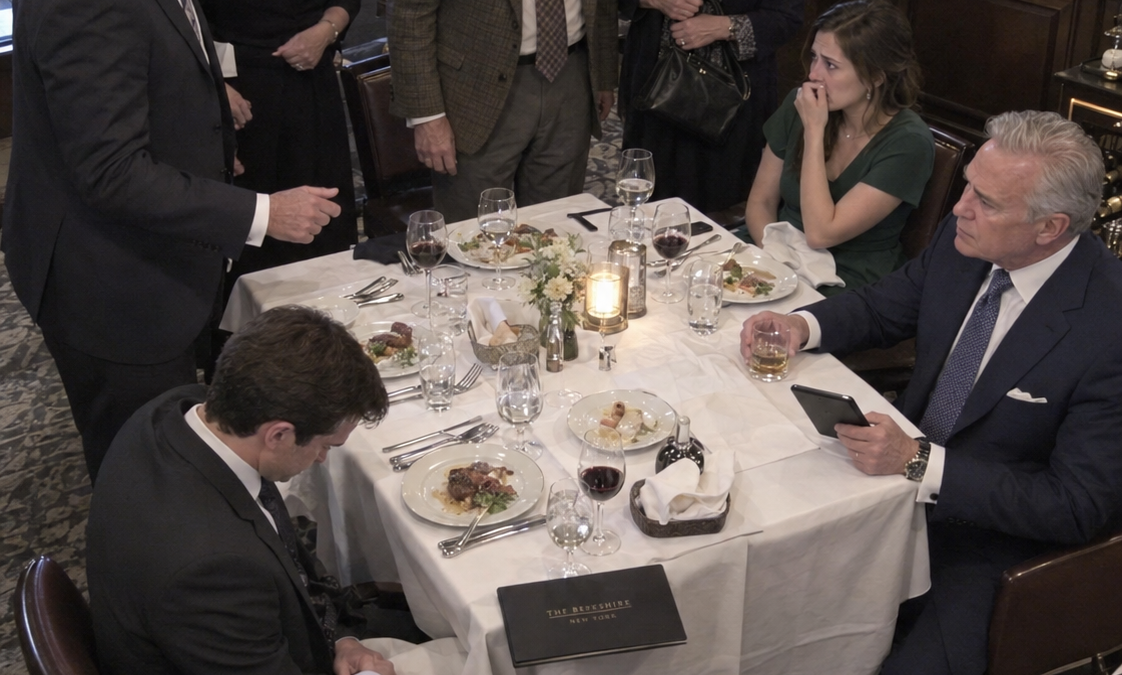
The man across the table had just told my brother, in front of a room full of strangers, that his family did not sit with ordinary people. Then he looked at me and smiled, the way a man smiles when he believes the evening is already won.
I didn’t raise my voice. I didn’t push back my chair. I took out my tablet and spoke one quiet sentence to a woman on the other end of the line. Forty seconds later, his phone began to buzz against the white tablecloth, and I watched the color leave his face.
The restaurant was called Aurelia, and it sat on the twenty-eighth floor of a glass tower on Park Avenue. The kind of place where the bread arrives under a linen cloth and nobody mentions prices because nobody has to.
I arrived twenty minutes early, a habit I picked up in my first year as a mechanical engineer and never lost. Early meant I could watch a room before it started watching me.
I wore my navy suit, the one my late wife Margaret had talked me into eleven years ago. My watch was a steel Seiko with a scratch across the crystal I had never bothered to fix. The hostess glanced at it when she took my coat. It was a small glance, quick and polite, and I understood it perfectly.
I had been getting that glance most of my adult life, and I’d come to find it useful. People who measure you by your wrist rarely look any closer.
Emily came in a green dress, her hair pinned up the way her mother used to wear hers. She kissed my cheek and held my hand a beat too long.
“Dad, just be patient with them tonight. Please.”
“I’m always patient.”
“I know,” she said. “That’s what worries me.”
She laughed, but it never reached her eyes.
The Whitmores arrived at seven sharp, and the room seemed to rearrange itself around them. Richard was sixty-seven, tall and silver-haired, in a charcoal suit that looked poured on. He walked like a man who had never once been told no by a maître d’.
Patricia followed in a triple strand of pearls, her eyes taking inventory of the room and then of me. Daniel came last, thirty-three, with his father’s jaw and, thank God, none of his father’s stride. He shook my hand firmly and held my gaze. I had always liked that about him.
“Oliver Hayes,” Richard said, gripping my hand once and releasing it as if he’d timed it. “Daniel tells me you’re in shipping.”
“Logistics. Industrial, mostly.”
“Ah, trucks,” he said warmly, the way you’d say puppies to a child.
Richard ordered a Bordeaux without opening the wine list and told the sommelier it was for the table, though he never asked what I drank. Over the appetizers, he wanted to know where I lived.
“A modest colonial in Westchester,” I told him. “The same house for twenty-two years.”
“Twenty-two years?” he repeated, as though I’d confessed to a prison sentence.
Patricia asked what I drove.
“A Ford.”
“A Ford,” she repeated to no one in particular.
Then Richard turned the conversation to himself, which required no effort at all. Lunch with a senator, a weekend on a hedge fund manager’s boat off Nantucket, a CEO who owed him a call. He scattered names across the table like seed, and every one of them landed on my side.
I nodded and ate my salmon.
Margaret used to say, “The loudest bell in the room is always the cheapest metal.” I thought of her then. I think of her often at tables built for two.
Emily tried three times to steer us elsewhere. The florist, the venue, Daniel’s work at the foundation. Each time, Richard let her finish, smiled, and returned to himself.
Under the table, her knee bounced against mine. Daniel studied his plate. Once, he began, “Dad, maybe we—”
Richard lifted a single finger.
Daniel closed his mouth.
I watched that finger, and I watched my daughter watch it, and something in my chest went quiet and cold.
I should admit something. Nine days earlier, my team had flagged a problem and left a document on my desk. Unsigned. I told myself it could wait until after the wedding. I told myself a great many things.
Dessert menus had just arrived when the maître d’ appeared at Richard’s shoulder.
“Mr. Whitmore, two more guests of Ms. Hayes have arrived. We’d be glad to extend the table.”
My brother Frank stood behind him. Sixty-six, a retired union electrician in a tweed sport coat, his hair still damp from the rain. Emily had invited him and his wife, Lorraine, because she wanted someone from my side who would laugh loudly and mean it.
Richard didn’t even turn around at first. Then he looked Frank over. The tweed, the damp hair, the hands that had spent forty years inside electrical panels.
And then he spoke to the maître d’ in a voice pitched for the whole alcove.
“We only sit with the elite. We don’t entertain ordinary people.”
Nobody moved.
Lorraine’s smile folded in on itself. Frank, God bless him, simply nodded once and began to step back, the way a man does when he’s been told to wait outside a hundred times.
Daniel lowered his head, his ears burning red, and said nothing.
Emily turned to me. The fear in her eyes was so naked I almost couldn’t bear it. She expected a storm.
I set down my glass instead.
“Are you sure that’s the standard you want to use tonight?” I asked.
Richard laughed.
“I’m protecting family standards, Oliver. Somebody has to.”
“Of course.”
I slid my tablet from my jacket and made a call.
“Nora, it’s Oliver. Cancel Whitmore Holdings’ corporate credit facilities. Effective immediately.”
Richard laughed again, louder.
Then his phone began to shiver against the tablecloth. Again and again. He glanced down.
The text was from his CFO.
“Richard, we have a serious problem. The bank just suspended our corporate credit lines.”
The color left his face slowly, like water draining from a glass.
“You have spent the evening telling me what separates your world from mine,” I said. “Tonight, you’re about to find out.”
Let me go back a little, because you can’t understand what happened at that table without knowing how I came to be sitting at it.
I grew up in Dayton, Ohio, the son of a machinist and a school secretary. My father used to say, “A good machine tells you what’s wrong with it if you’re willing to listen.”
I carried that into my first job designing conveyor systems for a freight company outside Cleveland. Later, I carried it into a rented warehouse in New York with one used truck, two loading docks, and Margaret doing the books at our kitchen table.
We called it Hayes Freight Systems.
For six years, I slept badly and paid my drivers before I paid myself. The company grew the way a foundation grows, mostly out of sight. Warehouses became distribution networks. Distribution networks became stakes in manufacturers, in commercial buildings, and in the lenders who financed them both.
By fifty-five, I owned most of a private group that moved a meaningful share of the cargo through three East Coast ports. I never took it public and never gave an interview. Margaret and I agreed early that money would be a tool and never a costume.
She died seven years ago, in March, when the Westchester garden was still brown. Afterward, I sold the boat we’d barely used and kept the house because her tomato stakes were still in the yard.
People assumed I’d gone gray and simple out of grief. Maybe I had. But I also found I liked being underestimated. It saved time.
Now, the part that matters.
Four years ago, Whitmore Holdings lost its largest contract, and the banks got nervous. Richard needed a credit facility, and quickly. A syndicate agreed to provide it, but only with a backstop.
And the backstop came from a lender called Harborline Finance, which sits under Hayes Capital, which sits under me.
Richard dealt with bankers and lawyers. He signed what they put in front of him and never once asked whose name stood behind the guarantee.
Men like Richard rarely look at the foundation. They look at the penthouse.
I want to be precise here, because precision is the only thing that separates a principle from a tantrum.
I did not run Whitmore Holdings. I had no seat on its board. What I had was a contract, and the contract had covenants: limits on related-party spending, minimum coverage ratios, quarterly reporting.
Nine days before that dinner, Nora Castellano, my chief of staff, had put a default notice on my desk. Richard’s cure period had expired, and under the agreement, Harborline had every right to suspend the facility.
I told her to hold it.
I didn’t want to blow up my daughter’s engagement season over a spreadsheet. So the notice sat there unsigned while Richard talked about senators.
Daniel had once described me to his father as “comfortable but ordinary.” Emily told me this later, wincing, and I laughed until I had to take off my glasses.
Comfortable but ordinary. I thought it was the nicest thing anyone had said about my life in years.
Emily herself knew I had money. She did not know how much, and I had arranged it that way deliberately. I wanted her to build her life out of her own materials. A girl who learns her father owns half the docks starts to wonder whether her successes belong to her.
Back at Aurelia, the room had gone so silent I could hear the ice settle in somebody’s water glass.
I stood, walked around the table, and put a hand on Frank’s shoulder.
“Frank, Lorraine, please sit down. Next to me.”
The maître d’ looked at Richard. Richard looked at nothing.
Two waiters brought chairs without a word, and Lorraine lowered herself into hers with her purse clutched in her lap like a life preserver.
Frank leaned toward me.
“Ollie, I can go. It’s no big deal.”
“It’s a big deal to me.”
Patricia had stopped moving altogether, one hand frozen at her pearls. Daniel stared at his father’s phone as it kept lighting up, face down, shuddering across the cloth.
Richard snatched it up, read it, and stood so abruptly his chair scraped the floor.
“A word, Oliver. Outside.”
The hallway by the elevators was all brass and mirror, with Park Avenue glittering far below through a window the height of a wall.
Richard kept his voice low, but his hands betrayed him. They wouldn’t stay still. They kept straightening a tie that was already straight.
“Whatever this is,” he said, “it’s a misunderstanding. I’ll speak to your brother. I’ll apologize if it’ll settle things. Just call your people and reverse it. We can both be reasonable.”
“You think this is about my brother, don’t you?”
“No, Richard,” I said, keeping my voice level. “You didn’t lose your credit because you insulted me. You lost it because your company violated the terms of the facility. The cure period expired nine days ago. I held the notice because I wanted my daughter to have a nice dinner.”
He stared at me.
“Harborline is a bank.”
“It’s a lender. Mine.”
He gave a short, brittle laugh, the laugh of a man checking a pocket to be sure it still held his wallet.
“You expect me to believe that? A man who drives a Ford?”
“I expect you to read your own contracts.”
I let that sit.
“I never wanted you to bow to me. I wanted you to treat my family decently. A man’s worth isn’t the size of the table he’s allowed to sit at. I’ve believed that since my father’s shop in Dayton, and no amount of money has ever changed my mind. Money should never decide who deserves respect.”
Richard’s mouth opened and closed for the first time all night. He looked his age.
Behind me, my phone vibrated once. It was an email from Nora.
I read it, and I felt something settle in my stomach, heavy as a stone dropped in a well.
“Oliver, the audit package is ready. We found more than the covenant breach.”
I didn’t open Nora’s file in that hallway. Some things deserve a quiet room and a clear head, and I had neither yet.
I went back to the table, finished a cup of coffee I didn’t taste, and let Frank tell Lorraine a long, rambling story about a transformer fire in Patterson because I wanted my daughter to hear someone at the table laughing.
Richard never came back. Patricia left ten minutes after him, her pearls catching the candlelight on the way out.
Daniel stayed. He sat very still, and when the check came, he reached for it before I could.
I let him.
It was past eleven when I got home.
The house in Westchester smelled the way it always does, like old books and the lemon oil Margaret used on the banister. I never changed that.
I poured a short bourbon, sat at the kitchen table where this whole thing began, and opened the file.
Nora is thorough in the way good engineers are thorough. Tabs, footnotes, a one-page summary that I read first, and then 140 pages that I read twice.
By midnight, the picture was clear, and it was not the picture Richard had painted over his Bordeaux.
Whitmore Holdings was a handsome building with a cracked foundation.
The company had drawn on its credit lines almost to the ceiling, quarter after quarter, using new money to service old debt. Two large loans came due within eighteen months and had no refinancing lined up. Half the real estate was pledged as collateral for debts Richard had described to his board as temporary.
And running through the ledgers like a vein through marble was the spending.
A corporate jet leased for the family’s use. A Hamptons house carried as a client hospitality asset. A country club, a wine cellar, Patricia’s charity galas, and a landscaping bill for a private residence in Greenwich.
All filed under business expenses.
Whatever kind of man Richard was, he was not stealing in the dark. He was spending in the light and hoping nobody would add it up.
I read that section three times because I wanted to be fair.
A man can be vain and foolish and still not be a criminal. I had no intention of inventing a crime to match my mood.
Those entries violated our related-party covenants. They were sloppy, arrogant, and probably aggressive on the tax side. But in the end, they were the sort of excess that auditors flag and lawyers argue about, not necessarily the sort that sends a man to a courtroom.
I wrote that on a legal pad in my own handwriting so that in the morning I couldn’t tell myself a different story.
What troubled me most was the correspondence.
Whitmore’s CFO, a careful man named David Okafor, had written Richard eleven times in eighteen months. Memos, then firmer ones, then one in March that used the word urgent twice.
Richard’s replies, when he sent any, were two lines long.
“Handled. Banks won’t blink.”
He had looked at a warning light and decided it was decoration.
He believed, truly believed, that his name on a letterhead was collateral, that a man who dined with senators did not get called by lenders.
I set the pages down.
I’d spent the evening being looked over as a man of no consequence, and now I understood the sad little secret of it.
Richard needed every table, every name, every raised finger at his son, because underneath the polish, he knew exactly how thin the ice was.
My phone rang at 12:40.
“Emily?”
“Dad.”
Her voice was small and raw, the voice she had at nine when a thunderstorm kept her up.
“I’m so sorry about Uncle Frank. About all of it. I should have known better than to put you in that room.”
“Emily, stop.” I rubbed my eyes. “You don’t need to apologize for someone else’s arrogance.”
She was quiet. I could hear her breathing and the soft tick of a clock somewhere in her apartment.
“Daniel’s here. He hasn’t said much. He’s been walking back and forth since we got home.”
A pause.
“Dad, what exactly did you do?”
I thought about how much of it to tell her. A father can lie to protect a child, and a father can also withhold something until it won’t break her.
I chose the second.
“I protected my company,” I said. “Nothing more.”
“That’s not an answer.”
“It’s the one I can give you tonight. I promise there’s more, and I promise you’ll hear it from me.”
She exhaled, and I heard Daniel’s voice somewhere behind her, low and stunned.
When she came back on, her tone had shifted.
“He wants to tell you something. Can I put him on?”
Daniel’s first words came out raw.
“Mr. Hayes, I’m ashamed. Not just of tonight. My father has talked about you for two years like you were something he scraped off his shoe. ‘He doesn’t belong,’ he’d say. ‘A nice man who got lucky.’ I let him. I told myself it was just his way.”
He stopped, then went on.
“But tonight, when his CFO texted him, Dad’s hands were shaking. I’ve never seen that. And I started wondering what else he’s been calling handled.”
“Take it slowly,” I said. “Find out what you can. Don’t accuse him. Ask.”
“Yes, sir.”
I hung up and sat there with the pages and the bourbon, the old house ticking around me like a patient thing.
I learned the rest the following Tuesday from Okafor himself, over coffee in a diner near Hayes Capital.
He told it plainly, like a man who had rehearsed it for weeks.
At eight the morning after the dinner, Richard called an emergency session of his executive committee on the forty-first floor. Nine people around a mahogany table. Nobody touching the pastries.
Okafor laid out the numbers. Without the facility restored, Whitmore would run short of cash for payroll and vendors within three weeks, maybe less.
Richard pounded the table.
“Whoever did this is trying to destroy me.”
“No, Richard,” Okafor said, and he told me his own voice surprised him. “Whoever did this read your contracts.”
Silence.
Then Okafor slid a single sheet across the table, one he’d pulled that morning. The guarantee page of the credit agreement Richard had signed four years earlier without a second glance.
Richard looked down at the name of the entity beneath the line that said Backstop Provider.
Harborline Finance, a wholly owned subsidiary of Hayes Capital.
Okafor said Richard read it, then read it again, and for a moment the whole room could hear the building’s ventilation.
Then Richard looked up, and for the first time since anyone at that table had known him, he asked a question he did not already know the answer to.
“Who the hell is Oliver Hayes?”
Richard Whitmore spent the next four days doing what he should have done four years earlier.
He read. I know because Nora kept a log.
His people called bankers, two law firms, a retired SEC attorney, and a reporter at a financial daily who had covered every deal in the Northeast for thirty years.
Every call came back with the same thin answer.
Hayes Capital. Privately held. No press. No photographs.
The reporter, Nora said, had told Richard’s assistant that he’d never heard of me, and that this was exactly what made it interesting.
What they eventually pieced together was most of the story.
Hayes Logistics Group. Forty million square feet of warehouse space from New York to Savannah. Commercial buildings in New Jersey and Pennsylvania that Margaret and I had bought one at a time, mostly in years when nobody wanted them.
Two manufacturing plants in Ohio, not far from the street I grew up on. A private lending arm that never advertised because it never needed to.
And buried in an exhibit to a four-year-old credit agreement, a single guarantee from a subsidiary called Harborline.
Okafor told me later that Richard found that page and then pulled the original term sheets from the archive himself, which he hadn’t done since his twenties.
He saw the date the syndicate had balked, the date the guarantee arrived, and the three-day gap between them.
The roof over his company, the one he’d shown to senators, had been built on my signature.
I think that was the moment he understood the real shape of his problem.
I didn’t need Whitmore Holdings to fail in order to win anything.
I only had to stop standing underneath it.
He came to my house on Saturday morning.
I was in the backyard in my oldest flannel, retying one of Margaret’s tomato stakes with garden twine, when I heard the car. A black Mercedes, a driver who stayed behind the wheel.
Richard got out alone and stood at the end of my driveway beside my Ford. For a long moment, he just looked at it.
I couldn’t tell what he was thinking. I’m not sure he could.
“Oliver.”
“Richard. Coffee?”
He followed me into the kitchen and sat where I pointed, at the scarred oak table, with his coat still on.
He looked around at the worn linoleum, the dented kettle, the school photo of Emily with her missing front teeth that I’d never taken off the refrigerator.
His eyes kept moving like a man in a foreign airport, searching for a sign he could read.
I set a mug in front of him.
He didn’t touch it.
“I owe you a conversation,” he said finally. “I was out of line the other night. Things were said at that table that shouldn’t have been. I’m prepared to put that behind us, and I trust you are too.”
“Put what behind us?”
“The dinner. Whatever happened at dinner.”
He spread his hands.
“We’re going to be family. Surely we can be adults about it.”
“You think dinner caused this?”
He opened his mouth, and nothing came out.
I went to the counter and brought back the folder Nora had assembled. It was a plain manila file, not thick.
I laid it between us and opened it, setting out the pages one at a time without commentary.
Eleven memos from David Okafor. Three formal compliance notices from Harborline’s covenant desk, each stamped as received at Whitmore’s headquarters. A quarterly coverage report with two numbers circled in pencil.
“Your company has been unstable for eighteen months,” I said. “Everyone in your building has known it but you, or you knew it and decided it didn’t count.”
His jaw tightened.
“Rates have been brutal. The market—”
“Rates were brutal for everybody. They didn’t lease the jet.”
He flinched, barely.
It was the first honest movement I’d seen in him.
Then he looked away, out the window above the sink, where the yard was going gold at the edges.
And when he spoke again, his voice had lost its polish.
“My father owned a hardware chain in Scranton,” he said. “Four stores. When I was fourteen, he lost every one of them in a single year. We moved into my aunt’s basement. I watched men who used to shake his hand cross the street.”
He swallowed.
“I swore, Oliver. I swore I’d never look like that. Not for a day.”
I hadn’t expected that.
I sat with it because it explained something and excused nothing.
A boy who learned that people are measured by their tables had grown into a man who spent forty years building the finest table money could buy.
It was a real wound.
It was also no reason to hand it down to my brother, who had done nothing but arrive wet from the rain.
“I understand that more than you think,” I said. “But I won’t finance it.”
Then I made him the only offer I’d decided to make.
Whitmore Holdings could be restructured, and the facility restored in stages. In exchange, Richard would accept an independent board with real authority, step back from sole control, and agree that not one more dollar of company money would go to personal expenses.
It wasn’t generous.
It was survivable, which is a different and better thing.
He read the single-page term sheet twice. His face went red from the collar up.
“You want my company?”
“I don’t want it at all,” I said. “I’m not taking your company, Richard. I’m giving it a chance to survive on your terms. On terms that keep four hundred people employed.”
He pushed back from the table and stood, the chair legs shrieking against the linoleum.
He stood there buttoning his coat with fingers that didn’t want to cooperate.
At the door, he turned, and the old Richard flared back to life, brittle and bright.
“You think you can control my family?” he said. “Because your daughter is marrying my son?”
I looked at him for a long moment.
Through the window behind him, the tomato stake leaned a little where I had tied it.
“No,” I said. “That’s exactly why I won’t.”
I wasn’t there for most of what came next. A father gets the story secondhand, in pieces, from the people who love him enough to tell it straight.
Emily gave me the first piece that same Saturday night, sitting on the edge of her bed because she thought I needed to hear it from her and not from a lawyer.
She had learned the truth about Whitmore Holdings the way you learn about a leak in your ceiling, by standing under it.
Daniel had spent the week doing what I told him to do. He asked questions, then pulled records, then sat on the floor of their apartment with a laptop and a legal pad, going quiet in a way she’d never seen.
By Friday night, he knew nearly everything.
The coverage ratios. The maturing loans. The jet. The Hamptons house carried as client hospitality.
What hit him hardest wasn’t the numbers. It was the dates.
Okafor’s first warning memo was eighteen months old, and Daniel had sat through a dozen Whitmore family dinners since then, listening to his father talk about acquisitions.
Emily told me she watched him read the last page and fold his hands over it like a man holding down a loose roof.
On Sunday, he drove out to his parents’ house in Greenwich. Emily went with him, and she told me she nearly stayed in the car.
Richard received them in his study, a room of dark wood and leather spines that I suspect nobody had ever opened. Patricia hovered in the doorway with a glass of white wine.
Daniel didn’t sit.
He set the pages on his father’s desk and asked, in a voice Emily said she hardly recognized, whether it was true.
Richard’s first move was the one he knew best.
He turned the problem into a villain.
Oliver Hayes had ambushed him, he said. Had planned the whole thing. Had been lying in wait for years to drag the Whitmore name through the mud because he couldn’t stand being looked down on.
A man like that, Richard said, would use his own daughter’s wedding as a lever.
“Did you really call Emily’s father ordinary?” Daniel asked.
Emily said the room went still enough that she could hear the clock on the mantel.
Richard straightened his cuffs.
“I was protecting you. You don’t understand what it costs to build a family like this. The people we associate with. The doors that open.”
“No,” Daniel said gently, which made it worse. “You were protecting your ego.”
Patricia made a small sound.
Richard stared at his son as if a piece of furniture had spoken.
Emily said it was the first time in thirty-three years she’d seen Daniel stand fully upright in that house.
I held the phone a little tighter when she told me that part.
I thought of him at Aurelia, head bowed, ears burning, while his father lifted a finger.
A man doesn’t change in a day, but he can decide in a day that he’s finished with who he was.
Then Emily came to see me in person on Monday evening, and she sat across from me at the kitchen table where her mother had helped her with fractions.
“I don’t want this to be a war,” she said. “Between you and Richard. Between our families. I don’t want to marry into a battlefield.”
“Then don’t let it be one.”
“That’s easy for you to say.”
“It’s the hardest thing I’ve ever said, actually.”
I turned my mug in my hands.
“Listen to me, Em. I will never stand in the way of who you marry. Daniel is a good man, and I’d be proud to call him my son. But I won’t let anyone make you feel small because of where you come from. Not him, not her, not anyone. That’s not a negotiation. That’s just who I am.”
She nodded slowly.
After a while, she laughed, wet and surprised.
“You’ve been sitting on all this for years. Mom knew, didn’t she?”
“Your mother knew everything. She just had the good sense to keep it quiet.”
I learned about Patricia’s attempt a few days later, and I’ll admit, it made me wince.
She’d invited Emily to lunch at her club, ostensibly to discuss the seating chart, and over a salad, she laid a manicured hand on my daughter’s wrist.
Emily was a lovely girl, Patricia said. But sweetheart, she needed to understand she was marrying into a different class with different obligations.
There were expectations, a certain way of doing things. It would be an adjustment, and she’d be happier if she started now.
Emily set down her fork. Her voice, she told me, was perfectly even.
“Maybe I don’t want your class.”
Patricia blinked.
And that was all. There was nothing left to say.
Emily paid for her own lunch and walked out past the hostess into an afternoon so bright she had to stop on the curb and laugh.
Richard played his last card two days later.
He summoned them both to his office and laid out terms as if he were closing a deal.
The wedding would be held at the Whitmore standard. One hundred eighty guests at the Pierre. I would be expected to cover a substantial share, and Emily would sign a prenuptial agreement drafted by his firm, with language protecting what he called the family’s assets.
I read that agreement later.
It was four pages of fear.
Emily said no. She said it kindly, and she said it once.
Then she looked at Daniel, and I understand that he took a long breath.
“We’re not signing it, Dad. And we’re not doing the Pierre.”
Richard’s face changed color.
“Then I’ll tell you what happens. If you won’t follow the family’s wishes, there will be no wedding. I will not bless it.”
“Then you’re the one ending your son’s marriage,” Daniel said. “Not us. Not Emily. You.”
He took Emily’s hand, and they walked out together.
Nobody stopped them.
Nora called me at ten that night.
I was in the den with the lamp low, a book open on my knee that I hadn’t read in an hour. She spoke quickly, the way she does when something has been bothering her all day.
“Oliver, our counsel just got a flag from the secured lenders group. Richard’s attorneys have been quietly drafting transfer papers, retitling the Greenwich house, the Hamptons property, and a brokerage account into trusts that name Patricia. All dated this week.”
I set the book down.
Moving personal assets out of reach before a restructuring was exactly the kind of thing the law has a name for. And it wasn’t a name I wanted to say about my daughter’s father-in-law.
“How sure are we?”
“Sure enough that you should call someone tonight.”
I looked at the photograph on the mantel. Margaret at the lake in a sun hat, laughing at whoever held the camera.
Then I picked up the phone.
I did not call a prosecutor that night.
I called Walter Brandt, my attorney of nineteen years, a dry, careful man who had once talked me out of suing a supplier over a clerical error.
He listened to Nora’s summary without interrupting. When I finished, he was quiet long enough that I checked the line.
“Oliver,” he said. “What do you want out of this?”
I thought about it honestly.
I thought about Richard’s hands shaking in that hallway and the boy in his aunt’s basement watching men cross the street.
“I want the truth on paper,” I said. “If it’s a crime, it goes to the people whose job that is. If it’s only foolishness, I won’t touch it. I won’t make a felon out of a fool because he insulted my brother.”
“Good,” Walter said. “That’s the only way you keep your own hands clean.”
It took eleven days.
Walter’s forensic accountants and Nora’s team went through every transfer, every retitled deed, every date. I stayed out of the room on purpose.
If a man’s guilt depends on how much you dislike him, you’ve already stopped being fair.
The answer came back on a Thursday, and it was a mixed one.
The retitling of the Greenwich house and the brokerage account was a family estate-planning move that had been in motion for a year, long before Aurelia, and the lawyers who prepared it had documented it carefully.
Legal, if unflattering.
But one transfer, a block of Whitmore preferred shares moved into a trust only weeks earlier, sat on the wrong side of the line.
It had been done without notice to the secured lenders, and the agreement required notice.
That was a breach, and the lenders group had every right to treat it as one.
Walter laid it out for me over lunch.
“You can do two things. Hand it to the lenders and let them decide. Or you can sit on it.”
“I’ll do the first,” I said. “I won’t be the one who decides what happens to Richard. I’ll be the one who makes sure the people entitled to decide have the facts.”
The emergency shareholders’ meeting was called for the following Wednesday.
In the same forty-first-floor conference room where Okafor had first slid that page across the table, I was told to sit at the far end.
I wore my navy suit, and I brought a single folder.
Richard arrived last, in a charcoal suit, his hair freshly cut. He had the posture of a man walking into his own coronation, but the room had changed since he’d last held it.
Eleven people sat around that table, including two directors I’d never met and the lenders’ representative, a quiet woman named Helen Marsh with reading glasses on a chain.
Everyone there had read the liquidity report.
Nobody looked at Richard the way people look at a king.
He opened with a speech about heritage and resilience and the long arc of the Whitmore name.
Nobody interrupted him.
Nobody needed to.
When he finished, the silence did the work.
Then Helen Marsh asked me politely if I’d like to address the group.
I stood.
I did not raise my voice. I’ve found that when you have the documents, you don’t need to.
“I’m here as a creditor and a strategic investor,” I said, “not as an adversary. I’d like to present facts and then three options. And then I’ll sit down.”
I passed out the folders.
I walked them through the coverage ratios, the maturities, the lease schedule, and the one trust transfer made without notice.
I didn’t characterize it. I let the page do that.
I saw Richard’s eyes drop to the paper and stay there. And I saw something in his face rearrange itself, the way a building looks just before a controlled demolition begins.
“Option one,” I said. “Richard steps down as CEO and keeps a meaningful share of his personal holdings. Option two, an independent board takes over operations and restructures the debt, and I will refinance on conditions. Option three, if neither is acceptable, the facility stays suspended under the terms of the contract Richard signed. I will not be the one to rescue a company from its own agreement.”
I put the folder down.
“That’s all. I’d only add that 412 people draw a paycheck from this building. They did nothing wrong.”
For a long time, nobody spoke.
Then a director named Alan Pruitt, gray and gentle, who had served on the board since Richard’s father’s day, cleared his throat.
“Richard,” he said with obvious pain. “This isn’t about Oliver. This is about whether the company survives.”
Richard looked at him for what felt like a full minute.
Then he looked at me, and I saw the whole thing cross his face.
The basement in Scranton, the senators, the long climb, and the awful discovery that the climb had been paid for with borrowed rope.
He took a pen from his jacket.
His hand didn’t shake.
I’ll give him that.
“I’ll step down,” he said.
The vote was unanimous.
Helen Marsh moved that an interim chair be named, and Pruitt accepted. The restructuring would begin within the week.
Nobody lost a job that quarter, and I signed the conditional refinancing before the afternoon was over, with one clause in it that Walter had drafted and I had insisted on.
Company money could no longer pay for any executive’s personal life.
Not a jet, not a golf membership, not a landscaper in Greenwich.
Richard kept the house, the bulk of his personal wealth, and enough to live comfortably for the rest of his years.
What he lost was the title, and I suspect that was the part that cost him most.
The trust transfer was resolved through the lenders without a lawsuit. The shares returned, the notice finally given.
I never told anyone how close it had come to going the other way.
People have asked me since whether I felt satisfied.
I felt tired, mostly.
I felt the way you feel when you’ve carried something heavy up a long flight of stairs and set it down at last, and you’re not sure whether to be proud or simply glad it’s over.
He called me on the Friday before the wedding.
I was in the garden, kneeling among Margaret’s tomatoes, a trowel in one hand. I almost let it go to voicemail.
“Oliver.”
His voice was thin, stripped of all its old music.
“I’ve been rehearsing this for a week. I don’t think I’m good at it.”
“Take your time.”
“I owe you an apology.”
I looked at the tomato plants, heavy and crooked in the late light.
I thought about Frank’s hands, the hostess’s glance at my watch, and my daughter’s knee bouncing against mine beneath a linen cloth.
“Not to me,” I said.
He was quiet.
And then, very softly, I heard him say, “No, I suppose not.”
The Whitmore-Hayes wedding took place on a Saturday in late October, in a stone chapel in the Hudson Valley, with maples turning outside the windows.
Ninety guests. No ice sculptures, no string quartet imported from Vienna, no step-and-repeat banner for photographers.
Patricia had wanted the Pierre until the very end. Then, in the last week, she simply stopped mentioning it.
Emily never asked why.
Some surrenders are better left unexamined.
I wore the navy suit and the steel Seiko with the scratched crystal.
Frank came in his tweed jacket with Lorraine on his arm, and Emily had them seated in the front row, directly behind where the groom’s parents would sit.
I did that on purpose, and so did she.
Before the ceremony, I stood alone in a small side room, straightening a tie that was already straight.
Funny how that habit travels.
I thought about Margaret. I thought about how she would have cried before the first hymn and pretended it was allergies.
When the door opened, I assumed it was the coordinator.
It was Richard.
He wore a plain dark suit, no pocket square, no cuff links I could see. He looked smaller somehow, and older, but also strangely easier to look at.
He stood with his hands at his sides, not knowing where to put them.
“I won’t take much of your time,” he said. “I wanted to say it to your face. I was wrong about you, Oliver.”
I considered several replies.
Most of them were satisfying.
None of them were true.
“You were wrong about what makes a person valuable,” I said. “I’m only one example. Frank is another. So is Okafor, who tried to warn you eleven times.”
He nodded slowly, taking that in like a man swallowing medicine.
“I’ve spoken to David. I asked him to stay on. I asked him to keep telling me things I don’t want to hear.”
“That’s the best thing you’ve said to me yet.”
He gave a short, unsteady laugh.
Then he did something I didn’t expect.
He turned and walked out to the front pew where Frank sat with his hands folded on his knee.
I watched through the doorway as Richard Whitmore, formerly of Whitmore Holdings, stopped in front of a retired electrician in a tweed jacket.
I couldn’t hear all of it.
I heard unforgivable, and I heard your table.
I saw Frank look up at him for a long moment, and then I saw my brother do what he has always done.
He stood, put out his big, scarred hand, and said, “Water under the bridge. But sit down before you fall down.”
Richard sat.
His shoulders shook once, quietly.
And Lorraine, bless her, passed him a tissue without a word.
He found Emily afterward in the bridal room, and I’m told he knelt in front of her chair, which a man like Richard does not do.
He told her she had been good enough from the first day she walked into his house, and that the failure of imagination had been his, not hers.
Emily told me she cried so hard she nearly ruined her makeup.
And then she forgave him because she is her mother’s daughter.
Patricia took longer.
She stood at the back of the chapel in a pale blue dress, her pearls gone, one hand gripping the other.
When Emily walked past on her way to the aisle, Patricia reached out and touched her sleeve.
“You look beautiful,” she said.
It was the first thing she had ever said to my daughter that wasn’t an instruction.
Emily squeezed her hand and kept walking.
I walked my daughter down the aisle.
Her arm was steady in mine, and mine was not as steady as I’d have liked.
At the altar, I lifted her veil, kissed her forehead, and placed her hand in Daniel’s.
“Take care of each other,” I said quietly, just for them.
Daniel’s eyes were bright.
“Mr. Hayes, I understand now why you never told Emily how much you had.”
“Why is that?”
“Because you wanted her to know who she was before she knew what you owned.”
I couldn’t answer.
I patted his shoulder and went to sit beside my brother.
At the reception, held in a barn strung with plain white lights, they asked me to say a few words.
I drafted a speech in my head three different ways, and every version had a little barb tucked inside it, a gentle reminder of the night at Aurelia.
I put all of them down.
A father’s toast is not a place for scorekeeping.
“Margaret used to say that a marriage is a long dinner,” I began. “You’ll sit across from the same person through good meals and bad ones, through fights about the check, through years when neither of you is hungry. What matters is who you want sitting there.”
I raised my glass.
“A family isn’t built by the names on a guest list. It’s built by the people who stay when nobody is watching. Emily, Daniel, may you always be that for each other.”
The room rose.
Frank whistled through his teeth.
Across the barn, Richard stood with the rest, his glass lifted, tears running openly down a face that had spent sixty-seven years learning to hide them.
Richard and I did not become friends that night. I won’t pretend otherwise.
We became something quieter, and I think more durable.
He sits on the new board now, one voice among five, and he reads every page before he signs.
Last spring, he drove up to Westchester unannounced and helped me tie up Margaret’s tomatoes.
We hardly spoke.
It was enough.
One morning in November, Emily came by the house with two paper cups from the diner on Route 9.
We sat at the kitchen table where the light comes in sideways across the oak, and she watched me over the lid of her coffee.
“Dad, can I ask you something?”
“You can ask.”
“Did you really cut off their credit because of what he said?”
I smiled.
“No.”
She blinked.
“No, I cut it off because their numbers were bad and because the contract allowed it. What Richard said at that table only helped me understand that he was the wrong man to trust with my money.”
She laughed, then went quiet, turning her cup.
“So it wasn’t revenge?”
“If it was, it was the quietest kind there is.”
I looked out at the yard, at the bare stakes standing in the garden like a row of patient soldiers.
The man who called me ordinary never understood the difference between looking rich and being secure.
I didn’t need to destroy him.
I only had to stop carrying him.
Emily reached across the table and took my hand, and we sat that way a while, the two of us with Margaret’s light in the window.
Thank you for staying with me through this one. If it touched something in you, I’d love to hear about it.
Have you ever sat at a table where someone decided you didn’t belong? How did you handle it? And what do you wish you’d said?
Leave a comment below and tell me where you’re watching from. I read everyone.
And if you’d like more stories like this about family, dignity, and the quiet ways people find their footing, subscribe so you never miss one.
We have plenty more to share with you every single day.
So let’s keep walking this road.








