On thanksgiving while i cooked alone, my son-in-law mocked my husband: “does a nobody like you deserve this table?” my husband stood to leave, i made a call. 30 minutes later, the gate opened. 30 people in gray entered. one looked at my husband and said, “sir…”
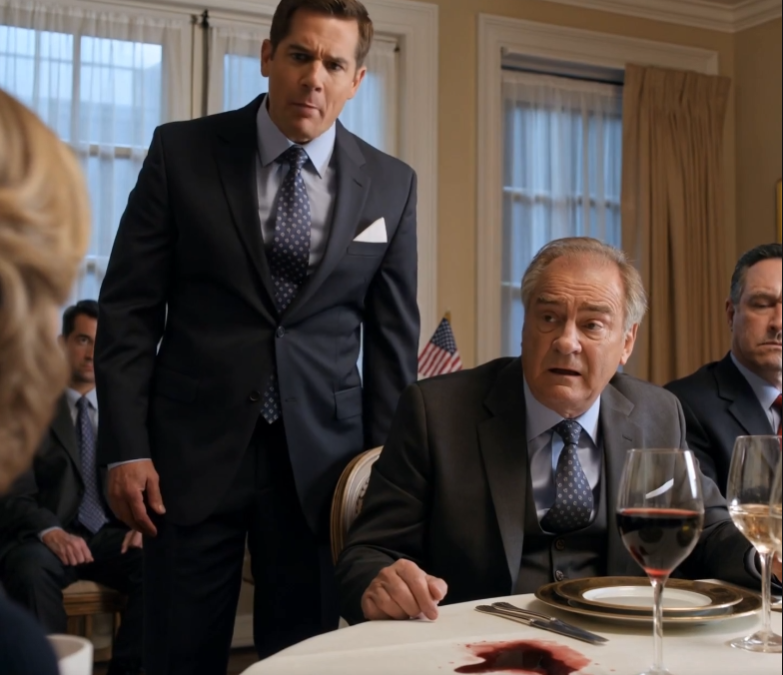
On Thanksgiving night, I had been cooking alone in that kitchen since four in the afternoon.
No one offered to help. No one said thank you.
Then my son-in-law stood up and said it in front of everyone.
“A nobody like you doesn’t belong at this table.”
My husband simply folded his napkin, apologized for the spilled wine, and walked out.
I reached into my apron pocket and sent one message.
Three minutes later, the gates opened.
Thirty strangers in gray walked in, and one of them said everything I had never been able to say myself.
Sir, this is Silent Revenge with Auntie May, and I am grateful you’re here. Tell me in the comments what city or country you’re watching from. Let’s find each other.
A note before we begin: this story weaves in fictional elements for storytelling and reflection. Any similarity to names or places is coincidental, but the heart of what I’m sharing with you tonight is something I mean completely.
My name is Marilyn Ashby, and I am sixty-seven years old. I have spent the better part of four decades learning how to make myself useful in rooms where no one particularly wanted me there.
Tonight was no different.
The kitchen of Preston and Allison’s Greenwich estate was a monument to things I would never own: marble countertops the color of fresh cream, copper pots hanging from a ceiling rack that probably cost more than Leland’s first truck, and a six-burner Viking range that I had to ask Allison how to turn on because the knobs were decorative and the actual controls were a touchscreen built into the backsplash.
A touchscreen for a stove.
I had been in there since four o’clock, my back aching, my hair pinned up and already falling loose at the temples, wrestling a twenty-two-pound turkey into a roasting pan while the catering staff Preston had hired floated around me with trays of bruschetta and glasses of Bordeaux, carefully stepping around me as though I were a piece of furniture someone had forgotten to move.
My phone buzzed against the edge of the counter.
Ruth Callaway, the screen said.
I dried my hands on my apron and answered before the second ring.
“Tell me you’re not in that kitchen by yourself again,” Ruth said.
I could hear the indignation in her voice even through the phone, sharp and warm, the way only a woman who has known you for thirty years can manage.
“I’m perfectly fine,” I told her.
“Marilyn Gene Ashby, do not lie to me on Thanksgiving.”
I almost laughed at that.
Almost.
“Tonight will be different, Ruth,” I said, keeping my voice low as I glanced through the pass-through window into the dining room, where Preston was already holding court, his voice carrying over the soft jazz playing from invisible speakers. “I promise you that.”
Ruth paused.
“You’re really going through with it.”
“Already in motion,” I said.
She exhaled a long, careful breath.
“Then God help everybody in that house tonight except you and Leland.”
We said our goodbyes, and I slipped the phone back onto the counter. Two notifications waited on the screen, both unread. The first was from a contact I had saved simply as DE. The second was from NL.
I did not open either of them.
Not yet.
The timing had to be right, and the timing was not yet right.
Through the pass-through window, I could see Leland sitting in the corner armchair near the fireplace, the one that was clearly not part of the formal seating arrangement but where he had quietly settled himself an hour ago because every other chair in the living room had been claimed by Preston’s guests.
He was wearing his good vest, the charcoal-gray one he had owned for twenty years, the one with the small pocket on the inside left where he kept things he did not want to forget.
His hands rested on his knees, and even from where I stood, I could see them trembling slightly, the way they had started doing eighteen months ago, before the diagnosis, before the word dementia had entered our lives and rearranged everything inside them.
Nobody was talking to him.
Not Allison, who was laughing at something Diane Holloway’s husband was saying near the bar cart.
Not Preston, who had not looked in Leland’s direction once since we arrived.
Not a single one of the twelve guests circulating through that gorgeous, hollow room.
My husband sat in the corner of his daughter’s home like a man waiting for a bus that was never going to come, and every person in that room walked past him as though he were part of the wallpaper.
My chest tightened so sharply it stole my breath for a moment.
I picked up my phone and looked at the two unread messages.
“Not yet,” I whispered to myself as I set it back down. “Not yet.”
From the dining room, Preston’s voice rose above the music, bright and performative.
“Make sure the Holloways feel welcome tonight, sweetheart. They’re very important to us.”
I picked up the roasting pan, squared my shoulders, and carried it toward the dining room alone, just like I had done so many things alone.
But not for much longer.
The dining room was the kind of beautiful that made you feel slightly ashamed for existing inside it.
A fourteen-foot table ran the length of the room, dressed in ivory linen and weighted down with centerpieces of white hydrangeas and eucalyptus that Allison had ordered from a florist in Manhattan. Every place setting had three forks. I had counted them when I helped lay the table that afternoon because that is the sort of thing you notice when you have spent your whole life in houses with one fork per person and were grateful for it.
Twelve guests had settled into their chairs, the kind of people who wore watches that cost more than our first home in Bridgeport.
At the head of the table sat Diane Holloway, a sharp-eyed woman in her early fifties with silver hair cut close to her jaw and the kind of posture that comes not from good breeding but from decades of walking into rooms and refusing to be underestimated.
She ran Holloway Capital, one of the largest independent investment firms on the Eastern Seaboard, and from the way Preston had been orbiting her all evening like a nervous moon, it was clear that her signature on a contract meant everything to him right now.
“Here she is,” Preston announced as I carried the turkey to the table, his voice swelling with a warmth that had never once been directed at me in private. “Marilyn made the turkey herself. Isn’t that something?”
Several guests murmured appreciatively.
Diane Holloway looked at me with calm, assessing eyes.
“That smells wonderful, Mrs. Ashby.”
“Thank you,” I said. “It’s Leland’s mother’s recipe.”
Across the table, Leland had found his way to a chair at the far end, slightly pulled back, as though he wasn’t entirely sure he was allowed to be fully at it.
He was reaching toward me now, arms extended, wanting to take the heavy roasting pan from my hands the way he had done at every holiday meal for forty-seven years.
His hands were shaking, but his eyes were clear and warm and entirely certain.
“I’ve got it, Mari,” he said. “I’ve got it.”
My heart cracked clean down the middle at those four words.
Before I could respond, Preston cut smoothly across the moment.
“Dad, you don’t need to. Just sit. Sit. We have it handled.”
He waved a hand in Leland’s direction the way you wave away a child offering to carry something too heavy for them, and Leland’s arms slowly lowered back to his sides.
The look on his face, that brief flicker of being gently erased, cost me ten years off my life.
I set the turkey down myself.
Preston was already pivoting back toward Diane, launching into something about fourth-quarter projections, and the table hummed back to life around him.
Allison smiled at something Diane’s husband said, her laugh bright and practiced and aimed entirely at the right people.
Sophie, their eight-year-old daughter, sat beside her father in a velvet dress the color of pine needles, swinging her legs under the chair and picking at the edge of her cloth napkin with the focused determination of a child who had been told seventeen times that night to sit still.
She looked up at me when I passed behind her chair and gave me a gap-toothed smile so purely her grandfather’s that my eyes burned.
Preston was mid-sentence, talking about leverage ratios and the Holloway portfolio, when Sophie straightened in her chair and, in the clear, carrying voice that only children and people with no remaining inhibitions ever truly achieve, announced to the entire table:
“Daddy, how come you told Grandpa he was embarrassing last week? You said he embarrasses you in front of important people.”
The table stopped.
Not gradually.
All at once, the way a clock stops when the battery dies.
Every conversation, every clink of silverware, every polished laugh cut off simultaneously until the only sound in the room was the faint crackle of candles in their crystal holders.
Preston’s face cycled through four distinct expressions in under two seconds. He landed on a smile that didn’t reach anywhere near his eyes.
“Sophie, sweetheart, grown-ups are talking.”
“But you did say it,” Sophie pressed with the relentless good-faith honesty of a child who has not yet learned that truth is sometimes socially inconvenient. “You said it on the phone to Uncle Garrett. I heard you from the hallway.”
Diane Holloway said nothing.
She reached for her wineglass, lifted it slowly, and looked at Preston over the rim with an expression that contained an entire verdict.
Allison’s smile had gone rigid at the corners.
Leland was looking down at his empty plate, his jaw tight, his shoulders pulled slightly inward, shrinking the way people shrink when they have spent too long being made to feel their presence is an imposition.
Then his hand reached for the wineglass near his setting, just to move it, I think. Just to have something to do with his shaking hands.
His fingers caught the stem.
The glass tipped.
The wine hit the tablecloth in a long, slow arc of deep red, spreading through the ivory linen like a wound that couldn’t be stopped.
Preston was on his feet before the glass finished rolling.
“Leland.”
His voice came out sharp and low, the kind of voice that is worse than shouting because it is so deliberately controlled.
“What is wrong with you?”
Leland looked at the spreading stain, then at his own hands, turning them over slowly as though they belonged to someone else.
“I’m sorry,” he said quietly. “I’m sorry. I didn’t mean to.”
“You never mean to.”
Preston stepped back from the table, straightening his jacket, his jaw tight with a fury he had clearly been storing up for longer than just tonight.
“That tablecloth is from Portugal, Leland. Do you understand that? It’s hand-embroidered. It costs more than you probably made in a month at that warehouse.”
The table had gone absolutely rigid.
Twelve people stared at their plates, the centerpiece, the wall—anywhere but at the two men at the end of the table.
“Preston.”
Allison’s voice was barely above a whisper.
He didn’t even glance at her.
“You know what your problem is?” Preston continued, spreading his hands wide as though he were making a perfectly reasonable point to a boardroom full of colleagues. “You have never once in your life learned how to act like a civilized man. Forty years pushing boxes around a warehouse, and it shows every single time. A nobody who never amounted to anything, sitting at a table he doesn’t belong at, breaking things that aren’t his.”
The words landed one by one, each one heavier than the last.
Leland did not flinch.
He did not raise his voice.
He did not defend himself.
He simply sat very still, his hands flat on the table, his eyes dropping slowly to the ruined tablecloth.
Something in his expression went somewhere far away, somewhere the rest of us couldn’t follow him and couldn’t bring him back from.
That look on his face—that quiet, absolute withdrawal—was the thing that broke me completely.
Allison had turned her face toward the window, her arms crossing tightly over her chest.
She said nothing.
She did nothing.
And in that moment, her silence was its own kind of cruelty.
Diane Holloway set her fork down against the rim of her plate with a small, precise click that somehow cut through the entire room.
Leland pushed his chair back slowly.
He picked up the cloth napkin from his lap, folded it with great care, and placed it on the table beside his plate.
Then he looked at me just for a moment, and what he said nearly knocked the breath clean out of my body.
“I’m sorry about the tablecloth, Mari.”
His voice was steady and soft.
“I’ll wait for you in the car.”
As though he were the one who had done something wrong.
As though the reasonable thing, the kind thing, was to remove himself so that everyone else could go on enjoying their evening undisturbed.
He walked toward the door with his shoulders back and his chin level, and not one person at that table said a word to stop him.
I stood at the end of that beautiful, monstrous table with my hands pressed flat against the linen, my chest burning with something that had no clean name. Not grief exactly. Not rage exactly. Some scorching combination of both that had been building in me for years and was now finally done waiting for permission to exist.
My phone was in my apron pocket.
My fingers found it without looking.
I did not go after him.
I know how that sounds.
I know what a person is supposed to do when her husband walks out of a room with his dignity in pieces on the floor behind him. She is supposed to follow. She is supposed to take his arm and say something that makes it better.
But I had learned over forty-seven years of marriage that there are moments when following a man is the wrong kind of love.
Leland didn’t need me to chase after him through a dining room full of people who had just watched him be humiliated.
He needed something else entirely.
Something I had been quietly building for six months.
So I stayed.
The table had shakily resumed around me, forks lifting, voices restarting in careful, artificial tones, everyone performing the collective amnesia that polite society requires after witnessing something ugly.
Preston had already retaken his seat and was saying something to Diane Holloway about the fourth quarter with a smile so smooth it made my stomach turn.
Diane was not smiling back.
She was looking at me.
I held her gaze for exactly one second, then looked away.
This was not her moment yet.
I walked through the French doors and out to the far edge of the garden, where the lights threw long gold shadows across the November grass.
And I let myself remember.
It was 1977, and Leland Ashby was thirty years old, standing in the parking lot of the diner where I waitressed on weekends, holding a ring box in both hands like it was something that might shatter if he gripped it too hard.
“I don’t have much, Mari,” he had said.
His voice was steady, but his eyes gave him away completely—wide open and terrified and hopeful in equal measure.
“I’ve got my truck and my job and three months of savings, and I know that’s not—I know it’s not what some men could offer you. But everything I have is yours. Every single piece of it, if you’ll have me.”
The ring was a thin gold band with a chip of diamond so small I had to tilt it toward the parking lot light to see it sparkle.
I had said yes before he finished the sentence.
Standing now in the cold November dark of my daughter’s manicured garden, I pressed my thumb against that same ring, still on my finger, worn smooth on the underside from forty-seven years of living.
I felt the memory move through me like a current.
He had given me everything he had.
Every single piece of it.
And for forty-seven years, I had watched other people look at what he had and decide it wasn’t enough.
Decide he wasn’t enough.
Not tonight.
From inside the house, I heard Preston laugh at something, loud and easy and completely unbothered, and the sound of it lit something in my chest that had been waiting a very long time for exactly this kind of kindling.
I took my phone out of my apron pocket.
I opened the message thread with DE and typed two words.
Now.
I pressed send before I could think about it any further because I had already done all the thinking I needed to do over the past six months.
The time for thinking was finished.
From somewhere beyond the garden wall, I heard the low rumble of engines.
More than one.
Growing closer.
I straightened my apron, lifted my chin, and turned back toward the house.
For forty-seven years, Leland had carried this family on his back without once asking to be thanked for it.
Tonight, whether he was ready for it or not, someone was finally going to say thank you loud enough for the whole room to hear.
The gates opened slowly, and the lights of three black SUVs swept across the garden in long, clean arcs before the engines cut to silence.
For a moment, nothing happened.
The party sounds from inside the house continued—the clink of glassware, the low current of conversation, Preston’s laugh rising above everything else like it always did, too loud, too confident, entirely certain of its own welcome.
Then the first car door opened.
Then another.
And another.
They came out in rows, thirty men and women in matching charcoal-gray suits moving across the gravel drive with a quiet, coordinated precision that made the air around them feel different—heavier, charged with something I could not yet name.
They were not hurrying.
They did not need to hurry.
People who know exactly what they are doing never do.
At the front of the group walked a man I recognized immediately, though we had only ever spoken by phone.
Dorian Ellsworth was fifty-eight years old, broad-shouldered, with close-cropped silver hair and the kind of face that had spent decades making difficult decisions and had made peace with every one of them. He wore his suit the way men wear things they never have to think about, as though it were simply part of him.
Behind him, one step to the right, walked Marcus Webb, Dorian’s second in command, a composed man in his mid-fifties whose job tonight was to carry a single folded piece of paper in the breast pocket of his jacket.
He had been carrying it for three days.
The guests on the patio heard them first.
Conversations faltered.
Heads turned.
Someone near the French door said, “Who are these people?” in a voice pitched halfway between alarm and fascination.
Preston appeared from inside almost immediately, his smile already deployed, his hand already extended in the reflex of a man who defaulted to networking even when he had no idea what he was networking toward.
“Can I help you? This is a private event.”
Dorian looked at Preston’s outstretched hand.
He did not take it.
“I’m aware,” Dorian said.
His voice was calm and even and carried across the patio without effort, the voice of a man who had addressed boardrooms and courtrooms and every difficult room in between.
“We were invited.”
He looked past Preston.
Entirely past him.
Through him, almost, as though Preston were a door rather than a person.
His eyes found Leland standing near the garden wall, his car keys already in his hand, his shoulders still carrying the shape of a man who had just been told, once again, that he did not belong.
Dorian walked toward him.
Preston stepped sideways to intercept.
“Now, just a minute—”
“Mr. Calder.”
Marcus Webb’s voice came from directly beside Preston, quiet and immovable as a wall.
“Please. One word.”
Preston stopped as though he had walked into something solid.
Dorian reached Leland and stopped in front of him.
He stood there for a moment, this powerful man in his perfect suit, and then he did something that made several of the guests audibly catch their breath.
He dipped his head in a slow, deliberate bow.
“Mr. Ashby,” Dorian said, his voice dropping to something quieter, something meant only for Leland and the immediate air between them. “It is an honor to finally meet you in person, sir.”
Leland stared at him, his brow furrowed deeply the way it did when he was working hard to place something just out of reach.
His keys shifted in his grip.
“I’m sorry, son,” Leland said carefully, searching. “Do I… have we met before?”
Dorian held his gaze without flinching, without any flicker of discomfort at the question.
“No, sir,” he said simply. “But I know you. I’ve known who you are for a very long time.”
The patio went completely still.
Even Preston stopped moving.
Dorian Ellsworth turned to face the crowd.
“My name is Dorian Ellsworth,” he said, his voice carrying across the patio with the ease of someone who had never once in his life needed a microphone. “I am the chief executive officer of Hallcrest Logistics. We operate forty-three distribution facilities across nineteen states and employ just over four thousand people.”
He paused, letting that number settle.
“I am also the son of Gerald and Ruth Ellsworth. And the reason I am standing in your garden tonight has nothing to do with business and everything to do with a man named Leland Ashby.”
The name landed like something dropped from a great height.
I watched Preston’s face from across the patio.
I watched the exact moment the name Hallcrest Logistics connected to something in his memory—the meetings, the proposals, the months of carefully cultivated overtures his firm had been sending to Hallcrest’s acquisitions department.
I watched the color leave his face one degree at a time, like water draining from a bathtub, slow and then all at once.
“Thirty years ago,” Dorian continued, “Hallcrest operated a distribution warehouse outside Bridgeport, Connecticut. On the night of March 14, 1994, an electrical fault ignited a fire in the facility’s main control room. The suppression system failed. Twelve workers were trapped inside before anyone fully understood what was happening.”
He stopped.
Not for effect.
For breath.
Even now, thirty years later, the telling of it cost him something.
“Every emergency protocol said to evacuate the building and wait for the fire department. Every protocol said to get out and stay out.”
Dorian turned and looked at Leland.
“Leland Ashby went in.”
The patio was so quiet I could hear the candles guttering in their glass holders.
“He went in once and brought out four men. Then he went back in a second time for the last two.”
Dorian’s voice held steady, but only just.
“He had no equipment. No training for that specific situation. He went in because there were men still inside, and he was not willing to stand outside and wait while that remained true.”
From within the group of thirty, a figure stepped forward.
He was a tall man in his early seventies, broad across the chest in the way of someone who had spent decades doing physical work, with a close-cropped white beard and eyes that were red-rimmed before he even opened his mouth.
He walked with a slight hitch in his right leg, the kind that comes from an old injury that healed mostly, but never completely.
“My name is Ray Tipton,” he said.
His voice cracked on the second word, and he pressed on through it.
“Anyway, I was the floor supervisor on shift the night of March fourteenth. I was one of the last two men Leland came back in for.”
He stopped and cleared his throat hard.
“I have a daughter who is thirty-one years old. I have two grandchildren. I coached youth baseball in Fairfield County for eighteen years.”
He looked directly at Leland, and his chin trembled with the effort of holding himself together.
“None of that exists without you, Leland. Not one day of any of it.”
Leland’s hand came up and pressed flat against his own chest as though he were trying to hold something inside himself that was threatening to come loose.
His eyes had gone bright and glassy, and his lips were pressed so tightly together that the skin around them had gone white.
I felt tears sliding down my own face and did not bother to stop them.
From behind me, I heard Preston make a sound, small and involuntary.
The sound of a man who had just understood the full dimensions of his own catastrophic mistake.
“A warehouse rat,” Dorian said quietly, turning his gaze to Preston.
The words were precise and deliberate and as cold as anything I had ever heard spoken in a civil tone of voice.
“That’s the phrase you used tonight, I believe.”
Before I read you what was on that list, drop a “still here” in the comments so I know you’re with me, because these names—these twenty-three names—I have never been able to get through them without my voice breaking.
A small note: parts of this story include fictional elements added for reflection and storytelling. If that’s not something you’d like to continue with, it’s completely okay to step away here.
Whatever Preston had been preparing to say, whatever carefully constructed defense he had been assembling in the ten seconds since Dorian repeated those words back to him, it never made it out.
Diane Holloway pushed her chair back from the table, and the sound of it scraping against the flagstone was loud enough to stop him cold.
She stood slowly, deliberately, the way a person stands when they have made a decision and are in absolutely no hurry to rush the moment.
“Mr. Calder,” she said.
Her voice had shed every trace of the warmth she had brought to the dinner table. What remained was something stripped and precise, the voice she used in boardrooms when a conversation had gone somewhere she would not follow.
“I have a question for you.”
Preston straightened, his jaw tightening.
“Diane, I think if we just—”
“Did you invite your in-laws here tonight as props?”
The word hit the patio like something thrown hard.
Several guests shifted in their seats.
Allison made a small, wounded sound somewhere to my left.
“That is not—” Preston started.
“Because from where I’m sitting,” Diane continued, not raising her voice and not needing to, “it appears that you arranged a Thanksgiving dinner to which you invited a significant potential business partner, placed your wife’s parents at the table as evidence of a warm family life, and then spent the evening treating your father-in-law with a contempt that I found difficult to watch even as a stranger.”
She tilted her head slightly.
“Am I missing something?”
Preston’s mouth opened and closed.
For the first time all evening, the man who had an answer for everything had nothing.
Then Sophie’s voice cut through the patio from somewhere near the garden steps, high and clear and completely unafraid.
“Daddy, why are you making that face? That’s the face you make when you get in trouble.”
A sound moved through the crowd, something caught between a gasp and something almost like laughter, painful and involuntary.
The sound of thirty people recognizing the truth when an eight-year-old delivers it without warning.
Preston turned toward his daughter, and his voice came out in a low, controlled hiss.
“Sophie, go inside now.”
“But Grandpa is still out here,” Sophie said, wrapping both arms around Leland’s nearest arm and squeezing with the full force of her small body. “I want to stay with Grandpa.”
Leland looked down at her.
The brightness in his eyes that had been threatening to overflow for the last several minutes finally did.
One tear cut a slow path down the side of his face, and he made no move whatsoever to wipe it away.
He placed his free hand gently over both of Sophie’s and held on.
Allison had pressed her fingers over her mouth.
Her shoulders were shaking.
She was staring at her daughter holding her father’s arm, and something in her face was fracturing open in a way that no amount of composure was going to hold together.
Diane Holloway looked at Preston one final time.
“I’ve seen a great many business deals fall apart, Mr. Calder,” she said. “I’ve seen them fall apart over numbers and contracts and timing and trust. I have never seen one fall apart quite like this.”
She picked up her evening bag from the back of her chair.
“I won’t be moving forward with the partnership. I’m sure you understand.”
She turned toward me, and her expression changed, softening into something that was almost unexpectedly kind.
“Mrs. Ashby.”
She extended her hand.
I took it.
“Your husband sounds like an extraordinary man. I’m sorry it took this kind of evening for me to learn that.”
“So am I,” I said. “But I’m glad you know it now.”
She nodded once and walked inside without looking back at Preston.
The silence he was left standing in was the loudest thing I had ever heard.
Marcus Webb stepped forward from the gray circle, a folded piece of paper held carefully in both hands.
He unfolded it slowly, the way you handle something that has no business still existing but somehow does anyway.
It was a photocopy.
I recognized it the moment I saw it.
A reproduction of something I had found six months ago in the bottom of an old shoebox in our bedroom closet, tucked beneath a folded American flag and a watch that had stopped working sometime in the nineties.
The original was written in Leland’s handwriting, cramped and slightly uneven, the penmanship of a man who had spent his working life using his hands for everything except writing.
Marcus cleared his throat.
“I’m going to read some names,” he said to the gathered crowd, his voice measured and unhurried. “These are people Leland Ashby wrote down because he was afraid he might forget them. I’d ask that you listen.”
The patio was absolutely still.
“Daniel Reyes,” Marcus began. “Roof leak, winter of 1998. Three kids under six.”
He paused for exactly one beat, then continued.
“Patricia Moore. Groceries for six months after her husband passed. Said she’d pay it back. Leland wrote, ‘Never asked her to.’”
Another beat.
“Tommy Briggs. Jump-started his car every morning for a winter because his battery was dead and he couldn’t afford a new one. Leland wrote, ‘Good kid. Just needed a hand.’”
The list went on.
Twenty-three names in total, each one followed by a brief notation, a sentence, sometimes two, written not in the language of heroism but in the plain, matter-of-fact shorthand of a man recording things he simply did not want to lose track of.
A furnace fixed.
A child tutored through algebra.
Two months of rent covered for a neighbor whose husband had lost his job.
A hospital vigil kept for a man who had no family to sit with him at the end.
Somewhere around the fourteenth name, a woman near the back of the gathered guests pressed her hand flat against her chest and exhaled a sound that was not quite a sob but was not far from one either.
I could not look at Leland directly.
I was afraid of what I would do if I did.
Then I heard him.
The soft rustling sound of him reaching into the inside pocket of his charcoal vest.
The small pocket on the left side, the one where he always kept things that mattered.
I turned.
He was holding the original.
The actual paper, not the copy.
Yellowed at the edges, soft from years of being folded and unfolded, the ink in some places faded to near invisibility.
He stared at it in his open palm like a man rediscovering something he thought he had lost.
“I just didn’t want to forget them,” Leland said.
His voice was barely above a whisper, rough at the edges, and it carried across the silent patio as clearly as anything spoken at full volume.
“That’s all it was. I just… I didn’t want to forget a single one of them.”
The woman near the back was crying openly now.
She was not the only one.
Leland lifted his eyes from the paper and looked out at the faces turned toward him, all these strangers who knew his name, who had come there on a Thursday in November because of a list he had kept in a vest pocket for twenty-five years.
His chin trembled so hard I thought he might have to sit down.
“Some mornings I reach for her name,” he said, “a name I have said every day for forty-seven years, and it takes me a moment to find it. And that scares me more than anything.”
He pressed the paper carefully against his chest.
“But I remember every single person on this list. Every one of them. Clear as anything.”
Allison took one step toward her father.
Then another.
Her foot caught on the edge of the patio stone, and she stumbled slightly, catching herself. The small, graceless lurch of it seemed to break something loose inside her entirely.
Allison stood in front of her father, and she looked like a woman who had just walked back into a room she had left a very long time ago and found everything exactly where she had left it, waiting.
She was still holding the copy of his list.
Her fingers had crumpled the edges without her seeming to notice, and now she smoothed it against her palm with a care that had come too late and knew it.
“Dad,” she said.
Just that.
Just the one word, and it came out broken in four different places at once.
Leland looked at his daughter.
His chin was still trembling, his eyes wet and bright.
He did not say anything yet.
He just looked at her the way fathers look at their children when they are seeing them clearly for the first time in a long while, with a love so steady and so long-suffering that it makes everything else in the vicinity seem small.
“I know your handwriting,” Allison said, her voice fracturing further with every word. “I’ve known it my whole life. You used to leave notes in my lunchbox when I was little. I’d find them between my sandwich and my apple every single day.”
She pressed the list against her chest the same way Leland had done moments before, without realizing she was mirroring him.
“You always wrote the same thing. You wrote, ‘Have a good day, Ally Bear. I love you to the moon.’”
Her face crumpled completely.
“Dad, I’m so sorry.”
The words tore out of her like something that had been lodged somewhere painful for a very long time and had finally been removed all at once, without anesthetic.
“I’m so sorry. I forgot who you were. I forgot who I was. I let him. I let him talk to you like that, and I sat there and I didn’t say a word. And I have no excuse for it. I have absolutely no excuse.”
“Oh, Ally.”
Leland’s voice was soft and immediate and left no room for the self-destruction she was spiraling into.
He reached out and took her face in both of his shaking hands.
The same hands that had carried men out of a burning building.
The same hands that had fixed roofs and jump-started cars and kept a list of names for twenty-five years so he would not forget a single one.
He tilted her face up toward his.
“Hey. Look at me.”
Allison looked at him.
Tears were streaming down her face, and she made no attempt whatsoever to stop them.
“You didn’t forget,” Leland said firmly, his thumbs brushing the tears from her cheeks with a gentleness that made my own throat close entirely. “You got lost for a while, sweetheart. That’s different. People get lost, and then they find their way back.”
He pressed his forehead gently against hers.
“You’re back now. That’s all that matters to me.”
Allison let out a sound that was part sob and part something that had no name—relief and grief and shame and love all colliding at once.
She wrapped both arms around her father’s neck and held on with the kind of desperate, whole-body grip that belongs to children and to people who have almost lost something and know it.
Sophie, who had been watching all of this with enormous, serious eyes from two feet away, launched herself at both of them, burrowing between her mother and her grandfather with complete disregard for anyone’s personal space and wrapping her small arms around as much of both of them as she could reach.
“I want to hug, too,” she announced into Leland’s vest, her voice muffled but utterly certain.
A sound moved through the crowd that was unmistakably laughter, warm and wet and entirely involuntary.
I pressed my hand over my mouth and felt my shoulders shaking.
Behind me, I heard Preston’s footsteps on the flagstone, slow and deliberate, moving toward the three of them.
Dorian moved before Preston had taken three steps.
He did not run.
He did not raise his voice.
He did not make any dramatic gesture whatsoever.
He simply repositioned himself one smooth, unhurried step so that he was standing directly between Preston and the three people holding on to each other near the garden wall.
It was the kind of movement that communicated everything without requiring a single word, the body language of a man who had spent thirty years deciding what he would and would not allow in his presence.
“Mr. Calder,” Dorian said.
Preston stopped.
His jaw was working, his eyes moving between Dorian and Allison and back again.
There was something in his face I had never seen there before, something cracked open and scrambling, the expression of a man watching the careful architecture of his evening collapse faster than he could calculate how to stop it.
“She’s my wife,” Preston said.
His voice came out tighter than he intended.
“I’d like to speak to my wife.”
“I imagine you would,” Dorian said. “But your wife is speaking to her father right now, and that conversation has been a long time coming.”
He held Preston’s gaze without blinking.
“It can wait.”
Preston pulled himself to his full height.
When he spoke again, his voice had shifted into the register he used in meetings—controlled, strategic, the tone of a man who believed the right framing could salvage any situation.
“Mr. Ellsworth, I think if we step aside and talk through the terms of the Hallcrest proposal, you’ll find that tonight’s misunderstanding doesn’t need to affect our business relationship. I have a full presentation prepared. The numbers are strong. The partnership makes sense for both parties.”
Dorian looked at him for a long moment.
Not with anger.
With something worse than anger.
Something flat and final and entirely without heat.
“There is no proposal,” Dorian said. “There is no partnership. There is no deal. Not now, not in six months, not at any point in the future. I want to be completely clear about that so there is no ambiguity.”
He tilted his head slightly.
“Hallcrest does not do business with men who humiliate their families for a contract. That is not a policy I wrote down somewhere. It is simply who I am.”
Preston’s mouth opened.
His voice, when it finally came, had been stripped of every layer of performance.
“You don’t understand what you’re doing. Do you have any idea what this deal meant?”
“I understand exactly what I’m doing,” Dorian said. “The question is whether you understand what you did.”
The silence that followed was not the silence of a room waiting for something to happen.
It was the silence of a room that understood something had already happened and was now settling into the shape of it.
Preston stood in the middle of his own patio, surrounded by thirty people in gray suits and a dinner table full of witnesses, and for the first time the entire evening, he had nowhere to redirect, no one to perform for, nothing to leverage.
He looked suddenly smaller than his suit, as though the confidence that had been filling it all evening had quietly drained away and left only the man underneath.
And the man underneath was not impressive at all.
Dorian turned away from him.
Simply turned, the way you turn away from something that no longer requires your attention.
He walked to where I was standing and stopped in front of me, his expression shifting into something almost gentle.
“Mrs. Ashby,” he said, extending his hand toward the garden gate. “There is a warm table waiting for you and your husband. You’ve both earned a proper Thanksgiving.”
I looked past him at Leland, who was still holding Allison with one arm and Sophie with the other.
His eyes found mine across the patio with an expression that asked a question and already knew the answer.
I nodded at my husband.
Then I took Dorian Ellsworth’s arm and walked toward the gate.
The night air outside the garden gate was cold and clean in a way the inside of that house had not been all evening.
No perfume.
No catered food.
No performance.
Just November in Connecticut, which smelled like fallen leaves and the first distant suggestion of winter coming in off the Sound.
Dorian walked beside me at an unhurried pace, his hands clasped behind his back, giving me silence for exactly as long as I needed it and not one second longer.
“How long have you been planning this, Mrs. Ashby?” he asked.
“Six months,” I said. “Since the last time.”
“The last time?”
“The last time they made him feel like he didn’t belong somewhere he had every right to be.”
I kept my voice level, though the memory of it—a birthday dinner in July, Preston’s offhand comment about Leland’s hearing aid, the way Allison had laughed along—still sat in my chest like a stone.
“That was the night I decided I was done waiting for them to figure it out on their own.”
Dorian absorbed this without comment, which was one of the things I had appreciated about him during our phone conversations over the past months.
He listened the way people listen when they actually intend to hear what you are saying.
“I found the list in February,” I continued. “It was in a shoebox in our closet underneath his father’s watch and a flag from a funeral. I can’t remember anymore. I didn’t even know he had kept it.”
I paused.
“I sat on the floor of our bedroom for forty-five minutes reading every name on it. And then I called your office. I gave you the date in October. You told me your people would be there.”
“You asked to speak to me directly,” Dorian said.
There was something in his voice, not quite a smile but adjacent to one.
“My assistant told me there was a woman on the phone who said she had information about a debt the company had never properly repaid. I almost didn’t take the call.”
“I’m glad you did.”
“So am I.”
He stopped walking for a moment and turned to look at me with an expression that carried considerable weight.
“Mrs. Ashby, I want you to understand something. When you told me what Leland had kept in that pocket for twenty-five years—the names, the notes—I went home that night and told my wife about it, and she cried. Then I went into my son’s room and watched him sleep for a while.”
He paused.
“Leland Ashby saved my parents. I have spent thirty years knowing that and not knowing how to say it to his face. You gave me the chance to do that tonight. I owe you more than I can properly express.”
My throat tightened so sharply I had to look away for a moment, out toward the dark line of trees along the property edge, breathing carefully through my nose until I trusted myself to speak again.
“I didn’t do it for revenge,” I said when I could. “I want you to know that. It was never about Preston. Not really.”
I turned back to face him.
“It was about Leland. He has good days and harder days now, Mr. Ellsworth. The doctor says the harder days will come more often as time goes on. I needed him to have this one good night while he could still hold on to it.”
I swallowed.
“Before it’s too late.”
The last four words fell between us and stayed there.
Behind me, I heard the sound of the garden gate opening.
Leland’s footsteps.
Unhurried and familiar.
The particular rhythm of a man I had been listening to walk toward me for forty-seven years.
“Mari.”
His voice was rough and warm and entirely present.
“You always knew, didn’t you? You always knew exactly what mattered.”
I turned around to face my husband, and my heart was so full it hurt.
“I learned it from you,” I said.
Dorian looked between us for a moment, then stepped back with the quiet discretion of a man who recognizes when he is standing in the middle of something that belongs only to two people.
“Shall we?” he said softly.
When we walked back through the garden gate toward the driveway, the thirty members of the gray circle had already arranged themselves.
They had done it without being asked, without any signal that I saw. They had simply read the moment the way people do when they have spent careers anticipating what needs to happen before anyone says it out loud.
Fifteen on each side.
Two straight lines from the gate to the driveway, their charcoal suits dark against the November night, backs straight in a way that was not military but was something close to it—the posture of people who understood the weight of what they were standing for.
Leland stopped when he saw them.
He stood at the entrance to that corridor and looked down the full length of it.
His chest rose and fell once, slowly, as though he needed more air than usual just to keep standing.
“Mari,” he said quietly. “What is this?”
“These are people who know who you are, Leland,” I said. “They just wanted you to know that they know.”
He made a sound low in his throat, something that had started to become a word and couldn’t finish itself.
Then he straightened his shoulders, squared his chin, and walked forward.
I walked beside him.
The gray circle did not applaud.
They did not speak.
They stood in absolute stillness as we passed between them.
And somehow that stillness was not empty but full—full of every name on that list, every cold morning, every quiet thing done without expectation of return.
I felt it pressing against my ribs as we walked, warm and almost unbearable and entirely necessary.
We were halfway down when I heard the small, running footsteps behind us.
Sophie hit the back of my legs at full speed, both arms wrapping around me from behind with a force that nearly knocked me off my feet, her face buried between my shoulder blades.
“Grandma! Grandma, wait!”
I stopped.
I turned and crouched down to her level.
Her face was flushed and serious, her eyes very bright, and she grabbed both my hands in both of hers with a grip startlingly strong for someone who weighed fifty-two pounds.
“Will you come back?” she demanded.
Not asked.
Demanded, with the full moral authority of an eight-year-old who has decided something matters and is not interested in being managed about it.
“Promise me, Grandma. Promise.”
My throat closed so completely I could not speak.
I pulled her toward me, pressed my lips against the top of her head, and held her there for three long seconds.
“We will always come back for you, baby,” I said into her hair. “Always. That is a promise I will never break.”
She pulled back and studied me with those serious eyes, deciding whether to believe me.
Then she nodded once with great ceremony and stepped back.
I stood and turned toward the house.
Allison was on the top step of the patio, her arms wrapped around herself against the cold, Leland’s list still in her hand.
Her eyes were red, mascara tracked in two dark lines down her cheeks, and she had never in her adult life looked more like the little girl I remembered.
From inside, Preston’s voice cut through the half-open door, sharp and tight.
“Allison, come inside. We need to talk.”
Allison looked at the door.
Then she looked back at us.
She did not move toward the door.
I held her gaze for one long moment.
Then I turned back to Leland, and we walked the rest of the way to the car together.
Behind us, the garden gate closed with a soft, final sound, like the last page of a chapter turning.
We had just left that garden, and I need you to stay with me for what comes next, because the best part of this night hadn’t happened yet.
Drop a “still watching” below so I know you made it this far.
Just a reminder: some details in this story are fictional, woven in with care. If you’d prefer to step away, this is a gentle place to do so. No hard feelings at all.
The restaurant was called Hion, and it was nothing like the Calder estate.
It was small and warm and lit entirely by Edison bulbs strung low over wooden tables, the kind of place where the menus were handwritten on a chalkboard and the smell of butter and rosemary hit you in the face the moment you walked through the door, in the best possible way.
Someone had reserved the entire back room.
Round tables had been pushed together into one long communal surface. Candles burned in Mason jars, and a small speaker in the corner played jazz so quietly that it felt less like music and more like the room itself was breathing.
Leland walked in and stopped just inside the door.
I watched his face do something I had not seen it do in a very long time.
He smiled.
Not the careful, compressed smile he had been wearing all evening at the Calder house, the one that lived only in the lower half of his face and never quite reached anywhere important.
This was the real one.
The one that started in his eyes and worked its way outward.
The one I had fallen in love with in a diner parking lot forty-seven years ago and had never once gotten tired of.
“Mari,” he said. “This is nice.”
“It is,” I agreed.
And I had to look away before I embarrassed myself completely.
The gray circle filled in around the tables with the easy comfort of people who had spent years working alongside one another, pulling out chairs, passing bread baskets, filling water glasses—the ordinary choreography of people who actually like each other.
Dorian sat across from Leland, Ray Tipton to his left, Marcus Webb already in conversation with a woman two seats down who kept laughing at something he said and covering her mouth with her hand.
One by one, quietly, members of the gray circle began introducing themselves to Leland.
A man in his forties with a red beard and calloused hands approached first.
“My name is Bobby Greer. My uncle was Tommy Briggs. You jump-started his car every morning one winter when he was too proud to ask anyone for help. He talked about you his entire life.”
Leland’s hand closed around Bobby’s and held it.
“Tommy,” he said, carrying the name like something precious. “How is he?”
“He passed four years ago,” Bobby said. “But he died knowing somebody had shown up for him when it counted. He said that changed the way he thought about people.”
Bobby cleared his throat hard.
“He said you were the reason he started showing up for other people, too.”
Then a woman in her early sixties with silver-streaked hair and Leland’s list folded in her jacket pocket stood up from her chair.
Her voice was steady when she spoke, but her hands were pressed flat against the table in the way of someone using the surface to keep herself upright.
“My name is Carol Reyes,” she said. “Daniel Reyes was my father. You fixed his roof in the winter of 1998 when we had nothing. Three kids under eight and a leak over the beds.”
She stopped and swallowed.
“He passed three years ago, Mr. Ashby. But he talked about you until the very end. Every single winter when it snowed, he’d look out the window and say, ‘Leland Ashby fixed our roof. Good man. Best kind of man there is.’”
The table had gone completely quiet around her.
Leland looked at Carol Reyes for a long moment.
His chin was trembling again, and he pressed his lips together hard before he spoke.
“Danny fixed it with me,” Leland said finally, his voice rough and certain. “I just brought the materials. He did the work. Wouldn’t let me do it alone.”
He shook his head slowly.
“Stubborn as anything, your father. I liked him enormously.”
Carol Reyes sat back down and pressed both hands over her face.
The sound she made was grief and gratitude so tangled together they had become the same thing.
Ray Tipton reached over and put a hand on her shoulder.
At the other end of the table, I reached over, took Leland’s hand, and held on.
Ray Tipton got to his feet the way men do when their bodies have earned every year they carry—slowly, with that slight hitch in his right leg that thirty years had never fully fixed.
He picked up his water glass because his hands needed somewhere to be.
The table went quiet without anyone asking it to.
“I said some of this out in that garden tonight,” Ray began, his voice rough at the edges. “But I didn’t say all of it. And Leland deserves to hear all of it in a room like this, not in somebody’s backyard.”
Leland looked up at him, his hands flat on the table, his eyes steady.
“March 14, 1994.”
Ray said the date the way people say dates that live in a different part of the brain than ordinary memory—not retrieved, just always there.
“Electrical fire. North wall of the main floor. Nine-forty at night. We had a skeleton crew and a suppression valve that had been faulty for two weeks. I had written it up.”
His jaw tightened.
“The work order was still on somebody’s desk. That is something I will carry until I die.”
He set his glass down.
“The smoke moved fast. Main exit cut off within four minutes. We were trying to reach the emergency door on the east side when the lights went out.”
He paused.
“I want to be honest. I thought that was it. I genuinely did.”
The jazz from the corner speaker had gone so soft it was barely there.
“Leland had clocked out forty minutes earlier. He came back for his thermos.”
Ray’s voice broke on the word, and he laughed at himself, a short, wet sound.
“Twelve-dollar thermos he’d had for six years. That’s what brought him back into that building.”
He looked directly at Leland.
“He came through that east door with a flashlight and a wet cloth over his face, and he moved through that smoke like he could see in it. Got four men out. Then Kevin Marsh told him there were two more down near the panel room.”
Ray’s chin was trembling hard now, and he let it.
“Nobody asked him to go back. Nobody would have blamed him. He just turned around and walked back in like it was the only reasonable thing to do.”
He lifted his glass.
“Leland Ashby went back into that building for twelve dollars and a conscience that doesn’t know how to leave people behind.”
His voice was barely holding.
“I have a daughter. Two grandchildren. Thirty years of mornings I would not have had.”
He looked at Leland, his eyes streaming, with no apology for it.
“To Leland Ashby, the best kind of man I have ever known.”
Every person at the table rose.
Leland pressed both hands over his face.
His shoulders shook with something that had been held a very long time and could not be held anymore.
My phone buzzed against the table.
I looked down.
Allison.
I slipped away from the table and into the narrow hallway near the back of the restaurant, where the noise softened enough for me to think, and opened her message.
It was longer than I expected.
Mom, Sophie is asleep beside me. We’re at the Marriott on Post Road. I called Aunt Sandra. She’s driving up from New Haven in the morning.
I don’t know what I’m doing yet. I don’t know what comes next, but I know I can’t go back into that house tonight and pretend nothing happened. I can’t do that anymore.
I think I need to come home, Mom. For real this time. Not for a visit. Home.
I don’t know if you’ll want that after everything. I just needed you to know where we are.
I love you. Tell Dad I love him.
Tell him I remember the lunchbox notes.
I still have some of them. I kept them in a box under my bed for twenty-two years and never told anyone.
I read it twice.
The third time, my eyes stopped working properly.
I pressed the back of my hand against my mouth and stood very still in that hallway until I had myself under something resembling control.
Twenty-two years.
She had kept those notes and never said a word to anyone.
I typed back slowly, one thumb at a time, the way I always did because I had never made peace with touchscreen keyboards and saw no reason to start pretending.
We know where you are. We are always coming back for you. Both of you. Sleep well, my darling. We’ll talk tomorrow.
I sent it and stood there a moment, the phone pressed against my chest, just breathing.
Then I walked back to the table.
Leland looked up the instant I appeared, that particular radar he had always had for me entering a room unchanged after forty-seven years.
His eyes asked the question before his mouth did.
“Allison?”
“She and Sophie are at the Marriott on Post Road,” I said as I sat beside him and took his hand under the table. “She’s safe. Sophie’s asleep.”
Leland closed his eyes for three full seconds.
When he opened them, they were wet, but his voice held steady.
“She’s going to be all right, Mari. She’s got your backbone.”
“She’s got yours, too,” I said. “She just needed a reason to remember.”
He squeezed my hand so hard it ached, and I was grateful for every bit of it.
Dorian had been watching from across the table with the quiet discretion of a man who recognizes when something private is happening in a public room.
When our eyes met, he raised his eyebrows gently.
“Good news?”
“The best kind,” I said.
Marcus Webb, who had been doing a convincing impression of someone absorbed in conversation with Bobby Greer, reached inside his jacket and set a white envelope on the table in front of Leland, slowly and carefully, the way you set down something that has been a long time coming.
Leland looked at it.
Then at Marcus.
Then back at it.
“What’s this, son?” he asked with the gentle weariness of a man who had already had enough surprises for one evening and wasn’t entirely sure he had reserves left for another.
Marcus looked across at Dorian and said nothing, leaving the answer exactly where it belonged.
Dorian opened the envelope himself, gently, because Leland’s hands had begun shaking again the way they did when he was tired or overwhelmed, or both.
He laid the contents flat on the table between them.
A letter on Hallcrest Logistics letterhead.
And beneath it, a check.
Leland looked at the check without touching it, then at the letter, then back at the check with the careful bewilderment of a man trying to fit something into a category he had never prepared for.
“Three months ago,” Dorian said, “our board of directors voted unanimously to establish a charitable fund. It covers medical costs, lost wages, and childcare for warehouse workers and their families when serious injuries happen on the job.”
He paused.
“The fund is called the Leland Ashby Workers Support Initiative. In its first quarter, it has already helped fourteen families.”
Leland stared at him.
“Fourteen,” he repeated, as though the number needed to be spoken aloud to become real.
“Fourteen,” Dorian said. “And growing every month.”
Leland read the letter slowly, holding it close the way he had to now, his lips moving slightly through the language.
When he reached the bottom, he set it down and shook his head with the gesture of a man who had been handed something he genuinely did not know how to receive.
“I can’t take this, son.”
His voice was quiet and certain.
“I appreciate it more than I can say. But I won’t take money for something I would have done anyway. That’s not right.”
“Leland.”
Dorian leaned forward, elbows on the table, his voice dropping low.
“The check is seed money, not payment. We’re asking permission to attach your name to something that keeps doing the work you did quietly for thirty years, long after you and I are both gone.”
He paused.
“That’s all. Your name. So that people who need a hand will still find one.”
Leland was quiet.
The real kind of quiet.
Full consideration, not emptiness.
The way he had always made decisions, without rushing toward the answer that felt good over the one that was right.
He looked at me.
I put my hand over his and held it.
“It’s not for us, Leland,” I said. “It’s for the ones whose names aren’t on your list yet. The ones who’ll need someone to show up and won’t have a Leland Ashby to do it.”
I squeezed his hand hard.
“Let your name be that person for them.”
Something shifted in his face.
Something that had been braced against the world for a very long time quietly let go.
He picked up the pen Marcus had placed beside the letter without anyone noticing and signed his name at the bottom of the authorization page.
Slowly.
Carefully.
The handwriting of a man who meant every letter of it.
When he set the pen down, his hand was steadier than it had been all evening.
“All right,” he said. “All right.”
The table exhaled.
Thirty people releasing something they had not realized they were holding.
Then the front door opened, letting in a rush of cold November air.
A woman stepped inside, unwinding a scarf and scanning the room until her eyes found mine.
Dr. Nora Lint.
Right on time.
I crossed the room to meet her, and when she reached me, she took both my hands and squeezed hard.
Her eyes went straight to Leland—to the smile on his face, the straightness of his shoulders, the way he was already leaning toward Ray, saying something that made the old man laugh out loud.
The expression that crossed her face was one I had never seen there before.
“Marilyn,” she said softly. “Look at him.”
“I know,” I said.
“I know.”
Dr. Nora Lint had been Leland’s doctor for two years, and in that time I had learned that she was the kind of physician who treated the person first and the patient second.
She remembered that he preferred morning appointments because afternoons wore him out.
She had called me one Tuesday evening three months earlier, not because anything was wrong, but because she had read something she thought might help me understand what he was going through and wanted me to have it.
She was exactly the person I had needed in my corner, and I had never told her enough times how much that meant.
I introduced her to Dorian, who shook her hand and thanked her for coming.
She thanked him for what he had done that night with a warmth that told me she already understood more of the story than my brief text messages had managed to convey.
Then she looked at Leland, who was deep in conversation with Ray Tipton, gesturing with both hands the way he did when he was telling something he cared about.
The expression on her face was quieter and more personal than her professional composure, something that looked very much like wonder.
“May I?” she asked, nodding toward the table.
“Please,” I said.
She pulled up a chair across from Leland and waited for a natural pause before speaking.
“Mr. Ashby, I hope you don’t mind the intrusion. Your wife was kind enough to invite me tonight.”
Leland turned to her.
For one terrible half second, his face did the thing it sometimes did.
The slight clouding.
The reaching inward.
My heart seized completely.
Then it cleared.
“Dr. Lint,” he said.
His smile of recognition was so immediate and complete that I had to press my thumbnail hard into my palm just to hold myself together.
“You moved my appointment last week. Mari told me.”
Dr. Lint laughed, a real laugh, startled clean out of her professional composure.
“She’s right. I did. I’m sorry.”
“Don’t be,” Leland said simply. “You’re here now.”
She held his gaze for a moment with that same quiet wonder, then turned toward Dorian.
“Mr. Ellsworth, Leland has given me permission to speak generally tonight.”
She glanced at Leland, who nodded.
“What you’ve done here matters beyond the emotional. Clinical evidence shows that genuine recognition—being truly seen by people who know your history—produces measurable improvements in cognitive clarity for people navigating what Leland navigates.”
She paused.
“The brain responds to dignity. That is not a metaphor. It is a physiological fact.”
Dorian absorbed this carefully.
“Is that what we’re seeing right now?”
“Look at him,” Dr. Lint said.
Every person at the table looked at Leland.
He had already turned back toward Ray, laughing at something, his shoulders loose, his hands steady, his eyes bright and completely present.
“I have had appointments where Leland struggled to tell me what month it was,” Dr. Lint said quietly. “Tonight he recognized me from across a room after I changed his appointment once three weeks ago.”
Her voice held, but her eyes were bright and full.
“You gave him this. Every single one of you.”
The room held that for a moment.
Not empty silence, but the full kind.
The kind that means something real has just landed and everyone in the room knows it.
Leland set his water glass down.
He looked slowly around the table, face to face to face, with the careful attention of a man who wanted to carry every detail of this moment somewhere safe inside himself.
Then he pushed his chair back and slowly began to rise.
He stood the way he always stood when something mattered—deliberately, with the straightness of a man who had spent his whole life using his body for work and knew precisely what it could still do.
Nobody moved to help him.
Something in the way he rose made it clear that he needed to do this on his own two feet, in front of these particular people, on this particular night.
He looked down the length of the table.
At Ray Tipton’s red-rimmed eyes.
At Carol Reyes with her fingers pressed together in her lap.
At Dorian with his hands clasped and his head slightly bowed.
At Marcus Webb, who had carried that list in his jacket for three days and read every name aloud without his voice breaking once.
Then Leland looked at me.
He held my gaze long enough that I felt it the way I felt everything with this man—all the way down.
Then he turned back to the room and began.
“I don’t remember everything the way I used to,” he said. “Some mornings I wake up and the day feels like it’s already going somewhere without me, like a train I have to run to catch.”
He paused.
“Some days I catch it. Some days I don’t.”
Nobody moved.
“But I remember every name on that list. Every single one.”
His eyes were the clearest they had been all evening.
“I remember Danny Reyes arguing with me for forty-five minutes about which shingles to use before he’d let me help him. I remember Tommy Briggs and the joke he told me every single morning while I waited for his engine to turn over.”
A faint smile touched his face.
“Not a good joke. Same joke every morning.”
His voice caught softly.
“I laughed every time.”
Laughter and grief moved through the table at exactly the same moment.
He turned toward me, his eyes wet and certain and entirely present.
“Forty-seven years ago, I told this woman I didn’t have much. She said that was fine. She said what I had was enough.”
His voice broke on the word, and he studied it.
“Mari, you were right. We had everything. And I’m sorry it took me this long to say it out loud.”
My throat closed completely.
I pressed my hand over my mouth and let the tears come.
“Thank you,” he said, looking around the table. “For coming. For knowing. For making an old man feel like the things he did quietly were worth doing.”
He lifted his glass.
“I would do every single bit of it again.”
The gray circle rose.
Ray was on his feet first, bad leg forgotten entirely.
Marcus Webb was crying openly, making no effort to stop.
Outside Hion’s windows, the first snow of the season had begun falling, soft and unhurried, settling over Greenwich the way good things sometimes do.
Quietly.
Without announcement.
I took Leland’s hand.
He squeezed back immediately, hard and warm and certain.
For the first time in a very long time, I was not walking alone.
I have thought about that night many times since.
Leland never asked to be seen.
He just kept a list of names in his pocket so he wouldn’t forget the people he had quietly loved.
That is the only lesson I know how to give you.
God doesn’t always send thirty strangers in gray suits.
But He always knows who deserves to be seen.
Don’t be who I was.
Family drama nearly cost me everything because I stayed silent too long. Revenge stories with moms like mine don’t start in anger. They start in all the times you say nothing.
I have lived through enough family drama to know that silence is its own kind of cruelty.
Every story of family drama begins somewhere quiet, somewhere small.
So speak up.
Show up.
Revenge stories with moms are born from love pushed past its limit.
And if tonight reminded you of someone you love but haven’t protected, don’t wait.
Revenge stories with moms begin with a quiet woman who finally says enough.
If this touched your heart, share it, leave a comment, and subscribe.
Thank you for staying until the very end.
Stories ahead contain fictional elements built for reflection.
If that’s not for you, no hard feelings.








