On my son’s 30th birthday, he tossed my gift aside and sneered: “still giving me trash, dad? you’ve always been a loser.” i quietly pulled out my phone, canceled his ceo title and trust fund, and said: “let’s see how smart you are without my money.”
My son threw my father’s watch across a room full of people and called me a loser on his thirtieth birthday. I didn’t raise my voice. I didn’t beg. I picked up the box, took out my phone, and made one call that would put everything he thought he owned under review before the night was over. Thirty guests watched me walk out of that house, and not one of them understood what had just happened.
But three months earlier, I had read the documents that made that call possible. What I found in them broke my heart.
It was a warm Saturday in late September, the kind of night Tennessee hands you right before autumn takes over. Nathan had rented a sprawling stone house in Brentwood, outside Nashville, with string lights over the patio, a bartender pouring bourbon, and a jazz trio near the pool. About thirty people had gathered: his college friends, a few business partners, senior managers from Bennett Industrial Solutions, and cousins who had driven in from Ohio. Everyone held a glass. Everyone laughed a little too loudly.
I parked my old Ford pickup at the end of the driveway, between a white Tesla and a Porsche. The valet glanced at the truck, then at me, and decided against asking whatever question had come to mind. I didn’t mind. That truck had hauled steel brackets through more sleepless Monday mornings than I could count, and it had taken me to my wife’s last appointment at Vanderbilt.
Under my arm, I carried a small box wrapped in brown paper and kitchen twine. Inside was my father’s Hamilton wristwatch from 1958, its leather strap worn soft, a scratch on the crystal from the day he bought his first house. It hadn’t kept time in twenty years. A watchmaker in Dayton had rebuilt the movement piece by piece, and now the second hand swept smoothly around the dial. Beneath it lay a four-page letter in my own handwriting.
I had imagined this moment for months. Nathan would read the letter, go quiet, maybe even hug me. I knew better than to expect much sentiment from him in public, but I had allowed myself that small hope.
Around nine, someone tapped a glass, and the room turned toward Nathan. He stood in the center in a tailored navy suit, handsome in a way that had never required effort. He thanked everyone for coming. He thanked his executive team, the people who, as he put it, really made Bennett run.
He never mentioned me.
I told myself it was an oversight.
When the applause settled, I crossed the room and held out the box.
“Happy birthday, son. This one’s from me and your granddad.”
Nathan took it with two fingers, the way you’d take a flyer from a stranger. He tore the paper, lifted the lid, and studied the watch for one long second.
Then he laughed, and there was nothing warm about it.
“Still giving me trash. Dad, you’ve always been a loser.”
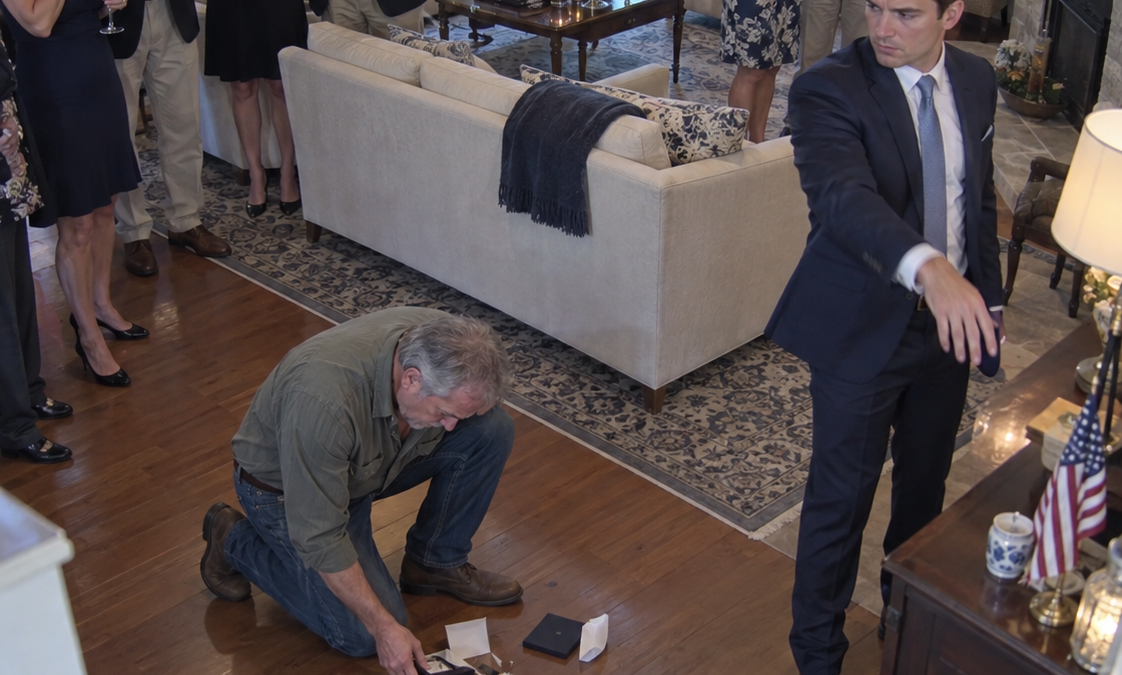
He flung the box sideways. It struck a side table, and the watch skidded across the hardwood floor before stopping against a woman’s heel. One small metallic click sounded in the silence, louder than the band had been all evening.
He wasn’t finished.
He told the room I’d never understood class, that I still wore the same boots to the office, that he had turned Bennett into a real company while his father clung to the past like a porch rail.
Somewhere, ice shifted in a glass. Carla from procurement stared at the floor as though it had personally insulted her.
Heat climbed my neck, the same heat I’d felt at seventeen when a foreman called my father “boy.” But forty years in business had taught me that the loudest person in the room rarely holds the strongest hand.
I knelt, and my knees reminded me of my age. The crystal now had a crack across its face, and the case was dented, but the second hand still moved. I placed the watch back in its box, closed the lid, and stood.
I didn’t shout. I didn’t ask for an apology. I had spent years begging my son for scraps of respect, and I was finished.
I took out my phone.
Margaret Collins answered on the second ring. She had been our family’s attorney for nearly twenty years, and she could hear a decision in my voice before I finished a sentence.
“Margaret, proceed with the resolutions we discussed. Effective immediately. I want Nathan’s executive authority reviewed and the discretionary trust distributions suspended to the extent the trust documents permit.”
There was a pause.
“Understood, Theodore. I’ll start tonight.”
I ended the call and turned to my son.
“Let’s see how smart you are without my money.”
Nathan laughed and looked around for backup.
“You can’t fire a CEO with a phone call, Dad. And you can’t touch what’s mine.”
A few guests chuckled uneasily.
“You’re right about one thing,” I said. “A phone call doesn’t make the law disappear. That’s why I spent the last three months making sure every step was lawful.”
His grin held for another second, then slipped. It was barely a flicker, but I had watched that face since it was small enough to fit in my palm, and I saw it.
I walked out through the silence. Behind me, the whispers started low and quick, like rain finding a tin roof. At the door, I looked down at the bent box and wondered if my son would ever understand what he’d thrown away.
That night was never just an argument between a father and a son. It was the moment I stopped paying for my own child’s respect.
What I hadn’t told a soul in that house was what Margaret and I had found over those three months, or why one phone call had been enough.
Let me tell you where I come from, because you can’t understand that night without it.
I grew up in Springfield, Ohio, in a two-bedroom house with a furnace that groaned all winter. My father, Walter Bennett, was a machinist at a farm equipment plant for thirty-one years. My mother, Ruth, worked the register at a grocery store three afternoons a week and clipped coupons the other four days. We weren’t poor exactly, but we knew the price of everything.
Dad came home with grease worked so deep into his knuckles that soap never fully reached it. When I was twelve, I watched him stop on a roadside to help a stranger change a flat tire, a man who could never have paid him back. We missed the first inning of my game because of it, and I sulked all the way to the ballpark.
Dad waited until I was done feeling sorry for myself.
“Son, you find out who a man is by how he treats people who can’t do a thing for him. Money just makes it louder.”
I didn’t understand him then.
I started Bennett Industrial in 1989, in a rented repair bay behind a feed store, with a used lathe and two employees. Hydraulic fittings, conveyor repairs, whatever came through the door. By the time Nathan was born, I had eleven people on payroll and a wife, Elaine, who kept the books at our kitchen table with a baby on her hip.
Here’s what I’m ashamed to admit. I missed things. Little League playoffs, parent-teacher nights, a fourth birthday I swore I’d be home for. And one Saturday when Nathan, age nine, sat on the porch steps in his catcher’s gear until dark, waiting for a father who never showed up.
Elaine never scolded me. She’d just slide my plate into the oven and say, “He’s keeping score, Teddy. Not out loud. But he is.”
Then Elaine got sick.
Ovarian cancer, caught late. Two years of Vanderbilt waiting rooms, vending-machine coffee, and magazines I never read. Nathan was fifteen when she died on a gray morning in March.
At the funeral, he stood stiff beside me in a borrowed jacket, not crying, his jaw clenched so tightly I could see the muscles working beneath his skin. I understood that I had lost my wife while my son had lost his mother, and that he had never really learned to turn to me.
In that church parking lot, I made myself a promise. Whatever he wanted, whatever he needed, he would never feel that absence again.
That promise was my first mistake, and it took me fifteen years to see it.
I paid for everything. Private school, a good university, a summer internship arranged through a supplier who owed me a favor, a first apartment in Nashville with a doorman. Each time, Nathan said thanks a little faster, the way you thank a vending machine.
When he joined Bennett at twenty-four, he worked hard, and I’ll give him that. He came in early, learned the shop floor, and pitched automation ideas that were genuinely good. I made him operations director, then COO, then, at twenty-eight, chief executive, while I stayed on as chairman and kept my controlling shares.
I thought I was handing him a ladder. I didn’t notice he’d started believing he’d built it.
The change came slowly, like a house settling. He started calling our plant “Legacy Operations.” He hired consultants in thin ties who said “synergy” without blinking. At Sunday dinners, which grew rarer, he joked about my flannel shirts and my pickup with 212,000 miles on it.
“Dad’s brand is basically a hardware store,” he told a table of friends once.
They laughed, and I laughed too, because laughing is cheaper than a fight.
I told myself he was young. I told myself every son has to push against his father to find his own shape.
Now, about that watch. It was never a cheap gesture.
My father bought that Hamilton in 1958 with eleven months of overtime because he wanted one object that said a Bennett man had been somewhere and kept his word about time. He wore it to work, to church, and to my wedding.
When he was dying in a hospice bed in Dayton, he pressed it into my palm and said, “Give it to the one who’s ready to understand it. Not before.”
I waited years.
When Nathan turned thirty, I decided he was finally old enough.
My letter told how Dad saved, how he taught me to rebuild a carburetor on a cold garage floor, and it ended with a single line:
“Everything we have began with somebody’s patience and somebody’s calloused hands. Remember who’s holding the other end.”
Nathan never read it.
The first crack in my own denial came in June, on a humid Tuesday, when Margaret called my office.
Margaret doesn’t call to chat.
“Theodore, come by my office. Don’t tell anyone where you’re going.”
In her conference room, she slid a folder across the table. Inside were contracts approved in a single afternoon that used to take three weeks of review, consulting fees climbing every quarter, and one agreement for $480,000 with a firm called Meridian Edge Advisory, founded eight months earlier by Nathan’s closest friend from college.
“It may be nothing,” Margaret said, removing her glasses. “Or it may be an undisclosed conflict of interest. I can’t tell you which yet.”
I read the invoice twice. The deliverables were vague. The dates didn’t line up. My stomach dropped like I’d missed a stair in the dark.
“What do you want to do?” she asked.
I wanted to drive straight to Nathan’s office and ask him to his face. That was the father’s instinct. But the chairman in me knew better. A confrontation would only give him time to tidy the paper trail, and people rarely confess to the man accusing them.
“We do this properly,” I said. “An independent review. Nobody touches anything. And pull every trust and shareholder document we have. I need to know exactly what I’m allowed to do and what I’m not.”
That night, I sat alone in my kitchen with the Hamilton ticking softly beside the sugar bowl and wondered how a boy who once waited on a porch for me could grow into a man who might gamble with the people I’d spent forty years protecting.
One hundred and forty families depended on that company.
This was no longer about disrespect, and I had no idea yet how deep it went.
The independent review began quietly in the first week of July. Margaret brought in a forensic accountant named Helen Park, a certified fraud examiner with reading glasses on a beaded chain and the patience of a woman who had spent thirty years watching people lie in spreadsheets.
She worked out of a rented office across town so nobody at Bennett would see her badge. I’d drive over after dark and sit in a folding chair while she walked me through what she’d found. Each visit felt a little like attending my own son’s autopsy while he was still alive.
The Meridian Edge contract came first. Helen laid out the paperwork in tidy rows. Four hundred and eighty thousand dollars for a market modernization strategy, and the only deliverable she could locate was a forty-slide presentation, half of it stock templates.
The firm’s founder was Caleb Whitaker, Nathan’s college roommate, who had stood beside him at every holiday party I could remember. Nathan had never disclosed the friendship. Our own policy required competitive bids on anything over $50,000, and the file held no bids at all. Nathan had signed off the same afternoon the proposal arrived.
“I want to be careful,” Helen said, tapping the page. “A close friend isn’t a crime, and an overpriced contract isn’t automatically fraud. But the pattern matters. Undisclosed relationship, skipped vetting, vague scope, fast payment. If I saw this at a client, I’d call it a serious red flag. I wouldn’t call it a conviction.”
I appreciated that. Somewhere in me, a hopeful father kept reaching for the gentlest explanation, and her caution gave him a little room to breathe.
Then she showed me the timing.
Over two quarters, Nathan had pressed our finance department to record certain expenses and revenues before the work behind them was complete. A conveyor retrofit for a customer in Memphis had been booked as finished while the crew was still on-site. The numbers looked better on paper by about a million dollars, and the quarterly report went out polished and proud.
One man had refused to go along.
Daniel Brooks, our chief financial officer, had been with me since 1996. He was the kind of man who balanced his own checkbook to the penny and kept a pencil behind his ear in the age of laptops.
Helen found his emails, polite and firm, stating that he could not approve the entries without documentation. Nathan’s replies grew shorter each time. By May, they were the kind of messages a boss writes when he intends to be quoted later.
Daniel was told he was not aligned with the company’s direction. He was told that perhaps it was time to consider his options.
Daniel was fifty-eight, with a daughter in nursing school and a mortgage he’d refinanced twice. I thought about him sitting in his office, reading those words and saying nothing to me. He had stayed quiet because he didn’t want to put me in the middle of a fight with my own son.
The email I wasn’t prepared for came the following week.
Helen had recovered a thread between Nathan and an outside communications consultant, and she slid the printout toward me without comment. In it, Nathan described me as the single biggest obstacle to the company’s future. He wanted the board to see me as a sentimental founder, someone loved but past his usefulness.
He asked the consultant to help shape that story gently over several months so that when the independent directors finally moved, it would feel like a natural retirement rather than a coup.
I read it three times.
I have been called worse by better men, but never by someone whose fevers I once sat up with. What stung wasn’t the ambition. Ambition, I understand.
It was the patience.
My son had been smiling across Sunday dinner tables while sharpening a quiet knife.
“There’s more,” Helen said, turning the page. “He’s also been shopping for personal financing. A commercial real estate project in Franklin, about one million dollars. The lender would want to see company performance, and the company’s performance, as currently reported, is inflated.”
It was easy to see the shape of it. Nathan was building a life on the assumption that Bennett’s name and my reputation would hold up whatever he stacked on top.
And if the numbers cracked, the first people to fall would be the welders, the dispatchers, the drivers, and the 140 families who had no seat in any of those meetings.
Margaret made me look at the legal side next, in her office with the blinds half-drawn. She is not a woman who comforts, and I have always valued that.
“Let’s separate what you want from what you can do,” she said. “Nathan’s trust is a family trust set up years ago. He receives discretionary distributions, which means the trustee has judgment over certain payments within conditions in the document. He does not own the whole pot, and he can’t drain it alone. But you can’t just tear up what he already holds, either. Money that’s legally his stays his.”
“So what can I do?”
“As founder, you hold the power to appoint and replace certain trustees under the document if procedure is followed. And you can request a formal review of discretionary payments. As controlling shareholder, you can propose governance actions, call for a special board meeting, and support interim limits on a CEO’s signing authority while an investigation runs.”
She paused to make sure I understood.
“What you can’t do is fire him because he insulted you at dinner. A judge would eat that alive.”
“Understood.”
“This only works,” she said, “if it’s clean. Every step documented. Nathan gets notice, counsel, and a chance to answer. Anything else, and he walks away the wronged party, and he’ll be right.”
I wanted to say I’d rather be wrong than lose my son. But I had also made that exact bargain for fifteen years, and look where it had put us.
So I chose the slow road.
I told Margaret to lock the records down, keep everything quiet, and prepare a formal process that would give Nathan every chance to explain himself.
Part of me still hoped he’d walk into that room, see the folder, and tell me the truth. I’ll be honest, I prayed for it in my truck some nights, hands on the wheel in the dark of my own driveway.
Then one Thursday in early September, Margaret called with a new document. It was a draft loan proposal already circulating among Nathan’s outside contacts, relying on projections the board had never seen.
I stared at the signature block, his name already typed beneath the line.
“If this goes out,” she said, “we won’t be fixing a problem. We’ll be explaining one.”
I looked at the Hamilton ticking on my kitchen table.
I had waited too long once before. I wouldn’t do it twice.
I didn’t sleep that night.
And on the night of Nathan’s birthday party, when I drove home from Brentwood with the windows down and the radio off, somewhere around the Concord Road exit, it occurred to me that I had just done in thirty seconds what I’d spent three months preparing to do.
People would say it was a temper.
It wasn’t.
The paper trail was already there, in a locked drawer at Margaret’s office.
Two weeks before the party, I had sat down with three independent directors, one at a time, over coffee and, in one case, a round of golf. I laid out Helen Park’s preliminary findings and asked for nothing except their attention.
Margaret had drafted a notice for a special board meeting and a resolution to place interim limits on the CEO’s signing authority while the review ran its course. The language was careful. It accused nobody of anything. It only said that when a company’s books raise questions, the people holding the checkbook should wait while someone else looks.
All of it was set to go out on Monday.
Nathan’s birthday had simply moved the date up by about thirty-six hours.
I want to be plain about this because later, people would say I’d punished my son for hurting my feelings. The most I could do was exercise the rights my documents gave me, no more. I couldn’t declare him guilty. I couldn’t take what was lawfully his.
The board would decide, and the board would answer to its duty to the shareholders and to 140 employees.
My part was to ask and to stop pretending I hadn’t seen what I’d seen.
Nathan called at 7:40 Sunday morning, which told me how little he’d slept either.
I was at the kitchen counter with a cup of coffee going cold, the Hamilton in its dented box beside the sugar bowl. By then, Margaret’s emails would have reached his inbox, and the board’s calendar change would have landed on his phone. There would be a formal letter asking him to preserve all records and turn over certain files by Wednesday.
“Are you seriously trying to destroy my career because I embarrassed you at my birthday party?”
I could hear traffic behind him. He was already in his car, already on his way to the office on a Sunday, which I’ll admit was more diligence than I’d seen from him in a year.
“No,” I said. “I’m stopping you from confusing my patience with permission.”
Silence.
Then he laughed, a short, ugly sound with no humor in it.
“You can’t do this. You don’t have the authority to touch my position.”
“I haven’t touched your position. The board will meet and consider some interim measures. You’ll have counsel, and you’ll be heard. Read the notice from Margaret. All of it. Slowly.”
“I’ll sue you. I’ll tie this company up so tight you won’t be able to buy a box of nails. You need me, Dad. Without me, this place doesn’t run.”
“Read the notice, Nathan.”
“This company doesn’t survive a week without me.”
“Then you’ve got nothing to worry about,” I said as gently as I could, and ended the call.
My hands shook as I set the phone down.
Doing the right thing, I was learning, doesn’t come with the feeling of rightness. It feels a lot like swallowing glass.
By Monday morning, the machinery was turning.
Margaret sent a formal request to the trustee reviewing Nathan’s discretionary distributions, citing the conditions written into the trust document years earlier. Nobody was seizing anything pending the review. No new discretionary payments would be approved, and those already scheduled would be held for evaluation.
Whatever Nathan already owned outright—his savings, his brokerage account, the condo he’d bought with his own signing bonus—remained his.
Margaret was firm about that, and so was I.
There was a second letter, less dramatic and, I suspect, more irritating.
The company would audit every personal expense run through corporate accounts: the leased Porsche, the club membership, the travel booked as client development that happened to coincide with ski seasons.
A lot of it might prove perfectly legitimate. Some of it clearly wouldn’t.
Either way, the era of nobody asking was over.
Daniel Brooks stopped by my office that afternoon. He stood in the doorway with his pencil behind his ear and his hands knotted in front of him.
For a long moment, neither of us spoke.
“I should have called you in May,” he said.
“You should have,” I said. “And I should have been somebody you felt you could call.”
He nodded slowly, and I understood that we’d both just been forgiven for something.
The part I didn’t explain to Nathan on the phone, because he wasn’t ready to hear it, was what I’d asked the board to prepare in case the interim measures went forward.
Back in July, Margaret and I had quietly drawn up a contingency plan. If Nathan’s authority had to be limited, someone needed to be able to keep the plants running Monday morning without a speech or a scandal.
The name on that plan was Linda Ortiz.
Linda had been our vice president of operations for twenty-two years. She started on the shop floor in 2002, hands in the gearboxes, and worked her way up without ever once asking for credit. Every driver knew her cell number. Every plant manager trusted her to answer.
When our Chattanooga facility flooded in 2019, Linda slept on a cot in the warehouse for four nights and had the line running again by Friday.
Nathan thought of her as legacy operations.
I thought of her as the reason the lights stayed on.
I’d asked the board to consider naming her interim chief executive if it came to that, with Daniel as her financial partner. It was a practical decision, not a sentimental one.
Nathan had spent years convincing himself and everyone around him that Bennett was a one-man machine, that the whole enterprise would seize up without him. He had come to believe it so thoroughly that he’d forgotten how many people had been quietly carrying the weight.
When word of Linda’s name reached him on Tuesday, I’m told he went white.
Someone from the executive floor said he stood at his office window a full ten minutes, saying nothing while the shop-floor shift change spilled out into the parking lot below him.
A hundred workers heading home, and every one of them knew exactly who made the place work.
And it wasn’t him.
I’d like to say I felt triumph.
What I felt was grief, quiet and heavy.
My son had finally seen that he could be replaced, but he hadn’t yet seen why.
And Helen Park still had one more box of documents to open, one I suspected would hurt us both far more.
Nathan hired a lawyer within forty-eight hours. His name was Grant Holloway, a Nashville litigator with a silver pocket square and a reputation for turning disputes into wars of attrition.
The letter arrived on Thursday, three pages of heavy bond paper accusing me of pretextual and retaliatory conduct motivated by personal animus. It demanded that I withdraw the board notice, restore Nathan’s full authority, and cease all communication with the trustee.
It used the word “elder” once in a way I didn’t miss, hinting that a man my age might be acting out of confusion or spite.
Margaret read it standing up, then laid it on her desk like a dead fish.
“He’s trying to paint you as an old man having a tantrum,” she said.
“Good. Let him. Tantrums don’t come with six months of forensic accounting.”
The story got around anyway. Nathan told his friends I was jealous, that I’d never forgiven him for being better at the job than I was, that a watch had somehow cost him his career.
Some of them believed it. A few ex-colleagues from his college days started texting my phone, which I’d never seen before, saying things like, “Mr. Bennett, I hope you two can work this out.”
I answered everyone the same way.
“I hope so, too.”
I never said a word against my son. I’d learned, finally, that I didn’t have to.
Nathan worked the board harder. He took directors to lunch and talked about modernization and generational change. He said his father was grieving his wife all over again and acting out of fear.
It was a clever pitch, and I’d be lying if it didn’t land a little close to home.
Two of the independent directors, Phil Gaines and a retired banker named Susan Yates, called me separately to ask whether there was any truth to it.
“Some,” I told Susan. “I haven’t been the father I should have been. But I didn’t invent the Meridian invoice.”
“No,” she said. “You didn’t.”
That was the week Daniel Brooks decided to talk.
He asked to meet at a diner off Highway 70 where nobody from the office ate, and he arrived with a banker’s box under his arm and a face like a man heading into surgery.
Over weak coffee, he told me he’d kept every email, every voided entry, every note of every conversation, in a folder labeled with a date and nothing else.
“I’m not here to hang him,” Daniel said. “I want that understood. He’s Elaine’s boy. I held him at his mother’s funeral. But I’ve got people in that accounting department who’ve started doubting themselves because he told them they weren’t team players. A twenty-six-year-old named Priya cried in the break room last month. I can’t carry it anymore.”
I put my hand over his on the table. I’m not a man who does that, and we both pretended not to notice.
Daniel presented his documents to Helen Park and the board’s audit committee the following Monday. He was careful to the point of pain. He never used the word “embezzlement.” He described what he’d seen: instructions to book revenue early, instructions to skip approvals, a pattern of pressure on staff who objected.
He showed the Memphis retrofit entry alongside crew photographs timestamped three weeks after Nathan had called the work complete. Helen cross-checked it all against the bank records and found two more consulting payments to Meridian Edge, smaller amounts each just under the threshold that would have required a second signature.
“Whether that’s intent or sloppiness,” she told the committee, “is a question for investigators and counsel. What it is, is a breakdown of controls, and the company has a duty to address it.”
Phil Gaines, who had been Nathan’s most dependable supporter on the board, took off his glasses and rubbed his eyes. He didn’t say anything. He didn’t have to. The room had shifted the way a lake shifts before weather.
By the end of that week, Nathan was asked to step back from any decision touching the investigation, including vendor contracts, finance, and personnel. It was procedural and temporary, and Margaret made sure the language said so.
His badge still opened the same doors it always had, but nobody went through him without checking whether he was authorized to approve something first.
Linda Ortiz started chairing the daily operations call. When Nathan joined, he listened. Someone told me he took notes, which no one could remember him doing before.
I heard all this secondhand, mostly. I stayed away from the building.
Margaret was blunt. If I showed up, the story would become Theodore versus Nathan, and Grant Holloway would frame it exactly that way. So I stayed home, and it was the longest stretch of quiet I’d known since Elaine died.
I fixed a leaky faucet. I split firewood I didn’t need. Twice, I drove to the cemetery in Franklin and sat on the grass beside her stone, telling her things I could never say aloud to a living person.
“I think I’ve been wrong for a long time, Elaine. I think I loved him so much I forgot to teach him anything.”
The wind moved the grass, and no answer came, which is the arrangement with the dead.
On a Wednesday in October, in the middle of a cold, hard rain, I heard a car in my driveway. I knew the engine before I looked.
I opened the door, and there he was, my son, soaked through a suit that cost more than my truck, his hair plastered to his forehead, without an umbrella or a plan.
“Let me in,” he said. “Please.”
I stepped aside.
He stood dripping on the kitchen floor, and his eyes went straight to the sugar bowl, to the dented box beside it. Then he turned on me.
“You need to stop this right now. You’re making the whole family a joke. People in town are talking. The bank is calling. My friends are looking at me like I’m contagious.”
“Are you worried about the family, Nathan?” I said quietly. “Or are you worried about losing the life I paid for?”
I watched it land. His jaw worked. Rain ran off his chin.
“You’ve never trusted me,” he said, his voice cracking in the middle. “Not once. You gave me a title and then stood over my shoulder for six years like I was a kid on training wheels.”
“I did stand over your shoulder,” I said. “That was wrong, but not for the reason you think. I never let you fall. Not once. I covered for you when you were short with employees. I smoothed over what you broke. I paid for every cushion. I thought that was love. It was fear. Mine. Fear that you’d feel what I felt when I lost your mother.”
Something flickered across his face, and for a second, I thought he might sit down. Then it hardened again.
“So that’s it. You picked the company over your son.”
“I’m picking you, Nathan. Just not the version of you that needs me to keep paying.”
He stared at me for a long time. Then he picked up his keys and walked out into the rain without another word.
The screen door banged twice behind him. I stood in my kitchen and listened to his engine fade down the road, and I understood that doing right by someone you love can feel exactly like losing them.
The final report was due in nine days, and I had no idea which version of my son would walk into that boardroom to hear it.
The special board meeting convened on a Tuesday morning in late October, in the long conference room on the second floor of Bennett Industrial. It was the one with the oak table I’d bought secondhand from a bankrupt law firm in Wendell.
I arrived early and sat at the far end in my one good suit, the gray one I’d worn to Elaine’s funeral. Margaret sat beside me with a leather folio and a face that gave away nothing.
Across the table sat Nathan, flanked by Grant Holloway and a junior associate with a laptop. Nathan had shaved carefully. He looked like a man who’d rehearsed his posture in a mirror.
Seven directors took their seats, including Phil Gaines and Susan Yates. Linda Ortiz and Daniel Brooks waited near the door as observers. Nobody offered coffee. The room smelled of carpet cleaner and nerves.
Susan Yates chaired the meeting. She opened by reading the ground rules aloud, slowly, so the minutes would reflect them.
Nathan would have the right to respond to every finding. His counsel could speak on his behalf. I would not vote on any matter concerning my son, and I would speak only if asked.
Margaret caught my eye at that last part, the way you’d glance at a dog you weren’t sure would stay.
Helen Park presented for fifty minutes. She was exactly what I’d hoped she would be, which is to say dull in the best sense of the word. She walked the board through the Meridian Edge contracts, the missing bids, the undisclosed friendship, and the revenue entries booked ahead of completion.
Her slides separated findings into two columns: Verified and Requires Further Investigation.
She never raised her voice or used a word like “fraud.”
When Grant Holloway objected that she was implying intent, she answered, “I’m describing documents, counselor. The conclusions belong to someone else.”
Then Holloway took his turn, and he was good.
He argued that Nathan had been a young executive under pressure to grow, that aggressive revenue timing was common in the industry, and that the Meridian contract reflected a sincere, if poorly documented, belief in Caleb Whitaker’s talent.
He suggested the entire inquiry had been triggered by a family quarrel and carried the odor of a vendetta. He turned and looked directly at me when he said it.
I looked back and said nothing, which is harder than it sounds.
Nathan spoke last.
I’ll give him this. He didn’t grovel, and he didn’t rage. He admitted he should have disclosed his friendship with Caleb. He conceded the approval process had been too informal, but he insisted that every decision had been made in the company’s interest and that his father’s lifelong habit of hovering had made him defensive.
It was a decent speech, partly true, and I felt something loosen and tighten in my chest at the same time.
Then Margaret asked for permission to submit one additional document.
She slid a thin folder across to Susan Yates.
“This is a succession framework signed by Mr. Theodore Bennett on the fourth of March of this year, seven months ago, long before any concern about contracts arose.”
A murmur moved around the table.
I kept my hands flat on the wood.
Susan read aloud, and I heard my own words come back to me in someone else’s voice.
The plan outlined a staged transition of operating control over three years. Milestones included audited financial transparency, independent board approval of major contracts, retention of senior staff, and a documented plan for employee development.
If Nathan met those benchmarks, I would step down as chairman and transfer a substantial portion of my voting shares into a structure he would help govern.
There was a line near the bottom that Susan read twice.
“The purpose of this plan is to ensure that my son earns the position he has been given so that no one, including himself, ever doubts it.”
I watched Nathan’s face while she read.
I’d seen that face go through a dozen shapes since he was a boy. Defiant, sullen, charming, cold. I had never seen it do what it did then.
It simply emptied, as though someone had pulled a plug.
“I wrote that in March,” I said, because Susan looked at me and nodded.
My voice came out rougher than I wanted.
“I wasn’t building a trap, Nathan. I was building a door. I wanted you to walk through it on your own legs.”
Holloway started to object, and Nathan put a hand on his sleeve. It was a small gesture, but the whole room saw it.
The board went into closed session. Margaret, Nathan, and I were asked to wait in separate rooms.
I stood in a corridor by a window overlooking the plant yard, where a forklift was loading pallets onto a flatbed, same as it had every day for thirty years.
A young welder in a gray hoodie waved at me from across the lot. I waved back.
I thought, Whatever they decide, that boy has a paycheck coming Friday, and that’s why I did all this.
Ninety minutes later, we were called back.
Susan Yates read the resolution in a steady voice.
By a vote of six to one, the board would suspend Nathan Bennett from his duties as chief executive officer, effective immediately, pending the completion of the investigation.
Linda Ortiz would serve as interim CEO, with Daniel Brooks as interim chief financial officer. The company would review every contract connected to Meridian Edge Advisory, quantify any losses, and pursue recovery where the documents supported it.
The trustee’s review of discretionary distributions would continue independently.
Nothing in the resolution should be read as a finding of criminal conduct. Nathan would remain free to respond, and the board would reconvene when the review concluded.
Phil Gaines was the lone no vote. He explained quietly that he believed suspension was premature. I respected that. It meant the process was real.
When the meeting adjourned, people stood in clumps and avoided looking at us.
Nathan didn’t move.
He sat with his hands folded on the oak table, staring at a spot on the wood where some long-gone lawyer had left a coffee ring.
I walked around the table and stopped at his chair. He glanced up. He was waiting, I think, for the smile, the “I told you so,” the last twist of the knife.
“I never needed you to fail, Nathan,” I said. “I needed you to understand that you were never entitled to succeed at everyone else’s expense.”
He opened his mouth, closed it, and looked away.
For the first time in his life, my son had no clever reply.
I left him there with his lawyer and walked out into the cold October light. In the parking lot, I leaned against my old truck and let my legs shake.
I hadn’t won anything. Not really. I’d only learned what the truth costs, and I wondered if Nathan could survive paying his share.
The winter that followed was the quietest of my life and, in some ways, the most honest.
The review took four months. Helen Park’s final report landed in February, 112 pages in a gray binder, and it said what careful documents usually say, which is less than the gossip and more than the denials.
Roughly half of the Meridian Edge fees were found to be unsupported by deliverables. Caleb Whitaker’s firm, facing a polite letter from Margaret and a less polite one from its own lawyer, agreed to return a little over $200,000.
The early revenue entries were corrected and restated, and the lender in Franklin quietly withdrew from Nathan’s real estate deal.
Nobody went to prison.
The board referred the remaining questions to counsel, who resolved them the way most of these things are resolved: with signatures, settlements, and a great deal of billable silence.
Nathan wasn’t ruined, and I won’t pretend otherwise for the sake of a better story. He still had his savings, his condo, and the money he’d earned honestly in his first years at Bennett.
What he lost was the cushion.
The trustee’s review concluded that the discretionary distributions would stay paused while the company’s recovery process ran, and that any future payments would depend on conditions written into the trust long before any of this began.
The leased Porsche went back. The club membership lapsed. He gave up the house with the string lights and the jazz trio and moved into a two-bedroom apartment in Antioch that Daniel told me, without my asking, had a view of a Kroger parking lot.
I didn’t call him. Margaret had advised against it, and honestly, I didn’t know what I’d say.
Twice, I drove to his building and sat in the truck without getting out.
Once, I saw him in the parking lot carrying groceries, two plastic bags in one hand and his phone in the other. For a moment, he looked so much like his mother that I couldn’t breathe.
He didn’t see me.
I pulled out and drove home.
It was Linda who gave me news of him, in the careful way she gives all news.
In January, a regional distributor in Murfreesboro had hired Nathan as an operations manager. It wasn’t a glamorous job. Warehouse schedules, shipping errors, a rotating cast of forklift drivers who had no idea who he was and wouldn’t have cared.
“Word is he’s there at six every morning,” Linda said. “Before the crew. He’s learned every one of their names.”
“Is he any good?”
“Ask me in a year.”
She smiled a little.
“But he apologized to a dockworker last week for blaming him for a mislabeled pallet. Turned out it was Nathan’s own mistake. The man told his supervisor, and the supervisor told someone who knows me.”
I held that small story the way you hold a coal in winter, carefully, afraid to blow on it too hard.
I’d like to tell you I spent those months in wise reflection. Mostly, I fixed things.
I rebuilt the back porch steps. I started going to a Saturday breakfast with Daniel, who had slowly stopped apologizing for being right.
I visited Elaine’s grave and told her about the apartment, the Kroger, and the dockworker. I didn’t tell her I was proud, because I wasn’t sure yet that I was.
But I told her I was watching.
The letter came on a gray Thursday in late October, almost a year to the day after the party.
A plain envelope, no return address.
Inside was one sheet of paper in my son’s handwriting, small and slanted, the same hand that had once signed birthday cards with a crayon.
Dad,
I’d like to come by Sunday. I won’t stay long if you don’t want me to. I’ll understand if you say no.
Nathan.
I read it standing at the mailbox, with the wind pulling at the page. Then I went inside and called Margaret, which was foolish because there was nothing legal about it.
She listened and then said, “Theodore, for once in your life, don’t make it a strategy.”
On Sunday afternoon, the sky was the color of old pewter, and I’d cleaned the kitchen twice.
I heard the car, a modest used Honda now, and when I opened the door, Nathan stood on the porch steps I had rebuilt.
He wore jeans and a canvas work jacket, his hands deep in the pockets. He’d lost some weight. There was a faint line between his eyebrows that hadn’t been there before, the kind a man earns, not the kind he’s born with.
“Hi, Dad.”
“Hello, son.”
He held out something wrapped in a dish towel.
I knew what it was before I unwrapped it.
The Hamilton lay in my palm, the crystal replaced, the dent in the case hammered nearly smooth, the second hand sweeping steadily around.
“I took it to a watchmaker in Franklin,” he said. “He said whoever rebuilt the movement did beautiful work. I told him my father did. Well, a man in Dayton, but you know what I mean.”
He cleared his throat.
“I read the letter, Dad. I found the box in my closet in the spring. I couldn’t open it until August.”
I didn’t trust my voice, so I stepped aside and let him in.
We sat at the kitchen table, the same table where I’d read Helen’s first report. Nathan told me about the warehouse, about a driver named Reggie who taught him how to read a bill of lading properly, about the day he understood that a mislabeled pallet could cost a family a week’s groceries.
He didn’t make excuses.
He said he’d spent years believing that a title was something you were, when it was something you did. He said he used to think I was a failure because I never seemed to need anyone’s applause, and that he was beginning to see that was the rarest kind of strength.
“I’m sorry,” he said, looking at his hands. “For the party. For what I said about you in front of those people. For Daniel and Priya and everyone I made feel small. For treating Mom’s memory and your work like they were things I could outgrow.”
I let the silence stand.
My whole life, I’d rushed to fill silences with money or forgiveness, and both had cost him something.
“I’m glad you came,” I said finally. “And I believe you mean it. But I won’t tell you it’s all behind us, because it isn’t. Trust gets built the slow way, Nathan. Day by day, in small things nobody sees. If you want it, I’ll be here. I just can’t hand it to you.”
“I don’t want you to,” he said. “I think that’s the whole point.”
I didn’t restore his title. I didn’t reopen the trust.
Those decisions belonged to people, documents, and time, and they should have been earned, not granted out of one soft afternoon.
Instead, I did the simplest thing I could think of.
I invited him to dinner the following Sunday, and the Sunday after that. He came every week, and we sat in that small kitchen with no guests and no show, eating pot roast that was always a little dry.
One evening, Nathan set the watch on the table between us.
“Tell me about Granddad,” he said. “From the beginning. Slowly.”
So I did.
I told him about the overtime and the 1958 payment plan, about the carburetor on the garage floor, about the stranger with the flat tire and the missed first inning.
Nathan listened the way he had when he was small, his chin resting on his fist.
When I finished, he strapped the watch to his wrist a little awkwardly and held it up to the light.
I used to believe that giving my son everything was how a father proved his love.
I was wrong.
Money bought him comfort, opportunity, and a title. It could never buy him character.
And the hardest lesson I ever learned was that loving him meant finally letting him become responsible for the man he chose to be.
I don’t know what Nathan will become, but for the first time in thirty years, I’m not trying to buy the answer.
If this story touched you, I’d love to hear from you. Leave a comment below and tell me where you’re watching from and whether you’ve ever had to love someone enough to let them face the consequences. Your stories matter to me more than you know.
We share new stories like this every single day, so please subscribe and hit the bell so you never miss a moment like this one.
Thank you for staying with me until the very end.








