On my daughter’s birthday, i stopped by her office with flowers, as i walked in, heard, “you broke little rat! how dare you touch my stuff?” through the cracked door, i saw my daughter on her knees, sobbing, then i saw who was yelling at her—and my blood boiled, it was…
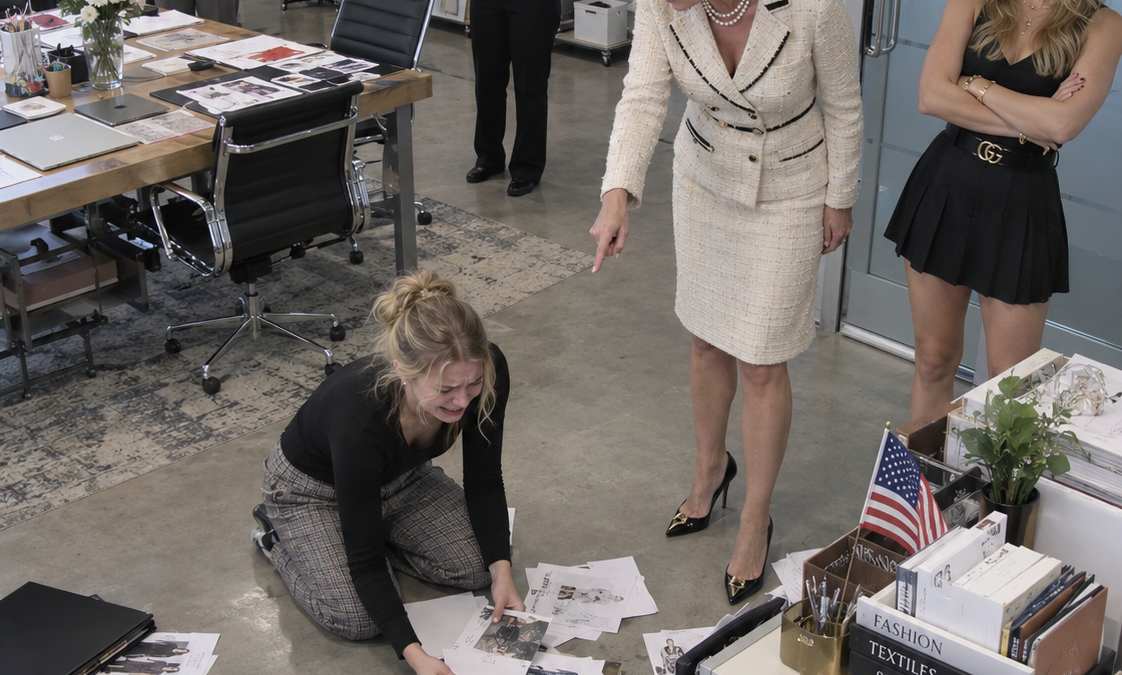
On my daughter’s birthday, I stopped by her office with flowers. The moment I walked in, I heard a woman screaming.
“You broke little rat! How dare you touch my things?”
Through a narrow gap in the frosted glass doors, I saw my daughter on her knees, sobbing as she gathered scattered papers from the floor. Then I saw who was standing over her, and my blood turned to ice.
It was my wife.
That morning, I had walked into the fashion company where my daughter worked carrying a bouquet of sunflowers, expecting nothing more than the pleasure of surprising her on her birthday. Instead, I found myself standing in a hallway, listening to a woman I thought I knew call my daughter a filthy little rat. And when I recognized the voice, something inside me changed permanently.
Before I tell you what happened next, I need to explain how that morning began, because the details matter more than I understood at the time.
The sunflowers had cost twelve dollars from a street vendor on Wilshire Boulevard. My daughter, Clare, had loved sunflowers since she was four years old, when her mother, Diana, planted a row of them along the back fence of our home in Pasadena. Diana died six years ago. Pancreatic cancer. Eleven weeks from diagnosis to funeral. I had built a shipping empire from nothing, negotiated in boardrooms across three continents without blinking, and made decisions involving hundreds of millions of dollars. None of it prepared me to watch the person who held my entire life together disappear that quickly.
I should say more about Diana, because I don’t think anything that happened afterward makes sense without understanding what her absence actually did to our family. She was a marine biologist by training, though she had stopped doing fieldwork after Clare was born, choosing instead to teach part-time at a community college in Pasadena so she could be home most afternoons. She had a laugh that filled a room without ever being loud, and she was the only person in my life, before or since, who could look at me across a dinner table and know without my saying a word exactly which negotiation had gone badly that day.
When she died, I threw myself into work with a desperate, unhealthy intensity. I closed three major acquisitions in the eighteen months following her funeral, as though moving enough tonnage through enough ports could somehow fill the particular shape of what I had lost. Clare was seventeen at the time. She watched me do that and said almost nothing about it for years. I understand now that her silence wasn’t peace. It was a seventeen-year-old girl quietly deciding that she wasn’t going to add her own grief to the burden her father was already failing to carry.
I built Holt Maritime Logistics from a single leased warehouse and a used forklift when I was thirty-one years old, freshly out of the Marines with nothing to my name but discipline and a stubborn conviction that smaller players in the shipping industry were being systematically overcharged by brokers who understood the paperwork better than the actual freight. Diana believed in that conviction before it had earned a single dollar of proof. She mortgaged our first house without hesitation to cover a shortfall in our second year, when the entire venture nearly went under.
I’ve built a great deal since then. Six regional distribution hubs, a fleet numbering in the low hundreds, and a reputation across three continents for reliability that competitors twice our size still struggle to match. None of it—not one acquisition, not one hard-won contract—has ever meant as much to me as the fact that Diana believed in me before there was any evidence to justify that belief.
I think that’s part of why Vivien’s particular brand of performed belief worked on me as effectively as it did. Without fully realizing it, I was still searching for an echo of something Diana had given me freely. Vivien understood, with the trained precision of someone who had made a career out of recognizing exactly that kind of hunger, how to counterfeit it.
But that morning wasn’t supposed to be about grief. It was supposed to be about surprising my daughter at work on her birthday. I wore an old olive jacket, frayed at the cuffs, that I’d bought from a military surplus store the year I left the Marines. I want to explain how Vivien entered our lives, because it matters enormously to understanding everything that came afterward. For a long time, I genuinely believed our meeting had been one of the luckiest accidents of my life rather than what it actually was.
I met her at a charity auction in Santa Barbara almost three years after Diana died. It was an event I attended only because a business associate had guilted me into buying a table. Clare was twenty then, away at UCLA, and I was, if I’m being truthful, a lonelier man than I allowed myself to admit to anyone, including myself.
Vivien introduced herself as a philanthropic consultant, recently relocated from San Francisco and connected to old money I never once thought to verify. There was something about the way she carried herself that made verification feel almost insulting. She asked questions about the shipping business that suggested a genuine understanding of tonnage economics, which I now know she had carefully researched in the weeks leading up to the auction, after identifying me as a target.
She laughed at the right moments. She touched my forearm lightly when she disagreed with something, a small, warm gesture that made disagreement feel like intimacy rather than conflict. I fell for the performance completely. And I want to be honest about something: even now, some part of me still misses the version of her that never actually existed. It’s the way you might miss a photograph of someone even after learning that the photograph had been doctored.
I’ve wondered since everything came apart exactly how she chose me from whatever pool of candidates a woman in her line of work presumably kept some mental accounting of. Marcus, working backward through the timeline once we understood what we were looking at, found evidence that Vivien had attended at least four other charity events in the six months before that Santa Barbara auction. She had always moved in circles adjacent to widowed or divorced men of significant means, and she had always disappeared before any real connection formed if the man in question proved too cautious, too closely surrounded by watchful family members, or too financially modest to justify the following two years of patient investment.
By whatever calculations she used, I was apparently the right combination of wealthy, recently grieving, and insufficiently guarded. I’ve mostly made my peace with having once been someone’s calculated opportunity rather than someone’s genuine choice. Even now, though, it’s one of the harder facts of this entire story to sit with for very long.
We married fourteen months later in a small ceremony at my house in Malibu. Clare attended, polite and reserved, though I remember now, with the clarity hindsight provides, a specific comment she made in the receiving line that I brushed aside far too easily.
“She’s very good at knowing exactly what you need to hear, Dad,” Clare said, watching Vivien work the room with practiced warmth.
I told her that was called being a good hostess. I understand now that my twenty-one-year-old daughter had identified in a single afternoon something it would take me two more years and a forensic investigation to fully see.
Looking back, I can identify a whole quiet catalog of moments across those two years that should have told me far more than I allowed them to. Moments I filed away individually as unremarkable, never once connecting them into the pattern they actually formed.
There was the way Vivien’s warmth toward Clare always seemed to cool by a precise, almost imperceptible degree whenever the two of them were alone together. It was a shift I noticed only in the brief silences after Clare left a room, silences that felt subtly different from the warm chatter that had filled it moments earlier.
There was a Christmas, the first after our wedding, when Vivien gave Clare an expensive, beautifully wrapped gift in front of the entire extended family. Weeks later, I discovered the receipt in a drawer, showing that the gift had been returned and exchanged for something considerably cheaper, with the difference pocketed. It was such a small detail that I genuinely convinced myself I had misread the receipt rather than consider what it actually suggested.
There was also an evening about a year into our marriage that I think about more than almost any other memory from that period. Vivien mentioned almost in passing over dinner that Clare had seemed distant lately, perhaps struggling with something at school, perhaps keeping something from both of us. Worried, I called Clare that same night. She was confused by my concern and told me nothing was wrong at all. In fact, she’d had a wonderful week.
I remember feeling reassured rather than suspicious. I filed the discrepancy away as Vivien simply being an attentive, worried stepmother who had read too much into nothing.
I understand now that I was watching, in real time, the opening moves of a much longer campaign to plant seeds of concern about Clare’s emotional stability. Seeds that, given enough years, might have grown into exactly the kind of narrative that could justify cutting a difficult, troubled daughter out of a will in favor of a more stable, more present, more grateful new family.
My assistant, Marcus Webb, had been with me for eleven years. Before that, he’d been a Marine Corps brother. When he saw the old olive jacket I had chosen for Clare’s birthday visit, he raised an eyebrow and reminded me that I had three Hugo Boss suits hanging in my closet. I told him I was aware. He understood, the way he always did, that some days called for the version of yourself that existed before the money.
Marcus and I served together in the same unit for four years, long before either of us had any idea what we would eventually become to each other professionally. He pulled me out of a burning vehicle outside Fallujah in 2004, an act he has never once brought up in the twenty years since, though I think about it more often than he probably realizes.
When I started the shipping company in a rented warehouse office in Long Beach, with four employees and a line of credit I genuinely wasn’t sure I could repay, Marcus was the second call I made, right after my banker. He didn’t ask what the salary was. He asked what the mission was.
That’s the kind of man he’s always been. And it’s exactly why, eleven years later, he would be the only person on earth I trusted enough to hand a phone number and a name and simply say, “Find out everything,” without needing to explain why.
Clare had accepted a design internship at Allara Fashion Group eight months earlier without telling me until after she’d accepted it. That was Clare. She never used my name in professional settings. She’d been that way since she was small, actually, long before there was any fortune to distance herself from.
I remember a summer when she was perhaps nine years old, entering a neighborhood art contest under a false name because she wanted to know whether the judges would like her drawing or simply like the fact that it belonged to Raymond Holt’s daughter. She won second place under that false name. I remember her being prouder of that second-place ribbon than she was of almost anything else that year, because it was entirely, unambiguously hers.
Diana used to say that Clare had inherited her stubbornness and her own need to be seen clearly rather than conveniently. Looking back, I think that combination was exactly what carried her through eight months at Allara without a single person there suspecting who her father was, and exactly what allowed her to endure things quietly that a more dependent daughter might have come running to me about immediately.
I’d offered more than once over the years to open doors for her. A word to a gallery owner, an introduction to a design house, the kind of favor that costs a man in my position nothing but can change a young person’s trajectory entirely. She refused every single time, always with the same gentle, unshakable firmness.
“I want to know if I’m good at this, Dad. Not whether you’re good at making calls.”
I genuinely respected that, even when it worried me. Even when I lay awake some nights wondering whether her privacy was protecting her or simply leaving her unprotected in rooms I couldn’t see into. As it turned out, both things were true at once.
She’d studied design at UCLA and graduated with honors, having paid her own way through a combination of scholarships and a part-time job at a fabric warehouse in Culver City, where she’d worked all four years. Again, she’d refused my offer to simply cover her expenses outright.
Her senior thesis collection, a series of garments constructed entirely from reclaimed materials sourced through that same warehouse job, had won a small but respected student design award. The judging was blind, with her work submitted under a candidate number rather than under the name Clare Holt.
She told me once, describing her design philosophy in the specific, careful language she used for things that mattered deeply to her, that she was drawn to the idea of finding real, wearable value in things other people had already decided were finished, discarded, or no longer useful.
I didn’t think much of that comment at the time beyond ordinary parental pride. I think about it constantly now, watching what she eventually built out of the wreckage of that terrible year and wondering whether some part of her had always understood, long before any of this happened, exactly what kind of resilience she would eventually need.
As far as anyone at Allara knew, she was a twenty-three-year-old intern from Pasadena, very good at her job and very private about her life. I respected that completely.
I parked two blocks from the Allara building, signed in as a surprise visitor, and rode the elevator to the fourth floor. That’s when I heard the voices behind the frosted glass doors of the design department.
One voice was sharp, trained to cut without needing volume. The other was quiet. My daughter’s voice. The sound of someone holding something unbearable very, very still.
I’ve replayed that hallway more times than I can count in the months since, trying to reconstruct exactly what I felt standing there, bouquet still in hand, twelve dollars’ worth of sunflowers suddenly absurd against the sound coming through the glass.
I remember the specific physical sensation of my own pulse in my ears, loud enough that for a moment I worried it might give away my presence before I was ready to be seen. I remember thinking, with a clarity that surprised even me, that whatever I was about to hear would divide my life cleanly into a before and an after. Certain moments simply announce themselves as permanent the instant they begin.
I was right about that, though I had no way of knowing yet exactly how permanent it would be or what shape the aftermath would eventually take.
“Look at yourself. A broke little nobody from nowhere. You actually thought you had the right to touch this collection?”
Then, louder, came the words I would spend months hearing in my memory.
“How dare a filthy little rat like you touch my things?”
I leaned toward the narrow gap in the doorframe, and there she was. My wife, Vivien.
Beside her stood her daughter from a previous relationship, Cassandra Marsh, twenty-eight years old, arms crossed, watching Clare with lazy amusement.
“Mom, she’s so slow,” Cassandra said, examining her nails. “They really will hire anyone these days.”
I learned more about Cassandra over the following weeks than I ever wanted to know, pieced together through Marcus’s investigation and later through the court record itself.
She was Vera’s biological daughter from a relationship years before the Vivien Holt identity had ever been constructed. She’d been raised alongside her mother’s long con almost from birth and brought into the fabricated San Francisco backstory at an age young enough that she likely never fully understood, as a child, that her entire life story was invented.
By the time she was old enough to understand it consciously, the fabrication had simply become the only reality she knew. She had apparently absorbed her mother’s particular talent for performance along with it, coasting through an expensive private education paid for with money extracted from Aldis Starrett, the Portland developer, before Vera had even met me.
I don’t offer this as an excuse for anything Cassandra did. A person raised inside a lie is still responsible for the cruelty they choose to inflict with their own hands, and Cassandra chose plenty of cruelty entirely of her own volition, the brake sensor tampering chief among it.
But understanding her origins helped me understand something about the machine I was actually up against. It wasn’t simply one manipulative woman. It was a two-generation operation, mother and daughter, each trained by the other in precisely how to identify a vulnerable, lonely, wealthy man and extract everything he had.
Vivien made Clare pick up scattered portfolio pages from the floor, one by one, on her knees, while Cassandra laughed and called it fitting for someone with her background. Then Vivien delivered the real blow.
“I’m going to suggest, gently, that perhaps this internship isn’t the right fit for anyone.”
As she and Cassandra walked toward the door, Cassandra swept the neatly restacked pages back onto the floor with the back of her hand.
“Oops.”
I didn’t walk through that door. I stepped backward into an alcove and let them pass eight feet from me without seeing me. Then I watched my daughter, alone now, pick up those pages a second time while two staff members who had witnessed everything stared at the floor and did nothing.
I recognized one of them, a junior designer named Priya Na, from a company profile Clare had once shown me proudly on her phone, back when she still occasionally shared small victories from work without realizing how much I treasured every one of those moments.
Watching Priya stare at her own shoes rather than help my daughter off the floor told me something important, something that would matter later. Whatever culture had allowed this to happen wasn’t limited to Vivien and Cassandra alone. Fear, once established in a workplace, tends to spread quietly through everyone in the vicinity.
Standing in that alcove, I understood that I wasn’t just looking at two cruel women. I was looking at an entire small ecosystem that had collectively learned to look away.
Something in my chest didn’t tear. It hardened into something colder and more permanent than rage.
A decision.
Because here is what I understood standing in that hallway: this wasn’t a coincidence. Vivien had appointments and a portfolio. Cassandra had arrived dressed and ready. They had chosen Clare’s birthday deliberately, for maximum damage. The whole thing had been planned.
I set the sunflowers against the base of the building and called Marcus.
“Pull everything on Allara Fashion Group,” I told him. “And find out how long Vivien has known Clare works there. Not when she found out. How long she’s known and said nothing.”
By the time I returned to my house in Malibu, Marcus was already sitting at the kitchen table with three legal pads covered in handwriting.
The drive itself, forty minutes up the coast from downtown to Malibu, was one I’d made ten thousand times over the years. I don’t remember a single detail of it that particular afternoon beyond the fact that I called Marcus twice more along the way, unable to sit with the silence of my own thoughts.
At one point, I pulled into a gas station even though I didn’t need gas, simply because I needed to stop the car entirely for a few minutes. I needed to put both hands on a steering wheel that wasn’t moving and breathe.
I sat in that parking lot replaying the sound of Vivien’s voice through the frosted glass.
“How dare a filthy little rat like you touch my things?”
I turned the words over and over, trying to reconcile them with two years of a woman who had, by every outward measure, seemed to genuinely love my daughter.
I couldn’t reconcile them.
I’ve since learned that you’re not supposed to be able to. The two versions were never meant to coexist in the same understanding of a person. One of them was always going to have to be revealed as the lie.
I want to describe that kitchen table scene in more detail because I think about it often, the way you think about the exact moment the life you believed was solid ground turns out to have been standing over a sinkhole the entire time.
Marcus had spread everything out in careful, methodical rows. Bank statements he’d obtained through channels I didn’t ask too many questions about. Printouts of Allara’s public records. A legal pad dense with his own cramped handwriting. Timelines drawn in blue ink, with important dates circled in red.
He didn’t ease into it. Marcus never has, not in twenty years of knowing him. He simply started talking the way he used to brief me on troop movements, flat and precise, because he understood correctly that softening the delivery would only make the information harder to absorb.
What he’d found in three hours made me wish he hadn’t found it at all.
Vivien had known about Clare’s job for at least three weeks. Marcus confirmed it through a lunch she’d had with Allara’s director, paid for with our household account, followed two days later by an unannounced VIP appointment she’d never mentioned to me.
Worse, over twenty-two months, systematic transfers had been bleeding money from our household accounts. Each one was small enough to avoid automatic review. Together, they totaled eight hundred and forty thousand dollars, funneled into a Nevada shell company and a personal account in Cassandra’s name.
The shell company itself, Marcus explained, was registered as Hian Ventures LLC, formed in Nevada eighteen months into our marriage. Its registered agent operated out of Las Vegas and appeared to do little beyond forming shell companies for exactly this kind of purpose.
Marcus had traced the formation documents to a filing service specializing in maximum anonymity. It was the sort of company that existed purely on paper. No employees, no office, no actual operations. Just a bank account and a legal identity convenient for moving money somewhere it couldn’t easily be traced back to its source.
Every transfer from our household accounts had been structured just below the threshold that would have triggered automatic compliance review at our bank. Marcus said grimly that this suggested whoever built the system understood banking regulations at a level far beyond casual familiarity.
I asked him, staring at the neat columns of transfer amounts on his legal pad, whether he thought Vivien had done it alone or whether Cassandra had helped structure the transactions.
He told me carefully that the pattern suggested genuine financial sophistication beyond what he’d expect from either woman working independently. His working theory, later confirmed in part by Derek Sloan’s own confession at the gala, was that Derek had quietly advised on the structuring, using his knowledge of exactly which thresholds triggered compliance reviews at our specific bank.
It was knowledge he’d originally acquired legitimately while managing my estate planning for more than a decade. As Marcus put it, it was a particularly ugly kind of efficiency. The same expertise that had once protected my family’s interests had been quietly repurposed, dollar by careful dollar, to drain them instead.
In California, moving marital assets in this manner from a spouse over sixty-five could constitute financial elder abuse. And Derek Sloan, my estate attorney, had been billing Vivien privately for something coded as document preparation.
In plain English, he’d been helping her draft a new will.
I sat with that particular betrayal for a long moment before Marcus continued.
Derek had handled my estate planning since before Diana died. He had sat across from me at her funeral and personally walked Clare through the basics of trust structures when she turned eighteen. Learning that the same man had been quietly working against my daughter’s interests, on my wife’s payroll, using knowledge of my estate that I’d entrusted to him in good faith, felt like discovering a second betrayal nested inside the first.
A smaller knife hidden inside the larger one.
Sitting at that kitchen table, I found myself almost against my will cataloging the manipulation tactics Vivien had used on me across two years, seeing them clearly for the first time now that I had a framework in which to organize them.
There was the technique Dr. Whitfield would later identify for me as intermittent warmth. The deliberate alternation between deep affection and small, cutting withdrawals of attention, calibrated precisely enough to keep me chasing her approval rather than questioning her behavior.
There was the isolation, subtle and gradual, the way she’d slowly discouraged my closest remaining friendships from before her, always with plausible, reasonable-sounding justifications. A golf partner of fifteen years I’d stopped seeing because she found him tedious. A monthly dinner with old Marine Corps friends that had quietly ceased happening because she always seemed to have a conflicting engagement planned for exactly that evening.
There was the way she’d patiently positioned herself as my primary source of comfort in every difficult moment, ensuring that whatever grief or stress I carried flowed toward her rather than toward Clare or Marcus or anyone else who might have noticed the pattern sooner.
None of these tactics, examined individually, would necessarily have alarmed anyone. Together, cataloged now with the clarity of hindsight, they formed as deliberate and effective a system of control as anything I’d ever seen in a hostile corporate takeover.
Except this one had been aimed at me, in my own home, by someone I’d trusted with everything.
Then Marcus told me the part that made the room go quiet.
Blood work I’d had done in July had shown markers my doctor attributed to age. Marcus had asked a toxicologist friend to review the results. Those same markers, the man said, could also indicate prolonged exposure to low doses of a sedative.
I thought about the glass of red wine Vivien poured for me every night. Always from a bottle she opened herself. Always handed directly to me.
I thought about the tremor in my hands that I’d written off as getting older.
Sitting at that kitchen table, I forced myself to reconstruct the previous eight months in specific, granular detail, the same way I would reconstruct a failed shipping contract to identify exactly where the breakdown had occurred.
The wine ritual had started, I realized, almost exactly when Clare began her internship. At the time, I’d experienced it as a thoughtful change in Vivien’s evening routine, a small kindness rather than a mechanism. She’d started insisting gently that I shouldn’t worry about decanting, that she enjoyed doing it herself, that it relaxed her after a long day.
I remembered evenings when I’d struggled to recall the specific content of conversations from earlier that same day, evenings I’d blamed on exhaustion or the particular fog of turning sixty-seven. I remembered a board meeting three months earlier when I’d found myself unable to locate a word I’d used comfortably my entire adult life, a moment I’d laughed off in front of my executives as a senior moment, unaware that I was describing with unwitting precision the exact symptom a toxicologist would later confirm.
I sent Clare a text that night.
“Happy birthday, sweetheart. I love you.”
She sent back a sunflower emoji, followed by three words.
“Love you, Dad.”
I sat alone in my study for a long time after sending that text. And I want to be honest about what that hour actually felt like, because the version of events I’ve told so far might suggest a man moving with pure, uninterrupted resolve from the moment he understood what was happening.
That wasn’t entirely true.
Somewhere beneath the resolve, in that quiet hour, I grieved. I grieved the version of my marriage I’d believed in for two years. The warm hand on my forearm. The wine poured with what I’d taken for tenderness. The particular comfort of not being alone in a house that had felt unbearably empty after Diana died.
Losing that belief, even knowing it had been a lie, still felt like a loss. A second one stacked on top of the first.
I allowed myself to feel the full weight of it for exactly that one hour before I closed the door on it and became, for the following weeks, the version of myself the situation actually required.
She had no idea what I now knew. And I intended to keep it that way until I was ready to move.
I didn’t sleep that night.
At 6:15 the following morning, I drove to a private clinic in San Diego and gave blood to a toxicologist named Dr. Hatch.
I chose San Diego deliberately rather than any facility closer to Malibu, precisely because I needed a toxicologist entirely outside my usual medical network. Someone with no prior relationship to my regular physician and no chance of my request somehow finding its way back to Vivien through casual professional conversation.
Dr. Hatch had been recommended by Marcus’s toxicologist friend as someone discreet, thorough, and accustomed to working with clients who required absolute confidentiality. Judging by the careful way he handled my case, I gathered that his client base probably included people navigating exactly this kind of domestic nightmare more often than I would have guessed possible before it happened to me.
Dr. Hatch himself was a quiet, unhurried man in his sixties who had spent most of his career doing forensic toxicology work for county coroners before moving into private consulting. I remember sitting in his small examination room at 6:30 that morning, struck by how entirely unbothered he seemed by the strangeness of my request.
He drew the blood himself, labeled it with a case number rather than my name, and told me as I was leaving that results of this kind typically took several days to process fully. Given the urgency I’d described, however, he would personally expedite the testing and have a preliminary read by that same afternoon.
I thanked him and asked, almost as an afterthought, how often he saw cases like mine.
“More than you’d think, Mr. Holt,” he said, not unkindly. “People don’t usually come to me until they’ve already started to suspect. The suspecting is almost always the hardest part. The confirming, as terrible as it sounds, is often something close to relief.”
While I was driving back up the coast, a nurse from Cedars-Sinai called.
Clare had been in a car accident on Bunker Hill Drive, hit from behind by an SUV that never stopped. She was alive, with bruised ribs, a sprained wrist, and a cut above her eyebrow, but she was alive.
I don’t remember most of the drive from that clinic to the hospital. I remember running two red lights on Sunset Boulevard, something I’d never done before or since in forty years of driving. And I remember the particular terror of not knowing, for the eleven minutes it took me to reach Cedars-Sinai, whether the daughter I’d left sleeping the night before was still breathing.
At the end of that drive, I found her in a curtained bay in the emergency department, propped against thin hospital pillows, a butterfly bandage above her eyebrow, her right wrist wrapped and immobilized, and the particular gray pallor of someone whose body had just absorbed an impact it wasn’t prepared for.
She tried to smile when she saw me.
I’ve never wanted to put my fist through a wall as badly as I did watching my daughter attempt to reassure me from a hospital bed.
“Dad, I’m okay,” she said before I’d even fully crossed the room.
It was the same reflexive reassurance she’d offered me in one form or another since she was small, since the year her mother died and she decided at seventeen that her own grief was a burden she wasn’t going to add to mine.
I sat down heavily in the plastic chair beside her bed and told her, more sharply than I intended, that she didn’t have to do that anymore. She didn’t have to manage my feelings on top of everything else happening to her.
She looked at me for a long moment, something shifting behind her eyes.
“I don’t know how to stop, Dad,” she said quietly. “I’ve been doing it since I was seventeen.”
It was the most honest thing either of us had said to the other in longer than I could remember. And it opened, right there in that curtained emergency bay, the first real crack in eight months of both of us protecting each other from truths neither of us could bear to say aloud.
Sitting beside her hospital bed, I asked her to tell me the truth.
What came out wasn’t just about the crash.
Her laptop had disappeared two weeks earlier. Her car had been keyed in the Allara parking garage. Someone had anonymously reported her to human resources for theft three days before the accident.
She told me about the laptop first, hesitantly, the way people describe things they’ve spent weeks convincing themselves don’t matter. It had disappeared from her desk during a fifteen-minute meeting, the only fifteen minutes that week when she hadn’t kept it physically with her. She’d shrugged it off as probably misplaced but filed a report anyway, quietly, without making a scene, because making a scene had never once worked out in her favor during eight months at that company.
The keyed car came next. Three parallel gouges down the driver’s-side door, discovered one Tuesday morning in Allara’s parking structure. There was no camera coverage on that particular level, an inconvenient gap she would only later understand wasn’t a coincidence at all.
The anonymous theft report had accused her of taking design samples home without authorization. It was a claim so easily disproved, since every sample she’d ever borrowed had been logged and returned on schedule, that human resources had quietly dismissed it within a day.
But the report itself had done damage regardless, planting a seed of suspicion in a building already primed by Vivien’s quiet campaigning to believe the worst about the intern from nowhere.
Clare told me she’d started sleeping with her apartment door double-locked around that time, unable to explain even to herself exactly what she was afraid of, only that something in the rhythm of her life had shifted into a register that felt, for the first time since she’d started the job, genuinely unsafe.
She’d told herself she was being paranoid.
She wasn’t.
That afternoon, Dr. Hatch called with the toxicology results. Temazepam, a prescription sedative, was present in a pattern consistent with four to eight months of deliberate, controlled exposure. In his assessment, what he was seeing did not resemble an accident.
Someone had been giving it to me in amounts small enough that I wouldn’t recognize what was happening but significant enough to affect my clarity, make me more suggestible, and leave me less inclined to question or resist someone I trusted.
That same day, Marcus obtained traffic camera footage from Bunker Hill. It showed a dark gray Chevy Suburban rented that morning from an Enterprise location in Burbank under a name that didn’t check out. The rental had been paid for with a card tracing back to the same Nevada shell company that had been draining our accounts.
I called Marcus with three orders.
“Freeze every joint account Vivien can touch before the business day closes. Find a family law attorney with absolutely no connection to my existing legal team. And get every bottle of wine out of that house before Vivien gets home, without letting her know why.”
He already had an attorney in mind. Katherine Doyle, one of the best in California.
Katherine met me in a private conference room at her firm at nine that same evening, having cleared her schedule the moment Marcus explained the outline of the situation over the phone.
She was a compact, precise woman in her fifties with a reputation, Marcus told me, for winning cases other attorneys wouldn’t touch because the sums or the personalities involved were too complicated.
She listened to my account without interrupting once, taking notes in a small, tight hand. When I finished, she set down her pen and looked directly at me.
“Mr. Holt, I need you to understand something before we go any further. Everything you’ve described to me tonight suggests a woman who has done this before, more than once, and successfully. That means she’s patient, and she’s good at this. We are not simply going to file paperwork and walk away. We’re going to build something airtight enough that she cannot talk her way out of it, because a woman with her skill set will absolutely try.”
I told her that was exactly what I needed to hear.
We worked until nearly two in the morning, outlining what would eventually become the annulment filing.
Near the end of that long first meeting, Katherine asked me a question that has stayed with me ever since, mostly because I didn’t have a good answer for it at the time.
“Mr. Holt,” she said, setting down her legal pad, “what do you actually want out of this, beyond the obvious protection for your daughter and your assets? People who come to me after a betrayal this large usually want one of two things. Sometimes both. They want the truth exposed publicly, or they want to disappear from the whole ordeal as quietly and privately as possible.”
I sat with that question longer than she probably expected before answering.
“I want them to lose in a room full of people,” I finally told her. “I want the truth to be the last thing that happens, in a place where it can’t be talked away or spun into something smaller.”
Looking back, I understand that answer shaped everything that followed, including the decision to confront both women publicly at the gala rather than simply allow the legal system to process everything behind closed doors.
Katherine didn’t judge the impulse. She simply nodded.
“Then let’s build you a room.”
The wine removal was handled quietly the following afternoon by Marcus and two men he trusted absolutely, while Vivien was at a scheduled hair appointment she had no reason to suspect was being monitored.
Every bottle in the house, opened and unopened, went into evidence bags provided by Dr. Hatch’s clinic. The chain of custody was documented meticulously from the moment the bottles left our wine cellar.
Three of the open bottles eventually tested positive for trace amounts of temazepam residue. Combined with the toxicology report, that finding would later become one of the more damning pieces of physical evidence in the case, even though the criminal charge itself was ultimately folded into a broader plea agreement.
Then I went to see Janet Morse, my executive assistant of twelve years.
She had been coerced.
Cassandra had uncovered an old, already repaid financial mistake involving Janet’s son and used it as leverage, forcing Janet to hand over my calendar and confirm Clare’s workplace. Janet had refused to surrender my medical portal credentials. That was the one line she wouldn’t cross.
I want to describe that conversation with Janet in more detail because I think it says something important about the machinery Vivien and Cassandra had built around us, one coerced or compromised person at a time.
Janet’s son, Devon, had made a serious mistake almost six years earlier. It involved the misappropriation of funds from a nonprofit he’d briefly managed, money he repaid in full within four months. The incident had never resulted in charges and had remained buried deeply enough in old records that most background checks would never have uncovered it.
Cassandra had found it anyway, through channels Janet still doesn’t fully understand, and approached her not with direct threats exactly but with the softer, more insidious language of a favor.
“Just confirm a few small details,” Cassandra had told her. “Nobody has to know. It’s not really betraying anyone.”
Janet sat across from me in my study, hands folded tightly in her lap, and told me the whole thing without once trying to minimize her own part in it.
“I should have come to you the moment she approached me, Raymond,” she said. “I told myself I was protecting Devon. I understand now that I was protecting myself from an uncomfortable conversation, and I let that cost your daughter something I can’t undo.”
I told her what I meant then, and still mean entirely sincerely: a mother protecting her son from an old mistake being weaponized against him is not in the same category of failure as the two women who did the weaponizing.
And the line she’d refused to cross, my medical credentials, told me something important about where her actual loyalty lived.
I met Devon himself briefly about two months later, when Janet invited me to a small family dinner. I understood the gesture as her quiet way of proving to herself that our relationship had genuinely survived what happened rather than simply being formally forgiven on paper.
He was in his early thirties by then, working steadily at a logistics firm not unlike my own and carrying himself with the particular, careful humility of someone who has spent years trying to outrun one bad decision made in his twenties.
He thanked me awkwardly for not allowing his mother’s employment to become collateral damage in something that was, in the end, Cassandra’s manufactured leverage rather than any serious wrongdoing on Janet’s part.
I told him what I’d told his mother: that everyone gets exactly one mistake weaponized against them if they’re unlucky enough to cross paths with people cruel enough to go looking for it, and that the measure of a person isn’t the mistake itself but what they do in the years after making it.
Devon has apparently repeated that sentence to Janet more than once since. I mention it only because it’s a strange, small comfort to know that something said at a difficult dinner table ended up mattering to someone in a way I hadn’t anticipated.
Janet wrote a full statement that night and called Katherine Doyle before she went to sleep.
The following morning, Marcus arrived with an envelope and a face that looked as though he hadn’t slept.
“Her legal name isn’t Vivien Holt,” he said. “It’s Vera Maslo. Born in Fresno in 1972. The San Francisco family, the private-school background—none of it is real. She built the identity in 2004 and has been living inside it for twenty years.”
Marcus laid out the timeline for me slowly and methodically, the same way he’d laid out troop positions on a map two decades earlier.
Vera Maslo had grown up the second of four children in a modest Fresno household. Her father was a long-haul trucker, her mother worked shifts at a regional distribution center. Nothing about her actual childhood was shameful, Marcus was careful to point out. Nothing would have prevented her from building an honest life under her own name.
She had simply decided, sometime in her early thirties, that an honest life under her own name wasn’t the life she wanted. And she possessed the particular combination of intelligence, patience, and complete absence of conscience required to build a different one from scratch.
At one point during that briefing, I asked Marcus how he’d managed to trace a twenty-year-old fabricated identity back to its origin in under seventy-two hours, a question that genuinely baffled me given how thoroughly Vera had apparently constructed the Vivien Holt persona.
He explained that the fabrication itself, however meticulous, had one unavoidable weakness. The biometric and financial systems in place in 2004 hadn’t yet caught up to the sophistication of the deception. A handful of old records remained quietly buried in databases: an old fingerprint from a minor traffic citation, a Social Security number that had technically belonged to Vera Maslo the entire time, even as every other detail surrounding it changed.
A competent investigator with the right access could still cross-reference them.
“It’s not that she made a mistake,” Marcus told me. “It’s that the world got better at catching this kind of thing after she’d already built the house. She just never went back to check whether the foundation still held.”
I’ve spent a great deal of time since then thinking about what kind of person devotes two decades of her life to sustaining a fabrication of that scale.
I don’t think I’ve arrived at a satisfying answer, only a series of partial ones.
Dr. Whitfield, in one of our later sessions, offered a framework I found useful without finding it entirely sufficient. He explained that some people experience their authentic selves as so fundamentally unacceptable, so certain to be rejected the moment they’re truly seen, that constructing an entirely false identity doesn’t feel internally like lying at all. It feels like survival, the only available alternative to a rejection they’ve decided in advance they cannot bear.
I don’t offer that as sympathy.
Vera made choices repeatedly across twenty years and three marriages that caused real, lasting harm to real people, my daughter chief among them. Understanding a possible psychological mechanism behind those choices doesn’t excuse a single one.
But it has helped me, oddly, to stop experiencing the entire ordeal as a referendum on my own judgment specifically and to understand it instead as an encounter with a genuinely rare, genuinely practiced form of predation that had, according to the historical record Marcus uncovered, fooled at least three other intelligent, successful people before it ever fooled me.
The transformation in 2004 had been meticulous. Vera moved to San Francisco, established a paper trail of consulting work that provided cover for gaps in her employment history, and cultivated a small circle of socially connected acquaintances who could vouch for a background none of them had actually witnessed firsthand.
Slowly, patiently, over nearly two years, she assembled the identity of Vivien Holt, complete with a fabricated private-school history and a family narrative built around relatives who either didn’t exist or had never met her.
There had been two prior marriages under that same false identity.
The first involved a Portland developer who lost 2.3 million dollars. The second involved a Scottsdale surgeon who died of a cardiac event fourteen months into their marriage, leaving an estate contested by his own children.
Marcus had tracked down the surgeon’s eldest daughter, a woman named Renata Kellerman, who was, even fifteen years later, still visibly shaken when discussing that marriage.
“She came into our lives like she’d been sent by God,” Renata had told Marcus over the phone.
According to his notes, she continued, “My father was lonely, brilliant, and completely unequipped to see what was happening to him. By the time we started asking real questions, he was already gone, and she’d already redirected most of the estate. We spent years trying to claw it back.”
Marcus said Renata had cried on the phone, twelve years of buried grief and suspicion finally finding somewhere to land, and asked him more than once whether there was anything her family could still do.
I told Marcus to give her the truth.
There might finally be something.
The Portland developer, a man named Aldis Starrett, had survived his encounter with Vera, though not without cost. He’d lost 2.3 million dollars over the course of an eighteen-month marriage, discovering the fraud only when a business partner happened to recognize an old photograph of Vera under an entirely different name.
He filed for divorce and spent the better part of a decade rebuilding both his finances and, by his own account to Marcus, his ability to trust anyone at all.
He agreed without hesitation to provide a sworn statement the moment Marcus explained what was happening.
“She’s still doing this?” he’d asked, according to Marcus’s notes, his voice flat with a kind of exhausted, vindicated fury. “I always knew she would be.”
Katherine explained that a marriage entered under a deliberately fabricated identity could provide grounds for annulment in California rather than ordinary divorce. Her legal strategy was to establish fraud serious enough to have the marriage treated as legally invalid from the beginning, protecting my separate property and preventing Vera from benefiting from the deception.
There was one more photograph in Marcus’s envelope.
Security footage from Allara’s storage room showed Cassandra herself cutting the seam of a forty-thousand-dollar gown, the same gown she and Vivien were preparing to blame publicly on Clare.
A second image, taken from the parking garage, showed Cassandra tampering with the brake sensor housing on Clare’s car days before the accident that put her in the hospital.
That was the last piece I needed.
I called Douglas Fenn, the majority shareholder of Allara Fashion Group, and arranged to buy his controlling interest outright that same afternoon.
I’d met Douglas exactly twice before that phone call, both times at industry events where our paths had crossed briefly and forgettably. He answered on the second ring, and I told him plainly, without preamble, that I wanted to buy his stake in Allara that same day, in cash, at a fifteen-percent premium over the last valuation.
No conditions attached beyond speed.
He asked, understandably, why.
I told him only that I had personal reasons and that the offer would remain open for exactly six hours.
Douglas Fenn had built Allara from a single boutique storefront in the 1990s into a genuine industry name. I think some instinct in him, the same instinct that builds a company from nothing, recognized that a man offering that kind of premium with that kind of urgency wasn’t bluffing.
He called his attorney, reviewed the term sheet Katherine Doyle’s office had drafted within the hour, and signed by two in the afternoon.
Near the end of our call, almost as an afterthought, he told me he’d always had an uneasy feeling about the culture Sandra Vance had been cultivating in the design department over the previous year. High turnover among junior staff. An atmosphere he couldn’t quite name but had noticed all the same.
I told him his instincts had been correct and that he’d find out exactly why within forty-eight hours.
Douglas called me again about six weeks after the gala, once the dust had genuinely settled, to ask whether I intended to keep my sixty-percent controlling stake long-term or eventually sell it back to him now that the crisis prompting the purchase had been resolved.
I told him I intended to keep it, not out of any grand strategic vision for the fashion industry, an industry I understood at best as an interested outsider, but because Clare had asked me to.
She’d told me quietly one evening, not long after returning to work, that she wanted to know the culture that had nearly destroyed her couldn’t simply return the moment ownership changed hands again.
“As long as you’re involved, Dad, even at a distance, I know it stays accountable to somebody.”
So I kept the stake.
I attend exactly one board meeting every quarter, say very little, and let Clare and the leadership team she’s built run the actual company.
It is, I think, the least glamorous and most meaningful business decision I’ve made in thirty years of building companies, precisely because its entire purpose is protective rather than profitable.
A fifteen-percent premium. Cash. No conditions.
By 3:17 that afternoon, I owned sixty percent of the company that had allowed my daughter to be tormented for months.
Nobody there would know until it was too late to matter.
I want to describe the brake sensor forensics in more detail because, in some ways, it was the piece of evidence that frightened me most. More than the toxicology results. More than the financial trail.
Marcus had obtained the parking garage footage the same day he secured the Bunker Hill traffic camera recordings, working backward from the accident to identify anyone who might have accessed Clare’s vehicle beforehand.
The footage showed Cassandra alone in the garage at 11:04 at night, four days before the accident. She spent nearly six minutes crouched beside the front wheel of Clare’s car, with a small toolkit resting on the concrete beside her.
Marcus had the recording independently reviewed by a forensic mechanic before we ever brought it to Detective Reyes, wanting absolute certainty before making an accusation of that magnitude.
The mechanic’s findings were unambiguous. There was evidence of deliberate interference with the vehicle’s braking system, and the condition of the affected components was inconsistent with ordinary wear. The damage had not immediately rendered the car undrivable, which made the apparent intention behind it even more disturbing.
Detective Reyes told me later that the deliberate nature of the interference was what ultimately convinced the district attorney’s office to pursue a vehicular assault charge involving intent rather than a lesser reckless endangerment charge.
Someone had planned not merely to frighten my daughter but to hurt her in a way that could easily have been mistaken for bad luck.
I brought everything to Detective Aaron Reyes.
I’d worked with Reyes once before, years earlier, when a cargo theft ring targeted one of my Long Beach warehouses. I remembered him as a methodical, unflashy investigator who cared more about building an airtight case than about moving quickly for the sake of appearing decisive.
That reputation held.
He spent nearly four hours in my study going through everything Marcus and I had assembled, asking sharp, specific questions and occasionally stopping to call a colleague in financial crimes or cross-reference a detail against something already in the department’s system.
He examined the toxicology report, the financial trail, the surveillance photographs, and Janet’s signed statement. He arranged for independent forensic confirmation of the vehicle tampering and began preparing the arrest warrants.
Reyes was careful, before drafting anything, to walk me through exactly what would and wouldn’t hold up under cross-examination. I came to appreciate that caution enormously in the months that followed, when every piece of the case eventually faced precisely the scrutiny he’d anticipated.
He flagged one gap immediately. The toxicology results, while consistent with deliberate exposure, would need corroborating evidence to withstand a strong defense. An attorney could argue that the sedative had entered my system through some other, less deliberate pathway.
That was precisely what made the evidence from the wine bottles, the vehicle investigation, and the financial trail so critical. Together, they built a case that didn’t depend on any single piece of evidence carrying the entire weight of the prosecution.
At one point during that four-hour session, Reyes asked me a question I hadn’t expected and didn’t have a ready answer for.
“Mr. Holt,” he said, setting down his pen, “I need to ask you something outside the strict scope of the case. Are you safe tonight? Is your daughter safe tonight?”
I told him I believed so. Vivien had no reason yet to suspect I knew anything. The wine had been removed while she was at her hair appointment, and Clare would remain under hospital observation for at least one more night.
He nodded, apparently satisfied, but told me plainly that he’d be assigning a patrol car to pass my street periodically until the arrests were made. It was a precaution I hadn’t requested and hadn’t fully considered necessary until he named it.
At that moment, the full danger of what I’d been sitting across a dinner table from every single night finally settled over me with its complete weight.
Cassandra faced allegations of intentional vehicular assault. Vivien faced allegations of criminal poisoning and elder financial abuse.
I gave Reyes one important piece of information.
I knew exactly where both women would be the following night.
Allara’s annual gala.
I went to see Clare at the hospital to explain the plan. And that’s when my daughter told me something that stopped me cold.
I remember the particular quality of that moment. I was sitting beside her hospital bed, with Reyes’s warrants still fresh in my mind, expecting to spend the visit simply explaining what would happen the following evening.
Instead, Clare took a long breath, the kind that precedes something a person has been holding inside for a very long time, and told me there was something I needed to know before we went any further.
Something she’d been carrying entirely alone for seven months.
Seven months earlier, she’d stumbled upon an email thread in our shared cloud account containing a draft of my will that cut her out entirely.
She described that discovery in detail, sitting in her hospital bed, her voice steady in a way that told me she’d rehearsed the account many times in her own head over the preceding months, waiting for a moment when she could finally say it aloud.
She’d been looking for a scanned copy of her passport, stored years earlier in a shared folder neither of us had touched much since. Instead, she’d found a document she wasn’t looking for and immediately understood she wasn’t supposed to see.
She read it twice, sitting frozen at her kitchen table at eleven that night, experiencing the particular vertigo of realizing that the two people who loved her most in the world might, between them, be planning to erase her from every material sense of belonging she had left.
The draft redirected everything to Vivien and a trust in Cassandra’s name.
Clare didn’t know whether I’d requested those changes myself. And she didn’t want to be the daughter who accused her father’s wife without proof.
I asked her why she hadn’t simply come to me directly the moment she discovered it.
She was quiet for a long moment before answering.
“Because if you’d asked for it yourself, Dad, and I confronted you, I would have lost you, too,” she said. “And if you hadn’t asked for it, and I was wrong about what I thought I was seeing, I would have blown up your marriage over a misunderstanding. You’d never have fully trusted my judgment again.”
She looked down at her hands before continuing.
“I needed to know which version was true before I said anything. And the only way to find out was to watch quietly for as long as it took.”
So instead of confronting me, she’d started documenting everything.
My slowed reactions. Repeated phrases. The evening wine ritual. In February, she’d even called Marcus with an unexplained suspicion that my blood ought to be checked for sedatives.
She showed me the notebook itself weeks later, once everything had settled enough for either of us to look at it without flinching.
It was a cheap composition book, the kind sold in bulk at any drugstore, filled from front to back in her small, careful handwriting. Dates, times, and specific phrases I’d repeated within the same conversation without noticing.
She had recorded the evenings Vivien poured my wine herself rather than letting the housekeeper handle it, a detail Clare had noticed by accident during a visit home and then started tracking deliberately once the pattern caught her attention.
Reading it, I felt something close to awe alongside the horror.
My twenty-three-year-old daughter had built, entirely on her own, while working nights after full days at a job where she was being actively tormented, a document that read like something out of a professional investigator’s file.
One entry, dated four months before her birthday, stopped me longer than any other.
“Dad called me Diana tonight for just a second before catching himself and apologizing. He looked scared when he realized what he’d said. I don’t think it’s just missing Mom. I think something is actually wrong.”
I hadn’t remembered that moment at all until I read her account of it.
It was a small, terrifying gap in my memory of an evening I apparently couldn’t fully recall even while it was happening, precisely the kind of erosion the sedative exposure had been producing.
Reading my daughter’s clinical, careful documentation of my decline was one of the hardest things I did in that entire year. Harder in some ways than the gala itself, because it forced me to understand exactly how much of myself I’d already lost before I ever knew to look for it.
That suspicion had been the seed of everything Marcus later confirmed on his own.
Clare had also overheard Cassandra mention her workplace by name at a dinner party months earlier. She understood then that Cassandra knew exactly where she worked and had deliberately chosen not to say anything, which told Clare more than enough about what might be coming.
She’d been keeping her notebook in her locker at Allara rather than in her apartment because she suspected, correctly, that someone might search her home.
That particular detail, more than almost anything else she told me in the hospital room, is the one that has stayed with me the longest.
My daughter, twenty-three years old, had developed a level of clear-eyed vigilance about the people closest to her that most people don’t develop until they’ve survived several genuine betrayals. And she’d reached that point without having experienced anything quite like this before.
I asked her gently how she’d known to be so careful.
She looked at me for a long moment before answering.
“I watched you fall for Vivien completely, Dad,” she said. “I watched how good she was at it. I decided a long time ago that if it ever came for me, too, I wasn’t going to be caught the same way you were.”
My daughter had been conducting her own quiet investigation in parallel with mine for seven months, protecting me from her fear the same way I’d been protecting her from mine.
“We’ve been running the same operation from different ends,” she said. “I think it’s time we compared notes.”
The gala was the following night.
I wore the black suit Diana had helped me choose for her own funeral.
I want to explain why that particular suit mattered to me.
Standing in my dressing room on the evening of the gala, my hands shaking slightly as I fastened the buttons, I remembered the afternoon Diana had picked it out herself, eleven weeks before she died.
It had been one of the last genuinely lucid afternoons of her illness. She’d insisted, with the particular stubbornness of a dying woman, that I own at least one properly fitted black suit for whatever came next.
“I love you too much to let you show up to my funeral looking like you dressed in the dark,” she’d told me, laughing even then, even through everything.
I’d worn that suit exactly once before, six years earlier, standing at her graveside with Clare’s hand gripped tightly in mine.
Wearing it again that night felt like carrying Diana into the room with me. It was a quiet, private form of armor that had nothing to do with tailoring and everything to do with the fact that the last time I’d worn it, I was burying the person who would have known exactly what to do with everything I now understood about Vivien.
Four hundred people filled the ballroom in Beverly Hills.
Marcus had coordinated with Reyes to position plainclothes officers around the room. At approximately 7:40, Vivien took the stage uninvited and began accusing an unnamed intern of destroying a VIP gown.
I stood near the back of the room during those opening minutes, close enough to the exits Marcus had quietly mapped out with Reyes earlier that afternoon, watching Vivien work the crowd the way she’d worked every room I’d ever seen her enter.
Warm. Composed. Entirely convincing.
It was a masterclass in performed sincerity that I now understood had been perfected across three marriages and twenty years.
Watching her from that distance, knowing everything I knew, was one of the strangest experiences of my life.
For the first time, I could see the seams in the performance clearly. The small calculated pauses. The practiced modulation of her voice, designed to sound like spontaneous emotion. The carefully chosen expressions that appeared just long enough to register with the audience.
I wondered how many other rooms she’d controlled in exactly the same way. How many other people had stood where I was standing, fully convinced of her sincerity.
Then Cassandra leaned toward the microphone and asked loudly how a nobody like Clare had ever been trusted with the gown in the first place.
Four hundred faces turned toward my daughter’s table.
I walked to the stage and took the microphone.
I remember the specific sensation of that walk. The length of the ballroom seemed to stretch farther than it had any right to. Four hundred faces turned toward me, one by one, as I passed. A low murmur rose as people began recognizing who I was and wondering what a shipping magnate was doing walking toward a stage occupied by his own wife, a woman most of them knew only as a wealthy patron of the company.
I climbed the three short steps.
Vivien’s face, for just a fraction of a second before she recovered her composure, showed something I’d genuinely never seen there before.
Fear.
Real, unrehearsed fear.
“My name is Raymond Holt,” I said, slowly and without heat. “I’m Clare Holt’s father.”
I told the room that the woman who had just spoken wasn’t named Vivien Holt. Her real name was Vera Maslo, and her entire background had been fabricated.
I told them the annulment paperwork had already been filed that morning.
I told them about the eight hundred and forty thousand dollars moved through a Nevada shell company.
Then I held up the security photograph showing Cassandra cutting the gown herself.
I explained that Sandra Vance, Allara’s design director, had been paid sixty thousand dollars from the same shell company to ensure that my daughter’s evaluations deteriorated and her position at the company became untenable.
I watched the color drain from Sandra’s face at her table near the front. I watched her husband slowly turn to look at her. And I watched the particular unraveling of a woman realizing, in real time and in front of four hundred witnesses, that every carefully constructed excuse she’d prepared for herself over the preceding months had just evaporated.
She didn’t try to run.
She simply sat very still, staring at the tablecloth the way I imagine people stare at the last few seconds before a verdict.
Then I told the room that as of the previous afternoon, I owned sixty percent of the company they were all gathered to celebrate.
Cassandra bolted toward the nearest exit and ran straight into an officer’s path.
Detective Reyes approached the stage carrying the warrants.
I’d asked him during our planning session two days earlier exactly how he intended to manage arrests inside a crowded, high-profile event without triggering the kind of chaos that might allow either woman to slip away in the confusion.
He’d walked me through the plan with the same methodical calm he’d brought to every part of the investigation. Six plainclothes officers would cover the exits and the perimeter of the ballroom. Two more would be stationed near the valet stand outside in case either woman somehow made it past the room itself. Reyes would remain close enough to the stage to move the moment I gave the signal we’d agreed upon.
Cassandra, true to his prediction, bolted the instant she understood the room had turned against her. She sprinted toward the nearest exit in heels clearly not designed for running and collided directly with an officer stationed exactly where Reyes had said one would be.
I remember the almost absurd detail of her shoe coming off in midstride, abandoned on the ballroom floor like a small, strange punctuation mark at the end of everything she’d built.
I turned toward Vivien.
Then I said one word.
“Vera.”
Quietly, in front of every camera in the room.
And I watched twenty years of careful construction come apart on her face.
Derek Sloan, panicking in the middle of the chaos, approached Marcus and tried to negotiate a deal. In doing so, he handed him what would become a fully recorded confession.
I brought Clare onto the stage, placed my arm carefully around her bruised ribs, and told four hundred people exactly who she was.
A UCLA honors graduate who had earned her position without ever using my name. A young designer who had been humiliated in that building and sent to a hospital because of people standing in that very room.
And the sole heir to everything I owned.
Derek’s decision to approach Marcus remains, in hindsight, one of the smaller ironies of that chaotic evening.
He’d apparently convinced himself, in the sixty seconds between my speech ending and the room erupting, that his best remaining option was to cooperate preemptively before anyone formally accused him of anything.
He walked directly up to Marcus and began offering information in exchange for leniency, before anyone had asked him a single question.
Marcus, with an investigator’s instinct for knowing exactly when to let someone keep talking, said almost nothing. His phone was already recording from his jacket pocket, and Derek filled eleven straight minutes with a confession so thorough it later formed the backbone of the State Bar’s case against him.
I want to describe the particular quality of the silence that fell over the ballroom in the moments after I said that final sentence about Clare, because it was unlike any silence I’ve experienced before or since.
Four hundred people, most of them strangers, some of them acquaintances of twenty years, stood absolutely still, processing in real time the complete inversion of everything the room had believed to be true only ninety seconds earlier.
Then, slowly, from somewhere near the back, someone began to applaud.
The applause spread, uneven and hesitant at first, then steadier, until most of the room was standing, applauding a young woman in a modest black dress who had spent eight months being quietly tormented by people this same room had, until moments earlier, assumed were her betters.
Clare didn’t smile.
She stood very straight, the lingering pain in her ribs visible in the careful way she held herself, and simply nodded once.
The way I imagine a soldier nods at the end of a long, difficult campaign, acknowledging the moment without needing to perform gratitude for it.
Cassandra spent that first night in a holding cell two doors down from her mother, though Reyes told me afterward that the two women were carefully separated after processing to prevent any coordination of their stories before formal interviews could take place.
I learned secondhand through Reyes weeks later that Cassandra had spent much of that first night demanding to speak with an attorney her mother’s remaining resources could no longer afford. The frozen accounts had cut off access to the very money that might once have purchased her a more aggressive defense.
There was something almost fitting about that, though I take no particular satisfaction in it. The machinery Vera and Cassandra had built together, the shell company, the systematic drain on my accounts, had become entirely unavailable to them in the space of a single night, frozen by the same legal system they’d spent two years attempting to manipulate.
News of the arrests reached Allara’s broader staff the following morning, well before I arrived to address the company formally.
I’d asked Reyes and Katherine Doyle to hold off on any public statement until I’d had the chance to speak directly with the employees. I wanted them to hear the outline of what had happened from ownership rather than piece it together from social media speculation.
I stood in the same fourth-floor design department where Clare had once knelt on the floor collecting scattered pages and addressed roughly forty employees gathered in a loose, uncertain semicircle.
I told them the company was under new majority ownership, that Sandra Vance would no longer be part of the organization, and that any employee who had witnessed mistreatment of colleagues and remained silent out of fear would now have a formal, protected channel through which to come forward without retaliation.
Priya was the first to speak afterward.
In front of the entire gathered staff, she apologized publicly to Clare in a moment that visibly moved several of her colleagues to tears.
It was, I think, the exact moment the culture of that department actually began to change. Not through policy alone, but through one person’s public willingness to name what she’d failed to do.
Later that night, Vivien asked to see me from her holding cell without her lawyer present.
I didn’t go in.
Instead, I stood outside the window and watched her sitting alone, still wearing her gown, her face finally undirected, not performing for anyone. Just tired in a way that looked, for the first time in two years, real.
The intake officer told me she’d said one thing when she was brought in.
“I didn’t plan to stay this long.”
I never got a clean answer about what she meant by that.
Some things don’t resolve. You simply learn to carry them.
My own board at Holt Maritime Logistics learned about the situation only after the gala. I’d deliberately kept the entire affair compartmentalized away from the company during the investigation, unwilling to let anything about Vivien touch the business Diana and I had built together.
I called an emergency board session the following Monday, laying out in the same flat, precise language I’d use for any material business disclosure exactly what had happened and why I’d been quietly distracted during board calls over the preceding weeks.
My vice chair, a sharp, no-nonsense woman named Constance O’Hiri, who’d been with the company almost as long as Marcus, listened to the entire account without a single interruption.
Then she said simply, “Raymond, you should have told us sooner. Not because we needed to know the details, but because carrying something like that alone on top of running a company this size isn’t sustainable. We would have covered for you without asking a single question if you’d simply told us you needed space.”
I took that criticism to heart more than almost anything anyone said to me that entire year, because it named something I hadn’t fully admitted to myself.
Even in a crisis, even with everything at stake, some old instinct in me still reached first for self-sufficiency rather than trusting the people around me to help carry the weight.
The board’s formal response was entirely supportive in the end, authorizing whatever legal and security resources I needed without a single dissenting vote. Constance personally reached out to Clare in the weeks that followed, unprompted, simply to check on her.
It was a gesture that meant more to my daughter, she told me later, than almost any other single act of kindness during that period, precisely because it came from someone who had no obligation to offer it.
Constance and I have had several long conversations since about exactly what happened in that boardroom, conversations that have quietly reshaped how I run the company in ways that extend far beyond the immediate crisis.
She successfully pushed for a formal peer-support structure among senior leadership, a standing arrangement ensuring that no single executive, myself included, would ever again feel obligated to carry a personal or professional crisis entirely alone simply because the company’s culture had never explicitly given anyone permission to ask for help.
I resisted the idea initially, the same old instinct Constance had already identified surfacing again the moment someone proposed formalizing vulnerability into company policy.
She won the argument the way she wins most of them: patiently, with evidence.
She pointed out that the six weeks I’d spent compartmentalizing the worst crisis of my adult life away from the people paid to help me run a multibillion-dollar operation had cost the company real, measurable inefficiency, quite apart from the personal cost to me.
The policy exists now.
I’ve used it myself twice in the year since, both times for problems considerably smaller than what Marcus and I faced that October.
And both times, I found the exercise of simply saying aloud to people equipped to help, “I need support with something,” easier than I’d ever expected it to be.
The story broke in the local press within hours and nationally within two days.
The particular details—the fabricated identity, the sedative, the daughter conducting her own parallel investigation from inside the company—proved irresistible to outlets well beyond the business and society pages that would normally cover something involving my name.
I’d spent thirty years deliberately avoiding personal press coverage, keeping my name attached to shipping tonnage and quarterly earnings rather than anything resembling a human-interest story.
The sudden reversal of that privacy was, I’ll admit, disorienting in ways I hadn’t fully anticipated, even after living through everything that preceded it.
Most of the coverage was accurate, if breathless, thanks largely to Katherine Doyle’s insistence on releasing a single, carefully worded statement rather than allowing either Clare or me to speak directly to reporters in the immediate aftermath.
A few outlets got details wrong in ways that mattered. One early report suggested that Clare had known my identity was being concealed and had used it strategically, an inversion of the truth so complete that Katherine’s office issued a correction within hours.
Clare handled the attention with the same measured composure she’d shown throughout, declining every interview request except one, a brief written statement to a business publication that focused entirely on the design department’s revised whistleblower policy rather than on her own ordeal.
“I want people who read this to walk away thinking about how workplaces protect vulnerable employees,” she told me, explaining her choice. “Not about how dramatic my birthday was.”
In the weeks after the story broke, I received an unexpected number of messages from strangers, mostly through the company’s general contact line, describing versions of their own quieter, less dramatic experiences with the same underlying pattern.
A parent’s new spouse who never quite added up. A sibling who seemed a little too interested in an aging relative’s finances. An instinct dismissed for years because naming it aloud felt disloyal or paranoid.
I couldn’t respond to all of them personally, though I tried to read every message Marcus forwarded to me.
Again and again, I was struck by how common the underlying shape of the story actually was, even when the specific details varied wildly.
Vera Maslo’s twenty-year fabrication was extraordinary in its scale and patience. The basic mechanism she exploited—a lonely, grieving, trusting person’s willingness to believe that someone finally understood them—turned out to be almost ordinary, replicated in smaller, quieter forms in more households than I would ever have guessed before it happened to mine.
Marcus, for his part, became something of a reluctant minor celebrity in industry circles, a fact he found so uncomfortable that he took two weeks of vacation, the first extended time off he’d taken in eleven years, specifically to avoid the calls.
I gave him a substantial bonus that year, along with a title change formalizing what had functionally been true for a decade. Chief of staff rather than assistant.
He told me, only half joking, that the title mattered less to him than the fact that I’d finally learned, after everything, to trust his instincts on the first call rather than the third.
Clare’s physical recovery from the accident took roughly six weeks. Her ribs healed more slowly than her wrist, and the scar above her eyebrow faded to a thin, barely visible line by early winter.
The deeper recovery took considerably longer.
And I want to be honest that I don’t think it’s fully finished even now, more than a year later.
She saw a therapist twice a week for the first four months, a woman named Dr. Okafor who specialized in trauma related to workplace abuse and betrayal.
Clare has told me in the unguarded moments she slowly learned to allow herself that the hardest part of recovery wasn’t processing what Vivien and Cassandra had done to her directly.
It was learning to trust her own instincts again after eight months of being told, both explicitly and through a hundred small, engineered humiliations, that her perceptions couldn’t be trusted. That she was imagining slights. That she was too sensitive, too paranoid, too much.
I met Dr. Okafor exactly once, at Clare’s invitation, during a joint session focused on how the two of us could better support each other going forward.
She explained something to me that morning that reframed the entire eight months in a way I hadn’t fully grasped on my own.
“What Vivien and Cassandra did to your daughter, Mr. Holt,” she said, “wasn’t simply cruelty in isolated incidents. It was a coordinated campaign specifically designed to make her doubt the accuracy of her own perception of reality, which is one of the most effective and most damaging forms of psychological harm a person can experience.”
She continued, “Precisely because it doesn’t just hurt in the moment. It erodes the very tool a person needs to recognize harm the next time it happens.”
Hearing it explained so clearly helped me understand why Clare’s recovery couldn’t simply be a matter of time passing.
It required actively rebuilding a faculty that had been deliberately and systematically undermined.
I watched her rebuild that trust in herself slowly and deliberately, the same methodical way she’d built her secret investigation in the first place.
She started small, simply naming things aloud the moment she noticed them, a practice Dr. Okafor had suggested.
“That felt wrong.”
“That made me uncomfortable.”
“I don’t like that.”
She refused to let herself explain away her own perceptions the way she’d trained herself to do during eight months at Allara.
I noticed the change most clearly at a work dinner perhaps five months after the gala, when a vendor made a comment that came close to being condescending.
Clare corrected him plainly, without visible hesitation, and moved on.
The old Clare, the one who’d survived that internship, might have absorbed the comment silently and turned it over alone later that night.
This Clare simply named it and continued the conversation.
The legal proceedings that followed took the better part of eight months to resolve fully.
I want to walk through them in more detail than the headline outcomes suggest, because the process itself taught me things about the machinery of justice that a tidy summary glosses over entirely.
Katherine Doyle handled the annulment with a precision I’d rarely seen even in my own boardrooms. Her office filed the necessary papers within days of the gala, building the case around Vera’s twenty-year fabricated identity so thoroughly that opposing counsel, a defense attorney whom Vera’s family had somehow managed to scrape together, withdrew any contest at the first hearing.
The judge granted the annulment on the record, stating plainly that a marriage entered under a knowingly false identity sustained across two decades and multiple states represented the kind of fraud the annulment statute was intended to address.
Cassandra’s criminal case moved faster than either of us expected, largely because the forensic evidence concerning the vehicle tampering was simply too strong to contest effectively.
Her attorney negotiated the plea Detective Reyes had anticipated from the beginning.
Two years in state custody. Full restitution tied to both the vehicular assault and financial fraud charges. A permanent restraining order prohibiting any contact with Clare or me.
I attended the sentencing hearing, sitting three rows behind Clare, and watched Cassandra, finally stripped of the expensive clothes and casual cruelty that had defined every previous encounter I’d witnessed, read a brief, clearly attorney-drafted statement of remorse.
It convinced no one in the room, least of all the judge.
I found myself watching Cassandra during that hearing with an attention that surprised me, trying to locate somewhere in her stripped-down posture, dressed in an orange correctional uniform, some trace of the childhood spent being raised inside a lie that Marcus’s investigation had uncovered.
I didn’t find much sympathy there.
Not really.
And I don’t think I was obligated to.
But I did notice that in the one unscripted moment of the hearing, when the judge asked her directly whether she understood the severity of deliberately interfering with a vehicle’s braking system, her composure cracked for just a fraction of a second.
Something raw and young flashed across her face before the practiced blankness returned.
I don’t know what that fraction of a second actually meant. I’ve stopped trying to decide.
Some people, I’ve come to believe, remain permanently unreadable, even to those who’ve spent the most time studying them. Cassandra, raised by a woman who made an art form of concealment, may simply be one of them.
Vivien’s sentencing, several weeks later, was harder to sit through than I’d expected.
Not because I felt sympathy exactly, but because watching the machinery of the state process something as vast and strange as a twenty-year fabricated identity felt oddly anticlimactic after everything that had led to it.
Eighteen months suspended, with two years of supervised probation. Full restitution of the eight hundred and forty thousand dollars. Mandatory counseling and a financial monitoring requirement that would follow her throughout her probation.
Her attorney argued, not entirely unpersuasively, that the poisoning charge was difficult to prove with absolute certainty given the limitations of retrospective toxicology.
The prosecutor, weighing the strength of the financial fraud case against the more difficult poisoning allegation, accepted a plea agreement that folded both matters into one negotiated sentence.
I understood the legal logic.
I still walked out of that courthouse feeling that the sentence, however legally sound, didn’t fully account for four to eight months of my own slowly eroded clarity.
The tremor in my hands.
The fog I’d mistaken for ordinary aging.
Cassandra had taken a plea that resulted in two years in state custody, restitution, and a permanent restraining order. Vivien received an eighteen-month suspended sentence, two years of supervised probation, restitution of the money she’d taken, and mandatory counseling.
Sandra Vance kept her job only long enough to apologize to my daughter’s face before my attorneys handled the rest.
That apology, arranged at my insistence rather than out of any generosity on Sandra’s part, took place in a small conference room at Allara three weeks after the gala.
Sandra sat across from Clare, hands folded tightly, and delivered an apology that began stiff and rehearsed and slowly, somewhere around the third sentence, cracked into something that sounded almost genuinely human.
“I told myself I was just doing my job, protecting the company’s biggest client relationships,” she said. “I understand now that I was helping torment a twenty-three-year-old because it was easier than telling a wealthy woman no.”
Clare listened without interrupting.
She accepted the apology with the same measured grace she’d shown throughout the entire ordeal and told Sandra simply that she hoped the next young employee under her supervision fared better.
Sandra resigned two days later, before my attorneys ever needed to act formally.
Janet Morse’s coercion was formally recognized. Her record remained clean, and she was back at her desk the following Monday with the coffee already poured.
Janet and I had a longer conversation about a month after everything settled, one I’d been putting off because I wasn’t entirely certain what I wanted to say.
Finally, sitting in my office with the door closed, I told her I understood why she’d hesitated to come directly to me when Cassandra first approached her, and that I didn’t hold it against her.
Not really.
Not anymore.
“What I do want you to know,” I told her, “is that in twelve years, you never once gave me a reason to doubt you before this. And one moment of understandable fear doesn’t erase twelve years of the opposite.”
She cried a little hearing that and told me it was the first time since the whole ordeal that she’d allowed herself to believe she might still be the person I’d always trusted rather than simply the person who’d been compromised.
I think forgiveness, real forgiveness, is less about erasing what happened and more about refusing to let a single failure become the entire definition of a person.
Janet earned that refusal.
Not everyone in this story did.
Derek Sloan’s cooperation, extracted in the chaotic minutes after the gala, ultimately cost him his license to practice law in California following a State Bar investigation that moved with unusual speed once Marcus’s recording made its way into the right hands.
He avoided criminal charges by cooperating fully and testifying against Vivien in a supplementary proceeding related to the fraudulent will.
But the professional consequences were appropriately total and permanent.
I’ve thought on occasion about the version of Derek who sat across from Diana and me twenty years earlier, drafting our first will together, genuinely invested, or so it seemed at the time, in protecting our family’s future.
I don’t know exactly when that version of him gave way to the one who billed my wife privately for helping erase my daughter from my estate.
I don’t think it matters in the end which version was ever the real one.
I called Renata Kellerman myself about three weeks after the gala, once the immediate legal chaos had settled enough that I had a quiet evening to make the call properly rather than delegate it to Marcus a second time.
She was, I think, surprised to hear directly from me rather than through an intermediary.
I told her plainly that I understood, in a way I couldn’t have before any of this happened, exactly what it meant to watch someone you love be systematically deceived by a person skilled enough to make the deception feel like devotion.
She told me her father, the Scottsdale surgeon, had been a genuinely brilliant man, the kind of person who could diagnose a rare condition from a single unusual laboratory value. The particular cruelty of watching him fail to recognize the pattern in his own marriage had haunted her family for fifteen years.
I offered to connect her with Katherine Doyle’s office regarding whether any additional restitution might still be pursued, given the newly established pattern of fraud across three marriages rather than the isolated incident her family had spent more than a decade fighting largely alone.
She eventually accepted.
It wasn’t closure exactly, not the kind you find in a single phone call after fifteen years. But she told me near the end of our conversation that it was the first time anyone outside her family had ever fully believed her account of what happened to her father.
And that alone, she said, was worth more than she’d expected to receive from a stranger’s phone call.
Diana’s parents, Clare’s maternal grandparents, are both gone now. But Diana had a younger brother, my brother-in-law Wallace, who lives outside Sacramento and had never fully warmed to Vivien, a fact he’d kept mostly to himself out of respect for what he assumed was my happiness.
He called me the week the story broke nationally, his voice tight with an anger I rarely heard from him.
“I never liked her, Raymond,” he said. “I never had proof of anything, just a feeling I couldn’t put into words. And I told myself it wasn’t my place to say something without proof.”
I’ve thought about that call often since.
It was another version of the same lesson the whole ordeal seemed determined to teach everyone connected to it. The people who love you sometimes sense the truth before the evidence exists to justify saying it aloud. And the instinct to remain quiet out of politeness or uncertainty can cost more than anyone intends.
Wallace came down from Sacramento for one of Clare’s monthly diner visits, making the trip specifically to sit with the two of us for a single breakfast and tell Clare stories about her mother as a young woman that neither of us had heard before.
It was, Clare told me afterward, one of the best mornings of that entire difficult year.
Not because it resolved anything about Vivien, but because it reminded both of us that the family we actually had left, the real one, was larger and warmer than the two-person unit grief had sometimes made it feel like since Diana died.
Clare went back to Allara, not as an intern but as director of creative development, reporting directly to the board.
She insisted on one condition.
No favors. No special adjustments. She would earn the position the same way she’d tried to earn everything else.
I want to be honest that this condition frustrated me initially, in the way a father’s instincts always want to smooth every remaining obstacle from his child’s path once he’s finally in a position to do so.
I told her once that nobody in that building would ever begrudge her a title she’d already survived so much to earn.
She looked at me evenly.
“That’s not the point, Dad. The point is that I need to know for myself that what I build from here is actually mine.”
Hearing that, I understood I was watching the same instinct that had made her enter a childhood art contest under a false name, grown now into something sturdier and more deliberate.
I stopped arguing.
She spent the following several months rebuilding the design department almost entirely from the ground up, working with the board I now controlled to introduce anonymous performance reviews, a formal whistleblower process, and a mentorship program specifically designed to give junior staff a channel that didn’t run through whoever happened to be the boss’s favorite that quarter.
Priya Na, the young designer who’d looked away rather than help Clare off the floor, came to Clare’s office one afternoon without being asked and apologized again.
Clare told me about it that evening, still turning the conversation over in her mind.
“I was scared of losing my job,” Priya had told her. “I understand that’s not an excuse. I just wanted you to know I’ve thought about that day every single week since.”
Clare didn’t fire her.
She kept Priya on, though she told me she watched her more closely for a while, with the same careful, discerning watchfulness she’d apparently inherited from watching her father be fooled.
Somewhat unexpectedly, Priya became one of the first people Clare recruited to help design the new whistleblower system.
When I raised an eyebrow at that decision, Clare explained it with characteristic clarity.
“She’s the person who knows exactly what it feels like to be too afraid to say something, Dad. That makes her better at building a system that actually protects the next person who’s afraid, not worse.”
I’ve come to think that’s one of the more remarkable qualities my daughter developed out of everything that happened to her.
Not simply the capacity to punish the people who hurt her, which she was fully entitled to do and mostly declined to pursue beyond what the legal system itself delivered, but the capacity to look past a moment of someone else’s cowardice toward what that same person might build once given a genuine second chance and a system that no longer required silence as the price of safety.
Clare’s own design work changed noticeably in the months after everything settled, a shift several people at Allara mentioned to me independently before I noticed it myself, having been too close to the whole story to see it with much objectivity.
Her earlier work, the reclaimed-materials thesis collection that had first won her recognition at UCLA, had been technically accomplished but, by her own later assessment, somewhat guarded. Careful. Unwilling to take the kind of emotional risk that separates competent design from work that actually moves people.
Her first full collection as director of creative development, unveiled roughly eight months after the gala, was different.
Bolder. More openly personal.
It was built around a recurring motif of things mended rather than replaced, seams deliberately visible rather than hidden. A design philosophy she described in her own show notes as beauty that doesn’t pretend the break never happened.
Olivia Bennett, no relation to anyone else in this story, simply the fashion critic who reviewed the show for a major trade publication, wrote that the collection read like the work of an artist who had finally stopped designing around her own scars and started designing directly through them.
Clare cut that review out and keeps it, along with everything else that matters to her, in a growing collection of things too meaningful to simply file away.
In December, I drove past the same street vendor on Wilshire and bought two more bunches of sunflowers.
I brought them to her office, where the ones from her birthday still sat, dried and curled, in a coffee mug on her desk.
“I keep them until they’re done,” she told me.
I sat across from my daughter in the room where all of it had started, in the pale December light, and told her about my morning.
I want to describe that December afternoon a little more fully, because it’s the scene I return to most often when I think back on everything that happened that year.
Clare’s office was on the same fourth floor where I’d once stood in an alcove listening to her being humiliated, though the room itself had changed considerably by then.
New paint. Better light. A small collection of her own sketches framed along one wall, work she’d finally stopped hiding out of fear that people would judge it as nepotism rather than talent.
The dried sunflowers from her birthday sat in a chipped ceramic mug she told me she’d owned since college. She’d refused every offer from the office manager to replace it with something nicer.
“I keep them until they’re done,” she said again, watching me notice the mug. “I like being reminded that things that look finished sometimes aren’t, and things that look wilted sometimes still have roots.”
We’ve kept a small tradition since that December, one Clare suggested herself during that same visit, sitting across from me in the afternoon light with dried sunflowers between us.
Once a month, no assistants, no calendars managed by anyone else. Just the two of us at a small diner in Pasadena, two blocks from the house where she grew up, on the same street where her mother once planted a row of sunflowers along our back fence.
We don’t talk about business most of those mornings.
And we don’t talk about Vivien either.
Not anymore. Not really.
We talk about ordinary things. A book Clare is reading. A project at the office she’s excited about. A memory of Diana that surfaces without warning and that neither of us feels any need to rush past.
It is, I think, the single best thing that came out of that entire terrible year, strange as that sounds to say.
Not the justice. Not the restored estate. Not even watching the people who hurt her finally face consequences.
Just this.
A standing monthly promise between a father and daughter who spent seven months protecting each other in secret and finally, mercifully, learned how to do it aloud instead.
I spent two years trusting a performance instead of watching the pattern.
Trust without discernment isn’t a virtue. It’s just vulnerability in a good suit.
Diana used to tell me, back when she was still healthy, that the people who fool you most completely are never the ones who lie about big things first.
They lie about small things consistently, patiently, until lying has become so woven into the fabric of how they relate to you that you stop noticing the seams at all.
I think about that observation constantly now, turning it over against everything Vivien did across two years of small, patient, consistent deceptions.
The wine poured just so. The warm hand on my forearm. The carefully timed absence from any room where her cruelty might have been witnessed by someone who mattered.
I built an entire company by learning to read patterns in shipping data, currency fluctuations, and geopolitical risk.
It never once occurred to me, until it was almost too late, that the same discipline needed to apply inside my own home.
Marcus and I have never formally discussed what that period cost him personally.
The weeks of round-the-clock investigation layered on top of his existing responsibilities. The late nights at my kitchen table. The burden of being the one person who had to deliver news I could barely stand to hear.
I tried once, months after everything settled, to thank him properly for it, sitting across from him at the same kitchen table where he’d first laid out those three legal pads covered in handwriting.
He waved it off almost before I finished the sentence.
“You’d have done the same for me, Raymond,” he said.
That wasn’t entirely true, since I don’t think I possess a fraction of his particular competence under pressure, but I understood what he actually meant.
Eleven years of trust doesn’t require a formal accounting when it’s finally called upon.
It simply gets spent, fully and without hesitation, because that’s what it was always for.
We still work together every day, though the shape of our partnership has shifted subtly since that year.
He sits in on board meetings now, a seat he never wanted before but that I insisted upon because I’ve come to believe a man capable of building an airtight case against a twenty-year fraud in under a week deserves a voice in decisions considerably less complicated than that one.
We don’t talk about Vivien much anymore.
Not directly.
But every so often, usually late in the evening after everyone else has gone home, one of us will mention something small. A phrase. A gesture. A particular quality of silence that neither of us needs to explain to the other because we both know exactly which memory it’s pulling from.
My own healing, if that’s the right word for it, has been slower and less linear than Clare’s.
I want to be honest about that rather than pretend the story ends with me simply moving forward unscathed.
I stopped drinking wine entirely, an association I don’t think I’ll ever fully separate from that particular betrayal, even years removed from the specific danger.
I eventually saw a therapist myself, at Clare’s gentle but persistent urging, a decision I resisted far longer than I now think was wise.
I’d been operating under the old-fashioned assumption that a man who’d survived combat and built an empire from nothing shouldn’t need to sit in a room and talk about his feelings.
I was wrong about that.
As it turns out, I was wrong about a great many things during those two years.
The therapist, a quiet, patient man named Dr. Whitfield, told me something during our third session that has stayed with me ever since.
“You didn’t fail to see her clearly because you’re foolish, Raymond,” he said. “You failed to see her clearly because you were still grieving. And grief makes people extraordinarily vulnerable to anyone offering to fill the specific shape of what they’ve lost.”
That reframing, more than almost anything else during the months of recovery, finally allowed me to stop punishing myself quite so relentlessly for two years I’ll never get back.
Last month marked one year since the gala, and Clare suggested, without my prompting, that we mark the occasion together rather than let it pass unremarked.
The way people sometimes need to acknowledge the anniversary of something terrible so it doesn’t quietly ambush them every year on a date they’d otherwise allowed themselves to forget was coming.
We didn’t do anything elaborate.
We drove out to the same stretch of coast near the house in Malibu, walked the beach the way Diana and I used to when Clare was small, and ended the evening back at that same Pasadena diner where our monthly tradition had first taken root.
Clare brought a small gift, simply wrapped, and told me a little sheepishly that it wasn’t really for the anniversary of the gala so much as for everything the years since had actually built.
Inside was a framed photograph, one I hadn’t seen before, taken at her graduation from UCLA three years earlier.
The two of us standing together in the sun, her diploma in hand, both of us laughing at something neither of us could remember anymore.
“I found it going through old files at the office,” she told me. “I wanted you to have a version of us from before any of this. So we remember there was a whole life happening before Vivien, and there’s a whole life happening after her, too. She isn’t the middle of our story just because she tried so hard to be.”
I keep that photograph on my desk now, beside the one of Diana at her piano and my father in his shop apron.
A small, growing collection of the people and moments that actually built the life I’ve lived rather than the ones who simply tried for a while to take it apart.
Clare asked me, sitting across from me in that diner booth, whether I thought we’d ever fully stop being careful. Whether we’d ever stop watching for the gap between performance and truth in the people who entered our lives from then on.
I told her the honest answer.
I don’t think we will.
And I don’t think we should.
Vigilance, once earned the hard way, isn’t a wound. It’s simply wisdom that cost more than it should have.
I’d rather carry it forward than pretend I never needed to learn it at all.
If you take one thing from this, let it be this: the people closest to you aren’t automatically the people safest for you.
Watch what they protect.
Watch what they hide.
Watch what happens to the people they claim to love when they think no one important is looking.
I think about that last sentence more than any other part of this story because it’s the single clearest measure of character I know, and it’s the one I failed to apply for far too long.
Vivien was extraordinary in rooms where an audience existed to witness her extraordinariness.
She was something else entirely in a hallway she believed was empty, screaming at a young woman on her knees over scattered paper.
The gap between those two versions of her wasn’t an aberration.
It was the truth.
And the polished version was the performance.
I’ve come to believe that almost everyone reveals some version of that same gap eventually, given enough time and enough moments when they believe no one who matters is watching.
The people worth keeping in your life are the ones whose gap, when you finally see it, turns out to be small enough not to matter.
I made every mistake a father can make, except the last one.
I didn’t stop fighting for my daughter.
I was lucky enough to get there before it was too late.
Not everyone is.
I think about that last phrase often, more than almost any other single sentence in this account, because it’s the part that keeps this from being merely a satisfying story about justice finally arriving.
Not everyone gets a Marcus, patient and loyal enough to spend eleven years earning the kind of trust that allows a single phone call to become a full investigation within hours.
Not everyone gets a daughter resourceful enough to keep a secret notebook in a locker rather than her own apartment, methodical enough to survive eight months of engineered cruelty while quietly building a case of her own.
Not everyone gets a Detective Reyes, careful and thorough enough to insist upon airtight evidence rather than a quick, satisfying arrest that might not survive a courtroom.
I was lucky at nearly every step of this in ways that had nothing to do with money and everything to do with the specific, irreplaceable people who happened to be standing beside me when I needed them most.
I don’t know how to fully account for that luck except to say I’m aware of it, and I try, in whatever ways I still can, to be the kind of person who extends the same loyalty to others that Marcus and Clare and Reyes extended to me.
If there’s a version of you reading this who has felt, somewhere in your own life, that same faint, dismissible unease about a person you’ve been told you should trust completely, I’d ask you to take that unease more seriously than I took mine during the first two years of my marriage.
Pull one thread.
See what unravels.
The people who love you honestly will never be threatened by a closer look. The people who don’t will eventually find a way to make that closer look feel like betrayal, because making you doubt your own instincts is the only defense a performance like that has ever had.
Clare still keeps sunflowers on her desk.
Fresh ones now, replaced weekly.
The original dried bunch from her birthday has finally, after everything, been allowed to be thrown away. Retired not out of forgetting but out of a decision, hers alone, that some things earn the right to finally rest.
I asked her once, gently, whether she still thought about that morning much.
The frosted glass. The sound of her own name twisted into an insult.
She told me she does sometimes, usually on quiet mornings much like this one, but that the memory has changed shape over the past year, softened at the edges into something closer to a scar than an open wound.
“It’s not that it doesn’t matter anymore, Dad,” she told me. “It’s that it’s not the only thing that’s true about me anymore, either.”
I’ve never been prouder of a single sentence my daughter has spoken to me, and I’ve had more than two decades of sentences to compare it against.
I don’t know what I’ll do with the rest of the years I have left, beyond the obvious continuation of running a company and showing up every month without fail to a diner booth in Pasadena with my daughter sitting across the table from me.
I know I won’t marry again.
Not out of bitterness exactly, but out of a clear-eyed understanding that some doors, once they’ve taught you what they can teach, don’t need to be walked through a second time.
I know I’ll keep that black suit in my closet, the one Diana chose for her own funeral, worn twice now for two very different kinds of endings.
And I’ll probably wear it again someday for whatever comes next.
Whether that’s another funeral or, more likely, simply another occasion that calls for the version of myself capable of standing very still and telling the truth in a room full of people who’d rather I didn’t.
What I know most clearly, sitting here writing this down at Clare’s request, is that the twelve dollars I spent on sunflowers that October morning turned out to be the best investment of my entire career.
Better than any acquisition, any shipping contract, any boardroom negotiation I’ve ever closed.
Not because of what came afterward.
Not because of the recovered fortune, the company I now quietly protect, or the justice finally delivered in a room full of witnesses.
But because of what those flowers were actually for in the first place.
A father, trying in the only language he had left after losing his wife, to tell his daughter that she was loved on the one morning of the year meant specifically to say so.
Everything else that happened, all of it, was simply the length I was willing to go to make sure that message never had to be taken back.








