On my birthday, my son threw my cake on the floor and pointed down: “eat it,” his wife laughed, his children stared, i knelt down, looked at the mess, stood up, and walked out, the next day, every bank account and every property tied to my name was empty, he never found out… where any of it went.
My name is Thora Caldwell, and I am 68 years old.
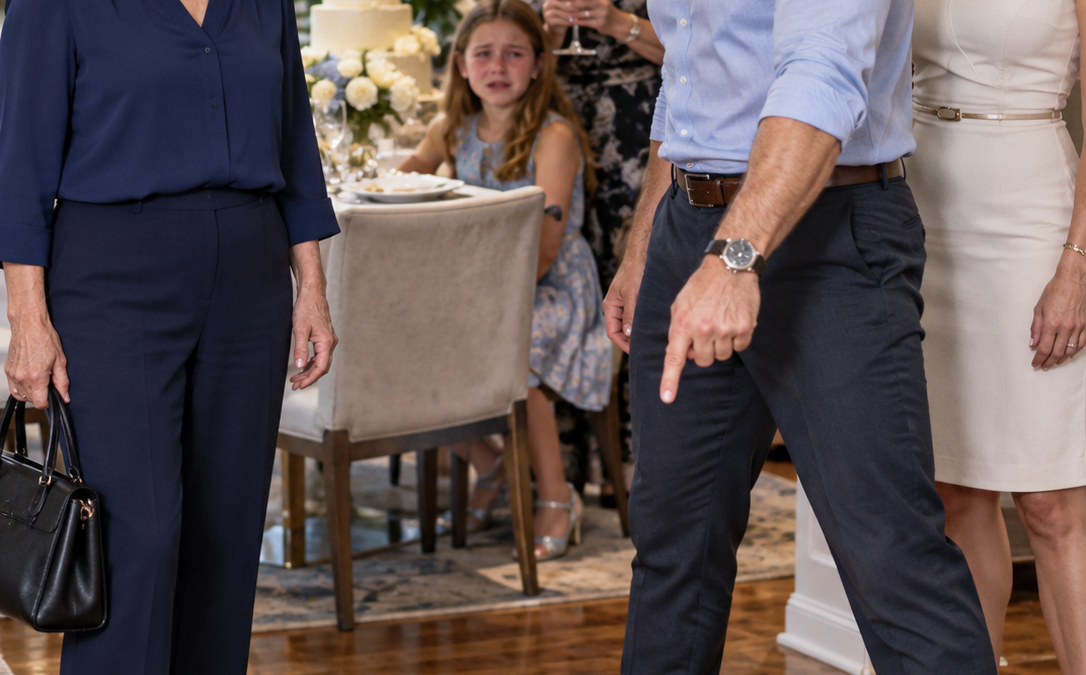
On my birthday, my only son picked up the lemon cake I baked from my late husband’s recipe, held it in both hands, and dropped it on the hardwood floor. He pointed down at the mess—cream cheese frosting spreading across planks I paid $47,000 to install—and said two words.
“Eat it.”
His wife laughed. Not nervous laughter. A real, satisfied sound, like she had been waiting for it all evening. His mother-in-law smirked behind her wineglass. My 10-year-old granddaughter started to cry.
I knelt down. I looked at every crumb.
Then I stood up, picked up my purse, and walked out of the house I helped buy.
Nobody followed me. Nobody said stop.
He said two words. Two words that cost him everything.
By the next morning, all of it was gone.
Welcome back to Alpha Mom Stories. If this is your first time here, you’re in the right place. Hit subscribe and turn on notifications, because this story is going to make you want to call your mother or change your locks.
I live alone now. The apartment is small. One bedroom, one bathroom, and a kitchen in Dayton, Ohio, that smells like lemon zest and dish soap. Everything is in its place. Bills filed by date. Spices in alphabetical order.
I spent 32 years as a senior loan officer at First National Bank, and the habits of that work never left me.
My husband Harold died eight years ago of a heart attack at 63. We were married 33 years, and in all that time, I never once saw him ignore a problem. He replaced the kitchen faucet two weeks before it would have leaked. He noticed the soft spot in the porch before anyone stepped through it. He was the kind of man who fixed things before they broke because he believed that was what decent people did.
I wear his wedding ring on a chain around my neck, under my blouse, against my skin. It sits just below my collarbone, and when I need steadiness, I press my fingers to it through the fabric. Nobody sees it. I know it is there. That has always been enough.
Every birthday, every holiday, every Sunday that felt heavy, I baked Harold’s lemon cake. Cream cheese frosting from his mother’s recipe, written on a yellowed index card in his handwriting.
The kitchen would fill with that smell—butter, sugar, lemon zest—and for 20 minutes, the apartment wouldn’t feel empty anymore. For 20 minutes, he would still be standing behind me, tasting the batter off the spoon before I could stop him.
I spent 32 years telling other people whether they could afford their dreams. I evaluated risk for a living. I read balance sheets the way some people read novels. The numbers told me who was holding together and who was about to collapse.
I could look at a family’s finances and know more about their future than their therapist did.
I never once told my own son no.
He was the riskiest loan I ever approved, and I never even ran the numbers.
There is a leather notebook on my kitchen shelf. Small. Brown. The spine is worn soft from 25 years of handling. Harold gave it to me the day our son was born, September 14, 1985.
He set it in my hand while I was still in the hospital bed, Kyle sleeping on my chest, seven pounds and four ounces of new life wrapped in a blue blanket.
Harold looked at me and said five words I have never forgotten.
“Keep track of everything, Thora. Someday it’ll matter.”
So I did.
Page one, in my own handwriting:
September 14, 1985. Kyle Robert Caldwell. 7 lb. 4 oz. Hospital bill: $320. Paid in full.
I have filled three notebooks since then. The current one is half full.
Every dollar I gave my son, documented. Every loan I co-signed, recorded. Every bill I quietly covered when Kyle didn’t know I was covering it. Every security deposit, every tuition check, every emergency transfer made at two in the morning when his checking account hit zero.
Twenty-five years of entries, each one dated, each one with the exact amount written in blue ink on ruled paper by a woman trained to track every penny that crossed her desk.
The running total as of last month: $487,352.
Nearly half a million dollars given by a woman who lives in a one-bedroom apartment, buys her blouses from the clearance rack, and drives a 12-year-old sedan with 140,000 miles on it.
I never showed anyone the notebook. I never complained. I never tallied the number out loud.
Harold told me to keep track.
I think he knew that someday the numbers would be the only thing that told the truth.
Let me trace the giving for you, because the total means nothing without the timeline.
Kyle was 22 when he needed his first apartment. Security deposit and first month’s rent: $1,800. He had just started a sales job, and he didn’t have it.
I did.
His college loans came next. $38,000. I paid them off over six years, writing checks every month from my salary at the bank while Kyle built his career and never mentioned the debt again.
He graduated with honors. I have a photograph from commencement day—Kyle in his cap and gown, arms around me, grinning.
“Couldn’t have done it without you, Mom.”
He meant it then.
That was the last time I believed him.
Then came the big one. The house.
Kyle needed a down payment, and the number was $60,000. I took a second mortgage on my own home to make it happen. His credit score wasn’t strong enough to qualify for the loan on his own, so I co-signed the mortgage. My name sat right next to his on every document at the closing table.
Then the business: $45,000 in seed money for a side venture he wanted to launch. He said he would pay me back.
He never said when.
I never asked.
Then Renee’s boutique, an interior design firm she started three years into the marriage. The startup needed a $70,000 business loan. The bank required a guarantor.
Kyle asked me during a Saturday morning phone call, his voice low as if Renee were in the next room.
I guaranteed it.
Renee never knew.
Then the renovation. $47,000 paid directly from my savings. New kitchen. Hardwood floors throughout. Two bathrooms remodeled.
Then the grandchildren. School tuition. Piano lessons. Soccer registration. Birthday parties with bouncy castles that cost more than my monthly rent.
Every time I wrote a check, I told myself the same thing.
That’s what mothers do.
I said it so many times I almost believed it was true.
Kyle never once said, “I’ll pay you back.”
The thought simply never crossed his mind. The money appeared, and he assumed it would always appear the same way he assumed the sun would rise and water would run when he turned the faucet.
Kyle met Renee when he was 30.
She was polished, confident. She came from the Whitfield family—old name, nice house, the kind of people who use the word summer as a verb.
The shifts were subtle at first.
At Christmas dinner, I was seated at the end of the table instead of next to Kyle.
Then the food.
“Oh, Thora, you didn’t need to bring anything. We had it catered.”
Then the phone calls—shorter, further apart, and always ending with, “Renee and I have plans.”
Renee never raised her voice at me. She didn’t need to. She just made sure I was always standing in the wrong place.
A comment about my apartment.
“It’s cozy.”
A glance at my blouse.
“Vintage, I suppose.”
A smile at my lemon cake.
“Homemade. How sweet.”
Each one so small, so polite, so precisely aimed that you couldn’t call it rude without sounding oversensitive.
Kyle started echoing her.
“Mom, you don’t have to do all that.”
“Mom, it’s fine.”
“We’ve got it covered.”
“Mom, Renee says…”
That was the phrase I grew to dread.
Mom, Renee says.
As if his wife’s opinions had replaced his own, cell by cell, until there was nothing left of the boy who hugged me at graduation.
The last time Kyle said thank you to his mother was eight years ago. I remember it clearly. I was carrying a casserole dish through their front door, and he took it from my hands.
“Thanks, Mom. Smells great.”
The year Harold died.
The last time those words came out of his mouth directed at me.
He didn’t become cruel overnight. He became something worse.
Embarrassed.
Embarrassed by my apartment, my car, my careful way of living.
Renee showed him a world where people spent money they hadn’t earned on things they didn’t need, and he decided that was the world he wanted.
The world I had built for him with my own savings was suddenly too small for who he was becoming.
Renee’s mother, Paige Whitfield, arrived at family events the way a diplomat arrives at a summit—with gifts and territory on her mind.
iPads for the grandchildren at Christmas. Cashmere scarves for Renee. A bottle of wine that cost more than my grocery bill for the week.
I brought the lemon cake.
Paige brought a three-tier confection from a French bakery downtown. Two hundred dollars’ worth of buttercream and fondant.
The grandchildren reached for hers first.
Paige smiled.
She had won.
Thanksgiving, two years into the marriage, Paige held court at the dinner table, a glass of Chardonnay in hand, talking about a charity gala she was chairing.
She looked at my outfit—a navy cardigan I had worn to church that morning—and said without malice, without heat, in the same tone you might use to note a stain on a tablecloth:
“Some people just aren’t meant for this kind of family, dear. And that’s perfectly fine.”
I said nothing.
I smiled.
I cleared the dishes.
I washed them by hand while Renee and Paige laughed in the living room.
Lily started calling Paige Nana and me Grandma Thora.
Two syllables versus four.
A small thing, unless you are the one carrying the heavier name. I felt that distance every single time it came out of my granddaughter’s mouth.
Here is what Paige didn’t want anyone to know.
Her wealth was inherited.
Every dollar.
She had never worked a single day in her life.
Her money sat in a trust she could barely access, and her monthly allowance covered her mortgage, her club dues, and not much else.
The French bakery cakes were a performance funded by a shrinking budget and a desperate need to be seen as the grandmother who mattered.
I earned every dollar I ever spent.
Thirty-two years. Five days a week. Sensible shoes and early mornings.
Paige told me I wasn’t meant for this kind of family.
She was right.
I was meant for a family that says thank you.
Three days before my 68th birthday, I had heard nothing from Kyle. No call. No card. No mention of a plan.
Then a text arrived.
Not from Kyle.
From Renee.
Kyle wanted me to let you know dinner’s at 6. Dress nice.
Not a phone call.
Not “Happy birthday, Mom.”
A forwarded obligation with a dress code.
I read it twice and set my phone on the counter. I pressed my fingers to Harold’s ring through my blouse.
Maybe this time would be different.
I bought a new blouse at the department store downtown. Navy blue, modest neckline, $13 on the clearance rack. I ironed it twice. I polished my good shoes. I set my hair in the bathroom mirror and told myself I looked fine.
Then I baked the lemon cake.
Harold’s recipe.
I creamed the butter by hand because that was how his mother did it, and some things should not be changed. The frosting was thick. The top was golden.
The apartment filled with that smell.
The smell of every good Sunday Harold and I ever had.
I wrapped small gifts for Lily and Owen—a book about constellations for Lily, a set of colored pencils for Owen. Nothing expensive. Something chosen with care because I still believed that was what mattered.
I looked at myself in the hallway mirror before I left.
Navy blouse. Harold’s ring under the fabric. Cake in my hands.
Hope in my chest.
I should have known better than both.
412 Birchwood Lane.
I pulled into the driveway of the house I helped buy and noticed the new landscaping. Hydrangeas along the walkway. A stone border I hadn’t seen before.
That part, at least, was not on my dime.
The front door had a brass knocker I picked out 12 years ago, back when the house was new and Kyle still asked my opinion on things.
I knocked on my own choice and waited.
Paige opened the door, glass of wine already in hand.
She looked me up and down—navy blouse, sensible shoes, lemon cake—and said, “Oh, Thora. You came.”
She said it the way you might greet a stray cat that wandered onto the porch: surprised, mildly inconvenienced.
I stepped inside.
The house smelled like roasted garlic and something expensive.
Kyle was in the kitchen. He did not come out to greet me.
Lily and Owen ran over. They hugged me—quick, tight, genuine—but pulled away fast, as if they had been told not to linger.
Lily looked up with those brown eyes and whispered, “Your cake smells good, Grandma Thora.”
On the counter behind Renee’s arrangement of cloth napkins and fresh flowers sat the other cake.
Three tiers. White fondant. A gold topper that read 68.
Renee’s name was on the bakery receipt beside it.
They had ordered a birthday cake for me that had nothing of me in it.
Dinner was stiff.
Paige sat at the head of the table, though it was my birthday in my son’s house, and held court about a garden tour she was chairing in the spring.
Renee refilled wineglasses and steered every conversation toward the Whitfields.
Kyle barely looked at me. He answered his phone twice during the meal.
Owen ate with his elbows on the table and talked about a video game.
Lily sat quietly, watching everyone.
She is the kind of child who notices things—the pauses, the glances, the things adults think they are hiding.
After dinner, I stood and went to the kitchen. I carried my lemon cake into the dining room with both hands steady, the way I had carried it into this family a hundred times before.
“I made it the way Harold always liked it,” I said.
Silence.
The table went quiet.
Renee looked at the cake, then at Kyle.
Something passed between them. A glance. A signal. A decision made in half a second that I was not invited into.
“We already have a cake, Thora,” Renee said.
Her voice was smooth. A proper one.
Kyle stood up.
He reached across the table and picked up my cake.
He held it with both hands.
He looked at it the way you look at something you are about to throw away.
Then he dropped it.
Deliberately.
Both hands opened and the cake fell.
Not a stumble.
Not an accident.
With his eyes open and his jaw set, my son dropped my birthday cake on the floor of the house I helped buy.
The tin bent against the hardwood. Cream cheese frosting splattered across the grain. The lemon layers split and crumbled.
The frosting looked like a wound on that floor.
He pointed down at the mess.
“Eat it.”
Two words.
Flat. Final.
Delivered while standing over his mother.
Renee laughed.
It was real. Delighted. Satisfied.
The sound of a woman watching a plan unfold exactly the way she designed it.
Paige smirked behind her wineglass and did not set it down.
Owen stared, frozen, a seven-year-old trying to understand why his father was breaking things.
Lily’s eyes filled with tears.
She looked at me, and I saw something in her face I will carry for the rest of my life: the expression of a child learning that the adults in her world are capable of deliberate cruelty.
I knelt down.
The frosting was cold under my knees.
I could see Harold’s recipe in every crumb. The extra lemon zest. The way the layers pulled apart just right.
I pressed my fingers to the ring beneath my blouse.
It was warm against my chest.
My granddaughter was crying.
My son was standing over me.
His wife was laughing.
And I was on my knees.
I stood up.
I picked up my purse from the back of the chair.
I did not raise my voice.
I did not cry.
I walked through the kitchen, past the three-tier bakery cake with the gold topper, through the living room, and out the front door.
No one followed me.
No one said, “Stop.”
No one said, “Wait, Mom.”
The brass knocker caught the porch light as I pulled the door shut.
The last thing I heard was Renee’s voice drifting through the closed door.
“Well, that was dramatic.”
The drive home was silent.
No radio.
No tears.
Just the engine and my own breathing and the dark streets of a city I had lived in for 40 years.
I pulled into the parking lot of my apartment complex and sat behind the wheel for five minutes before my hands would unclench.
Then I called June.
June Barlow, my next-door neighbor. Seventy-one. Retired elementary school teacher. Widowed like me.
She’s watched me come home from family events with red eyes more times than either of us wants to count.
“It happened again,” I said. “Except this time, he threw my cake on the floor and told me to eat it.”
June was quiet for a long time.
She has a teacher’s instinct for silence, knowing when to let the words settle before she speaks.
Then she said, in a voice that was gentle and furious at the same time, “Thora, you need to stop setting yourself on fire to keep them warm.”
I went inside.
At the kitchen table, I made a cup of tea. Earl Grey. One sugar.
It sat in front of me and went cold while I stared at the wall above the stove.
The apartment was dark except for the light over the range.
I watched the clock on the microwave change numbers.
No calls.
No texts.
Three hours passed.
The tea grew a film.
The refrigerator hummed.
Then, at 11:42, one text from Kyle.
You embarrassed everyone by leaving. Renee is upset.
I read it twice.
I set my phone face down on the table.
Three hours.
That’s how long it took him to text.
Not to apologize.
Not to ask if I made it home safely.
To tell me that I—the woman who had been on her knees in front of a smashed birthday cake—was the one who embarrassed the room.
I did not respond.
There was nothing to say to a man who believed the problem was my walking out and not his throwing the cake.
I could not sleep.
At two in the morning, I gave up and went to the kitchen.
The apartment was still dark, the kind of silence that presses against your ears and makes you hear your own heartbeat.
I made another cup of tea and sat at the table.
I thought about Harold. His steady hands. His practical voice. The way he could look at Kyle across the dinner table and, without raising his voice, make the boy sit up straight and act right.
Harold had a gravity to him.
When he died, that gravity went with him.
And Kyle drifted.
Keep track, Thora. Someday it’ll matter.
I opened the kitchen drawer and took out the leather notebook.
The first one.
The original from the hospital.
September 14, 1985.
I set it on the table.
Then the second.
Then the third.
Three notebooks stacked together, the leather warm and soft from decades of my hands.
I turned to page one.
September 14, 1985. Kyle Robert Caldwell. 7 lb. 4 oz. Hospital bill: $320. Paid in full.
I read every entry.
Every page.
The down payment. The tuition. The co-signed mortgage. The business loan. The renovation. The guarantee. The grandchildren’s school fees.
Line after line after line.
Each one dated.
Each one exact.
Each one a sacrifice I had made willingly and that had been received without a word of thanks.
$487,352.
I knew the number, but reading every line, every date, every amount, every careful entry made by a woman who had been trained to keep precise records, something shifted inside me.
Not anger.
Something quieter than anger and far more permanent.
Clarity.
By dawn, the tea was cold and my decision was made.
I did not feel angry.
I felt clear.
For the first time in 25 years, I could see the whole shape of what I had done.
A woman pouring water into a bucket with no bottom, then wondering why she was thirsty.
I showered.
I dressed.
I pressed Harold’s ring against my chest.
Harold told me to keep track.
I think he knew that someday the numbers would be the only thing that told the truth.
At eight in the morning, I called my bank.
My bank.
First National, where I had worked for 32 years, where the teller still said, “Good morning, Mrs. Caldwell,” when I walked through the door.
“I’d like to close my savings account. The one where my son is listed as beneficiary.”
The teller paused.
“Mrs. Caldwell, are you sure?”
“I’ve never been more sure of anything in my life.”
$34,000 transferred to a new account at a different bank across town.
My money.
My name.
No beneficiary listed.
At 8:30, I called Margaret Wells.
Margaret and I worked side by side at First National for 18 years. She is 66 now, a paralegal at a real estate law firm downtown.
Practical. Blunt. Loyal in the way that only someone who has watched you cry in the break room for two decades can be.
She had been telling me the same thing for five years.
You’re too good to them, Thora.
“Margaret, I need your help.”
“It’s time?”
The line went quiet for a beat.
Then Margaret said, with the calm satisfaction of a woman who had been packing for a trip she always knew was coming, “I’ve been waiting for this call for five years. Get dressed. I’ll pick you up at nine.”
By ten o’clock, I was sitting across from Elliot Marsh in the conference room of Margaret’s firm.
Fifty-five years old. Real estate attorney. Gray suit. Reading glasses. The kind of quiet competence that doesn’t need to announce itself.
He handled the notebook the way you handle something that might change a case.
He read it.
Every page.
Then he set it down and looked at me over his glasses.
“Mrs. Caldwell, you functionally own the foundation of everything your son has.”
“I know exactly what I own, Mr. Marsh. I’ve known for 25 years.”
He nodded once, squared the notebook on his desk, and said, “Then let’s get to work.”
Margaret spent the next two hours pulling records—property deeds, loan documents, co-signer agreements, bank correspondence.
She spread them across Elliot’s conference table like a map of everything I had given and everything my son had forgotten.
The house at 412 Birchwood Lane.
I am co-signer on the mortgage.
Kyle could not qualify for the loan when they applied. His income-to-debt ratio was too high.
My credit score carried the application.
My income verification.
My signature right next to his on every page.
Without me on that mortgage, the bank would have declined him.
Kyle’s business loan: $120,000 remaining.
I am the guarantor.
If Kyle defaults, the full amount becomes my obligation.
The bank knows this.
Kyle never thought about it.
Renee’s boutique startup loan: $70,000 guaranteed by me.
I signed the paperwork because Kyle asked me to during a Saturday morning phone call, his voice low.
Renee had never seen my name on her loan documents.
She built her entire professional identity on being self-made.
She had no idea who actually made her possible.
The renovation at 412 Birchwood: $47,000 paid directly from my savings.
New kitchen.
Hardwood floors.
Two full bathrooms.
Every receipt in the notebook.
I never filed a lien against the property for those costs. Any contractor or material supplier could have.
I chose not to.
Until now.
The grandchildren’s education fund: $28,000 in my name.
Kyle listed as beneficiary.
That could change with one form and one signature.
Elliot laid out the legal options in plain language.
One: initiate co-signer removal on the mortgage. The bank reassesses Kyle on his own merits, and he won’t qualify.
Two: withdraw as business-loan guarantor. The lender demands a new guarantor or full repayment within 90 days.
Three: transfer the education fund to an irrevocable trust I control.
Four: file a mechanic’s lien on 412 Birchwood for renovation costs. $47,000 documented to the penny.
“Do all of it,” I said.
Elliot set down his pen.
“All of it?”
“He told me to eat off that floor, Mr. Marsh. I’d like him to understand what that floor cost.”
Mr. Marsh looked at me like I was the calmest person who had ever handed him a half-million-dollar case.
I probably was.
That evening, at home, the apartment was quiet.
I opened the kitchen drawer, the same drawer where the notebooks live beside the measuring spoons and the stack of rubber bands I keep for no good reason.
Harold’s recipe card for the lemon cake was there.
Yellowed.
Creased.
His handwriting slanted and cramped, the penmanship of a man who was better with a wrench than a pen.
Butter stains lined the margin, accumulated over decades of my hands.
Across the top, in blue ink faded almost to gray:
For my Thora, who makes everything sweeter.
I held the card for a long time.
I traced the letters with my thumb.
Then I cried for the first time since the birthday.
Not for Kyle.
Not for the cake on the floor, or the two words, or the sound of Renee’s laughter.
I cried for Harold.
For the man who gave me a notebook and a recipe and trusted me to know when to use both.
I set the recipe card on the kitchen table next to the notebooks.
They belonged together.
The love and the evidence, side by side.
Harold’s handwriting was never neat, but I could read every word he ever wrote me.
Even the ones he didn’t put on paper.
Two days after the birthday, Kyle called.
I answered because I wanted to hear what he would say first.
Part of me—the mother part, the part that still sees a seven-pound baby on my chest—held on to a thin, stubborn hope.
I wanted to know whether any piece of the boy who hugged me at graduation was still alive inside the man who threw my cake.
He did not lead with an apology.
He led with an accusation.
“Mom, Renee said you were rude to everyone at dinner.”
I let that sentence hang between us for three full seconds.
“Kyle, you threw my cake on the floor.”
“It was a joke. Mom, you always take everything so seriously. It’s exhausting.”
A joke.
Twenty-five years of baking Harold’s lemon cake.
The same recipe.
The same frosting.
The same care.
And he called it a joke.
“Tell me one thing I’ve ever taken from you, Kyle,” I said. My voice was level. “One thing.”
Silence.
I could hear Renee in the background, her voice a low hum. Coaching.
She was always there now, a current under everything he said.
“I don’t have time for this,” Kyle said. “Just don’t make a big deal out of it, okay?”
He hung up.
I set the phone on the counter.
I looked at the recipe card still sitting on the kitchen table.
Harold’s handwriting.
Harold’s love.
Harold’s cake smashed on the floor of a house Harold’s wife paid for.
A joke.
He called it a joke.
$47,000 of floor and 25 years of cake.
And he called it a joke.
Three days after Kyle’s call, my phone rang again.
The voice on the other end was not his.
It was small.
Careful.
Ten years old.
“Grandma Thora?”
“Lily?”
“Mommy says you’re being mean to Daddy. Are you mad at us?”
My hand tightened on the phone.
My throat closed, but my voice held.
Thirty-two years of sitting across desks from borrowers and delivering bad news with a steady voice.
That training held.
“I could never be mad at you, sweetheart. I love you more than lemon cake.”
“More than lemon cake?”
She almost laughed.
I heard the ghost of a smile.
Then Owen’s voice came through in the background, bright and careless the way seven-year-olds are.
“Nana Paige says Grandma Thora is being silly.”
Nana Paige.
The rankings again.
The careful hierarchy fed into my grandchildren’s mouths like medicine disguised as candy.
I said goodbye to Lily.
I told her I loved her.
I told her I would see her very soon.
Then I hung up.
My hand was shaking, but my mind was perfectly still.
I called Elliot Marsh.
“The education fund,” I said. “Move it to the trust today. Not next week. Today. My grandchildren are not bargaining chips.”
The trust terms were clear.
$28,000 accessible to Lily and Owen at age 25, or earlier if they maintained a direct relationship with their grandmother—not arranged through Kyle, not supervised by Renee.
She had used my grandchildren’s voices to hurt me.
That was the moment I stopped feeling guilty about anything.
The next morning, at 9:15, my phone rang.
Paige Whitfield.
I had never received a direct call from Paige in 11 years of knowing her. She preferred to operate through Renee, a general directing troops from a safe distance.
“Thora.”
Her voice was honeyed, the kind of sweetness with vinegar underneath.
“I think we need to have a frank conversation.”
“Go ahead, Paige.”
“You need to accept your role in this family. Kyle has a wife now, a proper life, children who need stability. You need to step back gracefully. This… whatever you’re doing, it’s unbecoming.”
I listened to the silence after the word unbecoming.
It hung between us like smoke.
“Paige,” I said quietly. “Do you know how much your daughter’s business cost to start?”
“Renee is self-made, Thora. Unlike some people.”
I almost laughed.
Self-made?
A $70,000 loan with my name on the guarantee, and Paige was calling her daughter self-made.
“Hmm,” I said. “That’s what mothers do, I suppose.”
The words tasted different this time.
Not the warm, justifying phrase I had repeated for 25 years.
Bitter now.
Sharp.
A sentence turning itself inside out.
I hung up.
Paige was still mid-sentence.
Paige told me her daughter was self-made.
I decided to let her find out what self-made really looks like when the guarantee disappears, the loan comes due, and there is nobody standing behind the curtain writing checks.
Elliot filed the paperwork on a Tuesday morning.
I sat across from him in my navy blouse and signed five documents that would dismantle the financial architecture my son had mistaken for his own achievement.
Co-signer removal on the mortgage at First Federal: initiated. A formal letter requesting removal, triggering a mandatory reassessment of Kyle’s individual qualification.
Business-loan guarantor withdrawal: a certified letter to Kyle’s commercial lender. Ninety-day window to find a new guarantor or repay the remaining $120,000.
Education fund transferred to a revocable trust: completed the same day. $28,000. My terms. My grandchildren protected regardless of what happened next.
Mechanic’s lien filed on 412 Birchwood Lane: $47,000 in renovation costs, documented with receipts dating back eight years. Every item in the notebook.
I signed five documents that morning.
Each one felt like setting down a bag I had been carrying for 25 years.
My hand was steady.
My signature was the same clean, professional signature that had approved thousands of loans at First National Bank.
This time, I was calling one in.
I pressed Harold’s ring through my blouse and whispered quietly enough that Elliot could not hear.
“I’m sorry it came to this, Harold.”
But I think Harold would have understood.
He was the one who told me to keep track.
And he was the one who taught me that when something is broken beyond repair, the kindest thing you can do is stop pretending it works.
Now, I know some of you are thinking she went too far.
But I want you to sit with that for a moment.
I gave half a million dollars over 25 years.
I never asked for a penny back.
And my son threw my cake on the floor and told me to eat it.
So if you think a mother protecting herself is going too far, I want you to keep listening.
And if you haven’t yet, subscribe, because what happens next is the part nobody saw coming.
The first domino fell on a Wednesday afternoon.
Kyle was at his desk. Regional sales director. Corner office. The title he had earned on a foundation he never examined.
Then his phone rang.
First Federal Bank.
“Mr. Caldwell, we need to discuss your mortgage. Your co-signer has initiated removal from the loan agreement. We’ll need to reassess your individual qualification.”
“What co-signer?”
“Thora Caldwell.”
He had forgotten—or perhaps he had never truly understood—that his mother’s name sat on the most important financial document of his life.
He had treated it the way he treated everything I gave him.
Invisible.
Always there.
Never acknowledged.
He called me that afternoon.
I watched my phone light up on the kitchen counter.
His name.
His number.
I let it ring.
He called again.
I let it ring.
Again.
And again.
Six calls in two hours.
I watched the screen glow and go dark, glow and go dark, like a heartbeat nobody was answering.
He left one voicemail.
I listened to it that evening while I ate soup at the kitchen table.
His voice was tight, controlled—the sound of a man trying very hard not to sound afraid.
“Mom, I got a call from the bank about the mortgage. I need to talk to you. Please call me back.”
He called me six times that afternoon.
I watched my phone ring each time.
I let it.
The second domino fell two days later.
Different bank.
Same kind of call.
Kyle’s commercial lender.
“Mr. Caldwell, your guarantor has withdrawn from your business-loan agreement. We require a new guarantor or full repayment within 90 days.”
Kyle’s voice cracked.
“The remaining balance is $120,000?”
“That is correct, sir.”
$120,000.
Ninety days.
No guarantor.
Kyle sat in the corner office of a midsize office-supply company, a career built on the confidence of a man who believed he had earned everything himself, and felt the ground shift beneath his chair.
He called Renee at the boutique.
“Did you know my mother guaranteed my business loan?”
Her voice sharpened.
“That’s ridiculous, Kyle. You did that yourself.”
“The bank says otherwise. Her name is on the guarantee. Her credit. Her signature.”
Silence.
The kind of silence that fills with things a person does not want to acknowledge.
“That can’t be right,” Renee said.
But there was a hairline crack running through her voice, thin and unmistakable.
“It is right. I called the lender directly. They confirmed.”
This was the first crack.
Not in the marriage.
That would come later.
This was the crack in the story Kyle and Renee had been telling themselves for a decade.
The story where they were self-made.
The story where Thora was a sweet but irrelevant old woman in a one-bedroom apartment who brought homemade cake to dinner parties that had moved beyond her.
That story was fracturing.
And neither of them had a backup.
He built his whole identity on being self-made.
It took one phone call to find out who actually made him.
Kyle showed up at my apartment the next evening.
He did not call first.
He banged on the door.
Three hard knocks, the kind that rattle the chain lock and make the neighbor’s dog bark.
I opened it.
I was wearing my house slippers and holding a cup of chamomile tea.
I looked exactly like what I was: a 68-year-old retired loan officer at home on a Thursday evening.
He looked like a man whose life was unraveling faster than he could track.
His shirt was untucked.
His eyes were red-rimmed.
He smelled like coffee and sweat and not enough sleep.
“What are you doing?”
His voice was raw.
Half shout.
Half plea.
“You’re going to destroy everything I’ve built.”
I took a sip of my tea.
“I’m not destroying anything, Kyle. I’m taking back what’s mine.”
“This is about the cake.”
He stepped into the doorway.
Too close.
Too loud.
“Mom, just eat it. Eat your pride and let this go.”
There it was.
Eat it.
Again.
He kept reaching for those two words like a weapon, never understanding that the weapon was empty and had always been empty.
The same words he threw at me while I was on my knees.
He thought they still had power.
“Kyle,” I said.
My voice was the voice I had used for 32 years when I sat across a desk from a borrower and explained calmly and clearly why their application had been declined.
“I want you to listen to me carefully. The house. The business. Renee’s boutique. I paid for all of it. Every dollar is in a notebook your father gave me the day you were born.”
His jaw worked.
His hands opened and closed at his sides.
“You’re crazy,” he said. “You’re losing it, Mom.”
“I’m a retired loan officer. Thirty-two years of evaluating risk and reading balance sheets. I am the least crazy person in your life right now, Kyle. And I think somewhere under all of this, you know that.”
I put my hand on the door.
I closed it gently.
The latch clicked.
The chain slid into place.
I closed the door the same way I opened it.
Quietly.
He was the one screaming.
Renee’s turn came the following week.
The phone call arrived at her boutique, the storefront on Main Street with the hand-lettered sign and curated fabric samples in the window.
Her lender was on the line.
The loan guarantee had been withdrawn.
The bank required additional collateral to maintain the terms of the agreement.
Renee’s boutique ran on razor-thin margins.
Three employees.
A showroom that looked expensive.
A bank balance that did not.
She had no collateral beyond the business itself, and the business was not enough.
She called Kyle at work.
“Your mother is ruining us.”
Kyle was quieter than she expected.
“She says she paid for your business too, Renee.”
“That’s a lie.”
But her voice wavered, a tremor small but unmistakable, like a fault line shifting under pavement.
“Is it, Renee? Because the bank has her signature on your loan guarantee. $70,000. She signed it three years into our marriage.”
For one moment—brief, genuine, stripped of performance—Renee was shocked.
She had built her identity around self-made.
She had told clients, friends, her own mother, that she launched the boutique on talent and determination alone.
And now her husband was telling her that the quiet woman she mocked for bringing homemade cake was the reason the bank said yes.
The shock lasted three seconds.
Then Renee pivoted.
Not to gratitude.
Not to reflection.
To fury.
“She set us up. She planned this from the beginning. She guaranteed everything so she could hold it over our heads.”
Kyle stared at her.
He did not argue.
But for the first time, he looked at Renee and did not look convinced.
Renee called me a manipulator.
I thought that was interesting, coming from the woman who taught my grandchildren to rank their grandmothers.
A process server arrived at 412 Birchwood Lane on a Tuesday afternoon.
He walked up the stone-bordered path, past the hydrangeas, and knocked on the front door—the door with a brass knocker I picked out 12 years ago.
Renee answered.
She was holding a glass of sparkling water and wearing a silk blouse.
The process server handed her a manila envelope.
Inside: a mechanic’s lien filed by Thora Caldwell in the amount of $47,000 for renovation costs.
Receipts attached.
Every item documented.
Kitchen cabinets.
Hardwood flooring.
Bathroom tile.
Fixtures.
Labor.
Renee read it.
The color left her face.
She called Paige.
“Mom, she’s putting a lien on the house.”
Paige’s voice came from the other end of the line, still carrying that practiced authority.
“Get a lawyer, darling.”
Renee’s voice broke.
“With what money?”
Silence from Paige.
$47,000.
That’s how much it cost to install the floor my son told me to eat off of.
And now there was a lien on every plank.
I know this is a lot.
And I know some of you are shaking right now because you’ve been in that room.
You’ve been the one holding the cake.
You’ve been the one nobody thanked.
If that’s you, do me a favor.
Share this story.
Not for me.
For the woman in your life who needs to hear it.
And stay with me, because Kyle still doesn’t know the biggest part.
Kyle did what desperate people do when the walls close in.
He tried to build an army.
He called Aunt Linda first.
Harold’s sister. Sixty-three years old. Two towns over. Sharp-eyed and plainspoken, the way all the Caldwells were.
Kyle figured blood loyalty would win her over.
“Aunt Linda, Mom’s lost her mind. She’s trying to take everything I have.”
Linda’s voice was calm.
The kind of calm that comes from knowing the truth for a very long time and finally being asked about it.
“Kyle, your mother gave you everything you have. She told us. She told all of us.”
“What?”
“We’ve known for years.”
“What do you mean?”
“The house. The business. The school tuition. The renovation. Your father’s savings that she used to carry you through 2019. We know, Kyle. Every family dinner for five years, your mother’s name came up after you left.”
Kyle’s mouth opened and closed.
He tried again.
“She’s being unreasonable. She’s trying to punish me.”
“Your father would be ashamed of what you did to that cake, Kyle.”
Linda’s voice did not waver.
“He would be ashamed of who you’ve become.”
Kyle hung up.
He called his cousin Martin.
Same response.
He called Uncle Roger.
Same.
He called a second cousin he hadn’t spoken to in three years.
Same.
The entire extended family knew what I had sacrificed.
Every one of them.
They had known for years.
Not because I complained.
Not because I broadcast it.
Because they asked.
And I have never learned how to lie to people who cared enough to ask.
He called four relatives looking for allies.
He found four witnesses instead.
Renee went to the only person she had left.
“Mom, we need $80,000 to stabilize. The mortgage, the business—we’re underwater.”
Paige sat in her living room, in a house she inherited from her parents, furnished with pieces older than Renee and maintained with money from a trust that was running thin.
She was quiet for a long time.
“Darling, I’d love to help, but my accountant says I’m overextended.”
Renee stared at her mother.
“You told me you could always help. You always said that.”
“I said I’d always support you, Renee. That’s different from writing checks.”
Here is the truth about Paige Whitfield.
Her wealth was inherited property sitting in a trust she could barely access.
Her monthly allowance covered her mortgage, her car, her club membership, the French bakery cakes, the cashmere, the iPads for the grandchildren.
Those were performances funded by a shrinking budget and a desperate need to be seen as the grandmother who mattered.
She could not write an $80,000 check because she did not have $80,000.
Paige looked at her daughter.
For one moment, the mask slipped.
She looked tired.
Genuinely tired.
The 64-year-old woman underneath the image was visible for the first time.
“I never wanted you to need money, Renee,” she said quietly. “I wanted you to marry well.”
She meant it.
It was the truest, saddest thing she had ever said.
And it revealed the engine underneath everything.
Paige’s entire philosophy of motherhood, her entire worldview, was transactional.
Love was not something you gave.
Love was something you invested, and you expected a return.
Renee looked at her, bitter and bright-eyed.
“I did marry well, Mom. His mother just turned out to be the one with the money.”
Paige spent her whole life teaching Renee that money was the only kind of power.
She just never counted on the quiet woman with the notebook having more of it.
They came together.
Kyle and Renee.
A united front, standing side by side in the hallway outside my apartment on a Saturday afternoon.
For the last time in their marriage, though neither of them knew that yet.
Renee tried tears first.
Her mascara was fresh—applied in the car, I suspect—and her voice was pitched soft and apologetic, the voice of a woman who had practiced contrition in the mirror.
“Thora, I’m so sorry about the birthday. It was wrong. We were both wrong. I should have said something.”
She was apologizing because she needed something.
The apology had a price tag attached, and everyone in that hallway could see it.
“Renee,” I said, “you laughed when my son threw my cake on the floor. You laughed.”
“Not a nervous laugh. A satisfied one. I heard every note of it.”
“I was nervous. It was nerves.”
“It wasn’t nerves, Renee. It was the sound of a plan working.”
Kyle stepped forward.
His eyes were pleading.
“Mom, please think about the kids.”
I looked at my son.
Forty-one years old.
Standing in a hallway using his own children as leverage without the decency to be ashamed of it.
“I’m thinking about the kids, Kyle. I’ve set up a trust for Lily and Owen. They’ll be taken care of. Their college. Their future. It’s protected. Just not through you.”
I began closing the door.
Renee dropped the mask.
The tears vanished.
Her voice went hard and sharp.
The real voice I had always known was underneath the silk blouses and honeyed manners.
“We’ll sue you, Thora. We’ll take everything.”
I paused.
The door was six inches from the frame.
“Good luck,” I said. “I kept the receipts.”
The door closed.
The lock turned.
The chain slid home.
She threatened to sue a woman who kept 25 years of receipts.
I almost admired her courage.
Easter Sunday.
Aunt Linda’s house on Maple Drive, a suburban ranch with warm lighting and a dining table that seats 12.
Kyle and Renee arrived early, which they never did.
I knew why.
They wanted to set the story before anyone else sat down.
They wanted to be the victims.
The hard-working couple brought low by a vindictive, senile mother who was punishing her own son over a harmless birthday joke.
I was not there.
I chose not to go.
I told Linda the week before, and she said, “I’ll handle it, Thora. You just rest.”
But Linda did something I did not expect.
She set a place for me at the table.
An empty chair at the far end.
A cloth napkin folded on the plate.
A small glass vase of yellow daffodils, just for me, separate from the arrangement on the counter.
The family gathered.
Twelve adults around the table.
Linda and her husband. Three cousins. Uncle Roger. Their spouses.
Kyle and Renee at one end, looking confident.
The empty chair at the other, saying nothing and everything.
Linda said grace.
“We are grateful for the people who built this family, the ones who sacrificed so that others could have more, especially the ones who are not at this table tonight.”
Kyle stared at the empty chair.
Dinner conversation moved the way family dinners do—slowly, with pauses, with someone passing the rolls and someone else refilling water glasses.
Someone mentioned the housing market.
Someone mentioned Kyle’s business.
The conversation turned like a river finding a new channel.
Kyle set his fork down.
His voice was rehearsed, pitched to sound reasonable.
“Mom is being unreasonable. She’s trying to take—”
Linda put down her own fork.
She looked at Kyle the way Harold used to look at him when he lied about his homework.
“Kyle, your mother gave you nearly half a million dollars over 25 years. She co-signed every major purchase you own. She guaranteed loans you didn’t even know about. And on her 68th birthday, you threw her cake on the floor and told her to eat it.”
Linda let the silence hold for three beats.
“If that’s your definition of reasonable, I’d like to hear your definition of ungrateful.”
Silence.
The kind that fills a room like water rising toward the ceiling.
Silverware settled on plates.
Someone cleared their throat.
A cousin shifted in his chair.
Martin spoke up.
“We all knew, Kyle. We’ve known for years.”
Uncle Roger, gravel-voiced, put his hands flat on the table.
“Harold would have put you through a wall.”
Kyle looked around the table, one face after another.
Not a single person met his eyes with sympathy.
Not one.
Renee leaned forward, her voice climbing.
“She’s manipulating all of you. She kept receipts for 25 years. That’s not love. That’s—”
“Renee.”
Linda’s voice was quiet and final.
The voice of a woman who had raised three children and taught Sunday school and did not tolerate nonsense at her table.
“The only person at this table who doesn’t have the facts is you.”
Paige, seated at the far end, examined her fingernails.
She said nothing.
The performance was over, and there was no audience left.
Kyle pushed back his chair.
The legs scraped against the floor.
He stood and looked at the empty chair one last time.
The daffodils.
The folded napkin.
The place set for a woman who wasn’t there.
Then he walked out the door.
Renee followed.
The chair stayed.
The flowers stayed.
The napkin stayed folded.
The empty chair was louder than anything Kyle said all night.
I didn’t need to be in the room.
The room already knew.
After the Easter dinner, Kyle drove to my apartment alone.
It was nearly nine o’clock.
The streetlights were on.
I heard a car door close outside, then footsteps on the stairs.
Slower than last time.
Heavier.
As if each step cost him something.
He knocked.
Not the frantic banging of two weeks before.
Two quiet taps.
I opened the door.
Slippers.
Tea.
Some things about me are constant.
He looked smaller.
His shoulders were down.
His tie was loosened.
He had been somewhere that took something out of him, and he had come here with nothing left to perform.
“Mom, I need to ask you something.”
I stepped aside.
He came in for the first time in months.
He sat at the kitchen table.
The same chair.
The same table where I had read the notebooks at two in the morning.
The same table where I cried over Harold’s recipe card.
“Is it true?” he said. “Everything Aunt Linda said?”
I went to the drawer.
I took out the leather notebook.
The original.
The one Harold gave me in the hospital, the spine soft from 25 years of my hands.
I set it on the table in front of my son.
“Your father gave me this the day you were born. He said, ‘Keep track, Thora. Someday it’ll matter.’”
I opened it to page one.
He looked down.
September 14, 1985. Kyle Robert Caldwell. 7 lb. 4 oz. Hospital bill: $320. Paid in full.
He turned the page.
Then the next.
And the next.
His hands began to shake around the fifteenth page.
By the thirtieth, the shaking was in his shoulders.
He was reading the history of his entire life rewritten.
Not in his accomplishments.
Not in his sales numbers or promotions.
In his mother’s sacrifices.
Dollar by dollar.
Year by year.
Entry by entry.
He looked up.
His eyes were red and wet.
“Why didn’t you ever say anything?”
“Because that’s what mothers do.”
Five words.
The same five words I had told myself a thousand times over 25 years.
But they sounded different now.
Not warm.
Not justifying.
Final.
An indictment written in the language of love.
“Mom, I’m so—”
“You told me to eat off that floor, Kyle.”
My voice was even.
My hands were still on the table, steady as the day I signed my first loan approval at First National.
“I paid for that floor.”
The sentence landed.
He flinched.
His mouth closed.
“I spent 25 years saying, ‘That’s what mothers do.’ Turns out this is also what mothers do.”
I looked at him.
“They stop.”
Kyle cried at my kitchen table for 20 minutes.
I made him tea.
Earl Grey.
One sugar.
I set it in front of him the way I had set a thousand cups of tea in front of a thousand borrowers who were learning that their numbers did not add up.
I did not make him a promise.
When he was done, I took the notebook from under his hands.
I closed it.
I set it back in the drawer next to the recipe card, next to the rubber bands.
He stood.
He wiped his face with the back of his hand.
He walked to the door.
“Mom—”
“Good night, Kyle.”
He left.
I locked the door behind him.
The chain.
The deadbolt.
Both.
He cried at my kitchen table for 20 minutes.
I made him tea.
I did not make him a promise.
Kyle drove home.
He walked into 412 Birchwood Lane, the house with the lien on it, the house with the mortgage he could not carry alone, and sat down across from Renee at the kitchen island.
The kitchen I paid $47,000 to renovate.
The hardwood under his feet?
Mine.
The cabinets behind his head?
Mine.
He told her about the notebook.
“She has everything documented. Every dollar. Twenty-five years. The down payment. The mortgage. My business. Your boutique. The renovation. The kids’ school.”
Renee listened.
She set down her phone.
She crossed her arms.
Then she delivered her verdict.
“So she kept receipts for 25 years. That’s not love, Kyle. That’s accounting.”
“She paid for your business, Renee. She paid for this house. She paid for the kids’ school. She paid for these floors we’re standing on.”
“And now she’s using all of it to control us.”
Renee’s voice was certain and clipped, the voice of a woman who would rather lose everything than admit she was wrong about anything.
“Classic narcissist behavior. She guaranteed everything so she could hold it over us whenever she wanted.”
Kyle stared at his wife.
He had heard her say things like this before.
About me.
About Linda.
About anyone who challenged Renee’s version of events.
But this time, his expression changed.
Not anger.
Recognition.
He didn’t argue.
He picked up his car keys from the counter, walked to the front door, and drove to the Comfort Inn on Route 35.
He checked in at 10:40 that night and slept on a mattress that cost less per night than a single tile in his kitchen.
It was the first night he had slept apart from Renee in 11 years.
He wasn’t angry at her.
He had simply, finally, heard her clearly.
Kyle called me the next morning.
His voice was flat, the voice of a man in a hotel room who had spent the night staring at a ceiling fan.
“Mom, I want to fix this.”
“Kyle, I love you. I will always love you. But I don’t trust you, and I can’t fix that for you.”
Silence.
I could hear the hum of a hotel air conditioner in the background.
“What do I do?”
“You have 90 days on the business loan, 60 days on the mortgage. Figure it out. That’s what adults do.”
He was quiet again.
Then:
“And the kids? Their college fund?”
“The trust is for them, not for you. They’ll have access at 25, or sooner if they visit their grandmother.”
I paused.
Let the sentence settle.
“The one who bakes the cake.”
He hung up without another word.
I set my phone on the kitchen counter and pressed my fingers to Harold’s ring.
I gave him a boundary.
It was the first one I had ever set with my own child.
It should have been the thousandth.
Here is what happened after.
Kyle and Renee could not qualify for the mortgage on their own.
First Federal gave them 90 days to find a new co-signer.
They asked every person they knew.
Renee’s college friends.
Kyle’s business contacts.
A cousin on Renee’s side.
Nobody stepped forward.
Nobody wanted their name on a loan for a couple whose finances were collapsing in real time.
They sold the house at 412 Birchwood Lane at a loss—$40,000 below what they had paid—in a rush because the bank was not going to wait.
They moved into a two-bedroom rental on the east side of town.
The brass knocker on the front door was not theirs anymore.
Kyle’s business loan went the same way.
He negotiated with the lender for an extended timeline, but he could not meet the terms.
He sold his half of the venture to his business partner at a discount.
Net loss: approximately $80,000 in equity.
The business went on.
His name did not.
Renee’s boutique closed within five months.
Without the loan guarantee, the bank called the note due.
She could not cover it.
Three employees were laid off.
The storefront went dark.
The hand-lettered sign came down.
Her professional reputation—the self-made designer, the woman who built it from nothing—dissolved.
Eight months after the birthday, Renee filed for divorce.
Not out of reflection or remorse.
Kyle was simply no longer financially useful to her.
She moved back into Paige’s inherited house.
The irony wrote itself.
Paige stopped visiting the grandchildren once there was no nice house to host in.
The French bakery cakes stopped coming.
The iPad gifts dried up.
The performance required a stage.
And the stage was gone.
Kyle got a small apartment.
Same job.
Same salary.
Smaller life.
He started calling me once a week.
I answered sometimes.
Not always.
Not out of cruelty.
Out of honesty.
I was not ready to pretend that a weekly phone call repaired 25 years of silence and one night of cream cheese frosting on a hardwood floor.
Lily, now 11, bikes to my apartment every Saturday morning.
I am teaching her to bake.
We started with lemon cake.
Harold’s recipe.
She’s learning to cream the butter by hand, to fold the batter without rushing, to test the center with a toothpick and wait for it to come out clean.
Owen asked for the lemon cake on his eighth birthday.
I made it.
I brought it to Kyle’s small kitchen and set it on the folding table.
Everyone ate a piece.
Owen said, “This is good, Grandma Thora.”
Nobody threw it.
Nobody pointed at the floor.
Where did the money go?
I paid off my apartment.
I funded the grandchildren’s trust.
I donated $25,000 to a women’s financial-literacy nonprofit that teaches mothers how to read a balance sheet and protect what is theirs.
The rest went into accounts Kyle will never see.
Not because I am hiding it.
Because it is mine.
And I do not owe anyone an explanation for what I do with my own money.
He never found out where any of it went.
Because I decided the answer to that question belonged to me.
Lily bikes over every Saturday now.
She’s learning to separate the eggs.
She’s better at it than Kyle ever was at separating things.
I mean the eggs from the shells.
The truth from the noise.
I am not a vengeful woman.
I am not cruel.
And I did not do any of this to watch my son suffer.
I am a woman who spent 25 years being convenient.
And one night, kneeling on a kitchen floor I paid for, I stopped.
There’s a difference between vengeance and a boundary.
And every mother who has ever been taken for granted knows exactly what it is.
Harold’s ring is still warm against my chest.
I press my fingers to it one last time, and I am at peace.
Some things don’t lose their heat.
That’s my story.
If you’ve ever baked a cake for someone who wouldn’t eat it—or worse, threw it on the floor—I want you to know you deserved better.
And it’s not too late to stop.
Subscribe to Alpha Mom Stories.
I’ll see you next time.








