On mother’s day, my 8-year-old daughter and i went out to dinner with my mom at a restaurant. my mom told the waiter, “i’m not paying for her.” my daughter heard it and went quiet. i just kept eating. when the bill came, the manager walked over, said 1 sentence that made my mom’s face went pale.
My mother didn’t even look at my daughter when she said it.
The waiter stood beside our table, his pen hovering over a small notepad, and asked politely, “Will this be one check tonight or separate?”
My mother touched her napkin to her lips. “Separate. I’m not paying for her.”
Then she tipped her head toward Josie, the way someone might point out a coat left behind on a chair.
Josie was eight years old. She was wearing the pale blue knit hat she wore everywhere that year because there wasn’t much hair underneath it. She had been halfway through coloring the word Grandma on a Mother’s Day card she’d made herself.
The pink crayon stopped in the middle of the M. She set it down, closed the card, folded her hands in her lap, and looked at her plate. She didn’t say another word.
And I just kept eating.
I cut another piece of salmon, put it in my mouth, chewed, and swallowed. I did all of that because folded twice in the back of my wallet was a receipt proving that every single thing on that table had already been paid for.
I had paid for it on Thursday, with money that was supposed to go toward my rent.
What I didn’t know yet was that the man standing near the bar, the restaurant manager in the gray vest, had been watching my daughter ever since we walked through the door. He kept looking at her as though he’d seen her face somewhere before.
And in about forty minutes, he was going to walk over to our table and say one sentence that would turn my mother’s face the color of the tablecloth.
Welcome back to Calm Drama Stories. Here, we tell family stories about the people who were supposed to protect us, the moments when everything changed, and the quiet strength it takes to stand up and start again. Pour yourself something warm and stay with me until the end. Drop a comment, and be sure to subscribe.
Three days before Mother’s Day, I had stood at the host stand of that same restaurant with my debit card in my hand and the rent money still sitting in the checking account behind it.
The restaurant was called the Lark Spur. It sat on a brick street in German Village in Columbus, Ohio, with ivy climbing the front of the building and little candles glowing inside amber glass holders on every table. It was the place my father had taken my mother every year on their anniversary for thirty-one years.
I’d never eaten there as an adult. I’d only heard the stories.
The crab cakes. The way the waiters placed your napkin in your lap for you. The year Dad slipped the pianist twenty dollars to play the song from their wedding, and Mom pretended to be embarrassed even though she couldn’t stop smiling for a week.
It was Thursday, a little after three in the afternoon. I’d come straight from work, and I was still wearing my employee lanyard. I’m a medical coder. At the time, I worked four days a week at an orthopedic clinic in Westerville, translating doctors’ notes into the numbers insurance companies understand. I spent most of my working hours on hold with people who told me a claim was still pending.
The man who came to meet me at the host stand was in his late fifties, with silver hair, a gray vest, and reading glasses pushed up onto his head. His name tag said Hollis.
“I have a reservation for Sunday,” I told him. “Six-thirty, under Marlo. Three people. I was wondering if you take payment ahead of time for the whole table.”
He looked a little surprised, but he said they did. They handled advance payments for parties and special occasions all the time. He explained that they could put a spending cap on the reservation, and anything above that amount would simply be settled at the table. Gratuity could be included.
“Three hundred and eighty,” I said. “Can you do three hundred and eighty?”
He said he could.
I’ll tell you what that number meant.
My rent was $1,280, and it was due the next day. I had about $1,140 in checking. I’d already done the math in my car. I would pay whatever I could on Friday, call the property office, and beg them to give me two weeks for the rest.
I’d done that once before. They’d been decent about it once, and I was hoping they might be decent again.
I slid my debit card across the counter. While the machine processed the payment, I looked up at Hollis.
“Could you do one more thing? We’ll be ordering dessert. Could someone write on the plate, ‘Happy Mother’s Day, Grandma. Love, Josie’? It’s for my mom. My daughter’s eight.”
Hollis was typing the request into the reservation notes when his fingers stopped moving.
“Josie Marlo?” he asked.
“Yes.”
He looked up at me over the top of the computer screen, and something moved across his face. It wasn’t recognition, not quite. It was the expression of a man who was about to say something and then decided against it.
“Is she—” He stopped and started again, more gently. “Is she doing okay?”
When I’d booked the table over the phone, I’d mentioned that my daughter was receiving chemotherapy. I’d asked whether we could please sit somewhere away from the air-conditioning vents because she got cold so easily. I assumed Hollis was simply being kind.
People are kind when they hear the word chemo. Their voices grow softer. They lower their eyes. I’d gotten used to it.
“She’s in maintenance,” I said. “That’s the long, boring part, which is the good part.”
“Good,” he said.
He said it as though it genuinely mattered to him.
He printed the receipt, handed it across the counter, and told me, “We’ll take good care of her on Sunday.”
I folded the receipt twice and slipped it into the back pocket of my wallet, behind an old photograph of my father wearing his orchard hat.
Then I walked outside into the afternoon sunshine feeling something I hadn’t felt in a long time.
I felt as though I was finally giving my mother something.
My mother had called me that Monday.
“The Lark Spur,” she’d said. “Sunday at six-thirty. Your father always took me there.”
There had been a pause before she continued.
“Just you, Tessa. Not the girl. She gets tired, and I want my daughter to myself for once.”
Another pause.
“And bring a pen. I’ve got a little paper for you to sign. Some insurance thing for the house.”
Not the girl.
She had started calling Josie that about a year earlier. I don’t think she even noticed herself doing it.
“Is the girl with you?”
“How’s the girl’s blood work?”
I’d noticed. Of course I’d noticed. I just decided not to say anything.
I decided not to say a lot of things that year, and that is the part of this story I’m least proud of.
To understand why I stood at that host stand with my rent money, you need to know about my father, about his orchard, and about $2.1 million.
My dad was Walt Marlo. He grew apples on forty acres outside Sunbury, Ohio, north of Columbus, on the same ground his own father had planted. Honeycrisp, Gala, and a few rows of old Northern Spy trees that nobody wanted to buy from anymore. He refused to pull those trees out because, according to him, they made the best apple pie.
I grew up between those rows.
He taught me how to graft when I was nine. I can still remember him standing behind me, his big hands covering my small ones, showing me how to cut a scion at just the right angle so two pieces of wood could heal into one.
“Two pieces of wood that aren’t supposed to be together,” he’d tell me. “Bind them right, and in a year, you can’t tell where one ends and the other starts.”
He died four Octobers before that Mother’s Day, right in the middle of the Gala harvest. A heart attack in the packing shed. He was sixty-six.
One of the pickers found him sitting on an overturned crate, looking as though he’d simply sat down to rest for a few minutes.
His will left the house to my mother and the orchard land to me.
That wasn’t a surprise. I’d worked those rows with him every fall of my life, even after I moved into the city, even after Josie was born. Dad had made me a partner on paper when I was twenty-five.
My mother had never liked the orchard. She called it “your father’s mud.”
Within six months of his death, a developer offered $2,100,000 for the land.
I remember sitting at my mother’s kitchen table with the offer letter spread between us. When she saw the amount, she started crying.
She told me she didn’t know how she was going to live. Dad’s pension was small, the house needed a new roof, and she was sixty years old with nothing of her own.
“He left it all to you,” she sobbed. “Thirty-five years I gave that man, and he left it all to you.”
My cousin Leanne is a lawyer. When I told her what I was considering, she tried to stop me.
“Tessa, at least keep some of it. Keep enough for a house. Keep enough for Josie’s college. Put it in a trust.”
I didn’t listen.
I sold the orchard land and transferred every dollar to my mother.
I did it because I thought that was what Dad would have wanted. I thought it would make her feel safe. And if I’m being completely truthful, I thought it might finally make her love me in a way she never quite had.
She hugged me in that kitchen. I remember the smell of her lilac lotion.
“Whatever Josie ever needs, it’s there,” she whispered. “Your father would be so proud of you.”
I held on to that sentence for four years.
Fifteen months before that Mother’s Day, Josie began developing bruises she couldn’t explain. Then came a fever that wouldn’t break. Our pediatrician ordered blood work, looked at the results, and called me back that same afternoon.
Acute lymphoblastic leukemia.
The doctors explained that it was the most common type of childhood cancer, that the cure rates were good, and that treatment would take a little over two years.
I remember the word good.
I don’t remember much else from that day.
That same month, a pipe burst in the apartment above ours. Water soaked through the walls, and black mold began growing behind the drywall in Josie’s bedroom.
Her oncologist was unequivocal.
“Absolutely not. A child with no immune system cannot sleep next to mold.”
So, for four months, while my apartment was torn apart and rebuilt, Josie and I lived with my mother in the house on Corbin Road.
I’d purchased supplemental cancer insurance through my employer when Josie was five. It was one of those optional policies that cost twelve dollars out of every paycheck, the kind you hope you’ll never actually need.
When I filed the claim, I was sitting in a plastic chair at the hospital at two in the morning. I filled out the paperwork with my exhausted hands and put my mother’s address on the form because that was where we were living.
A few weeks later, my mother handed me a letter at her kitchen counter.
Claim denied.
There were words about a waiting period and something preexisting. I was so tired that I couldn’t make the words hold still long enough to understand them.
“Don’t make yourself sick over it,” my mother said.
She took the letter out of my hand and fed it into the little paper shredder beside the telephone.
I remember the sound the machine made.
A dry, hungry sound.
And I remember being grateful.
My mother came to the hospital exactly once during those fifteen months.
She brought a camera.
She took pictures of Josie asleep in her hospital bed, the tubes running into her arm. When I asked why she wanted those pictures, she said, “For the prayer chain, honey. So people know who they’re praying for.”
I thanked her.
I actually thanked her.
Later that spring, when the copays began stacking up and my savings were gone, I asked whether I could borrow $3,000 until the insurance claims came through.
My mother looked at me with what seemed like genuine pain in her face.
“Oh, sweetheart, it’s all tied up. Investments. Your father would want me to be careful.”
I felt so ashamed for asking that I apologized.
That was where things stood.
I had a daughter with cancer, an apartment I could barely afford, and a mother to whom I’d given more than $2 million. A mother who now called my child the girl.
And that Monday, she’d invited me to Mother’s Day dinner at the restaurant where my father had spent thirty-one years loving her.
I wanted to give her something.
For one night, I wanted to be the daughter who took care of her mother instead of the daughter who always seemed to need something.
And I knew, the way you simply know certain things about your own family, that if Josie came along, my mother would resent having to pay for her.
So I made sure she wouldn’t have to.
On Sunday morning, the babysitter canceled.
Her son had a fever, and with Josie’s blood counts where they were, I couldn’t risk exposing her to another sick child. There was nobody else I trusted to watch her.
Josie had been working on Grandma’s Mother’s Day card since Wednesday. She’d drawn the two of them holding hands under an apple tree because I’d once told her that Grandma used to live near an orchard.
She wanted to come. She begged me to bring her.
In the car on the way downtown, she sat in the back seat with her bravery beads looped around her wrist, counting them quietly under her breath.
The children’s hospital gave the kids a bead for every procedure they endured. Blue for a clinic visit. Yellow for a night in the hospital. Purple for a spinal tap. Glow-in-the-dark for radiation.
Josie had 212 beads.
She knew what every single one represented.
“Don’t tell Grandma about the card,” she said when we turned onto the brick street. “It’s a surprise.”
“I won’t say a word.”
We parked half a block from the restaurant.
My mother was already waiting outside the Lark Spur in her good cream-colored coat, holding her purse in front of her with both hands.
She saw me climb out of the car, and she smiled.
Then the back door opened, and Josie stepped onto the sidewalk in her pale blue hat.
My mother’s face did something I’d seen it do a hundred times when I was a little girl and brought home a grade she didn’t approve of.
It went completely still.
“I said just you,” she told me when we reached her.
Not hello.
Not Happy Mother’s Day.
“The sitter canceled, Mom. Her son’s sick. I couldn’t leave her.”
“You could have called.”
“I didn’t want you to cancel.”
My mother looked at Josie the way someone looks at the weather.
“Hi, Grandma,” Josie said in her small, careful voice.
“Hello.”
My mother turned and went inside.
The hostess began leading us toward a lovely table near the front window, close to the piano. Evening light came through the glass, touching the white tablecloth and the little amber candle in the center.
My mother stopped.
“Is there something in the back?” she asked. “Somewhere quieter?”
Then she reached into her purse, took out a pair of sunglasses, and put them on.
Indoors.
In a restaurant lit mostly by candles.
“Migraine,” she explained when she noticed my expression.
We were given a booth in the back corner, half hidden behind a pillar. My mother slid into the far end, positioning herself as far from Josie as the booth allowed.
She didn’t remove her sunglasses until the bread arrived.
I want to tell you what I was thinking that evening because I’ve asked myself about it a hundred times since.
I thought she was angry that I’d brought Josie. I thought she didn’t like being seen with a sick child, the way some people don’t, the way certain people cross the street rather than look at something that frightens them.
I kept telling myself she’d warm up. She would see Josie’s card, remember she was her grandmother, and warm up.
What I wasn’t thinking was that my mother was afraid.
It never once occurred to me that she might be terrified of being recognized inside her favorite restaurant.
Our waiter was a young man named Devon, with very clean shoes and a slightly nervous smile.
My mother ordered a bottle of wine without glancing at the price.
I glanced at it.
Ninety-two dollars.
I did the math in my head against the $380 I’d prepaid, then decided to let it go.
Josie ordered the children’s pasta with butter because her stomach was still tender from that week’s pills. She asked Devon, with the seriousness only an eight-year-old can manage, whether the bread would be warm.
He assured her it would.
“Good,” she said. “Because I’m always cold.”
Devon laughed and promised to bring extra bread.
Josie liked him immediately. That year, she had developed a remarkable talent for finding the one genuinely kind person in any room.
When the bread came, Josie slid her card across the table.
“Happy Mother’s Day, Grandma,” she said. “I made it.”
My mother glanced down.
Pink and purple crayons. An apple tree. Two stick figures holding hands. The word Grandma almost finished across the top.
“Thank you,” she said.
Then she placed the card facedown beside her bread plate.
She didn’t open it.
Josie watched her grandmother turn the card over. After a moment, she quietly picked up her crayons and began coloring on the paper placemat, as though that had been her plan all along.
My mother reached into her purse and took out a long white envelope.
She slid it across the table toward me, pushing it past Josie’s crayons. A yellow sticky note protruded from one side.
“Sign where the yellow is,” she said. “It’s just the house insurance. Takes two seconds.”
I was cutting Josie’s pasta into small pieces, the way I still did on her bad days.
“After dinner, Mom.”
“It takes two seconds, Tessa.”
“After dinner.”
I picked up the envelope and put it inside my purse.
I saw my mother’s mouth tighten. She stared at my purse the way someone might stare at something valuable they’d just watched fall into a lake.
Then she leaned toward me and spoke quietly enough that only I could hear.
“You bring her everywhere like a—like a mascot. People stare, Tessa.”
I looked around the dining room.
Nobody was staring.
At the front window, three generations of women were laughing together over a cake. At another table, an elderly man sat holding his wife’s hand.
“Let them,” I said.
That was when Devon returned with his little notepad and asked whether we wanted one check or separate checks.
I’ve already told you what my mother said.
I’ve told you how she said it.
What I haven’t told you is what it felt like to sit there in that exact moment, knowing what I knew.
The receipt was in my wallet. The $380 had already been charged. Somewhere in the kitchen, a dessert plate was waiting to be decorated with my daughter’s name.
I could have said, “Mom, it’s paid.”
I could have said it loudly enough for the next table to hear.
I could have watched her face change, and part of me wanted that so badly I could almost taste it.
But Josie was sitting right there, her crayon abandoned on the table, her hands folded carefully in her lap, trying to make herself smaller.
And I knew that if I started a fight across that table, what my daughter would remember about the evening wouldn’t be that her mother had defended her.
She would remember two grown women hissing at each other over her head while she sat trapped between them, believing she was the reason.
So I picked up my fork.
Under the table, with my other hand, I found Josie’s hand and held it.
She gripped mine hard. She didn’t look at me, but she didn’t let go.
And I kept eating.
I finished the entire piece of salmon while my mother poured herself a second glass of the ninety-two-dollar wine. I watched her check her phone beneath the table three times. I watched her glance toward the bar, then look away, then glance toward it again.
Somewhere during those quiet minutes, something inside me began to change.
I stopped being hurt.
I started paying attention.
When the plates were cleared, I saw Hollis come out of the kitchen himself.
He was carrying a white dessert plate with a slice of strawberry cake on it. Around the rim, written in chocolate in a looping script, were the words Happy Mother’s Day, Grandma. Love, Josie.
My mother noticed the plate before she noticed the man carrying it.
I watched her read the words. I watched her eyes move from the name on the plate to Hollis’s face, and I watched something leave her expression, the way all the color seems to drain from a room when a cloud passes across the sun.
Hollis placed the dessert in front of her with a little flourish.
Josie’s entire face lit up. She grabbed my arm and leaned forward.
“That’s for you, Grandma! That’s from me!”
Hollis turned toward my mother, smiling warmly and completely unaware of what he was about to do.
And then he said it.
“There’s no bill tonight, Mrs. Marlo. Your daughter paid for the whole table on Thursday. And after the eleven thousand dollars our guests raised for Josie right here in March, it’s an honor to finally meet her.”
My mother’s face turned white.
Not pale, the way people look when they’re tired. White like a sheet of paper.
Her hand, which had been reaching for her wineglass, stopped halfway across the table.
Josie looked from the cake to Hollis to her grandmother, trying to understand what she’d done wrong.
And I heard myself speak.
“What? Eleven thousand dollars?”
Hollis looked at me. Then he looked at my mother.
I watched him realize, in the space of about two seconds, that he’d just said something nobody at that table was supposed to know.
The smile remained on his face, but it no longer meant anything.
“The fundraiser,” he said slowly. “Dine Out for Josie, in March. We donated twenty percent of the night’s sales, and the staff contributed their tips. A lot of our regulars made donations, too.”
He hesitated before continuing.
“Your mother organized the whole thing. We made the check out to her for Josie’s medical account.”
He looked at my mother again.
“Mrs. Marlo?”
“Not here,” my mother said.
Her voice came out unnaturally high.
“Mom, what fundraiser?”
“Not here, Tessa.”
She stood up so quickly that her hip caught the edge of the table. Her hand swept against her wineglass, tipping it over.
Dark red wine spread across the white tablecloth, running straight into the card Josie had made, the one still lying facedown beside her grandmother’s bread plate.
My mother didn’t even look at it.
She snatched up her purse and cream-colored coat and walked out of the Lark Spur without looking back. She passed the piano, the table of laughing women, and the front windows before disappearing through the door onto the brick street.
The entire thing took perhaps fifteen seconds.
Josie reached across the table and turned her card over.
Wine had soaked through the paper. The two stick figures under the apple tree had bled into one another, and the purple letters of Grandma had blurred. The half-finished M was running down the page like something crying.
Josie didn’t cry.
She’d learned not to cry in clinics, and she’d gotten very good at it.
She studied the ruined card for a moment, then looked at me.
“Should I make her a new one?”
Hollis stood beside our table with a white napkin in his hand, looking as though he no longer knew what to do with it.
“Miss Marlo, I’m so sorry. I thought—I assumed you knew.”
“I didn’t,” I told him. “I didn’t know anything.”
He lowered the napkin over the spilled wine. Then he did something I hadn’t expected.
He took out his phone and refunded the entire $380 to my debit card, right there at the table.
“You’re not paying for anything tonight,” he said. “Please. And when you’re ready, if you’re ready, I’d like to show you something in my office.”
Josie ate her grandmother’s strawberry cake.
She ate it slowly and carefully, scraping the chocolate letters off the rim with her fork. She saved the word Josie for last.
After the dining room began to empty, Hollis led us past the kitchen into a small office.
Josie climbed into his rolling desk chair and spun herself slowly around with her eyes closed.
Hollis opened a drawer, took out a rolled-up poster, and spread it across the desk. He weighed down the corners with a stapler and a coffee mug.
The poster was nearly the size of a window.
Across the top, in large, friendly letters, it read Josie’s Fight.
Underneath were the words Dine Out for Josie. Thursday, March 21st. Twenty percent of all sales donated to help an eight-year-old local girl battling leukemia.
In the middle of the poster was a photograph of my daughter.
I knew the picture immediately.
It was the one my mother had taken at the hospital on the only day she’d visited. Josie was asleep, her face swollen from steroids, most of her hair gone, with tubes taped to the back of her small hand.
For the prayer chain, honey.
That was what my mother had told me.
And I had thanked her.
I couldn’t speak. I just stood there looking at my child’s worst night, printed in color and displayed for strangers to stare at on their way into a restaurant.
“It was in our front window for three weeks,” Hollis said quietly. “Your mother came to me in February. She’d been a regular here for years with your father. I knew him a little. He always asked for the corner table by the piano.”
He rubbed the back of his neck, clearly struggling with what he needed to say next.
“She told me the family was overwhelmed. She said she was handling the finances because you—well, because you had enough on your plate. She asked that the check be made out to her. It didn’t seem strange at the time. Grandmothers do things like that.”
“How much?”
“Eleven thousand four hundred dollars. I handed it to her myself on March twenty-sixth. She cried. She hugged me.”
“I haven’t seen a dollar of it,” I said. “Not one.”
Hollis closed his eyes for a moment.
When he opened them, he looked older than he had when we’d first met.
“I’ll ask my bank for a copy of the cashed check,” he said. “Front and back. Whatever you need from me, Miss Marlo, you have it.”
I drove home to Westerville with Josie asleep in the back seat and her ruined Mother’s Day card lying on the passenger seat beside me.
Before she’d fallen asleep at a red light on Broad Street, she’d asked one question. Her voice was so drowsy that it barely seemed real.
“Did Grandma raise money for me? Where is it?”
“I don’t know, baby,” I’d told her. “But I’m going to find out.”
After I carried her upstairs and tucked her into bed, I sat down at my kitchen table and took the white envelope with the yellow sticky note out of my purse.
It wasn’t house insurance.
It was a form printed on the letterhead of Grace Fellowship, the church my mother had attended for twenty-two years.
Authorization for Disbursement of Benevolence Funds.
Beneficiary: Josie Marlo, minor.
Below that was a typed statement authorizing the release of $9,800 raised by the Grace Fellowship family on behalf of Josie Marlo to Diane Marlo, identified as the child’s grandmother and caregiver.
The statement was written from the perspective of the undersigned parent or legal guardian.
The yellow sticky note sat directly beside the line marked Parent or Legal Guardian Signature.
At the bottom of the page, in blue ink, was another signature already waiting.
June Ostrowski, Treasurer.
So now there were two amounts.
Eleven thousand four hundred dollars from the Lark Spur.
Nine thousand eight hundred dollars from the church.
More than $21,000 that people had given to help my daughter, my sick child, while I was sitting at my mother’s elbow as she tried to persuade me to sign the last of it over to her between the bread and the cake.
It was 11:20 that night when I called her.
She answered on the fifth ring.
Her voice was calm, and somehow that was the worst part. She’d had three hours to make herself calm.
“Before you start,” she said, “that money is safe. It’s in a trust for Josie’s future. For college.”
“Which trust? At which bank?”
“Tessa, you would spend it on rent. You know you would. You can barely keep the lights on.”
“Josie’s future is chemo on Tuesday, Mom. Josie’s future is a copay.”
“Don’t you dare,” she snapped, her voice turning thin and sharp. “Don’t you dare make me the villain on Mother’s Day after everything I’ve done for you two.”
“Mom, where is Dad’s money? Where is the two million?”
But she’d already hung up.
I sat there with the phone still in my hand and remembered something.
A letter my mother had handed me at her kitchen counter a year earlier.
And a dry, hungry sound.
On Monday morning, at five minutes past seven, I found a piece of paper taped to my apartment door.
Notice to Leave the Premises.
Three days.
It was the standard Ohio notice landlords use before filing an eviction case in court.
I’d paid $900 on Friday with a promise to bring in the rest, but someone in the property office had apparently decided a promise wasn’t good enough this month.
The $380 Hollis had refunded wouldn’t cover the gap.
Nothing in my bank account would.
Josie came out of her bedroom wearing her pajamas and rubbing her eyes. She saw me standing beside the front door, reading the notice.
She was eight, not stupid.
She could read the word leave.
“Are we moving?”
“No, baby. It’s just a paper. Go brush your teeth.”
I took her to school because that week her blood counts were finally high enough for her to attend. Then I went to work.
I sat at my desk in the back office of the orthopedic clinic, put on my headset, and spent three hours coding knee replacements and rotator cuff repairs.
I didn’t think about anything else.
I’m good at doing that. I think a lot of mothers with sick children become good at doing that.
During my lunch break, I didn’t eat.
I took out my phone and found the insurance company’s telephone number in an old email containing the supplemental cancer policy I’d purchased through the clinic.
I spent my working life dealing with insurance companies. I knew how to get past the first automated recording and the second. I knew which words made a representative stop reading from a script and start paying attention.
I gave the woman my policy number and Josie’s date of birth. Then I asked her to tell me the status of every claim filed under that policy during the previous eighteen months.
There had been no denial.
There had never been a denial.
The representative read the payments aloud in a pleasant, ordinary voice, the way somebody might read items from a grocery list.
An initial diagnosis benefit of $10,000, paid in March of the previous year.
A hospital confinement benefit of $300 per day for twenty-five days, totaling $7,500, paid in April.
A treatment benefit of $3,750.
A surgical benefit for Josie’s port placement, $2,500.
Twenty-three thousand seven hundred and fifty dollars in all.
Four separate checks.
Every one of them mailed to the address on file: Corbin Road, Sunbury, Ohio.
“And all four were cashed?” I asked.
“Yes, ma’am. All four show as negotiated.”
I didn’t speak for so long that the woman asked whether I was still on the line.
What I was doing was standing in my mother’s kitchen a year earlier, holding a letter I was too exhausted to read, watching her take it from my hand and feed it into the shredder.
I was hearing that horrible dry sound again.
And for the first time, I understood that my mother had stood a foot away from me in that kitchen with my daughter’s insurance money already in her bank account and destroyed the only document that might have led me to discover it.
Then she’d let me apologize for asking to borrow $3,000.
“Ma’am? Are you still there?”
“I’m here,” I said. “I need copies of the cashed checks, front and back, and the complete claim file.”
There was a pause, the particular kind of pause that happens when someone suddenly realizes what sort of conversation they’re having.
The representative explained that she would need to send my request to their special investigations unit. Someone would contact me, but the process generally took seven to ten business days.
I thanked her and ended the call.
Then I sat in the break room with my untouched sandwich still inside its plastic bag and both hands resting flat on the table.
After a while, I called the church.
June Ostrowski had been my mother’s best friend for thirty years. She’d attended my high school graduation, my wedding, and my divorce, in that order. She’d held Josie at her baptism.
June was seventy years old. She’d served as the church treasurer for nineteen years, and she was the sort of woman who balanced the checkbook down to the last penny every Sunday afternoon whether it needed balancing or not.
When she heard my voice, there was a small catch in hers.
“Tessa, honey. How’s our girl?”
“June, I need to ask you about the money the church raised for Josie.”
There was a silence.
Then, carefully, she asked, “What about it?”
“Is it still there?”
“Yes,” she said. “It’s still in the benevolence account. Nine thousand eight hundred and some change. The bake sale in April and the special offering.”
She paused again.
“Your mother’s been calling about it twice a week. She says you’re too overwhelmed to deal with paperwork and she’s handling everything for you. But we changed the rules after an incident a few years back. I won’t release benevolence money to anybody except the parent or someone with the parent’s signature.”
She took a breath.
“I told her that. She hasn’t been happy with me.”
“June, I’ve never received a single dollar from anyone. Not from the church, not from the restaurant, nothing. I didn’t even know there had been a fundraiser until last night.”
The line grew so quiet that I could hear the clock ticking in the background.
I knew that clock. I could picture it perfectly. A little brass clock on the shelf above June’s kitchen sink. I’d heard it ticking every Christmas Eve of my childhood.
“Oh, Tessa,” she said finally, very softly. “Your mother has been through so much since Walt.”
It wasn’t an answer.
It was the sound of someone deciding not to say something.
I didn’t press her. I didn’t yet know what there was to press.
“Don’t release the money,” I told her. “Not to her. Please. I’m not going to sign that form.”
“I won’t,” June promised. “Not without your signature.”
Then, as though the thought had only just occurred to her, she asked, “You know about the supper, don’t you? The spaghetti supper?”
“What supper?”
“Josie’s Fight. Saturday the thirtieth, in the fellowship hall. A silent auction, the whole thing. Your mother’s been planning it for weeks.”
June hesitated before adding, “She’s handling the cash donations herself. She bought a lockbox.”
Her voice seemed to grow smaller with every word.
“She said it was so the money could go straight to you.”
I said goodbye and ended the call.
Then I remained sitting in the break room for a very long time.
Here was what I knew.
My mother had taken $11,400 that strangers had donated at a restaurant to help my daughter.
She had taken $23,750 from an insurance company by intercepting checks that legally belonged to me.
She was trying to get another $9,800 from her own church.
And in less than three weeks, she intended to stand in front of a room full of people who loved and trusted her and ask them to give her even more.
What I didn’t know was why.
My mother had been given $2,100,000.
I had given it to her myself.
Four years earlier, I’d sat in her kitchen and transferred more money than either of us had ever imagined possessing. She’d held me and promised that whatever Josie needed would always be there.
Why would a woman with $2 million forge her own daughter’s signature on a check for $2,500?
There was only one answer I could think of.
And I wasn’t ready to say it, not even to myself, not even inside my own head.
So I decided I would find out.
That was my first mistake.
I’ll own it.
I should have waited for the insurance company to finish its investigation. I should have called a lawyer, or my cousin Leanne, or anybody who might have helped me think clearly.
But I’d been patient for fifteen months.
I’d been patient while my daughter vomited into a hospital bucket. I’d been patient while I apologized to my mother for asking her to help pay for treatment she had already collected insurance money for.
I was done being patient.
My mother had attended Wednesday night Bible study at Grace Fellowship every single week for twenty years. Seven to nine, without fail. I knew that schedule the way I knew my own phone number.
On Wednesday evening, I left Josie with Mrs. Alvarez, our downstairs neighbor. She was an eighty-year-old retired nurse who adored my daughter and could easily manage an hour or two with her.
Then I drove north to Sunbury.
I still had a key to my mother’s house. She’d given it to me when Josie and I moved in that first winter, and she’d never asked for it back.
I pulled into the gravel driveway at 6:40 and sat in the car for ten minutes with the engine turned off.
It’s my house, too, I kept telling myself. I grew up here. I learned to ride a bike in this driveway. I’m not breaking in. I’m going home.
None of those thoughts made me feel any better.
When I finally climbed the porch steps and unlocked the front door, the house smelled of lilac lotion and lemon furniture polish. Underneath those familiar smells was something else, something that reminded me faintly of my father.
I don’t know how a house can still smell like someone four years after they’ve died.
But that house did.
My phone buzzed inside my pocket. When I took it out, I saw that it had connected automatically to my mother’s Wi-Fi network.
Marlo Orchard.
The same network it had connected to every day during the four months Josie and I had lived there.
As though the phone had never left.
As though it still belonged in that house.
My father’s office was at the end of the downstairs hallway. It had been his office throughout my childhood, and after he died, my mother had kept everything exactly as he’d left it.
Or so I’d thought.
His cracked leather chair was still behind the big rolltop desk he’d refinished himself when I was little. His reading glasses sat folded on the shelf above it, beside a glass jar of dried apple seeds he’d saved from his first harvest.
I rolled up the wooden cover of the desk.
My mother kept everything. She always had. She saved grocery receipts for a full year, sometimes longer. I knew that if there was anything to find, it would probably be filed neatly in the same place where my father used to sit and pay the household bills.
The first thing I found was a letter from a Columbus law firm sitting on top of a pile of papers, as though someone had been reading it recently.
Notice of Sheriff’s Sale.
A home equity line of credit.
One hundred and eighty thousand dollars.
Taken out against the house on Corbin Road two years earlier.
In default for eleven months.
The property was scheduled to be sold at public auction on June eighteenth.
My father’s house.
The house he’d finished paying off while I was in college.
The house where he’d raised me and where I’d spent some of the happiest days of my childhood was going to be sold on the courthouse steps in less than five weeks.
I lowered myself slowly into his leather chair.
The second thing I found was a folder containing bank statements from my mother’s checking account.
I’m a medical coder. I read complicated records for a living. I know how to examine a document line by line and pull meaning from details that other people might overlook.
So I began reading those statements the same way I approached my work.
Line by line.
And I forced myself to keep going long after I wanted to stop.
March of the previous year.
Mobile deposit: $10,000.
That same afternoon, an ATM withdrawal.
Riverbend Casino: $500.
Another ATM withdrawal.
Riverbend Casino: $500.
Then another.
Riverbend Casino: $500.
An electronic transfer to a sportsbook.
Two thousand dollars.
April.
Deposit: $7,500.
Then Riverbend Casino.
Riverbend Casino.
Riverbend Casino.
Every one of the insurance checks had been deposited into her account. Every one of them was followed, that same day, by money leaving the account and going to a casino about forty minutes east of Columbus.
I turned to March of the current year.
March twenty-sixth.
Deposit: $11,400.
The Lark Spur’s check.
That night, there were more withdrawals.
Riverbend Casino: $800.
Another eight hundred.
Then eight hundred again.
And again.
And again.
Beneath the bank statements lay a plastic membership card with a gold stripe across the front.
Riverbend Rewards.
Platinum Member.
Diane Marlo.
I kept going.
I don’t know why. I think some part of me needed to see the bottom of it.
At the back of the folder, I found the statements from the brokerage account where I’d transferred the money from my father’s orchard four years earlier.
The first statement showed approximately $2,098,000.
A year later, the balance was $1.4 million.
The following year, $600,000.
Then $40,000.
The last statement, from the previous fall, showed $2,129.
I sat staring at that final number until the figures began to lose their meaning.
Tucked behind everything, at the very back of the folder, was a small pink slip of paper from a pawnshop on Route 36.
One men’s Hamilton wristwatch.
Gold case. Leather band.
Loan amount: $400.
Redemption date: February.
Long past.
My father’s watch.
The watch he’d worn every day of his life.
The watch I’d felt against the back of my hand when he stood behind me in the orchard and showed me how to make a grafting cut, how to bring two pieces of wood together so they could heal into one.
I took out my phone and started photographing everything.
Every page.
Every statement.
The sheriff’s sale notice. The checking account records. The brokerage statements. The Riverbend membership card. The pink pawnshop receipt.
Seventeen photographs altogether.
My hands were steady while I took them.
I still don’t understand how.
All the while, my phone remained connected to my mother’s Wi-Fi, just as though it had never left the house.
When I finished, I sat in my father’s leather chair with the folder open across my lap and his reading glasses resting on the shelf above me.
I want to be truthful about what I felt in that room because it wasn’t only anger.
There was anger, of course.
My daughter’s money had gone into a slot machine.
But there was something else, something worse, something I didn’t yet have a name for.
Because sitting there in my father’s office, I finally understood that my mother had been drowning for four years, alone, ever since the week we buried him.
She’d lost more than $2 million, one button press at a time.
She’d lost the house.
She’d pawned his watch.
And she’d told nobody.
She’d sat across from me at Thanksgiving and Christmas and Easter, smiling as though everything was fine.
“It’s all tied up, honey. Investments.”
And I hadn’t seen it.
I’d been so busy being grateful that she still allowed me to visit that I hadn’t noticed she was disappearing right in front of me.
I was still sitting there holding the pink pawnshop slip when headlights swept across the office window.
I looked at my phone.
7:22.
Bible study had been canceled.
I found out later that the pastor had come down with a stomach bug that afternoon. It was the first Wednesday in twenty years that my mother had returned home early.
I could have put everything back.
I had perhaps forty seconds.
I could have slid the statements into their folder, rolled down the desk cover, and slipped out through the back door and mudroom. She might never have known I’d been inside, except that my car was parked in the driveway, and she’d already seen it.
I didn’t leave.
Instead, I gathered the folder against my chest, opened the voice recorder on my phone, and pressed the red button.
I set the phone faceup on the corner of the desk.
Then I waited.
I heard the front door open. I heard her keys land in the bowl on the hallway table.
And I heard her call into the apparently empty house.
“Tessa?”
She didn’t sound frightened.
She sounded annoyed.
She’d recognized my car.
A few seconds later, she stood in the doorway of my father’s office, still wearing her cream coat with her purse hanging from one shoulder.
Her eyes moved to the open desk, then to the folder in my arms.
And her face did something I’d never seen it do in all thirty-seven years of my life.
It closed like a door.
“Give me that,” she said.
“Where is it, Mom? Where’s the two million?”
“That was a gift.”
Her voice was low and perfectly even.
“You gave it to me. You don’t get to audit a gift.”
“The insurance checks. Josie’s insurance checks. You signed my name on them.”
“I fed you and that child for four months,” she said. “I gave you a roof.”
“That was rent, Tessa. That was room and board.”
“Twenty-three thousand dollars for four months in my own childhood bedroom?”
My voice was rising, and for once, I let it rise.
“You told me the claim was denied. You put the letter in the shredder right in front of me. And the Lark Spur, and the church. You put her picture on a poster, Mom.”
I could feel my heart pounding against my ribs.
“You took a picture of her asleep with tubes in her arms, and you told me it was for the prayer chain. Then you put it in a restaurant window so people would give you money, and you took that money to a casino.”
My mother came around the desk.
She moved quickly for a woman with bad knees.
I turned my shoulder to protect the folder, but she grabbed it anyway, using both hands.
For a moment, we were two grown women standing in my father’s office, pulling on a manila folder like children fighting over a toy.
Papers began slipping out of the top.
I could smell my mother’s lilac lotion. I could see the little gold cross she’d always worn swinging at her throat.
“Let go, Mom.”
“It’s mine. It’s my house. It’s my desk. It’s mine!”
I was stronger than she was.
I knew it, and she knew it.
But I wasn’t going to hurt her. I don’t think I could have hurt her, not even then.
I simply held on.
Then she released the folder with one hand.
I thought she was giving up.
She wasn’t.
She reached up, grabbed the heavy wooden rolltop of my father’s desk, and slammed it down.
The edge of the slatted cover struck my left wrist where it rested against the desktop.
I heard a sound.
A wet crack.
I couldn’t tell whether it came from the wood or from something inside my arm.
Then I heard myself scream.
Pain shot up my arm like a hot wire. My fingers opened involuntarily, and the folder fell from my hands.
Papers scattered across the hardwood floor. Bank statements, brokerage records, and the little pink pawnshop slip slid beneath my father’s leather chair.
I doubled over, pressing my wrist against my stomach, trying to breathe through the pain.
Through the tears filling my eyes, I saw my mother look toward the corner of the desk.
My phone was still there.
The screen was lit, and a tiny red recording dot pulsed near the edge.
She picked it up.
She didn’t say anything. She didn’t even look at me.
She turned and walked out of the office, down the hallway, and into the kitchen without hurrying, almost as casually as someone carrying a dirty dish to the sink.
I stumbled after her.
By the time I reached the kitchen doorway, she was standing beside the sink.
She dropped my phone into a basin of gray dishwater left over from breakfast.
Then she held it beneath the surface with her fingertips.
“Mom!”
I shoved her aside with my good arm.
I’ll admit that. I pushed harder than I meant to.
She stumbled backward against the refrigerator.
I plunged my hand into the water and pulled out the phone. Soap streamed from the case. The screen flickered once, flashed white, and went black.
My mother straightened her cream-colored coat.
Then she walked to the wall telephone beside the pantry, the same beige landline she’d had since I was in high school.
She dialed three numbers.
And in a voice I’d never heard come out of her mouth before, a small, trembling, elderly voice, she said, “Please. My daughter broke into my home. She’s hurting me. Please send someone.”
I stood in my mother’s kitchen, dripping water onto the floor, holding a dead phone in one hand and my swelling wrist against my chest.
I listened as she gave the dispatcher her address.
And I thought, She’s used this voice before.
Maybe not with the police.
But she’d used it before.
This was the voice she’d used at the Lark Spur. At the church. With the insurance company.
And with me.
The folder was still lying on the floor of my father’s office.
The papers were right there.
I could have gathered them, gone out the back door, climbed into my car, and driven away before anyone arrived.
I thought about it.
I really did.
But I had an eight-year-old daughter waiting at home with an eighty-year-old neighbor, and I could see exactly how that would play out.
Daughter flees scene with stolen documents.
Some deputy pulls me over on Route 3.
Josie’s mother spends the night in a jail cell, and Josie spends the night wondering where I’ve gone.
I couldn’t do that to her.
Whatever happened next, my daughter needed a mother who hadn’t run from the police.
So I walked outside, sat down on the front porch steps, rested my injured wrist in my lap, and waited.
A Delaware County Sheriff’s cruiser turned into the gravel driveway at 7:51.
The deputy who stepped out was a woman about my age, with a blonde ponytail and a calm, tired face. Her name tag read Linfist.
My mother came onto the porch before the deputy had even reached the steps.
She was crying now.
Real tears.
She gripped the porch post as though she needed it to remain standing.
“I came home from church,” she said, “and she was in my private papers. She’s been like this since the cancer, since her daughter got sick. She takes things. She’s not well. I asked her to leave, and she grabbed me.”
“Ma’am, did she strike you?” the deputy asked.
My mother looked at me.
I will never forget that look.
“She pushed me into the refrigerator.”
The deputy turned toward me.
I told her everything.
The insurance checks. The forged signatures. The fundraiser. The casino. The brokerage statements.
I could hear how it sounded as the words came out of my mouth.
Too fast.
Too much.
A woman with wet sleeves, standing on a porch after dark, telling a sheriff’s deputy that her elderly mother had stolen $2 million.
The deputy listened with a perfectly polite expression, and somehow I knew exactly what she was thinking.
“Do you live here, ma’am?”
“No. I used to. She gave me a key.”
“Did you have permission to be in the house tonight?”
“I didn’t ask.”
“And she’s asked you to leave?”
“Yes.”
The deputy nodded.
She explained the situation to me in a kind, matter-of-fact voice, the same tone I used when explaining deductibles to confused patients.
Having a key didn’t necessarily mean I had permission to enter if the homeowner said I didn’t. The documents belonged to the homeowner. The money, the checks, and the insurance issues were civil matters or matters for the insurance company to investigate.
I could pursue them through the proper channels.
But not tonight.
And not by removing documents from somebody else’s house.
Then she asked me for the key.
I took it off my key ring with one hand and gave it to her.
She looked down at my left wrist, which had begun swelling badly. The skin across the back had turned a deep, angry red.
“Ma’am, how did you hurt your arm? Do you want to make a report?”
Before I could answer, my mother spoke.
“She slammed it in the desk when she was going through my things. I heard her.”
I looked at her.
She was dabbing at her eyes with a tissue she’d taken from her coat pocket. She looked back at me over the deputy’s shoulder with the same gentle, composed expression she wore in the front pew on Sunday mornings.
I could have told the truth.
She did it.
She did it on purpose.
I could have said those words and waited to see what happened next.
But I thought about Josie.
And I thought about my mother being led away in handcuffs on the porch of the house where I’d grown up.
I couldn’t make the words come out.
“I just want to go home,” I said.
The deputy completed her report on a tablet. She handed me a card with a case number written on it and told me to drive carefully.
I drove back to Westerville with one hand on the steering wheel and my left arm cradled against my chest.
I had no working phone.
No papers.
No key.
No photographs, as far as I knew.
And now my name appeared in a sheriff’s report as the daughter who had broken into her elderly mother’s house and gone through her private belongings.
The only thing I’d managed to take out of that house was my father’s reading glasses.
They’d fallen from the shelf when the desk slammed shut. I’d picked them up from the floor without thinking as I stumbled out of his office.
One lens had a crack running across it, corner to corner.
At an urgent care clinic on Polaris Parkway, they told me I had a grade-two sprain with a torn ligament. No broken bones, but the injury was serious enough to require a brace.
They fitted me with a black brace extending from my knuckles to my elbow and told me it would take about six weeks to heal.
The copay was $175.
I put it on a credit card that was already close to its limit.
I tried putting my phone in a bag of rice, but it never turned on again.
When I picked Josie up from Mrs. Alvarez that night, she was asleep on the couch under an afghan blanket.
The following morning, she saw the brace while we were having breakfast.
“What happened? Did you fall?”
“I slipped,” I told her. “I’m clumsy. Eat your oatmeal.”
She studied the brace for a long moment, with the same serious expression she wore whenever a nurse told her something wouldn’t hurt.
Then she lowered her eyes and ate her oatmeal.
On Thursday afternoon, my mother wrote a post in the Grace Fellowship family group on Facebook.
A woman named Patty, who attended the church and also worked as a scheduler at my clinic, showed it to me on her phone in the break room.
She did it kindly. I think she believed I had a right to know.
The post began:
Please pray for my daughter.
My mother explained that while she had been at church the previous evening, I’d let myself into her home and searched through her private papers. When she’d asked me to leave, I’d put my hands on her, and the sheriff had to be called.
She wrote that I’d been trying to get my hands on the money the church had lovingly raised for Josie, and that she’d been forced to stand in my way.
I don’t blame her, the post continued. Grief and fear do terrible things to people. Please lift her up, and please keep coming to Josie’s Fight on the thirtieth. That little girl needs us more than ever.
There were sixty-three comments.
Praying for you, Diane.
Praying for your family.
You are so strong.
Bless you for protecting that baby.
And one comment from a woman I’d known since Sunday school.
That poor child.
Patty put her phone away without saying anything.
She didn’t have to.
When I returned to my desk, two women from the billing department stopped talking as soon as I walked past.
On Friday, Pastor Glenn called me.
I’d known Glenn since I was fifteen years old. He’d officiated my father’s funeral.
He told me how sorry he was to hear about my struggles. He explained that my mother had shared a copy of the sheriff’s report with him.
In light of what had happened, he said, and given the concerns that had been raised, the church leadership had decided that all funds collected on Josie’s behalf, including whatever came in at the spaghetti supper, would be released to my mother.
He called her the grandparent and, as he put it, “the more stable caregiver at this time.”
“Pastor Glenn, she’s not a caregiver. She’s never once taken care of Josie. She’s been to the hospital one time in fifteen months.”
“Tessa,” he replied gently, “I think you should consider talking to someone about the grief. About all of it. We have a wonderful counselor who comes on Tuesdays.”
When I called June, she was crying.
She told me Glenn had overruled her during a meeting she hadn’t even been invited to attend.
She said she was sorry.
She said she didn’t know what to do.
Then she whispered, “I have to go, honey,” and hung up before I could ask her anything else.
That Friday afternoon, a process server approached me in the parking lot of my apartment building and handed me an envelope.
The property company had filed for eviction in Franklin County Municipal Court.
My hearing was scheduled for June second.
That night, after Josie had gone to sleep, I sat on the bathroom floor with the door closed, turning my father’s cracked reading glasses over and over in my good hand.
I thought very seriously about calling my mother and apologizing.
Not because I believed I’d done anything wrong.
I wanted everything to stop.
I wanted her to remove the Facebook post, give Josie the money that belonged to her, and leave us alone.
I thought about telling her I’d sign the church form. I’d let her keep whatever amount she wanted. I’d promise never to say the word casino to her again.
Maybe then we could go back to the way things had been.
I thought I could simply let her win.
People do that in families.
They do it every day.
They let the other person win so Christmas still happens, so Thanksgiving dinners remain possible, so nobody has to explain why a chair at the table is suddenly empty.
I sat there until two in the morning, holding my father’s glasses and imagining how easy it might be to surrender.
But I didn’t call.
On Monday, I received an email from a man named Ray Okafor.
I still didn’t have a working smartphone, so I read it during my lunch break on a public computer at the Westerville Library. I sat in a carrel beside the window, with a teenager doing homework on one side and an elderly man reading the obituaries on the other.
Ray Okafor was an investigator with the insurance company’s special investigations unit.
His email was short and formal.
As requested, attached please find images of the four negotiated checks issued under the above policy, front and back. Please contact me at your earliest convenience.
I opened the attachment.
The fronts of the checks were exactly what I’d expected.
Pay to the Order of Tessa Marlo.
The amounts were printed clearly beneath the insurance company’s name in blue.
Then I scrolled down to the backs.
Every check had been endorsed with my name.
Tessa Marlo.
But the T in Tessa wasn’t my T.
It was a large, looping capital letter with a curl at the top, like a climbing vine, and a little tail at the bottom that swept backward underneath the rest of the name.
I knew that T.
I had seen it every school morning for twelve years, written in black marker on a brown paper lunch bag.
Tessa.
Some years, my mother drew a heart above the i. Other years, she’d add a smiley face. In fourth grade, when I decided I was too old for hearts, she simply wrote my name.
But the T was always the same.
From kindergarten until I graduated, my mother had written my name on my lunch every single school morning.
She wrote it the same way every time.
That curling vine of a T.
Beneath my forged signature on each check was a second line, written in the same hand.
Pay to the Order of Diane Marlo.
Under that was her real signature, followed by her bank’s deposit stamp and account number.
I covered my mouth with my hand.
The elderly man beside me looked up from his obituaries, glanced in my direction, and then politely looked away.
There is a kind of grief that doesn’t feel like anything you’ve ever experienced before.
It isn’t exactly the grief of losing someone.
It’s the grief of watching a memory you loved become evidence against the person who gave it to you.
Every one of those brown paper lunch bags had once been a small, ordinary proof that my mother loved me. Every morning, she’d written my name before sending me off to school.
And now that same handwriting was the proof that she’d stolen from my child.
I asked the librarian whether I could use the desk telephone, and I called Ray Okafor.
He had a deep, patient voice. He walked me through the process like a man who’d had the same conversation many times before and had never once enjoyed it.
If the company was going to reissue the funds to me and pursue the matter, I would have to sign an affidavit of forgery.
It was a sworn statement, made under penalty of perjury, declaring that I had not endorsed those checks and had not authorized anyone else to endorse them on my behalf.
Once I signed, the insurance company would seek recovery from the bank that had accepted the deposits. The company might also, at its discretion, refer the matter to the county prosecutor.
“I want to be clear with you, Miss Marlo,” Ray said. “I can’t tell you what a prosecutor will do. I can’t promise that anyone will be charged, or that they won’t be. That isn’t up to me, and it isn’t up to you once it’s out of your hands.”
“I understand.”
He paused.
“Miss Marlo, I have to ask you something. Do you know who endorsed these checks?”
I looked at the looping T on the computer screen.
“Yes,” I said.
He waited.
I didn’t say anything else, and he didn’t make me.
“Take a day or two,” he told me. “I’ll fax the affidavit to your workplace if that’s easier. It’ll need to be notarized.”
I asked him for two days.
Josie had a lumbar puncture scheduled for Tuesday.
A spinal tap.
Every few months during maintenance treatment, the doctors put her under anesthesia, inserted a needle into her lower back, withdrew a little fluid, and administered chemotherapy.
She’d endured the procedure so many times that she could recite the steps from memory.
She called the anesthesia “sleepy milk.”
On Tuesday morning, I drove her to the children’s hospital with my left arm still in its black brace.
I held her hand with my right hand while the sleepy milk entered her IV. I watched her eyelids grow heavy, then close.
Afterward, I sat in the waiting room for forty minutes, staring at a blank wall with the forged insurance checks folded inside my purse. I’d printed them at the library.
When a nurse finally brought me back to recovery, Josie was sitting on the examination table in a paper gown, groggy and pink-cheeked, with her bravery beads spread across her lap.
One of the nurses had just given her a new bead.
Purple.
For the spinal tap.
Josie was carefully threading it onto the string with fingers still clumsy from the anesthesia, counting quietly under her breath.
“Two hundred and thirteen.”
She managed to get it onto the string.
Then she stopped.
“Mom?”
“Yeah, baby?”
“When Grandma said she wasn’t paying for me…”
Her fingers stayed on the purple bead. She didn’t look up.
“Is that because I cost too much?”
I had answers prepared for a lot of things.
Needles.
Hair loss.
Why some of the children at the clinic stopped coming.
I’d practiced those answers in the car, in the shower, and while lying awake at two in the morning.
But I didn’t have an answer ready for that.
“Why would you think that?”
“Because I heard you on the phone about the rent. And there was the paper on the door that said leave.”
She turned the purple bead around and around on its string.
“And my medicine costs a lot. Eli’s mom said it costs more than a car. And Grandma raised money for me, but then she didn’t give it to you.”
Her voice grew very small.
“So maybe she thinks I’m not worth it because I’m so expensive.”
She paused.
“I could give back my birthday stuff. The art set. We could sell it.”
I knelt on the cold linoleum floor in front of her examination table.
With my good hand, I gathered both of her small hands together.
Then I told her the only true thing I knew.
“Josie, look at me. You are the one thing in my whole life that was worth every single penny. Every one. Do you hear me? Nobody gets to put a price on you. Not Grandma. Not anybody.”
She studied my face for a long time.
Her cheeks were still round from the steroids, and her eyes were solemn in a way no eight-year-old’s eyes should have to be.
Then she nodded and leaned forward, resting her forehead against mine the way she always did.
And kneeling there on that cold hospital floor, I understood something I should have understood a week earlier.
My silence wasn’t protecting my mother.
It was protecting the lie.
And the lie wasn’t sitting on my mother’s shoulders.
It was sitting on my daughter’s.
Every day I kept quiet because I didn’t want my mother to be embarrassed was another day Josie got to believe she was too expensive to love.
The affidavit was already waiting in the fax tray at my clinic.
Ray had sent it that morning.
I dropped Josie off at Mrs. Alvarez’s apartment with a grilled cheese sandwich and a movie, then drove to work.
I took the affidavit out of the tray and read every word twice.
Then I walked down the hall to Denise in the front office. Denise was a notary, and I asked her to witness my signature.
I signed my name.
Tessa Marlo.
With my own T.
A plain, straight capital T, the one I’d taught myself to write in high school because I no longer wanted my handwriting to look like my mother’s.
I don’t know whether I ever told anyone that before.
Denise stamped the document.
I faxed it back to Ray Okafor before I could change my mind.
I stood beside the machine and listened as it pulled the pages through.
One.
Two.
Three.
Then came the little electronic chirp that meant the transmission was complete.
I had just set in motion something that could put my mother in front of a prosecutor.
There was no taking it back.
And I had eleven days to make sure she didn’t walk out of that church supper on the thirtieth carrying another box full of money.
That night, I took my old laptop out of the closet.
It was six years old. The battery barely held a charge, and the only reason I still owned it was that Josie liked using it for drawing games.
I wanted to download the forged checks properly, save copies somewhere secure, and print them somewhere other than a public library.
When the laptop finally finished starting up, a small notification appeared in the corner of the screen.
Photos backup complete.
17 new items.
For a moment, I didn’t understand what I was looking at.
Then I clicked on the notification.
And there they were.
My father’s office.
The sheriff’s sale notice.
My mother’s bank statements.
Every page. Every line. Every ATM withdrawal at Riverbend Casino.
The brokerage statements showing the balance falling year after year until almost nothing remained.
The Riverbend Platinum membership card.
The pink pawnshop slip for my father’s watch.
Seventeen photographs, uploaded between 7:14 and 7:19 that Wednesday evening.
My phone had backed them up automatically while it was connected to my mother’s Wi-Fi network.
The same network it had found all by itself when I walked into the house, as though it still lived there.
The photographs had uploaded three minutes before my mother’s headlights swept across the office window.
Eleven minutes before she dropped my phone into the dishwater.
I sat at my kitchen table and cried harder than I’d cried at any point during the entire ordeal.
Harder than I’d cried on the bathroom floor.
Harder than I’d cried at the Lark Spur.
I cried because I’d been so certain that I had nothing.
And I had something.
I had all of it.
The recording was gone. It had still been running on my phone when the device hit the water, and there was no recovering it.
But the photographs were safe.
The following morning, Hollis called me.
I’d given him the number of an old flip phone I’d managed to dig out of a drawer.
“I have it,” he said.
His bank had sent him an image of the cashed check from the fundraiser.
Eleven thousand four hundred dollars.
Deposited on March twenty-sixth into an account bearing Diane Marlo’s name.
He told me the bank’s name.
It was the same bank shown on the statements I’d photographed.
The account number matched, too.
“And, Miss Marlo,” he continued, “I saw the Facebook post. My daughter goes to Grace Fellowship. She showed it to me.”
He was quiet for a moment.
“I know what I saw at my own table. I watched your mother’s face.”
I didn’t interrupt.
“Whatever you’re going to do, I want to be there. I put that poster in my window. I’d like to help take it down.”
On Thursday evening, June called and asked me to come to her house.
She lived in a small brick ranch in Sunbury with a birdbath in the front yard.
When she opened the door and saw the brace on my arm, she covered her mouth with her hand.
“I saw you at Kroger on Sunday,” she said. “I saw that thing on your arm, and I read what Diane wrote, and I haven’t slept since.”
We sat at her kitchen table beneath the brass clock I’d known since childhood.
I opened my laptop, turned the screen toward her, and said nothing.
I let her read.
The bank statements.
The casino withdrawals.
The Lark Spur’s check.
The night of March twenty-sixth.
Eight hundred dollars.
Eight hundred.
Eight hundred.
Eight hundred.
The forged insurance checks with the curling T.
June removed her glasses and placed them on the table. Then she pressed her fingertips against her eyes.
“I knew,” she whispered.
I waited.
“Not this. Not all of this. But January…”
She took a shaky breath.
“The senior ministry took a bus trip to Riverbend for the buffet and the show. I don’t even like slot machines. I went for the shrimp.”
She gave a short laugh that sounded terrible in the quiet kitchen.
“And around one o’clock on a Tuesday afternoon, I went looking for the ladies’ room. There was your mother, sitting at a machine at the end of a row.”
June looked toward the window as though she could still see the scene.
“She had her coat on and her purse in her lap. She was just pushing the button. Push, push, push. She didn’t even look up when the machine made noise.”
Her hands trembled as she reached for her glasses.
“When I said her name, she jumped like I’d shot her. She said, ‘Just this once, June. Don’t tell anybody. Just this once.'”
“And you didn’t,” I said.
June lowered her head.
“Thirty years,” she whispered. “Thirty years she’s been my friend. She sat with me every night when Stan was dying. I told myself it was her business.”
She looked back at the laptop screen.
“I thought I was protecting her. I wasn’t protecting that baby.”
We made a plan at that kitchen table.
June called Pastor Glenn while I sat beside her. She told him she had evidence he needed to see before Saturday’s fundraiser.
Bank records.
Checks.
She emphasized that it was serious.
I could hear Glenn’s voice coming through the phone, faint but clear.
“June, the supper is Saturday. Everything is printed. The auction items have been donated. A hundred people are coming.”
He said Diane had warned him that Tessa might try something like this.
“Let’s sit down after the supper, when everyone’s calmer,” he suggested. “This isn’t the time.”
June ended the call and looked at me.
“He’s not going to listen.”
“Then I’ll say it where he has to listen.”
June had a key to the fellowship hall. She was responsible for setting up nearly every church event.
She also had access to the church’s little projector and the cable needed to connect a laptop.
Hollis would be there.
I would stand up before any cash disappeared into my mother’s lockbox, and I would tell the truth to the same people she’d been telling her lies to.
There was only one problem.
Josie.
Mrs. Alvarez was flying to Tucson that Friday to visit her daughter. Josie’s blood counts were good, but not great, and I wasn’t willing to leave her with a stranger.
I had no one else.
“She’ll stay with me,” June said. “In the church kitchen. There’s a table and a little television in there, and the door shuts. She can color. She won’t hear a thing.”
Sitting there at June’s table, I made a rule for myself.
I wrote it down on her notepad so I wouldn’t forget.
No screaming. No calling her names.
I would ask my mother to tell the truth, and I would give her the chance to do it herself.
Whatever else she’d done, she was still my mother, and I wanted to give her that one chance.
On Saturday morning, my old flip phone buzzed with a text message.
It was the first time my mother had contacted me since that night on the porch.
Don’t come tonight. You’ll only humiliate Josie.
I read the message three times.
I didn’t answer.
What I didn’t know that morning was that Josie had been awake late on Friday night, sitting at our kitchen table with her art supplies while I thought she was asleep.
I didn’t know she’d made Grandma a new Mother’s Day card to replace the one ruined by the wine.
I didn’t know she’d put that card in her backpack.
And I didn’t know that when she overheard me talking to June on the flip phone, when she heard the words Josie’s Fight, supper, and money, she’d gone into her bedroom and taken the glass jar down from her bookshelf.
It was the jar where she kept her quarters and the birthday dollars Mrs. Alvarez sometimes gave her.
She put that in her backpack, too.
The fellowship hall at Grace Fellowship was a long, low room with a linoleum floor, folding tables, and a small stage at one end with a wooden podium.
I’d attended a hundred church potlucks in that room.
I’d celebrated my sixth birthday there.
That Saturday evening, the place was full.
Someone had hung pink and purple paper streamers from the ceiling.
Josie’s colors.
The same colors she’d used on her Mother’s Day card.
More than a hundred people sat at long tables eating spaghetti from paper plates. Along one wall, tables for the silent auction displayed a handmade quilt, a basket of jams, two tickets to a Buckeyes game, and a weekend stay at somebody’s lake cabin.
At the front of the room, a slideshow played on a large screen.
Josie’s second-grade school picture.
Then Josie in a hospital bed.
Josie bald and asleep, with tubes taped to her arm.
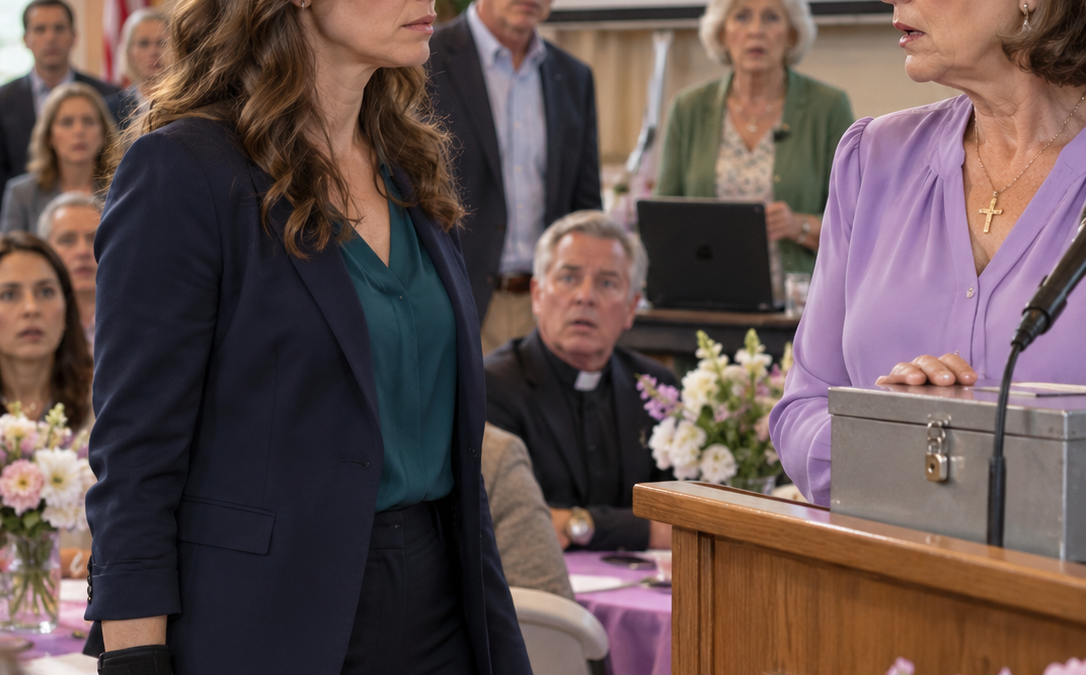
On a small table beside the podium sat a gray metal lockbox with a narrow slot cut into the top.
Above it was a handwritten sign.
I recognized my mother’s neat lettering.
Every dollar goes straight to Josie’s care.
June met us at the side entrance and took Josie directly into the kitchen.
Josie went happily. She was wearing her backpack, and she liked June. June had promised her root beer and the good crayons.
I watched the kitchen door swing shut behind them.
Then I drew a breath, walked into the fellowship hall, and sat at the very last table near the back wall.
My injured arm rested in my lap, and my old laptop was inside my bag.
A few minutes later, Hollis arrived wearing a sport coat.
He sat down beside me.
He didn’t say anything. He simply rested his hand on my shoulder for a moment before taking it away.
People noticed me.
I watched it happen, table by table.
One head would turn, followed by a whisper, followed by another head turning.
Some people looked away.
One woman I’d known since vacation Bible school looked straight at me and then very deliberately turned her chair.
I let them look.
I’d told myself in the car that I was going to let them look.
At a quarter to seven, my mother walked onto the little stage.
She wore a lavender blouse and her familiar gold cross. Her hair had been professionally styled, and she looked exactly like the woman everyone in that room believed her to be.
A grandmother.
A widow.
A pillar of the church.
She tapped the microphone.
It squealed, and several people laughed.
My mother smiled.
“Well, that’s one way to get your attention.”
The room laughed again.
Behind her, the slideshow stopped on the photograph from Josie’s hospital stay.
My daughter asleep, the tubes taped to her small hand.
“I want to thank every one of you for being here tonight,” my mother began. “For Josie. For our girl.”
Her voice caught at precisely the right moment.
“Many of you know it’s been a very hard year for our family. Josie’s mother is struggling. You’ve all seen it. I won’t say more than that because I love her, and it isn’t my place.”
She paused, looking out over the room.
“But somebody had to step in. So I’ve taken this on myself. And I want you to know that every dollar you put in that box tonight goes straight to Josie’s care. Straight to her.”
She touched the edge of the podium.
“So please, before the auction closes, give what’s on your heart.”
People were already opening their purses and reaching into their back pockets.
A man near the front stood with an envelope in his hand and started toward the lockbox.
I stood up.
My chair scraped against the linoleum floor.
It’s a surprisingly loud sound in a quiet room.
Heads turned.
“Before anybody puts anything in that box,” I said, “I’m Josie’s mother, and Josie hasn’t received a single dollar.”
The room went silent.
The man holding the envelope stopped halfway down the aisle.
My mother didn’t miss a beat.
I’ll give her that.
She looked out at me from behind the podium with such tender, exhausted sorrow on her face that, for a fraction of a second, even I almost believed her.
“Sweetheart,” she said into the microphone, “please sit down. You’re not well.”
Then she turned toward the room, and her voice changed.
It became quiet, confidential, pained.
“I didn’t want to do this here. But you all deserve to know. There’s a sheriff’s report. Two weeks ago, she broke into my house and went through my papers. She hurt me.”
She paused to let those words settle.
“And she’s being evicted. She can’t even keep a roof over that child’s head. That is why I hold the money. That is the only reason.”
A murmur moved through the hall.
I watched it spread from one table to another.
A man near the middle called out, “Let her mother talk.”
Someone else said, “Sit down, Tessa.”
I could feel every eye in the room on me.
On the black brace covering my wrist.
On the daughter my mother had just described.
My rule was folded in my pocket, written on a page from June’s notepad.
No screaming.
I didn’t argue about the eviction.
I didn’t argue about the sheriff’s report.
I didn’t argue about anything she’d said about me.
I simply looked at my mother and asked one question.
“Mom, where is the eleven thousand four hundred dollars from the Lark Spur?”
She smiled sadly.
“In Josie’s trust, honey. Where it’s always been.”
“Which bank?”
It was such a small question.
Two words.
But I watched those two words land on her.
I watched her open her mouth to answer and find nothing there.
Because there was no bank.
There was no trust.
There had never been a trust.
“Tessa, this isn’t the place to discuss family finances in front of—”
“Which bank, Mom?”
The kitchen door beside the stage swung open.
June walked out carrying my laptop under her arm.
I’d given it to her before sitting down at the back table.
She walked straight toward the projector cart at the edge of the stage.
Pastor Glenn half rose from his chair at the front table.
“June,” he called. “June, what are you doing?”
June didn’t even slow down.
“Glenn,” she said, “I have been treasurer of this church for nineteen years. Sit down.”
He sat down.
June connected the laptop to the projector.
The hospital photograph of my daughter disappeared from the screen.
In its place, enlarged until it was almost ten feet tall, appeared a page from my mother’s checking account statement.
I’d marked the important entries with yellow highlighting in the photo editor the previous night.
March twenty-sixth.
Deposit: $11,400.
Below it were the transactions from that same evening.
ATM withdrawal. Riverbend Casino. $800.
Another eight hundred.
And another.
And another.
Eight hundred dollars at a time.
You could hear the entire room draw a breath.
Hollis stood up beside me.
He didn’t raise his voice.
He didn’t need to.
“That’s our check,” he said. “From the Lark Spur. From the night we raised money for Josie. I wrote that check myself, and I handed it to Diane Marlo. I watched her cry.”
June advanced to the next image.
The back of an insurance check.
My name appeared in enormous letters across the screen.
Tessa Marlo.
That curling vine of a T.
Beneath it were the words Pay to the Order of Diane Marlo.
“That’s not my signature,” I said.
My voice was shaking now, and I let it shake.
“That’s the T my mother wrote on my lunch bag every morning for twelve years.”
Nobody interrupted.
“Josie had an insurance policy. It paid twenty-three thousand seven hundred and fifty dollars while she was in the hospital. My mother told me the claim had been denied. She put the letter in a shredder right in front of me.”
I looked directly at her.
“Then she signed my name on the checks, deposited them, and took the money to the casino. I’ve signed a sworn statement with the insurance company saying so.”
Nobody moved.
Nobody told me to let my mother speak.
And my mother, standing at the podium in her lavender blouse with the microphone still in front of her, said the one thing she could never take back.
“She stole those pictures out of my desk when she broke in!”
Her voice came out loud and shrill, amplified through every speaker in the hall.
Then she heard what she’d said.
I watched her hear it.
I watched her understand, at exactly the same moment as everyone else, that she’d just told a hundred people the photographs were real.
The silence that followed was the loudest thing I have ever heard.
Pastor Glenn stood up slowly and walked toward the edge of the stage.
His face had gone gray.
“Diane,” he said quietly. “Give me the key to the box.”
The key hung from a ribbon around my mother’s neck, beside her little gold cross.
She reached up and lifted the ribbon over her head.
For a moment, I thought she was going to hand it to him.
Instead, she bent down, grabbed the entire gray metal lockbox from the table with both arms, and hurried toward the side door at the end of the stage.
She was almost running.
The door led into the back hallway.
And from there, directly to the parking lot.
I had about one second to decide what to do.
I’d like to tell you that I thought it through carefully, that I weighed every possible consequence before moving.
I didn’t.
But I knew what I knew.
The evidence was on the screen. The affidavit had been signed. Whatever happened next, the truth wasn’t going anywhere.
If my mother made it through that door with the lockbox, the money would be gone.
I could have let her leave.
But I knew where she’d drive.
I knew exactly which exit she’d take off the interstate.
And I knew, the way you know things about your mother that you’ve never dared say aloud, that if she walked out that door with the money tonight, she might never come back from wherever she was going.
So I ran.
I hurried down the side aisle along the wall, past the silent auction tables, and through the swinging door into the back hallway.
It was a narrow corridor painted cream, with coat hooks along one wall, a bulletin board, and a fire exit at the far end.
The door had a red push bar and a sign that read Emergency Exit Only.
I reached it first.
My mother had to go around the stage. I didn’t.
I turned around, pressed my back against the push bar, and stood there breathing hard, my injured arm held against my chest.
A moment later, my mother came around the corner with the metal lockbox clutched in both arms.
She stopped about ten feet away.
“Put it down, Mom.”
“Move, Tessa.”
“You’re going to Riverbend.”
“Move.”
“You’re going to drive to Riverbend with Josie’s money in your passenger seat, and you’re going to put it in a machine.”
Her face crumpled.
Then it hardened again so quickly that it was like watching two different women occupy the same body.
“I have less than three weeks,” she said.
Her voice wasn’t the voice she’d used at the podium.
It wasn’t the trembling voice she’d used on the porch.
It was just her own voice.
“Less than three weeks, Tessa. They’re taking your father’s house. Do you understand me? They’re going to sell your father’s house on the courthouse steps to some stranger, and I cannot—I cannot—”
It was the first true thing she’d said to me in four years.
“I know, Mom,” I said. “I saw the letter.”
She came at me.
She lowered her head and drove the corner of that steel lockbox into my chest and shoulder with all her weight behind it.
I wasn’t prepared for how hard she struck.
My left arm was trapped between my body and the box. My injured wrist slammed backward against the metal push bar.
The pain was enormous, bright and white, shooting through my arm until I doubled over.
But I didn’t move my feet.
I don’t know how.
I simply didn’t move.
The lockbox struck the doorframe beside my head.
Its lid sprang open.
Envelopes, cash, and checks poured out over my shoulder and scattered across the hallway floor.
Twenties.
Fifties.
Folded five-dollar bills.
A check written in the careful cursive handwriting of an elderly woman.
Money spilled everywhere.
And my mother dropped to her knees.
She let the box fall and knelt on the tile floor, grabbing at the scattered bills with both hands.
She gathered handfuls against her chest, reached for envelopes, and stretched toward a piece of paper that had slid beneath the bulletin board.
She wasn’t looking at me.
She wasn’t looking at anything.
She was just gathering the money, over and over, making a little sound that wasn’t quite a word.
Only breath.
Behind her, the kitchen door opened.
Josie was standing in the doorway.
I learned later that she’d heard the metal box strike the door. She’d slipped underneath June’s arm before June could stop her.
She was wearing her pale blue knit hat and her bravery beads, all 213 of them looped around her wrist.
In one hand, she held a folded piece of pink construction paper.
In the other, she carried the glass jar from her bedroom bookshelf, the one filled with quarters and birthday dollars.
She looked at her grandmother kneeling on the floor with money clutched against her chest.
My mother didn’t see her at first.
Josie had to speak.
“Grandma?”
My mother’s hands stopped moving.
“Grandma, you can have my money.”
Josie stepped forward and held out the jar with both hands.
“It’s eleven dollars. I counted.”
She looked down at the bills and coins, then back at her grandmother.
“I don’t cost that much. I promise.”
I’ve spent a great deal of time thinking about what happened to my mother’s face in that moment.
I’ve decided I’ll never be able to describe it properly.
The closest I can come is this.
It was the face of a woman who had been running for four years and had suddenly, all at once, run out of road.
She remained on her knees.
She looked at Josie’s glass jar.
She looked at the pale blue hat.
Then she looked at Josie.
Really looked at her.
Not the way she’d looked at her across the table at the Lark Spur.
Not the way she’d looked at her during the previous fifteen months, when she’d seemed determined not to see the child standing right in front of her.
This time, she saw her.
And I made a choice.
I didn’t grab the lockbox.
I didn’t reach for the money.
Instead, I lowered myself carefully onto the floor beside my mother, holding my injured wrist against my stomach.
I leaned close to her ear so Josie wouldn’t hear what I was about to say.
“Mom, the insurance company already has my affidavit. I signed it on Tuesday. That doesn’t change. No matter what you do tonight, you’re going to have to answer for it.”
I drew a breath.
“The only thing you get to decide tonight is whether she remembers you as the grandmother who ran out that door.”
Then I reached behind me with my good hand and pushed the red bar.
The emergency exit swung open.
Cold May air rushed into the corridor, carrying the smell of freshly cut grass and the sound of crickets singing in the dark parking lot.
Somewhere nearby, a faint alarm began to chirp.
“It’s open,” I said. “You choose.”
My mother stared through the doorway.
Beyond it lay the parking lot and her silver Buick, parked beneath a light pole. I could see the car from where I knelt.
She looked at the car.
Then she looked at Josie.
Slowly, she opened her hands.
The money slid from her fingers and fell from her lap onto the floor.
She let it go.
All of it.
Then she began to cry.
Not the way she’d cried on the porch.
Not the way she’d cried at the podium.
She cried like someone who had finally stopped running and was only now beginning to feel how exhausted her legs had become.
She covered her face with both hands.
“I lost it,” she said through her fingers. “I lost all of it.”
She could barely force the words out.
“Your father’s orchard. Every tree. I lost it at a machine that plays music when you lose.”
Josie moved closer with the same caution she used when approaching anything unfamiliar at the hospital.
She held out the folded pink paper.
“I made you a new card,” she said. “The other one got wine on it.”
My mother took the card with shaking hands.
She didn’t open it.
She pressed it against her chest.
Josie offered her the glass jar again.
“No, baby,” my mother whispered.
Her voice sounded wrecked.
“No. You keep that. You keep every penny of that. You hear me? Every penny.”
Pastor Glenn and June found us in the hallway a minute later.
Glenn stopped and looked at the cash scattered across the floor, at my mother kneeling among it, at me with my injured arm, and at Josie holding her little glass jar.
For a long moment, he didn’t say anything.
Then he knelt down in his good dress slacks and began picking up the envelopes, one by one, placing them back inside the lockbox.
June knelt beside him and helped.
Neither spoke to my mother.
June simply rested one hand on her back while using the other to gather the money.
When the box was full again, Glenn closed the lid and held it in his lap.
He looked at me.
“The church will hold this,” he said. “June will decide where it goes. Not me. Not Diane.”
He swallowed.
“Tessa, I’m sorry.”
I took Josie back into the kitchen and sat her down with her root beer.
I told her Grandma was very sad. I told her grown-ups sometimes made terrible mistakes, and that none of this, not one single bit of it, had happened because of her.
She nodded thoughtfully.
Then she asked whether Grandma liked her card.
I told her I thought Grandma liked it more than anything she’d received in a very long time.
I think that was true.
When I returned to the hallway, my mother was standing.
Her lavender blouse was wrinkled. Her makeup had run down her cheeks, and she was holding Josie’s card carefully in both hands.
She looked at me.
“I need to go back in there.”
I didn’t take her hand.
I want to be honest about that.
I walked beside her through the swinging door and back into the fellowship hall. I accompanied her onto the little stage and stood next to her at the podium.
But I didn’t touch her.
The hall was still full.
Almost nobody had left.
A hundred faces looked up at my mother.
She didn’t say very much.
She didn’t need to.
She told them she’d started gambling after Walt died because the house had become too quiet.
The casino machines were loud and bright.
And nobody at the casino knew she was a widow.
She told them she’d lost everything.
Everything Walt had left her.
Everything her daughter had given her.
She told them she’d used Josie’s name and photograph to raise money, and that she’d signed her daughter’s name on checks that belonged to her granddaughter.
“I took that child’s money to the casino,” she said. “Every time.”
Then she looked toward me.
“And the night Tessa came to my house, she didn’t hurt me. I slammed the desk on her hand. I did that. And I lied about it to the sheriff. And I lied about it to all of you.”
She apologized to every person who’d donated money.
She said she didn’t expect anyone to forgive her.
Then she stepped away from the microphone, walked down off the stage, and went out through the front door of the fellowship hall.
Nobody stopped her.
Nobody followed her except June.
The room remained quiet for a long time.
Eventually, Pastor Glenn climbed onto the stage and took the microphone.
In front of everyone, he apologized to me.
He apologized for the phone call.
For suggesting the counselor who came on Tuesdays.
For believing a report instead of asking a question.
June returned a few minutes later and stood beside him.
She announced that every dollar raised that night, along with the $9,800 already in the church’s benevolence account, would be paid directly to Tessa Marlo by church check.
There would be two signatures on the check.
June herself would deliver it on Monday morning.
The woman who had written That poor child beneath my mother’s Facebook post came over to my table afterward.
She was crying.
She apologized and told me she should have known better.
I said it was all right.
I wasn’t sure yet that it was.
Then Hollis stood up and addressed the room.
He announced that the Lark Spur would host another fundraiser for Josie in the fall.
A real one this time.
There would be an account in her mother’s name, and her mother’s name would be on the check.
People applauded.
I hadn’t expected applause.
That night, June and two deacons counted the money from the lockbox in the church office.
They left the door open while they worked.
The total was $8,640.
By the time Josie and I finally walked out to my car, it was nearly ten o’clock.
My mother’s silver Buick was still parked beneath the light pole.
She sat in the driver’s seat with the engine off, not moving.
June was beside her in the passenger seat.
Neither woman was talking.
They were simply sitting together in the dark.
As far as I know, that car didn’t start for another hour.
I buckled Josie into the back seat and drove us home.
She fell asleep before we reached the highway, the jar containing her eleven dollars resting in her lap, both hands wrapped around it.
At the red light on Route 3 in Polaris, I lowered my head onto the steering wheel.
I cried once.
Just until the light turned green.
I paid my rent the following Wednesday.
Every dollar I owed.
All the late fees, too.
I used the check from the church.
The property company dismissed the eviction case before the hearing scheduled for June second.
I framed the dismissal letter.
I’m not entirely sure why.
It’s in a drawer now.
A few weeks later, Ray Okafor called me.
The insurance company had accepted my affidavit.
A little over five weeks after I’d signed it, a check arrived in the mail.
Twenty-three thousand seven hundred and fifty dollars.
Made out to Tessa Marlo.
Mailed to my own address in Westerville.
I stood beside my mailbox holding that envelope for a full minute before I finally opened it.
Ray also told me that the insurance company had referred the matter to the prosecutor’s office in Delaware County.
What happened next, he said, was out of his hands.
And out of mine.
My mother didn’t wait for investigators to come looking for her.
She walked into the prosecutor’s office herself with a public defender and told them everything.
Several months later, she accepted a plea agreement.
I won’t pretend to understand every legal detail.
What I know is this.
She wasn’t sent to prison.
She was placed on probation.
She was ordered to receive treatment for gambling addiction.
And she was ordered to repay the $11,400 she’d taken from the Lark Spur fundraiser.
The payments would come out of her pension, a little every month, into a fund the church helped establish to return the money to any donor who wanted it back.
Most people didn’t ask for refunds.
Most of them told June to give the money to Josie.
The sheriff’s sale happened on June eighteenth.
There was nothing anybody could do to stop it.
My father’s house, the house on Corbin Road where I’d learned to ride a bicycle, where he’d refinished that rolltop desk with his own hands, was sold on the courthouse steps to an investment company.
It sold for less than it was worth.
I drove past it in July.
A man wearing a polo shirt stood in the front yard with a clipboard, measuring the porch.
I didn’t stop.
Farther down the road, where the orchard used to be, there was a subdivision.
Townhouses with gray siding and white trim.
The sign at the entrance said Orchard Glenn.
There wasn’t a single apple tree left.
I went to the pawnshop on Route 36 with a photograph of the pink receipt.
The man behind the counter looked it up in his records, then shook his head.
My father’s watch had been sold in March.
To whom, he either didn’t know or wouldn’t say.
That watch is somewhere in the world now, on somebody else’s wrist.
I’ll never see it again.
I’ve made a kind of peace with that.
Not a whole peace.
But a kind.
I took my father’s reading glasses to a little optical shop in Westerville and had the cracked lens replaced.
The woman who repaired them didn’t charge me.
I didn’t tell her the story.
I think she could see some of it.
The glasses sit on a shelf in my living room now, beside Josie’s bravery beads.
My wrist healed in about six weeks.
It still aches when it rains.
I’ve decided I don’t mind.
My mother moved into a one-bedroom apartment in Delaware, above a dry cleaner.
She began attending Gamblers Anonymous meetings on Monday nights in a church basement on the west side of town.
June drove her.
June has driven her every Monday since.
My mother also enrolled in Ohio’s voluntary exclusion program, which bars participants from the state’s casinos.
She deleted the sportsbook application from her phone while her sponsor watched.
And she began writing me letters.
They arrived about once a week.
On every envelope was that familiar handwriting, the curling vine of a T in my name.
She never asked for money.
She never asked me to forgive her.
She didn’t try to explain away what she’d done.
She simply told me things.
What the GA meetings were like.
What it felt like to leave the house without money in her pocket.
What she did during the long hours when she wanted to gamble and couldn’t.
One letter was entirely about my father.
She wrote about the year they met, about how he’d smelled like apples and machine oil, and about how her own mother hadn’t approved of him.
I hadn’t known any of that.
She’d never told me those stories before.
I didn’t answer the first eight letters.
The ninth arrived in December, inside a soft package.
When I opened it, I found a hat.
A pale blue knitted hat, a little crooked, with a tassel on top.
A small note was pinned to it.
I learned to knit at group. It keeps my hands busy at night when they want to do other things.
I don’t expect to see her. I just wanted her head to be warm.
I sat at my kitchen table holding that little hat for a long time.
Then I called my mother the next day.
It was the first time we’d spoken since the night at the fellowship hall.
We arranged to meet at a coffee shop near her apartment.
June sat at a table on the other side of the room with a newspaper, close enough to keep an eye on us.
That was my idea.
My mother looked smaller than I remembered.
Grayer, too.
She’d stopped coloring her hair.
She held her coffee cup between both hands and never took a drink.
I told her the rules.
I’d written them down beforehand so I wouldn’t soften them when I saw her.
She could see Josie, but only if I was present, and only in public places at first.
No money would ever pass between us again, in either direction, for any reason.
She would never be alone with Josie until I decided otherwise, and I wasn’t promising that day would ever come.
She would not discuss the casino, the forged checks, or the court case in front of Josie unless Josie asked her directly.
And if Josie asked, she would tell her the truth.
My mother listened to every word.
When I finished, she said, “Yes.”
Just yes.
She didn’t bargain.
She didn’t ask me to change anything.
She didn’t request a single exception.
I think that was what made me believe her a little.
Forgiveness isn’t one thing.
I’ve learned that.
It isn’t handing somebody back everything they had before.
It isn’t pretending that something terrible never happened.
For me, forgiveness meant deciding that my mother was a person who had done something awful, and also a person who was trying, every Monday night in a church basement, not to do it again.
And I could hold both of those truths at the same time without letting either one go.
Josie saw her grandmother for the first time in seven months at a park near our apartment.
It was a cold, bright Saturday in January.
Josie wore the new blue hat with the tassel.
My mother cried when she saw it on her.
Josie politely pretended not to notice.
That’s a kindness she’d learned in hospitals.
Josie rang the bell in April.
At the children’s hospital, there’s a brass bell mounted on the wall of the oncology clinic.
When a child finishes treatment, they get to ring it.
Every nurse on the floor comes out to clap.
Josie rang it three times, as hard as she could, with both hands gripping the rope.
Her hair had grown back by then.
It came in curly, which it had never been before.
Dark, beautiful curls, just like my father’s hair in the photographs from when he was young.
Every nurse came out.
My mother was there, too.
She stood at the back of the crowd beside June.
She didn’t come forward.
She just clapped.
Then May came around again.
A week before Mother’s Day, my mother called and asked whether she could take us out for breakfast.
Not the Lark Spur.
She was very clear about that.
She suggested a diner on State Street in Westerville, a place that served pancakes the size of hubcaps and had booths upholstered in cracked red vinyl.
I almost said no.
Then I said yes.
We arrived at nine that morning.
My mother was already sitting in a booth beside the window.
She’d come early so she could have the table ready when we got there.
She stood up as we approached.
Josie slid into the booth beside her without being asked.
I sat across from them.
We ordered breakfast.
Josie wanted chocolate-chip pancakes with whipped cream.
Her stomach could handle almost anything now, and she was making up for two years of not being able to eat whatever she wanted.
My mother ordered the short stack.
I ordered eggs.
When the waitress returned with the coffee, she asked the question.
“One check today or separate?”
My mother reached into her purse.
She took out a plain white envelope with cash inside.
She’d counted the money before leaving her apartment.
Her sponsor had gone over her budget with her that week, and this was the amount she could afford to spend.
She only carried cash now.
Only what she needed.
I knew that because she’d told me in one of her letters.
She placed the envelope on the table.
Then she looked at Josie.
Right at her.
She kept her eyes on my daughter the entire time she spoke.
“One check,” my mother said. “I’m paying for her.”
Josie grinned.
Then she reached into her backpack and took out a card.
Pink construction paper.
An apple tree.
Two people standing beneath it, holding hands.
And across the top, in careful letters, every single one of them finished, were the words Happy Mother’s Day, Grandma.
My mother opened the card immediately.
She didn’t set it facedown beside her plate.
She opened it and read it aloud, sitting there in the red vinyl booth with steam rising from the coffee in front of her.
“Happy Mother’s Day, Grandma. You are worth it. Love, Josie.”
My mother had to put down her fork.
A year earlier, at a candlelit table inside the Lark Spur, I had continued eating while my mother said the worst thing she’d ever said to my child.
I’d kept eating because I’d already paid.
Because I was deciding something.
Because I didn’t want Josie to watch me fight.
But that morning at the diner, I put my fork down.
I listened while my mother told Josie about the orchard.
About the forty acres north of Sunbury.
About the Honeycrisp and Gala apples.
About the old Northern Spy trees her grandfather had refused to pull out because they made the best pie.
She told Josie how he’d stood behind me when I was little, placing his big hands over my small ones, showing me how to make a cut so two pieces of wood could heal together.
Two pieces that weren’t supposed to be together.
Bound carefully enough that, with time, you couldn’t tell where one ended and the other began.
Josie had never heard any of those stories.
She listened with her chin resting in her hands and a little smear of whipped cream on her nose.
There are things we didn’t get back.
Two million dollars.
My father’s house.
My father’s watch.
A year and a half of my daughter’s life when her grandmother wasn’t there for her.
I don’t pretend those things came back.
They didn’t.
And they won’t.
But I’ll tell you what I did get back.
Josie’s bravery beads were lying on the table beside her plate that morning.
All 260 of them.
A long, bright, finished rope.
And my daughter, the same little girl who’d once sat on a hospital examination table and asked whether she cost too much to love, was sitting in a cracked red booth eating chocolate-chip pancakes beside her grandmother.
She didn’t believe that anymore.
She knew exactly what she was worth.








