On christmas eve, i saw the photos my daughter posted online — the whole family gathered around the table, her father-in-law seated right in the center, and me, not invited; for eleven years i had paid for everything they had; i opened my banking app and cut three transfers; the fourth one, i didn’t…
I spent $217,000 taking care of my daughter’s family. And at Christmas dinner, they didn’t even leave me a chair.
I found out on Instagram, sitting alone in my workshop, eating cold lasagna and scrolling through 41 photos of a Christmas I wasn’t in. Fourteen chairs. Fourteen people. Not one of them was me.
Three weeks later, I was standing in the back of a banquet hall in Cranston, watching my son-in-law campaign for a seat on the school board. Behind him was a banner with one word printed in letters a foot tall.
Accountability.
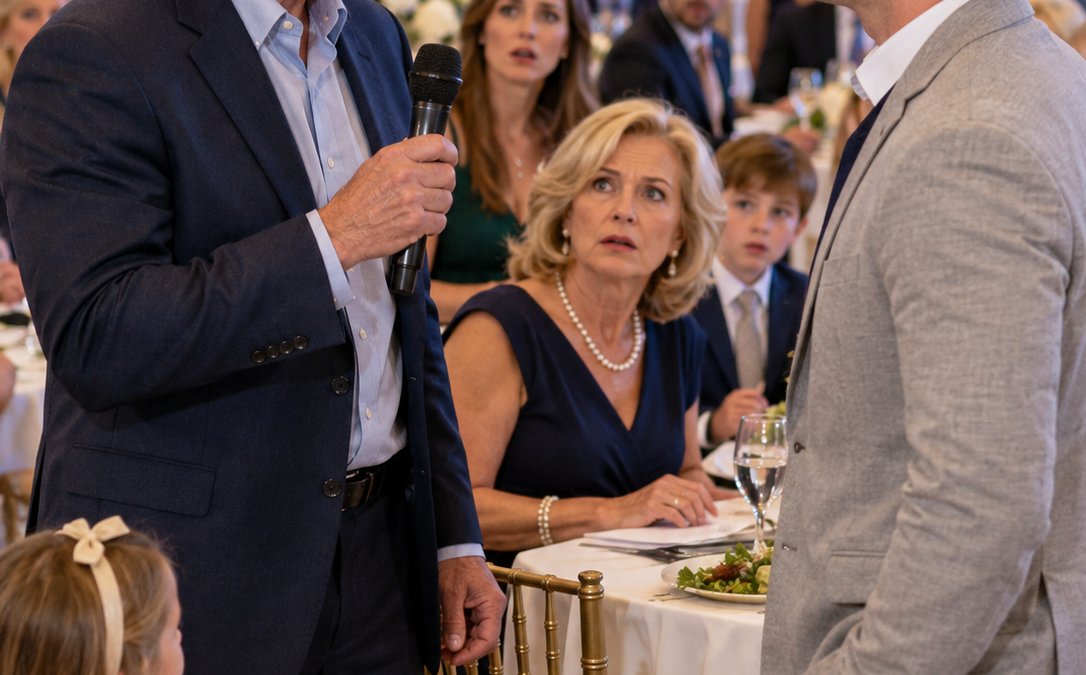
I looked at that word for a long time. Then I looked at Colin, stood up, and said, “Can I borrow the microphone?”
But before you hear what I said into that microphone, I need to take you back seven weeks, to the night I saw those 41 photos.
My name is Vernon Kimble. I’m 61 years old, and I want to tell you how I ended up standing there with a napkin folded beside my plate, because I did not get there in a straight line. I’d also like to be honest with you about the parts where I was wrong, because I was wrong about some of it. That’s the part I still chew on at two in the morning.
Let’s go back seven weeks, to a workshop on Manton Avenue in Olneyville.
I own Kimble Upholstery. Twenty-nine years in a narrow brick building squeezed between a tire place and a Dominican bakery. I rebuild wingback chairs. I restore church pews. I once put a horsehair sofa back together for a museum down in Newport, and I never mentioned it to a single member of my family, which is going to start seeming like a pattern here in a minute.
On Christmas Eve, I was in that shop by myself at six in the evening, eating cold lasagna out of a foil tray my sister-in-law Teddy had dropped off the night before. I was hand-stitching a welt cord onto a chair that wasn’t due until February.
I told myself I wasn’t sad about it. I told myself that a lot that year.
Then my phone lit up on the workbench.
Bernadette Trowick had posted a carousel of 41 photos. The caption said something warm about how the whole crew was finally under one roof.
And I want to be clear about why I even followed that woman. She is my son-in-law’s mother, and my grandchildren showed up in her feed more often than they showed up in my actual life. That was the whole reason. That was the only reason.
I opened it with lasagna still in my mouth.
The first picture was the table. One of those long rentals with folding legs, dressed up so well you could almost forget it was rented. White tablecloth, real napkins, little sprigs of rosemary tucked into the napkin rings, which meant somebody had stood in a kitchen for an hour doing rosemary.
I counted the chairs.
I always count chairs. That’s not a metaphor. That’s just what happens to your brain after 29 years of building seating.
Fourteen chairs. Fourteen people.
My grandson Elias was in the fifth photo. Eleven years old, his front tooth finally all the way in, wearing a forest-green apron with cream lettering stitched across the chest.
“Grandpa’s Sous Chef.”
Hollis Trowick had a hand on his shoulder, and the two of them were laughing at something outside the frame.
My granddaughter June was in the ninth photo. Four years old, dead asleep across Bernadette’s lap, with a clementine still gripped in one fist.
I scrolled through all 41.
Fourteen chairs. Fourteen plates. Not one empty seat. Not one extra setting shoved against the wall in case somebody dropped in.
Somebody had written a number down on a piece of paper before calling the rental place. That number was fourteen, and I was not in it.
I want to slow down right here, because everything after this depends on you understanding it correctly.
I was not angry.
I’ve thought about that for a year now, and I think I finally understand why. Anger is what you feel when you believe a mistake has been made. Anger is hope wearing a bad costume.
I sat on that stool for the better part of an hour, with the lasagna going cold on my knee. Somewhere in that hour, I stopped waiting for an explanation, because you do not accidentally leave a man off a list fourteen separate times.
I just needed to know the size of the thing first.
So I drove home to my half of a two-family house on Sutton Street, sat down at my kitchen table, and opened my banking app.
Here is what was on that screen.
$1,250 a month, every first of the month, going into the joint account belonging to my daughter Camille and her husband Colin.
That started five years ago, when Colin’s contracting crew lost their two biggest builders in the same quarter. Camille called me from a CVS parking lot in Edgewood, crying so hard that I honestly thought somebody had died.
I set that transfer up the same night, standing at that same table with my reading glasses on.
Colin’s work came back inside of a year. The transfer never stopped. Nobody ever brought it up, including me.
Then there was $600 a month toward the loan on Colin’s work van.
His credit was in the basement when he bought it, and the dealership wanted a name on the paperwork that wasn’t his. I signed. I told him I’d carry it for a year while he got his footing.
That was five years ago.
Another $415 a month went toward keeping Camille on the small-group health plan I ran through the shop, because she’d quit her office job to start a floral studio out of the garage and lost her coverage doing it.
I added her without making an announcement about it.
I have never in my life made an announcement about anything. Hold on to that.
And then there was $900 a month going into an education account I opened the week Elias was born, back when that boy was eleven hours old and my hands were still shaking. I added June to it the day she showed up.
I did the arithmetic that night in pencil on the back of a cutting list, because that’s how I do everything.
$1,250 times 60 months.
$600 times 60 months.
$415 times 48 months.
$900 times 96 months.
About $217,000.
And I had never mentioned a dollar of it.
Not once. Not at a birthday. Not at a christening. Not at one single Sunday dinner. Not when Colin stood in his own driveway on the Fourth of July, telling a neighbor that van was the nicest thing he’d ever bought himself.
Not when Camille told a bride she’d built that whole studio from nothing with her own two hands.
Not ever.
And if you have ever done something enormous for somebody and then stood there quietly while they told a room they did it alone, you already know what that kitchen felt like.
It isn’t rage.
It’s a very specific kind of tired that lives behind your eyes and doesn’t come out with sleep.
I closed the app without touching a thing. I wanted one more piece of information first.
Tuesday afternoon, I drove out to Edgewood with two small presents: a marble-run set for Elias and a sticker book for June.
I texted ahead like a person is supposed to.
Camille sent back a thumbs-up, which is its own kind of answer, and I chose not to hear it.
Her car wasn’t in the driveway. A neighbor’s kid named Priya was watching the children. She let me in and went straight back to her phone.
The first thing I noticed was the hallway.
Camille had repainted that hall two years earlier, a dusty clay pink, and then hung a full run of framed photographs down its entire length. I’d stood on a stepladder for four hours helping her level every one of those frames with a torpedo level I brought from the shop.
My knees were sore for two days afterward. I remember being happy about that.
Now I stood in that hallway and looked.
The photo from Elias’s first haircut was gone. The one where he’s screaming and I’m laughing so hard I’m crying, with hair all over both of us.
Gone.
The one from the morning June was born was gone, too. Me in a vinyl hospital chair, glasses shoved up on my forehead, holding a baby who was nine hours old because I’d been trying to read the discharge paperwork.
In their places were three pictures I had never seen in my life.
Hollis teaching Elias to bait a hook off a dock in Wickford. The whole Trowick family at some fall festival, with June riding on Hollis’s shoulders. Bernadette and Hollis flanking both kids in front of a Christmas tree, everybody wearing matching cream sweaters.
I counted the frames on that wall.
Sixteen.
I was in zero of them.
Elias came sliding down the hall in his socks, the way he’s done since he was five, taking the last six feet on pure momentum.
“Vern, did you bring something?”
I set the bags on the bench and got down on one knee, which my knees have strong opinions about now.
“You don’t call me Grandpa anymore?”
He shrugged. The exact shrug an eleven-year-old gives you about something he considers long-settled and slightly boring.
“Mom says Grandpa is what you call Hollis. She said it gets confusing if there’s two.”
“When did she tell you that, bud?”
“I don’t know. Before Halloween.”
He already had the box out of the tissue paper.
“Is this the one with the loops?”
Then June came around the corner, dragging a stuffed otter by one flipper. She saw me, and her whole face opened up like a window.
“Grandpa V!”
Her brother corrected her without even looking up from the box.
“Not Grandpa, June. That’s Vern.”
June stopped moving.
She looked at her brother. She looked at me. Four years old, standing in a clay-pink hallway, trying to work out which one of these two people was telling her the truth about the world.
I have gone back to that half second more times than I want to tell you.
Because a snub, I can survive. I’ve survived plenty.
That was something else.
That was a very small person being handed a version of reality where I’m a stranger with a decent first name and being asked to file me accordingly.
And here’s the ugly thing I thought in that hallway, which I have not said out loud to anybody until right now.
My first thought was not about June.
My first thought was, So this is what I’ve been paying for.
I’m not proud of that, but I told you I’d be honest.
I got down lower.
“You call me whatever feels right in your mouth, baby. But you know who I am.”
Elias said, “Okay,” and sat down on the floor to read the piece count off the back of the box.
And honestly, that’s the correct amount of concern for an eleven-year-old to have.
He wasn’t being cruel. His mother told him a thing, and he believed her because that is what mothers are for.
I put my hand on his head for a second. Then I let myself out.
I sat in my cargo van in that driveway for nine minutes. I watched the clock on the dashboard the whole time because I wanted to know later exactly how long I’d sat there.
That’s a strange thing to do. I know it’s a strange thing to do.
Then I drove north to Woonsocket, to Teddy.
Teddy is my late wife’s sister, and I’d been quietly avoiding her for about four years. I want you to understand why, because it matters.
Teddy says the thing.
Whatever the thing is, whatever everybody at the table is carefully steering around, Teddy says it out loud before you’ve even got your coat off.
Ruby loved her sister for that. It has taken me a lot longer.
She had coffee going when I got there.
I told it the way I’d describe a broken frame to a customer. Fourteen chairs. The apron. The three new photographs on the wall.
She didn’t gasp. She didn’t reach across the table, grab my hand, and say, “Oh, Vern.”
She said, “Nobody forgot you, Vern. They filed you.”
I started to tell her that was too harsh a word for it.
She got up, went to the counter by the toaster, and came back with a glossy card the size of a postcard.
A campaign mailer.
Colin Trowick for Cranston School Committee.
That word again, underneath his name, taking up most of the bottom half.
Accountability.
On the front was a professional family portrait taken on the steps of Hollis and Bernadette’s place in Garden City.
Colin, my daughter, both kids. Hollis with his hand on Elias’s shoulder. Bernadette beside June.
Everybody in coordinated navy blue.
“Where’d you get this?”
“It’s been on the corkboard at my dentist since October. There’s one in the bakery window. One came to my house.”
Then I looked at June’s sundress in that photograph, and I felt the floor tilt about two degrees.
I knew that dress.
She wore it to her preschool sing-along in August. I was there. I sat in a folding chair in the back row, and I clapped.
August.
Five months before Christmas Eve.
Which meant the decision hadn’t been made in some tense moment at a holiday table.
The photograph on that mailer was the decision.
The seating chart in December was just the press release.
Teddy sat back down and asked me the question that I think is the actual spine of this whole story.
“If they were done with you back in August, Vern, why did your money keep leaving your account on the first of every month all the way through the fall?”
I didn’t have an answer.
I still sort of don’t.
Sit with that one for a second, because there’s a kind of cruelty that’s loud, and then there’s a kind that’s just comfortable.
And comfortable is so much worse.
Loud means they’re still thinking about you.
I called Camille that Saturday evening.
She picked up on the fifth ring. Behind her I could hear a vent running, voices, a truck gate slamming, and somebody counting vases out loud.
“Dad, hey. Everything okay?”
I didn’t mention the mailer.
I’d had about a hundred ways to bring it up, and I put every single one of them back in the drawer. I’m still not sure whether that was restraint or cowardice.
“I thought I’d come by Sunday. Have dinner with you all.”
There was a pause with a lot of furniture sitting in it.
“This weekend’s honestly insane. Colin’s got the campaign thing. And I mean, you know, big, loud group stuff isn’t really your speed anyway, Dad.”
I switched the phone to my other ear.
“Camille, what does June call me now?”
Truck noise. Somebody laughed near the phone.
Three full seconds.
“Dad, don’t make this into a whole thing. I have so much on me right now. You have no idea.”
“I asked you one question.”
“They need me. I’ll call you this week.”
She hung up first.
I stood in my own kitchen with the phone still against my ear for a while after the call dropped.
And here’s the detail that finished it for me.
She never asked what I meant.
She didn’t say, “What are you talking about?”
She didn’t say, “Who said something to you?”
She went straight to, “Don’t make this a thing.”
You only reach for that defense when you already know the answer.
Which meant my daughter knew. She knew in August, at the fall soccer games, and on every single first of the month when that money hit her account.
And she didn’t say a word about it.
I opened the banking app that night with only the light over the stove on.
This time, I did not close it.
I did it in order, top to bottom, the way I run a job.
Transfer one: $1,250. The mortgage.
The app asked me to confirm.
I confirmed.
Transfer two: $600. The van.
Confirm.
Transfer three: the insurance.
I couldn’t cancel that from an app, so Monday morning I called my broker, a woman named Dot Ivy, whom I’d been working with for seventeen years, and asked her to take Camille off the shop’s group plan.
Dot asked whether I wanted it effective at renewal or effective immediately.
“Immediately.”
She said she’d mail written confirmation to every address on file.
Remember that. It comes back.
Transfer four, I did not touch.
That money was never for the adults.
That money was for a boy who was eleven hours old and a girl who hadn’t been born yet.
So Wednesday, I drove up to a credit union in Pawtucket and moved the entire balance into a proper 529 plan, with me listed as sole custodian.
Same kids. Same beneficiaries. Same $900 going in on the first.
Different lock on the door.
The balance that morning was $61,300.
I sat in that parking lot afterward and wrote my daughter a letter on a legal pad.
Four sentences.
I worked on those four sentences for two days before writing out the final version, and I threw away a page and a half of things I would have regretted.
I told her the mortgage help, the van payments, and the insurance ended as of the first. I told her the education money was untouched, still growing, and that she could see a statement anytime she wanted one, no permission required.
And then I wrote the line I’d been building toward for eleven years without knowing it.
“I am still your children’s grandfather. I am finished being your household’s line of credit.”
I mailed it.
Paper. Stamp. Mailbox on Broadway.
Because an email gets swiped away at a red light, and a letter sits on a counter being a letter.
Nobody called me for 23 days.
I want to be straight with you about those 23 days, because they weren’t what you’d expect, and I’ve had a year to figure out how to say it.
They were the best three weeks I’d had in about six years.
And that scared me a lot more than the silence did.
I took a full lobby restoration down in Newport that I’d been putting off for two months, because taking it would have meant being unreachable. And being unreachable was the one thing I’d organized my entire life around not being.
Twelve chairs and two settees. Six in the morning to four in the afternoon, just me and one apprentice named Marco.
I finally replaced the porch railing on Sutton Street that had been wobbling since the spring before last. I sat in a booth at a diner on Chalkstone with Hector Palma, who does my books, for two hours talking about absolutely nothing.
And I laughed twice.
Every night around nine, I checked my phone. Nothing. Not a call, not a text, not one thumbs-up from anybody.
I told myself that was information, not an injury. I’m still not sure I believed it.
There’s a difference between being at peace and being relieved that the phone stopped ringing. Some nights, I couldn’t tell you which one I was.
On day twenty-one, I made the mistake of opening Instagram.
Camille had posted a video to her studio page. She was standing inside a storefront on Hope Street. Bare brick, big front window, a walk-in cooler humming behind her. Her voice was bright and a little out of breath.
“Big news! New space, bigger events, more weddings, so much more capacity!”
I watched it twice.
My daughter had signed a commercial lease, a real one with a real number on it, in the same month that the $1,250 covering the gap in her household had already stopped arriving.
Which meant one of two things.
Either nobody in that house had opened my letter, or they’d opened it and simply hadn’t believed it.
The first of the month was eight days away.
On the first, I was up a ladder in Newport, hand-tacking trim on a settee, when my phone buzzed against my hip.
“Dad, I think something’s wrong with the bank. The automatic payment didn’t go through.”
I read it twice. I finished the row of tacks I was working on, put the phone back in my pocket, and kept working.
And I want to tell you my hands were steady, but they weren’t.
At 11:52, there was a missed call. At 12:06, another missed call. At 12:31, a long text from Colin.
He used the word miscommunication twice and signed it with a single letter, C, like a man sending a memo to a subcontractor.
I called at six, after I cleaned my brushes.
Camille answered before the first ring finished.
“Dad, thank God. Okay, so the transfer—”
“There’s no bank error,” I said. “I stopped it. I’m allowed to stop it.”
The sound she made, I’ve only heard that sound out of my daughter one other time in my life, and that was the night her mother died.
“You can’t just—Dad, I just signed a lease!”
“I know.”
“You didn’t even warn me!”
“I mailed you a letter three and a half weeks ago.”
Then Colin’s voice came through, right up close on the speaker.
Completely calm.
That was the part I hadn’t prepared for. I’d braced for anger. I would have known what to do with anger.
He was calm the way a man is calm when he thinks he’s about to close a deal.
“Vern. Hey, let’s everybody take a breath here. I hear you, and I want you to know we hear you.”
A pause, and then, in the tone of a man wrapping something up, he asked, “So, how long are you planning to run this for?”
Not What did we do?
Not What happened?
Not Are you okay?
How long are you planning to run this for?
He thought I was leverage. He thought I was an old man having a rough month with a long memory, and that somewhere out there was a number that would make it stop.
And then he said the thing he should not have said.
“You’re punishing two little kids over a dinner.”
I let that sit on the line for four full seconds so he could hear it in the air between us.
Then I said, “Colin, get a pen.”
And I’ll be honest with you. I don’t know where those four seconds came from. Everything in my chest wanted to say something I could never take back.
I’ve gone over that call maybe two hundred times, and the thing I’m proudest of in this entire year is that I didn’t.
Not because I’m a better man than that, but because I knew if I let one crack open, I’d lose the only advantage I had left.
I was the only person in that conversation who wasn’t improvising.
I told him the education account had never stopped. Not for a single month. I told him where it was, that I was the custodian, that both children were named on it, and that $900 was still going in on the first of every month.
I told him the balance.
$61,300.
A longer silence followed.
Then he said, “You don’t have the right to move that account without our consent.”
“It’s my money, Colin. My name’s on it. Neither one of you has ever put in a dollar.”
Camille got the phone back, and she was crying.
The real kind now. The kind that isn’t a strategy.
“Dad, please.”
“Those are my children, and they are getting every dollar I ever promised them. The adults in this made choices. The kids didn’t. That’s the line.”
She hung up.
My hands were not steady after that call.
I sat in my truck in my own driveway that night and asked myself out loud, in an empty vehicle, whether I’d gone too far.
Doing the right thing did not feel good. It just felt finished.
Nobody tells you those are different.
And I want to ask you the same question right now, honestly, because I go back and forth on it even today.
If you’d been sitting where I was sitting, would you have protected that college account the way I did? Or would you have shut down all four of them the day you saw those photos? Clean slate, no exceptions.
Type a one in the comments if you would have cut every single thing. Type a two if you think I got it right, keeping the kids’ money running no matter how the adults behaved.
I read them, all of them, including the ones that tell me I got this wrong, because it gets more complicated from here.
Bernadette Trowick called me on a Wednesday morning.
In eleven years of family events, that woman had never once dialed my phone. Not one time.
She didn’t mention money. Not once in the entire call. And I’ll give her that credit.
She talked about family, about how misunderstandings happen between people who care about each other, about how the most important thing in this world is for children to watch the adults around them behave with grace.
She used the word grace four times.
She said for the sake of the little ones twice.
Then she got to it.
Colin’s campaign kickoff was on the twelfth, at the Regent Banquet House in Cranston.
“And of course, you should be there, Vern. You’re family. We’ve always thought of you that way.”
Family.
She said it warmly. Real warmth, too.
That’s what makes a woman like Bernadette so effective.
She has never, in my entire presence, said one genuinely unkind thing out loud. Not one. And I have watched her rearrange four households’ holiday plans over a group text and come out of it looking like she’d done everybody a personal favor.
“I’d be glad to come,” I said.
“Wonderful. I’ll add you to the list.”
Now, here’s what I want you to understand about that phone call, because I didn’t understand it myself until about eleven that night.
She wasn’t calling to repair anything.
She was calling because, in three weeks, there would be sixty people in a banquet room, and a man who won’t answer his phone will absolutely answer a question in front of sixty people.
She was setting a table again.
She just didn’t know I had my own reason to sit at it.
And here’s where I have to be fair to her, because if I’m not, this whole story is just me settling a score, and I don’t want that.
That woman has run every holiday for that family for 31 years. She books the hall. She locks the dates. She manages the group text. She orders the cards. She decides who sits next to whom so that two people who can’t stand each other don’t share a gravy boat.
And nobody has ever once thanked her for a minute of it.
When she looked at me, I don’t think she saw a man she was erasing. I think she saw a quiet, hard-to-place person who never volunteers, never RSVPs first, never asks for anything, and who confuses the grandkids by holding a duplicate job title.
Taking me out didn’t feel like cruelty to her.
It felt like tidying.
That’s the thing I’ve had to sit with.
Most of the people who do this to us are not villains. Most of them are just decorators who stop noticing that the furniture is alive.
Then the consequences started showing up, and I want to be extremely clear about something.
I did not plan a single one of them. Not one.
I have replayed my own decisions, looking for the moment I got clever, and it isn’t there.
On the sixth, a notice came from the van loan servicer. When you cosign, they notify both parties.
Fifteen days past due.
I read it and put it in the kitchen drawer.
On the ninth, something bigger happened.
Colin’s contracting business had carried its general liability insurance through my small-business policy for four years. It was a favor I set up back when he had nothing and never once renegotiated, because renegotiating would have meant bringing it up.
And bringing it up would have meant being a burden.
So when Dot processed that cancellation on the second, it didn’t just drop Camille’s health coverage. It dropped his business coverage, too.
And in this state, a registered contractor without active liability coverage doesn’t just have a problem.
He has a public one.
The registration lookup is a website. Anybody can type in a name.
And on the ninth, Colin Trowick’s registration flipped to noncompliant insurance, right in the middle of a race for school committee in a city where he’d bid on two municipal repair jobs.
A campaign built around one word.
Accountability.
Somebody screenshotted it.
Somebody always screenshots it.
Camille’s text came at eleven that night. Three paragraphs.
The sentence I’ll remember for the rest of my life was this one.
“You are setting my entire life on fire because you didn’t get a seat at a dinner.”
I wrote three replies and deleted all three.
What I finally sent was this.
“Dot mailed Colin the cancellation notice on the second. Check the stack of mail on your counter.”
Her answer came the next morning.
Four words.
“He never opened it.”
I’ve thought about that more than almost anything else in this story.
Whether he truly never opened it. Whether it sat under a pile of campaign mailers for two weeks. Whether somebody saw the return address and quietly moved it to the bottom of the pile without mentioning it. Or whether nobody in that house ever genuinely believed the money would stop.
I sent one more text, put the phone face down, and went to bed.
“Nothing’s on fire, Camille. I just set down what I was carrying. Those are not the same thing.”
She came to the shop on a Friday at three in the afternoon, still in her work apron with floral wire in the pocket.
She was crying before the door finished closing behind her.
I brought out the good chair from the back office and a box of tissues from the bathroom. I sat on my work stool and let my daughter talk for fourteen minutes without saying one single word.
She talked about Bernadette, about how that woman runs every holiday and every Sunday, and decides where everyone goes and which photograph ends up on the church card.
She talked about how Colin handles all their money, and how she has to ask him before she spends more than $250 on anything in her own house, out of an account with her own name on it.
She talked about how tired she was all the time.
Years of asking permission to live inside her own life.
Some of it was true. I could hear exactly which parts.
And I’ll tell you what I was thinking while she talked, because it wasn’t noble.
I was thinking, You’re describing a cage, and I’d have taken you out of it in one afternoon. And you never asked me.
Not once in five years did she ask me for anything except money.
When she was done, I handed her another tissue.
“One question,” I said. “Then I’ll do whatever you tell me is right.”
She looked up.
“Who taught June to call me Vern?”
Her face did something I hadn’t seen since she was sixteen and I found the cigarettes in her jacket pocket.
“That doesn’t matter now, Dad.”
“It’s the only thing on this earth that matters to me right now.”
I put my phone on the workbench between us.
“Tell me who decided it, and I’ll turn all three of those transfers back on tonight, from this phone, while you sit there and watch me do it. You know I don’t bluff.”
The dust collector in the back kicked on. It runs about ninety seconds.
She stared at that phone the entire time it ran.
She didn’t say Bernadette.
She could have. It would have been easy, and I’d have believed at least half of it. We would both have walked out of there with something to hold on to.
She just didn’t say anything at all.
And that’s how I found out.
Not from what my daughter said.
From what she wouldn’t say.
“You had a real chance just now,” I told her.
She stood up.
At the door, with her hand on the frame, she stopped and turned around. She wasn’t crying anymore.
That’s how I knew we were finally about to have the real conversation.
“You never tried either, Dad. You know that, right?”
I looked at her.
“You never once asked why you weren’t on a list. Not at Christmas. Not at Elias’s birthday in the spring. Not one single time in six years.”
She paused.
“Do you have any idea what that looks like from the outside? It looks like you didn’t want to come.”
Then the door shut, and the bell above it made its little sound.
I was standing in an empty workshop at 4:15 on a Friday afternoon.
I stood there a long time.
Because she wasn’t entirely wrong.
And I’d like to tell you I figured that out gradually over the following weeks, but I didn’t.
I knew it the second the door closed.
It went through me like a nail gun.
Six years since Ruby died.
Every skipped invitation. Every dinner moved to a day I wasn’t told about until afterward. Every photograph I wasn’t in.
I had never asked about a single one of them.
Not once.
Every time, I decided that asking would make me a burden, and being a burden was the one thing on this earth I refused to be.
Ruby used to do the asking.
That was the whole system.
And in 31 years, neither one of us ever said it out loud.
She’d say, “Vern wants to know what time on Sunday,” and everybody would answer her.
I’d stay quiet and still end up at the table with a plate in front of me.
She was my voice for 31 years.
And then she was gone.
I spent six years talking to absolutely nobody and calling it dignity.
If you’ve ever lost the person who did your speaking for you, the one who made the calls, sent the RSVPs, remembered which cousin was mad at which cousin, then you already know that grief isn’t the only thing that shows up at the house.
Silence shows up, too.
And silence is very, very good at convincing you it’s the same thing as being strong.
I took the cutting-list pad off the counter and started writing down what I’d say if I ever got to say it in a room where nobody could hang up on me.
I wrote a paragraph, crossed it out, wrote another one, and crossed that out, too.
Four days later, I had it down to four sentences.
Four was what I could get through without my voice going somewhere I didn’t want it to go in front of strangers.
I’m 61 years old. I know exactly where my limits are, and I have made a career out of not testing them in public.
Two nights before the kickoff, Hollis Trowick called my cell phone.
We’d talked across dinner tables maybe fifteen times in eleven years. Always about the Sox. Never once about anything real.
“Vernon, got a minute?”
“Sure.”
“I want to ask you something, and I’d like a straight answer. Christmas Eve. Why weren’t you there?”
I looked at my ceiling for a second.
“I wasn’t invited.”
Silence.
Then he said, “That is not what I was told.”
“What were you told?”
“That you don’t like big crowds. That you’d mentioned having other plans. Colin said something about it in the car on the way over. Said you’d been stepping back for a while.”
I pulled up my text thread with my daughter.
Christmas the year before. One message from me asking what time to come. No reply.
The year before that, same message, same silence.
I told him to check his email, and I forwarded him the screenshots.
About forty seconds of nothing on the line.
Then Hollis spoke.
“That apron. The green one the boy had on.”
He took a breath.
“Bernie ordered that online. I didn’t know it was coming. She put it over his head about ninety seconds before the first picture.”
I didn’t say anything.
“I’ve got four grandkids on my son’s side,” he said. “I have never once in my life tried to be anybody’s only grandfather.”
Another pause.
“Come on the twelfth. I’ll handle where you sit.”
I got to the Regent Banquet House twelve minutes early.
I want to slow this down now, because everything I’ve told you has been walking toward this room, and I don’t want you to miss any of it.
I’ve had a year to remember it, and I remember all of it.
It’s the kind of place that does retirement parties, christenings, and fundraisers. Low ceiling with those square acoustic tiles. Twelve round tables covered in white cloths. Sixty folding chairs with padded seats. A portable riser up front with a podium and a standing microphone.
It smelled like chafing-dish fuel and carnations.
A DJ in a rented vest was tapping the microphone twice and saying, “Check,” to nobody at all.
Somebody’s toddler was running a toy car along the baseboard by the coat rack, making engine noises.
Campaign posters lined the near wall.
Colin was wearing a quarter-zip fleece, arms folded, looking like a man you could hand a budget line to.
Accountability.
Hollis was near the entrance.
He came the whole way across that room when he saw me, shook my hand, and held on about two seconds longer than a handshake requires.
“Glad you came. You’re up at the main table with me.”
Then he walked me the entire length of that room.
I could feel the arithmetic happening around me in real time.
Sixty people all doing the same math and coming up with slightly different answers.
A woman at table four stopped with a roll halfway to her mouth. Two men by the bar leaned toward each other without moving their eyes off me.
I kept my hands at my sides.
I remember making that decision consciously.
Keep your hands down. Don’t touch your face. Don’t look like a man who’s about to do something.
Bernadette was already seated at the main table.
She had a printed seating arrangement in her hand, laminated on card stock, the way a person laminates something when they’ve put real hours into it.
I watched her look down at that chart, then up at me, then across at her husband.
She turned the chart facedown on the tablecloth and said nothing at all.
Colin was over near the bar with two people I didn’t know. A man in a sport coat who owned a paving company in Coventry, and a woman who ran three daycare centers and wrote checks to local races.
He hadn’t seen me yet.
Camille had.
She was standing near the windows, and she had gone completely still, the way a deer goes still.
And that’s when Elias came ducking under somebody’s elbow at a dead run and pulled up short about four feet from me.
“Vern, how come you get the seat up front?”
Hollis Trowick answered before I could open my mouth.
He did not lower his voice one single decibel.
“Because that’s your grandfather’s chair, Elias.”
The boy frowned.
“But you’re my grandpa.”
“I’m your grandpa on your dad’s side.”
Hollis put his hand flat on the back of my chair.
“That one’s your grandpa on your mom’s side. You’ve got two. That’s lucky, bud. Most kids I know only get one.”
Elias considered this for about two seconds.
“Okay,” he said, and went to find the bread.
Two seconds.
That’s how long it took to undo eight months of very careful work.
I stood there holding on to the back of a folding chair and thought, Kids are so much simpler than the adults arranging them.
Kids just want to know the rule.
Somebody gave them the wrong rule, and they filed it and moved on.
Then Colin got up to speak.
And he was good.
I have to be honest about that, or none of the rest of this counts.
He was genuinely good.
The right pauses. The right amount of looking up from his notes.
He talked about the neighborhood he grew up in, about the school his kids went to, about what his values had cost him.
And then he lifted his glass.
“One more thing before we eat. My mother always told me that a real family isn’t about obligation.”
He smiled and let the room settle.
“It’s not about who’s been around the longest, and it’s not about who picks up the biggest tab.”
He let that land.
“Family is about who chooses to show up. That’s the whole definition.”
Applause came from the tables nearest him, maybe twelve people.
It spread outward toward the middle of the room, then died in a wide, quiet patch somewhere past the third table.
I want to tell you what was going through my head right then, because it wasn’t rage, and it wasn’t triumph.
It was this.
He doesn’t know.
He genuinely does not know that he just said that in front of the man who paid for the room he grew comfortable in.
He isn’t taunting me.
He forgot I was a person who could hear.
That’s worse.
I want you to understand that’s worse.
I folded my napkin and set it beside my plate, squared to the edge, the way I square everything.
Then I stood up.
The chair legs made a sound against the floor. Not loud, just enough.
And sixty heads turned at a speed you can actually watch happen.
“Colin,” I said, “can I borrow that microphone?”
In front of sixty people, with a paving contractor and a daycare owner standing four feet behind him, and his mother at the main table with a laminated seating chart turned facedown beside her salad plate, he could not say no.
The microphone gave a short pop when it changed hands.
Somebody near the back said something I didn’t catch. The DJ’s hand hovered over his board, then came away from it.
And the room went quiet in that very particular way a room goes quiet when it knows something is coming and has decided it would rather not miss it.
I did not look at my notes.
I’d read them enough times that I had them.
My hands were shaking. I want you to know that. I put one of them on the podium so it would stop.
“My name is Vernon Kimble. I’m Camille’s father, and I’m Elias and June’s grandfather.”
My voice held.
I’d honestly expected it not to.
“Colin’s right that family is about showing up. I’ve been showing up for eleven years. For five of those years, I’ve been paying $1,250 a month toward my daughter and son-in-law’s mortgage, $600 a month toward the van in the parking lot, $415 a month for my daughter’s health insurance and the liability coverage on his business, and $900 a month into a college account for both of my grandchildren.”
Nobody moved.
A fork stopped halfway to somebody’s mouth at table two and just stayed there.
“Last month, I stopped three of those. The fourth one is still running. That one belongs to the children, not the adults.”
I let one breath happen.
“I wasn’t invited to Christmas. And I didn’t come here tonight to embarrass anybody about that.”
Then I put my hand on the back of my own chair.
“I just needed somebody to save me a seat. Hollis saved me one tonight. Thank you, Hollis.”
I set the microphone down on the podium.
I counted five seconds.
I counted them because counting is what I do instead of feeling things in public, and I have been doing it my entire life.
Then a man at the very back of the room, a retired school bus mechanic named Walter Boyce, a man I had never met before in my life and have only met once since, started clapping.
Then the woman directly across the table from me.
Then most of the side tables over by the windows.
It wasn’t loud. It wasn’t a standing ovation, and thank God for that, because a standing ovation would have turned it into a performance, and I’d have had to live with that.
It was quieter than that.
And so much worse for the people at the front of the room.
It was the sound of sixty adults sitting very still with something they’d just been handed, knowing they were going to discuss it in the car on the way home.
Bernadette did not clap.
She was looking down at a laminated card, facedown beside a salad plate, that she had spent four hours making.
And Colin walked out through the kitchen-side door.
I left before dessert.
I’d said what I came to say, and I am not built for the part that comes after.
Camille caught me in the parking lot.
“You humiliated me in front of every single person I know.”
No tears this time.
That’s how I knew we’d finally arrived.
“I said my name,” I told her.
Then I said what was true.
“If the true parts are humiliating, honey, that’s not something I did to you.”
She stood there in the March cold with her arms wrapped around herself.
And then she said, “It was me.”
A long breath.
“Teaching June. It was me.”
I didn’t move.
“Bernie kept correcting her at Sunday dinner. Every single time that baby called you Grandpa, Bernie would do this little thing, this look, and then she’d look at Colin, and Colin would look at me, and I—”
She stopped.
“It was easier to fix it at home than to fight about it every Sunday for the rest of my life. I understand that you don’t know what it’s like inside that family.”
“Then tell me.”
And she did.
Some of it.
The group text she wasn’t on. The holidays where the Trowick side locked their plans in first, and my daughter was simply informed of the outcome.
The $250 ceiling on her own spending, in her own house, out of her own account.
And then last summer, Colin telling her that if she couldn’t commit to his family the way a wife commits, they’d need to take a hard look at the whole arrangement.
Then, because Colin Trowick is a careful man, mentioning that his cousin practiced family law up in Attleboro.
She was 24 when I walked her down that aisle.
I had thought he was a serious young man.
I remember being relieved that he was serious. I remember thinking, Well, he’s not warm, but he’ll never leave her guessing.
I got that exactly backward.
And I got it backward for eleven years.
“Dad,” she said, “are we going to be okay?”
I looked at my daughter for a long time.
“Not yet,” I said. “But I think, for the first time in about six years, we’re standing in the right place to start.”
She flinched.
I let her.
I didn’t reach for her, and I have gone back and forth on whether that was right.
“I’m not angry that you were afraid of them,” I said. “I’m sad that you let me pay the bill for it.”
Then I reached into the van and took an envelope off the dashboard.
I’d had it sitting there for three days.
Account number. Both kids’ names. The current balance. The credit union’s phone number.
“You can call them any day you want, and they’ll read you that balance out loud. You don’t need my permission for one single thing on that page.”
She held it in both hands like it might come apart in the cold.
Four days later, Elias called my cell phone.
I was in the shop sorting a bin of upholstery tacks that did not need sorting.
“Vern?”
He stopped.
Started again.
“Vern, I mean—”
He stopped again.
“It’s okay, bud.”
“Are you actually my grandpa? Like, for real?”
Best question anybody had asked me in fourteen months.
I told him yes.
“How do I know, though?”
I thought about that for a second.
Then I said, “Go somewhere you can look at your phone.”
I scrolled back through my gallery.
Eleven years.
Elias in a hospital bassinet, eleven hours old. His head still a little cone-shaped, the way newborns’ heads are.
Me in a vinyl chair beside him, leaning in, glasses shoved up on my forehead.
Timestamp in the corner.
4:52 in the morning.
And in the top right of that photograph, resting on my shoulder, a hand.
A small hand with a wedding band on it and a burn scar across two knuckles from a roasting pan in 1994.
I sent it.
There was a long quiet on the line.
I could hear him breathing.
“Is that Grandma Ruby’s hand?”
“That’s your grandmother’s hand,” I said. “She’s holding on to you. She’s just doing it through me.”
A pause went on so long that I thought the call had dropped.
Then he said, “Okay, Grandpa.”
First time in fourteen months.
I had to put the phone down on the bench for a second before I told him I’d see him Tuesday.
Here’s what I read to Camille off the cutting-list pad the following week, because that’s how I do things now.
Out loud, on paper, where nobody has to guess.
One: The education account stays with me. I keep paying into it every month, and she can see a statement anytime she wants, without asking permission and without explaining why she’s asking.
Two: I take Elias and June every Tuesday afternoon. Actual Tuesdays, not when it’s convenient Tuesdays. Every week.
Three: I get told about family holidays before the reservation is made. I find out when everybody else finds out, not the next morning from a photo album.
And four: No more automatic transfers. Not for the house, not for the van, not for insurance, not for an emergency. Not ever again.
If she is ever in genuine trouble, she comes to me, and we sit down at a table and figure it out together like two adults.
She read that page twice.
“That’s fair.”
“It’s not generous,” I said. “It’s just true. I spent a very long time confusing those two things.”
And that’s the part I actually want you to take out of this, because here’s what this whole year taught me.
I’m still working on it at 61.
The mistake most of us make isn’t being too generous.
It’s using generosity as a substitute for one sentence we’re too scared to say out loud.
I paid $217,000 over eleven years so I would never have to ask, “Am I still welcome here?”
And it worked.
That’s the awful part.
It worked perfectly.
It kept me useful.
Useful is not the same as wanted.
And useful will let you go your entire life without ever finding out the difference.
So here’s the one thing I’d ask you to actually do tonight.
Open your banking app and look at every automatic payment leaving your account for another adult.
Not to cancel them. That’s not the assignment, and I’m not telling anybody to do what I did.
Just say out loud what each one is really buying.
Some of them are love.
Some of them are just logistics.
And one or two of them, if you’re honest with yourself at eleven at night, are rent on a chair at a table where nobody has ever once written your name.
And here’s the question I want you to sit with when the house goes quiet.
Whose table have you been clearing for years without ever checking whether they counted you when they set it?
My daughter separated from Colin that spring, and I want to be careful how I say this, because it matters to me.
That was not my doing.
I never said one word to Camille about that marriage, and I’m not going to start now.
What happened is that she learned she was allowed to say no.
And it turned out that, in that house, no was load-bearing.
Colin withdrew from the school committee race in February.
The statement mentioned family priorities and timing.
That registration screenshot had gone through two neighborhood groups and one local news blog by then, and in a race decided by a few hundred votes, a screenshot is plenty.
Both of his donors stepped back quietly the week after the kickoff.
Neither one of them ever said why.
One of them had been in the room. The other one’s wife heard about it from somebody who was.
Bernadette and I don’t speak.
We see each other in the Stop & Shop on Reservoir Avenue sometimes, and we nod.
That’s the arrangement.
I’ve made my peace with it, and I want to say clearly that I don’t wish that woman harm.
She built something for 31 years, and nobody thanked her once. I understand more about her now than I did when I was inside it.
Hollis takes me to breakfast on the first Sunday of every month.
He always brings croissants I don’t like, and I have stopped mentioning it.
Teddy says I’m better.
“But you’re still too quiet, Vern,” she said across a table at Easter, pointing a fork at me. “Except now it’s the other kind. There’s quiet where you swallowed it, and there’s quiet where you already said it. You’re finally the second kind.”
The education account crossed $73,500 in October.
Same $900 on the first of every month.
I have never said that number out loud to a single person in this story except Hector, who does my books.
And now you.
Father’s Day came back around, and I want to be honest about this, too, because I think people expect a man to be completely transformed by a year like the one I had.
And I wasn’t.
I woke up on a Sunday morning and didn’t know what to do with myself.
So I drove to the shop and started sorting webbing that did not need sorting.
At 10:40, my phone buzzed on the bench.
Video call.
June’s face was about four inches from the lens, one enormous eye taking up half the screen.
“Grandpa V, where are you? We’re waiting!”
I was twelve minutes away.
I made it in nine.
Six of us at Camille’s dining room table.
Camille, Elias, June, Teddy, Hollis, invited on his own account as himself, exactly the way it always should have been, and me.
There was a card propped against my water glass.
Construction paper cut with safety scissors, the edges nowhere near straight.
Thick crayons.
“Grandpa Vern,” written in big, uneven letters with the N facing the wrong way.
Underneath was a drawing of what was unmistakably a chair, because June has decided that’s what I make for a living.
She is not wrong about the important part.
Elias told me later that she did the whole thing herself. He helped her sound out the letters, but he let her do the drawing and all the coloring.
Nobody took a picture of it.
Camille reached for her phone at one point, then set it facedown on the sideboard and said, “Let’s just eat.”
And we did.
My chair was at the end nearest the kitchen.
Not the head of the table. Not the middle.
The end by the door, where you can get up and refill everybody’s water without making a single person move.
Ruby always sat there.
I sat across from her for 31 years, watching her do it, and I never thought about it once.
But there was a card on that chair with my name on it, mostly spelled right.
And somebody had put it there before I walked through the door.
That’s the part I keep coming back to.
Because after a full year of sorting through all of this, it was never about the money.
It was never about the seating chart, or the apron, or the van, or the photographs on that hallway wall.
It was about a card.
The one somebody makes before you get there.
The one with your name on it because they counted.
And when they counted, you were inside the number.
And if nobody is putting your name on that table, you are allowed to stop clearing it for everybody else.
So before you go, I’d like to hear from you.
And I mean that honestly.
Comment a one if you think I should have shut down all four payments the day I saw those photos. Kids’ money included. Clean slate, no exceptions.
Comment a two if you think protecting that college account was exactly right, no matter how those adults behaved.
And comment a three if you think I was wrong to stand up at that dinner at all, that some things ought to be handled in private, even when private is exactly where they buried you.
I read every one of them, including the ones that tell me I got it wrong.
And tell me where you’re watching from and what time it is where you are right now.
I like knowing somebody out there is hearing this at two in the morning, in a kitchen with one light on over the stove.
And I’d like to know you’re there, because I’ve sat in that kitchen.
Most of all, tell me if you’ve lived some version of this.
If you’ve ever been the one who paid, or drove, or showed up early and stayed late, and then found out the group text had a version you weren’t on, you’re not being dramatic.
You’re not too sensitive.
You just noticed.
And noticing is the hard part.
If any of this reached you somewhere real tonight, subscribe and stay with me.
I tell these stories every week, and underneath, they’re all about the same thing: people working out the difference between holding on and holding something up.
It matters to me that you’re here.
Thank you for sitting with me all the way to the end of this one.
This is a fictional story inspired by real emotional experiences, fully rewritten and reimagined in Providence, Rhode Island, to create original content. Any resemblance to real people or events is coincidental.








