On christmas eve, i saw the photos my daughter posted online — the whole family gathered around the table, her father-in-law seated right in the center, and me, not invited. for eleven years i had paid for everything they had. i opened my banking app and cut three transfers. the fourth one, i didn’t…
I spent $217,000 taking care of my daughter’s family. And at Christmas dinner, they didn’t even leave me a chair.
I found out on Instagram while sitting alone in my workshop, eating cold lasagna and scrolling through 41 photographs of a Christmas celebration I hadn’t been invited to. Fourteen chairs. Fourteen people. Not one of them was me.
Three weeks later, I was standing in the back of a banquet hall in Cranston, watching my son-in-law campaign for a seat on the school board. Behind him hung a banner with one word printed in letters nearly a foot tall: ACCOUNTABILITY.
I looked at that word for a long time. Then I looked at Colin, stood up, and asked, “Can I borrow the microphone?”
But before I tell you what I said into that microphone, I need to take you back seven weeks, to the night I saw those 41 photographs.
My name is Vernon Kimble. I’m 61 years old, and I want to explain how I ended up standing in that banquet hall with a napkin folded beside my plate. Because I didn’t get there in a straight line, and I’d like to be honest about the parts where I was wrong, too.
I was wrong about some of it. That’s the part I still find myself chewing on at two o’clock in the morning.
It started in my workshop on Manton Avenue in Olneyville. I own Kimble Upholstery, a business I’ve operated for 29 years out of a narrow brick building squeezed between a tire shop and a Dominican bakery. I rebuild wingback chairs, restore church pews, and bring old furniture back to life for people who have forgotten what it once looked like.
I once restored a horsehair sofa for a museum down in Newport. It was one of the most challenging jobs I’d ever taken, and I never mentioned it to a single member of my family. That probably tells you something about me, although I didn’t understand what it meant until much later.
On Christmas Eve, I was alone in the shop at six in the evening, eating cold lasagna from a foil tray my sister-in-law Teddy had dropped off the night before. I was hand-stitching welt cord onto a chair that wasn’t due until February. There was no practical reason to be working on it that night, but I needed something to do with my hands.
I told myself I wasn’t sad about spending Christmas Eve alone. I told myself things like that quite a lot that year.
Then my phone lit up on the workbench.
Bernadette Trowick had posted a carousel of 41 photographs on Instagram. Her caption said something warm about how wonderful it was to finally have the whole crew together under one roof.
Now, I should explain why I followed Bernadette in the first place. She’s my son-in-law’s mother, and my grandchildren appeared on her Instagram feed more often than they appeared in my actual life. That was the reason. The only reason.
I opened the post with a mouthful of lasagna.
The first photograph showed the dining table. It was one of those long rental tables with folding legs, dressed up so carefully that you could almost forget it had been rented. White tablecloth, real cloth napkins, and little sprigs of rosemary tucked into the napkin rings. Somebody had spent a good hour in that kitchen making everything look just right.
I counted the chairs.
I always count chairs. That isn’t a metaphor. It’s simply what happens to your brain after 29 years of building and repairing things people sit on.
Fourteen chairs. Fourteen people.
My grandson Elias appeared in the fifth photograph. He was eleven years old, his front tooth had finally grown all the way in, and he was wearing a forest-green apron with cream-colored lettering across the chest. It read, “Grandpa’s Sous-Chef.”
Hollis Trowick, my son-in-law’s father, had one hand resting on Elias’s shoulder. They were both laughing at something outside the frame.
My granddaughter June appeared in the ninth photograph. She was four years old and fast asleep across Bernadette’s lap, still clutching a clementine in one small fist.
I scrolled through all 41 photographs.
Fourteen chairs. Fourteen plates. Not one empty seat. Not one extra place setting pushed against the wall in case somebody happened to stop by.
Somebody had written a number on a piece of paper before calling the rental company. That number had been fourteen, and I wasn’t included in it.
I want to slow down here because everything that happened afterward depends on understanding what I felt in that moment.
I wasn’t angry.
I’ve thought about that for a year now, and I think I finally understand why. Anger is what you feel when you believe somebody has made a mistake. Anger is hope wearing a bad costume.
I sat on that stool for the better part of an hour, my lasagna growing cold on my knee. Somewhere during that hour, I stopped waiting for an explanation. Because you don’t accidentally leave a man off a list fourteen separate times.
Before I did anything else, though, I needed to understand the size of what I was looking at.
I drove home to my half of a two-family house on Sutton Street, sat down at my kitchen table, and opened my banking app.
The first thing I saw was an automatic transfer of $1,250 every month, on the first, into the joint account belonging to my daughter Camille and her husband, Colin.
That transfer had started five years earlier, when Colin’s contracting crew lost its two biggest builders in the same quarter. Camille called me from a CVS parking lot in Edgewood, crying so hard that I honestly thought somebody had died. I set up the transfer that same night, standing at the same kitchen table with my reading glasses on.
Colin’s business recovered within a year. The transfer never stopped. Nobody brought it up again, including me.
Then there was $600 a month going toward the loan on Colin’s work van. His credit was terrible when he bought it, and the dealership wanted somebody else’s name on the paperwork. I signed. I told him I’d help carry the payments for a year while he got back on his feet.
That had been five years earlier, too.
Another $415 a month went toward keeping Camille covered under the small-group health insurance plan I ran through my shop. She had quit her office job to start a floral studio out of their garage and lost her insurance in the process. I added her to the plan without making any announcement about it.
I have never been a man who makes announcements about anything. Remember that, because it matters.
Finally, there was $900 a month going into an education account I’d opened the week Elias was born, back when that boy was eleven hours old and my hands were still shaking from holding him. I added June as a beneficiary the day she came into the world.
That night, I did the arithmetic in pencil on the back of a cutting list, because that’s how I’ve always done everything.
The mortgage assistance came to $1,250 a month for 60 months. The van payments were $600 a month for 60 months. The insurance was $415 a month for 48 months, and the education contributions were $900 a month for 96 months.
The total came to a little over $217,000.
And I had never mentioned a single dollar of it.
Not at a birthday party. Not at a christening. Not during one of the Sunday dinners I used to attend. Not when Colin stood in his driveway on the Fourth of July and told a neighbor that his van was the nicest thing he’d ever bought himself.
Not when Camille told a bride that she’d built her entire floral studio from nothing with her own two hands.
Not once.
If you’ve ever done something enormous for somebody, then stood quietly while they told a room full of people they’d done it alone, you already know what that kitchen felt like.
It isn’t rage. It’s a very particular kind of exhaustion that settles behind your eyes and doesn’t disappear no matter how much sleep you get.
I closed the banking app without changing anything. I wanted one more piece of information before I made a decision.
That Tuesday afternoon, I drove out to Edgewood with two small presents in the passenger seat: a marble-run set for Elias and a sticker book for June. I texted Camille before leaving, the way a person is supposed to.
She sent back a thumbs-up emoji.
That’s its own kind of answer, although I chose not to hear it that way.
When I arrived, Camille’s car wasn’t in the driveway. A neighbor’s daughter named Priya was watching the children. She let me inside and went straight back to her phone.
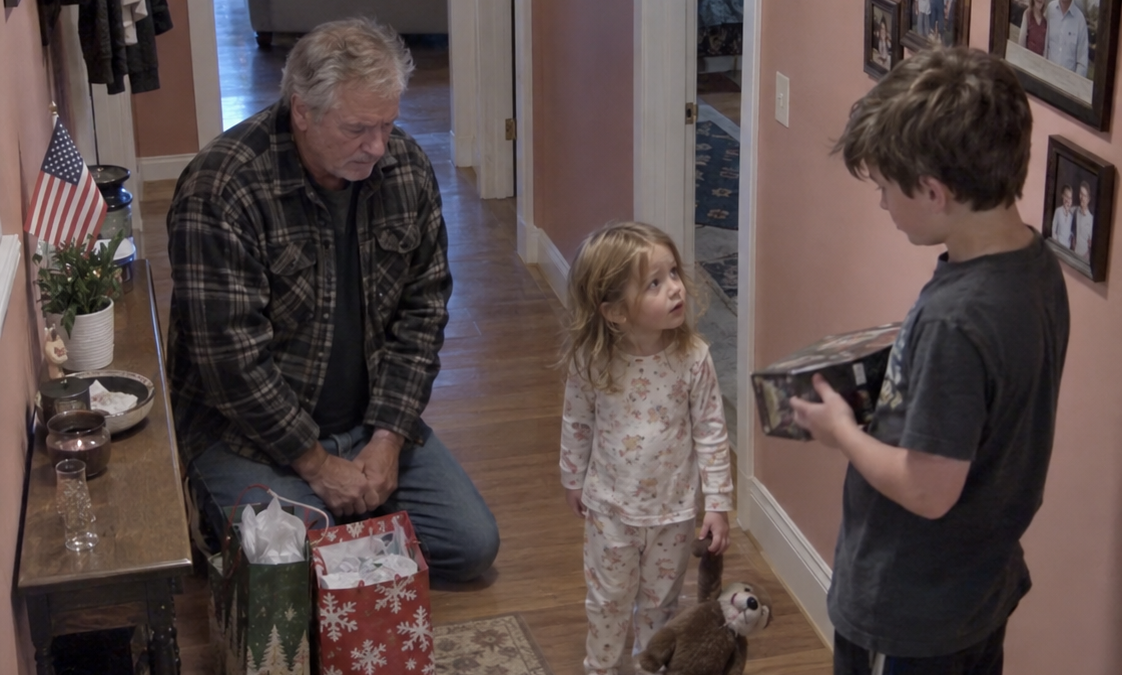
The first thing I noticed was the hallway.
Camille had repainted it two years earlier, a dusty clay-pink color, and hung a long row of framed photographs along the wall. I remembered helping her with every single frame. I’d stood on a stepladder for four hours, using a torpedo level I’d brought from the shop to make sure everything lined up perfectly.
My knees hurt for two days afterward. I remember being happy about that.
But standing in that same hallway, I realized something had changed.
The photograph from Elias’s first haircut was gone. In that picture, he was screaming while I laughed so hard I had tears running down my cheeks. There was hair all over both of us.
Gone.
The photograph from the morning June was born had disappeared, too. I was sitting in a vinyl hospital chair with my reading glasses pushed up onto my forehead, holding a nine-hour-old baby because I’d been trying to read the discharge paperwork when somebody handed her to me.
That picture was gone as well.
In their places were three photographs I had never seen before.
One showed Hollis teaching Elias how to bait a fishing hook off a dock in Wickford. Another showed the entire Trowick family at a fall festival, with June riding on Hollis’s shoulders. The third showed Bernadette and Hollis standing on either side of the children in front of a Christmas tree, everybody dressed in matching cream-colored sweaters.
I counted the frames along the wall.
Sixteen.
I appeared in none of them.
Then Elias came sliding down the hallway in his socks, the way he’d been doing since he was five, covering the last six feet on pure momentum.
“Vern, did you bring something?”
I set the bags on the bench and lowered myself onto one knee, which is something my knees have very strong opinions about these days.
“You don’t call me Grandpa anymore?”
He shrugged. It was the exact shrug an eleven-year-old gives when you ask about something he considers settled and slightly boring.
“Mom says Grandpa is what you call Hollis. She said it gets confusing if there’s two.”
I looked at him.
“When did she tell you that, bud?”
“I don’t know. Before Halloween.”
He was already pulling tissue paper out of the box.
“Is this the one with the loops?”
Before I could answer, June came around the corner dragging a stuffed otter by one flipper. When she saw me, her whole face opened up like a window.
“Grandpa V!”
Her brother corrected her without looking up from his present.
“Not Grandpa, June. That’s Vern.”
June stopped moving.
She looked at her brother. Then she looked at me.
Four years old, standing in a clay-pink hallway, trying to figure out which of the two people in front of her was telling the truth about the world.
I’ve gone back to that half second more times than I care to admit.
Because I can survive being snubbed. I’ve survived plenty of that. But this was something else entirely. This was a very small child being handed a version of reality in which I was a stranger with a decent first name, then being expected to accept that version as fact.
And here’s the ugly thing I thought in that hallway, something I hadn’t admitted out loud until I started telling this story.
My first thought wasn’t about June.
My first thought was, So this is what I’ve been paying for.
I’m not proud of that thought, but I promised I’d be honest.
I lowered myself a little farther so June could look directly into my eyes.
“You call me whatever feels right in your mouth, baby. But you know who I am.”
Elias said, “Okay,” then sat down on the floor and started reading the piece count from the back of his box.
And, honestly, that was exactly the appropriate amount of concern for an eleven-year-old to have.
He wasn’t being cruel. His mother had told him something, and he believed her, because that’s what children are supposed to be able to do.
I rested my hand on his head for a moment. Then I stood up and let myself out.
I sat in my cargo van in that driveway for nine minutes.
I watched the clock on the dashboard the entire time because I wanted to remember exactly how long I’d been sitting there. I know that’s a strange thing to do. I knew it was strange even while I was doing it.
Then I drove north to Woonsocket to see Teddy.
Teddy was my late wife’s sister, and I had been quietly avoiding her for about four years. I need you to understand why, because it matters.
Teddy is the kind of woman who says the thing.
Whatever the thing is, whatever everybody else at the table is carefully steering around, Teddy will say it out loud before you’ve even taken off your coat.
Ruby, my wife, loved her sister for that. It has taken me considerably longer.
Teddy had coffee going when I arrived. I sat at her kitchen table and explained everything the way I would describe a broken chair frame to a customer. Fourteen chairs. The green apron. The photographs. The missing pictures in Camille’s hallway.
She didn’t gasp or reach across the table to squeeze my hand. She didn’t say, “Oh, Vern,” in that soft voice people use when they feel sorry for you.
She just looked at me.
“Nobody forgot you, Vern. They filed you.”
I started telling her that was too harsh a way to describe it, but she had already pushed back her chair.
She went to the counter near the toaster and returned with a glossy card about the size of a postcard.
It was a campaign mailer.
COLIN TROWICK FOR CRANSTON SCHOOL COMMITTEE.
Beneath his name was that word again.
ACCOUNTABILITY.
Most of the lower half of the mailer was taken up by a professional family portrait. They were standing on the front steps of Hollis and Bernadette’s house in Garden City.
Colin. My daughter. Both children. Hollis with his hand on Elias’s shoulder. Bernadette standing beside June.
Everybody wore coordinated navy-blue clothing.
“Where did you get this?” I asked.
“It’s been on the corkboard at my dentist’s office since October. There’s one in the bakery window. One came to my house.”
I looked at the photograph again.
Then I noticed June’s sundress, and I felt as though the floor had tilted a couple of degrees beneath my feet.
I knew that dress.
She had worn it to her preschool sing-along in August. I was there. I sat in a folding chair in the back row, and I clapped.
August.
Five months before Christmas Eve.
Which meant the decision hadn’t been made during some tense conversation at a holiday table. That family portrait had been the decision. The seating chart in December was merely the press release.
Teddy sat back down and asked me the question that I think forms the backbone of this entire story.
“If they were done with you back in August, Vern, why did your money keep leaving your account on the first of every month all the way through the fall?”
I didn’t have an answer.
I still don’t have a complete answer, if I’m being truthful.
There’s a kind of cruelty that’s loud, and then there’s a kind that’s simply comfortable. Comfortable is so much worse. Loud cruelty means the people doing it are still thinking about you. Comfortable cruelty means they’ve stopped noticing you altogether.
That Saturday evening, I called Camille.
She picked up on the fifth ring. I could hear what sounded like a ventilation fan behind her, several voices talking at once, a truck gate slamming, and somebody counting flower vases out loud.
“Dad, hey. Everything okay?”
I didn’t mention the campaign mailer.
I’d imagined a hundred different ways to bring it up, but when the moment arrived, I put every single one of them back in the drawer. I’m still not sure whether that was restraint or cowardice.
“I thought I’d come by Sunday,” I said. “Have dinner with you all.”
There was a pause with a lot of furniture sitting inside it.
“This weekend’s honestly insane. Colin’s got the campaign thing, and, I mean, you know, big, loud group stuff isn’t really your speed anyway, Dad.”
I switched the phone to my other ear.
“Camille, what does June call me now?”
Truck noise. Somebody laughed close to her phone.
Three full seconds passed.
“Dad, don’t make this into a whole thing. I have so much on me right now. You have no idea.”
“I asked you one question.”
“They need me. I’ll call you this week.”
She hung up first.
I stood in my own kitchen with the phone still pressed against my ear long after the call had disconnected.
And here’s the detail that finished it for me.
She never asked what I meant.
She didn’t say, “What are you talking about?” She didn’t ask, “Who said something to you?”
She went straight to, “Don’t make this into a whole thing.”
You only reach for that defense when you already know the answer.
Which meant my daughter knew. She knew in August, at the fall soccer games, and on every first of the month when my money arrived in her bank account without anybody mentioning it.
That night, I opened my banking app again. The only light in the kitchen came from the bulb above the stove.
This time, I didn’t close the app.
I worked from top to bottom, the same way I approach a job in the shop.
Transfer one: $1,250 toward the mortgage.
The app asked me to confirm the cancellation.
I confirmed.
Transfer two: $600 toward the van.
Confirmed.
Transfer three was the insurance. I couldn’t cancel that through an app, so on Monday morning I called my broker, a woman named Dot Ivy whom I’d been working with for seventeen years, and asked her to remove Camille from the shop’s group plan.
Dot asked whether I wanted the cancellation effective at renewal or immediately.
“Immediately,” I said.
She told me she would mail written confirmation to every address on file.
Remember that detail. It comes back later.
The fourth transfer was different.
I didn’t touch it.
That money had never been intended for the adults. It was for a boy who had once been eleven hours old and a little girl who hadn’t even been born when I first opened the account.
So on Wednesday, I drove to a credit union in Pawtucket and transferred the entire balance into a proper 529 education plan, with me listed as the sole account owner.
Same children. Same beneficiaries. Same $900 going into the account on the first of every month.
A different lock on the door.
The balance that morning was $61,300.
I sat in the credit union parking lot afterward and began writing my daughter a letter on a yellow legal pad.
Four sentences.
I worked on those four sentences for two days before I was satisfied with them. Along the way, I threw away a page and a half of things I knew I would regret saying.
I told her that the mortgage assistance, the van payments, and the insurance coverage had ended. I explained that the children’s education money was untouched, still growing, and that she could see a statement whenever she wanted one without asking my permission.
Then I wrote the sentence I had apparently been building toward for eleven years without knowing it.
I am still your children’s grandfather. I am finished being your household’s line of credit.
I mailed the letter.
Paper, stamp, and an actual mailbox on Broadway. Because an email can be swiped away at a red light, but a letter sits on the kitchen counter being a letter.
Nobody called me for 23 days.
And I want to be straight with you about those 23 days, because they weren’t what you might expect.
They were the best three weeks I’d had in about six years.
That frightened me considerably more than the silence did.
I took a full lobby-restoration job down in Newport, one I’d been putting off for two months because accepting it would mean being unreachable for long stretches of the day. And being unreachable was the one thing I had organized my entire life around avoiding.
The job involved twelve chairs and two settees. I worked from six in the morning until four in the afternoon with an apprentice named Marco. We worked hard, and when the day was over, I went home tired in a way that had nothing to do with worrying about somebody else’s problems.
I finally replaced the porch railing on Sutton Street. It had been wobbling since the spring before last, and I’d been promising myself I would fix it for nearly two years. I also sat in a booth at a diner on Chalkstone with Hector Palma, the man who handles my books. We spent two hours talking about absolutely nothing important, and I laughed twice.
Every night, around nine, I checked my phone. There was never anything from Camille or Colin. No missed calls, no messages, not even one of Camille’s usual thumbs-up emojis. I tried to tell myself that the silence was information rather than an injury, but I’m not entirely sure I believed it.
There’s a difference between being at peace and simply being relieved that the phone has stopped ringing. Some nights, I honestly couldn’t tell which one I was experiencing.
On the twenty-first day, I made the mistake of opening Instagram again.
Camille had posted a video to her floral studio’s business page. She was standing inside a storefront on Hope Street. The walls were exposed brick, a large front window let in the afternoon light, and a walk-in cooler hummed somewhere behind her.
Her voice was bright, excited, and a little breathless.
“Big news! New space, bigger events, more weddings, so much more capacity!”
I watched the video twice.
My daughter had signed a commercial lease, a real one with a real monthly payment attached to it, during the same month that the $1,250 I had been contributing toward her household expenses had stopped arriving.
That meant one of two things. Either nobody in that house had opened my letter, or they had opened it and simply hadn’t believed what it said.
The first of the month was eight days away.
When that morning arrived, I was standing on a ladder in Newport, hand-tacking trim onto a settee, when my phone buzzed against my hip.
The message was from Camille.
“Dad, I think something’s wrong with the bank. The automatic payment didn’t go through.”
I read it twice, then finished the row of tacks I was working on. I put the phone back in my pocket and continued working.
I’d like to tell you my hands were steady. They weren’t.
At 11:52, I had a missed call. Another came at 12:06. At 12:31, Colin sent a long text message in which he used the word miscommunication twice. He signed it with a single letter, C, like a man sending a memo to a subcontractor.
I waited until six o’clock, after I’d finished working and cleaned my brushes, before I called Camille.
She answered before the first ring had finished.
“Dad, thank God. Okay, so the transfer—”
“There’s no bank error,” I told her. “I stopped it. I’m allowed to stop it.”
The sound she made was one I’d only heard from my daughter one other time in my life, and that was the night her mother died.
“You can’t just—Dad, I just signed a lease!”
“I know.”
“You didn’t even warn me!”
“I mailed you a letter three and a half weeks ago.”
Then Colin’s voice came through the speaker, close enough that I knew he’d taken the phone or leaned directly over it.
He was completely calm.
That was the part I hadn’t prepared for. I had braced myself for anger because I understand anger. I’ve dealt with angry customers, angry suppliers, and people who discover that restoring an antique costs more than buying something new. I know what to do when somebody raises their voice.
Colin sounded like a man who believed he was about to close a deal.
“Vern. Hey, let’s everybody take a breath here. I hear you, and I want you to know we hear you.”
He paused, then continued in that smooth, professional tone he used when he wanted a conversation wrapped up.
“So, how long are you planning to run this for?”
Not What did we do? Not What happened? Not Are you okay?
How long was I planning to run this for?
That was his question.
He thought I was using money as leverage. He thought I was an old man having a difficult month, holding a grudge, and that somewhere out there was a number or an arrangement that would make the problem disappear.
Then he said the one thing he absolutely should not have said.
“You’re punishing two little kids over a dinner.”
I let that sentence hang between us for four full seconds. I wanted him to hear exactly what he’d said before I responded.
Then I told him, “Colin, get a pen.”
I don’t know where those four seconds of restraint came from. Everything inside my chest wanted to say something cruel, something I could never take back.
I’ve gone over that phone call maybe two hundred times, and the thing I’m proudest of from that entire year is that I didn’t give in to that temptation. Not because I’m a better man than anyone else, but because I understood that if I allowed even one crack to open, I would lose the only advantage I had.
I was the only person in that conversation who wasn’t improvising.
I explained that the education account had never stopped receiving contributions. Not for one single month. I told Colin where the money was held, that I was the account owner, and that both children were named as beneficiaries.
I told him the same $900 would continue going in on the first of every month. Then I gave him the balance.
“Sixty-one thousand, three hundred dollars.”
There was a longer silence.
Finally, Colin said, “You don’t have the right to move that account without our consent.”
“It’s my money, Colin. My name is on it. Neither one of you has ever put a dollar into it.”
Camille got the phone back, and now she was crying. The real kind of crying. The kind that doesn’t sound like a strategy.
“Dad, please.”
“Those are my grandchildren,” I told her, “and they are getting every dollar I ever promised them. The adults in this made choices. The kids didn’t. That’s where I draw the line.”
She hung up.
My hands were shaking after that conversation. Later that night, I sat in my truck in my own driveway and asked myself out loud, in an empty vehicle, whether I had gone too far.
Doing what I believed was right didn’t feel good. It simply felt finished.
Nobody tells you those are different things.
And I want to ask you the same question now, because even today I find myself going back and forth over it. If you’d been sitting where I was sitting, would you have protected that college account the way I did? Or would you have shut down all four payments the night you saw those Christmas photographs, with no exceptions?
Type a one in the comments if you would have cut off every single payment. Type a two if you think I made the right decision by protecting the children’s education money regardless of how their parents behaved. I read those comments, including the ones that tell me I got it wrong, because the situation became considerably more complicated afterward.
Bernadette Trowick called me on a Wednesday morning.
In eleven years of family gatherings, that woman had never once dialed my phone number. Not a single time.
What surprised me was that she never mentioned money during the conversation. Not once. I’ll give her credit for that.
Instead, she talked about family. She talked about misunderstandings between people who care about each other and about how important it is for children to see the adults around them behaving with grace.
She used the word grace four times.
She said, “For the sake of the little ones,” twice.
Eventually, she arrived at the real reason for her call.
Colin’s campaign kickoff was scheduled for the twelfth at the Regent Banquet House in Cranston.
“And of course you should be there, Vern. You’re family. We’ve always thought of you that way.”
She said the word family warmly, with what sounded like genuine affection. That was part of what made Bernadette so effective.
In all the years I’d known her, I had never heard her say one genuinely unkind thing out loud. Not once. Yet I had watched her rearrange four households’ holiday plans through a group text and somehow emerge looking as though she had done everybody a personal favor.
“I’d be glad to come,” I told her.
“Wonderful. I’ll add you to the list.”
At the time, I didn’t fully understand why she had called. It wasn’t until around eleven that night, when I was sitting alone in my kitchen, that the purpose of the invitation became clear to me.
She wasn’t calling to repair anything. In three weeks, sixty people would be gathered in a banquet room, and a man who refused to answer his phone might still answer a question when sixty people were watching him.
She was setting another table.
What she didn’t know was that I had my own reason for wanting to sit at it.
But I need to be fair to Bernadette, because if I’m not, this whole story becomes nothing more than an old man settling a score. And that isn’t what I want it to be.
That woman had organized every major holiday for her family for 31 years. She booked the halls, confirmed the dates, managed the group texts, ordered the cards, and arranged the seating so that two relatives who couldn’t stand each other wouldn’t have to share a gravy boat.
Nobody had ever thanked her for a minute of that work.
When she looked at me, I don’t believe she saw a man she was deliberately erasing. I think she saw somebody quiet and difficult to place, somebody who never volunteered, never responded first to an invitation, never asked for anything, and apparently confused the grandchildren by holding a duplicate title.
Removing me from the family gatherings probably didn’t feel cruel to her. It probably felt like tidying up.
That’s something I’ve had to sit with.
Most of the people who treat us this way aren’t villains. Sometimes they’re just decorators who have stopped noticing that the furniture is alive.
Then the consequences of my decisions began to arrive, and I want to be very clear about something.
I hadn’t planned a single one of them.
Not one.
I’ve gone back over every decision I made, looking for the moment when I became calculating or clever, and I honestly cannot find it.
On the sixth of the month, a notice arrived from the company servicing Colin’s van loan. When you cosign a loan, both parties receive delinquency notices. The payment was fifteen days past due.
I read the letter, folded it, and put it in my kitchen drawer.
On the ninth, something much bigger happened.
Colin’s contracting business had been carrying its general liability insurance through my small-business policy for four years. It was another favor I’d arranged when his company was struggling, and I had never renegotiated it.
Renegotiating would have meant bringing it up. Bringing it up would have meant asking questions, and asking questions might have made me a burden.
I had spent most of my adult life trying not to be a burden.
When Dot processed the insurance cancellations on the second, she didn’t just remove Camille’s health coverage. Colin’s business liability coverage was canceled as part of those changes, too.
And in Rhode Island, a registered contractor without the required active liability coverage doesn’t just have a private problem. He has a public one.
There’s a registration lookup website. Anybody can type in a contractor’s name and check the status.
On the ninth, Colin Trowick’s registration changed to show noncompliant insurance status.
That would have been bad enough for any contractor. But Colin was also running for a seat on the Cranston School Committee, in a city where his company had submitted bids on two municipal repair jobs, and his campaign was built around the word accountability.
Somebody took a screenshot.
Somebody always takes a screenshot.
Camille texted me at eleven that night. Her message was three paragraphs long, but one sentence has stayed with me more clearly than anything else she wrote.
“You are setting my entire life on fire because you didn’t get a seat at a dinner.”
I wrote three different replies and deleted every one of them.
What I finally sent was simple.
“Dot mailed Colin the cancellation notice on the second. Check the stack of mail on your counter.”
Her response came the following morning.
Four words.
“He never opened it.”
I’ve thought about those four words more than almost anything else in this story.
I’ve wondered whether Colin truly never opened the notice, whether it had been buried under a pile of campaign mailers for two weeks, or whether somebody saw the return address and quietly moved it to the bottom of the stack.
Or perhaps nobody in that house ever genuinely believed the money would stop.
I sent one more message, then turned my phone face down and went to bed.
“Nothing’s on fire, Camille. I just set down what I was carrying. Those are not the same thing.”
That Friday, at three in the afternoon, Camille came to my shop.
She was still wearing her work apron, with floral wire sticking out of one pocket, and she was crying before the door had finished closing behind her.
I brought out the good chair from my back office and fetched a box of tissues from the bathroom. Then I sat on my work stool and let my daughter talk.
For fourteen minutes, I didn’t interrupt her once.
She talked about Bernadette and the way that woman controlled every holiday, every Sunday gathering, and every decision about which photograph ended up on the family’s Christmas card.
She talked about Colin handling all their money. She told me she had to ask his permission before spending more than $250 on anything, even purchases for their own home, even when the money came from an account with her own name on it.
She talked about being tired all the time. About years of asking permission to live inside her own life.
Some of what she said was true. I could hear exactly which parts were true, and I could also hear the parts she was choosing not to say.
And I’ll tell you what I was thinking while she talked, because it wasn’t particularly noble.
You’re describing a cage, Camille. I could have taken you out of it in one afternoon, and you never asked me.
Not once in five years had she come to me and asked for help getting free of the situation she was describing.
She had asked me for money. Again and again, money.
When she finally finished, I handed her another tissue.
“One question,” I said. “Then I’ll do whatever you tell me is right.”
She looked up.
“Who taught June to call me Vern?”
Her face changed in a way I hadn’t seen since she was sixteen and I’d found cigarettes in her jacket pocket.
“That doesn’t matter now, Dad.”
“It’s the only thing on this earth that matters to me right now.”
I took my phone out of my pocket and placed it on the workbench between us.
“Tell me who decided it, and I’ll turn all three of those transfers back on tonight. Right here, from this phone, while you sit there and watch me do it. You know I don’t bluff.”
The dust collector in the back of the shop kicked on. It usually runs for about ninety seconds after its cycle starts.
Camille stared at my phone the entire time it was running.
She didn’t say Bernadette.
She could have. It would have been easy. I would probably have believed at least half of it, and we both could have walked out of that shop with something to hold on to.
But she said nothing at all.
That was how I learned the truth. Not from anything my daughter said, but from what she refused to say.
“You had a real chance just now,” I told her.
She stood up. When she reached the door, she put one hand on the frame and stopped.
Then she turned around.
She wasn’t crying anymore.
That was how I knew we were finally about to have the real conversation.
“You never tried either, Dad. You know that, right?”
I looked at her without answering.
“You never once asked why you weren’t on a list. Not at Christmas. Not at Elias’s birthday in the spring. Not one single time in six years.”
She waited a moment.
“Do you have any idea what that looks like from the outside? It looks like you didn’t want to come.”
Then she opened the door and left.
The little bell above it made its usual sound as the door swung shut.
It was 4:15 on a Friday afternoon, and I was standing alone in an empty workshop.
I stayed there for a long time.
Because she wasn’t entirely wrong.
I’d like to tell you I came to understand that gradually over the following weeks, through careful reflection and long conversations with people I trusted. But that isn’t what happened.
I understood it the second the door closed.
The realization went through me like a nail from a nail gun.
Six years had passed since Ruby died. Six years of invitations that never came, family dinners moved to dates I wasn’t told about until afterward, and photographs taken at gatherings where nobody had thought to include me.
I had never asked about a single one of them.
Not once.
Every time something like that happened, I told myself asking would make me a burden. And being a burden was the one thing on this earth I had decided I would never allow myself to become.
Ruby used to do the asking.
That had been our entire system.
For 31 years of marriage, neither one of us ever said it out loud. She would call somebody and say, “Vern wants to know what time on Sunday,” and somebody would give her an answer.
I would stay quiet and still end up at the family table with a plate in front of me.
She had been my voice for 31 years.
Then she was gone.
And for the next six years, I barely spoke up about anything at all, while telling myself that what I was practicing was dignity.
If you’ve ever lost the person who did your speaking for you, the person who made the phone calls, answered the invitations, remembered which cousin wasn’t speaking to which other cousin, then you know grief isn’t the only thing that arrives at your house afterward.
Silence comes with it.
And silence is very, very good at convincing you that it’s the same thing as being strong.
I took the cutting-list pad off the counter and started writing down what I might say if I ever had the chance to speak in a room where nobody could hang up on me.
I wrote a paragraph, crossed it out, wrote another, and crossed that one out, too. Four days later, I had reduced everything I needed to say to four carefully worded sentences.
Four sentences were what I believed I could get through without my voice going somewhere I didn’t want it to go in front of strangers.
I was 61 years old. I knew exactly where my limits were, and I had made a career out of not testing them in public.
Two nights before the campaign kickoff, Hollis Trowick called my cell phone.
We had probably spoken across dinner tables fifteen times in eleven years. Our conversations were always about the Red Sox or the weather. Never once had we talked about anything that mattered.
“Vernon, got a minute?”
“Sure.”
“I want to ask you something, and I’d like a straight answer.”
I waited.
“Christmas Eve. Why weren’t you there?”
I looked up at my ceiling for a moment.
“I wasn’t invited.”
There was silence on the other end.
Then Hollis said, “That’s not what I was told.”
“What were you told?”
“That you don’t like big crowds. That you’d mentioned having other plans. Colin said something about it in the car on the way over. Said you’d been stepping back for a while.”
I opened the message thread with my daughter and scrolled back through our conversations.
Christmas the year before, there was a message from me asking what time I should arrive. No reply.
The year before that, the same question and the same silence.
I told Hollis to check his email, then forwarded him screenshots of both exchanges.
For about forty seconds, neither of us said anything.
Then he spoke again.
“That apron. The green one the boy had on.”
He stopped for a breath.
“Bernie ordered that online. I didn’t know it was coming. She put it over his head about ninety seconds before the first picture.”
I remained quiet.
“I’ve got four grandkids on my son’s side,” Hollis continued. “I have never once in my life tried to be anybody’s only grandfather.”
Another pause settled between us. This one felt different.
“Come on the twelfth, Vern. I’ll handle where you sit.”
I arrived at the Regent Banquet House twelve minutes early.
I want to describe that evening carefully because everything I’ve told you so far had been leading toward that room, and I don’t want you to miss what happened there.
I’ve had a full year to remember it, and I remember almost everything.
The Regent was the kind of place that hosted retirement parties, christenings, political fundraisers, and anniversary dinners. It had low ceilings covered with square acoustic tiles, twelve round tables dressed in white cloths, and about sixty folding chairs with padded seats.
At the front was a portable riser with a podium and a standing microphone.
The room smelled of chafing-dish fuel and carnations. A DJ wearing a rented-looking vest tapped the microphone twice and said, “Check,” to nobody in particular.
Near the coat rack, somebody’s toddler was running a toy car along the baseboard and making engine noises.
Campaign posters lined the wall closest to the entrance. Colin appeared in one of them wearing a quarter-zip fleece, his arms folded across his chest, looking like the kind of man you could confidently hand a budget line to.
Under his name was the same familiar word.
Accountability.
Hollis was standing near the entrance when I arrived.
As soon as he saw me, he crossed the entire room, held out his hand, and shook mine. He kept hold of it about two seconds longer than a normal handshake requires.
“Glad you came,” he said. “You’re up at the main table with me.”
Then he walked me the entire length of the banquet hall.
I could practically feel the arithmetic taking place around me. Sixty people were looking at us, doing the same calculation, and arriving at slightly different answers.
A woman at table four stopped with a dinner roll halfway to her mouth. Two men standing by the bar leaned toward each other without taking their eyes off me.
I kept my hands at my sides.
I remember making that decision consciously. Keep your hands down. Don’t touch your face. Don’t look like a man who is about to do something.
Bernadette was already seated at the main table.
She had a printed seating arrangement in her hand, laminated on cardstock. It was the kind of thing somebody laminates after putting a great deal of time into making it perfect.
I watched her look down at the seating chart, then up at me, then across the table at her husband.
Without saying a word, she turned the chart facedown on the tablecloth.
Colin was standing near the bar, speaking with two people I didn’t know personally. One was a man in a sport coat who owned a paving company in Coventry. The other was a woman who operated three daycare centers and contributed money to local political campaigns.
Colin hadn’t noticed me yet.
Camille had.
She was standing near the windows, and when she saw Hollis leading me toward the main table, she went completely still, the way a deer freezes when it senses movement in the woods.
Before anybody could say anything, Elias came running across the room, ducking beneath somebody’s elbow and stopping about four feet in front of me.
“Vern, how come you get the seat up front?”
Hollis answered before I had the chance.
He didn’t lower his voice. Not one bit.
“Because that’s your grandfather’s chair, Elias.”
The boy frowned.
“But you’re my grandpa.”
“I’m your grandpa on your dad’s side.”
Hollis placed his hand flat against the back of my chair.
“That one’s your grandpa on your mom’s side. You’ve got two. That’s lucky, bud. Most kids I know only get one.”
Elias considered this new information for about two seconds.
“Okay,” he said.
Then he went off to find the bread.
Two seconds.
That was how long it took to undo eight months of very careful work.
I stood there holding the back of a folding chair and thought about how much simpler children are than the adults who arrange their lives.
Children just want to know the rules. Somebody had given Elias the wrong rule, and he’d accepted it because he had no reason to believe it was wrong. Hollis had just explained the correct rule, and Elias had accepted that one, too.
No argument. No family meeting. No complicated explanation.
He simply had two grandfathers, and now he knew it.
Then Colin stepped up to the microphone.
He was good.
I want to be honest about that because otherwise none of what happened afterward means as much. Colin was genuinely good at public speaking.
He paused in the right places, looked up from his notes often enough to appear sincere, and spoke with the practiced confidence of a man who had spent months preparing for that evening.
He talked about the neighborhood where he’d grown up, the schools his children attended, and the values he believed every elected official should live by.
He spoke about what those values had cost him personally.
Then he raised his glass.
“One more thing before we eat,” he said. “My mother always told me that a real family isn’t about obligation.”
He smiled and waited for the room to settle.
“It’s not about who’s been around the longest, and it’s not about who picks up the biggest tab.”
He let those words land.
“Family is about who chooses to show up. That’s the whole definition.”
Applause began at the tables closest to him. Maybe twelve people clapped at first, then a few more joined in. The sound spread toward the middle of the room before fading into an oddly quiet patch beyond the third table.
I want to explain what was going through my head at that moment because it wasn’t rage, and it wasn’t triumph.
It was a single realization.
He doesn’t know.
Colin genuinely did not understand that he had just said those words in front of the man who had helped pay for the comfortable life he occupied.
He wasn’t trying to taunt me.
He had simply forgotten that I was a person who could hear him.
And somehow, that was worse.
I folded my napkin and placed it beside my plate, carefully squaring it with the edge of the table, the way I square everything.
Then I stood up.
The legs of my chair scraped across the floor. It wasn’t a particularly loud sound, but it was enough.
Sixty heads turned toward me, and they did it at a speed you could almost watch traveling across the room.
“Colin,” I said, “can I borrow that microphone?”
I was standing in front of sixty people, with a paving contractor and a daycare owner a few feet behind Colin, and his mother seated at the main table beside a laminated seating chart she had just turned facedown next to her salad plate.
He couldn’t very well say no.
The microphone made a small popping sound when it changed hands.
Somebody near the back of the room said something I didn’t catch. The DJ’s hand hovered over his control board for a moment, then moved away.
The room grew quiet in that very particular way a room becomes quiet when everyone knows something is coming and nobody wants to miss it.
I didn’t look at my notes.
I had read those sentences so many times over the previous four days that I knew them by heart.
My hands were shaking, though. I want you to understand that. I placed one hand on the podium to keep it from trembling.
Then I began.
“My name is Vernon Kimble. I’m Camille’s father, and I’m Elias and June’s grandfather.”
My voice held steady. I had honestly expected it not to.
“Colin’s right that family is about showing up. I’ve been showing up for eleven years.”
I looked out at the room.
“For five of those years, I’ve been paying $1,250 a month toward my daughter and son-in-law’s mortgage, $600 a month toward the van in the parking lot, $415 a month for my daughter’s health insurance and the liability coverage on his business, and $900 a month into a college account for both of my grandchildren.”
Nobody moved.
At table two, a fork stopped halfway to somebody’s mouth and stayed there.
“Last month, I stopped three of those payments. The fourth one is still running. That one belongs to the children, not the adults.”
I took one breath.
“I wasn’t invited to Christmas. And I didn’t come here tonight to embarrass anybody about that.”
Then I reached back and placed my hand on the back of my own chair.
“I just needed somebody to save me a seat. Hollis saved me one tonight. Thank you, Hollis.”
I set the microphone down on the podium.
Then I counted five seconds.
I counted them because counting is what I do instead of feeling things in public. I’ve been doing it my entire life.
After those five seconds, a man near the back of the room began clapping.
His name was Walter Boyce, a retired school bus mechanic. I had never met him before that evening, and I’ve only met him once since.
Then the woman sitting directly across from me started clapping. A moment later, most of the people at the side tables near the windows joined in.
It wasn’t loud.
It wasn’t a standing ovation, and thank God for that. A standing ovation would have turned the whole thing into a performance, and I would have had to live with that.
This was something quieter.
And in a way, it was much worse for the people sitting at the front of the room.
It was the sound of sixty adults sitting very still with an uncomfortable truth that had just been placed in their hands, knowing they would be talking about it in their cars on the way home.
Bernadette didn’t clap.
She was staring at that laminated seating chart, still facedown beside her salad plate, the one she had probably spent four hours preparing.
Colin walked out through the door leading to the kitchen.
I left before dessert.
I had said what I came to say, and I’ve never been particularly well equipped for the part that comes afterward.
Camille caught up with me in the parking lot.
“You humiliated me in front of every single person I know.”
There were no tears this time. Her voice was steady, and her face had gone hard.
That was how I knew we had finally arrived at something real.
“I said my name,” I told her.
She stared at me.
“I told them who I was, Camille. And then I told them what was true. If the true parts are humiliating, honey, that isn’t something I did to you.”
She stood there in the cold March air with her arms wrapped around herself.
For a long moment, neither of us said anything.
Then she looked at the ground.
“It was me.”
I waited.
“Teaching June. It was me.”
She took a long breath.
“Bernie kept correcting her at Sunday dinner. Every single time that baby called you Grandpa, Bernie would do this little thing, this look. And then she’d look at Colin, and Colin would look at me, and I…”
Her voice trailed off.
“It was easier to fix it at home than to fight about it every Sunday for the rest of my life. I understand that you don’t know what it’s like inside that family.”
“Then tell me.”
And she did.
Not everything, but enough.
She told me about the family group text she wasn’t included in, the one where the Trowicks arranged holidays before anybody bothered asking what worked for her household. By the time she learned about the plans, the dates were already set, and she was simply expected to show up.
She told me again about the $250 spending limit Colin had imposed on her. Her own money, in an account bearing her name, and she still had to ask permission to spend it.
Then she told me something I hadn’t known.
The previous summer, Colin had told her that if she couldn’t commit to his family the way a wife was supposed to commit, they would need to take a hard look at their entire arrangement.
And because Colin Trowick was a careful man, he had made a point of mentioning that his cousin practiced family law up in Attleboro.
Camille had been twenty-four when I walked her down the aisle. I remembered looking at Colin that day and thinking he was a serious young man. He wasn’t especially warm, but he seemed dependable, and I had been relieved about that.
I remember thinking, Well, he may not be warm, but at least he’ll never leave her guessing.
I had gotten that exactly backward.
And I had stayed wrong about him for eleven years.
“Dad,” Camille said, “are we going to be okay?”
I looked at my daughter for a long time.
“Not yet,” I said. “But I think for the first time in about six years, we’re standing in the right place to start.”
She flinched.
I let her.
I didn’t reach for her, and I’ve gone back and forth on whether that was the right thing to do.
“I’m not angry that you were afraid of them,” I told her. “I’m sad that you let me pay the bill for it.”
Then I opened the passenger door of my van and took an envelope from the dashboard.
It had been sitting there for three days.
Inside was the information for the children’s education account: the account number, both children’s names, the current balance, and the credit union’s telephone number.
I handed it to her.
“You can call them any day you want, and they’ll read you that balance out loud. You don’t need my permission for one single thing on that page.”
She held the envelope in both hands as though it might come apart in the cold.
Four days later, Elias called my cell phone.
I was back in the workshop, sorting a bin of upholstery tacks that did not need sorting.
“Vern?”
He stopped.
“Vern, I mean…”
He stopped again.
“It’s okay, bud,” I told him.
Then he asked the best question anybody had asked me in fourteen months.
“Are you actually my grandpa? Like, for real?”
I told him yes.
“How do I know, though?”
I thought about that for a moment.
Then I said, “Go somewhere you can look at your phone.”
I opened my photo gallery and started scrolling back through eleven years of pictures.
Eventually, I found the one I wanted.
Elias was lying in a hospital bassinet, eleven hours old. His head was still a little cone-shaped, the way newborn babies’ heads sometimes are, and he had that serious expression babies get when they haven’t figured out what to make of the world yet.
I was sitting beside him in a vinyl chair, leaning forward with my reading glasses pushed up on my forehead.
The timestamp in the corner read 4:52 in the morning.
And in the upper-right corner of that photograph was a hand resting on my shoulder.
A small hand with a wedding band and a burn scar crossing two knuckles, the result of an accident with a roasting pan back in 1994.
Ruby’s hand.
I sent Elias the picture.
For a long time, neither of us said anything. I could hear him breathing on the other end of the line.
Finally, he asked, “Is that Grandma Ruby’s hand?”
“That’s your grandmother’s hand,” I said. “She’s holding on to you. She’s just doing it through me.”
Another silence followed.
It went on so long that I thought the call might have dropped.
Then he said, “Okay, Grandpa.”
Grandpa.
For the first time in fourteen months.
I had to put the phone down on my workbench for a moment before I could tell him I’d see him Tuesday.
The following week, I sat down with Camille and read her something I’d written on the back of another cutting-list pad.
That’s how I handle difficult things now. I put them on paper and say them out loud so nobody has to guess what I mean.
There were four conditions.
First, the education account would stay under my control. I would continue contributing every month, and Camille could review a statement whenever she wanted, without asking permission and without explaining why she wanted to see it.
Second, I would spend every Tuesday afternoon with Elias and June. Not Tuesdays when somebody found it convenient. Actual Tuesdays, every single week.
Third, I would be informed about family holidays before reservations were made. I wanted to hear about gatherings when everybody else heard about them, not the following morning when somebody posted a photograph online.
And fourth, there would be no more automatic transfers.
Not for the house. Not for the van. Not for insurance. Not for an emergency.
Never again.
If Camille ever found herself in genuine trouble, she could come to me. We would sit down at a table, look at the problem together, and figure out what to do like two adults.
She read the page twice.
Then she looked at me.
“That’s fair.”
“It’s not generous,” I said. “It’s just true. I spent a very long time confusing those two things.”
And that brings me to the part of this story I actually want you to take away, because here’s what that entire year taught me.
I’m still working on it at sixty-one.
The mistake most of us make isn’t being too generous. It’s using generosity as a substitute for the one sentence we’re too frightened to say out loud.
I spent $217,000 over eleven years because I never wanted to ask the question that had been sitting in my chest since Ruby died.
Am I still welcome here?
And the terrible part is that my arrangement worked.
It worked perfectly.
It kept me useful.
But useful is not the same thing as wanted.
And being useful can carry you through your entire life without ever forcing you to discover the difference.
So here’s one thing I’d ask you to do tonight.
Open your banking app and look at every automatic payment leaving your account for another adult.
I’m not asking you to cancel anything. That isn’t the point, and I’m certainly not telling anybody to handle their family the way I handled mine.
Just look at each payment and ask yourself, out loud if you have to, what it’s really buying.
Some of those payments are expressions of love. Some are simple practical arrangements, the kind families make because people need help sometimes.
But one or two of them, if you’re completely honest with yourself while sitting alone at eleven o’clock at night, might be rent on a chair at a table where nobody has ever written down your name.
And that’s the question I want you to sit with when the house goes quiet.
Whose table have you been clearing for years without ever checking whether they counted you when they said everybody was invited?
My daughter separated from Colin that spring.
I want to be careful about how I describe that because it matters to me.
That was not my doing.
I never told Camille to leave her husband. I never told her to stay, either. I never offered my opinion about what she should do with her marriage, and I’m not going to start now.
What happened was that my daughter learned she was allowed to say no.
And it turned out that in her house, the word no was load-bearing.
Once she started using it, a great many things that had seemed solid for eleven years began showing their cracks.
Colin withdrew from the Cranston School Committee race in February. His public statement mentioned family priorities and unfortunate timing.
By then, the screenshot showing the insurance compliance problem with his contracting business had circulated through two neighborhood groups and appeared on a local news blog.
In a race where the difference between winning and losing can be a few hundred votes, one screenshot can be enough to change everything.
Both of his major donors quietly stepped back during the week following the campaign kickoff. Neither publicly explained why.
One had been in the banquet hall that night.
The other donor’s wife had heard about what happened from somebody who was there.
I don’t know what either of them said behind closed doors, and I’ve never asked.
Bernadette and I don’t speak anymore.
Occasionally, we see each other at the Stop & Shop on Reservoir Avenue. When that happens, we nod and continue on our way.
That’s our arrangement. I’ve made my peace with it.
I want to say clearly that I don’t wish that woman any harm.
She spent 31 years building and managing something that she believed was holding her family together, and nobody thanked her for doing it.
I understand more about her now than I did when I was still inside that family arrangement.
Understanding her doesn’t mean I have to return to the way things were. It just means I no longer need to hate her to know where my boundaries are.
Hollis takes me to breakfast on the first Sunday of every month.
He always brings crullers I don’t particularly like, and I’ve stopped mentioning it.
We talk about the Red Sox, furniture, our grandchildren, and sometimes absolutely nothing at all.
It’s a comfortable kind of quiet.
Teddy says I’m better.
“But you’re still too quiet, Vern,” she told me at Easter, pointing her fork across the table in my direction.
Then she smiled.
“Except now it’s the other kind.”
I asked her what she meant.
“There’s quiet because you swallowed what you wanted to say, and there’s quiet because you already said it. You’re finally the second kind.”
I’ve thought about that a lot.
The children’s education account passed $73,500 in October.
The same $900 still goes into it on the first of every month. I haven’t announced that number to anybody in the family. The only person I’ve discussed it with is Hector, who does my books.
And now you.
Father’s Day came around again, and I want to be honest about that day, too.
I think people expect a man to be completely transformed by an experience like the one I’d had. They expect him to wake up every morning full of confidence, having learned his lesson and left all his old habits behind.
That isn’t how it works.
I woke up that Sunday morning and had no idea what to do with myself.
So I drove to the shop and started sorting upholstery webbing that didn’t need sorting.
Some habits are harder to break than others.
At 10:40, my phone buzzed on the workbench.
It was a video call.
When I answered, June’s face filled the screen. She was about four inches from the camera, with one enormous eye taking up almost half the picture.
“Grandpa V, where are you? We’re waiting!”
I was twelve minutes away.
I made it in nine.
There were six of us sitting around Camille’s dining room table that afternoon.
Camille, Elias, June, Teddy, Hollis, and me.
Hollis had been invited on his own account, as himself, exactly the way it always should have been.
There was a card propped against my water glass.
It was made from construction paper, cut with safety scissors. The edges were nowhere near straight, and somebody had used thick crayons to write my name in large, uneven letters.
Grandpa Vern.
The N was facing the wrong way.
Underneath the words was a drawing of something that was unmistakably a chair.
June had decided that chairs were what I made for a living. She wasn’t wrong about the important part.
Elias told me later that she’d done the whole thing herself. He had helped her sound out the letters, but he let her do all the drawing and coloring.
Nobody took a picture of the card.
Camille reached for her phone at one point, then seemed to think better of it. She placed it facedown on the sideboard and looked around the table.
“Let’s just eat.”
And that’s what we did.
My chair was at the end of the table nearest the kitchen.
Not at the head. Not in the middle. Just at the end, close to the doorway, where a person could get up to refill everyone’s water without making anybody else move.
Ruby always used to sit there.
For 31 years, I sat across from her and watched her get up and down from that chair, taking care of everybody around the table. I never thought much about it at the time.
But that afternoon, there was a card waiting on the chair before I arrived.
A card with my name on it.
Mostly spelled correctly.
Somebody had made it before I walked through the door. Somebody had thought about where I would sit. Somebody had expected me to be there.
That’s the part I keep coming back to.
Because after a full year of sorting through everything that happened, I realized the story had never really been about the money.
It wasn’t about the seating chart, the green apron, the work van, or the photographs that disappeared from my daughter’s hallway.
It was about a card.
The kind somebody makes before you get there.
The kind with your name written on it because somebody remembered to count you.
And when they counted, you were part of the number.
I had spent years believing that if I paid enough, helped enough, worked hard enough, and never complained, I would always have a place at the table.
I never understood that those things were two entirely different questions.
Whether people needed me was one question.
Whether they wanted me there was another.
And I had been answering the first question for so long that I had almost forgotten I was allowed to ask the second.
It took 41 photographs, fourteen chairs, a green apron, and an eleven-year-old boy calling me Vern to make me understand how far I’d let myself disappear.
It took my daughter telling me something I didn’t want to hear to make me recognize my own part in that disappearance.
And it took Hollis putting his hand on the back of a folding chair and telling Elias that he had two grandfathers for me to understand something I should have known all along.
I didn’t have to compete for a title that was already mine.
I didn’t have to earn the right to be somebody’s grandfather by paying their parents’ bills.
And I didn’t have to keep making myself smaller so other people would find me easier to accommodate.
That Father’s Day, I sat in Ruby’s old place at the table. I listened to June talk about her drawings and Elias explain something about the marble run I’d given him months earlier.
Hollis passed me a plate. Teddy complained about the coffee. Camille got up to bring out more food, and nobody acted as though anything unusual was happening.
It was an ordinary family meal.
There was no speech, no applause, no argument, and no photograph afterward to prove that we had all been there.
For the first time in a very long while, I didn’t feel the need for proof.
I just ate my lunch.
And when I looked down, there was that crooked little card leaning against my water glass.
Grandpa Vern.
That was enough.
So if nobody is putting your name on the table, you are allowed to stop clearing it for everybody else.
You’re allowed to ask whether you’re welcome. You’re allowed to say that something hurt you, even if you’ve spent your whole life pretending those kinds of things don’t matter.
And you’re allowed to stop paying for the privilege of being tolerated.
That doesn’t mean you have to stop loving people. It doesn’t mean you have to punish them or make them suffer because they failed to appreciate you.
Sometimes it simply means telling the truth, setting down what you’ve been carrying, and giving the people around you a chance to decide whether they want a relationship with you when your money is no longer holding it together.
Some relationships won’t survive that.
Others might finally become real.
Mine did, although not in the way I expected.
Before you go, I’d genuinely like to hear what you think about the choices I made.
Comment a one if you believe I should have stopped all four payments the night I saw those Christmas photographs, including the money for my grandchildren. A clean break, with no exceptions.
Comment a two if you think protecting the college account was exactly the right decision, regardless of how the adults behaved.
And comment a three if you believe I was wrong to stand up at Colin’s campaign dinner at all, that some things should always be handled in private, even when private is exactly where people have been burying you for years.
I read every comment, including the ones from people who believe I handled this badly.
I’d also like to know where you’re watching from and what time it is where you are right now.
I like knowing that somewhere out there, somebody might be hearing this at two in the morning, sitting alone in a kitchen with one light burning above the stove.
I know what that kitchen feels like.
I’ve sat in it.
Most of all, tell me if you’ve lived through some version of this yourself.
If you’ve ever been the person who paid, drove, showed up early, stayed late, and took care of everybody else, only to discover there was a family group text you weren’t included in, you’re not being dramatic.
You’re not too sensitive.
You just noticed.
And sometimes, noticing is the hardest part.
If any part of this story reached you somewhere real tonight, subscribe and stay with me. I tell stories like this every week, and underneath all the different details, they’re usually about the same thing: people trying to understand the difference between holding on to something and holding something up.
It matters to me that you’re here.
Thank you for sitting with me all the way to the end.
This is a fictional story inspired by real emotional experiences, fully rewritten and reimagined in Providence, Rhode Island, to create original content. Any resemblance to actual people or events is entirely coincidental.








