New CEO fired me on her first day. The tulips I brought still trembling in my hands. “Walter Jenkins, your time is over.” She didn’t know that two days earlier, I’d signed papers making me the owner. The next morning, the secretary burst in, breathless. You need to see this…
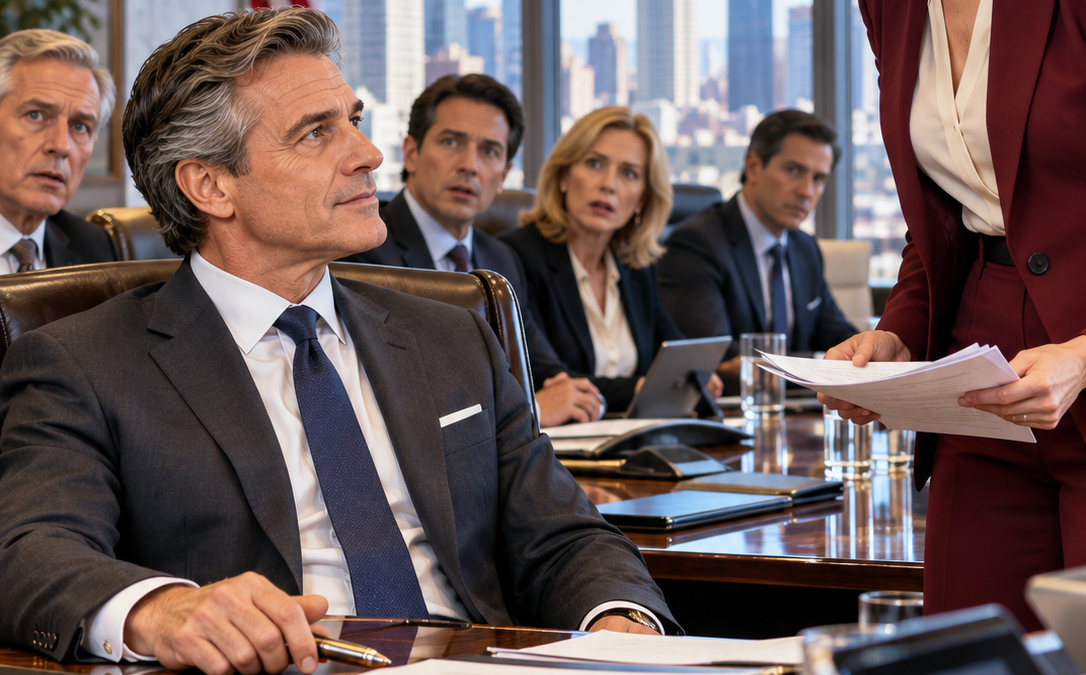
They thought firing me would be the end of the story. They were wrong. My name is Walter Jenkins, and what happened in that boardroom three days ago changed everything. But to understand how a 54-year-old veteran got publicly humiliated and then turned the tables on a 37-year-old CEO, you need to know about the silver pen in my pocket and the phone call that happened 72 hours earlier. Let me start at the moment it all went sideways.
The yellow roses sat steady in my grip as I waited outside the conference room. A simple gesture, I told myself. A bouquet to welcome Victoria Croft, our new Chief Executive Officer. Twenty-five years at AeroFreight Corp had taught me that respect mattered more than titles. I wanted her first morning to feel like she was joining a family, not just a cold corporate machine. But the moment I stepped inside, the air shifted.
Victoria did not smile. She did not glance at the flowers. Instead, she adjusted her glasses and spoke with a cold clarity that pierced the room.
“Walter Jenkins, your time here is over.”
The words did not register at first. Around the table, two newly promoted directors sat stiffly, their pens poised as if they were waiting for me to argue. I looked at Victoria, searching her face for some sign that this was a tasteless joke. There was none. She slid a thick black folder across the polished mahogany table, her eyes flat, already dismissing me. My brain refused to process what was happening.
Twenty-five years of midnight calls, routing rescues during blizzards, and surviving compliance audits—all of it collapsed into a single cruel moment. No acknowledgment. No thank-you. Just a surgical cut.
The humiliation deepened when Victoria leaned forward, raising her voice just enough for everyone in the room to hear.
“This,” she declared, tapping the folder with a manicured finger, “is the beginning of cultural reform. AeroFreight must shed its outdated overhead to survive, and Walter’s departure will be our signal of change.”
Whispers rippled through the silence. I felt every eye on me, not with respect, but with pity. My gift of yellow roses lay on the side table, suddenly looking ridiculous. I set the folder down for a moment, my fingers brushing the engraved silver pen I always carried in my pocket. George Montgomery, the company’s founder, had given it to me years ago. I clenched it tightly, using its familiar weight to steady myself against the wave of humiliation.
But here was what Victoria did not know. What nobody in that room knew.
Two days earlier, I had signed papers that made me the majority owner of the company she thought she controlled.
Victoria straightened in her chair, satisfied, believing she had staged a spectacle that would establish her authority. She had no idea that this scene would not be remembered as her triumph. It would be remembered as her downfall.
I stood in the quiet room, looking at the faces of people I had worked with for decades. They looked down, avoiding my eyes. It was a familiar corporate ritual. When the axe falls, everyone scrambles to make sure they are not next in line. Victoria gestured toward the door, her expression making it clear that my continued presence was already an inconvenience.
I picked up the folder. The cardboard felt heavy in my hands, like a tombstone for a career I had built from the ground up. I did not say a word. I did not plead, and I did not raise my voice. I simply turned and walked out of the room, leaving the scent of yellow roses lingering behind me.
The walk back to my office was the longest walk of my life. The hallway seemed longer, the fluorescent lights brighter, and the silence of my coworkers louder than any shout. They already knew. Word travels fast in a building made of glass and whispers.
When I reached my office, I closed the door and sat down. My hands were shaking, not from fear, but from the effort of containing my anger. I looked at the silver pen on my desk. The engraving was slightly worn, but the name George Montgomery was still clear.
George had built this company on the backs of drivers, dispatchers, and mechanics. He believed in the people who did the work. Victoria Croft believed in spreadsheets, consulting reports, and cost-cutting measures that looked good on slide decks but gutted actual operations.
She had spent six months at a high-priced consulting firm before the board brought her in to modernize the company. To her, I was just a line item under logistics management that needed to be erased. She did not know that the logistics department was the only thing keeping AeroFreight from collapsing under the weight of its own debt.
I opened the black folder and examined the severance package. It was insulting. A few months of pay in exchange for signing away my rights, agreeing not to sue, and handing over all intellectual property.
I let out a dry laugh.
They really thought I was helpless. They thought a 54-year-old manager would take the check, pack his boxes, and quietly fade into retirement. They did not realize that the logistics network they relied on was built on systems I had created, systems protected by patents they did not own.
As I stared at the papers, my phone buzzed.
It was a text message from George. Short and to the point.
“Did she do it?”
I typed back a single word.
“Yes.”
George’s reply came a second later.
“Excellent. The trap is set. See you on Friday.”
I leaned back in my chair, the anger slowly transforming into a cold, sharp focus. The game had started, and Victoria Croft had just played her first move without looking at the board.
As the morning went on, I sat in my office and watched the daily operations continue outside my window. The dispatch team was busy on their phones, managing deliveries, unaware of the corporate storm brewing above them. The logistics board on the wall showed 45 trucks currently on their routes, moving cargo across 12 states. Every one of those routes was calculated using software I had spent five years developing.
I thought about how Victoria had called me outdated overhead. It was a classic corporate buzzword, used to justify cutting experienced workers so companies could hire younger, cheaper staff who did not understand the business.
I looked at my computer screen, realizing this was my last official week. I decided I would do my job until the very last second. I logged into the system and began checking the active routes, making sure our drivers had the support they needed for the day.
I would not let my personal situation affect the safety of our drivers on the road. That was the difference between Victoria and me.
She saw numbers. I saw people.
To understand how I ended up sitting in that office with a folder of termination papers, you have to go back 72 hours.
It was a rainy Sunday evening, and I was trying to relax in my living room, watching the rain beat against the windowpane. My mind was consumed by rumors that had been circulating through the office for weeks. The board was bringing in a new Chief Executive Officer, Victoria Croft, and the whisper network said she was planning to dismantle the logistics division.
The phone rang, shattering the quiet.
The caller ID showed George Montgomery.
George was 78 now, and although he had retired from active management five years earlier, he was still the largest individual shareholder of AeroFreight Corp. When George called, you did not let it go to voicemail.
“Walter,” George said, his voice carrying the gravelly authority of a man who had spent 40 years running a trucking company. “I need you to come over to the house. We have a problem, and we need to solve it before Monday morning.”
Thirty minutes later, I was sitting in George’s study. The room smelled of old paper, leather, and pipe tobacco. A fire crackled in the hearth, casting long shadows across the dark oak bookshelves. George sat behind his desk, looking at a stack of documents. He did not look like a retired executive. He looked like a general preparing for a siege.
He pushed the documents toward me. I took a seat and began to read. They were confidential board memos and financial proposals that had been leaked to him by a contact on the board.
“The board is planning to sell the logistics fleet,” George explained, leaning forward. “They want to spin off the entire transportation network to a shell company called Thorne Logistics, which is owned by Reginald Thorne. Reginald is Victoria Croft’s close ally, and she’s the one pushing this deal.”
He paused, giving me a moment to absorb what he was saying, then continued.
“They want to outsource all our shipping to Thorne’s company. They’ll lay off 300 drivers and dispatchers, dismantle our hubs, and lease back the trucks at a premium. It’s a classic asset-stripping scheme. They’ll make millions in short-term dividends, and within three years, AeroFreight will be bankrupt because we won’t control our own supply chain.”
I read the numbers. The leaseback rates were astronomical. It was a corporate heist disguised as a restructuring plan.
“How are they going to pass this?” I asked, my blood running cold as I thought about the drivers I had known for 20 years, men who had mortgage payments and kids in college.
“Victoria has the votes,” George said. “She’s convinced the institutional investors that this is the only way to boost the stock price. I’ve tried to fight them, but my 42% share isn’t enough to block a majority vote.”
He looked at me steadily.
“They’re going to approve the sale at the board meeting on Friday. And before they do that, Victoria is going to fire you. She knows you’re the only one in management who can expose the numbers. She wants you out of the building before the vote.”
I looked at the paperwork, then back at George.
“We can’t let this happen. This company is your legacy, and it’s the livelihood of hundreds of families.”
George smiled, a slow, grim expression I had seen before during the labor disputes of 2012.
“I don’t intend to let it happen, Walter. That’s why I called you here. I’m selling my shares. All 42% of them. To you.”
I stared at him, dumbfounded.
“George, I can’t afford to buy 42% of AeroFreight. Even with my savings and stock options, that’s millions of dollars.”
George waved his hand dismissively.
“I’m not asking for cash upfront, Walter. We’re going to structure this as a seller-financed transfer. You’ll pay me back over ten years from the dividends. I don’t care about the money. I care about this company.”
He leaned forward, his expression growing serious.
“You already own 9% of the shares through the stock options you’ve accumulated over the last 25 years. If you buy my 42%, you’ll hold 51%. You’ll be the majority owner.”
He pulled a document from the drawer, along with a silver pen.
The pen was engraved with the original AeroFreight logo from 2001.
“This was the pen I used to sign the incorporation papers,” George said, placing it in my hand. “It’s been sitting in my drawer for years. It belongs to the owner of this company.”
I turned it slowly between my fingers, feeling the cool metal against my skin.
“Sign the transfer papers, Walter. We’ll file them with our transfer agent first thing Monday morning. But we’ll keep it quiet. Let Victoria go ahead with her plan. Let her fire you. I want to see how far she’ll go.”
George’s gaze remained fixed on mine.
“I want her to stand before the board on Friday and tell them she has everything under control. And then we’ll show them who really owns AeroFreight.”
I took the silver pen, its cool weight reassuring in my palm, and signed my name.
With that stroke, the power shifted, though the world did not know it yet.
George poured two glasses of scotch and handed one to me. We sat in silence for a few minutes, watching the flames in the fireplace. I thought about how we had started this company with just five trucks and a small rented office near the docks. We had worked sixteen-hour days, sleeping on the office floor to make sure every delivery was on time.
George had always treated his employees like family. When one of our drivers fell ill, George paid the man’s salary out of his own pocket until he could work again.
Victoria Croft did not understand that kind of business. To her, employees were just liabilities, and loyalty was an outdated concept that had no place on a balance sheet.
I looked at the silver pen in my hand, feeling the heavy responsibility that came with it. I was no longer just an employee defending my job. I was the guardian of the company’s soul.
We talked for another hour, planning our moves for the coming week and ensuring that every document was signed and every legal precaution was taken before the Friday showdown.
Tuesday morning was a quiet affair. I arrived at the AeroFreight office at seven, carrying an empty cardboard box. The building was mostly deserted, its glass corridors silent beneath the dim morning lights. I began the process of clearing out 25 years of my life. It was a strange experience, trying to pack a quarter-century into a few small boxes.
I started with the photographs. There was one of George and me standing in front of our first warehouse in 2002, both of us covered in grease after helping a driver fix a transmission. There was another of the logistics team after we managed to deliver 50 shipments of emergency supplies during the blizzards of 2014. These were not just memories. They were the physical evidence of the life I had built there.
As I packed, my mind drifted back to the sacrifices I had made. In 2017, my father was in his final days at a hospital in Chicago. At the same time, Hurricane Harvey was battering the Gulf Coast, threatening to destroy our entire Southern logistics network. Forty of our trucks were trapped in the storm zone, carrying critical medical supplies and food.
I spent 72 hours straight in the operations center, sleeping on a cot, coordinating with state troopers and emergency management officials to reroute the fleet and get the drivers to safety. We did not lose a single driver, and we delivered the supplies. But while I was staring at the tracking screens, my phone rang.
My sister told me our father had passed away.
I never got to say goodbye.
I carried that sacrifice quietly for years. The company did not owe me anything for it, but it was part of the foundation of AeroFreight. To Victoria Croft, that sacrifice did not exist. In her spreadsheets, I was just an expensive resource that could be replaced by a cheaper outsourcing contract.
As I taped the first box shut, the door opened. It was Carl Jenkins, my cousin and one of our senior dispatch supervisors. Carl looked furious, his fists clenched at his sides.
“Walter, this is garbage,” Carl said. “Everyone in the warehouse is talking about it. They can’t just throw you out after everything you’ve done. The drivers are talking about staging a sick-out on Friday to protest.”
I shook my head and told Carl to calm down.
“Don’t do that, Carl,” I said, keeping my voice low. “The drivers need their jobs. Tell them to stay on the road. We’re going to handle this the right way.”
Carl looked at me, confused by my lack of anger.
“How can you be so calm about this? They’re destroying everything we built.”
I just smiled and told him to trust me.
“There’s a plan, Carl. Just keep the trucks moving and make sure the logs are accurate.”
He nodded slowly, still unsatisfied, but he respected my word. After he left, I sat back down, and my phone buzzed.
It was an email from Oliver, a young analyst I had hired and mentored three years earlier. Oliver worked in the executive suite now, assisting the Chief Financial Officer. The email contained no text, only an audio file attachment.
I plugged in my headphones and clicked play.
The recording was from the executive committee meeting that had taken place on Monday afternoon, just hours after I was fired. Victoria’s voice was clear, carrying that sharp, condescending tone she used whenever she wanted to dominate a room.
“We have officially removed the old guard,” Victoria was saying. “Walter Jenkins was an anchor weighing down our operational margins. He was too sentimental about the drivers and too rigid in his methods. By removing him, we have demonstrated to the investors that we are serious about cutting overhead. We will proceed with the Thorne contract on Friday, and the board will approve it.”
I listened to the recording twice.
She had not just fired me. She was using my departure as a trophy to show off her corporate ruthlessness. She was boasting about cutting the throat of the logistics division to please investors who did not know the difference between a dry van and a flatbed.
My grip tightened around the silver pen in my pocket. The anger was still there, but it had become cold and controlled. Victoria thought she was playing chess, but she had only looked at the pieces she wanted to move. She did not realize that the very board she was standing on had already been tilted.
I saved the audio file to an external drive, labeled it, and put it in my briefcase. It was time to prepare the legal files for Friday.
I spent Wednesday packing the remaining items from my office and saying goodbye to the staff. Many of the older employees came by to shake my hand, some with tears in their eyes. They had seen what happened to other veterans who had been pushed out when the new management took over. They believed my departure marked the end of an era.
I felt a deep sadness, not for myself, but for the company. We had built something special, a place where people actually cared about one another. Now it was being turned into a carcass for corporate raiders to feed on.
I loaded my boxes into my car and drove away, looking back at the glass building one last time. I would return in two days, but not as the man they had fired.
I would return as the owner.
I spent Wednesday evening reviewing the logistics reports, finding several discrepancies in the financial projections Victoria had presented to the board. She had deliberately underestimated the cost of outsourcing to make the Thorne contract look more attractive. She was willing to lie to the board to get her way, and I was going to make sure they saw the truth.
By Thursday, the pieces of the puzzle were coming together. I spent the morning in the office of my attorney, Howard Vance. Howard was a sharp corporate lawyer who had worked with George Montgomery for decades. He was looking over the licensing agreements for AeroRoute, the proprietary software system that ran our entire routing and dispatch network.
People in the industry called it the secret weapon of AeroFreight. It was a software package that used real-time GPS data, traffic feeds, and weather reports to calculate the most efficient routes for our trucks, saving the company more than $3 million in fuel costs every year.
What Victoria Croft did not realize was that the patent for AeroRoute did not belong to AeroFreight.
It belonged to me.
I had developed the system in 2015, using my own time and resources. When we implemented it, I signed a licensing agreement with the company. Howard pulled the document from his folder and pointed to a specific paragraph.
“Here it is, Walter,” Howard said. “Clause Nine. The license granted to AeroFreight Corp to use the AeroRoute software is exclusive and royalty-free, subject to the condition that you remain an active employee of the corporation. In the event of your involuntary termination without cause, the license terminates automatically and immediately. Any continued use of the software after termination will constitute willful patent infringement.”
I smiled.
Victoria’s rush to get rid of me had blinded her to the legal reality of the software they used every single hour. Under federal patent law, specifically 35 U.S.C. § 271, using patented software without a license is a serious violation.
If they continued running the trucks using AeroRoute after my termination, they would be liable for damages, and because the infringement would be willful, we could seek triple damages.
Howard had already drafted the cease-and-desist letter.
“We’re going to send this to their legal department and to every member of the board on Friday morning, right before the meeting starts,” Howard said. “The moment they realize they can’t use the software, their entire fleet will be blind. They’ll have to go back to manual routing, which will delay deliveries and cost them millions. They can’t survive three days without AeroRoute.”
We also verified the share transfer. The transfer agent had processed the documents, and the SEC filing was officially updated. As of nine o’clock Tuesday morning, I was registered as the holder of 51% of the voting shares of AeroFreight Corp.
The official notifications were scheduled to be pushed to the directors’ devices on Friday morning.
The trap was fully set, the legal and financial wires connected to a single detonator.
On Thursday afternoon, I drove out to our main logistics hub in Portland. I stood on the catwalk, watching the forklift drivers loading trailers beneath the bright warehouse lights. The air smelled of diesel exhaust and cardboard, while the familiar sounds of air brakes and humming engines filled the enormous space.
These men and women did not know their jobs were on the line. They did not know that a group of directors sitting in a mahogany boardroom was planning to sell their livelihood to Reginald Thorne.
I saw Carl Jenkins walking the floor, clipboard in hand, checking the manifest. He spotted me and came over.
“Walter, the drivers are still angry,” he said. “But they’re keeping the trucks moving.”
“Good,” I said. “Tell them to keep doing their jobs. Friday is going to be a very interesting day for AeroFreight.”
He studied my face, noticing the quiet confidence in my expression.
“I hope you know what you’re doing, Walter.”
I patted him on the shoulder.
“Trust me, Carl. By tomorrow afternoon, things are going to look very different around here.”
I left the hub and drove home, ready for the morning.
I spent Thursday evening preparing my presentation. I did not need a fancy slide deck or consulting reports. I had the raw data, the legal documents, and the truth.
I knew the board members personally. I knew that while some of them were greedy, others actually cared about the company’s survival. They had been swayed by Victoria’s polished presentations and false promises. Once they saw the actual numbers and the legal risks she was exposing the company to, their loyalty would shift.
I looked at the silver pen on my desk, feeling a strange sense of calm.
The battle was already won. Victoria just did not know it yet.
I went to bed early, sleeping better than I had in months. The weight of the last 25 years felt lighter, replaced by anticipation of the morning.
The executive conference suite on Friday morning was filled with the quiet tension that always precedes a major corporate battle.
The board of directors had gathered around the long glass table, their faces serious as they reviewed the proposals for the Thorne Logistics contract. Victoria Croft stood at the head of the table, looking sharp and confident in her designer suit. She was presenting a slide deck detailing the financial benefits of the outsourcing deal.
At the far end of the table, a leather chair remained empty. A simple white placard rested in front of it, bearing the words Majority Shareholder.
The sight of the empty chair had caused a stir among the directors. Some were whispering, wondering who had acquired George’s shares. Victoria noticed the whispers and decided to address them.
“As you can see, we have a seat reserved for our new majority shareholder,” Victoria said, her voice smooth and confident. “Although they are not present today, I have been in communication with their representatives. They are fully aligned with our strategy for modernization and have given their silent endorsement to the Thorne contract. We will proceed with the vote to approve the sale of the logistics fleet.”
She was lying, of course.
She had no idea who the shareholder was, but she needed to project control to get the board to vote. She was counting on their compliance.
But before she could call for the vote, the doors to the boardroom swung open.
I walked into the room wearing my old gray suit. I did not rush. I moved with the steady pace of a man who knew exactly where he was going. In my hand, I held the silver pen George had given me.
The directors stared at me in shock.
Victoria’s face hardened, her expression shifting from confidence to irritation.
“Walter?” she said sharply. “What are you doing here? You were terminated on Monday. You have no right to be in this room. Security, please remove Mr. Jenkins.”
I did not look at her.
I walked straight to the end of the table, pulled out the chair marked Majority Shareholder, and sat down. I placed the silver pen on the glass tabletop.
“I’m here because this is my seat,” I said, my voice calm and even.
Victoria laughed, a nervous, shrill sound.
“This is ridiculous. That seat is for the majority shareholder.”
I looked at her, my eyes steady.
“I know. I own 51% of AeroFreight Corp.”
As I spoke, the tablets and phones of every director in the room buzzed with notifications. The SEC filings had just updated on their screens.
I watched the color drain from Victoria’s face as she looked down at her phone.
The notification was clear.
Walter Jenkins held 51% of the voting shares.
At the same time, their email inboxes received the cease-and-desist letter from Howard Vance, warning them of willful patent infringement under 35 U.S.C. § 271 for the unauthorized use of AeroRoute.
The room erupted into whispers.
One of the senior directors, looking down at his tablet, raised his head toward Victoria.
“Victoria, what is this?” he asked. “It says here that the license for our routing software was terminated when you fired Walter. Is this true?”
Victoria stammered, her confidence evaporating.
“That… that is a minor legal detail. We can renegotiate the license. We can—”
I cut her off.
“You can’t renegotiate, Victoria. The license is terminated. If a single truck rolls out of our hubs using AeroRoute today, this company will be in willful violation of federal patent law, and we will sue for triple damages.”
I held her gaze.
“The Thorne contract is dead. And so is your tenure as Chief Executive Officer.”
Victoria looked around the room, desperate for support. Her eyes found Reginald Thorne, who was sitting in the corner, but he looked away, realizing the deal was ruined. She turned toward the directors, but they were all looking at me.
The balance of power had shifted completely.
I reached for the silver pen, picked it up, and looked around the table.
“I do not accept the decision to terminate my employment,” I said. “And as the majority shareholder, I am proposing a resolution to remove Victoria Croft from her position as CEO, effective immediately.”
The senior director who had questioned her earlier raised his hand.
“I second the motion,” he said.
The vote was quick.
Victoria Croft was removed without a single director voting to save her.
She stood there, pale and trembling, her eyes filled with defeat. I looked at her from my seat.
“You will pack your things and leave the building, Victoria,” I said. “Your modernization plan is over. We’re going to run this company the way George Montgomery built it. With respect for the people who do the work.”
She did not say a word.
She gathered her papers, turned, and walked out of the boardroom, the doors swinging shut behind her.
The room was silent for a moment, and then the senior director began to clap. Soon the other directors joined in, their applause echoing off the glass walls.
I leaned back in my chair, the silver pen secure in my pocket.
Justice had been served, quietly and completely.
I was ready to get back to work.
After the meeting, the board members stayed to discuss the transition plan. We agreed to reinstate all employee benefits that Victoria had planned to cut, and we officially canceled the Thorne Logistics proposal.
I called Carl Jenkins and told him to gather the team at the Portland hub.
I drove down there that afternoon, walking into the warehouse where the drivers were waiting. When they saw me, a loud cheer went up.
I told them that the fleet was not being sold, that their jobs were safe, and that we were going to grow the company together.
Carl shook my hand, his eyes shining with relief.
“Thanks, Walter,” he said. “You saved us.”
I looked at the trucks lined up at the loading docks, ready to hit the road. I felt a deep sense of accomplishment.
We had saved the company, not by cutting costs or laying off workers, but by defending the values that had made us strong.
The silver pen in my pocket was not just a symbol of ownership. It was a promise to the people who kept AeroFreight moving.
And that was a promise I intended to keep.








