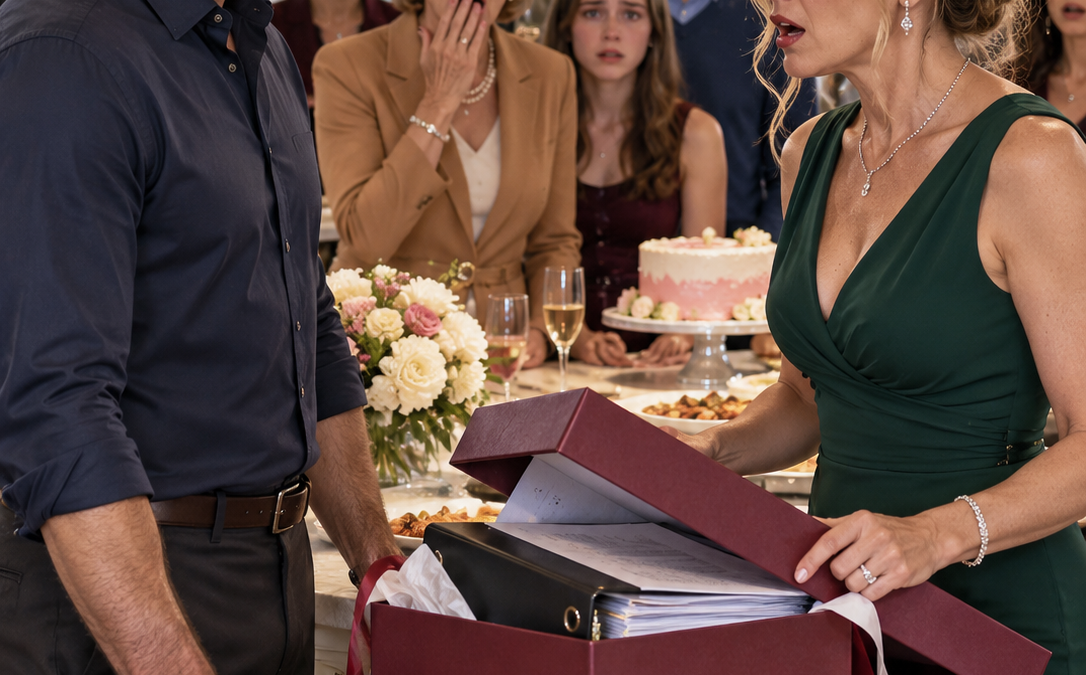
My wife sneered, “buy your own food stop living off me.” i said nothing. weeks later, on her birthday, 20 relatives rushed into the kitchen then went silent. she turned pale. “what did you do?” i smiled. “exactly what you told me to”…
Seventeen years of mortgage payments, school lunches, and silence. And all it took was a sandwich to end a marriage.
My name is Cliff Froman. I lived on Windham Crest Drive in Alpharetta, Georgia. Good neighborhood, great schools. I drove a 2019 Honda Pilot. Nothing flashy. Reliable. Got the kids where they needed to go without complaint, which, now that I think about it, described me pretty well, too.
I worked at a municipal contracting firm off Haynes Bridge Road. Project management for city infrastructure, county water systems, road rehabilitation contracts. Not glamorous, but perfectly stable. Government pension, premium family health coverage, home by 5:30 every evening. I chose that life deliberately, but we’ll get to that.
My wife, Nancy, drove a leased 2023 Mercedes GLE 450. White, panoramic roof, the kind of car that announces itself before it parks. We were not the same kind of people anymore. I just hadn’t admitted it yet.
When Nancy and I met, she was twenty-nine and absolutely drowning. Over $100,000 in predatory student loans, the kind that compound faster than you can breathe. She couldn’t qualify for an apartment in her own name. Debt collectors called before her alarm went off in the morning. She was brilliant, driven, and completely trapped.
I was thirty-two, pulling serious weight as a senior solutions architect at a major cloud infrastructure firm in Midtown Atlanta. The hours were brutal, seventy a week, easily, but my stock options had been quietly compounding for years, and I knew exactly what they were worth.
I made a decision. Liquidated everything. One wire transfer.
I handed her the zero-balance confirmation at our wedding reception, folded inside a card. No speech, no audience, just the two of us for thirty seconds near the coat closet at the venue on Old Milton Parkway.
She read the number, looked up at me, and cried like I have never seen another human being cry before or since.
“You didn’t have to do that,” she whispered.
“I know,” I said.
That was the last time Nancy Froman cried in a way that made me feel like a good man.
About eight months after the wedding, my division got cut in a tech restructuring. Not unusual. Atlanta’s tech sector hiccups like that every few years. What made the timing complicated was that we were already under contract on the Windham Crest house.
The bank restructured the deal. Mortgage approval, deed, everything solely in my name. My credit score, my remaining liquid assets, my signature.
Nancy sat across from me at our kitchen table with the pen in her hand and tears running down her face.
“You’re saving us again,” she said.
“We’re saving us,” I told her. “Sign the paper.”
She signed. We moved in three weeks later.
A year after that, when she got her first real recruiting position, junior corporate recruiter at a tech firm in Sandy Springs, $52,000 a year, I made the second deliberate choice.
Instead of chasing another high-octane corporate role, I took the municipal job. Stable hours. Present father. Home for dinner. She was debt-free, career-mobile, and completely unburdened.
I figured we had built something solid.
I figured a lot of things back then.
Welcome to Dad’s Raw Revenge. Get comfortable. This story is going to take you somewhere. Hit that like button and drop a comment below letting me know where you’re watching from. Trust me, you’re going to love it here.
Here’s what nobody tells you about a slow burn. You don’t smell the smoke until the whole room’s already on fire.
The first seven years were fine. Good, even. David was born, then Marcy. We had cookouts with neighbors on the Fourth of July. Ate at Taqueria El Rey on Canton Street when Nancy didn’t feel like cooking. Drove up to Lake Lanier on long weekends with a cooler full of sweet tea and Capri Suns.
Then Nancy got promoted to senior corporate recruiter. $105,000 a year in Alpharetta. That’s a very comfortable salary unless you start spending it like you’ve got a trust fund behind it.
It started with the Mercedes, then the grocery hauls from Whole Foods on North Point Parkway. Seventy-dollar olive oils, imported cheeses, the kind of sparkling water that comes in a glass bottle for eight dollars.
Then came the weekend trips with her girlfriends to Savannah, Charleston, Scottsdale. Instagram stories from rooftop restaurants with captions like, “She works hard for this.”
She absolutely did. I just also happened to be the reason she had no overhead.
See, my entire municipal paycheck, every dollar, was already committed before I ever saw it. $3,200 a month on the mortgage, $6,200 in semiannual property taxes, HOA fees, homeowners insurance, the premium family health plan that covered all four of us without a gap.
Her $6,000 a month take-home pay? Purely discretionary. Every cent.
She was living like a millionaire because I was quietly functioning as her entire financial infrastructure. She just stopped noticing. Or maybe she stopped caring. I’m still not sure which is worse.
The separate bank accounts came about three years into her promotion.
“I just think financial independence is important,” she told me one evening while loading the dishwasher. “For a modern woman. It’s not personal.”
Sure, it’s not.
I agreed because that’s what I did. I kept the peace, kept the house running, and told myself she was just going through a phase.
What I didn’t anticipate was what the separation would expose. Once our finances were split on paper, the math became impossible to ignore.
I had nothing left at the end of the month. Not because I was irresponsible, but because I was carrying everything. And she had everything left because she was carrying nothing.
But it was a Sunday dinner about two years ago that first made my stomach drop.
Her mother, Sandra, a retired schoolteacher from Smyrna with a sharp tongue and sharper opinions, was visiting for the weekend. Nancy’s sister, Ashley, was there, too. We’d ordered Nashville hot chicken from a place on Roswell Road.
I was getting plates down from the cabinet when Nancy said it. Didn’t even lower her voice.
“Must be nice to have a cozy little nine-to-five where you don’t have to think. Must be nice to let your wife carry the heavy financial lifting for the family.”
Her mother laughed into her napkin. Ashley looked at the ceiling.
I set the plates down, sat at the table, and passed the bread.
I thought about the wire transfer, about the deed, about the zero-balance receipt folded inside a card at a wedding venue on Old Milton Parkway. I thought about all of it, and I passed the bread.
That was the night I started to understand what I had actually built.
But the kids. That’s the part that still catches me sideways when I let myself think about it.
David is sixteen. Tall, fast, obsessed with baseball the way only a Georgia kid can be. Marcy is thirteen, sharp as a tack, always watching, always calculating, more like her mother than either of them would like to admit.
I drove them to school every morning down GA-400, past the Avalon development on Wills Road, all the way to their campuses in the Fulton County system.
I made lunches. I showed up to games. I showed up to recitals. I cooked four nights a week. Real food, not DoorDash. Shrimp and grits on Fridays, chicken bog on slow Sundays, peach cobbler when I felt generous.
And somewhere along the way, my kids started looking at me the way their mother looked at me.
One evening in September, David came to me about a travel baseball team. Elite program, tournaments across Georgia and the Carolinas. The fee was $4,000.
I looked at the calendar. The semiannual tax bill was hitting in eleven days.
“Buddy,” I said, “I can’t do it this exact week. Sit down with me this weekend. Let’s budget it out for next month. I want to make this happen for you.”
He sighed. Dropped his shoulders. The specific sigh of a teenager who has been pre-taught where to expect disappointment.
Nancy walked in from the hallway. She reached into her bag and put her platinum card on the table.
“Here you go, sweetie. Mommy’s got you.”
She looked at our son, not at me. Didn’t look at me once.
“It’s a shame only one parent cares about your talent and your future.”
David’s face lit up like Christmas morning. He hugged her and left the room.
I sat at the kitchen table alone with the sound of the refrigerator humming and the distant noise of the neighborhood outside.
I told myself it wasn’t a pattern. I told myself she was just excited to help. I told myself a lot of things in that kitchen.
I had no idea what was coming. None.
I was still making lunches, still paying the mortgage, still driving down GA-400 every morning with two kids in the backseat, one of whom had recently asked me to drop him off half a block from school so his friends wouldn’t see the Pilot.
I parked where he asked, watched him walk away without looking back, and kept the car in park until he turned the corner. Then I sat there for a minute longer than I needed to.
I was still the foundation. I just didn’t know yet that a foundation can hold a house up forever and still be the first thing destroyed when the walls come down.
That part was coming sooner than I thought.
They say the straw that breaks the camel’s back is never really about the straw. It’s about every single bale of hay that came before it.
It was a Wednesday in November. Nothing special about it. No anniversary, no argument simmering from the night before. Just a regular, gray, nothing Wednesday in Alpharetta. The kind of day that ends before you remember it started.
I’d spent eight hours managing a county water main rehabilitation project off Webb Bridge Road. Spreadsheets, subcontractor calls, a site inspection in the cold that ran forty minutes longer than it should have.
My back hurt. My coffee had gone cold by 9:00 a.m., and I never got around to reheating it.
I came home, changed out of my work clothes, and walked into the kitchen to make a sandwich.
That’s it. That’s the whole setup.
If you’d told me that a turkey sandwich was going to be the last domino, I would have laughed at you.
I opened the fridge and pulled out the deli turkey, the sourdough from the Whole Foods run she’d made on Sunday, and the good brown mustard. The one in the glass jar she bought because the plastic-bottle kind was apparently beneath us now.
I set everything on the counter and got a plate down from the cabinet. I had the bread in my hand when she walked in.
She didn’t say anything at first. Just stood in the doorway in her work blazer, laptop bag still on her shoulder, and watched me the way you watch someone doing something mildly irritating, like humming or chewing too loudly.
Then she crossed the kitchen.
She took the plate out of my hand, set it on the counter behind her, closed the refrigerator with her hip, and looked at me.
“Buy your own food.”
Flat. Quiet. No heat in it whatsoever, which was somehow so much worse than screaming.
“Stop living off me. I am tired of feeding an anchor.”
The kitchen was completely silent except for the hum of the refrigerator she had just closed.
I stood there in my kitchen, in my house, on my mortgage, on the foundation of my premarital assets and seventeen years of my adult life.
And I looked at my wife.
I thought about the wire transfer, the wedding card, the kitchen table where she signed the deed, crying, calling me her safe place. I thought about the $4,000 baseball fee and the platinum card slapped on the table.
The Nashville hot chicken Sunday dinner.
Must be nice to let your wife carry the heavy financial lifting.
I thought about David asking me to stop half a block from school. I thought about all of it in about four seconds flat.
Then I said the only thing I trusted myself to say.
“Understood.”
I walked to the bedroom, closed the door, and sat on the edge of the bed in the dark.
I didn’t cry. I didn’t punch a wall. I just sat there while something very quiet and very permanent finished breaking inside my chest.
I sat there for a long time.
When I finally got up, I wasn’t angry. I was done. And there was a very significant difference between those two things.
Angry people make noise.
Done people make moves.
I went to my desk, opened my laptop, and started making a list.
The next morning, I was sitting in the office of a family law attorney on North Point Parkway before 9:00 a.m.
Her name was Rebecca Owens. Mid-fifties, former Fulton County family court judge, the kind of woman who has heard every version of every story and still manages to look at you like yours actually matters.
I walked in with a folder. Inside was seventeen years of documentation I had quietly assembled over the previous eight hours.
Bank statements. The original wire transfer confirmation from my premarital stock liquidation. The mortgage deed solely in my name. Property tax records. Insurance premium records. Health plan enrollment showing all four family members covered under my municipal benefits package.
Seventeen years of paper that told a very different story than the one being performed on Nancy’s Instagram account.
Rebecca Owens put on her reading glasses. She didn’t speak for several minutes. Then she looked up.
“Mr. Froman,” she said, “do you understand what you’re sitting on?”
“I’m starting to,” I said.
She leaned forward and walked me through it, piece by piece, with the calm efficiency of someone defusing something complicated in a very small amount of time.
The house, solely in my name and funded entirely by premarital assets, could go to an off-market cash sale to an institutional buyer. Thirty-day close. Clean.
The equity would be directed into a locked court escrow account and applied as a legal offset against the marital debt I had absorbed before the wedding.
$100,000 in student loans, documented, transferred, and paid in full by Clifford Allen Froman before Nancy ever drew a paycheck as his wife.
“That escrow argument is airtight,” she said, tapping the wire confirmation with one finger. “This doesn’t disappear in a standard asset split. This has its own lane.”
Then she asked about the children.
I told her about the school runs every morning down GA-400 for years. The meals, the games, the recitals, the half-block drop-offs I never argued about.
I told her about Nancy’s travel schedule, conference trips to Charlotte, Dallas, Chicago, the sixty-plus-hour weeks that were documented in her own LinkedIn post celebrating her corporate hustle.
Rebecca made a note.
“With your schedule versus hers, sole physical custody is very arguable,” she said, “especially given your documented primary caregiver history.”
Then she pulled out a calculator.
She entered Nancy’s gross annual income, entered mine, ran the state of Georgia’s child support formula, and added the alimony calculation on top.
She turned the screen toward me.
I looked at the number. I kept my face completely neutral. Inside, I felt something shift. Not satisfaction, exactly. More like the specific feeling of a long equation finally balancing.
“That’s what she’d owe you,” Rebecca said. “Monthly, starting from court approval.”
“Per month?” I said.
“Per month,” she confirmed.
I nodded slowly and closed the folder.
“What do you need from me?” I asked.
“Time,” she said. “And patience. Can you keep your behavior at home completely unchanged for the next several weeks?”
“I’ve been doing that for seven years,” I said. “A few more weeks won’t be a problem.”
She almost smiled.
“Then let’s get to work.”
If you’ve been listening for a while, drop your thoughts in the comments. Hit the like button while you’re at it, and be sure you’re subscribed.
Here’s what nobody tells you about executing a plan like this. The hardest part isn’t the legal strategy. The attorneys handle the legal strategy. The hardest part is going home every single night and acting like nothing has changed.
And I did it for five weeks. I did it without a crack.
I drove David and Marcy to school every morning. Down GA-400, past the Avalon. Same route, same playlist David always hijacked to play whatever he was into that week.
I made dinner four nights out of seven. I paid the mortgage. I kept the family health insurance active. I attended every function I was invited to and showed up to a few I wasn’t.
Marcy had a winter choral showcase at her school in Johns Creek the second week of November.
I took a half day, arrived early, and found a seat in the third row, which I later realized was too close when she spotted me from the risers and gave me the look. The one that said, Dad, please blend into the wall.
So I moved back four rows without being asked.
She sang beautifully. I clapped louder than anyone around me.
Afterward, she found me by the exit doors. Her friends were nearby, doing the teenage orbit thing, pretending not to watch.
“You didn’t have to come,” she said.
“I know,” I said. “You were great.”
“Thanks,” she said.
Then she went back to her friends.
I drove home on GA-400 in the dark and told myself she’d understand one day. I told myself that enough times it almost worked.
David’s travel baseball team had a tournament the last weekend of November down at a complex in McDonough.
I drove forty minutes south in the Saturday cold. Sat in aluminum bleachers with a gas station coffee and watched my son play the best game I had seen him play all season.
He went two for three, made a diving stop at third that had the entire dugout on their feet.
I stood up, spilled half my coffee, and didn’t care.
On the drive home, David was in the passenger seat with his earbuds in, texting. About fifteen minutes into the ride, he took one earbud out.
“Mom’s going to post the highlights,” he said.
“She wasn’t there,” I said.
“Coach recorded it. She always posts when they record.”
He put the earbud back in.
I watched the highway, Georgia pines sliding past in the dark on both sides of I-75. I said nothing because what was there to say?
Your mother is going to take credit for a game she watched on a phone screen while your father smelled like bleacher rust and gas station coffee for four hours.
I kept driving.
Meanwhile, things were moving precisely on the legal side.
By the third week of November, Rebecca had secured an emergency pre-filing motion because I was running a structural deficit keeping our heads above water.
While Nancy hoarded discretionary cash, the court quietly green-lit a conditional off-market sale authorization to a real estate investment group.
The cash buyer was locked in. The closing escrow was established, and the petition was signed.
The trap was set, sitting in Rebecca Owens’s office on North Point Parkway, waiting for my signal.
I found an apartment the last week of November. A clean three-bedroom on Kimball Bridge Road. Same school district, same morning commute route. Nothing disrupted for the kids in terms of their daily lives. Good natural light, quiet complex.
I put down the deposit on a Tuesday.
That evening, while Nancy was on a work call upstairs, I packed the first bag methodically, quietly. The things that were mine before any of this started. Documents, personal items, the things that had my name on them.
I staged everything in the hall closet behind the winter coats.
Standing in that closet with a duffel bag full of my own life, I felt something I hadn’t expected.
Not sadness. Not rage.
Relief.
The specific, exhausted relief of a man who has finally stopped waiting for someone to remember who he is.
Now, Nancy’s birthday was December 14.
She had organized the party herself. Twenty relatives, catered spread, the whole production.
Her mother, Sandra, was flying in from Smyrna. Her sister, Ashley, was coming up from Macon. Aunts, uncles, cousins, the full assembly gathered to celebrate her latest corporate milestone layered right on top of the birthday.
She mentioned it to me twice in passing, both times while looking at her phone.
I listened. I nodded. I told her it sounded like a great time.
She didn’t notice that I meant it for completely different reasons.
I had one thing left to prepare.
I found a gift box. Large, heavy, quality presentation. Deep burgundy paper, wide white ribbon. The kind of packaging that signals real thought went into what’s inside.
What was inside was a legal binder three inches thick.
I wrapped it myself at the kitchen table on a Sunday afternoon while Nancy was at North Point Mall with Ashley.
I creased every fold. I tied the bow twice until it sat right.
I set it on the closet shelf above my bags and looked at it for a moment.
Happy birthday, Nancy.
I want you to understand something before we get to December 14.
I did not do what I did because I was angry. I was over being angry.
I did it because a woman stood in my kitchen, the kitchen in the house I built, and told me to stop living off her.
So I decided to take her completely at her word.
What happened next? You’re not ready for it. But it’s coming.
Some people spend their whole lives waiting for justice.
I scheduled mine for a Saturday afternoon in December.
December 14 arrived the way all genuinely significant days do. Completely ordinary on the outside.
Cold, gray Georgia morning. The kind of December sky that can’t decide between clouds and sunlight and ultimately commits to neither.
I was up at 6:00 a.m. I made coffee and stood at the kitchen window in my robe, looking out at the backyard.
The Japanese maple Nancy planted three summers ago. The deck I pressure-washed every spring. The HOA-approved fence I installed myself over a long July weekend while David handed me screws and asked questions about everything except what I was actually doing.
I built a good life in this house. I just wasn’t the one living it anymore.
By 10:00 a.m., Nancy was already in full production mode.
She’d hired a catering company out of Roswell, the kind that arrives in black polo shirts and sets up chafing dishes with quiet, professional efficiency.
The dining room table was extended to full length. Flower arrangements sat on the kitchen island. A custom birthday banner stretched across the back wall that said Celebrating Her in gold script, which told you everything you needed to know about the energy of the afternoon.
I helped move furniture when asked, carried folding chairs up from the basement, and smiled at the catering crew.
Normal husband at a normal party.
Nobody in that house knew this was the last Saturday it would ever be mine.
They started arriving around 1:00.
Sandra came first. Nancy’s mother swept through the front door in a camel coat like she was hosting the thing herself, kissed her daughter on both cheeks, and immediately began a tour of the house she’d taken forty times before.
Except this time, she was narrating it to Nancy’s aunt Beverly like a real estate agent describing her own listing.
“Four bedrooms, three and a half baths. Look at these ceilings. My daughter picked out every fixture in this kitchen herself.”
I was standing eight feet away when she said that.
I let it go. I was good at letting things go. Had seventeen years of practice.
Nancy’s sister, Ashley, arrived with her husband, Tom.
Good guy, Tom. The kind of man who finds the nearest other husband at a family party and sticks close for survival.
He found me within four minutes.
We stood near the kitchen doorway with our drinks and talked about the Falcons with the focused relief of two men who had found neutral ground.
By 2:00, twenty people filled the house. The noise level climbed.
The catering spread was impressive. Shrimp and grits station, a full Lowcountry boil setup, peach bourbon-glazed chicken that smelled incredible.
Somebody had ordered a cake from a bakery in Alpharetta that did custom fondant work. It had Nancy’s corporate headshot printed on top of it.
A cake with your own face on it.
I don’t know what you say about that. I don’t think you say anything.
Nancy moved through the room the way she always did when the audience was right. Luminous, laughing loudly, touching people’s arms when she talked.
She was wearing a deep green dress. Her mother followed three steps behind like a hype woman, interjecting superlatives into every conversation Nancy had.
“She just closed the biggest recruiting contract in the Southeast region.”
“Did I tell you she’s up for a regional VP title?”
“That Mercedes in the driveway? She leased that herself.”
I watched from the periphery, quiet and patient. A man with absolutely nothing left to prove.
David and Marcy were there, orbiting their mother’s gravitational pull the way they had been for years.
David was on his phone near the dining room. Marcy was sitting with a cousin her age near the window.
Neither of them had said more than twelve words to me all morning, which, in the mathematics of my recent life, was actually above average.
The burgundy gift box was sitting on the hallway console table. I had placed it there at noon, centered, bow facing out.
Nobody had asked about it yet.
Good things come to those who wait.
They sang “Happy Birthday” at 3:15.
The catering crew dimmed the kitchen lights. Somebody lit the candles. Sandra stood beside her daughter with her hand pressed to her chest like she was watching a coronation.
Twenty people crowded into the kitchen and dining room doorway. Phones up, voices rising.
I stood in the back. I sang too softly.
Happy birthday to you.
Nancy closed her eyes while they sang. Really leaned into it. The whole performance. The slight smile, the tilted chin, the hand over the heart.
She had built her entire life around moments like this one. Being witnessed, being celebrated, being the center of something.
I thought, Enjoy this part, Nancy. This is the last thirty seconds of the life you think you have.
The song ended. Applause.
Someone said, “Speech, speech.”
She laughed and waved it off with the practiced humility of someone who absolutely wanted to give a speech.
I stepped forward.
I was holding the gift box.
The room noticed before she did.
Twenty people tracking the husband who had been invisible all afternoon, suddenly moving to the center of the kitchen with a beautifully wrapped box.
Tom caught my eye from across the room. Something in my expression made him lower his drink slowly.
Good instincts, Tom.
Nancy turned and saw the box.
She looked at her sister. A smirk, small and involuntary, the kind that bypasses your brain and comes straight from years of conditioned expectation.
“Let’s see what he scraped together.”
She took the box, held it for the audience a moment, and set it on the kitchen island.
She pulled the ribbon. She tore the paper. She lifted the lid.
The room was still making small party noises. Glasses clinking, someone laughing near the back.
For about three full seconds, Nancy just stared at what was inside.
Processing. Her brain doing that thing where it refuses the information her eyes are clearly sending.
Then the color left her face.
Not gradually. All at once, like someone had pulled a plug.
She lifted the top document with two fingers like it might burn her.
The divorce petition.
The sole custody motion below it.
A court-ordered emergency mandate granting me exclusive possession of our assets for liquidation, alongside a signed intent to close from the cash buyers.
It wasn’t an eviction notice.
It was a legally binding clock ticking down.
And sitting right on top of that last section, circled in red ink by Rebecca Owens herself, was the monthly support figure the state of Georgia had calculated based on the dramatic income disparity between Nancy Froman and her husband.
$2,500 per month, payable by Nancy starting Friday.
The kitchen was absolutely silent.
Then Sandra looked over her daughter’s shoulder and read enough to understand.
And the kitchen was not silent anymore.
“Are you kidding me? On her birthday? What is wrong with you?”
Sandra’s voice climbed above all of it. Sharp and practiced. The voice of a woman who had been sharpening it specifically for men like me for her entire adult life.
“You vindictive, pathetic little man. You would do this here? Today? In front of her family? You are a coward. You have always been a coward. And this just proves—”
I turned and looked directly at Sandra.
Her mouth was open, ready for another round. I gave her a calm, steady look.
“Sandra,” I said, my voice cutting right through her panic. “You spent years bragging about how your daughter carried the heavy financial lifting. Well, now she gets to do it. Her first check to me is due Friday.”
The color left Sandra’s face so fast she had to reach out and grab the doorframe to steady herself.
I turned away from her. She was completely out of ammunition.
I looked at my children.
David had come in from the dining room when the singing started. He was standing near the doorway, phone down, completely still, reading the atmosphere of the room the way athletes read a field. Fast, instinctive, processing.
Marcy was beside him. Her cousin had disappeared.
She was looking at me with an expression I had never seen on her thirteen-year-old face before.
Not embarrassment. Not pity. Something closer to the very first moment of understanding.
I looked at both of them, and I spoke.
Not loudly. I didn’t need loud. The room had gone quiet enough that every word landed exactly where I put it.
“For years, you two have been taught to look at me like a loser because I didn’t buy your love with flashy toys. What your mother never told you is that before you were born, I emptied my entire life savings to pay off $100,000 of her debt so she could even have the career she’s being celebrated for today.”
I looked from David to Marcy, letting the words settle before I continued.
“I intentionally chose a stable job with lower pay so I could be the parent who actually raised you. The one who cooked your dinners, drove you to practice, sat in the bleachers in the cold, showed up to every single thing, including the ones where you asked me to stand in the back.”
Marcy made a sound. Small, involuntary.
David didn’t move, but his jaw tightened in a way that told me the words were landing somewhere real.
“My salary paid the mortgage that kept this roof over your heads. Every month for seventeen years, while my account ran to zero and hers ran to Whole Foods and weekend trips and a Mercedes neither of us needed.”
I paused and let it sit.
Then I turned to Nancy.
She was gripping the edge of the kitchen island. The legal binder was open in front of her.
She was not crying. She was past crying.
She had arrived somewhere beyond it. That hollow, exposed place where there is nothing left to perform for.
“Weeks ago, right here in this kitchen, you took a plate out of my hands and told me to stop living off you. You told me to buy my own food. Stop utilizing what was yours.”
I paused briefly.
“So I did.”
I watched her face.
“I took my name off your life. I sold my house because it was my house, Nancy. It was always my house. And the equity is locked in court escrow to settle the debt you walked into this marriage with. The debt I cleared so you could have the career you just spent an hour letting your mother brag about.”
Nancy stood there with both hands gripping the kitchen island. Nobody interrupted.
“Since your income is so dramatically higher than mine, the family court judge ran the numbers and ordered you to pay me $2,500 a month in combined support starting this Friday.”
The room remained still as I continued.
“Since I have primary custody, the children are leaving with me right now. The court has ordered the immediate listing and transition of this property.”
I looked at her, the woman who had once cried into a wedding card because I had given her a future she thought she’d never have.
“The luxury ride is over, Nancy. You have until the end of the week to pack whatever fits in your car before the locks are changed.”
I looked at her one final time.
“Happy birthday, Nancy.”
I walked down the hallway.
My two bags were in the closet exactly where I’d left them. Packed, zipped, ready.
I pulled them out, set them by the front door, and put on my coat.
The house behind me was a specific kind of chaos.
Sandra’s voice. Someone crying. Hushed, urgent conversations breaking out in every corner of the room like small fires.
The catering crew had gone completely still near the chafing dishes, professional enough not to move, human enough to stare.
I stood at the front door and waited.
Fifteen seconds. Thirty.
Then I heard footsteps.
David came around the corner first, backpack on one shoulder.
He didn’t say anything. He looked at me, then at the door, then back at me. And he walked to my side and stood there.
Marcy came around the corner twelve seconds later.
She had her jacket half on, one arm still finding the sleeve. Her eyes were red, but her chin was up.
She stopped in front of me.
“Dad,” she said.
And then she didn’t finish the sentence because she didn’t have to.
“I know,” I said. “Come on.”
I opened the front door.
We walked out into the cold December air, the gray Georgia sky, the manicured lawn, the HOA-perfect street that had watched us come and go for twelve years.
I loaded the bags into the Pilot.
The kids got in without being asked.
I closed the trunk, stood beside the car for one moment, and looked back at the house on Windham Crest Drive one final time.
The lights were on inside.
Through the kitchen window, I could see movement. Shapes. People. The blurred aftermath of twenty relatives processing something none of them had come here expecting.
Sandra pacing. Ashley on her phone. The catering crew beginning to quietly, professionally pack up a party that was over.
And in the center of it all, standing completely still at the kitchen island, was Nancy.
Alone inside a crowd, holding a legal binder in a house she had never owned, at a party celebrating a version of her life that had just walked out the front door.
I got in the car.
David had one earbud in, but the music wasn’t playing. Marcy was looking out the window at the house.
Neither of them spoke.
I started the engine, backed out of the driveway slowly, and pointed the Pilot north toward Kimball Bridge Road and our new apartment and whatever came next.
Halfway down Windham Crest Drive, Marcy said quietly, almost to the window, “Dad, the baseball tournament in McDonough. Were you really there the whole time?”
“Every inning,” I said.
She nodded and looked at her hands.
David pulled the earbud out and set it in his lap.
Nobody said anything else for a while, and that was fine.
We had time now.
I had the stable hours. I had the pension and the health plan and the predictable schedule and a second bedroom with enough space for both of them.
I had primary custody and a court order and a clean apartment and the specific, unshakable peace of a man who had stopped waiting for someone to remember who he was and reminded them himself.
We drove north on GA-400, Georgia pines on both sides.
The gray sky finally decided, somewhere over Forsyth County, to let a little light through.
I turned the heat up.
First time in a long time, everyone in my car was exactly where they were supposed to be.
If you enjoyed this story, you already know someone like Cliff. Hit that like button, subscribe, and drop a comment below. Let me know where you’re watching from.
And if you want to see what happens when Nancy shows up at that apartment six weeks later trying to negotiate, tell me below.
I’ll see you in the next one.








