My wife died in Spain six months ago. Every night I still stand in front of her ashes. Then yesterday, I saw her shopping at a grocery store. It was her. I couldn’t be wrong. I followed her all the way home and froze as another man kissed her cheek at the door.
Six months ago, I buried my wife. I put her ashes on a shelf in our living room. Every night afterward, I stood in front of that shelf, trying to understand how a man was supposed to keep living when the person he’d built his life around was gone. Then, on an ordinary Tuesday morning, I saw her buying yogurt in a grocery store less than ten minutes from my house.
Not a woman who resembled her. Not some stranger whose face reminded me of the wife I’d lost. It was Addie. My wife. The woman who had been declared dead in Spain six months earlier.
I knew it was her before I even saw her face. There was the perfume, lavender with something like cedar underneath it. The silver-gray hair, cut straight just below her ears. And there was the way she picked up two containers of yogurt, checked their expiration dates, put one back, then reached for a different one. It was the same little routine I’d watched her perform for thirty-eight years.
I want you to understand exactly what I did next, because I suspect whatever you’re imagining is wrong. I didn’t call her name. I didn’t reach for her or demand an explanation. I stood at the end of the aisle with both hands gripping the handle of my shopping cart, watching the wife I’d spent six months grieving walk calmly toward the checkout. Then I moved to a window near the front of the store and memorized the license plate on her car.
I’m going to tell you everything that happened, including the part where I nearly convinced myself I was losing my mind. That part matters more than the ending, though it took me a long time to understand why.
My name is Truitt Howerin. I’m sixty-three years old, and I live outside Roanoke, Virginia. I own a machine shop called Howerin Precision. I’ve been running it for thirty-one years, and I employ twenty-two people. We manufacture precision-machined components for hydraulic systems and railroad equipment. It isn’t glamorous work. It’s extremely specific, and doing it properly requires a certain way of thinking.
That trade taught me one principle that runs through every hour of what I’m about to tell you: You never measure a part against another part.
In the back of my shop, there’s a temperature-controlled cabinet containing a set of gauge blocks. They’re our master standards, pieces of steel ground to tolerances measured in millionths of an inch and checked against a national reference. Everything we manufacture gets measured against those blocks. Not against the last part that came off the machine. Not against a piece that looks good. And certainly not against what a machinist remembers the dimensions ought to be.
The moment you start measuring parts against other parts, small errors begin accumulating. They do it quietly. Nobody notices. You can manufacture four hundred components before somebody finally discovers that the entire lot is scrap, even though every individual measurement appeared perfectly acceptable at the time.
Remember that. It matters to this story more than anything else, and I’ll come back to it before I’m finished.
Adelaide was my wife for thirty-eight years. Everybody called her Addie. For twenty-six of those years, she ran the office side of Howerin Precision. She handled invoices, payroll, vendors, and the thousand administrative details that keep a manufacturing business alive while the people on the shop floor concentrate on making things. Eventually, she stepped back to part-time work, then consulting, and finally to doing very little at all.
But she remained a co-owner the entire time. She retained full signing authority over our business accounts because we’d built the company together, and it never once occurred to me that I ought to change that arrangement. Remember that detail, too.
Addie died in March. Or that’s what I was told, what I believed for six months, and what I paid to have memorialized.
She’d gone away on a nine-day group tour through Portugal and southern Spain with a woman she’d known since community college. After her mother died, Addie had started taking trips like that every couple of years. I never objected. She enjoyed traveling more than I did, and the shop had a way of making nine consecutive days away from home feel like an impossible luxury.
The call came on a Tuesday from a number I didn’t recognize. There had been a cardiac event, the caller explained, in a coastal town about four hours south of Lisbon. Addie had been taken to a regional hospital, but she hadn’t survived.
I need to slow down here, because everything that followed rests on one detail I never thought to question.
No body was brought home.
There was a foreign death certificate. There were consular forms. There was a cremation performed overseas, and an urn was shipped back through a funeral home in Roanoke. We held a memorial service at a church on Bent Mountain Road, with more than two hundred people in attendance. Friends, relatives, former employees, customers, people who had known Addie for decades. They filled the pews and stood afterward in small groups, speaking softly about what a wonderful woman she had been.
But I never saw her body.
That isn’t necessarily unusual when somebody dies overseas. Repatriation is expensive and slow, and people involved in the process tend to gently steer grieving families toward cremation. I was sixty-two years old and so thoroughly flattened by the news that I could barely make ordinary decisions. I let the process carry me wherever it was supposed to go.
My daughter handled almost everything. The consular paperwork, the funeral home, the certificate, the notifications, all the things I couldn’t bring myself to think about. She was extraordinary. That’s what I told everyone for six months.
I don’t know what I would have done without Dia.
My daughter’s full name is Dileia. She’s thirty-six, and she’s the controller at the shop. She has a sharpness with numbers that I never possessed, despite spending my entire adult life working in a profession built around precision. She understood the financial side of our business in ways that had always seemed to skip a generation.
I placed Addie’s urn on a shelf in the front room, beside a photograph taken in 1989. In that picture, we were younger than I can quite remember being. For six months, I couldn’t look toward that shelf without feeling something tighten beneath my ribs.
That Tuesday morning, I went to the grocery store on Brambleton because my refrigerator was empty. Grief doesn’t excuse a man from eating. Nobody tells you that, and I learned it the hard way around the third week.
I had a shopping list. I was standing in an aisle trying to decide whether I needed one can of soup or two, which turns out to be a genuinely difficult question when you’ve spent most of your life cooking for a household and now find yourself cooking for an empty chair.
I wasn’t thinking about Addie. I want to be clear about that. I wasn’t wandering through the store looking for ghosts or imagining her face in the crowd. I was thinking about soup.
And then I smelled her perfume.
Lavender, with something woody beneath it. Cedar or sandalwood; I was never entirely sure which. It was a blend from a little shop in Floyd, something I’d bought her probably fifteen times over the years. It wasn’t a department-store fragrance. It wasn’t the kind of scent a person ordinarily encountered by accident in a supermarket at nine o’clock in the morning.
My feet stopped before the rest of me understood why.
I turned around.
She was two aisles away, standing with her back to me. Medium height, silver hair cut just below her ears, the way she’d worn it since around 2014. She reached for a box on a high shelf, examined it, put it back, and selected another. There was the same hesitation, that small pause before making a decision that didn’t particularly matter.
She placed the box in her shopping cart and adjusted it twice.
Addie always adjusted things twice. Every time, her whole life. She used to say it was the only way to be certain something was actually where you’d put it.
I stood there watching this woman and told myself I was coming apart.
Six months of sleeping on one side of a bed can do strange things to a person. I’d read somewhere that grief sometimes makes people believe they’re seeing someone they’ve lost. It was probably in one of those pamphlets funeral homes leave on the counter when you’re not paying attention.
I’d already experienced something like it twice. Once, in a parking lot in October, I thought I’d seen Addie getting into a car. Another time, I caught a glimpse of a woman from the highway and felt that same sudden, impossible recognition. Both times, when I’d looked properly, it had been someone else.
So I did what seemed reasonable. I decided I was wrong.
Then she tucked her hair behind her left ear.
And I saw the scar.
It was small and crescent-shaped, just behind her left ear where the hairline began. She’d gotten it in 1990, in our first kitchen on Grandon Road, when a pot slipped as she was taking it off the burner and caught her as she passed. Three stitches.
I remembered driving her to an urgent care clinic out on Williamson because we hadn’t found a regular doctor yet. I remembered holding her hand while a doctor who looked barely nineteen closed the wound. And I remembered teasing her about that scar for the next thirty years, because she hated that I could always find it when she wore her hair up.
Now, what happened inside my head at that moment was entirely a machinist’s thought, and I’m not embarrassed to admit it.
The perfume could have been a coincidence. The haircut could have been a coincidence. The way a woman adjusted a box twice could absolutely have been a coincidence. Those were parts being measured against other parts. I knew exactly how much that kind of evidence was worth.
Nothing.
But the scar was different.
The scar was a gauge block.
It was a fact with a date attached to it, a cause, a place, and three stitches. It didn’t drift. It didn’t compound. It existed outside whatever my grieving mind might have wanted to believe.
My shopping cart rolled into the shelf beside me and made enough noise that two customers turned their heads.
She didn’t.
I stood with both hands on the handle and watched my dead wife compare the labels on two boxes of granola as if she had nowhere in the world she needed to be.
Everybody who’s heard this story has asked me the same question: Why didn’t you call her name?
I’ve thought about that a great deal, and I want to explain something. It wasn’t strength. It wasn’t courage. It certainly wasn’t some brilliant tactical instinct that suddenly appeared when I needed it.
Something cold moved into the back of my head and told me to be still.
That’s the most accurate description I can give you.
I’d spent thirty-one years working around machines that could take a man’s hand off if he became excited or careless. Somewhere along the way, my body had learned that when something went seriously wrong, the first response ought to be to stop moving and look.
So I stayed where I was.
I watched Addie reach the end of the aisle. I watched her pick up three containers of yogurt, study the dates, and put one back. I watched her place her groceries on the conveyor belt.
She paid cash.
She folded the bills into her wallet exactly the way she always had, all facing the same direction, with the largest denominations at the back. Then she put the wallet in her purse, collected her bags, and walked through the automatic doors.
I didn’t follow her outside.
I can’t entirely explain that decision, either. I think some part of me understood that if she turned around and saw my face, whatever was happening would end right there. There would be words, explanations, perhaps accusations, and I might never learn what had actually been going on.
Instead, I walked to a window near the front of the store, beside the propane cage.
Through the glass, I watched her load two grocery bags into a dark blue sedan I’d never seen before. I memorized the license plate and repeated it under my breath four times, standing at that window like a lunatic.
I stayed there until she pulled out of the parking lot and turned left toward Salem.
Then I went to my truck, sat behind the wheel, and didn’t start the engine for something like twenty minutes.
If you’ve ever experienced something your mind physically cannot find a place for, you may understand what that felt like. I sat perfectly still. My hands were cold. I was intensely aware of my own breathing, of the dashboard in front of me, of the ordinary world continuing outside the windshield.
I don’t think it was shock. Shock, at least as I’d always imagined it, is loud. This was more like walking into a room where every sound had suddenly stopped.
I’ve made a lot of decisions under pressure. Running a machine shop for thirty-one years means spending thirty-one years dealing with things that go wrong at the worst possible hour. Eventually, you learn to think before you move. More importantly, you learn that your first impulse is almost never your best one.
So I sat in that truck and made myself consider every reasonable explanation.
A woman who resembled my wife. A similar perfume. Coincidental mannerisms. Grief doing what grief does to a man who’s spent six months alone.
I was genuinely willing to entertain all of it. I had no interest in humiliating myself, frightening an innocent stranger, or convincing everyone I knew that grief had finally pushed me beyond reason.
But every time I returned to the scar, those explanations became a little thinner.
Eventually, I drove home.
I took a yellow legal pad from my desk and wrote down the license plate number, the time, the grocery store, a description of the car, and everything I could remember about what she was wearing.
Underneath those details, I wrote three instructions.
Do not confront anyone. Do not call Dia. Do not do anything that cannot be undone.
Then I added one more line.
Find out what’s actually true.
I’ve kept that page.
The following morning, I parked my truck two blocks off Brambleton at a quarter to eight, with a cup of coffee slowly going cold in the holder.
I felt like an idiot. I was sixty-three years old, sitting in a pickup truck as though I’d wandered into some ridiculous television detective show. I kept looking at the street, half expecting someone I knew to pull alongside me and ask what on earth I was doing.
But I also knew there was no version of my life in which I could simply turn around and go home.
At 8:20, the dark blue sedan appeared.
Same car. Same woman.
She went inside the grocery store and came back out about twenty-five minutes later carrying two bags. When she drove away, I followed her at a distance of four or five car lengths, far enough back that I didn’t think she’d notice me, but close enough that I wouldn’t lose her at a traffic light.
We drove through town and eventually entered a neighborhood I only half knew.
It was newer construction, the kind of subdivision where the houses look as though somebody made sure they all belonged together before permitting them to be built. Trees had been planted at even intervals along the sidewalks. People waved to one another from driveways. It was a quiet, ordinary street where nothing particularly terrible seemed likely to happen.
She stopped in front of a tan house with a stone walkway and a small garden running along the left side of the porch. Dark wooden wind chimes hung beside the front door.
Before she reached the steps, the door opened.
A man came outside.
I’d have guessed he was in his mid-forties, taller than me, with the relaxed posture of somebody who wasn’t carrying much worry around. He moved without hurry. There was no tension in his shoulders or in the way he came down the steps.
When he saw her, he smiled.
He took one grocery bag out of her hands, leaned forward, kissed her on the cheek, and went inside with her.
I sat half a block away with the engine turned off.
I still don’t have a satisfactory word for what I felt. It wasn’t the sharp, violent pain I’d braced myself for. It was more like watching something happen through a distant window. I understood that it was real, but it seemed to be taking place in somebody else’s life.
My mind kept working, producing explanations I knew were getting increasingly absurd. Maybe it was a sister nobody had ever mentioned. Maybe there was some circumstance I couldn’t begin to understand. Maybe the man was a relative. Maybe there was an explanation for every piece of it.
Maybe. Maybe. Maybe.
I drove home and told nobody.
There’s something I’d like to say to anyone who’s ever found themselves in the early stages of discovering a terrible truth. That period when you know something and are still arguing with yourself about whether you know it is one of the loneliest places a person can inhabit.
The loneliness is built into it. You can’t tell anyone because the moment you say the thing out loud, you either sound insane or set something in motion that you may never be able to stop.
I remained in that place for four days.
They were the longest four days of my life.
That Sunday, I drove past our old church on Bent Mountain Road.
I’m not entirely sure why I went there. Addie and I had attended that church together nearly every Sunday for close to thirty years, unless one of us was sick. After the memorial service, I stopped going. There were too many people who knew both of us, too many kind questions, too many conversations for which I simply didn’t have the strength.
As I approached the church, I saw the parking lot was full. I slowed down, almost continued past it, then found a spot across the road and waited.
The service ended around 11:15.
People began coming down the front steps in twos and threes, shaking hands, standing in the sunshine, talking about whatever people talk about after church on an ordinary Sunday.
And then Addie came out.
She was walking beside a woman I didn’t recognize. They were laughing at something. Addie wore a blue cardigan I’d never seen before. At the bottom of the steps, she stopped to speak with an older man who clearly knew her well, and she touched his arm when she laughed.
She looked like somebody who had been attending that church for a year.
What took the floor out from under me wasn’t the laughter. It wasn’t even the fact that she was standing there in broad daylight, alive and apparently happy.
It was that she wasn’t watching the parking lot.
She didn’t scan the cars. She didn’t glance over her shoulder. She didn’t show the slightest sign of being afraid somebody might recognize her.
She stood there on those church steps for six or seven minutes, completely at ease, just four miles from the house we’d shared for thirty-one years.
And that was the moment I understood that I wasn’t mistaken.
A person who has faked their own death ought to be careful. Someone who has staged a memorial service and walked away from thirty-eight years of marriage ought, at the very least, to avoid places where their husband might appear.
Addie wasn’t doing any of that.
She wasn’t afraid because it had never seriously occurred to her that I might become a problem.
Thirty-eight years of marriage, and she had calculated that I was the kind of man who wouldn’t look.
That is the most painful sentence in this entire story. It took me almost three weeks before I could say it out loud.
I drove home and called Ruben Ostrovski.
I’d gotten Ruben’s name from my attorney two years earlier during a supplier dispute that we eventually settled. I’d never needed his services, but I still had his business card in a desk drawer.
We met the following morning at a diner off Route 220. Ruben was sixty-two, thick through the shoulders, with twenty-six years in the sheriff’s office behind him before he’d gone into private investigation. He had a particular kind of steady attention that I associate with people who have heard a great deal in their lives and no longer feel any need to interrupt.
He let me tell the entire story without saying a word. The grocery store, the perfume, the scar, the tan house, the man who’d kissed her, and the church where she’d stood laughing in the sunshine.
When I finished, he looked down at his coffee for a moment.
“Mr. Howerin,” he said, “if what you’re describing is accurate, this isn’t a woman who left. This is identity fraud. And probably a good deal more.”
He said it with the same matter-of-fact calm a man might use to read a weather report.
“I don’t want speculation,” I told him. “I want documents. I want whatever ties that woman to a name that isn’t my wife’s, in a form somebody can hand to an attorney.”
He warned me that the investigation wouldn’t be quick and wouldn’t be cheap. I didn’t negotiate. I wrote him a check right there at the table.
Before we left, however, he asked one more question, and I noticed how carefully he chose his words.
“Is there anybody close to you who might have known?”
I sat there looking at him because I’d already had that thought. It had occurred to me while I was sitting in my truck outside the church, and I’d pushed it away at least nine times since.
Dileia had handled the consulate paperwork. Dileia had dealt with the funeral home. Dileia had obtained the certificate and managed the notifications. My daughter had stood beside me and carried me through the worst six months of my life.
I told Ruben I wasn’t sure.
He nodded as though that were exactly the answer he’d expected, which was its own particular kind of terrible.
Eleven days later, Ruben called and asked me to come to his office.
He worked on the second floor of a building downtown, above an insurance agency. There wasn’t much on the walls except a whiteboard and a calendar. His desk was plain, and when I sat down, there was a thick folder waiting in the middle of it.
He pushed it across to me. I remember the sound it made against the desktop.
I opened it.
The bank records came first.
There were accounts under the name Elaine Proer, opened quietly over a period of several years. The earliest activity Ruben had been able to document went back four and a half years.
Four and a half years.
Not eighteen months. Not an impulsive decision made after a difficult winter. Whatever this was, Addie had begun building it long before I noticed a single thing was wrong.
The transfers out of our business accounts totaled $1,940,000.
I looked at that figure for a long time.
The money had been moved in increments, never more than $38,000 in a single transfer, spread across approximately twenty months. Each transaction was large enough to matter but small enough to avoid attracting the sort of attention that catches people who don’t understand how financial controls work.
Addie understood those controls.
She knew exactly what she was doing.
The next section concerned property.
The tan house with the stone walkway had been purchased outright fifteen months earlier. The deed was in the name Elaine Proer. There was no mortgage. The property had been bought with cash.
Behind that paperwork were utility accounts, a vehicle registration, and a state driver’s license bearing my wife’s photograph under that same name. Ruben had traced an extensive paper trail for the identity, stretching back years. It had been constructed piece by piece, patiently and methodically, the way a careful person builds something they expect to last.
Then, near the back of the folder, I found the phone records.
There were regular calls between a number I recognized immediately and my daughter’s personal cellphone.
It was Addie’s old number, the one I’d believed had gone dead in March.
The calls hadn’t stopped when my wife supposedly died. There had been forty-one of them in the six months since her death. Two or three a week in some stretches, including one on a Sunday in June that I remembered with painful clarity.
That was the Sunday Dileia came to my house and cooked dinner for me.
She’d asked how I was sleeping. She’d wanted to know whether I’d been eating properly. She’d stood in my kitchen and fussed over me in the way she had since the memorial service, and I’d been grateful because I was still struggling to remember how to look after myself.
According to the records, she’d called her mother at 4:12 that afternoon.
By six o’clock, she’d been sitting at my kitchen table.
I closed the folder and placed it back on the desk.
Ruben didn’t say anything. He’d been doing this work long enough to recognize when a man needed a few minutes without being asked whether he was all right. He gave me about four of them, and I’ve been grateful for that ever since.
Finally, I asked him the one question that hadn’t stopped troubling me.
“What about the death certificate?”
“That’s the piece I can’t fully close from here,” he said.
He explained that a foreign-issued death certificate passes through a consular process. The consulate reports what the relevant local authority has certified. If a document is obtained improperly at the local level, the information can travel all the way through that process and emerge on this side looking entirely legitimate.
“This happens more than anybody would like,” Ruben told me.
I looked at him and asked, “So what’s in the urn on my shelf?”
For the first time that afternoon, he hesitated.
Ruben Ostrovski, who had remained composed and professional through an hour of explaining a financial and identity fraud scheme, looked down at his desk before answering.
“Sir, I don’t know. And I’d want that answered by people with subpoena power, not by me.”
I drove home that afternoon and stood in my front room, looking at the shelf where I’d placed Addie’s urn six months earlier.
The photograph from 1989 was still beside it. Nothing in that room had changed. The same furniture, the same familiar things we’d collected over thirty-eight years, the same shelf I hadn’t been able to look at without feeling my chest tighten.
But I couldn’t look at any of it the same way anymore.
I still don’t have a complete personal answer about what was inside that urn. The investigation eventually established one, and I’ve been told I can read the findings whenever I want.
I haven’t done that yet.
After standing in the front room for a long time, I got back into my truck and drove to my daughter’s apartment.
Dileia lived about twenty minutes away, in a converted building near the river. She’d moved there after her engagement ended, and I’d helped carry boxes up those stairs myself. Since March, I’d eaten dinner at her table probably fifteen times. I knew the building, the hallway, and the sound of the stairs beneath my feet.
She opened the door wearing jeans and a sweatshirt, her hair pulled back.
The moment she looked at my face, something disappeared from her expression.
I hadn’t said a word.
I didn’t raise my voice. People have asked me about that repeatedly, and I want to be precise: I didn’t raise my voice once during that conversation.
I also didn’t begin by dropping Ruben’s folder on her table. That would have been a performance, and I hadn’t come there to perform.
Instead, I took out my phone.
I showed her one photograph, the picture I’d taken from my truck of her mother walking up the stone path toward the tan house, carrying a grocery bag in each hand.
“Tell me who that is,” I said.
Dileia stared at the photograph for a long time.
She didn’t tell me it wasn’t her mother. She didn’t suggest I was confused. She didn’t offer any explanation about grief making people see things that weren’t there.
She walked over to the couch, sat down, and covered her face with both hands.
Then she began to talk.
She talked for close to an hour.
Four and a half years earlier, her mother had come to her and said the marriage was finished. According to Dileia, Addie had told her she’d been unhappy for a long time, that she no longer wanted to be married, and that she simply hadn’t been able to bring herself to say it to me.
A divorce, Addie had insisted, would destroy the business.
There would be years of attorneys and legal expenses. The company would have to be valued, and there was a good chance it would need to be sold. Dileia’s own job would disappear along with it. After everything had been divided and everyone had paid their lawyers, we’d all end up with less than half of what we’d spent our lives building.
Worse than broke, Addie had said. Publicly humiliated on top of it.
But she’d found another way.
A way that wouldn’t cost anybody anything.
Dileia told me all of this while sitting on her couch, sometimes looking at me, sometimes staring at her hands. At one point, she said something I’ve never been able to forget.
“She made it sound like the kind option, Dad.”
That was her explanation.
She’d believed she was protecting her mother. She’d convinced herself nobody was really being hurt because the money being taken from the business was, in some sense, her mother’s money, too.
She had accepted the idea that the elaborate disappearance was somehow less destructive than an ordinary divorce.
I listened until she stopped talking.
Then I asked the only question I’d truly wanted answered since Ruben showed me those phone records.
“At what point did you understand that I was going to be sitting in a church?”
Dileia looked at me.
She said she hadn’t understood how far the scheme had gone until it was already happening. By the time she’d realized what her mother intended to do, telling me would have meant destroying her mother, herself, and me all at once.
So she’d remained silent.
She stayed silent through the memorial service.
She stood beside me in that church. She held my arm while more than two hundred people came to offer their condolences. She watched me accept an urn I believed contained my wife’s ashes. And for six months afterward, she came to my house, made me dinner, asked whether I was sleeping, and worried aloud about whether I was eating enough.
I sat there looking at my daughter and tried to locate the correct thing to feel.
I couldn’t.
There were four different emotions inside me at once, and none of them seemed to fit together. I loved her. I was furious with her. I understood that she’d been manipulated. And I couldn’t comprehend how she’d watched me suffer without telling me the truth.
I didn’t know how to make those things exist in the same room.
Finally, I told her I needed to speak with my attorney.
I told her not to contact her mother.
Then I picked up the folder I’d brought with me and walked toward the door.
“Dad.”
I stopped.
She told me she’d promised herself a hundred times that she would tell me. She’d rehearsed it, she’d thought about it, she’d nearly done it. But every time the moment came, she found another reason to wait.
And the waiting became six months.
I looked back at her and said the only true thing I could find.
“I know you did.”
Then I went down the stairs.
My attorney’s name is Wilhelmina Tras. She’s been practicing law for twenty-four years, and everybody calls her Billy.
Her office is on the fourth floor of a building downtown. There isn’t much on her walls except a framed print of the Blue Ridge Mountains. She has the sort of presence that makes unnecessary conversation feel especially unnecessary.
I gave her Ruben’s folder.
She read through it for nearly twenty minutes while I sat across from her desk. She didn’t ask questions or make little noises of surprise. She turned each page, studied the documents, and kept reading.
When she finished, she laid the folder down and looked at me the way a doctor looks at a patient after receiving test results that cannot be softened.
She explained that what I was describing amounted to a criminal conspiracy involving several distinct offenses.
The identity fraud presented a federal issue. The transfers from our business accounts raised questions of wire fraud and misappropriation of company assets. Although Addie was a co-owner with full signing authority, that authority gave her permission to act on behalf of the business. It didn’t give her the right to strip the business of its assets.
Then there was the fraudulent death documentation.
Billy said she’d encountered that particular kind of case only twice in her entire career.
What happened next is important, because people often assume there must have been some elaborate trick involved in obtaining the evidence. There wasn’t. There didn’t need to be.
Billy asked whether I could get access to the shop’s complete internal financial records. She wanted the ledgers, authorization trails, transfer approvals, and anything that would show exactly how the money had moved and who had approved it.
“I own sixty percent of that company,” I said.
She looked at me.
“Then there’s nothing to arrange. Go get them.”
That was the entire strategy.
I didn’t have to trick my daughter. I didn’t have to send somebody into the business pretending to be a potential investor. I didn’t need to invent a reason to request records or create some clever pretext to get past the people who’d been hiding things from me.
I walked into my own building on a Saturday morning with my attorney and a forensic accountant Billy had brought in.
We pulled twenty years of financial records from the company’s servers.
My servers. My building. The machine shop I’d owned since 1994.
I emphasize that because there seems to be an entire genre of stories in which the wronged man has to outsmart somebody through an elaborate scheme. That may make for a satisfying dramatic scene, but in real life, it’s very often the wrong approach.
If you have a legitimate right to something, use that right.
It’s slower. It’s less exciting. It may not give you the immediate satisfaction of watching somebody fall into a trap. But it’s the kind of approach that can withstand examination in a courtroom.
The forensic accountant needed nine days.
By the time he finished, he had mapped the entire structure: every transfer, every authorization, every account, and the sequence in which the money had been moved.
The pattern was there in black and white.
Then I had to do something harder than looking at financial records.
I called Dia and asked her to come to Billy’s office.
When she arrived, I told her plainly what her choices were. She could provide a voluntary statement, or she could decline. Nobody was going to pretend there was an easy way out.
“If you give a statement,” I told her, “it’s going to expose you. There’s no version of this where it doesn’t.”
I explained that Billy would tell her what she was facing either way. I also told her she needed her own attorney, someone whose responsibility would be to represent her interests rather than mine.
“I’ll pay for that lawyer,” I said. “And that’s the last thing I’m going to do for you in this matter.”
My daughter sat there for a moment.
Then she said, “I’ll give the statement.”
She didn’t ask for a day to think about it. She didn’t want to know what she would get in exchange or whether cooperation would guarantee a particular outcome.
She simply agreed.
I’ve thought about that decision more than I can tell you, and it’s the one thing in this entire story that has brought me any real measure of peace.
Billy filed the relevant materials with the Commonwealth’s attorney’s office and made the federal referral the following morning.
Eleven days later, the charges were accepted.
Identity fraud. Wire fraud. Misappropriation of business assets. Fraudulent procurement of vital records. And a conspiracy count connecting the separate pieces of the scheme.
Billy called me at 4:30 that afternoon and read the charges aloud in order.
I listened to the entire list.
I’d imagined that moment many times over the preceding weeks. I’d wondered whether I would feel anger, satisfaction, vindication, or perhaps some tremendous sense of relief.
I felt none of those things.
I was simply tired.
It was a different kind of exhaustion from the one I’d carried through six months of grief. Somehow, it felt heavier and cleaner at the same time.
That evening, I drove to the tan house.
This time, I parked directly in front.
I didn’t remain in the truck studying the windows. I didn’t sit half a block away trying to decide what I was looking at. I got out, walked up the stone path, passed the dark wooden wind chimes, and rang the doorbell.
I want to describe what happened as carefully as I can because I’d spent two weeks preparing for that visit. I’d written down four different things I might say. I’d worked on the words, rearranged them, and tried to imagine how I would feel when I finally stood face-to-face with the woman I’d believed was dead.
In the end, I used none of them.
The man answered the door.
Neil.
Up close, he looked younger than he had from half a block away. He had an open face and the mildly cautious expression of someone who wasn’t expecting a stranger to appear on his doorstep on a Thursday evening.
I told him I needed to speak with Elaine.
I said it was urgent.
He turned and called back into the house.
Then I heard footsteps crossing a wooden floor.
I knew those footsteps.
Thirty-eight years. When you’ve lived with someone for that long, you come to recognize the particular rhythm of the way they move across a room. You don’t consciously think about it. You don’t even know you’ve memorized it until you hear that same familiar sound coming from inside a house that isn’t yours.
Addie appeared behind Neil in the doorway.
The moment she saw me, she went completely still.
Not shocked in the ordinary sense. Still in the way an animal becomes motionless when it recognizes danger.
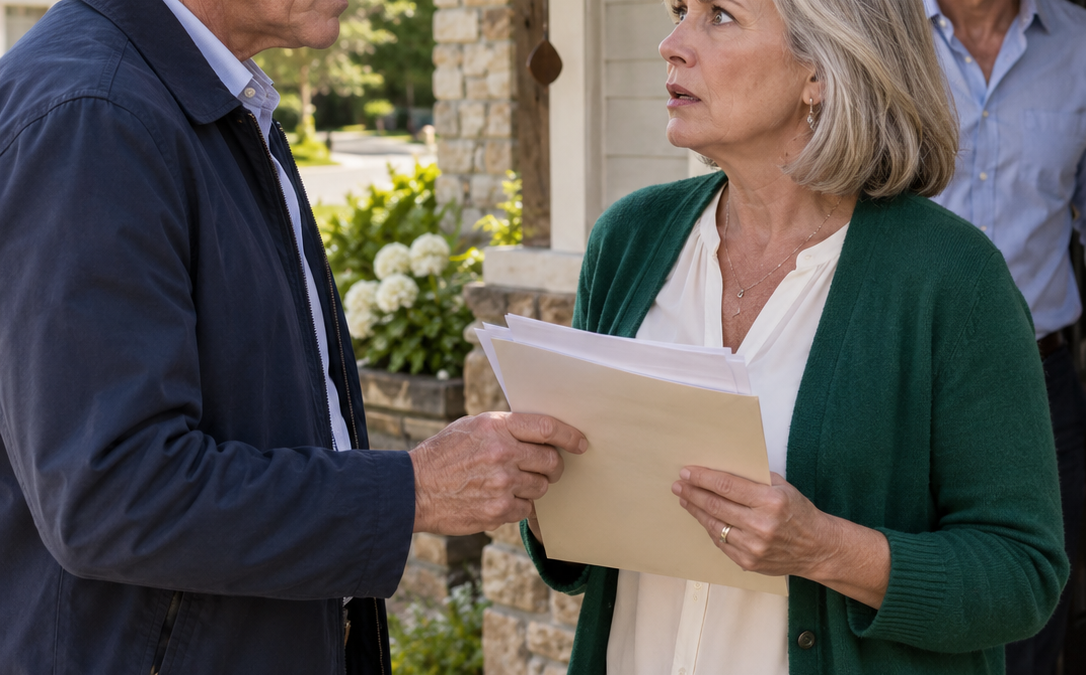
I held out the envelope.
“These are legal documents,” I said. “You need to read them.”
She took the envelope with both hands.
I noticed that her hands were steady.
I don’t know what to make of that detail even now.
She opened the flap, pulled out the first page, and began reading. I watched her eyes travel across the paper. I saw her jaw tighten. Then I watched the color drain from her face, not all at once, but gradually, from the top down, like water leaving a glass as it tips.
Behind me, the wind chimes moved softly in the evening air.
Neil was no longer looking at me.
He was watching her.
“Ela, what is this?”
She didn’t answer.
She continued reading.
And then I said the only thing I had actually come there to say.
I looked at Neil.
“Her name isn’t Elaine Proer. We were married for thirty-eight years, and she’s been dead for six months. I paid for her funeral service.”
The silence that followed was unlike anything I’ve experienced.
It lasted long enough for me to hear a car passing two streets away. Long enough for the wind chimes behind me to move again. Long enough for Neil to look from my face to the documents in Addie’s hands and then back to her.
Finally, he turned toward her.
“Is that true?”
There was something about his voice I recognized immediately.
It was the voice of a man who already knew the answer but needed to hear it spoken aloud. I’d used that same voice inside my own head in a grocery store when I saw the scar behind her left ear.
Addie looked at me instead of him.
“Truitt.”
She said my actual name.
Not whatever name Elaine Proer might have used when telling stories about the life she’d left behind. Not some carefully altered version of the man who supposedly no longer existed in her world.
My name, spoken the way she’d said it across our kitchen for almost four decades.
“I can explain this,” she said.
I’d prepared four sentences for that moment. Four sentences I’d thought about, written down, and rehearsed.
Standing there, I suddenly understood that I didn’t want to say a single one of them.
There was nothing Addie could tell me that would amount to new information.
I already knew what she’d done.
And I knew why she’d done it. Dileia had explained her mother’s reasons on that couch, and I suspected much of what she’d told me was true.
Addie had been unhappy. She hadn’t known how to tell me. She’d reached a point where she no longer wanted our marriage, but she couldn’t bring herself to sit across a table and have the hardest conversation of both our lives.
So she’d found another road.
That was the part I continued to struggle with.
I don’t believe greed alone explains what she did. She could have faced the end of our marriage, divided what we’d built, and gone away. Instead, she chose to avoid a difficult conversation and spent four and a half years constructing an extraordinarily elaborate means of escape.
Four and a half years of planning, paperwork, money transfers, identity documents, and careful preparation, all to avoid sitting down with me and telling me the truth.
That’s not a monster, at least not in the simple way people like to imagine monsters.
That’s a coward.
And somehow, to me, that was worse in a way I still can’t fully articulate.
I looked at the envelope in her hands.
“You’ve explained enough,” I said. “It’s all in your hands.”
Then I turned and walked back down the stone path.
Behind me, Addie called my name again.
I heard Neil say something in a low voice, but I couldn’t make out the words. Then there was nothing except the sound of the wind chimes moving beside the porch.
I reached my truck, got in, and pulled away from the curb.
As I turned onto the street, I heard the first siren approaching from about four blocks away.
I didn’t slow down.
I didn’t look in the rearview mirror.
I didn’t need to watch what was about to happen.
I needed it to happen.
Those are two very different things, and it took me until I was sixty-three years old to understand the distinction.
Billy called at 7:10 the following morning.
Addie had been taken into custody the previous evening without incident. The accounts under the Elaine Proer identity had been frozen overnight. The federal identity fraud component gave investigators jurisdiction they didn’t have to spend time arguing over.
I thanked Billy, hung up the phone, and made myself a cup of coffee.
My phone started ringing at about ten minutes to eight.
Dileia called three times. Then a cousin I hadn’t spoken to since 2019 called to ask whether I’d seen the news. After that came a man I’d attended high school with. Then Addie’s sister called twice.
I placed the phone facedown on the kitchen table and made a second cup of coffee.
Here’s the part I hadn’t anticipated.
I’d spent two weeks preparing for that morning. I’d approached it the same way I approached almost everything else in life: work out what needed to be done, decide how to do it properly, and then do it without making a ceremony out of the process.
I’d imagined that once the truth came out and the authorities took over, something inside me would finally settle.
But sitting there in my kitchen, listening to my phone vibrate against the wooden table, I realized that I didn’t feel relieved.
Not even a little.
What I felt was a very specific kind of stillness.
It reminded me of the way a room feels after a long argument finally ends and both people have walked away. The words are gone. The tension has drained out of the air. But the furniture is still there, and so is everything that happened.
Nobody really warns you about that.
People talk about closure as though it’s a door swinging shut. They describe it as a moment when the truth is revealed, the guilty are held accountable, and the person who’s been wronged can finally breathe again.
That’s not what it felt like to me.
Closure wasn’t a door closing.
It was simply the noise stopping.
Everything afterward moved at the slow, deliberate pace that legal matters tend to move.
The transferred assets were identified and flagged for recovery. Most of the money will eventually come back, according to the people handling that side of the case. Some of it won’t. I understand that, and I’ve accepted it.
The financial records we collected from my own servers on that Saturday morning became the backbone of the prosecution’s case. Every transaction, every authorization, and every document establishing how the money left the company was there for the attorneys and investigators to examine.
Addie’s attorney entered a plea of not guilty.
Billy told me the documentary evidence was extensive enough that the initial plea didn’t particularly change her assessment of the case.
Dileia entered into a cooperation agreement.
She provided full testimony, including the voluntary statement she’d agreed to give in Billy’s office, and continued assisting investigators with the financial side of the scheme. Her cooperation resulted in reduced charges. Her sentence included supervised probation and restitution, but no custody.
I’d told Billy early in the process that I wasn’t trying to put my daughter in a cell.
I was trying to get the truth onto an official record. I wanted the people who had deliberately buried that truth to be held accountable for what they’d done.
Billy kept that distinction in front of the prosecutor, and it held.
Dileia called me the week after her sentencing.
I watched her name appear on my phone and let it ring twice before answering.
She told me she was sorry.
There wasn’t anything elaborate about the apology. She didn’t begin explaining her reasons again or asking whether I could understand how she’d gotten involved. She didn’t try to argue that she’d meant well or that her mother had placed her in an impossible position.
She simply said she was sorry.
She said it the way people speak when they’ve run out of every other word. Not as a defense. Not as a request. Just as a fact.
And I believed her.
Believing her didn’t undo a single thing that had happened. It didn’t change those six months, the memorial service, or the evenings she’d sat across from me knowing something I didn’t.
But it mattered in another direction.
It meant she finally understood what her choices had cost.
I told her I loved her.
I told her that hadn’t changed and wasn’t going to change.
Then I told her something I’d worked out while driving home from her apartment after our first conversation.
“Love and consequence are two separate accounts,” I said. “They don’t offset each other. You’re going to have to carry both of them for a while, and I can’t carry either one for you.”
She was quiet for a moment.
Then she said she understood.
For the first time in her adult life, my daughter didn’t rush to fill the silence after I stopped speaking. She didn’t try to make the moment easier with another explanation or a promise that everything would eventually be fine.
We stayed on the line for four or five seconds without either of us saying anything.
Then we said goodbye.
That’s the most hopeful moment in this entire story, and I realize it doesn’t look like much.
I haven’t attended a single day of the legal proceedings against Addie, and I don’t intend to. I made that decision early and have never seriously reconsidered it.
There is nothing anyone could say in that courtroom that would revise what I already know. I have the documents. I have my daughter’s account of what happened. I stood in the doorway of that tan house and watched my wife read the papers that finally brought her carefully constructed life into contact with the truth.
I don’t need to hear the story repeated under oath to believe it.
The house I live in feels different now.
Not lighter, exactly. I wouldn’t describe it that way. But more honest, somehow, as though the walls have finally stopped pretending.
I repainted the back porch in the spring.
That may sound like a small thing to mention after everything else, but it mattered to me. I chose the color myself, without asking anyone’s opinion or wondering whether somebody else would have preferred something different.
I recommend that experience to every widower and every man who’s been married for a long time. Choose a color you like. Paint something with it. See what it feels like to make an ordinary decision entirely for yourself.
I started attending an early service at a church across town.
Nobody there knows anything about me yet, and I’ve discovered that anonymity is worth considerably more than I expected. I’m just another older man who comes in, sits down, listens, and leaves. Nobody looks at me with pity. Nobody asks about Addie. Nobody feels obligated to tell me how strong I’ve been.
For an hour every Sunday, I get to be a person without a story.
I also had coffee with two men I’d allowed to drift out of my life during the decades when the shop and my marriage occupied almost every available space.
One of them I hadn’t spoken to since 2011.
When I called, he answered on the second ring and talked to me as though we’d seen each other the previous week.
I hadn’t realized how much I’d missed that kind of friendship until I heard his voice.
The shop is still running.
The same machines turn. The same people come through the doors each morning. We still manufacture hydraulic and rail components, and I still find satisfaction in work that requires care and precision.
Some days, I think about selling the business and doing something smaller.
Other days, I imagine running it until I physically can’t anymore.
I haven’t decided.
And for the first time in my adult life, I’m comfortable admitting that I haven’t decided.
Not every question requires an answer by a particular date. That’s another lesson I seem to have learned later than most people.
But I want to tell you what this experience actually taught me, because whenever somebody hears the story, they tend to come away with a familiar piece of advice.
Trust your gut.
People say that as though it explains everything. And I suppose there’s some truth in it. If I’d ignored what I saw in that grocery store, if I’d dismissed every detail as a product of grief, I might never have discovered what was happening.
But trusting your instincts is only about a third of the lesson.
The rest is something more difficult.
For thirty-one years, I’ve kept a set of gauge blocks in a temperature-controlled cabinet at the back of my shop.
I’ve told every machinist who’s ever worked for me the same sentence.
You do not measure a part against another part.
That’s how error accumulates. That’s how small deviations become large ones while every individual comparison continues to look acceptable.
And for four and a half years, I measured my marriage against itself.
Was this year like last year?
Was Addie quieter than she’d been in the spring?
Well, she’d been quiet before.
Had we stopped talking about certain things?
Everybody gets tired.
Had we become less interested in spending time together?
People change as they get older.
Was the distance between us growing?
Well, that was just how we were now.
Every single one of those explanations was a part being measured against another part.
Every one of them seemed reasonable in isolation.
Nothing appeared dramatically wrong because I kept comparing each new change with the change that had come immediately before it.
The error was accumulating, and I couldn’t see it.
Then one day, I discovered that the entire lot had been scrap for years.
I never checked my marriage or our shared business against anything outside itself.
Not the accounts.
Not the paperwork.
Not an independent accountant’s review.
Not a single outside set of eyes examining what was happening.
I never once stepped away from the arrangement we’d built together and asked whether the assumptions supporting it still matched reality.
Because we’d built it together.
Because I trusted Addie.
And because asking to verify something felt uncomfortably close to making an accusation.
But I understand now that those are not the same things.
Trust is a decision you make with your eyes open.
What I had was an assumption I’d stopped inspecting sometime around 2009.
I’d grown so accustomed to the way things worked that I no longer considered the possibility that they might have changed. Each year looked enough like the previous year that I allowed myself to believe the underlying structure was still sound.
In my shop, I would never have permitted that.
I would never have accepted a machinist telling me that a part was accurate because it looked almost exactly like the part we’d manufactured yesterday.
I’d have told him to get the gauge blocks.
I’d have insisted on an external standard.
But in my own life, I let the measurements drift for years because I didn’t want the discomfort of checking.
Here’s the specific thing I’d ask anybody listening to this story to consider doing.
It takes an afternoon and costs a few hundred dollars.
If you co-own anything with anybody—a business, a farm, a rental property, or a joint account of any significant size—have an independent professional look at the books once a year.
Not the person who handles the accounts every day.
Not an accountant who works exclusively for one of the owners.
Not a relative.
Someone independent, with no personal reason to protect either party and no financial incentive to overlook a problem.
Once a year.
Put it on the calendar alongside the reminder to change the smoke detector batteries.
And when you arrange it, don’t frame it as suspicion.
It isn’t.
Frame it the way I’ve always framed calibration in my machine shop.
We calibrate annually because everything drifts.
Drift is not an accusation.
It is a condition of the world we live in.
Metal expands and contracts. Instruments change over time. Measurements that were accurate a year ago may no longer be accurate today. That doesn’t mean anybody has deliberately done something wrong.
It means you check.
You compare the thing in front of you against a standard that doesn’t depend on somebody’s memory or good intentions.
Then you know where you stand.
If I’d put that independent review on my calendar in 2015, this story might have been four paragraphs long.
It might have ended with a difficult conversation across a kitchen table.
There might have been lawyers and tears and arguments about money. We might still have lost the marriage we’d spent thirty-eight years building.
But it wouldn’t have ended with an urn on a shelf.
And I wouldn’t have spent six months mourning a woman who was buying groceries ten minutes from my house.
There’s a question I’d like you to sit with tonight.
What in your own life have you stopped measuring against anything outside itself?
I’m not asking what you suspect.
I’m not asking whether you think somebody is lying to you or whether there’s some hidden betrayal waiting to be discovered.
I’m asking what you’ve simply stopped checking.
What arrangement has become so familiar that questioning it now would feel like distrust?
What assumption have you carried forward year after year because the last time you looked, everything seemed fine?
That’s where the danger lives.
It usually isn’t hiding inside the thing you’re actively worried about.
It’s in the thing you’ve quietly retired from thinking about at all.
I still drive past that grocery store sometimes.
It’s on the way to the shop, and avoiding it would add six minutes to my drive. I’ve never been inclined to waste six minutes simply because a particular building holds an uncomfortable memory.
The cereal aisle is just an aisle.
The parking lot is just a parking lot.
People go in and out every day, buying milk, bread, soup, and yogurt. They compare expiration dates, study prices, wait at the checkout, and return to lives that may or may not be what they believe them to be.
Nothing about the building announces what happened there.
But I remember standing at the end of that aisle with both hands gripping the handle of my shopping cart. I remember the lavender perfume, the silver hair, and the little crescent-shaped scar behind Addie’s left ear.
I remember the instant when the world I’d been living in stopped matching the facts in front of me.
What happened in that store was the beginning of something I had to walk all the way through.
And I did walk all the way through it.
That’s enough.
Now I’d like to hear what you think, and I want the honest answer rather than the polite one.
If you believe I did the right thing by standing there in that grocery store and letting Addie walk away without saying a word, comment one.
If you think a man who sees the wife he buried six months earlier should call her name right there in the aisle and let the consequences fall wherever they may, comment two.
I understand that argument. My brother-in-law makes it to me about twice a year, and I haven’t entirely stopped considering his point.
But if you believe the real failure happened years before I ever entered that grocery store, when I stopped looking at my own business accounts because checking them felt like an insult to someone I loved, comment three.
That’s the answer I’d choose.
It’s the part I still think about when the house is quiet.
I’d also like to know where you’re watching from and what time it is where you are. I read every response. There’s something about being a machinist in Virginia and knowing somebody halfway around the world might be hearing this story at six in the morning that I can’t quite find the words to describe.
If there’s something in your gut that’s been trying to get your attention and you’ve repeatedly talked yourself out of it, you can say that, too.
You don’t have to share a single personal detail.
Somebody reading through these comments tonight may be standing in the middle of their own version of that grocery store aisle, wondering whether they’re imagining what they think they’ve seen.
It might help them to understand what uncertainty actually feels like from the inside, before the facts become impossible to ignore.
And if you’d like to hear more stories like this one, subscribe and stay with me for a while. These are stories about ordinary people, difficult seasons, and what they discover they’re made of when life demands more from them than they thought they could give.
I’d be glad to have you here.
For thirty-one years, I’ve kept a set of precisely ground steel blocks inside a locked cabinet, checked against a standard that does not move.
It took me until I was sixty-three to understand that I’d never had anything like that for my own life.
This is a fictional story inspired by real emotional experiences, fully rewritten and reimagined in Roanoke, Virginia, to create original content. Any resemblance to actual people or events is entirely coincidental.








