My son’s wife blocked me on everything. I said nothing. Two months later my son called: “Mom, we need $5,800 for rent.” I said no. The next day…
Before I go any further, if you’re new here, hit that subscribe button right now, because I promise you, this story only gets heavier from here, and you do not want to miss how it ends.
I picked up my phone, opened my contacts, and deleted my son’s number. Not because I hated him, but because I finally loved myself enough to stop.
My daughter-in-law had blocked me on every platform. Without a word, without a reason, without a goodbye. And while I was sitting alone in that silent house, I found out they were still watching.
Not me. The house. The one I built with my husband. The one they were waiting to inherit.
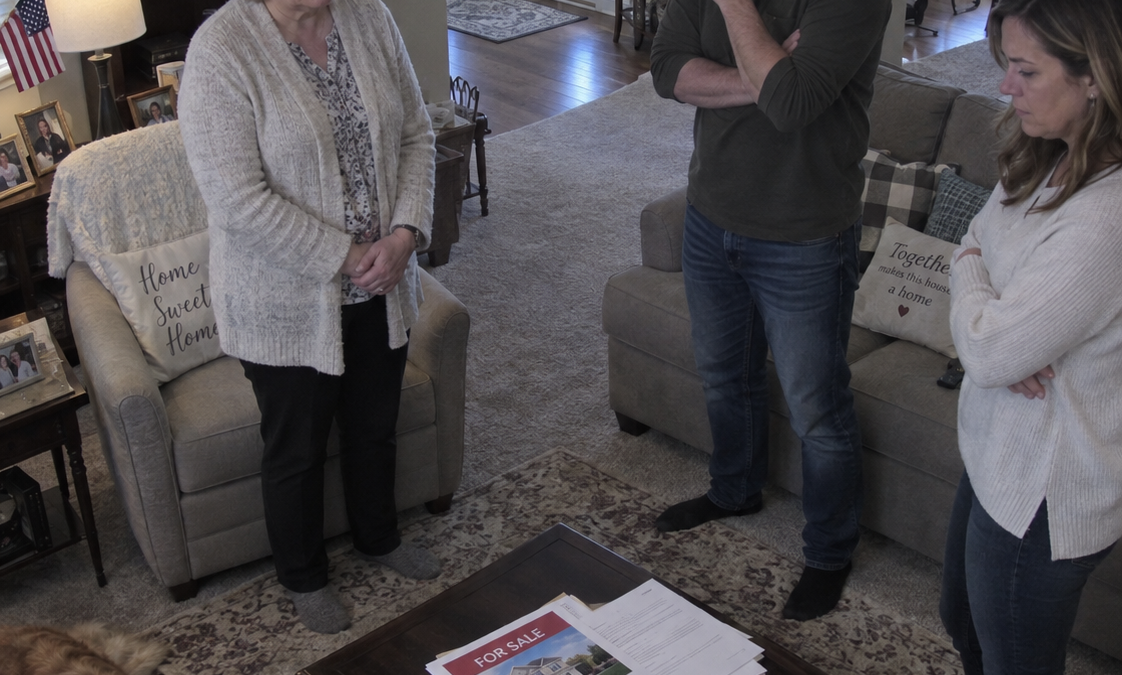
So I put a For Sale sign in the front yard, and I never looked back.
Most mornings, before the coffee even finishes brewing, I walk out through the back door in my robe and slippers, and I check on the garden. The roses along the fence that Harold planted in the spring of 1919. The sunflowers that always lean east like they’re chasing something. The little row of lavender I added three years ago because someone told me it kept the deer away.
It doesn’t. But I kept it anyway because I love the smell.
That morning, I cut three stems of yellow roses. They were perfect, the kind of perfect that makes you want to share it with someone. So I took a photo and sent it to Rachel.
The message sat there for a moment, that little spinning icon turning, and then it stopped.
Message not delivered.
I frowned. I checked my signal. Three bars. I tried again.
Message not delivered.
I thought maybe she had a bad connection. I thought maybe her phone was off. I thought maybe she was busy with the kids or in the middle of something.
I am a woman who has spent 64 years giving people the benefit of the doubt. And I did it automatically, the way you breathe, without thinking, without questioning, without realizing that sometimes doubt exists for a reason.
I went inside, poured my coffee, and pulled up her social media page. It wasn’t there. I typed her name into the search bar. Nothing. I tried her maiden name. Nothing.
I put down my coffee cup very carefully, very slowly, the way you put something down when your hands have started shaking and you don’t want to drop it.
I opened the family group chat, the one with Daniel’s sister and his cousin Marbel and his aunt Grace. The one we’d had for four years. The one where we shared birthday photos and holiday recipes and pictures of the grandkids at Halloween.
Gone. Not archived. Not muted. Gone.
I sat at my kitchen table for a long time. The coffee got cold. The roses sat on the counter in their little glass of water, and I didn’t even look at them.
Then I called Daniel.
It rang three times and went to voicemail. I hung up and called again. Voicemail.
I texted him.
“Daniel, I think something is wrong with my phone. Can you call me?”
I watched the screen. One check mark, not two. The message was sent but not delivered.
My son had blocked me, too.
I want you to understand something about that moment, because if you’ve lived long enough, you know there are moments in life that don’t feel real while they’re happening. Moments when your brain is still trying to catch up to what your heart already knows.
I sat at that table and looked around my kitchen.
The curtains Harold and I picked out together at a little shop in Savannah on our anniversary trip. The wall where I’d marked Daniel’s height in pencil every year, from the time he was four until he hit the doorframe at 16 and made me cry because I realized he was done growing.
The photo on the refrigerator. Daniel and Rachel on their wedding day, with me standing between them, my arms around both of them. All three of us laughing at something somebody said right before the shutter clicked.
And I have never been able to remember what it was.
I looked at that photo for a long time, and I thought, When did it change?
Because it did change. And the painful, honest truth is that I knew it before that morning. I had known it for a long time.
I had just been doing what mothers do, telling myself stories about temporary rough patches and the stress of modern life and how people get busy.
You know how it is. It doesn’t mean anything.
But sitting in my kitchen with my cold coffee and my delivered-but-unread text message, I finally stopped telling myself that story.
Let me take you back, because this didn’t start on that Tuesday morning with a blocked text message.
It started years earlier, slowly, the way rust starts. Quietly, invisibly, in places you’re not looking.
Harold died in October of 2018. Pancreatic cancer.
We had eight weeks from diagnosis to funeral. And I don’t mean eight weeks of suffering. I mean eight weeks of total disbelief.
Because Harold was the kind of man who ran five miles every Saturday morning and had never spent a night in a hospital in 40 years of marriage.
The doctor said, “These things can hide. These things can wait.”
And then one day, they don’t wait anymore.
He was gone so fast that I didn’t have time to prepare. I don’t mean prepare the way you write a will or pick out a casket. I mean prepare the way you prepare to become a person who sleeps alone, who cooks for one, who reaches over in the night for someone who isn’t there and lies awake with your hand on the cold sheet until the sun comes up.
Daniel was there for the funeral. He was good about that. He flew in. He handled the arrangements. He stood next to me at the graveside and held my hand.
And I was grateful. I was genuinely grateful.
But two weeks after the funeral, he went back to his life, which is what children do, which is what they should do. I understood that.
What I didn’t understand was how quickly I would become invisible inside my own grief.
The first time Rachel made me feel like a burden, I told myself I was misreading her.
It was Thanksgiving, three months after Harold passed. I had asked, tentatively, if maybe we could do the holiday at my house, because the thought of cooking Harold’s favorite recipes in Harold’s kitchen with Harold’s good dishes felt like the only way I was going to get through the day without coming apart completely.
Rachel said they were thinking of going to her parents’ place in Scottsdale.
“It’s easier,” she said. “Their house is bigger, and the kids can use the pool.”
“Of course,” I said. “Of course, I understand.”
I spent Thanksgiving alone that year.
I made a small chicken because I couldn’t face a turkey. I watched the parade on television, and I called my friend Loretta. We talked for two hours, and she said all the right things.
I was fine. I was absolutely fine.
But something shifted that day. Something quiet, something I filed away and didn’t look at directly for a long time.
By the spring of 2019, Daniel had started calling more.
At first, I was relieved. I thought, He’s finding his way back. He’s being a good son.
But the calls had a pattern. There was always a warm-up, five minutes of “How are you? How’s the garden? Did you see the game?”
And then the pivot. The almost casual mention of a problem, a financial pressure, a gap that needed filling.
“Mom, I hate to even ask this, but we’re a little short this month.”
“Mom, Rachel’s car needs work, and the timing is just terrible.”
“Mom, the kids’ school is doing this trip, and we don’t want them to feel left out.”
I said yes every time, without hesitation, without conditions, without keeping score.
Because he was my son. Because Harold would have done the same. Because there is something in a mother that cannot look at her child’s discomfort and choose to do nothing.
The amounts were never enormous. Five hundred here, eight hundred there. Once, just under three thousand when their water heater died and their emergency fund was, as Rachel explained, more of a theoretical concept than an actual account.
I laughed at that. I wrote the check, laughed at her little joke, and told her not to worry about paying it back.
She never offered to.
It was Rachel who first mentioned the house.
We were sitting at my dining room table. This would have been maybe early 2020, right before everything went sideways with the world.
And she was looking around with a kind of appraising look that I didn’t quite register at the time. The way you look at something you’re measuring. The way you look at something you’re picturing differently.
“This house is so much space for one person,” she said.
“It feels right to me,” I said. “I know every corner of it.”
“I just mean…” She tilted her head. “It must be a lot of upkeep. All alone.”
“I manage.”
“Daniel worries about you,” she said. “Being out here by yourself. What if something happened?”
And I heard what she was saying on the surface. I am a woman with a functioning mind, and I understood the words.
She was framing it as concern. She was packaging it in the language of care. But something underneath those words made me sit very still.
“I’m not ready to make any changes,” I said. “This is my home.”
She smiled.
“Of course. Nobody’s rushing you.”
But she kept looking around the room.
Daniel brought it up six months later.
We were on the phone, just the two of us, and he said, “Mom, have you given any more thought to what Rachel mentioned about the house?”
“She mentioned it once,” I said casually. “I didn’t realize there was more thought to give.”
“It’s just, you know, Rachel and I have been talking about maybe moving somewhere with more room. The kids are growing. The apartment’s getting tight.”
“That sounds like something you two should work toward,” I said. “A mortgage, saving up.”
A pause.
“Right,” he said. “Yeah, obviously.”
But the way he said obviously, tight and clipped, like the word cost him something.
I heard it. I heard all of it.
In 2021, Rachel left her job.
She announced it over a Sunday call, brightly, the way you announce something you’ve already decided and are simply informing others of.
“I’ve been thinking about it for a long time, and I just think it’s the right moment.”
“What will you do?” I asked.
“Focus on the kids. Maybe start a little wellness blog. Something creative.”
“And financially?” I asked. “Will you two be okay?”
Another pause. Longer this time.
“We’re figuring it out,” Daniel said. He had gotten on the call halfway through. “It might be a little tight for a bit.”
I heard the unspoken ask beneath those words, the way you hear thunder before you see lightning. You don’t have to look up. You already know what’s coming.
Two weeks later, Daniel called.
“Mom, I hate to do this again, but—”
“How much?” I said.
“Two thousand. Just until Rachel gets the blog monetized. It shouldn’t take long.”
The blog never made a dollar.
I know because Rachel mentioned it six months later with the cheerful brevity of someone closing a chapter and opening a new one.
“The whole blogging thing kind of ran its course.”
And the two thousand had run its course, too, right out of my savings and into a future they were building on the assumption that I would always be standing underneath it, holding it up.
I want to be honest with you about something, and I want you to hear this part clearly.
I was not a victim. Not in those years. Not in any simple way.
I made choices. I wrote the checks. I said yes. I answered the phone. I told myself that giving was loving, and that mothers who calculated their generosity were cold and transactional.
And I did not want to be that kind of mother.
But there is a difference, and this took me a very long time to understand, between giving from abundance and giving from fear.
Between helping someone because you want to and helping someone because you are terrified of what happens if you don’t.
Of being needed less. Of being called and asked about less. Of that terrible, quiet, shameful fear that if you are not useful, you will be forgotten.
I was giving from fear.
And I told myself it was love.
The conversation happened on a Wednesday night in the fall of 2022.
Daniel called with no warm-up, no five minutes of “How are you?” He went straight to the center of it with a kind of determination that told me they had discussed this, that they had rehearsed it.
“Mom, Rachel and I want to talk to you about something. Can we put you on speaker?”
“Go ahead,” I said.
“We’ve been thinking a lot,” Rachel said. “About the future. About what makes sense for everyone.”
“Okay.”
“The house,” Daniel said. “Mom, we’ve been thinking about the house.”
I set my book down. I folded my hands in my lap.
“What about it?”
“We think, and hear us out, we think it would be good for the whole family if we moved in there. With you. We could help with upkeep. You wouldn’t be alone. The kids would have a yard. It just makes so much sense.”
The silence that followed lasted about four seconds. I know because I counted.
“You want to move into my home?” I said.
“With you,” Rachel said quickly. “We’d all be there together.”
“And the costs?”
“We’d work something out.”
“Would you be paying rent? Contributing to the mortgage?”
Another silence. This one heavier.
“Mom,” Daniel said. “It would be family.”
“I know,” I said. “But the question stands.”
“We thought,” Rachel said carefully, “that maybe this could be the beginning of, you know, transitioning ownership gradually so it stays in the family.”
There it was.
Not a request. A plan.
A plan that had been built piece by piece. Every time I said yes. Every time I wrote a check. Every time I let them see that I would bend.
They hadn’t been calling to check on me. They had been building a case.
“I need some time to think,” I said.
“Of course,” Rachel said warmly. “No pressure.”
But there was pressure. That’s exactly what it was.
The pressure of years of expectations piling up in a corner of my life. And now they were asking me to hand over the keys to the room where I kept everything that mattered.
I thought about it for three weeks.
I prayed on it, if I’m being honest. I sat in Harold’s old chair in the study, his reading chair, the one I could never bring myself to move, and I talked to him the way I sometimes do, out loud into the quiet.
“What would you have done?” I asked the empty room.
And I knew the answer because I knew Harold.
Harold, who built this house with his hands and his retirement savings and his absolute certainty that we would grow old here. Harold, who loved Daniel fiercely and would have given him anything except the thing that wasn’t Daniel’s to take.
I called Daniel on a Tuesday morning.
“I’ve thought about what you asked,” I said.
His voice was careful, hopeful in a way that made my chest ache.
“I love you,” I said. “That is not something you will ever need to question. But I will not be transferring this house to you, and I will not be offering free housing as a stepping stone to ownership. If you want to rent a room from me at market rate, we can talk about that. But the house is mine.”
The silence on the other end of the line could have filled a cathedral.
Then Daniel said very quietly, “I can’t believe you’re doing this.”
“Doing what? Telling you the truth about what I’m willing to do with my own property?”
“We thought, after everything, we thought you understood what family meant.”
“I understand exactly what family means,” I said. “That’s why I’m being honest with you right now instead of agreeing to something I would regret.”
He hung up.
Rachel called back 20 minutes later.
She did not call to ask questions. She called to deliver a verdict.
“I want you to know,” she said, and her voice had a quality I’d never heard from her before, cold and certain and somehow rehearsed, “that what you’re doing is selfish. Daniel has given you years. He has made you part of his family. He has included you, and you are choosing a piece of property over your own grandchildren.”
“Rachel—”
“I hope you’re proud of yourself.”
A pause.
“I really do.”
She hung up before I could say another word.
The blocking happened that same afternoon.
I discovered it in stages, the way you discover most devastating things. First, a small oddity, then a growing confusion, then the full, undeniable shape of it.
Rachel’s phone. Daniel’s phone. The family group chat. Social media.
All of it gone, severed with the clean finality of someone who has already made their peace with the decision.
I sat in my kitchen, in the same chair where I’d had my cold coffee that Tuesday morning, and I understood something that I had been circling for years without looking directly at.
This was never about love. It was never about family.
It was about what I had, what they wanted, and how long they had been quietly, patiently, strategically waiting for me to hand it over.
My grief. My loneliness after Harold died. My need to feel needed. My fear of being forgotten.
They had fed off all of it.
Not cruelly, maybe. Not consciously, maybe. People rarely sit down and decide to exploit someone they love.
But the effect is the same. The erosion is the same.
And the moment I stopped being useful, the moment I said no, I ceased to exist in their world.
I sat there for a long time.
I didn’t cry. I had cried enough.
I thought about Harold. I thought about the roses in the back garden. I thought about every room in this house that held a piece of something I had lived.
And then, very slowly, something moved inside me that I can only describe as clarity.
I got up. I walked to my desk. I opened my laptop, and I searched for the name of a real estate attorney.
I didn’t have a plan yet. Not a complete one.
But I knew something that I had not known that morning when I sent Rachel a photo of yellow roses and watched the message fail to deliver.
I knew that I was not finished.
I knew that this house, my house, had one more chapter to write.
And I was going to be the one holding the pen.
The attorney’s name was Margaret Holloway. Her office was on the third floor of a building downtown, the kind of place with neutral carpet and framed diplomas and a receptionist who offered you water the moment you sat down.
I had driven past that building a hundred times over the years without ever thinking I would walk through its doors for something like this.
I called on a Wednesday morning, four days after the blocking.
The receptionist asked what the matter concerned.
“Estate planning,” I said, “and a property decision I need help thinking through.”
She gave me an appointment for the following Monday. I wrote it in my calendar in ink, the way Harold always said you should write the things that matter. Not pencil. Ink. Because some decisions you don’t leave room to erase.
Those four days between the call and the appointment were the quietest days I had experienced since the weeks after Harold’s funeral. The house felt different in the silence. Not empty exactly. More like held breath, like the walls were waiting to see what I would do next.
I did not call Daniel. I did not text Rachel. I did not reach out to anyone in the family to explain or apologize or soften what had happened.
People who have known me for years would tell you that was unusual. I am not a person who leaves things unresolved. I’m not comfortable with unresolved conflict sitting in a corner of my life like a piece of furniture nobody wants to acknowledge.
For most of my 64 years, I would have been on the phone inside of 48 hours, smoothing things over, finding the middle ground, being reasonable.
But something had changed in me.
I couldn’t name it that week. I can name it now.
What changed was that I finally stopped being more afraid of their anger than I was of my own disappearance.
I had been managing their feelings for so long that I had lost track of my own. And for those four days, I just sat in that quiet house and let myself feel what was actually there.
What was there surprised me.
It wasn’t grief exactly. Or not only grief. There was grief, yes, for the relationship I had believed I had with my son. For the version of Rachel I had invented in my head because I needed her to be someone I could trust.
But underneath the grief, there was something harder and cleaner. Something close to anger, but steadier than anger. Something that had been building for a long time in a room I had kept locked.
I finally opened the door, and what I found inside was the simple, undecorated truth.
I’d let this happen. Not because I was weak. Not because I was foolish. But because I had confused being loved with being needed, and I had spent years making myself as necessary as possible to people who were slowly learning to see me as a resource rather than a person.
That truth did not feel good, but it felt real.
And for the first time in longer than I could remember, real felt like enough.
On Sunday night, the night before my appointment with Margaret Holloway, I sat down at the kitchen table with a yellow legal pad and a pen, and I wrote down every number I could remember.
The check for Daniel’s car repair in 2019. The water heater in late 2020. The $2,000 for Rachel’s wellness blog experiment. The smaller amounts. The birthday party for my granddaughter that I quietly covered when Daniel mentioned they were running short.
The grocery runs. The unexpected utility bills. The “just this once” moments that had accumulated over four years into a total that, when I finally wrote it down and added it up, made me sit back in my chair and press both hands flat on the table to steady myself.
$31,400.
I sat there and looked at that number for a long time.
Thirty-one thousand dollars.
The number wasn’t what undid me. What undid me was the realization that I had never once, not a single time, written it down before.
I had given it away in pieces small enough that I could tell myself it was nothing. It was manageable. It was what you do for family.
Thirty-one thousand dollars.
And not one of those pieces had ever been paid back. Not once.
I put the cap back on the pen. I folded the legal pad closed, set it on the corner of the table where I would see it in the morning, and went to bed.
I slept better than I had in months.
Monday morning, I drove downtown and walked into Margaret Holloway’s office with the legal pad under my arm and a very clear sense of what I needed to say.
Margaret turned out to be a woman in her late fifties, sharp and direct in the way that good attorneys are. No wasted words, no performance of warmth she didn’t have time for, but genuinely attentive.
She listened to everything I told her with her hands folded on her desk and her eyes steady on my face.
When I finished, she said, “You want to understand your options regarding the property.”
“I want to understand all of them,” I said. “Including selling.”
She didn’t blink.
“Is that what you’re leaning toward?”
“I’m leaning toward understanding what belongs to me,” I said, “before I decide what to do with it.”
She nodded slowly, and I could see a kind of respect in the set of her expression.
“Okay,” she said. “Then let’s start from the beginning.”
We talked for almost two hours that morning.
Margaret walked me through everything. The deed, which was in my name alone after Harold’s estate settled. The fair market value of the property based on recent comparable sales in the area. The tax implications of a sale. The legal realities of what it would have meant to gradually transition ownership the way Rachel had described.
That last part is where I had to put my hands back flat on the table.
“Walk me through that one more time,” I said. “What would that have looked like legally?”
Margaret leaned forward slightly.
“What they were describing, a gradual transition of ownership, that’s not a casual family arrangement. That’s a legally binding process. Depending on how it was structured, you could have found yourself in a position where they had a partial or full equity stake in your property without having paid market value. If the relationship deteriorated, which it appears it has, extracting yourself from that situation could have involved courts, contested claims, potentially years of litigation.”
I looked at her.
“They weren’t just asking to move in,” I said.
Not a question. A statement.
“Based on what you’ve described,” Margaret said carefully, “it sounds like they were asking you to begin a process that would have been very difficult to reverse.”
The room was very quiet for a moment.
“How soon can we talk about listing it?” I said.
Margaret looked at me steadily.
“You’re sure?”
“I’m not sure about anything,” I said. “But I’m sure this is mine, and I’m sure I want to decide what happens to it before anyone else decides for me.”
She picked up her pen.
“Then let’s get started.”
I drove home that afternoon a different person than the one who had driven downtown that morning. Not lighter exactly, but clearer.
There’s a difference between those two things.
Lightness can be temporary. It can be the relief of having looked away from something difficult. Clarity is permanent. Clarity is what happens when you have finally looked at something directly and you cannot pretend anymore that you haven’t seen it.
I had seen it. All of it.
Two weeks after my meeting with Margaret, I called a realtor.
Her name was Sandra. She had sold three houses on my street over the past decade, and when I told her I was thinking about listing, she came over the next day with comparables and a clipboard and the honest, measured energy of someone who had sat across from grieving widows and divorcing couples and elderly parents at crossroads before and understood that selling a house is never just about a house.
She walked through each room with me, and I watched her take notes while I thought about all the life that had happened inside those walls.
Daniel’s childhood bedroom, where the carpet still had a stain from when he was 11 and knocked over an entire bottle of model paint trying to build a fighter jet. We scrubbed for an hour and couldn’t get it all out.
The kitchen where Harold and I danced on New Year’s Eve 1999, just the two of us, because we had declined every party invitation and decided we would rather be home.
The back porch where I had sat with my morning coffee every day for decades, watching the garden change with the seasons and feeling, usually, a deep contentment.
I love this house.
I want to be very clear about that because this part of the story is easy to misread.
I was not selling out of spite. I was not selling to punish Daniel.
Spite would have required me to still be in the emotional place I had been in that first week, that raw, destabilized grief of having been blocked and erased.
But I’d moved through that place, and what was on the other side of it was something quieter and more considered.
I was selling because the house had become something it was never supposed to be.
It had become leverage in my son’s eyes and his wife’s eyes.
My home was no longer a place where I lived. It was a prize at the end of a long game of patience.
Every time they asked about it, every time Rachel made her appraising comments, every time Daniel reminded me that it was too much space for one person, they were reminding me that they were watching, that they were counting down.
I would not spend the rest of my life living inside a countdown.
Sandra gave me a number that made my breath catch a little.
The market had been kind to this neighborhood. The house Harold and I had bought for the kind of modest figure that feels almost fictional now had appreciated into something substantial.
Something that, once sold, would give me options. Real options. The kind that don’t depend on other people’s goodwill or the continued patience of someone who loves you conditionally.
“I think we could move it within 60 days,” Sandra said. “Maybe less, the way things have been.”
“Let’s list it,” I said.
She nodded. She didn’t ask if I was sure.
I think she could see that I was.
I signed the paperwork that afternoon.
The sign went up on a Thursday.
I remember the morning it went up because I was standing at the kitchen window with my coffee when the truck pulled into the driveway.
I watched the man take the sign out of the back, walk it to the front yard, and push it into the ground with two confident thumps of his hand.
FOR SALE.
I stood there and looked at it through the window for a long time.
I thought it would feel like loss.
But what it felt like was something I had not expected at all.
It felt like a beginning.
Daniel called that same afternoon.
I stared at my phone when his name appeared on the screen because it had been, I counted back, 23 days since he had blocked me.
Twenty-three days of nothing. Of silence. Of complete and total erasure.
And now here was his name, lighting up my screen like those 23 days had simply not occurred.
I let it ring. Not out of cruelty, but out of the genuine need to sit with the fact of it for a moment before I decided what to do.
It rang five times and went to voicemail.
He called again 40 minutes later.
This time, I picked up.
“Mom.”
His voice was strange, thick in a way that told me he had been working up to this call.
“Mom, I saw the sign.”
“Yes,” I said.
“You put the house up for sale.”
“I did.”
A pause that stretched out long enough that I could hear him breathing.
“Without telling us.”
“It’s my house, Daniel.”
“Mom.”
His voice cracked on that single word, and I sat with the crack of it. Let it land. Felt it. The way a mother always feels her child’s pain, even when her child has earned it.
“Mom, how could you do this?”
“How could I do what?”
“Make a decision about your own property without even talking to us?”
“You blocked me,” I said simply, without heat. Just the fact. “You blocked me on every platform, Daniel. You and Rachel both. How exactly was I supposed to have a conversation with you?”
Another silence. Different this time. Heavier.
“That was…” He stopped, started again. “Rachel was upset.”
“So was I,” I said. “But I didn’t disappear on you.”
“Mom, can we please talk about this? Can we come over? Can we sit down together and talk about this before anything is finalized?”
I looked out the window at the sign in my front yard.
“You can come over,” I said. “But Daniel, I want you to understand something before you do. I’m not looking for a negotiation. The house is listed. That decision has been made. But if you want to sit down and actually talk, not about the house, not about what I’m going to do with my money, but actually talk, then yes, come over.”
“Okay,” he said quietly. “We’ll come Sunday.”
They arrived Sunday afternoon.
Rachel walked in first, which told me something about the way they had prepared for this visit.
She walked in with the controlled energy of someone performing composure, wearing it like a garment she had put on deliberately. She hugged me with both arms and said, “Evelyn,” in a tone that tried to reach across 23 days of silence and land somewhere warm.
I hugged her back.
I am still her mother-in-law. That did not stop being true because she hurt me.
But I noticed the hug. I noticed the performance of it.
Daniel was behind her. He looked tired. Not the tired of someone who has been sleeping badly, but the tired of someone who has been thinking hard things they would rather not have to think about.
He hugged me longer than Rachel did, and he didn’t say anything for a moment. Just held on.
And I let him.
We sat in the living room. I had made coffee and put out the little shortbread cookies Daniel has liked since he was a child.
I don’t know why I did that. Some reflex of hospitality older than the argument between us.
And we sat across from each other with the coffee cups and the plate of cookies and 23 days of silence in the room with us.
Rachel opened.
“We’ve been thinking,” she said, “about everything that was said. And we know things got heated. We want you to know that we never meant for you to feel like—”
“Rachel,” I said gently but clearly. “I’m going to ask you to start over. Not with what you meant. With what happened. Can we start there?”
She looked at me. Then she looked at Daniel.
Daniel put his coffee cup down.
“We handled it wrong,” he said. “Blocking you. That was wrong.”
“Thank you,” I said.
“But Mom…” He leaned forward, his elbows on his knees, his hands clasped together the way he has clasped them since he was a teenager working up to something difficult. “I need you to understand where we were coming from. We had been building toward something in our minds, something we thought—”
“That I had agreed to?” I said.
He stopped.
“Daniel, at no point did I agree to transfer this house to you. At no point did I agree to subsidize your living expenses indefinitely. I helped when I could and when I wanted to. But somewhere along the way, my help became your expectation. And when I said no to that expectation, you and Rachel chose to punish me.”
“We didn’t—”
“You blocked me,” I said again. “What do you call that?”
The room was quiet.
Rachel set her cup down carefully.
“We were angry,” she said. “People do things when they’re angry.”
“They do,” I said. “And I understand anger. I felt it, too. But I want you to think about the sequence here. I said no to something that was never mine to give away freely. And your response, both of you, was to erase me from your lives. Not to call and fight with me, not to tell me you were hurt, but to block me on every platform and go silent. Think about what that says.”
Daniel looked at his hands.
Rachel looked at a point somewhere past my shoulder.
“What do you want from us?” she said finally.
The performance had dropped a little. The real question underneath was starting to show.
“I want honesty,” I said. “Right now, in this room. That’s all I want.”
A long pause.
Then Daniel looked up at me with something raw in his expression that I recognized.
It was the face of a child who has just realized he’s been caught, not in a lie exactly, but in a story he told himself so many times he started to believe it.
“We thought,” he said slowly, “that you had all this, so much, and we had so little. And it felt like… I know how this sounds, Mom, but it felt like you weren’t using the house, the space, and we had the kids and the expenses and Rachel wasn’t working, and it felt like the answer was right there. We just needed you to see it, too.”
The honesty of that cost him something. I could see it cost him.
“I appreciate you saying that,” I said. “And I want to say something back that I also need you to hear. I am your mother. I love you. I have never stopped loving you, and I will not stop. But you are not entitled to what I own. You are not entitled to my financial security or my home or my future because you have needs and I have assets. That is not how love works. That is not how family works.”
Rachel made a sound. Not quite a word. Not quite a dismissal. Something complicated and caught in her throat.
“We weren’t trying to take—”
“Then what were you trying to do?” I said. “Help me understand. You sat at this table two years ago and talked about gradually transitioning ownership of my house. What would that have looked like?”
Silence.
“What would it have looked like, Rachel?”
She looked at me directly.
Then, for the first time since she had walked through the door, I saw something pass across her face that I had never seen there before.
Not guilt exactly. Not shame. Something older and harder and more complicated than either of those.
The look of someone who has been operating under a set of assumptions for so long that having them named out loud is genuinely disorienting.
“We thought you’d want to keep it in the family,” she said quietly.
“It is in the family,” I said. “It’s mine. I am your family. And when I am gone, whatever remains will be handled the way Harold and I decided, in a will, legally, with care. That is not your business to manage ahead of time.”
Daniel stood up.
Not in anger. He walked to the window and stood with his back to us for a moment.
And I watched his shoulders.
I thought about all the times I had watched those shoulders from behind. As a little boy running across the yard. As a teenager walking away from an argument. As a grown man carrying something too heavy.
“I don’t know how we got here,” he said to the window.
“I think you do,” I said.
His eyes were wet.
“I’m sorry, Mom.”
And there it was.
The thing I had waited for without knowing I was waiting for it.
Not because I needed an apology to move forward, but because the apology told me something essential.
That somewhere underneath the entitlement and the years of managed expectations, my son was still present. Still capable of looking clearly at something and calling it what it was.
Rachel said nothing.
I noticed that, too.
“I accept that,” I said to Daniel. “And I love you. But the house is being sold. That decision is not about punishing you. It is about me choosing my own future on my own terms.”
For the first time in longer than I should have waited, he nodded. One small, tight nod.
“Where will you go?” he asked.
“I haven’t decided everything yet,” I said. “But I’m looking at a smaller place. Something that is entirely, completely mine. Something I don’t have to worry about anyone else’s claim on.”
Rachel picked up her coffee cup and sat back down without drinking.
“This feels very final,” she said.
“It is final,” I said. “This part of things, the part where I arrange my life around your needs and your timeline, that part is final.”
She looked at me for a moment with an expression I couldn’t entirely read.
Then she said, “I still think this is a mistake.”
“That’s okay,” I said. “It’s not yours to make.”
They left about an hour later.
The goodbye was awkward in the specific way that goodbyes are awkward when all the important things have been said and nobody knows what register to land the ending in.
Daniel hugged me again. Rachel hugged me more briefly.
They walked to their car, and Daniel looked back once from the end of the driveway. I raised my hand, and then they were gone.
I went inside.
I stood in the kitchen for a while without doing anything in particular. Then I walked to the back door, opened it, and went out to the garden.
The roses were coming in. The lavender was doing that thing it does in the middle of the day where the scent is almost too strong, like it can’t help itself. The sunflowers were leaning east the way they always did.
I stood there in my garden, and I let myself feel everything that was in me.
The grief, yes. The complicated love that does not disappear just because someone disappoints you. The strange, aching sadness of having seen my son clearly for the first time in years.
And underneath all of it, persistent and steady and getting stronger by the day, that clarity I had found in Margaret Holloway’s office.
I was not finished.
I was, in fact, just beginning.
The house went under contract 41 days after listing.
The buyers were a young couple, both in their early thirties, expecting their first child. Sandra showed me their letter.
Buyers sometimes write letters in this market explaining why they love a house, why they want it, and I read it twice.
They talked about wanting a yard for their child to grow up in. They talked about the light in the kitchen in the morning. They talked about the feeling they got when they walked through the front door the first time.
I recognized that feeling.
I had felt it the first time Harold and I walked through that door almost 40 years before, with paint swatches in my pocket and absolutely no idea what our lives were about to become.
I signed the contract.
Daniel texted that night, not knowing about the contract, just a brief checking-in message.
Things between us were not repaired, but they were not nothing either. A thin thread still connecting us.
I read the text, then put my phone face down and let myself sit with what I had just done.
I had just sold the house Harold built.
I had just sold the place where Daniel learned to ride a bike, where I planted the first rosebush, where I danced in the kitchen on New Year’s Eve in 1999, and where I sat alone on the night after Harold’s funeral and tried to understand how the world could keep turning when the person at the center of mine had stopped.
I cried.
I want to be honest about that because I have told this story, parts of it, to a few close friends, and some of them nod very approvingly, like selling was a triumph. Like it was all clean and righteous and easy.
It was not easy.
It costs something. Even the right decisions cost something, and anyone who tells you otherwise is either lying or has never had to make one.
I cried for maybe half an hour, and then I washed my face.
And then I sat back down at my kitchen table with a new legal pad, and I started making a list.
Not of what I had lost.
Of what I was going to do next.
Because for the first time in years, maybe the first time since Harold died, the next chapter of my life was being written entirely by me.
No one else’s needs. No one else’s timeline. No one else’s carefully managed expectations about what I owed them or what they deserved or how my resources should be distributed to accommodate their lives.
Mine. Just mine.
And I realized, sitting there with my legal pad and my still-damp face and the sound of the house settling around me the way old houses do, that I had been waiting for someone to give me permission to want things for myself again.
Nobody was going to give me that permission.
I was going to have to take it.
The closing was scheduled for six weeks out.
I had work to do.
The six weeks between signing the contract and closing day were the strangest weeks of my life.
Not the hardest. The weeks after Harold died were the hardest, and nothing has come close to that. Nothing ever will.
But these six weeks had a quality unlike anything I had experienced before.
They felt suspended, like the whole world was holding its breath along with me, waiting to see what happened when Evelyn Parker stopped arranging her life around other people’s needs and started arranging it around her own.
I told my friend Loretta about the contract on a Tuesday night over the phone because Loretta has been the person I call when I need to say something out loud before I’m completely sure of it.
We’ve been friends for 31 years. She was at my wedding. She was at Harold’s funeral. She’s known me through every version of myself I have cycled through in six decades.
And she is constitutionally incapable of telling me what I want to hear when what I want to hear isn’t the truth.
So I told her about the contract, and I told her about the Sunday visit with Daniel and Rachel, and I told her about the legal pad with the list of what came next.
And I waited.
There was a pause on the other end of the line that lasted about four full seconds.
“You actually did it,” Loretta said.
“I actually did it.”
“Evelyn.” Another pause. “I have been waiting for you to do something like this for three years.”
That landed harder than I expected.
“Three years?”
“Honey, I watched you give that boy everything. I watched you cover Rachel’s blog money and Daniel’s car and every other thing they floated your way. And I watched you tell yourself it was fine. I didn’t say anything because you weren’t ready to hear it.”
“You could have said something.”
“Would you have listened?”
I thought about it honestly.
“No,” I said. “Probably not.”
“That’s why I didn’t say anything,” Loretta said. “But I am saying it now. You did the right thing. The house, the contract, all of it. You did the right thing.”
I held on to that for a moment.
Not because I needed her validation to feel certain. I had passed through the needing-validation stage sometime around the meeting with Margaret Holloway.
But because there is a particular comfort in being known by someone who knew you before the hard parts, who remembers who you were before loss and grief and loneliness quietly rearranged your priorities without your full consent.
“I’m scared,” I admitted.
“Of what?”
“Of what comes after. Of whether I’ve made a mistake. Of whether Daniel and I can come back from this.”
“You haven’t made a mistake,” Loretta said. “And as for Daniel, that boy loves you. He’s just been letting Rachel drive for too long. Men do that. They get comfortable letting someone else navigate, and then they look up and realize they’re somewhere they never meant to go.”
“That’s generous to him.”
“Maybe. But Evelyn, he cried. You said he did. Rachel didn’t.”
I was quiet.
“I noticed that, too,” I said.
The thing about Loretta is she always knows when to stop.
She knows when she’s given you enough to sit with and when to let the silence do the rest.
She said good night about ten minutes later, and I sat in Harold’s old chair in the study for a long time after the call, turning over what she had said about Rachel.
Because she was right.
In the two hours that Daniel and Rachel had sat in my living room on that Sunday, Daniel had gotten to a place of genuine emotion. Imperfect, complicated, not fully resolved, but real.
He had looked at me with wet eyes and said, “I’m sorry.”
And I had believed him.
Rachel had said she still thought it was a mistake.
Not “I understand why you’re doing this, even if I disagree.”
Not “I’m sorry for my part in what happened.”
Not even “I hope we can find a way through this.”
“I still think this is a mistake,” said with the composed certainty of someone who has not yet accepted that they do not get a vote.
I thought about that for a long time.
What I understood, and this understanding came to me slowly in pieces over the following days, was that Rachel and Daniel were operating from two very different emotional positions.
And those positions told me something important about where the future between us might go.
Daniel was ashamed.
Rachel was inconvenienced.
Those are not the same thing.
Shame means you have looked at your own behavior and recognized something in it that falls short of who you want to be.
Inconvenience means the obstacle is external. Inconvenience means the problem is what I did, not what she did.
Inconvenience means she was still, somewhere in the back of her mind, waiting for me to come to my senses.
I was not going to come to my senses.
I was already in my senses, possibly for the first time in years.
Three weeks before the closing, Daniel called again.
It was a Sunday morning, early, before nine, which told me he had been awake thinking.
Daniel has always been an early caller when something is weighing on him. Harold was the same way. Some things pass down in families that have nothing to do with genetics.
“Are you up?”
“I’ve been up since six,” I said. “What’s going on?”
“I need to ask you something, and I need you to know that I’m asking it honestly. Not with an agenda. Just because I need to understand.”
“Okay.”
“Was it always going to be no? The house, the arrangement we asked about. Did you know from the beginning it was never something you would consider? Or did you actually think about it?”
I got up from my chair and walked to the kitchen and poured myself a second cup of coffee before I answered, because the question deserved more than a quick response.
It deserved the truth.
“I thought about it,” I said. “When you first mentioned it, the moving in, the arrangement, I didn’t say no that same day. I went away and I actually sat with it. I tried to imagine it working. I tried to see what you were seeing. And what I kept coming back to was the feeling I would have living in my own home, knowing that the people under the same roof were waiting for me to sign it over.”
I paused.
“That’s not a home anymore, Daniel. That’s a transaction with beds in it.”
A long silence.
“I never thought of it that way,” he said.
“I know you didn’t. That’s part of what I’ve been sitting with.”
“Rachel thought…” He stopped.
“What did Rachel think?”
Another pause. This one felt careful, like he was choosing something.
“Rachel thought that if we moved in and helped around the place, with the yard, with upkeep, that eventually it would feel natural. That you’d come around.”
I set my coffee cup down.
“Come around,” I repeated.
“Her words, not mine.”
“Daniel.” I kept my voice even. “Do you understand what that means? That your wife had a strategy. A plan to wait me out. She wasn’t suggesting we all live together because she was worried about me being alone. She was suggesting it because she had a timeline.”
The silence on his end was very long.
“I know,” he finally said.
And the weight of those two words, the quiet, exhausted weight of them, told me something had shifted in him between Sunday and now.
Something he was still in the middle of working through.
“Are you okay?” I asked.
“I don’t know,” he said. “Honestly, Rachel and I have been… It’s been a hard few weeks.”
“I’m sorry to hear that.”
“Are you?”
It was a genuine question, not a sharp one.
And I answered it genuinely.
“I don’t want your marriage to be difficult. I don’t want any of this to have made your life harder. But I will not apologize for what I decided.”
“I know,” he said again. “I’m not asking you to.”
We talked for another hour that morning.
Not about the house. Not about money. Not about anything with stakes in it.
We talked about the kids. He told me my granddaughter had started taking piano lessons and was already driving the whole household out of the room when she practiced.
We laughed about that.
We talked about a trip he and Rachel had taken years ago, before the kids, and how much they had loved it.
We talked about Harold a little, the comfortable way you talk about someone when enough time has passed that the grief has softened into something you can carry without it stopping you mid-sentence.
It felt, for the first time in a very long time, like talking to my son.
Not to a person managing me. Not to someone with an ask underneath the conversation.
Just to Daniel.
Just to my boy.
I hung up that morning with something complicated in my chest.
Not hope exactly. Hope felt premature.
But the small, fragile beginning of something that might, with time and patience and both of us choosing honesty, become hope eventually.
Then, two days later, Rachel showed up at my door unannounced.
I want to be careful about how I tell this part because it would be easy to tell it in a way that makes Rachel a villain.
And I have worked hard not to do that because the truth of people is almost never that clean.
Rachel is not a villain.
She is a woman who had plans and who was accustomed to getting them to work out. And she had spent enough years watching me give and give and give that she had genuinely, perhaps not even consciously, come to see my generosity as a fixed feature of the landscape, like a river that would always run in the direction you expected.
I had changed direction, and she was standing on my doorstep at ten in the morning on a Tuesday to tell me that was not acceptable.
I opened the door, and she was already talking.
“I know you didn’t expect me,” she said, stepping past me into the entryway with the easy confidence of someone who has spent years treating my home as an extension of her own life. “But I need to talk to you. Just us. Without Daniel.”
I closed the door.
“Okay,” I said.
Without Daniel was not a small detail.
That told me this conversation was to be something he didn’t know about, something she had decided to handle herself.
I filed that away.
We went to the kitchen. I offered coffee, and she accepted, which surprised me a little.
Accepting coffee means you’re staying. Means you’re settling in. Means you’re not here for a quick exchange.
I poured two cups and sat across from her, and she wrapped both hands around her mug and looked at me with an expression that I had never seen on her face in all the years we had known each other.
It was not the composed Rachel of the Sunday visit. It was not the cold Rachel of the phone call before the blocking.
It was something raw and less managed.
And for a moment, I thought, This is the real conversation. This is the one we should have had a long time ago.
“I need to ask you to reconsider,” she said. “The sale. All of it. The sale, the direction you’re taking this.”
“Rachel—”
“Hear me out.” She leaned forward. “I know what you think. I know you think this is about the house. That I’m here because of the house. And maybe, okay, maybe that’s part of it. I’m not going to sit here and pretend I don’t care about what happens to it. But it’s not just the house.”
“Then what is it?”
She pressed her lips together.
“It’s the kids, Evelyn. My kids need their grandmother. And if you sell this house and move somewhere on your own and build a life that has nothing to do with us, what does that do to them? They’re going to grow up without… You’re going to be somewhere separate from everything they know. And I think you’re punishing them for something they had no part in.”
I looked at her for a long moment.
“Rachel, I’m not moving to another country. I’m moving to a smaller house, probably 15 minutes away.”
She blinked.
“You are?”
“Did you think I was leaving the state?”
“I… Daniel said…”
She stopped. Recalibrated.
“I thought you were making a clean break from all of us.”
“I’m making a clean break from a dynamic that was hurting me,” I said. “Not from my grandchildren. Not from Daniel. The children will always have access to me. That has never been in question.”
Something moved across her face. A complicated thing, part relief, part something else that I watched her try to rearrange.
“I didn’t know that,” she said quietly.
“You didn’t ask.”
Silence.
“You’re right,” she said. “I didn’t ask.”
And there it was.
Not a full apology. Not the moment of reckoning I think part of me had been quietly waiting for.
But an acknowledgment. Small and careful and real.
I decided to meet her there.
“Rachel, I have something I want to say to you, and I need you to actually hear it rather than respond to it. Can you do that?”
“Yes.”
“I never disliked you,” I said. “I know the last few months might make that hard to believe, but from the time Daniel first brought you home, I wanted this to work. I wanted a daughter-in-law. I wanted to be part of your family and to have you in mine.”
She was very still.
“What happened between us happened slowly, and I was not entirely without fault in it. I let patterns develop that I should have addressed earlier. I let my fear of losing connection with Daniel override my instinct to be honest about what I was and wasn’t willing to do. That is on me.”
I paused.
“But the moment that cannot be undone,” I said, “is not the house. It’s not the money. It’s the blocking. That morning when I sent that photo of flowers and discovered you had removed me from your life without a word. Rachel, I need you to understand what that did. I need you to understand that I sat at this table and realized I had spent years and years and $31,000 making myself available to you. And the moment I said no to one thing, I ceased to exist.”
“I know,” she said.
“Do you?”
“I know it was wrong.”
She looked at me, her expression changing.
“I was angry, and I made a decision that I… I made it in a moment, and then I didn’t know how to walk it back.”
“You didn’t walk it back for 23 days,” I said. “The sign in the yard walked it back.”
Her jaw tightened, then released.
“Yes,” she said. “You’re right.”
We sat with that for a moment.
Then she said, “Is there any version of this where we can be okay? You and me?”
I thought about it honestly.
I did not answer immediately. I sat with the question the way I have learned to sit with questions that matter, fully, without rushing toward the comfortable answer.
“I think there is,” I said finally. “But it’s a different version than what we had before. What we had before was built on me giving and you receiving and both of us pretending that was affection. What would have to come next would have to be built on something more honest. And I don’t know if you’re ready for that.”
She looked at me.
“What would honest look like?”
“It would look like you acknowledging clearly to Daniel, not to me, to Daniel, what the plan actually was. The gradual ownership transfer. The strategy. It would look like the two of you building your lives without my house as the foundation, because that was never solid ground to build on. It would look like you and me finding out whether we actually like each other outside of what I can provide.”
She was quiet for a long time.
“That’s a lot,” she said.
“Yes,” I said. “It is.”
She didn’t stay much longer after that.
She drank her coffee. We talked briefly about the kids, about my granddaughter’s piano lessons.
When she stood to leave, she paused in the doorway between the kitchen and the hall and looked back at me with an expression I could not fully translate.
“I think,” she said carefully, “that I’ve been wrong about some things.”
“That takes courage to say,” I told her.
“It doesn’t feel like courage,” she said. “It feels like being late.”
She let herself out.
I sat at the kitchen table for 20 minutes after she left. Not moving, just sitting with everything that had happened in the past hour.
Rachel coming unannounced. The moment when I said $31,000 out loud and watched her face. The question she asked: “Is there any version of this where we can be okay?”
And the way she had asked it, like someone testing the ice before they step onto it, not sure it will hold.
I did not know yet whether it would hold.
What I knew was that the conversation had happened, that something real had passed between us for the first time, possibly ever.
And I knew something else.
Something I had turned over in my mind as the closing date got closer and the boxes started appearing in my hallway.
Rachel was smart. She had always been smart.
And she had understood something in that conversation that a less intelligent person might have missed entirely.
She understood that if there was going to be a future between us, between her family and me, it was not going to look like the past.
The question was whether she could live with that.
I didn’t know the answer.
But for the first time, I was not the one who had to figure it out for her.
The closing happened on a Thursday morning.
I had asked Sandra to handle as much as possible by proxy so I did not have to sit in a room full of strangers and sign papers at a table in a building downtown while the last official thread connecting me to the house Harold built was transferred to someone else’s name.
Sandra arranged it. I signed what needed to be signed at her office the afternoon before.
The morning of the closing, I woke up early, earlier than usual, even for me.
I lay in the dark for a while, and then I got up and put on my robe and walked through the house.
I did not do this ceremonially. I did not move slowly from room to room with my hand trailing along walls. I just walked through the way I had walked through it for decades.
The kitchen. The hallway. The living room. The study with Harold’s chair. The back door.
Not saying goodbye. Just being present one last time in a way that was only about me and the house and 40 years of living.
I made coffee. I took it to the back porch.
The garden was doing what gardens do in the early morning, that particular quiet fullness before the day has really started, when everything is still and the light is just beginning and the world smells like itself.
The roses were mid-bloom. The lavender was thick. The sunflowers were already beginning their slow turn east.
I sat out there for an hour.
I thought about Harold. I talked to him a little, the way I do.
I told him what I was doing and why, and I told him I thought he would understand, and I told him I missed him with a particular fierce ache that never fully goes away, that just becomes something you carry rather than something that flattens you.
Then I came inside, washed my coffee cup, and started packing.
My friend Loretta came over that afternoon with three large boxes and no agenda other than being there.
That is the best kind of friend. The kind who doesn’t ask what they can do. They just show up with boxes.
“Where do you want to start?” she said.
“The study,” I said. “Harold’s books. That’s the thing I’ve been avoiding.”
We worked for five hours.
There were moments that undid me.
Finding Harold’s reading glasses in a drawer of his desk, still folded, still in the little leather case he kept them in. The prescription label on the inside of the case, in handwriting that was not mine.
Finding a birthday card I’d given him. I don’t know which birthday. Sometime in the nineties, with a note inside that I had forgotten writing, one that said things I had no memory of being able to articulate so plainly.
Loretta handed me tissues and didn’t say things like, “It’s okay,” or “You’ll be all right.”
She just let me feel it and kept packing around me.
And that was exactly the right thing.
By evening, a significant portion of what I had decided to keep was in boxes.
The things I had decided not to keep, furniture that was too large for a smaller space, pieces that were tied to a version of this house that couldn’t travel, those I had already arranged to donate.
Some to a young couple from church who were just starting out. Some to a charity resale shop two towns over that Harold used to donate to every spring.
The house would go to new people. The things inside it would go to people who needed them.
And what I was keeping, the reading glasses, the birthday card, the roses I had taken cuttings from to transplant, Harold’s chair, which was coming with me absolutely regardless of whether it fit, those things would come with me into whatever came next.
I sat on the floor of the study that evening after Loretta had gone home, surrounded by labeled boxes, and I called Daniel.
He picked up on the second ring.
“Mom, how are you doing?”
“I’m doing,” I said. “It’s been a full day. The closing was this morning.”
A pause.
“How does it feel?”
“Strange,” I said honestly. “Good strange.”
“Not the bad kind?”
“Not the bad kind.”
And then, very quietly, he said, “I’m sorry it had to go this way.”
“So am I,” I said. “But Daniel, I need you to hear something.”
“Okay.”
“I’m not leaving you. I’m not walking away from you. What I’m walking away from is the role I played in something that wasn’t healthy for either of us. Those are different things.”
“I know,” he said.
“Do you really? Because I need you to know it not just right now on the phone when things are still tender. I need you to know it in six months and a year and in ten years, when all the complicated feelings about this have had time to settle.”
“Mom.” His voice was steady. “I know. I hear you.”
“Rachel came to see me,” I said.
A silence.
“She didn’t tell me that.”
“She will, I imagine. Give her time.”
Another silence, longer.
“Was it… How did it go?”
“It was honest,” I said. “More honest than any conversation we’d had before. I think that’s something.”
He let out a long breath.
“Yeah,” he said. “Yeah, that’s something.”
We talked for another 30 minutes.
He told me his daughter had played her first full song on the piano. One hand only, very slowly, but complete, beginning to end.
I told him I wanted to hear it. He said he would send a video.
He sent it 20 minutes after we hung up.
I watched it four times.
My granddaughter, eight years old, sitting at a small upright piano with absolute concentration on her face, one hand moving carefully across the keys, playing something that was recognizably a melody, even through the careful, effortful pauses between notes.
I watched it four times, and the fourth time I pressed play, I was crying.
Not from sadness.
From the particular kind of feeling that is almost too big to name. The feeling of loving someone with your entire being and knowing that no matter what arrangements shift and what houses are sold and what painful truths are spoken in kitchen conversations, that love does not diminish.
It does not become collateral damage in the necessary, overdue work of choosing yourself.
You can choose yourself and still love your grandchildren with everything you have.
You can draw a boundary and still cry four times at a video of a child playing piano.
These things are not contradictions.
I understood that now in a way I had not been able to before, because before I had confused love with self-erasure for so long that I couldn’t tell them apart anymore.
They are not the same thing.
They were never the same thing.
I sent Daniel a voice note back. I told him she was extraordinary. I told him I was proud of her. I told him I loved him.
Then I turned off the lights in Harold’s study for the last time in that house, and I walked to my bedroom and slept.
The next morning, I was up before the sun.
I made coffee. I carried it out to the back porch one last time.
The new owners would be in within the week.
The garden, the roses, the lavender, the sunflowers that always leaned east, would belong to them now.
I had taken my cuttings. I had replanted what I could carry.
What remained would grow for someone else.
That was how it should be.
Gardens are not diminished by being inherited.
I sat on that porch and drank my coffee and watched the light change.
And I thought about what my list said.
The legal pad on my kitchen table, the one I had started writing the night the contract was signed, the one that was titled in my own handwriting, in ink:
What comes next?
It had grown considerably since that first night.
Loretta wanted me to look at a condo near her neighborhood. She had been not-so-subtly suggesting this for weeks and had, with characteristic Loretta efficiency, already compiled a folder of listings.
There was a smaller house three streets over from my church that I had driven past twice and pulled over in front of both times, because something about the window boxes in front made me feel like it was waiting for someone to arrive and plant something in them.
My friend Grace from book club had suggested a trip she and I had talked about for years, going somewhere neither of us had been. And the talk had always been the kind of talk that accumulates over decades without ever becoming a plan.
Maybe it was time for talk to become a plan.
I had things I wanted to do.
Not obligations. Not responsibilities to other people’s timelines.
Things I actually wanted for no reason other than that I wanted them.
When had I last made a decision on that basis alone?
I sat with that question on my back porch on the last morning the porch was mine, and I watched the sun come the rest of the way up.
And I felt, underneath everything, underneath the grief and the complicated love and the uncertainty about what happened next with Daniel and Rachel and what shape the future between us would take, something that I recognized after a moment’s search as peace.
Not the peace of having given up.
The peace of having arrived.
I finished my coffee. I stood up, carried the cup inside, and started the last of the packing.
The new house had window boxes.
That was the first thing I noticed when Loretta pulled up in front of it on a Tuesday morning, three weeks after the closing, the folder of listings on her lap and that particular expression she gets when she already knows the answer but is waiting for you to arrive at it yourself.
I had driven past this house twice before. I had pulled over in front of it twice before.
And standing on the sidewalk that morning, looking at those window boxes, empty and waiting, the wood freshly painted a color that was almost but not quite white, I felt something clicking into place.
The way things click when you have been looking for the right fit without knowing exactly what shape you were looking for.
“This one,” I said.
Loretta didn’t even open the folder.
“I thought so.”
It was smaller than the house Harold built. Considerably smaller.
Two bedrooms instead of four. One and a half baths. A kitchen that I could cross in eight steps. A backyard that was a fraction of what I had kept for decades.
Everything about it was more modest, more contained, more precisely sized to one person living one intentional life.
I loved it immediately and completely.
We toured that afternoon with the listing agent, a cheerful woman named Patricia, who had the efficient warmth of someone who has matched enough people to enough houses that she has developed a genuine faith in the process.
She showed us the kitchen first, then the main bedroom, then the small second room that I was already, in my mind, converting into a reading room.
Harold’s chair would go there. His books, the ones I had kept, would line the walls. The reading glasses would sit on the shelf.
“Any questions?” Patricia asked at the end.
“When can I move in?” I said.
Loretta laughed.
Patricia blinked and then smiled.
“Let’s talk about an offer.”
I made one that afternoon. It was accepted by evening.
I called Daniel to tell him.
Not because I needed his approval. Those days were behind me.
But because he was my son, and I had decided in the weeks since the closing that I was going to be the one who kept choosing connection, even when it was complicated.
That was not weakness.
That was the particular strength of a woman who knows the difference between keeping a door open and letting people walk through it without knocking.
“It sounds nice,” he said.
“It is nice. It’s exactly the right size for me.”
A small pause.
“Mom, I’ve been wanting to ask. The money from the sale. I know that’s yours, and I know it’s none of my business, but are you okay financially? I mean, you’ll be comfortable?”
I sat with the question for a moment because I wanted to understand what was underneath it.
Was this the old Daniel, angling toward something?
Or was this the Daniel who had been showing up recently? The one who was working through something, who had been calling more often with conversations that didn’t end in a pivot to need?
I decided it was the second one.
“More than comfortable,” I said. “For the first time in a long time, I’m not worried about money at all. The sale gave me more than enough. Between what Harold and I had saved and the equity in that house, Daniel, I’m genuinely okay.”
“I want you to know that I’m glad,” he said. “And that I think… I’ve been thinking a lot about what you said about the thirty-one thousand.”
I was quiet.
“I want to pay it back,” he said.
I had not expected that.
I let the silence hold for a moment before I responded because I wanted to be careful. I wanted to say the right thing rather than the easy thing.
“Daniel, that money is gone. I made peace with it being gone.”
“I know. But I haven’t.”
“What does Rachel say about that?”
A pause.
That was one beat too long.
“We’re still working through a few things,” he said carefully.
“I see.”
“She and I, we’ve had some hard conversations since everything happened. Real ones. The kind we probably should have been having for a while.”
“That’s good,” I said. “Hard conversations are good.”
“They don’t feel good,” he said.
And there was something almost rueful in it, the voice of a man who had recently discovered that honesty is not as comfortable as the alternative but is considerably better for you.
“They don’t feel good,” I agreed. “But they’re good.”
We talked for a while longer.
Before we hung up, he said, “Can I help with the move? I can come with a truck. Take a Saturday.”
I thought about it.
A month ago, I would not have been able to answer yes to that without a complicated mixture of love and weariness.
But something had shifted in the weeks since the closing. Something in both of us.
And the weariness had not disappeared exactly, but had settled into something more manageable.
“Yes,” I said. “Come Saturday.”
He showed up at eight in the morning with a rented truck and two of his work friends, neither of whom I had met before.
Both of them called me Miss Evelyn within five minutes and treated my furniture with the specific, careful respect of men who have been briefed about the situation.
I learned later from Daniel that he had indeed briefed them.
He had told them, “Be careful with everything. Especially the big reading chair.”
That mattered to me.
The move took most of the day.
By late afternoon, the truck was unloaded and Daniel’s two friends had gone home.
Daniel and I were sitting on the floor of my new living room, surrounded by boxes, eating pizza directly from the box because neither of us had thought to bring plates.
And it was so specific and familiar, this exact scenario of eating bad pizza on the floor amid moving chaos, that it telescoped back through 30 years to the first apartment he had ever moved into.
The summer after college, when Harold and I had driven four hours to help, and we had eaten cheap pizza on the floor of an empty apartment, and Daniel had been 22 and completely certain he knew exactly how his life was going to go.
“Do you remember your first apartment?” I asked.
He looked at me with a slow smile.
“The pizza?”
“The pizza.”
“Dad burned his mouth on the cheese,” Daniel said. “He always did that. Every single time. Never learned.”
“Never learned,” I agreed.
We sat with Harold in the room with us for a moment.
The way he shows up sometimes in conversations. Not sad exactly, just present.
The way people who have mattered enormously are always somewhere in the room.
“I miss him,” Daniel said.
“I know. Me too. Every day.”
He looked around the room, at the boxes, at Harold’s chair already positioned in the corner of what would be the reading room, visible through the open door.
“He would have liked this place,” he said. “Small and sensible. Dad was always suspicious of too much space.”
I laughed.
“He was. He always said people with enormous houses were just afraid of intimacy.”
Daniel laughed, too.
A real laugh. Loose and unguarded.
The kind I had not heard from him in a very long time.
We sat there for a while longer.
And then he said, not looking at me, looking at his pizza, “Rachel is going back to work.”
“Oh?”
“She’s been talking to a former colleague. A real position, full-time. She starts in six weeks.”
“How does she feel about it?”
“Relieved. More than she expected to.” A pause. “I think she’d convinced herself that not working was what she wanted. And maybe for a while it was. But I think underneath it, for a while now, she’s needed something of her own.”
“Most people do,” I said.
He looked at me.
“Yes,” I said. “Like me.”
He nodded slowly.
“Mom, can I ask you something that might be uncomfortable?”
“You can always ask.”
“Do you think Rachel is a bad person?”
The question hung in the air between us, honest and a little raw.
And I took it seriously because it deserved to be taken seriously.
“No,” I said. “I don’t think Rachel is a bad person. I think Rachel is a person who got comfortable with a situation that wasn’t fair to me and didn’t examine it closely enough for long enough. That’s not the same as being bad. That’s being human in a particular way that a lot of people are human.”
“But you were hurt.”
“I was very hurt,” I said. “Both of those things are true.”
He was quiet for a moment.
“She’s been different,” he said. “Since everything. More, I don’t know, more awake to things. She asked me last week, out of nowhere, if I thought we had been treating you like a convenience instead of a person.”
Something moved in my chest.
“What did you say?”
“I said yes,” he said quietly. “I said I thought we had. And she cried.”
He paused.
“She doesn’t cry easily. You know that.”
I did know that.
In all the years I had known Rachel, I had seen her cry twice. Once at Daniel’s grandmother’s funeral and once at my granddaughter’s birth.
She was not a woman who cried easily or publicly.
And the fact that she had, that this was what it had taken to get there, said something I didn’t know how to evaluate yet, but that I filed away carefully.
“Give her time,” I said.
“Give her time,” he repeated, like he was writing it down somewhere internal.
“And Daniel…”
I waited until he looked at me.
“Give yourself time, too. You’ve been doing your own reckoning here. That’s not a small thing.”
He looked at me for a long moment.
“I have a lot to make up for.”
“You have a lot to rebuild,” I corrected gently. “Those aren’t the same thing. Making up suggests a debt. Rebuilding is just… it’s just choosing something different day after day until the different thing becomes normal.”
He nodded.
And then, unexpectedly, he reached over and hugged me the way he used to hug me when he was young.
Fully, without reservation, his arms all the way around me.
I hugged him back with everything I had.
We stayed like that for a moment longer than was strictly comfortable, and neither of us moved to end it first.
Then he sat back and picked up his pizza, and we ate in the companionable quiet of two people who have said the important things and can now simply be in the same room.
He left around seven.
I stood at the door of my new house and watched his truck pull away.
And I felt… I searched for the word and found it.
Whole.
Not fixed. Not resolved. Not arrived at some final destination where everything was tidy and accounted for.
But whole in the way that matters, which is feeling like yourself again.
Feeling like the person you actually are rather than the person circumstances had slowly, incrementally, and with your own cooperation shaped you into being.
I went inside and unpacked three boxes before I made myself stop, because I had learned something over the years about not exhausting yourself on the first day of anything.
I made tea instead.
I carried it to Harold’s chair, which was already the right kind of broken-in and comfortable that good chairs become after decades.
And I sat in it and looked at my new room and let myself feel what was there.
Four days after I moved in, Rachel called.
Not texted.
Called.
And she called my number directly, not through Daniel, which meant she had to unblock me at some point and dial deliberately.
I noted that. It was not a small thing.
I picked up.
“Evelyn.”
Her voice had a quality I had not heard from her in a long time. Careful and undefended. The way people sound when they have decided to stop managing the impression they’re making and just speak.
“Do you have a few minutes?”
“I have time,” I said.
“I wanted to call instead of coming over because I thought… I thought it might be easier for both of us if you could just hang up if you needed to. If this goes somewhere you don’t want it to go.”
That was, I thought, the most self-aware thing I had ever heard Rachel say.
“Okay,” I said. “Talk to me.”
She took a breath.
“I owe you an apology. A real one. Not the kind I gave in your living room that Sunday, which I’ve thought about since and realized was more about protecting myself than actually acknowledging what I did. I want to do it right this time.”
I was very still.
“I’m listening,” I said.
“What we did. What I did. The plan about the house. The way I framed it as concern for you when it was really about us. The blocking. Evelyn, I blocked my mother-in-law because she said no to giving us her house. When I say it out loud like that, I can hear exactly how that sounds, and I’m ashamed of it. I am genuinely ashamed of it.”
She stopped. I could hear her breathing.
“The $31,000,” she said. “Daniel told me the number. He sat me down and showed me the list you made and told me the total, and I…”
She stopped again.
“I knew we had borrowed from you. I told myself it was borrowing, even though we never paid it back. But seeing the total, Evelyn, I’m so sorry. I’m sorry we took that from you. I’m sorry I let it happen and told myself it was fine because you seemed fine and because I wanted it to be fine.”
The room was very quiet.
I held the phone and felt the words land one at a time.
And I will be honest, this was not the moment of clean triumph that stories sometimes offer. It was not cathartic in the simple way.
It was complicated because the apology was real.
I could hear that it was real, and real apologies from people who have hurt you have a way of reopening the wound a little even as they begin the work of closing it.
“Thank you,” I said finally. “That means more than you know.”
“I don’t expect things to go back to how they were,” she said. “I don’t even know if that would be good.”
She paused.
“You said something when I came to your house that day. You said maybe we could find out if we actually like each other outside of what you could provide. I’ve been thinking about that a lot. And… and I think I want to try, if you’re willing.”
I sat with that.
“I’m willing,” I said. “But Rachel, I need you to understand something. What comes next has to be built differently. I am done being a financial resource. I am done being available in ways that cost me my peace. I’m not done being your children’s grandmother or Daniel’s mother, but the rest has to change.”
“I know,” she said. “I want it to change.”
“Then we can try,” I said.
A pause.
Then, in a quieter voice, she said, “I’m going back to work. Did Daniel tell you?”
“He mentioned it.”
“It’s… I’m nervous. I’ve been out for three years, and the world has kept going without me.”
And here was the thing. Here was the unexpected thing.
Because even after everything, even with the full weight of what she had done and said and planned and taken sitting between us, when I heard the nervousness in her voice, the genuine, unperformed nervousness of a woman stepping back into something that scared her, I felt something move in me that was simply human.
“You’ll be fine,” I said. “You’re smart and you’re capable, and three years out doesn’t change that. It just means you have some catching up to do. Catching up is manageable.”
A silence that felt different from the ones before it. Softer.
“Thank you,” she said.
“Call me when you start,” I said. “Tell me how the first day goes.”
She said she would.
She did.
Six weeks later, on a Monday evening, my phone rang, and it was Rachel. And before I even said hello, she said, “I forgot how much I liked this. Having somewhere to go that was mine.”
And I laughed.
Genuinely, warmly, without calculation. Just laughed.
“Good,” I said. “Hold on to that.”
The weeks in the new house were something I am still, even now, finding words for.
Because I had spent so long managing. Managing the expectations of others. Managing my own loneliness. Managing the complicated arithmetic of how much to give and what it would cost me.
I had genuinely forgotten what it felt like to simply live.
Not to perform living for an audience. Not to arrange my days around someone else’s timeline.
Just to wake up in the morning and ask myself quietly what I wanted to do today.
I planted things in the window boxes.
Geraniums first, because they are forgiving of imperfect attention and bloom in colors that feel like an argument for continuing.
Then trailing vines that grew down from the boxes and swayed a little in the breeze.
Then, on the left side, a cutting from Harold’s rosebush that I had carried from the old garden in a pot and nursed through the transition with more care than I had given most things.
It took.
The rose took.
I stood at my front window the morning I saw the first bud on the cutting, and I pressed my hand against the glass and said out loud, to Harold, to the room, to no one in particular, “It worked.”
I called Loretta that morning.
“The rose took,” I told her.
“Of course it did,” she said, with the serenity of a woman who never doubted it would.
I went back to my book club, which I had attended inconsistently for two years while I was managing the complicated energy of the house and Daniel and Rachel and all of it.
I walked in the door of Grace’s living room on a Thursday evening, and six women looked up, and Grace said, “Evelyn Parker, where have you been?”
And I sat down and spent three hours talking about a novel I had loved, eating Grace’s shortbread and laughing in the unguarded way that I had almost forgotten I could laugh.
On the drive home, I realized I had not thought once in those three hours about Daniel, about Rachel, about the house, about any of it.
I had just been there.
Just been myself.
I had to pull over for a minute when I got close to home because the feeling was so large and so unexpected that I needed to just stop moving and let it sit in my chest for a moment.
This was what I had sold the house for.
Not the money. Not the clean break. Not the satisfaction of having said no to something that wasn’t theirs to take.
This.
These three hours of being entirely myself, with no performance, no management, no quiet, vigilant anxiety about what was needed from me.
I drove the rest of the way home. I made tea. I sat in Harold’s chair. I opened my book.
My phone rang at 9:30 that evening, and it was a number I did not recognize.
I almost let it go to voicemail.
Something made me pick up.
“Is this Evelyn Parker?”
A woman’s voice. Professional and warm.
“It is.”
“My name is Catherine Marsh. I’m calling from Hillrest Community Center. We got your name from Loretta Dennis. She said you might be interested in our older adult volunteer program. We’re specifically looking for someone to help coordinate our weekly social hours. She said you were someone who knew how to make people feel they belonged somewhere.”
I sat up a little in Harold’s chair.
“She said that?”
“She did. Would you be interested in hearing more?”
I thought about it for approximately four seconds.
“Yes,” I said. “I would.”
I started volunteering three weeks later.
And what happened there, what I discovered in those Tuesday afternoon social hours at the community center, is something I had not expected and could not have planned for.
Because you cannot plan for the particular gift of discovering that the capacity you spent years pouring into people who did not value it is not diminished by having been taken for granted.
It is still there. It is entirely still there.
It just needs to be directed somewhere it can actually take root.
I met a woman named Dewey at the first session.
Eighty-one years old, recently widowed, she sat in the corner when I arrived and looked at the room with the specific, wary dignity of someone who has decided that needing people is a vulnerability she would prefer not to show.
I recognized that look.
I had worn it myself after Harold died.
I brought her coffee. I sat next to her.
I did not ask her to talk or perform or explain herself.
I just sat.
By the end of the session, she had told me about her husband, a retired schoolteacher named Edwin, who had liked crossword puzzles and terrible puns.
And she was laughing about the terrible puns while she was crying about missing him.
And I was laughing, too, and crying a little, too.
And the two of us in that corner were doing the exact thing that I had needed someone to do for me in the months after Harold’s death, and that no one in those particular months had quite known how to offer.
I went home that Tuesday evening, sat in Harold’s chair, and thought about all the ways life redirects itself when you stop forcing it toward the shape other people want it to take.
I had thought selling the house was the end of something.
It was the beginning.
And the beginning was better than anything I could have designed from the inside of the life I had been living.
Three months after I moved into the new house, something happened that I had not seen coming.
Rachel showed up on a Saturday morning with my granddaughter.
Just the two of them. No Daniel. No announcement.
My granddaughter, eight years old, her father’s eyes, her mother’s stubbornness, and a personhood entirely her own, ran up the front path and stopped in front of the window boxes.
She put her face about three inches from the geraniums and said, “Grandma, are these yours?”
“They are,” I said from the doorway.
“Can I touch one?”
“Gently,” I said.
She touched one with one careful finger, the way children touch things they understand are fragile and want to honor.
Rachel was standing at the end of the path.
She looked at me over her daughter’s head with an expression that I had not seen from her before.
Not managed. Not strategic. Not performing anything.
Just a woman on a Saturday morning with her child, standing in front of her mother-in-law’s new house, not entirely sure of her welcome.
“We were in the neighborhood,” she said. “She wanted to see where you live now.”
“Come in,” I said.
We spent two hours together that morning.
My granddaughter sat at my kitchen table and drew pictures. She had brought a notebook, which told me this visit had been planned more than “in the neighborhood” suggested.
Which told me Rachel had prepared her.
Which told me more about where Rachel was than anything she could have said out loud.
Rachel and I drank coffee and talked, at first carefully and then with increasing ease, about ordinary things.
Her first weeks back at work. The school play my granddaughter was going to be in. A book Rachel had started reading.
Ordinary things. Normal things.
The things families talk about when they are not managing a crisis.
Before they left, my granddaughter asked if she could come back and help me plant something in the window boxes.
I looked at her for a moment.
This child I loved so entirely, this small, fierce person who had inherited the best of my son and was developing her own considerable additions.
And I felt everything I had felt watching the piano video.
Just love. Immediate and real.
“Anytime you want,” I said.
She nodded with the satisfied authority of someone who has gotten the answer she came for and walked back down the path to where her mother was waiting.
Rachel paused at the gate.
“Thank you,” she said. “For the coffee.”
“Thank you for coming,” I said.
We looked at each other for a moment.
Two women standing on either side of a gate that was standing open, neither of us entirely sure yet what the territory ahead of it looked like.
Both of us choosing, today, to step through anyway.
She left.
I stood at my door for a while after they were gone.
Then I went inside and sat in Harold’s chair and opened my book and read for two hours in the perfect quiet of a Saturday afternoon in a house that was entirely, completely mine.
That evening, Loretta called.
“How was your day?” she asked.
“Rachel came by,” I said. “With my granddaughter. And it was good. It was genuinely good.”
“Well,” Loretta said, with the tone of a woman who has been right about something for a very long time and is choosing not to say so. “Good.”
“Don’t,” I said.
“I’m not saying anything,” she said.
“You’re thinking very loudly.”
She laughed. I laughed.
We talked for an hour about nothing important, which is to say we talked about everything that matters.
The small daily texture of life. The things that make you laugh. The things you’re looking forward to. The ways the ordinary world is full of more than you sometimes remember to notice.
I went to bed that night in my small, right-sized house, with the window boxes out front and Harold’s chair in the reading room and the rose cutting growing slowly and stubbornly in its corner of the yard.
And I lay in the dark and thought about the morning I had sent Rachel a photo of yellow roses and watched the message fail to deliver.
Seven months.
That was all it had been.
Seven months between that morning and this one.
Seven months that had contained more honesty and more pain and more change and more of the particular hard-won peace that comes from choosing yourself than the previous seven years combined.
I was not the same person who had sat at that kitchen table with the cold coffee and the failed message.
I was someone who had looked at her own life clearly, made the hard decision, and lived inside the consequences until the consequences became the beginning of something new.
The house was gone.
The money from it was mine.
The next chapter was being written in ink.
And in the morning, I was going to wake up in my house, make my coffee, go to Harold’s chair, and read until it was time to go to the community center, where Dewey would be in the corner again.
And I would bring her coffee and sit next to her, and we would talk about Edwin and his terrible puns and laugh and cry at the same time, the way humans do when they are fully alive to something.
That was my life.
That was the life I had sold a house to get to.
And not one single piece of it, not the geraniums, not the rose cutting, not the laughter in Grace’s living room, not my granddaughter’s one careful finger on the petal, not Rachel standing at my gate, not entirely sure of her welcome, not one single piece of it had been given to me.
I had taken it for myself.
Finally.
Dewey called me selfish once.
Not meanly. Not the way Rachel had said it, cold and deliberate, a weapon dressed up as an observation.
Dewey said it on a Tuesday afternoon at the community center, about four months after we had met, when I told her I had turned down Daniel’s invitation to spend an entire week at his house over the holidays and had instead booked a trip with Loretta and Grace to a place none of us had ever been.
Dewey looked at me over her coffee cup with those sharp, 81-year-old eyes and said, “That’s selfish.”
I looked right back at her.
“I know.”
“Good,” she said.
She took a sip of her coffee and nodded once, slowly, the way she nods when something has been settled.
“Selfish isn’t always wrong. Most people who call you selfish are just angry you stopped giving them what they wanted.”
I thought about Rachel saying those exact words on the phone seven months earlier.
I thought about how much had changed since then.
“You sound like you know something about that,” I said.
Dewey set her cup down.
“Edwin’s sister called me selfish every year for 22 years because I wouldn’t lend her money I knew she’d never return. She stopped calling eventually. Edwin said good riddance.”
She paused.
“He was right.”
Another pause.
“Miss him every single day.”
“I know,” I said. “Me too. Mine, I mean.”
We sat with our husbands in the room for a moment, the way the two of us had learned to do.
Not in sadness exactly, but in that particular warm ache of people who have loved well and continued to, just differently now.
Then Dewey said, “Where are you going on this trip?”
“Portugal,” I said.
She stared at me.
“Portugal?”
“Lisbon, mostly. Then a few days along the coast.”
She stared at me for one more second, and then she laughed.
Her full laugh. Not the polite one she used with people she didn’t know well, but the real one that came from somewhere deep and surprised her a little every time it arrived.
“Evelyn Parker,” she said, “you are my favorite person in this building.”
I told Daniel about Portugal on a Sunday call.
The Sunday calls had become a reliable thing between us, not by formal agreement, but by the kind of organic accumulation that happens when two people are consistently choosing to show up.
He called or I called every Sunday, somewhere between nine and eleven in the morning, and we talked for between 20 minutes and an hour, depending on what there was to say.
And the calls had a texture now that was different from anything we had managed before.
Not managed. Not angled. Not building toward an ask.
Just conversation.
Just a mother and her son talking.
He had been getting better at this.
So had I.
“Portugal?” he repeated when I told him.
“With Loretta and Grace. We’re going for nine days.”
“Mom.”
There was something in his voice that I had come to recognize over the past months.
A kind of soft disbelief, like he was still adjusting to this version of me and found her surprising in ways that were good.
“That’s incredible.”
“It is, isn’t it?”
“When did you decide this?”
“About three weeks ago. Grace found the flights. We all said yes within 20 minutes of her sending the link.”
He laughed.
“How long have you three been talking about going somewhere?”
“Years,” I said. “Long enough that it stopped being a plan and started being a phrase. It was one of those things people say they’re going to do and never do.”
“And now you’re doing it.”
“And now we’re doing it,” I said. “Because life is, it turns out, not actually something I have to keep waiting for permission to live. Nobody was ever going to give me that permission.”
A pause on his end.
“Proud of you,” he said.
Those four words.
I sat with them for a moment because they landed in a place that was still tender.
The place that had spent so many years needing something from this person and not being sure it would come.
“Thank you,” I said. “That means something.”
“Mom, I’ve been wanting to say something, and I keep not saying it on these calls. And then I hang up and think, why didn’t I say it?”
“Say it now.”
“I think watching you this past year, I think I finally understand something about you that I should have understood a long time ago.”
I waited.
“You are the most giving person I have ever known. And I took that and made it into something you had to do instead of something you chose to do. And I’m sorry. I know I said that before, but I mean it more specifically now. I made your love into an obligation, and I didn’t notice until you refused to be obligated anymore.”
I was quiet for a long time.
Outside my window, the geraniums in the window boxes were catching the morning light in the way they did on bright days, vivid and almost aggressive in their color, refusing to be anything other than entirely themselves.
“I let it become that,” I said finally. “I need you to know that I had a role, too. I said yes long past the point where yes was honest. I said yes because I was afraid that no would cost me you. And it took you actually walking away, you and Rachel both, for me to understand that a love that only holds on condition of constant giving is not love worth being afraid to lose.”
“Rachel and I have talked about that,” he said. “A lot. About what we were doing without naming it for what it was.”
“How is she?”
“She’s good. She really is. The job has changed things for her. She’s… I think she’s happier than she’s been in years. She has something of her own again.”
A pause.
“She’s been wanting to call you.”
“She can call me,” I said.
“I know. I think she’s still working up to it. She’s not great at… She doesn’t do vulnerability easily.”
“Tell her I know that,” I said. “And tell her I’m not keeping score.”
“I will.”
“And Daniel?”
I waited.
“The repayment. You mentioned it before, and I told you to let it go. I’m going to say that one more time, and then I’m going to mean it as the final word on the subject. The money is gone, and I made peace with it. What I want from you is not money. What I want is what we’ve been doing for the past several months. These calls. This honesty. This choosing to show up. That is worth more than $31,000.”
He was quiet for a moment.
“Okay,” he said. “Okay, Mom.”
“Now, tell me about my granddaughter. How is piano going?”
He told me she had learned a second song.
Both hands this time.
The trip to Portugal happened in October.
I want to tell you about it, not because the travel itself is the point, but because of what happened on the third night.
Loretta and Grace and I sat at a small table at an outdoor restaurant and ordered things we couldn’t pronounce.
The evening was warm, and the food was extraordinary, and the wine was better.
Grace raised her glass and said, “To doing things.”
We clinked glasses.
“To doing things,” Loretta said.
“To doing things,” I echoed.
And then Grace, who is 70 and has known me for 12 years and is the kind of person who delivers truth with the accuracy of someone who has been thinking about what she wants to say for a very long time, looked at me and said, “Evelyn, you look different.”
“Different how?”
“Like yourself,” she said. “I don’t know if I’ve ever seen you look entirely like yourself before.”
I didn’t know what to say to that.
I picked up my wine glass and took a sip and looked out at the street and thought about it.
“I think,” I said slowly, “that for a very long time I thought being myself and taking care of other people were the same thing. And when they turned out to be different things, I didn’t know which one to choose.”
“And now?” Grace asked.
“Now I know they don’t have to be enemies,” I said. “I can take care of people and still be myself. I just have to be myself first. The rest has to come after.”
Loretta looked at me with the expression she reserves for moments when she has been waiting for something and it has finally arrived.
“I need to write that down,” she said.
“Write what down?”
“Whatever you just said. I’m going to need it later.”
We laughed.
The whole table. All three of us.
The kind of laughter that starts with something specific and then becomes its own thing, its own momentum, until you’re not even sure what you’re laughing at anymore.
Just that you’re alive and here, and 50 years of friendship and ten days in a country you’ve never seen before is an extraordinary gift that you almost didn’t give yourself.
I thought about the woman who had been sitting at a kitchen table seven months earlier with cold coffee and a failed text message and no idea what she was going to do next.
I thought about how close I had come to not doing any of this.
Not selling the house. Not meeting with Margaret. Not standing my ground in that Sunday meeting and in that phone call and in every small daily choice that followed.
How close I had come to doing what I had always done.
Absorbing it. Adjusting. Finding the thing I could give to make the discomfort stop.
I had almost done that.
The morning after I discovered the blocking, I had almost called Daniel to apologize for what I could not have said.
But the reflex was there.
Sixty-four years of managing relationships by finding the nearest available fault in myself and offering it up as the explanation.
I had almost done it again.
Something stopped me.
I think it was the number.
The $31,000 I wrote on that legal pad.
The visual reality of all those yeses lined up and added together into an amount that could not be reasoned or reframed as nothing.
That number stopped me.
And because it stopped me, I was sitting at a table in Lisbon on a warm October night with two women who loved me, eating food I couldn’t pronounce, laughing until my chest hurt.
I called Daniel from the hotel room that night, which was morning his time, because I had found over the months since the sale that I wanted to share things with him when they happened rather than saving them up.
That was new for both of us.
He picked up sounding already awake.
Rachel was pregnant, four months along. The news had arrived three months after I moved into the new house, on a Sunday call, and I had received it with the specific, complicated joy of a woman who loves her grandchildren completely and is still learning to navigate the people who are giving her more of them.
“How is it?” he asked.
“Daniel,” I said, “it’s extraordinary.”
“Yeah?”
“The city, the food, the people. It’s… I’m standing here in this room, and I’m so glad I came. I almost didn’t, you know. I almost talked myself out of it because it felt like too much. Like too self-indulgent or too something. And I almost didn’t.”
“But you did.”
“But I did.”
A pause.
In the background, I could hear movement, the domestic sounds of a morning. A drawer. A coffee maker. The particular acoustics of a kitchen I had never been in.
“Rachel’s been up since five,” he said. “Baby is rearranging her organs, apparently.”
“Tell her,” I said, “that’s completely normal and completely unfair.”
He laughed.
“I’ll tell her.”
“Daniel, the baby. Are you ready?”
“No,” he said immediately.
Honestly, without pretense.
“Not even slightly. But I think that’s probably normal, too.”
“It is,” I said. “It absolutely is. Nobody ever is.”
A beat.
“Were you ready for me?”
I thought about it.
About the morning Daniel was born. The particular shock and immediacy of becoming someone’s mother. The way the world reorganized itself around this new reality with no warning and no practice.
“No,” I said. “I was terrified. And then I looked at you, and I wasn’t terrified anymore. Something else took over.”
“What?”
“Love,” I said. “Just love. Like a switch.”
He was quiet for a moment.
“Then I hope that happens.”
“It will,” I said. “I promise you it will.”
I came home from Portugal on a Sunday.
Loretta drove me from the airport, which was classic Loretta. She had simply informed me she would pick me up. No discussion.
And when I came out of arrivals, there she was, the car running and a thermos of coffee she had made at home because airport coffee was, as she put it, an insult.
“Well?” she said when I got in.
“I don’t want to talk about it yet,” I said. “I just want to sit with it for a little while.”
She handed me the thermos and drove.
That was 31 years of friendship in one exchange.
The new house felt different when I walked in.
Not smaller or bigger. The same.
But it felt settled in a way that I realized, standing in the doorway with my suitcase, it had not quite felt before I left.
Like it had been waiting for me to come back to it. Like it knew it was mine now, in a way that takes time to fully establish.
And the time had passed, and now we understood each other.
I put my suitcase down. I went to Harold’s chair. I sat in it and closed my eyes.
And breathed.
I was home.
The thing about rebuilding a life from the inside out is that it doesn’t announce itself.
It doesn’t arrive with a clear before and after the way you might hope for.
It happens in increments so small you can miss them individually.
And then one day you look up, and the total of them is something you couldn’t have imagined from where you started.
The Tuesday sessions at the community center. Dewey in her corner, now more often in the middle of the room, now the one who sometimes brings newcomers their coffee.
My granddaughter on two Saturdays a month, planting things in the window boxes with a focus and a proprietary pride that makes my heart feel too large for my chest.
The Sunday calls with Daniel, which had started to include Rachel occasionally.
Not every time. Not with any pressure. But sometimes she was in the background and said something, and sometimes she got on the phone herself for a few minutes.
And it was always careful and always real and always somehow a little better than the time before.
The book club. The trip. The mornings in Harold’s chair with a book and no obligations before noon.
These were not dramatic things.
They were not the stuff of the story I would have told you I was building toward back in the years when I was writing checks I couldn’t afford and saying yes to things that cost me pieces of myself I wasn’t tracking.
But they were mine.
Entirely, unmistakably, unambiguously mine.
And then the thing happened that I had not anticipated.
Six months after Portugal, on a Wednesday, my phone rang.
And the name on the screen stopped me cold.
Rachel.
Rachel was calling directly, which she had done perhaps four times since the unblocking, and each time with a specific purpose.
The news. A question about a family recipe I had sent Daniel years ago. A brief thank-you for a gift I had sent for her first day back at work.
I picked up.
“Evelyn.”
Her voice had something in it I could not immediately name.
Not upset. Not managed.
Something else.
“Rachel. What’s going on?”
“I need to ask you something,” she said. “And I need to ask you honestly. Without… without the thing I usually do where I frame it a certain way to make the answer I want seem most likely.”
I sat up a little.
“Okay.”
“Would you be willing to be in the delivery room?”
The question sat in the air between us, and I did not say anything for a full five seconds.
“When I say delivery room,” Rachel said quickly, “I don’t mean… I know that’s a big ask. I know we’re still… I know things between us aren’t what they were, or aren’t what they maybe should be, or…”
She stopped. Started again.
“I want you there. Not because Daniel wants it. He doesn’t even know I’m asking. I want you there because you’re going to be this baby’s grandmother, and I want this baby to come into the world with… I want to start differently.”
My throat tightened.
“Start differently,” I said.
“With this one,” she said. “I want to do this one differently. I want you in there, and I want to look up and see you there. And I want this baby to have a grandmother who is present from the first minute. Not someone we’ve managed poorly and kept at arm’s length and called when we needed something.”
I could hear her breathing.
“I know I don’t have the right to ask,” she said. “I know everything that’s happened, and I know what I did, and I know you’re in a different place now. You’ve built something good, and I don’t want to reach into it and take something else from you. But I’m asking. I’m asking directly. No strategy, no framing. Just… will you come?”
I thought about the morning she had blocked me.
I thought about the Sunday in my living room and her face when she said she still thought it was a mistake.
I thought about the Tuesday she had come to my door unannounced and sat at my kitchen table and told me it felt like being late.
I thought about my granddaughter touching the geranium with one careful finger.
I thought about Dewey saying selfish isn’t always wrong.
I thought about all of it.
Everything.
The full, accumulated weight of the last year and a half.
And what I felt underneath all of it, at the bottom of everything, was not caution. Not strategy. Not self-protection.
What I felt was love.
The stubborn, inconvenient, not particularly logical love of a woman for her family.
Offered this time not from fear. Not from the need to be needed. Not as currency or as proof of her own worth.
Just love.
Because I had it to give.
And because I had finally learned the difference between giving it freely and giving it away.
“Yes,” I said. “I’ll be there.”
She exhaled.
A sound that was almost a sob, but wasn’t quite. The sound of someone who has been holding something in their chest and has finally been given permission to set it down.
“Thank you,” she whispered.
“Rachel.”
I waited.
“This is a start. Not a return to before.”
“A start,” she said. “I know it is.”
“Good. Now tell me, how are you feeling?”
“Honestly?”
And she told me for 20 minutes.
She told me about the back pain, the exhaustion, the fear that was larger than she had expected. The way Daniel hovered, and how it was both touching and occasionally maddening.
She told me things she might not have told her own mother. Things that lived in the specific emotional territory of a woman who is about to become a mother for the third time and still finds that it does not get entirely less frightening.
I listened to all of it.
Not managing. Not calculating.
Just listening.
The baby came on a Thursday morning, six weeks later, at 6:47.
I was there.
I will not describe what it is to be present at the beginning of a person’s life because I do not think I have words that are large enough, and I would rather not use the small ones.
What I will tell you is this.
I was standing near the window when that baby announced himself to the world for the first time.
And I looked over at Rachel.
Exhausted, undone, more present in her own skin than I had ever seen her.
And she looked at me.
What passed between us in that moment was something that could not have existed before any of what had happened.
It required all of it.
The blocking. The $31,000. The first For Sale sign. Margaret Holloway. The Sunday visit. Rachel at my kitchen table with her coffee. Loretta and her boxes. Portugal. The geraniums. Harold’s chair. The rosebush.
All of it.
It required all of it to arrive at that room that morning.
That look between two women who had hurt each other and told the truth to each other and were choosing now, deliberately, to begin again.
Daniel was holding the baby.
He looked up at me with the expression I had described to him over the phone.
That switch.
That love arriving like a physical event.
And I saw it happen to him in real time.
I watched my son become someone new in the span of five seconds, the way becoming a parent remakes you whether you are ready or not.
“Mom,” he said.
Just that. Just the word.
But it held everything.
I went over, and he put the baby in my arms.
I held my new grandson for the first time, and I thought about Harold.
Who would have been holding him, too. Who would have been insufferable with pride about it. Who would have immediately started telling people about it with a volume and enthusiasm that was endearing and slightly excessive and entirely Harold.
I told him about it later, out loud in Harold’s chair.
When I got home, I told him everything.
I told him about Rachel’s face and Daniel’s face and the baby’s face, which was the concentrated, slightly indignant face of someone who has just been asked to exist in a world significantly larger and louder than the one they’re accustomed to.
I told Harold that his family was going to be okay.
Not the same as before. Not repaired exactly, in the sense of restored to an original state.
Some things that break do not restore.
They reconstitute.
They become something structurally different that is nonetheless sound.
But okay.
We were going to be okay.
I sat in his chair for a long time that Thursday evening, in my small, right-sized house with the window boxes and the rose cutting and the reading room full of his books.
And I thought about everything I had been when the story began and everything I was now.
Sixty-four years old. Widowed.
The mother of a man I had almost lost to a slow accumulation of unspoken things.
The mother-in-law of a woman I might, with time and patience and the willingness of both parties, actually come to know.
The grandmother of three people I loved so completely that the love had no edges I could find.
The owner of a house that fit me.
The volunteer who brought Dewey her coffee.
The friend who had eaten unfamiliar food at a table in Lisbon and laughed until her chest hurt.
The woman who had written a number on a legal pad and stopped pretending it was nothing.
The woman who had put a For Sale sign in her yard and meant it.
I thought about what I would say to the version of myself who was sitting at that kitchen table on the morning of the blocked message, with the cold coffee and the failed delivery notification and no idea what was coming.
I would not say it all works out.
That is too simple and not entirely true.
Some things do not work out in the way you hoped they would. Some losses do not restore themselves. Some relationships reconstitute rather than repair.
Some trust takes years to rebuild and may never fully resemble what came before it.
I would not promise her clean resolution.
What I would tell her is this.
That the thing she was most afraid of was not as dangerous as the thing she was already living.
That the house was never what she would miss.
That the life on the other side of the hard decision was better than she could currently imagine.
Not because it was easy or finished or free of complication.
But because it was hers.
I would tell her to get up from the table.
I would tell her to wash her face and call the attorney and write down the number and stop pretending the number was fine.
I would tell her that she was allowed to stop holding things up for other people when the holding was breaking her.
I would tell her that her worth was not a function of what she gave.
I would tell her that peace was not something she had to earn.
And I would tell her this part most of all.
That the people worth keeping in her life would still be there on the other side of her saying no.
That love worth having would survive her choosing herself.
That the relationships that could not withstand her honesty were not the sturdy things she had believed them to be.
And knowing that was not a loss.
It was information.
It was the truth she had been paying to avoid for years.
And the truth, once you stop paying to avoid it, costs nothing.
I would tell her all of that.
And then I would tell her one more thing.
The thing I know now that I could not have known then.
The thing that took everything, the sale, the silence, the hard conversations, the rebuilding, Portugal, the geraniums, and the rose cutting, and placed it in my arms on a Thursday morning at 6:47 for me to fully understand.
A mother’s love is not a house anyone else gets to live in.
It is something you carry.
It goes where you go.
It does not diminish when you sell the walls.
It does not require anyone’s permission.
It was mine then.
It is mine now.
It will be mine for every day I have left.
And I am done giving it away to anyone who has not learned to value it.
I am 64 years old, and I am sitting in my husband’s chair in my own house, and I’m at last entirely free.
That is where the story ends.
And it is also entirely where it begins.
If this story meant something to you tonight, do me a favor and hit that subscribe button. Drop a comment below and let me know what part hit you hardest. I read every single one, and it genuinely means the world to me.








