My sister’s shots started spreading. she smirked: “your turn. let’s see what a staff officer can do.” i took the pistol and put a tight group dead center. then the delta force veteran who owned the range walked over: “hale…? rebecca hale?” my sister stopped smiling.
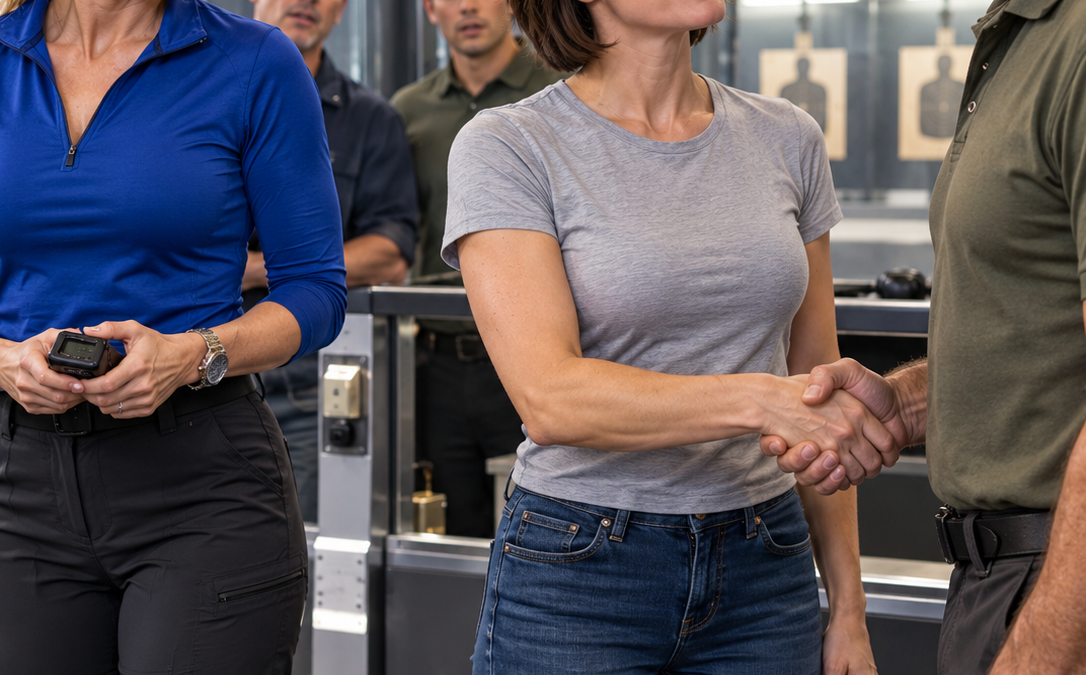
“Your turn,” Dana said, sliding the pistol onto the bench. “Let’s see what a staff officer can do.”
She had that smile again. Not a friendly one, but the kind she wore when she already believed she had won.
I looked at the pistol, then at the target hanging twenty-five yards downrange. Behind the thick observation glass, a gray-haired man had stopped what he was doing. He was looking at me.
At first, I didn’t recognize him.
But he was beginning to recognize me.
Dana tapped the bench with one finger. “Come on, Becca. Don’t make everybody wait.”
I reached for the pistol.
Twenty-four hours earlier, none of us had planned on being there.
The whole thing had started at my mother’s house outside Fayetteville, North Carolina. Mom was hosting one of those family cookouts that was supposed to be simple: burgers, potato salad, too many folding chairs, and at least three relatives asking questions they already knew the answers to.
I had driven over from Fort Bragg that afternoon. No uniform, no government vehicle, nothing that said Lieutenant Colonel Rebecca Hail except the haircut I’d had for so long that even my mother had stopped complaining about it.
Dana arrived about forty minutes after me.
My older sister was forty-four, four years older than I was, and she had been in the Army almost as long as I had. She was a major, and a good one, too.
That part mattered.
Dana wasn’t incompetent. She wasn’t some joke who had somehow survived two decades in uniform without learning anything. She knew logistics. She knew people. She could organize a movement plan faster than most officers could find the right spreadsheet.
What Dana had never learned was how to stop comparing herself to me.
She walked through the back gate carrying a bottle of wine for Mom and wearing sunglasses that probably cost more than my first car payment.
“Colonel,” she said when she saw me.
She always called me that around family. Never Becca, not when someone else was listening.
“Major,” I said.
She pulled off her sunglasses. “Still enjoying life in conference rooms?”
“Very much. Living the dream. Coffee’s free.”
My uncle Mark laughed from beside the grill.
Dana didn’t.
That was usually how our conversations worked. She threw something. I let it land. Then I moved on.
For years, I told myself that was maturity.
Sometimes it probably was.
Sometimes I was just making things easier for everybody else.
Dinner started normally. Mom asked about work, and I gave her the short version. Training schedules, readiness reviews, meetings, more meetings about the meetings. Nothing classified. Nothing interesting enough to ruin potato salad.
My aunt asked whether I still spent much time on ranges.
Before I could answer, Dana leaned back in her chair.
“Becca?” She laughed. “She spends more time with PowerPoint than gunpowder these days.”
A few people smiled.
I took a drink of iced tea. “She’s not completely wrong.”
Dana looked almost disappointed that I agreed.
Uncle Mark pointed his fork at me. “You used to shoot a lot, though, didn’t you?”
“I did.”
Dana jumped in again. “Twenty years ago.”
“Not quite.”
“Close enough.”
She smiled across the table. “I’ve probably spent more time on a range this year than she has.”
That was possible.
Dana had gotten serious about civilian shooting over the past year. Every few weeks, she posted pictures from another pistol course. New optic, new holster, new range bag. There was always a caption about fundamentals or standards or staying sharp.
Nothing wrong with any of that.
Training was good. Practice was good.
Dana’s problem was that every new class seemed to convince her she had discovered knowledge nobody else possessed.
Mom asked about the pistol course Dana had taken the previous weekend.
That was all the invitation she needed.
For the next ten minutes, Dana explained grip pressure, trigger reset, sight tracking, recoil control, and why most people wasted money on the wrong equipment.
Uncle Mark nodded like he was listening to a weather report.
My cousin Josh looked at me once and raised an eyebrow.
I kept eating.
Dana noticed.
“You disagree.”
“I didn’t say anything.”
“That usually means you disagree.”
“No. Sometimes it means I’m eating a burger.”
Josh coughed into his napkin to hide a laugh.
Dana gave him a look. Then she turned back to me.
“What are you carrying these days?”
“Nothing. I’m at Mom’s house.”
“You know what I mean.”
“I know.”
She waited.
I didn’t help her.
Dana had always hated silence when she wanted an audience.
Finally, Uncle Mark leaned forward.
“So, who’s actually better?”
Mom sighed immediately. “Mark.”
“What? They’re both Army.”
Dana smiled.
There it was. The opening she had been waiting for.
“Better at what?” I asked.
“Shooting,” Mark said.
Dana looked straight at me. “Me.”
Now she gave a short laugh.
I kept my face neutral.
Mark looked at me. “You letting her say that?”
“She can say whatever she wants.”
Dana leaned back. “See? She knows.”
“I know you’ve been practicing.”
“That sounded diplomatic.”
“I’m an officer. We take classes.”
A few people laughed again.
Dana’s smile tightened.
Then she said, “There’s a range I use outside Fayetteville. We can settle it tomorrow morning.”
Mom put down her fork. “There is nothing to settle.”
Dana ignored her.
“Come on, Becca. I’m good.”
“Of course you are.”
I looked at her.
“What’s that supposed to mean?”
“Nothing.”
She lifted her glass.
Then she added, “You’ve been behind a desk too long.”
There was a small pause around the table.
Dana kept going.
“You used to be good. I’ll give you that. Used to be.”
I almost smiled.
She had no idea how many times I had heard that exact kind of sentence from officers who thought an assignment changed everything you had learned before it.
Usually, I let them find out on their own.
Dana pointed toward me.
“Rank doesn’t help you on a firing line.”
“I never said it did.”
“No staff.”
“No staff.”
“No one calling you ma’am every five seconds.”
“Sounds peaceful.”
Mark laughed again.
Dana didn’t even look at him. She was focused on me now.
“Tomorrow. Nine o’clock.”
I shook my head. “I came here to see Mom.”
“And you’ll still see Mom.”
Mom raised one hand.
“I would actually prefer not to spend my birthday weekend watching my daughters compete with firearms.”
“That’s fair,” I said.
Dana laughed. “Becca, relax. It’s a range.”
“I am relaxed.”
“You look nervous.”
That one got me.
Not because it hurt, but because it was so obviously designed to.
Dana had spent years learning which buttons might work. And when one failed, she simply tried another.
She leaned closer.
“Come with me. I’ll show you what you’ve forgotten.”
I looked around the table.
Nobody was laughing now.
Mom looked tired. Josh stared at his plate. Uncle Mark suddenly seemed very interested in the grill.
And I realized I had seen this exact moment in different forms for years.
Dana took a shot. I ignored it. Everyone moved on.
Then she took another one the next time.
My silence had never made her stop.
It had only made the cost of doing it zero.
I set my glass down.
“Okay.”
Dana blinked.
I looked directly at her.
“Tomorrow.”
Her smile came back immediately.
“Good.”
She reached for her drink like the matter had been settled exactly the way she wanted.
Then she started explaining which pistol she planned to bring.
Dana was still describing the pistol when I realized she had already started treating tomorrow like a win.
She talked about the optic first, then the trigger, then the ammunition she had been testing because, according to her, most people never bothered to understand how much difference a load could make.
I listened for a while.
Not because I needed the lesson.
Because I knew where the conversation was going.
Dana had always liked being the one who knew first.
When we were younger, that made sense. She was four years older than me. She joined the Army about a year before I did, and for a while, she was the closest thing I had to a field manual with an attitude.
When I enlisted at eighteen, I called her constantly.
How early should I arrive? What should I bring? Was this normal? Was that sergeant actually angry, or did he just sound like that all the time?
Dana loved those calls.
And I needed them.
She showed me how to square things away that nobody at home understood. She explained the difference between looking prepared and actually being prepared.
She corrected the way I packed. She checked my boots when I came home on leave. Once, she spent twenty minutes fixing a crease in my uniform because she said I looked like I had slept in it.
She wasn’t wrong.
Back then, I looked up to her.
I never had a problem admitting that.
Dana was confident. She knew the system better than I did. When she spoke about the Army, I listened.
For a while, I followed the path she had already started.
Then our careers began moving in different directions.
Mine took me closer to training. Weapons, ranges, the kind of work where small mistakes mattered and the people around you noticed quickly if you didn’t know what you were doing.
I spent years learning fundamentals, then teaching them.
Nothing glamorous. No movie moments. Mostly repetition, standards, corrections, paperwork, maintenance issues, scheduling headaches, and trying to get twenty soldiers to listen at the same time.
That last part was usually harder than the shooting.
Dana stayed in logistics.
She was good at it. Very good.
She could look at a movement problem that gave everyone else a headache and start organizing it almost immediately. She understood systems. She understood supply. She understood how to get things where they needed to be when half the people involved had already made the process harder than necessary.
The Army needs officers like that.
A lot of them.
But Dana never seemed satisfied with being good at her own job if somebody thought I was good at mine.
That part came later.
I was selected for a commissioning program before she was.
It wasn’t something I had planned when I enlisted. A senior officer pushed me to apply. I almost didn’t.
Dana told me I should.
I still remembered her looking over my packet at her kitchen table and finding three mistakes before I sent it.
For a while, she was proud of me.
I think that was real.
The problem started when the distance between us changed.
I commissioned first.
Dana commissioned later, after spending more years enlisted. That meant she had more total service time. I had more commissioned service.
There was nothing strange about that.
Career paths don’t move in straight lines.
But family rarely sees the difference between complicated and simple.
They saw ranks.
I made captain. Dana was still a lieutenant.
Nobody said anything cruel.
Nobody needed to.
Dana heard comparison even when no one made one.
When I made major, she made major later. When I was selected for lieutenant colonel, my mother called half the family before I could stop her.
Dana called me that evening.
She said, “Congratulations.”
Then she added, “Good timing for you.”
Just like that.
Not rude enough to challenge.
Not warm enough to miss.
A few months later, at Thanksgiving, Uncle Mark asked what my new assignment involved.
Before I finished answering, Dana said, “Becca’s good at getting the assignments people notice.”
I remembered looking at her.
She had smiled like it was a joke.
That became the pattern.
If I earned something, there was always a reason it didn’t quite count.
Timing. Networking. Politics. Being visible. Knowing the right person.
I never heard Dana say I was incompetent.
She was smarter than that.
She just kept moving the credit one step away from me.
For years, I let her.
Partly because arguing would have made everything worse. Partly because she was my sister.
And partly because I still remembered the woman who fixed my uniform and answered my stupid questions when I was eighteen.
That version of Dana was easier to hold on to.
The cookout started breaking up around eight.
Mom brought out a cake nobody had room for. People ate it anyway. That was family tradition, too.
I was carrying plates into the kitchen when my cousin Josh followed me in.
He waited until the back door closed.
“Can I ask you something?”
“You just did.”
He stared at me.
I smiled. “Go ahead.”
He leaned against the counter.
“Does she always do that?”
I didn’t pretend not to know who he meant.
“Do what?”
“You know.”
He lowered his voice.
“Turn everything into a contest.”
I rinsed a plate.
“She’s competitive.”
“That’s not what I asked.”
Josh had always been annoyingly observant.
It was probably why I liked him.
I put the plate in the dishwasher.
“She’s my sister.”
He watched me for a second.
“That doesn’t answer it either.”
“No, it doesn’t.”
I dried my hands.
Josh nodded slowly.
Then he said, “For what it’s worth, tomorrow seems like a terrible idea.”
“Probably.”
“You’re still going?”
“Yes.”
“Why?”
I looked through the kitchen window.
Dana was outside talking to Uncle Mark. Her hands were moving as she described something about shooting.
She looked happy. Comfortable. Certain.
“Because if I don’t, she’ll bring it up for the next five years.”
Josh laughed.
“That is absolutely true.”
I smiled.
But that wasn’t the whole reason.
The whole reason was harder to admit.
Every time Dana pushed, I backed away.
Every time she made a comparison, I changed the subject.
Every time she turned a family dinner into a quiet scorecard, I acted like I couldn’t see it.
Maybe I thought refusing to compete meant there was no competition.
Dana clearly disagreed.
I drove home a little after ten.
My phone buzzed while I was brushing my teeth.
Dana.
9:00 a.m. Don’t back out.
I stared at the message.
A second one appeared.
And don’t worry. I’ll start you close.
I almost laughed.
Instead, I set the phone on the bathroom counter and looked at myself in the mirror.
Dana wasn’t inviting me to practice.
She wasn’t trying to spend time with me.
She wanted an audience.
More than that, she wanted a result.
For once, she wanted everyone in the family to watch me come in second.
I turned off the bathroom light, left the phone unanswered, and started thinking about what I would wear to the range.
I chose jeans, a plain gray shirt, and the same kind of shoes I would wear on any normal Saturday. No Army logos, no unit shirt, nothing that gave Dana another excuse to turn the morning into a rank comparison.
I left Fort Bragg early enough to stop for coffee and reached Mom’s house a few minutes before eight-thirty.
Dana was already there.
Of course she was.
Her range bag sat on the backseat of her SUV, packed so neatly it looked ready for inspection. She had a hard pistol case, a separate ammunition box, two sets of hearing protection, three magazines, a shot timer clipped to the outside of the bag, and enough accessories to suggest we were preparing for something more complicated than punching holes in paper.
Josh walked out of Mom’s house carrying coffee. He looked through Dana’s open rear door.
“Are we shooting or invading somewhere?”
Dana shut the door. “Being prepared isn’t a bad thing.”
“I brought my wallet.”
“You’ll survive.”
He looked at me. “See? I’m already learning.”
I laughed. Dana didn’t.
Mom had decided not to come. She said watching her daughters compete with loaded firearms was not how she planned to spend a Saturday morning. That was probably the healthiest decision anyone made all weekend.
Uncle Mark came with us. Josh did, too. I drove separately.
The range sat outside Fayetteville, far enough from the busiest roads that the gunfire didn’t bother anybody. It was privately owned, clean, and well maintained, the kind of place that took safety seriously without turning every rule into a speech.
A sign near the entrance listed the usual requirements: eye protection, hearing protection, muzzle awareness, no handling firearms behind the firing line, and immediate compliance with range officer commands.
Nothing unusual.
Dana walked through the front door like she had brought clients there before.
“Morning, Tyler.”
The young man behind the counter looked up.
“Morning, Major.”
Dana smiled slightly. She liked that.
She placed her case on the counter.
“Same bay?”
“If it’s open.”
“It is.”
He handed over the paperwork.
Dana turned toward us. “I told you. Good place.”
I picked up the waiver.
She glanced at me. “You don’t need to read every line, Becca.”
“I know.”
“You still are.”
“Yes.”
“Staff officer,” Josh whispered.
I looked at him. “Careful.”
He grinned.
Dana was already talking to Tyler about ammunition. She mentioned the optic on her pistol, then the trigger, then the course she had taken two weeks earlier.
Tyler listened politely. He had the expression of a man who had heard a lot of customers explain guns to him.
I knew that expression.
I had probably worn it myself a few thousand times.
Dana opened her pistol case after we entered the staging area. The handgun was expensive. Good optic, good sights, clean. Nothing wrong with it.
She noticed me looking.
“Want to try it first?”
“You go ahead.”
“I figured.”
There was no reason to answer that.
A range safety officer named Carlos gave us the briefing. Dana nodded through most of it before he finished each sentence. When he reminded us that all handling stayed forward of the line, she said, “We know.”
Carlos looked at her, then at me.
I gave him a small nod.
He continued.
Dana leaned toward me after he walked away.
“New guys always give the full speech.”
“He should.”
“I didn’t say he shouldn’t.”
“You sounded like you wanted him to hurry.”
“I’ve heard it before.”
“So have I.”
She gave me a look.
That ended that conversation.
The range had several lanes separated by ballistic dividers. Behind us, reinforced glass looked into an office and observation area. A gray-haired man stood inside talking with another employee.
He looked to be in his late fifties. Solid build, plain polo shirt, no tactical costume, no effort to look impressive. He glanced toward our group once, then returned to the conversation.
I didn’t recognize him.
At least, not yet.
Dana loaded her first magazine.
“Seven yards,” she said.
Uncle Mark stood behind the safety line. “That close?”
Dana looked over her shoulder.
“You start close and build speed.”
“See, this is why I asked.”
She smiled. “Watch.”
Dana stepped into the lane.
Her fundamentals were decent. Better than decent, actually. Good two-handed grip, reasonable stance. She found the dot quickly and fired five controlled rounds.
The group landed high center.
Not perfect, but good.
She lowered the pistol and looked back at us.
Mark nodded. “Okay, that looked pretty good.”
It was.
I looked at the target. “Nice group.”
Dana turned toward me. There was something almost suspicious in her face.
“You mean that?”
“Yes.”
She stared for another second, then faced the target again.
That was part of the problem.
Dana didn’t really want me to compliment her. She wanted me to be threatened. Those were different things.
She sent the target farther out and loaded another magazine. This time, she shot faster. The first few rounds stayed together. Then the group opened. One went left, another dropped lower than the others.
Still on target. Still perfectly respectable.
Dana looked at the paper. Her jaw tightened.
She loaded again.
Carlos stepped closer.
“Major, keep the pace where you can control it.”
“I’ve got it.”
“I know. Just keep it controlled.”
She nodded.
No argument, but I saw the irritation.
She fired another string.
Better.
Not as good as the first.
She lowered the gun.
“The dot’s washing out a little under these lights.”
Carlos said nothing.
Neither did I.
Josh leaned toward Mark. “I thought dots were supposed to help.”
Dana heard him.
“They do.”
“Okay.”
“They’re not magic.”
“Didn’t say they were.”
I bit the inside of my cheek. Josh was enjoying himself far too much.
Dana cleared the pistol and set it on the bench.
Then she turned toward me.
“All right.”
I took one step forward.
She held up a hand.
“Wait.”
I stopped.
Dana picked up the unloaded pistol.
“Let me show you something first.”
I looked at her.
She placed her support hand high against the grip.
“You want more contact here.”
I said nothing.
“And don’t crush it with your firing hand. Let your support hand do more of the work.”
Still nothing.
She adjusted her stance, leaning slightly forward.
“Not too much.”
Josh looked at me.
I ignored him.
Dana kept going.
“Watch the dot through recoil. Don’t stare at the target and wait for the gun to come back. Got it?”
She paused.
“You remember all this?”
“Some of it.”
That answer made her smile.
She handed me the pistol.
“Take it slow. Nobody expects a staff officer to shoot like she did twenty years ago.”
I accepted the handgun without responding.
Magazine out. Chamber clear. Muzzle downrange.
The controls were familiar enough. The balance was slightly different from what I usually preferred, but nothing that mattered.
I seated the magazine, racked the slide, and established my grip.
The joking behind me got quieter.
In the next lane, a man who had been loading a magazine stopped for a second and looked over. Behind the observation glass, the gray-haired man turned his head toward our bay again.
Dana was still standing a few feet behind me.
“Remember,” she said, “don’t fight the recoil.”
I settled into position. The pistol came up naturally.
Dana kept talking.
I stopped listening.
I let the sight picture, the dot, and the pressure in my hands do what they had done for years.
The first shot broke clean.
Then the second.
Then three more.
No rush. No show. Just five controlled rounds, with the pistol returning to the same place each time.
I lowered the gun and locked the slide back.
The target came toward us.
Nobody said anything until it stopped.
The group sat tight in the center. Not one hole, not some impossible trick. Just a clean group from somebody who had spent a lot of time learning not to waste movement.
Uncle Mark leaned forward.
“Well.”
Josh looked at Dana.
“That seems inconvenient.”
I turned my head.
“Josh.”
“What? I’m supporting both sides.”
“You’re enjoying this a little.”
Dana ignored him.
She looked at the target for several seconds, then shrugged.
“Slow fire.”
I waited.
She crossed her arms.
“That doesn’t prove much.”
“I didn’t know we were proving anything.”
Her jaw tightened.
That was probably the wrong answer.
Or maybe it was exactly the wrong answer for someone who wanted me to argue.
Dana pointed downrange.
“Try it faster.”
Carlos, the range safety officer, was standing a few lanes away. He heard her and looked over.
I glanced at him.
“You good with a controlled drill?”
He nodded. “Keep it simple. No movement. Stay in the lane.”
“Got it.”
Dana watched that exchange closely.
I think she expected me to announce some complicated drill. Maybe start naming standards. Maybe finally give her the competition she wanted.
I didn’t.
I changed the target, brought it to a reasonable distance, and loaded a fresh magazine.
Then I raised the pistol again.
This string was faster.
Not reckless. Not flashy.
The group opened because groups open when speed increases. That was normal.
It was still centered, still controlled, still inside what I wanted.
I cleared the pistol and placed it down.
Carlos glanced at the target, then at me.
“You shoot regularly?”
Dana answered for me.
“She used to.”
Carlos looked at her, then back at me.
“Looks like some of it stuck.”
Josh laughed.
Dana didn’t.
She walked closer to the target carrier.
“You’re pushing a little left.”
I looked at the holes from two rounds.
“Exactly.”
“You’re not going to fix it?”
“I’ll live.”
Dana stared at me like I had violated some basic law of competition.
“You’re not even going to correct it?”
“Of course I am.”
“You don’t seem bothered.”
“I’m not.”
That irritated her more than a bad group would have.
I could see it.
Dana wanted emotion. She wanted frustration. She wanted the version of me she had imagined on the drive over: rusty, defensive, trying to explain why I wasn’t as good as I used to be.
Instead, I was standing there talking about two slightly left shots like they were exactly what they were.
Two slightly left shots.
Nothing more.
Behind us, a door opened.
The gray-haired man from the observation area stepped into the range. He spoke briefly to Carlos, who nodded toward our lane.
The man looked at me again.
This time, he didn’t look away.
I noticed the way he stood. Not rigid, not trying to project anything, but balanced and comfortable. The kind of posture you saw in people who had spent years paying attention without looking like they were paying attention.
Something about him felt familiar.
I still couldn’t place it.
Dana reached for another magazine.
“All right, now let’s do something timed.”
“No.”
She looked at me. “What?”
“I’m fine.”
“You just did two slow drills.”
“I shot the gun.”
“That’s not a drill.”
“It involved a target and ammunition. I feel like it qualifies.”
Josh made a choking sound behind me.
Dana turned.
“Do you want to shoot?”
“No, ma’am.”
“Then stop laughing.”
“Yes, ma’am.”
He stopped for almost three seconds.
Dana turned back to me.
“I’m just saying, if we’re going to compare—”
“We’re not.”
She gave me a flat look.
Then a voice behind us said, “Hail.”
I turned.
The gray-haired man had stopped a few feet outside the lane.
He was looking directly at me now. Not at Dana, not at the target.
At me.
He narrowed his eyes slightly.
“Rebecca Hail?”
For a second, I only stared.
Then the face connected to a much older memory.
Different haircut. Less gray.
Same eyes.
Same habit of looking at people like he was checking whether they had become more or less sensible since the last time he saw them.
“Master Sergeant Mercer?”
His expression changed immediately.
He laughed once.
“That was a long time ago.”
I smiled. “It was.”
He stepped forward and held out his hand.
I shook it.
His grip was firm, normal, quick. No performance, no exaggerated reunion.
He looked me over once.
“Lieutenant colonel now?”
“Yes.”
He shook his head.
“Good for you.”
Dana was standing beside me.
She knew my rank. Everyone there knew my rank.
That wasn’t what made her go quiet.
It was the way Mercer said it, like he already knew enough about me to understand how much distance sat between the person he remembered and the person standing in front of him.
Dana looked from him to me.
“You two know each other?”
Mercer turned toward her.
“Years ago.”
Dana waited for more.
He didn’t give it.
She finally asked, “From where?”
Mercer looked back at me.
“Training environment. Long time back.”
I nodded. “That’s about right.”
He smiled.
“You were still enlisted.”
“I was.”
Dana’s face changed slightly.
Not shock. Calculation.
She knew I had been enlisted before commissioning. What she didn’t know was why this man remembered me.
Mercer glanced toward the target.
“Still shooting?”
“Not like I used to.”
He looked at the group again.
“Could’ve fooled me.”
Dana gave a small laugh.
“She’s had a good morning.”
Mercer looked at her, then at me.
“She was serious about this stuff long before she became an officer.”
Dana’s smile stayed in place.
Barely.
“You worked with her?”
“Some.”
He kept it simple.
No résumé. No war stories. No dramatic introduction.
Then he looked at the target one more time.
“She was good then, too.”
The smile disappeared from Dana’s face. Not all at once, just enough for me to notice.
Mercer turned back toward me.
“You still correcting people’s grip without hurting their feelings?”
I laughed.
“Less often now.”
Dana looked at me again.
This time, she wasn’t looking at my target.
She was trying to figure out how much of my past she had never bothered to ask about.
Dana kept looking at me, and I could almost see her rearranging the story she had told herself about me.
Mercer didn’t seem interested in helping her.
He turned toward Carlos.
“How’s the morning?”
“Busy, but clean.”
“Good.”
That was it. No speech, no dramatic explanation, no attempt to make me sound more important than I was.
Mercer had never been that kind of man.
That was probably why I remembered him.
Dana stepped closer.
“So what kind of training was it?”
Mercer looked at her.
“Marksmanship instructor development.”
“With her?”
“With a lot of people.”
Dana glanced at me.
“She never talks about that.”
I shrugged. “You never asked.”
Her mouth tightened.
“I knew you did range work.”
“That’s what I told you.”
“Not like this.”
“Like what?”
She didn’t answer, because there wasn’t really a good answer.
Mercer had recognized me. That was all. He remembered a younger version of me who had spent a lot of time around ranges, instructors, and soldiers who took standards seriously.
Dana was the one turning it into something bigger.
She looked at the target again, then at me.
“Fine.”
I knew that tone.
Fine never meant fine with Dana.
It meant she had found another way to keep going.
She picked up her shot timer.
“Let’s do something timed.”
I looked at the timer.
“No.”
Her eyebrows lifted.
“No?”
“I’m good.”
“You came all the way out here.”
“I shot.”
“You fired a couple of strings.”
“Yes.”
“That’s not really a comparison.”
“I didn’t come here for a comparison.”
Dana laughed. “Right.”
Mercer glanced between us.
He didn’t say anything.
Smart man.
Dana held up the timer.
“Same target. Same distance. Same number of rounds.”
“No.”
“Why not?”
“Because I don’t want to.”
She looked past me at Uncle Mark and Josh.
“You hearing this?”
Josh immediately raised both hands.
“I’m not involved.”
“You were laughing five minutes ago.”
“I can laugh and stay neutral.”
“That’s not how neutral works.”
“It is in my house.”
“We’re not at your house.”
“Then I’m even safer.”
I had to look away for a second.
Dana did not appreciate that.
She stepped closer to me.
“Come on, Becca. One timed run.”
“No.”
“What? Afraid I might beat you?”
I looked at her.
“No.”
She waited.
I could have left it there.
I probably should have.
Instead, I said, “I just don’t need to beat you.”
Something changed in her face.
Not anger at first. Something quicker, sharper, like I had said the one thing she wasn’t prepared to hear.
Dana gave a short laugh.
“Wow.”
“What?”
“That’s very you.”
“I don’t know what that means.”
“Of course you don’t.”
Carlos walked by and looked toward our lane.
“All good?”
“Yes,” I said.
Dana said, “Perfect.”
Carlos looked at her, then at me. He kept walking.
Mercer gave me the smallest nod toward the front counter.
I understood.
He was giving us room. More importantly, he was making sure this didn’t turn into something stupid with firearms involved.
I appreciated that.
I cleared the pistol one more time, set it down, and stepped away from the bench.
Dana stared at me.
“So that’s it?”
“For me, yes.”
“You came here, shot two decent groups, got recognized by somebody, and now you’re done?”
“I was done before he walked over.”
“That’s convenient.”
“What is?”
“Walking away when you look good.”
I looked at her for a moment.
“Dana, this is a commercial range, not the Olympics.”
Josh covered his mouth.
She turned on him.
“Seriously?”
“I didn’t say anything.”
“You’re making faces.”
“I have a face.”
Uncle Mark stepped between them with both palms out.
“All right, everybody, relax.”
Dana looked at him.
“I am relaxed.”
Mark nodded.
“Sure.”
That did not help.
Dana packed her magazines faster than necessary. The plastic trays clicked against each other. She zipped the range bag hard enough to make the zipper complain.
Nobody rushed her.
Nobody needed to.
The entire mood had changed. Ten minutes earlier, she had wanted an audience. Now she wanted out.
We said goodbye to Mercer near the counter.
He shook my hand again.
“Good seeing you, Hail.”
“You too.”
He looked at Dana.
“Major.”
She nodded.
“Sergeant.”
Mercer smiled.
“Retired.”
“Right.”
Her answer was polite.
Technically.
We walked outside.
The heat hit us immediately. North Carolina in summer had no patience for dignity.
Josh headed toward Mark’s truck.
Mark looked at me.
“I’m going to pretend I need gas.”
“You do that.”
He nodded toward Dana.
“Good luck.”
“Coward.”
“Absolutely.”
He got into the truck.
Dana waited until the doors closed.
Then she turned toward me.
“You knew?”
I looked at her.
“Knew what?”
“That he worked here?”
“No.”
“Come on.”
“I had no idea Mercer owned this place.”
“You expect me to believe that?”
“Yes.”
She laughed.
“Of course.”
I folded my arms.
“What exactly do you think happened?”
“You show up. You barely say a word. You shoot just well enough to make everybody stare. Then some former Delta guy walks out and acts like he’s known you forever.”
“He did know me.”
“That’s my point.”
“No. Your point keeps changing.”
Her face hardened.
“You always do this.”
There it was again.
A sentence that sounded like it had been waiting years for an excuse.
“Do what?”
“You act like none of it matters.”
“None of what?”
“The attention.”
“I didn’t ask for attention.”
“You never have to.”
I stared at her.
She kept going.
“People just remember you.”
“Dana—”
“No. That’s always how it works.”
Her voice was getting louder now. Not enough to draw a crowd, but enough that Josh looked through the truck window and then quickly looked away.
Dana pointed back toward the range.
“People like Mercer remember you. Senior officers remember you. Boards remember you. Somehow, your name is always in the right room.”
“You think that happens by accident?”
“I think you’ve always been very good at making sure the right people notice you.”
That landed differently.
Not because it was true.
Because I knew exactly what she was saying without saying it.
“You mean networking.”
“I mean whatever you want to call it.”
“Say what you mean.”
She looked away.
“That’s not what I said.”
“No. You’re careful.”
Her eyes came back to mine.
“What’s that supposed to mean?”
“It means you never say I didn’t earn something. You just make sure there’s always another explanation.”
“That’s ridiculous.”
“Promotion timing.”
“I never said you didn’t deserve it.”
“Assignments. Networking.”
“Everybody networks.”
“Evaluations. Right boss.”
“I didn’t say that.”
“You didn’t have to.”
She shook her head.
“This is exactly what I’m talking about.”
I almost laughed.
“What are you talking about?”
“You turn everything around.”
“I’m asking you questions.”
“You make people feel like they’re crazy for noticing how things work.”
I stepped closer.
“No. I’m asking why every good thing that happens to me needs a reason that has nothing to do with me.”
Dana said nothing.
So I asked the question that had been sitting between us for years.
“Why does everything I earn feel like something you lost?”
Her expression went still.
For one second, I thought she might finally answer me plainly.
Instead, she looked toward Mark’s truck, then back at me.
“Because somehow, every room we walk into becomes about you.”
I held her gaze for a second, then opened my car door instead of giving her the fight she wanted.
Dana laughed behind me.
Not because anything was funny.
Because she hated being left with her own words.
“You’re really just walking away?”
I looked back.
“We’re standing in a parking lot outside a gun range.”
“So?”
“So I’m not doing this here.”
“You started it.”
“I asked you one question, and then you acted like you had no idea what I meant.”
“I know exactly what you mean.”
That stopped her.
I got into my car.
Dana stood there another few seconds before turning toward her SUV.
By the time we returned to Mom’s house, neither of us had said another word.
Mom noticed immediately.
She always did.
She was carrying a bowl from the kitchen when Dana walked inside.
“How was it?”
“Fine,” Dana said.
Mom looked at me.
“Becca?”
“Range was good.”
Josh came in behind us.
“Educational.”
Dana turned toward him.
“Don’t.”
He raised his hands.
“I said one word.”
“One unnecessary word.”
“Most of mine are.”
Mom looked between all three of us.
“What happened?”
“Nothing,” Dana said.
I took a bottle of water from the refrigerator.
“Nothing that needs to happen in your kitchen.”
Mom gave me the look mothers have been using since the beginning of time, the one that says they know you’re avoiding something and are deciding whether to let you get away with it.
She let me.
For about four hours.
By dinner, everyone was back.
Mom had ordered barbecue because nobody wanted to cook again. We crowded around the table with paper plates, iced tea, sauces, and enough side dishes to feed an infantry company.
For the first twenty minutes, everything stayed normal.
Mark talked about work. Josh complained about traffic. My aunt told a story about her neighbor’s dog getting loose during a wedding.
I almost believed the day might settle down.
Then Uncle Mark looked at me.
“I still can’t believe that range owner remembered you.”
I stopped chewing.
Dana stopped, too.
Mark didn’t notice.
“He hadn’t seen you in what, fifteen years?”
“Something like that.”
Josh said, “That’s a long time.”
“It is.”
Mark shook his head.
“Guy must have a good memory.”
Dana put down her fork.
“He remembered a person from a training course. It’s not exactly historic.”
Nobody answered.
Mark looked at her.
“I didn’t say it was.”
“I’m just saying.”
She took a drink.
“People are acting like Becca walked in and some legend came out of retirement to salute her.”
I kept my voice even.
“Nobody saluted anybody.”
Josh looked down at his plate.
I could see his shoulders moving.
Dana saw it, too.
“Something funny?”
He shook his head.
“Nope.”
“Then stop.”
Mom spoke before Josh could answer.
“Dana, enough.”
“What?”
“Enough.”
Dana leaned back.
“I’m not doing anything.”
Mom gave her a long look.
I knew that look, too.
Dana apparently did not.
She turned toward Mark.
“Mercer remembered Becca. Great. Good for her. That doesn’t prove anything.”
Mark frowned.
“I don’t think anybody said it proved anything.”
“Then why are we still talking about it?”
Nobody had a good answer, because nobody had really been talking about it.
Dana had.
She looked at me.
“You must have made quite an impression.”
There it was.
That tone again.
Soft enough to deny.
Sharp enough to land.
I set my fork down.
“What do you mean?”
“You know what I mean.”
“No. Say it.”
Dana smiled.
“I’m complimenting you.”
“No, you’re not.”
Mom sighed.
“Please.”
I looked at her.
“I’m trying.”
Dana shook her head.
“This is ridiculous.”
“What is?”
“Every little comment turns into some interrogation.”
“You’ve been making the same comment for years.”
“What comment?”
“That nothing I accomplish is really about my work.”
Dana rolled her eyes.
“I never said that.”
“Not directly.”
“There you go again.”
“Promotion was timing.”
“It was good timing.”
“My assignment was networking.”
“I said networking matters.”
“My last evaluation was because I had the right boss.”
“I never said that.”
“You asked who my senior rater was and said, ‘Well, that explains it.’”
Dana paused.
Mark looked at her.
She noticed.
“That was a joke.”
“No.”
My voice stayed calm.
“That’s what you call it afterward.”
The table went quiet.
Dana’s face tightened.
“You’re seriously keeping a list?”
“I don’t need one.”
“Oh, please.”
“You repeat yourself.”
Josh looked at his plate again.
This time, I almost smiled.
Dana caught it.
“See, this is exactly what I mean. You do this calm little performance, and everybody thinks you’re reasonable.”
“I am being reasonable.”
“You’re being condescending.”
“I’m asking you to stop insulting me.”
“I didn’t insult you.”
“You implied I get ahead because the right people notice me.”
“That happens in the Army.”
“Yes. People notice performance.”
Dana laughed.
“Sometimes.”
I looked at her.
That one was clear enough.
“So say it.”
“Say what?”
“What you actually think.”
She stared back at me.
“I think you’ve always been good at making connections.”
“That isn’t what you mean.”
“It’s exactly what I mean.”
“Then why does every connection somehow explain every promotion?”
Dana pushed her plate away.
“Because you act like career success happens in a vacuum.”
“I’ve never said that.”
“Boards matter. Timing matters. Who knows you matters. Your work matters.”
“Of course.”
“Then why are you offended?”
“Because you only mention those things when the subject is me.”
That landed.
Dana opened her mouth.
Nothing came out.
I continued before she could change direction.
“When someone else gets promoted, you congratulate them.”
“That’s not true.”
“When I get promoted, you explain it.”
“Becca—”
“When someone else gets a good assignment, you call it a good assignment.”
“You’re twisting this.”
“When I get one, suddenly we need a seminar on networking.”
Dana looked around the table.
Nobody jumped in.
That bothered her. I could see it.
She pointed at me.
“You always make yourself the victim.”
“I’m not a victim.”
“Really?”
“Yes.”
I leaned back.
“I’m doing fine.”
That made her angrier.
Maybe because it was true.
Mom spoke quietly.
“Dana, she has a point.”
Dana turned toward her.
“Seriously?”
Mom didn’t move.
“I’ve heard you make those comments.”
“They’re jokes.”
Uncle Mark shook his head.
“Not all of them.”
Dana stared at him.
“You, too?”
Mark looked uncomfortable, but he didn’t back down.
“She’s right, Dana.”
The room changed.
Not dramatically. No shouting. No one stood up.
But Dana suddenly realized that the jokes she had been making for years were no longer invisible.
She looked from Mark to Mom, then to Josh.
Nobody smiled.
Her eyes came back to me.
“So this is what we’re doing now?”
“What are we doing?”
“Everybody gets to sit here and analyze me because you had a good morning at the range.”
“This isn’t about the range.”
“Of course it is.”
“No.”
I shook my head.
“The range just made it harder to pretend.”
Her expression hardened.
I kept going.
“I never took your career away from you.”
Dana froze.
“I never took one promotion from you. I never took an assignment. I never took credit for your work.”
Her eyes narrowed.
“You decided my career was a judgment on yours.”
She pushed her chair back an inch.
“You have no idea what you’re talking about.”
I looked at her.
“Then tell me why I’m wrong.”
Dana’s hand stayed on the edge of the table.
Her voice dropped.
“Because you don’t remember what it was like when you were the one following me.”
Dana kept her hand on the table and looked at me like I had just erased twenty years of history with one sentence.
“I remember,” I said.
“No, you don’t.”
“I remember calling you from basic training.”
“That’s not what I mean.”
“I remember asking you how to fix my uniform. I remember asking what to expect from my first unit. I remember calling you because I didn’t know if I was overreacting to things.”
Dana’s expression shifted just a little.
I kept my voice steady.
“I remember looking up to you.”
That stopped her.
Nobody else at the table moved.
Dana looked at me for a long second, then leaned back.
“Well, you stopped.”
There it was.
Not anger. Not sarcasm.
Something closer to resentment finally showing its real face.
“I grew up,” I said.
“That’s convenient.”
“It’s normal.”
“You know what I mean.”
“I think I do.”
She folded her arms.
“You were always asking me how things worked. You were always behind me. I was the one who knew the Army. I was the one who had already done it.”
“You had.”
“And then suddenly, you knew everything.”
“I never said that.”
“You didn’t have to.”
I almost laughed, but there was nothing funny about where this had gone.
Dana looked around the table.
“Everybody acts like this just happened naturally.”
“What did?”
“That she passed me.”
There was silence.
Mom looked down at her plate. Uncle Mark shifted in his chair. Josh didn’t move at all.
I looked at Dana.
“Passed you?”
She gave me a hard stare.
“You know exactly what I mean.”
“I want to hear you say it.”
Her jaw tightened.
“You commissioned before I did.”
“Yes.”
“You made captain before I did.”
“Yes.”
“You made major first.”
“Yes.”
“And now you’re a lieutenant colonel.”
“Yes.”
She laughed once.
Short. Bitter.
“There. Happy?”
“No.”
“Could’ve fooled me.”
I shook my head.
“You’re listing facts like I did them to you.”
“That’s not what I said.”
“It’s what it sounds like.”
Dana leaned forward.
“I had already been in the Army before you even signed your contract.”
“I know.”
“I had more time in.”
“You still do.”
“I had more experience in some things.”
She looked at me sharply.
“In a lot of things.”
“Okay.”
“You say that like you’re giving me credit.”
“I’m agreeing with you.”
“That’s exactly it.”
I stared at her.
“I honestly don’t know what answer you want.”
“I don’t want an answer.”
“Then what do you want?”
She looked away.
For the first time all night, Dana seemed less angry than cornered.
I knew that feeling. I had seen officers reach that point during hard counseling sessions. They came in ready to argue about one thing, then realized the problem was something else.
Usually something harder.
Dana rubbed one thumb against the side of her glass.
“You were supposed to follow me.”
The words were quiet, but everyone heard them.
I sat back.
Dana’s eyes stayed on the table.
“When you joined, you called me for everything.”
“I did.”
“You wanted my advice.”
“I did.”
“You cared what I thought.”
“I still do.”
She looked up.
“No, you don’t.”
“That’s not true.”
“You don’t need it.”
“That’s different.”
“To you.”
I let that sit for a second.
Then I said, “I did follow you.”
Dana frowned.
For a while, she just stared at me.
I continued.
“You went first. I learned from you. I asked questions. You helped me.”
Her face stayed hard.
“That didn’t stop being true because my career changed.”
“You make it sound so simple.”
“It is simple.”
“No, it isn’t.”
“It can be.”
Dana shook her head.
“Not when everybody keeps score.”
“Who?”
She pointed vaguely around the table.
“Family. People we serve with. Everybody.”
Uncle Mark frowned.
“I never kept score.”
Dana turned on him.
“You didn’t have to say it.”
“Oh, come on.”
“You don’t think people notice?”
“Notice what?”
“That she outranks me.”
Mark looked confused.
“Of course I notice. It’s literally her rank.”
“That’s not what I mean.”
He put down his fork.
“Dana, I’m not sitting around wondering why Becca has silver oak leaves and you don’t.”
Josh muttered, “I definitely wasn’t.”
Dana shot him a look.
He immediately picked up his drink.
“Bad time. Understood.”
I almost smiled.
Almost.
Dana looked back at me.
“You don’t get it.”
“Then explain it.”
She took a breath.
“When you made major, Mom called me afterward.”
Mom’s face changed.
“I called to tell you the news.”
“I already knew.”
“I didn’t know that.”
“That’s the point.”
Mom looked hurt.
Dana kept going.
“She was excited. Everybody was excited. And I was still a captain.”
“You were selected for major not long after.”
“That doesn’t matter.”
“It should.”
“It didn’t feel like it.”
There was the first honest sentence of the night.
No joke. No excuse.
Just the truth.
Dana stared down at the table.
“When you made lieutenant colonel, people started asking me when I was going to make it.”
I said nothing.
She looked at me again.
“Do you know what that feels like?”
“Yes.”
She laughed.
“No, you don’t.”
“I do.”
“How?”
“Because I’ve watched people junior to me get selected for things I wanted.”
“That’s not the same.”
“It’s close enough.”
“No, it’s not. Your little sister?”
I nodded slowly.
“Okay.”
Dana looked almost surprised that I didn’t argue.
I said, “So every time I moved up, you thought people were looking at you?”
“They were.”
“Some probably were.”
Her eyes narrowed.
“You think that helps?”
“No. I think it’s honest.”
I leaned forward.
“But what I don’t understand is why their opinion became my responsibility.”
Dana went still.
I kept going.
“If somebody asked you an insensitive question, that was on them.”
“You benefited from it.”
I stared at her.
“You think there was only room for one successful sister?”
Dana didn’t answer.
That was answer enough.
I looked around the table, then back at her.
“You had a good career before I ever commissioned.”
She said nothing.
“You still have one.”
“Easy for you to say.”
“No. It should be easy for you to say.”
Her face tightened again.
“You really don’t understand.”
“I understand more now than I did this morning.”
That made her look at me.
I kept my voice low.
“You weren’t trying to prove you could shoot.”
Dana’s eyes flicked away.
“You were trying to prove there was still something where I had to stand behind you.”
Nobody spoke.
She opened her mouth, then closed it.
I waited.
Dana finally said, “Every time you moved up, I felt like everyone was looking at me and wondering why I didn’t.”
The room stayed quiet.
I didn’t feel victorious.
I felt tired.
Because once she said it out loud, the last several years suddenly made a lot more sense. The jokes, the comments, the explanations, the need to turn every achievement into a technicality.
I looked at her.
“And that’s why you wanted tomorrow morning to go the way you planned.”
Dana’s eyes lifted to mine.
For the first time all evening, she didn’t deny it.
Dana looked away first, and for once, nobody rushed in to rescue her from the silence.
Mom started clearing plates. Uncle Mark helped. Josh suddenly became very interested in stacking cups.
I stayed seated.
Dana did, too.
For a few minutes, neither of us said anything.
There wasn’t much left to argue about.
Not that night.
I went to bed late and slept badly.
By seven the next morning, I was dressed and packing my overnight bag. I had a drive back to Fort Bragg. Work didn’t care about family tension. Monday morning would still arrive on schedule.
I zipped the bag and carried it toward the front door.
Dana was sitting on the porch.
Coffee in one hand.
No sunglasses. No performance.
She looked tired.
I stopped.
“Morning.”
She nodded. “Morning.”
I reached for the door.
“Becca.”
I looked back.
Dana stared into her coffee.
“You really think I’m jealous of you?”
It wasn’t a question.
“I think you told me that last night.”
“I said people compare us.”
“You said every time I moved up, you felt like you were falling behind.”
“That’s not exactly the same.”
“It’s close.”
She shook her head.
“You always do that.”
“Do what?”
“Reduce everything to one sentence.”
“Sometimes one sentence is enough.”
That almost made her smile.
Almost.
She set the cup on the porch railing.
“You don’t understand what it’s like.”
I stepped outside and closed the door behind me.
“What part? Being the older one?”
“I’m aware you’re older.”
“Four years.”
“I’ve been reminded.”
“Very funny.”
“You brought it up.”
Dana folded her arms.
“I was the one who went first.”
“I know.”
“I was the one people asked about.”
“I know.”
“I was the one Mom bragged about.”
“I know.”
“And then you came along.”
I raised an eyebrow.
“I was already alive.”
“You know what I mean.”
“I do.”
She looked annoyed, then tired again.
“I had one role in this family.”
“Dana, you had a whole life.”
“You know what I’m saying.”
“Yes.”
I set my bag down.
“You liked being the one ahead.”
She didn’t answer.
“That’s not a crime. But punishing me for catching up is different.”
“I didn’t punish you.”
I looked at her.
She exhaled.
“Fine. Maybe sometimes I pushed.”
“At the range?”
“That was a joke.”
“Was it?”
She looked at me.
I waited.
Dana opened her mouth, stopped, then looked toward the driveway.
“You were so calm.”
“What?”
“Yesterday.”
“I was at a range.”
“That’s not what I mean.”
She rubbed one hand over her forehead.
“You walked in like none of it mattered.”
“It didn’t.”
“That’s the part you don’t get.”
I stared at her.
She kept going.
“I’d been practicing for months.”
“I know.”
“I took classes.”
“I know.”
“I worked at it.”
“I know.”
“And you just walked in.”
Her voice tightened.
“No big speech. No fancy setup. You barely even talked.”
I said nothing.
“That made it worse.”
“Why?”
“Because you weren’t trying.”
“I was trying to shoot.”
“Well, you weren’t trying to beat me.”
“No.”
She gave a short laugh.
“Exactly.”
I leaned against the porch post.
“That still sounds like your problem.”
“It is.”
That surprised me.
Dana looked down.
“For once, I know that.”
The morning was quiet except for a truck passing somewhere down the road.
She picked up her coffee again.
“It felt like I cared more.”
“You did.”
She looked at me sharply.
I shrugged.
“You cared about winning. I didn’t.”
“That sounds arrogant.”
“It’s not meant to.”
“It does.”
“Okay.”
She shook her head.
“You see that?”
“What?”
“You don’t even defend yourself.”
“I’ve been defending myself for twelve hours.”
“No. You’ve been explaining me.”
“That’s fair.”
She looked at me for a second.
Then she said, “I wanted you to miss.”
I didn’t move.
Dana looked straight at me this time.
“At the range.”
I waited.
She swallowed.
“I wanted you to miss.”
No joke. No excuse. No careful wording.
Just the truth.
“I wanted you to step up there and be rusty.”
I said nothing.
“I wanted you to fumble the grip a little.”
Her voice got quieter.
“I wanted you to have trouble with the dot.”
I still didn’t answer.
“And I wanted everybody to see it.”
That one landed.
Not because I was shocked.
Because hearing it said plainly was different from suspecting it.
Dana looked embarrassed now. Not about the shooting, but about herself.
“I wanted one thing,” she said, “where everybody looked at me instead.”
I took a slow breath.
“Why?”
“Why? You know why.”
“No. Say it.”
She looked irritated again.
Then she stopped fighting it.
“Because I’m tired of feeling like the less successful Hail sister.”
“Nobody called you that.”
“I did.”
That was probably the most honest thing she had said all weekend.
I nodded.
“Okay.”
She frowned.
“That’s it?”
“What do you want me to say?”
“I don’t know.”
“I’m not going to tell you it’s fine.”
“I didn’t ask you to.”
“Good.”
I picked up my bag.
Dana stood.
“So what now?”
“Now?”
“Yes. What do you want, a counseling statement?”
She stared at me.
I smiled.
“That was a joke.”
“Not a good one.”
“I’ve heard worse.”
She folded her arms again.
“I’m serious.”
“So am I.”
I put the bag down one more time.
“You can be angry.”
She watched me.
“You can be jealous.”
Her jaw tightened.
“You can hate that I made lieutenant colonel first.”
“I don’t hate—”
“Dana.”
She stopped.
“You can feel whatever you feel.”
I kept my voice even.
“But you don’t get to use me as a target every time you’re unhappy with yourself.”
Her expression changed.
“You don’t get to turn family dinners into performance reviews.”
She looked away.
“You don’t get to question whether I earned my career because you’re unhappy with yours.”
“My career is fine.”
“Then act like it.”
That hit harder than I intended.
Dana’s eyes came back to mine.
I didn’t take it back.
“And if it happens again?”
She asked it quietly.
I answered the same way.
“I leave.”
Her eyebrows lifted.
“That simple?”
“Yes.”
“You’d walk out of Mom’s house?”
“If I need to.”
“Over comments?”
“Over a pattern.”
She stared at me.
I continued.
“At work, I outrank you.”
Dana’s face tightened.
“At this table, you’re my sister.”
I paused.
“I never needed one of those things to change the other.”
She didn’t answer.
“You did.”
Her arms dropped to her sides.
For the first time, Dana looked less angry than scared.
Not of me.
Of what her behavior might actually cost.
I picked up my bag again.
She said, “You’d really stop coming around?”
“If the price of showing up is pretending this is normal, yes.”
Dana looked toward the house.
Mom was moving around inside the kitchen. I could hear cabinets opening.
Dana rubbed her thumb along the rim of the coffee cup.
“I don’t know how to turn it off.”
I opened the car door.
“Then start by not feeding it.”
She looked at me.
I put the bag on the backseat.
“You notice the comparison, and you stop before you turn it into a comment.”
“That sounds easy.”
“It isn’t.”
“No kidding.”
I closed the rear door.
Dana stood beside the porch step, still holding the coffee.
I reached for the driver’s door.
“Becca.”
I turned.
Her voice was quieter now.
“What if I already messed this up more than I thought?”
Her question stopped me with my hand on the driver’s door.
I looked back at her.
“You probably did.”
Dana winced.
I wasn’t trying to hurt her.
She had asked for the truth.
“But that doesn’t mean you can’t stop making it worse.”
She looked down at the coffee in her hand.
“That’s not exactly comforting.”
“I’m your sister, not a motivational poster.”
That got a small laugh out of her.
Barely.
But it was the first one all morning that didn’t have an edge to it.
I opened the driver’s door.
“You don’t have to fix twenty years before breakfast.”
Dana nodded.
“What do I fix first?”
“Today.”
She looked at me.
“Just today. That’s usually enough to keep people busy.”
I got into the car.
Dana stayed by the porch while I started the engine.
Neither of us waved.
That would have felt too neat.
I drove back toward Fort Bragg with the radio low and the windows up against the heat.
The farther I got from Mom’s house, the easier it became to think about the weekend without Dana standing ten feet away.
I wasn’t angry the way I expected to be.
Mostly, I was tired.
For years, I had treated Dana’s comments like bad weather. Annoying, predictable, not worth arguing with. I had assumed that refusing to react meant I was refusing to participate.
Now I wasn’t so sure.
Sometimes silence ends a fight.
Sometimes it just lets the other person keep talking.
Monday morning put me back where I understood the rules.
A training readiness meeting started at eight. By 8:05, somebody had already brought up a scheduling conflict. By 8:10, three people had different versions of the same requirement. By 8:15, I remembered why coffee existed.
I sat at the conference table with officers and senior NCOs from different backgrounds. Some had more operational experience than I did. Some had less.
One colonel across from me had forgotten more about large-scale training management than I would probably ever know. A master sergeant two seats down could look at a range plan for thirty seconds and find three problems everybody else had missed. A captain briefing one section was younger than me by more than a decade and knew that particular system better than anyone in the room.
Nobody found that threatening.
Why would we?
The point was to get the work right.
The captain knew something I didn’t, so I listened. The master sergeant corrected one of my assumptions, so I changed it. The colonel challenged the timeline, so we fixed the timeline.
Nobody lost anything.
That thought stayed with me longer than it should have.
Dana had spent years looking at ability like there was only a fixed amount available. If I had more, she had less. If somebody respected me, that respect had somehow been taken from her. If I advanced, she had fallen behind.
But sitting in that room reminded me how impossible that way of thinking was.
The Army would be unbearable if everybody treated somebody else’s competence as a personal insult.
It was already difficult enough without adding sibling psychology.
Around lunch, I returned to my office and found a message on my phone from a number I had saved the day before.
Mercer.
Good seeing you again. You still have the fundamentals.
That was the entire message.
No long story. No praise that needed framing.
Just one professional recognizing another after a lot of years.
I smiled.
Then I typed back.
Good seeing you too. Thanks for not making my family situation worse.
His reply came a minute later.
I’ve owned a range long enough to know when to step away from a family argument.
I laughed out loud.
The captain working outside my office looked in.
“You okay, ma’am?”
“I’m fine.”
“Yes, ma’am.”
He disappeared immediately.
Smart captain.
I put my phone down.
What Mercer had done at the range kept bothering me for a different reason.
He hadn’t tried to impress anyone. He didn’t need Dana to know where he had served. He didn’t need me to talk about what I had done.
He remembered me because we had worked in the same professional environment years earlier.
That was enough.
Dana had spent the morning trying to manufacture exactly that kind of credibility.
Mercer simply had it.
And I realized that was probably part of what had bothered her.
You can buy better equipment. You can take another course. You can get faster. You can improve.
But respect built over years cannot be demanded in one afternoon.
The week kept moving.
Tuesday was busy. Wednesday was worse.
By Thursday, I had almost convinced myself Dana wasn’t going to contact me.
That was fine.
I meant what I had told her. A boundary wasn’t useful if I needed an immediate apology to feel good about setting it.
She needed time.
So did I.
Thursday evening, I was heating leftovers when my phone buzzed on the counter.
Dana.
I looked at the screen before opening the message.
I was out of line at the range.
I read it twice.
Then I waited.
A second message appeared about a minute later.
And at dinner.
That was all.
I kept looking at the screen.
Something was missing.
At first, I couldn’t identify it.
Then I did.
There was no but.
No but you embarrassed me.
No but everyone was against me.
No but you know how Mom compares us.
No but Mercer made me look stupid.
Just two sentences.
I had spent years hearing Dana apologize with an escape hatch built into the middle.
Sorry, but…
I shouldn’t have said that, but…
I didn’t mean it that way, but…
This time, there was nowhere to hide.
I typed a response.
Deleted it.
Typed another.
Deleted that, too.
Finally, I sent four words.
We don’t have to compete.
The message showed delivered.
No answer.
I put the phone down and went back to the kitchen.
Five minutes passed.
Then ten.
I started eating.
The phone buzzed again.
I know.
I read it.
Another message arrived.
I’m trying to get there.
I rested my fork on the plate.
For the first time in years, Dana had admitted she was the one who needed to move.
Not me.
Not the promotion system.
Not our family.
Not some senior officer who happened to remember my name.
Her.
And sitting alone at my kitchen table, I started thinking about how many years I had spent believing the only mature response to jealousy was silence.
That last message stayed with me longer than anything that happened at the range.
Not because Dana suddenly changed.
She didn’t.
People don’t erase years of jealousy with two texts and a quiet apology.
But for the first time, she had stopped blaming everyone else for how she felt.
That mattered.
I kept thinking about something I had believed for most of my Army career.
Real competence doesn’t need to shout.
I still believe that.
Some of the best soldiers I’ve worked with were also some of the quietest people in the room. They didn’t need to remind you what they had done. They didn’t need to make somebody else look weak just to feel strong.
Their work spoke for them.
But what happened with Dana taught me something else.
Being humble does not mean allowing people to disrespect you forever.
For years, I thought ignoring her comments made me mature.
Sometimes it did.
Other times, my silence simply taught her that there would be no consequence for saying the next thing.
There is a difference between refusing to fight and refusing to stand up for yourself.
I didn’t understand that soon enough.
Dana’s jealousy also taught me how dangerous comparison can become.
I have spent more than twenty years in the military. During that time, I have worked beside people who were better than me at things I cared about.
Some were stronger. Some were faster. Some were better shooters. Some understood leadership in ways I was still learning. Some got opportunities I wanted.
That never made their success an attack on me.
It gave me something to learn from.
If every talented person around you feels like a threat, you eventually stop learning from good people and start hoping they fail.
That was what happened to Dana.
At some point, she stopped wanting to improve beside me.
She started wanting me to lose.
The strange part was that I had never been competing with her.
Her promotion did not take anything from mine. My rank did not erase her service. Her experience did not become less valuable because someone remembered my name.
There was room for both of us to succeed.
She just couldn’t see it anymore.
And that lesson goes far beyond the military.
Families do this all the time.
One sister gets the promotion. One brother buys the house first. One cousin earns more money. One person gets married. Someone else gets praised.
Suddenly, what should have been a happy moment becomes a scoreboard.
That is how ordinary family drama turns into resentment.
And if nobody stops it, resentment becomes behavior.
Jokes get sharper. Compliments disappear. Achievements get minimized.
Eventually, somebody starts hoping the other person falls.
That is where a lot of family revenge stories really begin.
Not with one huge betrayal, but with years of small comparisons that nobody deals with.
I also learned something about revenge itself.
For a long time, people imagine revenge as making the other person suffer. Taking something away. Embarrassing them. Destroying their career.
I didn’t need any of that.
I didn’t want Dana to lose her rank. I didn’t want her commanders involved. I didn’t want the Army to punish her for being jealous of her younger sister.
She needed to face herself.
That was enough.
The most satisfying moment wasn’t when I shot better than she expected. It wasn’t when Daniel Mercer recognized me. It wasn’t even when Dana finally admitted she had wanted me to miss.
It was when I stopped accepting the idea that I had to make myself smaller to keep her comfortable.
That changed something in me.
And if you have someone in your life who treats your success like their personal failure, remember this.
You do not owe them failure.
You do not have to apologize for something you worked hard to earn. You do not have to hide your progress because somebody else is uncomfortable with their own.
Stay humble. Stay respectful.
But set boundaries.
And if you recognize yourself in Dana, that matters, too.
Maybe you have looked at a sibling, coworker, or friend and wondered why they were moving faster than you. Maybe their success made you feel embarrassed.
That feeling doesn’t make you a terrible person.
What you do with it matters.
Use it to improve. Ask questions. Learn. Work harder.
But do not turn somebody else’s life into the scoreboard for your own.
Daniel Mercer had not seen me in years.
When he recognized me at that shooting range, he didn’t remember my rank first.
He remembered how I worked.
That stayed with me.
Titles change. Assignments change. People retire.
But the way you carry yourself sticks with people.
That is true in military stories. It is true in family revenge stories. And it is true in ordinary life.
Dana walked into that range hoping I would miss.
I walked out realizing I had been missing something, too.
I thought staying quiet always made me the bigger person.
Sometimes it only teaches people how much disrespect you are willing to take.
If this story meant something to you, subscribe to the channel. We tell revenge stories about military service, family drama, jealousy, betrayal, respect, and the moments when people finally have to face the truth.
And if you have ever had someone treat your success like it was their failure, tell me about it in the comments.








