My sister slapped me in front of my team. she didn’t know every camera on that navy range was recording… or that hitting a female navy seal would… end her career.
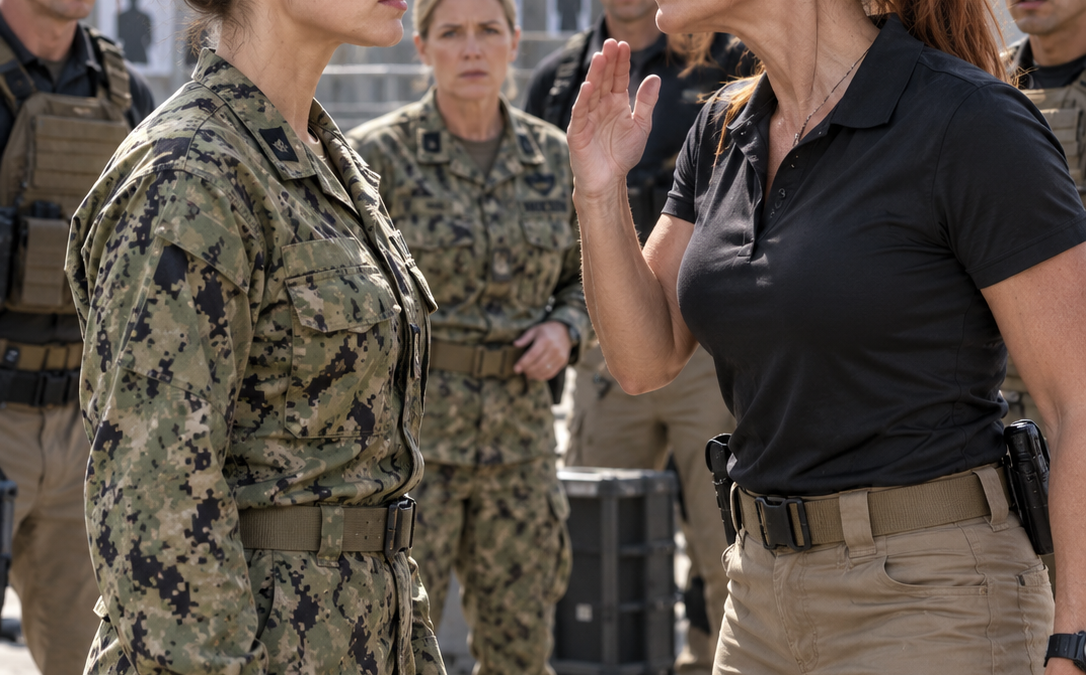
The slap cracked across the range so sharply that even the men wearing hearing protection turned their heads. For three full seconds, nobody moved.
Lieutenant Sienna Whitmore’s face snapped to the side. Her teeth cut into the inside of her lip, and she tasted blood before she felt the pain. The training M4 slipped from her hands and struck the concrete with a hard plastic clatter.
Then came the silence.
It was not the ordinary silence of people waiting for instructions, exhausted from training, or simply too bored to speak. This was the kind of silence that settled when every trained professional in the same place witnessed a mistake so reckless, so public, and so legally disastrous that their minds needed a moment to catch up with what their eyes had just seen.
Amber Whitmore stood directly in front of her, breathing hard.
Amber was Sienna’s oldest sister. She was also a former Marine staff sergeant and, on that particular morning, the senior civilian contractor leading a four-person training team at a Naval Special Warfare range outside San Diego.
That was the distinction Amber seemed to have forgotten.
She had not slapped her younger sister in a kitchen during Thanksgiving dinner. She had not struck her in a parking lot after a family argument. She had slapped a commissioned Navy officer on an active military training range, in front of Navy SEALs, contractor personnel, range staff, security cameras, and a commander who had watched the entire incident unfold from less than twenty yards away.
Excellent planning. Truly first-rate decision-making.
Amber’s hand remained suspended in the air, as though even her body had not yet caught up with what she had done. Her face was flushed, but not with fear. Not yet. The color came from pride, fury, and the stubborn conviction that being the loudest person in the Whitmore family still gave her authority over everyone else.
Sienna slowly brought her head back to center.
She did not swing back. She did not shout. She refused to give Amber the family fight her sister so clearly wanted. Instead, she blinked once, worked her jaw, and pressed her tongue against the cut inside her mouth. A thin line of blood slipped from the corner of her lip.
Behind Amber, the three other contractors stood frozen.
Grant Keller, broad-shouldered and clean-shaven, a former Army soldier, had one hand half-raised, as though he had considered intervening before remembering how much he enjoyed being employed. Derek Malloy stared at the ground. Luis Ortega looked from Sienna to the cameras and then toward Commander Patricia Hayes.
Smart man.
Cameras presented a serious problem when your team leader had just transformed a professional range evaluation into an episode of family court, with weapons conveniently nearby.
“Contractor Whitmore, step back.”
Commander Hayes’s voice cut across the concrete.
Amber did not move.
That was her second mistake.
Her first had been assuming that Sienna’s quietness meant weakness. Amber had made that mistake for years, at family dinners, birthday celebrations, during telephone calls, and in front of cousins, neighbors, and anyone unfortunate enough to be trapped near a Whitmore family gathering when Amber felt she had something to prove.
To Amber, Sienna was still the quiet little sister. The one who never fought to have the last word. The one who let rude remarks pass without protest. The one who lowered her eyes toward her dinner plate when Amber began talking over her.
Amber had never understood the difference between silence and surrender.
The Navy understood it. Sienna’s SEAL team understood it. Every man on that range who had trained beside her knew exactly what her silence meant.
It meant she was listening. It meant she was measuring distance, evaluating movement, and choosing the response that would cause the least damage.
Amber glanced at the blood on Sienna’s mouth and smiled.
It was a small smile, barely noticeable, but Sienna saw it. Of course she did.
Amber leaned closer and lowered her voice, though not nearly enough to keep the others from hearing. She still wanted an audience. Amber always wanted an audience.
“Don’t look at me like that,” she said. “You’re still my little sister.”
Those words landed harder than the slap.
Not because they hurt more, but because they explained everything.
To Amber, this confrontation had never been entirely about the range. It had never been only about a score, safety procedures, tactical evaluations, or which team moved more efficiently through the shoot house.
It was about control.
Amber had walked onto Sienna’s range and discovered something she could not tolerate: her younger sister possessed authority. Real authority. Not the kind that came from organizing birthday seating arrangements or deciding who carved the Thanksgiving turkey, but authority supported by military rank, training, command structure, and the deeply inconvenient reality that professional competence mattered more than volume.
Sienna looked at her sister for another moment.
“Not on my range.”
Three words, delivered quietly and without drama.
That made everything worse for Amber.
If Sienna had screamed, Amber could have called her unstable. If she had cried, Amber could have dismissed her as weak. If she had struck back, Amber could have declared herself the victim before the red mark on Sienna’s cheek had even finished forming.
But Sienna gave her nothing useful. Only blood, self-control, and a statement Amber could not reasonably dispute.
Commander Hayes approached, her boots striking sharply against the concrete.
“Contractor Whitmore, this is your final instruction. Step back. Now.”
The word contractor mattered.
Hayes had not called her Staff Sergeant. Amber was no longer serving in the Marine Corps. She held no military command authority here, outranked nobody on the range, and operated as a civilian contractor inside a controlled military training environment.
She had just assaulted a Navy lieutenant during an official evaluation.
Amber’s jaw tightened.
There it was again, that familiar flash in her eyes. The part of her that could not endure correction in public. The part that had started this entire disaster long before the final score was posted, before the first slap, and before the first live simulation.
Sienna noticed her sister shift her weight.
Left foot forward. Right shoulder rising. Hand lifting again.
The first slap had been a shock. A second would be a deliberate decision.
“Amber, stop,” Sienna warned quietly.
Everyone heard her.
Even Grant muttered, “Amber, don’t.”
Too late.
Amber’s palm came up fast, aimed at the same side of Sienna’s face. Apparently, once she discovered a terrible idea, her instinct was to repeat it in front of additional witnesses.
Sienna moved before the hand could land.
There was no angry outburst, no wild counterstrike, and no dramatic speech. Her left hand caught Amber’s wrist while her right controlled the elbow. She stepped away from the line of attack, turned her hips, and redirected Amber’s own forward momentum.
Amber lost her balance.
One moment, she stood over Sienna as though she still controlled the room. The next, she was on the concrete, her face turned sideways, one arm pinned and her shoulder secured at an angle that made further resistance an extremely poor choice.
Sienna did not slam her down. She did not strike her or grind her face into the ground. She applied exactly enough pressure to prevent another attack and not an ounce more.
That distinction mattered.
Many people failed to understand it. Force was not the same as anger, and control was not the same as revenge.
Sienna knew precisely how much pressure was needed to restrain Amber without causing injury. She also knew how much additional pressure would be required to break something. She chose the first option because, unlike her sister, she understood consequences before they arrived.
Amber gasped, sounding more offended than injured.
“Get off me!”
“Stay down,” Sienna instructed.
Commander Hayes raised her voice.
“All personnel, stand down. Nobody moves!”
For one brief second, it seemed the situation might end there.
Amber had made a reckless decision. Sienna had stopped the second attack. Security was already moving, and the commander had control of the range. Amber could have remained still, stopped talking, and allowed the investigation to determine how badly the morning would affect her future.
But Amber Whitmore had built an entire personality around never admitting she was wrong in public.
Now her younger sister had put her on the concrete in front of the contractors she was supposed to lead.
Naturally, Amber chose the worst possible thing to say.
“She’s attacking me!” she shouted. “Get her off me!”
Grant Keller stepped forward.
Then he took another step, looking confused, angry, and dangerously committed to not thinking through what he was doing.
Sienna released Amber’s arm and rose to one knee, already turning toward the movement.
“Do not touch me.”
Grant kept advancing.
Brilliant.
Behind him, Malloy shifted as well, following Amber’s direction because she was his team leader. Bad leadership spread quickly when people stopped using their own judgment.
“Keller! Malloy! Stand down!” Hayes shouted.
Grant reached toward Sienna’s shoulder.
His hand never reached her.
Sienna moved to the outside, caught his wrist, and redirected his momentum rather than meeting strength with strength. Grant stumbled forward directly into Malloy, who had been attempting to approach from the other side.
They collided shoulder to chest and went down in an untidy tangle of boots, elbows, and instant regret.
Nobody on the SEAL team laughed.
A few clearly wanted to. Their expressions gave them away. But they remained professional, and besides, paperwork was coming. Paperwork had a remarkable ability to destroy comedy.
Sienna backed away two steps, both palms open.
“Stay where you are.”
Her voice was not loud, but it carried with the clarity of someone accustomed to being heard when it mattered.
Amber was getting to her feet behind her.
Sienna heard it before she saw it: a boot scraping the concrete, an uneven breath, a curse muttered between clenched teeth. She did not turn completely. Instead, she angled her body just enough to keep Amber in her peripheral vision while watching Grant and Malloy struggle upright.
That was the difference between the sisters.
Amber saw only humiliation.
Sienna saw the entire range.
People. Weapons. Angles. Distance. Security. Cameras.
And the training rifle rack six steps behind Amber.
The same rack her sister had already glanced at twice.
Commander Hayes had noticed it too.
“Amber,” she ordered, her voice suddenly sharper, “move away from that rack.”
Amber froze.
For half a second, something changed in her expression. It was not guilt.
It was calculation.
Sienna lowered her hand slightly. Not toward her sidearm. Not yet. Just enough to prepare herself.
Amber stared at her, blood beneath her nose, dust on her sleeve, and years of resentment burning through her eyes. It was the kind of hatred that had spent a long time waiting for a stage large enough to display itself.
“You always do this,” Amber said. “You stand there quiet and let everyone think you’re better than me.”
Sienna did not respond.
Amber took one step backward, then another, edging toward the rack.
The entire range seemed to tighten around them.
Nobody wanted more violence. But every trained person there understood how quickly a reckless morning could become a career-ending, life-altering disaster when wounded pride moved within reach of a weapon.
Sienna kept watching Amber’s hands.
“Contractor Whitmore, stop moving,” Commander Hayes ordered.
Amber smiled as though she still possessed one final card to play.
Sienna knew with cold certainty that her sister had not learned anything.
Amber’s fingers hovered near the rifle rack, close enough that everyone on the range seemed to forget how to breathe normally.
Sienna watched her hand.
Not her face. Not her mouth.
Her hand.
Faces could lie. Mouths could perform. Hands revealed what a person was preparing to do.
And Amber Whitmore had always been a performer.
Sienna knew that better than anyone.
Long before Amber became a civilian contractor, before she was a Marine staff sergeant, and before she developed the habit of wearing wraparound sunglasses indoors as though every hallway were a tactical operation, she had been the oldest Whitmore daughter.
Inside the Whitmore household, being the oldest meant Amber possessed a microphone.
Not a literal microphone. She never needed one.
Amber could dominate a room while holding nothing more impressive than a dinner fork and telling a half-finished story about traffic. She could turn a birthday celebration into a professional status report about her career. She could make the Thanksgiving table feel like a courtroom in which she served simultaneously as judge, jury, and an argumentative cable-news commentator who never stopped talking.
Sienna learned early that arguing with her sister was like feeding money into a vending machine that never dispensed the snack.
You put energy in and got noise back.
Eventually, Sienna stopped feeding it.
That only made Amber worse.
To Amber, silence did not indicate maturity. It signaled weakness. It proved Sienna had nothing worth saying, that the younger sister still understood her place.
Know your place.
Amber loved that phrase, though she rarely said it directly in front of the entire family.
Instead, she disguised it.
“You’re still the baby.”
“Let the adults talk.”
“You were always the quiet one.”
“Don’t act like you run the room.”
Soft words with sharp edges.
Their parents interpreted them as ordinary teasing between sisters. Their cousins laughed because laughter was easier than making dinner uncomfortable. Sienna usually let the remarks pass because she had no desire to turn every family gathering into a full-contact sport.
Amber mistook that restraint for surrender.
A serious mistake.
The complicated part was that Amber was not incompetent. That would have made everything easier.
She had been good at her work in the Marine Corps. She had earned respect, reached the rank of staff sergeant, and led people under pressure. She understood field discipline whenever she chose to apply it. She could plan, brief, move, and command a team through difficult conditions.
Her downfall would not come from a complete absence of ability.
It would come from pride.
The dangerous kind that took genuine skill and poisoned it.
After leaving the Marine Corps, Amber became a senior civilian military contractor. Her company supported tactical training, security preparation, and overseas contract readiness.
The position paid well and gave her authority again. It allowed her to keep one boot in the military world without remaining subject to exactly the same chain of command.
Amber liked that arrangement enormously.
She enjoyed beginning stories with “Back when I was in,” while submitting invoices that made her civilian friends blink twice. She loved telling people she still worked with special operations units, even when her actual responsibilities usually involved training assistance, support evaluations, or related contractor work.
It was close enough to sound impressive and far enough from the details that nobody at Thanksgiving could easily challenge her.
Then there was Sienna.
Lieutenant Sienna Whitmore. Naval Special Warfare. Navy SEAL.
Quiet, controlled, difficult to read.
She was the sort of person who came home for Christmas carrying one small duffel bag, helped wash dishes, asked everyone else about their lives, and volunteered almost nothing about where she had been.
That drove Amber nearly insane.
Amber needed attention to confirm her importance. Sienna did not.
Their family knew Sienna served in the Navy. They understood that she had undertaken assignments she could not discuss. They knew she trained constantly, deployed frequently, and missed weddings, birthdays, baby showers, and the family occasions where Amber particularly enjoyed reminding everyone who had attended and who had not.
But Sienna never delivered speeches about sacrifice. She did not correct every foolish military observation made around the dinner table, and she never presented herself as a hero.
Amber watched that behavior and concluded there was no hero there at all.
Just a uniform. Just a title. Just another instance of people making Sienna seem exceptional because she was quiet enough to let them imagine whatever they wanted.
A few weeks before the range incident, the Whitmore family gathered for dinner at their parents’ house in Riverside County.
It was nothing elaborate: grilled chicken, salad, and a store-bought pie everyone politely pretended was homemade because Sienna’s father had taken the trouble to put it on a serving plate.
Amber arrived late and made certain everyone noticed.
She came through the door wearing contractor pants, a fitted black polo embroidered with her company logo, and sunglasses balanced on top of her head, despite the fact that the sun had set more than an hour earlier.
“Long day,” she announced, dropping her keys onto the kitchen counter. “Some of us still work for a living.”
Sienna was standing at the sink rinsing plates.
She said nothing.
Amber kissed their mother on the cheek, hugged their father, and turned toward the table.
“We might have a big evaluation coming up,” she said. “Naval Special Warfare facility down near San Diego. If it goes well, the company could pick up a serious contract.”
Their father looked impressed.
“That’s good, Amber.”
“It’s more than good,” she replied. “It’s the kind of thing that puts people in the right rooms.”
Sienna placed a clean plate in the drying rack.
Amber noticed.
Of course she did.
“You’re down there sometimes, right?” she asked.
Sienna dried her hands.
“Sometimes.”
Amber gave a knowing smile.
“That’s all we get? Sometimes?”
“That’s all I can give.”
Amber laughed, but there was nothing particularly friendly about it.
“Always mysterious.”
Sienna reached for another plate.
“The facility has strict procedures. Whoever goes should be ready for a serious safety review.”
It was not an insult. It was not a challenge. It was simply a warning.
Amber heard it as a slap weeks before she raised her own hand.
She leaned back in her chair.
“Relax, little girl. Some of us were clearing rooms before you learned how to salute.”
One of their cousins chuckled.
Poor survival instinct.
Sienna turned off the faucet and looked at her sister.
“Then you know safety won’t be optional.”
That was all.
Eight words. Plain, calm, and correct.
Amber’s smile remained in place, but something behind her eyes changed.
Their mother stepped in immediately, because mothers had a way of sensing family tension with the accuracy of dogs detecting an approaching thunderstorm.
“Who wants pie?”
Nobody had ever needed pie more urgently than that particular dinner table.
Amber took a slice anyway.
For the remainder of the evening, she talked about contracts, money, travel, and how civilian work was where the real operators ended up once they became tired of government nonsense.
Sienna let her talk.
She had an early drive the next morning and no reason to inform Amber that the evaluation near San Diego was already on her own schedule.
Not as a visitor. Not as an observer standing quietly in the background.
She was one of the officers responsible for safety and tactical assessment.
Amber would discover that when she entered the briefing room.
And that was exactly what happened.
On the morning of the evaluation, Amber walked into the facility as though she owned the building.
Three contractors followed her, all carrying themselves like men with enough operational experience to be confident and enough contractor income to be slightly irritating about it.
Grant Keller. Derek Malloy. Luis Ortega.
Good résumés. Real experience. None of them amateurs.
Amber led the group through check-in, signed the required visitor and contractor access paperwork, passed through security, and joked with the desk sergeant as though she belonged there.
Then she entered the briefing room.
Sienna stood at the front.
Her uniform was immaculate, her hair secured neatly, her expression neutral. Lieutenant’s bars were visible on her uniform, a clipboard rested in one hand, and Commander Patricia Hayes stood beside her.
Amber stopped for half a step.
Only half.
But Sienna noticed.
Amber recovered quickly. She usually did.
“Well,” Amber announced, loudly enough for her entire team to hear, “look who got herself a clipboard.”
Sienna did not smile.
“Good morning, Contractor Whitmore.”
The greeting struck Amber harder than she expected.
Not Amber. Not sis. Not even Staff Sergeant, because Amber no longer held that position.
Contractor Whitmore.
Professional. Accurate. Entirely unacceptable to a woman who had built so much of her identity around being addressed by something more impressive than her current job title.
Amber’s lips tightened.
Sienna continued with the briefing, covering range boundaries, emergency communication, weapons status, target identification, simunition safety, medical response procedures, and the conditions under which a participant could be removed from a drill.
No raised voice. No sarcasm. No family drama.
Just the rules.
Amber interrupted twice, inserting small jokes and apparently harmless observations. They were the kind of comments people made when they wanted to undermine authority without openly admitting that was their intention.
Sienna answered each interruption the same way: briefly, calmly, and according to procedure.
That made Amber look worse rather than better.
By the time the group moved from the briefing room toward the training structure, Amber’s smile had hardened around the edges.
She continued performing confidence, but Sienna could see the calculations changing behind her eyes.
This was not the family kitchen. It was not Thanksgiving. It was not a room where Amber could speak the longest and declare herself the winner.
Here, regulations were written down. Cameras recorded everything. Rank mattered.
And worst of all, from Amber’s perspective, competence mattered more than volume.
Sienna collected her training M4 and checked the chamber.
Amber watched her.
Then her gaze shifted toward the rifle rack, in much the same way it would later when she had blood beneath her nose and anger doing most of her thinking.
The range officer called the first dry run into position.
Sienna stepped aside, already tracking muzzles, hands, feet, and movement angles.
Amber rolled her shoulders, assumed her place at the front of the contractor team, and gave Sienna one last look.
It communicated the same message she had delivered for years, even when she did not put it into words.
I am still above you.
Sienna raised one hand.
“Begin.”
Amber moved first.
Fast. Confident. Too confident.
Twelve seconds into the run, the muzzle of her training rifle swept across Grant Keller’s shoulder.
“Stop!”
Sienna’s voice cut through the structure.
“Stop!”
The command carried without her needing to shout.
Amber froze with her rifle still angled across Grant’s shoulder. Grant stopped too, his eyes dropping toward the muzzle that had just passed through the space where his head might have been if the exercise had been less controlled and the situation considerably more dangerous.
Sienna stepped forward, her fingers straight and her own muzzle pointed down.
Amber lowered her training weapon, doing it slowly enough to make a point.
Not a particularly intelligent point, but a very Amber Whitmore one.
Commander Hayes watched from the observation line, arms folded, her expression unreadable.
That was not a promising sign. Commanders rarely needed dramatic reactions to communicate displeasure. When they became unusually quiet, paperwork generally began preparing for a long day.
“Contractor Whitmore,” Sienna said evenly, “your muzzle swept your teammate.”
Amber gave a short laugh.
“It’s a training weapon.”
Grant did not laugh.
Luis Ortega looked as though he would rather be almost anywhere else. Perhaps back in the Army. Perhaps at a dentist’s office. Anywhere that involved fewer sisters and fewer surveillance cameras.
“Training is where bad habits get corrected before they become real mistakes,” Sienna replied.
Amber turned toward her.
“I know what muzzle discipline is.”
“Then use it.”
Clean. Direct.
A little too direct for a woman who regarded correction as a form of theft.
Amber’s expression tightened. She glanced toward her teammates, then toward the SEALs observing from the side.
That was what truly bothered her.
Not the correction itself.
The audience.
She leaned closer to Sienna.
“You don’t get to lecture me like I’m one of your sailors.”
Sienna maintained her position.
“Then don’t make a safety mistake on my range.”
There it was again.
My range.
Sienna had not spoken the words arrogantly. That only made them more offensive to Amber. Her sister said them the way someone might explain that a door was locked or a road was closed.
As a simple fact.
Amber had always disliked facts that refused to work in her favor.
Commander Hayes intervened before Amber could turn the exchange into a full performance.
“Contractor Whitmore, Lieutenant Whitmore is correct. Reset the drill. You’ll run it again from the entry point.”
Amber looked at Hayes.
For one dangerous second, she seemed ready to argue.
Almost.
Then the part of her that understood the importance of keeping her contract narrowly defeated the part that insisted on winning every argument with her younger sister.
“Yes, ma’am.”
The words came out tight.
Not especially respectful. Just legally acceptable.
Sienna returned to the evaluation line while Amber reset her team.
The second dry run was cleaner. Amber did not sweep Grant with her muzzle again. Instead, she overcorrected, maintaining such rigid control of the weapon that her movements slowed noticeably at every corner.
It was the kind of compliance that proved she had understood the instruction while simultaneously attempting to punish everyone for requiring her to follow it.
Classic Amber.
Her team still moved well, and that mattered.
These men were not amateurs. Grant had solid footwork. Malloy was quick during entries. Ortega communicated effectively and checked his assigned sectors without unnecessary theatrics.
Amber’s commands were sharp. Her timing was strong. Her technical ability was obvious.
That only made the larger problem uglier.
She possessed the skills.
She simply lacked the humility to accept correction.
The dry runs concluded after forty minutes.
Nobody celebrated. Nobody joked. The atmosphere had grown tense in the distinctly professional way it did when everyone recognized that something was wrong but nobody wanted to be the first to say it aloud.
The group moved toward the staging area for the scored simulation.
Sienna checked the equipment with the range officer: simunition rounds, protective masks, medical kit, radio communications, and camera recording systems. The target system was active, the timekeeper was prepared, and everything had been inspected and logged.
Everything was controlled.
Everything was documented.
Everything Amber would soon attempt to portray as unfair.
Commander Hayes gathered both teams near the entry point.
“Same structure, same rules,” she explained. “Randomized target sequence. No live rounds. Safety violations stop the run. The system logs time, accuracy, no-shoot hits, muzzle violations, and communication delays. Scores are reviewed by range staff and command.”
Amber folded her arms.
“Who reviews the judgment calls?”
Hayes looked directly at her.
“The system handles objective scoring. Lieutenant Whitmore and range staff observe safety and tactics.”
Amber smiled.
There it was again, that small expression suggesting she believed she had discovered a weakness.
“So my sister is evaluating me.”
Sienna remained still.
Hayes answered before she could.
“Your team is being evaluated by this facility. Lieutenant Whitmore is assigned to safety and tactical observation. If you have a conflict of interest to report, now is the time.”
That silenced the room.
Amber had a choice.
She could formally report the conflict and risk being removed from the evaluation, or she could acknowledge the procedure and continue.
Pride made the decision for her.
“No conflict,” she said. “I can be professional.”
One of the SEALs standing behind Sienna coughed.
It sounded suspiciously like a laugh that had been forcibly stopped halfway out.
Amber heard it.
Of course she did.
Her eyes snapped toward him before returning to Sienna, whose expression remained completely neutral.
Even that neutrality was beginning to feel personal to Amber.
The SEAL team ran first.
Sienna did not perform for the observers. She did not attempt to make the exercise appear impressive. She spoke only when necessary, and her team moved through the structure using brief communications and precise angles.
“Left.”
“Clear.”
“Door.”
“Hold.”
“Move.”
Four voices. No shouting. No wasted motion.
Targets appeared in randomized sequences: hostile, no-shoot, another hostile partially concealed behind cover, then a civilian positioned behind a doorway.
It was the sort of simulation designed to punish speed when it was not supported by judgment.
Sienna’s team did not rush.
They moved quickly because they were prepared, not because they were panicking.
There was a significant difference.
Amber watched from the staging line, her jaw set. She pretended not to be particularly interested, but she followed every movement and every call.
The final room was cleared.
The timer stopped.
The range officer reviewed the results and announced the preliminary score.
Near perfect.
Not perfect.
Perfect could look suspicious. Perfect could be dismissed as staged, manipulated, or the result of favorable conditions. Near perfect was harder for Amber to attack because it resembled exactly what it was: disciplined work performed at a high level.
Commander Hayes gave one small nod.
“Good run.”
Sienna stepped out, removed her protective mask, and returned to the observation line without looking at Amber.
That was rude.
Not actually, but Amber chose to interpret it that way.
Then the contractor team entered.
They started strongly.
Their initial entry was fast, and their spacing was good. Grant took his assigned sector cleanly. Malloy cleared a corner with reasonable control, while Ortega identified a no-shoot target before anyone overcommitted.
Amber led confidently from the front.
For the first half of the exercise, her team looked good.
Then the small problems began appearing.
Malloy talked over Grant during a doorway call. Amber increased the pace before Ortega completed his scan. Grant hesitated when a target appeared behind a partial obstruction.
There was no disaster. No spectacular failure. Nothing that made the team look incompetent.
Just friction.
At that level, friction cost points.
In the final room, Amber made the correct decision, but she made it half a beat too late.
The target system recorded the delay.
So did the clock.
So did the cameras.
Machines were inconvenient that way. They did not care about your résumé.
The run ended.
Amber removed her mask, breathing hard but smiling as though she had already won.
Her team’s score was respectable.
It was also lower than Sienna’s.
Not by an enormous margin.
By enough.
Amber’s smile disappeared in stages.
She studied the scoreboard, looked at Sienna, and then turned toward Commander Hayes.
“Run it again.”
Hayes did not appear surprised.
“No.”
Amber blinked.
“Equipment issue.”
“The system logged no malfunction.”
“Target sequence was different.”
“Randomized within the same difficulty parameters.”
Amber pointed toward the structure.
“The lighting changed.”
The range officer looked up from his tablet.
“No, ma’am.”
That ma’am was doing a considerable amount of work.
Amber’s face turned red.
Grant shifted uncomfortably behind her.
“Amber,” he said quietly.
She ignored him.
Of course she did.
Instead, she stepped toward Sienna.
“You had an easier sequence.”
Sienna checked the tablet before looking back at her sister.
“The system says otherwise.”
Amber released a short, sharp laugh.
“Oh, the system says? Great. That clears it up.”
Commander Hayes moved closer.
“Contractor Whitmore, your score stands.”
Amber kept her eyes on Sienna.
“You always were good at getting people to protect you.”
Sienna said nothing.
Amber continued.
“At home, at school, and now here. You just stand there quiet, and everybody fills in the blanks for you.”
“Keep this professional,” Sienna replied.
Amber smiled again, though there was no humor left in it.
“Professional? That’s rich.”
“That is enough,” Hayes warned.
Amber did not stop. She had waited too long for this audience.
“You think putting on that uniform made you better than me?”
Sienna’s shoulders remained relaxed.
“No.”
“Then stop acting like it.”
“I’m acting like the officer assigned to this range.”
That answer struck exactly the wrong nerve.
Amber stepped closer. Several SEALs shifted their weight, not advancing, but preparing themselves in case the confrontation became physical.
“You are my little sister,” Amber said. “Before the Navy. Before all this. Before whatever story they sold about you.”
Sienna lowered her tablet.
“And you’re a contractor who just finished a scored evaluation.”
Amber’s mouth tightened.
“Your team performed well,” Sienna continued. “Not as well as mine. That isn’t an insult. That’s the score.”
It was a reasonable explanation, delivered fairly and without malice.
Unfortunately, reason was a poor choice against someone determined to be offended.
Amber lowered her voice.
“You don’t talk to me like I’m one of your sailors.”
Sienna held her gaze.
“Then don’t act like someone who needs to be removed from my range.”
“Contractor Whitmore, step back,” Hayes snapped.
“Amber, let it go,” Grant added.
Malloy looked away.
Ortega glanced toward the cameras again, apparently the only member of the contractor team with a consistently functioning survival instinct.
Amber looked from Hayes to the SEALs and finally back at Sienna.
Her expression changed.
Not suddenly. Slowly, like someone deciding to burn a bridge and then preparing to act surprised when the flames turned out to be hot.
Sienna saw the movement.
The shoulder rising. The weight shifting. The hand beginning to lift.
She could have stopped it.
That was something nobody fully appreciated when they first watched the recording.
Sienna could have intercepted the slap before Amber’s palm reached her face.
But Amber had not touched her yet. Not here. Not while acting as a contractor on a military installation. Not during an official evaluation.
Sienna gave her one final opportunity to remain merely angry rather than become responsible for a physical assault.
“Amber,” she warned. “Do not.”
Amber stepped forward anyway.
Her palm struck Sienna’s face with a crack that made Grant flinch.
The training M4 fell from Sienna’s hands.
Blood appeared at her lip.
Every camera continued recording.
Amber stood over her, breathing hard, and finally smiled as though she had reclaimed something.
Sienna slowly turned her head forward and looked at her older sister.
No tears. No panic. No family argument.
Only a split lip, steady eyes, and the kind of calm that made intelligent people nervous.
Amber should have stepped back immediately.
She did not.
Instead, she remained where she was, her hands still half-raised, her chest moving rapidly as she stared at Sienna like someone expecting applause.
Nobody applauded.
Not Grant. Not Malloy. Not Ortega.
Not even the parts of Amber’s ego that usually arrived so quickly with reinforcements.
Commander Hayes moved first.
“Contractor Whitmore. Step back.”
Amber blinked as though the command had reached her from a great distance.
“I said step back.”
This time Amber took one step.
A small, angry step.
Not enough.
Sienna did not advance toward her. She did not retrieve the fallen M4, nor did she touch the blood on her lip again.
She simply stood there and allowed the facts to occupy the silence.
That made the slap far more damaging to Amber.
A physical attack could sometimes be distorted into a mutual fight if the other person reacted badly enough. Amber desperately needed Sienna to lose control.
If Sienna yelled, Amber could claim she had been threatened. If Sienna shoved her, Amber could insist she had acted in self-defense. If Sienna struck back, Amber could drag the entire incident into the familiar swamp of a family dispute, where she had always enjoyed home-field advantage.
But Sienna offered nothing except stillness.
And stillness was an uncomfortable place to stand when you were the only person rapidly losing credibility.
Hayes turned her head slightly.
“Range security, move in.”
Two security personnel started forward from the side entrance.
Amber noticed them.
Her expression shifted once more. The anger did not disappear. It reorganized.
That was one of Amber’s particular talents. She could do something clearly wrong, sense the consequences approaching, and somehow decide that the real problem was everyone else noticing.
She pointed at Sienna.
“You saw how she talked to me.”
Hayes remained unmoved.
“I saw you strike a commissioned officer.”
“She provoked me.”
“No. She corrected you.”
Amber laughed as though Hayes had said something absurd.
“You don’t know our family.”
Sienna’s eyes sharpened.
There it was.
Amber had finally dragged their family relationship into the open, not as a private wound but as a weapon. She was trying to make the range smaller, to transform uniforms, cameras, military procedures, and formal authority into another Whitmore living room where everyone eventually became exhausted enough to let Amber win.
Hayes did not give her that opportunity.
“I don’t need to know your family to know what I just watched.”
A good answer.
An exceptionally bad answer for Amber.
Grant shifted behind her.
“Amber, just let them handle it.”
She snapped her head toward him.
“You shut up.”
Grant fell silent.
That told Sienna plenty.
Amber was not merely domineering at home. She behaved the same way at work. Her team recognized the change in atmosphere whenever she felt embarrassed. They knew when to look away and when to stop trying to help.
They simply did not know when to stop following her.
That would become important.
Amber turned back toward Sienna.
“You think that uniform makes you untouchable?”
“No,” Sienna answered.
Amber advanced another half step.
“You’ve been waiting for this.”
“No.”
“You wanted to embarrass me.”
“You embarrassed yourself.”
That answer landed cleanly.
Too cleanly.
Amber’s expression hardened.
The slap had failed to give her control. Her accusations had failed. Even Commander Hayes’s refusal to participate in the family drama had denied Amber the victory she wanted.
So Amber returned to the oldest weapon she possessed.
Her position inside the family.
“You are still my little sister,” she said.
Sienna’s voice remained low.
“And you are still on my range.”
Ortega muttered something in Spanish.
Nobody asked him to translate.
A wise decision.
Security continued approaching, but Hayes raised one hand to slow them. It was not because Amber deserved another opportunity to dominate the situation. Hayes knew that crowding an unstable confrontation could make it worse. She wanted compliance before contact.
“Contractor Whitmore,” she said, “you are done for the day. You will surrender your training weapon and move to the holding area to provide a statement.”
Amber opened her mouth.
Hayes cut her off.
“That is not a request.”
Amber glanced toward the M4 lying on the concrete near Sienna’s boot.
Then she looked at her contractor team, the SEALs, and the cameras.
Sienna could almost see the story forming inside her sister’s head.
Amber would claim Sienna had set her up. She would insist Hayes had protected her. She would accuse the SEALs of closing ranks. She would call it politics.
She would say absolutely anything except the one thing an adult in her position should have been able to admit.
I was wrong.
Amber inhaled, then smiled again.
The smile was smaller now.
Meaner.
“You always knew how to make people feel sorry for you,” she told Sienna.
Sienna did not answer.
Amber continued because silence had always made her uncomfortable, even at home.
“You remember that? You’d sit there with that quiet little face and let Mom think I was the problem.”
Sienna’s jaw flexed.
Only once.
Hayes noticed.
Amber noticed too.
That tiny reaction encouraged her.
“Oh, there she is,” Amber said. “There’s the real Sienna.”
Sienna turned toward Hayes.
“Ma’am, I recommend removing Contractor Whitmore from the range.”
Amber gave a mocking laugh.
“She recommends. Listen to you.”
Hayes nodded toward security.
“Move her.”
The two officers stepped forward.
That should have ended the confrontation. Two trained security personnel, a commander, multiple witnesses, and one contractor who had already crossed a very clear line.
Any reasonable person would have stopped.
Amber Whitmore was not experiencing a particularly reasonable period of her life.
She jerked her arm away before the first security officer could touch her.
“Don’t put your hands on me!”
“Ma’am, you need to come with us,” the officer replied.
“After she hits me?”
Sienna’s expression remained unchanged.
Hayes answered immediately.
“Nobody hit you.”
Amber pointed toward the ground.
“She’s waiting to!”
That was a new accusation.
Not true, but certainly new.
Grant looked toward Sienna. Malloy’s jaw tightened.
They were experienced contractors, trained enough to recognize how serious the situation had become, but loyal enough to Amber to make a bad situation worse.
That was a dangerous position.
Not detached enough to remain professional. Not foolish enough to be completely unaware of the consequences. Just uncertain and emotional enough to follow the wrong person.
Amber understood exactly what she was doing.
She widened her eyes slightly and changed her voice, transforming herself from an enraged team leader into a frightened woman who supposedly needed protection.
It was unpleasant to watch because it appeared practiced.
“She’s going to attack me,” Amber insisted. “You all saw how she was looking at me.”
Sienna nearly laughed.
Nearly.
Apparently, under Amber’s developing legal theory, looking at someone could qualify as assault.
Hayes did not find it amusing.
“Contractor Whitmore, final warning.”
Amber took another step backward, but not toward the holding area.
She moved toward her team.
Toward the people who might still obey her rather than the commander.
“Grant,” she said.
Grant looked at her.
There it was: the decision that would determine whether he remained a bystander or became part of the incident.
One path was straightforward. Obey the commander. Preserve his clearance, his paycheck, and his ability to go home at the end of the day. Perhaps reconsider his choice of professional associates.
The other path led directly into a potential federal-level disaster.
Grant chose the disaster.
He moved.
Sienna saw his intention before he fully committed. His shoulders squared, and his right hand began to rise.
He was not throwing a punch. Not yet.
He appeared to be reaching for her arm, perhaps intending to separate her from Amber, perhaps imagining himself a rescuer in the worst performance ever staged on concrete.
Sienna warned him once.
“Do not touch me.”
Grant continued.
That decision ended the polite portion of the morning.
Sienna stepped back and off the line of his approach. Grant’s hand passed through the space where her shoulder had been a moment earlier. She caught his wrist, rotated it outward, and guided him past her with his own momentum.
No dramatic flip. No theatrical spinning throw.
Just physics and poor planning.
Grant stumbled directly into Malloy, who had chosen that moment to approach from the side.
Apparently, terrible ideas seemed more attractive when attempted in pairs.
The men collided hard.
Malloy cursed. Grant lost his footing, and both dropped to one knee, looking considerably more embarrassed than injured.
Sienna released her hold immediately and retreated, hands visible.
“Stay back.”
Security advanced faster.
Commander Hayes shouted, “All contractor personnel on the ground! Now!”
Ortega obeyed without hesitation.
He extended his hands where everyone could see them and dropped to one knee.
That man wanted to reach retirement.
Grant did not obey.
Neither did Malloy.
They were already getting up, pride bruised and expressions heated, apparently still trying to decide whether they had been attacked or merely corrected by gravity.
Amber shouted from behind them.
“Get her off me!”
Nobody was touching her.
Details had apparently never been Amber’s department.
Sienna adjusted her position to keep all three in view. Amber stood behind Grant. Malloy was to the left. Ortega remained on one knee and posed no threat. Security was closing in, Hayes maintained command, and the SEALs were ready but holding back.
The entire range had become a map.
Sienna read it.
Amber felt it.
That was why her panic sharpened into rage. Even now, in the middle of chaos she had personally created, Sienna remained the one controlling the space.
Not by shouting.
Not by threatening.
By observing more than anyone else.
Grant lunged again, this time lowering his body and attempting to wrap his arms around Sienna’s waist to drag her down.
Sienna shifted her weight backward just enough to stop the attempt, pressed down on his shoulder, and moved away before he could secure his grip.
Malloy reached for her sleeve.
She turned her arm, broke his hold, and gave him a firm shove in the chest. He struck the padded wall panel with a grunt.
Still no punches.
Still no retaliation.
Only stopping, redirecting, and releasing.
Every passing second made Amber look worse.
The harder her team pushed, the more obvious Sienna’s discipline became.
Amber seemed to recognize that too.
Her gaze returned to the training rifle rack.
The rack should have been an unremarkable part of the facility, holding checked and tagged training weapons under controlled conditions. Such equipment was useful when professionals treated it as equipment.
It became dangerous when an angry former Marine decided humiliation required a prop.
Commander Hayes noticed the glance.
“Amber, do not move toward those weapons.”
Amber breathed through her nose.
Once.
Twice.
Sienna’s attention narrowed to her sister’s right hand.
Grant was still near the ground. Malloy was against the padded wall. Ortega remained kneeling. Security was close, but not quite close enough.
Amber took one step backward.
Then another.
“Amber, stop,” Sienna said.
Amber reached toward the rack.
Her fingers closed around a simunition rifle.
And everyone on that range understood that the morning had just crossed into something far worse.
The moment Amber took hold of the rifle, the situation stopped being merely embarrassing.
Now it was dangerous.
There was a line in military training that everyone understood, even when nobody needed to explain it aloud.
People could argue. They could behave foolishly, embarrass themselves, bruise their knees, and destroy their professional prospects through bad judgment.
But when someone reached for a weapon during a confrontation they had already lost control of, the nature of the entire situation changed.
And it changed fast.
The rifle in Amber’s hands was not loaded with live ammunition.
It had been configured for simunition, the specialized marking rounds used during force-on-force training exercises. They were designed to create enough physical discomfort that participants remembered their mistakes.
But the absence of live rounds did not make the weapon harmless.
At close range, a simunition round could split skin, injure an eye, damage teeth, or cause serious harm if it struck the wrong place.
Amber knew that.
She was not some uninformed civilian wandering onto a military range who happened to mistake a blue-marked training rifle for a toy. She was a former Marine staff sergeant, a senior contractor, and a team leader with years of experience.
This was not ignorance.
It was a choice.
“Contractor Whitmore, put the rifle down!” Commander Hayes ordered.
Amber did not raise it fully.
Not at first.
That was the ugliest part.
She held it low across her body, angled just enough to leave herself room to argue afterward that she had not truly threatened anyone.
People like Amber enjoyed that gray area, the space where they could behave recklessly and later insist that everyone else had overreacted.
Sienna watched the muzzle.
Not Amber’s eyes. Not her mouth.
The muzzle.
Amber’s finger hovered near the trigger guard, neither properly positioned for firing nor cleanly indexed away from the trigger.
Sloppy.
Angry.
Worse than merely sloppy, because an angry person holding a weapon often believed she possessed far more control than she actually did.
Grant remained on one knee, breathing heavily. Malloy stood against the padded wall, rubbing his shoulder. Ortega stayed exactly where he was, hands visible and one knee down, looking like a man who had decided Amber Whitmore was not worth dental surgery or federal charges.
Good for Ortega.
Personal growth.
Sienna did not advance.
Not yet.
If she rushed too quickly, Amber might flinch and discharge the weapon. If she waited too long, Amber might convince herself the rifle had restored the authority she believed she had lost.
The timing mattered.
“Amber,” Hayes said again, speaking more slowly this time. “Set it on the ground. Step away from it.”
Using Amber’s first name was not a sign of softness.
It was strategy.
Sometimes a familiar name reached the rational part of a person before pride finished burning everything around them.
For half a second, it appeared to work.
Amber looked toward Hayes, then down at the rifle, and finally at Sienna.
Sienna saw the hesitation.
A tiny opening in which common sense nearly found its way back.
Nearly.
“Amber,” she said calmly, “put it down.”
Amber’s jaw moved.
“You don’t get to tell me what to do right now.”
“Everyone does.”
That was probably not the warm family moment their mother had envisioned when she bought the sisters matching Christmas pajamas back in the nineties.
But it was accurate.
Amber looked around the range for what seemed like the first time.
She saw the security cameras mounted high near the roofline. She saw the range officer standing rigid behind the control station. She saw the SEALs positioned at a distance, giving her space while remaining ready.
Commander Hayes stood with one hand raised, preventing anyone from rushing forward. Security personnel were approaching from the side entrance.
And Sienna was still standing.
Still bleeding.
Still refusing to look frightened enough to satisfy Amber.
That refusal was what finally pushed her.
Not the rifle itself. Not the score. Not even the original slap.
It was the fact that Sienna would not become small.
Grant coughed behind her.
“Amber,” he said, “just put it down.”
That might have helped.
Then Malloy opened his mouth.
A demonstration of terrible timing deserved its own medal.
“Don’t let her make you look weak,” he said.
The words reached Amber at exactly the place they should never have touched.
Sienna glanced toward Malloy for a fraction of a second.
Really?
That was his contribution?
A woman had assaulted a military officer, refused lawful instructions, and picked up a training rifle during an active security incident. Cameras were recording every second.
And Malloy had chosen that moment to offer advice on protecting her pride.
He appeared to recognize the problem immediately after speaking.
His mouth closed.
Too late.
Amber’s grip tightened.
“Malloy, shut your mouth!” Hayes snapped.
Too late for that as well.
Amber raised the rifle.
Not smoothly, and not with the control of a trained professional preparing to fire.
She lifted it like someone using a weapon to punctuate an argument.
The muzzle moved toward Sienna’s side of the range.
Sienna’s right hand dropped instinctively toward the sidearm secured to her thigh.
Then stopped.
That pistol was real.
Real steel. Real ammunition. Real consequences.
If she drew it, the entire nature of the incident would change. The report would change. The investigation would change. The threat assessment could become a deadly-force decision in an instant.
Whether Amber survived the next two seconds might depend on one movement.
Sienna had every reason to prepare herself.
She had no reason to escalate before she had exhausted the safer options.
So she did not draw.
Instead, she kept her hand open, low, and visible while her eyes remained fixed on the rifle’s muzzle.
“Amber,” she said. “Look at me.”
Amber did.
“Put it down. You can still stop.”
Amber released a thin, humorless laugh.
“You’d love that.”
“No. I’d prefer it.”
There was nothing dramatic about the answer.
That made it harder to distort.
Amber wanted a fight. Sienna kept offering her a way out.
An extraordinarily inconvenient response from someone Amber was determined to portray as the villain.
Security was almost within reach.
Amber noticed the movement. Her eyes flicked to the right.
Sienna reacted to that flicker.
At the same moment, Amber’s finger tightened.
The simunition rifle fired.
The report was smaller than live gunfire, but still loud enough to destroy every possible conversation that might have followed.
A marking round snapped past Sienna’s shoulder and struck the wall panel behind her, leaving a bright mark on the surface.
Close.
Far too close.
Nobody needed to ask whether Amber had intended to fire.
At that point, intention had become a luxury.
Amber had taken hold of the rifle. She had raised it. She had allowed her finger near the trigger. She had pointed the muzzle toward people standing on the range.
The projectile did not care what explanation she planned to offer later.
Sienna moved low and fast.
She closed the distance before Amber could reset her grip. Her left hand forced the barrel upward and away from the people around them, while her right hand secured Amber’s wrist.
Sienna rotated the weapon, stepped inside Amber’s stance, and used her shoulder to disrupt her sister’s balance without driving her violently into the ground.
Amber resisted.
Of course she did.
Pride had already caused this much damage. It was not going to resign voluntarily.
Sienna turned the rifle hard enough to break Amber’s grip.
The weapon came free.
She did not point it back at her sister. She did not threaten Amber or deliver a triumphant speech.
Instead, she removed the magazine, cycled the action, checked the chamber, and placed the rifle on the concrete behind her with the muzzle directed away from everyone.
Controlled.
Clean.
Almost boring, if someone had been hoping for a dramatic movie confrontation.
Exactly right, if the objective was getting everyone home alive.
Amber stumbled backward, clutching her wrist.
“You attacked me!”
Sienna stared at her for a second.
Even Commander Hayes looked exhausted by that particular accusation.
Security moved in.
Two officers took Amber down carefully but firmly. There was nothing theatrical about it, though there was nothing gentle either. They ordered her prone with her hands extended.
Amber resisted for one second.
Then she noticed the actual weapons being held at low ready and made what might have been her first intelligent decision of the morning.
She complied.
Grant and Malloy were ordered onto the ground as well.
Grant hesitated.
Ortega, still kneeling, turned toward him.
“Man, get down.”
That worked better than half the official commands had so far.
Grant lowered himself onto the concrete.
Malloy followed, his face noticeably pale. He was probably replaying his earlier advice about not looking weak and realizing how unpleasantly impressive it might appear in an investigative summary.
Sienna stepped away with both hands visible.
“I’m not armed with a training rifle,” she said clearly.
Hayes approached.
“Lieutenant Whitmore, step away from the weapon and keep your hands where I can see them.”
“Yes, ma’am.”
No attitude.
No wounded protest.
No argument that she was the victim and therefore deserved different treatment.
Sienna simply stepped back.
Her split lip had begun bleeding more heavily. A dark line ran toward her chin, and she could feel the throbbing in her cheek where Amber’s palm had landed.
Her breathing, however, remained steady.
That mattered more.
One security officer secured the discharged simunition rifle. Another inspected the rack, while a third maintained coverage of the detained contractors.
The range officer spoke into his radio, his voice tense but controlled.
“Training weapon discharged. Contractor detained. Medical requested. Military police requested.”
There it was.
The official language.
Not sister fight.
Not misunderstanding.
Not family drama.
Training weapon discharged.
Contractor detained.
Military police requested.
Amber heard those words too.
Her head turned slightly against the concrete.
For the first time that morning, fear broke through her anger.
Not much.
Just enough.
She looked toward Sienna as though the entire incident were somehow still her fault. As though Sienna had forced Amber’s hand around the rifle, placed her finger near the trigger, and transformed years of jealousy into a reportable security incident with witnesses and camera footage.
Sienna did not answer that look.
She had learned long ago that Amber could turn practically anything into an argument if given a sentence to seize.
So she gave her nothing.
Commander Hayes stopped beside her.
“Medical will check you. Then you’ll give a statement.”
“Yes, ma’am.”
“You understand this is now a formal incident?”
“Yes, ma’am.”
Hayes looked at the blood on Sienna’s mouth, then toward Amber on the ground, and finally at the training rifle being bagged and tagged by security.
Her expression communicated something the regulations did not.
What an absolute mess.
Sienna almost smiled.
Almost.
Because if she could not find some trace of humor buried beneath the adrenaline, she might have to confront the fact that her own sister had just tried to use a training rifle to win an argument she had already lost.
Medical personnel entered through the side gate.
Military police arrived immediately behind them.
The range gates were closed, and phones were collected for evidence review.
Witnesses were separated. Names were recorded. Camera systems continued recording until security placed the footage into preservation mode.
Amber was raised to her feet and secured in flex cuffs.
She was still talking.
“She started this,” Amber insisted. “You all saw her put hands on me.”
Nobody responded.
That was the first indication her story was in serious trouble.
The second came when Ortega looked directly at one of the military police officers.
“I want my statement recorded separately.”
Amber’s head snapped toward him.
Sienna saw it.
So did everyone else.
And somewhere beneath the blood, adrenaline, and what had become perhaps the worst family reunion in Naval Special Warfare history, Sienna understood one thing with perfect clarity.
Amber had finally lost the room.
Ortega kept his hands visible and repeated himself.
“I want my statement recorded separately.”
Amber stared at him as though he had just pushed her off the side of a boat.
He did not look back.
Smart people recognized when a ship was sinking.
Smarter people stopped hugging the anchor.
One MP guided Amber toward the holding area beside the range office.
She walked with her shoulders stiff and her chin raised, attempting to look offended rather than detained.
It did not work particularly well.
Flex cuffs were terrible for personal dignity.
Grant and Malloy were separated and escorted to opposite sides of the range. Ortega was taken to a third location, while the SEALs were instructed to remain available for statements.
The range officer locked down the control system and began preserving the camera recordings.
That was when the day stopped feeling loud.
Not peaceful.
Procedural.
It was the sort of atmosphere that made guilty people nervous, because procedure cared very little about how convincing their excuses sounded.
Sienna stood beside a medical table while a Navy corpsman examined her lip.
“Bite down on this,” he instructed, handing her a piece of gauze.
She complied.
“Any dizziness?”
She shook her head.
“Vision changes?”
“No.”
“Jaw pain?”
“A little.”
He gently examined the bruising developing across her cheek.
“You’re going to feel that later.”
“I figured.”
The corpsman glanced toward Amber, who was already talking at an MP with the confidence of someone who had not yet discovered that confidence was not evidence.
“Family?” he asked.
Sienna looked straight ahead.
“Unfortunately.”
He gave a small nod.
Military medical personnel heard a remarkable amount of information compressed into a single word. They did not always need the full explanation.
Commander Hayes approached while the corpsman finished.
“Lieutenant, you’ll surrender your sidearm for documentation.”
“Yes, ma’am.”
Sienna carefully unholstered the pistol, cleared it under supervision, and handed it over grip first.
She did so without complaint.
Her sidearm had never left its holster during the confrontation, but that did not remove the need for documentation.
Following a training weapon discharge and a physical altercation, everything relevant had to be recorded.
That was how adults handled dangerous situations.
They documented them.
Amber apparently preferred shouting at them.
From across the range office, her voice rose again.
“She attacked me first. I want that in my statement.”
The MP answered in a calm, thoroughly unimpressed tone.
“You’ll have time to provide a full statement.”
“I’m giving it now.”
“You’re talking now. That’s different.”
Sienna nearly smiled around the gauze in her mouth.
The MP sounded like a man who had spent years watching people discover regulations only after violating them.
Amber clearly did not care for him.
She leaned as far forward as her restraints allowed.
“My sister has had a problem with me for years.”
The MP glanced at his notebook.
“Your sister is Lieutenant Whitmore.”
Amber’s expression tightened.
There it was again.
Lieutenant.
Not Sienna.
Not her little sister.
Not the quiet one.
A title Amber could not erase simply by raising her voice.
“Yes,” Amber said stiffly. “Lieutenant Whitmore. She used her position to humiliate me.”
The MP wrote something down.
Amber watched his pen.
“What are you writing?”
“Your statement.”
“I didn’t say it like that.”
“You did.”
That was another unfortunate feature of official statements.
They tended to preserve people’s words in the same order they had spoken them.
Sienna was escorted into a small interview room beside the range office.
White walls. A metal table. Two chairs.
No music, no dramatic lighting, no cinematic atmosphere.
Just a room designed to encourage people to tell the truth or exhaust themselves trying not to.
An MP sat across from her. Commander Hayes remained near the door for the preliminary portion of the interview, then left when the formal statement began.
A clean process.
No hovering.
No pressure.
The MP activated the recorder.
“State your name, rank, and assignment for the record.”
“Lieutenant Sienna Whitmore. Naval Special Warfare.”
“Are you injured?”
“Split lip. Facial bruising. No other injuries that I’m aware of.”
“Did you request medical care?”
“I complied with medical evaluation.”
He looked up briefly.
It was a good answer.
Neither defensive nor emotional.
Exact.
“Tell me what happened, beginning with the safety issue.”
So Sienna did.
She did not begin with their childhood. She did not describe Amber’s years of controlling behavior or explain how much her sister hated being corrected.
She stayed with the events on the range.
The dry run.
The muzzle sweep.
The safety correction.
The scored simulation.
The dispute over the results.
The verbal escalation.
Commander Hayes’s instructions.
The slap and the warning that followed.
The second attempted strike.
The control hold.
The interference by the other contractors.
The simunition rifle.
The discharge.
The disarming.
Security’s arrival.
She described each event in chronological order, using short, clear sentences without unnecessary decoration.
The truth sounded better that way.
When the MP asked whether she believed Amber had intended to kill her, Sienna paused.
“No.”
He looked up.
“No?”
“No, sir. I believe she intended to intimidate me. I believe she lost control of the weapon. I believe she created a serious threat, whether she intended to or not.”
He wrote the answer down.
That distinction mattered.
Sienna was not attempting to make Amber look worse than the evidence justified.
Amber had handled that responsibility quite thoroughly herself.
Across the hall, Amber approached the interview very differently.
She started with volume, shifted toward claims of personal injury, and eventually returned to family history.
“She’s always resented me,” Amber insisted. “Always. She acts quiet, but she knows exactly what she’s doing.”
The MP allowed her to speak.
Experienced investigators often did that. They let people continue long enough to discover whether their own explanations would become their greatest problem.
Amber claimed Sienna had been aggressive from the beginning of the briefing. She said her younger sister deliberately singled her out, humiliated her in front of the team, and initiated physical contact.
Then the MP asked a simple question.
“Did you slap Lieutenant Whitmore?”
Amber fell silent.
Not for long.
Just long enough.
“I reacted.”
“That isn’t what I asked.”
“She provoked me.”
“Did you slap Lieutenant Whitmore?”
Amber breathed through her nose.
“Yes, but—”
The MP wrote it down.
Amber hated that pen.
It was obvious.
Outside the interview rooms, personal phones began vibrating.
The Whitmore family rumor mill had officially entered service.
Amber had managed to make one call before her phone was collected for evidence review.
One call was all she needed.
She called their mother, delivering a frantic mixture of anger, panic, and carefully omitted information designed to make Sienna sound dangerous.
By the time Sienna received permission to use her phone for a brief supervised personal call, she had seven missed calls from her father, four from her mother, and a message from her cousin Diane.
You need to tell me what happened. Amber says you attacked her at work.
Sienna stared at the screen.
The corpsman had cleaned the blood from her chin, but her lip was now swollen. The left side of her face had begun darkening beneath the skin.
Amber had slapped her in front of cameras. Amber had grabbed a training rifle. Amber had caused the weapon to discharge.
And somehow, by dinnertime, half the family would probably be demanding to know why Sienna had made everything so difficult.
It was the same trick Amber had been performing for years.
Start a fire.
Call 911.
Then insist the smoke was attacking her.
Sienna opened a message to her mother.
I’m safe. I can’t discuss details during the investigation. Please don’t repeat anything until the facts are reviewed.
She read it twice before sending it.
No anger. No extended defense. No long paragraph trying to explain the obvious.
She knew better.
The more you explained yourself to people committed to misunderstanding you, the more material you gave them to distort.
A Judge Advocate General’s Corps officer arrived later that afternoon, not to conduct the entire investigation, but to advise command regarding legal exposure and the review of force used during the incident.
Base security had filed the initial report. Military police had collected statements. Command would appoint an investigating officer from outside Sienna’s immediate unit.
NCIS was notified because a civilian contractor had assaulted an active-duty officer and a training weapon had discharged during a confrontation.
That did not guarantee NCIS would assume responsibility for the entire case, but it was more than enough to make Amber’s attorney begin earning whatever ridiculous hourly rate he charged.
Sienna gave a second brief statement to the command representative.
Same facts.
Same sequence.
Same controlled tone.
That was something else Amber had never understood.
Consistency was boring.
It was also extraordinarily difficult to defeat.
Amber’s version of the events changed repeatedly.
In the first account, Sienna had attacked her.
In the second, Sienna had moved aggressively toward her.
In the third, Amber claimed she picked up the rifle only because she feared for her own safety.
In the fourth, she insisted the rifle had discharged while she was trying to put it down.
That final explanation was bold.
Not convincing.
Just bold.
By late afternoon, Amber was released from the immediate holding area but removed from the facility under escort. Her access badge was confiscated, her employer was notified, and she was instructed not to contact witnesses.
She heard that last instruction and looked directly toward Sienna.
Because in Amber’s mind, witnesses were not people who had observed facts.
They were people who still needed convincing.
As she passed, Amber leaned close enough for Sienna to hear without getting close enough to attract the MP’s attention.
“You think they’ll choose you over me?” she asked.
Sienna said nothing.
Amber narrowed her eyes.
“I’m family.”
The word was supposed to land like protection.
It did not.
Not here.
Not after the cameras, the rifle, and Ortega’s request to provide an independent statement before Amber could pull him into her personal version of reality.
Sienna watched her sister walk away between two military police officers, standing as straight as she could and still trying to appear like the victim of an unfortunate misunderstanding.
The doors closed behind her.
The range became quiet again.
A different kind of quiet.
Not shock this time.
Evidence.
Commander Hayes came to stand beside Sienna.
“You did the right thing by not drawing your sidearm.”
Sienna kept her eyes on the closed doors.
“Yes, ma’am.”
Hayes exhaled through her nose.
“This is going to get ugly.”
Sienna nodded once.
“It already is.”
Her phone vibrated again. This time it was her father, followed by her mother and then Diane. Another call came from an unknown number, probably someone on Amber’s side of the family who had suddenly developed a passionate interest in fairness.
Sienna turned the phone facedown.
Across the hall, a range technician opened the first camera file.
Amber’s voice emerged from the speaker, small but unmistakably clear.
“You’re still my little sister.”
Then came the slap.
Then the silence.
Nobody in the room spoke.
The footage continued playing, and for once in her life, Amber Whitmore would not be the person allowed to explain what had happened.
With every passing frame, Amber’s version of the day began falling apart.
There was no argument, no emotion, and no dramatic music. Only a timestamp in the corner of the recording and a camera that cared nothing about which people shared a last name.
That was Amber’s problem.
Within the Whitmore family, she could usually shape the story before anyone thought to investigate the facts. She could make the first phone call, cry first, accuse first, and speak long enough to exhaust everyone before the truth had an opportunity to enter the room.
On a military installation, that strategy had a considerably shorter life.
The first camera angle showed the original dry run.
Amber moved quickly, Grant positioned on her left, Malloy behind her, and Ortega checking his assigned corner.
Then came the muzzle sweep.
Clear as daylight.
Amber’s training rifle crossed Grant’s shoulder, and Sienna immediately called for the exercise to stop.
The technician paused the recording and enlarged the image.
Nobody spoke.
Nobody needed to.
Amber had told the MP that Sienna was searching for an opportunity to embarrass her.
The recording showed something entirely different: a safety violation, a justified correction, and a properly ordered restart.
Nothing personal.
Nothing petty.
Simply procedure.
Commander Hayes stood at the back of the room beside an investigating officer from another command.
That distinction was important.
The investigation could not appear to be Sienna’s own team protecting one of its members. Command understood that. So did the Navy. Anyone with a modest amount of common sense and access to a contract lawyer understood it as well.
The officer assigned to review the incident was Major Alan Briggs, a Marine Corps officer from outside the immediate unit.
There was something almost amusing about that.
Amber had spent the morning behaving as though her former Marine rank made her immune to correction.
Now a Marine officer was reviewing the evidence proving just how badly she needed it.
Life had remarkable timing.
Briggs watched the dry-run footage twice.
Then he wrote a single note.
Initial safety correction appears justified.
Justified.
A quiet word with considerable weight.
The next recording showed the scored simulation.
Sienna’s team moved through the structure first, using clean communications, controlled movement, and precise angles. One minor timing issue was corrected quickly. There were no safety violations, and the recorded system score matched the evaluator notes.
Then came Amber’s team.
They performed well.
Ironically, that fact helped Sienna more than it hurt her.
The recording did not show a weak contractor team being deliberately set up to fail. It showed an experienced, capable team losing points for legitimate reasons.
A delayed doorway call.
Overlapping communications.
Amber increasing the pace before Ortega had finished clearing a no-shoot angle.
Nothing catastrophic.
Nothing shameful.
Just a lower score.
Amber could have accepted that.
She had not.
The third recording showed her challenging the results.
Equipment malfunction.
Changed lighting.
An unfair target sequence.
A biased system.
By the time Amber began making personal comments about Sienna, including calling her a “poster girl,” even Briggs stopped writing for a moment and looked toward the screen.
Hayes’s jaw tightened.
Sienna sat across the room with her hands folded in her lap, her expression steady.
Her lip had swollen overnight. The bruise on her cheek had deepened to a darker shade.
Makeup might have concealed it.
She had not bothered.
There was no reason to make Amber’s work appear prettier than it was.
Briggs turned toward her.
“Lieutenant, did you respond to that comment?”
“No, sir.”
The recording answered the question before she needed to elaborate.
On the screen, Sienna remained still. She did not raise her voice or step forward.
Amber did all three.
The fourth recording came from a camera mounted above the west wall of the range.
It captured the confrontation from an angle that left very little room for argument.
Amber stepping closer.
Commander Hayes ordering her back.
Sienna lowering the tablet.
Amber declaring, “You are my little sister.”
Sienna answering, “And you are still on my range.”
Then the slap.
Its sharp, ugly sound filled the review room.
Sienna did not flinch in her chair while watching it.
That seemed to surprise Briggs more than the strike itself.
He glanced toward her, but she continued watching the screen.
People expected pain to look a certain way. They expected trembling hands, tears, a dramatic confession of betrayal, or an emotional speech about how deeply someone had been hurt.
Sometimes pain simply sat upright in a chair and allowed the evidence to do its work.
The next camera angle revealed what Amber had omitted from every version of her account.
Sienna warning her.
Amber raising her hand again.
Sienna waiting until the second strike had begun before responding.
Then the wrist control, the takedown, and the restraint.
“Pause,” Briggs instructed.
The technician froze the frame.
Sienna had Amber pinned to the concrete. Amber’s arm was controlled, and her shoulder was held in an uncomfortable but not dangerously overextended position.
Sienna’s knee placement provided control without unnecessary crushing pressure.
Briggs leaned toward the JAG officer seated beside him.
“Use of force appears controlled.”
The legal officer nodded.
“Proportional to stopping a continued assault.”
Sienna exhaled quietly through her nose.
Only once.
It was not exactly relief. It felt more like her body had been waiting for someone to express the obvious in official language.
Then came the footage of the contractors interfering.
Grant moving toward Sienna after Amber shouted for help.
Sienna warning him not to touch her.
Grant continuing anyway.
Malloy approaching from the side.
Commander Hayes ordering both men to stand down.
Neither complying.
The video was unkind to everyone involved.
Grant did not look like a rescuer. Malloy did not look heroic.
They looked like two grown men following a terrible instruction because the person shouting it had been their team leader five minutes earlier.
Ortega, meanwhile, dropped to one knee almost immediately and kept his hands visible.
Briggs made another note.
Ortega complied early.
Good for Ortega.
That observation might prevent his career from being dragged into the fire Amber had started.
The simunition rifle footage came last.
Amber retreating toward the rack.
Hayes warning her.
Sienna warning her.
Then Malloy saying, “Don’t let her make you look weak.”
Briggs paused the video and looked toward Malloy’s written statement lying on the table.
Malloy had claimed he was attempting to calm Amber down.
For a moment, the room sat with the contradiction.
Trying to calm an angry woman holding a training weapon by saying precisely the words most likely to make her do something reckless was certainly a bold strategy.
Very contractor of him.
The technician resumed playback.
Amber took hold of the rifle, raised it, and allowed her finger to move dangerously close to the trigger.
Sienna’s hand dropped toward her sidearm.
Then stopped.
The JAG officer noticed first.
“Pause.”
The image froze.
Sienna’s hand was visible, open and low. Her pistol remained secured in its holster.
The officer looked toward Briggs.
“She had time to draw and didn’t.”
Briggs nodded.
“Noted.”
The recording continued.
The simunition rifle discharged.
A bright mark appeared on the wall panel behind Sienna.
Then she moved.
Barrel redirected upward.
Wrist controlled.
Weapon removed.
Magazine released.
Chamber checked.
Rifle placed safely on the ground.
There was no strike to Amber’s face, no retaliation, no drawn pistol, and no speech afterward.
Briggs watched the sequence twice.
Then a third time.
Not because the events were unclear.
Because clarity that complete deserved careful attention.
By late afternoon, Amber’s official account was in serious trouble.
By evening, it was barely standing.
A compliance representative from her contracting company arrived with the exhausted expression of a man who had been pulled from another meeting and informed that one of his senior employees had assaulted a Navy officer, contributed to a security confrontation, handled a training weapon recklessly, and possibly created a criminal matter.
Nobody enjoyed receiving that email.
The representative asked whether Amber had disclosed her direct family relationship with Lieutenant Whitmore before the evaluation.
She had not.
He asked whether Amber knew Sienna might be present.
Amber claimed she knew her younger sister worked somewhere on the installation but had not understood her specific role.
That part was probably true.
It was not especially helpful.
The compliance representative rubbed his forehead.
“Amber, why didn’t you flag the relationship once you saw her assigned to the evaluation?”
Amber crossed her arms.
“Because I can be professional.”
The room fell silent.
Not the flattering kind of silence.
By that stage, the word professional had suffered considerable damage.
Outside the investigation offices, the family narrative was beginning to crack as well.
Sienna’s mother had started demanding to know what actually happened.
She could not review the complete official footage, but she heard enough during a call involving Sienna’s father and a family friend who worked in defense contracting to realize Amber’s explanation contained holes large enough to park a truck in.
Then Diane sent Sienna another message.
Amber said you attacked her. Mom says there’s video. Is that true?
Sienna stared at the screen for a long moment.
Finally, she typed a reply.
There is video. Let the facts come out.
Diane responded almost immediately.
She’s saying you’re hiding behind the Navy.
Sienna began composing a response.
Then another.
Six different possible replies passed across the screen before she deleted them all.
In the end, she sent one sentence.
I’m not hiding. I’m waiting.
That was the hardest part.
Waiting while someone lied about you.
Waiting while relatives whispered.
Waiting while people who should have known you better decided that the loudest person must also be the most wounded.
Amber had always weaponized speed.
Sienna chose patience.
Not because patience felt good.
It did not.
It felt like swallowing glass and calling it discipline.
But it worked.
The following morning, Major Briggs asked Sienna to return for clarification on one specific point.
Not the slap itself. Not the rifle. Not the takedown.
The family relationship.
He played a phone video recorded by a range support employee who had been standing behind the equipment table.
The camera angle was shaky, but the audio was clear.
Amber’s voice came through the speaker.
“You should remember you’re my little sister before you act like an officer.”
Then came the slap.
Briggs stopped the video.
“That statement changes the context,” he said.
Sienna looked toward the blank screen.
“Yes, sir.”
“It suggests the confrontation was personal before it became physical.”
“Yes, sir.”
He waited.
Most people would have taken the opportunity to explain more, perhaps recounting years of arguments and humiliation.
Sienna did not.
Briggs looked down at his notes.
“Lieutenant, is there a long-term family conflict relevant to this incident?”
Sienna remained still.
There were a hundred ways she could have answered.
Most would have felt satisfying for five seconds and looked terrible in an official report.
So she chose the truth without adding poison.
“My sister has a history of treating me as subordinate in family settings. I did not bring that dynamic onto the range. She did.”
Briggs recorded the statement.
Cleanly.
That sentence would survive review.
Amber’s competing explanations would not.
By the end of the day, the preliminary findings were clear enough to brief command.
Sienna’s use of force appeared justified.
Amber had initiated physical contact and escalated the confrontation after a lawful safety correction.
Members of her contractor team had failed to obey direct instructions.
Amber had mishandled a simunition rifle during an active incident.
Her employer suspended her pending an internal review. Her installation access was revoked, and her security clearance was placed under review.
NCIS also had enough information to determine whether a broader criminal investigation was warranted.
When Amber learned about her suspension, she reacted exactly as Sienna would have expected.
She called it betrayal.
Not consequences.
Betrayal.
Because in Amber’s version of the world, people like her never lost opportunities because of their own choices.
They lost because everyone else suddenly became unfair at precisely the same time.
Sienna received the preliminary findings in an ordinary office with beige walls and terrible coffee.
Hayes stood near the window while Briggs closed the investigation folder.
“Your conduct is still under final review,” he explained. “But based on the evidence so far, your actions were controlled and defensible.”
Sienna nodded.
“Thank you, sir.”
Hayes watched her for a moment longer than necessary.
Something in the commander’s expression was difficult to interpret.
Not bad.
Not good either.
Complicated.
“Lieutenant,” Hayes said, “Captain Webb wants to see you tomorrow morning.”
Sienna felt the atmosphere change around that sentence.
Not panic.
Not fear.
Calculation.
That meeting could mean almost anything.
A favorable investigation did not automatically guarantee a smooth career, particularly when civilian contractors were involved, when a family relationship complicated official duties, and when a training weapon had discharged on a Naval Special Warfare range.
Somewhere higher in the chain of command, someone might want the simplest possible solution.
And the simplest solution was not always the fairest.
Sienna stood.
“Yes, ma’am.”
As she left the office, her phone vibrated.
A message from Amber.
You ruined my life.
Sienna looked at the four words.
Still no responsibility.
She turned the phone facedown and continued walking.
The hallway smelled of floor wax and burned coffee. Normal base smells, the background of an ordinary workday.
But there was nothing ordinary about what awaited her the following morning.
The hallway outside Captain Marcus Webb’s office was far too clean for a place where careers could be bent permanently out of shape.
Sienna stood at parade rest beside the wall, her uniform neatly pressed and her hair secured tightly. Her lip remained swollen enough to make smiling a questionable idea.
Not that she particularly wanted to smile.
The bruise on her cheek had changed from red to purple overnight. Medical personnel estimated it would fade within a week, perhaps sooner.
The paperwork would take longer.
Paperwork always won.
Amber had learned that lesson too late.
By 0700, her company had suspended her from all duties connected to the Naval Special Warfare contract. By 0730, her installation access had been revoked. At 0855, compliance personnel opened a formal internal investigation into her failure to disclose that her younger sister was assigned to the evaluation.
That last issue was going to sting.
Contractors depended on trust.
Not friendship. Not impressive stories. Not the atmosphere they created by telling everyone how experienced they were.
Trust.
Could they follow instructions? Could they function under pressure? Could they enter a controlled military environment without transforming a training exercise into a family argument involving a weapons violation?
Amber’s answer was now preserved on video.
Several camera angles.
Excellent lighting.
Terrible implications for her professional reputation.
Sienna’s phone vibrated in her pocket.
She did not check it.
She already knew the family was still in turmoil.
Her mother had sent a message late the previous evening.
I saw enough to know I was wrong. I’m sorry.
Sienna had read it three times.
She had not answered.
Not because she wanted to punish her mother, but because she did not yet have an honest sentence ready.
Some apologies arrived before your body had stopped preparing itself for the next accusation.
Her father had called twice.
Diane had sent a longer message, filled with variations of I didn’t know, Amber made it sound different, and You know how she gets.
That last phrase had nearly made Sienna throw her phone against a wall.
You know how she gets.
The unofficial family motto of everyone who would rather manage the reasonable person than confront the reckless one.
Yes.
Sienna knew how Amber got.
That had always been the point.
Captain Webb’s door opened.
Commander Hayes stepped into the hallway, her expression revealing nothing.
“Lieutenant,” she said. “Come in.”
Sienna entered.
Captain Marcus Webb sat behind a desk with the investigation folder open in front of him.
He was older, broad through the shoulders, with the weathered face of a man who had spent considerably more time in salt air and difficult environments than he had sitting through pleasant meetings.
He did not stand.
That was fine.
When commanding officers stood, the news was often either extremely good or extremely bad.
When they remained seated, it could still go either way.
An enjoyable system.
Sienna stopped in front of the desk and came to attention.
“Lieutenant Whitmore reporting as ordered, sir.”
“At ease.”
She adjusted her stance.
Webb looked at the bruise on her cheek before returning his attention to the file.
“I watched the footage.”
“Yes, sir.”
“All of it.”
“Yes, sir.”
He tapped the folder once.
“Your sister made a lot of choices for a woman who had cameras pointed at her.”
Sienna did not respond.
Webb looked up.
“That wasn’t a question.”
“No, sir.”
He leaned back in his chair.
“The preliminary finding supports your account. You did not initiate physical contact. You warned her. You used controlled force after a second attempted strike. You disengaged when possible. And you did not draw your sidearm when the simunition rifle came into play.”
He paused.
“That last part is getting attention.”
Sienna remained still.
“Yes, sir.”
“Do you understand why?”
“Yes, sir. Drawing a live weapon could have escalated the incident into a lethal-force scenario.”
“Correct.”
Webb studied her.
“You had legal arguments available if you had drawn.”
“Yes, sir.”
“But you didn’t.”
“No, sir.”
“Why?”
Sienna took one measured breath.
“Because I did not believe I had exhausted lower-risk options yet.”
Webb nodded.
That was the answer he had been looking for.
Not because it sounded heroic.
Because it demonstrated judgment.
He closed the folder halfway.
“Amber Whitmore is no longer authorized on this installation. Her company has been notified that she is suspended from contract activity pending review. Her clearance is under evaluation.”
He glanced at another page.
“The three contractors assigned to her are also under review. Ortega’s early compliance has been noted. Keller and Malloy will have more explaining to do.”
Sienna thought of Malloy’s unforgettable advice.
Don’t let her make you look weak.
The sort of guidance that should have arrived with a warning label and a criminal attorney’s business card.
Webb continued.
“NCIS has been briefed. Whether they open a full criminal inquiry will depend on the final legal review and command recommendation. At minimum, your sister is facing issues involving assault, misuse of training equipment, and loss of professional credibility in a field where credibility is the product.”
There it was.
Not revenge.
Not payback.
Just the cold language of process and consequence.
It sounded harsher that way.
Better, too.
Amber had always understood drama.
She did not understand systems.
Systems did not care whether someone was upset. They did not care who was older, who had once outranked someone else, or how uncomfortable Thanksgiving dinner might become.
They asked what happened.
Then they asked who had done it.
Then they asked which rules applied.
Amber had spent years winning arguments by dominating rooms.
Now she had encountered a room that wrote everything down.
Webb opened another page.
“There is one more issue.”
Sienna felt a slight drop in her stomach.
“Yes, sir.”
“This incident is clear enough on video, but clear doesn’t necessarily mean simple. You were involved in an altercation with a family member during an evaluation involving an outside contractor. A training weapon discharged. Multiple personnel were detained. This has already moved well above the level of a local inconvenience.”
Local inconvenience.
That was one way to describe being slapped by your sister and dragged into a command investigation.
Webb’s expression remained serious.
“People will ask why the family relationship wasn’t flagged sooner. They’ll ask whether you should have recused yourself once she appeared. They’ll ask whether command should have removed one of you from the evaluation before the tension escalated.”
Sienna had expected those questions.
They still hurt.
“Yes, sir.”
“I am not saying you caused the incident.”
“Yes, sir.”
“But command decisions aren’t always about fault. Sometimes they’re about future risk.”
There it was.
The part no camera could protect her from.
A person could do everything correctly and still become inconvenient.
The military had many fine traditions.
That was one of its less charming ones.
Webb folded his hands.
“You are being reassigned.”
Sienna kept her expression still.
Years of training helped.
So did the fact that her swollen lip hurt whenever she moved her face too much.
“Yes, sir.”
Webb watched her.
“That’s all?”
“If that is the command decision, sir, I understand.”
“You don’t want to argue?”
“No, sir.”
“Why not?”
Because she was exhausted.
Because her sister had struck her, lied about her, nearly caused a serious weapons incident, and somehow persuaded half the Whitmore family that Sienna was the problem.
Because any objection she made might be interpreted as an emotional reaction.
Because she had seen how these things could work.
She did not say any of that.
Instead, she answered, “I have given my statement, sir. The evidence is available. I trust the review process.”
Webb looked toward Hayes.
Hayes looked as though she was trying very hard not to smile.
That was odd.
Webb opened the folder again.
“Your reassignment is not disciplinary.”
Sienna’s eyes shifted back toward him.
He let the sentence hang in the air.
A little mean, perhaps.
Commanding officers enjoyed timing more than they usually admitted.
“Your name was already before a higher-level Naval Special Warfare assessment board prior to this incident,” Webb continued. “Your training record, leadership evaluations, and operational performance put you there.”
Sienna remained motionless.
“This event did not create that opportunity.”
He paused.
“It confirmed why you were being considered.”
The room became very quiet.
Not the uncomfortable silence Sienna had become accustomed to over the past several days.
Something different.
“The board reviewed the preliminary footage this morning,” Webb said. “Their interest increased.”
Sienna suddenly had to pay closer attention to her breathing.
“Yes, sir.”
Webb’s expression softened by perhaps two percent.
An astonishing display of emotion.
“They aren’t impressed because you put your sister on the ground,” he explained. “Any number of people can fight when they’re embarrassed. They’re impressed because you didn’t let embarrassment make decisions for you.”
Hayes finally spoke.
“You were struck in public. You were baited with family history. You were rushed by contractors. You faced a mishandled training weapon. You had a live sidearm and didn’t turn a bad incident into a worse one.”
Webb nodded.
“That is what we mean by judgment under pressure.”
Sienna looked straight ahead.
For the first time since Amber’s hand had connected with her face, something inside her chest loosened.
Not happiness.
Not yet.
More like discovering there was finally enough room to breathe.
Webb slid a sealed envelope across the desk.
“Reporting instructions. You’ll remain available for final questions related to the investigation, but your current duties on this range are ending. You’ll report for the assessment pipeline listed there once the administrative hold clears.”
Sienna accepted the envelope.
“Yes, sir.”
“And, Lieutenant?”
“Yes, sir.”
Webb glanced toward the bruise on her cheek.
“Try not to let any more relatives turn my training facility into a documentary about poor impulse control.”
Hayes lowered her gaze.
Sienna nearly laughed.
Nearly.
“I’ll do my best, sir.”
“That sounded noncommittal.”
“My family is unpredictable, sir.”
Webb actually smiled.
Just a little.
“Dismissed.”
Sienna saluted and left the office with the envelope in her hand.
The hallway looked exactly the same as it had before.
Too clean. Too bright. Carrying the familiar scents of coffee and floor wax.
But the direction of her life had shifted.
Her phone vibrated again.
This time she looked.
Another message from Amber.
You ruined my life.
The same message as before.
Perhaps Amber had resent it. Perhaps she believed repetition made accusations more powerful, even in text messages.
Beneath it appeared another.
You turned them all against me.
Sienna stared at the screen.
No.
Amber had accomplished that herself.
She had done it when she ignored a legitimate safety correction. When she slapped Sienna. When she ordered her team to interfere. When she grabbed the rifle. When she lied afterward.
And when she called accountability betrayal because it sounded more flattering than responsibility.
Sienna typed nothing.
She locked the screen and continued walking.
Outside, the morning sunlight struck the concrete with a hard brightness. Several SEALs were crossing toward another training area.
Nobody stopped her.
Nobody made a scene.
That was good.
Sienna did not want applause.
Master Chief Daniel Reyes stood near the exit, leaning against the wall with his arms crossed, looking as though he had been placed there by the building itself.
He nodded toward the envelope in her hand.
“That what I think it is?”
Sienna held it at her side.
“Depends what you think it is.”
“I think command finally noticed something some of us have known for a while.”
She looked at him.
“And what’s that, Master Chief?”
Reyes pushed away from the wall.
“That the quiet ones are usually quiet because they’re busy paying attention.”
Sienna looked away for half a second.
Her face hurt. Her family was a mess. Her sister’s career was falling apart.
And somehow, in the middle of all that damage, someone had just handed her the key to the next door in her own career.
Reyes held out a small challenge coin.
It had a black edge, a silver trident, and a single word engraved on the back.
DISCIPLINED.
Sienna accepted it carefully.
“Figured ‘Consequences’ was already taken,” Reyes said.
This time she smiled.
Even with the swollen lip.
A terrible idea.
Worth it.
The movement hurt, so she stopped smiling before her lip could punish her for optimism.
Reyes noticed.
Naturally.
“Medical clear?”
“Mostly.”
“That means no.”
“It means mostly.”
He nodded as though that were a perfectly normal military answer.
Because it was.
Sienna turned the challenge coin over in her hand.
The engraved word caught the sunlight.
Discipline.
Not strength.
Not revenge.
Not justice.
Discipline.
The Navy had a remarkable way of taking a terrible family disaster and turning it into an object small enough to carry in your pocket.
Reyes looked toward the parking lot.
“Your sister’s gone from the installation?”
“Yes.”
“From the problem?”
Sienna slipped the coin into her pocket.
“No.”
He grunted.
“That tracks.”
Her phone vibrated again.
She ignored it.
Reyes glanced toward her pocket.
“Family probably needs some advice.”
Sienna looked at him.
“Is it good advice?”
“No, but it’ll be direct.”
“That’s usually the dangerous kind.”
He smiled slightly.
“Don’t let people use blood as a badge that lets them cross security.”
That one stayed with her.
It was not a soft observation.
Not gentle.
Useful.
Sienna nodded.
“Yes, Master Chief.”
“And don’t answer every message just because somebody sent it angry.”
Also useful.
Annoying, but useful.
She returned toward the temporary office where her equipment had been moved after the range lockdown.
The building smelled of printer toner, stale coffee, and government carpeting.
Nothing communicated national defense quite like a hallway that appeared to have been designed by a committee with a serious allergy to color.
Inside, her locker stood half-open.
Extra gloves rested on the top shelf. There was a notebook, spare socks, tape, a bottle of electrolyte tablets, and the other small ordinary objects that belonged to a life organized around readiness.
Sienna placed Captain Webb’s envelope on the desk and studied it.
Higher-level Naval Special Warfare assessment.
Not a promise.
Not a victory parade.
Just a door.
Doors were enough.
Someone knocked against the doorframe.
Commander Hayes stood outside.
“You have a minute?”
“Yes, ma’am.”
Hayes entered and closed the door halfway.
Not all the way.
That seemed respectful.
“I wanted to say this without an office full of rank around us.”
Sienna straightened instinctively.
Hayes waved a hand.
“Relax. You’ve had enough command posture for one morning.”
Sienna did not relax very much.
Hayes accepted the effort.
“I reviewed the family communication concern with legal. You’re not restricted from speaking with your family, but don’t discuss investigative details. Stay with what’s personal, not procedural.”
“Yes, ma’am.”
Hayes studied her.
“You don’t owe anyone a defense speech.”
Sienna remained quiet.
“People who want the truth can wait for it,” Hayes continued. “People who want drama will manufacture it no matter what you say.”
Sienna nearly asked whether that wisdom came from military experience or family experience.
She decided against it.
Some questions answered themselves.
“Understood.”
Hayes glanced toward the bruise on her face.
“For what it’s worth, I’ve seen operators lose control for less.”
Sienna did not quite know how to respond.
“Thank you, ma’am.”
“That wasn’t praise. That was context.”
Still, Sienna appreciated it.
“Thank you.”
Hayes nodded and left.
The moment the door settled, Sienna finally took out her phone.
Twenty-three unread messages.
That was not a family conversation.
That was an ambush with Wi-Fi.
She opened her mother’s messages first.
I’m sorry. I should have waited. I let Amber scare me. I saw enough to know she lied.
Sienna read the message twice.
Then she opened the one from her father.
Call when you can. I believe you. I’m sorry I asked if you were okay in that tone. I didn’t know what was true.
That hurt differently.
Not because it was cruel.
Because it was late.
Next came Diane.
I know you probably hate me right now. Amber made it sound like you jumped her. I shouldn’t have repeated it. I’m sorry.
Then Uncle Ray.
Family needs to handle this privately. Don’t let the Navy ruin Amber’s life over one bad moment.
Sienna stared at that message for a long time.
One bad moment.
Such a neat little phrase.
The sort of phrase people used when they preferred not to count all the individual decisions that had brought someone to disaster.
Amber had not experienced one bad moment.
She had made one poor decision, followed by another, followed by another.
Then came the slap.
Then the order to her team.
Then the rifle.
Then the lies.
That was not a moment.
That was a route.
Sienna set the phone down.
Then picked it up again.
She opened the family group conversation and began composing a message.
Her thumb hovered above the screen.
She could have written an entire book.
She could have listed every fact: the cameras, the investigation, the simunition round, the range commands, the blood, and the way Amber had looked at her immediately after the slap, as though she had finally won.
She could have told them how carefully she had tried to keep the situation from becoming worse.
She could have explained everything.
But she did not.
Long messages were often where the truth went to be dragged into a dozen unrelated arguments.
So she wrote one short paragraph.
I am safe. I will not discuss the investigation while it is active. What happened was not a private family misunderstanding. It happened during an official training evaluation on a military installation, with witnesses, cameras, and a formal review. I will not be pressured to treat violence as family drama.
She read it once.
Then added another sentence.
Do not ask me to protect Amber from the consequences of her own choices.
She sent it.
Typing indicators appeared almost immediately.
Of course they did.
Sienna turned the phone facedown again.
A few minutes later, her mother called.
Sienna allowed it to ring twice before answering.
“Hi, Mom.”
Her mother’s voice sounded smaller than usual.
“Sienna.”
No nickname. No forced warmth.
Just her name.
“I’m sorry,” her mother said.
Sienna leaned against the desk.
“I know.”
“I should have waited before believing her.”
“Yes.”
The silence that followed was uncomfortable.
Good.
Some silences ought to be uncomfortable.
Her mother drew a slow breath.
“She sounded so sure.”
“She usually does.”
“I know.”
That was the first time her mother had said those words in quite that way.
Not as an excuse.
As an admission.
Sienna closed her eyes for a second.
“I can’t talk about the details.”
“I understand. And I’m not calling Amber.”
“I wasn’t going to ask you to.”
Sienna waited.
Her mother hesitated before continuing.
“I was thinking it. But I wasn’t going to ask.”
That honesty mattered.
Sienna released a quiet breath.
“I need space.”
“How much?”
“I don’t know yet.”
Her mother did not like that answer.
Sienna could hear it in the silence.
But for once, her mother did not argue.
“Okay,” she said.
“I love you.”
“I love you too.”
Sienna ended the call before either of them attempted to repair twenty years of complicated family history in a single conversation.
That never worked.
It was how people managed to say one genuinely good sentence and then ruined it with twelve unnecessary ones.
Her father called next.
Sienna did not answer.
Not because she did not love him.
She simply had enough emotional energy for one honest family conversation that day, and she had already used it.
Instead, she sent him a message.
I’ll call later. I need time.
He responded quickly.
Take all the time you need.
That helped.
Then Amber’s number appeared on the screen again.
Not a call.
A message.
Mom turned on me because of you.
Sienna read it.
Another followed.
You always wanted this.
Then a third.
You think your little uniform makes you better than family.
Sienna looked at the word family until it stopped meaning what Amber intended it to mean.
Family.
Amber used it like a shield whenever she wanted protection.
Like a knife whenever she wanted control.
Like a debt Sienna could never finish paying.
Sienna blocked the number.
Perhaps not forever.
But for now.
Sometimes peace began with a button.
She put the phone away and opened her locker again.
One item at a time, she began packing.
Gloves.
Notebook.
Tape.
Socks.
A small photograph of her parents from before everything became so complicated.
Not before Amber.
Amber had always been complicated.
But before everyone else started pretending not to notice.
Sienna slipped the photograph into her bag.
Outside, training had resumed on another range. Distant instructions carried through the window, short and clear, delivered in professional voices.
The world had not stopped because Amber lost control.
That was another lesson.
A personal crisis could feel enormous, capable of swallowing every part of your life, while the rest of the world continued moving.
People still went to work.
Planes still departed.
Doors still opened.
You either moved forward with the day or remained trapped inside the moment someone else had tried to use to define you.
Sienna zipped her bag.
Commander Hayes appeared at the doorway again.
“Transport is ready when you are.”
Sienna looked around the room.
The old locker.
The plain desk.
The terrible chair.
The place where one chapter of her military career had ended in the strangest way imaginable.
She lifted her bag.
Then her phone vibrated one more time.
An unknown number.
She should have ignored it.
She did not.
The message was short.
This is Ortega. I gave them the truth. I should have stopped it sooner. I’m sorry.
Sienna stood still.
That apology was different.
No excuses.
No family pressure.
No insistence that everyone knew how Amber behaved.
Just responsibility.
She typed a reply.
Thank you for telling the truth.
Then she started writing a second sentence.
I wish more people understood how rare that is.
She deleted it before sending.
There was no need.
Ortega probably understood already.
Sienna stepped into the hallway with her bag over one shoulder and the challenge coin in her pocket.
Disciplined.
Not loud.
Not flashy.
Just heavy enough that she could feel its presence when she walked.
She passed the range office, where the preserved camera footage remained secured in the system, copied, logged, and protected as evidence.
Amber had spent years trusting volume.
Sienna trusted records.
One of those approaches aged considerably better.
At the exit, Commander Hayes held the door open.
Sienna walked into the sunlight.
Her cheek hurt.
Her lip hurt.
Her future did not.
And that was more than Amber had managed to take from her.
If this story meant something to you, subscribe to the channel. You’ll find more military revenge stories, family revenge stories, and family dramas about people who stayed calm, stood their ground, and allowed the truth to accomplish what anger never could.
Because sooner or later, every line crossed has a consequence.








