My sister laughed when she saw me at bootcamp, telling everyone I was “just a medic.” Then she ripped my shirt during training in front of the whole unit. The commander saw the tattoo on my back, went pale, and asked one question… that made her stop smiling.
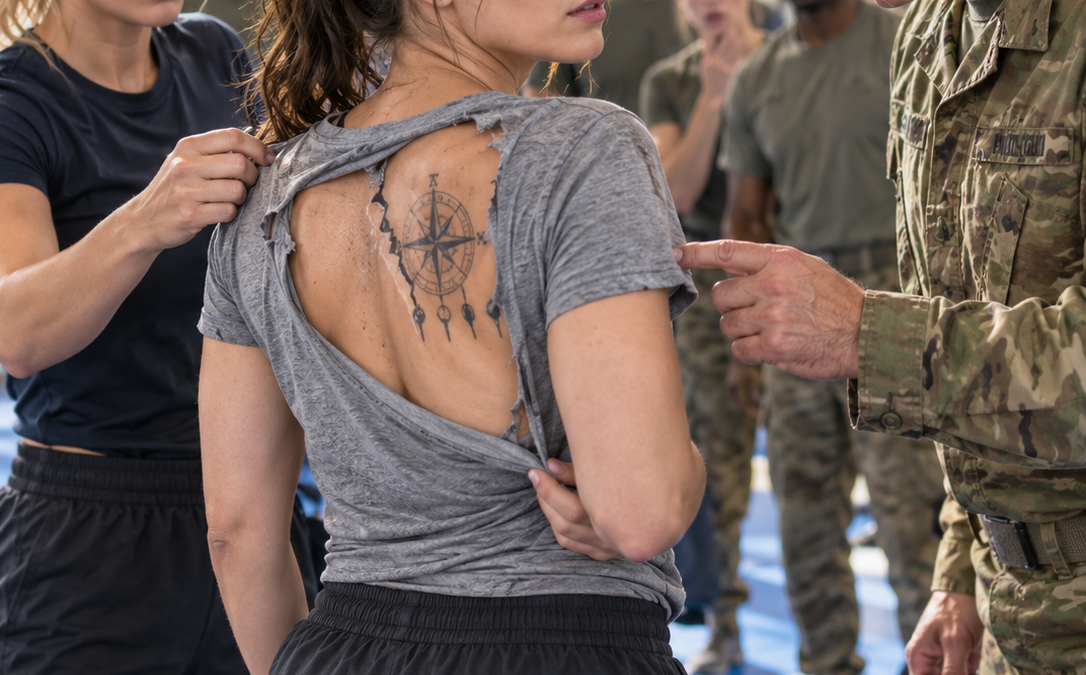
The first thing my sister noticed was the tear in my shirt. The second thing she noticed was the tattoo. The third thing she noticed was Colonel Grant Holloway walking toward me with a look I had never seen on his face before.
He had been talking to two instructors near the edge of the combatives mat. Then he stopped in the middle of a sentence.
Mallerie was still smiling. I wasn’t.
My gray Army PT shirt had ripped across the upper back during the last grapple. I could feel cool air against my skin, but I hadn’t realized how much of the tattoo was showing.
Mallerie had.
She looked at the broken compass, the four initials underneath it, and the date. Then she laughed.
“So that’s it.”
I turned my head. “What?”
“Your big secret.” She pointed at my back. “Your warrior tattoo.”
A couple of people nearby looked over. Nobody laughed with her.
Colonel Holloway stepped onto the mat. His face had gone pale.
“Sergeant Monroe.”
I stood straight. “Sir.”
His eyes went back to the tattoo. “Where did you get that?”
“After a deployment in 2019, sir.”
He stared at the date, then the initials. His expression changed again.
“Those four names?”
I didn’t answer.
He looked directly at me.
“Are they who I think they are?”
Six days earlier, my biggest problem had been finding a parking space.
I should have appreciated that more.
My name is Tessa Monroe. I was thirty-three years old, a sergeant first class in the United States Army, and I had been serving for a little over twelve years. I started as a combat medic. By the time this happened, I was working as a senior medical NCO.
That sounds more impressive when somebody else says it. When you actually do the job, it mostly means more responsibility, more paperwork, and a strange number of people asking you questions five minutes after ignoring the exact same answer from someone junior.
The Army has traditions. Some are just more annoying than others.
The training event was a three-week multinational field leadership rotation. People kept calling it boot camp because the schedule was ugly, sleep was limited, and apparently adults with military careers still enjoyed pretending misery was a bonding activity.
It wasn’t basic training. Nobody was learning how to make a bunk.
We had American officers and NCOs, personnel from several specialties, and partner forces from NATO countries rotating through planning exercises, field problems, medical lanes, communications drills, and leadership evaluations.
My unit sent me as part of a medical support element.
My younger sister’s unit sent her, too.
Captain Mallerie Monroe. Army logistics officer. Thirty years old. And according to Mallerie, the first person in our family to ever achieve anything worth mentioning at Thanksgiving.
I saw her before she saw me.
She was standing outside in-processing with two other officers, coffee in one hand and her phone in the other. Her uniform looked like it had been ironed by someone with a personal grudge against wrinkles.
Mine had spent two hours in a duffel bag.
Mallerie spotted me walking over and smiled. Not the warm kind. The other kind.
“Oh, you’ve got to be kidding me.”
I stopped in front of her. “Good morning to you, too.”
One of the officers beside her looked between us. “You two know each other?”
Mallerie laughed. “Unfortunately, that’s my sister.”
I nodded. “Tessa Monroe.”
Mallerie couldn’t leave it there. She never could.
“Don’t let the stripes fool you. She’s basically been a medic forever.”
The lieutenant beside her gave one of those polite little laughs people use when they have no idea whether something was supposed to be funny.
I looked at Mallerie. “Sergeant Monroe works fine.”
She raised her eyebrows. “Relax, Tess.”
There it was. Tess.
She only called me that around soldiers when she wanted to remind everyone that she knew me before the Army did.
I picked up my packet. “Captain Monroe works fine, too.”
The lieutenant suddenly became very interested in his coffee.
Mallerie stared at me for half a second. Then she smiled again.
That was how we usually worked. She pushed. I refused to give her the reaction she wanted. She called that being difficult.
I called it getting through Thanksgiving without flipping a table.
Mallerie had been doing some version of this for years. At family dinners, she talked about assignments, promotions, commanders, evaluations, and career plans.
Nothing wrong with that. She had worked hard. She had earned her commission.
The problem was what happened whenever someone asked about me.
My aunt would say, “Tessa, where were you stationed last year?”
Mallerie would answer, “Medical support.”
My dad would ask whether a deployment had been dangerous.
Mallerie would laugh. “She’s a medic, Dad. She wasn’t kicking down doors.”
Once, a cousin asked whether I had ever worked around special operations personnel.
Before I could answer, Mallerie said, “She did some support work around those guys. That’s different.”
Technically, none of those sentences were completely absurd.
That was Mallerie’s talent.
She could take ten percent of the truth, wrap it around something misleading, and deliver it with enough confidence that nobody bothered checking the other ninety percent.
I usually let it go.
I had reasons.
Some experiences weren’t dinner-table material. Some assignments weren’t stories I felt like telling. Some names belonged to people who couldn’t tell their own stories anymore.
And I had never liked turning those memories into proof that I mattered.
So when Mallerie talked, I stayed quiet.
For years, I told myself that was maturity. If my work was real, I didn’t need to advertise it. If my career meant something, I didn’t need Mallerie to agree.
And if my own family wanted to believe the loudest person at the table, that was their problem.
At least, that was what I told myself.
In-processing lasted most of the morning. Weapons accountability, medical screening, billeting, training briefs, safety briefs, then another safety brief, apparently because the Army remains deeply concerned that somebody might survive the first one without being completely bored.
By early afternoon, the entire rotation gathered in a large briefing room.
That was where I first saw Colonel Grant Holloway.
He was the commander of the training brigade hosting the rotation. Mid-fifties, maybe. Calm voice. No performance.
He didn’t need one.
The room settled as soon as he stepped forward.
He explained what he expected. Professionalism. Accountability. No hiding behind rank. No treating an exercise like a game just because the bullets weren’t real.
“If you make a bad call,” he said, “own it. If somebody junior to you has the better answer, listen to them. We are not here to protect anybody’s ego.”
I glanced toward Mallerie.
Bad idea.
She was already looking at me. She gave me a tiny smile.
After the briefing, she caught me near the hallway.
“Try not to embarrass me out here.”
I kept walking. “I wasn’t planning to think about you at all.”
She followed me. “See, that’s what you do.”
I stopped. “What do I do?”
“That whole calm act.”
“It’s called walking.”
“You know what I mean.”
“I really don’t.”
She crossed her arms. “You always act like none of this matters to you.”
“Training matters.”
“You know I’m not talking about training.”
I checked my watch. “We have group assignments in ten minutes.”
She shook her head. “Fine.”
Then she walked away.
The assignments went up on a board outside the main operations room.
Mallerie and I weren’t in the same chain of command. We weren’t even in the same primary element.
Good.
Then I looked at the cross-functional training lanes.
Planning exercise. Medical response. Night coordination. Leadership assessment.
Our names kept appearing in the same blocks.
Mallerie came up beside me. She read the board, then gave a short laugh.
“Guess we finally get to see which one of us actually knows what she’s doing.”
I pulled the roster off the board long enough to photograph it.
“That’s usually what training is for.”
“You know what I mean.”
“Yeah.”
I handed the sheet back. “That’s the problem.”
She stared at me while I walked toward the barracks.
I put the roster inside my notebook with the rest of my paperwork, set my alarm for 0430, and went to sleep.
When it went off the next morning, Mallerie’s voice was already carrying down the hallway.
I heard Mallerie before I saw her, which was usually how these things started. She was laughing somewhere near the sinks.
I pulled on my boots. By the time I stepped into the hallway, she was already talking to Captain Eric Lawson from the logistics group and Staff Sergeant Dana Ruiz, one of the communications NCOs assigned to our rotation.
Mallerie saw me coming.
“There she is.”
Lawson looked over. “Morning, Sergeant.”
“Morning.”
Mallerie took a sip of coffee. “We were talking about field experience.”
I nodded. “Sounds dangerous.”
Dana smiled. Mallerie didn’t.
Lawson asked, “You’ve done a few deployments, right?”
Before I could answer, Mallerie did it for me.
“She’s medical. Most of her stuff was support.”
I looked at her. “Most?”
Mallerie shrugged. “You know what I mean.”
“No. That’s why I asked.”
Lawson suddenly found something interesting on the training schedule taped to the wall.
Dana looked between us.
Mallerie gave me a tight smile. “Tess doesn’t like talking about herself.”
“Sergeant Monroe,” I said.
“Seriously? We’re at work.”
She rolled her eyes. “Fine. And Sergeant Monroe likes being mysterious.”
Dana leaned against the wall.
“Maybe she just likes answering her own questions.”
That earned her a look from Mallerie.
I almost smiled.
Almost.
We stepped off for the morning planning lane just after sunrise.
Our group had to move equipment and personnel across several checkpoints, hit a reporting station, and arrive at the final location inside a fixed time window.
Nothing dramatic.
No explosions. No helicopters dropping out of the sky. Just maps, terrain, weather, limited time, and eight people who all had opinions.
In other words, leadership training.
Mallerie took control of the planning discussion early.
She was good at that. She spoke clearly. She made decisions fast.
She also had the kind of confidence that made people assume the decision had been good before anyone checked it.
She pointed at a route on the map.
“This is the shortest line.”
I looked at the contour marks. Then I looked toward the actual terrain outside.
It had rained most of the night.
“That low ground is going to slow us down.”
Mallerie barely looked at me.
“It’s shorter on the map. We’re not carrying a hospital, Tessa.”
A few people smiled.
I ignored it.
“The drainage area is going to be soft. We should take the higher route.”
Lawson looked at the map. “That adds distance.”
“About eight hundred meters.”
Mallerie tapped her route again.
“Which is why we don’t do that.”
I could have pushed harder.
Maybe I should have.
But Mallerie wasn’t the lane leader, and neither was I. The designated leader listened to both arguments and chose the shorter route.
So we moved.
For the first ten minutes, Mallerie looked right.
Then the ground got soft.
Then it got worse.
One vehicle bogged down enough that we had to stop and reposition. Two people slipped carrying a case.
Nobody got hurt. Nobody was in danger.
We just watched the clock bleed away while the shorter route turned into a very long morning.
When we reached the reporting point, we were thirty-seven minutes behind.
The observer-controller/trainer didn’t yell.
That would have been easier.
He just looked at his watch, then at us.
“Let’s talk about planning.”
We gathered around the map for the after-action review.
The OC/T pointed to the low ground.
“Who identified this as a risk?”
Mallerie spoke first.
“We discussed it after we stepped off.”
I looked at her.
She didn’t look at me.
Before I said anything, Dana did.
“No. Sergeant Monroe brought it up during planning.”
The group got quiet.
The OC/T looked at Dana. “You’re sure?”
“Yes.”
Mallerie laughed lightly. “Maybe I remember it differently.”
Dana didn’t laugh.
Neither did I.
The OC/T continued the review.
No drama. No accusation. No one called Mallerie a liar.
But something small had changed.
Until then, her comments about me were family noise. Annoying. Petty. Easy to dismiss.
That statement had been different.
It involved the work.
After the review, I walked toward the water point.
Dana caught up.
“Does she always do that?”
I took a drink. “She’s my sister.”
“That wasn’t my question.”
I screwed the cap back on. “No.”
Dana waited.
I added, “Not exactly.”
“That’s a very Army answer.”
“It means mind your business.”
“Also a very Army answer.”
That got a laugh out of me.
She grinned. “See? You’re not actually scary.”
“Don’t spread that around.”
We headed toward the next lane.
Mallerie was standing ahead of us. She watched Dana talking to me, her expression flat.
Then she turned away.
The afternoon was mostly physical work. Movement under load, casualty drags, short conditioning events.
Nothing I hadn’t done before.
But twelve years in the Army had taught me one very useful truth.
There is always someone younger, and that person is usually irritatingly fast.
A twenty-four-year-old infantry sergeant beat me badly on the run.
Not close. Not honorable.
He finished, turned around, and had enough oxygen left to smile.
I hated him immediately.
Mallerie saw my time.
“Twelve years in, huh?”
I bent over with my hands on my knees.
“I’m thirty-three, not dead.”
The infantry sergeant laughed.
Mallerie didn’t.
During the casualty drag, one of the younger participants kept trying to pull the training dummy with his lower back.
I stopped him.
“Change your grip.”
“I’ve got it.”
“Your spine disagrees.”
He adjusted.
I showed him where to place his weight. The second attempt went much better.
One of the instructors saw it.
“Good correction, Monroe.”
“Roger.”
That was it. Four words.
But I saw Mallerie look over.
By dinner, people had started talking to me without going through her first.
A lieutenant asked where I’d been stationed. I answered.
A British medic asked about our casualty procedures. I answered that, too.
Nobody needed a dramatic biography. Nobody asked me to prove anything.
The world kept turning.
Mallerie seemed almost annoyed by that.
Later, while people were checking gear for the next morning, Lawson asked if I had ever worked outside conventional medical units.
I opened my mouth.
Mallerie walked past us.
“Tess has done some support work around different units. She likes the mystery.”
I turned.
“Why do you keep doing that?”
She stopped. “Doing what?”
“Answering questions nobody asked you.”
Lawson looked uncomfortable.
Good.
Maybe discomfort would finally teach him to stop standing there.
Mallerie smiled. “I’m helping.”
“No. You’re editing.”
Her smile faded.
I let the silence sit for a second. Then I went back to checking my gear.
That night, I realized I’d left my notebook in the briefing area.
The building was mostly empty when I walked back. On the way there, I heard Mallerie outside near the side entrance.
She was on the phone.
I wasn’t trying to listen.
Then I heard my name.
“Tessa’s doing that thing again.”
I stopped.
Mallerie laughed softly.
“No, Mom. The quiet thing. She acts like she can’t talk about anything, so people assume she has some huge story.”
There was a pause.
Then Mallerie said, “Trust me. I know what she actually did.”
I stood there with one hand on the door.
For years, I had assumed Mallerie’s comments disappeared when family dinner ended.
Apparently, they didn’t.
She had been explaining my career when I wasn’t even in the room.
I picked up my notebook without saying anything to her.
At 0500 the next morning, I tightened my laces, checked my medical kit, and followed the group toward the casualty lane.
The first casualty was already screaming when we walked onto the lane.
The second one was trying to crawl.
The third one wasn’t making any sound at all.
That was the one I kept looking at.
The scenario was a simulated mass-casualty event built around a vehicle rollover followed by secondary injuries.
Nothing real. No live blood. No actual danger.
But the training was designed to make people rush.
And rushing people miss things.
Mallerie stepped forward before the evaluator finished explaining the lane.
“I can take lead.”
The designated team leader hesitated, then nodded.
“Go.”
Mallerie moved fast.
I gave her credit for that.
She pointed two people toward the loudest casualty and sent another person to check the driver.
The quiet casualty stayed where he was.
I moved closer.
“Mallerie.”
She kept issuing orders.
“Mallerie.”
She looked at me. “What?”
“Check the quiet one.”
“I’ve got it.”
“His airway is going.”
She frowned. “He’s conscious.”
“So is the guy yelling.”
She turned away. “Work your task.”
I looked at the evaluator.
He was watching everything.
I looked back at the casualty.
Then I said, louder this time, “Ma’am, that patient needs airway intervention now.”
Mallerie snapped around.
“I said I have it.”
The evaluator raised one hand.
“Freeze!”
Everybody stopped.
Mallerie let out a breath.
The evaluator pointed toward the casualty I’d been watching.
“Captain Monroe, why is that patient not your priority?”
“He was responsive.”
“Responsive how?”
Mallerie looked down.
The training mannequin had simulated facial trauma, shallow breathing, and a swelling airway.
“He was awake.”
The evaluator nodded. “So?”
Mallerie didn’t answer.
He looked at me.
“Sergeant Monroe, you saw something?”
“Yes. The loud casualty still had a clear airway. He was scared and in pain, but he could talk. The quiet one had worsening obstruction and couldn’t move air well enough to speak.”
The evaluator pointed at Mallerie.
“That’s the difference between noise and priority.”
Nobody said anything.
He reset the lane. Then he looked at me.
“Sergeant Monroe, you run medical.”
Mallerie’s face tightened.
I stepped forward.
“Ruiz, airway kit. Lawson, control bleeding on casualty two. Somebody get me a time hack and keep it coming every two minutes.”
People moved.
I didn’t yell.
I didn’t need to.
The lane got quieter once everyone had a job.
We stabilized the airway. We controlled the major bleed. We reorganized transport order.
Then we moved.
When the evaluator called end exercise, my shirt was stuck to my back, and Dana had fake blood all the way to one elbow.
She looked at it.
“I’m billing somebody for this.”
“You signed up for communications.”
“Exactly. I was promised radios.”
I laughed.
Mallerie was standing near the evaluator.
She wasn’t laughing.
During the review, he didn’t praise me like I’d saved the free world.
Good.
That would have been ridiculous.
He just went through the decisions.
What worked? What didn’t? Where had we lost time? Where had Mallerie moved too quickly? Where had I slowed the team down by double-checking one transport category before movement?
That part was mine.
I wrote it down.
The evaluator noticed.
“You agree?”
“Yes.”
“You cost yourself about ninety seconds there.”
“I know.”
“Why’d you hesitate?”
“I wanted confirmation before movement.”
“Did you need it?”
“No.”
He nodded.
“Then don’t manufacture certainty where judgment is enough.”
Fair.
I wrote that down, too.
Mallerie watched me.
I knew that look.
She wanted me embarrassed.
The problem was, I wasn’t.
If an instructor told me I was wrong, and I was wrong, there wasn’t much to argue about.
That should not have been controversial.
Apparently, in my family, it was advanced theory.
When the group broke, one of the younger officers walked over.
“How many times have you done something like that for real?”
I started putting equipment back.
“Enough.”
Mallerie heard him.
She stepped in.
“She means training.”
I looked at her.
“No, I don’t.”
The officer glanced between us.
Mallerie’s mouth opened, then closed.
I picked up the airway bag and walked it back to the equipment table.
That was the first time all week I had corrected her in front of somebody without softening it.
It felt strange.
Not dramatic.
Just late.
The next lane was weapons handling.
I was competent. That was all.
No speed record. No trick shooting. No instructor staring at me like I had descended from a classified helicopter.
I cleared the weapon, checked it, broke it down, reassembled it, and performed the function check.
One of the instructors watched my hands.
“You always work that slow?”
I looked at the timer.
“I finished.”
He smiled.
“You did.”
A younger soldier beside me had rushed and seated something wrong. He had to start part of the sequence again.
The instructor pointed toward my station.
“Slow is smooth until smooth gets fast. Monroe isn’t wasting movement.”
I shrugged.
“Repetition.”
That answer bothered Mallerie more than bragging would have.
I could tell.
She kept looking at me every time an instructor made a positive comment.
Not angry, exactly.
More like she was recalculating.
At lunch, Dana sat across from me.
She opened a packet of hot sauce.
“Your sister doesn’t seem embarrassed when you’re wrong.”
I kept eating.
“She seems embarrassed when you’re right.”
I looked up.
“You’ve known her three days.”
“I’ve known radios longer. Patterns are patterns.”
“Don’t turn this into family drama.”
Dana squeezed too much hot sauce onto her food.
“Pretty sure your sister beat me to it.”
I shook my head.
She smiled. Then she took a bite and immediately regretted the amount of hot sauce.
I let her suffer.
Some lessons should be experiential.
The afternoon planning lane was mine to lead.
That helped.
Then it didn’t.
The scenario required us to plan support for a movement over several hours. I built casualty evacuation coverage first.
Alternate routes. Medical handoff points. Contingency timing.
I felt good about it.
Which should have worried me.
During the brief, the evaluator asked one question.
“What happens when your second vehicle needs fuel forty minutes earlier than your plan allows?”
I looked at the chart, then the movement timeline.
There it was.
I had built a strong medical plan around a logistics schedule that didn’t work.
Mallerie leaned back slightly.
I could almost hear the smile.
I didn’t look at her.
“That was mine,” I said. “I missed it.”
The evaluator nodded.
“Fix it.”
I did.
We shifted the staging time, adjusted the handoff point, and changed the fuel window.
The plan worked.
Afterward, the evaluator stopped me.
“Good recovery. Would have been better not to miss it.”
“Everybody misses something.”
He glanced toward Mallerie.
“What matters is what you do after.”
I didn’t answer.
Across the room, two officers were talking while they packed their maps.
One of them said, “Monroe’s solid.”
Mallerie looked over.
She smiled.
The officer finished his sentence.
“Sergeant Monroe.”
Mallerie’s smile disappeared.
An hour later, we were staging equipment for the night movement.
Radios were being checked. Call signs were assigned.
Checkpoint changes started coming across the net.
I was tightening a strap on my medical bag when I saw Mallerie receive one of the updates.
She read it, looked across the staging area at me, then folded the note and slid it under her clipboard.
Mallerie tucked the note under her clipboard and kept talking like nothing had happened.
I noticed it.
I didn’t ask about it.
At the time, I had no reason to think the update had anything to do with me.
The night coordination lane started just after dark.
Our element had a simple job. Move through a set of reporting points, maintain radio contact, pass information, and reach the final location inside the assigned window.
Nobody was going to die if we made a mistake. Nobody was even going to get yelled at very much.
We were being tested on communication timing and whether eight adults could follow a plan without turning it into a committee meeting.
That last part was ambitious.
Dana handled our radio. I had the medical support role and one of the team leadership responsibilities.
Mallerie was working from the coordination side with another element.
About twenty minutes in, Dana checked the net.
“Nothing new.”
I looked at my watch.
“We’re still going to checkpoint three, as far as I know.”
“Copy.”
We moved.
The terrain wasn’t difficult. Visibility was another matter. Red lenses, low light, equipment straps catching on everything that had apparently spent its entire life waiting for a soldier to walk past.
We reached checkpoint three minutes early.
There was nobody there.
Dana checked the radio again.
“Checkpoint Three, this is Raptor Two. Radio check.”
Nothing.
She tried again.
Still nothing.
I looked at the map.
“Wrong time?”
“No.”
“Wrong frequency?”
“Nope.”
“Wrong Army?”
Dana looked at me.
“Working theory.”
We waited another minute.
Then a training vehicle came down the trail.
An OC/T leaned out.
“Why are you here?”
I pointed at the map.
“Reporting checkpoint.”
“Not anymore.”
I looked at Dana.
She looked at me.
The OC/T continued.
“Checkpoint shifted east about forty minutes ago.”
Dana frowned.
“We never got that.”
“You should have.”
That sentence sat wrong.
Not because the update existed. Changes happened. That was part of the lane.
The problem was somebody had received it, and somebody hadn’t passed it.
We moved to the new location.
By the time we arrived, we were outside the scoring window.
The lane continued. We finished it.
Nobody threw a helmet. Nobody gave a speech.
But I was irritated.
There are mistakes you can learn from.
Then there are mistakes you didn’t get the chance to make because someone else never gave you the information.
The after-action review happened under a covered staging area.
The OC/T went through the timeline.
He pointed to the checkpoint change.
“Raptor Two missed the update. Why?”
Dana answered first.
“We didn’t receive the relay.”
Mallerie was standing across the group.
She spoke immediately.
“It went out.”
I looked at her.
“To everyone?”
“Yes.”
“Your side relayed it to my element?”
She met my eyes.
“Yes.”
Dana shifted beside me.
I heard it.
So did Mallerie.
That small sound people make when they know a sentence can be checked.
The OC/T looked at Dana.
“You have your radio log?”
“Yeah.”
“Pull it.”
Mallerie crossed her arms.
“We’re seriously doing this?”
The OC/T didn’t even look at her.
“Yes.”
That ended the discussion.
Dana opened the log.
The update had come through the coordination net. Mallerie’s position had acknowledged receipt.
There was no relay recorded to our element.
The OC/T pointed at the line.
“Looks like the message stopped here.”
Mallerie leaned over.
“Then communications missed it.”
Dana looked up.
“No. Your side had the relay responsibility.”
Mallerie’s jaw tightened.
“I sent it.”
Dana turned the log slightly.
“Not on this net.”
“Maybe I used the alternate.”
Dana checked.
“No traffic there either.”
Nobody said the word lie.
That mattered.
One missing transmission did not prove intent.
People forgot things. Radios failed. Messages got lost.
Training existed partly because humans were excellent at making simple systems complicated.
The OC/T wrote something down.
“Communication failure affected the lane. We’ll annotate it.”
Mallerie looked at me.
I didn’t say anything.
After the review, Dana caught my arm outside.
“She didn’t send it.”
“She didn’t send it on the recorded nets.”
Dana stared at me.
“That is exactly what I said.”
“No. You said she didn’t send it.”
“Okay, Sergeant Lawyer.”
I kept walking.
“She could have believed she did.”
Dana stopped.
I stopped, too.
“You really believe that?”
“I believe what I can prove.”
She lowered her voice.
“You’re still protecting her?”
“No.”
I looked back toward the staging area.
“I’m protecting the facts.”
Dana watched me for a second, then nodded.
“Fine. Facts say she got the update.”
“Yes.”
“Facts say we didn’t.”
“Yes.”
“Facts say she told everyone she sent it.”
“Yes.”
Dana spread her hands.
“That’s a pretty ugly little triangle.”
I almost laughed.
“I’ll put that in the official diagram.”
She smiled once.
Then her face got serious.
“You need to document it.”
“I know.”
I went to the OC/T before lights-out.
No accusation. No family history. No theory about Mallerie secretly plotting my downfall under a full moon.
Just the issue.
“I want the communication failure documented because it affected the lane.”
He nodded.
“Already noted.”
“I also want it clear that I did not receive the change.”
“It is.”
“Thank you.”
That should have been the end of the conversation.
It wasn’t the end of the night.
Mallerie was waiting near the barracks.
“You reported me.”
I kept walking.
“I documented a training issue.”
“You went to an evaluator about me.”
“The evaluator already saw it.”
“You’re making me look incompetent.”
I stopped.
“You said you sent something you didn’t send.”
“I did send it.”
“Then where is it?”
“Radios don’t work perfectly.”
“No.”
I stepped closer.
“But logs work pretty well.”
Her face changed.
There was anger there now.
Not embarrassment.
Anger.
“You’ve been waiting for this.”
“For what?”
“A chance to make me look bad.”
I stared at her.
“You think I planned a missing checkpoint update?”
“You know what I mean.”
“I keep hearing that sentence from you.”
She folded her arms.
“You’re loving this. People suddenly think you’re some seasoned expert because you can run a medical lane.”
“I am a senior medical NCO.”
“Exactly.”
She laughed once.
“You’re good at one thing, and now everybody acts like you’re some great leader.”
“I didn’t ask them to.”
“You never ask. That’s your trick.”
I felt something in me tighten.
“There is no trick.”
“There always is with you.”
I lowered my voice.
“You told an evaluator you relayed information when you didn’t.”
“You don’t know that.”
“I know I never received it.”
“Maybe your team screwed up.”
“Dana has the logs.”
Mallerie looked away just for a second.
Then she came back harder.
“You think because you’re good at medical stuff, everyone should suddenly worship you?”
I took a breath.
“I think officers should tell the truth.”
Her eyes narrowed.
“Careful, Sergeant.”
That did it.
Not enough to make me yell.
Just enough to make me stop treating this like a sisterly argument.
I looked directly at her.
“You’re my sister right now, Mallerie. Not my commander.”
She went still.
For the first time all week, there was no smile.
Then she said it.
“Mom and Dad always knew I was the one who actually went somewhere. You just never liked hearing it.”
I didn’t answer.
She kept going.
“You can play respected NCO out here all you want. At home, everybody knows the difference.”
“The difference between what?”
“Between serving and actually building a career.”
I stared at her.
Twelve years. Three deployments. Soldiers I trained. People I treated. People I’d buried.
And somehow, in Mallerie’s head, none of it counted because her rank started with captain and mine started with sergeant.
I walked away before I said something I couldn’t take back.
The next morning, I was standing near the equipment cage, checking a roster, when a lieutenant from another group glanced at my name tape.
“Monroe?”
“Yeah.”
He hesitated, then asked, “You ever have issues with people questioning your deployment history?”
I looked at him.
“What?”
He shifted his weight.
“Nothing. I just heard you sometimes make your assignments sound more high-speed than they were.”
My hand stopped on the roster.
“Who told you that?”
He gave me the universal military answer for I already regret starting this conversation.
“I don’t remember exactly.”
I did.
And for the first time since we arrived, I stopped wondering whether Mallerie was trying to embarrass me.
I started wondering how far she had already gone.
I folded the roster in half and put it back on the table.
The lieutenant was still standing there.
He looked like he wanted to disappear.
I understood the feeling.
“Who said I exaggerated my deployments?”
He rubbed the back of his neck.
“I heard it from somebody in logistics.”
“Mallerie?”
“I don’t know.”
He knew.
So did I.
I didn’t push him.
“Did I ever tell you I was special operations?”
“No.”
“Did I tell you I was attached to a unit I wasn’t attached to?”
“No.”
“Did I tell you I earned something I didn’t earn?”
“No.”
I nodded.
“Then don’t repeat things you can’t verify.”
He looked embarrassed.
“Fair enough.”
I walked away before my temper made the conversation worse.
That was the first time Mallerie had found a target I couldn’t ignore.
Call me old. Call me slow. Call me just a medic.
I had been called worse by better people.
But questioning a soldier’s service was different.
Integrity was not a joke.
By lunch, I noticed the shift.
Nobody openly accused me of anything.
That would have been easier.
Instead, the questions came wrapped in curiosity.
A captain from another team sat across from me.
“So, where were you actually deployed?”
I looked up from my food.
“Actually?”
He paused.
“You know what I mean.”
There was that sentence again.
I was starting to hate it.
“I’ve deployed more than once.”
“With who?”
“Different formations.”
He waited.
I didn’t keep going.
Then he said, “Someone said you make it sound like you were running around with special operations.”
I put my fork down.
“I have never said that.”
“Okay.”
“Who said I did?”
He shrugged.
“I don’t want to get involved.”
“You’re already involved.”
He stared at his tray.
That ended the conversation.
Dana sat down beside me a minute later.
She looked at my face.
“Who do I need to fight?”
“Nobody.”
“That’s disappointing.”
“Eat your lunch.”
She opened a drink.
“What happened?”
“People are asking about my service.”
“They’ve been asking all week.”
“Not like this.”
Dana stopped drinking.
“What are they saying?”
“That I exaggerate assignments. Maybe implied I was special operations.”
Her expression hardened.
“Did you?”
“No.”
“I know.”
I looked at her.
“You’ve known me less than a week.”
“Yeah, and you’ve spent most of it refusing to talk about yourself. You’re terrible at fake hero stories.”
I almost laughed.
“Thanks.”
“It’s a compliment.”
“It needs work.”
She leaned closer.
“This came from Mallerie.”
“I don’t have proof.”
Dana sighed.
“You and proof.”
“It’s useful.”
“So is common sense.”
“Common sense doesn’t belong in an official statement.”
That afternoon, another person asked whether I’d really been in combat overseas.
That one bothered me more than it should have.
Not because the question was insulting.
Because somebody had convinced him it was reasonable to ask.
I found Mallerie near the equipment storage area before evening chow.
She was alone.
Good.
“Did you tell people I lied about my service?”
She looked up slowly.
“No.”
That was quick.
“Because it’s ridiculous.”
“Did you tell people I exaggerate my deployments?”
Mallerie closed the case she was checking.
“I told people you let them make assumptions.”
“Which assumptions?”
“You know exactly which ones.”
“No. Say it.”
She looked around.
Nobody was close enough to hear.
“You act like you can’t talk about anything.”
“Sometimes I don’t want to.”
“You give half an answer. Then you go quiet. People start thinking there must be some classified story behind it.”
“I don’t control what they imagine.”
“You enjoy it.”
I stared at her.
“Enjoy what?”
“The attention.”
I actually laughed.
It came out once, short.
“You think I like attention?”
“You like people wondering about you.”
“You’ve spent the entire week answering questions for me.”
“Because you won’t.”
“I didn’t ask you to.”
Mallerie stepped closer.
“You always do this.”
“Do what?”
“The mysterious Tessa thing.”
“There is no mysterious Tessa thing.”
“Yes, there is. You don’t explain anything, and then people assume you’re more important than you are.”
I felt my jaw tighten.
“You don’t know everything I’ve done.”
She pointed at me.
“There. That. That line.”
“What line?”
“‘You don’t know everything I’ve done.'”
“Because you don’t.”
“Then tell people.”
“No.”
She threw up her hands.
“Exactly.”
I took a breath.
“I don’t owe everybody my deployment history because you’re uncomfortable with silence.”
“You use silence.”
“For what?”
“To make yourself look important.”
“I have never claimed special operations.”
“I didn’t say you did.”
“You suggested I exaggerate my service.”
“I said people shouldn’t assume things after you gave them something to assume.”
Mallerie looked at me like I was being deliberately stupid.
Then she said it.
“You know what I’m tired of?”
I waited.
“Mom and Dad acting like we’re both in the Army. Like it’s the same thing.”
There it was.
Not the radio log.
Not the training score.
Not even the rumors.
Rank.
“I never said it was the same thing.”
“I’m an officer.”
“I know.”
“I earned that.”
“I know.”
“You always say it like it doesn’t matter.”
“It matters in the Army.”
Her eyes narrowed.
“And outside the Army?”
“Outside the Army, you’re my sister.”
She laughed without humor.
“Convenient.”
“For what?”
“You get to act like rank means nothing because yours is lower.”
I stared at her.
“My rank isn’t low.”
“You know what I mean.”
“No, Mallerie. I know what you mean. That’s the problem.”
She crossed her arms.
“When Mom and Dad talk about us, they make it sound like we took the same path.”
“We didn’t.”
“Exactly.”
“I enlisted. You commissioned.”
“Exactly. And—”
She looked genuinely irritated that I wouldn’t finish the argument for her.
“And I built a career.”
That one landed.
Not because I believed it.
Because she did.
I kept my voice level.
“So did I.”
Mallerie gave me a small smile.
“If you say so.”
I stood there for another second.
Then something in me settled.
I wasn’t going to argue with her.
I was going to document her.
I found the senior OC/T assigned to our group before dinner.
“I need to raise a potential integrity concern.”
He motioned toward a chair.
I stayed standing.
I gave him the facts.
The missing relay. The statement in the after-action review. The rumors about my deployment history.
I handed over the communication timeline Dana had helped verify.
I didn’t call Mallerie jealous.
I didn’t talk about Thanksgiving.
I didn’t tell him she’d been doing versions of this for years.
He read the notes.
“This is your sister?”
“Yes.”
“You understand why that makes this complicated?”
“Yes.”
“Why didn’t you bring it up earlier?”
I looked at the paperwork in his hand.
“Because I thought ignoring it was the professional thing to do. And now\…”
“Now?”
“Now it’s affecting the work.”
He nodded.
“We’ll review what we can verify.”
“That’s all I’m asking.”
When I stepped outside, Dana was waiting near the walkway.
She didn’t ask what I had said.
She just handed me a bottle of water.
We headed toward the evening brief.
A few minutes later, Mallerie walked past a group of soldiers near the entrance.
Someone asked her something about me.
She laughed.
“If Tess really had some incredible combat history, trust me, our family would know.”
I heard every word.
Dana heard it, too.
She waited until Mallerie disappeared inside.
Then she looked at me.
“Does your family really not know?”
“They know what I chose to tell them.”
Dana nodded toward the doorway.
“And what Mallerie chose to tell them.”
I didn’t answer.
The schedule for the next morning was already posted beside the briefing room.
Combatives rotation.
I scanned the names once.
Then again.
Mallerie’s name was in my cycle.
At 0530 the next morning, I pulled my gray T-shirt over my head, tied my hair back, and walked toward the mat where my sister was already warming up.
Mallerie was bouncing on the balls of her feet when I stepped onto the mat.
She looked energized.
Too energized.
I had seen that look before at family dinners, usually right before she said something she knew would bother me and then acted surprised when the room got uncomfortable.
The combatives instructor pointed us into position.
“Controlled intensity. This is training, not a parking lot fight.”
A few people laughed.
Mallerie smiled at me.
“Good reminder.”
I ignored her.
The first round was basic control work.
Grip. Position. Escape.
Nothing dramatic.
Mallerie pushed harder than she needed to.
Not enough for the instructor to stop us.
Enough for me to notice.
She drove her shoulder into me and whispered, “Come on, Tess.”
I shifted my hips and broke the position.
“This isn’t about us.”
“It always is with you.”
I stared at her.
“That doesn’t even make sense.”
She came forward again.
The instructor called out a correction.
Mallerie adjusted for about ten seconds.
Then she went right back to trying to turn a training lane into a family argument.
She reached for control behind my shoulder.
I pulled free.
She grabbed the back of my shirt hard.
The fabric stretched.
I heard the seam tear.
The instructor shouted, “Break!”
We separated.
I stepped back.
Mallerie looked at me, then past me.
Her expression changed into a grin.
“What?”
She pointed.
“So that’s the big secret.”
I reached behind my shoulder.
My fingers touched skin.
The back of the PT shirt had split from near the collar toward my shoulder blade.
Enough of the tattoo was exposed to see most of it.
A broken compass.
Four initials underneath.
A date.
Mallerie laughed.
“Seriously?”
I pulled at the shirt.
She kept going.
“All this mysterious deployment stuff, and it’s a warrior tattoo.”
Nobody answered her.
I noticed that first.
Then I noticed people looking behind me.
Colonel Grant Holloway had been walking along the edge of the training area with two OC/Ts.
He had stopped completely.
His face had lost color.
Not movie-star shock. Not some dramatic, openmouthed stare.
He just looked like a man who had recognized something he had not expected to see again.
He walked toward us.
The instructor straightened.
“Sir.”
Holloway barely acknowledged him.
His eyes stayed on the tattoo.
“Sergeant Monroe.”
I turned.
“Sir.”
He pointed, but not at the whole design.
At the date.
“When did you get that?”
“After a deployment in 2019, sir.”
His jaw tightened.
He looked at the initials, then back at me.
“What formation were you attached to?”
I answered.
The noise around the mat faded.
People weren’t silent because they knew what the tattoo meant.
They didn’t.
They were silent because Holloway clearly did.
He asked, “That date. Was that the incident near your forward position?”
“Yes, sir.”
Mallerie’s smile was gone.
Holloway looked at the four initials again.
His voice got quieter.
“Those four names?”
I didn’t say anything.
He looked directly at me.
“Are they the four from the memorial?”
“Yes, sir.”
He inhaled slowly.
One of the OC/Ts beside him glanced at the tattoo, then at Holloway.
Holloway asked, “What was your rank then? Staff sergeant?”
“Yes, sir.”
He stared at me for another second.
“Monroe, you were the medic.”
I nodded once.
“Yes, sir.”
Mallerie made a small sound.
Not a word.
Just enough to remind me she was still standing there.
Holloway turned toward the instructor.
“Continue training.”
That was it.
No salute. No announcement. No speech about bravery.
Nobody clapped.
Thank God.
The instructor looked at my torn shirt.
“Sergeant, go replace that.”
“Roger.”
I walked off the mat.
Dana was standing near the edge.
She handed me my sweatshirt.
She didn’t ask what the tattoo meant.
I appreciated that.
Mallerie followed me two steps.
“Tessa.”
I stopped.
She lowered her voice.
“What was that?”
“Training.”
“You know what I mean.”
I looked at her.
“No. You tell me.”
She stared at my back.
“Why did he know that tattoo?”
“He didn’t know the tattoo.”
“He knew the date.”
“Yes.”
“And the names.”
“Yes.”
Mallerie waited.
I didn’t fill the silence.
For once, she looked genuinely unsure what to say.
I pulled on the sweatshirt.
“Go finish your lane.”
She didn’t move.
I did.
About forty minutes later, an OC/T found me near the equipment area.
“Sergeant Monroe, Colonel Holloway wants to speak with you.”
“Now?”
“Now.”
I followed him to a small office inside the training building.
Holloway was there with a senior training officer and an administrative NCO.
Nobody looked excited.
That was reassuring.
Excited headquarters people usually meant extra paperwork.
Holloway motioned to a chair.
I sat.
He stayed standing.
“I want to be clear about something.”
“Yes, sir.”
“What I saw on your back is not verification of anything.”
“Understood.”
“We’re going to verify your service history through normal channels.”
“That’s fine.”
He studied me.
“You don’t seem surprised.”
“Sir, I would be more concerned if a tattoo counted as official documentation.”
The administrative NCO looked down.
I think she was hiding a smile.
Holloway almost did, too.
Almost.
Then he got serious again.
“I was on staff supporting that formation in 2019.”
I stayed quiet.
“I was at the memorial.”
That explained his face.
He continued.
“I remember the four names. I also remember an after-action report involving a female medical NCO attached from a supporting element.”
My hands were resting on my knees.
I kept them there.
Holloway asked, “You were attached to that medical support package?”
“Yes, sir.”
“You continued treatment during the incident?”
“Yes, sir.”
“You moved casualties after the position took additional fire?”
“Yes, sir.”
The senior training officer glanced toward me.
Holloway didn’t.
He kept his eyes on the paperwork.
“What recognition did you receive?”
I told him.
Nothing exaggerated. Nothing hidden.
Just the award and the documentation attached to it.
The administrative NCO started checking the available record.
A few minutes passed.
Nobody filled them with dramatic music.
There was a printer making too much noise in the corner.
That felt more accurate.
The administrative NCO looked up.
“Sir, service history matches the deployment period and supporting assignment.”
She handed over the page.
Holloway read it.
Then another.
His expression didn’t change much, but his shoulders dropped a little, like a question had been answered.
He looked at me.
“I remember their names.”
I swallowed.
“So do I.”
That was the first time the room got truly quiet.
Holloway set the record down.
“I have another question.”
“Yes, sir.”
“Why am I hearing that someone in this rotation thinks you lied about that deployment?”
I reached into my folder and pulled out the communication log, the timeline, and the notes I had already submitted.
I placed them on the desk.
“I don’t know exactly what has been said, sir.”
Holloway looked at the documents.
“But I asked for a potential integrity issue to be reviewed yesterday.”
He opened the first page, read the name, then looked up.
“Captain Mallerie Monroe.”
“Yes, sir.”
“Your sister?”
“Yes.”
He leaned back slightly.
“Does she know what that tattoo means?”
“No, sir.”
“Does she know what happened in 2019?”
“Not the details.”
Holloway looked down at the record again.
Then at the complaint notes.
His voice stayed calm.
“Then how did she decide it didn’t happen?”
The administrative NCO turned another page and slid it toward Colonel Holloway.
He read it once.
Then again.
I stayed in the chair.
Holloway tapped the communication log with one finger.
“This is the checkpoint issue.”
“Yes, sir.”
“And Captain Monroe acknowledged receiving the update.”
“Yes, sir.”
“But your element never received the relay.”
“Correct.”
He looked at the senior training officer.
“Who reviewed this?”
“I did. And we documented the failure. We hadn’t made a determination about intent.”
Holloway nodded.
“Good.”
That mattered.
Nobody was going to decide Mallerie had sabotaged me just because she was my sister and I was angry.
Facts first.
Exactly how I wanted it.
Holloway closed the folder.
“One more thing. I’m removing myself from any direct scoring of Sergeant Monroe.”
The senior officer nodded.
“Understood.”
I looked at Holloway.
“Sir, I didn’t ask for that.”
“I know.”
He leaned back.
“That’s why I’m doing it.”
Fair enough.
If the commander recognized part of my past and then personally evaluated me, Mallerie would have an argument about favoritism before anyone even touched the real issue.
Holloway looked at me.
“You continue training.”
“Yes, sir.”
“No special treatment.”
“Wouldn’t know what to do with it.”
That got half a smile from the administrative NCO.
Holloway didn’t smile.
“Good.”
I went back outside.
Dana was waiting near the walkway.
She looked at my face.
“How bad?”
“I’m still employed.”
“Strong start.”
“Holloway knew the names.”
Her expression changed.
I didn’t explain more.
She didn’t ask.
That was one of the things I liked about Dana.
She knew when curiosity stopped being harmless.
The training schedule kept moving.
Nobody gathered everyone together and announced my service record. Nobody pinned anything on me. Nobody suddenly treated me like I had walked out of a war movie.
A few people who had heard the rumors became painfully polite.
One lieutenant actually said, “Sergeant, I hope I didn’t offend you earlier.”
I told him, “You did.”
He blinked.
Then I added, “You’ll survive.”
He laughed.
So did I.
That was enough.
Mallerie didn’t speak to me that morning.
She was called into a small conference room just before lunch.
I knew because I saw her walk in.
I also saw her come out forty minutes later.
She looked furious.
Dana leaned toward me.
“That face usually means someone asked for receipts.”
“Don’t enjoy this.”
“I can enjoy it quietly.”
“Apparently not.”
Inside the review, they kept the questions simple.
I learned that later from the statements and from what Mallerie admitted herself.
Had I ever claimed to be special operations?
No.
Had I ever claimed an award I had not earned?
No.
Had I ever claimed an assignment Mallerie knew was false?
No.
Had Mallerie told people I exaggerated my service?
She tried to soften that.
She said she had warned people not to assume too much.
The reviewer asked what they were assuming.
Mallerie said I encouraged mystery.
The reviewer asked how.
Mallerie said I refused to explain certain deployments.
The reviewer asked whether refusing to discuss an assignment was the same as lying about one.
That was where her answers started getting messy.
By afternoon, I was back on a planning lane.
Good.
I needed something normal.
The scenario involved moving a support package across several locations with limited vehicles, medical coverage, fuel requirements, and a tight timeline.
I took the lead.
I built the casualty evacuation plan first.
Primary route. Alternate route. Transfer points. Medical handoff.
It looked clean.
Too clean.
The evaluator waited until I finished.
Then he asked, “What happens when your primary radio link hits a dead zone at the third rally point?”
I looked at the board.
Then at my timeline.
There it was.
I had protected the medical plan so carefully that I had failed to account for a loss of signal in the lower valley terrain.
Mallerie was standing near the back.
I could feel her watching me.
I didn’t look at her.
“That was mine,” I said. “I missed it.”
The evaluator nodded.
“Fix it.”
We shifted movement time, changed the handoff point, and adjusted fuel support.
It cost us a few minutes.
The plan worked.
The evaluator looked around the group.
“Everybody misses things.”
He pointed at my corrected timeline.
“This is what accountability looks like. You identify the miss, own it, correct it, and move.”
Mallerie’s face tightened.
I almost felt sorry for her.
Almost.
Then I remembered the service rumors.
That feeling passed quickly.
After the lane, she found me near the equipment racks.
“You happy now?”
I kept packing a bag.
“About what?”
“Don’t do that.”
“Do what?”
“Act like you don’t know what’s happening.”
I zipped the bag.
“I know you’re being reviewed.”
“You started it.”
“You started it.”
She laughed once.
“You’ve taken this far enough.”
I stood up.
“I submitted a communication issue and an integrity concern.”
“You submitted me.”
“No.”
I looked straight at her.
“I submitted what happened.”
“You knew exactly what this would do.”
“I didn’t write your statements.”
Her jaw tightened.
“You think you’re clever?”
“No.”
“You’ve got everybody looking at me like I’m some liar.”
“Then answer their questions.”
“I did.”
“How’d that go?”
That hit.
She stepped closer.
“You’ve always wanted this.”
“What?”
“To finally be the impressive one.”
I stared at her.
“You really still think that’s what this is about?”
“You’ve got the commander asking about your tattoo. People suddenly treating you like some hero.”
“I didn’t ask him to recognize it.”
“You love that he did.”
That made me angry.
Not loud angry.
The colder kind.
“That tattoo has four dead people’s initials on it.”
Mallerie looked away.
For once, she had nothing ready.
I continued.
“It is not a career tool. It is not a conversation starter. And it is definitely not something I ever wanted you to use in an argument about who Mom likes better.”
Her face hardened again.
“You think that tattoo makes you untouchable?”
I shook my head.
“It didn’t protect me from you.”
She stared at me.
I picked up the bag.
She blocked my path for half a second, then moved.
“You’re going to regret making this official.”
I stopped.
“No, Mallerie.”
She turned.
“For the first time, I’m letting you own what you’re doing.”
I walked past her.
That evening, the senior OC/T told Mallerie the review might be documented and forwarded to her parent command if the concerns could not be resolved locally.
She said very little during dinner.
She barely looked at me.
Around 2200, I stepped into the common area to refill my water bottle.
Mallerie was sitting alone at a table with her laptop open.
A blank complaint form filled the screen.
She saw me, closed the lid halfway, then changed her mind, opened it again, and started typing.
Mallerie was still typing when I left the common area.
I didn’t ask what she was writing.
I didn’t need to.
By breakfast, the complaint was already moving.
The senior OC/T pulled me aside before the first lane.
“Sergeant Monroe, I need you to know Captain Monroe submitted a formal complaint regarding the conduct of this rotation.”
I nodded.
“About me?”
“About several things.”
That was Army language for yes, absolutely about you.
He continued.
“She raised concerns about favoritism after Colonel Holloway recognized your tattoo.”
“Okay.”
“She also stated that you have implied a classified background to influence how cadre perceive you.”
I stared at him.
“I’ve never said that.”
“I know what you’ve said to me.”
He held up one hand.
“But we’re going to review the complaint on its own facts.”
“That’s fair.”
He watched my face.
“You understand she’s also alleging that you intentionally exposed the tattoo?”
I actually laughed.
Not because it was funny.
Because sometimes a lie becomes so stupid that anger has to stand in line.
“She pulled my shirt during combatives.”
“We have video.”
“Good.”
He almost smiled.
“That’s what I said.”
There was one part of Mallerie’s complaint I couldn’t dismiss.
She had questioned whether Colonel Holloway’s personal connection to the 2019 incident created the appearance of favoritism.
That was a legitimate concern.
If I had been standing on the outside, I might have asked the same question.
The difference was Holloway had already removed himself from my direct scoring.
Mallerie knew that.
She wrote the complaint anyway.
Then she added things she could not support.
That was where the problem stopped being perception and started becoming evidence.
Training footage showed exactly how my shirt tore.
I was not displaying anything.
I was trying to get out of a grip.
Mallerie’s hand caught the back of my PT shirt and pulled it apart.
Three people nearby gave statements saying the same thing.
Two more said they had never heard me claim special operations, classified missions, or secret assignments.
Dana’s statement was even shorter.
“Sergeant Monroe barely talks about herself unless someone asks her a direct question.”
When she told me that, I said, “That makes me sound boring.”
Dana shrugged.
“You are a little boring.”
“Thank you.”
“You’re welcome.”
Colonel Holloway gave his own statement.
He explained that he recognized the date and initials. He explained his connection to the old incident.
He also documented that he had removed himself from evaluating me as soon as that connection became clear.
Nobody had increased my score.
Nobody had changed my role.
Nobody had handed me a ceremonial sword and declared me queen of the Army.
I had gone right back to training.
Mallerie’s complaint had taken one reasonable concern and buried it under a pile of claims that the available evidence did not support.
That was her choice.
Nobody made it for her.
The cadre separated us from direct interaction while they reviewed the issue.
Again, nothing dramatic.
No guards. No escort. No public announcement.
Mallerie simply stopped appearing in lanes where she would have direct influence over my element.
A day later, she was removed from an assessed leadership role for the remainder of the rotation.
The findings would be forwarded to her parent command.
She found me outside the operations building after she got the notification.
“You happy?”
I kept walking.
“No.”
“You got me pulled.”
“I didn’t write your complaint.”
She stepped in front of me.
“You keep saying that like it means something.”
“It means exactly what it says.”
“You know they’re sending this back to my command.”
“Yes.”
“You know what that can do?”
“Yes.”
Her face tightened.
“And you don’t care.”
I looked at her.
“I care that you had about six chances to stop.”
She said nothing.
“You didn’t.”
Her voice dropped.
“You could have told them this was family drama.”
“It stopped being family drama when you questioned my service in a professional setting. You could still fix it.”
“How?”
“Tell them you were upset.”
“You were.”
“Tell them I didn’t mean it.”
“Did you?”
That shut her up.
I walked around her.
She didn’t follow.
The final field exercise started the next morning.
I was assigned to lead a mixed team through a timed movement and support scenario.
Medical. Communications. Logistics. Security.
Nothing flashy.
Exactly the kind of event where one bad assumption could wreck a good plan.
We were forty minutes into the lane when the evaluator introduced a simulated casualty.
At the same time, our radio link became unreliable.
We were already behind schedule.
The casualty was not immediately life-threatening, but the scenario required treatment documentation and a safe handoff before movement.
One of the team members looked at the clock.
“If we stop, we miss the objective window.”
“I know.”
“We can stabilize and push.”
I checked the casualty card, then the timeline.
We could move fast.
Maybe make the window.
Maybe.
But we’d be cutting the procedure short to protect the score.
I shook my head.
“No. We treat, hand off, then move.”
“We’re going to lose points.”
“I know.”
Nobody argued after that.
We worked.
Dana handled the radio problem. Another NCO set security. I stayed on the casualty until the required handoff was complete.
We moved late.
We reached the final point outside the best scoring window.
The evaluator met us there.
He looked at his clipboard.
“You knew the delay would cost you.”
“Yes.”
“Why’d you make the call?”
“Because the casualty requirement wasn’t optional.”
He waited.
I added, “The point of leadership isn’t looking good on the score sheet.”
He wrote something down.
“Good.”
That was the whole speech.
Very Army.
The rotation ended two days later.
My evaluation was good.
Not perfect.
I didn’t finish at the top.
Dana actually scored better than I did in two categories.
Which she mentioned approximately nine hundred times.
“I just want you to know,” she said while we packed gear, “I am available for autographs.”
“I’ll survive.”
“You sound jealous.”
“I am devastated.”
She grinned.
Mallerie packed separately.
Nobody made a show of it.
Her leadership assessment had already stopped.
The package regarding her conduct and complaint was being sent back to her command for review.
That was serious.
It was not a conviction.
It was not the end of her career.
It was the Army saying, in very formal language, Somebody else needs to look at this.
I loaded my duffel into the truck.
Dana shut the tailgate.
“Going home for a few days?”
“Family, unfortunately.”
She winced.
“Good luck.”
“I’ve been deployed.”
“Exactly.”
I laughed and got into the driver’s seat.
My phone buzzed before I turned the engine on.
Mom.
I almost ignored it.
Then I saw the message underneath.
Mallerie called us. We need to talk about what you did to her.
I read my mother’s message twice before starting the truck.
Not because I didn’t understand it.
I understood it perfectly.
Mallerie had gotten home first without ever leaving the training site. She had called our parents, and she had given them her version.
I didn’t call back right away. I drove.
For the first hour, I told myself I needed time to cool off. That was partly true. The other part was habit.
For years, when Mallerie said something unfair, I waited for it to pass. I had always been good at waiting.
The Army had rewarded me for it.
My family had not.
Mom called again that evening. This time, I answered.
“Tessa?”
“Yeah.”
“What happened?”
I set my bag on the floor of my apartment.
“You tell me.”
She sighed. “Mallerie says the commander recognized some tattoo you have and started treating you differently.”
“He removed himself from scoring me.”
“She says you knew he would recognize it.”
“I didn’t even know he would be there.”
“She says you used an old deployment story to make her look dishonest.”
I closed my eyes.
“What old deployment story?”
“The one connected to the tattoo.”
“Mom, she didn’t know the story.”
Silence.
Then she said, “She was trying to protect the fairness of the training. She submitted a complaint.”
“I know. She also made statements in that complaint that the evidence didn’t support.”
Mom went quiet again.
I could hear my father in the background.
“Your father wants to talk.”
“Not on the phone, Mom.”
“Tessa—”
“Not on the phone.”
A pause.
“When are you coming over?”
“Saturday.”
I hung up before I could change my mind.
For the next few days, I went back to normal Army life. Emails, appointments, training calendars, and a counseling packet that had somehow reproduced while I was gone.
The Army is impressive that way.
Leave one piece of paperwork unattended for three weeks, and it develops a family.
I also got a short update through the proper channel. Mallerie’s parent command had received the documentation. Her scheduled leadership opportunity was being reconsidered while the matter was reviewed.
That was all I knew.
That was all I needed to know.
I didn’t call anyone. I didn’t ask for favors. I didn’t send another statement.
Mallerie had written her own words.
The records could do the rest.
Saturday afternoon, I drove to my parents’ house.
My dad opened the door.
He looked tired.
Mom was already sitting at the kitchen table. Nobody had food out.
That was how I knew this was serious.
In our family, even arguments usually had snacks.
Dad sat across from me.
“Did you report your sister?”
“I reported what happened.”
“That’s not what I asked.”
“It is the answer.”
Mom leaned forward.
“She says you wanted her career ruined.”
I looked at her.
“I wanted her to stop lying about mine.”
That shut the room down.
Dad looked at the table.
Mom looked confused.
“What did she lie about?”
I almost laughed.
Not because it was funny.
Because that question was the entire problem.
“Before I answer that, I need you both to answer something for me.”
Dad looked up.
“Okay.”
“How many years has Mallerie told you what I do in the Army?”
Neither of them spoke.
“How many times did she tell you I was just medical support?”
Mom shifted in her chair.
“Tessa…”
“How many times did she explain my deployments?”
Dad said, “We thought she knew.”
“She knew what I told her.”
Mom frowned.
“You never corrected her.”
There it was.
The sentence I had been expecting.
“We thought you would tell us if she was lying.”
I sat back.
“I thought family wouldn’t need me to defend myself from family.”
Mom’s face changed.
Dad stopped looking at the table.
Nobody said anything for several seconds.
Then Dad asked, “What is the tattoo?”
I looked toward the window.
I had known they would ask.
I still didn’t want to answer.
“The design is a broken compass.”
Mom nodded slowly.
“And the initials?”
“Four people from the unit. From a formation I was supporting.”
Dad asked, “The date?”
“2019.”
Mom’s voice got quieter.
“What happened?”
I kept the answer short.
“There was an incident during the deployment. We took casualties. I was part of the medical response.”
“Were you hurt?”
“No.”
“Were you under fire?”
I looked at her.
“Yes.”
Dad leaned back.
I could see him trying to understand why he had never heard this.
I didn’t give him every detail.
There were things I still didn’t tell people.
Not because they were classified.
Because they belonged to a bad day and four families who had lost more than I had.
Mom pointed toward my shoulder.
“And the initials are the people who died?”
“Yes.”
She covered her mouth for a second.
“Why didn’t you tell us?”
I answered before I could soften it.
“Because it wasn’t a story I wanted to use to win an argument at Thanksgiving.”
Dad looked away.
Mom’s eyes dropped.
I wasn’t trying to punish them.
But I wasn’t going to rescue them from the truth either.
Mallerie had spent years turning our careers into a scoreboard.
I had spent years refusing to play.
My parents had watched both of us and decided the loudest person probably had the correct statistics.
That was partly on them.
And partly on me.
“I should have corrected her years ago,” I said.
Mom looked up.
“You shouldn’t have had to.”
“No. But I should have.”
Dad asked, “What happens to Mallerie now?”
“I don’t know.”
“You really don’t know?”
He studied me.
“I thought you’d be involved.”
“Why?”
“Because she’s your sister.”
“That is exactly why I shouldn’t be involved.”
My phone buzzed on the table.
Mallerie.
Nobody moved.
It buzzed again.
Mom looked at me.
“You should answer.”
I almost said no.
Then I picked it up.
“Hello?”
Mallerie didn’t bother with hello.
“You got what you wanted.”
I looked at my parents.
“I never wanted this.”
“Sure.”
“What do you think I wanted?”
“You wanted everybody to finally think you’re better than me.”
“No.”
“You got the commander. You got Mom and Dad. You got my command asking questions.”
“I didn’t write your complaint.”
“Stop saying that.”
“I’ll stop when it stops being true.”
Her breathing got louder.
“You’ve always wanted to prove I wasn’t as good as everyone thought.”
“No, Mallerie.”
I stood and walked into the hallway.
“What I wanted was a sister.”
She didn’t speak.
I continued.
“What you wanted was an audience.”
Her voice turned cold.
“So that’s it?”
“No.”
I leaned against the wall.
“This is it. Until you can talk about what you actually did without turning it into something I did to you, you don’t get access to my life like nothing happened.”
“You’re cutting me off.”
“I’m setting a boundary.”
“Oh, please. Call it whatever you want. You always have to sound superior.”
I almost laughed.
There it was again.
Even now.
“Goodbye, Mallerie.”
I ended the call.
When I went back into the kitchen, my mother was wiping her eyes.
Dad was staring at his hands.
I sat down.
Nobody tried to fix the last twelve years in one conversation.
That would have been dishonest, too.
Mom reached across the table.
This time, I let her take my hand.
And for once, I didn’t confuse saying nothing with having nothing to say.
My mother’s hand stayed over mine for a few seconds.
I didn’t pull away.
I didn’t forgive everything either.
That was something I finally understood.
Peace does not require pretending nothing happened.
For years, I thought staying quiet made me stronger.
Sometimes it did.
The Army teaches you not to react to every insult, every bad opinion, or every person who thinks rank gives them permission to be difficult. If you stop to fight every small battle, you never get the real work done.
But silence has a limit.
Ignoring disrespect can be maturity.
Ignoring a lie that keeps damaging your name can become permission.
That was my mistake with Mallerie.
I kept thinking the truth would eventually speak for itself.
Sometimes it does.
Sometimes it needs documentation.
Sometimes it needs a witness.
And sometimes you have to look someone directly in the eye and say, “That is not true.”
I also learned something harder about family.
Being related to someone does not excuse behavior you would never accept from a coworker.
Family does not get a free pass on honesty. It does not get unlimited access to your life just because you share parents, holidays, or the same last name.
You can love someone and still set a boundary.
You can forgive someone and still decide they are not safe enough to trust.
Those are different things.
Mallerie was a captain.
I was a sergeant first class.
Those ranks mattered inside the Army because authority and responsibility matter.
But rank never told me who had more integrity.
It never told me who could admit a mistake.
It never told me who was willing to tell the truth when the truth became inconvenient.
That part comes from character.
The tattoo on my back never made me more worthy of respect.
That matters, too.
If I had never deployed in 2019, Mallerie still would have been wrong to treat me the way she did.
If Colonel Holloway had never recognized those initials, she still would have been wrong.
If I had been exactly what she called me, just a medic, I still would have deserved basic respect.
The tattoo only made people stop and check the story they had been hearing.
It was never proof of my value.
And revenge was never really the point either.
I didn’t ruin Mallerie’s career. I didn’t call her commander demanding punishment. I didn’t post anything online. I didn’t spend my nights planning how to hurt her back.
Her own words created consequences.
Her own complaint created questions.
Her own choices forced people to look closer.
That was enough.
Real revenge stories are not always about destroying the person who betrayed you.
Sometimes the strongest family revenge stories end when you stop protecting the person who keeps hurting you and simply let accountability do its job.
That was the part I had to learn.
I didn’t need Mallerie to admit I was right.
I didn’t need her apology before I could move forward.
And I definitely didn’t need to spend the rest of my life competing in a family drama I never agreed to join.
What I needed was a boundary.
What I needed was the truth on record.
And what I needed most was to stop letting someone else’s version of me become more important than the life I was actually living.
So if someone in your life keeps talking over you, minimizing you, rewriting your history, or making you feel like you have to prove your worth every time you walk into a room, remember this.
You do not owe everyone an explanation.
But you do owe yourself the courage to speak when silence starts helping someone else erase the truth.
Document what matters.
Correct the lie where it is doing damage.
Set the boundary before resentment becomes your whole life.
And then keep moving.
If you enjoy military stories, revenge stories, family revenge stories, and family drama built around betrayal, accountability, and people finally standing up for themselves, subscribe to the channel.
We tell stories about what happens when loyalty breaks, when family crosses the line, and when someone finally decides they will not let another person define their worth.
If this story stayed with you, subscribe and stay with us.
There are more stories ahead.








