My sister laughed and asked what rank a single mom could possibly have. I stayed quiet. Then four generals walked right past her and returned my salute. By Friday morning, her smile was gone.
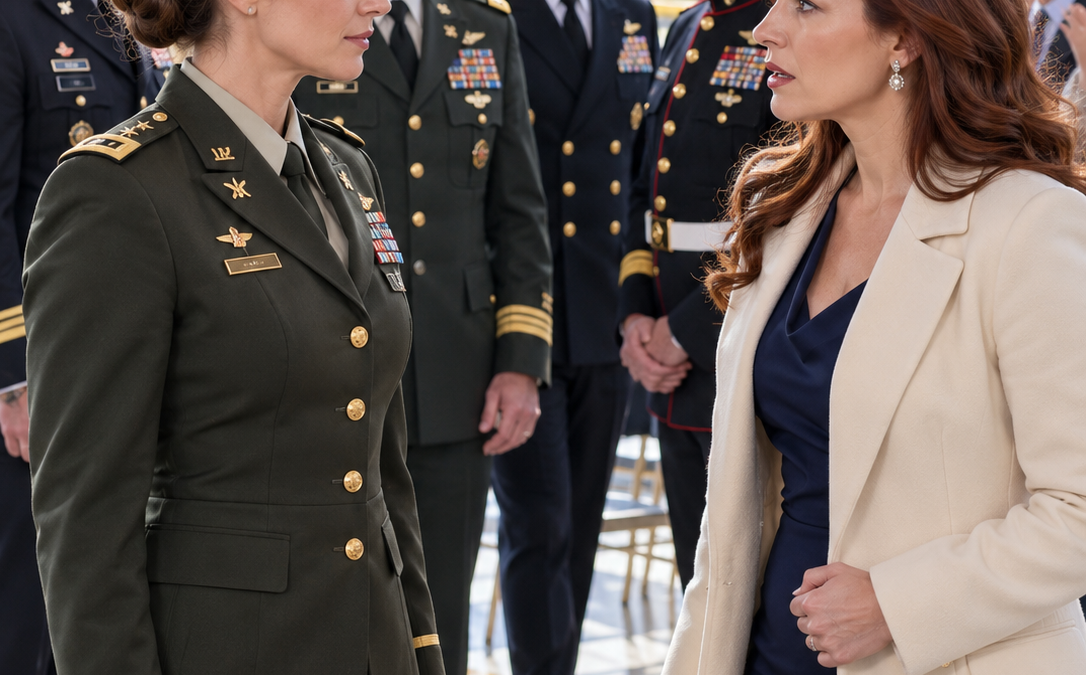
Monday morning in Virginia Beach started with a cold windshield, bad coffee, and my daughter’s baseball jacket thrown across the backseat of my old Toyota Highlander. That was about right for my life. The truck was twelve years old. The check-engine light had been on so long it felt less like a warning and more like a relationship. In the backseat, next to Marin’s jacket, there was a half-open bag of cheddar crackers, a water bottle with stickers peeling off, and a piece of construction paper she had left on the floorboard. Across the top, in purple marker, she had written, “The Strongest Person I Know.”
I saw it when I reached for my visitor badge. I did not pick it up. Not then. I was already late enough to be annoyed, but not late enough to be irresponsible. There is a difference. Most adults pretend there is not. The military does not give you that luxury, and neither does being a single mother.
The gate guard at Joint Maritime Training Center checked my ID, looked at the visitor pass, and looked back at me.
“Purpose of visit?”
“Readiness observation.”
He typed that in, then paused. It was a small pause. Most people would have missed it. I had spent too many years watching people read screens they did not expect. His eyes moved once. His shoulders changed just enough. He had found the part of my visit that did not match the jacket, the jeans, or the tired woman in the Highlander with crumbs in the cup holder. To his credit, he recovered fast.
“Have a good morning, ma’am.”
“You too, Petty Officer.”
He opened the gate, and I drove in slowly. Joint Maritime Training Center sat under a pale gray sky, all concrete, fences, towers, and clean signs telling people where they were allowed to go. The kind of place that looked organized from the road. Most places do. That was why I was there. Not to admire the signs.
I parked in the visitor lot beside two government sedans and a row of contractor trucks with magnetic logos on the doors. I clipped the badge to my jacket, checked my phone, and saw a text from Marin.
Don’t forget Wednesday.
I smiled despite myself. She had been reminding me for three days. Her school was doing some family presentation night, and her topic was apparently me, which already felt like an internal investigation I was not ready for.
I typed back, I won’t forget. Promise.
The reply came almost right away.
You said that last time.
That one landed. I stared at it for a second longer than I should have. Then I put the phone away and stepped out into the cold.
A few senior people on that base knew why I was there. The right office knew. The right signatures were on the right paperwork. But this was a low-visibility observation day, which meant most of the people I was about to watch had not been told to act pretty for the review team. That was the point. People behave differently when they know they are being graded. They tuck in the loose edges. They paint over the rust. They find the binder with the clean tabs and pretend that is the system.
I was not there for the binder.
I walked past the administration building and followed the sound of shouted commands toward the training yard. A fast-rope evolution was already underway near the tower. Twelve operators were rotating through the drill, mostly Navy, with a few attached personnel from joint units. A handful of contractors stood behind the marked boundary, watching like proud parents at a spelling bee, except with more fleece vests and less self-awareness.
I stopped near the fence and watched. Not the people first. The system.
The tower frame. The anchor points. The rope handling. The belay line. The secondary safety line clipped into a load-bearing point near the outer rail. The carabiner on that line was turned just enough that the morning light caught the gate hinge.
I looked at it once, then again.
There was a thin stress mark near the hinge. Not a surface scratch. Not dirt. A real fracture line, small enough to miss if you were checking boxes instead of looking at metal.
A young operator clipped in. My eyes moved from the carabiner to his harness, then to the height of the tower. Three stories, maybe a little more. I stepped closer to the fence.
“That secondary carabiner needs to come out of service,” I said.
The nearest contractor turned first, then two operators, then the man with the whistle.
Lieutenant Commander Grant Sloan had the kind of posture some men develop when they are used to being obeyed in outdoor spaces. Squared shoulders, chin slightly up, sunglasses even though the sun was losing badly to the clouds. He looked at me like I had just interrupted a wedding toast.
“Excuse me?”
I kept my voice even.
“The carabiner on the secondary safety line. Gate-hinge side. It’s showing a stress fracture. That needs to be replaced before you put another man on that line.”
A short silence followed. Not concern. More like the room deciding whether I was worth taking seriously, except there was no room, just cold air and a fence between me and a training yard full of people who already knew the social answer.
Then I heard her voice.
“Well, this is new.”
I did not turn right away. I knew that voice. I had known it since I was five years old and she told a neighbor I had broken a lamp she had knocked over with a jump rope.
Kendra Lowell stepped out from behind two contractors wearing Atlantic Shield Systems badges. She had on a cream coat that probably cost more than my monthly car insurance and heels that made no sense on a training yard, which was on brand. Kendra always dressed like someone might name a building after her if she stood still long enough.
She smiled at me. Not a warm smile. A press-release smile.
“Valerie,” she said. “What are you doing here?”
“Observing.”
Her eyes dropped to my visitor badge, then to my jeans, then passed me to the old Highlander in the lot. That part made her smile wider. Of course it did. Kendra had always believed a person’s value could be estimated by how recently their car had been washed.
Grant Sloan looked between us.
“You two know each other?”
“She’s my sister,” Kendra said, and somehow made the word sister sound like a medical condition. “She has a habit of walking into places and deciding she knows better than everyone.”
“I said the equipment should be replaced,” I said. “That’s all.”
Kendra gave a little laugh. A few of the contractors laughed with her. Not because it was funny, but because she was the person signing dinner checks and forwarding contract renewals. She took one step closer to the fence.
“Oh, Val,” she said. “You’re standing out here in a visitor badge, yelling at trained personnel about equipment you don’t manage.”
“I’m not yelling.”
“No,” she said. “You’re doing that calm thing. That’s worse.”
That got another small laugh. Then she raised her voice just enough for the operators to hear.
“What rank could a single mom like you possibly have?”
There it was.
Not just a shot at my career. A shot at my daughter, my divorce, my schedule, the parent-teacher conferences I had joined from airports, the lunches I packed at five in the morning, the permission slips I signed in parked cars, and the nights I told Marin I would call before bed and then fought through bad signals and the worst time zones.
Because a promise to an eleven-year-old is still a promise.
Kendra put all of it into one sentence and tossed it over the fence like trash.
A couple of contractors laughed louder this time. One sailor looked down at his boots. Grant Sloan did not laugh, but that almost made it worse. He looked at my badge again, then at Kendra, then back at the training system.
“The equipment was inspected last week,” he said.
“Then it needs to be inspected again.”
“We are not stopping a scheduled evolution because someone outside the training chain noticed a mark on a clip.”
“It’s not a mark.”
“Ma’am,” he said, and the way he said it had nothing to do with respect. “This area is controlled. If you have a concern, take it through the proper channel.”
I looked at the carabiner again. The young operator was still waiting. That bothered me more than Kendra did.
“Pull that line before you run another cycle,” I said.
Grant’s jaw tightened. Kendra folded her arms.
“See?” she said. “This is what I mean. She always does this. Walks in late, tells everyone else how to do their jobs, then acts wounded when people ask basic questions.”
That was rich coming from Kendra. She had once called roadside assistance because she did not know where her spare tire was, then told the family she had handled a vehicle emergency.
But I did not say that.
Tempting. Very tempting.
I reached into my jacket pocket and took out the small black notebook I carried everywhere. Not government-issued. Not fancy. Just paper. Paper does not crash, freeze, auto-delete, or pretend an email was never sent.
I clicked my pen.
Kendra watched me, still smiling. Grant watched, too. So did the young operator on the platform.
I wrote one line.
8:42 a.m. Secondary safety carabiner. Visibly stressed. Warning dismissed.
Then I closed the notebook.
Kendra shook her head like I had just proved her point.
“Unbelievable,” she said with a snort. “You’re taking notes now?”
“Yes.”
“On what authority?”
I looked at her for just a second. Long enough for the smile to flicker, but not long enough for anyone else to notice. Then I put the notebook back in my pocket.
Grant lifted the whistle toward his mouth.
“Continue the rotation,” he called.
The operator hesitated only half a second. Then training culture did what training culture does. He moved because the man in charge had spoken, and everyone around him had learned that hesitation could be judged faster than danger.
Kendra turned away first, satisfied. She thought she had won. She thought she had reminded me of my place in front of contractors, sailors, and a lieutenant commander who did not yet know he had just made the first bad decision of a very long week.
By Friday morning, four general officers and flag officers would walk into that same base. They would pass Kendra without stopping. They would stop in front of me. I would salute, and all four of them would return it before asking for my findings.
But at 8:42 on Monday morning, Kendra was still laughing, and Grant Sloan was still reaching for the whistle.
The whistle blew before I made it halfway across the concrete. I did not turn around. That took more control than I like to admit. There are moments in life when every normal part of your body wants to go back, point at the obvious danger, and ask a grown man if he left his common sense in his other uniform.
This was one of those moments.
I kept walking. My phone buzzed before I reached the administration building. I pulled it from my pocket and saw Marin’s name on the screen. That helped. Not because it made the morning better, but because it reminded me what mattered after bad mornings.
I answered. “Hey, kiddo.”
“Mom,” she said, already stressed in that very specific eleven-year-old way where the world is ending, but there is still time to explain the seating chart. “You remember Wednesday, right?”
“I remember Wednesday.”
“The presentation?”
“Yes.”
“At school?”
“Yes.”
“At six thirty?”
“Yes, Marin.”
“And the topic is ‘The Strongest Person I Know.’”
“I remember that, too.”
There was a pause. Not a quiet pause. A loaded one.
Then she asked, “You’re coming, right? Promise?”
I stopped walking.
That word always found the bruise.
Promise.
Kids do not ask that way unless they have learned the hard way that adults can mean something and still fail to do it. I hated that Marin had learned that from me. Not because I did not care, but because sometimes the call came in. Sometimes the briefing moved. Sometimes a safety issue became urgent at 1700 because equipment does not check the school calendar before it fails.
One time last spring, I missed the first ten minutes of her choir performance. Ten minutes. Not the whole thing. Just the opening song.
Marin never yelled at me for it. That made it worse. She had just smiled too fast when I walked in, like she wanted to make sure I did not feel bad.
A child should not have to protect a parent from guilt. That is not in the job description.
“I’ll be there,” I said. “Front row. Depends if they let dangerous military moms sit that close.”
She giggled. That sound did more for my blood pressure than any doctor ever had.
“You’re not dangerous,” she said. “You can’t even open pickle jars.”
“I loosen them with discipline.”
“No, you hand them to me.”
“Teamwork.”
She laughed again, then dropped her voice.
“And Kendra texted Grandma’s group chat.”
Of course she did.
There were many things in life you could count on. Sunrise. Taxes. Kendra turning a private insult into a public press release.
“What did she say?”
“I don’t know. I only saw part of it on Aunt Lisa’s phone when she came over yesterday. Something about you being at the base and making a scene.”
I closed my eyes for one second. Not long. Just enough.
“You don’t need to worry about grown-up group chats,” I said.
“That means it was bad.”
“It means grown-ups should have hobbies.”
“Mom, I’m serious.”
“Some people knit. Some people run marathons. Some people start family drama before lunch.”
That got a tiny laugh, but not enough.
“She said you always try to prove you’re special.”
There it was. Kendra’s favorite old song, remixed for a new audience.
“I’m not trying to prove anything to Aunt Kendra,” I said.
“Are you mad at her?”
I looked back toward the training yard. From where I stood, I could still see the tower through a gap between two buildings.
“No,” I said. “I’m working.”
That was true. Mostly.
Marin went quiet again.
“Wednesday,” she said.
“I’ll be there.”
“Promise?”
“Yes,” I said. “Promise.”
When the call ended, I stood outside the administration building with the phone in my hand and let myself feel it for exactly three seconds. Then I put it away.
That was my rule.
Feel it. Don’t live in it.
Kendra used to say she was the one who stayed.
She said it at Thanksgiving. She said it after church. She said it in hospital hallways when nurses were close enough to hear. She said it with that tired little smile people use when they want credit and pity at the same time.
“I was the one who stayed.”
People believed her because it sounded noble. It was also convenient.
I was the one who left for basic training at eighteen. I was the one who deployed. I was the one who missed birthdays, came home with a duffel bag, and left again before people stopped asking if I was still doing the Army thing.
Kendra stayed in North Carolina.
So that became the story.
Kendra stayed. Valerie left.
Simple stories are easy to sell.
The truth had more paperwork.
I paid for the home health aide when Mom started falling at night. I covered the second mortgage payment when Kendra’s temporary cash-flow problem became a six-month tradition. I paid the pharmacy bills. I paid the hospital balance that Kendra told everyone had been handled.
Handled.
That was one of her words. It meant someone else paid and she accepted the gratitude.
I never corrected her. At first, I told myself it was because Mom did not need fighting around her. Then I told myself it was because family peace mattered. Then Mom died, and Kendra became executor on part of the estate paperwork, and somehow peace started looking a lot like surrender.
She did not forge a will. That would have been too sloppy. Kendra was not sloppy.
She delayed information. She forgot to forward notices. She told relatives I had missed decisions because I was unavailable. She described my military schedule as instability. She described my divorce like it was a character flaw.
She described single motherhood like a condition that made me less reliable than a woman who once put diesel in a gas engine and blamed the pump.
I should have challenged her sooner. I know that now. But when you are trying to raise a child, serve your country, keep your house running, and sleep more than four hours without waking up to a phone alarm, some battles get labeled later.
Kendra built a castle in that word.
Later.
Inside the administration building, the duty clerk directed me to a records room near the maintenance office. He did not ask many questions. His screen probably told him enough to know that asking more would not improve his morning.
The room smelled like old paper, floor cleaner, and burnt coffee. A real government building, in other words. Someone had placed a motivational poster above the printer.
Excellence Is a Habit.
The printer below it was jammed.
I respected the honesty.
I signed into the terminal and started with the fast-rope equipment files. The system had clean categories: inspection logs, contractor notes, safety exception reports, readiness impact statements.
On paper, everything looked beautiful.
Inspection passed. Minimum standard met. No readiness impact. Training continuity maintained.
Green, green, green.
If you only read the summary lines, the system looked healthy. But I had seen the carabiner. A real crack does not care what the summary says.
I pulled the last six months of records for the tower system and found the same equipment ID in three separate entries. The first report mentioned gate tension irregularity. The second said wear pattern at hinge. The third reduced both into the kind of language that makes risk sound like a calendar item.
Monitor at next scheduled service interval.
That phrase had done a lot of work.
Too much work.
My phone buzzed again. This time it was the family group chat. I usually kept it muted because I valued my remaining brain cells, but Marin had mentioned it, so I opened it.
Kendra had written a paragraph.
Of course she had.
Valerie showed up at my site this morning and started interfering with a military training evolution. I know she likes to make everything about proving herself, but there are professionals on that base who actually understand the equipment and the process. Being loud does not make you right.
I stared at the message. Then I looked at my silent phone.
Being loud.
That was impressive, considering I had barely raised my voice. But Kendra never needed facts to be accurate. She only needed them shaped correctly. A cousin had replied with a sad face. Another had written, Hope you two can work this out.
That was family code for, Please fix the discomfort your abuse is causing us.
I locked the phone and went back to the files.
The fast-rope system had been supplied under an Atlantic Shield Systems contract package. That part I expected. Kendra’s company was everywhere on the training side. Atlantic Shield loved the phrase mission ready. They printed it on banners, brochures, and probably coffee mugs no one wanted.
Then I opened the related contractor support folders.
A cross-reference tag caught my eye.
Same vendor. Different incident category.
Aircraft Mishap Support Documentation.
I clicked it.
The folder header loaded slowly because government software believes suspense builds character.
Six months earlier. Rotary-wing training event. Two personnel injured. Preliminary cause listed as unexpected component fatigue.
I scrolled down.
Atlantic Shield Systems appeared again.
Not in the summary. Not in the public-facing language. In the supporting documentation trail.
I sat back in the chair. The room stayed quiet around me. The printer clicked once like it was considering a comeback, then gave up.
I had not come to that base to fight my sister. I had not come to reopen twenty years of family history beside a training tower. But if Kendra’s company was sitting inside the fast-rope file and the helicopter mishap folder, then my family problem had just walked into a much more dangerous room.
The folder name stayed on the screen while my coffee went cold.
Aircraft Mishap Support Documentation.
That was not supposed to be sitting next to a fast-rope equipment file. Not casually. Not neatly cross-referenced. Not under the same contractor’s support package, like somebody had filed danger under miscellaneous and called it a day.
I leaned closer to the terminal. The system showed the usual layers: summary, supporting documents, maintenance references, contractor correspondence, readiness impact. A whole little museum of people saying things in careful language so no one had to say the ugly thing out loud.
I opened the fast-rope file again and copied down the equipment ID. Then I moved to the maintenance records office. It was two hallways over, past a vending machine that had somehow survived three administrations and several wars against nutrition.
A printed sign above it said OUT OF ORDER.
The machine was humming, so at least one thing in the building had confidence.
The maintenance records room had metal shelves, two shared desks, and a young petty officer standing in front of a wall-mounted log binder like he had been caught near a crime scene. He had a clipboard in one hand and the alert eyes of a man who had learned to hear ranking footsteps.
He looked at me, then at my visitor badge, then at my face. I saw the recognition land.
He had been near the yard that morning. Maybe not in the front row, but close enough. Close enough to hear Kendra. Close enough to watch me stand there and say nothing while people decided I was either annoying, confused, or both.
“Ma’am,” he said.
His voice was polite. His body was already preparing an exit.
The name tape on his coveralls read RUSK.
“Petty Officer Rusk?”
“Yes, ma’am. Caleb Rusk.”
His eyes changed a little. Not fear exactly. More like he had just realized I could read more than visitor badges.
I nodded toward the binder.
“When was the last complete inspection on Training Tower Four’s fast-rope system?”
He looked at the door.
That told me more than the binder.
“I’d have to check the log,” he said.
“Good. Check it.”
He opened the binder slowly. Too slowly for a man who knew exactly where the page was. His finger moved down the sheet.
“Last weekly check was Thursday.”
“I didn’t ask about the weekly check.”
He stopped.
I kept my voice flat.
“I asked about the last complete inspection. Full system. Anchor points, rope condition, secondary safety line, carabiners, load-bearing hardware, documented replacement schedule.”
He swallowed.
“That would be in the digital file.”
“I saw the digital file.”
Another pause. He looked at the door again.
There it was. The thing I had seen on a hundred faces in twenty-five different offices.
Not cowardice. Not disloyalty.
Calculation.
How much truth can I afford today?
I softened my voice by half an inch.
“I’m going to find it in the records,” I said. “But it’s faster if someone who saw what happened tells me where to start.”
He did not answer right away.
That was fine. People think silence is empty. It usually is not. Most of the time, silence is where the honest answer is trying to survive.
Rusk closed the binder.
“Six months,” he said.
I waited.
“Maybe seven for the full system.”
“Six or seven months?”
“Yes, ma’am.”
“Why?”
He gave a small, humorless laugh. Not loud. Just enough to show he knew how bad it sounded.
“Training tempo.”
Two words. A lot of trouble.
I wrote them down. He watched the pen move.
“The carabiner I pointed out this morning,” I said. “Has it been flagged before?”
He looked at the door for the third time. Then he looked back at me.
“Twice.”
I did not react.
“Who flagged it?”
“Chief Warrant Officer Donna Pike wrote the first discrepancy. Senior Chief Ward wrote the second.”
“Elias Ward?”
“Yes, ma’am.”
“What happened to the reports?”
Rusk rubbed his thumb along the edge of the clipboard.
“They came back with corrections.”
“Corrections?”
“With language.”
That was a very military answer. It was also a very contractor answer.
“Tell me what that means.”
“The first one said, ‘Remove from service before next use.’ That came back as ‘Minimum operational standard met.’”
He took a breath.
“The second one said, ‘Hinge wear and possible stress at the gate.’ That came back as ‘Scheduled monitoring.’”
“Who sent it back?”
“I don’t know who made the final call.”
“That wasn’t my question.”
He looked at me then. Really looked for the first time.
I think he saw past the visitor badge. Not all the way, just enough to understand I was not asking because I enjoyed paperwork.
No one enjoys paperwork. People who say they do should be monitored.
“It came back through operations,” he said. “Commander Voss’s office.”
I wrote that down, too.
“And Atlantic Shield?”
His face tightened.
That was the answer before the answer.
“They were on the email threads.”
“Doing what?”
“Contract language. Replacement liability. Stuff like that.”
Stuff like that usually means the part someone wants me to ask about.
Rusk almost smiled.
Almost.
“There was a line in one of the emails,” he said. “I only saw it because I was CC’d on the support request. It said, ‘We should avoid unnecessary contract exposure.’”
“Who wrote it?”
He looked down.
I waited.
He looked back up.
“Kendra Lowell.”
The name did not surprise me.
That was the problem.
I wrote it anyway.
Kendra Lowell. Atlantic Shield Systems. Contract exposure.
My pen made a small scratch against the paper. Rusk watched that, too.
“I’m not trying to get jammed up over this,” he said.
“I know.”
“I didn’t steal anything.”
“I didn’t ask you to.”
“I saw what crossed my desk. That’s all.”
“That may be enough.”
He leaned closer, lowering his voice.
“There’s something else.”
I closed the notebook halfway. Not all the way.
“What?”
“The helicopter mishap.”
I let the room sit with that.
Six months earlier. Two injured. Official language clean enough to eat off of.
Unexpected component fatigue. No readiness impact beyond temporary aircraft availability. Corrective actions implemented.
Government poetry.
Bad poetry.
“What about it?” I asked.
Rusk’s voice dropped again.
“There was a tail-rotor pitch-control component flagged before that flight. I’m not a flight mechanic, ma’am. I don’t want to pretend I know more than I know.”
“Good. Don’t.”
“But I saw the support packet. The original note said it should be pulled and replaced before further training use. Then the packet went through review. By the time it came back, the wording changed.”
“To what?”
“Acceptable for limited training use.”
I felt my jaw tighten.
Just once.
“Who was injured?”
“Staff Sergeant Miguel Alvarez was one. The other was a Navy crew chief attached for the exercise. I don’t remember his name offhand.”
“Fatalities?”
“No, ma’am. But Alvarez got hurt bad. Back, shoulder, head injury. His wife kept calling. People were told not to speculate.”
People are always told not to speculate when the truth is inconvenient and the lie is still in draft form.
I asked, “Did anyone raise concerns after the mishap?”
“Senior Chief Ward did. And he got told the investigation was closed. By Voss, I heard. I heard Voss’s name. I can’t swear to the room.”
That mattered. A lot.
There is a difference between knowing something and being able to prove it. The first one keeps you awake. The second one gets action.
Rusk shifted his weight.
“I’m not saying Atlantic Shield caused anything.”
“No.”
“And I’m not saying Commander Voss knew the component would fail.”
“No.”
“I’m saying the same kind of wording keeps showing up right before broken things get treated like acceptable things.”
That was clean.
That was honest.
That was dangerous for him.
I closed my notebook.
“Listen carefully,” I said. “Don’t take anything you’re not authorized to access. Preserve what crossed your desk. Don’t become the story.”
He nodded.
“I mean it,” I said. “No screenshots of restricted systems. No downloading files you don’t have clearance for. No hero nonsense.”
That almost got another smile.
“Hero nonsense?”
“Yes. It’s popular. Also stupid.”
He breathed out.
“I have emails. I was copied on work orders. A draft comment packet from a replacement request. Nothing classified. Nothing outside my lane.”
“Keep them exactly as they are. Do not forward them to your personal email. Do not print anything new. Do not talk about this in the hallway. If anyone asks, you answered routine maintenance questions.”
He watched me for another moment.
“Who are you?” he asked.
There it was. The question everybody kept circling.
Kendra had asked it as an insult. Grant had asked it with his posture. The gate guard had asked it with a pause.
Rusk asked it because he was deciding whether telling the truth had just ruined his life.
I gave him the only answer he needed.
“I’m someone who knows the difference between a bad part and a bad record.”
He studied me for a second. Then he nodded.
“Ma’am,” he said quietly. “I don’t think the equipment failed. I think the paperwork failed first.”
That one went into the room and stayed there.
Because he was right.
Equipment breaks. Metal fatigues. Parts age. Systems wear down. That is why inspections exist.
But paperwork does not fail by accident.
Paperwork fails when people make it fail.
I left the maintenance records room with Rusk still standing by the binder, trying to look like nothing had happened. He was not very good at it yet.
That was fine. Fear has a learning curve.
Outside, the cold hit my face again. Across the yard, Grant Sloan was still running the training evolution. Operators moved through the rotation. Contractors watched from the boundary. Kendra stood near them, laughing at something one of the men had said.
The secondary safety line was still clipped in. The cracked carabiner was still on the system.
And now I knew it was not a small flaw in a piece of metal.
The flaw was still sitting in my head when Kendra started pulling at mine.
I did not see her make the first call. I learned about it later from the administration clerk, who looked like he wanted to be reassigned to a submarine with no phones.
Kendra had gone back to the contractor office near the west side of the training center. Atlantic Shield had a temporary workspace there, complete with folding tables, branded banners, and a coffee station that tried very hard to look like leadership.
She asked for my visitor classification.
Not my name. Not my purpose.
My classification.
That was Kendra. She never asked a question unless she already knew what she wanted the answer to prove.
The clerk would not tell her. Good for him. He gave her the correct line about visitor records not being released to contractor personnel.
But there was a pause.
That was all Kendra needed.
A pause is a dangerous thing around someone like my sister. She could turn half a second of silence into a conspiracy, a family emergency, or a three-paragraph text message with punctuation aggressive enough to need its own attorney.
By the time I got back to the records terminal, my phone buzzed again.
Family group chat.
Of course.
Kendra had sent another message.
Valerie is at the base again, inserting herself into things she does not understand. I know everyone wants to be polite, but this has been a pattern for years. She shows up, makes a scene, then acts like everyone else is the problem. Maybe if she put this much energy into stability at home, Marin would not have to keep adjusting to chaos.
I read it once, then again.
Not because I needed to.
Because some wounds make you check the blade.
There were already replies. Aunt Lisa wrote, Let’s not fight. My cousin Mark wrote, Hope Marin is okay.
That one irritated me more than it should have.
Marin was okay. Marin had homework, soccer socks in the wrong drawer, and a mother who knew exactly where her inhaler was. That was more than Kendra could say about her own car keys on most days.
But Kendra had done what she always did. She had taken a clean insult and wrapped it in concern.
People trust concern. It sounds nicer than cruelty.
I locked the phone and opened the contractor memo trail again.
The fast-rope records were built like a layer cake nobody wanted to eat. Equipment inspection. Contractor response. Operations review. Readiness impact. Final disposition.
Everyone got one slice of responsibility thin enough to deny later.
I found the draft memo Caleb had mentioned.
The original line was clear.
Unsafe for continued use.
Someone had struck through it.
The replacement line sat below it.
Requires scheduled monitoring.
There it was.
The magic trick.
No smoke. No stage. No rabbit.
Just five words turned into three softer ones, and suddenly a real hazard became something that could wait until the next service window.
I checked the export data.
The comment author was blank.
Of course it was.
The PDF had been flattened before upload, which is a fancy way of saying someone wanted the final version to look clean and boring.
Clean and boring is where a lot of bad decisions go to retire.
I saved the document reference number in my notebook. Not the file itself. The reference. There is a difference, and that difference keeps you employed.
A knock came at the open door.
Lieutenant Commander Grant Sloan stood there, sunglasses now hooked into the front of his shirt. Without them, he looked younger, less sure of himself. That did not make him harmless, but it made him easier to read.
“Miss Keen,” he said.
I let the title sit there. He knew enough to be uncertain, not enough to be respectful.
“What can I do for you, Lieutenant Commander?”
He stepped in.
“I was told you were reviewing training equipment records.”
“I am.”
“That concern you raised this morning has been documented.”
“Documented how?”
He shifted.
“Verbal concern from civilian observer regarding secondary safety hardware.”
I stared at him.
He did not enjoy that.
“Civilian observer,” I said.
“That’s how it was logged.”
“That’s how you chose to log it.”
His jaw moved once. He did not like being corrected. Most people do not. Officers especially. We are trained to make decisions under pressure, which is useful right up until someone starts confusing speed with accuracy.
“Commander Voss reviewed the training status,” Grant said. “The system remains within minimum standard.”
Standard.
There was that phrase again.
Minimum standard.
If bureaucracy had a cologne, that would be the name on the bottle.
“Did Commander Voss inspect the carabiner?”
“He reviewed the report.”
“That wasn’t my question.”
Grant looked away for a second.
That tiny break mattered.
“No,” he said. “He did not physically inspect it.”
“Did you?”
“I inspected the line visually after you left, and I saw wear.”
“Wear or fracture?”
He took a breath.
“I’m not a metallurgist.”
“No. You’re the officer running men off that tower.”
That landed. Not hard enough to change him yet, but enough to leave a mark.
“Commander Voss said minimum standard is still standard,” he replied. “We do not stop scheduled training unless there is a confirmed safety failure.”
I stood up.
“Lieutenant Commander, if the failure is confirmed after someone hits the ground, that is not a safety process. That is a cleanup plan.”
He did not answer.
For one second, I saw him do the math. Not the paperwork math. The real math.
Height. Weight. Load. Acceleration. Metal under stress.
A young operator trusting the adults around him to care more about physics than scheduling.
Then his phone buzzed.
He looked at it, and his face closed again.
“Operations wants training continuity maintained,” he said.
There it was.
The leash.
He left without another argument, which was not the same as agreement.
I sat back down and opened the helicopter folder.
Before I could dig deeper, my phone buzzed again.
Private message.
Kendra.
A scan loaded first. Legal paperwork. My mother’s trust documents. The version Kendra loved to send when she wanted to remind me she had keys to rooms I had not been invited into.
Then her message came through.
Maybe if you had been home more, Mom would have trusted you more.
I did not move for a moment.
No sarcasm came. No quick answer. No little internal joke to make it smaller.
That one hurt.
I thought of my mother’s voice over bad satellite connections from overseas. I thought of calling her from a plywood office at two in the morning because it was afternoon back home. I thought of Kendra not answering when the pharmacy needed payment, then texting me the amount with no please and no shame.
I thought of the wire transfers, the medical bills, the mortgage payments, the home health aide named Denise who sent me updates because Kendra kept forgetting.
Maybe if you had been home more.
That was the kind of sentence only someone who had benefited from your absence could say with a straight face.
My screen flashed with another notification before I could put the phone down.
Marin’s school reminder.
Family Presentation Night. Wednesday, 6:30 p.m. Students should arrive by 6:10. Topic: The Strongest Person I Know.
I looked at that message.
Then at Kendra’s.
For a second, both parts of my life sat on the same screen.
My daughter asking me to show up.
My sister using my absence like a weapon.
Then the records terminal chimed.
SYSTEM ALERT.
I turned back to the computer.
A maintenance archive folder tied to the helicopter mishap had been accessed three minutes earlier.
Not opened for viewing.
Not searched.
Modified metadata attempt.
My body went still.
That was not curiosity.
That was movement.
Someone had tried to touch an old file right after my records query hit the system.
I copied the alert number into my notebook. Then I pulled up the review contact list and called counsel assigned to our team.
He answered on the third ring.
“Keen.”
“I need to prepare a records preservation notice.”
There was no pause on his end.
“What scope?”
“Fast-rope system. Atlantic Shield contractor correspondence. Operations readiness review. Helicopter mishap support documentation from six months ago. Include metadata and version history.”
He exhaled.
“That broad?”
I looked through the window toward the training yard. Grant was back outside. Kendra was near the contractors. Commander Voss stood beside them now, calm and clean, hands in his pockets, like a man watching a machine do exactly what he wanted.
“Yes,” I said. “That broad.”
The word broad was still in my mouth when counsel stopped sounding like a lawyer and started sounding like a man who knew his afternoon had just been ruined.
“Valerie,” he said, “if we send a preservation notice that wide, command is going to ask what triggered it.”
“They can ask.”
“They will ask loudly.”
“Then I hope they hydrate.”
A short silence.
That one was not legal silence. That was professional disappointment with my personality.
“I need more than a metadata alert,” he said.
“You’ll have it.”
I hung up before he could ask me to be reasonable.
Reasonable had a bad smell that day.
I found Senior Chief Elias Ward in a small equipment control office behind the training wing. He was fifty-two, squared away, gray at the temples, and built like a man who had spent thirty years carrying heavy things and refusing to complain about it.
He looked up from a parts inventory sheet when I stepped in.
“Can I help you?”
His tone said he already hoped the answer was no.
“Senior Chief Ward?”
“Yes, ma’am.”
“I need five minutes.”
“About what?”
“Training Tower Four and a helicopter mishap six months ago.”
His face did not change much.
That was the first thing I respected about him.
Most people react when you hit the right nerve. Ward just got still.
“I gave my statement on the mishap,” he said.
“I read the statement in the system.”
“Then you have what I gave.”
“No,” I said. “I have what survived.”
He set the inventory sheet down slowly.
The room was small. Two desks, one file cabinet, a rack of labeled equipment bags, no decorations except a coffee mug that said I LOVE CHECKLISTS, which felt less like a joke and more like a warning.
I placed two printed log excerpts on the desk.
I did not say anything.
He looked at the first page, then the second. His eyes moved down the line, stopped once, went back, and stopped again.
There.
He had seen it.
The first version carried his language.
Secondary carabiner gate hinge shows stress indication. Remove from service before next use.
The second version carried someone else’s.
Minor hinge wear observed. Scheduled monitoring recommended. Minimum operational standard met.
Ward looked up at me.
“Where did you get these?”
“From the system.”
“That first one isn’t in the system.”
“It was briefly.”
He leaned back in his chair. For a man like Ward, that was practically throwing furniture.
“I knew it,” he said.
Not loud.
Worse.
Flat.
The kind of flat you get when anger has had six months to mature.
“You filed the original,” I said.
“I did.”
“Who received it?”
“Operations first. Then contractor support because Atlantic Shield owned the replacement package.”
“Did you approve the revised language?”
“No, ma’am.”
“Were you asked?”
He gave me a look. Not rude. Just tired.
“People don’t ask enlisted personnel to approve the version they already want.”
That one earned a place in my notebook.
I sat across from him.
“I’m not here to make you relive a bad review process for entertainment.”
“Good. I’d hate to be boring.”
There was the sarcasm. Dry, Navy-issue.
“I need to know if this was isolated.”
He looked at the two pages again. Then he opened the lower drawer of his desk and pulled out a black notebook with worn corners.
Not government-issued.
Personal.
I understood that immediately.
People who trust systems do not keep notebooks like that.
People who have been corrected by systems do.
Ward placed it on the desk but did not open it yet.
“I started keeping this after a crane accident in Bahrain,” he said. “Long time ago. Different unit, different command. Same kind of language.”
“What kind?”
“The kind that makes a warning sound like a suggestion.”
He opened the notebook.
Every page was clean. Dates on the left. Serial numbers. Defect notes. Names. Times. Who received what. Who called back. What changed.
No drama. No speeches.
Just facts.
The most dangerous thing in a room full of excuses.
“I didn’t keep this to go around the chain,” he said. “I kept it because sometimes the chain forgets what went up it.”
I nodded.
He turned to an entry from six months earlier.
Rotary-wing training support package. Tail-rotor pitch-control assembly component flagged for replacement before further training use.
I read the line twice.
Below it, Ward had written:
Contractor review requested. Operations requested readiness impact assessment. Language revised: Acceptable for limited training use.
“Who requested the readiness impact assessment?” I asked.
“Commander Voss.”
That was the first clean line to him.
Not rumor. Not hallway talk.
A name tied to a process.
“Was Kendra Lowell in the thread?”
Ward’s eyes sharpened.
“You know her?”
“She’s my sister.”
That got the first honest surprise out of him. Not much, but enough.
“Well,” he said, “Thanksgiving must be a blast.”
“Mostly a hostage situation with pie.”
His mouth twitched.
Then he turned the notebook toward me.
He had written the names from the email routing.
Commander Aaron Voss. Operations. Atlantic Shield Systems. Kendra Lowell, Government Programs. Aircraft Maintenance Liaison. Safety Office.
I did not touch the notebook.
“Did Lowell make a technical determination?”
“No.”
“Did she recommend language?”
“Yes.”
“What kind of language?”
“Contract exposure language. Liability language. The kind they pretend is separate from safety until safety needs a budget line.”
He tapped the page.
“The original recommendation was replacement. After the contractor review, it became limited training use. After operations review, the readiness impact went from red to amber. Then amber became green with conditions.”
“Green with conditions,” I said. “Pretty color. Ugly sentence.”
I took a breath.
“Two people were injured.”
Ward’s jaw set.
“Yes, ma’am.”
“Did anyone from command reopen the issue after the mishap?”
“I raised it.”
“With whom?”
“Voss’s office first. Then safety.”
“What happened?”
“I was told the investigation had determined unexpected component fatigue. I was told not to confuse correlation with causation.”
He paused.
“I was also told I had a strong reputation and should be careful not to damage it by sounding frustrated.”
There it was.
Not a threat.
Worse.
Career advice.
That is how professional pressure works when it has had practice. It does not kick the door in. It puts a hand on your shoulder and says it is looking out for you.
I looked at the notebook again.
“Would you be willing to provide a formal statement if a preservation notice goes out?”
Ward did not answer right away.
I respected that, too.
A formal statement was not a casual favor. It came with meetings, questions, side-eyes, and people suddenly remembering every mistake you had made since 2009.
Finally, he said, “If the notice is real, yes.”
“It’ll be real.”
“I’ve heard that before.”
“I know.”
He studied me.
“You’re not wearing rank.”
“No.”
“Why?”
“Because I wanted to see what people did when they didn’t know what to perform for.”
He nodded once.
“That worked out.”
“Could have gone better.”
“Could have gone worse,” he said. “That kid could have dropped off the tower.”
I did not answer because he was right.
My phone buzzed with a secure call request.
Brigadier General Thomas Ror.
That was fast.
I stepped into the hallway to answer.
“Keen,” he said. “General Counsel says you’re requesting a broad preservation notice.”
“Yes, sir.”
“How broad?”
“Fast-rope system, contractor replacement language, operations readiness decisions, Atlantic Shield correspondence, and helicopter mishap support documents from six months ago. Include metadata, version history, draft comments, and export records.”
“That’s not a notice. That’s a net.”
“It needs to be.”
“What do you have?”
I kept it short.
No story.
Just bones.
“Two versions of a fast-rope safety log. Same equipment. Original says unsafe for continued use. Final says scheduled monitoring. Personal log from Senior Chief Ward confirms original submission. Similar pattern appears in the helicopter mishap file. Tail-rotor pitch-control component flagged before training use. Language changed after contractor and operations review. Commander Voss appears in the approval chain. Kendra Lowell at Atlantic Shield appears in contract exposure correspondence.”
Ror was quiet.
When a general is quiet, you do not fill the silence unless you enjoy making your own life worse.
Finally, he asked, “How bad?”
I looked through the narrow hallway window.
Outside, personnel moved between buildings like the base was a normal place having a normal Monday.
That is the thing about damage inside institutions.
From the outside, the grass still gets cut.
“Bad enough that a family was given a lie on official letterhead,” I said.
That did it.
His voice changed.
Not louder.
Sharper.
“I’ll authorize preliminary preservation pending counsel language, effective 0600 tomorrow. No deletion, alteration, overwrite, disposal, or metadata change on the identified records. I’ll have it transmitted through proper channels.”
“Yes, sir.”
“And Keen?”
“Sir?”
“Make sure your facts are clean.”
“They are.”
“Make sure they’re cleaner than theirs.”
The line went dead.
I went back into Ward’s office.
He looked up.
“Notice goes out at 0600 tomorrow.”
For the first time, he let out a breath like he had been holding it for six months.
“Then I’ll write the statement.”
Across the base, Kendra would receive notice through Atlantic Shield less than an hour later. Not the full scope. Just enough to know records connected to her contract language were about to be frozen.
I did not see her face when she read it.
I did not need to.
By then, Kendra had spent her whole morning smiling.
For the first time that day, she stopped.
The notice hit the base at 0600.
And by 0617, people who loved clean reports started having dirty mornings.
Maintenance logs were locked. Contractor reports were locked. Email threads, draft language, accident files, metadata, version history. All of it.
No deletion. No alteration. No overwrite. No quiet little correction after the fact.
The kind of instruction that sounds boring until you are the person who was hoping to make something disappear before lunch.
By 0700, Commander Aaron Voss had called two meetings and canceled one of them when counsel showed up.
That told me plenty.
Voss did not storm down a hallway. He did not slam doors. Men like Voss usually know better. They get calm when they are angry because calm looks professional on camera and in sworn statements.
He walked into the operations conference room with a legal pad and a jaw tight enough to crack a walnut.
I was not in the room. I got the summary from someone who was.
Voss said the preservation notice was disruptive to operational continuity.
Counsel said operational continuity was not the priority listed in the notice.
I would have paid money to see his face.
Not a lot of money. I am still a single mother with a mortgage.
But some.
The notice did not accuse anyone. That was the beauty of it. It simply froze the record. It told the truth to stand still long enough for someone honest to look at it.
And that was when Kendra called.
I was in a small review office with a government laptop, two file folders, and coffee that tasted like someone had threatened a bean with hot water.
Her name came up on the screen.
Kendra Lowell.
I let it ring twice.
Not for drama.
For breathing.
Then I answered.
“Valerie Keen.”
“Oh, now we’re using full names.”
“Good morning, Kendra.”
“It is not a good morning.”
“That sounds like a personal problem.”
“You froze records tied to my contract.”
“I requested a preservation notice tied to safety records.”
“Don’t play cute with me.”
“I promise you, I have never once been accused of being cute before 0800.”
She exhaled hard.
The old Kendra would have gone sharp right away. This Kendra sounded colder, more controlled.
That meant she was scared enough to manage herself.
“You have no idea what you’re doing,” she said.
“I’ve heard that today. It’s getting less original.”
“You don’t understand contractor operations. You don’t understand how many jobs are connected to this package. If this contract gets frozen, people get hurt. Real people. Not just whatever imaginary villains you think you’re chasing.”
I looked at the fast-rope file on the desk.
“Real people already got hurt.”
“That is not fair.”
“No,” I said. “It usually isn’t.”
“You think this is about you and me?”
“No,” I said. “You do.”
Silence.
Then her voice dropped.
“You always do this. You walk into a room, act calm, and make everyone else look unstable.”
“That must be exhausting for everyone else.”
“This isn’t funny.”
“I agree.”
That made her angrier.
Good.
Angry people get sloppy. Kendra was usually careful. I needed careless.
“You have always looked down on what I do,” she said. “You think because you wear a uniform, everyone else is just pushing paper.”
“Kendra, if your contract needs a lie to stay alive, it shouldn’t stay alive.”
There was a pause.
Small.
Real.
Then she changed lanes fast.
“How is Marin?”
My hand tightened around the phone.
Not much.
Enough.
“She’s fine.”
“Is she, Valerie? I’m asking because from where I sit, you’re on a military base before sunrise, chasing documents, picking fights, and pretending that’s stability.”
There it was.
The hook under the bait.
“I’m not discussing my daughter with you.”
“You may have to discuss her with someone eventually.”
I did not speak.
She heard it. She moved in.
“You travel. You get called away. You miss things. You know that.”
“I know that.”
“Marin knows that.”
“That’s enough.”
“Courts care about stability, Val.”
She said it softly.
That was the ugly part.
Not a threat shouted in anger. A suggestion placed gently on the table like a business card.
“I’m not saying I would do anything,” she said. “I’m saying people ask questions when a mother keeps putting work first.”
My laugh came out once.
Short.
No humor in it.
“You’re trying to make a safety review sound like neglect.”
“I’m trying to protect this family from your need to prove yourself.”
“There it is again. ‘Protect this family.’ You use those words like a locked door.”
She did not answer.
I ended the call before I said something Marin would not have been proud of.
That was the line I kept.
Not because Kendra deserved restraint.
Because Marin deserved a mother who did not let Kendra write the rules for her behavior.
At 10:26, the school called.
I knew the number before I answered.
My stomach did, too.
“This is Valerie Keen.”
“Miss Keen, this is Angela Morris at Bayside Intermediate. Everything is okay. Marin is in class.”
She said that first because school staff know how to keep parents from levitating through the ceiling.
I stood up anyway.
“What happened?”
“We have a woman here. Kendra Lowell. She says she is Marin’s aunt and that she used to be listed as an emergency contact. She said you were tied up with military work and asked her to pick Marin up early.”
The room went quiet around me.
Not actually.
People were still moving outside the door. Phones still rang. Someone laughed down the hall.
But inside my head, everything went flat.
“Is Marin with her?”
“No, ma’am. Marin is still in class. We checked the current authorized pickup list, and Ms. Lowell is not listed. Since she mentioned prior emergency contact status, we called to verify.”
“You did the right thing,” I said.
My voice sounded normal.
That took effort.
“Kendra Lowell is not authorized to pick up my daughter. Not today. Not any day. Please document the visit and send me a copy of the incident note.”
“Of course.”
“Do not allow her access to Marin.”
“We won’t.”
“Thank you.”
I hung up and stared at the phone.
For the first time that week, I wanted to leave the base.
Not walk.
Drive fast.
I wanted to go to that school, stand between my daughter and every person who thought family meant access. I wanted to tell Kendra in language even Atlantic Shield could not soften exactly where she could file her concern.
But I did not move.
Because Marin was safe.
Because the school had done its job.
Because if I ran every time Kendra pulled a string, she would keep pulling strings.
I called the school back, confirmed the pickup list in writing, then sent a calm email.
Calm emails are underrated.
They are little paper fences.
At 17:30, I picked Marin up myself. She climbed into the Highlander wearing her backpack on one shoulder and suspicion all over her face. Eleven-year-olds know when adults are acting normal too hard.
“Aunt Kendra came to school,” she said before I put the car in drive.
“Yes.”
“Why?”
“She made a bad decision.”
“Was she trying to take me?”
“No,” I said carefully. “She was trying to act like she had permission she didn’t have.”
Marin looked out the windshield.
“Is Aunt Kendra mad because you did something wrong?”
There it was. The damage. Not dramatic. Not loud. Just a child trying to place blame somewhere safe.
I wanted to tell her everything. I wanted to say Kendra was scared because people were finally looking at her emails. I wanted to say her aunt used concern like a crowbar. I wanted to say some adults loved control more than they loved truth.
But Marin was eleven, and she was my daughter, not my witness.
“Sometimes people get angry,” I said, “when you stop pretending they did nothing wrong.”
She thought about that.
“Did she do something wrong?”
“Yes.”
“Can you tell me?”
“Not all of it. Not yet. But I can tell you this: You are safe. Your school knows who can pick you up. And grown-up problems do not get to climb into your backpack.”
That got a tiny smile.
“Good. Because my backpack is already full.”
“I saw. Are you carrying bricks?”
“Science binder.”
“Same thing.”
She leaned back, a little lighter.
That night, after dinner, after homework, after I checked the doors twice and pretended it was only once, Kendra called again. I stepped into the garage before answering.
The Highlander sat there with bug splatter on the windshield and Marin’s old softball cleat under the workbench. Normal things. Real things. The kind of things Kendra kept mistaking for weakness.
I answered.
“Don’t go to my daughter’s school again.”
Kendra did not even pretend.
“You made this ugly.”
“No. You made it personal.”
“You dragged my company into your little crusade.”
“Your company dragged itself in when your name landed on safety language.”
“You don’t know what you’re reading.”
“I know exactly what I’m reading.”
“You’re going to hurt people.”
I looked at Marin’s cleats. Small, dusty, outgrown.
“You already did.”
Kendra breathed into the phone. I let her hear the next sentence clearly.
“Don’t use my daughter to protect your contract.”
Nothing.
For once, no comeback, no polished insult, no speech about family. Because we both knew I had named it. Not all of it. Enough.
The garage felt colder after I hung up. I stood there for a moment, letting my hand relax around the phone.
Then the screen lit again.
A text message from Caleb Rusk.
Ma’am, I found the original attachment. It still has the comments.
Caleb’s message sat on my screen while Marin called from the kitchen, asking if we had any clean poster tape. That was motherhood in one sentence: a possible safety cover-up on my phone, a school presentation crisis in the next room.
Both urgent, apparently.
I typed back to Caleb.
Do not send it to personal email. Keep it where it is. I’ll review through proper channels.
Then I put the phone face down.
That was the hard part. Not the investigation. Not Kendra. Not Voss and his office voice and his magic trick where danger became training continuity. The hard part was knowing something mattered and still choosing the child in the kitchen first.
I walked in and found Marin standing at the table with her poster board, three markers, two glue sticks, and the distressed expression of a project manager with bad funding.
“I need tape,” she said.
“I thought we bought tape.”
“We bought bad tape.”
“There’s good tape and bad tape now?”
“Mom.”
“Right. Crisis.”
I found the tape in the drawer where it belonged, which shocked both of us. We celebrated like reasonable people. By that, I mean she took it and immediately told me I was standing in the light.
Her poster was mostly covered with photos. A picture of me at one of her softball games. A picture of us in the kitchen with pancake batter on the counter. A picture from a school field trip where I looked like I had slept in a chair because I had.
There was also one picture of me in uniform, smaller than the rest, tucked near the bottom.
I noticed that.
I did not say anything.
Marin adjusted the title across the top.
The Strongest Person I Know.
“You don’t have to make it about me,” I said.
She gave me a look. The look said I was embarrassing myself in my own home.
“It’s already about you.”
“Fair.”
She bent over the poster again, serious and careful. I watched her for a second too long.
Then my phone buzzed again.
This time it was the base.
A message from review counsel.
Preliminary review access established. Files preserved. Need in-person review before Friday board prep.
Of course.
The week had decided to become a juggling act, except someone had replaced one of the balls with a live grenade and another with an eleven-year-old’s feelings.
I checked the time.
5:38 p.m.
Marin had to be at school by 6:10. The presentation started at 6:30. The base was twenty-three minutes away without traffic, which meant forty minutes in real life because Virginia Beach roads enjoy lying.
I had fifty-two minutes to leave the base, get home, change, drive to the school, park, and walk in like a mother who had not spent the day reading proof that people had softened safety language until soldiers got hurt.
I did not make it pretty.
I changed shirts in the laundry room while Marin yelled that she could not find her blue hair tie. I found it on her wrist. She accused me of putting it there with military speed. I told her that was classified.
She rolled her eyes.
Good.
Eye rolls meant normal.
I grabbed my jacket, my keys, and the folder I should not have brought home but had not let out of my sight. It stayed closed. It stayed in my bag.
It did not belong in Marin’s night.
We got in the Highlander. The backseat was its usual disaster: baseball jacket, snack bag, one sock, a library book that had been due last week because apparently I could coordinate interagency review but not defeat the public school library system.
Marin held the poster on her lap like it was a diplomatic treaty.
She was quiet for the first five minutes.
That worried me more than talking.
“You okay?” I asked.
“Yeah.”
That meant no.
I waited.
She looked out the window.
“Do you think Aunt Kendra is coming tonight?”
“No.”
“Good.”
I kept my eyes on the road.
“Did she scare you today?”
“Not scared,” Marin said. “Just weird. She was smiling too much.”
That was my girl.
Accurate threat assessment.
“She won’t pick you up unless I say so.”
“I know.”
Another pause.
“People think because you’re in the Army, you’re not around,” she said.
That one hit the steering wheel before it hit me.
“Who said that?”
She shrugged.
“People.”
There are no people more dangerous than unnamed people in a child’s sentence.
“They’re wrong,” I said.
“Sometimes you’re gone.”
“Yes.”
I did not dress it up. Kids know when you lie to protect yourself.
“Sometimes I’m gone,” I said, “and sometimes that hurts you. I know that.”
She looked at me then.
I kept going.
“But gone for work is not the same as gone in the ways that matter. I will always come back to you. I will always tell you the truth I’m allowed to tell. And I will always make sure you know you’re not second place.”
She nodded, small.
Then she said, “Even when you miss stuff?”
“Even then.”
“That’s kind of unfair.”
“It is.”
She thought about that.
Then she said, “You owe me ice cream.”
That was a tactical ambush.
“Yes. Fine.”
“After?”
“After.”
She smiled.
The school gym was already half full when we arrived. Folding chairs, parents with phones, kids running like they had been raised by wolves with backpacks, and a teacher near the stage using the voice.
All teachers have the one. The one that can stop a child at thirty feet without raising its volume.
I signed in at 6:26.
Four minutes to spare.
Not my best work.
Still work.
My shirt had a coffee spot near the cuff. My hair was tied back too tight. My eyes looked like they had filed a complaint with management.
But I was there.
Marin went to line up with her class. Before she left, she turned back.
“You’re staying the whole time, right?”
“Yes.”
“Even the boring ones?”
“Especially the boring ones. Builds character.”
She smiled and ran off.
The presentation started with a boy talking about his grandfather, who had survived the 1970s, which made several adults cough into their hands. Then a girl talked about her older brother. Then another student talked about a soccer coach who sounded much more organized than I had ever been.
Then Marin walked up.
She carried the poster with both hands.
She looked small on that stage. Not weak. Just young.
There is a difference people forget until it is their child up there under bad gym lighting.
“My presentation is called ‘The Strongest Person I Know,’” she said.
Her voice shook once, then steadied.
“The strongest person I know is my mom.”
I looked down at my hands. Not because I was crying. Because I was managing an event. A private one.
“She is not strong because she can lift heavy things,” Marin said. “She asks me to open pickle jars, so that would be false advertising.”
The room laughed.
I deserved that.
“She is not strong because she wears a uniform. She does wear one sometimes, and it is very serious, and she makes this face when she’s thinking that makes people stand up straighter.”
More laughter.
I closed my eyes for half a second.
This child was going to get me investigated at home.
“But that’s not why,” Marin said.
The gym settled.
“My mom is strong because she tries really hard to keep promises. She calls me from hotels, airports, parking lots, and once from a place where the phone sounded like it was inside a washing machine.”
I knew that call.
Fort Irwin.
Awful signal. Worst coffee.
“She says good night even when she is tired. She comes to my games when it is raining. She does not say mean things about people in front of me, even when I can tell someone made her sad.”
That one went quiet.
The whole gym softened.
Marin looked at her poster.
“She misses things sometimes, but she always comes back. And when she says something matters, she shows up for it. I think being strong means you keep showing up, even when it would be easier not to.”
I stopped looking at my hands.
Marin looked right at me.
“My mom is the strongest person I know because she keeps choosing what matters.”
The applause came in warm. Not loud at first, then bigger.
I clapped with everyone else, but I could barely see her for a second.
Afterward, she ran over, pretending not to care what I thought.
“Well?” she asked.
I crouched a little because I still liked meeting her at eye level when things mattered.
“It was perfect.”
“Even the pickle jar part?”
“That was damaging but fair.”
She grinned.
Then her face changed.
“Mom?”
“Yeah?”
“What rank are you really?”
I had answered that question a hundred ways in my life. On forms, in briefings, in rooms where rank decided who spoke first and who waited.
But standing in that gym with her poster between us and glue still drying on the corner, none of those answers felt like the whole truth.
So I gave her the part she could carry.
“High enough to know rank isn’t what makes someone worth listening to.”
She thought about that.
“That sounds like something a mom says when she doesn’t want to answer.”
“It is exactly that.”
She laughed and hugged the poster to her chest.
Later, after ice cream, after homework, after Marin fell asleep with her book open on her blanket, I sat at the kitchen table and opened the secure review portal.
Caleb’s preserved attachment was there.
Original PDF.
Comments intact.
I opened the markup panel.
There was Kendra’s name.
Kendra Lowell.
And beside the original line, Unsafe for continued use, her comment sat clean and calm, dressed up in professional language.
Recommend replacing “unsafe for continued use” with “requires scheduled monitoring.” Reduces unnecessary contract exposure.
I read Kendra’s comment three times before I let myself move. Not because I did not understand it, but because I understood it too well.
Recommend replacing “unsafe for continued use” with “requires scheduled monitoring.” Reduces unnecessary contract exposure.
That was Kendra in one sentence.
Clean words.
Dirty hands.
She had not written Keep broken equipment in service. She was too smart for that. She had not written Hide the danger. She was too careful.
She had written the kind of sentence people write when they want the benefit of a decision without the burden of saying what the decision really does.
I opened a blank timeline file.
Then I started building.
No music. No dramatic pacing. No heroic montage. Just the kitchen table, a laptop, cold tea, and a sleeping child upstairs who still believed adults could fix things if they cared enough.
The first entry was the original discrepancy report.
Training Tower Four. Secondary safety system. Carabiner gate hinge. Stress indication. Remove from service before next use.
Clear.
Plain.
Boring in the best possible way.
The second entry was Kendra’s comment.
Recommend replacing “unsafe for continued use” with “requires scheduled monitoring.”
The third was an Atlantic Shield email from the same chain.
Kendra again.
We should avoid language that creates unnecessary replacement liability before the readiness demonstration.
There it was.
Not safety.
Liability.
The fourth entry came from Commander Voss’s office.
Training continuity to be maintained pending scheduled service interval. Minimum operational standard met.
The fifth was the readiness report.
Green.
Of course it was green.
Everything was green if you painted over enough red.
I added the helicopter file.
Six months earlier.
Tail-rotor pitch-control component flagged for replacement before further training use.
Contractor review requested.
Operations review completed.
Language revised.
Acceptable for limited training use.
Then the aircraft flew.
Then two men were injured.
Then a letter went to the Alvarez family.
Unexpected component fatigue.
The words looked harmless until you put them beside the original record. Then they stopped looking harmless and started looking like a door someone had shut from the outside.
At 0138, I stopped typing.
My eyes hurt. My back hurt. My left shoulder was doing that thing it did when I sat too long, which I like to blame on the Army and not on being forty-three.
I checked on Marin.
She was asleep sideways because apparently beds are just suggestions to children. One foot was outside the blanket. Her book was open on her chest.
I pulled the blanket up.
She did not wake.
For a moment, I stood there and listened to her breathe.
That was the part Kendra never understood.
Being a mother did not make the work smaller.
It made the stakes clearer.
At 0705, I was back on base.
At 0820, I was on the phone with Lydia Alvarez.
She did not sound surprised when I introduced myself. Wives of injured service members learn the sound of official voices fast. They also learn not to trust them too quickly.
“Is this about Miguel?” she asked.
“Yes, ma’am.”
“Is the case being reopened?”
“I can’t say that yet.”
“Then why are you calling?”
Fair question.
Sharp question.
Earned question.
“I’m reviewing records tied to the training event,” I said. “I know you contacted the command after the mishap.”
“Three times,” she said.
It came fast, like the number had been sitting in her mouth for months.
“Three times. My husband kept saying there had been talk about a part before the flight. He was not making accusations. He was on pain medication half the time, but he remembered men arguing near the maintenance bay.”
“I asked if there had been prior concerns.”
“What were you told?”
“That the investigation was complete. That the cause was unexpected component fatigue. That the command regretted the incident.”
She laughed once.
No humor.
“Regretted,” she said. “That word does a lot of work, doesn’t it?”
“Yes, ma’am. It does.”
“My husband can’t sleep through the night. He can’t lift our youngest without pain. He was thirty-eight and could run six miles before breakfast. Now he needs help getting out of a chair some mornings. So when someone tells me they regret it, I want to ask if they regret the pain or just the paperwork.”
I did not answer right away.
Some questions do not want answers.
They want a witness.
“I can’t promise you an outcome today,” I said.
“I’ve had a lot of people promise me almost nothing.”
“I won’t add to the pile.”
Another silence.
Then I said, “If the record was wrong, it won’t stay wrong.”
Her voice changed just slightly.
“Do you believe it was wrong?”
“I believe it is incomplete.”
“That sounds official.”
“It is. I’m sorry.”
“Don’t be sorry,” she said. “Be useful.”
I wrote that down.
Be useful.
Best mission statement I had heard all week.
By late morning, the timeline had twelve entries. By noon, it had eighteen. By 1300, counsel had stopped asking if the scope was too broad and started asking how soon I could brief.
That was progress.
Not comfort.
Progress.
At 14:25, Grant Sloan found me outside the equipment control office.
He looked worse than he had on Monday. Less polished. No sunglasses. No easy posture. His face had the strange look of a man who had finally met the inside of his own decision-making process and did not enjoy the tour.
“Lieutenant Colonel Keen,” he said.
So he knew now.
Not all of it, probably.
Enough.
“What do you need, Lieutenant Commander?”
“I inspected the fast-rope system again.”
“Personally?”
“Yes, ma’am.”
He looked toward the yard.
“I pulled the secondary system out of service.”
That was the first smart thing he had said to me.
“What did you find?” I asked.
“Two additional stress points. One on the backup anchor bracket. One on the replacement carabiner batch.”
“Replacement batch?”
“Yes, ma’am. Same contractor package.”
“Atlantic Shield again.”
He took a breath.
“I grounded the full tower system pending independent inspection.”
That would cost him.
I watched his face while he said it. I knew that, too.
“Voss approved that?”
“No, ma’am.”
“Did you notify him?”
“Yes.”
“How did that go?”
Grant gave me a tired look.
“Professionally terrible.”
I almost smiled.
Almost.
“Commander Voss said I was overcorrecting based on outside pressure. I told him I was correcting based on physical inspection, and he said readiness impact would be noted.”
There it was. The leash again.
But this time, Grant had not followed it.
I nodded.
“Document everything.”
“I did.”
“Good.”
He hesitated, then said, “You were right Monday.”
“I know. That came out faster than professionalism required.”
Grant blinked.
I let him have that one.
Then I added, “Being right does not help much unless someone acts on it.”
His mouth tightened.
“Yes, ma’am.”
He turned to leave, then stopped.
“For what it’s worth, I should have pulled the line when you said it.”
“Yes,” I said. “You should have.”
No soft landing.
Not yet.
By 1600, the base was buzzing under the surface. Nobody announced panic. Military organizations rarely do. They just start holding meetings with names like Alignment Sync and Review Touch Point, which is how you know everyone is sweating through their undershirts.
Kendra was busy, too.
She had decided Friday’s open readiness demonstration would still be her stage.
Atlantic Shield had been expecting recognition for supporting training continuity, which was a sentence only a contractor could love. She had invited a few relatives to the visitors section. Aunt Lisa, cousin Mark, and two others who always showed up when there might be photos.
I knew why.
Kendra wanted witnesses.
Not military witnesses.
Family witnesses.
She wanted them to see her standing beside commanders and contractor banners while I stood somewhere off to the side. Still the difficult sister. Still the unstable single mom. Still the woman who made scenes.
She was building the picture before she knew the frame had changed.
At 1712, the official schedule landed in my inbox.
Friday. Open Readiness Demonstration. 0900. Hangar Two.
Joint Readiness Accountability Board arrival: 0915.
Safety findings review to precede all contractor recognition.
Attendees included four general officers and flag officers.
I read that line once, then again.
Not because I was surprised.
Because I could already see Kendra stepping forward, and I could see them walking past her.
That evening, I went home, fed Marin chicken nuggets with carrot sticks because balance is important and sometimes fictional, checked math homework, signed a permission slip, and waited until she went upstairs.
Then I opened the hall closet.
My dress uniform hung inside its garment bag.
I unzipped it.
The nameplate caught the light.
Keen.
Not Lowell.
Not Kendra’s version of the family.
Mine.
I looked at the rank.
Lieutenant Colonel.
Then I closed the closet door.
Friday was not going to belong to my sister.
By 8:40 Friday morning, the hangar smelled like floor wax, coffee, and people pretending nothing was wrong.
That is a very specific smell. You find it anywhere an organization knows trouble is coming but still sets up chairs in straight rows.
Hangar Two had been dressed for an open readiness demonstration. Folding chairs faced a small stage. Atlantic Shield banners stood near the contractor display tables. A projector screen showed a clean title slide about training continuity. Somebody had put bottled water on the front table like hydration could fix liability.
Kendra stood near the visitor section in a navy dress and a cream coat. Perfect hair. Perfect makeup. Perfect contractor badge.
She had Aunt Lisa beside her, cousin Mark behind her, and two family friends who had clearly been invited to witness the Kendra Lowell success tour.
She wanted an audience.
She always did.
Private victory never satisfied her. She needed witnesses, preferably ones with phones.
Commander Voss stood with command staff near the front, calm face, tight mouth, hands folded in front of him like this was a normal Friday.
Grant Sloan stood off to the side with the training team. He looked like he had slept about as much as I had, maybe less. His face had that quiet punishment men give themselves when they realize being wrong was not the worst part.
Caleb Rusk was near the back wall. He tried to look invisible. He failed.
Senior Chief Ward stood beside a support table, silent, squared away, and still. If Ward was nervous, he kept it in a classified location.
I entered through the side door at 0903, in uniform.
Not because I needed a costume change.
Not because Kendra deserved a reveal.
Because the board was official. The findings were official. And if I was going to put people’s names in a timeline that would change careers, I was going to do it with my own name and rank visible, too.
Kendra saw me almost immediately.
Her eyes dropped to my uniform, then to my rank, then back to my face.
For one second, something real crossed her expression.
Not fear yet.
Adjustment.
The look of a woman realizing the furniture in the room had been moved while she was still pretending she owned the house.
She recovered fast. She always did.
She walked close enough to speak without drawing the whole room.
“Dressing up doesn’t change what you are.”
I looked at her.
I said nothing.
That bothered her more than any answer would have.
She wanted a fight. A whisper fight. A family fight. Something she could twist later into Valerie made a scene again.
I had given her too many years of material by staying quiet for the wrong reasons.
This time, I stayed quiet for the right one.
The hangar door opened.
The room shifted.
Four officers came in with board staff behind them.
Two Army general officers, one Navy flag officer, and one Marine general officer.
They did not rush. People at that level rarely do. They moved at the pace of people everybody else has to wait for.
Kendra stepped forward just half a step. Enough to be seen. Enough to be available for the handshake she thought was coming.
They walked past her.
No pause. No nod for the banner. No smile for the contractor table.
They passed Commander Voss, too, though one of them gave him the kind of look that made a man rethink breakfast.
Then they stopped in front of me.
I came to attention and saluted.
All four returned the salute.
Correct protocol.
Clear image.
A room full of people watched four general officers and flag officers walk past my sister and return the salute of the single mother she had mocked four days earlier.
Kendra’s face changed.
Not dramatically.
That would have been easier.
Her smile just lost power, like someone had unplugged it.
Brigadier General Thomas Ror lowered his hand and said, “Lieutenant Colonel Keen, the board is ready for your findings, ma’am.”
The hangar went quiet.
Not quiet like people listening.
Quiet like people recalculating.
Kendra looked at my rank again, then at Ror, then at me.
She had asked what rank a single mom like me could possibly have.
Now she had her answer.
Ror turned to the room.
“The open demonstration is postponed. Personnel without review authorization will exit the hangar at this time. Contractor representatives will remain as directed. Command staff will stay available.”
That changed the air fast.
The family visitors were guided out.
Aunt Lisa looked confused. Cousin Mark looked like he wanted to become part of the wall.
Kendra tried to follow them, but a board staff officer stopped her.
“Miss Lowell, please remain.”
That was the first time I saw real fear.
Not much.
Enough.
The closed session moved to the secured side of the hangar, behind temporary partitions and a controlled access point.
No drama.
No shouting.
No handcuffs.
Real accountability usually starts with chairs, folders, and someone asking you to confirm your name for the record.
I stood at the front table and opened the findings package.
Page one was the fast-rope discrepancy.
“Original entry,” I said. “Secondary carabiner gate hinge shows stress indication. Remove from service before next use.”
The screen showed the line.
Then the revised version.
“Final uploaded language. Minor hinge wear observed. Scheduled monitoring recommended. Minimum operational standard met.”
Nobody spoke.
I moved to the comment file.
“Contractor markup preserved in original attachment.”
Kendra’s name appeared on the screen.
Kendra Lowell.
Recommend replacing “unsafe for continued use” with “requires scheduled monitoring.” Reduces unnecessary contract exposure.
Kendra leaned forward.
“I was addressing liability language,” she said. “I did not make a technical determination.”
“No,” I said. “You made the technical determination easier to ignore.”
Her mouth opened.
Ror raised one hand.
She closed it.
I moved to the email.
“Atlantic Shield. Kendra Lowell. Replacement liability. Readiness demonstration. Avoid unnecessary contract exposure.”
Then Voss.
“Operations approval. Training continuity maintained. Minimum operational standard met.”
Voss sat very still. The kind of still men use when they believe movement might count as a confession.
I brought up the helicopter file.
Six months earlier.
“Tail-rotor pitch-control component flagged for replacement before further training use. After contractor review and operations review, language changed to ‘acceptable for limited training use.’”
The aircraft flew.
Two personnel were injured.
I clicked again.
“Letter to family.”
The screen showed the language sent to Lydia Alvarez.
Unexpected component fatigue. Command regrets the incident.
I let that stay there.
Some people in the room looked down.
Good.
They should have.
“Words did not simply describe risk,” I said. “Words gave permission to ignore it.”
Nobody coughed.
Nobody shuffled papers.
Even Kendra stayed quiet.
I brought up Senior Chief Ward’s personal log references. Dates. Serial numbers. Names. Times.
Then Caleb’s preserved work orders and email chains.
Then Grant Sloan’s new inspection report from Thursday, grounding the tower system after two additional stress points were found.
Grant did not look proud.
That mattered.
He looked like a man who understood late was still better than never, but not the same as on time.
Voss finally spoke.
“Minimum standard was met based on available documentation.”
Ror turned his head.
“Commander, the available documentation appears to have been shaped to reach that conclusion.”
That sentence landed hard.
Kendra tried again.
“This is being framed unfairly. Atlantic Shield supports readiness. We don’t control military operations.”
“No,” I said. “But you influence the language command used to justify operations.”
“And your sisterhood has nothing to do with this,” she snapped.
There it was.
The family knife, right on schedule.
I looked at her.
“No. My relationship to you is why I waited until the record was clean before I said your name.”
That shut her down.
For once, the room saw the difference between personal anger and documented truth.
The initial actions came within the hour.
Atlantic Shield’s contract extension related to the training systems was suspended pending review. Kendra was placed on administrative leave by her company representative on site. Her contractor badge was collected.
Commander Voss was relieved from operations duties pending investigation.
The fast-rope system remained grounded.
The helicopter mishap review was reopened.
Caleb was moved into a protected reporting channel. Ward was directed to provide a formal statement.
Grant Sloan was removed from active training command pending review, though his decision to ground the system was entered into the record.
Nobody cheered.
This was not that kind of room.
Kendra walked out with a board staff officer on one side and Atlantic Shield counsel on the other.
She did not look at me.
Maybe she could not.
Maybe she knew I would not give her the satisfaction of triumph.
I had not come for her face.
After the session, Lydia Alvarez was brought into a private room with counsel present.
She sat with her purse in her lap, both hands wrapped around the strap.
She looked tired.
Not weak.
Tired.
I sat across from her.
“There is more process ahead,” I said. “I can’t give you every answer today.”
“I know.”
“But the prior finding is being reopened.”
Her hands tightened.
I gave her the sentence I had wanted someone to give her months ago.
“Your husband deserved the truth. So did you.”
Lydia closed her eyes for just a second.
When she opened them, she did not thank me right away.
She breathed first.
That was enough.
Lydia Alvarez’s sigh of relief in that small room stayed with me longer than anything Kendra lost.
For Lydia, it was not about revenge. It was about validation. The truth finally moved because someone finally told her, “You were not crazy.”
The fallout was not a movie ending, but it was real.
Atlantic Shield lost its contract extension. Kendra was placed under federal review and internal investigation. Commander Voss was relieved of duty pending a board of inquiry.
Even Grant Sloan faced the consequences, having chosen late honesty over polished denial. His decision to ground the system had been a small but vital act of integrity, but it did not erase the decision he had made on Monday.
The lie at the heart of my family also crumbled.
When the estate attorney uncovered my payment records, years of medical bills and mortgages, Kendra’s favorite line, I was the one who stayed, was exposed for what it was.
A hollow mask for financial exploitation.
For years, she had used my absence as proof that I cared less. She had accepted the money I sent, the bills I paid, and the responsibility I carried, then turned around and told the family I was the one who had walked away.
The records told a different story.
The following Thursday, picking up Marin in my old Highlander, she asked the question Kendra had once used as an insult.
“So, what rank are you really, Mom?”
I looked at her, squeezed her hand, and smiled.
“I’m your mom. That’s the rank I work hardest to deserve.”
Marin called it cheesy.
But for the first time in years, I did not feel the need to explain myself to anyone.
This story was never just about a military review. It was about truths I had spent too many years learning the hard way.
Never mistake silence for weakness. Silence is not always an absence of words. Sometimes it is a gathering of evidence. Sometimes the person who refuses to argue is the one paying attention, remembering names, keeping records, and waiting until the truth can speak for itself.
Family does not have the right to weaponize your sacrifice. Being related to someone does not give them ownership of your story. It does not give them permission to rewrite your years of work, turn your absence into abandonment, or use your love for your child as a weakness to exploit.
And being a single mom is not an insult. It is a title of immense strength, earned through early mornings and endless perseverance, through missed sleep, impossible schedules, packed lunches, late-night calls, and promises you keep trying to honor even when life makes keeping them difficult.
Real power is not about making people afraid of you. It is about protecting those who do not have the power to protect themselves. It is about doing the uncomfortable thing when silence would be easier, standing by the truth when the paperwork says otherwise, and refusing to let someone else’s position become an excuse for putting people at risk.
Kendra asked the wrong question.
My worth did not come from four generals returning my salute.
It came from keeping my word, protecting my daughter, and telling the truth when the system wanted to hide it.
That was the true victory.
Truth with consequences.
If Valerie Keen’s story reminded you that your truth matters, leave a comment below. For more stories of military justice and family accountability, subscribe to the channel.
Some smiles deserve to disappear.








