My sil stole my car and caused a horrific crash. when the hospital called my mil: ‘the driver is critical! authorize surgery!’ she coldly snapped: ‘not my family. don’t treat her!’ 3 hours later, seeing me walk in, she collapsed: ‘how…?’
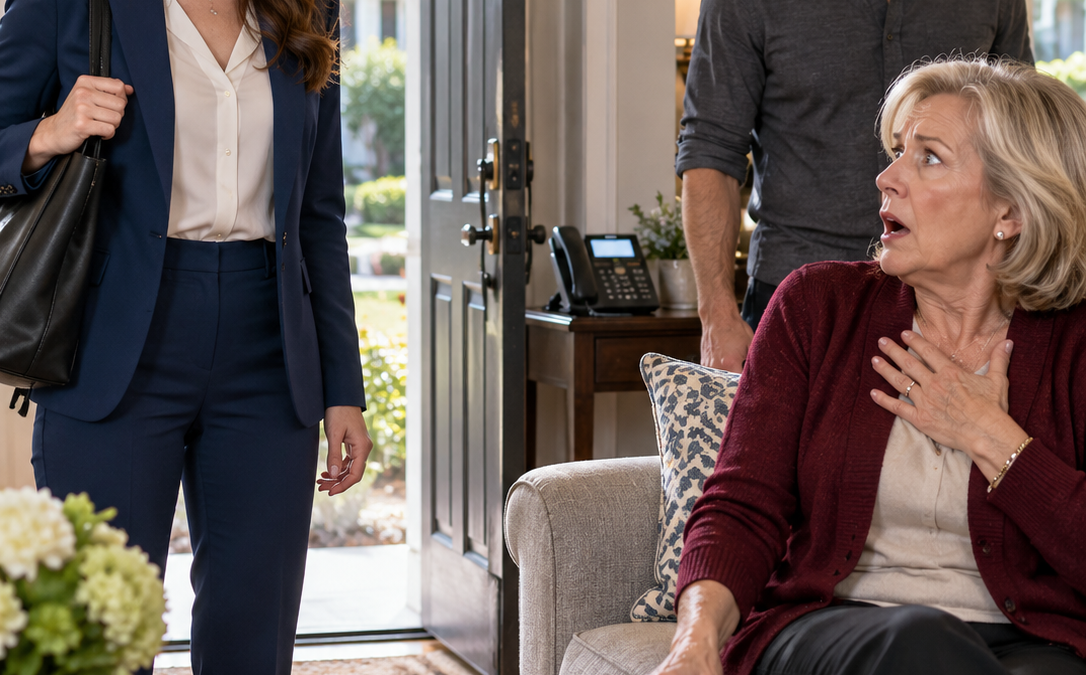
The hospital called our landline at 1:17 in the afternoon. My mother-in-law, Norma Cassell, answered it, and what she said next—what she did next—was something I would not learn about until hours later, when I walked through our front door completely unharmed and watched the color drain from her face like someone had pulled the plug from a sink.
But I am getting ahead of myself.
Let me take you back to that morning. My name is Vera Callaway. I had been going by my husband’s last name for six years, though lately I wondered why I had ever bothered. The house we lived in, a four-bedroom Craftsman in the Dilworth neighborhood of Charlotte, North Carolina, was mine. The mortgage was in my name. The property tax bill came in my name. The homeowner’s insurance policy—all of it, mine. I had purchased the house two years before I ever met my husband, Russell Castle.
Russell worked as a freelance graphic designer, which in practice meant he spent most weekday mornings playing video games in the spare bedroom he had converted into a studio, and most afternoons explaining to me why a particular client had not yet paid an invoice. His mother, Norma, had moved in eighteen months earlier after selling her condo in Raleigh, ostensibly to help with the household while I managed my demanding schedule as a senior contracts analyst at a regional logistics firm.
His younger sister, Deanna Castle, had arrived four months after Norma, dragging two suitcases and a story about a bad roommate situation that had never quite resolved itself. That was how I ended up feeding, housing, and absorbing the monthly utility costs of three additional adults on a single corporate salary.
I had made peace with most of it, or told myself I had. What I had never made peace with was the way Norma looked at me across the breakfast table every morning, as though she were appraising something she had overpaid for and was waiting for the right moment to return.
That particular Tuesday, I was up at 5:45. The coffee was brewing, and I was standing over the stove scrambling eggs when Norma appeared in the kitchen doorway in her housecoat. She looked at the pan, then at me.
“Turkey sausage again,” she said.
Not a question. A verdict.
“You said last week that turkey bacon was too rubbery. I thought sausage might be better.”
“I said turkey bacon was rubbery. Turkey sausage is entirely different. They’re not the same product.”
She opened the cabinet above my head to reach the mugs, forcing me to step sideways.
“I suppose this is what we’re having.”
I said nothing. Six years had taught me that responding to Norma before seven in the morning was roughly equivalent to arguing with a smoke detector. Pointless, and it never actually stopped anything.
Deanna came down the hallway a few minutes later wearing my cardigan—the cream-colored one with the mother-of-pearl buttons that I had bought at Anthropologie during my birthday trip to Charleston. I recognized it immediately because I had worn it exactly once before hanging it in my closet.
“Deanna, that’s my cardigan.”
She looked down at it the way a person looks at a paper towel they’ve already used to wipe something up.
“It was just hanging there. I have a job interview this morning.”
“You have a job interview at eleven at the marketing firm on South Tryon. Then please go put on something from your own closet. You’ve been here four months. You have your own clothes.”
Norma set her mug down on the granite counter harder than necessary.
“Vera, for heaven’s sake, she has an interview. Would it kill you to let her borrow a sweater?”
“It wouldn’t kill me. What bothers me is that she didn’t ask. And this isn’t the first time something from my closet has shown up on someone else.”
Norma made a sound in the back of her throat that I had come to recognize as her version of dismissal.
“In a family, people share. That’s what family does.”
I turned back to the eggs.
This, too, was a familiar loop. The invocation of family as a kind of blanket authorization for whatever anyone in that house wanted to take, borrow, use, or consume without asking. It applied to my skincare products, my streaming subscriptions, my Sunday leftovers in the back of the refrigerator, and apparently now my wardrobe.
What they didn’t know was that six weeks earlier, after finding my good wool pea coat missing from the coat closet for three days, I had installed a small security camera in the hallway outside my bedroom. It was discreet, motion-activated, and synced to my phone. I hadn’t told anyone. I simply needed to know.
Russell shuffled out of the bedroom at a quarter to seven, a full forty-five minutes before he needed to be anywhere. He poured himself coffee, looked at the breakfast I had made, and sat down without saying thank you, which was also familiar.
“You’re coming straight home tonight?” he asked, without looking up from his phone.
“I have the quarterly compliance review today, and probably a working dinner afterward. I may not be home until nine or ten.”
He nodded slowly, in the way that meant he was filing that information away for a purpose I could not yet identify.
“Deanna,” he said, “you need anything today? You have your interview at eleven.”
“I was going to ask if I could take Vera’s car.”
She had already changed out of my cardigan and was standing in the kitchen doorway wearing a blazer.
“Mine’s making that noise again.”
This also was not new. Deanna’s car made noises the way other people made excuses—persistently and always at convenient moments.
“My car is parked on the street,” I said. “I’m taking the light rail in today. But Deanna, the interview is on South Tryon. That’s a twelve-minute train ride from here.”
“I can’t show up to a job interview on public transit. It looks bad.”
“Taking the train looks bad?”
“For my aesthetic. Yes.”
I looked at her. Then I looked at Russell.
Russell was looking at his phone.
“If you take my car,” I said carefully, “I need it back by five. I may need it this evening.”
“You just said you’re not home until nine or ten.”
“I said I may not be. I’d like it back by five regardless.”
Deanna picked up her tote bag.
“Fine. Five. Got it.”
She held out her hand.
I hesitated. Then I went to the hook by the door and unclipped my spare key fob, the one I kept there for emergencies, and placed it in her palm.
The moment she drove away, I felt uneasy. I couldn’t have explained why exactly. I pushed the feeling aside, gathered my things, and walked to the light rail station three blocks away.
The compliance review began at ten and ran straight through lunch. Our conference room on the fourteenth floor of the Hurst Tower had floor-to-ceiling windows facing north, and I sat with my back to the city, working through vendor contract amendments with our legal team for four uninterrupted hours.
My phone was face down on the table. I checked it twice, once at noon and once at two, and saw nothing urgent.
At 1:17 p.m., a nurse at Carolinas Medical Center called our home number.
I didn’t know this until much later. What I know now, because I watched the footage, is that Norma was sitting on the living room sofa watching a talk show when the landline rang. She picked up on the second ring.
“Is this the primary emergency contact for the owner of a silver Honda Accord, North Carolina plate 774 Kilo Romeo Sierra?”
That was my car. My plate.
Norma straightened on the sofa.
“Yes, that’s my daughter-in-law’s vehicle.”
“Ma’am, the driver of that vehicle was involved in a serious collision on I-277 westbound approximately forty minutes ago. She has been transported here to Carolinas Medical Center. She’s in critical condition. We need immediate family authorization to proceed with emergency surgical intervention. Are you able to come to the hospital?”
There was a pause.
On the footage, I can see Norma’s expression shift. The initial alarm, the widening of her eyes, the hand going to her mouth—it all passes, and something else settles in behind it. Something slower and quieter and much, much colder.
“What exactly is the nature of the injury?” she asked.
“The patient has sustained a traumatic brain injury and multiple internal injuries. Time is critical, ma’am. We need family presence immediately to authorize—”
“She’s not my biological daughter,” Norma said. “She’s a daughter-in-law. I’m not her legal guardian.”
“Ma’am, any immediate family member can provide—”
“I’m not authorizing anything. Don’t call here again.”
She hung up.
She sat for a moment on the sofa. Then she stood, went to the kitchen, and poured herself a glass of sweet tea from the pitcher in the refrigerator. My pitcher. My sweet tea, which I had made Sunday evening.
She walked back to the sofa and turned up the volume on the talk show.
I can see her lips moving in the footage.
She was humming.
She thought it was me dying on that operating table. She thought the call was about me, and she sat back down and turned up the television.
I finished my compliance review at 6:15, skipped the working dinner because one of the outside counsel had a conflict, and took the light rail home. I got back to the house at 7:48. I remember the exact time because I looked at my watch when I unlocked the front door, thinking I was home earlier than expected.
“I’m home,” I called out.
Norma was on the sofa. She turned her head, and the moment she saw me standing in the entryway, still in my work blazer, my laptop bag over my shoulder, completely intact, she made a sound I had never heard come out of another person before.
It was a kind of strangled intake of breath that started as a gasp and ended as nothing.
The remote control fell out of her hand. Her face went the particular shade of gray that belongs to people who have just seen something they cannot reconcile.
“Norma, are you all right?”
She couldn’t speak. She was pointing at me, her finger shaking.
Russell came out of the studio hallway.
“Mom, what is—Vera? You’re home.”
He frowned, looking between us.
“Mom, why do you look like that?”
Norma was pressing her hand to her sternum.
“How? How are you? You were—I thought—”
“Thought what?”
Russell walked to the landline console near the door and checked the call history. His face changed.
“Mom, there’s a call here from Carolinas Medical Center at 1:17 this afternoon.”
He turned around.
“Where’s Deanna?”
The room went very still.
Russell dialed the hospital. I stood in the entryway with my laptop bag still on my shoulder and watched my husband’s face go through every stage of a disaster in the span of about ninety seconds.
By the end of the call, he was gripping the counter with one hand, and his voice had dropped to the register people use when they’re trying to hold something together that is already breaking.
“She went to her interview. She said she was taking the light rail.”
He looked at me.
“You said she could take the car.”
“I said she could use the car for the interview and have it back by five.”
“What time did she—Russell, when did she leave the house?”
“I don’t know. I was in the studio.”
He called Norma’s cell. He called Deanna’s cell. No answer. He called the hospital again.
The admitting nurse told him that the patient had been brought in at approximately 12:55, that she had been in surgery for several hours, that the surgery had concluded and she was now in the neuro ICU, and that the delay in family contact had complicated the timeline significantly.
We drove to the hospital in forty minutes of silence that felt like four hours.
Deanna was alive.
The neurosurgeon met us in the family consultation room off the ICU wing at 9:20 that night. He was a calm, methodical man with silver at his temples who spoke the way doctors speak when they are being as honest as they can be without making promises they cannot keep.
“Your sister sustained a severe traumatic brain injury. We performed emergency decompression surgery. She’s stable, but the delay between injury and intervention is a complicating factor. We cannot say with certainty what her level of function will be when she regains consciousness.”
He paused.
“If she regains consciousness.”
Norma collapsed into a chair. Russell stood with his face against the wall for a very long time. I sat in a vinyl chair near the window and thought about the call Norma had received at 1:17 in the afternoon, about the footage I had on my phone, about what had been done and not done in the hours between that call and the moment we walked through those hospital doors.
We didn’t get home until after three in the morning. Norma went directly to her room. Russell sat on the living room sofa with his face in his hands. I made a cup of tea, sat at the kitchen table, and said nothing to either of them.
Then Norma came back out.
She stood in the kitchen doorway and looked at me, and the grief on her face curdled into something else before she even opened her mouth.
“You shouldn’t have let her borrow the car,” she said.
I set my mug down.
“You knew she was going to take it for more than the interview. She always does. You should have known she wouldn’t come straight home. This is partly your fault.”
I looked at her for a long moment.
“Norma, you received a call from the hospital at 1:17 this afternoon.”
Something flickered across her face.
“I don’t know what you’re talking about.”
“The call log on the landline shows an incoming call from Carolinas Medical Center at 1:17. I’d like you to tell me what was said in that call.”
“I barely remember. It was confusing. They were asking strange questions, and I couldn’t understand what they wanted.”
“Did they tell you the driver of my vehicle was in critical condition and needed emergency surgery authorization?”
“I—they said something, yes, but I wasn’t sure what they were asking, and I—I hung up because it was confusing.”
Russell had come to the doorway behind her. He looked exhausted and hollow.
“Vera, can we please not do this right now? My sister’s in the ICU.”
“I understand that. I’m trying to understand what happened today.”
“Nothing happened. Mom got a confusing call. She didn’t understand it. That’s all.”
I looked at them both. Then I picked up my mug and went to bed.
The next afternoon, while Russell was at the hospital, I sat on the edge of my bed and opened the security footage on my phone.
I watched every second of it.
Forty-four minutes of footage from the hallway camera, which had been triggered by motion when Deanna walked past that morning, and twenty-two minutes of footage from the small camera I had also installed in the living room. The one I had added three weeks earlier, after my good copper cookware went missing and came back with a burned bottom and no explanation.
The living room footage showed Norma as clearly as anything, sitting on the sofa. It showed the moment the phone rang. It showed her face going through that sequence—alarm, then calculation, then something that could only be described as relief.
It captured every word of the phone call. It captured her hanging up. It captured her going to the refrigerator, pouring herself a glass of my sweet tea, sitting back down, and humming.
I watched it twice.
Then I opened my secure cloud backup and uploaded every file.
When Russell came home that night, he smelled like hospital coffee and old grief, and he didn’t look at me when he walked through the door. He went to the kitchen, poured himself a glass of bourbon, and sat at the table.
“She opened her eyes for about thirty seconds this afternoon,” he said. “She recognized me.”
“That’s encouraging.”
He took a drink.
“The ICU bills are going to be significant. I talked to the billing department. Even with insurance, there are going to be substantial out-of-pocket costs. Surgery, ICU, daily rate, neurologists…”
He looked down at his glass.
“I know you have the better income right now.”
I sat across from him.
“Russell—”
“I’m just saying, as a family—”
“I want to ask you something. Before we discuss any of that, I want to ask you about the call Norma received from the hospital yesterday afternoon.”
“We talked about this.”
“I have the phone call recorded.”
He put his glass down.
“I have a security camera in the living room. I’ve had it for three weeks. I have the full recording of the call Norma received at 1:17 yesterday afternoon. Every word of it, including the part where she refused to authorize surgery and hung up.”
Russell stared at me.
“You were recording us in our own home?”
“It’s my home, Russell. My name is on the deed. And yes, I was recording the common areas because my belongings kept disappearing and no one would take responsibility. What I captured wasn’t what I was looking for. But it’s what I have.”
He pushed back from the table.
“Vera, you can’t seriously be suggesting—”
“I’m not suggesting anything. I’m telling you what happened. Your mother received a call from the hospital. She was told the driver of my car was in critical condition and needed emergency surgery authorization. She believed it was me, and she told them she wasn’t authorizing anything. She said she wasn’t the patient’s legal guardian, and she hung up. Then she poured herself a glass of tea and sat back down.”
The kitchen was very quiet.
“She thought it was you,” Russell said finally.
It came out barely above a whisper.
“Yes.”
He stared at the table for a long time. Then he stood, went to his mother’s room, and closed the door behind him.
I could hear their voices through the wall, his low and urgent, hers rising and falling in waves of denial. After about twenty minutes, it went quiet.
He didn’t come to bed that night. He slept on the sofa.
The following morning, Norma came into the kitchen while I was making coffee and told me the hospital bills were my responsibility because Deanna had been driving my car.
I told her I disagreed.
She told me I was cold and heartless. I asked her if she would like to watch the recording together. She told me I was a wicked woman who had always hated their family and had somehow contrived to destroy it.
I took my coffee to my room, sat at my desk, and called an attorney.
His name was Frederick Danes, an attorney a colleague had referred me to two years earlier when I needed contract review work. I had kept his number in my contacts ever since.
I reached him by ten that morning. By noon, I was sitting in his downtown office on the ninth floor of a building on East Trade Street, my phone on the table between us, the footage playing.
Frederick watched the living room video without speaking. When it ended, he leaned back in his chair and looked at the ceiling for a moment.
“How long have you had this recording system in place?” he asked.
“Three weeks for the living room. Six weeks for the hallway outside my bedroom.”
“And you have additional footage?”
“Yes. I have footage from the hallway camera of Deanna taking my spare key from the hook by the door at 11:40 that morning. She told Russell she was taking the light rail to her interview. She lied. She took my car without clear authorization. I had said five o’clock, and the accident happened before noon, which suggests she never went to the interview at all. She went somewhere else.”
“What else do you have on the hallway camera?”
I pulled up the older footage.
Three instances over the previous six weeks of Deanna going into my bedroom and returning with items I had later discovered missing. A pair of earrings, a cashmere wrap, and the wool pea coat that had been gone for three days.
Frederick folded his hands on the desk.
“Vera, the medical malpractice angle is separate, and I’m not the right attorney for that. But what this footage represents from a civil standpoint, and potentially a criminal standpoint, is significant. You need to think very carefully about what you want to do.”
“I want to protect myself. Norma and Russell are already suggesting that I’m financially liable for the medical bills and for the crash. They contacted the other driver’s family.”
“They what?”
“I received a call this morning from a man who identified himself as an attorney representing the driver of the other vehicle. His name is…”
I checked my notes.
“His name is Paul Arowwood. He told me that Russell and Norma had reached out to his client’s family and implied that I was the responsible party as the vehicle’s owner, and that I would be assuming full civil liability.”
Frederick picked up his pen.
“All right. Here’s what happens next. First, you don’t speak to anyone. Russell, Norma, Paul Arowwood, the hospital billing department—no one without me present. Second, we file for an emergency protective order, and I begin preparing the divorce petition. Third, I reach out to Paul Arowwood’s office today to establish the correct factual record.”
“The car is in my name. Does that make me liable?”
“Owner liability in North Carolina requires that the owner gave permission for the vehicle to be used. You gave conditional permission—back by five, for a specific errand. The car was being used in an unauthorized manner at the time of the collision. The hallway footage of Deanna taking the key and the timestamp of the accident are going to be very useful. This isn’t a simple case, but it’s far from a losing one.”
I drove home that afternoon with something I hadn’t felt in a very long time. Not relief, exactly. More like the sensation of having found solid ground after a long time spent stepping very carefully on ice.
When I walked into the house, Russell was on the phone. He looked at me over his shoulder.
“She just walked in. I’ll call you back.”
He hung up and turned around.
“Where were you?”
“I went to see an attorney.”
Russell’s jaw tightened.
“An attorney?”
“Yes.”
“Vera, my sister is in the ICU. My mother is beside herself. Can we please just—can we hold the family together for five minutes before you go nuclear?”
I looked at him.
“Your mother received a call from the hospital yesterday at 1:17, informing her that the driver of my vehicle was in critical condition and needed emergency surgery authorization. She told them no. She said she wasn’t her legal guardian. She hung up, and then she sat back down on the sofa and hummed to herself because she believed she had just allowed me to die.”
I let that sit in the air between us.
“I have it on video, Russell. Every second of it.”
He couldn’t look at me.
“I don’t want to blow up the family,” I said. “The family blew itself up. I’m just the one who watched it happen.”
I went to my room, locked the door, and began making a list.
What followed over the next three weeks was exhausting in the way that all necessary things eventually become. Not dramatic, not explosive, but grinding and steady, like pulling a splinter.
Frederick Danes proved to be methodical and precise in exactly the way I needed. He filed the divorce petition on a Wednesday afternoon and had Russell served before Friday evening. He sent a formal response to Paul Arowwood’s office with a certified copy of the hallway footage timestamps, documentation of the conditional nature of the vehicle loan, and a demand that Russell and Norma cease misrepresenting the factual record to outside parties.
Paul Arowwood called Frederick the following Monday.
His client, a man named Gerald Hinton, who had sustained a fractured collarbone and two broken ribs in the collision, was a forty-three-year-old electrician with two children in elementary school. When Paul reviewed the actual footage—the full, unedited hallway video, the living room recording, the time-stamped evidence of what Norma had done and not done—his tone shifted entirely.
“My client’s grievance is with the driver,” Paul told Frederick. “Not with the registered owner. Not under these facts.”
Norma tried several things over those three weeks. She called my office and left a message for my supervisor implying that I had been negligent with my vehicle. She posted vague accusations on her Facebook page that my colleagues saw and asked me about. She showed up at Frederick’s building one afternoon and left a handwritten letter at the reception desk claiming the security footage had been tampered with.
Frederick filed for a temporary restraining order. A judge granted it four days later.
The mediation session took place on the first Tuesday of the following month, in a conference room at a mediation center on North College Street. Russell arrived with his attorney, looking like someone who hadn’t slept properly in weeks, which he hadn’t. Norma was not permitted to attend under the terms of the temporary restraining order.
I sat across from Russell with Frederick beside me. The mediator was a tall, soft-spoken woman named Dr. Okono, who had the particular skill of looking at you in a way that made unnecessary speech feel wasteful.
Frederick presented the financial record of the marriage first.
Six years of mortgage payments, property taxes, and utility bills, all originating from my accounts. The initial down payment on the house, made two years before our marriage. Russell’s contributions, modest and documented, dwarfed by mine. The graphic design income that had fluctuated between fifteen and twenty-eight thousand dollars annually for the entirety of our marriage.
Then Frederick presented something I hadn’t known he had found until he laid it on the table.
A series of wire transfers from Russell’s personal account over the past eight months, totaling just under $19,000, to an account belonging to a woman named Tanya Carell, with whom Russell had been corresponding through a personal email account linked to his design business.
I looked at the documents.
Then I looked at Russell.
He looked at the table.
Dr. Okono asked everyone to take five minutes.
When we reconvened, Russell’s attorney whispered something in Russell’s ear, and Russell nodded once, slowly. The way a person nods when they’re accepting something they no longer have the energy to fight.
The final settlement agreement was clean and entirely in my favor.
I retained the house, as I had purchased it before the marriage and maintained it exclusively throughout. I retained all joint property. Russell retained his vehicle and his personal design equipment. He received no spousal support. He had thirty days to vacate.
Norma, through Russell’s attorney, sent a formal request that I submit a leniency letter to the county court, where she was facing a civil complaint filed by the hospital related to the delay in surgical authorization.
I did not respond.
On a Thursday afternoon in late November, I drove to Carolinas Medical Center and took the elevator to the third floor.
Deanna was in a standard hospital room by then, no longer in the ICU. She had regained consciousness three weeks after surgery. She had a partial motor deficit on her left side and a speech therapy regimen she would be following for the foreseeable future.
She was alive.
She was going to stay alive, which was more than her mother had been willing to guarantee.
She looked up when I came in, and her face went through several expressions before she spoke.
“You don’t have to be here,” she said.
Her voice was slower than I remembered it. The speech deficit.
“I know.”
I sat in the chair beside her bed.
We were quiet for a moment.
“I was going to the lake,” she said finally. “With some people from my old job. I thought you wouldn’t be home until late. I thought no one would know.”
“I know.”
“I’m sorry about the car.”
“I know that, too.”
She looked down at her hands resting on the blanket.
“Mom said… she said when the hospital called, she thought it was you.”
“Yes.”
“And she told them…”
“Yes.”
Deanna closed her eyes.
She was quiet for a long time.
“I spent three days not knowing if I was going to remember how to talk,” she said. “And the whole time I was in there, I kept thinking, what if she had just… what if the surgery had been another hour later?”
I didn’t say anything.
“She thought it was you,” Deanna said again, very quietly, as though she were still processing it, as though it were a splinter she would be pulling at for a long time.
I stood up.
“Take care of yourself, Deanna. I mean that genuinely.”
She looked at me.
“Why are you being kind to me?”
I picked up my coat from the back of the chair.
“Because what happened to you wasn’t what you deserved. What your mother did wasn’t your fault.”
I paused at the door.
“None of what happened in that house was entirely any one person’s fault. Except the part that was.”
I drove home in the early dark of November, the Charlotte skyline lit up to my left.
My house was quiet when I pulled into the driveway. Russell had moved out ten days earlier. Norma had gone back to Raleigh to stay with her sister while the civil matter was pending.
The hooks by the door held only my keys.
I made dinner for one and ate it at the kitchen table. I didn’t feel the need to fill the silence with anything.
A few weeks later, I had the guest bedroom repainted a deep sage green and put a reading chair in it. I bought a new cardigan, a slightly nicer one, and hung it in my closet.
Frederick called me in early December to let me know that the civil complaint against Norma had resulted in a formal finding of negligence and a significant financial judgment.
He also mentioned, in the professionally neutral tone of a person who had seen many things and retained his equilibrium about all of them, that the county district attorney’s office was reviewing the recording for potential criminal charges related to the deliberate delay in emergency care authorization.
“What’s the likely outcome?” I asked.
“Uncertain. But the footage is unambiguous. Whatever happens, the record is clear.”
“That’s enough,” I said. “The record being clear. That’s enough for me.”
He was quiet for a moment.
“For what it’s worth, Vera, I’ve handled a lot of family property cases. Most people in your situation spend the first year very certain they did something wrong. I want to say plainly that you didn’t.”
I thanked him, hung up, and stood in my kitchen for a moment with the late-afternoon light coming through the window above the sink.
My kitchen.
My window.
My light.
The following Saturday, I drove out to Lake Norman with a thermos of good coffee and sat on a bench near the water, watching people walk their dogs along the path.
A woman jogged past with a yellow Lab who was far more interested in the geese than in the jogging. A man pushed a stroller one-handed while talking on his phone. An older couple walked slowly, close together, pointing at something on the water.
I thought about the six years I had spent in a house that was mine on paper and no one else’s in any way that mattered. About the version of myself who had cracked another egg into the skillet every morning rather than say, clearly and finally, “This is not how I will be treated.”
I thought about what it had taken to become the version of myself sitting on that bench.
It had taken a hospital call.
It had taken a recording.
It had taken the specific cruelty of a woman humming to herself over someone she believed was dying.
It had taken all of that to make me understand that the patience I had mistaken for virtue was actually something else entirely: the slow erosion of the boundary between what I would and would not accept.
And by the time I had let it go that far, the most radical thing I could do was simply to stop.
I finished my coffee.
I drove home.
I parked in my driveway, unlocked my door, and walked into the house that held no one’s expectations but mine.
That was enough.
That was, in the end, exactly enough.








