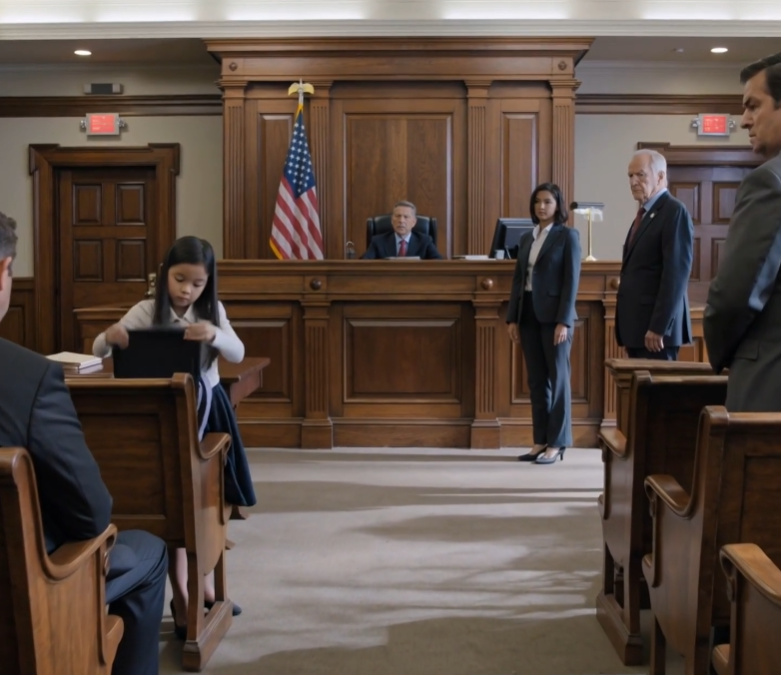
My parents sued to evict me so my sister could “own her first home,” in court, my 7-year-old asked the judge, “can i show you something daddy doesn’t know?” the judge nodded, she held up her tablet, pressed play, when it started…
My parents, Frank and Diane, were hardworking people who provided a stable, if sometimes strict, upbringing. Dad worked as a mechanical engineer at the local manufacturing plant for 30 years, and Mom was an elementary school teacher. They weren’t wealthy, but we never went without necessities. They seemed to embody traditional family values—loyalty, honesty, putting family first. Words that taste bitter now when I say them.
Then there was my sister, Amanda, three years younger than me. She was always the golden child. When I brought home a B+, she’d bring home an A. When I made the junior varsity team, she became team captain. It wasn’t that she was malicious about it, at least not when we were kids. It was simply the family dynamic. I was the responsible one who should know better. She was the special one who deserved extra chances.
“Your sister is more sensitive,” Mom would say whenever I complained about unfair treatment. “You’re stronger. You can handle more.”
I accepted that reality. I even found pride in being the strong one. What I didn’t realize was how deeply those patterns would cut once we were adults.
My early adulthood wasn’t easy. I married Jessica right after college, probably too young, at 23. We had Sophie when I was 27, and for a while, things seemed perfect. I was building a career in architectural drafting. Jessica was teaching at the local high school, and Sophie was the light of our lives.
But the cracks in our marriage started showing when Sophie was around three. The problems weren’t dramatic. There were no affairs, no abuse, just a slow-growing distance neither of us knew how to bridge. After months of counseling and trying to make it work, we separated when Sophie was four. The divorce was finalized six months later with joint custody, although Sophie lived primarily with me because Jessica’s teaching schedule was less flexible.
During that difficult period, my parents initially seemed supportive. They watched Sophie when needed and listened to my frustrations, but there was always an undercurrent of “we told you so” in their comfort. They had never quite approved of Jessica, thinking she was too independent-minded for family life.
Meanwhile, Amanda had moved to Chicago after college with dreams of making it big in advertising. She’d call home with grand stories about client meetings and networking events, though I later learned most of it was exaggerated. My parents spoke about her adventures with such pride—their daughter in the big city, living the glamorous life they’d never had.
Then came the opportunity that changed everything.
About five years ago, my parents decided to downsize. They’d found a single-story ranch better suited to their retirement years and wanted to sell the family home. The timing coincided with me needing a more stable situation for Sophie after the divorce.
“Why don’t you buy it?” Dad suggested during Sunday dinner. “We can work out a fair price, and this way Sophie gets to grow up in the family home.”
The offer seemed perfect. The housing market in our area was hot, and buying directly from my parents meant avoiding bidding wars and real estate commissions. We agreed on a price of $220,000—below market value, but still fair.
Since I couldn’t qualify for a conventional mortgage so soon after the divorce, we set up a private financing arrangement. The agreement was straightforward. I would make monthly payments directly to them over 15 years at a reasonable interest rate. We had the basic terms drawn up by a notary, though not by a full real estate attorney, a decision I would later regret deeply.
Dad insisted we didn’t need to waste money on lawyers when family could trust family.
Those words haunt me now.
For the next five years, everything worked well. I made every payment on time, sometimes even adding extra when I received bonuses at work. Sophie and I settled into a routine. I converted my old childhood bedroom into her princess castle, complete with lavender walls and glow-in-the-dark stars on the ceiling. We planted a vegetable garden in the backyard.
We belonged here.
Then, last year, everything changed when Amanda moved back to town. Her big-city career had apparently fallen apart, though she described it as “seeking better work-life balance.” She moved in with my parents temporarily while finding her footing.
At first, her return didn’t seem to affect my situation. We’d meet for Sunday dinners at my parents’ new home, where Amanda would dominate the conversation with stories about Chicago, carefully edited to make it sound as if she’d left entirely on her own terms. I noticed the lingering looks she gave my house whenever she visited, commenting on what she would do differently with the space, but I dismissed it as harmless talk.
If only I’d recognized the warning signs sooner.
It started on an ordinary Tuesday in September. I’d just dropped Sophie off at school and returned home to grab my laptop before heading to the office. That’s when I noticed an official-looking envelope tucked among the bills and flyers in the mail. The return address showed the county courthouse.
My first thought was that it might be related to my divorce, perhaps some paperwork Jessica needed updated.
I was wrong. So very wrong.
Inside was a summons for an eviction hearing.
The plaintiffs were Frank and Diane Miller.
My own parents.
The document claimed I was substantially behind on payments and in violation of our agreement. It stated that they were exercising their right to reclaim the property. I read it three times, convinced it had to be some elaborate mistake.
I immediately called my father, my hands shaking as I dialed.
“Dad, there must be some mix-up. I just got court papers saying you’re trying to evict me from the house.”
The pause before he answered told me everything.
“This is no mistake, Abram. We didn’t want it to come to this, but you’ve left us no choice,” he said, his voice unnaturally formal. “You haven’t been meeting the terms of our agreement.”
“What are you talking about? I’ve made every single payment. I have the receipts. The bank statements.”
“There were other conditions,” he interrupted. “The property maintenance standards we discussed, and the payment schedule was adjusted last year, which you’ve ignored.”
My mind raced. There had been no adjustment to our agreement. No discussion about changing the terms. The maintenance clause in our original agreement only required that I keep the property in good condition, which I absolutely had.
“Dad, this is crazy. We never changed any terms. I need to speak with you and Mom in person about this.”
“We’re actually heading out of town for the weekend. We can talk when we get back, but the court date is set. Maybe it’s better to let the legal process handle this now.”
The dismissive tone in his voice felt like a physical blow.
I hung up and immediately called my mother, hoping she would be more reasonable. Instead, her phone went straight to voicemail. I tried Amanda next, wondering if she knew what was happening.
She answered on the first ring.
“I was wondering when you’d call,” she said, without even a greeting.
“Amanda, do you know what’s going on? Mom and Dad are trying to evict me and Sophie from our home.”
“It’s not really your home, though, is it?” she replied. “It’s their house that they’re letting you live in while making payments. And honestly, Abram, they’ve been more than patient.”
That’s when the pieces started coming together.
“This is about you, isn’t it? You want the house?”
Her laugh confirmed my suspicion before her words did.
“Look, I’m starting over here after the Chicago situation. I need a place of my own. And Mom and Dad agree that I deserve a chance to own my first home. You’ve had your opportunities. It’s my turn now.”
“My opportunities? Amanda, I bought this house. I’ve been paying for it for five years. Sophie’s entire life, her stability, is here.”
“Don’t be so dramatic. Kids are adaptable. And technically, you haven’t bought it yet. The deed is still in Mom and Dad’s name until you pay it off completely.”
She was right about that last part, and the realization made my stomach drop.
Under our private financing arrangement, the property deed would transfer into my name only after the final payment, which was still ten years away.
Legally, they still owned the house.
After hanging up with Amanda, I spent the next hour digging through my files, pulling out every document related to the house purchase. The agreement we’d signed was clear about the payment amounts and schedule, which I had followed religiously. There was absolutely no mention of revised terms or conditions.
I called the bank and requested a complete history of every payment I’d made to my parents. Then I drove to the courthouse to get more information about the case they’d filed.
The clerk explained that my parents were claiming I’d defaulted on our agreement by failing to meet the revised payment schedule established in an addendum.
“What addendum?” I asked.
She showed me a document I’d never seen before, dated eight months earlier, with what appeared to be my signature at the bottom. It outlined new terms, including substantially higher monthly payments and strict property maintenance requirements with regular inspections.
The signature looked like mine.
But I had never signed such a document.
I’d never even seen it.
The realization that they had potentially forged my signature made me physically ill.
When I picked Sophie up from school that afternoon, I struggled to maintain my composure. Her cheerful chatter about art class and playground games was the only normal thing in a day that had shattered my sense of reality.
“Daddy, can we go to Grandma and Grandpa’s this weekend?” she asked innocently. “Auntie Amanda said she’d show me how to make friendship bracelets.”
My heart sank. They had been talking to my daughter without my knowledge, probably setting the groundwork to explain why we might need to move soon.
Had they been poisoning her against me, too?
“Not this weekend, sweetheart. They’re going out of town.”
At least that wasn’t a lie.
That evening, after Sophie was asleep, I called Jessica to update her on the situation. Despite our differences, she’d always been fair when it came to Sophie’s well-being.
“They can’t just take your home,” she said, outraged on my behalf. “What kind of grandparents try to make their own granddaughter homeless?”
“They don’t see it that way,” I replied, exhaustion weighing down my voice. “In their minds, they’re helping their daughter start her life while teaching their son a lesson about… I don’t even know what. Not being successful enough?”
“I guess you need a lawyer, Abram. A good one.”
She was right.
First thing tomorrow, I would find legal representation. This wasn’t just about me anymore. This was about protecting Sophie’s home and stability.
If my parents and sister wanted a fight, they’d get one.
What hurt most in those initial days wasn’t just the betrayal. It was the realization that they must have been planning this for months. Every Sunday dinner, every casual visit, every time they hugged Sophie, they knew what they were going to do.
They looked their granddaughter in the eyes while plotting to take away her home.
The family I thought I knew was a lie.
And now I had to fight them in court to protect the only stable thing in my daughter’s life—the home we’d made together.
Finding a lawyer within my budget felt nearly impossible. After calling eight different attorneys who either charged retainers I couldn’t afford or didn’t handle real estate disputes, I finally found Marcus Patel, a younger attorney who had recently opened his own practice and was building his client base.
“This is a complicated case,” Marcus said after reviewing my documents. “Private family real estate agreements often get messy because people skip important legal steps, thinking trust is enough. The good news is that the alleged addendum they’re presenting has some serious authentication issues.”
Marcus agreed to take my case at a reduced rate with a payment plan I could manage alongside the mortgage payments to my parents—payments I continued making despite the lawsuit, on Marcus’s advice.
“Don’t give them any actual ammunition,” he warned. “Keep making payments exactly as outlined in the original agreement.”
The financial strain was immense. Between regular bills, Sophie’s needs, the house payments, and now legal fees, I was dipping into what little savings I had. I took on freelance drafting projects in the evenings after Sophie went to bed, often working until two or three in the morning before getting up at 6:30 to start our day.
As Marcus dug deeper into the case, he discovered the legal loophole my parents were exploiting. Our original agreement had a clause stating that terms could be modified as needed to reflect market conditions or maintenance requirements. It was vague enough that they could argue it gave them the right to create the addendum, even without my explicit consent.
“Did you read every page of the original agreement before signing?” Marcus asked during one of our meetings.
I admitted I hadn’t scrutinized it the way I should have.
It was my parents, after all.
I trusted them.
“That’s what they’re counting on,” he sighed. “But we have something on our side, too. Even if the court were to recognize their right to modify terms, there’s a reasonable expectation of proper notification and consent. We have your bank records showing consistent payments according to the original terms, with no indication you were ever informed of changes.”
While I focused on the legal battle, I also had to deal with Sophie’s questions. She was too perceptive not to notice something was wrong.
“Why don’t we go to Grandma and Grandpa’s anymore?” she asked one evening as I tucked her in. “Are they mad at us?”
I sat on the edge of her bed, searching for words that wouldn’t burden her with adult problems but wouldn’t lie to her, either.
“Sometimes grown-ups have disagreements they need to work out,” I explained. “Right now, Grandma, Grandpa, and I are having a disagreement about the house.”
“Our house?” Her small voice quivered, and I saw fear in her eyes.
“Yes, but you don’t need to worry. I’m doing everything I can to make sure this stays our home.”
“Does Aunt Amanda want our house?” she asked, surprising me with her insight.
“Why do you ask that?”
“She told me which room would be hers when she lived here. She said I could visit and stay in the small room.”
My blood boiled at the revelation. They had been explicitly telling my daughter about their plans, preparing her for our eviction.
I kept my expression neutral for Sophie’s sake, but inside I was seething.
“No matter what anyone says, this is our home,” I assured her, hugging her tightly. “And I promise I’m doing everything I can to keep it that way.”
As the court date approached, pressure from extended family increased. My aunt called, saying she’d heard both sides and thought I was being unreasonable.
“Your sister needs a fresh start,” she said. “You could find another place. Sophie is young. She’ll adjust.”
My uncle sent a similar message.
“Your parents are getting older. This stress isn’t good for them. Think about the family as a whole.”
It became clear that my parents and Amanda had been working the family circuit, spinning a narrative that cast me as the selfish one. According to them, I was refusing to cooperate with a simple change in agreement that would benefit everyone.
They conveniently left out the part about forging my signature and trying to evict my seven-year-old daughter from her home.
Two weeks before the court date, Marcus and I compiled all our evidence: my payment records, bank statements, the original agreement, and documentation showing the house’s condition to counter any claims of maintenance neglect. We also had a handwriting expert examine the signature on the addendum, and he provided a report questioning its authenticity.
“Be prepared,” Marcus warned me. “Family court cases get ugly. They’re going to say things about you that hurt. They’ll bring up every mistake you’ve ever made. Every shortcoming as a son, a father—anything they can use to paint you as irresponsible.”
I nodded, already feeling the weight of what was to come.
“As long as Sophie keeps her home, they can say what they want about me.”
The night before we submitted our evidence, Amanda showed up at my door unannounced. Sophie was at Jessica’s for her regular weekend visit, so I was alone.
“We need to talk,” Amanda said, pushing past me into the house without waiting for an invitation.
She looked around the living room with a proprietary gaze that made my skin crawl.
“This could all be so much simpler if you just cooperate,” she said, settling herself onto the couch. “I’ve already got a buyer interested if I decide to sell.”
Her words confirmed what I’d suspected but hadn’t been able to prove.
This wasn’t about Amanda wanting a family home.
This was about her getting a valuable asset she could convert into cash.
“So that’s the plan? Get the house from me below market value and then immediately flip it for profit?”
She shrugged, not even bothering to deny it.
“It’s just business, Abram. I need capital to restart my career, and Mom and Dad agree I deserve this opportunity. They’ve always helped both of us.”
“By stealing my home? The home where their granddaughter lives?”
“Don’t be so dramatic. Kids are resilient. And honestly, would Sophie really miss seeing the people next door? Having her own bathroom? These are luxuries, not necessities.”
Her cavalier dismissal of my daughter’s stability ignited something in me.
“Get out of my house,” I said quietly, my voice steady despite the rage building inside.
“Not your house yet,” she smirked, but she stood to leave.
At the door, she turned back.
“You know, if you fight this, Mom and Dad are prepared to bring up everything. Your financial struggles after the divorce. That time you were late picking up Sophie because you fell asleep. Even Jessica’s new boyfriend and how that might be affecting Sophie’s home life.”
The threat was clear.
They would attack my parenting in court if necessary.
I closed the door behind her without responding, then sank to the floor, my back against it, wondering how the people who were supposed to love us most could turn so cruel.
What I didn’t know then was that Sophie had left her tablet recording in the living room earlier that day, forgotten during her rush to pack for her mom’s house. The device had captured every word of my conversation with Amanda, including her admission about selling the house and her threats against me.
It was sitting there silently, holding evidence that would change everything.
Three days before our court date, I came home from work to find my parents’ car in the driveway alongside Amanda’s. They hadn’t called or texted to say they were coming over.
I found them inside, walking through the house with a notepad.
“What are you doing here?” I asked, standing in my own doorway and somehow feeling like the intruder. “You can’t just enter my home without permission.”
“We’re still the legal owners,” my father replied without looking at me. “We have the right to inspect the property.”
My mother at least had the decency to look uncomfortable.
“We called earlier, but you didn’t answer,” she said.
I checked my phone.
No missed calls.
Another lie.
Amanda was in Sophie’s room, opening closets and taking notes.
“This closet has water damage,” she announced. “That’s a maintenance violation.”
“There’s no water damage,” I countered, following her. “Sophie spilled juice last week. I cleaned it up.”
She made a note anyway.
“The court will determine that.”
It was surreal watching them move through the home where I’d grown up, where they’d raised me, now acting like cold-hearted landlords rather than parents. My father checked every faucet and every light switch, documenting perceived deficiencies. My mother ran her finger along the baseboards, looking for dust.
“Why are you really doing this?” I finally asked as they gathered in the living room and completed their inspection.
“You haven’t maintained the property according to standards,” my father began.
“Stop it,” I interrupted. “The real reason. Not the legal excuse.”
An uncomfortable silence fell.
Finally, my mother spoke.
“Amanda needs a fresh start. She’s had some financial setbacks in Chicago.”
“So she gets my house? Sophie’s home? That’s the solution?”
“It’s not like that,” my father said, though his eyes wouldn’t meet mine. “Amanda has a solid plan. She’ll be able to leverage the property equity to stabilize her situation, and—”
“And she’s going to sell it,” I cut in. “She already told me she has a buyer lined up.”
My parents exchanged a look I couldn’t interpret.
Had they known?
“That’s not necessarily true,” my mother said carefully.
“Even if it is,” my father added, “it would be her right. The property would be hers to do with as she sees fit.”
Amanda entered from the hallway.
“I was thinking we could do this transition smoothly. I’d let you stay through the end of Sophie’s school year, for example. That’s generous, considering the market right now.”
“Generous?”
I couldn’t believe what I was hearing.
“I’ve paid over $70,000 toward this house over the past five years. I’ve made improvements that increased its value, and you think letting us stay a few extra months before taking it is generous?”
“You’ve been living here paying below-market rates,” Amanda countered. “So really, Mom and Dad have been subsidizing you this whole time.”
“That’s not true. We agreed on a fair price and interest rate. I have the documentation.”
“Documentation can be interpreted different ways,” my father said dismissively. “The judge will decide whose interpretation is correct.”
As they continued justifying their actions, Sophie arrived home from her after-school program. She froze in the doorway, eyes wide at the unexpected gathering.
“Grandma, Grandpa, Aunt Amanda!” she exclaimed, momentarily excited before reading the tension in the room.
Her smile faltered.
My mother stepped forward with forced brightness.
“There’s our special girl. We were just talking about the house with your daddy.”
Sophie looked at me uncertainly. I forced a reassuring smile.
“Why don’t you go start your homework, sweetie? We won’t be much longer here.”
She nodded and headed toward her room. But I noticed she’d left her backpack in the living room, her tablet partially visible in the front pocket.
Once Sophie was out of earshot, the conversation took an even uglier turn.
“You know, Abram,” Amanda said, lowering her voice, “we’ve been very careful not to mention certain things in our filing. Your history of overworking to the point of exhaustion. That incident last year when the school called because Sophie showed up without lunch three days in a row.”
“That was during a massive project deadline. And it was twice, not three times,” I defended myself, feeling my face flush with shame despite knowing I was a good father who’d made normal human mistakes.
“The court might not see those as minor oversights,” my father said. “Particularly if we also mention Jessica’s concerns about your irregular hours affecting Sophie’s routine.”
“Jessica has no concerns,” I shot back. “She’d be furious if she knew you were using our co-parenting relationship this way.”
“We’d prefer not to bring these things up,” my mother added, her voice gentle, as if she were being reasonable. “But if you insist on fighting this, we need to present the full picture.”
They were threatening to attack my parenting to win a property dispute.
My own parents.
“Sophie’s stability means nothing to you, does it?” I asked as the realization hit me fully. “You’d uproot her. Traumatize her with a court battle over her father’s fitness. All so Amanda can cash in on a house she didn’t pay for.”
“That’s unfair,” my mother protested. “We love Sophie.”
“You love the idea of her,” I corrected her. “The perfect grandchild you can show off at church and family gatherings. But her actual well-being, her need for stability and security—those are inconveniences you’re willing to sacrifice.”
Amanda scoffed.
“So dramatic. It’s a house, Abram. Just a building. Sophie will be fine.”
“It’s her home,” I said, my voice breaking despite my efforts to stay calm. “It’s the only stability she’s had since the divorce. The place where she feels safe.”
“She can feel safe somewhere else, too,” my father said firmly. “This discussion is over. We’ll see you in court unless you come to your senses and agree to vacate voluntarily.”
They left without another word, leaving me standing in the middle of my living room, shaking with anger and disbelief.
I sank onto the couch and put my head in my hands, trying to compose myself before Sophie came back out.
A small voice broke through my thoughts.
“Daddy, are they gone?”
I looked up to see Sophie standing in the hallway, her tablet clutched to her chest, her eyes wide with concern.
“Yes, sweetheart. They’re gone.” I patted the couch beside me. “Come sit.”
She climbed up next to me and leaned against my side.
“They want to take our house, don’t they?”
I considered sugarcoating it, but decided against it. Sophie deserved honest answers, presented appropriately for her age.
“Yes. Aunt Amanda wants to live here, and Grandma and Grandpa are helping her try to make that happen.”
“But where would we go?”
“If that happened, we’d find another nice place. But I’m doing everything I can to make sure we stay right here, where we belong.”
She was quiet for a moment.
Then she said, “I recorded them.”
“What do you mean, honey?”
“On my tablet. You showed me how to make voice memos for school, remember? When they came in, they were saying mean things about us before you got home. So I pressed record and left it on the table when I went to get the door for you.”
My heart sank, thinking of what she might have heard.
“Oh, Sophie. I’m sorry you heard unkind things.”
“It’s okay,” she said with surprising maturity. “But I got them saying the bad stuff about selling our house and saying those lies about you. Is that important?”
I stared at my seven-year-old daughter, who in her innocent wisdom had possibly captured the very evidence we needed.
“It might be very important, Sophie. Can I see?”
She unlocked her tablet and opened the voice memo app, showing me a recording that was nearly 45 minutes long.
I pressed play, and immediately heard Amanda’s voice.
“Once we get the house, I already have a buyer willing to go 320, maybe more if we update the kitchen first. That’s a hundred-thousand-dollar profit after paying off what Mom and Dad are owed.”
Then my father’s voice:
“Just don’t mention that part in court. The judge needs to believe this is about you wanting a family home, not a financial transaction.”
My mother’s voice followed.
“I still don’t feel right about that addendum. Abram never actually signed it.”
“He would have had to eventually,” my father countered. “This just speeds things up. Besides, he’s had the house at below market value for years. It’s our turn to benefit now.”
The recording continued, capturing their inspection and the later confrontation after I arrived home. Every damning word, every admission, every threat—all preserved by a child who simply knew right from wrong better than the adults who had raised me.
That night, after Sophie was asleep, I called Marcus and told him about the recording.
His excitement was palpable.
“This changes everything,” he said. “This recording proves their intent to defraud you and the court. The admission about the forged addendum alone would likely get the case dismissed.”
“Can we use it?” I asked. “I didn’t record it. Sophie did, without their knowledge.”
“It’s complicated,” he admitted. “But I think we can. In this state, recording conversations you’re a party to is legal. Sophie was in her own home and captured conversations happening in common areas. I’ll research the precedent, but I believe this is admissible.”
For the first time since finding that envelope in my mailbox, I felt a glimmer of hope.
My daughter, in her simple understanding of fairness and truth, might have saved our home.
The night before court, I sat on the edge of Sophie’s bed after story time, anxiety gnawing at my stomach.
“Are you scared about tomorrow?” she asked.
Always perceptive.
“A little,” I admitted. “But having the truth on our side helps a lot.”
“Will I have to talk to the judge?”
Marcus had prepared us for the possibility that Sophie might be asked about the recording.
“Maybe,” I said. “But only if you feel comfortable, and only a few simple questions.”
She nodded solemnly.
“I can do it. I can tell the truth.”
I brushed her hair back from her forehead.
“I know you can, sweetheart. You’re the bravest person I know.”
“Braver than you?” she asked with a small smile.
“Much braver than me,” I assured her, tucking the blanket around her. “Get some sleep. Tomorrow’s an important day.”
As I turned to leave, her small voice stopped me.
“Daddy, no matter what happens with the house, we’ll be okay, right? Because we have each other.”
In that moment, my seven-year-old daughter showed more wisdom and strength than anyone else in this sorry situation.
“That’s absolutely right,” I told her, my voice thick with emotion. “As long as we have each other, we’ll always be okay.”
The county courthouse was an imposing building of red brick and tall columns. Sophie held my hand tightly as we climbed the steps, her other hand clutching the tablet inside her small backpack. Jessica had taken the morning off work to support us and walked slightly behind.
“Remember,” she whispered to Sophie. “You don’t have to be scared. Just tell the truth if the judge asks you questions.”
Inside, the hallway outside Courtroom Three was already crowded. My parents stood stiffly by the wall, dressed in formal clothes I rarely saw them wear. My father wouldn’t meet my eyes. My mother gave a small, uncertain wave that I didn’t return.
Amanda stood between them, scrolling through her phone as if this were a minor inconvenience in her day rather than an attempt to take a child’s home.
Marcus met us at the doors, his normally casual demeanor replaced by professional formality in a crisp suit.
“Ready?” he asked quietly.
I nodded, though my dry mouth and racing heart suggested otherwise.
“And you must be Sophie,” he said, crouching down to her level. “Your dad tells me you’re very brave.”
She nodded solemnly.
“I brought my tablet,” she whispered.
“Perfect. We may not need it, but it’s good to have just in case.”
The bailiff called our case, and we filed into the courtroom. The judge, a woman in her sixties with silver-streaked hair and penetrating eyes, looked over her glasses as we settled into our places.
My parents’ attorney, a polished man in an expensive suit, presented their case first. He laid out a compelling narrative: generous parents helping their son by selling him the family home below market value, only to have him neglect the property and fall behind on the revised payment schedule they’d established.
“Furthermore, Your Honor,” he continued, “the plaintiffs have another child who is now in need of stable housing. They’re simply exercising their legal right to repurpose their asset to help both of their children fairly.”
Marcus took notes throughout, occasionally whispering clarifications to me.
When it was our turn, he approached the bench with confident steps.
“Your Honor, this case is not about property maintenance or payment schedules. It’s about an attempt to defraud my client through forged documents and false claims. Mr. Miller has made every payment according to the original agreement on time, and sometimes in excess of the required amount.”
He presented my payment records, bank statements, and photographs showing the excellent condition of the home. Then he addressed the alleged addendum.
“My client never saw, discussed, or signed this document. We have an expert witness who questions the authenticity of the signature. But more importantly, we have evidence that the plaintiffs themselves have admitted to creating this addendum without my client’s knowledge or consent.”
My parents’ attorney objected immediately.
“Your Honor, no such evidence has been submitted to the court.”
“We only discovered this evidence recently,” Marcus explained. “We’re prepared to present it today, with the court’s permission.”
The judge considered this, then nodded.
“I’ll allow it, with the understanding that opposing counsel has the right to review and respond.”
Marcus hesitated and glanced at me. We had discussed how to handle the recording, deciding that letting Sophie speak directly to the judge might be more impactful than simply playing the audio.
“Your Honor, the evidence was captured by Mr. Miller’s seven-year-old daughter, Sophie, who is present in the courtroom today. With the court’s permission, she would like to address you directly about what she discovered.”
My parents and Amanda exchanged alarmed glances. Their attorney looked confused, clearly unprepared for this development.
The judge looked at Sophie, her stern expression softening slightly.
“Is the child comfortable speaking in court?”
“She is, Your Honor,” Marcus confirmed.
The judge nodded.
“I’ll allow it. Sophie, would you please come forward?”
Sophie squeezed my hand once before walking to the front of the courtroom, her small shoulders squared with determination. The bailiff adjusted the microphone to her height.
“Hello, Sophie,” the judge said kindly. “Do you understand that you need to tell the truth in this courtroom?”
“Yes, ma’am,” Sophie replied clearly.
“Go ahead and tell me what you’d like to share.”
Sophie took a deep breath.
“Can I show you something my daddy doesn’t know about?” she asked, her voice steady despite the tension in the room.
The judge looked momentarily surprised, then nodded.
“You may.”
Sophie unzipped her backpack and pulled out her tablet.
“I recorded Grandma and Grandpa and Aunt Amanda in our house when they came over. They were saying mean things and telling lies.”
My parents’ attorney stood immediately.
“Your Honor, if this is a recording made without consent—”
“It was in our house,” Sophie interrupted, her indignation overcoming her nervousness. “My house. And they were saying they were going to take it away from me and Daddy.”
The judge raised a hand to quiet the attorney.
“I’d like to hear what Sophie has to say.”
Turning back to her, the judge asked, “Why did you make this recording, Sophie?”
“Because they were being mean and not telling the truth. My daddy always says that the truth is important, even when it’s hard.”
Pride swelled in my chest despite the tension of the moment.
“Can I play it for you?” Sophie asked, her finger hovering over the screen.
The judge nodded.
“Yes, you may.”
Sophie pressed play, and Amanda’s voice filled the courtroom.
“Once we get the house, I already have a buyer willing to go 320, maybe more if we update the kitchen first. That’s a hundred-thousand-dollar profit after paying off what Mom and Dad are owed.”
My father’s voice followed.
“Just don’t mention that part in court. The judge needs to believe this is about you wanting a family home, not a financial transaction.”
Then came my mother’s hesitant admission.
“I still don’t feel right about that addendum. Abram never actually signed it.”
Gasps and murmurs rippled through the courtroom.
I watched my parents’ faces drain of color. Amanda stared straight ahead, her jaw clenched. Their attorney looked as though he wanted to disappear.
Sophie continued playing the recording, including the parts where they threatened to attack my parenting in court and admitted the real reason behind the eviction attempt—not to provide Amanda with a family home, but to flip the property for profit.
When the recording ended, the courtroom was silent.
Sophie looked up at the judge.
“They lied, and they were going to take away my home. Is that allowed?”
The judge’s expression was unreadable as she considered the child before her.
“Thank you for bringing this to the court’s attention, Sophie. You were very brave today.”
Sophie nodded solemnly.
“Can I go back to my dad now?”
“Yes, you may.”
As Sophie returned to sit beside me, I wrapped my arm around her shoulders and whispered, “I’m so proud of you.”
The judge turned to my parents’ attorney.
“Counselor, would you like to respond to this evidence?”
He conferred hurriedly with my parents and Amanda, their whispered conversation growing heated. Finally, he turned back to the judge.
“Your Honor, my clients would like to request a brief recess to discuss this new information.”
“Granted. Fifteen minutes.”
As they filed out, Amanda shot me a venomous glare. My mother wouldn’t look at me at all. Only my father hesitated, glancing back at Sophie with an expression I couldn’t interpret.
Shame, perhaps. Or simple surprise at being outmaneuvered by a seven-year-old’s sense of right and wrong.
During the recess, Marcus was cautiously optimistic.
“The recording is damning. They admitted to creating fraudulent documents and misleading the court. No judge would rule in their favor after hearing that.”
When court resumed, my parents’ attorney approached the bench with visibly less confidence.
“Your Honor, in light of the new evidence, my clients would like to withdraw their eviction claim.”
The judge nodded, but her expression remained severe.
“Before I accept this withdrawal, I want to be clear about what happened here today. This court has heard evidence suggesting an attempt to defraud both the defendant and the court itself through falsified documents and misleading testimony.”
She looked directly at my parents and Amanda.
“I could refer this matter for criminal investigation. Mortgage fraud and forging documents are serious offenses. However, given the family relationship involved and the withdrawal of the claim, I will instead dismiss this case with prejudice, meaning it cannot be refiled.”
Turning to me, she continued, “Mr. Miller, I strongly advise you to consult with your attorney about creating a more formal and secure arrangement regarding the property, preferably with the involvement of a proper real estate attorney.”
“Yes, Your Honor,” I agreed, relief washing over me.
“As for the existing agreement,” she added, “this court finds it valid and enforceable as originally written, without the alleged addendum. The plaintiffs will continue to honor those terms until the property is paid in full or the parties reach a new, properly documented agreement.”
With one final stern look at my parents, she concluded, “Case dismissed.”
The gavel’s sharp crack echoed through the courtroom, marking the end of a nightmare that had consumed our lives for weeks.
Sophie squeezed my hand, a small smile playing at her lips.
“We won, Daddy,” she whispered. “We get to keep our home.”
“Yes, sweetheart,” I replied, hugging her close. “Thanks to you, we do.”
Outside the courthouse, a light rain had begun to fall, matching the somber mood despite our victory. Jessica gave Sophie a big hug, telling her how proud she was before heading back to work.
Marcus shook my hand firmly.
“Congratulations,” he said. “Not many cases resolve this decisively. Your daughter is quite something.”
“She really is,” I agreed, watching Sophie jump in a small puddle nearby, her immediate concerns already shifting back to more age-appropriate interests now that the danger had passed.
As Marcus left to file the final paperwork, I saw my parents and Amanda huddled under the courthouse awning, engaged in what appeared to be a heated discussion.
Part of me wanted to walk away without another word.
But there were things that needed to be said.
“Sophie, wait here for just a minute, okay? Stay where I can see you.”
She nodded, continuing her puddle exploration while keeping close.
I approached my family, if I could still call them that.
My father noticed me first, his expression hardening.
“I suppose you’re here to gloat,” he said.
“No,” I replied evenly. “I’m here to make something very clear. What you tried to do was unforgivable. Not just to me, but to Sophie. Your own granddaughter.”
“We never meant to hurt Sophie,” my mother began, her voice pleading.
“You only wanted to take away the only home she’s known since the divorce,” I finished for her. “To lie in court. To forge documents. To threaten my reputation as a father. Tell me exactly which part wasn’t meant to hurt us.”
Amanda stepped forward, eyes blazing.
“You had no right to record us without permission. That’s illegal.”
“Actually, in this state, it’s perfectly legal to record conversations in your own home,” I countered. “Besides, I didn’t record you. Sophie did. A seven-year-old child who recognized dishonesty better than her own grandparents and aunt.”
“This isn’t over,” Amanda hissed. “You’ve ruined everything. Do you know how much I needed that money?”
“Your financial problems aren’t my responsibility,” I replied. “And certainly not Sophie’s. If you needed help, there were a thousand better ways to ask for it than trying to steal our home.”
My father put his hand on Amanda’s shoulder, silencing her.
“What happens now?” he asked, his voice gruff but carrying an undertone of uncertainty.
“Now I’ll continue making payments according to our original agreement. But our relationship is a different matter. I need time to process what you were willing to do to us.”
“You can’t keep Sophie from us,” my mother said, her voice quavering. “We’re her grandparents.”
“I’m not going to use Sophie as a weapon the way you tried to use the house,” I assured her. “But any contact will be supervised, at least for now. She needs time to understand why the people who should have loved her tried to take away her home.”
“We do love her,” my mother insisted.
“Love isn’t just a feeling, Mom. It’s actions. And your actions showed exactly where Sophie and I stand with you. Somewhere below Amanda’s financial convenience.”
I turned to leave, then paused.
“One more thing. If any of you ever again threaten my home or my relationship with my daughter, I won’t hesitate to use that recording for a restraining order. I hope we’re clear.”
Without waiting for a response, I walked back to Sophie, took her hand, and led her to the car.
In the rearview mirror, I could see my parents and sister still standing in the rain, looking smaller somehow, diminished by the truth of what they’d tried to do.
That evening, after Sophie was in bed, I sat alone in the living room. The victory felt hollow amid the ruins of what I’d thought was a loving family.
The phone rang.
My mother, calling for the third time.
I let it go to voicemail.
A text followed.
Please let us explain. We made a terrible mistake.
Too little, too late.
The following day, I filed paperwork for a temporary restraining order against all three of them, preventing them from entering the property without explicit permission. Marcus also helped me begin the process of creating a new, legally sound purchase agreement with proper documentation, though that would take time to complete.
Word of what had happened spread quickly through our small community. Neighbors who’d heard snippets of the courtroom drama stopped by with casseroles and offers of support. Sophie’s teacher called to check whether she needed any extra attention at school following the stress. Even my boss was understanding about the time I’d need to miss for follow-up legal appointments.
What surprised me most was the call from Pastor Jim, who’d known our family for decades. My parents were devoted members of his congregation.
“I’ve heard what happened, Abram,” he said when I answered. “I wanted you to know that your parents came to see me yesterday. They’re deeply ashamed.”
“They should be,” I replied, not bothering to hide my bitterness.
“Yes,” he agreed, which surprised me. “What they did was wrong on every level. But they’re also lost right now, realizing the terrible mistake they made.”
“Pastor, with all due respect, this wasn’t a mistake. A mistake is forgetting an appointment or saying something thoughtless in anger. They planned this for months. They forged documents. They tried to make my daughter homeless for profit.”
He was quiet for a moment.
“You’re right. And I’ve told them as much. I’m not calling to ask you to forgive them immediately. I’m calling because I care about you and Sophie, and I wanted you to know that support is available if you need it.”
His kindness nearly undid me.
“Thank you,” I managed. “Right now, I’m just trying to get through each day and keep things stable for Sophie.”
“How is she doing?”
“Better than me, honestly. Kids have a remarkable ability to adapt. She knows something serious happened, but she’s focused on the fact that we get to stay in our home. The deeper betrayal doesn’t fully register yet.”
“And with you as her father, she’ll learn how to process it in a healthy way when the time comes,” he assured me.
After we hung up, I found myself on the back porch, staring at the oak tree where my father had hung my swing as a child. The memory felt tainted now, as did so many others.
Would I ever be able to look at this house again without thinking of their betrayal?
Sophie found me there, coming outside in her pajamas after finishing her bedtime routine.
“Daddy, are you sad?” she asked, leaning against my knee.
“A little,” I admitted. “But also very proud of you.”
“Are Grandma and Grandpa ever coming back?”
I chose my words carefully.
“Not for a while. They made some very bad choices that hurt us. And we all need time to think about what happened.”
She considered this, her small face serious.
“They were wrong to try to take our house.”
“Yes, they were.”
“And they were wrong to say mean things about you. You’re the best daddy.”
My throat tightened.
“Thank you, sweetheart.”
“Can I ask something else?”
“Anything.”
“Can we paint my room purple now since we’re staying?”
Her simple, forward-looking question broke the spell of melancholy.
This was what mattered—building our life together. Making this house truly ours in all the ways that counted.
“Absolutely,” I promised. “Purple it is.”
In the weeks that followed, we began establishing new routines and boundaries. I kept my word about supervised contact, allowing my parents to see Sophie in neutral locations like the park or a restaurant. Those visits were awkward and strained, but I refused to use Sophie as a pawn in adult conflicts.
Amanda declined to participate, having moved to a neighboring city without saying goodbye.
The restraining order remained in place, as did the original payment arrangement. My parents made no further attempts to modify it, accepting the court’s ruling without complaint. Each month, I sent a check for the agreed amount, accompanied by a brief, formal request for confirmation of receipt. Nothing more.
My mother’s attempts at reconciliation continued through texts, calls, and the occasional handwritten letter. Some days, I considered responding. Other days, the memory of what they had tried to do made it impossible.
My father, true to character, remained mostly silent, though Pastor Jim told me he was working through things in his own way.
As for Sophie and me, we focused on making our house more thoroughly our own. We painted her room purple, as promised. We planted new flowers in the garden. We adopted a rescue cat named Pumpkin, who quickly claimed the sunny spot beside the living room window as his domain.
Slowly, painfully, we began to heal from the betrayal, though the scars would always remain.
What helped most was knowing that when it truly mattered, we had stood together, fought for our home, and won.
Six months after the court case, spring arrived with a burst of new beginnings. The cherry tree in our front yard bloomed spectacularly, and Sophie insisted on taking pictures of it every day so she could “remember how pretty things can become.”
Her wisdom, as always, stopped me in my tracks.
In those six months, our lives had transformed in ways both expected and surprising. The most significant change was in my approach to family relationships. The betrayal forced me to recognize that blood connections don’t automatically equal unconditional love or support.
I’d spent years accepting less than I deserved from my parents, making excuses for their favoritism and dismissal of my needs.
No more.
Through a local community center, I found a support group for single parents. The Thursday-night meetings became a lifeline, connecting me with others navigating similar challenges. There, I could speak openly about the court case, the ongoing family tension, and the daily struggles of raising a child alone without fear of judgment.
“What your parents did was abuse of power and trust,” said Tanya, a single mom of twins who had become a close friend. “Recognizing that isn’t being unforgiving. It’s being honest.”
Her words helped me set boundaries without guilt.
I maintained the supervised visitation schedule with my parents but refused to pretend everything was normal. During those visits, I was polite but distant, focusing on facilitating their relationship with Sophie rather than rebuilding what they had broken with me.
Sophie, meanwhile, was thriving.
Her second-grade teacher sent home glowing reports about her leadership skills and emotional intelligence.
“Sophie has an extraordinary ability to stand up for what’s right while remaining compassionate,” she wrote in her midyear assessment. “The court experience, rather than traumatizing her, seemed to have reinforced her innate sense of justice and truth.”
Sophie spoke openly about it when asked, with a seven-year-old’s remarkable clarity.
“My grandparents and aunt tried to take our house,” she explained to a curious classmate during a playdate I overheard. “But I recorded them saying mean things and showed the judge. Now they can’t take it, and they’re sorry. Sometimes grown-ups make really bad choices, too.”
Her resilience humbled me daily.
As for my parents, the process of reconciliation moved in halting steps.
Three months after court, they requested a meeting without Sophie present. We met at a coffee shop on neutral ground, where my mother cried and my father stared at his hands while they offered apologies that somehow still contained justifications.
“We got caught up in trying to help Amanda,” my mother explained. “She was in such financial trouble, and we thought that—”
“Sacrificing my stability was acceptable collateral damage,” I finished when she trailed off.
“We were wrong,” my father said simply.
It was perhaps the first time I’d ever heard him admit fault so directly.
I didn’t offer easy forgiveness, but I did agree to continue the current arrangement of supervised visits with Sophie, with the possibility of revisiting the restrictions after more time had passed.
Amanda remained distant, having moved two hours away to start a new job. She sent Sophie a birthday card with no return address, a small peace offering that didn’t extend to me.
I was fine with that.
Some relationships might be beyond repair, and I was learning that was okay, too.
The most unexpected development came from my relationship with our next-door neighbor, Leah, a hospital nurse in her early thirties. She had lived beside us for three years, but we’d never progressed beyond friendly waves and occasional conversations about lawn care.
During the court drama, she noticed my stress and started bringing over home-cooked meals to help. What began as neighborly concern evolved into genuine friendship. She joined Sophie and me for movie nights, helped with our backyard garden renovation, and became the reliable emergency contact I’d previously lacked.
Sophie adored her, particularly after discovering Leah’s talent for elaborate braiding techniques.
“You know,” Leah said one evening as we sat on the porch watching Sophie play with Pumpkin in the yard, “what happened with your family was terrible. But the way you protected Sophie, the way you’ve handled everything since… it says a lot about who you are.”
Her words, and the warmth in her eyes as she said them, sparked something I hadn’t felt in a long time.
Whether our relationship would develop beyond friendship remained to be seen, but for the first time since the divorce, I felt open to the possibility.
On the legal front, Marcus helped me secure a proper mortgage through a local credit union, allowing me to pay off my parents completely and transfer the deed into my name. The closing costs strained my budget, but the peace of mind was worth every penny.
The day I received the official deed, I framed it and hung it in the hallway—a reminder that this home was truly, legally ours now.
No one could take it away.
“Does this mean Grandma and Grandpa can never try to get our house again?” Sophie asked when I showed her.
“That’s right. It’s officially ours now. One hundred percent.”
She studied the document seriously.
“Good, because I like our house.”
“Me too, sweetheart.”
To celebrate the milestone, we embarked on a whole-house refresh project. Nothing extravagant. Fresh paint, some new furniture, rearranging spaces to better suit our needs. With each change, the house felt less like the place where I grew up and more like the home Sophie and I had created together.
My favorite addition was a large corkboard wall in the kitchen where Sophie displayed her artwork and I pinned important notices and memories. Among them was a quote I’d found that resonated deeply:
“Family isn’t about blood. It’s about who is willing to hold your hand when you need it most.”
On a sunny Saturday in May, six months and two weeks after the court case, my parents came for their first unsupervised visit at our home since the incident.
It was a tentative step toward a new kind of relationship. Not a return to what had been, but perhaps the beginning of something healthier.
As they admired the changes we’d made to the house, complimenting Sophie’s purple room and the thriving garden, I watched them with clear eyes.
They were flawed people who had made a terrible mistake, driven by misplaced priorities and old patterns. I would never fully trust them again, but perhaps we could build something new from the ashes of what had been lost.
“You’ve made this place your own,” my father observed as we walked through the living room with its new arrangement and colors.
“Yes,” I agreed. “That’s exactly what we’ve done.”
Later, after they left and Sophie was helping me prepare dinner, she asked a question that once again showed her remarkable perception.
“Daddy, are you still mad at Grandma and Grandpa?”
I considered how to answer truthfully while remaining age-appropriate.
“I’m not as angry as I was,” I finally said. “But I’m still sad about what happened, and it will take more time before I can fully trust them again.”
She nodded, carefully tearing lettuce leaves for our salad.
“I think they’re really sorry.”
“I think so, too.”
“Can people do really bad things and still be good people?” she asked.
The question struck me with its depth.
“That’s a complicated question,” I admitted. “I think people are a mix of good and bad choices. One really bad choice doesn’t make someone all bad forever, but it does mean they need to work hard to show they’ve changed and won’t make that same bad choice again.”
“Like when I lied about brushing my teeth, and then I had to prove I was trustworthy again by showing you my toothbrush every night.”
I smiled at her comparison.
“Something like that, yes. Just on a much bigger scale.”
She considered this while arranging tomatoes on top of the lettuce.
“I think we should give them a chance to prove they’re trustworthy again. Not with our house, but with other stuff.”
“I think you’re right,” I agreed. “And that’s exactly what we’re doing.”
That night, after tucking Sophie in, I sat on the back porch with a cup of coffee, reflecting on the journey of the past year.
The betrayal had shattered my understanding of family. But from those broken pieces, Sophie and I had created something stronger.
We’d learned that homes aren’t just buildings, but the safe spaces we create together. That family isn’t defined by DNA, but by respect, honesty, and unwavering support. That sometimes the people who should love us most fail us terribly, and that’s not our fault or our responsibility to fix.
Most importantly, we’d learned that when the foundations shift beneath you, it’s possible to build again on firmer ground.
The house that had been the center of so much pain was now truly ours. Not just legally, but in all the ways that mattered. Every wall held our stories. Every room contained our choices.
It wasn’t my childhood home anymore, or the house my parents had sold me, or the property they’d tried to take back.
It was simply home.
Our home.
And nobody could take that away.
Have you ever had to stand up to family members who betrayed your trust? What boundaries did you set to protect yourself and your children?
Share your stories in the comments below. If this journey of fighting for what’s right resonated with you, please hit that subscribe button and give this video a thumbs-up. Your support helps others find these stories of resilience and healing.
Remember, sometimes the family we choose is more reliable than the family we’re born into.
Thank you for listening, and I wish you strength in your own battles for what’s right.
In this heartbreaking Reddit family drama, I share how my parents sued to evict me and my seven-year-old daughter so my sister could own her first home. After discovering that they forged documents and planned to sell the house for profit, we faced them in court, where my daughter bravely asked to show evidence they never expected.
This powerful Reddit family drama showcases how money can reveal true character when my own parents were willing to make their granddaughter homeless for financial gain. The judge’s reaction to my daughter’s recording changed everything in this intense Reddit family drama that tested the limits of family loyalty.
I discussed setting boundaries after betrayal and rebuilding trust in this deeply emotional Reddit family drama that resonated with thousands. If you’ve experienced similar Reddit family drama, you’ll understand the painful journey of protecting your children while processing parental betrayal.
It’s a story of resilience, justice, and creating true family bonds beyond blood.








