My parents showed up at the funeral in pressed black suits, stepping out of a rented porsche suv, talking about family, talking about $100 million, they didn’t know he already signed everything 15 minutes later…
My name is Caleb Sutton. I am 31 years old. Twenty-two years ago, my parents drove me out to a dusty, isolated horse ranch in the high desert of eastern Oregon and left me standing on the front porch with a cracked plastic suitcase and nothing else.
Ten years later, those exact same parents showed up at my grandfather’s funeral in pressed black suits, stepping out of a rented Porsche SUV, talking loudly about family and quietly calculating a fortune they had already decided was rightfully theirs.
While I stood there in the biting November wind, burying the only man who had actually raised me, my mother looked at her slick, expensive lawyer and said it was an absolute tragedy how isolated her father had become in his final years. She had the nerve to stand in his own living room, surrounded by his neighbors, clutching a designer tissue, and cry about how much she missed him.
If you did not know her, you would have believed her heart was breaking clean in two.
But I knew her.
I watched her eyes drift over the solid mahogany furniture, the heavy antique silver, the wide grazing pastures through the bay window, and I could practically hear the gears turning behind her face, mentally pricing every acre and every piece of equipment on the place.
Gerald stood a few feet behind her in a suit that fit him a size too tight in the shoulders, checking his phone every few seconds like a man waiting on a stock quote rather than mourning a father-in-law. My brother Preston lingered near the punch bowl through the whole reception, clearly counting the minutes until he could decently leave.
None of them had asked me a single question about how I was holding up. Not one. Not since the moment they’d arrived that morning in a car that cost more than most people in that town made in a year.
I stood near the back of the room in a suit I’d bought for exactly this occasion, feeling every bit as invisible to them as I had felt standing on that porch twenty-two years earlier. Except this time, the invisibility didn’t hurt the way it used to. This time, I understood it for exactly what it was.
Three people so completely consumed by what they believed they were about to receive that they had no attention left over for the man who had actually spent the last decade holding Harold Whitfield’s hand through every hard year at the end of his life.
There was one enormous thing they did not know.
My grandfather, Harold Whitfield, was a master engineer.
He had spent his working life building agricultural water systems and irrigation pipelines designed to hold under pressure for decades without failing. And he had built his estate plan the exact same way.
He engineered it like a fortress.
My mother and father came to his house ready for a brutal fight, ready to throw around wild accusations, question his mental capacity, and threaten a lawsuit to seize everything he owned. And right now, tonight, they are very likely still paying off the high-interest credit card debt they racked up just to rent that Porsche and retain that aggressive lawyer.
Before I tell you exactly how one piece of paper collapsed their entire reality in under fifteen minutes, hit that like button if you believe in justice, and tell me in the comments where you’re watching from tonight, because stories like this one deserve witnesses.
Now, let me take you back to the exact day this whole thing started.
It was late August, and I remember the month vividly because the air smelled like dried alfalfa, hot fence wire, and something I can only describe now as impending doom.
The heat that summer was suffocating. The sun beat down relentlessly on the cracked asphalt, and my cheap canvas sneakers were nearly melting into the vinyl of the backseat of my father’s battered beige sedan. We had been driving for six straight hours from our perfectly manicured suburban home outside Portland, and nobody had said a single word to me since we stopped for gas somewhere past Bend that morning.
The radio was off.
The silence in that car was not simple quiet. It was heavy and thick, the kind that presses against your eardrums and makes it hard to pull air all the way into your lungs.
I was a nine-year-old boy holding a plastic astronaut with a broken helmet, and I had no idea my entire life was about to end in the space of a single afternoon.
I still remember packing that suitcase the night before—or rather, watching Renee pack it for me, since I was apparently not trusted to choose my own clothes for whatever this trip actually was. She never called it anything specific. She said we were going to visit Grandpa for a while, the same vague phrase she’d have used to describe a long weekend.
I remember asking whether I should bring my school backpack, and her saying, in a tone that should have told me everything right then, that she wasn’t sure I’d be needing it right away.
I packed my astronaut figure myself, sneaking it into the suitcase after she’d already zipped it once, because some part of a nine-year-old brain apparently already understood that whatever was coming, I was going to need something familiar to hold on to.
Nobody explained why we were suddenly driving six hours to a ranch I’d visited exactly twice in my entire life. Nobody explained why Preston wasn’t in the car with us, off instead at some overnight camp Gerald had arranged weeks in advance, with timing I would only understand as deliberate much later.
I just remember the specific quality of that morning light coming through the kitchen window while Renee packed my bag with her back to me, and how carefully, deliberately normal she made her voice sound while doing something that was not normal at all.
My mother, Renee, sat up front, flipping violently through a glossy magazine, turning the pages so hard they tore at the edges, her jaw locked and her eyes fixed on the paper, never once flicking toward the rearview mirror.
My father, Gerald, drove with one hand draped over the wheel and the other tapping a frantic rhythm against the console like a man counting down the last agonizing seconds of a hostage negotiation. He checked his mirrors, adjusted his collar, wiped sweat off his forehead, and never once looked back at me.
He treated me like cargo that simply needed to reach its destination.
When we finally turned off the paved highway onto the long gravel road leading to Whitfield Stables, Renee turned around in her seat. She did not look at my face. She looked directly at the cheap blue suitcase sitting beside me.
“You’ll have your own room,” she said, her voice flat and entirely without warmth. “Grandpa has a big house. You’ll like it here. It’s better for everyone this way.”
That was the whole pitch.
That was the entire explanation for dropping a nine-year-old on the doorstep of a seventy-year-old man I had met exactly twice, both times at stiff, awkward Thanksgiving dinners.
There was no family meeting. There was no discussion about a temporary arrangement. There was no tearful goodbye with promises of weekend visits.
Gerald parked near the heavy wooden porch and left the engine running, a steady mechanical reminder that they were absolutely not staying.
He got out, opened my door, took my suitcase, and carried it to the bottom of the steps, setting it down hard enough that the plastic cracked slightly against the wood, exactly the way you’d drop a package you were tired of carrying.
He did not kneel to look me in the eye. He did not offer a hug or even a pat on the shoulder. He turned his back, brushed the dust off his slacks, and walked away.
Renee never opened her door at all. She rolled the window down maybe two inches, just enough to let her voice escape into the hot air without letting the reality of what she was doing seep into the air-conditioned cabin.
I stood on the bottom step, my knuckles white around the strap of my backpack, looking at her through that narrow gap in the glass. I wanted her to say they’d be back Sunday. I wanted her to call it summer camp.
She met my eyes for half a second.
A cold and calculating look with no regret in it anywhere.
Then she turned to Gerald as he buckled his seat belt and said something I was never supposed to hear. But the wind carried it straight to me through that two-inch gap.
“He’s the one we can afford to lose.”
Those exact words hit my chest like a blow from a sledgehammer.
Gerald threw the car into reverse, the tires spitting gravel into the dry summer grass, and I watched the taillights shrink down the long, winding road until the dust they’d kicked up hung glowing orange in the afternoon light.
The only sound left in the whole world was the slow creak of the old iron windmill turning behind the barn, the same way it had been turning long before I arrived and the same way it would keep turning long after everyone forgot I existed.
I did not cry. My brain simply could not process the size of what had just happened to me. I stood there staring at an empty road, waiting for a car that was never coming back.
Then the screen door groaned open behind me.
Harold Whitfield stood six foot two, with short white hair buzzed close to his scalp, wearing a faded chambray work shirt, heavy denim, and thick leather boots. Dark machine grease was permanently worked into the creases of his knuckles. He looked carved out of stone, weathered by decades of sun and wind and completely unmovable.
He did not crouch down to make himself smaller. He did not ask if I was scared or if I wanted water.
He looked at my cracked blue suitcase in the dirt, then looked at me.
“Can you carry that yourself?” he asked, his voice like gravel rolling down a hill.
I nodded, my throat too tight to speak.
“Good,” he said, turning back toward the house. “Your room is at the top of the stairs, second door on the right. Drop it and meet me in the workshop behind the barn. Don’t drag your feet.”
There was no warm embrace, no cookies waiting on the counter, no comforting speech about how everything was going to be all right.
There was a direction and a job.
I dragged that suitcase up the wooden stairs, the house smelling of old pine, black coffee, and solitude, and dropped my bag on an iron-framed bed with a handmade quilt. I did not sit down.
I knew better than to keep a man like Harold Whitfield waiting.
So I walked back out into the sun toward the corrugated metal building behind the barn, still thinking the worst part of my life had already happened.
I was about to learn exactly how wrong I was.
The workshop was a cavernous, concrete-floored room lined from floor to ceiling with pegboard, every wrench and socket and screwdriver in its own labeled place. Nothing was out of order, and nothing was dirty.
The first thing that hit me walking through those double doors was the smell—an overpowering mix of saddle leather, machine oil, and hot metal. The smell of a place where things were given a clear purpose.
Harold stood at a heavy workbench holding a leather horse bridle with a snapped brass buckle, and he pointed a greasy finger at a battered wooden stool in the corner.
“Sit,” he said without looking up.
I sat, pulling my knees to my chest, trying to make myself as small as I possibly could.
“Watch,” he said.
He did not sit me down and explain the psychology of abandonment. He did not offer platitudes. He just fixed the buckle, his hands slow and deliberate, cutting away the ruined leather with a utility knife, aligning the straps, driving a new brass rivet home with three solid strikes, and testing the joint with a hard tug.
When he was satisfied, he wiped his hands on a red shop rag, balled it up, and tossed it at my chest.
“You’ll work,” he told me, looking me dead in the eye. “Working is how you stop drowning in your own head.”
That was my real welcome to Whitfield Stables.
The first real test came about ten days in, on a morning so cold my breath fogged in the workshop before the sun even cleared the ridge. Harold set me in front of a bench vise with a rusted length of pipe fitting and told me to clean every thread by hand with a wire brush until the metal underneath looked new again.
I worked at it for what felt like an hour, my fingers raw. When I finally held it up for him to inspect, he turned it once under the light, handed it back, and said, “Again.”
I did it three more times before he was satisfied.
I remember standing there furious, my hands stinging, wanting badly to throw the pipe across the room. He must have seen it on my face because he set down the bridle he was working on and said, “You’re not angry at the pipe. You’re angry at your parents. And the pipe is just what’s in front of you right now. Get the anger out on something that can take it.”
That was the closest thing to therapy Harold Whitfield ever offered anybody.
And it worked better than anything a counselor could have said to me at nine years old.
Within a month, I had my own designated corner of the pegboard, my own set of gloves sized down to fit a kid’s hands, and a chore list taped to the inside of the barn door in Harold’s blocky print.
Feed the horses at six. Check the south trough for ice by seven. Report to the shop by eight unless told otherwise.
There was a comfort in the rigidity of it that I hadn’t expected, a structure that never once shifted depending on someone’s mood, the way life in Portland had shifted constantly depending on whether Gerald had closed a deal or Renee had gotten the seating she wanted at a restaurant.
Out here, the rules did not care how anyone felt.
A bolt was either torqued correctly or it wasn’t. A gate was either latched or it swung open in the wind and let the cattle wander onto the county road. There was something almost merciful about a world with that few variables in it.
I learned to read the sky for weather before I learned to read a full chapter book on my own because Harold cared far more about whether I could smell a storm coming off the eastern ridge than whether I could recite state capitals.
He never once asked to see a report card in those early years, not because he didn’t value school, but because he trusted the school to handle school, and he saw his own job as handling everything an institution could never teach a boy who’d just been thrown away by the two people meant to protect him.
Looking back now, as a grown man who has hired and trained plenty of people myself, I understand exactly what he was doing in those first months.
He wasn’t raising a ranch hand.
He was rebuilding a foundation, one small, repeatable, masterable task at a time. The same way you’d approach reinforcing a structure that had taken damage: load by load, joint by joint, until the whole thing could bear weight again without buckling.
Harold taught me how to torque a bolt to factory specification before he ever taught me how to make a decent plate of scrambled eggs.
That first week, my soft suburban hands blistered and bled. I learned to clean engine parts, sort his hardware bins by thread pitch, and tighten steel bolts on a diesel tractor engine to exact tolerance.
“You have to feel the threads catch,” he told me, standing behind me and guiding my hands over the cold metal. “That’s where the metal wants to stop. It’s talking to you. Push past it because you think you’re stronger than the design, and you’ll strip the exact thing you’re trying to hold together. Then you’ve got nothing but stripped metal and a bigger problem than you started with.”
He always talked like that. Short, practical sentences with a second meaning riding right behind the first one. And he never once explained the second meaning out loud.
You either caught it or you didn’t.
He was telling me not to force things.
He was telling me not to break myself trying to hold on to people who clearly had no interest in staying.
Cole was the one who finally got me up on a horse, a stout gray quarter horse named Samson, who had the patience of a saint and absolutely no tolerance for a nervous rider yanking on the reins.
My first real attempt ended with me flat on my back in the dirt of the round pen, staring up at a sky so blue it looked fake. The wind had been knocked clean out of my lungs for the second time that year, though this time it was considerably less permanent.
Cole leaned over me, blocking the sun, and instead of asking if I was hurt, he just said, “You pulled left when you should have pulled nothing at all. Get up and try it again before you start thinking about it too hard.”
That became something of a mantra between the two of us over the years.
Get up before you start thinking about it too hard.
I have used some version of that sentence on more nervous new hires at my own company than I could possibly count.
Cole taught me to mend fence in the brutal heat of July, showing me how to string barbed wire taut without slicing my palms open, how to set a post so it would hold through a hard winter freeze without heaving out of the ground come spring.
He taught me to recognize the particular droop of a sick calf’s ears from fifty yards away, a skill that has never once come up in a boardroom but that I still find myself unconsciously applying to people, watching for the small signal that says something underneath is wrong before anyone says a word about it out loud.
Cole had grown up two towns over, the son of a man who’d worked that same land as a hired hand for thirty years before him, and there was something steady in him that I gravitated toward hard in those early months, something that felt like the older brother I should have had and didn’t.
He never once asked me about my parents either, following Harold’s unspoken rule without ever being told to. But he had a way of putting a hand on my shoulder at exactly the moment I needed it that told me he understood everything anyway.
Years later, when I hired him to run the foundation full-time, I told him as much.
He just shrugged and said, “Kid, everybody on this ranch knew exactly what happened to you the day your daddy’s car pulled out of that driveway. We just figured you didn’t need us talking about it. You needed us teaching you something useful instead.”
That said more about how that whole ranch operated than anything else anyone ever said to me directly.
By my second month, the blisters had hardened into calluses, and I was out in the fields alongside Cole Bennett, the ranch foreman, a man in his late twenties with a permanent sunburn, heavy forearms, and a booming laugh.
Cole saw exactly how broken I was and treated me more like a little brother than some rich family’s discarded kid. He taught me to saddle and ride a quarter horse without breaking my neck, to stretch and mend barbed wire without shredding my arms, and to spot a sick animal from fifty yards just by the way it carried its head.
I spent my days sweating in the dirt under that relentless sun and my evenings learning to read mechanical blueprints in the workshop.
Harold never once brought up my parents.
If I mentioned Portland or the life I used to have, he’d pause, look at me with a hardened expression, hand me a wrench, and send me out to check the water troughs in the south paddock.
It wasn’t cruelty.
It was a calculated, protective decision to teach me how to build a life that simply did not include Renee and Gerald Sutton anywhere in it.
One quiet evening in late autumn, I sat on my stool watching Harold sketch a modification to the barn’s ventilation system, his pencil lines clean and precise, the kind of drafting that belonged in an architecture firm rather than a ranch in the middle of nowhere.
I noticed the thick iron ring on his right hand, the band worn smooth on the outside but engraved somewhere on the inner surface.
“What’s that ring?” I asked, breaking the silence.
He looked at his own hand like he’d forgotten it was there.
“My father’s,” he said, his voice dropping.
“What’s it for?” I pressed.
He turned the ring once around his finger, picked his pencil back up, and looked straight at me with sharp blue eyes.
“You don’t inherit a single thing in this world, Caleb. You earn the right to keep it through sweat and loyalty.”
I didn’t understand the weight of that sentence for years.
I had no idea the quiet man eating canned soup three nights a week held fourteen lucrative patents for irrigation systems used across the entire American West, or that his land and intellectual property together were worth a genuine fortune.
I just knew he was the man who fixed broken things, including the broken boy sleeping down the hall.
My parents, though, always knew exactly what he was worth.
There was exactly one time in all those years that Harold came close to talking about Renee directly, and it happened almost by accident on a night I nearly forgot until much later.
I was maybe thirteen, sitting up late in the kitchen doing algebra homework at the table while he sat across from me, mending a torn canvas tarp with a leather needle, and I asked him out of nowhere whether he and my mother used to get along when she was young.
He didn’t look up from the tarp for a long moment, and when he finally answered, his voice had a flatness to it I hadn’t heard him use before, even when talking about my parents directly.
“I wasn’t an easy man to grow up under, Caleb,” he said. “I raised her the same way my own father raised me, and I didn’t know any other way to do it at the time. I taught her to work, and I taught her to expect nothing handed to her. And somewhere along the way, I forgot to teach her that those two things don’t have to come at the expense of a person feeling like somebody actually wants them around.”
He set the tarp down in his lap and looked out the dark window for a while before picking the needle back up.
“That’s not an excuse for what she did to you,” he said, his voice hardening back into its usual register. “There is no excuse for what she did to you. But you asked me a question, and I’m not going to lie to you about the answer.”
I didn’t think much of that conversation again for close to twenty years. It was one line in a hundred other quiet evenings at that table, and at thirteen years old, I had no context for what it actually meant.
No idea there was an entire second ledger sitting in a drawer somewhere with my mother’s own name written across it in that same blocky, unforgiving handwriting.
I only understood much later that Harold Whitfield had spent his whole life engineering systems that could withstand enormous pressure without failing, and that somewhere along the way, decades before I was ever born, he had built one system that failed catastrophically anyway.
And he knew it.
And he had never once figured out how to say so directly to the person it had actually broken.
They called maybe three times a year, and the calls always followed the same pattern.
Renee would call on a Sunday afternoon and ask Harold about property taxes and insurance rates and long-range weather forecasts. Gerald would take the phone for twenty seconds, clear his throat, and ask if I was staying out of trouble.
Neither one ever asked what grade I was in or what I wanted for my birthday.
They treated me like a poorly performing investment they’d already written off.
Then came my fifteenth birthday.
Renee had called a week earlier and sworn on her life that she and Gerald would drive out for the weekend. They were bringing my older brother Preston, too.
Preston was the golden child, the one they kept, the one with the tailored clothes and private tutors and the new car at sixteen and the fully funded college account.
I spent two days scrubbing the guest room until my hands bled again, washing the sheets, dusting baseboards on my knees, clearing my own closet so they’d have somewhere to put their bags.
Harold said nothing about my frantic cleaning. But on Friday, he drove into town and bought an expensive chocolate cake from the bakery, the most celebratory thing I’d ever seen him do in six years under his roof.
Saturday came and went.
I sat on the porch from sunrise to sunset, watching every dust cloud on the horizon, certain each one was their car.
No car ever turned down the gravel road.
The sun went down behind long, dark shadows, and the crickets started up, mocking the silence.
Sunday morning, the kitchen phone rang and went straight to the machine.
Renee left a voicemail, apparently unable to find the courage to call while we might actually pick up and hear the disappointment in our voices. Her tone was breezy and completely unapologetic.
Gerald’s meeting had run long. Preston had a tournament. They’d try again next month.
I sat on the porch with a slice of cake on a paper plate. I couldn’t force myself to eat. I watched the sun disappear behind the barn, a hollow ache opening in my chest that felt like it went all the way through.
Harold came out with his coffee and stood beside me at the railing without saying a word for a full hour.
Then he went back inside, picked up the phone, and dialed their number himself.
I listened from the porch.
His voice had an edge I’d never heard from him before.
“Don’t ever promise that boy something you don’t deliver,” he said, not bothering with a hello. “You do it again, you don’t call this house. I’ll change the number.”
He hung the phone up so hard the plastic base cracked.
A few days later, I was hunting through his desk drawer for a hardware receipt when I found a thick black ledger tucked under a stack of blueprints.
It wasn’t feed records.
It was pages of detailed notes on every phone call with Renee and Gerald going back years—dates, times, exact summaries.
They weren’t calling to check on me.
They were calling to ask for money.
May 14: Renee requesting $15,000 for Preston’s private school tuition. Denied.
October 3: Gerald requesting $45,000 for a down payment on a lake house. Denied.
April 22: Renee demanding a bailout for Gerald’s failing business. Denied.
Every single entry ended with that same word in Harold’s blocky handwriting, underlined in red.
They hadn’t left me behind because they were broke and desperate.
They’d left me behind because Preston was the priority, and I was an expense they’d coldly decided to cut.
My chest went hollow, and then the hollow turned into something like unbending steel.
I closed the ledger, put it back exactly where I’d found it, wiped a single tear off my face, and promised myself I would never cry over Renee and Gerald Sutton again.
The boy who waited on that porch was officially gone.
But the real storm hadn’t even started gathering yet.
For a long while after finding that ledger, I carried it around like a stone in my pocket. Not the object itself, which I put carefully back exactly where I found it, but the knowledge of it, the specific weight of finally understanding in cold, hard numbers exactly what I had been worth to the two people who were supposed to want me the most.
I didn’t tell Harold I’d found it.
I didn’t tell Cole.
I carried it entirely alone for the better part of two years, the way you carry any wound you’ve decided you’re not ready to let anyone else touch yet.
Looking back now, I think that silence did as much to shape the man I eventually became as anything Harold ever said to me directly in that workshop.
I threw myself into engineering the exact way Harold had taught me in that workshop.
Find the problem. Break it into smaller pieces. Solve each piece with precision. Test the whole structure for weakness.
I turned every ounce of my anger into pure ambition.
I graduated valedictorian with a perfect grade point average, went to Oregon State on a full scholarship, and worked night shifts at a diesel shop to cover my own books and rent.
I never asked Harold for a dime because I needed to prove I could build my own foundation from nothing.
By thirty-one, I was pulling a serious six-figure salary running a freight logistics software company I’d co-founded with my college roommate, Miles Doyle.
We built it out of a rented garage.
We wrote code that revolutionized freight routing for regional shipping firms up and down the West Coast. And for the first time in my life, money stopped being either a source of anxiety or a weapon used against me.
It wasn’t a straight line getting there.
I think it’s worth saying that plainly because Miles and I nearly lost the whole company eighteen months in over a problem that had absolutely nothing to do with code and everything to do with a load-bearing failure I recognized only because of ten years spent standing next to Harold Whitfield in a workshop.
We’d landed a contract with a regional shipping firm that was far bigger than anything we’d handled before. Two weeks before launch, our routing algorithm started failing under real freight volume in ways it never had in testing—timing out, dropping shipments, threatening to torch the single biggest client we’d ever signed before we’d even fully onboarded them.
Miles wanted to throw more processing power at it. Brute-force the problem into submission.
I remember standing in that server closet at two in the morning telling him, “No. That’s exactly the mistake Harold spent years training out of me. You don’t force something past the point where it’s telling you it’s about to fail. You find out why it’s failing, and you fix the actual joint instead of just adding more pressure to it.”
We spent the next six hours mapping the system the way Harold had taught me to map a hydraulic circuit, tracing every connection point back to its source instead of just patching symptoms.
We found it at four in the morning.
A single database query buried three layers deep that hadn’t been built to handle the volume we were now asking of it. A tiny, undersized joint carrying a load it was never engineered for.
We rebuilt that one piece properly instead of piling more infrastructure on top of a design flaw.
And the system held.
Miles still brings that night up sometimes, usually when we’re interviewing new engineers, and he always tells them the same thing: that his co-founder learned more about building resilient systems fixing tractors on a ranch in eastern Oregon than either of us learned in four years of a computer science degree.
I think about that night often now because it was the first time I really understood that everything Harold had taught me with a wrench in my hand translated directly into a world he never once set foot in himself.
He never saw the company.
He never met Miles.
He died still thinking of me as the kid who could rebuild a pump motor, not the man running a business worth eight figures.
There’s a particular kind of grief in that, knowing the person who built the entire foundation you’re standing on never got to see the building itself finished.
But I don’t think he would have cared much about the building anyway.
I think he would have asked whether the load-bearing joints were sound.
And when I told him yes, he would have nodded once the way he did and gone back to whatever he was fixing at the time.
If you have ever built something entirely from nothing after everyone who was supposed to help you walked away instead, tell me where you’re watching from tonight, because I want to know how many of us are actually out there.
Two months after Miles and I signed our biggest client to date, the calls from the ranch started sounding different, and it sent a chill straight down my spine.
Harold’s voice on the phone was thin and frail, missing the deep authority that used to fill an entire room without effort.
He’d developed a rattling, wet cough he waved off as seasonal dust.
But I’d spent ten years in that workshop, and I knew dust when I heard it.
This was fluid.
This was his lungs failing him.
I didn’t wait for an invitation.
I packed the truck, told Miles I’d be working remotely indefinitely, and drove the six hours home, breaking the speed limit the whole way.
When I pulled up to the house, I saw it immediately.
The iron gate Harold would have fixed in twenty minutes was tied shut with rusting baling wire. The barn roof had a new leak covered with a flimsy blue tarp instead of a proper repair.
Harold himself had lost twenty pounds he didn’t have to spare, his clothes hanging off him. Seventy-eight years old, with a body finally done cooperating with his iron will.
I moved back into my childhood room and spent my days running the company from a laptop at the kitchen table and my evenings catching up on years of deferred maintenance—replacing the barn flashing, rehanging the gate, rewiring the flickering lights in the shop, feeling the old rhythm return.
The two of us side by side.
Only now I was the one holding the tools, and he was the one pointing with a trembling finger from a worn chair.
A home health nurse named Patricia came by three times a week to check his oxygen levels and adjust his medication. Harold tolerated her presence the exact same way he tolerated a necessary but unwelcome piece of equipment: politely and with zero enthusiasm.
I sat in on the appointments when I could, taking notes the way I would on a technical specification because it was the only way I knew how to manage the fear underneath it, treating his failing lungs like a system I could still somehow diagnose and fix if I just gathered enough data.
Patricia was kind about it. She’d let me ask my questions and answer them plainly. No false comfort, which was exactly what Harold would have wanted and exactly what I needed, too.
His pulmonologist in town, a soft-spoken man named Dr. Reyes, told me plainly on one visit that we were looking at months rather than years.
I remember driving the six miles back to the ranch afterward and pulling over on the shoulder of the county road because I couldn’t see well enough to keep driving safely.
Renee called exactly once during that stretch in early October.
I made the mistake of answering because I still, even then, held some small, foolish hope that word of her father’s decline might soften something in her.
It didn’t.
She asked how he was doing for exactly eleven seconds before pivoting into a question about whether he’d had the west pasture appraised recently, since property values in that part of the state were apparently climbing.
I told her he was dying and hung up the phone.
She never called again before the funeral, which told me everything I already knew but had apparently still needed to hear confirmed out loud one more time.
Those last weeks, I slept on a cot in the living room so I’d hear him if he needed anything in the night.
Some nights, he’d wake up disoriented from the medication and start talking about the ranch the way it had been decades earlier, about laying the first irrigation lines by hand before he’d ever filed a single patent, about a father of his own who’d handed down an iron ring and a set of expectations neither one of them ever quite knew how to soften.
I didn’t understand at the time how much of what he said in those half-lucid nights was actually about Renee, too, buried sideways in stories that seemed to be about himself.
I just held his hand and let him talk until he drifted back off, grateful for every single one of those nights in a way I couldn’t have explained to anyone who hadn’t spent their whole childhood waiting on a porch for a car that never came back.
One freezing evening in late October, I brought him a bowl of hot soup while he sat staring out at the dark pastures, an oxygen concentrator humming beside him like a countdown clock.
“Grandpa, we need to talk about the future of the ranch,” I said. “We need to look at the paperwork.”
“No, we absolutely do not,” he said without turning from the window, his voice surprisingly firm. “If something happens to me, it’s already handled. It’s final, locked down tight, just like a bolt torqued to spec. There’s a man named Gordon Ashby, a good attorney in town, and when the time comes, everything you need is with him.”
“What does that mean exactly?” I asked, frustration leaking into my voice.
“It means you don’t have to worry about it for one second,” he said.
I wanted to push, my engineering brain desperate to audit the architecture of his plan.
But he patted the arm of my chair with a weak hand and looked at me with tired eyes.
“I set it up years ago, Caleb, before you even left for college. Just trust the paperwork. The paperwork doesn’t lie.”
Two weeks later, we sat together in the workshop, him leaning on my shoulder to get there, sitting on a stool while I calibrated a new irrigation pump motor, his breathing shallow and labored.
He held up his right hand and slowly slid the iron ring off his finger, holding it out under the buzzing fluorescent light.
“My father wore this for forty years,” he said, his voice barely above a whisper. “He was a master machinist. When he retired, he handed it to me and told me to keep what matters and let the rest go to hell.”
I took the ring from his trembling fingers, still warm from his skin, and looked at the inscription on the inside.
March 14, 1962.
WHITFIELD KEEPS.
“The Whitfields always keep their word,” he said softly, his eyes closing. “We keep what we build with our own hands, and we keep the people who show up when things get hard. When the time comes, this ring goes to whoever actually earned it, not whoever demands it. Keep it where they can see it clearly.”
Harold Whitfield died quietly in his sleep on a Tuesday morning in November.
I walked into the living room with his coffee and found him sitting in his recliner, head tilted back, eyes closed like he was simply resting.
The house was hauntingly silent except for the familiar creak of the windmill outside, and I sat on the hardwood floor beside his chair for two hours, completely numb, before sliding the ring onto my thumb, the only finger it fit.
I didn’t cry loudly.
He taught me long ago that real grief is a weight you carry with dignity, not a performance you put on for an audience.
The obituary ran Thursday morning, and Friday at eight sharp, my phone rang.
The caller ID said Renee.
I hadn’t spoken to my mother in five years, and I answered, keeping my breathing level.
“Caleb, sweetheart,” she said in a low, theatrical tone of fake grief that made my skin crawl instantly. “We just heard the terrible news about Daddy. We’re simply devastated.”
She only ever called him Daddy when she was calculating a payout.
“The funeral’s tomorrow at ten,” I said, offering nothing.
“We’re coming. Of course we’re coming,” she said quickly.
I could hear Gerald in the background barking at a travel agent about first-class tickets on a maxed-out card.
Then Renee slid it in like an afterthought.
“Has anyone from the law office talked to you about the estate yet?”
Three days.
He wasn’t even in the cold ground, and her very first real question was about the money.
“The estate’s being handled by his attorney,” I said sharply.
“An attorney?”
Her voice spiked, dropping the grieving-daughter act entirely. There was real panic underneath it.
She’d clearly banked on him being a confused old man with a messy desk and a handshake deal they could tear apart in probate.
Before I could say anything else, my phone buzzed with a text from Cole Bennett.
Get to the main barn right now. It’s an emergency.
I hung up on Renee without goodbye and walked out into the freezing air.
Cole was standing by the feed shed, jaw clenched, holding a printed sheet of paper, his face bright red.
“Denny left his tablet logged in on the breakroom desk,” he said, shoving the paper into my hands. “Read it.”
Denny Fitch was a quiet ranch hand we’d hired two years back to help with heavy lifting.
The email was sent from his personal account straight to Gerald.
Harold passed away yesterday morning.
It continued:
“The lawyer handling everything is Gordon Ashby. From what I overheard in the shop last month, the patents and the land combined are worth well north of a hundred million. I expect my five-percent finder fee deposited as soon as you force the payout.”
My own father had secretly bribed a ranch hand to spy on a dying man.
They didn’t just want the money.
They were actively gathering intelligence while I was up all night changing Harold’s oxygen tanks.
A cold, absolute fury settled in my chest.
“Fire Denny immediately,” I told Cole, my voice dangerously calm. “Throw his gear on the shoulder of the highway. If he sets foot on this property again, call the sheriff and press charges.”
Cole cracked his knuckles with a grim smile.
“Consider it done, boss.”
They wanted a war.
They wanted to strip this ranch bare and leave me with nothing, exactly like they had tried twenty-two years ago, driving away in that beige sedan.
They had no idea they were walking arrogantly into a trap that had been engineered years before they even showed up.
The funeral was held on a bitter Saturday morning at the little community church in town, a white clapboard building with a tall steeple that Harold had quietly helped reroof with his own money and his own labor over a decade earlier.
The pews were packed, standing room only. Ranch hands in clean jeans, the hardware store owner, the county clerk—half the town had come to pay respects to a man who quietly showed up for other people and never once asked for recognition.
At exactly ten, right as the service was about to begin, a sleek black Porsche SUV crunched into the gravel lot, absurdly out of place beside the row of battered work trucks.
Renee stepped out first in a tailored black designer dress and heels that sank straight into the mud, dressed for a gala rather than a country funeral.
Gerald followed in an Italian suit too tight around his expanding waist.
Then came Preston, thirty-four now, bored and inconvenienced, hands jammed in the pockets of a wool peacoat.
The golden child, arriving to collect his prize.
They didn’t come over to offer condolences.
They walked the perimeter of the lot, studying the pastures, Gerald tapping numbers into his phone’s calculator, clearly estimating acreage off whatever Denny had fed him.
I watched my own blood family appraise my grandfather’s life’s work before they’d even walked through the sanctuary doors.
Inside, during the reception downstairs, I watched Renee work the room like a politician running for office, targeting the older folks one by one until she cornered Walt Simmons, the town veterinarian and Harold’s oldest friend.
She put a manicured hand on his arm, leaned in close, and put on her best tragedy face.
“It’s so hard, Walt,” she whispered, loud enough for me to hear from the coffee station. “His mind just wasn’t right at the end. It breaks my heart. Caleb was handling all his finances and shutting us out. It’s so sad how confused my father became.”
Walt stopped drinking his coffee and looked at her like she’d lost her mind.
“Harold was arguing with me about new equine vaccination protocols three months ago, Renee,” he said loudly, making sure everyone around them heard it. “His mind was sharper than yours on your best day. Don’t try selling that garbage here.”
He turned his back and walked off, leaving Renee clutching her pearls in shock, her face flushed dark red.
She was building a public narrative of undue influence before ever setting foot in a courtroom.
She tried the same routine twice more before I finally lost track of her in the crowd.
Once on the county clerk, a woman named Sandra who had processed Harold’s property paperwork for thirty straight years and simply raised an eyebrow and said, “Funny. He renewed his own water-rights filing in person just last spring. Seemed sharp as a tack to me.”
And once on my old high school shop teacher, who didn’t even bother being polite about it and told her flatly that Harold Whitfield had been the guest lecturer in his advanced mechanics class less than a year before he died, walking students through hydraulic pressure calculations without a single note card.
Word travels fast in a town that small.
By the time Renee had worked her way through half the fellowship hall, the room had quietly turned against her—not with confrontation, just with a kind of polite, unified refusal to hand her the narrative she was so desperately trying to build.
People who had known Harold Whitfield for forty years were not about to let a woman they’d met exactly twice rewrite his final chapter for the sake of a lawsuit.
I stood near the coffee station watching all of it happen.
I remember feeling something close to grief on Renee’s behalf for the first and only time that whole week.
Not because I felt sorry for what she was going through, but because I could see, even then, a woman who had spent her entire life believing that enough performance could substitute for an actual relationship, standing in a room full of people who had built exactly the relationships she’d never bothered to build herself.
It was the closest I ever came in that entire ordeal to understanding her instead of simply being furious at her.
Though understanding never once translated into forgiveness, and I want to be honest about that distinction because I think people sometimes confuse the two and end up handing forgiveness back out to people who never actually earned it.
I stepped out the back door for air.
A moment later, Preston followed, lighting a cigarette, taking a long drag, looking up at the steeple before finally looking at me.
“So, you’re the one running the show now?” he said, blowing smoke into the cold wind.
Up close in the daylight, he looked exhausted, aging fast under an expensive haircut, dark circles under his eyes, his hands trembling slightly.
The golden child was tarnished.
“Look,” he said, shifting his weight. “Mom and Dad have been through a lot lately. Dad’s real estate business took a hit. There’s ugly divorce talk. They need this inheritance, Ethan. They’re drowning.”
He caught himself, and I let it slide.
“Don’t make this difficult tomorrow. We’ve retained counsel. We’re prepared to fight this for years if we have to. We are family,” he added, like it settled something.
“They need it?” I asked flatly.
“Yeah, they need it,” he snapped, the arrogant facade cracking into pure desperation. “We’re family. You’ve been living out here for free your whole life while we struggled in the real world. It’s time to balance the scales. I’m in a brutal custody fight with my ex, and the lawyer fees are draining me. My cards are maxed. We need this.”
I looked at the man who’d gotten the fully funded college account, the vacations, the unconditional love, standing in a parking lot begging his discarded younger brother for a multimillion-dollar bailout.
“The reading is tomorrow morning at nine in the ranch house living room,” I said. “Bring your lawyer. You’re going to need him.”
I walked away, leaving him alone with his cigarette burning down toward his fingers.
I spent that whole night alone in the workshop, only the small desk lamp on, the smell of leather and oil pulling Harold’s presence right back into the room.
I sat in his chair and ran my thumb over the letters engraved on the ring.
WHITFIELD KEEPS.
Tomorrow, my parents would walk into this house flanked by an expensive lawyer, ready to tear apart a dead man’s legacy.
They thought they were facing the same frightened kid they’d abandoned twenty-two years earlier.
They had no idea what they were actually walking into.
Monday morning arrived under a bitter frost.
I woke at five without an alarm, my internal clock permanently set by years of dark mornings in the machine shop.
I walked down the oak stairs, the boards creaking the same way they always had, and brewed a pot of strong coffee in a kitchen that was silent but nowhere near empty.
Harold’s presence was everywhere—in the spice rack he’d built by hand, the cast iron hanging in a row above the stove, the ledgers on his desk.
At eight-thirty, a silver sedan pulled up the frozen driveway, and Gordon Ashby stepped out into the cold, a man in his late sixties who moved with the unshakable calm of someone who’d seen every ugly variation of human greed there was and had stopped being surprised by any of it.
He carried a battered brown briefcase that looked like it held the weight of entire lives inside it.
“Good morning, Caleb,” he said, shaking my hand with a grip like a steel vise. “Are you ready for the circus?”
“I’m ready, Gordon,” I said, pouring him coffee. “I just want them out of this house permanently.”
Gordon set his coffee down and looked at me for a long moment before speaking again, the way he did when he was about to say something he considered genuinely important rather than merely procedural.
“Your grandfather asked me once, years ago, whether I thought engineering a trust this thoroughly was overkill for a family of four,” he said. “I told him at the time that most families never need this level of redundancy, that a simple pour-over will would probably have done the job just fine. He looked at me and said, ‘Gordon, I’ve built pipelines that carry water under enough pressure to kill a man if a single seam fails, and I have never once regretted overengineering a system that mattered.’”
Gordon paused.
“He wasn’t planning for his daughter to behave reasonably, Caleb. He was planning for the version of her he’d watched calculate the resale value of a used tractor within an hour of losing her own mother.”
Hearing that settled something in me I hadn’t realized was still unsettled.
Some small remaining part of me had spent the last several days wondering whether I was the one being unreasonable, whether grief was making me colder than the situation actually called for.
It wasn’t grief making me cold.
It was twenty-two years of accumulated, entirely reasonable evidence.
Evidence Harold himself had apparently been collecting and weighing right alongside me the entire time, quietly building a legal structure specifically engineered to survive contact with people he understood better than I’d ever given him credit for understanding.
At 8:55, the Porsche crunched up the drive and parked sideways across three spots, blocking the turnaround the feed trucks needed.
A small, arrogant power move perfectly aligned with their whole worldview.
Renee had upgraded her wardrobe since the funeral, wearing a sharp navy pantsuit that screamed corporate dominance and carrying a designer bag that probably cost more than a ranch hand’s monthly wage.
Gerald adjusted his tie, looking smug.
Preston slid out with an overpriced coffee, looking bored.
But this time, they hadn’t come alone.
A fourth man stepped out, mid-forties, wearing a flashy pinstriped suit and a gold watch that caught the morning sun, carrying a sleek aluminum briefcase completely out of place on a working cattle ranch.
This was Vincent Cray, a high-priced probate litigator from Portland, exactly the kind of man who bought interstate billboards promising to get you the inheritance you deserved.
My family had bet the farm on him bulldozing his way through Harold’s estate.
I opened the door and stood in the threshold in heavy denim, scuffed steel-toe boots, and a plain flannel shirt, the iron ring visible on my thumb.
Renee walked past me without acknowledgment, scanning the house like a developer eyeing a distressed property.
Gerald offered a tight, patronizing smile that never reached his eyes.
Preston bumped my shoulder walking past without a word.
Vincent Cray stopped on the porch, looked me up and down, clearly deciding I was an easy country target.
“You must be Caleb,” he said, extending a manicured hand. “I represent your parents’ interests. We’re hoping to keep this transparent and amicable this morning to avoid expensive litigation.”
It was a veiled threat delivered with a practiced smile.
I left his hand hanging in the cold.
“The living room’s this way,” I said.
Gordon had arranged the seating perfectly, sitting behind Harold’s heavy oak desk at the far end of the room, four wooden chairs set in a semicircle facing him.
I sat on a small stool by the stone fireplace off to the side, exactly where I’d sat for twenty-two years in this family: a shadow at the edge of the room.
Cole Bennett stood quietly near the kitchen doorway, arms crossed, present at Gordon’s specific request as an independent witness to the proceedings. Walt Simmons sat in a folding chair near the hallway for the same reason.
Both men had known Harold for decades, and Gordon wanted them in the room precisely because their presence made absolutely clear there would be no version of this story where anyone could later claim the reading had happened quietly, privately, or under any kind of undue pressure.
I hadn’t asked for either of them to be there.
Gordon had arranged it entirely on his own, telling me only that morning that a man as careful as Harold Whitfield would have wanted every possible door closed against a future challenge, including the door marked Nobody else was in the room to see it happen fairly.
Renee claimed the center chair, crossing her legs, bag on her lap, looking every bit the executive ready to acquire a failing company.
Gerald sat beside her with a legal pad and a silver pen, ready to take notes on his impending wealth.
Preston slumped into the third chair, scrolling his phone, completely checked out.
Vincent Cray took the last chair and snapped his aluminum briefcase open with a loud, echoing click.
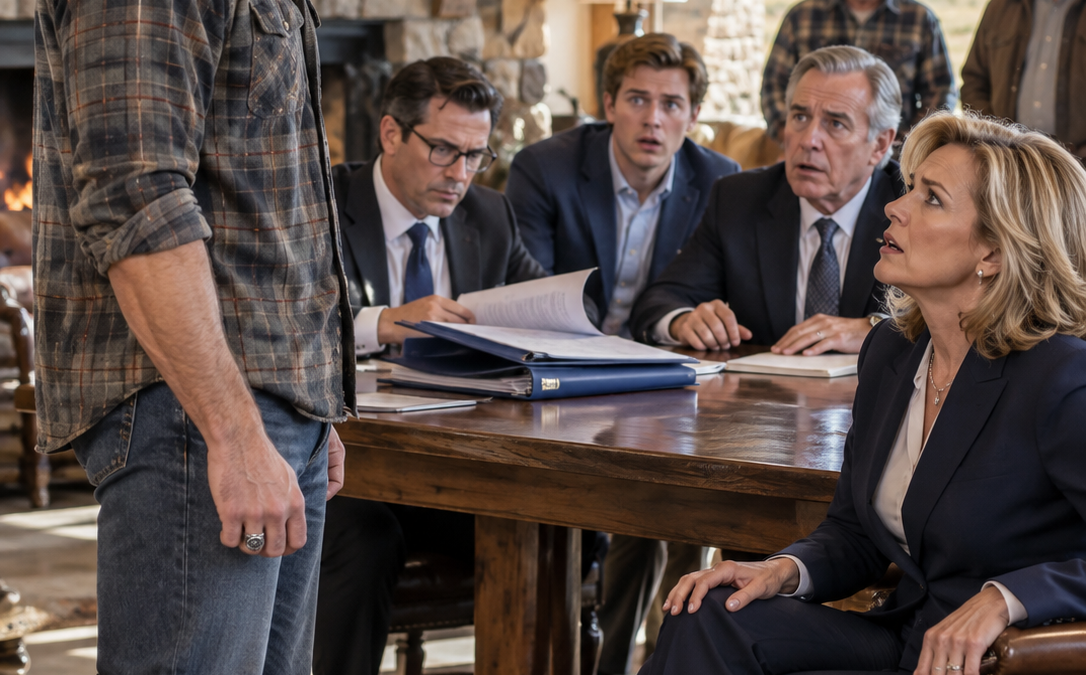
“Let’s get this over with quickly,” he said, leaning forward. “My clients have a tight schedule today. We’re here to formally challenge any irregularities regarding Mr. Whitfield’s declining mental capacity in his final months of isolation. We want to protect his true family from undue influence.”
Gordon didn’t flinch.
He opened his briefcase, pulled out a thick stack of documents bound in blue covers, and set it on the desk with a heavy thud, adjusting his glasses.
“Mr. Cray,” he said, entirely calm, “we are not here to read a last will and testament. We are here to execute the Harold Whitfield Revocable Living Trust, which, upon his death on Tuesday morning, became irrevocable under the laws of the state of Oregon.”
Cray’s practiced expression flickered.
A trust, not a will.
A will runs through probate: a matter of public record, contestable, drawn out for years, bled dry by lawyers.
A properly funded trust bypasses probate entirely.
It’s a private, locked-down vault.
My parents had shown up with a battering ram for a titanium door with no visible lock.
“I strongly suggest you hold your objections until I finish reading the relevant sections,” Gordon said.
Then he began.
“Schedule A of this irrevocable trust details the complete verified inventory of the estate assets. This includes, but is not limited to, the real property known as Whitfield Stables, comprising 1,200 acres of prime agricultural land, all associated water rights dating back to 1922, all industrial machinery, livestock, and the primary residence.”
Gerald nodded approvingly, already calculating real estate value in his head.
“Furthermore,” Gordon continued, “the trust holds full ownership and all future royalty rights to fourteen active United States utility patents for agricultural irrigation technology engineered entirely by the grantor. The total independently assessed market value of the combined trust assets at the time of the grantor’s death is $114 million.”
The room stopped breathing.
Renee’s mouth fell open, her bag sliding off her lap and hitting the floor with a thud.
Gerald’s pen rolled across the hardwood and stopped inches from my boot.
Even Preston looked up from his phone, gripping his chair, eyes wide.
They’d expected a modestly successful ranch worth two or three million at best.
They had no concept of the patent empire underneath it.
Vincent Cray’s eyes lit up with unfiltered greed, looking at Renee like she was a winning ticket he was already holding.
Gordon gave them no time to recover.
“Section Four: Asset Distribution,” he read. “Upon the death of the grantor, the acting trustee is directed to distribute one hundred percent of the total trust assets to the sole named beneficiary.”
He looked up, locking eyes with Renee.
“The sole beneficiary of this entire estate is Caleb Sutton.”
The silence that followed was the kind that happens right before something detonates in a closed room.
“Wait,” Gerald stammered. “That’s a mistake. Read it again. My wife is his only living daughter. There’s a clear line of succession here.”
Gordon ignored him and kept reading.
“Section Five: Intentional Exclusions. The grantor further directs that the following individuals are intentionally and completely excluded from any distribution, any benefit, or any access to any property under this trust. And this exclusion is not an oversight, but a deliberate decision made with full knowledge and sound judgment.”
He read the names slowly.
“Renee Marie Sutton. Gerald James Sutton. Preston Alexander Sutton.”
Vincent Cray shot to his feet, face flushing red with manufactured outrage.
“This is an outrage!” he yelled, slamming his briefcase. “This is the textbook case of undue influence and elder abuse. You cannot disinherit an entire biological family like this. We’re filing an emergency injunction tomorrow morning. We’ll freeze every account. We’ll demand full medical records. Harold Whitfield was clearly suffering cognitive decline, and this young man manipulated him in his isolation. We’ll destroy this document in probate.”
Gordon closed the folder calmly, looking profoundly amused.
“Mr. Cray, before you embarrass yourself and rack up unbillable hours for your desperate clients, I suggest you review Appendix C sitting right in front of you.”
Cray tore open the folder, Gerald leaning over his shoulder.
“Your clients are attempting to claim Harold Whitfield lacked testamentary capacity or was under undue influence,” Gordon said. “He anticipated exactly that strategy. Eight years ago, when he first established this trust, he voluntarily underwent a four-hour psychiatric evaluation with Dr. Alan Weiss, a board-certified forensic psychiatrist in Portland, who certified his complete mental competence. Eighteen months ago, when he amended the trust to include his final three patents, he submitted to a second evaluation by a different psychiatrist entirely. Both notarized reports, independently witnessed, are permanently attached to this trust.”
Gordon looked directly at Cray.
“Harold Whitfield was certified in the top percentile of cognitive function for his age group. Any challenge to his mental capacity will be dismissed with prejudice and likely accompanied by sanctions against your firm for filing a frivolous suit.”
Gordon slid a second folder across the desk.
This one contained signed and dated visitor logs from three separate professionals: an accountant, a land surveyor, and the same Dr. Reyes who had been treating Harold’s lungs, each of whom had independently noted in writing that the man they’d met with was lucid, sharp, and entirely in command of his own affairs right up through the final months of his life.
Gordon had clearly spent years building not just an estate plan but an evidentiary case, layering proof on top of proof exactly the way Harold himself would have layered redundant safety margins into a pressurized irrigation system, so that even if one seal failed, there were three more behind it holding the line.
Cray’s face drained of color as he stared at the medical reports in his trembling hands, a shark realizing he was swimming at full speed through an empty pool.
“And finally,” Gordon said, driving the last nail home, “Section Seven contains a strict, heavily tested no-contest clause. Any excluded party who attempts to challenge the validity of this trust, question the grantor’s capacity, or file frivolous claims against the estate or its beneficiary automatically and permanently forfeits the one-time token distribution of $5,000 allocated to them in Schedule B.”
Five thousand dollars out of $114 million.
Harold had left them exactly enough for a used car, and even that crumb was contingent on walking away quietly.
Renee stood up so fast her chair scraped violently against the floor, her composure shattering completely.
She ignored the lawyers, ignored her panicking husband, and turned entirely on me.
“You manipulated him!” she screamed, her voice echoing off the ceiling. “You poisoned my father against his own family! We brought you here! We gave you this life! You were nothing before we dropped you off! You were a mistake!”
She pointed a shaking finger at me, spit flying.
“You’re stealing our lives from us! We need this money! You owe us!”
I didn’t stand up.
I didn’t raise my voice.
I looked at the woman who’d once looked at a nine-year-old and calculated exactly how much he cost to keep.
“You said it best yourself,” I told her, my voice quiet and completely final. “You were the one we could afford to lose.”
The room went dead silent.
The echo of her own words hung there.
Cray closed his eyes and pinched the bridge of his nose, already knowing it was over because she had just admitted the truth of it in front of three credible witnesses.
I lifted my hand and rested it on my knee, the iron ring catching the morning light.
“He already said no,” I said. “In writing.”
Cray slammed his briefcase shut with a final metallic snap.
He didn’t look at Renee or Gerald, only at Gordon with something close to grudging professional respect.
“Your paperwork is flawless, Counselor,” he said, picking up his coat. “It’s an ironclad fortress.”
Gordon nodded once.
“I know it is.”
Cray turned to Gerald and dropped the performance entirely.
“My retainer doesn’t cover fighting impossible miracles in probate. Mr. Sutton, you lied to me about the psychiatric state of the deceased. You lied to me about the financial structure of the estate. You have zero standing, and filing an injunction would trigger sanctions against my own firm. I’m withdrawing as your counsel effective immediately. I’ll send a final invoice for my travel and consultation. Do not contact my office again.”
He walked out without waiting for a response, the heavy door slamming behind him.
For a moment after the door slammed, nobody in that room moved at all.
Then Gerald turned to me directly for the first time since he’d walked through the front door that morning, dropping the smug corporate mask entirely.
For one strange second, I saw something in his face that almost looked like the man he might have been if he’d made a single different decision twenty-two years earlier.
“Caleb,” he said, his voice cracking in a way I’d genuinely never heard from him before. “We made mistakes. We know we made mistakes. But you’re still my son. Doesn’t that count for something here?”
I looked at him for a long moment.
The man who had carried my suitcase to the bottom of a porch step and walked away without once looking back was now standing in the wreckage of his own greed, asking whether biology alone was supposed to purchase him a share of a fortune he’d never once lifted a finger to help build.
“It counted for exactly as much as it counted twenty-two years ago,” I told him, “when you decided I was the one you could afford to lose. You made that calculation once already, Gerald. I’m not required to make a different one on your behalf just because the numbers changed.”
He didn’t have an answer for that.
For the first time in my entire life, I watched my father simply run out of things to say.
Gerald stood frozen in the middle of the room, pale and sweating, staring at the documents representing $114 million now permanently out of reach.
Renee, still shaking with rage, turned on him.
“Do something,” she hissed, grabbing his arm. “You’re letting him steal our lives out from under us. Say something.”
Gerald wrenched his arm free.
“Do what, Renee?” he yelled. “Look at the paperwork! We’re locked out of the vault! You heard the lawyer. We have nothing. We’re ruined.”
Preston finally stood, shoving his phone into his coat pocket, looking at his panicking parents with open disgust.
“You ruined this,” he muttered, shaking his head. “You dragged me out to this freezing desert, promised me a payout to cover my debts, and walked us straight into a brick wall. You’re both pathetic.”
He walked past them without looking at me and headed for the door.
Renee and Gerald stood shell-shocked for another ten seconds before following him out into the cold.
I stood and walked to the bay window and watched the final collapse of my biological family play out on the frozen driveway.
Gerald screamed at Renee, waving his arms, losing every ounce of his corporate composure.
Renee screamed back, pointing at the house and then at his chest.
Preston stood by the Porsche smoking, ignoring both of them completely.
They climbed in.
Gerald slammed it into reverse, spun the tires in the loose gravel, and sped off toward the highway, driving back toward crippling debt, a crumbling real estate business, and a marriage with no safety net left underneath it.
I watched the dust settle over the road, the windmill turning steadily behind me, the only sound left in the world.
Gordon packed his briefcase, closing the locks.
“They’ll never challenge this document,” he said. “They don’t have the resources, and no reputable lawyer in this state would touch it on contingency after seeing those reports. Harold checkmated them from the grave. You’re the sole uncontested owner of everything now.”
“Thank you, Gordon,” I said, shaking his hand. “For everything.”
The house was strange for a few days after that.
Quiet in a way it hadn’t been quiet even in the weeks right after Harold died, because grief has its own particular sound.
This was something else entirely.
Something closer to the ringing silence that follows a controlled demolition.
Cole came by most evenings that first week just to sit with me on the porch, not saying much, the same way he never said much when I was nine years old, learning to ride a horse that kept throwing me.
Walt Simmons brought over a casserole his wife had made, the exact kind of small, unglamorous gesture nobody in my biological family had ever once thought to offer me in twenty-two years.
I remember standing in the kitchen, eating it cold straight out of the dish at eleven at night, thinking that this—a casserole from a veterinarian’s wife who barely knew me—was worth more than everything sitting in that trust combined.
Gordon called twice that week just to check that I was doing all right, which surprised me since I’d assumed our relationship ended the moment the paperwork was finalized.
He told me something I’ve held on to ever since.
Harold hadn’t just hired him to draft documents.
He’d hired him fifteen years earlier specifically because Gordon had a reputation for looking after his clients’ people, not just their property. Harold had made him personally promise, back when I was still a teenager mucking out stalls, that whoever eventually inherited that ranch would not be left standing entirely alone in the aftermath of getting it.
I spent the next two years expanding the ranch’s operations and scaling the software company with Miles, landing three more national contracts, filing two patents of my own, using the exact engineering principles Harold had drilled into me in that workshop.
My net worth grew, but my life barely changed.
I still wore denim every day, still drove a truck, still ate dinner at the kitchen table alone.
Then, almost exactly two years after the reading of the trust, the final twist arrived.
I was reviewing an acquisition file when my personal email chimed.
It was from Preston.
I hadn’t heard a word from my brother since he walked out that door in disgust.
The email was a wall of text, a desperate plea for salvation.
He admitted the whole lavish performance at the funeral had been a lie.
The Porsche had been rented on a high-interest card in his own name because Renee and Gerald’s credit had already collapsed.
He was drowning in more than $200,000 of debt. His custody battle had bankrupted him. And our parents, amid their own bankruptcy filing, had cut him off completely.
Caleb, the email read, I know we don’t have a relationship, and I know Mom and Dad treated you badly, but I’m begging you. I’m losing the house next week. I could lose custody of my kids. You have over $100 million sitting there. $50,000 would save my life. Please. We’re family.
I read it twice, sat back, and looked at the iron ring on my thumb.
WHITFIELD KEEPS.
I didn’t feel vindication or joy or even pity.
I felt nothing at all because the cord connecting me to that family had been severed on a hot porch twenty-two years earlier, and no amount of desperate emailing was going to splice it back together.
I moved the cursor over the screen, clicked Delete, and emptied the trash folder.
Then I closed the laptop and walked out toward the workshop because I had real work to do that didn’t involve rescuing the people who had once tried to drown me.
A few months later, going through Harold’s old papers to finally organize the estate archive properly, I found something I hadn’t expected.
Tucked at the very back of the same drawer where the black ledger had lived all those years was a second, older ledger.
The leather was cracked and the ink faded, and it went back decades before I was ever born.
In it, in the same blocky handwriting, I found entries about my own mother.
Renee requesting $2,000 for community college enrollment. 1988. Denied.
Renee requesting help after losing her apartment. 1991. Denied.
There was no explanation attached, no softening, just the same cold word repeated over and over against a young woman’s name instead of mine.
I sat on the floor of that office for a long time, turning that ledger over in my hands.
Harold had never once told me that the coldness had started with him decades before I ever arrived on that porch, that Renee had grown up being taught the exact same lesson about earning everything the hard way, except nobody had ever followed the denial with a workshop, a wrench, and a stool in the corner.
He’d handed her the discipline without ever handing her the mentorship.
Then he’d handed me both.
It didn’t excuse a single thing she did to a nine-year-old boy.
It explained where the coldness in her had first been forged, and it explained why she’d spent her whole life clawing after money like it was the only proof of love she understood.
I sat with that ledger longer than I probably should have, running my thumb over pages of Harold’s handwriting the same way I’d once run my thumb over the engraving on his ring.
For one long, strange evening, I actually considered picking up the phone and telling Renee what I’d found.
I got as far as pulling up her number before I set the phone back down.
I tried to imagine how that conversation would actually go, and every version I ran through in my head ended the same way, with her taking the discovery not as an invitation toward some kind of healing, but as fresh ammunition—proof in her mind that she, too, had been wronged and was therefore owed something, that her father’s coldness toward her somehow retroactively excused what she’d done to a nine-year-old boy she had chosen to abandon on a porch.
I don’t believe that’s a fair reading of what happened to her.
I believe, having now sat with both ledgers side by side, that Harold Whitfield genuinely did fail his daughter in some fundamental way decades before I ever entered the picture, and that failure deserves to be acknowledged honestly rather than buried the way he tried to bury it in the back of that drawer.
But acknowledging that he failed her is not the same thing as excusing what she chose to do with that failure once she became a parent herself.
She had every opportunity at twenty-nine years old, holding her own son’s hand, to decide she would break that particular cycle instead of extending it.
She chose instead to extend it, and worse, to extend it selectively, keeping the son who reminded her of the version of herself she wished she’d been allowed to become and discarding the one who reminded her, I think now, of exactly how replaceable her own father had once made her feel.
I never told her I found it.
There was nothing left between us for that information to repair.
But I stopped carrying quite as much anger about it after that, and I started my own ledger instead.
A plain notebook I keep in the same drawer.
Except mine doesn’t have a single word denied written anywhere inside it.
Mine tracks the opposite.
Every kid we bring through the program, every tool they master, every scholarship we fund—every one of them gets a line, and every line ends with the word granted.
Exactly eighteen months after Harold passed, I used a fraction of the trust to establish the Harold Whitfield Hope Foundation, partnering directly with the state foster care system.
Every summer, we bring eight teenagers aging out of the system to the ranch for a fully funded three-month apprenticeship in mechanical trade skills.
We don’t sit in circles talking about trauma.
We hand them torque wrenches.
We teach them to run a welding torch without burning their hands off, to diagnose a failing diesel engine, to read a blueprint, to build something permanent with their own two hands—the exact same survival skills Harold Whitfield taught a broken nine-year-old boy who had nowhere else to go.
I was standing at the main workbench one afternoon watching a seventeen-year-old named Dante fight a stubborn stripped bolt on a tractor engine block, his knuckles white, forcing the wrench, cursing under his breath.
I walked over, put a hand on his shoulder, and slid the wrench gently out of his grip.
“Stop forcing it,” I told him. “You have to feel the threads catch. That’s where the metal wants to stop. It’s talking to you. Push past it because you think you’re stronger than the design, and you’ll break the exact thing you’re trying to hold together. Then you’ve got nothing but stripped metal and a bigger problem.”
Dante took a breath, wiped the grease off his forehead, and tried again slowly.
He found the spot.
The bolt locked home clean.
He looked up at me, grinning.
“Good job,” I said. “Go check the hydraulic fluid levels.”
These kids are the closest thing to family I have left.
And I mean that in the only definition of the word that ever actually held any weight in this house.
Dante wasn’t the first kid to come through that program who reminded me uncomfortably of myself at that age.
And he won’t be the last.
The year before him, there was a girl named Priya, seventeen, who’d bounced through six different foster placements before landing in the state system entirely on her own and who arrived at the ranch that first summer with exactly the same locked jaw and refusal to make eye contact that I imagine I wore myself the day I got dropped on that porch.
Priya didn’t say more than a handful of words to anyone for the first two weeks, but she watched everything, the way a person watches when they’ve learned the hard way that paying close attention is the only form of safety available to them.
I put her on small-engine repair almost immediately, mostly because it was the one task where nobody needed her to talk to succeed at it.
By the end of that first month, she was diagnosing carburetor problems faster than kids who’d been in the program twice as long as she had.
At the closing ceremony we hold every August—a small, unglamorous gathering in the same workshop where Harold once fixed a broken bridle in front of a terrified nine-year-old—Priya stood up on her own, without anyone asking her to, and said that this was the first place in her entire life where an adult had handed her something difficult and simply trusted her to figure it out instead of either doing it for her or writing her off before she’d even tried.
She’s twenty now, finishing an associate’s degree in diesel mechanics on a scholarship the foundation funds directly.
And she calls Cole most Sundays, which is a small detail that means more to me than almost anything else the foundation has produced in its short existence.
We keep a wall in the workshop office now.
Nothing fancy, just a corkboard with a photograph of every kid who’s come through the program pinned up next to a short note about where they landed afterward.
Mechanic apprenticeships. Welding certifications.
Two of them now working full-time on ranches of their own two counties over.
It is, in its own way, the exact opposite of the ledger Harold kept locked in his desk for thirty years.
A running record not of everything denied, but of everything finally granted.
I think about that inversion often, standing in front of that corkboard at the end of a long day, tracing the shape of what an entire family history can look like if just one person along the chain decides to build something different than what was handed to them.
I don’t know if Harold ever imagined this specific version of what I’d eventually do with what he left me.
I don’t think he needed to imagine it exactly.
I think he simply trusted that a boy who’d learned to feel the threads catch under his own hands would eventually figure out how to apply that same feeling to people.
And that trust, more than the money, more than the patents, more than 12,200 acres of prime irrigated pastureland, is the actual inheritance I carry around on my thumb every single day.
Cole Bennett walked over, wiping his hands on a red rag, officially the head instructor now, earning every bit of the salary he deserved after all these years of loyalty.
He watched Dante walk off with a new kind of confidence in his shoulders.
“You sound just like the old man,” Cole said, laughing. “It’s actually a little frightening how much you sound like Harold when you’re teaching these kids.”
I smiled and looked down at the ring on my thumb.
“I guess some things in this world really are engineered to last.”
I walked out of the workshop into the yard as the sun dropped low over the eastern mountains, casting long orange shadows across the pastures, the windmill turning slow and steady in the evening breeze, the same rhythm that had scored my entire life since the day I arrived on that porch with nothing but a cracked suitcase.
My parents threw me away because they’d calculated I was a burden they couldn’t afford to carry.
They valued money and status and their own comfort over their own child.
And they genuinely believed they were cutting their losses.
In reality, they handed me the single greatest inheritance a person can receive.
Harold Whitfield didn’t just leave me a fortune and a stack of patents.
He taught me that real family has nothing to do with a shared bloodline or a name on a birth certificate.
Real family is defined by the people who show up when you’re broken and bleeding.
The people who hand you a wrench when you’re drowning and teach you how to build the boat yourself.
I earned the right to keep this ranch.
I earned the right to carry this name.
And now I spend my life handing those same tools to the kids who need them most.
And that is my whole truth.
A cracked plastic suitcase at nine, an iron ring at nineteen, and a legacy I fought hard enough to actually deserve.
A good design doesn’t just resist stress.
It redirects the load into something strong enough to hold.
I was the load Harold redirected, and now I’m the beam holding up eight kids a year who would have otherwise fallen straight through the same crack I did.
I think about Renee sometimes more than I probably let on in the rest of the story.
Not with anger exactly anymore, but with a specific kind of clear-eyed sadness reserved for people who had every tool available to build something better and chose instead to keep rebuilding the exact structure that had once collapsed on top of them.
I don’t know if she’s read anything about the foundation.
I don’t know if she knows Dante’s name or Priya’s name or any of the eight names that rotate through this ranch every single summer.
Now, I suspect if she does know, some small part of her recognizes exactly what those kids represent.
The version of a childhood she could have given me and chose instead to give to nobody, not even herself.
I used to think the ending of the story was the reading of that trust, the moment the paperwork finally did what twenty-two years of hoping never could.
I don’t think that anymore.
I think the actual ending is standing in a workshop, watching a seventeen-year-old girl who arrived unable to make eye contact stand up in front of a room and describe in her own words what it feels like to be trusted with something difficult for the very first time in her life.
Harold Whitfield spent his whole career engineering systems built to outlast the people who designed them.
Irrigation lines still running water across dry fields decades after he first laid the pipe.
Patents still generating royalties long after his hand stopped being able to hold the wrench steady.
I think, without ever saying it directly, he understood that the most important system he ever built wasn’t made of steel or water rights or blue-bound legal paper at all.
It was built out of one broken nine-year-old boy, reinforced joint by joint, lesson by lesson, until it could bear weight on its own and eventually start bearing weight for other people, too.
That’s the part of the inheritance nobody can contest in probate court.
That’s the part no lawyer, however expensive his watch, can ever manage to strip out of a family and sell off for parts.
People ask me sometimes, usually in messages after a story like this one, whether I ever wonder what my life would have looked like if that car had simply turned around, if Renee had rolled that window all the way down instead of two inches and said something different, something that actually meant what a mother is supposed to mean.
I used to wonder about it constantly, lying awake in that iron-framed bed those first few winters, running the alternate version of my life like a movie I kept rewinding to a scene I wished had gone differently.
I don’t wonder about it much anymore.
And it isn’t because I’ve made some kind of peace with what happened to me, because peace isn’t really the word for what this is.
It’s closer to gratitude.
Uncomfortable and complicated as that word feels sitting next to everything that came before it.
Gratitude for the specific shape my life ended up taking because a man I barely knew chose to hand a broken kid a wrench instead of an excuse.
I would not trade Harold Whitfield’s ten years for Renee and Gerald’s twenty-two.
Not for any amount of money sitting in any trust.
And I think that sentence alone is the entire verdict on everything that happened in that living room the day the paperwork finally caught up with the truth.
Thank you for listening tonight.
If there’s one thing I want you to carry out of this story with you, it’s this:
Never let the people who threw you away get to define what you’re worth.
Your value was never up to them to decide, and their complete failure to love you was never a verdict on your character.
Build the boundaries out of solid steel.
Do the hard work in the dark when nobody’s watching.
And let what you build be the loudest sound in the room.
Have you ever had to build your entire life back up from nothing after the people who were supposed to protect you decided you were the one they could afford to lose?
Tell me in the comments and hit subscribe before you go, because I put a story like this one up every single week, and I would like to have you here for the next—








