My parents flew to paris for 68 days for my brother’s graduation, they abandoned me, bedridden and seriously ill, and before leaving, mom ordered the caretaker to hide my medication, withhold food, cut off power and water, and lock me in a filthy storage room with rats, but when they returned, they opened the door and both went pale at what they saw…
I was on the floor of my own laundry room, my back pressed against the washing machine and my legs completely dead beneath me, when I heard my stepfather’s sedan pull out of the driveway I’d paid cash for. In that moment, I understood with a clarity I have never managed to fully explain to anyone since that my family had just left me there to die.
The deadbolt had slid shut four minutes earlier. Someone had already flipped the breaker for that entire wing of the house, because the window air-conditioning unit that usually kept the room bearable had gone silent in the middle of a cycle. The Louisiana heat, even in the darkness, was already building into something thick and wet and almost alive against my skin. The water had been shut off somewhere outside, which I only discovered later, when I managed to drag myself far enough to reach the utility sink and got nothing from the faucet but a dry, rattling cough of air.
Somewhere inside the wall behind me, mice were scratching at the insulation. It was a small, patient sound, the kind made by something that knows it has all the time in the world. I remember thinking, with the strange, sideways clarity that sometimes comes when everything else is failing, that the mice currently had a better survival plan than I did.
I want to tell you how I got there, because none of it will make sense unless I start much earlier.
My father, Howard Mercer, died when I was ten. His heart gave out on a Tuesday morning while he was sitting at his own desk, so suddenly that nobody had a chance to say anything useful to him before he was gone. He ran a small, unglamorous accounting practice out of a strip-mall office with a hand-lettered sign, the kind of business that survives on the loyalty of a few dozen regular clients rather than on any particular ambition.
These days, I remember him mostly in small, specific pieces. I remember the patient way he explained a ledger to me at the kitchen table when I was eight, convinced even then that a child should understand where money actually came from rather than simply where it went. I remember the sound of his key in the front door at exactly 6:15 every evening, a punctuality he treated almost like a promise. And I remember one afternoon, perhaps six months before he died, when he let me sit in his office chair and told me, with no apparent irony, that the two things worth building a life around were the people who showed up uninvited to help you and the discipline to track every dollar honestly.
The first, he said, told you who you actually had. The second told you whether you deserved to keep what you had earned.
I didn’t understand that sentence at eight. There have been entire weeks of my adult life when I have thought about almost nothing else.
My mother, Evelyn, remarried within fourteen months. Her new husband was William Driscoll, a man who sold industrial flooring for a living and radiated the particular confident mediocrity of someone who had never once been forced to examine whether his confidence was actually earned. He had a son from his first marriage named Ryan, two years younger than me, golden-haired and effortlessly likable in the way certain children simply are, through no particular virtue of their own.
Within the first year of that marriage, I watched my mother’s attention migrate toward Ryan with a speed that still catches in my throat twenty-four years later whenever I allow myself to think about it directly. I don’t believe she deliberately set out to replace me. I believe, more precisely, that Ryan simply required less work to love visibly, and that my mother, grieving one husband and newly married to a man she barely knew, chose the path that asked less of her. She never looked back long enough to notice what that choice had cost the son she already had.
William’s first marriage had ended, according to William, through absolutely no fault of his own. It was a version of events I eventually learned to distrust almost reflexively, largely because he told it so often and so identically, word for word, the way a man tells a story he has polished specifically to survive repetition rather than scrutiny. He worked for a regional industrial flooring distributor, a solid but unremarkable career that allowed him to dress like a man with considerably more money than he actually possessed.
I think my mother, in the wreckage of losing my father so suddenly, mistook William’s particular brand of easy confidence for the stability she desperately needed someone to represent. At the time, she had neither the energy nor, I suspect, the real desire to examine the difference between the two.
To understand why she needed that representation so badly, you have to understand something about who my mother had been before any of this happened. That version of her exists for me only in fragments, pieced together from a handful of old stories she told and a few photographs that used to sit on my father’s dresser.
She had grown up the younger of two daughters in a household where her older sister had been, by every account I ever heard, the obvious favorite. Her sister was the valedictorian, the girl on homecoming court, the daughter my grandparents mentioned first at every holiday gathering. My mother, meanwhile, had been quietly and persistently informed, in all the small, accumulating ways families communicate such things without ever saying them outright, that she was the daughter who tried hard but never quite measured up. Pretty, but not striking. Pleasant, but not memorable.
She told me once, the only time I ever heard her speak about it directly, that she had spent her entire childhood waiting for someone to notice her first. Marrying my father at twenty-three had felt, for a few years, like exactly that kind of recognition. He was steady and plainspoken, and he had chosen her specifically and visibly over anyone else he could have chosen.
I think some of what left her so unmoored after he died wasn’t simply grief in the ordinary sense. I think part of it was the terrifying, specific fear of sliding back into being the sister nobody mentioned first. William, whatever else he actually was, offered her a particular kind of loud, constant attention that felt, to a woman already primed by thirty years of practice to mistake volume for value, like the opposite of being invisible.
I don’t say any of this to excuse what she eventually did to me. I say it because I spent a long time afterward trying to understand how a woman who had genuinely loved my father could arrive, step by step, at a laundry room floor. The only honest answer I ever found was that her fear of being overlooked again had apparently come to matter more to her than I did. Ryan’s easy, effortless lovability must have looked like a second chance at being chosen first, and she wasn’t about to let anything, including her own first son, get in the way of getting that feeling a second time.
I remember one birthday in particular, the year I turned twelve and Ryan turned ten, because even a quarter century later it remains the clearest single example I can offer of how our household actually worked.
It was nominally my birthday party, held at a bowling alley I’d specifically requested. Ryan threw a tantrum during the second frame because he was losing. Rather than let a ten-year-old experience the ordinary discomfort of losing a game, my mother quietly asked the attendant to reset the pins and allow him a few extra practice turns until his score caught up with mine. Meanwhile, the cake I’d chosen sat forgotten on a side table because Ryan had loudly announced that he wanted the one from the vending machine instead, and naturally, he got it.
I don’t think either of them even remembered that detail by the following week. I have never once managed to forget it.
The pattern remained steady throughout the following decade. Eventually, I stopped being surprised by it, even when it appeared in moments that should, by any reasonable measure, have mattered considerably more than a birthday party at a bowling alley.
My college graduation fell on the same weekend as one of Ryan’s middle-school soccer tournaments, a regional qualifier my mother described at the time as genuinely impossible to miss. I remember crossing the stage at twenty-two and scanning the crowd out of some old, stubborn reflex before I’d even fully admitted to myself that I was looking for her.
What I found instead was a single folding chair near the back, occupied by my father’s old business partner. He had driven two hours to be there after hearing through a mutual acquaintance that nobody else from my family was planning to attend.
I didn’t tell my mother how much that afternoon hurt. Mostly, that was because I already knew, with a weary and premature clarity, exactly what she would say if I did. Soccer tournaments didn’t reschedule themselves. Ryan needed her there in a way that I, at twenty-two, presumably didn’t. And I was being, in whatever gentle word she happened to choose that week, a little sensitive about the whole thing.
I kept the detail about the folding chair to myself for years, the way you keep anything you’re not ready to discover doesn’t actually matter to the person you would be telling.
I spent my twenties building something nobody in that house particularly understood or cared to understand.
It was a boutique medical billing software company called Clear Path, born out of a frustration I’d developed while watching my father’s small accounting practice drown in exactly the kind of denied-claims paperwork I eventually built a career automating. I started at twenty-four in a one-bedroom apartment with a cofounder named Ranata Alcaras, a former hospital billing coordinator who had spent six years watching the same broken claims process from the inside.
She approached me after a conference talk I gave on automated denial management with one blunt question: Why was nobody building the thing I’d just spent forty minutes describing?
We built the first version of Clear Path together over eighteen months of exhausted, exhilarating focus, the kind I don’t think I’ve fully replicated since. Some weeks, we slept in shifts. We argued over architecture decisions in a way that somehow never once felt personal. And we watched our first real client, a midsize orthopedic practice that had been losing nearly a fifth of its billable revenue to preventable denials, cut that number by more than half within its first quarter using our platform.
We nearly didn’t survive long enough to secure that client, though. That’s a detail I rarely tell people, partly because my stomach still drops whenever I remember it clearly.
Fourteen months in, our savings had dwindled to almost nothing, and a second, larger client was threatening to walk away over a bug in our claims-matching logic. For one horrifying week, the software had begun silently misrouting a small percentage of submissions. Ranata and I spent four straight days essentially living in that one-bedroom apartment, trading two-hour sleep shifts on the couch while rebuilding the entire matching engine from scratch rather than patching around a flaw neither of us trusted a patch to fix completely.
On the third day, I called my mother, mostly because I wanted to hear a voice that wasn’t Ranata’s exhausted one. I told her, with as much calm as I could manufacture, that the company might not survive the month. She assured me, in a tone I remember finding comforting at the time and considerably less comforting in hindsight, that she was sure I’d figure it out, the same way I figured out everything.
Then, almost in the same breath, she asked whether I’d heard back yet about helping with Ryan’s summer camp deposit.
I didn’t bring up the company’s troubles with her again.
Ranata, for what it’s worth, never once asked me for anything that week except coffee and an extra set of eyes on a rejection pattern neither of us could get to behave. Looking back, I think some formative part of my understanding of what real partnership looks like was built in that apartment during those four days. That understanding made the following decade inside my own family considerably harder to make sense of by comparison.
We grew slowly, and then suddenly, the way these things apparently do, expanding from four employees to sixty over the following six years. I sold the company at thirty-one to a healthcare conglomerate for a sum large enough to change the entire shape of my life.
Ranata took her own considerable share of the sale and almost immediately started a second company, something in diagnostic imaging software that I still follow with genuine pride from a distance.
And I did what I think most people in my position do at least once.
I used some of my share to try to buy back a family I’d never actually had.
I bought a sprawling ranch house outside Baton Rouge, paying cash and putting only my name on the deed, along with a modest real estate portfolio across three states that I managed mostly for the quiet satisfaction of managing something well.
Then my mother called me crying about William’s strip-mall investments. Three failed developments in two years. A second mortgage underwater. A marriage she described, in the peculiar language of someone rehearsing a speech, as barely holding together under the financial strain.
I moved them in rent-free.
I added both of them as authorized users on two of my credit cards. I arranged automatic payments for Ryan’s tuition at a considerably more expensive university than the one I’d attended myself. I did all of it because some part of me, even at thirty-one, with a company sale behind me and more money than I knew what to do with, still wanted, more than almost anything else, to hear my mother say she was proud of me.
I remember the particular satisfaction of that first year, before anything had gone wrong with my health. I watched them settle into bedrooms I’d furnished for them. I watched William set up a home office he never seemed to actually work from. I watched my mother redecorate the kitchen with a confidence that suggested she’d already stopped thinking of the house as something I’d loaned them and had begun thinking of it as a long-overdue correction to some cosmic ledger only she could see.
At the time, I told myself this was simply what generosity looked like. A little one-sided at first, perhaps, but the kind of imbalance that would eventually even out once they’d had time to settle in and feel secure again.
I didn’t yet understand that some people, once they stop feeling the weight of a debt, simply stop believing the debt exists at all. And the people around them who continue to insist it does begin to look, from that angle, less like creditors and more like nuisances.
I remember the afternoon I first walked them through the house, before they’d moved a single box inside. My mother moved from room to room in a particular kind of silence, running her hand along a countertop here, pausing beside a window there. I mistook that silence for the overwhelmed gratitude you might expect from someone being handed a life considerably larger than the one she’d been drowning in.
It was only months later, replaying that afternoon with considerably more information, that I recognized the silence for what it had probably been. Not gratitude, exactly, but a kind of rapid, private recalculation. The sound of a woman mentally measuring spaces for furniture that wasn’t hers yet, while already describing those spaces to herself as though they belonged to her.
That same afternoon, she asked, almost as an afterthought, whether the primary suite might eventually make more sense for her and William. After all, I was young and flexible, while they needed the extra space to settle in properly.
I remember saying yes. Easily. Happily, even.
At that point, I still believed generosity was an investment that compounded, that the more I offered now, the more of whatever I’d been missing since I was ten would eventually come back to me with interest.
I gave them the primary suite and moved into the smaller bedroom down the hall, the one that would, four years later, share a wall with the laundry room where I would begin a sixty-eight-day lesson in exactly how badly I’d misunderstood the terms of that particular investment.
William redecorated his new home office within the first month, replacing furniture I’d purchased specifically for the space with pieces he ordered using one of my own cards. I noticed, and I deliberately chose not to say anything, because mentioning it felt at the time like exactly the kind of petty, ungenerous accounting my father had warned me against becoming.
I understand now that there is a considerable difference between declining to keep score out of genuine generosity and declining to keep score because you’re afraid that honest accounting will tell you something about your own family you’re not ready to hear.
I spent most of that first year doing the second while telling myself, quite sincerely, that I was doing the first.
My mother never quite said what she believed about the arrangement. What she said instead, once they’d settled into my house and started treating it within months as something that had simply always belonged to them, was considerably more complicated.
I didn’t understand how complicated until I got sick.
The illness arrived without a name for the first eight months, which is its own particular kind of hell.
It was a neurological condition that would eventually be diagnosed as a rare autoimmune disorder attacking the nerve sheathing along my spine, the kind of thing that appears in medical journals with a prevalence rate low enough that most doctors might see only one case in an entire career.
It began, as these things apparently often do, with symptoms that were easy to dismiss. A tingling sensation in my left foot that I attributed to a long flight. A weakness in my grip that I blamed on a poor night’s sleep. Then, one morning, four months in, I simply couldn’t stand up from the kitchen table. My legs folded beneath me like those of a marionette whose strings had suddenly been cut.
I sat on that kitchen floor for almost twenty minutes before anyone in the house even noticed I hadn’t come upstairs.
I spent the following four months doing what I imagine most people do when their own body begins betraying them in ways nobody can immediately explain. I saw a general practitioner who ordered the obvious blood work and found nothing conclusive. Then I saw a neurologist who ordered considerably less obvious blood work and still found nothing conclusive.
Finally, I saw a second neurologist, a careful, soft-spoken woman named Dr. Pretty Anand. She ordered a spinal MRI alongside a specific panel of autoimmune markers nobody else had thought to check. She called me herself on a Tuesday afternoon, a day I remember with a clarity most Tuesdays never earn, to walk me through what she’d found.
She used the word rare four separate times during that conversation. I don’t think she was being dramatic. She genuinely wanted me to understand what I was dealing with before I started searching online for easy comparisons that wouldn’t actually apply to my particular condition.
She explained that the disorder attacked the nerve sheathing along my spine in a pattern her specialty might encounter only once or twice in an entire career. A treatment protocol existed, and it worked, provided I followed it with a precision that left essentially no margin for the kind of casual missed dose most people could get away with on an entirely different medication.
“This is not a regimen you get to be human about,” she told me in the blunt, specific tone I came to appreciate over our subsequent appointments. “Missing a dose on this one doesn’t give you a bad day. It gives you a bad week if you’re lucky, and something considerably worse than that if you’re not.”
Sitting in her office that afternoon, I had no idea how literally I would eventually learn what the unlucky version of that sentence looked like, alone on a concrete floor in the dark, with nobody coming.
The eventual diagnosis, confirmed after three specialists and a battery of tests, came with a medication regimen precise enough that missing even a single scheduled dose risked what my neurologist called, in a tone I initially found almost comically understated, a cascading inflammatory event.
That meant a fever that climbed rapidly and didn’t respond particularly well to anything except the medication itself. Muscle spasms severe enough to be genuinely dangerous on their own. And, if the condition went untreated long enough, a real risk of organ strain that might not reverse once it began.
On bad days, I couldn’t reliably control my own legs. I also became entirely unable to manage the handful of ongoing business interests I’d kept after the company sale. William cheerfully absorbed those responsibilities into his own supervision within weeks, approaching them with a confidence considerably larger than his actual competence.
Within roughly four months, I went from being the person everyone in that house depended on to being the person everyone had started quietly, and then not so quietly, to resent.
I want to be precise about how that resentment appeared, because it rarely announced itself in anything as straightforward as open cruelty.
It appeared as William moving into my study to “handle things” while I was too weak to object. He drank my bourbon in the evenings and polished a set of golf clubs he hadn’t swung in months, as though maintaining the equipment of a life he could no longer quite afford was its own form of dignity.
It appeared as my mother commandeering Nathan Brooks, the caretaker I paid from my own account specifically to help me bathe and manage my medication schedule. She redirected him toward her errands and household demands until, on most days, I genuinely couldn’t have told you whether he worked for me or for her.
Nathan was twenty-eight, newly certified as a home health aide after a few difficult years doing shift work at an assisted living facility that had, by his own quiet account, burned through most of his patience for the work before he’d even completed his training. He’d accepted the job with me specifically because the pay was steady and the hours, at least on paper, were supposed to be reasonable.
He was good at the actual job, gentle and unhurried in exactly the way you want someone handling your body on the days it refuses to cooperate with you.
Looking back, I don’t think Nathan’s real failure was cruelty. I never once saw him treat me unkindly on his own initiative. His failure was a particular young man’s inability to tell a woman twice his age, firmly convinced of her own authority, that her instructions exceeded his job description.
I don’t think he understood until considerably too late exactly how much that failure of nerve would eventually cost him.
The resentment also appeared through people who weren’t technically family at all.
Ryan’s friend Tyler Morgan visited one afternoon while I sat gray and trembling at the kitchen island. He looked at me the way someone looks at a stain on a carpet they’ve already decided isn’t worth the trouble of removing. Then, loudly enough for me to hear perfectly, he remarked that it was “kind of sad watching the rich uncle fall apart.”
My mother was standing less than six feet away. She smiled and asked whether he wanted more ice for his drink.
Tyler was a classmate of Ryan’s in the graduate program I was still dutifully paying for. Ryan had gone back for an MBA in his late twenties, a decision my mother described to anyone willing to listen as evidence of genuine ambition. I noticed that she never once applied that same generous description to the seven years I’d spent building a company from a one-bedroom apartment.
Tyler treated our house the way he apparently treated most things that weren’t technically his, as a resource to be enjoyed without any particular obligation to notice who had paid for the enjoyment.
He returned three more times that same month, growing a little more comfortable on each visit, until one afternoon I overheard him speaking to Ryan from the pool deck. The sliding door was only partly closed, and his voice carried clearly into the house.
He said his own father would have put a guy like me in a home by now.
That sentence landed with a particular cold clarity I don’t think either of them realized had traveled as far as it did.
I didn’t fight any of this as hard as I probably should have during those months. Some old, stubborn part of me still believed that if I simply endured long enough, quietly enough, without becoming the kind of burden they’d clearly already decided I was, I would eventually earn back whatever version of a family I’d spent my adult life trying to buy.
I didn’t yet understand that the family I was trying to earn had never actually existed in a form capable of being earned.
Three hours before the deadbolt slid shut, Ryan called from Paris on speakerphone, loudly enough that I could hear him clearly from my bed down the hall.
He had graduated, or at least believed he had that week, with the ceremony still ahead of him. He wanted his parents at the airport immediately because he’d booked a Michelin-starred dinner for that evening using a card linked to my checking account. He didn’t want to be the one explaining a delay to the restaurant.
Even through the speaker, I could hear the particular self-satisfied cadence in his voice, the voice of a man narrating his own success to an audience he’d already decided was obligated to be impressed.
“I’m telling you, Mom, the ceremony is incredible. The whole program flew everyone out. There’s a reception after with actual champagne, not the stuff from the grocery store.”
I remember lying in bed listening to him describe a reception that, as it would turn out two months later, he had never actually attended. He was celebrating a supposed graduation paid for through tuition installments that had, at the very moment he was describing them, already technically lapsed without either of us knowing it yet.
My mother’s voice, when she answered him, had a brightness I hadn’t heard directed at me in longer than I wanted to count.
“We’re already packing, baby. Your father’s getting the car.”
I lay there in the dark, feeling the first warning tremor building in my left leg, and understood with a sinking, familiar clarity exactly how this afternoon was going to go.
At some point, William joined the conversation, asking Ryan with genuine enthusiasm whether the reception venue had a view of the Seine. Ryan described it in detail, offering the kind of specific, performative description a person gives when he knows he’s being listened to by more people than the person he’s nominally addressing.
Somewhere in the middle of that description, I heard him add, almost casually, “And tell David thanks for the card limit increase, by the way. I maxed the old one out on the suit.”
He gave the sentence no more weight than he might have given a remark about the weather.
Lying there in the darkness, I understood exactly how thoroughly my existence in that conversation had been reduced to a line item rather than a person anyone felt the slightest need to address directly.
Nobody asked how I was doing. Nobody mentioned, even in passing, that I’d spent the previous three days barely able to get to the bathroom without assistance.
I listened to them plan a champagne toast with my money while calculating, with a clarity I wish I hadn’t possessed at that particular moment, exactly how many hours remained before my own body would begin failing without the medication vial sitting in the refrigerator.
When I heard car keys jingling in the kitchen, I called my mother into my room.
I need to be clear about what I was actually asking for, because it matters. I wasn’t asking her to drive me anywhere. I wasn’t asking to be entertained or even particularly comforted. I was asking for a small amber vial sitting in the kitchen refrigerator behind the orange juice.
I needed it within the hour, or my nervous system would begin misfiring in a way that, left untreated, could progress toward fever, spasms, and eventually organ distress severe enough to be genuinely dangerous.
I had explained this exact mechanism to her calmly and in detail at least a dozen times over the preceding months.
She stood in my doorway wearing a tailored traveling jacket, the kind of outfit chosen specifically to look good in airport photographs, and told me in a voice I will remember for the rest of my life that she thought I was faking it, at least partly for attention.
She wasn’t going to let me ruin Ryan’s graduation with one of my episodes.
Then she picked up my phone from the nightstand, dropped it into her purse without asking, and called down the hall for Nathan.
“Clear the vials out,” she told him when he appeared in the doorway.
Nathan stood there, a thin, nervous man in his late twenties who had worked for me for over a year and had never once raised his voice to anyone.
“All of them. And shut off the water and the breaker to this wing before we go, so he doesn’t flood the place or burn it down trying to do something stupid while we’re gone.”
She delivered those instructions the way someone might give directions about a pet being boarded for the weekend, with a practiced lightness that told me more than the actual words about how completely she’d stopped thinking of me as a person whose consent mattered.
“I own this house,” I said, or tried to say. My voice was thinner than I wanted it to be. “I’m paying for every single thing you’re about to go do in Paris. You cannot just—”
“I’m not going to let a sick man run this family from a mattress,” she interrupted.
There was something in the particular coldness of that sentence that told me she’d been building toward it for considerably longer than the three hours since Ryan’s phone call.
“You’ll thank me for this once you’ve calmed down.”
Then she was gone down the hall.
Nathan wouldn’t meet my eyes. He half carried and half dragged me into the laundry room at the back of the house, set me down against the washing machine with a gentleness that felt almost like an apology, and left without a word.
A few minutes later, I heard the deadbolt slide shut.
William’s sedan pulled out of the driveway not long afterward. For a long, strange stretch of time that I genuinely cannot measure accurately, there was nothing but the heat, the darkness, and the particular patient sound of mice working at the insulation inside the walls around me.
I spent some unknowable portion of those early hours trying to talk myself out of panic, the way you do when some part of you still believes the whole thing must be a misunderstanding that will correct itself if you simply remain calm long enough.
I called out twice, as loudly as I could manage, hoping a neighbor might be walking a dog close enough to the property line to hear me.
Even as I shouted, I knew the laundry room sat on the interior side of the house, with no window facing the street. Suddenly, with sickening clarity, I understood that this detail had very likely not been an accident in my mother’s choice of where to put me.
The spasms began somewhere in that stretch of time.
First came a tremor in my left calf, a sensation I recognized immediately and dreaded exactly as much as I’d expected to. Then came something considerably harder to ignore, climbing through both legs in waves that left me gasping against the cool metal side of the washing machine.
I counted the seconds between each wave, trying to give myself something predictable to hold on to. But there was no predictable end waiting on the other side of that count.
I don’t know how long I sat there before I finally began moving. By then, moving meant dragging myself across the concrete floor with legs that answered to nothing I asked of them. I used my forearms like oars, pulling myself toward the hurricane supply bins stacked against the far wall.
Water, batteries, a radio. The kind of modest emergency preparation any sensible person in South Louisiana keeps within reach.
My knuckles split open against the lid of the first bin. The plastic had swollen shut in the humidity and refused to give way for several minutes, leaving skin and blood along its edge before I finally managed to open it.
The second bin contained a scattering of old batteries and a radio whose internal battery was dead.
When I finally forced open the third lid, the water was gone.
Not simply used up. Gone in a way that told me, with a cold certainty I desperately didn’t want to feel yet, that someone had deliberately removed it before leaving.
At the bottom of that same bin, half buried beneath a tangle of old phone chargers I’d apparently never bothered to throw away, my hand found a prepaid flip phone I’d forgotten I still owned. It was a relic from the early, paranoid days of my first startup, when I’d kept a second, untraceable number for a handful of sensitive calls.
The phone showed two bars of battery. As far as I could tell in the darkness, it contained exactly one stored number, because I’d never bothered reprogramming it after those early years.
I dialed the number from memory anyway. It had never actually left my head.
It belonged to my uncle Arthur Coleman, my father’s older brother, a blunt, weathered general contractor who had never once pretended to like William.
My mother had banned Arthur from the house eighteen months earlier following what she described to anyone willing to listen as an unprovoked, aggressive outburst. I happened to know firsthand that the confrontation had actually begun because Arthur had asked William, directly and not particularly gently, where exactly the money for his supposed golf-club maintenance fund was coming from.
I was in the room when it happened, which is why I knew exactly how one-sided my mother’s later retelling had been.
We were eighteen months into the new living arrangement. I’d cooked Sunday dinner myself because Evelyn had declared herself too exhausted from redecorating to manage it. Arthur was sitting at the table while William wandered through a long, meandering story about a golf trip he’d taken with two men from his old flooring sales territory.
At some point, Arthur simply set down his fork and asked, in the same flat, unhurried voice he used for everything, whether the trip had come out of William’s own account or mine.
William laughed at first, called it “typical Arthur,” and tried to move the conversation along.
Arthur didn’t move with it.
“I’m asking a simple question,” he said. “You’ve got a stepson paying your mortgage who can’t stand up without help some mornings, and you’re telling us about a golf trip to Hilton Head. I want to know whose money bought the plane ticket.”
My mother exploded before William could answer. She accused Arthur of being bitter and jealous, of being unable to stand seeing anyone else happy. Even then, that description struck me as a strange one to apply to a man who had spent the entire meal quietly refilling everyone else’s water glass before his own.
Arthur didn’t raise his voice once. He simply stood up, thanked me specifically for dinner, and told my mother on his way out the door that he hoped she’d remember this exact conversation on the day she finally needed to.
I don’t think either of us, as I walked him out to his truck that night, imagined how long it would take or how much it would cost for that prediction to come true.
Arthur had operated his own construction company for almost thirty years, the kind of small, steady business that survives on word of mouth and a reputation for never padding an invoice. Throughout most of my childhood, he’d been the particular kind of uncle who showed up to help you build something instead of merely talking about helping.
He taught me how to frame a wall when I was fourteen. That same summer, quietly and without ever drawing attention to it, he began attending every one of my school events that my stepfather somehow always found a reason to miss.
Arthur had never remarried after his wife left decades earlier. Once, over a beer at a job site, he told me he’d decided somewhere in his forties that he’d rather be reliably alone than unreliably accompanied. I think he extended that philosophy, without ever quite saying so, to the rest of his dealings with people.
He had distrusted William from the very first dinner the two men shared, a distrust he voiced plainly and repeatedly at family gatherings for years, long before any of us had a single piece of evidence to justify it.
I think some part of me, calling him from that dark laundry room floor, already knew that of everyone left in my life, he was the one person who would believe exactly what I told him without demanding a second explanation.
He picked up on the second ring.
I don’t remember everything I said during that call. My voice had begun doing the thing it does when a flare-up becomes severe, growing thick and slurred, difficult even for me to understand.
But I remember Arthur telling me, in the same flat, unhurried voice he’d use to quote a roofing estimate, that he was already grabbing his keys. He wanted me to stay on the line for the entire drive so that every few minutes he could hear that I was still conscious enough to keep talking.
Forty minutes later, I heard a circular saw bite into the deadbolt from the other side of the laundry room door.
It is a sound I will never, for the rest of my life, be able to hear without feeling my pulse spike.
Arthur had called the paramedics from the road the moment he correctly judged that I sounded considerably worse than a man who’d simply been locked away from his own medication. He described the situation to the dispatcher with enough specific, practical detail—a locked interior room, no running utilities, a known neurological disorder, a patient slurring badly over the phone—that the responding unit apparently treated it as a priority call before they’d even finished confirming the address.
I remember the door finally giving way in a shower of sawdust. A flashlight beam swept into the room, its sudden brightness almost violent after so long in the dark, and found me slumped against the washing machine.
For a second, before the paramedics moved past him, I saw Arthur’s face in that light.
He wore an expression I had genuinely never seen on him before, something between fury and a fear he was visibly struggling to keep out of his voice.
Much later, once I was well enough to ask him about it directly, he told me the saw had kicked back twice against the deadbolt’s reinforced strike plate before finally cutting through cleanly. During the half-second it took him to reposition the blade, he’d become convinced that when the door finally opened, he was going to find me completely silent.
He said it was the particular kind of fear that doesn’t fully leave a person once they’ve felt it about someone they love.
The emergency physician who had ridden along, a calm, precise man in his forties named Dr. Lucas Bennett, took one look at my temperature reading on the portable monitor and immediately told the paramedics, in the clipped shorthand of someone who had made this exact kind of decision many times before, that we needed to move.
No more assessment at the scene. Straight to the nearest emergency department.
Later, when I was stable enough in the hospital to absorb what he was telling me, Dr. Bennett explained that my core temperature had been approaching the range where organ failure becomes an immediate risk rather than a theoretical possibility. Another hour, maybe less, would very likely have meant a conversation with my family conducted over a closed casket instead of a hospital bed.
He said it plainly, without theatrics, the way doctors sometimes deliver the things that matter most.
I remember staring at the ceiling tiles above my hospital bed for a long time afterward, quietly calculating exactly how narrow the margin had been.
Dr. Bennett visited my room twice more over the following two days, even after his shift no longer required him to. During the second visit, he told me he’d documented my case in unusually specific detail, including the exact sequence of events as I’d described them.
He’d seen enough genuine medical emergencies disguised as family misunderstandings over the years to recognize the ones that were likely to matter considerably more once lawyers became involved.
“I’m not telling you what to do with this,” he said, checking my vital signs with the same unhurried thoroughness he’d brought to the ambulance bay. “I’m telling you that whatever you decide to do with it, the medical record is going to hold up.”
At the time, I didn’t fully appreciate how much that single piece of foresight would matter four months later in a courtroom.
I understand it completely now.
During that second visit, I asked why he’d gone so far out of his way for a patient he probably would never see again after discharge.
He considered the question for a moment, the way he seemed to consider most things before answering, then told me that early in his career he’d lost a patient under very similar circumstances.
An elderly man had been brought in severely dehydrated and deprived of medication. His family had convincingly insisted that the whole thing had been an unfortunate accident. The case had eventually fallen apart in exactly the places cases like that so often do, in the gap between what everyone quietly suspected and what anyone had actually bothered to document while the evidence was still available.
“I don’t get to fix what happened to him,” Dr. Bennett told me. “I get to make sure the next file doesn’t have the same hole in it.”
I have thought about that sentence more often than I expected to, considering how briefly I actually knew the man who said it.
Arthur stayed with me through that entire first night, sitting in a stiff hospital chair and refusing to exchange it for anything more comfortable.
Somewhere around three in the morning, when the monitors had finally settled into something resembling a normal rhythm, he carefully asked whether I wanted him to call the police.
I told him no.
Not yet.
I want to explain why, because I think it was the single decision in this entire story that people are most likely to misunderstand.
I had watched my mother operate for thirty-five years. I knew, with a certainty born not of cynicism but of simple pattern recognition, that if the police appeared at my hospital room door that same week, she would cry convincingly in front of whatever officer or judge eventually heard the case. She would find some way to center Nathan rather than herself in the story. And she would walk away with something close to a slap on the wrist.
A fine, perhaps. A stern lecture. Nothing that would actually cost her the comfortable life she’d spent the previous four years quietly building on top of mine.
I didn’t want a slap on the wrist.
What I wanted, with a clarity that surprised even me as I lay there at three in the morning, was to let them have every single one of their sixty-eight days.
I called Mason Bennett the next morning from my hospital bed, the moment visiting hours technically allowed it.
Mason had handled the legal side of my company’s sale four years earlier. He was a ruthless, meticulous corporate attorney who had once spent an entire weekend rewriting a single indemnification clause rather than allow a buyer’s lawyer to slip something past him. I knew, when I made that call, that I needed exactly that particular temperament, not anything gentler.
He’d made partner at his firm by thirty-four on the strength of a reputation for never losing a deal simply because an opponent had outprepared him. In his office, he kept a small framed piece of needlepoint, a gift from an assistant years earlier, with the words “Assume they’re lying” worked into the careful cross-stitch.
He once told me he displayed it specifically because new associates always laughed at it, right up until the week they learned how often it turned out to be true.
I don’t believe Mason was remotely surprised by how calculated my mother’s behavior sounded when I described it over the phone. If anything, he seemed almost relieved to finally have a case where the facts were clean enough for his particular skill set to do the necessary work.
He drove to the hospital himself that same afternoon and listened to my entire account without interrupting once.
Then, with the same cold precision he’d once brought to a nine-figure acquisition, he explained exactly what we’d need to build an airtight case rather than merely a believable one.
We needed the hospital’s documentation of medication withdrawal and severe dehydration. We needed a verified timeline. Most importantly, we needed something tying the decision directly to my mother’s own instructions, leaving her no room to later claim that Nathan had simply misunderstood what she wanted.
Mason pulled a legal pad from his bag before he’d even fully settled into the chair beside my bed and sketched out three parallel tracks in his neat, cramped handwriting.
The first was a criminal referral we’d hold in reserve rather than file immediately. The second was a civil claim for damages that we’d build regardless of what happened on the criminal side. The third was a financial restructuring plan designed to protect what remained of my assets against any retaliatory claims Evelyn’s side might attempt once she realized what was coming.
“The mistake people make in situations like this,” he told me, tapping the legal pad twice for emphasis, “is thinking of it as one decision. Press charges or don’t. It’s never one decision. It’s a dozen smaller ones, and the order you make them in is usually what decides who actually wins.”
I remember finding something almost soothing in the structured calm of that legal pad.
Three clean columns, where only a day earlier there had been a locked door and mice scratching inside a wall.
We obtained the first piece of evidence almost by accident, less than forty-eight hours later.
Arthur was scrolling through his social media feed out of habit rather than strategy when he found a photograph my mother had posted from a Paris airport lounge. Champagne flutes were raised. Ryan beamed between his parents. Evelyn glowed in a dress that had clearly been purchased specifically for the occasion.
The caption was written with a cheerfulness that still turns my stomach whenever I recall it.
Something about celebrating sixty-eight glorious days together as a family before real life resumed.
The timestamp on that photograph placed it just under two hours after Arthur had cut through the laundry room door.
That phrase, sixty-eight glorious days, is the entire reason I’ve come to think of that period of my life by that specific number instead of by the illness, the betrayal, or any of the other words that might come more naturally to someone describing the events from the outside.
She had counted the days herself, deliberately and publicly, as something worth celebrating.
Somewhere in that hospital bed, reading Arthur’s screenshot for the fourth or fifth time, I decided that if she wanted the number to mean something, I would be the one who determined, in the end, what it actually meant.
Arthur read the same caption over my shoulder and went unusually quiet. Then, in a low voice I don’t think he entirely intended for me to hear, he said my father would have put his own brother through a wall before allowing anyone to write a sentence like that about his son.
I didn’t answer him.
I think we both understood, sitting there, that some sentences don’t require a response. They only require a witness.
Mason’s investigators spent the following week gathering the rest of the evidence.
They obtained a full record of authorized-user charges on my credit cards. A private river cruise. A boutique shopping spree. Two more Michelin-starred dinners. Every charge was timestamped against the dates I had spent in a hospital bed recovering from what my family had done to make the trip possible.
Piece by piece, the evidence developed into something considerably more damning than a family disagreement over inheritance or an overbearing mother’s terrible judgment.
It became a documented, dated record of a family celebrating in real time, and on camera, during the exact stretch of days when they believed, or reasonably should have believed, that I might not survive what they’d done.
The most difficult piece of evidence to secure, and the one that ultimately made the entire case airtight, was Nathan.
Mason’s investigators located him within a week. He was no longer working for my mother. He’d taken a shift at a hardware store outside the city, and he agreed to meet with them almost immediately.
That willingness told me something by itself about how heavily the memory of the locked door had apparently been sitting with him.
By every account I heard afterward, Nathan was visibly terrified, no longer of my mother but of the specific legal consequences he had suddenly realized he might face. He was looking at the possibility of an attempted-manslaughter charge for a man who, however reluctantly, had followed an order he should have refused.
One of Mason’s investigators, a methodical former paralegal named Denise Okafor, told me later that she’d barely needed to apply any pressure.
She introduced herself at the hardware store’s break-room table and calmly explained the general shape of the legal exposure Nathan was facing. He went quiet for almost a full minute.
Then, in a voice she described as more relieved than frightened, he asked whether she would mind if he simply told her everything from the beginning.
He spoke for nearly ninety minutes, without Denise having to ask more than a handful of follow-up questions.
He described that afternoon in such specific, damning detail that within the first ten minutes she knew she was listening to a man who had carried the exact sequence of events around with him, unspoken, since the day they happened, waiting for someone to finally ask.
Mason arranged an immunity agreement in exchange for Nathan’s full, documented cooperation. Nathan accepted during that same meeting, handed over his phone, and signed a sworn affidavit explaining in his own words exactly what my mother had told him to do that afternoon.
She had instructed him to put me in the back laundry room specifically because it had no window through which a passing neighbor might see me.
She had ordered the water turned off so I couldn’t flood the house by doing something stupid.
She had told him to throw my medication vials into the outside trash can rather than simply hide them somewhere inside.
And she had instructed him not to return to the property or check on me again until she personally emailed him.
An instruction that, as far as either of us could tell, she had simply never gotten around to sending.
The text messages Nathan handed over authenticated every part of his account. They were timestamped and written in my mother’s own words, leaving none of the plausible deniability she would have needed to make Nathan take the blame alone.
When Mason told me all this, I asked whether Nathan had said anything else, anything that might explain, even partially, why he’d actually gone through with it instead of quitting on the spot and walking out of the house.
Mason told me Nathan had briefly cried while signing the affidavit.
He’d needed the job badly that month. He was behind on a car payment and partly supporting a younger sister. In the moment, he’d convinced himself that my mother surely wouldn’t actually leave if I was in genuine danger, that some responsible adult version of her would reassert itself before the car ever pulled out of the driveway.
Hearing that excuse secondhand from a hospital bed, I understood it considerably better than I expected to.
I don’t think it excuses what he did.
I do think it explains it.
That’s a distinction I found myself needing to preserve afterward, specifically so that the entire weight of what happened to me didn’t collapse onto one frightened twenty-eight-year-old who had, at the very least, eventually told the truth.
I remember Mason calling with that news, and I remember feeling something for the first time since the laundry room floor that wasn’t quite relief but was at least close to it.
It was the particular settling sensation of watching a case that had begun as a desperate phone call to an uncle become something a jury, a judge, or simply the truth itself could no longer easily be argued away.
I spent the following weeks doing two things simultaneously, with a discipline I’m not sure I would have found in myself a year earlier.
I began rebuilding my own body, and I began quietly dismantling the life my family had built around my money.
My physical recovery followed a strict schedule established by a physical therapist named Monica Alvarez. We worked together twice a week at first, then daily, alongside a medication regimen I now followed with a precision bordering on reverence.
I understood, in a way I hadn’t fully understood before that laundry room floor, exactly what missing a single dose could cost.
Monica had spent most of her career working with stroke patients before beginning to take on cases like mine. Early on, she told me in a blunt, practical tone I came to appreciate more with every session that physical recovery was almost always the easier half of what she watched her patients go through.
The harder half, she said, was learning to trust your own body again after it had failed you in front of people who hadn’t lifted a finger to help.
I didn’t fully understand what she meant until considerably later, when I began lying awake some nights, convinced against all actual evidence that my legs might simply stop working again at any moment, for no reason at all, the way they had the first time.
By the fourth week, I was walking slowly. By the sixth, I was back in a modest home gym, rebuilding strength in legs that had, during a stretch of days I will never fully recover the memory of, simply stopped responding to me.
Ranata called during that same period. She’d heard a secondhand version of what happened through a mutual acquaintance from her old Clear Path days.
I remember her going silent for a long moment after I told her the real sequence of events, the actual one rather than whatever softened version had apparently reached her first.
“I always thought the worst thing that family ever did to you was make you think you had to buy their attention in the first place,” she finally said.
I didn’t have an answer ready.
Some part of me had known she was right for considerably longer than I’d allowed myself to admit.
She flew down two weeks later and sat beside me through one of my more difficult physical therapy sessions. On her way back to the airport, she told me that whatever I decided to build next—a company, a foundation, anything—she wanted to be involved.
Not out of obligation, but because she’d apparently spent eleven years waiting for me to build something that didn’t also require me to keep earning my own family’s love in the background.
I think that was the moment I began seriously considering the nonprofit, months before Mason and I ever put a real structure around the idea.
The other project moved more quietly and considerably more patiently.
I changed every lock on the property and had a monitored security system installed within the first week. But I left the laundry room itself completely untouched.
The same bins remained against the wall. The same dark stain from my own blood marked the concrete beside the dryer. The deadbolt housing was still split where Arthur’s saw had cut through it.
Mason had recommended preserving the room as a potential evidence scene in case any of it mattered later.
But if I’m being truthful, some part of me simply needed the room kept exactly as it was for reasons that had very little to do with the law.
I let their credit cards continue working.
I let the automatic payments continue flowing.
I wanted every single one of their sixty-eight days to be as comfortable, as unburdened, and as entirely oblivious as the first two had been.
I understood, with a coldness I didn’t fully recognize in myself until I was already acting on it, that the distance between the family they believed they still possessed and the family they were about to discover they’d lost was the entire point.
Arthur had appointed himself an unofficial monitor of the whole affair. He maintained a loose, almost absurd running tally of whatever charges Mason’s investigators uncovered each week.
Some evenings, he’d sit at my kitchen table and read the latest expenses aloud from printed statements, like box scores from a game he was actively rooting against.
A private boat tour along the Seine.
A pair of designer sunglasses Ryan had posted himself wearing with the caption, “Treating myself.”
Dinner at a restaurant with a nine-month waiting list that William had apparently managed to get into through a concierge service whose subscription fee I was also technically paying.
I remember laughing once, a genuine laugh, the first one in longer than I wanted to admit, when Arthur read me one of Evelyn’s posts describing the trip as a well-earned celebration of family.
He looked at me for a second afterward with an expression that wasn’t quite amusement. It was closer to relief at seeing me laugh about any of it at all.
I think those weekly spending reports served a purpose beyond strengthening the legal case. They allowed me to practice, in small, manageable doses, the particular kind of cold clarity I would need on day sixty-eight.
I was learning to look at exactly how comfortable my family had made themselves and feel, instead of hurt, something closer to patience.
It wasn’t an entirely clean or unwavering patience, though, and it would be dishonest to describe it that way.
There was a Tuesday somewhere around the fifth week, a bad flare-up day that left me gray and shaking in Monica’s care for most of the morning. Half out of exhaustion and half out of genuine doubt, I told her that maybe the whole plan was cruel in its own way.
Maybe I should simply call my family, end their trip early, and allow the simpler, angrier version of justice to unfold on an ordinary timeline instead of waiting out a number my mother herself had chosen.
Monica didn’t try to talk me out of the feeling, which I appreciated more than I think she realized.
She simply adjusted the resistance on the machine I was using and asked whether I thought my mother would have given me five extra minutes on that laundry room floor if our positions had been reversed.
Then she let me sit with my own answer for the remainder of the session without saying anything else about it.
I didn’t call them early.
Looking back, I don’t think I was ever really going to.
Arthur’s weekly reports also began stirring up older memories I hadn’t revisited in months.
I remembered a week closer to the tenth week of the illness’s original slow progression toward diagnosis, long before any of this happened, when my mother had actually sat with me for two full afternoons during a particularly bad stretch.
She had read aloud from a mystery novel she liked, using a voice considerably softer than the one I’d grown accustomed to hearing directed at Ryan. I remembered being almost pathetically grateful for it at the time.
I’d filed those two afternoons away as proof that the real version of her, the one from before William, was still somewhere inside her and might eventually return permanently if I just gave everything enough time.
I mention it now because I think it’s important for anyone waiting out their own version of a destructive family relationship to understand that occasional genuine kindness doesn’t disprove the larger pattern.
It simply means the person is capable of kindness when it costs them nothing.
That is a considerably lower standard than most of us want to believe it is when we’re the ones desperately hoping someone will meet it.
It wasn’t until the eighth week, with the evidence finally assembled, that I allowed the second phase of the plan to begin.
I canceled every credit card quietly through my bank, using channels that wouldn’t immediately notify the authorized users. I moved nearly all my liquid assets into a new trust structure they knew nothing about and had no legal claim against, leaving exactly fifty dollars in the old joint household account as the only balance anyone would see if they happened to check.
Then, with a particular deliberate satisfaction I’m not going to pretend I didn’t feel, I canceled the automatic payment for the final installment of Ryan’s tuition three days before it was due.
I later learned that the failed payment triggered an automatic suspension of his academic standing at the university. It barred him from the graduation ceremony he’d already told half of Paris he’d walked across the stage for, and rendered meaningless every photograph he’d posted outside a building he had, by the time those pictures were taken, already been quietly barred from entering.
I want to be honest about that particular decision because it was the one Mason advised against most strongly on purely legal grounds.
He reasonably worried that a jury or judge might interpret it as retaliation rather than a straightforward financial consequence. He spent an entire phone call trying to convince me not to do it before I finally told him that I’d heard his advice and intended to proceed anyway.
I think he understood from my voice that this particular part of the plan had stopped being about the law somewhere along the way. It had become something I needed to do for reasons that were entirely my own.
In the four years I’d quietly funded Ryan’s degree, he had never once sent me a single message asking how I was doing during the worst of my illness.
I didn’t owe him a diploma he hadn’t actually earned the honest way, and I was no longer interested in pretending otherwise simply to keep a legal strategy tidy.
I slept perhaps three hours the night before day sixty-eight.
It wasn’t exactly nerves. It was more the peculiar electric anticipation of finally reaching a date I’d been counting toward for over two months.
Arthur arrived at six that morning without being asked. He wore work boots and a flannel shirt he’d clearly chosen because they were comfortable rather than because the occasion required anything in particular.
He made coffee in my kitchen with the easy familiarity of a man who’d spent most of the preceding weeks there anyway, going over the case files with Mason and learning the specific shape of what we were about to do together.
On day sixty-eight, I sat at the kitchen island beside Arthur, healthy enough by then to hold a cup of coffee without my hand shaking, and watched the security camera feed as an airport car service pulled into my driveway.
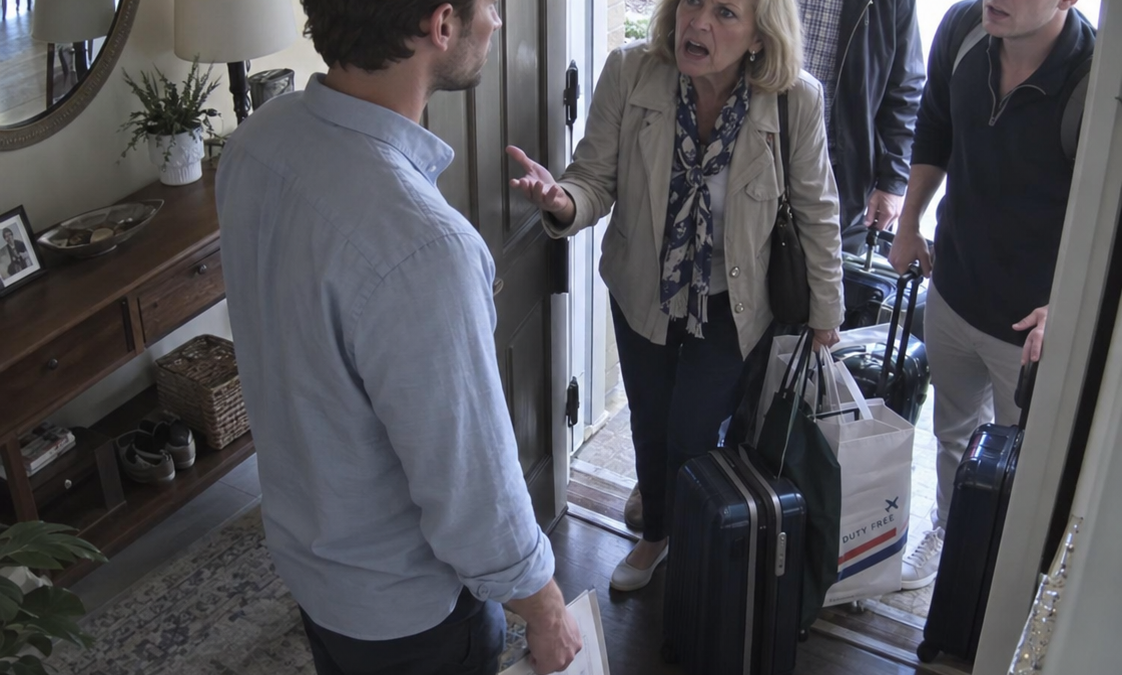
My family climbed out with an absurd quantity of luggage and duty-free shopping bags.
They looked tanned, relaxed, and entirely unaware.
Evelyn tried her code on the new keypad first. She frowned when it failed, then tried William’s code. Finally, with a flicker of something that might have been the first genuine doubt any of them had experienced throughout the trip, she entered Ryan’s old birthday code.
That failed exactly the same way.
I watched her begin pounding on the front door, calling Nathan’s name. She didn’t yet understand that Nathan had been let go two weeks earlier or that the number she was now dialing belonged to a disconnected line.
I walked down the hall myself, wearing a clean, tailored shirt, steady on my own two legs for the first time in longer than I wanted to think about.
Then I opened the door.
My mother’s face did something I had genuinely never seen it do in thirty-five years.
First, she went pale. Then gray. Then her expression settled into the particular blankness of someone whose entire internal script has suddenly run out of pages.
“You can’t just change the locks on your own mother,” she said.
She recovered faster than I expected, reaching automatically for outrage because outrage had always worked for her before.
“This is completely—”
She stopped herself, visibly recalibrated, and tried a softer tone instead, one I recognized from every previous apology that had never actually been an apology.
“David, honey, we were worried sick about you the whole trip. You have no idea how hard it was for me to even enjoy myself knowing you were home resting. We called the house every day.”
I let her get that far before asking her to name a single date when she’d actually called.
I watched her falter.
Of course there wasn’t one.
The phone she’d taken from my nightstand had sat at the bottom of her purse for sixty-eight days without once being used to check on the son she now claimed to have spent the entire trip worrying about.
I held up the deed to the house, which I’d printed and laminated specifically for this moment.
It was a small, petty satisfaction I’m not going to apologize for.
“My name,” I told her. “Only my name. It was only ever my name.”
Then, because I’d spent sixty-eight days waiting to say everything in exactly this order, I began reading her own text messages aloud on the front porch.
I spoke loudly enough for the two neighbors who had already come out onto their lawns to hear every word clearly.
I read the instruction to Nathan, identifying the laundry room specifically because it had no window. I read the order to shut off the water and throw the medication vials into the outside trash.
I laid out the plain, documented shape of what any reasonable court would eventually recognize as a premeditated attempt on my life, supported by a signed, sworn affidavit from the person who had actually carried out her instructions.
Ryan, still apparently operating under the belief that he’d successfully graduated, sneered at me from behind his mother.
“Nice try,” he said. “But I already walked. I have the photos. You can cancel whatever you want. It doesn’t unhappen a ceremony that already happened.”
I told him, as evenly as I could manage, that I’d actually looked into that particular claim before coming down to meet them at the door.
Then I handed him the university’s own letter.
Tuition payment failed. Academic standing suspended. Diploma canceled. Ceremony participation revoked.
Every photograph he’d posted had been taken, according to timestamp data Mason’s team obtained from the university’s event photographer, outside a building Ryan had already technically been barred from entering by the time anyone snapped the picture.
He read the letter twice.
I watched his face move through something between confusion and genuine panic.
Then he lunged at me so quickly that I didn’t fully register the movement until Arthur had already stepped between us and shoved him flat onto the concrete.
Under the circumstances, it was considerably more restrained than I would have managed myself.
“Touch him again,” Arthur said, in the same flat voice he’d use while quoting a roofing estimate, “and I will break both of your arms before the ambulance even gets here.”
Ryan remained on the concrete for a long moment without moving.
When he finally looked up at me again, something in his expression had changed in a way I hadn’t expected.
It wasn’t exactly fear. It was more the dawning realization of someone doing arithmetic he’d avoided his entire life and discovering that he didn’t like any of the numbers coming back.
“This isn’t fair,” he said, much more quietly now.
For one brief moment, I almost felt sorry for him.
I don’t think Ryan had ever genuinely understood himself as someone benefiting unfairly from anything. I think he’d simply absorbed, over four years of watching my mother and stepfather treat my money as an ambient resource rather than a gift from an actual person, the quiet lesson that it had never really belonged to me in the first place.
Not in any way that mattered.
“You’re right,” I told him. “It isn’t fair. None of the last four years were fair to me either, and I spent most of them telling myself that didn’t matter.”
I didn’t wait to see whether that landed.
Truthfully, I don’t know if it ever did.
William, to his credit, didn’t bother attempting outrage.
He tried something closer to negotiation, offering in a hurried, placating voice to pay rent if we could simply discuss everything like reasonable adults. He seemed to believe that an offer of rent he had no actual income to pay was the one thing I’d been waiting sixty-eight days to hear.
“We can work something out, David. You know I’ve always had your best interests at heart.”
I remember the surreal quality of hearing him deliver that sentence with a straight face.
Here was a man who had spent two months in Paris drinking wine and enjoying private tours funded by my money while his own stepson had been left on a concrete floor thousands of miles away. And now he was telling me, apparently without irony, that he’d had my best interests at heart the entire time.
I informed him that the cards had been canceled and reported stolen weeks earlier, that a civil lawsuit seeking medical expenses, damages for endangerment, and compensation for emotional distress was already being filed, and that I had absolutely no intention of discussing anything with him ever again.
Somewhere in the middle of all this, Evelyn’s composure finally broke.
She dissolved into a screaming fit loud enough that she actually kicked one of her own suitcases down the front steps. It burst open, scattering duty-free perfume across the driveway in a spray of broken glass.
“After everything I did for you!” she shrieked, in a voice I almost didn’t recognize as hers. “After I gave you a family! I gave you people to come home to! This is how you repay me?”
The sentence was so completely inverted from the actual sequence of events that I simply stood there for a moment and allowed it to hang in the air between us.
I didn’t bother correcting her.
I finally understood, completely and without reservation, that she wasn’t actually arguing with me anymore.
She was arguing with a version of the previous four years that had never existed anywhere outside her own head.
I watched her with a strange, detached curiosity I hadn’t expected to feel.
Oddly, I found myself thinking about the story she’d told me only once, years earlier, about growing up as the sister nobody mentioned first.
I don’t think the woman screaming on my front steps that afternoon had any conscious access to that memory anymore. But I think its shape was still somewhere inside her, driving the wounded fury of someone who genuinely believed, against every available fact, that she was the person being wronged.
That realization didn’t soften anything I felt while standing there.
It simply made the scene seem less like malice in the comic-book sense and more like the slow, accumulated momentum of thirty years spent protecting herself from a fear so old that she could no longer distinguish between protecting herself and hurting someone else to do it.
Across the street, a neighbor named Caleb Anderson stood on his porch filming the entire confrontation with his phone. He wore an expression of frank, undisguised fascination, the kind of expression you see on someone witnessing a suburban spectacle he knows he’ll be describing to every other neighbor on the block within the hour.
I didn’t ask him to stop.
When I mentioned the recording to Mason afterward, he told me it had turned out to be more useful to our case than almost anything else we’d gathered.
Nothing establishes a pattern of behavior for a judge quite as efficiently as an unbiased third party capturing it in real, unedited time, with no apparent incentive to make either side look better than it actually was.
Caleb eventually provided Mason’s team with a short written statement as well.
Almost sheepishly, he admitted that he’d recognized Evelyn from a neighborhood gathering eight months earlier. During that event, she had mentioned, with what he described as visible pride, that her son David handled all that kind of thing so the rest of the family didn’t have to worry about money.
Placed beside everything that followed, that detail did a considerable amount of quiet work in establishing exactly how long and how comfortably the arrangement had been understood by everyone involved, before anyone decided that my continued survival was no longer a necessary part of it.
A police cruiser arrived not long afterward.
The responding officer was a man named Dylan Harrison, who reviewed the certified deed, Nathan’s affidavit, and the cease-and-desist letter Mason had already prepared and somehow managed to get into the responding officer’s hands before he even reached the property.
Officer Harrison read all three documents methodically while standing in my driveway, with the particular unhurried patience of a man who had learned not to let a screaming woman rush his examination of paperwork that was about to determine a legal outcome.
Then he turned to Evelyn.
“Ma’am, this is a certified deed showing sole ownership in his name and a signed affidavit describing conduct I’d personally classify as attempted homicide if the DA’s office agrees with me, which I expect they will. You have two minutes to be off this property, or I place all three of you under arrest right now.”
Evelyn made one last attempt to argue that this was a family matter and didn’t require police involvement.
Without raising his voice, Officer Harrison told her that family matter had stopped being an applicable description the moment someone shut off a sick man’s water supply and left the state.
Then, almost as an afterthought, he asked whether she understood that the affidavit he was holding had come from the same caretaker she’d instructed to carry out the plan.
She started to answer.
He held up one hand and explained that he wasn’t actually asking for an explanation. He merely wanted to confirm that she understood the document existed before she said anything else on the record that she might regret.
I think it was the single most professionally restrained sentence anyone delivered that entire afternoon.
It did more to quiet my mother than anything I’d said in the twenty minutes before he arrived.
They dragged their luggage to the curb themselves.
William was already muttering something about divorce. Evelyn and Ryan had begun turning on each other in that particularly ugly way people do when there’s finally nobody else left to blame.
William tried one last card, literally.
He had apparently kept a hidden high-limit account secret even from Evelyn, and he attempted to use it to book a downtown hotel room from the back of the car.
It was a small, almost pathetic act of quiet betrayal toward his own wife, one that told me everything I needed to know about how thin the loyalty inside that car had become the moment my money stopped flowing.
He soon discovered that Mason’s team had already found and flagged the account as fraudulent weeks earlier, during routine due diligence once we’d begun examining the family’s finances.
According to what Arthur eventually pieced together, the hotel’s front desk called the police when the card declined twice and William grew loud and insistent at the counter.
That meant his first stop after leaving my property had nearly resulted in a second encounter with law enforcement on the same afternoon.
Arthur relayed that particular detail to me with a wheezing laugh I hadn’t heard from him in years.
The three of them spent their first night back in the country sleeping inside a rented sedan in a Walmart parking lot on the edge of town.
They ran the engine intermittently for air conditioning until the gas gauge apparently convinced them to start rationing it.
According to Arthur, they’d parked close enough to the store’s front doors that a security guard eventually knocked on the window near midnight to ask whether everything was all right.
Evelyn reportedly answered with a brittle version of her airport-lounge smile, an expression that didn’t survive contact with the circumstances she was actually sitting in.
At one point that same night, William tried to use the store’s restroom to wash up, only to be turned away by an overnight stocker who informed him that the restrooms were reserved for paying customers during business hours.
I know these details only because Arthur, who still had a few contacts around town inclined to keep him informed, told me about them the next morning with the particular grim satisfaction of a man watching exactly the ending he’d have written for them himself.
I didn’t celebrate it.
Not exactly.
I remember sitting with the details for a long moment, turning them over in my mind, and feeling something much closer to the quiet satisfaction of an equation finally balancing than any genuine joy.
A month later, I sat beside Mason in a Baton Rouge courtroom, healthy and composed, wearing a suit that fit me the way it had before any of this began.
Across the room, William’s overwhelmed public defender struggled to construct a version of events that could survive contact with the hospital records, the text messages, and the spending audit Mason presented with the same cold precision he’d once brought to dismantling a buyer’s indemnification clause.
The defense’s entire strategy, such as it was, depended on portraying the laundry room as a misguided but ultimately well-intentioned attempt to keep me safe and contained during what they described as an unpredictable medical episode.
That argument began collapsing almost immediately when Mason entered Dr. Bennett’s deposition into the record. The doctor described exactly how close my core temperature had come to the threshold for irreversible organ damage. Whatever protective intention the defense wanted the judge to imagine became considerably harder to believe after that.
Then Nathan took the witness stand.
He spoke in a flat, exhausted voice, confirming line by line that every single decision had come directly and specifically from Evelyn. There was no ambiguity left for anyone to hide behind.
The public defender attempted to suggest during cross-examination that Nathan’s immunity agreement gave him an obvious incentive to shift the blame entirely onto my mother, regardless of what had actually happened.
Mason had clearly anticipated that argument and prepared for it weeks in advance.
Even so, Nathan’s answer surprised me with how plainly he delivered it.
“I’m not shifting anything,” he said. “I did exactly what she told me to do, and I’ll live with that for a long time. But I’m not going to sit here and let anyone say I thought it up myself, because I didn’t. And the texts on my phone don’t either.”
The public defender had very little left to work with after that. The attempt to portray Nathan as an unreliable, self-interested witness effectively ended the moment the judge allowed my mother’s actual text messages to be read into the record in her own typed words.
Ryan sat beside Evelyn through most of the proceeding. During that particular stretch of testimony, he stared fixedly at a point on the defense table.
Watching him from across the room, I realized it was the first time in all the years I’d known him that he looked genuinely, completely out of arguments.
I watched my mother through most of Nathan’s testimony as well.
She never once looked at him while he spoke, not even when he described throwing the medication vials into the outside trash can specifically because she had instructed him to make sure I couldn’t find them, even if I somehow managed to escape the laundry room.
I think some part of her had decided long before that morning that refusing to look directly at the consequences of her choices was the closest thing to innocence she still had available.
Judge Marcus Warren took very little time with his findings.
He was a soft-spoken man in his sixties who had, by Mason’s account, presided over more family dispute cases than almost anyone else on the Baton Rouge bench. He listened to the entire proceeding with an expression that revealed almost nothing until the moment he began speaking.
“I have sat on this bench for nineteen years,” he said. “And I have seen families fight over money, over pride, over old grievances nobody can quite agree on the facts of anymore. This is not that.”
The courtroom was quiet.
“This is a documented, premeditated decision by two adults to deprive a gravely ill man of medication, water, and electricity, specifically so they could travel internationally in comfort, funded in large part by that same man’s own money. I don’t need to speculate about intent here. The defendant’s own text messages tell me everything I need to know about it.”
Then he used the words I have since memorized without ever intending to.
“Calculated malice directed at their own flesh and blood.”
Judge Warren granted a permanent restraining order requiring all three of them to remain five hundred yards away from me and my property. He also allowed the civil lawsuit seeking medical expenses, legal fees, and punitive damages to proceed in full.
The resulting judgment would, within the year, leave all three of them bankrupt, their credit damaged beyond any realistic hope of near-term repair.
The criminal referral Mason had kept in reserve since that first night in the hospital moved forward separately in the weeks following the civil verdict.
The district attorney’s office reviewed the same evidentiary package and determined that there was more than enough to charge Evelyn with felony endangerment of an at-risk adult. Under the specific statute the prosecutor cited, the sentencing range could involve actual years of imprisonment rather than the slap on the wrist I’d spent sixty-eight days refusing to accept.
William faced a lesser charge as an accessory, based on the theory that he had largely followed my mother’s decisions rather than directed them. I understood the distinction, even if I didn’t entirely like it.
Nathan’s immunity agreement held exactly as Mason had promised.
I chose not to attend the criminal sentencing hearing months later.
By then, I had said everything I actually needed to say to my mother in person. I decided I would rather hear the final number from Mason over the telephone than sit in another courtroom watching her face do whatever it was going to do when a judge read the sentence aloud.
One of our final encounters had already given me more than enough of that.
My mother had approached the rail before the bailiff could stop her, offering, in a voice stripped of every trace of the composure she’d walked into court with, to live in my garage, scrub my floors, or do absolutely anything if I would simply reconsider.
“I’m your mother,” she said.
I remember how strange that sentence sounded to me by then.
Not because it wasn’t technically true, but because I’d spent sixty-eight days on the other side of exactly what that word apparently meant to her.
“You don’t just throw away your mother over one mistake.”
I told her, as gently as the setting allowed, that I agreed completely.
You don’t throw away a mother over one mistake.
But the distance between one mistake and a well-documented, deliberately timed decision that left a seriously ill man without water or medication while his family enjoyed sixty-eight days abroad was not a distance either of us should pretend to be confused about.
I told her I wasn’t doing anything to her.
I told her, as evenly as I could manage, that she was simply reaping, in full, exactly what she had spent four years sowing. And I told her that I never wanted to hear from her again for whatever remained of either of our lives.
I meant every word.
As of this writing, I have not had a single reason to take any of it back.
She called the house twice in the following weeks from numbers I didn’t recognize. After the second call, Mason sent a formal letter reminding her and her attorney that the restraining order prohibited telephone contact just as explicitly as it prohibited her from coming within five hundred yards of the property.
I didn’t answer either call.
I want to be honest about that, too.
Some small, old part of me, the same part that used to scan graduation crowds searching for my mother’s face, considered answering for a second each time before I let the phone ring out.
I think that part of me probably never disappears completely, no matter how many years pass or how thoroughly the rest of me moves on.
I’ve made a kind of peace with that leftover part of myself.
It doesn’t get a vote anymore.
It just occasionally shows up to remind me that it used to.
Six months later, the laundry room was gone.
I had it torn out entirely and replaced with a sunlit greenhouse where I grow rare orchids, a hobby I picked up almost by accident during the slowest weeks of my recovery and have since come to genuinely love.
I think the reasons have everything to do with how patient and forgiving the plants are toward a person still relearning how to care for something without immediately suspecting that the care will eventually be punished.
Monica, my physical therapist, laughed the first time she saw the finished room.
She told me it was the single most obvious piece of self-directed healing she’d ever personally witnessed a client arrange for themselves.
I correctly took that as a compliment.
These days, I spend most mornings in the greenhouse before anyone else is awake, checking soil moisture and light levels on plants that ask nothing of me except steady, reliable attention.
That turns out to be exactly the kind of relationship I apparently needed to practice before I began trusting myself around people again.
There’s one particular orchid in the back corner, a stubborn, temperamental variety Monica actually chose for me at a nursery. The woman behind the counter had warned her that it was notoriously difficult to keep alive and that most people gave up on it within the first year.
I’ve kept it alive for eight months now, through a few mistakes and one genuinely close call with overwatering that I managed to catch just in time.
I think part of the reason I bother with a plant that difficult, when I could just as easily fill the room with something considerably more forgiving, is that I wanted at least one thing in the greenhouse that required the precise kind of patient, unglamorous daily effort nobody in my family had ever once been willing to put into keeping me.
It blooms briefly twice a year.
I’ve developed the habit of standing in front of it on those occasions with a cup of coffee, not for any reason I could fully explain to someone else, but as a quiet, private reminder that some things, given the right conditions and someone who actually shows up for them, eventually do come back.
My flare-ups have diminished almost entirely under a medication schedule I now follow with the unwavering discipline of someone who knows exactly what the alternative costs.
I’m walking normally again.
I’m back in the gym four days a week, rebuilding strength I no longer take for granted in the careless way I once did before any of this happened.
I made Arthur the chief project manager of a new real estate development I’m building outside the city. That decision had nothing to do with charity and everything to do with the simple fact that he is, by a considerable margin, the most reliable person I’ve ever known.
He accepted the position on one condition, half joking and half serious, that I never again call him at three in the morning needing a locked door removed.
I’ve happily honored that condition so far.
He still drives out to check on the greenhouse every couple of weeks, ostensibly to inspect the foundation work he insisted on redoing himself before I could grow anything in there at all.
I think by now we both understand that the foundation is simply the excuse.
The visit itself is the point.
Together with Mason, I’m also launching a nonprofit legal fund aimed specifically at helping disabled adults fight the same kind of financial and physical abuse by relatives that very nearly cost me my life.
I learned in the ugliest possible way how little protection exists for people in my position unless they happen to have an uncle with a circular saw and a lawyer willing to drive to the hospital on a Sunday.
In the few weeks since we quietly announced the fund, we’ve already received considerably more calls than either of us expected.
We’ve heard from adult children who have been locked out of their own bank accounts by siblings holding power of attorney. We’ve heard from a man in his sixties whose own son had been slowly selling off his furniture while he was hospitalized.
We’ve heard from a woman who, like me, had simply never known there was a single attorney who specialized in this particular, unglamorous category of betrayal.
And we’ve heard from a retired schoolteacher whose daughter had moved back home, supposedly to help, before quietly beginning to redirect her mother’s pension deposits into an account the schoolteacher had never personally opened.
Mason has started referring to the fund’s growing caseload with the same grim, focused satisfaction he once reserved for his biggest corporate deals.
I think that temperament suits this work considerably better than it ever suited the last.
After a fair amount of back and forth, we named it the Coleman Mercer Fund.
I initially objected because putting my own name on the organization felt uncomfortably close to the kind of self-congratulation I’d spent my whole life trying to avoid.
Arthur settled the argument in about four words, telling me flatly that if I was going to spend real money keeping a door like that from closing on anyone else, I could at least let people know whose family had paid for it.
I didn’t have a good enough counterargument to keep fighting him.
We held a small launch event in the greenhouse itself, of all places.
Monica talked me into that decision over my mild protests that it might feel strange to show people the literal room where the worst sixty-eight days of my life had begun, now filled with orchids instead of hurricane supply bins.
It didn’t feel strange in the end.
If anything, it felt like exactly the right room to have chosen.
Everyone who walked through it that evening understood, without my needing to explain it directly, precisely what kind of reversal they were standing inside.
Tyler Morgan, as it turned out, had his own small reckoning in all of this, though it was never anything I pursued directly.
Once the story made its way through Ryan’s graduate program, and apparently it spread fairly thoroughly in the specific, efficient way these things travel among people who would rather gossip about a scandal than admit they’ve been standing adjacent to it, Tyler found himself quietly dropped from two separate group projects.
His classmates had decided, correctly in my opinion, that a man who mocked a disabled host while standing in that host’s own kitchen wasn’t someone they wanted their names associated with.
I heard about it secondhand months after the trial from someone who still knew people in the program.
I remember feeling considerably less satisfaction than I’d expected.
Some reckonings don’t need to be engineered.
They simply need enough time and enough other people finally paying attention.
Nathan, for what it’s worth, reached out to me once more after the trial concluded.
He sent a short, carefully worded email rather than calling, thanking me for not pursuing anything beyond what Mason had already negotiated. He also told me he’d returned to the assisted living facility where he’d started his career, this time in a position with considerably more oversight than his previous one.
I didn’t answer immediately.
When I finally responded weeks later, I told him only that I hoped he’d learned from everything that happened exactly how much his own voice was worth the next time someone with more authority than conscience asked him to use his hands instead of it.
I don’t know whether he’ll ever get the opportunity to prove that he’s learned the lesson.
I hope, for his own sake, that he does.
I don’t think family is defined by blood, obligation, or the particular legal fact of sharing a last name.
I think it’s defined, simply and completely, by the people who show up and break down a locked door to save you, rather than the people who lock it and get on a plane.
My father understood that long before I did. He’d tried to explain it to me when I was eight years old, sitting at the kitchen table with a ledger open between us. Back then, I’d thought he was teaching me about money. It took me most of my adult life to understand that he was really teaching me about people, about the difference between those who take whatever you offer and those who show up when there’s nothing left for you to give.
I spent years confusing those two kinds of people because I wanted so badly to believe that the family I’d been born into could become the family I’d spent my life hoping for.
It took a locked laundry room, a nearly fatal medical emergency, and sixty-eight days of watching my own money finance a celebration of my absence for me to finally stop making that mistake.
And it took one man with a circular saw to remind me that the people who love you don’t always share your home, your bank accounts, or even your version of what a family is supposed to look like.
Sometimes they’re simply the ones who answer on the second ring and start reaching for their keys before you’ve finished explaining what’s wrong.
If you’re reading this and some part of you already knows exactly which category the people in your own life fall into, I’d ask you the only question that actually matters, the one I had to answer for myself on a concrete floor in the darkness.
Have you ever had to cut off the people who were supposed to love you simply to save your own life?
And if the answer is yes, and you haven’t done it yet, I hope, however this story reaches you, that it’s the thing that finally gets you moving.








