My parents cut me off for years; they demanded i sell my bakery to pay my brother’s $1m debt, i refused, and days later, they broke in and destroyed my life’s work, not knowing i already…
My parents cut me off for years. They demanded I sell my bakery to pay my brother’s $1 million debt. I refused. Days later, they broke in and destroyed my life’s work, not knowing what I had already done.
The sound of shattering glass at two in the morning is a nightmare you never entirely stop hearing, even years later, even in rooms with no windows at all.
I got a frantic, breathless call from the local police department telling me my bakery had been absolutely gutted. My parents had taken heavy sledgehammers to my life’s work because I flatly refused to pay off my golden-child brother’s $1 million debt. They thought they were destroying my business to punish me.
What they didn’t know was that I had already transferred the property deed to a commercial developer three days earlier.
Thank you for watching this video. Before I take you back there, do me one small favor. Take a second to like and subscribe, and tell me in the comments where you’re watching from and what time it is right now where you are. It helps more than you’d think.
My name is Spencer Reed. I’m 36 years old, and I’m a forensic auditor. In my family, I was never really a son. I was a workhorse, an emotional punching bag, and an endless source of funding for the people who shared my blood. I was the one expected to mow the lawn, earn straight A’s, and never once ask for a dime.
Standing in the freezing rain outside my bakery that night, staring at the sheer devastation, I did not shed a single tear. The officer pointed his flashlight at the shattered display cases, at the flour mixing with broken glass across the hardwood floor, and at the venomous words spray-painted across the wall behind the register.
He asked if I had any enemies. I stared at the ruined ovens and said nothing for a long moment, because I already knew exactly who the predators were, and I was still deciding how much of that truth he actually deserved to hear that night.
Later that morning, I sat in a blindingly bright interrogation room at the precinct, watching security footage from the hidden cloud cameras I’d quietly installed eight months earlier. It was a habit left over from my day job, the same instinct that makes an auditor back up everything twice.
On the grainy overhead angle, timestamped 2:07 a.m., I watched my father, Gerald, a 63-year-old retired mechanic, swing a sledgehammer through my custom pastry case with a force that didn’t look like it belonged to a man his age. Glass exploded across the counter I’d wiped down myself twelve hours earlier.
I watched my mother, Patricia, spray thick red paint across the wall behind the register, the letters crooked and furious. TRAITOR, in letters two feet tall, the paint already running before she’d finished the last stroke. She called me a coward in a voice the camera’s microphone caught clearly enough that the detective sitting across from me winced.
The officers in that room were visibly disturbed. One of them, a younger officer who couldn’t have been more than 25, actually paused the footage and asked if I needed a minute.
I told him I didn’t.
They asked why my own parents would commit an act of violence this staggering. I kept my voice level and detached, the same voice I use when walking a nervous client through a bad quarter. I explained that they had demanded I sell my bakery to save my brother and that I had refused.
One of the officers sighed and warned me, not unkindly, about the nightmare of getting insurance to cover damage caused by immediate family. I looked at him and felt something cold and steady settle over my whole body.
I told him insurance wasn’t my problem anymore. I told him my parents hadn’t destroyed my property.
They had just committed a felony against a multimillion-dollar commercial real estate corporation.
To understand the sheer madness of that night, you have to understand the toxic little empire my parents spent thirty years building, one small decision at a time, long before either of them ever picked up a sledgehammer, and the one person it was all built around.
My younger brother, Brennan, was 29 years old and the undisputed prince of our household. Four years younger than me, he had been treated for as long as I could remember as though the ordinary rules governing consequences simply didn’t apply to him.
From the moment he was born, the sun rose and set on whatever he happened to want that week. While I worked after-school shifts to buy my own school clothes, Brennan was handed designer sneakers and praise he’d done absolutely nothing to earn.
He called himself an entrepreneur and a lifestyle influencer online, but in reality, he was an unemployed parasite with a ring light and a rented convertible. His account had around 40,000 followers, mostly bought or bot-driven if you actually looked closely at the engagement numbers.
He posted the same handful of poses in rotation, leaning against a rented sports car he didn’t own, holding a glass of champagne on a hotel balcony that belonged to whoever was paying for the room. Captions about building an empire and how not everyone understood the grind appeared underneath photos of a man who had never once, to my knowledge, worked a forty-hour week in his life.
All of it was funded quietly out of my parents’ shrinking retirement account, dollar by dollar, year after year, without either of them once stopping to add up the total.
My father would scream at me for leaving a single hallway light on to save a few pennies, then turn around and hand Brennan $4,000 for his latest doomed venture without asking a single question about where it would actually go.
I became a forensic auditor because I needed a version of the world where the truth was absolute. I spent my days hunting corporate fraud, finding a strange comfort in spreadsheets and bank ledgers. Numbers don’t lie. They don’t have favorites.
I built a quiet, steady life with my wife, Julia, our daughter, Molly, and the bakery. A little storefront on the edge of downtown Richmond called Hearth & Crumb was the one thing that belonged entirely to me. Funded with my own money, as far from my family’s grasping hands as I could get it, I kept a strict, deliberate distance from all of them.
I met Julia in a night class on financial law that neither of us strictly needed for our majors, but both of us found strangely calming. It was a room full of case studies where every dispute eventually resolved into a clean, provable answer.
She was studying to become a pediatric nurse, steady in a way I hadn’t known people were allowed to be steady. On our third date, after I’d spent twenty minutes describing my family without quite realizing how much I was revealing, she set down her fork and said flatly, “That’s not normal, Spencer. None of what you just described is normal.”
Nobody had ever said that to me out loud before. I think some part of me married her for that sentence alone, though there turned out to be plenty of other reasons that came later.
We got married four years after that class, in a small ceremony my parents attended mostly, I think, to be seen attending it. I remember my father spending most of the reception talking to Julia’s father about the stock market rather than to either of us.
My mother commented within earshot of Julia’s own mother that she hoped I’d finally settle down and stop being so difficult now that I was married. It was a sentence Julia’s mother apparently found so strange that she brought it up to Julia privately weeks later, unable to understand what about her son-in-law had ever struck anyone as difficult.
Brennan gave a toast that night that somehow, over the course of four rambling minutes, mentioned his own upcoming business plans more times than it mentioned either of our actual names.
I remember Julia squeezing my hand under the table the entire time, a small, steady pressure that told me she’d already recognized exactly what kind of family she was marrying into and had decided, characteristically, to love me anyway rather than run.
Julia’s parents, by contrast, hosted a small dinner the week before the wedding just for the two of us. No agenda, no favor being extracted, simply because they wanted to. I hadn’t fully understood until that dinner that a family could sit in a room together for two hours without anyone needing anything from anyone else.
Molly came two years later. She’s seven years old now, missing both front teeth and utterly convinced the tooth fairy personally audits every transaction, which I’ve chosen to take a small amount of professional pride in.
I opened Hearth & Crumb the same year Molly was born, using a modest inheritance from my grandmother that my parents didn’t know existed and absolutely would not have approved of if they had.
The first eighteen months nearly broke me. I was pulling double duty, auditing during the day and standing over proofing dough at four in the morning before opening the counter myself at six, because I couldn’t yet afford to hire anyone I trusted with the ovens.
Julia used to bring Molly by in a stroller some mornings just so I’d see another human face before the lunch rush. There were entire months when the bakery didn’t turn a profit at all, when I covered payroll out of my own savings and told no one because admitting it out loud to my family would have handed them exactly the leverage they eventually found anyway.
By the third year, it had become something real. A reliable little corner storefront with a line out the door on Saturday mornings. A small write-up in the local paper for the laminated pastries nobody else in the city was doing properly.
It became my sanctuary.
Four in the morning. Flour dust catching the light through the front window. The ovens ticking as they warmed. No phone calls from anyone who needed something from me that I hadn’t chosen to give.
My actual routine went the same way almost every single morning, and there’s something in the repetition itself that I think saved me more than once during those years.
I’d unlock the front door at 3:45, turn on exactly two lights, and pull the previous day’s dough from the walk-in, already laminated and resting, cold enough to work without the butter tearing through the layers.
Roll, fold, turn a quarter turn, roll again. The same four motions over and over for the better part of an hour until the dough held ninety-some layers so thin you could nearly read newsprint through them if you held a sheet up to the window.
There’s no room in that process for distraction. You either watch the dough closely enough to catch the exact moment it’s ready to fold again, or you don’t, and the whole batch tells on you later in the oven, when the layers that should have lifted apart cleanly instead fuse into a single, dense, disappointing mass.
I found more than once that the version of my brain capable of tracking a suspicious wire transfer through four shell accounts was the exact same version capable of feeling, through nothing but touch, whether a slab of butter had gone one degree too warm to fold properly.
I’ve never fully explained that connection to anyone who hasn’t stood at a counter with cold hands at four in the morning. I’m not sure it’s explainable. I just know it’s true.
I kept my parents at arm’s length through all of it. A card at Christmas, the occasional obligatory Sunday dinner I could tolerate for ninety minutes at a time. I did not lend money, and when I said no to something, I did not explain myself further than the word itself.
I believed, right up until the week it happened, that a boundary like that could simply hold under its own weight indefinitely, the way a good wall holds without needing to be defended every single day.
I was wrong about that in a way I genuinely did not see coming.
But a predator always comes back around when it’s hungry enough.
Six months before any of this happened, a man named Dale walked into the audit office with a stack of invoices for a company he swore was clean as a whistle. I ran the vendor list against the state registry in under an hour and found four shell companies routing money back into his own personal account, dressed up as consulting fees.
He sat across from me sweating, insisting I’d made a mistake.
I hadn’t. I never do. Not on the numbers.
That’s the part of me my family never bothered to learn. I don’t guess, and I don’t get talked out of what the evidence actually shows me.
It’s the same instinct that makes a good baker. You don’t eyeball the flour and hope for the best. You weigh it every single time.
My specialty at Hearth & Crumb was laminated dough. Croissants. Kouign-amann. The kind of pastry that takes three days of folding butter into flour in thin, honest layers. No shortcuts, because a shortcut always shows up later as a flat, dead spot in the crumb.
I used to tell my apprentices that dough and financial records aren’t so different. Both of them tell you the truth eventually. You just have to be patient enough to keep folding.
Growing up, the inequality in our house was never subtle. My father would count the minutes I spent in the shower to save on the water bill, then buy Brennan a used motorcycle for his sixteenth birthday that we genuinely could not afford.
My mother kept a framed photo of every single one of Brennan’s school plays on the living room mantel. He was in maybe four of them, never with more than two lines, while my own high school diploma sat in a drawer somewhere, never framed, never mentioned.
Whenever I pointed out the difference, even gently, my mother had one phrase she reached for every single time, delivered with the same wounded, patient sigh, like she was explaining gravity to a child who refused to accept it.
“That’s what family does for each other, Spencer.”
She said it when I was twelve and gave up my birthday money so Brennan could have new cleats. She said it when I was seventeen and drove him to three separate job interviews he never showed up for.
She said it so many times over so many years that it stopped sounding like a value and started sounding like a leash.
I remember one specific evening with an unusual amount of clarity, the kind of clarity that only attaches itself to the moments your body decides matter more than the rest.
I was fourteen. I’d spent an entire summer mowing lawns around the neighborhood to save up for a secondhand bicycle. Ninety-one dollars I kept folded inside a sock in my dresser drawer, counted almost nightly.
Brennan, ten at the time, wanted the same bicycle after seeing mine. When my father discovered I hadn’t offered to simply hand mine over, he sat me down at the kitchen table with an expression I still remember perfectly.
“You have two legs and a bus pass,” he said. “Your brother’s still small. Give him the bike.”
“I earned that bike, Dad. All summer.”
“And you’ll earn another one,” he said, like that settled something. “That’s what family does for each other, Spencer. You don’t sit on something good while your brother’s got nothing.”
I gave him the bicycle.
I rode the bus for another year and a half, watching Brennan crash that same bike into a mailbox twice and leave it out in the rain more times than I could count, the paint peeling within a season. I never once got a replacement of my own.
I didn’t bring it up again. I’d already learned by fourteen that bringing it up only ever cost me more than staying quiet did.
There’s a second memory that sits right alongside the first one, from a few years later, that I think tells you everything about my mother specifically.
I was seventeen, applying to colleges, and I’d been accepted early to a solid state school with a partial academic scholarship I’d spent two years of effort earning.
I came home genuinely excited, the acceptance letter still in my hand, and found my mother at the kitchen table, already on the phone with a relative, mid-conversation about Brennan’s middle school basketball tryouts.
“Mom, I got in,” I said, holding out the letter. “The scholarship came through, too.”
She covered the phone with her hand for exactly three seconds.
“That’s wonderful, sweetheart,” she said, already turning back to the call. “Did you hear that, Carol? Brennan made varsity as an eighth grader. Can you believe that?”
I stood there another moment with the letter still extended, then folded it back into my pocket and went up to my room without saying anything further.
I don’t think she ever asked to see it. I don’t think, honestly, she remembers that conversation happened at all.
I remember every second of it twenty years later with a clarity that still occasionally surprises me when it surfaces.
One week before the bakery was destroyed, my phone rang on a quiet Sunday afternoon while Molly was doing a jigsaw puzzle on the kitchen floor and Julia was reading in the next room.
It had been, up to that exact moment, an entirely unremarkable weekend. A farmers market that morning, a batch of dinner rolls proofing on the counter for that evening, the particular contentment of a life that had finally stopped requiring vigilance.
It was my father.
His voice was frantic in a way I had genuinely never heard from him before. Not angry-frantic, which I knew well, but frightened-frantic, which I did not.
He told me Brennan was in terrible trouble. He said Brennan had borrowed a million dollars from a dangerous underground loan shark to fund a streetwear clothing line and that the money was already gone, spent or stolen. He wasn’t sure which.
He said men had been calling the house. He said the mob was threatening to kill him.
My father did not ask for my help. He informed me of it the way you’d inform someone of a fact already in motion.
“You’re going to sell the bakery,” he said. “You’re going to liquidate whatever else you’ve got saved up, and you’re going to wire it to your brother by Friday.”
“Dad, slow down. Who exactly is threatening him? Have you called the police?”
“You don’t call the police on people like this, Spencer. They said if anyone goes to the cops, they’ll know. They said they’ll make an example of him.”
His voice cracked on the word example, and for one brief second, I actually believed him before the rest of it caught up with me.
“He showed me the messages. It’s real. It’s one hundred percent real. And you’re the only one in this family who has that kind of money sitting around.”
“I don’t have a million dollars sitting around, Dad. Nobody does. That’s not how money works.”
“Then you find a way. You sell that bakery. You take out a loan against the house. I don’t care how. Your brother’s life is worth more than a building full of pastries.”
I sat at my own kitchen table and felt something in my chest go very cold and very still. The sheer size of the demand took a moment to actually land.
He wanted me to burn down my own future and my daughter’s future to bail out a 29-year-old con with a ring light and a rented convertible over a debt that had apparently been assembled and delivered to my family with less than a week’s notice and zero verification from anyone but Brennan himself.
“I’m not setting my life on fire to keep Brennan warm,” I said.
My mother grabbed the phone. She was sobbing, already deploying the full arsenal. Heartless, cruel, a coward, practically pulling the trigger myself if anything happened to him.
I let her finish. Then I said the only thing I had left to say.
“That’s what family does for each other, right, Mom? Funny how it only ever runs one direction in this house.”
I hung up. I blocked both their numbers before I’d even set the phone down.
Julia came into the kitchen and found me sitting very still. I told her what had happened, and she put her hand flat on my back and didn’t say a word because there wasn’t really a word that fit.
I thought the boundary would hold this time.
I was completely wrong.
That night, after Molly was finally asleep, Julia and I sat at the kitchen table with the lights low, going over what had just happened the way you’d go over a diagnosis you weren’t ready for.
She asked me carefully if there was any part of me that wanted to just pay it, just to make it stop.
“No,” I told her, and I meant it, though saying it out loud still cost me something. “But I keep thinking about what happens if they don’t stop asking.”
“Then we make sure we’re ready if they don’t,” she said.
The next morning, I called the same security company that had installed the bakery’s original cloud cameras eight months earlier and asked them to add two more units along the alley behind the building. The kind that upload footage automatically the second they’re triggered, the kind no one can smash their way out of erasing.
I told the technician it was for shoplifting. That wasn’t entirely a lie.
I genuinely didn’t know yet what I was actually protecting the place from. I just knew, somewhere underneath the numbers, that the version of my father who’d screamed at me down a phone line an hour earlier was not a version I trusted to simply lose interest and move on.
Two nights later, the real nightmare began.
We were at the dinner table. Molly was laughing about something that had happened at recess, halfway through a plate of pasta, when a thunderous pounding shook the front door hard enough to rattle the picture frames in the hallway.
Julia jumped up. I got to the entryway first.
It was my parents.
They were screaming on my porch, slamming their fists against the wood, completely unhinged in a way I had never once seen from either of them in thirty-six years.
Through the narrow window beside the door, I could see my mother’s face stretched with something between rage and desperation, her hair coming loose from its clip. Behind her, my father paced in tight, furious circles on the welcome mat like a man who’d forgotten which direction the door actually opened.
Molly started crying behind me, a high, frightened sound I’d only ever heard from her once before, during a thunderstorm that knocked the power out when she was four.
Julia scooped her up and carried her toward the back of the house, murmuring something low and steady into her hair.
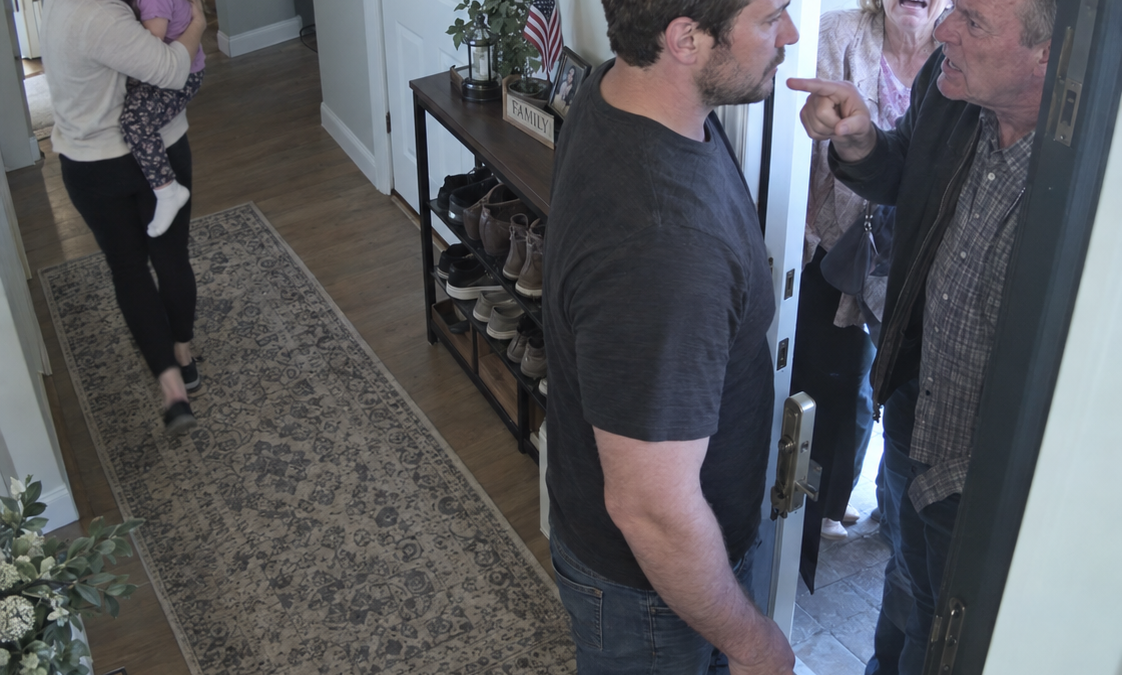
I opened the door a few inches, blocking the gap with my own body.
My father’s face was purple. He pointed a shaking finger an inch from my nose.
“You’re dead to us,” he said. “You hear me? If you don’t sell that bakery to save your brother, I will make sure it’s ruined. I will make your life hell, Spencer. I swear to God.”
I looked past him at my mother, who was crying the way she always cried when she wanted an audience rather than comfort, and I said nothing at all.
I closed the door. I locked the deadbolt.
I stood there with my back against the wood, listening to my daughter sob into her mother’s shoulder in the next room, and I felt the last thread connecting me to my parents finally, completely snap.
I found Molly curled against Julia on the couch, still hiccuping from crying, her small hands fisted in her mother’s shirt. When she saw me, she reached for me instead. I picked her up the way I hadn’t in probably a year, since she’d started insisting she was too big for it, and she pressed her face into my neck.
“Are Grandma and Grandpa mad at us?” she asked, her voice muffled.
I sat down with her still in my arms and thought carefully about how to answer a seven-year-old honestly, without handing her more weight than she could carry.
“They’re upset about something that isn’t your fault at all,” I told her. “Sometimes grown-ups get so upset about something that they act scary even when they shouldn’t. That doesn’t mean you did anything wrong.”
“Are they going to come back?”
“Not tonight. And if they do, the door stays locked, and Daddy’s going to make sure of it.”
I felt her nod against my shoulder, some of the tension going out of her small body.
“You did exactly the right thing tonight,” I added. “You stayed with Mommy. That’s exactly what I needed you to do.”
She fell asleep in my arms within twenty minutes, worn out the way only a frightened child can be, her breathing finally evening out against my shoulder.
I sat there a long time after Julia had gone to check the locks a second time, thinking about the fact that my own parents had never once in thirty-six years asked whether frightening me was something they should feel bad about.
I decided, sitting there with my daughter’s weight against my chest, that whatever came next, it was never going to touch her the way it had touched me.
They weren’t just toxic anymore. They were a threat sitting in my own driveway.
I considered briefly simply calling the police that same night and reporting the threat itself, before anything physical happened. I decided against it almost as quickly as I’d thought of it.
A threat made on a porch with no follow-through yet tends to get logged and forgotten, especially between family members, especially when the people making it are two sixty-something homeowners with no record of violence.
I’d have a piece of paper and nothing else, and my parents would simply wait a few weeks and try again through some other door.
I needed something that ended the threat permanently, not something that delayed it.
The lot itself was the only leverage they actually had over me. Once it belonged to someone else, the leverage belonged to someone else, too.
That same night, once Molly was finally asleep and the house had gone quiet enough that I could think clearly again, I called a commercial developer who had been trying to buy my bakery’s corner lot for the better part of a year.
A company called Kestrel Commercial Holdings. Midsize, aggressive, exactly the kind of buyer who doesn’t ask a lot of questions if the price is right and the paperwork is clean.
Their acquisitions manager, a brisk woman named Renata who’d left three separate voicemails over the previous spring that I’d never once returned, picked up on the second ring and didn’t bother hiding her surprise.
I told her I’d take a lower cash offer if we could close and sign the deed transfer immediately under a strict condition of confidentiality. No public filing announcement, no press release, nothing that would tip off anyone watching the property records before the ink was fully dry.
She didn’t ask why. People like Renata rarely do when the number works in their favor.
Their lawyer had documents drawn up by nine the next morning. I signed at eleven in a glass conference room that smelled like fresh carpet, Renata sliding the pen across the table without a single wasted word.
Three hundred forty thousand dollars, well under what the lot was actually worth, wired directly into an account my parents didn’t know existed.
I’ve been asked since, mostly by Julia in the early days, whether I regretted taking less than the property could have fetched with a normal sale process and a few more weeks of negotiating.
I never once did. Not for a single day. Not even in the weeks afterward, when the exact figure would occasionally surface in some unrelated conversation about real estate and make me do the math again out of habit.
Every dollar of that discount bought speed, and speed was the only currency that actually mattered that week.
A slower sale done properly through a realtor with a sign in the yard would have tipped my parents off within days, and none of what followed would have been possible.
Sometimes the correct price for something isn’t the highest number you could get for it. It’s the number that closes before anyone who shouldn’t know yet finds out.
Renata sent flowers to the new bakery the week it reopened, along with a short card that just read, “Glad it worked out the way it needed to.”
I never found out exactly how much of the full story reached her, probably enough given how thoroughly the case ended up in the local paper. But I appreciated that she never once tried to ask me for details directly, professionally or otherwise.
Some people understand instinctively that a closed deal is allowed to stay closed.
I walked out of that office feeling something I hadn’t expected to feel. Not triumph, just a very quiet, very total kind of relief. The kind you feel when you finally set down something that’s been cutting into your hands for years.
The call came at 2:14 in the morning, three days after that night on the porch.
I remember the exact number glowing on my nightstand because I stared at it for a full second before my brain caught up to what a police department calling at that hour actually meant.
Julia sat up beside me, already reaching for the lamp. The officer on the line was calm in the practiced way of someone who makes this exact call several times a week, and none of that calm made the words land any softer.
“Break-in. Extensive damage. You’ll want to come down.”
I drove there in eleven minutes, running two lights I would never normally run. Julia sat beside me in her coat over pajamas, both of us silent because there wasn’t yet anything useful to say.
I could see the flashing lights two blocks out, red and blue washing across wet pavement. When I finally pulled up and got out of the car, the first thing that hit me wasn’t the broken glass.
It was the smell. Flour and rain and something acidic underneath it that I’d later learn was the spray paint, still slightly wet.
I stood on the sidewalk in the freezing rain, staring through my own shattered front window at the wreckage of three years of my life. I felt Julia’s hand find mine, and I did not shed a single tear.
The owner of the dry cleaner two doors down, a woman named Grace who’d been renting that storefront even longer than I’d had mine, stood wrapped in a bathrobe on her own front step, watching the whole scene with her arms crossed tight against the cold.
She caught my eye and came over, careful of the broken glass scattered across the sidewalk.
“I heard it,” she said quietly. “Woke me straight up. I looked out and saw an older couple, just the two of them. No masks, no hurry at all. Like they thought they had every right in the world to be doing what they were doing.”
She shook her head.
“I almost didn’t believe it when the police told me. People who look like that don’t usually look like the ones doing the damage.”
“They’re my parents,” I told her.
She didn’t say anything else for a long moment. She just reached out and squeezed my arm once before going back inside out of the rain.
Somewhere underneath the shock, a small, cold, professional part of my brain was already running the numbers.
The lot had been out of my name for three days.
Whatever this was, it wasn’t going to cost me the way they thought it would.
My parents broke into what they still believed was my bakery and smashed it to dust without knowing they were no longer aiming at me at all.
Detective work moves faster than most people expect when the evidence is this uncontested.
A young detective named Marshall Hollis, the same man who would later run the sting at Aunt Phyllis’s house, though I didn’t know that yet, pulled the cloud footage off my account by seven that morning and had it matched to my parents’ faces before their coffee had even finished brewing.
He came by the ruined bakery himself around nine to walk the scene with me, notebook in hand, asking careful, methodical questions that reminded me uncomfortably of my own job.
At one point, one of the older officers pulled me aside and mentioned gently that most insurance carriers exclude damage caused by immediate family members from standard commercial policies, and that I should brace myself for a difficult conversation with my provider.
I thanked him for the warning. I didn’t tell him yet that the conversation he was picturing wasn’t the one I’d actually be having, because the policy on that building had already transferred three days earlier to a corporation that carried its own considerably less forgiving legal team.
My insurance company, when I finally did call them out of pure formality that afternoon, spent four minutes confirming I no longer held the policy at all since I no longer owned the property.
It was, without question, the shortest and least stressful phone call I made that entire week.
“Any reason they’d target this place specifically?” Marshall asked. “Instead of your house?”
“They wanted to punish the thing I loved most that wasn’t my family,” I said. “It worked for about three days. Then it stopped.”
He looked at me for a moment like he was deciding how much of that sentence he actually understood.
“You’re taking this remarkably calmly, Mr. Reed.”
“I’ve had practice staying calm around numbers that don’t add up,” I told him. “This one adds up fine. It just doesn’t add up the way my parents think it does.”
Once Marshall left, I walked through the space alone for the first time in full daylight. The destruction looked worse without the flashing police lights giving it a strange kind of theater.
The pastry case my father had gone through first, glass in a wide spray across the floor, mixed with flour from an overturned bin that had apparently been kicked open sometime after the case itself.
The custom oven I’d saved eight months for had a dent the size of a fist in its front panel. Cosmetic only, thankfully, though it took me a full minute of standing there to confirm that with my own hands rather than trust my eyes.
The words on the wall up close were worse than they’d looked on the grainy security footage.
TRAITOR, in red, and beneath it, smaller, almost an afterthought:
YOU CHOSE THEM OVER US.
I stood in front of that second line for a long time because, as far as I could tell, them meant Julia and Molly.
There was something about seeing my own wife and daughter reduced to an accusation spray-painted on a wall by my own mother’s hand that hit me harder than any of the broken glass had.
I gave a full statement that morning and another the following week once the civil suit from Kestrel’s legal team was formally underway.
I didn’t call my parents. I didn’t need to.
Some part of me still finds that fact worth sitting with, that in the single worst hour of my adult life, calling the people who caused it never once crossed my mind as an option worth considering.
Julia’s mother, on the other hand, showed up at our house the same afternoon with a casserole and an offer to take Molly for a few days so Julia and I could handle the practical mess of insurance calls and police statements without a seven-year-old underfoot.
She didn’t ask a single question about why my own parents were the ones responsible. She just hugged me at the door and said, “You call if you need anything else, sweetheart.”
The exact plain kindness I’ve been quietly starving for my entire life without ever having a name for it until Julia’s family gave it to me for free.
Owen texted me that afternoon. Word travels fast in a small professional community. He said simply, “Whatever you need, Spencer, take the week.”
I took two days. On the third, I was back at my desk because staring at my own kitchen ceiling wasn’t accomplishing anything the numbers couldn’t.
The consequences of that night were swift and frankly brutal.
Police arrested Gerald and Patricia Reed at their own home before the sun came up, the security footage handed over within the hour.
Because the property now legally belonged to Kestrel Commercial Holdings, a corporation with a legal department the size of a small law firm, their attorneys descended on my parents like they’d been waiting for exactly this.
In civil court, my parents were crushed.
One hundred twelve thousand dollars in restitution for the physical damage and lost development time, plus almost forty thousand more in Kestrel’s own legal fees, which the judge ordered my parents to cover in full given the clear intent behind the break-in.
Legal fees stacked on legal fees against two people whose entire net worth, once the dust settled, came to roughly a third of what they now owed.
To avoid actual prison time, they had to sell their house within sixty days and liquidate almost everything they had left.
I heard through my mother’s older sister, secondhand, that they’d packed what remained of their belongings into a handful of garbage bags and moved into a cramped, aging trailer on the edge of town, the kind of place with a single window unit fighting a losing battle against the Virginia summer.
She told me my father had cried loading the last box into the truck. Not over the house, she said, but over a workbench in the garage he’d built with his own hands thirty years earlier and had to leave behind because there was nowhere left to put it.
I didn’t go help them move.
I want to be honest about that because it would be easy to tell you I felt nothing at all, and that wouldn’t be true.
I felt something uncomfortably close to grief, sitting in my own kitchen that weekend, knowing exactly where that grief was and choosing not to act on it.
I had a daughter of my own who’d been sobbing into her mother’s shoulder nine days earlier because of the people I was grieving for.
The two feelings sat right next to each other, and neither one canceled the other out.
I did drive past the trailer park once, about two weeks after they’d moved in, on my way back from a client meeting that had run late.
I told myself it was on the way. It wasn’t. Not really.
I slowed down at the entrance long enough to see the row of aging single-wides lined up under a stand of pines. Laundry strung between two of them. A window unit hanging half out of a frame two lots down from the one I guessed, from Aunt Phyllis’s description, belonged to my parents.
I didn’t pull in.
I sat at the stop sign a moment longer than the intersection required, feeling something complicated and unfinished settle in my chest. Then I drove home to my own family because that was still, even then, the only direction that made any actual sense to drive.
I watched their empire collapse from a careful distance, and for a while, I let myself believe the scales had finally balanced.
I thought the nightmare was over.
During that month, I heard almost nothing about Brennan at all, which I now understand should have struck me as strange in its own right.
My mother mentioned once in a voicemail I let go to message rather than answering that Brennan had moved somewhere safer, just until things calmed down. Her voice was hushed like she was still protecting an active secret.
I assumed, without really examining the assumption, that he was staying with a friend somewhere, lying low the way you would if actual dangerous people were actually looking for you.
It never once occurred to me to check because by that point I’d already decided I was done spending any part of myself on him.
One month later, I found out it had barely even started.
I was sitting in my office when my boss, Owen Price, knocked on my door.
Owen is a veteran auditor with almost thirty years in the field and an eye for detail that borders on unnerving. The kind of man who can glance at a spreadsheet across a room and tell you the tab is off by forty cents.
He’d hired me straight out of graduate school back when I was a nervous 24-year-old who overprepared for every meeting out of sheer terror of being wrong in front of someone.
He’d told me once early on that the reason he kept me around wasn’t my speed. It was that I never once tried to talk him into a conclusion the numbers didn’t actually support, even when it would have been easier for both of us.
He’d been at my wedding. He was the second person I called after Julia the morning the bakery was destroyed.
He looked genuinely uncomfortable, which was rare enough on its own to make me put my pen down.
He told me he’d spent the weekend at Ashford Hills Country Club, a golf course on the west side of town that costs more a year than most people’s cars, celebrating his own wife’s birthday at the clubhouse restaurant.
He said he’d seen my brother there. Not hiding. Not terrified.
Wearing a designer jacket, sitting at a reserved table, popping bottles of champagne with three other guys who looked exactly like him.
“I almost didn’t say anything,” Owen admitted, rubbing the back of his neck. “Figured it wasn’t my business. But then I remembered what you told me about the mob thing. And Spencer, nobody hiding from people who want to kill them rents a table with a placard on it that says ‘Reserved Reed Party.'”
“You’re sure it was him?”
“I’ve met your brother twice at the holiday party, Spencer. It was him.”
I stared at Owen for a long moment, feeling the temperature of the room drop a few degrees.
A man being hunted by loan sharks does not rent a VIP table to celebrate anything in public under his own name.
I closed my office door after Owen left and sat there for a long time without doing any actual work, staring at a spreadsheet I could no longer make sense of.
My first instinct, embarrassingly, was to doubt myself rather than Brennan. To wonder if I’d somehow misjudged the whole situation, if maybe there was an explanation, a coincidence, some version of events where my brother wasn’t simply lying to an entire family that had already sacrificed everything for him.
I sat with that instinct long enough to recognize it for what it actually was.
It was the same old reflex, thirty years deep, that had taught me to doubt my own read on things whenever it conflicted with the story my family had already agreed to believe.
I made myself set that reflex down deliberately, the way you’d set down a tool that had stopped being useful.
I already knew the rough financial math of my parents’ ruin.
My aunt had told me quietly over the phone that after the house sale and the legal fees, they’d had exactly $20,000 left to their name, and that they had wired every single cent of it to Brennan, believing it was the last piece of a ransom that would finally make the mob leave him alone.
They were currently living on canned soup in a trailer with a broken air conditioner, completely convinced they had heroically saved their son’s life.
Something in my head clicked into a colder, more familiar gear. The gear I use at work.
There was no mob. There was no loan shark. There never had been.
It was a staggering, deliberate lie.
Brennan had used it to manipulate our parents into a violent frenzy, watch them lose their home, and walk away with $20,000 to fund exactly the kind of lifestyle he’d been faking online for years.
I didn’t say anything to Julia that night until after Molly was asleep.
When I finally told her, sitting at the same kitchen table where all of this had started, she was quiet for a long moment, turning her water glass in a slow circle, the way I’d later notice my own father doing with his coffee cup, an unconscious family gesture that apparently skipped bloodlines entirely.
“So none of it was real,” she said finally. “Not the debt, not the danger, any of it.”
“None of it.”
“And your parents lost their house for nothing.”
“They lost their house for a lie their own son built specifically to be believed by them and nobody else,” I said. “That’s not nothing. That’s the whole design.”
She reached across the table and took my hand, and neither of us said anything else for a while.
I remember thinking, sitting there, that grief and rage can occupy the exact same square foot of a person at the same time, and that I hadn’t yet decided which one was going to end up running the next several months of my life.
As it turned out, neither one did.
Something colder and more patient took over instead, and I was grateful for it because rage makes mistakes and grief makes you stop too soon.
I needed to do neither.
I opened a new encrypted folder on my laptop that night and named it Operation Ledger.
I was going to take his entire facade apart down to the studs the same way I’d take apart a fraudulent invoice: patiently, methodically, with paper that couldn’t be argued with.
The next afternoon, I drove to a convenience store two towns over and bought a cheap prepaid phone with cash.
I sat in my car in the parking lot for almost ten minutes before I actually dialed, running through exactly what I needed to say and how I needed to sound.
“Mom, it’s me.”
There was a long pause on the line, long enough that I wondered if she’d hang up.
“Spencer? Why are you calling from this number?”
“I lost my phone. Mom, I haven’t slept in days. I keep thinking about what I said to Dad, and I…”
I let my voice catch deliberately, the way I’d practiced twice in the mirror before I left the house.
“I think I made a horrible mistake. I want to help Brennan. I just need to see it myself first. The messages, whatever they sent him. I need to know exactly what we’re dealing with before I start liquidating my retirement accounts.”
She wept with something close to joy. She told me she always knew I’d come around, that I was finally acting like a real son, that this was exactly the kind of family loyalty Brennan needed right now.
She had no idea she was handing me the exact weapon I needed.
Within five minutes, screenshots landed on the burner phone.
I forwarded them to my own laptop immediately and sat down to look at them properly.
The actual text messages were almost laughably bad. Movie-villain phrasing, misspelled threats, the kind of dialogue nobody who’d actually spent time around organized crime would ever write.
Lines like, “You have until Friday or things get ugly for your family,” and “We know where your parents live,” phrased with the clumsy self-importance of someone who’d learned everything they knew about intimidation from late-night cable.
I didn’t care about the words. I cared about the metadata sitting underneath them.
Using tracing software I’d used a dozen times for actual fraud cases, I pulled the routing information buried under the messaging app.
It took me two full days of digging through data brokers and old network logs before an actual location resolved on my screen.
I did most of that digging after Molly went to bed, sitting at my kitchen table with three monitors’ worth of case notes from work, repurposed for a case that had nothing to do with work at all.
The first day yielded almost nothing. A dead-end proxy server registered to an anonymization service that dozens of legitimate businesses use for entirely mundane reasons.
I nearly gave up on the digital trail twice and considered simply confronting Brennan directly, before remembering both times exactly how well he’d learned to lie to a room full of people who loved him.
Direct confrontation would only ever get me another performance. I needed something that couldn’t perform back.
On the second night, cross-referencing a secondary routing log against a data broker’s archive records from eleven months earlier, an actual residential IP address finally surfaced, tied to an account that had been active at the same address for over a year.
The IP address didn’t belong to some underground crime syndicate.
It belonged to a cheap apartment complex fifteen minutes outside the city.
I pulled the lease records. The unit belonged to a man named Colton Pike, 28, no criminal record, no employer listed on file for the past sixteen months.
I ran his name through the same public databases I use for legitimate fraud cases and found exactly what I expected to find.
A man living well beyond any visible income, three overdue utility notices, a car registered to an address that no longer existed.
He wasn’t a hired professional. He was broke and bored and apparently willing to do almost anything for cash, which made him either the perfect accomplice or the weakest link in the whole operation, depending on how hard someone eventually leaned on him.
I scrolled back through Brennan’s social media until I found a three-year-old photo of the two of them at a bar, arms slung over each other’s shoulders.
The caption said something about “my brother from another mother, best unemployed actor in Richmond.”
I found four more photos after that, spanning almost five years. Birthdays, a fishing trip, a blurry New Year’s countdown. Enough to confirm this wasn’t some anonymous hire off a classified page.
This was a friendship weaponized.
Colton had a public post on an amateur acting forum from around the same time, asking almost proudly whether anyone knew good software for modulating your voice to sound like an old, scary crime boss for a role.
Three commenters had recommended the same free program.
I downloaded it myself that night just to understand exactly how convincing it could sound coming through a cheap phone speaker to two frightened people who badly wanted to believe it.
It was convincing.
That was the worst part.
I learned the full story of how Colton got roped into it only after the arrest, when Marshall shared what came out during the plea negotiations.
Brennan hadn’t approached him with the whole scheme laid out from the start.
He’d started small, months earlier, asking Colton to pretend to be a landlord on a reference call for an apartment application. Then a former employer verifying a fake job for a different lease.
Each favor was framed as harmless, a little theater between old friends. Twenty dollars here, fifty there.
By the time Brennan asked him to play a debt collector with an accent, the escalation had been so gradual that Colton told detectives he genuinely didn’t remember the exact moment it stopped feeling like a joke between friends and started feeling like something he couldn’t easily back out of.
That’s not an excuse.
I want to be clear about that again because it would be easy to read this as me feeling sorry for him. I don’t. Not really.
But I understand now that predators rarely announce themselves at the start. They build the trap one small, deniable favor at a time, the same way Brennan built our parents’ trust, one small demand at a time for thirty years before ever asking for something as enormous as a house.
Brennan had hired his own drinking buddy to play a Mafia enforcer, and our parents had believed every word of it.
But a story like that needed a paper trail, not just a hunch, if it was ever going to actually matter.
I pulled public commercial records. I leveraged the databases I have legitimate professional access to for exactly this kind of financial forensic work, and I ran a full background check against Brennan’s own Social Security number.
The truth was almost pathetic in how small it actually was.
He didn’t owe a million to anyone dangerous.
He owed $83,000.
Four maxed-out credit cards totaling $31,000, a defaulted personal loan from an online lender at nearly 22 percent interest, and just over $29,000 in federal tax penalties going back three years.
The kind of debt that drowns a person slowly rather than dramatically.
He wasn’t dodging killers. He was dodging collection calls.
The same three numbers had been showing up in his call log almost daily for the better part of a year. All of them ignored.
The streetwear clothing line my father had mentioned on that first frantic phone call turned out to be exactly as real as the mob debt attached to it.
I found the brand’s name easily enough on Brennan’s own social feed. A logo he’d apparently paid a freelancer eighty dollars to design. A single product mockup of a hooded sweatshirt that had never actually gone into production.
And a business registration filed with the state that had lapsed after nonpayment within four months of being opened.
There was no factory order, no inventory, no supplier invoices of any kind.
It existed exclusively as a handful of Instagram posts and the sentence he’d apparently repeated to our parents enough times that they’d stopped questioning whether it was real at all.
I traced the $20,000 our parents had wired him across four separate transfers over eleven days.
Twelve thousand had gone straight into a security deposit and first month’s rent on a luxury high-rise apartment downtown, secured with a set of falsified pay stubs that listed an employer, a marketing firm called Vantage Creative, which, according to the state business registry, had dissolved two years earlier and no longer existed in any form.
Five thousand had gone to Ashford Hills, the same club where Owen had spotted him. A birthday weekend with bottles of champagne billed at ninety dollars each and a private cabana rental on top of it.
The remaining three thousand had simply evaporated across a string of restaurant charges and online purchases, the way money always does around people who’ve never once had to account for where it goes.
Going further back through his transaction history, I found two more incidents I hadn’t been looking for.
A $2,200 transfer from our great-uncle Bernard three years earlier, around the time of a supposed medical emergency that our great-uncle, now 81 and living in an assisted care facility, likely no longer fully remembered clearly enough to confirm either way.
And a smaller amount, just under $900, from a family friend named Ruth, who’d apparently once loaned Brennan money for a security deposit on an apartment he never actually moved into.
Neither amount was large enough on its own to have raised alarm at the time.
Stacked together with everything else, they told a much clearer story: Brennan hadn’t invented this particular con for our parents specifically.
He’d been quietly running smaller versions of it against anyone in the extended family soft enough to say yes for years, and simply escalated the scale once our parents proved willing to lose an entire house over it.
I sat in my dark office that night, printing every receipt, every network trace, every lien, every falsified document, organizing all of it into a heavy black binder, tabbed by date the way I tab every case file at work.
Because a story only holds together if you can find any single piece of it in under ten seconds, no matter how large the file eventually grows.
It was, in its own quiet way, a work of art.
I remember sitting back from the desk once it was finally finished, somewhere past midnight, and feeling an odd kind of stillness settle over me instead of the triumph I’d half expected.
A completed audit usually feels like closing a door.
This one felt more like opening one.
The binder wasn’t an ending at all, just the first solid piece of ground I’d stood on since that phone call from my father a month and a half earlier.
I still didn’t know exactly what I was going to do with it.
I just knew, looking at that stack of paper, that I finally could do something, which, after weeks of feeling like the ground kept shifting under every decision, was its own significant kind of relief.
I want to tell you about something I found in the middle of that dig because it matters for what comes later, even though I never once used it the way I could have.
I also want to be honest about what those weeks actually cost me, because it would be easy to make this sound like a clean, satisfying process, and it wasn’t.
I lost weight I didn’t have to lose. Julia mentioned twice, gently, that I’d started grinding my teeth in my sleep again, something I hadn’t done since my first year of graduate school.
I missed one of Molly’s school assemblies because I was three hours into a data broker archive that finally, at hour four, gave up nothing useful at all.
I found out about it when Julia texted me a photo of Molly onstage in her little paper crown, part of some second-grade pageant about the water cycle, and I realized with a sick drop in my stomach that I’d completely forgotten it was that afternoon.
I left work early and picked her up from Julia’s mother’s house that evening.
She climbed into my car, quieter than usual.
“You said you were coming,” she said, not looking at me, working at a loose thread on her backpack strap.
“I know, sweetheart. I made a mistake. I got busy with something important, and I lost track of the day, and that’s not okay, and I’m sorry.”
“What was so important?”
I thought carefully about how much to tell a seven-year-old.
“I’ve been trying to figure out something that isn’t fair so I can fix it,” I said. “But that’s never a good enough reason to miss something of yours. You matter more than any of it. I should have written it down.”
She considered this with the total seriousness only children bring to adult apologies.
“Okay,” she said finally. “But next time, write it down.”
I bought a physical calendar the next morning and hung it in the kitchen.
I have not missed a single one of her school events since, a promise that has cost me on at least three occasions walking out of important meetings I otherwise would have stayed in.
I sat in the bakery’s walk-in cooler one morning before opening, just to be somewhere cold and quiet and silent for ten minutes, and realized I’d been standing there long enough that my hands had gone numb.
The strange mercy of running a bakery through all of it was that the dough didn’t care what else was happening in my life.
It still needed folding at four in the morning, whether I’d slept two hours or eight, whether I’d spent the previous night tracing shell accounts or simply sleeping like anyone else.
Some mornings that routine felt like the only solid surface left standing in my entire life, and I leaned on it harder than I think I let myself admit to Julia at the time.
None of it made me reconsider what I was doing.
But I don’t want you to think this was easy, or that righteous anger simply carries a person through weeks like that without a cost attached.
It doesn’t.
It just makes the cost feel worth paying, which is a different thing entirely and a distinction I don’t think I fully understood until I was already on the other side of it.
While I was tracing Brennan’s financial history further back, cross-referencing old bank transfers to build a fuller timeline, I found a wire transfer from five years earlier.
Eight thousand dollars moved from my father’s personal retirement account directly to Brennan on a date that matched almost exactly another one of Brennan’s smaller forgotten emergencies.
A supposed car accident, a supposed lawsuit, details that had never made it to the rest of the family.
My mother’s name wasn’t on the transfer at all. My father had done it alone, quietly, and as far as I could tell from the records, never told her.
He’d been drained before. Quietly, privately, ashamed enough to hide it from his own wife for five years.
I sat with that a long time, turning it over the same careful way I turn over a suspicious line item before deciding whether it belongs in a final report.
It would have been easy to use.
One more nail, one more proof of the rot, one more way to make my father feel exactly as small as he’d made me feel my entire life.
I filed it away instead in a folder I never opened again after that night.
Some things you find out about a person that you simply don’t have to spend.
I told Julia most of it that same week, sitting on the back porch after Molly was asleep, the black binder opened between us on the patio table like something we were studying rather than something that would eventually end a man’s freedom.
She read through the credit report twice quietly and then asked me the question I’d been avoiding asking myself.
“Does finding all this make you feel better?”
I thought about it longer than I expected to.
“No,” I said finally. “It makes me feel accurate. That’s not the same thing.”
“Are you doing this for them?” She meant our parents. “Or for you?”
“Honestly, neither at this point. I think I’m doing it so he can’t do it to anyone else.”
I looked at her.
“Is that a good enough reason?”
She reached over and closed the binder gently, the way you’d close a book someone had fallen asleep reading.
“It’s the only reason that’s ever going to hold up once this is over,” she said. “The other ones don’t last.”
I’ve thought about that sentence more times since than almost anything else she’s ever said to me.
I kept watching Brennan’s digital footprint over the following weeks, and I noticed something that made my stomach drop harder than anything else so far.
He was already broke again.
Our parents had nothing left to give him.
And he’d started liking, then commenting on, then privately messaging our aunt Phyllis, my mother’s older sister, 68 years old, a wealthy widow who lived alone in a big house on the north side of town and had adored Brennan blindly his entire life.
I need to tell you a little about Phyllis because she matters more to this story than a passing mention would suggest.
Her husband, my uncle Walt, ran a small chain of hardware stores for thirty years before he passed and left her comfortable enough that money had genuinely never once been a source of stress in her life, which I’d come to learn made her exactly the kind of person con artists dream about.
She was warm and a little lonely in her big empty house, and Brennan had always been the grand-nephew she never got to spoil properly, since her own two sons lived out of state and rarely called.
I remembered, going through my own memory the same careful way I go through a ledger, a specific Thanksgiving when Brennan was maybe nineteen and had shown up two hours late with some story about his car breaking down.
Phyllis had pressed three hundred dollars into his hand before he’d even finished apologizing, told him not to argue, and spent the rest of the meal glowing every time he laughed at one of her jokes.
She sent him birthday checks well into his twenties.
She’d once told me without a hint of self-awareness that Brennan just needed someone to believe in him the way nobody else in the family ever had.
She had absolutely no idea how much of that belief he was about to try to cash in at once.
At the same time, Colton posted again on that same acting forum, asking if anyone had tips for sustaining a convincing elderly authority-figure voice over a longer phone call for what he called a bigger gig this time.
He was going to run the exact same script on her.
I called Phyllis directly that same evening before I decided on anything as formal as a trap, mostly just to hear her voice and reassure myself she was still safe.
We talked for almost half an hour about nothing in particular. Her garden, a cruise she was considering, a mutual cousin’s new grandbaby.
Near the end of the call, gently, I asked whether Brennan had been in touch lately.
“Oh, he’s been so sweet lately,” she said, delighted. “Calls me almost every week now. Asked all about my retirement accounts the other day, if you can believe it. Wanted to make sure his old aunt was taken care of.”
She laughed, warm and completely unsuspecting.
“He’s really growing up, Spencer. I always knew he had it in him.”
I sat with the phone against my ear for a long moment after we hung up, feeling something cold settle low in my stomach.
He was already inside the walls.
He was already asking the right questions to know exactly how much there was to take.
That was the line.
I wasn’t just going to expose him anymore. I was going to make sure he never got the chance to do this to another person in our family again.
I brought the black binder to Owen’s office the next morning and set it on his desk without a word.
He read through it slowly, page by page, the same unhurried way he reviews every audit before signing off on it.
When he finally closed the cover, he sat back in his chair and looked at me for a long moment.
“This is federal-level fraud, Spencer. This isn’t a family argument anymore.”
“I know.”
“You built this whole case yourself?”
“I had help getting some of the records legitimately,” I said. “But yes, most of it.”
“Get a lawyer of your own before you go any further,” Owen said, more seriously and more firmly than anything else he’d said so far. “Not for them. For you. Using a burner phone to misrepresent yourself to your own mother in order to extract evidence is the kind of thing that can get complicated in ways you don’t want to discover for the first time in a courtroom.”
I hired a defense attorney the following week, a careful, unflappable, thorough woman named Karen Whitlo, who reviewed every step I’d already taken and every step I was about to take, line by line, the same patient way I’d review a client’s ledger.
She confirmed that everything sat on the right side of the line as long as I never once accessed an account or a document I didn’t have legitimate standing to see.
It cost me a few thousand dollars I hadn’t budgeted for, an expense I never once mentioned to my parents, who by that point had already handed over every dollar they had left for a debt that had never existed in the first place.
It was worth every cent, if only for the specific peace of mind that comes from knowing your own methods can survive being read back to you in a deposition.
Owen shook his head slowly, not in disapproval, more in the specific way you shake your head at a piece of work.
“I genuinely didn’t expect you to be this thorough. Remind me never to lie to you about anything,” he said.
Then he picked up his phone to call a detective he’d worked with on a fraud case two years earlier, a man in the financial crimes division named Marshall Hollis.
Marshall was calm and unhurried on the phone, listening to the entire story without interrupting once, then asking exactly three questions.
Did I have documentation for every claim in the binder? Was I willing to testify if it came to trial? And was there any version of this where I wanted the outcome to be quiet rather than official?
“No,” I told him on that last one. “I want official. I want it on a record somewhere that can’t be argued with later.”
He nodded like that was the answer he’d been hoping for.
Marshall had a framed photo on his desk of a woman I later learned was his late mother. He mentioned once, almost in passing, that she’d lost a small savings account to a phone scammer posing as a grandson in need of bail money, three years before Marshall ever joined the financial crimes division.
He didn’t dwell on it. He didn’t need to.
It had explained, without him ever having to say so directly, exactly why a case like this one got his full attention instead of getting shuffled to the bottom of a stack behind bigger, flashier fraud cases with more zeros attached to them.
Over the following two weeks, he took my binder and quietly built an actual federal case around it, subpoenaing bank records I hadn’t had legitimate access to myself, confirming the falsified pay stubs directly with the property management company, and getting a warrant for Colton’s apartment that would let agents seize his laptop and phone the moment the sting went live.
He walked me through what would happen if Brennan tried to run, what would happen if he lawyered up on the spot, and what would happen if the whole thing somehow fell apart in the room.
I appreciated more than I expected working with someone who thought in contingencies the same methodical way I did.
Together, we built the trap.
Marshall suggested using a real check for a smaller, more plausible amount, worried a full million might read as too obviously theatrical, even to someone as greedy as Brennan.
I disagreed.
“He spent his whole life believing he’s special enough to deserve exactly that number,” I told him. “He won’t question it. He’ll just be thrilled someone finally agrees with him.”
Marshall thought about that for a moment, then said dryly that I clearly understood my brother better than any file in the federal system did and agreed to let me play it my way.
We debated the venue longer than almost anything else.
My own house was out immediately. I wasn’t bringing that particular danger anywhere near Molly, not even for one carefully managed evening.
My parents’ trailer was too small for agents to stage discreetly and too likely to spook Brennan the moment he noticed anything off about the layout.
Aunt Phyllis’s house solved both problems at once.
Large enough for a kitchen team to wait unseen. Familiar enough that Brennan would walk in with his guard fully down.
And though I didn’t say this part out loud to Marshall, it felt right in some way I couldn’t fully articulate that the reckoning should happen in the one house in that family where love had never once come with a price tag attached.
If Brennan was going to learn what real family actually cost, I wanted him to learn it standing in the one room that had never once tried to charge him for it.
I called Aunt Phyllis and asked her to host a family dinner. I told her to let Brennan know I was finally coming around, that I was bringing a certified cashier’s check for a million dollars to clear the debt once and for all.
Marshall’s office handled the check itself, a convincing federal exhibit rather than an actual million dollars I obviously didn’t have sitting around, printed on genuine bank stock borrowed for exactly this purpose and voided the moment the sting concluded.
I held it in my hands the morning of the dinner, turning it over once, struck by how strange it was that a single piece of paper worth precisely nothing was about to do more work than every dollar my parents had ever actually spent trying to buy their son’s redemption.
I slid it into the same pocket of the briefcase as the binder. Side by side, the fake promise and the real evidence traveling together to the same room for the same purpose.
Greed makes a predator blind.
He couldn’t say no to that kind of bait if he tried.
There was one night, four days before the dinner, when I genuinely thought it had all fallen apart before it even started.
Brennan called my actual cell phone, not the burner, at almost midnight, his voice sharp with suspicion.
“Someone’s been asking Colton questions,” he said. No greeting at all. “Some guy claiming to be doing a background check for an apartment complex. Colton says he never applied anywhere.”
My pulse spiked, but I kept my voice exactly level, the same voice I use when a client’s numbers don’t add up and I need them to keep talking anyway.
“No idea what that’s about,” I said. “Maybe he’s finally getting hunted by one of his own landlords.”
“Yeah, maybe.”
A pause long enough that I could hear him deciding whether to believe me.
“Anyway, you’re still good for Sunday? The check?”
“I’m good for Sunday.”
He hung up without another word.
I sat in my kitchen afterward with my hands not quite steady because a background check company I’d contracted through work, a legitimate outfit I’d used a dozen times for actual audits, had apparently called Colton’s old employer directly instead of routing through a shell request the way I’d asked.
They had come within one careless phone call of ending the entire operation before Marshall Hollis even had his warrant paperwork finished.
I called the company first thing the next morning and told them, in language considerably less polite than I usually use, exactly how close they’d come to blowing up a federal case.
It never happened again.
But it taught me something I hadn’t fully appreciated until that moment: a predator who’s been fed for this long doesn’t stop being alert just because he’s comfortable.
Some part of Brennan, underneath all the champagne and the ring light, was still checking the perimeter.
The night before the dinner, Marshall walked me through the plan one final time at his office, a whiteboard between us with a rough diagram of Aunt Phyllis’s living room sketched out in blue marker.
Two agents in the kitchen, out of sight until the signal. A third parked down the block in an unmarked car. Phyllis wired for audio, though we both agreed the binder itself would do most of the actual work.
“Last chance to back out,” Marshall said, not unkindly. “Once this starts, it doesn’t stop until it’s finished. You understand that?”
“I understand it.”
“Your parents are going to watch their son get arrested in front of them.”
“I know exactly what they’re going to watch,” I said. “They should have thought about that possibility a lot harder before they picked up a sledgehammer.”
He studied me for a moment, then nodded and capped the marker.
“Nine tomorrow, then.”
I didn’t sleep more than two hours that night.
I lay in bed running through every possible way the dinner could go wrong. Brennan bolting the second he saw the binder. Aunt Phyllis’s nerve failing her at the last second. My mother somehow talking her way out of the room before Marshall’s team could move.
At some point around three in the morning, I got up and went down to the kitchen, not to work, just to stand there in the quiet the way I used to stand in the bakery before opening.
I found Julia already awake at the table, unable to sleep either, two cups of tea going cold in front of her.
“You don’t have to be perfect tomorrow,” she said without my having said anything at all about what I was thinking. “You just have to tell the truth in the right order. You’ve been doing that your whole life. Tomorrow’s just the first time anyone’s actually going to listen.”
I sat with her until the sky started going gray outside the kitchen window, neither of us saying much else.
By the time Molly woke up for school, I felt steadier than I had any right to feel on two hours of sleep.
Before I left the house that evening, Julia met me at the front door and straightened my collar, an unnecessary gesture that had nothing to do with my collar and everything to do with needing to touch me one more time before I walked into a room full of people who’d already tried to burn my life down once.
“You don’t have to go alone,” she said, though we’d already had this exact conversation twice that week and both knew the answer wasn’t changing.
“I do, actually,” I said. “This one’s mine to finish.”
She nodded, kissed me once, and told me she’d have the porch light on.
It was such a small, ordinary sentence, and it stayed with me the entire drive across town because my own parents’ porch light had been the last thing I’d seen through a locked door on the worst night of my life.
And here was my wife promising me the exact same fixture would mean something entirely different by the time I got home.
I’d decided sometime during that sleepless night with Julia at the kitchen table exactly what I wanted to say once the binder was open on that coffee table.
Not a speech. Not an accusation dressed up as a question.
Just my mother’s own sentence handed back to her in the one room where its actual meaning could finally be tested against the truth.
That’s what family does for each other, Spencer.
I’d carried that phrase for thirty years as a leash.
I wanted, for once, to be the one holding it when it finally snapped taut around the person who’d built it.
The following Sunday evening, I pulled up to Aunt Phyllis’s immaculate house under a heavy gray sky, the kind that never quite decides whether it’s going to rain.
I gripped my briefcase walking up the driveway, the black binder resting inside it like something with real weight, and I felt a strange, cold clarity settle over me.
I was not angry anymore.
I was simply finishing a job.
Aunt Phyllis met me at the door, playing her part beautifully, hands fluttering with rehearsed nerves.
“They’re already in the living room,” she whispered. “Marshall’s men are in the kitchen. Been here since five. I’ve never been more terrified making small talk in my entire life.”
“You’re doing fine,” I told her, and meant it.
I walked into the living room and found the scene staged almost perfectly.
My parents sat on the sofa looking frail and worn, their clothes cheap now in a way they’d never been before, the very picture of quiet defeat.
My mother’s hands were folded so tightly in her lap that her knuckles had gone pale.
Brennan sat across from them in a velvet armchair, wearing an oversized hoodie, bouncing his knee anxiously, playing the terrified victim with real practiced commitment.
On the side table beside him sat a half-empty glass of Aunt Phyllis’s good scotch, which struck me even in that moment as a strange thing for a man supposedly hours from death to be sipping.
My father looked up at me, his voice hollow.
“Thank you,” he said, “for finally stepping up.”
I set my briefcase down on the ottoman without opening it yet.
“Where’s the check?” Brennan asked too quickly, his eyes flicking to the briefcase and back to my face.
“We’ll get there.”
“They’re going to kill me, Spencer,” he said, his voice shaking beautifully. “They said if I don’t have the money by tomorrow, they’re coming here to Aunt Phyllis’s house. You understand that, right? You’re putting her in danger, too, if you don’t just give me the check.”
My mother started crying immediately, right on schedule.
“You see what your selfishness caused? We lost our home because of you. If you just sold that bakery when we asked, none of this would have happened. You almost got your brother killed.”
I let that sit in the room a moment.
Then I said the phrase I’d been saving for exactly this moment, the one she’d handed me herself thirty years earlier without ever once meaning it the way I was about to use it.
“That’s what family does for each other, right, Mom?”
She blinked, thrown for a second by hearing her own words come back at her in a room that suddenly didn’t feel like it belonged to her anymore.
I stood perfectly still and let all of it fill the room a moment longer.
I didn’t raise my voice.
I walked to the coffee table, clicked open the latches on my briefcase, and set the black binder down with a heavy, deliberate thud that seemed to echo longer than it should have in a room that quiet.
“What is this?” my father asked, squinting at it like it might bite him.
“The truth,” I said, my voice dropping into something flat and clinical, the exact register I use when I’m about to walk a room full of executives through the precise moment their company’s numbers stopped adding up.
I looked at Brennan.
“It’s the end of the line, Brennan.”
I opened the cover.
“Let’s start with the dangerous mob,” I said. “These messages you sent Mom and Dad? I traced the IP address myself. They didn’t come from a loan shark. They came from an apartment fifteen minutes from here belonging to a man named Colton Pike. Your friend since college. The guy from the fishing trip photos. Dad, remember those?”
I turned the page.
“You paid your own drinking buddy to terrify our parents so they’d panic and hand over everything they had left.”
My mother went completely silent.
“What are you talking about?” she whispered, the color draining out of her face in real time, one hand rising slowly to her throat.
I flipped the page.
“There’s no mob, Mom. This is Brennan’s actual credit report, pulled from the Federal Bureau three weeks ago. Eighty-three thousand dollars. Four maxed-out credit cards and almost thirty thousand in unpaid IRS penalties. That’s the whole debt. That’s all it ever was, start to finish.”
“You’re lying!” Brennan said, his voice cracking, all the polish gone from it in an instant, the terrified-victim performance collapsing into something uglier and more familiar.
“You forged this! You’ve always been jealous of me! You’ve always been a bitter, resentful little—”
“Careful,” I said quietly. “Everyone in this room is about to see exactly how careful you should have been three weeks ago.”
I ignored him completely and pushed the binder toward my father.
“You gave him your last $20,000 after you lost the house. He didn’t pay off any loan shark, Dad. Twelve thousand went to a security deposit on a luxury apartment downtown using pay stubs from a company that hasn’t existed in two years. Five thousand went to champagne and a private cabana at Ashford Hills. The same weekend you two moved into a trailer with a window unit that doesn’t work.”
My father stared down at the printed bank statements, turning one page and then the next with fingers that had gone visibly unsteady.
I watched something in him give way completely.
Not anger, not yet, just a kind of collapsing recognition, the look of a man watching thirty years of certainty fold in on itself in real time.
Brennan tried one more angle, softer this time, his voice dropping into something almost pleading.
“Spencer, come on. We’re brothers. Whatever you think of me, that’s still true.”
He looked around the room, gauging whether anyone might still be reachable.
“You really want to do this to your own family in front of everyone?”
I thought in that exact second about the $8,000 sitting quietly in a folder I’d promised myself I’d never open again.
The one piece of leverage that would have made Brennan’s plea collapse instantly and completely in front of the one audience that would have understood it best.
I didn’t reach for it.
Some doors, once you open them in front of a room, can’t be closed again. And that one wasn’t mine to open on my father’s behalf.
Not even to win an argument I was already winning without it.
“You did this to our family,” I said instead. “You did it the night Mom and Dad took a sledgehammer to a bakery I built with my own two hands over a debt that never existed. You did it to two people who loved you enough to lose everything they owned for a lie.”
I looked him directly in the eyes.
“Brothers don’t do what you did. Family doesn’t do what you did. You just borrowed the word for thirty years because nobody ever made you pay for what it actually costs.”
“Brennan,” my mother said very quietly, not looking at me anymore at all. “Is this true?”
He didn’t answer her.
That, more than anything in the binder, seemed to be the answer she needed.
I turned back to him, and he was looking around the room now like a cornered animal calculating exits it didn’t have.
“And tonight,” I said, softer, “you were about to run the exact same script on Aunt Phyllis. Colton was scheduled to call this house tomorrow morning. Same voice, same story, to drain her retirement fund the same way you drained theirs.”
Aunt Phyllis, who had been silent by the doorway this entire time, made a small sound I won’t forget.
Not quite a gasp. More like the air leaving a room all at once.
Brennan lunged across the table for the binder, screaming something incoherent, knocking the scotch glass to the carpet.
I didn’t flinch.
“Numbers don’t lie, Brennan,” I said. “And unlike you, I don’t play games with them.”
Before he could grab a single page, the kitchen door slid open.
Two detectives stepped into the room, badges catching the chandelier light.
Marshall Hollis’s voice filled the space like it belonged there, calm and enormous all at once.
“Brennan Reed, sit down right now.”
Brennan froze completely.
Whatever mask he’d been wearing his entire adult life slipped off all at once, and what was underneath it was smaller and emptier than I expected.
Not a monster, not really, just a frightened, hollow man who’d finally run out of rooms to perform in.
The detectives cuffed him. He didn’t fight.
He didn’t say a single word to our parents on his way out the door. No apology, no explanation, nothing at all.
Somehow, that silence was worse than anything he could have said.
Marshall told me later that a second team had hit Colton’s apartment at the exact same moment, catching him mid-rehearsal, the voice modulation software still open on his laptop, a printed script with the words for tomorrow’s call to Aunt Phyllis sitting on his kitchen counter next to a half-eaten sandwich.
He hadn’t even tried to run.
He just sat down on his own couch when the agents came through the door and asked, apparently, whether this meant he wasn’t getting paid.
My mother and father sat frozen on the sofa, utterly hollowed out.
They had given up their younger son, their home, and their dignity to protect a lie.
And now they had nothing left to show for any of it.
I closed my briefcase and walked out without looking back.
Julia and Molly were waiting up when I got home, well past Molly’s bedtime, the two of them curled together on the couch under one blanket, Julia’s phone in her hand like she’d been checking it every few minutes.
Molly was asleep by the time I walked in, but Julia looked up immediately, searching my face for the answer before I’d said a word.
“It’s done,” I told her. “It went exactly the way it needed to.”
She got up carefully so as not to wake Molly and wrapped her arms around me right there in the doorway, still in my coat, the briefcase still in my hand.
Neither of us said anything else for a long moment.
I remember thinking, standing in my own front hallway with my wife holding on to me like that, that this was the entire difference between the family I’d been born into and the one I’d built.
Nobody in that living room I’d just left had ever once waited up for me like this, worried in the specific, unconditional way that has nothing to do with what you can offer someone and everything to do with whether you make it home safely.
I didn’t see my father again for almost two months after that night.
When I finally did, it was because he called my office. Not the burner phone, not through my mother, but his own number, dialed by his own hand for the first time in longer than I could remember.
We met at a diner off the highway, somewhere neutral, somewhere that wasn’t his trailer and wasn’t my house.
He looked smaller than I remembered, and older. He turned his coffee cup in slow circles for a long time before he said anything at all.
A waitress refilled it twice without either of us touching it.
“You didn’t have to come,” I said finally, breaking the silence myself.
“I know.”
He kept his eyes on the cup.
“I wanted to say something to you before the sentencing, and I couldn’t figure out how to say it over the phone.”
“Okay.”
He was quiet a moment, staring into his coffee.
“You want to know when I knew we’d done something we couldn’t undo?” he asked, not really waiting for an answer.
“Standing in the middle of your shop, sledgehammer still in my hand, your mother found a folder in the back office with a company name on it. Neither of us recognized it. Kestrel something. I remember thinking real clear all of a sudden, why would there be paperwork with a stranger’s company name sitting in Spencer’s own bakery?”
He looked down.
“Didn’t take me long after that to understand what it meant. The police were at the house before we’d even finished talking about it.”
I hadn’t known that detail, that they’d found the paperwork themselves in the wreckage in the middle of the act, already quietly informing them none of it belonged to me anymore before they’d even set the sledgehammer down.
I sat with it a moment, picturing my father standing in the ruin of my life’s work with that folder in his hand, and neither of us said anything else about it for a while.
He was quiet another long moment.
“My own father,” he said finally, “never once told me I did anything right. Not once. My whole childhood, my brother Vernon got the praise. I got the chores and the silence.”
He looked up at me, and there was something raw in his face I’d never once seen there before.
“I swore I’d never make a kid of mine feel that way. I swore it.”
“You didn’t swear it for both of us, Dad,” I said. “You swore it for him.”
He didn’t argue with that.
He just nodded slowly, like a man finally doing the math on a column he’d avoided his whole life.
“You reminded me of me,” he said quietly. “Striving, never satisfied. I thought pushing you was helping you. I thought protecting him was different. I never once saw it as the same thing happening twice in opposite directions.”
It didn’t excuse thirty years of it. I wanted to be clear about that.
Understanding where a wound comes from doesn’t heal the person standing on the other end of it.
But something in me softened by a degree I wasn’t expecting, sitting in that diner watching a 63-year-old man finally say a true thing out loud for possibly the first time in his life.
“What do you want from me, Dad?” I asked, because I genuinely didn’t know and I didn’t want to guess wrong.
He thought about it a long time.
“I don’t think I get to want anything from you,” he said finally. “I think I just wanted you to know I finally saw it. All of it. Whether or not it changes a single thing between us.”
He turned the coffee cup one more slow circle.
“I’d like to know my granddaughter someday, if you’ll ever let me. But I understand if that’s not something I’ve earned yet.”
“It’s not,” I said. “Not yet.”
“I know.”
He nodded like that answer was somehow a relief rather than a rejection.
“I can wait. I’ve gotten good at waiting for the right thing lately.”
I never told him about the $8,000 Brennan had taken from him five years earlier.
I still haven’t.
Some collapses don’t need my help finishing.
Marshall called me himself with the news rather than letting it reach me secondhand through a court notice.
“He took the deal this morning,” he said. “Didn’t even make us build the trial. Your binder did exactly what it was supposed to do.”
I thanked him, hung up, and found Julia in the kitchen to tell her. She set down the dish towel she’d been holding and just wrapped her arms around me without saying anything at all for a long moment, the same way she had the night I came home from the dinner.
Brennan pleaded guilty rather than face a jury with Marshall Hollis’s evidence stacked against him. Wire fraud, elder abuse, and extortion under an assumed identity.
I went to the sentencing hearing anyway.
Six weeks later, on a Thursday, in a federal courthouse that smelled like floor wax and old carpet, my parents sat two rows behind the defense table, my mother in the same gray coat she’d worn to my wedding a decade earlier, now hanging looser on her than it used to.
Brennan sat beside his court-appointed attorney in an orange jumpsuit that had replaced the designer jacket entirely, and for the first time in longer than I could remember, he looked genuinely small.
The gallery behind the defense table was fuller than I expected. Danielle, two other cousins I hadn’t spoken to in years, even a former neighbor of my parents who’d apparently followed the case in the local paper.
I understood, watching them file in and take their seats, that whatever version of the story the family had quietly agreed to believe for thirty years was about to end permanently, in public, on the record, with a court reporter typing every word of it into something nobody could later argue away over Thanksgiving dinner.
The prosecutor read the total losses into the record.
The $20,000 from our parents, three smaller amounts from two other relatives he’d apparently tried the same trick on in years past that had never come to light until the investigation opened them up, and the nearly $48,000 Aunt Phyllis’s own retirement fund had been one phone call away from losing entirely.
Aunt Phyllis had asked to speak before sentencing.
She stood at the podium in a navy dress with her hands trembling slightly on the wood, reading from an index card she’d clearly rewritten several times.
“I loved that boy since the day he was born,” she said, her voice thin but steady. “I never once questioned him, not because I was foolish, but because that’s what love is supposed to look like in a family. You give people the benefit of the doubt. He knew that about me. He used it like a tool.”
She paused and looked up from the card.
“I’m seventy years old. That money was supposed to see me through whatever is left of my life without becoming a burden on my sons. He didn’t just try to take money. He tried to take my ability to grow old without being afraid.”
She folded the card, sat back down, and Gerald reached over and gripped her hand for a moment before letting go.
The judge, a stern woman named Judge Okafor who did not once raise her voice the entire hearing, asked Brennan if he had anything to say before sentencing.
He stood, handcuffed in front of him, and said only, “I’m sorry for what I put my family through.”
He did not look at our parents when he said it.
He did not look at me either.
Judge Okafor studied him for a long moment.
“Mr. Reed,” she said, “you didn’t just take your parents’ money. You took their home, their sense of safety in their own family, and very nearly a great deal more from an elderly widow who trusted you unconditionally. Sentences in cases like this exist because trust is not a renewable resource, and someone has to answer for spending it.”
She sentenced him to seven years in federal prison, with restitution ordered to our parents and to Aunt Phyllis that everyone in that courtroom understood, without anyone saying it out loud, he would likely never actually pay in full.
Colton took a considerably shorter deal, eighteen months, in exchange for testifying fully about the voice modulation software, the scripted calls, and the entire scheme from its earliest planning stages.
Marshall Hollis told me afterward that Colton had cried during his first interview, not out of fear of prison, but because he genuinely hadn’t understood until the detectives laid it out plainly exactly how much money and how much of two people’s remaining lives had been on the other end of what he’d treated as an easy $2,000 and a favor for an old friend.
He kept asking if the old couple were going to be okay.
Marshall told me like that was still a live question he had any right to ask.
I didn’t feel sorry for him exactly. But I understood, hearing that, that Colton hadn’t set out to destroy anyone. He’d simply been broke and loyal to the wrong person at the wrong moment, which is its own kind of tragedy, even if it doesn’t excuse a single thing he actually did.
I sat in that courtroom and felt none of the satisfaction I’d expected to feel.
I felt mostly tired.
The specific tiredness that comes after a very long audit finally closes and the number on the page turns out to be exactly as bad as you suspected it would be from the start.
I watched my father’s face the entire time the sentence was read.
He didn’t cry. Not there, not in front of a room full of strangers. He simply sat very still, staring at the back of Brennan’s orange jumpsuit, his hands folded in his lap the exact way I’d watched him fold them at his own father’s funeral years earlier.
When the marshals led Brennan out through a side door, my father finally looked over at me two rows away, and I saw something in his face that I still find difficult to fully name.
Not quite grief, not quite relief.
Something closer to a man finally putting down a weight he’d been carrying so long he’d forgotten it was optional.
He found me in the courthouse hallway afterward, my mother a few steps behind him, neither of them quite meeting my eyes.
“Thank you,” he said quietly enough that only I could hear it. “For not letting him do this to anyone else.”
My mother said nothing at all.
She looked, standing there in that fluorescent hallway, like a woman who had aged a full decade in the space of six months.
For one brief moment, I felt something that surprised me.
Not forgiveness, nothing that generous, just a flicker of the same complicated grief I’d felt driving past the trailer park months earlier.
I didn’t say anything back to either of them.
I nodded once and walked out to my car alone, because some conversations aren’t ready to happen yet, no matter how badly a hallway makes you want to rush them.
I drove home with the radio off the entire way. Forty minutes of highway with nothing but my own thoughts for company.
Somewhere around the halfway point, I realized I was crying for the first time since any of this had started.
Not for Brennan, and not exactly for my parents either, but for the version of our family that had never actually existed.
The one I’d spent thirty-six years quietly hoping might still be possible if I just tried hard enough, waited long enough, gave enough of myself away.
That version had never been real.
Grieving something that was never real turns out to be its own strange, particular kind of grief, and nobody warns you about it in advance.
My cousin Danielle, Aunt Phyllis’s daughter-in-law by marriage, called me the week after the trial ended, someone I’d spoken to maybe four times in my entire adult life.
“I always thought something was off with how your parents treated you two,” she said. “But I figured it wasn’t my business to say anything.”
I told her that was more or less what everyone in that family had decided for thirty years running, and that I didn’t blame her specifically for a silence that widespread.
She was quiet a moment, then asked if there was anything she could do.
I told her the truth, that the only thing that would have helped was someone saying something twenty-five years earlier, and that we were well past the point where casseroles or sympathy calls changed much of anything.
She sent one anyway the following Sunday, and I appreciated it more than I expected to.
Two Thanksgivings ago, Aunt Phyllis hosted the whole extended family for the first time since everything happened, and I went, mostly out of curiosity about what that room would actually feel like now.
It felt different in a way I hadn’t fully anticipated.
Cousins who’d spent decades quietly deferring to whatever version of the family story my parents were telling that year now asked me direct questions instead.
How the bakery was doing, how Molly liked seventh grade, whether Julia’s new position at the hospital was going well.
Nobody mentioned Brennan by name once the entire afternoon.
Nobody needed to.
I sat at that table and understood, watching Molly laugh at something one of her second cousins said, that the family I actually belonged to now looked almost nothing like the one I’d grown up terrified of disappointing.
My parents remain in that trailer on the edge of town.
My father picked up part-time work at an auto parts counter, the kind of job that pays just enough to keep the lights on.
My mother cleans houses two days a week for a woman she used to consider beneath her.
They are, by every account I hear, isolated from the rest of the extended family, who finally saw the whole shape of what had actually happened once the story came out at trial.
I send my father a card at Christmas.
I don’t send my mother much of anything yet.
Some doors open slower than others, and I’ve stopped pretending that’s a flaw in me rather than an honest measure of how much healing has actually happened on both sides.
Six years later, I’m standing in the kitchen of the new Hearth & Crumb, the one I rebuilt from the ground up eleven months after the old one was destroyed, on a different corner with steel security shutters I genuinely hope I’ll never need.
Julia is out front managing the morning rush.
Molly, thirteen now, does her homework at the corner table most afternoons, flour dust settling into the pages of her math book in a way she claims helps her concentrate.
Rebuilding took longer than I expected, mostly because I insisted on doing it right rather than doing it fast.
A lesson I’d apparently absorbed permanently from a year spent learning that shortcuts always show up later as flat, dead spots you can’t fix after the fact.
Kestrel’s insurance settlement on the destroyed lot, combined with what I’d cleared from the original sale, gave me more capital than I’d ever had for the first bakery, and I used almost all of it on the kind of equipment I’d only ever dreamed about running.
A proper deck oven, a dedicated lamination fridge, the works.
Owen came to the reopening and told me, only half joking, that the croissants were good enough to make him consider a career change.
Aunt Phyllis was there, too, in the front row of folding chairs I’d set up for the small ribbon-cutting, wearing a hat entirely too formal for a bakery opening, beaming the whole time.
She still comes in every Thursday for a coffee and a plain croissant, and she still asks gently whether I’ve heard from my parents, and I still tell her the truth, whatever that truth happens to be.
Molly, seven at the time, cut a small ribbon of her own that day, a separate one I’d strung across the pastry case just for her.
She announced to the entire small crowd, with total seven-year-old confidence, that this was the safest bakery in Richmond now.
A sentence that made several adults in that room go quiet for a moment before Julia laughed and broke the tension, telling her she was exactly right.
Molly still says some version of that sentence occasionally, usually when a new employee asks about the security shutters, and I’ve never once corrected her because, as far as I’m concerned, she is exactly right.
I took on my first real apprentice two years ago, a nineteen-year-old named Priya who’d dropped out of culinary school after a bad semester and needed somewhere to remember why she’d wanted to bake in the first place.
She’d come in one afternoon just to ask about job openings, visibly bracing for rejection the way people do when they’ve already collected a stack of them.
Something about the careful, hopeful way she asked reminded me enough of myself at nineteen that I hired her on the spot without even checking her references first.
A decision that would have made the auditor half of me deeply uncomfortable in any other context.
I taught her the same way I was never taught anything growing up.
Patiently, honestly, willing to let her fail a batch of dough three times before she understood why the fourth one worked.
She asked me once, watching me fold butter into a slab of dough for the ninth time in a single morning, why I never seemed to get frustrated with a step that obviously wasn’t going anywhere fast.
“Because rushing it doesn’t actually save you any time,” I told her. “It just moves the mistake to a place where it’s harder to see coming.”
She’s opening her own small stand at the farmers market next spring.
I gave her my grandmother’s old rolling pin as a going-away gift, which felt at the time like closing a loop I hadn’t fully realized was still open.
When Molly turned nine, I bought her a bicycle without a second thought about the cost.
A good one. Exactly the model she’d pointed at in a shop window three separate times without ever once actually asking me to buy it for her.
Quiet about wanting it in the exact way I recognized from somewhere much older in myself than I like to admit.
I remember standing in that shop signing the receipt and thinking, with a clarity that nearly took my breath away, that this was the whole difference between the two childhoods sitting side by side in my own head.
One where a bicycle had to be earned and then surrendered anyway, and one where it simply arrived because a child wanted it and her father could provide it without anyone’s permission or apology attached.
Molly still rides that same bicycle to the bakery some Saturdays.
She leaves it leaning against the front window without a second thought, entirely unaware that the ease of that gesture had once been the single thing I wanted most in the world and never once got.
I’ve never told her that story, not the specific bicycle part of it.
Some things a father is allowed to simply carry quietly on his own as a private kind of proof that the layers finally hold.
Molly, thirteen now, is sharper than I was at that age in ways that occasionally startle me.
She’s the one who actually suggested two years ago that we name a pastry after the whole ordeal.
We didn’t in the end. Some things don’t need commemorating on a menu board.
But she knows the broad shape of what happened, in an age-appropriate version I built for her carefully over several conversations rather than one heavy sit-down.
That her grandparents made a terrible choice out of love for the wrong person, that her uncle hurt people badly and is paying a real consequence for it, and that her father chose every single time it mattered to protect his family instead of his pride.
She asked me once, not long ago, if I was ever scared that night on the porch.
I told her the truth.
I was terrified.
“Being scared and doing the right thing anyway aren’t opposites,” I told her. “Most of the time, they’re the same afternoon.”
Julia still works as a pediatric nurse three days a week and still, after all these years, comes by the bakery on her mornings off just to sit at the corner table with a coffee and watch the shop wake up around her.
The same way she used to when Molly was in a stroller and I was pulling double duty to keep the lights on.
She’s the one who suggested gently a few years back that I see someone about the sleep and the teeth grinding that never fully went away even after the trial ended.
I did, for the better part of a year. A Tuesday evening habit I kept as privately as I once kept the bakery’s early struggles.
My therapist, a quiet woman named Dr. Ferris, said something in one of our first sessions that I still think about.
That I’d spent thirty-six years building a career around proving things definitively, precisely because the one thing I most needed proof of growing up, that I mattered as much as my brother did, had never once been provided.
I told her that sounded almost too tidy to be true.
She told me the truest things about a person usually do sound that way, right up until you’ve lived through enough of them yourself to recognize the shape.
It helped more than I expected a stranger with a notepad to help.
I’ve stopped being embarrassed about mentioning that part of the story out loud because pretending the whole thing cost me nothing would be its own kind of dishonesty.
And I’ve built my entire adult life around not tolerating those.
My father calls now occasionally on his own number, usually just to ask how the bakery’s doing or whether Molly’s soccer season went well.
He and my mother are still together, still in that same trailer, though he tells me they’re saving toward something slightly bigger, slowly, on two modest incomes and a level of honesty with each other that I don’t think existed in their marriage before any of this happened.
My mother has never called.
I don’t know if she ever will.
I’ve made my peace, mostly, with the possibility that she won’t.
Brennan will be eligible for release in a little over a year, having earned some time off his sentence for good behavior.
I don’t know yet what I’ll do when that day actually arrives.
Aunt Phyllis asked me once whether I thought he’d changed.
I told her the honest answer, which is that I have no idea and that I’ve learned not to make predictions about people based on how badly I want them to be different.
Numbers tell you what already happened.
They’ve never once been able to tell me what happens next.
Phyllis herself recovered from the whole ordeal better than I think any of us expected her to, in that particular way some people have of treating a genuine crisis as simply one more thing to be practical about.
She started coming to the bakery every Thursday not long after the trial ended, and somewhere along the way that turned into her also showing up most Sunday afternoons, ostensibly to help Molly with a school project or two.
Though I suspect the real draw was simply having somewhere warm and unconditional to be.
She taught Molly how to knit last winter. Badly.
Both of them produced scarves with more dropped stitches than either would admit to, and I’ve never seen my daughter laugh harder than the afternoon Phyllis’s ball of yarn rolled clear across the bakery floor and got batted around by a customer’s dog before anyone managed to catch it.
Family, it turns out, was never actually the problem.
The version of it I grew up inside was.
For years, there was one recipe I could never quite finish.
A kouign-amann.
The notoriously difficult layered pastry that demands absolute patience with the butter and absolute honesty about when a fold has failed.
I’d tried it a dozen times before the old bakery was destroyed and never once gotten the layers to separate the way they’re supposed to. Thin and countless and golden.
I stopped trying after the destruction.
It felt for a long time like a door I didn’t have the right hands for anymore.
Last month, on a slow Tuesday morning, I finally got it right.
Ninety-six layers, each one thin enough to see light through.
Each one earned by not rushing the one before it.
I called Julia in from the front to see it before I even cut into it, and she took a photo on her phone that’s still the background on my laptop.
Molly heard about it that same afternoon when she came in after school to do homework at her usual corner table, insisted on trying a piece I’d saved for her, and declared it better than the ones at that place downtown, which, from a thirteen-year-old, is roughly equivalent to a five-star review in any actual newspaper.
I used to think family meant the people who happened to share your blood and that whatever they did to you, you owed them a permanent, unconditional accounting, no matter the balance.
I don’t believe that anymore, and I don’t think I ever will again.
Family, as far as I can tell now, is the people who show up without being billed for it.
Who wait up with the porch light on, who hand you a bicycle because you wanted one rather than because you’d earned the right to ask, who close a binder gently instead of demanding you hurry up and use it.
I got that version late.
I got it eventually.
I try every single day to make sure Molly never has to wait as long as I did to learn the difference.
I think about my old job more than people probably expect from a man who now spends his mornings covered in flour.
The truth is, I never really left it.
I still audit for a small firm two days a week because I like having one foot in a world where the answer is provable.
Last year, I caught a midsize logistics company quietly overbilling three separate municipal contracts by a combined total just under $200,000.
The kind of case that used to feel like the whole point of my career.
It still felt good.
It just doesn’t feel like the only thing that matters anymore, the way it did for the six or seven years I spent building a life almost entirely out of provable things because the unprovable ones in my own family had failed me so completely.
But I’ve come to understand that the two halves of my life were never actually separated.
A fraud and a bad fold in laminated dough fail for the exact same reason.
Somebody tried to save time on a step that only works if you don’t.
People ask me sometimes in the comments under videos like this one whether I’d do it all again the same way.
I’ve thought about that question more than any other single thing that’s come out of telling this story.
The honest answer is that I wouldn’t change a single decision, but I also wouldn’t wish the process on anyone.
Justice, when you actually build it yourself instead of waiting for someone else to hand it to you, costs something real every single time.
It cost me sleep and a school assembly I still feel bad about missing, and six months of therapy I probably should have started years earlier for entirely different reasons.
It was worth every bit of that cost, but I’d be lying if I told you it was free.
I’d like to tell you that this ends with some tidy line about winning.
It doesn’t.
Not really.
It ends with a man standing in a kitchen at five in the morning, listening to his daughter hum off-key in the next room, watching butter and flour separate into ninety-six honest layers because he finally stopped trying to rush the truth of it.
Thank you so much for watching. I’d love to hear how you think this played out, so leave a comment down below. And don’t forget to like this video and subscribe for more stories of justice finally served.
See you next time.








