My parents called me “uneducated trash” and kicked me out. “get out, you lowlife!” dad yelled. they had no idea i’d made $20 million. i just said “okay” and didn’t argue. the next day, i moved into my florida beach house.
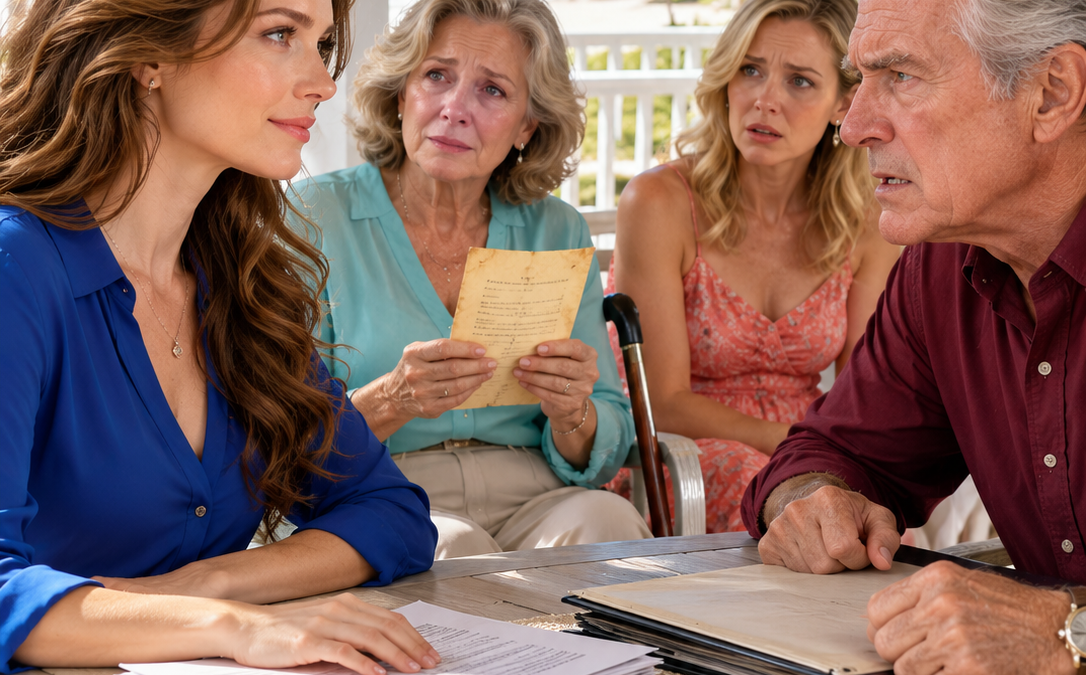
My parents threw me out of their house on the same night they toasted my sister’s doctorate, and my dad did it standing up, with his wineglass still in his hand.
“Get out,” he said. “Get out, you lowlife.”
He said it in front of the retired superintendent he’d spent thirty-one years trying to impress. He said it to a thirty-four-year-old woman sitting on a folding chair at the kids’ end of the table, a woman who had moved back into the apartment over his garage in March to drive her mother to physical therapy. He called me uneducated trash.
My mother said one word. “Dennis.”
My sister looked at her plate.
I said, “Okay.”
I folded the chair and went upstairs for my suitcase.
What nobody at that table knew was that the company I’d been running from that garage had sold twenty-five days earlier, and the keys to a house on the Gulf were in my purse. What I didn’t know was that three weeks later, my father would drive fourteen hours to that house to tell me what I owed him—and that the person who finally answered him wouldn’t be me.
Welcome back to Calm Drama Stories. This is the place where women who were underestimated, overlooked, or pushed out by their own families finally get to tell the whole story, from the quiet moment it started to the day they chose themselves. If you’ve ever had to prove your worth to people who should have known it already, you’re in the right room. Drop a comment, and be sure to subscribe.
Saturday, September 26, had started with my mother asking me to carry the good chairs in from the garage, all eight of them, and telling me gently that I’d be sitting on the folding one. She didn’t say it to be unkind. She said it the way she said everything about my father: quietly, with a little apology folded inside.
The good chairs were for the Puits. Gary Puit had been superintendent when my dad was assistant principal at Kettering High, and in my father’s mind, Gary was still his boss, still the man whose opinion decided what kind of year it had been. Marilyn Puit brought a pie. My sister Caroline arrived with her husband, Todd, and a framed copy of her new diploma, Doctor of Education, which my father hung on the dining room wall before dinner, right next to his own. Two frames, same wall. He stood back and looked at them the way other men look at a new truck.
I sat where I was told. I was close to the kitchen door, which my mother said was handy for getting things. And I got things. I refilled water. I brought the rolls. I took Marilyn’s plate when she was finished. My father stood up for the toast with his wine, and he did that thing he does with his shoulders when he’s about to say something he’s rehearsed.
“Two daughters,” he said. “One doctorate.”
Everyone laughed, including me, because that’s what you do. Then he reached into his jacket.
“And one who’s finally going to get a piece of paper, too.”
He set a receipt on the table in front of Gary, not in front of me. Sinclair Community College. A $300 deposit for an information technology support certificate starting in January.
“I already paid it,” he said. “No more excuses.”
He was smiling at Gary when he said it. I was a story he was telling his old boss, and the story was that he had fixed his other kid, too.
I’d like to tell you I had a speech ready. I didn’t. I had a sentence, and I said it to the table, not loudly, but clearly enough that Marilyn put her fork down.
“No, Dad. I’m not going.”
That was all it was. Four words and a name.
He turned, and I watched his face do the thing it does when a room full of people has seen him refused. I understood even then that what happened next wasn’t about whether I was right. It was about Gary Puit watching him be told no by the daughter without a degree.
“You live over my garage. Rent-free,” he said. “Fixing websites for plumbers.”
His voice grew louder with every clause.
“You’re uneducated trash. Brenda, get out. Get out, you lowlife.”
Then came the silence, my mother’s one word, Caroline looking down, and Todd studying the pie.
And I said, “Okay.”
I folded my chair and left it by the wall where the coats were.
The apartment over the garage had been built for Caroline when she was in graduate school, which was why it had a real bathroom and a real door. I had put a card table under the window in March, and that was where my laptop lived. When I came up the stairs that night, the screen was still open to a folder full of closing documents, the last of the due diligence. Three hundred pages of a deal that had already closed.
I sat down and shut the tabs one by one.
Downstairs, I could hear plates being stacked and Gary saying, “Thank you for dinner, Joanne. It was lovely.”
I heard the front door. I heard my father’s laugh, the social one.
Nobody came up the stairs. I didn’t expect anyone to, and I noticed that I didn’t expect it. That was its own small ache.
Caroline texted at 10:40.
He didn’t mean it. Just apologize tomorrow and it’s over.
I read it twice and put the phone facedown. Then I took the keys out of my purse. Two keys on a plain ring with a cheap plastic tag from a title company in Bradenton, Florida. I had been carrying them for two weeks, the way you carry a secret you’ve decided to tell later, at the right time, when it would land as a gift instead of a bomb.
I set them on the card table next to the laptop and looked at them for a while. For the first time, they didn’t look like a place I would bring my mother someday. They looked like a place to go.
I packed one suitcase: clothes, the external hard drive, and the plastic file box I’d been hauling from apartment to apartment for ten years. I folded the tablecloth my mother had given me for the card table and left it on the pillow. Then I set an alarm for six.
At seven the next morning, I put three things on the kitchen counter: the printed schedule of my mother’s physical therapy for the next six weeks, the phone number of Pat next door, who had offered a dozen times to drive her, and the key to the apartment.
My father was standing in the doorway of the garage with his coffee when I rolled the suitcase past him. He looked at the suitcase, not at me.
“Where are you even going to go?”
“I’ll let you know.”
He didn’t move, and he didn’t stop me.
My mother wasn’t at the door. She was behind the kitchen window, with one hand on the counter and the other on her walker. When I looked up, she lifted her hand. I lifted mine.
That was the whole goodbye.
I backed out of the driveway, and the GPS said fourteen hours and twenty minutes. I noticed I hadn’t said the word Florida out loud to either of them. Old habit. I noticed it, and I drove anyway.
Somewhere past Cincinnati, with the sun coming up over the interstate, I started doing what you do on a long drive, which is explain yourself to yourself.
Why? Why not a single word back?
The answer wasn’t in that dining room. It was in a high school auditorium in May of 2009, when I was seventeen and had just won second place in a regional app competition with a program that let the pizza place where I worked swap shifts by text message.
It was clumsy. It worked.
My mother took pictures with a disposable camera because she didn’t trust her phone. My father arrived late from a district meeting, still wearing his tie, and stood at the back with his arms folded while I demonstrated the program on a borrowed laptop.
He asked one question.
“Does this count for anything on the transcript?”
The judge said it would look great on an application. My father nodded as though that settled it.
In the car on the way home, he said, “Cute.”
A beat passed.
“Now, let’s talk about real schools.”
And then came the speech, which I could have given myself by then. He was the first person in his family to finish college. His father had worked at the GM plant in Moraine until it closed. A degree, he said, was the only thing nobody could take from you.
Everything else—a job, a house, a business—could be gone in a year. Paper lasted. That was why his diploma hung in the living room where other people hung family photographs.
That night, my mother pasted my second-place certificate into the photo album with the rest of my childhood. She did not hang it.
I understood the difference.
In that house, a thing I made was worth exactly what it could be converted into: a grade, a line on an application. If it couldn’t be turned into paper, it was cute.
Three years later, I found out what happened when I stopped trying to earn the paper.
I was twenty, a sophomore at Ohio State studying computer science, when a plumber named Ron Kesler, who had redone my parents’ bathroom, called me because his daughter had mentioned that I did computers.
He had six trucks, a receptionist, and a paper calendar, and he was losing jobs because nobody could tell a customer when a truck would show up. He offered me $4,000 to build him something.
It was finals week. I built it instead of studying.
And I kept building it after the $4,000 was spent, because every time I fixed one thing for Ron, he showed me three more things that were broken for every plumber he knew.
I withdrew from school in May. I didn’t fail out. I walked out with a plan, which is a different thing, and in my father’s house, a worse one.
“When this fails,” my father said, “don’t come crying.”
He said it at the kitchen table with his hands flat on the wood, and then he cut me off. No more tuition, no more car insurance, no more phone.
Fine. I expected that.
What I didn’t expect was my mother.
Three days later, $6,000 showed up in my checking account. When I called her, she said it was from her own savings, the account she’d kept since before she was married. It was for the deposit and two months on a studio apartment in Columbus.
And could I please not tell my father?
I didn’t tell him.
The bank statement did. He read everything that came into that house.
The next Sunday, I was summoned back to the same kitchen table, and on it was a single typed page.
Promissory note. $6,000 at 5%, payable in full within five years.
“So you learn what money is,” he said.
I signed it. My mother stood at the sink washing a glass that was already clean.
I want to be exact about what happened next, because it matters later.
Starting in January of 2014, when the plumbing software was finally paying me something like a wage, I sent my mother $500 a month, twelve payments in all. I put it in the memo line every time.
Loan payment, 1 of 12.
Loan payment, 2 of 12.
All the way through 12 of 12 in March of 2015, because I am the kind of person who puts things in the memo line.
She texted me after the first one.
We won’t tell your father. He’ll just make a speech.
So we didn’t.
I never asked what she did with the note. I assumed he had it in a file somewhere with the car titles. I paid it. She knew I paid it. And that was the first agreement my mother and I ever made that didn’t include him.
It was also, I can see now, the start of a habit.
Everything true between us had to be quiet.
After that, I stopped giving him anything to grade. That’s the simplest way to say it.
Thanksgiving of 2019, in my parents’ living room, my father put his hand on my shoulder in front of Gary Puit and said, “This is our other one. She does something with computers.”
By that November, the company I’d started with my business partner had eleven employees, nine hundred paying customers, and an office in Columbus with my name on the lease.
I said, “Yep. Something with computers.”
And went to get more ice.
I did it every holiday. I answered every question with the shortest true sentence available.
“Works good.”
“Busy.”
“Still in Columbus.”
I brought gifts that cost exactly what a person doing something with computers could afford. I never said the word Priya in that house. I never said the word payroll.
If I didn’t hand him a target, he couldn’t hit it.
That was the whole theory, and it worked, if by worked you mean I got through ten years of holidays without a single speech.
But here is what it cost, and I didn’t add it up until I was doing eighty on the interstate with a suitcase in the back.
My mother didn’t know either.
She asked me every Christmas, “Are you doing all right, honey?”
And I said, “Fine.”
She believed me because she wanted to and because I gave her nothing else. The one person who had wired me $6,000 of her own money and kept my secret from her husband had been told for a decade that I was fine.
I had made myself small enough to survive my father, and the person who disappeared was my mother’s daughter.
So when I said okay at that table, it wasn’t strength. It was the hundredth version of something with computers.
I knew that by Lexington.
I didn’t know yet what to do about it.
The thing I’d been hiding had a name, a payroll, and a closing date.
The name was Ledger Line.
For the first four years, it had no name at all. It was just me in a studio apartment in Columbus that cost $400 a month, writing scheduling software for Ron Kesler’s trucks, then for the HVAC guy Ron played softball with, and then for an electrician the HVAC guy owed a favor.
Tradespeople don’t care where you went to school. They care whether the thing works at six in the morning when the truck won’t start and the customer is calling.
I learned what they needed by riding along. Invoices sent from the cab of a truck. Appointment reminders that texted the customer so the dispatcher didn’t have to. A calendar that didn’t let two trucks be in two places at once.
None of it was clever. All of it was useful.
And useful was what they paid for.
In 2016, I rented a six-foot table at a trade show in Columbus and met a woman named Priya Raman, who was selling water heaters for a parts distributor. She stood at my table for twenty minutes before she said, “You have a product. You don’t have anyone who can sell it.”
She was right.
A year later, she quit the distributor, and we incorporated.
That same year, I applied for a business line of credit, and the bank wanted three years of personal statements. That was why I sat up one night downloading every statement I had back to 2013 and putting the records into a plastic file box.
Banks keep seven years online. I keep everything.
It’s not a virtue. It’s a nervous habit from a house where my father read the mail.
The box went with me to every apartment after that. It was in my suitcase the morning I left.
Ledger Line got its first hundred customers in 2017 and its first thousand in 2019.
I’ll spare you the middle, except to say what it cost. Eighty-hour weeks for three years. A boyfriend who left because I kept rescheduling dinner around server outages. Two Christmases when I didn’t go home at all because I couldn’t afford the plane ticket and couldn’t say why.
By 2025, we had thirty-one employees and a product that a bigger company wanted.
I had something my father couldn’t grade.
Customers who paid every month.
Then, in February of this year, my mother fell on the ice.
She broke her hip on the front walk while going to get the mail. Surgery in March, a full replacement, and the surgeon said six months of physical therapy if she did everything right.
My father couldn’t drive her.
That was what he said. Couldn’t, because of the foundation board, because of the gala planning committee, because of a schedule that somehow had room for everything but Tuesday, Thursday, and Saturday mornings at the rehabilitation clinic.
I came home in the middle of March, meaning to stay six weeks.
I stayed seven months.
I moved into the garage apartment, set up the card table, and every morning I drove my mother to therapy and sat in the waiting room answering emails while she learned to climb a step again.
In the afternoons, I ran the sale of my company from that card table, because that spring, a field-service platform called Service Corps had made an offer. The offer came with a nondisclosure agreement and four months of due diligence.
I’ll say the numbers once so you can follow them, and then I’ll stop.
Service Corps bought Ledger Line for $32 million.
I owned 62%, which made my share just under $20 million. That was the number that would end up in a headline.
The number that actually landed in my account on September 1, before taxes, was closer to $14 million, because 70% of the price was paid at closing and the rest sat in an escrow account for eighteen months and an earnout over two years, tied to how many customers stayed.
I’d also agreed to work as an adviser ten hours a week, remotely, for those two years.
So on the first of September, while my father was out front mowing the lawn in his district polo shirt, I stood at the window of the garage apartment with my phone against my ear and listened to our lawyer say the wire had cleared.
I watched my father go back and forth across the grass, and I did not go down.
I called exactly one person.
My aunt Lynn, my father’s younger sister, had dropped out of nursing school in 1990 and now owned a salon in Bradenton, Florida. For my entire childhood, she had been the family’s cautionary tale.
Lynn didn’t finish.
Lynn’s doing hair.
Lynn had been the only person I’d told about Priya and the office and the thirty-one employees, because Lynn was the only person who wouldn’t ask what my parents thought.
She listened to the number and said, “Tell your mother. She’s the one who’d want to know.”
“After her PT is done,” I said. “November. I’ll tell her then, properly.”
Lynn didn’t argue. Lynn never argued.
Three days later, she sent me a listing with no comment.
A house in Holmes Beach on Anna Maria Island, with a west-facing porch and a photograph of the sunset that looked fake.
I closed on it on September 12 for $2,600,000 cash, furnished, while sitting at the card table over my parents’ garage with a notary on a video call and my father at a gala planning meeting.
Lynn picked up the keys and walked through the house with her phone held up so I could see it.
Two chairs on the porch, facing the water.
“I want eight chairs,” I said.
She didn’t ask why.
I had a plan, and the plan was this: finish my mother’s therapy, tell her everything in November, and fly her down for Christmas to sit on that porch.
Two days later, I went to the bank and had them cut a cashier’s check for $140,000, payable to the lender on a home equity line of credit I knew about only because my mother had left an envelope on the kitchen counter in August, and I had read the balance before I could stop myself.
It was going to be her birthday present on October 20.
I put it in the drawer of the card table and told no one.
Twelve days later, my father told me to get out.
Lynn was waiting in the driveway when I pulled in at nine the next night, standing under a streetlight with the keys in her hand and a bag of groceries at her feet.
She hugged me for a long time.
Then she asked one question.
“Does your father know?”
“No.”
She nodded, handed me the keys, and went home.
I slept twelve hours in a bed that wasn’t mine yet and woke up to the sound of the Gulf, which is quieter than you’d think. I found the two chairs on the porch exactly where the video had shown them.
I sat in one with coffee and watched the water for an hour. I did not think about anything at all.
It was the first hour like that I’d had in seven months.
Priya called that afternoon.
She was at Service Corps now, with a vice president title and an office with a door, and she got straight to the point, the way she always had.
“The press piece. The business journal in Dayton wants to run a founder profile with the acquisition announcement on October 15. Your name, your photo, a quote. You’ve asked me to hold it twice. They won’t hold it again.”
I knew the piece. I’d seen the draft.
There was a line in it about my customers being people who drive trucks, which I’d liked, and a photograph of me in the Columbus office, which I’d hated.
“Say the word,” Priya said, “and I’ll pull your name. Last chance.”
I looked at the water.
My whole life, I had let people find out about me late and by accident, so I could say I never claimed anything.
“Let it run,” I said.
There was a pause.
“Okay,” Priya said. “That’s the first time you’ve said that about anything.”
After we hung up, I took a picture of the porch, the two chairs, and the water, and texted it to my mother with no caption.
She wrote back a heart.
Then my phone rang again, and it was Caroline.
“He’s been impossible since you left,” my sister said.
She was calling from her office at the middle school where she was assistant principal, and I could hear a bell ring behind her. She said it the way you’d report the weather.
Then she told me more than she meant to.
The Sinclair certificate was a plan, she said, not a whim. Dad thought that if I had a credential, I could get a real job with benefits and finally pay rent, or, better yet, move out, because he had already asked Gary Puit to find a student teacher who would rent the garage apartment for $1,100 a month.
“Why does he need $1,100 a month?” I asked.
There was a pause with a lot in it.
“The second mortgage,” Caroline said. “The home equity thing. The payment jumped. The pensions don’t cover it like they used to.”
She said it fast and moved on.
I noticed she didn’t say what the loan had been for.
“And he wants you at the gala,” she continued. “The foundation thing in November. He’s chairing it. He wants everyone to see the family’s fine.”
I waited.
“Just come home for Mom’s birthday. Bren, tell him you’ll do the certificate. You don’t have to actually do it. He’ll calm down.”
“He told me to get out, Caroline.”
“He says things.”
I looked at the two chairs.
“He said it in front of Gary Puit.”
“That’s why he said it,” she replied.
Then she seemed to hear herself and changed the subject to the weather in Ohio.
When I hung up, I understood that I hadn’t been thrown out in a fit. I had been thrown out according to a budget.
The certificate. The rent. The student teacher. The gala.
He’d had the deposit receipt in his jacket before the salad.
I stopped waiting for an apology that afternoon. I had been waiting for one for three days without admitting it.
I let it go the way you let go of a bag you didn’t know you were carrying.
The next morning, Marilyn Puit texted me.
Are you okay, honey? Can I call?
Marilyn and I had never once spoken on the phone.
I said yes.
She told me what happened after I rolled the suitcase through the dining room. My father had sat back down, she said, refilled his wine, and told Gary, “She’ll be back by Tuesday. Tough love.”
Then, before the pie was cut, he had asked Gary whether that student teacher was still looking for a place, because the apartment would be free.
Marilyn said she’d made Gary leave early. She said she was sorry.
I thanked her and meant it.
Then I went to the card table I’d brought from Ohio, opened the drawer, and looked at the cashier’s check.
$140,000 made out to my father’s lender for my mother’s birthday.
I didn’t tear it up.
I closed the drawer.
I was going to find out what they wanted before I decided what I would give.
On my phone, a calendar reminder for October 15 said, in my own handwriting, Article runs.
Nineteen days after the folding chair, the Dayton Business Journal published a story with the headline, “Kettering Native Sells Contractor Software Company for $32 Million.”
There was the photograph I hated, me in the Columbus office with my arms crossed, and a quote about how my customers were people who drove trucks for a living. Near the bottom was a line saying my share of the sale was estimated at nearly $20 million.
It went up at six in the morning.
By 7:40, Caroline had called three times.
At 8:15, my father called, and I let it go to voicemail.
The voicemail was warm.
“We are so proud of you, sweetheart. Your mother and I. Call your father.”
At 10:30, he left a third one, and this one was not warm.
“You let me look like a fool in front of Gary Puit. You sat there and let me.”
Two voicemails, two hours apart, from the same man.
I listened to each of them twice.
My mother sent one text.
Is it true?
I answered her and only her.
Yes. I’m safe.
I love you, she wrote back.
Okay.
And then, a minute later:
Your porch is beautiful.
That afternoon, Caroline called again, and her voice had changed. The weather report was gone.
“Todd and I are flying down Saturday,” she said. “Dad has a proposal. He wants you to hear it from family.”
A proposal.
I said that would be fine.
After I hung up, I went out to the porch and counted the chairs.
Still two.
I had said eight. I had not bought the other six.
They arrived at the house on Saturday afternoon in a rental car. Caroline was wearing a sundress she’d clearly bought for the trip. Todd wore a golf shirt and the expression of a man who had been told to be pleasant.
Caroline hugged me and set a paper bag on the porch table.
Banana bread wrapped in foil, still faintly warm from the hotel microwave.
“Mom sent it,” she said. “For both of us.”
Todd set a folder on the table next to it. He didn’t say who sent that.
We sat in the two chairs and the one plastic stool from the kitchen, and I let Todd open the folder because it was obvious that was what he had flown down to do.
It was four pages, with a title across the top in bold.
Family Settlement and Recognition Agreement.
Todd walked me through it in a voice I assumed he used for closings.
Paragraph one: I would contribute $140,000 to retire the family home’s line of credit as a gift.
Paragraph two: I would endow a scholarship of $250,000, to be called the Hale Family Scholarship, announced by my father at the Foundation Gala on November 14.
Paragraph three took up most of the second page.
Acknowledgment of Founding Capital.
It recited the promissory note from June of 2012, $6,000 at 5%, unpaid with accrued interest and appreciation, and argued that since the money had funded the start of my business, my parents were entitled to an equitable share.
Todd had set that share at 10% of my stake in the sale, roughly $2 million.
In exchange, page four promised full family reconciliation. Christmas in Florida. No further claims.
I read it twice while they watched.
I have read a lot of contracts in the last year.
This one was not a contract.
It was a story about me written by my father and typed by my brother-in-law, in which I was a debtor who had gotten lucky with family money.
I asked Todd one question.
“Does he think I didn’t pay that note?”
Todd looked at his own paragraph.
“There’s no record he received payment.”
“He didn’t,” I said. “Mom did.”
Todd wrote something on his legal pad.
Caroline leaned forward and said quietly, “The two million isn’t real to him, Bren. That’s Todd’s anchor. He’d settle for the scholarship and the loan.”
Todd looked at his wife as if she’d given away the ending of a movie.
I closed the folder.
“I’ll answer in writing,” I said.
Todd said that was reasonable.
Then he went out to the rental car to make a phone call, and Caroline stayed on the porch. The banana bread sat between us on the table like a third person.
“Tell me what the loan was for,” I said.
Caroline looked at the water for a while.
Then she told me.
The home equity line, $140,000, had paid for her doctorate, every semester of it, and for Todd’s buy-in at his firm, which was two years old and had not yet made a profit.
She had $90,000 in student loans on top of that, in her own name.
“So if he loses the house,” she said, “it’s because of me. And you can fix the whole thing with what’s a rounding error for you.”
She said the last part without meanness. She said it like arithmetic.
“Then why did you sit there?” I asked. “Saturday, when he said it. You didn’t say a word.”
“Because he was right that you’d be fine,” she said. “You always are. You’ve always been the one who’s fine.”
I didn’t answer that.
I looked at the foil on the banana bread, which my mother had folded at the corners the way she folded everything, and thought about how she had sent it with the person carrying the bill.
Here is what I understood when Caroline went back to the hotel.
If I paid, it was over. The loan gone, the scholarship announced, Christmas on the porch with all of them. My father telling the whole district the story in which he’d pushed me and I’d risen.
If I didn’t pay, my parents could lose a house my mother had lived in for thirty-eight years, with a hip that was four months old.
And whatever my father told the district about that, I knew what he’d tell her.
I had the money.
I had it in a drawer.
There was no version of this where I didn’t choose something, and every version cost my mother something.
I sat on the porch until it got dark and the bugs came. Then I went inside and opened the drawer for the second time that week.
I put the cashier’s check on the table next to Todd’s folder.
Same number.
$140,000.
A month ago, it had been a birthday present, a surprise, the kind of thing you plan while sitting in a rehabilitation clinic waiting room.
Now it was paragraph one.
I called Priya because she was the only person who had watched me do this for ten years.
I told her about the folder and the note and the two million that wasn’t real.
She was quiet for a second.
Then she said, “You’ve paid for a seat at that table your whole life with silence. Now they want you to pay with money. Same table.”
I started to argue and stopped.
She was right.
More than that, she had put her finger on the thing I’d been circling.
My father had not asked whether I could help. He had told me what I owed.
The note wasn’t a request. It was a claim of ownership on the whole of my life, backdated to a kitchen table in 2012.
Those were two different questions, and I had been letting them sit on top of each other for three days.
Did I owe him?
No.
I had the memo lines to prove it.
Would I give him anything?
I didn’t know.
But I knew I would not give it on his terms, as a line item in a document that called my mother’s $6,000 his founding capital.
The first thing I had to do was answer the paper with paper.
The second thing I had to do was ask my mother a question I had never once asked her in eleven years.
I got up and found the plastic file box in the closet where I’d put it the night I moved in. The statements were where I’d left them in 2016, in a folder labeled Huntington, organized by year.
I found January of 2014 and ran my finger down the page.
Transfer to J. Hale. $500. Memo: Loan PMT 1 of 12.
February. March.
I pulled all twelve pages, through March of 2015, laid them on the table in order, and looked at them for a while.
Twelve lines of a twenty-two-year-old’s handwriting in a memo field, because I had been raised in a house where you kept receipts.
I printed clean copies on the printer I’d bought that week and clipped them together.
Then I wrote an email to Todd and copied my father and Caroline.
Three sentences long.
There would be no agreement. I would meet with my parents, both of them, at my house on Saturday, October 24, at whatever time they liked.
No attorneys.
I read it four times and sent it.
Then I called my mother.
She answered on the first ring, which told me she’d been holding the phone.
“Your father wants to drive down,” she said before hello. “He’s been saying it since the article.”
“That’s fine, Mom. Saturday. Both of you.”
A breath.
“Both of us,” she agreed.
Then I made myself do it.
“Mom, the note. The one I signed in 2012. Do you still have it?”
The silence went on so long I checked the screen to see if the call had dropped.
It hadn’t.
“I know where it is,” my mother said.
That was all.
She didn’t say whether she’d bring it or what it would prove or what she’d do.
I know where it is.
I said thank you. She said she loved me, and we hung up.
I called Lynn next.
“Can you be here Saturday?”
“Honey,” my aunt said, “I’m not leaving you alone with my brother.”
On Thursday morning, Marilyn Puit sent me a screenshot.
It was the Facebook page of the Kettering Education Foundation, and the post was from the night before.
Thank you to board chair Dennis Hale and the Hale family for committing the Hale Family Scholarship to be presented at our November gala.
Sixty-one likes.
In the comments, teachers my father had supervised twenty years ago were congratulating him.
One of them wrote, So proud of your daughter, Dennis.
I looked at that one for a long time.
Caroline called an hour later, and she was rattled.
“He told the board it was as good as done last night. He stood up and said it.”
And Todd, she said, had been instructed to send a second version of the agreement, this one with a deadline.
Friday at noon.
I understood then what my father was coming to do on Saturday.
He wasn’t coming to ask.
He was coming to collect on something he had already spent.
He had put my name in front of the only audience that mattered to him before he had so much as said hello to me.
And for the first time in my life, it was my father who had no room to back up.
The second version of the agreement arrived in my inbox at four.
I didn’t open it.
I drove to a furniture store in Bradenton, bought six porch chairs that matched the two I already had, and arranged to have them delivered Friday.
Lynn got there at twenty to nine on Saturday morning with two coffees and sat down in the eighth chair, the one at the end nearest the steps, without asking which one was hers.
“I’m sitting here,” she said. “Don’t look at me. Look at him.”
At exactly nine, my father’s Buick turned into the crushed-shell driveway.
They had driven through the night. I could tell from the way Caroline got out of the driver’s seat and stretched before she looked at the house.
My father got out of the passenger side and looked at the roofline first, then the porch, then me.
My mother got out last, slowly, with her cane, and she looked at me first and the house second.
That order told me more than anything else.
I went down the steps and took my mother’s arm, brought her up one step at a time the way we’d practiced in the clinic parking lot, and settled her in the chair with the best view of the water.
Eight chairs, all the same.
There was no folding chair on my porch, and there never would be.
My father came up with a folder under his arm, Todd’s folder, and I could see the top page through the clear cover.
A single typed sheet, yellowed at the edges.
My signature at the bottom, written when I was twenty, too large, the way you sign things when you’re trying to look sure.
He sat down across from me, set the folder on the table, and looked around at the ceiling fan, the hurricane shutters, and the porch rail.
“Nice place,” he said. “How much?”
I didn’t answer, and he didn’t wait for me to.
He got up and walked through the house.
I let him.
He opened a kitchen cabinet and closed it. He asked what the floors were and whether the roof was new. He said the tile in the bathroom was good tile.
Then he came back out, sat down, folded his hands, and said in the voice he used for parent conferences, “We always knew you had it in you. Your mother and I.”
My mother looked at the water.
Caroline looked at her lap.
Lynn looked at my father and said nothing, which is harder for Lynn than it sounds.
He opened the folder.
He had a new word for it now, and the word was fair.
He wasn’t there for charity.
He said he’d never asked me for a dime, but a family invests in its children, and when the investment pays off, the family shares in it.
“That’s not greed, Brenda. That’s how families work.”
He set the agreement on the table, the second version, and on top of it the promissory note. Then he turned both so they faced me.
And then he told me the story of my life as he understood it.
He had pushed me, he said. He had been hard on me because soft didn’t make anyone. The night with the certificate was a push, too.
“And look where you landed,” he said.
He gestured at the Gulf of Mexico as if he’d arranged it.
He wasn’t shouting.
He was explaining.
He had renamed every single thing he’d done to me, and he believed every new name.
I saw that he would sit on my porch all day renaming things and never once arrive at the word wrong.
So I stopped waiting for the word.
I reached under my chair for the clipped pages and set them on the table beside his note.
“Twelve payments,” I said. “Five hundred dollars each, to Mom. January of 2014 to March of 2015. The memo lines say loan payment one of twelve through twelve of twelve.”
I turned the pages toward him one at a time.
He looked at them the way he’d looked at the pizza app, like a man checking whether a thing counted.
“Those were rent,” he said. “You were living in our apartment then. That was rent.”
“I lived in Columbus in 2014,” I said. “You rented the garage to the Nguyen boy that whole year. Gary found him for you.”
Lynn spoke from the end of the porch.
“I remember the Nguyen boy. He parked on the grass.”
My father’s jaw moved.
“Your mother never told me a thing about any payments.”
I turned to my mother.
She had not said a word since she sat down.
Her hands were in her lap, one over the other, and her cane leaned against the chair.
“Mom,” I said, “would you turn it over?”
She looked at me for a moment.
Then she reached across the table and picked up the promissory note, the actual page, the one I’d signed at twenty.
Her hand was shaking, but I’d spent seven months watching that hand, and it was the hip, not fear.
She turned the page over and set it down faceup.
There, on the back, in the small, straight handwriting of a woman who had labeled library books for thirty years, were five words and a date.
Paid in full. March 2015. JH.
“I wrote it the day the last five hundred came in,” my mother said.
Then she added, “I never told him because he never asked me.”
She said it to the table, not to him.
Then she looked up at my father, and I had never seen her look at him like that. Not once in thirty-four years.
Not as a wife or a woman afraid of a speech, but as a witness.
My father looked at his own piece of paper.
He had built a whole house on paper, and now he was holding the one page in that house that had ever been about me, and there was nothing on it for him to read.
“Mom,” Caroline said.
Very quietly.
And then nothing else, because there was nothing else.
He closed the folder.
I watched him do what he does, which is change what the argument was about.
“Fine,” he said. “Not the money. Forget the money. The scholarship.”
He leaned forward.
“I told the board, Brenda. I stood up in front of that board and told them. You’d humiliate me in front of the whole district.”
“You announced my name before you asked me,” I said. “That isn’t me humiliating you.”
He leaned forward again.
He had one argument left, and it was the one I’d been afraid of since I was seventeen.
“I made you,” he said. “You think you’d have fought this hard if I’d clapped for that pizza app? You think any of this—”
He waved at the water again.
“—happens if I’d been soft?”
I had thought about that question for seventeen years.
I had the answer ready, and it came out quieter than I expected.
“You didn’t push me, Dad. You pushed me out twice. Those aren’t the same thing.”
And then my sister, who had looked at her plate at the dining room table and at her lap on my porch, said, “Dad, stop.”
Two words.
He turned to her as if a chair had spoken.
Then he turned to my mother and said what he had said at the end of every argument of my childhood.
The sentence that ended things.
“Get in the car.”
My mother did not get up.
She picked up the note from the table, put it in her lap facedown, and folded her hands over it.
Lynn stood.
“Dennis,” she said to her brother, “sit down or go. Don’t make her choose in front of you.”
He looked at his sister, his wife, his daughters, and the eight chairs.
Then he went down the steps.
Caroline went after him.
The car doors made the sound car doors make.
I got up and followed them.
He had the passenger window down halfway. Caroline was already behind the wheel with the engine running.
He didn’t look at me when he said it.
“You’ll call when you’ve calmed down.”
“I’m calm now, Dad,” I said. “This is what it looks like.”
He rolled the window up.
Caroline got out of the car fast and hugged me hard.
“I’m sorry,” she said into my hair.
It was not enough, and we both knew it.
I let her say it anyway and didn’t say anything back.
Then she drove my father out of my driveway, the shells crunching under the tires, and I stood there until the sound was gone.
When I came back up the steps, my mother was talking to Lynn, not to me, and I understood that she’d needed to say it to someone easier first.
Then she turned.
“I’d like to stay the week,” she said. “If that’s all right.”
I sat down in the chair next to hers.
The two of us looked at the water, and it was the first time in my life we had ever looked at the same thing at the same time without him in the room.
After a while, she said the thing she had come fourteen hours to say.
And it wasn’t about the loan.
“I kept it,” she said, “because it was the only paper in that house that was about you.”
I cried then.
Not for long, and not with any explanation.
She let me, the way she had let me when I was small.
That night, she went to bed early in the room that looked at the water.
I stood in the doorway and saw her purse on the chair, her cane against the wall, and her shoes side by side on the floor.
I thought, She’s here.
Then I thought the other thing, the one that had been waiting all day beneath the good feeling.
Tomorrow, my father would still be in Ohio with a line of credit he couldn’t carry, in a house with my mother’s thirty-eight years in it. He had driven away from my porch with nothing in his folder.
The week had a shape now.
The week ended with her going home to that.
She brought it up herself on Sunday morning, on the porch with coffee, in a voice that wasn’t asking for anything.
“He’ll lose the house, Brenda.”
A pause.
“It’s my house, too. Thirty-eight years.”
I went inside, came back with the contents of the drawer, and put the cashier’s check on the table between us.
$140,000, made out to the lender, dated the fourteenth of September.
“I had this ready for your birthday,” I said, “before he told me to get out.”
She looked at it for a long time.
I could see the shortest road from where I sat.
Sign the back, send it Monday, and the whole thing would be over. Christmas on this porch with all of them. The scholarship at the gala. My father, for the rest of his life, telling the district the story in which he’d pushed me, and it had worked.
It would cost me one afternoon and nothing I’d miss.
And I would have bought, with my own money, the right to sit in the folding chair.
“I’ll take care of you, Mom,” I said. “Directly. Your therapy, your rides, your tickets, for as long as you want them. But his line of credit is his. He doesn’t get paid for the door he shut on me.”
She didn’t say anything.
The water did what it does.
Then she said, “You sound like your aunt Lynn.”
“I sound like me,” I said.
She looked at me and nodded.
It wasn’t agreement.
It was something closer to recognition, the look of a woman who has just watched her daughter do something she herself never managed in forty years of marriage, and who isn’t sure yet whether to be frightened or proud, but is going to try for proud.
Then I did it in front of her, because the point was that it wasn’t going to be quiet anymore.
I tore the cashier’s check in half, then into quarters, and put the pieces in my coffee saucer.
I opened the laptop.
First, the rehabilitation clinic in Kettering. Six months of my mother’s physical therapy, paid in advance, and a standing account with the medical transport service for every appointment, billed to me, not to the house.
Second, an email to my father, with Todd and Caroline copied.
One paragraph.
There would be no agreement, no scholarship, and no payment of any kind on a note that had been paid in full in March of 2015. He was welcome to reach me by text or in person at my home. I would not be blocking anyone.
Third, an email to the executive director of the Kettering Education Foundation.
The post of October 22 had been made without my knowledge or consent, and I asked that it be removed. If I ever chose to fund anything, it would come in writing from me under a different name.
I sent all three.
My mother watched me do it.
“Now what?” she said.
“Now we go buy you a hat,” I said.
And we did.
The foundation took the post down within forty-eight hours. The gala went on in November without a Hale Family Scholarship, and I heard from Marilyn that my father told anyone who asked that it was still being discussed.
Todd sent a three-line email withdrawing the agreement, and the words two million dollars were never typed again by anyone.
The garage apartment was rented to a student teacher by the first of November for $1,100 a month.
My father got his rent.
The house in Kettering did not go anywhere, and I checked, because I’m a person who checks.
It just got smaller around him.
He didn’t call.
I noticed I wasn’t waiting.
Caroline texted in the middle of November, and this time the apology had a shape.
I sat at that table and said nothing twice. I’m sorry.
I read it a few times and wrote back.
Thank you. Let’s talk after Thanksgiving.
We would.
It would take longer than a text, and that was fine.
My mother went home at the end of her week, on her own decision, with the hat. Two days later, she called and told me she had booked herself a flight to Sarasota for Thanksgiving.
I paid for the ticket directly to the airline.
On November 26, the plane came down over the bay, and I was at the gate with the car running.
I had bought eight placemats.
There were eight of us on the porch that afternoon: my mother, Lynn, Priya and her wife, who had driven over from Tampa, the couple two houses down who had been feeding my cat before I knew I had a cat, and me.
Eight chairs, all the same, and nobody at the kids’ end because there wasn’t one.
When the neighbor asked what I’d done before I moved there, I said, “I built scheduling software for plumbers. I sold it in September.”
The whole sentence.
It came out easily, which surprised me a little after ten years of something with computers.
My mother heard it.
She didn’t say anything, but she passed me the rolls.
And I think that was the same thing.
After the dishes, she handed me an envelope.
Inside was the note, the real one, the page from 2012 with my too-big signature on the front and her five words on the back.
“This is the only paper in that house that was ever about you,” she said. “I thought it should live here.”
I didn’t frame it.
There’s nothing on my walls but a watercolor the neighbor painted of the pier.
I put it in the drawer of the card table, the same drawer where the cashier’s check had been, and closed it.
Later, when Lynn was getting her keys, she asked my mother, not quite under her breath, “Did Dennis ask where you were going?”
My mother said, “He asked. I told him.”
And that was that.
My mother had stopped being quiet, too.
The next morning, I came out with coffee and found her asleep in the porch chair, with a blanket over her knees and the hat on the table beside her.
I sat down in the chair next to her with my laptop and opened a file I’d started the week before.
A sketch of an app for rehabilitation clinics, a way to line up rides so nobody’s mother sits in a waiting room because her husband has a meeting.
It didn’t have a name yet.
When she woke up, I didn’t close the screen.
She looked at it, then at me, and said, “What’s that?”
And I told her.
I used to think calm was what you did instead of arguing.
It turns out it’s what you get to do afterward.
If it had been your mother sitting across from that check, with her thirty-eight years in that house, would you have torn it up? I’d like to know. Tell me in the comments.
And if this story found you at the right time, stay with us. There are more where it came from.








