My own mom said: “i wish you were never born…” i stood tall and said: “consider me as if i never existed. live your lives as though there was never a daughter named sofia,” they went silent; the whole party froze.
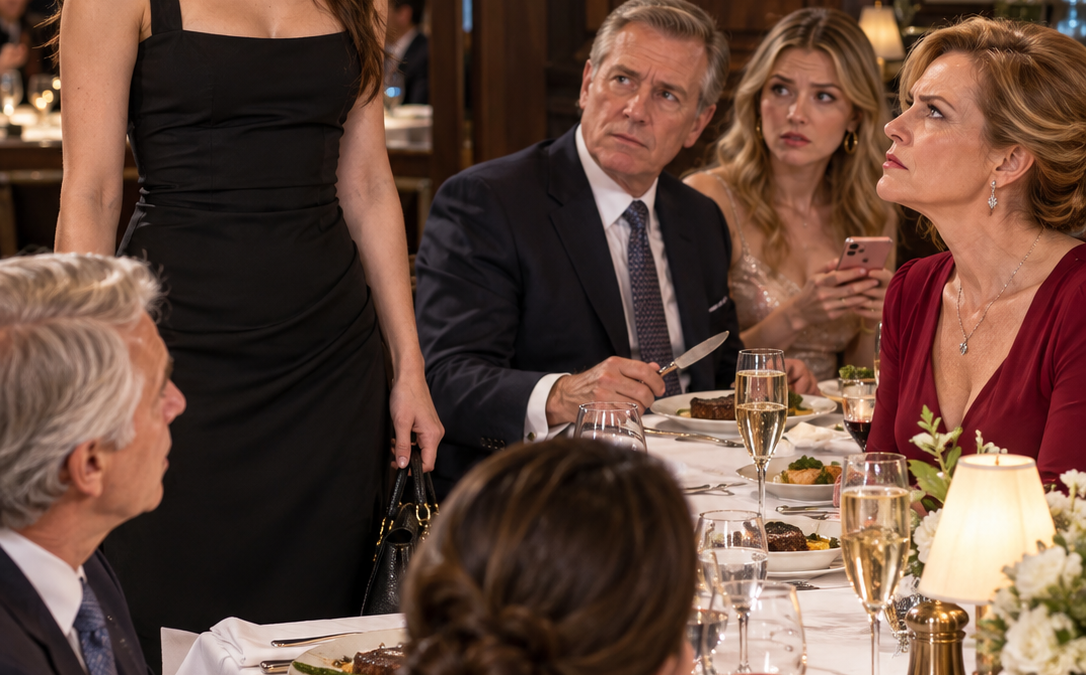
My name is Sophia. I am 26 years old, and I live in Rochester, New York. I sat at the head of the table at Del Monaco’s, staring at the crystal glass in my hand. The white tablecloth was crisp beneath my fingers. It was supposed to be a celebration. I had paid for everything—the vintage wine, the expensive steaks, the private room. My colleagues were there, raising their glasses to my Stanford MBA, their faces full of genuine warmth. But my parents sat across from me with tight, thin smiles.
My mother tapped her fork against her glass to silence the room. I took a breath. I thought, Finally. Finally, she’s going to say she’s proud. The room went quiet. She looked me right in the eye. Her voice didn’t shake. It wasn’t a joke.
“Honestly, Sophia,” she said, loud enough for the waiters to hear, “I wish you were never born.”
The silence that followed was heavy, like a physical weight dropping onto the table. My boss dropped his napkin in shock. My father didn’t look up from his plate. He didn’t defend me. He just kept cutting his meat.
For 26 years, I would have cried. I would have begged for their love. But in that moment, looking into her cold eyes, something inside me didn’t break. It snapped shut. I didn’t scream. I didn’t flip the table. I just realized that the daughter they hated was the same daughter who paid their bills.
And that was about to change.
But before I tell you how everything flipped, like and subscribe. Drop a comment. Where are you watching from?
My name is Sophia. I am 26 years old. I grew up in Rochester, New York, in a house that was always cold. I don’t mean the temperature, even though the winters there were long and gray. I mean the feeling inside the walls. It was a coldness that settled into your bones.
Our house was a two-story building with beige siding. It looked normal from the street. We had a lawn that my father mowed every Saturday and a porch where my mother sat in the evenings. But inside, there was a strict hierarchy. There was a center of the universe, and there were the satellites revolving around it. My younger sister, Ashley, was the sun. I was just part of the background, like the wallpaper or the rug in the hallway.
I remember when I was 8 years old. It was a Tuesday. I came home from school with a gold star on my spelling test. It was the first time I had gotten a perfect score. I had studied for three nights in a row, sitting at the kitchen table with my hands over my ears to block out the noise of the television. I felt a glow in my chest, a warm little fire of pride. I ran through the front door, my backpack bouncing against my shoulders.
“Mom!” I yelled. “Mom, look!”
My mother was in the living room. Ashley, who was six then, was sitting on the floor drawing. She was just scribbling with crayons on a piece of construction paper. It looked like a tangled mess of purple and green lines.
“Mom,” I said again, holding up my test paper. The red 100% was bright at the top.
My mother didn’t look at me. She was looking at Ashley. Her face was soft, glowing with a smile I never saw when she looked at me.
“Look at that, Ashley,” Mom cooed. “Look at how you use the green. That is so creative. You’re going to be an artist. You’re so special.”
I stood there. My arm started to hurt from holding the paper up.
“Mom, I got a 100 on my spelling test.”
My mother finally turned her head. Her eyes flicked over me. The warmth vanished from her face. It went flat.
“That’s nice, Sophia,” she said, her voice dull. “Don’t shout in the house. You’re disturbing your sister’s creative process.”
She turned back to Ashley.
“Now, do you want juice, baby? Do you want apple or grape?”
I lowered my paper. The gold star didn’t look shiny anymore. It looked stupid. I walked to my room, closed the door, and put the test in my bottom drawer.
That was the first lesson I learned. My achievements were noise. Ashley’s existence was a miracle.
As we grew older, the dynamic didn’t change. It just got bigger. Ashley was loud. She demanded attention. If she scraped her knee, it was a medical emergency. My father would rush to get the first-aid kit, and my mother would hold her and rock her back and forth, whispering sweet things.
When I was 12, I fell off my bike and gashed my leg open. There was blood running down into my sock. I limped into the kitchen, tears stinging my eyes. My father looked up from his newspaper. He frowned.
“Don’t bleed on the floor, Sophia. Go clean that up in the bathroom.”
That was it. No hug. No “Are you okay?” Just a command not to make a mess.
I cleaned the wound myself with burning rubbing alcohol, biting a towel so I wouldn’t scream. I put a bandage on it. I washed the blood off the linoleum. I learned to take care of myself because nobody else was going to do it.
By the time I was in high school, I had become invisible. I stopped trying to show them my grades. I stopped trying to tell them about my day. I realized that speaking just annoyed them. It was like I was an extra person they hadn’t planned for, a mistake they had to tolerate.
Ashley, on the other hand, was the star. She wasn’t good at school. She didn’t play sports. She didn’t really do anything except be Ashley. But that was enough. If Ashley laughed, my parents laughed. If Ashley wanted pizza, we had pizza. If Ashley wanted to watch a movie, we watched her movie.
I remember one dinner vividly. I was 16. I had just been elected treasurer of the student council. It was a big deal for me. I had campaigned for weeks. We were eating meatloaf. The clinking of forks against plates was the only sound.
I cleared my throat.
“I won the election today,” I said softly.
My dad chewed his food.
“Election? What election?”
“Student council treasurer,” I said.
My mom sighed. She looked tired.
“Pass the salt, Sophia.”
I passed the salt.
“I have to manage the budget for the whole school year,” I added, trying one last time.
“Ashley,” my mom said, completely ignoring me, “how was dance class? Did Mrs. Miller like your routine?”
Ashley lit up. She launched into a ten-minute story about how she forgot the steps, but everyone laughed and said she was cute anyway. My parents hung on her every word. They chuckled. They asked questions.
I looked down at my meatloaf. I felt like I was underwater. I was screaming, but no sound was coming out. I realized then that I could disappear right from the table, vanish into thin air, and they probably wouldn’t notice until it was time to clear the dishes.
That night, I lay in bed and stared at the ceiling. I didn’t cry. Crying implied that I was surprised. I wasn’t surprised. I was just learning the rules.
Rule number one: I am alone.
Rule number two: Do not expect anything.
Rule number three: Survive.
I started to build a wall inside myself. It wasn’t a wall of anger. Not yet. It was a wall of silence. I kept my thoughts, my dreams, and my victories behind that wall, where they couldn’t touch them. If they didn’t care about me, then they didn’t get to know me.
I became a stranger in my own home, a quiet ghost who drifted through the halls, watching a family that I wasn’t really a part of.
The summer I turned 17, the reality of my role in the family shifted. I went from being invisible to being a utility.
My father lost his job at the manufacturing plant. He sat at the kitchen table for weeks, staring at the want ads in the paper, drinking coffee that grew cold in his mug. The atmosphere in the house changed from cold to tense. Money became a monster that lived in the walls.
But the monster didn’t come for Ashley.
It came for me.
“Sophia,” my mother said one morning. She didn’t look at me. She was washing dishes, scrubbing a pan in aggressive circles. “You’re 17. You’re capable. We need help.”
“I can get a job,” I said. I had been thinking about it anyway. I wanted my own money. I wanted a way out.
“Good,” she said. “Because Ashley needs braces and the mortgage is due.”
She didn’t say we needed food. She said Ashley needed braces.
I got a job at a diner down on Main Street. It wasn’t glamorous. It smelled like old grease and burnt coffee. I worked the after-school shift from 4:00 p.m. to 10:00 p.m. On weekends, I worked doubles.
My life became a blur of exhaustion. I would wake up at 6:00 a.m. to study, go to school until 3:00 p.m., run to the diner, work until close, come home, and do homework until 1:00 a.m. My eyes were always burning. My feet throbbed constantly.
When I got my first paycheck, I was so proud. It was $300. I held the check in my hand, looking at my name printed on the paper. It felt like freedom.
I walked into the kitchen. My mom was waiting. She held out her hand.
“Is that it?” she asked.
I froze.
“I—I need gas for the car to get to work, and I need lunch money.”
“We are a family, Sophia,” she snapped, her voice sharp. “Families help each other. Do you want us to lose the house? Do you want your sister to suffer?”
I handed over the check.
She didn’t say thank you. She just looked at the amount and frowned.
“Try to pick up more shifts next week.”
That was the beginning.
I picked up a second job cleaning offices on the weekends. I would vacuum endless rows of gray carpets and empty hundreds of trash cans. I wiped down desks that belonged to people with real careers, people who probably went home to families who loved them. I started tutoring math during my lunch periods at school for $5 an hour.
Every cent went into a jar on the kitchen counter.
My parents stopped seeing me as a daughter completely. I was an ATM.
I remember one night in particular. It was February. A blizzard was hammering the windows. I had just come home from cleaning the offices. My hands were chapped and raw from the cleaning chemicals. My back ached so badly I could barely stand up straight.
I walked into the living room shivering. My dad and Ashley were watching a movie. They had popcorn. The house was warm.
“I’m home,” I whispered.
Dad didn’t turn around.
“Did you remember to stop at the store? We’re out of milk.”
I blinked, fighting back tears of sheer exhaustion.
“Dad, it’s a blizzard. I’ve been working for ten hours. I walked from the bus stop.”
“Ashley needs milk for her cereal in the morning,” he said, his voice hard. “You’re the one with the income right now, Sophia. Don’t be selfish.”
Selfish.
The word hit me like a slap.
I was 17. I was paying the electric bill. I was paying for the groceries. I was paying for Ashley’s dance lessons, and I was selfish because I didn’t want to walk back out into a blizzard to get milk.
I put my coat back on. My wet boots squelched as I walked back out the door. I walked three blocks to the corner store in the freezing wind. I bought the milk with the tips I had made cleaning toilets.
When I came back, I put the milk in the fridge.
Nobody said anything.
Nobody looked at me.
College was worse. I stayed local because they said they couldn’t afford for me to go away and they needed my income. I went to the state university nearby. I scheduled all my classes for the morning so I could work full-time in the afternoons and evenings.
I worked in the university library restocking shelves. I worked at a retail store folding clothes. I tutored.
My grades were perfect. I don’t know how I did it. I think I was fueled by a desperate, burning need to prove that I was worth something. I thought if I worked hard enough, if I succeeded enough, one day they would look at me and say, “Good job, Sophia.”
But they never did.
One month, the mortgage payment was higher because of a tax adjustment. I didn’t have enough. I had paid my tuition, bought my books, and given them everything else. I was short by $200.
I sat my parents down.
“I can’t cover the whole mortgage this month,” I said, my voice shaking. “I have to pay for my calculus textbook.”
My mother looked at me with pure disgust.
“So you’re choosing yourself over this family again.”
“I’m not choosing myself,” I cried. It was one of the few times I raised my voice. “I’m trying to get a degree. I’m trying to build a future.”
“Ashley needs a prom dress,” my mother said coldly. “Everyone else is getting new dresses. You want her to go in rags because you need a book?”
I stared at her.
It was insane. It was illogical. But in their eyes, it was absolute truth.
Ashley’s happiness was a necessity.
My education was a luxury.
I sold my old laptop to pay the mortgage. I studied at the library computers for the rest of the semester.
Ashley got her dress. She looked beautiful. My parents took a hundred photos of her. I stood in the background holding my used textbooks, wearing shoes with holes in the soles.
I was 20 years old, and I felt 80.
I was tired in my soul, but I kept going.
I kept paying.
I kept surviving.
The acceptance letter came by email on a rainy Thursday afternoon. I was sitting in the student union, my laptop plugged into the wall, nursing a black coffee because I couldn’t afford milk or sugar. I refreshed my inbox.
There it was.
Stanford Graduate School of Business.
My heart stopped.
I clicked it.
Dear Sophia, congratulations.
I stopped reading.
I put my hand over my mouth. Tears pricked my eyes, hot and sudden.
Stanford.
It was the best business school in the world. It was across the country. It was my ticket out. It was proof that I wasn’t invisible. It was proof that I was smart, that I was capable, that I was more than just a paycheck for my family.
I ran to my advisor’s office. Mrs. Gable was a stern woman with gray hair, but she had always been kind to me. I burst into her office without knocking.
“I got in,” I gasped. “Mrs. Gable, I got into Stanford.”
She stood up. Her face crumpled. She walked around her desk and hugged me.
It was the first time an adult had hugged me in years.
“I knew it,” she whispered. She was crying. “Sophia, you worked so hard. You deserve this more than anyone I’ve ever met.”
I held on to her.
I felt lighter than air. I felt like I was floating.
I drove home. I drove fast. I rehearsed what I would say. This had to be it. This was the moment. They couldn’t ignore this. This wasn’t a spelling test.
This was Stanford.
I walked into the house. My mom was in the kitchen chopping vegetables. My dad was watching TV. Ashley, who was 20 now and taking a gap year—which meant she was sleeping until noon and shopping with my money—was painting her nails at the table.
“Mom, Dad,” I said. My voice was ringing with excitement. “I have news.”
My dad didn’t mute the TV.
“Make it quick, Sophia. The game is on.”
“I got into graduate school,” I said. I took a deep breath. “I got into Stanford.”
“In California?”
Silence.
My mom stopped chopping. She turned around slowly. She didn’t smile. She looked worried.
“California,” she said. “That’s very far away.”
“It’s Stanford, Mom,” I said, emphasizing the name. “It’s one of the best schools in the world. I’m going to get my MBA.”
“How much does it cost?” my dad asked. He finally looked away from the TV.
“I got a scholarship,” I said quickly. “A full ride. It won’t cost you anything.”
“That’s not what I mean,” he grunted. “If you go to California, who’s going to pay the water bill? Who’s going to help with the groceries?”
I felt the air leave my lungs. I felt like I had been punched in the stomach.
“I—I won’t be living here,” I stammered. “I have to go. It’s my career.”
Ashley blew on her nails.
“So you’re just leaving us?” she said, her voice whiny. “That’s really rude, Sophia. Mom has been stressed lately. She needs help.”
“I have helped,” I said, my voice rising. “I’ve paid for everything for four years. This is my chance.”
My mother picked up her knife and started chopping again. The sound was loud against the cutting board.
Chop. Chop. Chop.
“Well,” she said without looking at me, “if you want to run away and be selfish, we can’t stop you. But don’t expect us to pay for your plane ticket.”
“I don’t expect anything from you,” I said.
“Lower your voice,” my father snapped. “You’re upsetting your mother.”
That was the celebration.
No cake.
No congratulations.
Just an accusation of abandonment.
I went to Stanford. I packed my life into two suitcases and left.
For two years, I worked harder than I had ever worked. But this time, it was for me. I met people who thought I was brilliant. I met professors who respected my mind. I learned what it felt like to be valued.
But the cord to my family was still there. I still sent them money from my stipend. I still answered their guilt-tripping phone calls. I still craved their approval.
It was a sickness, a deep, rotting hope that I couldn’t cut out.
I graduated at the top of my class.
I landed a job with a top-tier consulting firm in Seattle. The starting salary was more money than my father had made in ten years. I flew home for a visit before moving to Seattle.
I wanted to show them.
I wanted to say, Look, I made it. I’m successful. Please love me.
I sat at the kitchen table in my expensive suit. My parents were there. Ashley was there. Ashley was now working part-time as a receptionist at a vet clinic. She wore scrubs to work.
“I got the job,” I told them.
I slid the offer letter across the table.
“I’m going to be a senior consultant.”
My dad glanced at the paper.
“Consultant? What does that even mean? You just talk to people.”
“I solve complex business problems,” I explained. “I help companies survive.”
My mom patted Ashley’s hand. Ashley was wearing her scrubs.
“Well,” my mom said, “Ashley saves lives. She helped a golden retriever today that swallowed a sock. That’s real impact, Sophia. That’s real work, not just pushing papers around.”
I looked at Ashley.
She smirked.
“Yeah,” Ashley said. “It was really intense. The dog was so scared I had to hold his paw.”
“You’re an angel, Ashley,” my dad said, beaming. “A real angel.”
I sat there in my suit with my Stanford degree and my six-figure job offer, and I felt smaller than the grain of salt on the table.
They didn’t care.
They would never care.
I could become the president of the United States, and they would say, “That’s nice, but Ashley walked the dog today.”
I realized then that it wasn’t about what I did. It was about who I was.
To them, I was the provider, the mule, the background noise.
Ashley was the protagonist.
But I still didn’t give up. I had one last hope. My official graduation ceremony was coming up, and I decided to host a dinner. I wanted to force them to see me. I wanted to surround them with people who respected me, hoping that maybe, just maybe, they would see what everyone else saw.
It was the stupidest mistake of my life.
I planned the dinner with military precision. I wanted it to be perfect. I chose Del Monaco’s, the finest steakhouse in the city. It had dark wood paneling, velvet chairs, and waiters in white tuxedos. It was the kind of place my parents had never been to, the kind of place that demanded respect.
I invited my parents and Ashley. I paid for their plane tickets to fly out to California. I paid for their hotel. I bought Ashley a new dress because she complained she had nothing to wear.
I also invited my boss, Mr. Henderson, and two of my closest colleagues, Sarah and David. I wanted witnesses. I wanted my parents to hear how these successful, important people spoke about me.
The night arrived. I wore a black dress that cost more than my first car. I felt strong. I felt ready.
We met at the restaurant. My parents looked uncomfortable. My dad was pulling at his collar. My mom was looking around the room with a critical eye. Ashley was taking selfies with her phone, ignoring everyone.
“This place is dark,” my mom said as we sat down. “Why is it so dark? It’s depressing.”
“It’s atmospheric, Mom,” I said, trying to keep my voice light. “It’s elegant.”
“It’s pretentious,” my dad muttered.
He looked at the menu.
“$30 for soup? Are they crazy?”
“I’m paying, Dad,” I said. “Order whatever you want. Please.”
Mr. Henderson sat next to me. He was a distinguished man with silver hair. He leaned forward and smiled at my parents.
“You must be so proud of Sophia,” he said warmly. “She is one of the brightest young minds I’ve ever seen. Her analysis on the Tech Corp merger was brilliant. She’s going to be a partner one day. I’m sure of it.”
My heart swelled.
I looked at my parents, waiting for them to reflect his smile.
My mom just shrugged. She took a sip of her water.
“Sophia has always been book-smart,” she said.
The way she said it made it sound like an insult.
“But she lacks common sense sometimes. She works too much. She doesn’t know how to enjoy life like her sister.”
Sarah, my colleague, chimed in.
“But her work ethic is incredible. She inspires the whole team.”
“Ashley inspires people too,” my dad interrupted.
He pointed his fork at Ashley.
“She works at a vet clinic. She helps sick animals. That takes heart. That takes compassion. Business? That’s just cold numbers.”
I felt a flush of embarrassment creep up my neck.
They were doing it again.
They were diminishing me in front of my boss.
“Dad,” I said, my voice tight. “Let’s just have a nice dinner, please.”
The food arrived. It was exquisite—filet mignon, lobster bisque, truffle potatoes.
Ashley poked at her steak.
“It’s too pink,” she whined. “I asked for medium well. This is gross.”
“I’ll send it back,” I said immediately, signaling the waiter.
“You should have checked it for her,” my mom snapped at me. “You’re the hostess. You’re supposed to take care of your guests.”
“I didn’t cook the steak, Mom,” I said.
I was starting to lose my composure. The stress of the last 20 years was bubbling up in my throat.
The conversation continued to be a battlefield. Every time my colleagues praised me, my parents deflected it or countered it with a story about Ashley.
“Sophia is a natural leader,” David said.
“Ashley was prom queen,” my mom replied.
It was exhausting.
It was humiliating.
I looked at Mr. Henderson. He looked confused and a little sad.
He could see it.
He could see the dynamic.
Finally, dessert came. I decided to make a toast.
I stood up. My glass of champagne trembled slightly in my hand.
“I just want to thank everyone for coming,” I said.
I looked at my parents.
“This degree means a lot to me. It represents years of hard work, and I wanted to share it with my family. I know we’ve had hard times, but I hope we can celebrate this together.”
I raised my glass.
My parents didn’t raise theirs.
Ashley was texting.
My mother put her napkin on the table. She looked at me. Her eyes were hard, devoid of any love. She looked bored. She looked like she wanted to be anywhere else.
“You know, Sophia,” she said, her voice carrying across the silent table, “you always have to make everything about you. The fancy restaurant, the expensive wine, the speeches. You’re so desperate for attention.”
The room went dead silent.
“I’m not desperate for attention,” I whispered. “I just wanted you to be proud of me.”
She scoffed, a cruel, sharp sound.
“Proud?” she said. “You think money makes us proud? You think this”—she waved her hand at the restaurant—”fixes the fact that you’re cold? You’re ungrateful. You’ve always been difficult since the day you were born.”
She paused.
She took a breath.
And then she delivered the blow that shattered the world.
“Honestly, Sophia,” she said, loud and clear, “I wish you were never born. Life would have been so much simpler for all of us.”
Time stopped.
I saw Sarah gasp. I saw Mr. Henderson’s jaw drop. I saw my father nod casually in agreement, as if she had just said the weather was nice.
I wish you were never born.
The words hung in the air. They vibrated.
I looked at her.
I really looked at her.
I saw the lines around her mouth. I saw the bitterness in her eyes. And for the first time in my life, I didn’t see my mother.
I saw a stranger.
I saw a bully.
I didn’t cry. The tears that had been threatening to fall all night suddenly evaporated. A cold steel rod formed in my spine.
The clarity was absolute.
It was blinding.
They didn’t love me.
They didn’t even like me.
And they never would.
I had spent my entire life banging on a locked door, begging them to let me in.
But the house was empty.
There was nothing inside for me.
I gently placed my champagne glass on the table. It made a soft clink.
“Okay,” I said.
My voice was calm. It was the steadiest I had ever sounded.
“Okay.”
I picked up my purse.
“Sophia,” Mr. Henderson said softly, “are you all right?”
“I’m fine,” I said. “I’m better than fine.”
I looked at my parents one last time.
They looked smug.
They thought they had won. They thought they had put me back in my place.
“Enjoy the steak,” I said. “I’m leaving.”
I turned around and walked out. I walked past the white tablecloths, past the stunned waiters, and out through the heavy oak doors.
I stepped onto the street.
It had started to rain.
The water was cold on my face. It soaked my expensive dress. It ruined my hair.
But I didn’t care.
I stood there on the sidewalk under the streetlamp and took a deep breath. The air tasted like rain and exhaust, but to me it tasted like oxygen.
I was alone.
But for the first time, I wasn’t lonely.
I was free.
The taxi ride back to my apartment was a blur of neon lights smearing against the wet window glass. I sat in the back seat, shivering uncontrollably. My dress—the beautiful black silk I had bought specifically to impress them—was soaked through from the rain. It stuck to my skin like a cold, wet second layer.
The driver kept glancing at me in the rearview mirror, probably wondering if I was drunk or heartbroken.
I wasn’t either.
I was in shock.
When I walked into my apartment, the silence greeted me. Usually, the silence felt lonely.
Tonight, it felt like a bunker.
It felt like safety.
I locked the door. I threw the deadbolt. Then I put on the chain.
It was a symbolic act.
I wanted to seal myself in. I wanted to build a physical wall between me and the people who had just shattered my world.
I walked into the bathroom and peeled off the wet dress. I left it in a heap on the tile floor. I didn’t care if it got ruined. It belonged to the old Sophia, the one who tried too hard, the one who bought expensive things to buy respect.
I turned on the shower, making the water as hot as I could stand. I stood under the spray for a long time, watching the water swirl down the drain, pink from the runoff of my makeup.
I wasn’t crying.
My eyes were dry and hot. My heart was beating a slow, heavy rhythm against my ribs.
Thump.
Thump.
Thump.
I wish you were never born.
The sentence was burned into my brain. It wasn’t just a sentence. It was a verdict. It was the truth they had been hiding behind thin smiles and birthday cards for 26 years.
It explained everything.
It explained the lack of photos of me in the house.
It explained why my room was the smallest.
It explained why Ashley got the new car and I got the bus pass.
I stepped out of the shower and wrapped myself in a thick towel. I put on my oldest, softest pajamas. I went to the kitchen and poured myself a glass of water.
My hands were trembling, spilling a little water on the counter.
I stared at the puddle.
I wiped it up.
Then the shift happened.
It wasn’t a sudden explosion. It was a clicking into place. It was the sound of a machine finally turning on after years of rusting.
I walked into my living room and sat on the couch. I opened my laptop. The screen glowed blue in the dark room. I logged into my bank account.
The numbers loaded on the screen.
I stared at them.
I had always been good with money. I had to be. But for years, my bank account had been a pass-through entity. Money came in from my jobs, and money went out to them.
I was just the pipeline.
I clicked on the scheduled transfers tab.
There they were.
The digital umbilical cords that kept me tied to the people who wished I didn’t exist.
First on the list:
Mom and Dad — utilities/mortgage support. $2,400 monthly.
I looked at that number.
$2,400 every single month.
That was rent for a nice apartment. That was a vacation to Europe. That was a retirement fund.
I remembered the day I set that transfer up. It was three years ago. Dad had called, sounding frantic, saying the bank was threatening foreclosure. He said the manufacturing plant had cut his pension.
I had just gotten my signing bonus from my first job.
I didn’t even think about it.
I just said, “I’ll handle it.”
I thought I was buying their safety. I thought if I saved the house, they would finally see me as a hero.
But they didn’t see a hero.
They saw a resource.
I moved the cursor to the edit button.
Then I moved it to delete.
My finger hovered over the mouse.
A lifetime of conditioning screamed at me.
You can’t do this.
They need you.
They are your parents.
You are the responsible one.
If you stop paying, they will lose the house.
It will be your fault.
Then I heard her voice again.
I wish you were never born.
If I was never born, I wouldn’t be paying this bill.
If I was never born, they would have had to figure this out on their own.
I was just giving her what she wanted.
I was granting her wish.
I clicked delete.
A little box popped up.
Are you sure you want to cancel this recurring transfer?
“Yes,” I said out loud to the empty room.
My voice sounded strange, scratchy.
I clicked confirm.
Gone.
The line item vanished from the screen.
Next line:
Ashley — tuition/living expenses. $3,200 monthly.
This one made my stomach twist.
Ashley.
My sister.
The sun to my shadow.
I remembered her smirking at the dinner table while I was being humiliated. I remembered her saying the steak was too pink while I was paying for it. I remembered her checking her phone while I gave my toast.
I had been paying her tuition because my parents said they couldn’t afford it. I was paying her rent because she needed a safe place to study.
But she wasn’t studying.
She was barely passing.
She was posting photos of parties on Instagram.
She was living a life of leisure on my sweat.
I thought about the hours I spent cleaning toilets in office buildings to get where I was. I thought about the blisters on my feet from standing for eight hours at the diner. I thought about the hunger I felt in college because I was saving money for them.
Ashley had never been hungry because I fed her.
I clicked delete.
Are you sure?
I didn’t hesitate this time.
I felt a surge of cold anger.
I clicked confirm.
Gone.
I kept going down the list.
The cell phone family plan. I was paying for all four lines. I went into the carrier’s website. I selected my number and separated it into a new individual account. I left the other three lines on the old account, but I removed my credit card from the billing information.
They would get a notification in the morning that the payment method had failed. They would have to put in their own card, or maybe they would have to learn how to use a prepaid phone.
I went to the streaming services.
Netflix.
Hulu.
HBO.
I checked the watch history.
It was all them.
Ashley watching The Bachelor.
Dad watching old war movies.
Mom watching cooking shows.
I changed the passwords.
All of them.
Then I hit the button that said Sign Out of All Devices.
It was petty.
I knew it was petty.
But it felt good.
It felt like taking back the small pieces of myself that I had given away.
It took me an hour.
It was surgical.
I was dissecting my life, cutting out the tumors.
When I was done, I looked at the total monthly outgoing number at the bottom of the screen.
It had dropped by nearly $6,000.
$6,000 a month.
That was $72,000 a year.
That was a house.
That was freedom.
I closed the laptop.
The room felt different.
It felt bigger.
The air felt cleaner.
I looked at my phone.
It was buzzing.
Texts were coming in. They must have received the notifications about the canceled transfers or the phone plan changes.
Mom: Where did you go? That was incredibly rude.
Dad: You embarrassed us in front of your boss. You need to come back and pay the bill.
Ashley: My Netflix isn’t working. Did you change the password?
Mom: The phone company just texted me. The bill is due. Why isn’t your card working?
I didn’t feel the usual panic.
I didn’t feel the urge to apologize.
I felt a cold, distant curiosity, like I was watching ants scurry around after I stepped on their hill.
I didn’t reply.
I didn’t block them.
Not yet.
I wanted them to realize it on their own.
I went to my bedroom and crawled into bed. The sheets were cool. I curled up on my side.
I expected to stay awake all night, staring at the ceiling, tortured by guilt.
But I didn’t.
For the first time in years, the crushing weight on my chest was gone.
I closed my eyes, and within minutes, I was asleep.
A deep, dreamless sleep.
The sleep of the innocent.
The next morning, I woke up to the sun streaming through my window. It was a Saturday. Usually on Saturdays, I called my mother. I would listen to her complain about the neighbors, about her back pain, about how expensive groceries were.
I would offer to send more money.
I would try to fix her problems.
Today, I didn’t call.
I stretched.
My body felt different—looser, less tense. My jaw wasn’t clenched.
I made coffee using the expensive beans I usually saved for guests. I stood on my small balcony and looked out at the city.
My phone had more notifications.
Failed payment alerts.
Angry texts.
Dad: Call me immediately. Sophia.
Ashley: Seriously? You cut me off? I have rent due in two days.
Mom: You are being very childish. Pick up the phone.
I looked at the messages.
Then I turned my phone off.
I put it in a drawer in the kitchen.
I closed the drawer.
I had a few days before I had to move to Seattle for the new job. I decided to spend them being a person I had never met before: myself.
I went for a walk in the park. I bought a coffee and a croissant, and I sat on a bench and just watched people.
I watched a father pushing his daughter on a swing. He was laughing. She was screaming with joy.
It made my heart ache a little, but it was a dull ache, like an old bruise.
I didn’t have to study.
I didn’t have to work a second job.
I didn’t have to worry about whether the electricity at my parents’ house was going to be cut off.
That afternoon, I went to a bookstore. I bought three books just because the covers looked interesting.
I had never done that.
I always bought books I needed for class or for work.
I sat in a café and read for three hours.
No one interrupted me.
No one asked me for anything.
The silence from my end was absolute.
I didn’t call.
I didn’t email.
I didn’t send a letter.
A week later, I moved to Seattle.
I hired movers.
Real movers.
I didn’t have to beg friends to help me or do it myself to save money. I watched them pack my boxes, and I drove to my new city.
I got a sleek, modern apartment overlooking the Sound. It was expensive, but I could afford it easily now. I bought new furniture—a gray velvet couch, a glass dining table, a bed that felt like a cloud.
I started my job at the consulting firm.
It was demanding, high-pressure work, and I loved it.
I threw myself into it.
My first big project was Project Alpha, a restructuring plan for a massive logistics company. It was a mess of data, inefficient supply chains, and bleeding revenue.
It was a puzzle.
And I was good at puzzles.
I was good at seeing where the waste was.
I worked 14-hour days, but it wasn’t the exhausting, soul-crushing work of my youth.
It was stimulating.
My colleagues respected me.
When I spoke in meetings, people listened.
They took notes.
They asked for my opinion.
Mr. Henderson, my boss, who had been at the dinner, never mentioned that night explicitly, but he treated me with a new softness. He checked in on me. He made sure I was taking lunch breaks.
One afternoon, three months later, he called me into his office.
“Sophia,” he said, “the client is thrilled with your proposal. They want to implement it immediately. This is a huge win for the firm.”
“Thank you, sir,” I said.
He leaned back in his chair.
“You know, there’s a business magazine, Northwest Strategy. They want to do a feature on rising stars in the industry. I nominated you.”
I blinked.
“Me?”
“Yes,” he said. “They want to interview you next week. About your background, your drive. You have a story, Sophia. People should hear it.”
I hesitated.
My background.
My background was a minefield.
“I’d be honored,” I said.
The interview was held in a coffee shop near the office. The journalist was a kind woman named Elina. She asked about my education, my work ethic.
“You have such a relentless drive,” Elina said, her pen poised over her notebook. “Where does that come from? Was your family very academic?”
I looked at my coffee cup.
I could have lied.
I could have given the standard answer about supportive parents in a nurturing environment.
“No,” I said.
I looked her in the eye.
“My drive comes from survival.”
Elina stopped writing.
“Survival?”
“I grew up in a situation where I wasn’t seen,” I said. I chose my words carefully. “I learned early on that if I didn’t build a future for myself, no one was going to do it for me. I worked because I had no safety net. I succeeded because failure wasn’t an option. It would have meant disappearing.”
Elina listened intently.
We talked for two hours. I didn’t give her the gory details, but I was honest about the emotional reality. I spoke about resilience. I spoke about the power of walking away from toxic loyalty.
When the article came out a month later, the headline was:
The Architect of Her Own Life: Sophia Miller on Resilience and Breaking Free.
It went viral locally.
Then it got picked up by a national blog.
I started getting emails.
Hundreds of them.
Not from business people, but from strangers.
Dear Sophia, I read your interview. My mother is the same way.
Dear Sophia, I thought I was the only one who felt like an ATM for my family.
Dear Sophia, thank you for saying it’s okay to choose yourself.
I read every single one.
I cried over them.
I realized I wasn’t just a victim anymore.
I was a survivor.
And I was helping others just by existing.
Meanwhile, the silence from Rochester continued.
I assumed they were sulking. I assumed they were playing the game of Let’s ignore her until she comes crawling back.
They were waiting for me to break.
They were waiting for me to realize that I needed them.
But they didn’t understand that I wasn’t crawling anywhere.
I was flying.
My bank account grew.
I bought new clothes.
I started taking yoga classes.
I made friends—real friends—who liked me for my dry sense of humor, not for what I could buy them.
Six months passed.
I felt like I had been reborn.
The old Sophia, the sad, hunched girl in the hallway, was fading away like a bad dream.
I was becoming someone new.
Someone strong.
But the past has a way of trying to claw you back one last time.
It was a Tuesday in November.
It was raining in Seattle, a relentless gray drizzle that slicked the streets and made the city look like a watercolor painting.
I had just come home from work. I was tired but happy. I had ordered Thai food and was planning to watch a documentary.
My building had a buzzer system, but sometimes people slipped in when residents opened the main door. It wasn’t perfect security, but it was usually fine.
I was in my kitchen pouring a glass of wine when I heard a knock at my apartment door.
I frowned.
I checked the time.
My food delivery wasn’t due for another 20 minutes.
It was too early.
I walked to the door and looked through the peephole.
My blood ran cold.
The glass of wine in my hand shook, the red liquid tilting dangerously close to the rim.
It was them.
My mother and father.
Standing in my hallway in Seattle.
Three thousand miles from home.
They looked older.
My father’s coat was wet and looked too thin for the Seattle chill. My mother’s hair was frizzy from the humidity, her face pinched and sour.
They looked small.
They looked like ghosts from a life I had left behind.
For a second, I thought about pretending I wasn’t home.
I could turn off the lights.
I could hide in the bedroom.
I could wait them out.
But then I remembered who I was now.
I was the woman who closed million-dollar deals.
I was the woman who had walked out of Del Monaco’s.
I wasn’t hiding in my own home.
This was my sanctuary.
I unlocked the door and opened it wide.
“Hello,” I said.
I didn’t step back to let them in.
I stood in the doorway, blocking the entrance.
I made myself take up space.
“Sophia,” my mom said.
She didn’t say hello.
She didn’t say it was good to see me.
She looked frantic.
“We’ve been calling you. Why did you change your number?”
“Because I didn’t want to talk to you,” I said simply. “How did you find me?”
“The article,” my dad grunted.
He looked angry, but there was fear behind his eyes.
“We saw that article. The Architect of Her Own Life. Very cute. You put your company name in there. It wasn’t hard to find your address online after that.”
“What do you want?” I asked.
“Aren’t you going to invite us in?” my mom asked, shivering theatrically. “It’s freezing out here. We’ve been standing outside for an hour waiting for someone to let us into the building.”
I looked at them.
I felt a flicker of the old guilt, the programmed response to take care of them.
They are cold.
They are my parents.
But I squashed it.
I remembered the dinner.
I remembered the years of neglect.
“No,” I said. “State your business.”
My mother’s face hardened.
She dropped the act of the fragile old woman.
“Fine. Be that way. It’s Ashley.”
“What about her?”
“She’s in trouble, Sophia,” my mom said, her voice rising to a pitch I knew well.
The crisis pitch.
The pitch that used to make me open my wallet.
“The university. There was a mix-up with the tuition payment.”
“There was no mix-up,” I said. “I stopped paying it six months ago.”
“Exactly!” my dad shouted.
He stepped forward aggressively.
“You stopped paying. You didn’t tell anyone. The checks bounced. She’s two semesters behind. They’re kicking her out. They’re withholding her transcripts. She can’t transfer. She’s going to lose everything.”
“And she has some credit card debt,” my mom added quickly, wringing her hands. “She was using the card for living expenses, and when the payment didn’t go through, the interest piled up. The collectors are calling the house, Sophia. They’re threatening to sue. They’re going to ruin her credit.”
I leaned against the doorframe.
I crossed my arms.
“So let me get this straight. Ashley didn’t pay her bills. You didn’t pay her bills. And now she’s facing the consequences.”
“She’s your sister!” my mom screamed. “She’s family. How can you be so cold? She’s a child.”
“She is 22 years old,” I said. “I was paying a mortgage when I was 17. I was working two jobs. Ashley is an adult.”
“That was different,” my mom snapped. “You are strong. Ashley is sensitive. She can’t handle this kind of stress. She’s having panic attacks. She’s crying all day.”
“I don’t care,” I said.
The words hung in the hallway.
Heavy.
Absolute.
My parents looked shocked.
“What?” my dad whispered.
“I said I don’t care,” I repeated. “Ashley is an adult. If she wants an education, she can get a job. If she has debt, she can work to pay it off like I did. I am not her bank. I am not your retirement plan.”
“We don’t have the money, Sophia,” my dad pleaded.
He changed tactics, trying to look pathetic again.
“The plant cut my hours. Your mother’s back is bad. We can’t help her. You are the only one with money. You’re rich now. We saw the apartment building. We saw your clothes. You have plenty. You owe us this.”
“I owe you?”
I laughed.
It was a dry, humorless sound.
“I owe you after you told me you wished I was never born?”
My mother waved her hand dismissively.
“Oh, stop being so dramatic. I was upset. I didn’t mean it.”
“You did mean it,” I said. “And even if you didn’t, you said it. You can’t unsay it. You humiliated me in front of my boss. You broke me.”
“So you’re going to let your sister’s life be ruined because of a comment at a dinner?” my dad asked. “You’re that petty?”
“It’s not about the comment,” I said. “It’s about the 26 years before the comment. It’s about the fact that you’re standing here demanding $50,000 or whatever it is, and you haven’t even asked me how I am. You haven’t asked if I’m happy. You just see a wallet.”
“We are your parents!” my mom yelled. “We gave you life!”
“And you made me pay for it every single day,” I said. “The debt is paid, Mom. I’m done.”
“We’re not leaving,” my dad said, crossing his arms.
He planted his feet.
“We are not leaving until you write a check for Ashley. We will sleep right here in this hallway if we have to. We will cause a scene.”
“Then you’ll be sleeping in the hallway,” I said. “And I’m calling building security.”
I reached for the door handle to close it.
My father stepped forward.
He put his hand on the door to stop it.
His face was red.
For a second, I saw a flash of violence in his eyes, the kind of intimidation he used when I was a teenager to make me comply.
“Don’t you dare close this door on me,” he growled. “You ungrateful little brat. You think you’re better than us?”
I looked at his hand on my door.
I wasn’t 17 anymore.
I wasn’t afraid.
I looked at his hand, and then I looked into his eyes.
“Yes,” I said calmly. “I am better than you. Not because I have money. Not because I have a degree. But because I would never treat a human being the way you have treated me.”
I pulled my phone out of my pocket.
“I am dialing 911. You have ten seconds to get off my property.”
My father stared at the phone in my hand.
He saw the numbers on the screen.
9-1-1.
He hesitated.
He looked at my mother.
The bluff had been called.
They were bullies, and bullies are cowards when their victim stops being afraid.
They realized they had no power here.
This wasn’t their kitchen table.
This was my world.
He took his hand off the door.
“You’re a monster,” my mother hissed.
Her face twisted into a mask of pure ugliness.
“I was right. I should have never had you. You are a cold, heartless monster.”
“If being a monster means protecting myself from you,” I said, “then I’ll wear the label proudly.”
“Don’t expect to hear from us again,” my dad spat. “When you’re alone and miserable, don’t come crying to us. You are dead to us.”
“I’ve been dead to you for a long time,” I said. “I’m just finally accepting the funeral.”
I looked at them one last time.
I wanted to memorize this moment.
Not out of pain, but out of victory.
I wanted to remember the exact moment the last chain snapped.
“Goodbye,” I said.
“You’ll regret this!” my mom screamed as I started to close the door. “You’ll regret this for the rest of your life!”
“Consider me as if I never existed,” I said.
I slammed the door.
I threw the deadbolt.
Click.
I stood there in the hallway of my apartment.
I waited for the crash.
I waited for the sobbing.
I waited to fall apart.
But the silence in the apartment was just peaceful.
It was profoundly quiet.
I walked to the window. I looked down at the street.
It took a few minutes.
Then I saw two small figures walk out of the building entrance.
They were arguing.
My dad was gesturing wildly at my mother. My mother was huddled in her coat.
They walked down the wet street, getting smaller and smaller until they turned the corner and vanished.
They were gone.
I went back to the kitchen.
My wine was still there.
I took a sip.
It tasted rich and full.
My delivery food arrived five minutes later. The delivery guy was cheerful.
“Hey, sorry for the delay. Traffic was crazy.”
“It’s no problem,” I said.
I smiled.
“Have a good night.”
“You too.”
That night, I didn’t just eat dinner.
I feasted.
I sat on my couch wrapped in a blanket, and I realized that the fear was gone.
The obligation was gone.
The nagging voice in the back of my head that said, You are not enough, was silent.
I had faced the dragon.
I had opened the door and looked it in the eye.
And I had sent it away.
I slept that night with the windows open, listening to the rain on the city streets.
It didn’t sound like a storm anymore.
It sounded like applause.
The weeks turned into months.
The months turned into a year.
I never heard from them again.
I didn’t change my number again, but they didn’t call.
I assume they found someone else to leech off of, or maybe Ashley finally had to get a job. Maybe they sold the house. Maybe they were miserable.
I didn’t check.
I didn’t look them up on social media.
I didn’t ask old neighbors about them.
I let them stay in the past where they belonged.
I treated them like a bad book I had finished reading.
I put it on the shelf and walked away.
My life in Seattle blossomed.
I was promoted to partner at the firm. Within two years, I bought the apartment I had been renting.
I filled it with art that I liked, not cheap prints that were on sale.
I traveled.
I went to Paris and sat in cafés eating pastries.
I went to Tokyo and got lost in the neon streets.
I stood in the Colosseum in Rome and thought about endurance.
I started dating.
I met a man named Mark.
He was an architect.
He was kind.
He was steady.
He didn’t play games.
He had a loud, messy, loving family who welcomed me without question.
The first time I went to Thanksgiving at Mark’s parents’ house, I was terrified. I stood on the porch holding a bottle of wine, shaking.
“What if they don’t like me?” I whispered to Mark. “What if I do something wrong?”
“They’ll love you,” he said, kissing my temple. “Just be yourself.”
When we walked in, his mother hugged me.
A real hug.
Warm.
Enveloping.
Smelling of cinnamon and perfume.
“Sophia!” she cried. “Marcus told us so much about you. Come in, come in. Are you hungry?”
I sat at their table.
There was shouting and laughing and food passed around chaotically.
Nobody criticized the food.
Nobody made snide comments about anyone’s weight or job.
Nobody compared the siblings.
They just loved each other.
They teased each other, but it was with affection, not malice.
I excused myself halfway through dinner and went to the bathroom.
I locked the door and looked at myself in the mirror.
I let one single tear roll down my cheek.
It wasn’t a tear of sadness.
It was a tear of relief.
This existed.
Love without conditions existed.
And I had found it.
One evening, three years after the dinner at Del Monaco’s, I was standing on my balcony.
The sun was setting over Puget Sound, painting the water in stripes of gold and violet.
I had a glass of iced tea in my hand.
I had just signed a contract for my biggest project yet.
Mark was inside cooking dinner. I could hear him humming. I could smell garlic and basil.
I thought about the girl I used to be.
The girl in Rochester who cleaned offices and hid her spelling tests in a drawer because nobody cared.
I thought about the girl who stood in the rain outside the steakhouse, soaked in a black dress.
I wished I could go back and hug her.
I wished I could tell her, Just hold on. It gets better. You are going to build a cathedral out of these ruins.
I realized that my mother’s curse had been a gift.
I wish you were never born.
She wanted to erase me, but instead she had freed me by rejecting me so completely.
She had given me permission to stop trying.
She had forced me to be born for the second time, not as her daughter, but as myself.
I took a sip of tea.
The air was cool and fresh.
I didn’t hate them anymore.
Hate takes energy.
Hate is a connection.
I felt nothing for them but a distant, vague pity.
They were stuck in their miserable little loop of usage and resentment.
They were trapped in their own unhappiness.
I was here in the light.
I turned away from the railing.
I walked back into my warm, bright living room.
“Dinner’s ready,” Mark called out.
“Coming,” I said.
I slid the glass door shut, locking out the cold, and went to sit at the table where I finally belonged.








