My mom slid a house listing across the table. “we’re selling. You have 60 days to move out.” My sister started recording: “finally. Good luck, loser.” I went to the lawyer with the envelope grandma left me. The lawyer read 1 line, then locked the door, “ms. somers” he said: “you need to sit down.” =
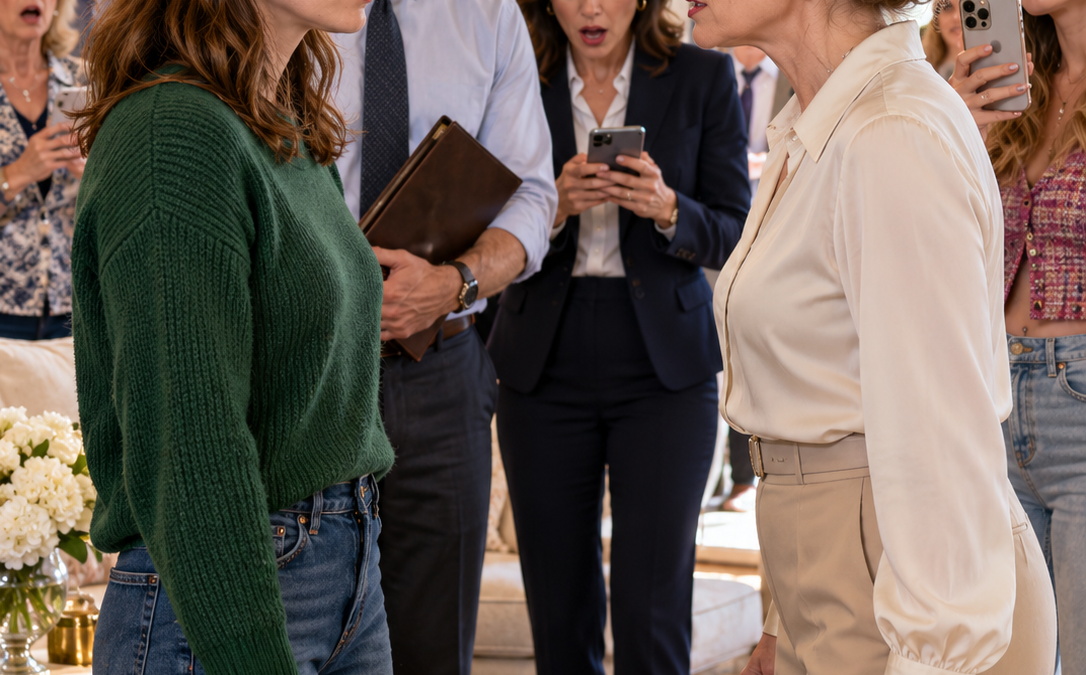
My mom slid the listing across Grandma’s kitchen table the way she used to slide me the check at restaurants. Face down, with two fingers, without looking at me.
“We’re selling,” she said. “You have sixty days to move out.”
I turned the page over. The first photo was my bedroom. My quilt. My scrubs on the hook behind the door. Somebody had stood in my room while I was at work and photographed it for strangers. Under the photo, it said $289,900.
Across the table, my sister Kendra already had her phone up, the little red dot glowing.
“Finally,” she said to the camera. “Good luck, loser.”
I didn’t cry. I folded the listing in half, then in half again, and said, “Okay.”
But my eyes went past my mother’s shoulder to the shelf behind her, to Grandma’s cedar recipe box, and to the envelope I had promised never to open unless someone tried to move me out.
The next morning, a lawyer read one line from that envelope, stood up, and locked his office door.
Welcome back to Calm Drama Stories. Here, we tell long family stories about daughters, sisters, and granddaughters who were overlooked for years until the day they finally stood up and protected the one thing that mattered most. Every story ends with courage, honest boundaries, and the quiet kind of justice that lets a person sleep peacefully again. Drop a comment and be sure to subscribe.
Mom had printed the listing in color on the heavy, glossy paper realtors use, and there was a yellow sticky note on the front that said, “1418 Larkspur — Priority.”
I had come home from a Sunday shift at the hospital an hour earlier, still in my teal-blue scrubs, and found her car in the driveway. She almost never came over. I had actually been glad.
“The probate court made me administrator in August,” she said, tapping the table with one nail. “I’m her only child. It’s mine to sell.”
Kendra, still filming, asked, “Can I have the dining chairs?”
I asked who had let someone into my room.
Mom looked at me like I had asked who paid for the sky.
“It’s my mother’s house, Bridget. I have a key. You’ve lived here rent-free for six years,” she added. “Most people would say thank you.”
I looked at the folded paper in my hand and asked one question.
“Did you look at anything of Grandma’s before you listed it?”
She laughed. Not a mean laugh, exactly. The laugh of a woman who had already decided how this would go.
“There’s nothing to look at. She left a house and a lot of old Tupperware.”
She picked up her keys.
“Sixty days is November twenty-eighth. Tamson will text you about showings. Please keep the bathroom clean.”
Kendra stopped recording, checked the clip, and smiled at it. Then they were gone, and the house was quiet in the way it only gets after somebody has taken something out of it.
I washed the three plates Mom had used for the cookies she brought and didn’t eat. I dried them, put them away, and then stood on a chair and took down the recipe box.
It still smelled like cedar and vanilla. Grandma had kept it on that shelf for fifty years, and I had never moved it. I flipped past chicken and dumplings, past pineapple upside-down cake, until I reached the card in the back that said “Peach Cobbler — Ruth” in her slanted blue handwriting.
Behind it was a thin manila envelope, soft at the corners.
On the front, in that same blue ink, she had written:
“For Bridget. If anyone ever tries to move you out, take this to Harold Brandt. Not before.”
Grandma had made me promise three years ago, and I had kept that promise every day since, even on the bad days when I wanted to know what she thought of me.
I held the envelope up to the kitchen light. I could see folded paper and something smaller tucked inside it.
I didn’t open it.
Somebody was trying to move me out. That meant before was over, and it meant the next step belonged to Harold Brandt, not to me.
I put the envelope in the inside pocket of my olive canvas jacket, the one that hangs by the back door, and zipped the pocket closed.
Then I set my alarm for 6:30.
At eleven that night, my phone started buzzing. It was Marisol from work.
“Is this you?”
There was a link.
Kendra’s video was fourteen seconds long. The caption said, “60-day countdown,” with a little house, a peace sign, and then #finally.
It already had a few hundred likes.
Someone had commented, “Who’s the loser? LOL.”
And Kendra had answered with a laughing face.
I watched it once with the sound off. Kendra had caught the exact moment I folded the listing. My face in that video did not look shocked. It looked like the face of someone who had done this before.
I didn’t comment. I didn’t text my sister.
I put the phone face down on the nightstand and lay there looking at the ceiling. And I thought about the first time my family had decided where I would sleep.
I was sixteen. Kendra was eleven and had just started competitive dance, and Mom decided Kendra needed my bedroom because it had the morning light and the wall that fit a mirror.
My things went down to the basement in black trash bags.
Down there, the ceiling was low enough that I could touch it flat-handed, and the dryer ran half the night. Nobody asked me.
Mom said, “You’re never home anyway.”
Which became true very quickly, because I got a job at the bakery on Wilmington Pike and took every shift they would give me.
Grandma noticed before anyone else did.
She started picking me up every Saturday morning in her Buick and driving me back to Larkspur Drive, where nobody had ever moved my things.
She taught me to make peach cobbler that first fall. She made me write the recipe on a card in my own handwriting. Then she took it, read it, and said I had the nutmeg wrong.
I rewrote it her way.
We ate at the same kitchen table, the oilcloth sticking a little to our elbows.
One Saturday, I offered to do her dishes before I had eaten, the way I did at home, and she put her hand flat on my wrist.
“You don’t have to earn a chair at my table,” she said.
I didn’t know what to say, so I ate.
When we were done, she tapped the cedar box with one finger.
“Everything important in this house is in here,” she said.
I thought she meant the recipes.
In February of 2017, Grandma slipped on the ice by her mailbox and broke her hip. She was seventy-seven. I was twenty-five, and I had just been accepted into a surgical technologist program in Columbus that started in March.
I had saved for it for three years. I had a deposit down on a studio apartment near the campus.
The day after Grandma’s surgery, Mom came to the hospital in Kettering and stood in the doorway of the room without taking off her coat.
I had a whole plan ready. If Mom took the weekdays for six weeks, I could start school and come home on weekends.
I said it to her in the hallway, quietly, because Grandma was sleeping.
“I can’t take her,” Mom said. “Kendra’s starting cosmetology school. She needs me.”
I said Kendra was twenty.
Mom said, “Exactly. She’s just getting started. You’re single, Bridget. You don’t have anything going on.”
Then she checked her phone and said she had a dentist appointment.
I walked down the hall to the vending machines, called the program office, and gave up my seat.
It took four minutes.
The woman on the phone was very kind about it.
I lost the apartment deposit, too, but I didn’t think about that until later.
That night, I moved into the spare room at Larkspur Drive with two suitcases and a box of work clothes.
I learned how to change a surgical dressing. I learned how to help a proud woman onto a toilet seat riser without making her feel like a patient. I counted her pills into a plastic organizer every Sunday night, and I wrote the counts down because that is what I do at work, and it calmed me.
At Easter that year, at Mom’s house, I heard her tell my aunt, “Bridget’s living at Mother’s rent-free now. Poor thing. It’s good for her.”
I was carrying a tray of deviled eggs.
I didn’t correct her. I set the tray down and went to get more napkins.
When I told Grandma about it later, she was quiet for a long time. Then she squeezed my hand.
“I saw what she did at the hospital,” she said. “I’m not as deaf as I let her think.”
Grandma got better, mostly. She walked with a cane after that, and she never drove again. But she was sharp and stubborn and funny, and she liked having me there.
I stayed.
I told myself it was temporary for about two years, and then I stopped telling myself anything.
I got a full-time job in sterile processing at St. Brendan’s Medical Center, the department in the basement that cleans, inspects, counts, and packs every surgical instrument in the building.
It was not the job I had wanted.
I was very good at it anyway.
Being useful became the way I stayed in the family.
When Kendra’s car insurance lapsed, I paid it for two years so she wouldn’t lose her license. When Mom had a crown that her insurance wouldn’t cover, I paid the $1,900 until she got back on her feet.
I cooked every Christmas dinner at Grandma’s. And every Christmas, Mom brought guests I hadn’t been told about and introduced me as, “My oldest. She lives with Mother.”
I kept thinking that if I was useful enough, long enough, she would look at me one day and see somebody she was proud of.
I know how that sounds now.
It made sense at the time.
It made sense for years.
In the fall of 2023, Grandma started to fade.
One night in October, she asked me to bring the recipe box to her bed. She didn’t open it. She found the envelope by feel and held it up so I could see the writing.
“If anyone ever tries to move you out of this house, take it to Harold,” she said. “Not before. Promise me.”
I promised.
She died in November at eighty-three, in her own bed.
At the funeral lunch, before the casseroles were even cold, Mom leaned toward me and asked, “So, what happens with the house?”
I said I would keep paying the property taxes for now.
Mom said, “Good.”
That was the whole conversation.
So I paid them. Three years of taxes. A new furnace when the old one quit in January, $7,400. The back porch steps.
I didn’t keep a tally to throw at anyone. The receipts were simply in my email, the way all of my life was in a record somewhere.
And on Monday morning, the day after Mom slid the listing across the table, I parked my car in front of a small brick office on Far Hills Avenue at 7:40 a.m.
The sign by the door said, “Brandt and Kearney, Attorneys at Law.”
I took the envelope out of my jacket pocket, held it against my chest, and went to find Harold.
The front door was unlocked, but the reception desk was empty, and the lights in the hallway were still off.
A man came out of a back office holding a mug of coffee and looked at my scrubs, then at my face.
He was in his forties, sleeves rolled up, tie not on yet.
“We don’t open till nine,” he said, not unkindly. “Can I help you?”
I said I needed Harold Brandt.
Something changed in his face.
“Harold was my father,” he said. “He passed two years ago. I’m Owen. I have his files.”
I told him my grandmother’s name, Ruth Hale, and Larkspur Drive.
He set his coffee down on the reception desk.
“Come on back,” he said.
His office had bookshelves on three walls and a window that looked out at the parking lot. He offered me a chair, and I said I would stand.
I never sit in offices. I don’t know why.
I stood by the window with my jacket still zipped while he took the envelope, turned it over to read my grandmother’s handwriting, and slid it open with a letter opener that looked older than both of us.
Inside, there was a letter folded in thirds, a photocopy of some kind of official document with a county stamp in the corner, and a smaller envelope sealed with three words on the front:
“For Diane.”
And underneath, smaller:
“Only if she asks why.”
Owen unfolded the letter and read the first line.
Then he stopped.
He didn’t read the second line. He put the letter face down on his desk, flat with his palm on it, and for a few seconds, he just looked at the wall.
Then he stood up, walked past me to his office door, closed it, and turned the lock.
The click was very loud in that small room.
“My father did that,” he said quietly, still facing the door. “Whenever somebody was about to hear something that would change the way they walked out of here. I used to think it was theatrical.”
He turned around and looked at me.
“Ms. Summers,” he said, “you need to sit down.”
I sat down.
It was the first time I had ever sat in a lawyer’s office.
Owen picked up the letter again and read the first line out loud so I would hear it in my grandmother’s words and not his.
“Harold, if my granddaughter is sitting across from you, then Diane has tried to sell my house.”
I put my hand over my mouth.
Not because I was surprised that Mom had done it.
Because Grandma had known.
Seven years ago, sitting in this building, she had known exactly what her daughter would do after she was gone, and she had written it down and hidden it behind a recipe for peach cobbler.
Owen slid the photocopy across the desk toward me.
“Do you know what this is?” he asked.
I didn’t.
“It’s a deed,” he said. “A copy of one. Your grandmother signed it in April of 2019. It transferred her house on Larkspur Drive to something called the Ruth M. Hale Revocable Trust.”
He explained it the way I explained a sterilization cycle to a new hire, plain and in order.
While she was alive, Grandma ran the trust herself and could change it whenever she wanted. When she died, the trust became permanent, and the person named to run it after her, the successor trustee, took over.
“That’s you,” he said.
He turned the letter so I could see the paragraph with my name in it.
Bridget Anne Summers.
And under that:
“The residence at 1418 Larkspur Drive to be distributed to my granddaughter, Bridget.”
“The house hasn’t belonged to your grandmother’s estate since 2019,” Owen said. “It belongs to the trust, and the trust, for all practical purposes, has belonged to you for three years. You just didn’t know.”
I asked him to show me. Not because I didn’t believe him, but because at work, I don’t sign off on a tray until I’ve counted every instrument myself.
He turned his monitor toward me and pulled up the Montgomery County Recorder website. He typed in the address.
Two clicks.
The deed came up on the screen, the same one that was on his desk, with a recording stamp from April 2019.
“This is public,” he said. “Anyone can see it. Your mother could have found it in five minutes.”
I asked who had signed it, who had witnessed it, and what day.
He read me the names and the dates.
Grandma’s signature. A notary named Patricia Voss. March fourteenth, 2019, on the trust itself. The deed recorded in April.
I wrote it all in the Notes app on my phone.
Then I asked the question that had been sitting in my chest since he locked the door.
“Mom said the probate court made her administrator. Doesn’t that mean she can sell it?”
Owen shook his head.
“It means she can handle whatever your grandmother owned when she died. Your grandmother didn’t own that house when she died. The trust did. Your mother has been given the keys to an empty room, and she thinks it’s the whole building.”
He said he needed to pull his father’s complete file from their storage company before he sent anything to anyone, to make sure the original trust and his father’s notes were where the letter said they were.
Two or three days.
Then I asked the thing I was most ashamed of asking.
“Will this hurt her?”
Owen leaned back in his chair. He didn’t laugh at me, which I appreciated.
“It will embarrass her,” he said. “That’s not the same thing.”
He unlocked the office door and opened it.
Out in the hallway, the lights were on now, and a receptionist was hanging up her coat.
I looked at my phone.
I was eleven minutes late for my shift.
I have been late to work maybe three times in nine years.
Sterile processing is in the basement of St. Brendan’s, past the loading dock and the linen carts, behind two sets of doors that need a badge.
There are no windows. There are washers the size of cars and the steady hiss of steam from the sterilizers. And there are rules for everything.
That afternoon, I was assembling an orthopedic tray for a hip replacement, and the count sheet said there should be four Hohmann retractors.
I counted three.
I counted again.
Three.
I didn’t sign the tray. I don’t sign a tray that’s short, no matter who is waiting on it.
It took me twenty minutes to find the fourth retractor stuck in the bottom of a washer basket. Then the tray was complete, and I signed it.
On my break, Marisol pulled up Kendra’s video on her phone and held it out to me without saying anything.
It had 14,000 views now.
Someone in the comments had written, “Isn’t that the girl from SPD at St. Brendan’s?”
And somebody else had tagged the hospital’s page.
My face got hot.
Marisol put her phone away and squeezed my shoulder and didn’t ask me anything, which is why she’s my friend.
When I went back on the floor, I stopped at the terminal to log my time, the way everybody does at the start and end of every shift. And I stood there with my badge in my hand, thinking that the hospital keeps every one of those time records for years.
I opened the Notes app and looked at the date I had written down in Owen’s office.
March fourteenth, 2019.
The day Grandma signed her trust.
I tried to remember that day and couldn’t. It had been a Thursday, probably a regular shift.
I didn’t know yet why it mattered.
I only knew that I keep records because records don’t change their minds later, and that my mother had been telling people for six years that I had moved in and taken over Grandma’s life.
At four o’clock, while I was loading the steam sterilizer, my phone buzzed in my pocket.
It was Owen.
“Storage is pulling Dad’s file. Should have it Thursday. Don’t sign anything anyone gives you.”
On Thursday, after my shift, I went back to Brandt and Kearney.
There was a banker’s box on Owen’s desk with “Hale, R. — 2019” written on the side in black marker, in an older man’s handwriting.
Owen had already been through it.
He looked tired.
“The original trust is here,” he said. “The will that goes with it is here. Everything your grandmother’s letter says is true.”
Then he folded his hands.
“I need to warn you about something. When a caregiver ends up with the house, the first thing the family says is undue influence. That you pressured her. That she was old and dependent, and you steered her. Courts take that seriously. Your mother is going to say it. I’d bet money.”
He pulled out a yellow legal pad covered in tight, slanted handwriting.
“This is my father’s,” he said. “He took notes on every meeting.”
He turned it toward me and pointed to a paragraph.
“Client called office herself to schedule. Driven to both appointments by neighbor, Mrs. J. Okafor. Granddaughter at work, not informed, not present at client’s insistence.”
Under that was a typed letter on a doctor’s letterhead.
Dr. Anand Mehta. March third, 2019.
“Mrs. Hale is alert, oriented, and fully capable of managing her own affairs and making decisions regarding her estate.”
Owen said, “Your grandmother knew exactly what her daughter would say. She built this whole thing so that you’d never be in the room.”
Then he pulled out one more sheet.
It was a list in Harold’s handwriting titled “Assets — R. Hale.”
The house to the trust. A small life insurance policy to the church. And a savings account at Day Air Credit Union, about $41,000, payable on death to Diane Summers.
Next to it, Harold had written, “Client wants D to have the cash outright. House to B.”
“A payable-on-death account goes straight to the person named,” Owen said. “No court, no will. The bank just pays it out. Your mother would have gotten that money a few weeks after the funeral.”
I sat very still.
Three weeks after the funeral, Mom had driven up to Christmas dinner in a brand-new silver Highlander. She had told everyone it was a bonus from work.
So Grandma hadn’t cut Mom out.
She had divided things exactly the way she wanted.
Mom had gotten the money. I had gotten the house I had already been living in and paying for.
And Mom had taken her share without a word.
Then she had come for mine.
And she had told the court Grandma left nothing but a house and old Tupperware.
I didn’t feel triumphant.
I felt like I had just found out the floor I had been standing on for years had been tilted on purpose.
Owen asked if I wanted him to send everything to the probate court and to the real estate brokerage the next day.
I said, “Let me talk to someone first.”
He nodded like he had expected that, too.
Mrs. Josephine Okafor has lived across the street from my grandmother’s house since 1979.
She is seventy-six. She still mows her own lawn, and she was Grandma’s best friend for four decades.
On Friday afternoon, I knocked on her screen door, and she was already on her way out to the porch with two glasses of iced tea, as if she had been waiting.
I asked her if she remembered driving my grandmother somewhere in March of 2019.
She set her glass down.
“In the rain,” she said. “In my old Buick. She wore her good blue coat. She said it was her business coat.”
Joe looked across the street at the house.
“She told me in the car, ‘Diane will want it the day after I’m gone. Bridget won’t ask for anything. That’s the problem.’”
Then Joe told me something I didn’t know.
“Last Tuesday,” she said, “around ten in the morning, your mother let herself into Ruth’s house with a woman in a blazer and a young man carrying big lights on stands. They were in there two hours.”
The photographer.
The listing photos of my bedroom.
“I went over,” Joe said, “and your mother told me very sweetly that her daughter had been squatting in that house for years, and they were finally sorting it out.”
Joe’s mouth went flat.
“I told her, ‘Squatters don’t pay for the furnace.’”
I laughed, and it came out wrong.
Half a sob.
Joe waited.
Then she said she would tell anyone who asked what she had seen, any day of the week.
I thanked her. I said I hoped it wouldn’t come to that. I said I wanted to give Mom a chance to stop on her own, quietly, before anyone else had to get involved.
Joe looked at me for a long moment over her iced tea.
She has very sharp eyes for a woman her age.
“Your grandmother planned for your mother,” she said. “She planned for every single thing your mother would do. The one thing she didn’t plan for was you being too kind to use it.”
I didn’t answer that.
I didn’t have an answer.
I walked back across the street to the house that was mine and had been mine for three years, and I let myself in through the garage the way I always did.
That evening, I called Owen from my car in the hospital parking garage, where I had gone back to pick up a sweater I had left in my locker.
I told him what I wanted.
A letter to my mother, only to her.
Not to the court. Not to the real estate company. Not to anyone else.
A copy of the deed. A plain explanation that the house belonged to Grandma’s trust and that I was the trustee.
And seven days for her to cancel the listing herself, quietly, so that nobody else ever had to know she had made a mistake.
Owen was silent long enough that I checked whether the call had dropped.
“You’re giving her a week to make this worse,” he said finally.
“I’m giving her a week to be my mother,” I said.
I heard how it sounded as soon as it was out of my mouth, and I didn’t take it back.
Owen sighed, the way I imagine his father used to sigh at clients who were about to do something kind and expensive.
He said it was my decision and he would write it that night.
He did.
He sent it to her email at twelve minutes past six that evening, and by certified mail the next morning, with the copy of the recorded deed attached.
He forwarded me the receipt.
Delivered. Opened at 6:40.
Then nothing.
No call. No text. Not even an angry one.
I told myself that silence meant she was thinking.
On Monday, I came home at six o’clock, and the garage door was already open.
Eleven cardboard boxes were stacked against the wall where my car goes. They were labeled in thick black marker, in a handwriting I didn’t recognize.
“B. Closet.”
“B. Bathroom.”
“B. Books.”
Inside the house, half of my clothes were gone from the closet, and a young woman I had never seen was arranging decorative pillows on my grandmother’s couch.
Pillows that didn’t belong to anyone I knew.
She looked up and smiled.
“You must be the tenant,” she said. “I’m with the staging company. We’re almost done.”
And then Mom came out of the kitchen holding Owen’s letter, printed out and folded the way she had held the listing.
“A letter from Harold’s kid,” she said. “That’s cute. Harold was ninety and senile.”
I said Harold had been seventy-four and that Grandma signed her papers in 2019, when she was doing the crossword in pen.
Mom didn’t argue with that.
She changed directions instead, so smoothly that I almost didn’t notice.
“You lived with her,” she said. “You drove her to every appointment. You did her pills. You did her mail. Any judge in Ohio is going to take one look at that and see exactly what you did.”
She said it in front of the stager, who suddenly needed something from her car.
“Don’t make me the bad guy in front of your sister, Bridget. Don’t you dare.”
Then she softened all at once.
And I knew that voice better than any other voice she had.
She took a pen out of her purse and set it on the kitchen table next to a single printed page.
“Here’s what we’ll do,” she said. “Three thousand dollars in moving help. You sign this. It just says you’re not claiming anything on the house, and I’ll write you the check tonight. Then this is over. We can be fine again. We can be fine.”
I looked at the page.
“A Simple Release,” it said at the top.
I looked at the pen.
Something in my chest leaned toward it.
The old part of me that had been waiting since I was sixteen for her to say we were fine.
I didn’t pick up the pen.
I didn’t tell her about Harold’s notes, either. Or Joe. Or the savings account.
I still wanted her to have the chance to walk away without hearing any of it.
I just said, “I’m not signing anything, Mom. Please read the letter again. Please call the lawyer.”
She looked at me for a second like she didn’t recognize me.
Then she picked up the release and the pen and put them back in her purse.
On her way out, she held up her key ring and let it jingle once.
Grandma’s brass back-door key was swinging from it.
It wasn’t a goodbye.
It was a reminder that she could come back whenever she wanted.
I opened all eleven boxes after she left.
I put my clothes back on their hangers, my books back on the shelf, my toothbrush back in the cup by the sink.
It took me until one in the morning.
The stager’s pillows I stacked neatly by the front door because none of this was her fault.
At some point while I was hanging up my scrubs, I realized I was counting the hangers.
Fourteen. Sixteen. Twenty-two.
That’s what I do when I’m frightened. I count things until the numbers come out the same twice, and then I can breathe.
I counted my hangers twice, and then I sat down on the edge of the bed I had slept in for six years and cried for the first time since Sunday.
On Tuesday, Kendra posted again.
It was a slow pan across the boxes in the garage, filmed the day before while I was at work, with a sad violin song playing over it.
The caption said, “Packing up the loser’s whole life. Open house Saturday,” with a little cardboard box at the end.
By lunchtime, it had more views than the first one.
That afternoon, a text came from a number I didn’t have saved.
“Hi Bridget, this is Tamson Reyes with Hearthline Realty. Just a reminder, we’ll need the house vacant Saturday from 10 to 2 for the open house. Please make sure personal items are put away. Thanks so much.”
It was polite.
It was the kind of message you send to a tenant.
It was not the kind of message you send to an owner.
I read it three times.
Tamson didn’t know.
If she had seen Owen’s letter, she would never have written that, which meant my mother had read a lawyer’s letter telling her she had no right to sell the house, and she had folded it up and kept it in her purse and told the realtor nothing.
She hadn’t used my seven days to stop.
She had used them to move faster.
My charge tech stopped by the break room and asked if I was okay because some people online were tagging the hospital, and she wanted to make sure nobody was bothering me at work.
I said I was fine.
I went home after my shift, took the cedar recipe box down from the shelf, and set it on the kitchen table.
Inside Grandma’s envelope, there had been one more page.
Owen had photocopied everything and given me back the originals, and this one was addressed to me.
I hadn’t been able to read it at his office.
Now, I unfolded it.
“My Bridget,” it began.
“I’m sorry I let you take care of me so long. You gave me years you were saving for yourself, and I let you because I was selfish and I liked your company. Your mother will come for this house with papers and then with tears. She will tell you that keeping it makes you a bad daughter. It doesn’t.”
And then, near the bottom, a line she had underlined twice.
“Don’t let them make you pay for a chair at this table. It was never for sale.”
I sat there for a long time.
Through the window over the sink, I could see the garage with three of the empty boxes still flattened against the wall.
On the refrigerator, held up by a magnet shaped like a peach, was the listing, still folded in quarters the way I had folded it on Sunday.
I had put it there without thinking, the way you put up a bill you haven’t paid yet.
And I understood something I should have understood years ago.
Protecting my mother from embarrassment was just one more bill I had been paying for her.
I had been paying for her comfort my whole life and calling it love, waiting for the receipt to say thank you.
At 9:40 that night, I called Owen at home.
He picked up on the second ring, like he had been expecting me.
“Send it all,” I said. “The court, the real estate company, whatever has to be recorded tomorrow.”
He didn’t say I told you so.
He said, “Okay. I’ll be at the recorder’s office when it opens.”
After I hung up, I took the listing off the refrigerator, unfolded it, and smoothed it flat on the table.
My bedroom.
My quilt.
$289,900.
Then I folded it back up and put it in the cedar box behind the cobbler recipe, where the envelope used to be.
Not because I wanted to keep it.
Because at work, we keep the record of every mistake so nobody can say later it never happened.
Wednesday went fast. At 8:30, Owen filed what Ohio calls a successor trustee affidavit at the Montgomery County Recorder’s Office. He explained that it didn’t create anything new.
“Your title never depended on this paper,” he said. “But now the county’s own records say your name in black and white next to that house.”
By eleven, he had filed a notice in my mother’s probate case with copies of the trust and the deed, so the court would see that the house was never part of Grandma’s estate. And he sent a letter by email and certified mail to the managing broker at Hearthline Realty, telling them the property they had listed was owned by a trust and that the person who had signed their listing agreement had no authority to sell it.
I did my part, too. On my lunch break, I went up to human resources and asked for a printout of my time records for March 2019. The woman at the desk raised her eyebrows but printed them without asking why.
Thursday, March fourteenth, 2019.
Clock in: 5:56 a.m.
Clock out: 4:31 p.m.
My supervisor’s initials were at the bottom of the page. I folded it once and put it in my bag.
After work, I stopped at Joe’s porch and told her there was going to be an open house on Saturday.
“And you’d like an old woman to come and be nosy,” she said.
I said yes, if she didn’t mind.
“Mind?” she said. “I’ll wear my good coat.”
That night, Owen called with one problem. Hearthline’s managing broker was on vacation until Monday, and the assistant who had opened the mail had said she would pass it along.
He had also learned that the title company Tamson used had been ordered to run a preliminary title report on the house and would send it by the end of the week.
“Once a title report comes back saying the owner is a trust,” Owen said, “an agent can’t pretend she didn’t see it. But if your mother tells them the lawyer’s letter is just a family squabble, they might wait for the broker to get back.”
I asked what he thought she would do.
He said, “I think you already know.”
On Thursday evening, my mother posted in the Kettering Neighbors group on Facebook.
“Open house this Saturday, 10 to 2. My late mother’s beautiful home on Larkspur. Finally ready for a new family to love it. Come by.”
There was a photo of the front porch with Grandma’s hanging fern, which I watered every other morning.
Forty people liked it.
Somebody commented, “Ruth’s house. She was the sweetest lady.”
My mother replied with a heart.
An hour later, Kendra posted a story with a picture of a bowl of popcorn and the words, “Livestream Saturday. You do not want to miss this one.”
On Friday afternoon, Tamson texted me again, a little cooler this time.
“Your mom says the attorney letter is a family matter her lawyer is handling. Please have the house tidy for Saturday. Thank you.”
So that was the answer.
My mother had read the letter, and she had read the deed, and she had decided that if she said family matter firmly enough, everyone would let her keep going.
I didn’t call her. There was nothing left to say on the phone that the papers didn’t already say.
On Friday night, I didn’t iron scrubs for the morning because I had asked for Saturday off. I ironed my green wool sweater instead, the one Grandma gave me the last Christmas she was alive, and hung it on the closet door.
I set the cedar box on the kitchen counter where I would see it in the morning.
Then I slept surprisingly well for the first time in almost a week.
Owen picked me up at ten minutes to ten on Saturday morning because I did not want to arrive in my own car and park in my own driveway behind a stranger’s.
From the end of Larkspur Drive, I could already see it.
A For Sale sign planted right in the middle of Grandma’s flower bed, between the daylilies and the peony bush. The soil was kicked up around the post. White balloons were tied to the mailbox, and six cars were parked along the curb.
Through the front window, I could see Kendra in the living room with her phone on a selfie stick, talking and laughing.
Owen turned off the engine.
“Do you want me to do the talking?” he asked.
“No,” I said. “You do the paper. I’ll do the talking.”
Across the street, Joe’s front door opened. She came down her steps in a long camel coat with gold buttons, holding the railing, and crossed the street without hurrying.
She looked like she was going to church.
I got out of the car.
I had a canvas tote bag over my shoulder with a copy of the deed, my time records, and Grandma’s letter to me, though I didn’t plan to read that to anybody.
For six years, I had come and gone through the side door from the garage like I was the help.
That morning, I walked up the front steps of my grandmother’s house, my house, and pressed the doorbell.
I heard the three-note chime Grandma had picked out in 1985.
Tamson opened the door with a bright smile that faltered when she saw me. She was about forty, in a navy blazer, with a clipboard of sign-in sheets.
Behind her, the living room smelled like a vanilla candle that didn’t belong to us.
A young couple was standing by the fireplace, holding hands. Two women I recognized from down the street were peeking into the dining room.
Kendra swung her camera toward me.
“Chat,” she said, “the loser’s here.”
Then my mother came out of the kitchen in a cream blouse with her reading glasses pushed up on her head.
“You were told to be out by ten,” she said, smiling for the room.
I ignored her and turned to Tamson.
“Can I ask you something? Did a title company send you a preliminary title report on this house last night?”
Tamson blinked.
“I… maybe. It might be in my email. I haven’t had a chance to look.”
She glanced at my mother.
My mother said a little too fast, “Tamson, my attorney is handling all of that.”
Tamson hesitated, then took her phone out of her blazer pocket anyway.
I watched her scroll. I watched her open an attachment and pinch the screen to zoom in. I watched her read the line that said who owned the property.
And I watched her face change the same way Owen’s had changed in his office.
A stillness that comes over people when the ground shifts under them.
She looked up at me and then at my mother, and my mother’s smile froze exactly where it was, like a smile in a photograph.
Then Tamson turned to the room and said, in a very calm, professional voice, “I’m so sorry, everyone. I need to ask you all to give me five minutes.”
The young couple looked at each other. One of the neighbor women stopped pretending to look at the crown molding.
Kendra kept filming.
In the corner of her screen, I could see the number of people watching her livestream. It had been sitting at about forty. Now it jumped to a hundred, and then to three hundred as people started sharing it.
Owen stepped up beside me with his leather folder.
Joe had come in behind him quietly and stood just inside the front door with her hands folded over her purse.
My mother recovered first.
She always does.
“This is my mother’s house,” she said to Tamson, but loudly enough for everyone. “I am her only child. The probate court gave me letters. I have the paperwork.”
Owen opened his folder.
“Mrs. Summers, the court appointed you to handle your mother’s estate,” he said. “And the house was never in her estate. In April of 2019, Ruth Hale deeded it to her trust. This is the recorded deed.”
He held up the copy with the county stamp.
“And on Wednesday, Bridget filed as successor trustee with the county recorder. That’s public, too.”
Tamson nodded slowly, still looking at her phone.
“The title report says the same thing,” she said. “The owner of record is the Ruth M. Hale Revocable Trust.”
“That trust is fake,” my mother said.
Her voice went up half a step.
“Harold Brandt was a senile old man, and anybody can print a piece of paper with a stamp on it.”
I spoke then for the first time since I had asked Tamson my question.
I kept my voice low because that’s how you get a room to listen.
“It’s on the county’s website, Mom. You can look it up from your phone right now. You could have looked it up in August before you went to court. It takes about five minutes.”
Tamson turned her screen so the young couple could see it.
The man leaned in to read. Then he looked up and asked Tamson very quietly, “So, who are we buying the house from?”
Tamson said, “Right now, no one.”
That was when it changed.
You could feel it in the room, the way you can feel the air change when the sterilizer door opens.
The neighbor women looked at my mother differently. The young couple took a step back toward the door.
Tamson closed her clipboard.
“Diane,” she said, “I can’t continue this showing. I’m going to have to call my broker and pause the listing until this is resolved.”
My mother stared at her.
Then she turned, not to me, but to Kendra’s phone, to the three hundred strangers watching it, and put her hand flat on her chest.
“Do you all want to know how she got it?” she said. “Do you want to know what she did to my mother?”
“She moved in,” Mom said to the camera. “She took over everything. My mother couldn’t drive, couldn’t do her own pills, couldn’t do her own mail. And then suddenly there’s a lawyer and a trust, and my daughter gets the house. She drove my mother to that lawyer, and she stood over her while she signed.”
I reached into the tote bag and took out the folded printout from human resources.
I didn’t hand it to her. I held it up so Tamson and Owen could see it.
“March fourteenth, 2019,” I said. “The day Grandma signed. I clocked in at St. Brendan’s at 5:56 that morning, and I clocked out at 4:31. My supervisor initialed it. I was in the basement of the hospital all day.”
Owen opened his folder again and read from Harold’s notes without any drama, the way you would read a weather report.
“Client called office herself to schedule. Driven to both appointments by neighbor, Mrs. J. Okafor. Granddaughter at work, not informed, not present at client’s insistence.”
Then he held up the letter from Dr. Mehta.
Her physician had examined her eleven days before she signed and written that she was fully capable of making her own decisions.
And then Joe stepped forward from the doorway in her camel coat with the gold buttons.
“I drove her,” Joe said. “In my Buick. In the rain. Bridget was at the hospital. And Ruth told me in the car, ‘Diane will want it the day after I’m gone.’ She was right.”
My mother’s face went through about four different expressions.
Then she landed on the last one she had.
“Fine,” she said. “Then she owes me. My mother left me nothing. Nothing. I’m her daughter, and I got nothing.”
And that was the moment I looked straight at my mother, which I realized I hadn’t done in a very long time.
“Grandma’s savings account at Day Air Credit Union,” I said. “Forty-one thousand dollars, payable on death to you. You picked it up three weeks after the funeral. That’s the silver Highlander parked out front.”
Nobody in the room said anything.
One of the neighbor women actually turned and looked out the window at the car.
Kendra slowly lowered her phone until it was pointing at the floor.
My mother looked at Kendra.
“Turn that off,” she said.
Kendra turned it off, but a livestream doesn’t disappear when you stop it.
It had been saved, and three hundred people had already seen it, and some of them had already started clipping it.
I didn’t think about that then.
I only knew that I was standing in my grandmother’s living room in her green sweater, and my hands weren’t shaking anymore.
I held out my open palm toward my mother.
“I need your key, Mom,” I said.
She looked at my hand like it was a stranger’s.
“I’m not giving you anything,” she said.
“That’s all right,” I said. “The locksmith comes at four. I already called him this morning.”
Tamson went out to the front porch and unhooked the lockbox from the door handle.
When she came back in, she apologized to me directly, which she didn’t have to do.
She said she had been shown court papers naming my mother as administrator and had had no reason to doubt them. She was sorry anyone had gone into my bedroom, and she said the listing would be withdrawn by Monday.
The young couple left first. On her way out, the woman touched my arm and said, “I’m really sorry.”
And I believed her.
The neighbors left after that, much more slowly, and Joe stayed by the door like a guard until the very last one was gone.
Then my mother walked out without a word, holding her purse against her side, her chin very high.
Kendra was the last one out.
Tamson asked her politely if she would mind pulling up the sign on her way to the car, since the sign was Hearthline’s and Tamson’s hands were full of sign-in sheets and candles.
Kendra yanked the For Sale sign out of Grandma’s flower bed with both hands and carried it to the curb.
It left a deep square hole in the dirt between the daylilies and the peony bush.
I stood on the porch and watched her drive away.
At 4:15, the locksmith changed every lock in the house. He gave me three new keys on a ring.
I put two in the kitchen drawer.
The old brass key, Grandma’s original, I wrapped in a paper towel and put in the cedar recipe box.
A week later, on a Saturday night, a little after nine, my mother came back.
She came alone.
No Kendra. No phone. No makeup.
She didn’t ring the bell. She knocked on the frame of the screen door softly, the way you knock when you’re not sure you’ll be let in.
I didn’t unlatch the screen.
We talked through it with the porch light on between us.
She was crying, and it wasn’t the performance kind.
I know the difference.
“Why would she do this to me?” she said. “Why would my own mother do this?”
She told me that a year ago, she had signed a personal guarantee on the lease for Kendra’s Lash Studio. The studio had never opened, and now the landlord was demanding $28,000, and she didn’t have it.
She had been counting on the house.
“You could take out a home equity loan,” she said. “On the house. It’s paid off. They’d give it to you in a week. You’d be saving your sister, Bridget.”
She wiped her face with the back of her hand.
“That’s what family does. That’s what you do. You’ve always been the one who takes care of things.”
And I almost did it.
I want to be honest about that.
My hand actually went to the latch on the screen door, and the words were already in my mouth. The words I had said a thousand times in my life.
Let me think about it.
Let me see what I can do.
They were the words that kept me sleeping in a basement and paying other people’s bills.
I took my hand off the latch.
I reached into the pocket of my cardigan and took out the small sealed envelope from Grandma’s packet, the one that said, “For Diane. Only if she asks why.”
I had carried it there all week.
“You’re asking why,” I said. “Then I think this is yours.”
I opened the screen door just wide enough to hand it through, and then I closed it again.
I told her the upright piano that had belonged to her own grandmother and Grandma’s pearls had been left to her in the trust, and that Owen had arranged a moving truck for next Saturday.
She held the envelope in both hands and didn’t open it.
I never found out what was inside.
It wasn’t mine.
“And no, Mom,” I said. “I’m not taking a loan on this house. I’m not signing anything. And I’m not putting anybody’s debt on this house. Not yours. Not Kendra’s. Not ever.”
She started to say something, and I kept going quietly because I had practiced this part in the shower all week.
“I’m not paying for a chair at this table anymore, Mom. It was never for sale.”
I told her nobody came into this house without being invited. I told her that if she wanted to call me on Sundays and talk about anything that wasn’t money, I would pick up.
Then I said good night, closed the front door gently, and turned the deadbolt.
I stood there with my hand flat against it.
I heard her stand on the porch for a while. Then I heard her go down the steps one at a time, and her car start and pull away.
I didn’t open the door again.
At 9:30, the porch light clicked off on the timer Grandma had set years ago and I had never changed.
In the weeks that followed, things settled the way they do after a storm, slowly and unevenly.
After Owen’s notice, my mother’s lawyer advised her to withdraw her application in probate court, and she did. She paid the court costs.
Hearthline formally withdrew the listing.
Kendra deleted both of her videos, but the saved livestream had already been shared in the Kettering Neighbors group, and people there have long memories.
The lash studio lease fell through completely.
About three weeks after the open house, Kendra sent me a text.
“I shouldn’t have filmed you. I’m sorry.”
I wrote back, “Thank you.”
That was all, and it was enough for then.
The movers delivered the piano and the pearls.
My mother didn’t call the first Sunday or the second.
On the third Sunday, she called and talked about the weather for four minutes and then said she had to go.
I said, “Okay.”
It wasn’t a reconciliation.
It was a phone call about the weather, with nobody asking anyone for anything.
And that was new.
In January, Owen recorded the final deed that moved the house out of the trust and into my name.
In May, I dug up a piece of Grandma’s old peony bush from the side of the house, the way she taught me, with a sharp spade and plenty of root.
I carried it around to the front flower bed and planted it in the square hole the For Sale sign had left.
The hole was still there, just a little softer around the edges.
I packed the dirt down with my hands, watered it, and sat back on my heels in the grass.
Then I repainted the mailbox.
Grandma’s name, Hale, was still on it in white letters, and I left it underneath. With a small brush and a lot of patience, I added Summers.
I had been living at this address for ten years.
It was time the mailbox knew it.
That same month, I started evening classes at Sinclair in Dayton, in the surgical technology program, the same kind of program I had given up a seat in when I was twenty-five.
I’m still in sterile processing during the day.
I’m still counting instruments, but now I’m also learning what happens to them after they leave my hands.
On Saturday morning, I made peach cobbler from the card in Grandma’s handwriting.
When it came out of the oven, Joe came across the street in her gardening clogs, and I didn’t stand at the counter to serve her.
I cut two pieces, sat down at Grandma’s kitchen table, and slid a plate across it to Joe, across the same oilcloth where my mother had slid that listing.
Joe took a bite, chewed, and made a face.
“She’d say it needs more nutmeg,” she said.
I laughed.
I said I had been thinking the same thing for nineteen years.
After she went home, I took a blank card from the drawer and wrote out the recipe in my own handwriting, with more nutmeg.
At the top, I wrote, “Peach Cobbler — Bridget’s Way.”
I put the card in the cedar box, right in front of Grandma’s.
The listing was still in the back of that box, folded in quarters behind everything else, where it belonged.
Then I opened the screen door to let the spring air in.
And I left it open.
If your family ever treated your home like something they could sell out from under you, what would you have done in my place? Tell me in the comments.
And if this story stayed with you, subscribe, because there are more stories like this one.








