My mom moved overseas with my sister and left me in foster care; 10 years later, she returned, begging to be part of my life, but i wasn’t the same child she had abandoned…
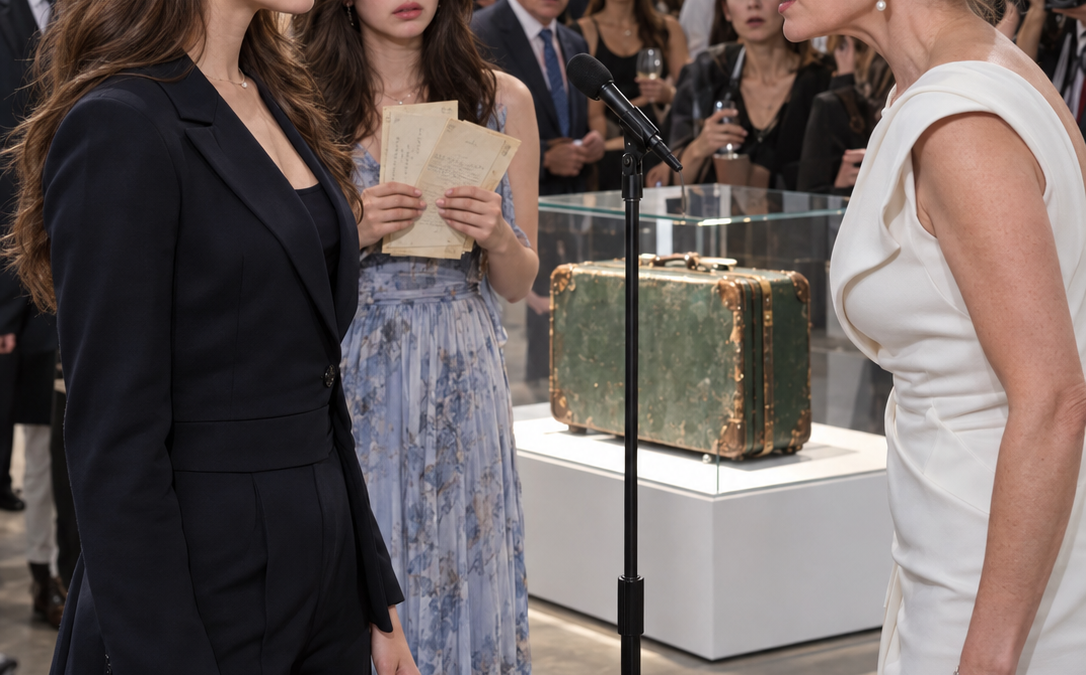
The real suitcase sat beneath a hard white light, its cracked plastic corners held together with silver tape, exactly as they had been on the morning my mother, Clara, drove me to the Lakeshore Youth Assessment Center.
I had been twelve.
My sister, Lily, was nine. Our father, Daniel, had died five years earlier, and after that, Clara divided our small family into two categories: the child who made life easier and the child who remembered too much.
I remembered the unpaid bills hidden behind the cereal boxes. I remembered her new boyfriend calling from London after midnight. I remembered hearing him say he had room for one uncomplicated child, followed by my mother’s silence.
Lily was gentle, trusting, and young enough to accept whatever story Clara gave her.
I asked questions.
That difference decided which of us received a plane ticket.
Clara told me the assessment center was a temporary program for children struggling with grief.
“Three weeks,” she promised as she zipped my clothes into the green suitcase. “You’ll paint, talk to someone, and come home stronger.”
She even let me bring Howard, the worn brown bear I had slept beside since my father’s funeral. Lily hugged me in the hallway and said she would save the window seat for our summer trip.
Clara stood behind her, one hand on the car keys, and would not meet my eyes.
At the center, a receptionist placed a paper wristband around my arm while Clara signed forms at a counter. I kept watching the door because she had promised to wait.
When I finished answering questions, her chair was empty.
The counselor who found me there was named Mara Patel. She sat across from me with the careful expression adults use when they know the truth will rearrange a child’s life.
Clara had not enrolled me in a three-week grief program.
She had requested emergency state placement, claimed I had severe behavioral problems, and listed no relative willing to take me.
Her flight to London had departed forty minutes earlier.
Lily was beside her.
I called my mother’s number until the recorded voice told me the line had been disconnected.
I wrote Lily three letters that month. In the first, I told her the program was taking longer than expected because I did not want her to be scared. In the second, I asked whether she liked London.
In the third, I stopped protecting our mother and wrote, “She left me here. Did she tell you why?”
None of those letters received an answer.
Years later, I would learn that Clara had intercepted all of them.
At my first family court hearing, she appeared by video from a polished apartment in London and told the judge that relocating me would be disruptive to my treatment. I tried to interrupt, but her attorney called my reaction proof of instability.
The court ordered a reunification plan.
Clara missed every scheduled counseling session, then signed a voluntary termination agreement eight months later.
She kept Lily, her new life, and the story that I was receiving specialized care in America.
The state kept me.
That evening, Mara returned my green suitcase and told me I would be going to a foster home. Inside, I found Howard, two shirts, one pair of jeans, and a folded airport brochure for London that Clara must have packed by mistake.
A red circle had been drawn around two seats on the flight map.
There had never been a third seat.
For ten years, I kept that brochure.
Now it rested inside the first display case of my exhibition beside Clara’s signed placement request. Visitors would eventually read the sentence she had written in her own hand:
International relocation is not appropriate for Emma at this time.
Appropriate for whom?
That was the question I had built an entire room to answer.
The second room of the exhibition was built around a narrow red ledger. Mara had given it to me during my first week in foster care because I kept asking questions no adult could answer.
She suggested I record every promise people made. Not because all promises were lies, but because writing them down would stop me from believing I had imagined them.
My first foster parents, the Whitakers, promised I could call London after dinner. When I asked for the phone, they said international calls were expensive and reminded me that gratitude was part of healing.
They received a monthly allowance for my care, yet I wore donated clothes and learned to hide crackers in my backpack because the kitchen was locked after seven.
Their favorite phrase was, “You’re lucky to be here.”
I wrote it in the ledger seventeen times.
I stayed with them for eleven months, until Mara discovered that several receipts submitted in my name were for furniture that never entered the house.
My second placement looked kinder.
Teresa Bell called me her little artist, framed one of my drawings, and told everyone at church that love had rescued me. Then she began selling photocopies of my work at weekend markets without telling me.
When I objected, she said everything I created under her roof belonged to the family.
That sentence went into the ledger, too.
I was moved again after she forged my signature on a youth arts grant.
By fifteen, I had lived at four addresses and could pack the green suitcase in less than six minutes. I stopped decorating bedrooms. I stopped learning neighbors’ names.
What I did not stop doing was drawing.
Art was not a magical cure, and I never pretended it was. It was evidence.
If I could put a locked kitchen, an empty chair, or a disconnected phone line onto paper, then the experience became something outside my body that I could examine.
Mara noticed.
She brought me discarded matboards from the county office and introduced me to Elena Ruiz, an art teacher who ran free Saturday workshops above a public library.
Elena never called me brave. She never asked me to turn pain into something inspirational for adults. She taught me perspective, composition, archival glue, and the difference between expressing a memory and surrendering control of it.
At sixteen, I created a charcoal triptych called Two Passports and a Wristband.
It won a city youth competition. The prize was small, but the local paper printed my name.
Clara saw it online.
Her first contact in four years was not a phone call. It was an email to the competition director asking that my family history be removed from the caption because it could damage a minor’s recovery.
She copied no apology to me. She asked no question about my life.
She simply tried to edit the truth from another country.
Elena saved that email. Mara saved the placement records.
I saved everything else.
On my eighteenth birthday, I aged out of care with two scholarships, three boxes of drawings, the green suitcase, and the red ledger. I rented a room with a woman from Elena’s church, worked at a print shop, and studied studio art at night.
Every time someone suggested that successful artists needed wealthy parents, I remembered how efficiently I had learned to build with scraps.
Four years later, the Halpern Contemporary selected me for its emerging artist residency and offered me a seven-room solo exhibition.
I named the show Unclaimed.
Not because nobody wanted me, but because I refused to let the people who abandoned me claim authorship of the woman I became.
While preparing the third room, I copied every broken promise from the ledger onto transparent sheets suspended from the ceiling. Viewers would have to walk through those sentences to move forward.
At the final sheet, I printed Clara’s newest message:
I never stopped trying to bring you home.
That lie was only three days old.
This time, I did not write it down to protect myself. I displayed it because I had finally learned that a documented lie could become a door, and I intended to make my mother walk through it.
I agreed to a video call the morning after Clara appeared outside the gallery. I chose the studio office, placed the white folder on the desk, and opened my laptop with the camera angled toward a blank wall.
If she wanted to study my face for signs of the frightened twelve-year-old she remembered, I would give her nothing but steady eye contact.
Clara appeared in a cream blouse with a small gold emblem pinned near her collar. Behind her was a temporary hotel suite, but she had arranged two framed photographs on the table: one of Lily at a school ceremony, and one of the three of us taken before my father died.
She had brought props.
“You look so much like Daniel,” she began, using grief as a key she assumed still fit.
Then came the practiced apology.
She had been overwhelmed. Her immigration status had been complicated. Her new husband had controlled the finances. She had believed the American care system could provide therapy she could not afford.
Every sentence placed her at the center of the tragedy.
“I made an impossible choice,” she said, pressing a hand to her chest. “I chose the path that gave both my daughters the best chance.”
I asked why the placement form described me as aggressive when no school or medical records supported that claim.
Her eyes moved slightly to the left.
“You were angry, Emma. Trauma can distort memory.”
I asked why she had terminated her parental rights.
She said her London attorney advised it.
I asked why she had blocked my letters to Lily.
For the first time, the performance cracked.
“Your sister was nine. I had to protect her from confusion.”
“Protect her from what? The fact that she had a sister?”
Clara inhaled, rearranged her expression, and moved to the reason she had actually called.
In London, she had founded the Whole Home Foundation, a family wellness charity preparing to open its first American branch. Its launch campaign was called Reunited by Choice.
Clara wanted Lily and me to appear beside her at the opening gala as proof that truth and forgiveness could rebuild any family.
She said the campaign could help thousands of children.
Then she slid the white folder closer to her camera, pretending I had not already seen it.
Our grandmother, Evelyn, had died six months earlier and left Brier House, a valuable lake property in Michigan, equally to Lily and me.
Clara had negotiated a sale through a development company connected to one of her foundation’s donors. Because the will bypassed her, the sale required both heirs’ signatures.
Lily had already signed.
Clara wanted mine.
A publicity release at the back of the folder would also give the foundation permanent rights to my image, childhood history, and artwork.
She was trying to purchase a reunion with property I already owned.
“Sign, attend the gala, and let me make this right,” she said. “We can stop living in the past.”
I asked her to email every document so my attorney could review it.
She smiled too quickly, believing caution meant interest.
After the call, I searched the foundation’s website.
Clara’s biography described her as a devoted mother who raised two daughters across cultures while advocating tirelessly to keep families together.
A stylized drawing of two girls holding hands appeared on every page.
I recognized the crooked sun in the corner.
I had drawn the original at age ten for my mother’s birthday.
Clara had taken my picture, removed my name, and turned it into a logo for an organization built on family preservation.
The site announced that I, acclaimed Chicago artist Emma Carter, would reveal a collaborative installation with my mother at the American launch.
I had never agreed.
She had already sold our reconciliation to donors.
I downloaded every page, saved the promotional video, and sent the files to an attorney Elena trusted.
Then I replied to Clara with six words.
I’m willing to hear you out.
It was not forgiveness.
It was permission for her to keep talking.
People who depend on lies often expose themselves when they believe the truth has finally surrendered.
But how much would she reveal if I let her think the daughter she abandoned still wanted a mother badly enough to sign anything?
Clara chose a restaurant overlooking the Chicago River for our first private meeting, a place with glass walls and tables far enough apart for secrets.
I arrived early and asked for a seat facing the entrance.
She came ten minutes late, wearing the same gold foundation pin, but she was not alone.
Lily walked beside her.
My sister was nineteen now, with our father’s dark eyes and the cautious posture of someone entering a room after an argument she had not heard.
Clara had not warned either of us.
She hugged me before I could decide whether to move.
“Look at you,” she whispered loudly enough for Lily to hear. “My beautiful girl.”
I did not return the embrace, but I did not push her away.
Clara mistook restraint for weakness and began directing the reunion like a stage manager. She ordered champagne, asked the server to take a photograph, and placed Lily beside me.
Lily kept studying my face.
Finally, she said, “Mom told me you chose to stay in Chicago because you had a scholarship at a therapeutic boarding school.”
Clara’s hand tightened around her glass.
There it was.
The story she had used for ten years.
I asked Lily what else she had been told.
She said I had refused calls because I blamed them for moving. She said Clara had shown her one returned envelope as proof that I wanted no contact.
I opened my bag and placed copies of my three childhood letters on the table.
Each carried an intake stamp from the assessment center.
None had been returned.
“I wrote these during my first month in state care,” I said.
Lily read the opening lines, then looked at our mother.
Clara leaned forward.
“Emma, not here. You promised to hear me out.”
I had promised nothing.
Still, I closed the folder.
I was not going to use Lily as a weapon by forcing ten years of betrayal into her hands between appetizers.
Clara had done enough of that to both of us.
I asked about Brier House instead.
Lily explained that Clara said the sale would fund the foundation’s American program and pay the remaining tuition at her London design school.
That claim did not match the contract.
The developer would send most of the proceeds to a private holding company, while the foundation received only a small community partnership fee.
I asked Clara who owned the holding company.
She smiled and said the financial structure was too complicated for dinner.
Then she pulled out a fountain pen and laid the signature page beside my plate.
“This can be the first thing we do together as a family.”
I turned the page over without signing it.
“A family does not begin with a release of claims.”
Lily went still.
The phrase appeared in the contract’s smallest print. By signing, I would waive any challenge to Clara’s management of our grandmother’s assets and any past use of my name or artwork.
Clara’s voice lowered.
“Your grandmother wanted peace. Don’t turn her final gift into another accusation.”
I asked why Evelyn had left the property directly to us if she trusted Clara to manage it.
Clara’s face hardened for one second before the smile returned.
She changed tactics and began speaking about Lily’s future, the tuition deadline, and the embarrassment a delayed sale might cause donors.
Each sentence asked me to prove my love by sacrificing something.
It was the same test the Whitakers had called gratitude and Teresa Bell had called family.
Only the tablecloth was more expensive.
I told Clara I would consider appearing at the foundation launch if it took place inside my exhibition on Friday.
Her eyes brightened.
She imagined cameras, reconciliation, and my signature delivered under applause.
I added one condition.
Lily and I needed time alone before any public event.
Clara objected immediately, then softened when I asked whether she trusted the daughters she claimed to have raised.
She agreed because refusing would expose her fear.
In the lobby, Lily slipped a folded napkin into my hand while Clara summoned the car.
A phone number was written inside with five words:
Please tell me what happened.
That night, I texted her one photograph—the placement form carrying Clara’s signature—and an address for the next morning.
My revenge had never included taking my sister away from our mother.
But the truth was already doing what I had not planned.
It was giving Lily a choice for the first time.
Lily arrived at my studio alone and without the foundation pin Clara had given her.
I had arranged the records chronologically across a worktable: the emergency placement request, the missed reunification sessions, the termination agreement, my letters, Clara’s email to the youth art competition, the Brier House contract, and screenshots of the foundation website.
I told Lily she could stop at any point.
She read everything.
The hardest moment was not anger.
It was recognition.
She remembered the London apartment on the night I disappeared from her life.
Clara had removed every photograph containing me before the movers unpacked. She told Lily that mentioning my name might trigger my illness and prevent my recovery.
For years, Lily had obeyed because she believed silence was an act of love.
At fourteen, she found an old photograph of us inside a cookbook and asked whether she could write to me.
Clara claimed my therapist had forbidden contact.
At seventeen, Lily searched for me online, but Clara discovered the browser history, showed her a fabricated email in which I supposedly asked to be left alone, and made her apologize for violating Emma’s boundary.
Lily took out her phone and showed me a screenshot she had secretly kept.
The fake message contained an American spelling error I would never have noticed, but it was dated two years before the email address existed.
Our mother had manufactured my rejection to keep both daughters from comparing stories.
Lily also brought access to a shared foundation drive. She had been doing unpaid design work for Clara and could see early campaign drafts.
One document described our reunion as a “high-emotion conversion event” expected to unlock three million dollars in American donations.
Another instructed staff to avoid the phrase foster care and instead say temporary therapeutic separation.
A private budget charged Clara’s flights, hotel suite, and attorney fees to a program for vulnerable families.
The final file was a memo from the Brier House developer.
Clara had promised the donor a discounted sale before our grandmother’s will cleared probate.
If I refused to sign, Clara would breach the agreement and expose the private holding company she controlled with her former husband.
The missing signature was mine.
But the trap was hers.
My attorney, Simone Grant, reviewed the material that afternoon.
She confirmed that Clara had no right to use my artwork, biography, or likeness. The estate contract contained misleading disclosures, and the foundation board had likely never seen the holding-company arrangement.
Simone advised me to preserve the evidence, send a formal notice forbidding further use of my identity, and allow the board and probate court to handle the consequences.
I agreed.
Revenge did not require me to invent a punishment.
It required me to stop shielding the person who had created one for herself.
We sent Clara the notice at four o’clock.
At 4:12, she called.
At 4:15, she called again.
By five, I had twenty-three messages.
The first five begged. The next seven blamed her former husband.
Then came anger.
You have always needed someone to be the villain, one message read.
If you embarrass me publicly, you will destroy programs that help real children.
The final message threatened to tell reporters that my years in care had made me unstable and obsessed with revenge.
I forwarded everything to Simone.
Then I completed the last piece of Unclaimed.
It was a mirrored wall covered by a vinyl reproduction of Clara’s foundation biography. Beneath the words raised two daughters, I cut a narrow opening at eye level.
Anyone reading the lie would see their own face inside it.
Lily chose to withdraw from the launch campaign and emailed the entire board from her own account.
She did not ask them to punish Clara.
She asked them to verify the documents before soliciting another dollar.
The board’s chair requested an emergency meeting for Friday afternoon, the same day as my exhibition.
Clara did not know Lily had written to them.
She still believed the gala inside my gallery would be her chance to regain control.
I let the public opening remain on the calendar and sent the board complimentary invitations.
Reporters had already been invited weeks earlier because Unclaimed was an art story.
Now Simone provided them with a concise evidence packet under embargo containing only records we were legally permitted to share.
No rumors. No anonymous accusations. No dramatic claims without proof.
Every consequence would begin with Clara’s own signature.
Before the doors opened, Lily asked whether exposing our mother would make us like her.
I looked at the green suitcase under its white light and answered.
“She used silence to take away our choices. We’re using the truth to give them back.”
At seven that evening, Clara entered the gallery in a white dress, smiling for cameras, completely unaware that everyone in the room had already read the document she needed me to hide.
Clara crossed the gallery with both arms extended, performing reconciliation before she reached me.
Camera shutters clicked.
Foundation donors gathered behind her, along with three board members, the Brier House developer, local arts reporters, Mara, Elena, Simone, and Lily.
My mother kissed the air beside my cheek and whispered, “We can still fix this if you behave like an adult.”
Then she turned toward the crowd and announced that Unclaimed was a testament to a family’s courageous journey back to love.
She had not looked closely at a single piece.
I stepped to the microphone and thanked everyone for coming.
My voice did not shake.
I explained that the exhibition contained seven connected works, each built from an object or record preserved during my ten years away from my family.
The first room held the green suitcase and the airport brochure showing two circled seats.
The second displayed the placement request in Clara’s handwriting.
The third forced visitors through the broken promises copied from my red ledger.
The fourth projected my unanswered letters beside the dates Clara told Lily I had requested silence.
The fifth showed my childhood drawing next to the foundation logo, with my original signature restored.
The sixth placed the Brier House contract over a transparent diagram of the holding company and its financial beneficiaries.
In the seventh, Clara’s public biography covered the mirrored wall.
As I spoke, the room changed.
Donors stopped smiling.
Board members moved closer to the documents.
The developer lowered his head and began typing on his phone.
Clara remained beside me, but the warmth vanished from her face.
“This is a private family matter,” she interrupted.
I looked at the foundation banner she had installed beneath my work.
“You made it a fundraising campaign.”
She reached for the microphone.
Simone stepped forward and calmly reminded her that the gallery had not granted permission for a speech.
Clara turned to Lily.
“Tell them,” she demanded. “Tell them I saved our family.”
Lily walked to the microphone, holding the three letters I had written when she was nine.
“My sister did not abandon me,” she said. “My mother lied to both of us, and I withdraw my name, my image, and my work from the Whole Home Foundation.”
She did not shout.
She did not insult Clara.
The quiet certainty of her words struck harder than any scene our mother could have accused us of creating.
The board chair then announced that Clara had been placed on immediate administrative leave pending an independent financial and governance investigation.
The American launch was suspended.
The foundation would contact donors directly and review every expense connected to the campaign.
The Brier House developer tried to leave through a side door, but two reporters were already asking about the holding company.
Clara stared at me as if I had pushed her from a height.
“You planned this,” she said. “You wanted to ruin me.”
I told her the records had been available to her for ten years.
All I had done was put them in frames.
She accused Lily of betrayal, Mara of interfering, the board of cowardice, and me of exploiting childhood pain for attention.
With every accusation, another person stepped away from her.
By the end of the night, she stood alone beneath the logo she had stolen from a child she left behind.
The consequences continued after the gallery closed.
Within forty-eight hours, the foundation removed Clara’s biography and announced a forensic audit.
The audit later found that she had charged personal legal fees, luxury travel, and image consulting to restricted family-support funds.
She was dismissed for cause.
A publisher paused her planned memoir after discovering that its central story—raising two daughters through adversity—was false.
Two speaking agencies canceled her contracts.
The Brier House sale collapsed, and the probate court barred Clara from participating in the property’s management while the financial conflict was reviewed.
She did not go to prison.
And I did not need her to.
She lost the career built on pretending she had protected children, the public reputation built on my silence, and the authority she had used to control both daughters.
Lily returned to London long enough to collect her belongings, then transferred to a design program in Chicago with scholarship support from the school, not from the sale of our inheritance.
She told Clara she wanted no contact until Clara could admit what she had done without blaming anyone else.
Clara sent me a final handwritten letter three weeks later.
It contained six pages of explanations and one sentence of apology.
I did not answer.
Instead, I asked Simone to communicate that all future contact had to go through her office.
Cutting ties was not a dramatic punishment.
It was the first boundary Clara could not rewrite.
On the final night of the exhibition, I stood alone in the seventh room and peeled Clara’s false biography from the mirrored wall.
Beneath it, I had painted one sentence.
I was never unclaimed. I belonged to myself.
Mara cried when she read it.
Elena squeezed my shoulder.
Lily stood beside me, not as the sister our mother had returned with, but as a woman choosing her own truth.
We decided not to sell Brier House.
After the estate settled, we leased it to a nonprofit that offered free studio retreats and legal clinics for young adults leaving foster care.
The income covered the property, and neither of us gave Clara control.
People later called the exhibition revenge.
Maybe part of it was.
I wanted my mother to experience one night in which she could not manage the story, erase a name, or leave before the truth arrived.
But the deepest victory was not watching her reputation collapse.
It was realizing that her regret did not create an obligation for me.
Ten years earlier, she chose the child she thought would be easier to love and left me to become someone else’s responsibility.
Ten years later, she came back expecting gratitude, forgiveness, and a signature.
She left with none of them.
I walked out of the gallery with my sister beside me, locked the door, and did not look back.
So tell me honestly: if someone abandoned you, rewrote your history, and returned only when they needed something, would you offer them another chance, or would you finally choose yourself?
We appreciate every viewer who stayed with this story from beginning to end.
Everything here is fictional imagery created for dramatic storytelling, reflection, and entertainment.
We hope the final message is this: after betrayal, disappointment, or unfair treatment, you still have the right to rebuild your confidence, protect your peace, and become someone who no longer needs to be chosen by those who failed to value you.








