My husband went to Miami Beach with his mistress, leaving me to take care of my paralyzed mother-in-law. At midnight, she stood up, handed me 20 gold bars, and revealed a shocking secret that left me speechless!
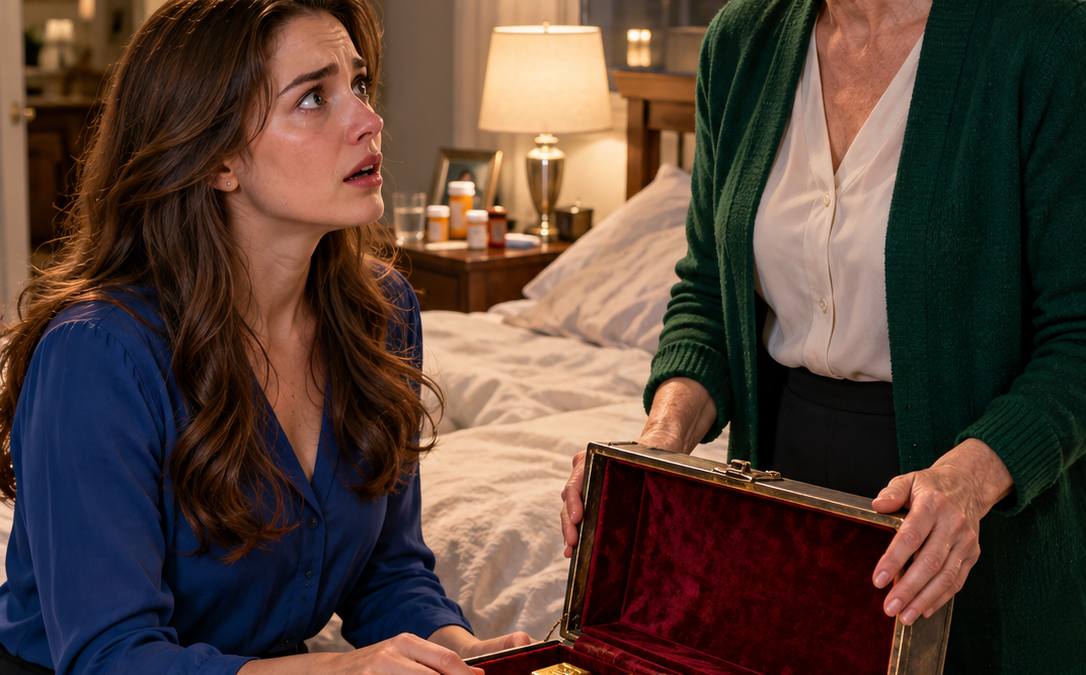
My husband took his mistress on a week-long vacation to Miami Beach, leaving me at home to care for my mother-in-law, who was paralyzed from the waist down. In the middle of the night, she suddenly stood up, handed me several old gold Eagle coins and heavy pieces of jewelry, and revealed a terrible secret that left me petrified.
My name is Amelia, and I’ve been married for six years. I used to believe that a happy life didn’t require luxury or wealth. As long as there was love between a husband and wife and understanding between a daughter-in-law and her mother-in-law, even the simplest house could become a warm and loving home.
My mother-in-law, Rose, was a woman in her late sixties. Before her illness, she had been remarkably healthy and hardworking, with a sharp tongue and a straightforward manner that sometimes made people uncomfortable. But she had never treated me unfairly. Years earlier, she had run a small neighborhood deli almost entirely on her own, saving every penny she could until she had enough to build the two-story house where we lived.
My husband, John, had once been a considerate man. He was always willing to lend a hand, whether that meant changing a light bulb for his mother, carrying groceries into the kitchen, or fixing something around the house after a long day at work. Sometimes, when he noticed how tired I was, he would ask whether I’d eaten and offer to pick up dinner on his way home.
But that was the John I remembered, not the man I was living with now.
A little more than a year earlier, something in him had changed drastically. He began coming home later and later, dressing in expensive-looking clothes, and paying far more attention to his appearance. His phone was always placed facedown on the table, and whenever I asked him a simple question, he answered with the impatience of a man being interrupted by a complete stranger.
Then, two months before that terrible night, Rose fell in the backyard while picking kale for a pot of soup. At first, I thought she had simply slipped on the damp ground. But when our family doctor, Dr. Miller, came to examine her, he told us she had suffered a nerve injury that had temporarily paralyzed her legs. She would need absolute rest, careful observation, and someone available to care for her around the clock.
From that day forward, nearly every responsibility in the house fell on my shoulders. I bathed Rose, washed her clothes, changed her bedding, fed her soup, massaged her legs, cleaned her room, and emptied her bedpan. Sometimes I barely had enough time to sit down before she needed something else. At night, the slightest cough from her bedroom would send me scrambling out of bed to make sure she was all right.
I never complained, because the truth was that I had grown genuinely fond of her.
Rose could be demanding, and she wasn’t the kind of woman who expressed affection through sweet words. But she had always been fair to me. On the day I first entered the house as her daughter-in-law, she had handed me her old recipe box and said, “You can consider this your home. If there’s something you don’t like, tell me to my face. I don’t like hypocrisy.”
Those words had stayed with me throughout our marriage. A mother-in-law like Rose, even with her blunt manner, deserved my respect.
John, however, had become the complete opposite of the person I had married. From the moment his mother became bedridden, he practically disappeared from the house, leaving early in the morning and returning late at night. Whenever I asked him to help, he acted as though I were imposing some terrible inconvenience on him.
One afternoon, I called him into Rose’s bedroom because I needed help lifting her so I could change the sheets. He stopped in the doorway, pinched his nose, and made a face.
“Can you hurry it up? The smell of medicine is unbearable.”
A lump rose in my throat. The woman lying helplessly in that bed was his own mother, the same woman who had worked herself to exhaustion raising him, and he spoke about her as though she were a disgusting burden that had nothing to do with him.
That evening, while I was preparing a basin of warm water to wash Rose, I heard the unmistakable rattle of suitcase wheels crossing the living room floor.
I stepped out of the bedroom and found John standing beside a black rolling suitcase. He was wearing a crisp white shirt, freshly pressed trousers, and enough cologne to make my head ache. His hair had been carefully styled with gel, and he looked more like a man preparing for a romantic getaway than someone leaving on an ordinary business trip.
“Where are you going at this hour?” I asked.
He didn’t even look at me. Instead, he checked his identification and slipped it into his pocket.
“I’m going to Miami Beach for a week. I have business with some partners.”
For a moment, I could only stare at him.
“What kind of business? Why didn’t you tell me anything about it? Your mother is lying in that bed, and you’re leaving for an entire week?”
He finally raised his eyes, but there was no warmth in them.
“Mom has you to take care of her. Since you’re staying home anyway, make sure you look after her properly. And don’t call me over every little thing.”
Before I could answer, the zipper on the outside compartment of his suitcase gave way. A tight red women’s dress, still carrying its store tag, slipped out and fell onto the floor.
I stared at it. There was nothing remotely businesslike about that dress, and it certainly wasn’t something John would need for a meeting with his partners.
I bent down and picked it up, my fingers trembling.
“Whose dress is this?”
John snatched it from my hands and shoved it back into the suitcase.
“Don’t touch my things,” he growled.
At that exact moment, his phone screen lit up on the table. A message appeared from a woman named Sylvia.
“Are you downstairs yet? I’m waiting for you at the curb. If we miss the flight, I’ll be mad at you.”
I felt something inside my chest collapse. The pieces had been gathering for months, but seeing those words made the truth impossible to ignore.
I looked at my husband and struggled to keep my voice steady.
“You’re going with her?”
John stared at me for several seconds before letting out a contemptuous laugh.
“Since you already know, why bother asking? At least when I’m with her, I can breathe. Not like being around you, always smelling of pain-relief cream and fussing over a paralyzed old woman.”
His words struck me harder than any insult he had ever thrown at me.
Inside the bedroom, Rose lay silently beneath her thin blanket. But when I glanced toward her, I noticed one of her hands trembling slightly. She had heard everything. I knew it, and I could only imagine what it must have felt like to hear her own son speak about her with such cruelty.
“Do you still consider this your home?” I asked, my voice thick with emotion. “Do you even consider your mother your mother anymore?”
John grabbed the handle of his suitcase and pulled it toward the door.
“Don’t lecture me. And if anything happens to my mother while I’m gone, don’t even think you’ll still have a place in this house.”
With those words, he opened the door and walked out.
A moment later, I heard the sharp, delighted laughter of a young woman coming from beyond the iron gate.
I stood motionless in the middle of the living room, my hands still carrying the medicinal scent of Rose’s ointment, watching my husband’s silhouette disappear into the night.
That evening, the house contained only two people: me and my supposedly paralyzed mother-in-law.
I thought it would be the most humiliating night of my life. I had no idea that, before morning, the very woman who had been unable to move her legs for two months would stand in front of me and reveal a secret powerful enough to destroy everything I believed about my marriage.
But to understand how a man who had once been as gentle as John could become so cold and cruel, I have to go back to the years when I first met him, when our house still echoed with laughter and I believed the people living inside it truly loved one another.
I grew up in a family of tailors. My parents were never wealthy. They spent most of their days bent over old sewing machines, altering clothes, making uniforms, and sewing formal dresses for people in our neighborhood. There were months when money was so tight that every expense had to be carefully considered, and savings were almost nonexistent.
Still, my parents taught me a lesson I never forgot.
“We can be poor in money,” they would say, “but we must never be poor in character.”
Because of that, I learned early to be independent, appreciate what I had, and avoid demanding luxuries that my family couldn’t afford.
When I met John, I was working as an administrative assistant at a construction supply company. He was a technician who rode an old motorcycle and wore work shirts faded by the sun and covered with dust from construction sites.
He wasn’t the kind of man who arrived with expensive gifts or made dramatic romantic gestures. But there was something about him that touched my heart deeply.
He adored his mother.
I still remember one particular evening after work when rain was pouring so heavily that the street outside our company looked like a shallow river. John was standing near the entrance, holding a pharmacy bag in one hand and trying to shield it from the rain with his jacket.
“Why didn’t you go straight home?” I asked when I saw him.
He gave me a modest smile.
“My mom’s joints have been acting up. I went to buy her some pills and figured I’d pick you up, too.”
It was such a simple thing to say, yet it left a lasting impression on me. In my mind, a man who remembered to buy medicine for his mother in the middle of a downpour couldn’t possibly be a bad person.
After we’d been dating for a few months, John took me home to meet Rose.
Back then, she was still full of energy. She was a short, agile woman whose hair had already begun turning gray, though her eyes remained bright and unusually sharp. She ran a little deli at the front of the house, opening it herself every morning and spending part of each afternoon carefully recording what her regular customers owed on their tabs.
During our first meeting, she didn’t pretend to be especially affectionate or shower me with compliments. Instead, she studied me from head to toe and asked a direct question.
“Do you know how to cook?”
I admitted, somewhat embarrassed, that I only knew how to prepare simple meals.
Rose nodded.
“What you don’t know, you learn. In this house, I don’t need a daughter-in-law who knows how to show off. I just need someone who’s genuine.”
Her answer made me feel strangely secure. She didn’t promise to love me like her own daughter or say beautiful things simply to please me. But I sensed that she meant every word she spoke.
Later, when John and I married and I moved into the house, Rose handed me the old recipe box that had accompanied her through years of cooking for her family.
“From today on, you live here. Consider this your home. If something doesn’t please you, say it to my face. I don’t like hypocrisy.”
For a young woman from a humble family, those words were more comforting than any expensive wedding gift.
The first years of our marriage were simple, but they were peaceful. John usually handed me his paycheck because he believed I was better at managing our household finances. On weekends, he helped his mother stock the deli shelves, repair things around the house, clean the awning, and change light bulbs.
Rose grumbled about almost everything, but whenever I became sick, she was the first person to make me a steaming bowl of chicken soup. She would set it on my nightstand and say in her usual gruff voice, “Eat this and get your strength back. If you keep lying there, who’s going to do your work?”
I knew better than to take offense. That was simply how she showed affection.
Sometimes I even thought I was luckier than most women. My husband’s family wasn’t rich, but they had principles. My mother-in-law wasn’t particularly sweet, but she was fair. My husband wasn’t vain or extravagant, but he was sensible and hardworking.
If our lives had continued that way, I would never have found myself standing in the living room one night, watching the man I married drag a suitcase toward the door so he could spend a week in Miami Beach with another woman.
Everything began changing about a year earlier, when a middle-aged couple started visiting our house.
The man’s name was Mr. Anthony, and the woman was Mrs. Fatima. They introduced themselves as distant relatives who had finally managed to reconnect with the family after many years.
From the beginning, Rose seemed deeply suspicious of them. I noticed the tension in her face whenever they appeared, although she never openly behaved rudely. She still invited them to sit down and offered them water, treating them with the basic courtesy she extended to any visitor.
John’s reaction was completely different.
I never knew exactly what the couple told him during their private conversations, but after several visits, he began acting strangely close to them. Mr. Anthony frequently invited him out for beer, while Mrs. Fatima bought him expensive shirts, watches, and other gifts.
She had an especially syrupy way of addressing him.
“My son, you’ve suffered so much in this life.”
Every time I heard her call him “my son,” an uncomfortable shiver went down my spine. At the time, I couldn’t explain why those words disturbed me so much.
Soon afterward, John began withholding more of his salary, claiming a man needed his own bank account for socializing and professional relationships. He criticized the house his mother had spent years building, calling it old-fashioned and embarrassing. He even complained that having a deli at the front made us look poor.
One evening, after returning from coffee with Mr. Anthony, he made a statement that left me speechless.
“A person has to know his roots. You can’t spend your whole life bowing your head to people who don’t share your blood.”
I turned to look at him.
“What do you mean by that?”
He immediately became irritated.
“If you don’t understand my family’s business, stay out of it.”
That night, I noticed Rose sitting alone on the porch long after the sun had gone down. She held a cup of tea that had already turned cold and stared into the darkness of the backyard.
I considered going over to ask what was troubling her, but before I could speak, she waved me away.
“It’s nothing, dear. Go to bed.”
On another occasion, I accidentally overheard her speaking on the phone with Dr. Miller. Her voice sounded weary and frightened, entirely unlike her usual confident manner.
“I’m afraid they’re manipulating him,” she said quietly. “If I tell the truth too soon, he’ll only hate me more.”
I stood frozen behind the kitchen door, feeling the blood drain from my face.
At the time, I had no idea what truth she was hiding, much less that it involved John’s real identity.
Around that same period, Sylvia appeared in his life.
It began with late-night phone calls and messages he deleted almost immediately after reading them. Then he started coming home at increasingly unreasonable hours, his shirts carrying traces of unfamiliar perfume. Money disappeared from our joint account faster than I could explain, and the way he looked at me grew colder and more contemptuous with every passing week.
Once, I asked Rose whether we should confront him directly.
She studied me for a long moment before answering.
“It’s not the right time yet, dear. Some truths have to come to light on their own. Speaking too soon only gives people with bad intentions a chance to make up excuses.”
I assumed she was simply suffering because of her son’s behavior and trying to endure the pain without causing more trouble.
What I didn’t know was that Rose had already begun to understand far more than I could imagine. She was watching everything, waiting for something, and quietly preparing the extraordinary deception that would finally be revealed on the night John abandoned us to go to Miami Beach with his mistress.
The morning Rose fell was cold and drizzly.
I’d been suffering from a stomachache since the night before and had gone into the kitchen intending to make myself some tea and toast. When Rose noticed how uncomfortable I looked, she immediately told me to stop.
“Go lie down and rest. I’ll go out to the yard and pick some kale. I’ll make you a nice, hot soup for your stomach.”
Before I could argue, she pulled on her raincoat, picked up a basket, and walked toward the backyard.
About ten minutes later, I heard a muffled thud outside.
My heart jumped. I rushed through the back door and found her lying on her side beside the garden. Her basket had overturned, scattering fresh kale leaves across the wet ground. Her face was pale, one hand was gripping the edge of a planter, and her legs were unnaturally stiff.
I was so frightened that I could barely get the words out.
“Mom, can you hear me? Where does it hurt?”
John was still home, standing in front of the mirror and adjusting his collar before leaving for work. When I called for him, he came outside, but his reaction was so strange that I would remember it for months.
He didn’t rush to his mother’s side. Instead, he stood motionless for several seconds, staring at her with an expression that seemed to combine fear and confusion.
Only when I shouted at him a second time did he finally take out his phone and call Dr. Miller.
The doctor arrived quickly. Since he’d been treating Rose’s joint problems for years, his presence brought me a little relief. He examined her carefully, pressing on her knees and feet before telling us to move her to bed.
“What’s wrong with my mom?” John asked impatiently. “Is it serious, Doctor?”
Dr. Miller looked at him and answered slowly.
“There are signs of a neurological injury in the lumbar region. For now, she can’t move her legs. She’ll need absolute bed rest and close observation.”
My own legs nearly gave way beneath me.
“Shouldn’t we take her to the hospital for tests?” I asked.
Dr. Miller paused before replying.
“For now, there’s no need to rush things. Rose has a history of spinal problems. Moving her improperly could make the injury worse. We’ll manage her treatment at home, and I’ll come by to examine her regularly.”
I was too worried about Rose to notice anything unusual in his response. Looking back, however, I remembered the strange way he watched me that morning.
Before leaving, he called me out onto the porch and spoke in a voice low enough that John couldn’t hear.
“From now on, take good care of Rose, especially at night. And don’t let anyone enter her room unless you’re present.”
I stared at him.
“Why are you warning me about that?”
He merely patted my shoulder.
“A bedridden patient is vulnerable to many things. A little caution and some chicken soup never hurt anyone.”
When John learned his mother would have to remain at home, he wasn’t devastated. In fact, he seemed almost relieved.
“Staying home isn’t so bad,” he said with a sigh. “We’ll save money on hospital fees. Besides, Amelia’s here to take care of her.”
I looked at him and felt a deep coldness settle inside me.
The woman lying helplessly in that bed was his mother, and the first thing he had thought about was saving money.
From then on, my life changed completely. I rearranged Rose’s bedroom so that a chair, basin, clean towels, medicine, and ointments were all within reach. During the day, I prepared soup and fed her one spoonful at a time. At night, I woke every few hours to help her change positions, massage her legs, and replace her adult diapers.
I became so accustomed to listening for her that even a small cough would wake me with a start.
Yet there were moments when something about Rose’s condition puzzled me.
One night, while gently massaging her foot, I noticed her big toe move. The motion was so slight that I almost missed it, but I was certain I’d seen it. I looked up at her face. Her eyes were closed, and her breathing was slow and even.
I told myself it must have been a reflex, or perhaps exhaustion had made me imagine it.
Another afternoon, while helping her change her blouse, I discovered an old flip phone tucked beneath her pillow. It had been carefully wrapped in a handkerchief.
Curiosity overcame me, and I opened the contacts list.
There were only two numbers saved: Dr. Miller and Attorney Nolan.
I was stunned. Why would a woman who was supposedly helpless in bed need a secret phone with her doctor and lawyer’s numbers?
Just then, Rose opened her eyes.
She placed her hand on my wrist and looked straight into my face. She didn’t say a word. She simply shook her head almost imperceptibly, as though warning me not to ask questions and, above all, not to tell anyone what I had found.
My uneasiness grew with each passing day.
If Rose was simply an ordinary patient, why hide a phone? Why had Dr. Miller warned me not to allow anyone into her room alone? And why did she become almost unnaturally still whenever John entered, as though she were deliberately suppressing every possible reaction?
Meanwhile, John began pressuring me to quit my job.
He argued that with a sick person in the house, we couldn’t trust strangers to provide proper care. Since I was the daughter-in-law, he insisted, the responsibility belonged to me.
I tried to explain that although my salary wasn’t large, it provided us with a steady income. If I resigned, finding another position later might be difficult.
He frowned at me.
“How much do you even make? Do you think my mother worked her whole life and didn’t save enough money for us to take care of her?”
He spoke as though Rose had plenty of money, but his own behavior became more miserly with every passing week. He gave me less and less for household expenses. Whenever I bought adult diapers, he rolled his eyes. When I purchased vitamins, he accused me of wasting money.
Once, I asked him for extra cash to buy a pressure-relief mattress for Rose. He threw a few bills onto the table and snapped, “Watch how you spend the money. She’s just lying in bed. What does she need all these fancy things for?”
I swallowed the hurt rising in my throat.
Rose was lying in her bed with her eyes closed, but I noticed tears gathering at their corners. I knew she had heard every word.
This was a woman who had spent years working from sunrise until sunset, selling her jewelry and even a piece of land to provide for her son. Now that same son considered a mattress that might ease her suffering an unnecessary luxury.
The cruelty became even harder to bear when Rose developed a high fever one day. Her skin was burning, and I called John at work, begging him to come home so we could get her medical attention.
He answered sharply.
“What are you even doing at home that you have to call me for every little thing? I’m not a nurse!”
Then he hung up.
I stood in the middle of the bedroom with the phone still pressed to my ear. The smell of medicinal ointment filled the air, and tears began running down my face.
It was during those days that I realized John’s transformation wasn’t simply a matter of falling out of love with me or becoming involved with another woman.
Something much deeper had changed inside him.
Either his ingratitude had grown so overwhelming that he could no longer feel compassion for the woman who had raised him, or someone was deliberately pulling him away from this house, away from me, and away from whatever conscience he still possessed.
With Rose confined to bed, Mr. Anthony and Mrs. Fatima began visiting our house even more frequently.
At first, they pretended they were merely concerned about her health. They brought bags of fruit, asked a few superficial questions about how she was feeling, and offered the occasional expression of sympathy. But the strangest thing was that they almost never entered her bedroom. They would pause at the doorway, offer a quick wish for her recovery, and then head straight into the living room, where John was usually waiting for them.
I couldn’t help noticing how completely John’s personality changed in their presence. With me and his mother, he was cold, impatient, and often openly hostile. But whenever Mr. Anthony and Mrs. Fatima appeared, he seemed like a little boy desperate for their approval.
Mr. Anthony would pat him on the shoulder and call him “my son” as naturally as if he had been doing it all his life. Mrs. Fatima continued showering him with expensive clothes, watches, and perfume, smiling with an exaggerated sweetness that never quite reached her eyes.
“A man who goes out into the world to work needs to be well dressed,” she told him one afternoon. “Otherwise, people won’t respect him.”
Her words were like sweet poison to John. He began spending even more time admiring himself in the mirror, criticizing his old car, and complaining that his mother’s house was outdated. He spoke about the deli with embarrassment, as though the little business that had fed and educated him for years were something shameful.
Eventually, even the meals I prepared became targets for his contempt.
“Always this poor people’s food,” he remarked one evening, staring at a plate of traditional home cooking. “No wonder our lives aren’t moving forward.”
I said nothing, but from the bedroom, I noticed Rose gripping the edge of her bedsheet so tightly that the veins stood out on her hand.
What bothered me even more was the way Mrs. Fatima seemed to enjoy humiliating me. She frequently made sharp, poisonous comments while pretending to offer innocent observations.
One afternoon, I was gently wiping Rose’s forehead with a damp cloth when Mrs. Fatima appeared in the bedroom doorway. She glanced around the room, then smiled with unmistakable disdain.
“It’s very strange to let someone who isn’t of the same blood take care of everything in a house like this. Blood children are blood children. No matter how much you raise an outsider, it never becomes more than a favor.”
I froze with the cloth still in my hand.
There was nothing innocent about that remark. I turned toward John, expecting him to defend me or at least tell her she had gone too far. But he kept looking at his phone, pretending not to have heard a word.
On the bed, Rose squeezed her eyes shut, and her breathing became heavier than usual.
At the time, I thought Mrs. Fatima was insulting me because I wasn’t related to the family by blood. I didn’t understand that her words were tearing open a much older and more painful wound in Rose’s heart.
One quiet afternoon, when the wind was gentle and the sunlight had turned pale, I went into the backyard to hang some blankets. The house seemed peaceful, but as I passed the living room window, I heard Mrs. Fatima speaking to John in a low voice.
“Your mother is old and paralyzed. Sooner or later, this house will be yours. Don’t let your wife or anyone else interfere. When women get their hands on money, they never let it go.”
I stopped behind the wall, hardly daring to breathe.
John remained silent for several seconds before answering so softly that I almost missed his words.
“But she raised me since I was a baby.”
Mrs. Fatima interrupted him immediately.
“She raised you because she couldn’t have children of her own. You don’t owe her your whole life out of pity. Sometimes people don’t adopt a child out of love. They do it because they want someone to take care of them when they’re old.”
Every word felt like a knife being driven into something sacred.
I didn’t yet understand the full truth behind their conversation, but their intentions were becoming clear. They were deliberately filling John’s head with resentment toward the woman who had raised him and treated him as her own flesh and blood.
And from that day onward, their manipulation seemed to work even faster.
John rarely entered Rose’s bedroom anymore. When he did, it was usually to ask questions that had nothing to do with her health.
“Where did you put the key to that wooden lockbox? And the bank passbooks? Do you still have them?”
One afternoon, he dragged a chair beside her bed and tried to speak in a gentler voice.
“Mom, now that you’re sick, you should transfer the deeds and important papers into my name. It’s more practical. If something gets lost, dealing with it later will be a headache.”
Rose stared silently at the ceiling.
When she didn’t respond, John’s patience vanished. He jumped to his feet.
“Don’t think I’m a fool. I’m your son! Or are you going to tell me you trust outsiders more?”
As he said the word “outsiders,” he glanced pointedly in my direction.
My chest tightened. Rose slowly closed her eyes, and a thin tear slipped down her temple.
Around that same time, Sylvia’s existence became impossible to ignore.
She was no longer merely an unfamiliar name appearing on John’s phone. One afternoon, while John was in the shower, he left his phone on the dining table. The screen suddenly lit up with a message.
“When you sell that house, we’re going to open our own med spa. I don’t want to spend my whole life working for other people.”
I felt my fingers go numb.
Before I could read anything else, John emerged from the bathroom, saw me looking at the phone, and lunged toward it.
“Who gave you permission to touch my things?” he demanded.
“I wasn’t trying to,” I answered quickly. “But what house are you planning to sell? Your mother’s house?”
He didn’t answer.
Instead, he slapped me across the face so hard that my skin burned and my ears rang.
“Don’t think that just because you’ve been taking care of my mother for a few days, you have the right to run this house,” he snarled.
I stood there in stunned silence, unable even to cry.
When I looked toward the bedroom, Rose had opened her eyes. Tears were streaming down her temples, yet she made no sound. Her silence frightened me almost as much as John’s violence. I could sense that she was holding something enormous inside herself, something so devastating that once it emerged, our house would never be peaceful in quite the same way again.
Dr. Miller came to examine her that evening. He noticed the red mark on my face immediately, and his expression darkened.
When John stepped outside to answer a phone call, the doctor leaned toward me.
“Amelia, from now on, if John gives Rose any medicine, water, or food, save the packaging and whatever is left over. Anything that seems unusual, keep it.”
I stared at him in alarm.
“What do you mean, Doctor?”
He glanced toward the bedroom door, then lowered his voice further.
“There are people who are in more of a hurry than we think.”
A chill ran down my spine.
I began mentally connecting the strange events of the past few months: Rose’s fall, her supposed paralysis, the secret phone, Dr. Miller’s warnings, and the unnatural stillness she maintained whenever John approached her bed.
None of it seemed normal anymore.
I became increasingly convinced that Rose and Dr. Miller knew far more than they were willing to reveal. Whatever they were hiding, they appeared to be waiting for the right moment to expose it.
From then on, living in that house felt like walking across a sheet of thin ice. On one side was my husband, growing more aggressive and unpredictable by the day. On the other stood Mr. Anthony and Mrs. Fatima, a couple who never stopped talking about blood and family while looking at everything around them as though they were calculating its value.
And in the middle of it all lay Rose, apparently motionless and helpless, yet somehow observing everything.
I had entered that situation believing my only responsibility was to care for my sick mother-in-law. Instead, I was being drawn into something much darker, something that taught me human cruelty could be far more frightening than any illness.
A week before John’s trip to Miami Beach, he came home drunk.
I was sitting beside Rose’s bed, replacing the cool cloths on her forehead, when I heard the front gate slam. Uneven footsteps followed, then the sound of keys being thrown carelessly onto the living room table.
The smell reached me before I even saw him: alcohol, cigarette smoke, and a woman’s perfume, all mixed together.
John stumbled inside and collapsed onto the sofa. His shirt was partly unbuttoned, his hair was disheveled, and a smear of red lipstick stained his collar.
I stood in the bedroom doorway and looked at him. To my surprise, I no longer felt the sharp jealousy that had tormented me when I first suspected his affair. A woman can only be hurt so many times before even her tears begin to dry up.
“Do you still consider me your wife?” I asked quietly.
He lifted his head. His eyes were bloodshot from drinking, and the expression on his face was filled with disgust. Then he gave a bitter, sarcastic laugh.
“A woman needs to know her place. What do you have besides the title of my mother’s caregiver? Don’t think spending all day in that sickroom gives you some special status.”
I gripped the hem of my shirt, trying to keep my voice from shaking.
“I don’t need you to praise me. But your mother is sick, and our home is falling apart. You can do whatever you want with your life outside, but you should at least stop long enough to take care of her.”
Without warning, John grabbed a drinking glass from the table and hurled it onto the floor.
The crash made me jump. Shards scattered across the room, and from the bedroom I noticed Rose’s eyelids flicker.
John pointed an accusing finger at me, his speech slurred and venomous.
“If she’s sick, then you take care of her. I’m not going to bury my life beside a paralytic and a woman who’s always moping around like you.”
His words were colder than the winter wind.
I couldn’t imagine what Rose must have felt hearing her own son speak that way. All I could see was her hand tightening beneath the bedsheet, the veins rising against her pale skin.
Yet she remained silent.
By then, her silence no longer seemed like helplessness to me. It felt like the silence of someone enduring one wound after another, waiting to discover just how deeply the person she loved was willing to cut.
The following morning, Mr. Anthony and Mrs. Fatima returned.
As usual, they brought a bag of expensive fruit, which they placed on the table without bothering to enter Rose’s bedroom. Mrs. Fatima deliberately raised her voice so that it could be heard throughout the house.
“A long illness is terrible for the person lying in bed, but it’s terrible for the caregiver, too. A man can’t let his whole life become trapped in a situation like this.”
I stopped pouring water and listened.
Mr. Anthony sat comfortably with one leg crossed over the other, looking at John with the confidence of a man who believed he understood the world.
“You have to think about your future, son. You’re at the age when you should be earning money, enjoying life, and building something of your own. Don’t let old-fashioned morality ruin everything.”
John listened without arguing, nodding occasionally.
I looked at the three of them and had the disturbing sensation that I was watching a carefully rehearsed performance. They seemed to know exactly which words would flatter John and which ones would push him further away from his responsibilities.
Mrs. Fatima turned toward me, her expression deliberately innocent.
“Some marriages are nothing but a burden. When a man has a house and money, he can always start his life over.”
I set the glass of water on the table with a sharp bang.
“What exactly are you to my husband that you feel entitled to interfere so much in our marriage?”
The room fell silent.
Mrs. Fatima recoiled slightly, while Mr. Anthony fixed me with an icy stare. John sprang from his chair.
“Watch your mouth! Your elders are speaking. Who told you that you had the right to interrupt?”
I turned toward him, no longer willing to swallow everything.
“Am I lying? Ever since these people showed up, you’ve changed. You despise your mother, you despise your wife, and all you ever talk about is money and houses. Who are they, anyway?”
Mr. Anthony smiled with open contempt.
“You’re only his wife, and there’s no guarantee you’ll remain his wife forever. There are matters of blood that you have no right to meddle in.”
The words “matters of blood” seemed to fall into the room like a heavy stone.
I stared at him. Mrs. Fatima quickly grabbed his arm, clearly trying to stop him from saying anything else, but the damage had already been done.
I looked toward John, silently hoping he would deny whatever they were suggesting.
He turned his face away.
That refusal to meet my eyes told me more than any explanation could have.
Later that evening, John began packing for Miami Beach, no longer bothering to conceal what he was doing.
He laid out swimming trunks, sunglasses, cologne, identification, and cash, arranging everything with the excitement of a man preparing for a long-awaited vacation.
I leaned against the bedroom doorframe, my throat so tight that my voice came out hoarse.
“Mom has a high fever today. Can’t you postpone the trip for a few days?”
He continued zipping his suitcase without looking at me.
“The flights are already booked. I don’t have time to change them.”
“You’re going with Sylvia, aren’t you?”
He stopped what he was doing and turned toward me. His expression was so empty of remorse that it hurt more than anger would have.
“And if I am? If you already know, why ask?”
I felt as though the floor beneath my marriage had finally disappeared.
“And what about your mother? What about me? What about this house?”
John laughed dryly, pulled a few bills from his wallet, and tossed them onto the table.
“If you run out of money, figure it out. Aren’t you the exemplary daughter-in-law? Take good care of my mother, and don’t call me expecting me to solve your problems while I’m trying to have fun.”
I looked at the money scattered across the table, overcome by humiliation and bitterness.
Six years of marriage, and the man I’d once trusted with my future was treating me like an unpaid domestic servant.
I said nothing more. There are moments when silence isn’t weakness. Sometimes it means you’ve finally understood that the person standing in front of you no longer deserves the effort of another argument.
As John pulled his suitcase toward the door, his phone rang. Sylvia’s shrill voice came through the speaker loudly enough for me to hear every word.
“Hurry up! I want to take some pictures at the airport. And if you show up for our vacation with that pouty face, I’ll be mad.”
John’s voice softened immediately.
“I’m on my way down. Give me two minutes.”
Then the door slammed, and a few moments later I heard the engine of a car fading into the distance.
I remained in the living room for a long time, staring at nothing.
Eventually, I bent down to clean up the broken glass from the previous night’s argument. I must have been distracted, because one of the shards sliced into my hand. Blood appeared along my skin, and I was still trying to figure out how badly I’d cut myself when I heard a voice coming softly from the bedroom.
“Amelia.”
I froze.
It was Rose’s voice, but it sounded nothing like the weak, strained voice I’d grown accustomed to hearing over the past two months.
It was clear, steady, and completely lucid.
I hurried into her room.
Rose was wide awake, looking at me with a brightness in her eyes that I hadn’t seen in weeks. Her expression was unusually grave.
“Lock the door, dear.”
I stood beside the bed, bewildered.
“Mom, you can speak clearly?”
She didn’t answer my question.
Instead, she planted her palms firmly against the mattress, slowly pushed herself into a sitting position, and lowered both feet to the floor.
Before my astonished eyes, the woman I had been caring for as a paralyzed patient stood up.
She stood straight, without holding on to the bed or leaning against the wall.
I stumbled backward, my heart pounding so violently that I thought it might burst out of my chest.
Rose walked to the nightstand, pulled open the drawer, and revealed a hidden compartment beneath its false bottom. From inside, she removed an old metal box.
When she opened it, I saw gold Eagle coins and thick gold chains carefully wrapped in red velvet. There were also bank passbooks, the deed to the house, and a yellowed folder filled with old documents.
She placed everything in my trembling hands.
Her voice was calm, but every word seemed to carry years of buried pain.
“I’m entrusting you with these gold coins and the family jewelry. Here is the deed to the house, and these are John’s adoption papers.”
The word “adoption” struck me so hard that my mind went blank.
I looked from the folder to her face, unable to speak.
Tears began slipping down Rose’s cheeks, but when she continued, she pronounced every word with painful clarity.
“John is not my biological son. His biological parents are Anthony and Fatima. They abandoned him when he was a baby, and now they’ve come back to teach him how to sell this house, abandon his wife, and forget the woman who raised him for more than thirty years.”
I stood holding the metal box, feeling a cold sensation spread from my fingertips all the way down my spine.
Somewhere outside, John was happily traveling with his mistress, probably thinking he had left behind nothing more important than a sick old woman and an unwanted wife.
And here, inside the house he had abandoned, that supposedly helpless woman was standing before me, revealing a secret capable of bringing his entire world crashing down.
For a long time, I couldn’t move.
The old box felt impossibly heavy in my arms. Inside were twenty gold coins, the deed to the house, and the documents proving John’s adoption. I could touch them, turn the pages, and see the faded signatures. There was no denying that they were real.
But even the gold and the adoption papers weren’t what frightened me most.
What truly unsettled me was the sight of Rose standing on the very legs I had spent two months washing, massaging, and caring for as though they no longer had any feeling.
Rose motioned for me to close the curtains. Then she walked out of the bedroom, checked that the front door was locked, turned off the porch lights, and returned to sit in the chair beside her bed.
Only then did she begin to explain.
“I wasn’t really paralyzed, dear,” she said, her voice hoarse but steady. “The day I fell in the yard, I only suffered a sprain. But Dr. Miller told me that if we allowed the situation to continue, we might finally discover whether John still had a conscience.”
I stared at her, struggling to make sense of what I was hearing.
“So you and Dr. Miller have been pretending for two months?”
Rose nodded. Her face looked tired, and there were deep shadows beneath her eyes, but her gaze remained astonishingly clear.
“I never wanted to do this. No mother wants to test her own son by lying motionless in a bed and listening to him say cruel things. But I’d already caught him searching through my drawers for the house deed and asking about my bank passbooks. Then I saw the messages he exchanged with Sylvia about selling the house and opening a spa.”
She paused, looking down at her hands.
“That’s when I realized that as long as I kept walking around normally, he would never show me what he was really planning.”
I felt another chill run through me.
For months, I had believed Rose was the most helpless person in our household and that I alone was responsible for keeping things together. Now I understood that she had been the most clearheaded person in the house all along.
She had spent those weeks lying quietly in her bed, listening to every cruel remark John made, every false expression of affection from Mr. Anthony and Mrs. Fatima, and every insult directed at her by the people who wanted her property.
The deepest injury she’d suffered wasn’t in her spine or her legs.
It was in her heart.
Rose opened the yellowed folder and spread its contents across the bed.
Inside were adoption documents, an old birth certificate, several faded photographs, and a picture of John as a newborn. In the photograph, he was wrapped in a blue blanket and held in the arms of a man I assumed was Rose’s late husband.
She gently ran her fingertips across the picture.
“Back then, his father and I couldn’t have children,” she began. “One rainy night, a baby was found abandoned outside the community health clinic. He had a terrible fever and had cried so much that his voice was hoarse. There was only a little note pinned to his clothes.”
She opened one of the old papers and showed it to me.
The message was heartbreakingly brief.
“No means to raise him.”
I felt a heavy ache settle inside my chest.
Rose explained that she and her husband had adopted John when he was only a few months old. At first, they planned to tell him the truth when he was older. But as the years passed, they became increasingly afraid of hurting him, so they kept the secret.
John’s adoptive father died while he was still young, leaving Rose to raise him alone.
She continued operating the deli, working long hours to keep food on the table and pay for his education. There had been times when she barely had enough money for ordinary necessities, but she always found a way to provide what John needed.
One year, when he failed a grade and needed to repeat it, she sold her wedding earrings to pay the expenses. Later, when he wanted to enroll in a vocational training course, she sold the piece of land behind the house.
“You know, dear,” she said, her voice breaking, “I never regretted any of it. To me, he was my son. I didn’t give birth to him, but I raised him. That was my duty and my purpose as a mother.”
I couldn’t think of anything to say. My eyes burned as I listened.
Here was a woman who had devoted most of her life to loving a child someone else had abandoned. She had worked, sacrificed, and endured loneliness to give him a future, only to become an obstacle in that child’s eyes once he believed he could claim her possessions.
Then Rose told me something else.
Almost two years earlier, Mr. Anthony and Mrs. Fatima had appeared in her life.
They had cried when they met her, claiming poverty had forced them to give up their baby and that they’d spent years regretting their decision. Now that they were growing older, they said they wanted to reconnect with their son and rediscover the family bond they had lost.
Rose had been moved by their story. She agreed to let them meet John, but asked them to reveal the truth gradually so he wouldn’t be overwhelmed.
She had believed she was doing something compassionate.
Instead, she had opened the door to disaster.
“They didn’t come back because they loved him,” Rose told me. “They came back because they discovered I owned this house and had gold and savings. They told John I was nothing more than his nanny. They convinced him I’d hidden his identity so he would remain tied to me and take care of me when I grew old.”
Her voice trembled slightly.
“They poisoned his mind little by little until he stopped looking at me as his mother.”
I remembered Mrs. Fatima’s poisonous remarks, Mr. Anthony’s calculating glances around the house, and Sylvia’s messages about selling the property.
Everything was beginning to fit together in a horrifying way.
John wasn’t simply a husband having an affair. He was a man whose greed had been deliberately encouraged by his biological parents, and in the process he was betraying the woman who had given him everything.
Rose pushed the metal box closer to me.
“I saved these twenty gold coins over my entire life. Some I bought when I was running the deli. Some came from money John’s father left behind. Others I kept in case of a medical emergency.”
She looked directly into my eyes.
“I want you to keep them. Not because I want to place another burden on you, but because you’re the only person in this house I still trust.”
I immediately shook my head and tried to push the box back toward her.
“I can’t, Mom. If I take this much gold and John finds out, he’ll think even worse of me.”
Rose caught my hand. Her fingers were thin, but her grip was remarkably firm.
“Then let him find out. I want to see whether he comes back because he cares about me, or whether he’ll show his true colors when he realizes the gold might be slipping out of his hands.”
I had no answer.
The pain in Rose’s eyes seemed to have reached a point beyond tears. She wasn’t simply seeking revenge against her son. More than anything, she wanted to know whether the child she had raised for over thirty years still possessed even a fragment of gratitude.
She told me that from that moment forward, I needed to save every message John sent and keep records of our conversations. I was not to open the door to anyone unless another trusted person was present, and under no circumstances was I to reveal that she could walk.
“This isn’t over yet,” she said quietly. “He’s gone now, but when he learns about the money and the house, he’ll come running back.”
Before I could respond, my phone began ringing.
It was a video call from John.
His name flashed across the screen, and beneath it I could see the airport lights. Sylvia was beside him, wrapping her arms around him and smiling as though she’d just won a competition.
Rose reacted immediately.
She returned to the bed, pulled the blanket over her legs, and closed her eyes. Within seconds, she looked exactly like the helpless patient I had spent two months caring for.
I wiped the tears from my cheeks, took a steadying breath, and answered the call.
In that moment, I understood that I was no longer merely a betrayed wife trying to survive her husband’s cruelty.
I was the only person standing beside Rose who could help protect the truth hidden inside our home.
On my phone screen, beneath the bright airport lights, John looked perfectly relaxed. He was wearing a new polo shirt, his hair was carefully styled, and there wasn’t the slightest trace of regret on his face.
Behind him, Sylvia tugged at his arm and leaned into the frame, laughing with the smug satisfaction of a woman who believed she had taken someone else’s place.
“How are things at home?” John asked indifferently. “Has Mom gotten any worse?”
I glanced toward the bed. Rose lay perfectly still, her eyes closed and her breathing slow and even.
“She’s about the same, just more tired. I finished giving her a bath a little while ago.”
John mumbled an absentminded acknowledgment.
He didn’t ask whether his mother still had a fever, whether she’d eaten, or whether I’d been able to sleep. His eyes kept shifting toward Sylvia until she finally pushed her face closer to the camera and waved.
“Hi, Amelia. I’m Sylvia, John’s partner. Good job holding down the fort over there.”
She deliberately stretched the word “partner,” her voice dripping with false sweetness.
She was wearing a sleeveless top that left her shoulders bare, and around her neck was a shiny necklace I recognized immediately. John had once told me he’d bought it as a promotional gift for one of his clients.
Apparently, that client was now standing beside him, laughing in my face.
“What kind of business partners travel together in beach clothes and behave like a couple?” I asked.
John’s expression darkened instantly. He pulled the phone away from Sylvia.
“Stop imagining things. I’m here for work. Don’t embarrass me in front of other people.”
I gave a bitter laugh.
“Other people? Who exactly are the other people here, John? Her or me?”
He paused for a second before answering coldly.
“Don’t start your drama. My mother is sick, and your job is to take care of her. You have no business interfering in my personal life.”
From the corner of my eye, I noticed Rose gripping the sheet beneath her hand.
She could hear every word, and I knew she was silently enduring another wound from the son she had spent her life raising.
Then John’s tone changed so abruptly that I almost didn’t recognize it.
“Oh, by the way, where did you put the key to that wooden lockbox in Mom’s room? I remember she kept some insurance documents in there. If her condition gets worse, at least we’ll have the paperwork ready for the hospital.”
I immediately understood what he was really asking.
On the bed, Rose lightly tapped the mattress twice with her fingertip. It was the signal we’d agreed upon, telling me to pretend I knew nothing.
“I don’t know,” I answered. “Mom always kept those things locked away. I can look for the key later.”
John’s voice became even sweeter.
“Yes, look carefully. If you find any deeds, bank passbooks, or transfer papers, take pictures and send them to me. With Mom being the way she is, we have to think about the future.”
His words made my stomach turn.
He wasn’t speaking about his mother as a living person whose health might improve. He was talking about her as though she were a legal inconvenience standing between him and an inheritance.
“Think about whose future?” I asked. “Hers, or yours and Sylvia’s?”
John immediately lost his temper.
“Amelia, don’t push my buttons when I’m trying to be civil. I’m warning you. The only reason you’re living in that house is because of me. Don’t make me repeat myself.”
Then he ended the call.
The screen went black, but the coldness of his words seemed to remain in the room.
I lowered the phone and looked toward Rose. She opened her eyes, sat up, and pushed the blanket aside.
There were no fresh tears on her face. Instead, she wore an expression of such quiet composure that it frightened me more than seeing her cry.
“Did you notice, dear?” she asked. “He didn’t ask whether I was suffering. He asked about the papers.”
She stood up and walked toward the old wall clock. Reaching behind it, she turned a small knob, and a hidden panel opened to reveal a tiny camera.
I stared at it in disbelief.
“Attorney Nolan had this installed,” she explained. “Everything that needs to be seen will be seen.”
Then she opened the closet and removed a thin brown envelope.
“This is the bait.”
Inside were photocopied documents arranged to make it appear that she was preparing to transfer some of her assets. The pages included official-looking references to inheritance and the transfer of rights.
Rose instructed me to photograph one sheet, making sure the words “heir” and “transfer of rights” were clearly visible.
I took the picture and sent it to John.
Less than five minutes later, my phone began vibrating repeatedly.
“Is that what I think it is?” John demanded when I answered. “Is my name on it?”
I deliberately made my voice sound nervous.
“I’m afraid Mom might find out.”
“What’s she going to find out in her condition?” he snapped.
He stopped abruptly, apparently realizing he’d said too much.
“I mean, with her being sick, you have to help her manage these things. Don’t be an idiot.”
I looked at Rose. Her face had gone pale, but her eyes remained hard and watchful.
“I’ll look at the papers again later,” I replied. “Mom is having trouble breathing. I need to check on her.”
John gave a distracted acknowledgment.
“Fine, but let me know. And save that envelope. Don’t say anything to anyone.”
I ended the call.
That evening, following the plan Rose and I had agreed upon, I sent John another message. I told him his mother had developed a high fever, that she seemed delirious and unresponsive, and that I didn’t know what to do with the papers from the lockbox if something terrible happened to her.
I waited, wondering whether the news would finally frighten him into showing concern.
His response arrived a short while later.
“While she’s asleep, find the papers. We can’t miss this opportunity.”
He didn’t ask whether I’d called Dr. Miller. He didn’t suggest taking his mother to the hospital or ask whether she needed anything.
He simply wanted the documents.
I showed Rose the message. Her hands trembled slightly as she read it, but her voice remained firm.
“Take a screenshot, dear. This is the first piece of proof he’s handed us on a silver platter.”
That night, strong winds swept across the neighborhood, rattling the windows and making the old house creak.
There were only two of us inside. We sat together in the quiet, aware that what we were doing had become much more than a test of John’s affection.
We were waiting for him to return, but we were also drawing him into a situation where his own choices and words would reveal exactly how much his wife and mother meant to him.
The following morning, just as I placed a bowl of chicken soup on Rose’s nightstand, a message arrived from an unknown number.
“If you can’t hold on to your husband, holding on to the house won’t do you any good. Be smart and sign the divorce papers early.”
I stood frozen in the kitchen with the spoon still in my hand.
When Rose asked what was wrong, I showed her the screen. She read the message and gave a sad, knowing smile.
“It’s Sylvia. No one else has that kind of nerve.”
I typed a short reply.
“What do you want?”
A few seconds later, my phone rang.
Remembering Rose’s instructions, I activated the call recorder before answering.
Sylvia’s voice came through the speaker, sweet on the surface but sharp underneath.
“Oh, Amelia, let’s be clear about something. Why are you still clinging to John when the love is gone? You need to move on with a little dignity.”
“Did you call me to give me a lecture about divorce?” I asked.
She laughed.
“No. I just want you to understand that John deserves a better place in life.”
“And what exactly is his place?”
“In a hotel room with me,” she announced proudly. “And in charge of the house that old woman has been hiding away. John’s suffered enough. He deserves to live for himself instead of being dragged down by an adoptive mother and a nagging wife.”
My heart began racing when she said “adoptive mother.”
Sylvia knew.
She knew about John’s adoption, the house, and the family’s most painful secret. From the way she spoke, I suspected she knew about the gold as well.
I glanced toward Rose. She was sitting in her chair, gripping the armrest so tightly that her knuckles had gone pale.
“Who told you that secret?” I asked.
Sylvia laughed again.
“Do you honestly think John wouldn’t tell me? He told me that woman didn’t even give birth to him, yet she wants to keep him trapped in that decrepit house for the rest of his life. You’re no different. You just want to get your hands on whatever money you can.”
I forced myself to remain calm.
“And what do you want from John?”
“I want him to sell the house and invest the money so I can open a med spa. He’ll be the boss, and his real parents will come live with us. He’ll finally have the family he should’ve had all along.”
Her voice grew more smug.
“And you? You’ll sign the divorce papers, take a few bucks, and disappear before you’re left with nothing.”
I listened in disbelief.
Sylvia wasn’t simply interested in taking another woman’s husband. She wanted Rose’s property, her savings, and the chance to build a business using money that didn’t belong to her.
“And you don’t feel any pity for Rose?” I asked. “She raised John, after all.”
Sylvia answered without hesitation.
“She raised him. So what? If she’s sick in bed now, she should know her place instead of being a burden. Tell me the truth, Amelia. Would you want to spend the rest of your life wiping an invalid’s ass?”
Rose turned her face away.
Tears were streaming silently down her cheeks.
I felt sick listening to the cruelty in Sylvia’s voice. John had shared his family’s most intimate secret with a woman who now used it as a weapon against the person who had loved him the longest.
Before hanging up, Sylvia warned me that I stood no chance against her because John was completely on her side.
When the call ended, Rose wiped her face and asked me to save the recording.
“Keep every word,” she said. “It’s enough to show what they intend to do.”
Less than an hour later, Mr. Anthony and Mrs. Fatima appeared at our front door.
This time, they didn’t bring fruit or pretend to be especially cheerful.
Mr. Anthony got straight to the point.
“John called us. How’s Rose?”
I stood in front of the bedroom doorway, blocking their view.
“Mom’s the same. What are you two doing here?”
Mrs. Fatima arranged her face into a false smile.
“We came to visit. We also wanted to suggest putting her in a nursing home. Having someone bedridden in the house makes life difficult for both the patient and the caregiver.”
I looked at her steadily.
“Mom is in her own house. Why should she go to a nursing home?”
Mrs. Fatima’s smile disappeared.
“This house will belong to John. Don’t talk as though you’re the owner.”
Mr. Anthony stepped closer and pulled me toward a corner of the living room. His voice dropped into a threatening murmur.
“You’re still young. Don’t cling to this house. Sign the divorce papers, and we’ll give you a little money to go away. But if you insist on being stubborn, don’t say we didn’t warn you when you end up with nothing.”
I stared directly into his eyes.
“Who told you I’m clinging to the house? Or do you know there’s something here worth even more than the house?”
Mr. Anthony fell silent immediately.
The sudden change in his expression confirmed what I’d suspected. He knew about Rose’s gold.
At that moment, my phone vibrated in my pocket. Rose had sent me a message from the bedroom, telling me to ask them about abandoning their son.
I didn’t hesitate.
“When John was a baby, you abandoned him. So tell me something. Did you come back because you wanted your son, or because you wanted his inheritance?”
Mrs. Fatima’s expression changed completely.
Her face twisted with fury, and she lunged toward me.
“What do you know, you stupid girl? Don’t think you can order us around just because you’ve spent a few days taking care of that old woman!”
I walked to the front door and pulled it open.
“Both of you, get out. Mom needs to rest.”
They left, muttering angry threats as they crossed the threshold.
I locked the door behind them. Then, following Rose’s instructions, I went to review the security camera footage.
What I saw made my blood run cold.
While I’d turned my back to fill a glass of water, Mrs. Fatima had quietly slipped into Rose’s bedroom. She approached the nightstand, removed something from her belongings, and poured a fine white powder into my mother-in-law’s medication cup.
I watched the recording again, unable to believe what I was seeing.
If Rose had really been paralyzed, and I had unknowingly given her that medicine, I couldn’t imagine what might have happened.
Rose sat beside me, watching the screen. Her face had become terrifyingly cold.
“Now we’re not just testing them,” she whispered. “They want to eliminate me for good.”
My hands were shaking as I called Dr. Miller.
He arrived about half an hour later, carrying his medical bag. This time, there was no reassuring smile on his face. He closed the curtains, watched the video, and asked me to bring him the contaminated medication cup.
He took a rapid testing kit from his bag and carefully examined the contents.
Several minutes passed before he looked up.
His expression had hardened.
“Sedatives,” he said. “A very high dose. If someone in a weakened condition took this all at once, it could cause severe respiratory failure and even a coma.”
He looked at Rose, then at me.
“This is a police matter.”
I felt completely overwhelmed.
“Let’s go to the police, Mom. This is too dangerous. We can’t keep waiting.”
Rose turned her head toward a small shelf in the living room. On it stood a photograph of her late husband beside a small candle.
She gazed at the picture for a long moment before answering.
“Not yet. I need John to come back. He has to see all of this and make his choice in front of everyone.”
I wanted to argue, but she continued.
“If we go to the police now, they’ll deny everything. John will say he’s been deceived and continue acting like the victim of some terrible hoax. I need him to see the truth with his own eyes.”
Still, Rose understood that the situation had become far more serious than she had originally imagined.
That evening, she called Attorney Nolan.
He arrived without unnecessary fuss, listened carefully to everything we told him, and examined the security footage. He secured the contaminated cup as evidence and, at Rose’s request, prepared the documents necessary to file a criminal complaint for attempted murder.
He also began preparing the process of disinheritance, using the legal provisions intended to prevent a person who had committed serious acts against a benefactor from claiming that person’s estate.
Rose told him she wanted John stripped of any inheritance rights he might otherwise possess.
When the discussion turned to protecting the house, gold, and savings, I immediately made my own position clear.
I didn’t want any of Rose’s money or property. I had cared for her because she was my mother-in-law and because I loved her, not because I expected to be rewarded.
Rose reached across the table and took both my hands.
“That’s exactly why I trust you,” she said. “I’m not giving you these responsibilities simply because you’re my daughter-in-law. I’m giving them to you because when I was lying helpless in that bed, you were the only person who still treated me like a human being.”
For the first time in six years of marriage, I felt genuinely valued by someone in that household.
Attorney Nolan carefully recorded everything. He instructed me to make three backup copies of the camera footage and phone recordings and keep them securely stored.
With the evidence preserved and the legal documents being prepared, Rose decided it was time to bring John home.
I sent him another message, saying his mother was delirious with a high fever and that I was afraid she might need to be taken to the emergency room.
Then I added something I knew would catch his attention.
“If something happens to her and I can’t find the house papers, this is going to be a mess.”
A short while later, John called.
There was alarm in his voice, but it wasn’t the alarm of a frightened son.
“Are you alone with her?” he demanded. “Don’t let any neighbors or lawyers see anything. Where are the papers? If you find the gold or the bank passbooks, hide them. We’ll figure out what to do with Mom later.”
I felt disgusted as I listened.
He was more frightened that someone else might see the documents than he was by the possibility that his mother was dying.
Not long afterward, Sylvia sent me another message.
“The old hag is dying. Hand over the papers and the gold before John gets there, and we’ll give you a few bucks.”
I stared at the screen. Then I decided to give her another opportunity to expose herself.
“How much will you give me?” I replied.
She took the bait immediately.
“Whatever you want, but hand over the deed and the gold.”
I saved the message.
It was the first time Sylvia had explicitly mentioned the gold in writing, confirming that she knew exactly what she and John were trying to obtain.
Near midnight, another message arrived from my husband.
“Changed my flight. Arriving tomorrow morning. Keep everything as it is. Don’t touch the lockbox.”
I showed Rose, and she read it without speaking.
Neither of us slept that night.
Dr. Miller and Attorney Nolan remained at the house, and together we made sure the evidence was secure and everything was ready for John’s arrival.
Outside, the wind grew stronger, and the night seemed unusually long.
A storm was coming, and this time it wasn’t only the weather.
It was five o’clock in the morning when a car screeched to a halt outside the iron gate.
Moments later, I heard a key turning in the lock. John pushed open the front door and hurried inside, dragging his suitcase behind him. He still smelled of the airport, expensive cologne, and the perfume that had become painfully familiar to me.
He barely looked at my face.
“Where are my mother’s papers?” he demanded.
I pointed toward the bedroom.
Rose was lying in bed, covered up to her neck, her eyes closed and her expression weak. John approached her and leaned over the mattress.
“Mom? Mom, can you hear me?”
There was something in his voice that might have sounded like concern to someone who didn’t know him. But I noticed how quickly his eyes moved from his mother’s face to the wooden lockbox in the corner.
I stood against the doorframe, watching him.
“Did you come back for your mother, John, or for that lockbox?”
He spun around, furious.
“What are you trying to say? I changed my flight to get back here, and you’re still finding ways to cause trouble!”
I held his gaze.
“Did you change your flight because you were worried about your mother, or because you wanted the deeds and the gold?”
He stepped toward me, his face darkening.
“Don’t talk to me like that.”
Before I could move, he slapped me across the face.
The force knocked me off balance, and I had to grab the doorframe to keep from falling.
From the bed, I saw Rose’s hand tighten beneath the blanket.
John sneered.
“Don’t think you’re getting your hands on any of it.”
I straightened myself, ignoring the burning in my cheek.
“What am I trying to get my hands on? You’re the one chasing the gold and the deeds. You’re the one who told me to search for everything while your own mother was supposedly delirious!”
He ignored me and went straight to the lockbox.
After finding the keys, he opened it and discovered the brown envelope Rose had prepared. He tore it open, pulled out the documents, and began reading.
The moment he saw the words “Transfer of Rights,” his eyes brightened.
He turned toward me, suddenly looking as though he’d found exactly what he wanted.
“Sign the divorce papers. I’ll give you ten thousand dollars, and you can walk out of here empty-handed.”
I stared at him for several seconds before a bitter laugh escaped me.
“Six years of my life are worth ten thousand dollars to you?”
John said nothing.
“And your mother?” I continued. “Where is she supposed to go when you sell the house?”
“I’ll put her in a nursing home. There are people more qualified to take care of her than you. My life can’t rot away beside a paralytic.”
His words seemed to hang in the air.
Behind him, Rose lay perfectly still, but I knew she had heard every syllable.
At that moment, another car pulled up outside.
A few seconds later, Sylvia entered the house with Mr. Anthony and Mrs. Fatima.
Sylvia was wearing the same tight red dress I’d seen fall from John’s suitcase. Her hair was carefully styled, and a pair of sunglasses rested on top of her head. She looked around the room with the satisfaction of someone arriving to collect a prize.
When she saw me, she laughed.
“You get it now, don’t you, Amelia? You lost. Taking the money is what a smart woman would do.”
Mrs. Fatima settled herself onto the living room sofa as though she already owned the property.
“John, hurry up with those papers. This whole situation is a mess.”
Mr. Anthony nodded impatiently.
“She won’t even know what’s happening. After all, John is our son.”
John swallowed hard.
For a moment, he looked from one face to another. Then, in a sudden burst of anger, he raised his voice.
“Yes! I’m their flesh-and-blood son! She hid everything from me. She owes me a decent life!”
I stared at him in disbelief.
“A decent life?”
Before I could say anything else, Sylvia stepped closer to John.
“Come on, John. Hurry up.”
Then she glanced toward the open lockbox.
“And the gold? Where is it? Without the gold, we can’t open the spa.”
The room went strangely quiet.
John turned toward her, looking genuinely confused for the first time since his return.
“You… you knew about the gold?”
I took out my phone and started recording.
“You just said your spa needs Rose’s gold,” I told Sylvia. “So you’re confirming that you knew about it all along, right?”
Sylvia’s confident smile disappeared.
She began stammering, searching for an explanation, while Mrs. Fatima abruptly rose from her seat.
John seemed to realize that the woman he’d chosen over his wife was just as interested in his mother’s wealth as everyone else in the room.
His face twisted with anger. He reached toward me, trying to snatch the phone from my hand.
And at that precise moment, the bedroom door opened.
Dr. Miller stepped out, followed by Attorney Nolan.
Before anyone could understand why they were there, Rose appeared behind them.
She was walking.
Not leaning on a cane, not being supported by the doctor, and not struggling to take a few uncertain steps.
She walked out of her bedroom on her own two feet and stood upright before everyone.
Sylvia jerked backward so suddenly that the sunglasses perched on her head fell to the floor.
John staggered away from me, his eyes wide, as though he had just seen a ghost.
Mrs. Fatima stood with her mouth open, staring at Rose’s legs.
My mother-in-law wore a simple dark dress, and her gray hair had been neatly tied back. She looked tired, but there was nothing weak or helpless about her posture.
She stopped in front of John and looked directly into his eyes.
Her voice was as cold and steady as stone.
“You said I owe you a decent life.”
John couldn’t answer.
“Well, today I’m going to pay that debt. I’m going to pay it with the truth, with the law, and by taking away everything that never belonged to you in the first place.”
John opened and closed his mouth several times before finally managing to speak.
“Mom… you can walk?”
Rose studied him.
“I can walk, son. And I can hear and see everything. I saw you leave on vacation with your mistress. I heard you ask about the deeds instead of my health. I heard you say you were going to put me in a nursing home.”
Her voice wavered for a moment, but she didn’t look away.
“If I were already dead, perhaps you’d be more comfortable.”
“No…” John whispered, lowering his head.
Before he could say anything else, Mrs. Fatima rushed forward, suddenly wearing an expression of exaggerated relief.
“Oh, Rose! Thank God you can walk! We’ve been so worried about our boy John. It’s only natural that he’s frustrated. You kept the truth about his roots from him all these years.”
She reached toward Rose, but my mother-in-law stepped aside before the woman’s hand could touch her.
“Don’t touch me.”
Mrs. Fatima froze.
“Were you worried about my son,” Rose asked, “or were you worried about the deed to this house?”
Mr. Anthony puffed out his chest indignantly.
“We are his biological parents!”
“Biological parents?” Rose repeated, her voice perfectly calm.
She turned toward him.
“The same biological parents who abandoned him outside a health clinic on a stormy night? The same people who returned more than thirty years later and encouraged him to turn his back on the woman who raised, fed, clothed, and educated him?”
Mrs. Fatima opened her mouth to argue, but Attorney Nolan stepped forward before she could speak.
He placed a tablet on the living room table.
“I suggest all of you listen carefully to this.”
He began playing the recordings.
First came John’s own voice, repeatedly asking about the gold, the bank passbooks, and the house deeds while showing almost no concern for his mother’s condition.
Then came Sylvia’s recorded conversation, her voice dripping with contempt as she insulted Rose, spoke about the spa, and admitted that she wanted the proceeds from selling the house.
The room grew increasingly tense.
Finally, Attorney Nolan played the security footage.
On the screen, Mrs. Fatima could clearly be seen slipping into Rose’s bedroom while my back was turned and pouring white powder into the medication cup.
The recording continued long enough for everyone to see exactly what she had done.
Mrs. Fatima began shouting.
“It was just a sedative! I only wanted to help her sleep better!”
Dr. Miller stepped forward, his expression severe.
“The substance was tested. The dose was high enough to have potentially fatal consequences for someone in a weakened condition. What you did is a serious criminal matter, Mrs. Fatima.”
She fell silent, her eyes darting toward her husband.
Sylvia immediately tried to pull John away.
“I didn’t do anything!” she cried. “John promised me money. I was just along for the ride!”
Attorney Nolan raised his hand.
“Ladies and gentlemen, all of this evidence has been properly preserved and duplicated. Anyone who believes they can intimidate these women or interfere with the evidence will have to answer for it elsewhere.”
Sylvia began crying.
Rose looked at her without the slightest trace of sympathy.
“You’re young,” she said quietly, “but don’t try to get ahead in life by standing on the suffering and tears of older people. The bill always comes due.”
The room fell silent.
Rose then turned toward John.
“Come here.”
He hesitated, but eventually approached her.
She led him toward the small shelf in the living room, where a candle burned beside a photograph of her late husband.
From a drawer, she removed an old, worn notebook and placed it in John’s hands.
“Read this.”
He opened it.
The pages contained records of expenses going back to the day he had arrived in their home as an abandoned infant. There were entries for milk, medicine, clothing, school supplies, and countless other necessities.
Rose had recorded the money she earned, the expenses she paid, and the sacrifices she made to keep him healthy and educated.
Among those records were notes about selling her wedding earrings to pay for the year he had to repeat in school and selling the land behind the house so he could attend vocational training.
John’s hands began trembling as he turned the pages.
Then Attorney Nolan handed him the old report from the community health clinic.
It contained the circumstances of his abandonment, including the condition in which he had been found and the note left with him.
The story his biological parents had told him was not true.
They had not simply been separated from him by unfortunate circumstances.
They had abandoned him.
John looked up at Mrs. Fatima.
“Why did you lie to me?”
For the first time, she had no ready answer.
She turned her face away.
Mr. Anthony stared at the wall, refusing to meet his son’s eyes.
John stood there holding the notebook, seemingly unable to process everything he’d just learned.
But even after hearing the truth, his thoughts returned to the money.
He turned toward me.
“What about my ten thousand dollars?”
Then he looked at Rose.
“Are you really giving the whole house to her, Mom?”
I felt a wave of revulsion.
After everything he’d witnessed, after discovering the truth about his childhood and learning that his biological parents had tried to harm the woman who raised him, he was still thinking about how much money he might receive.
Rose let out a long, exhausted sigh.
“I never took this house away from you, John. You lost it the day you began treating me like an obstacle.”
Mr. Anthony and Mrs. Fatima immediately began accusing me of manipulating Rose to get her property and gold.
I no longer had the patience to argue with them.
Instead, I handed the keys to Attorney Nolan and asked him to open the safe.
Inside were twenty small gold bars, intact, sealed, and properly documented. Nothing had been stolen or secretly transferred, and the records clearly established that the valuables belonged to Rose.
Mr. Anthony fell silent when he saw them.
But Sylvia wasn’t finished.
Realizing that she might lose access to the money, she suddenly pressed a hand against her stomach and began crying.
“You can’t do this! I’m pregnant! John’s child deserves part of that inheritance!”
Everyone turned toward her.
John looked stunned.
“What?”
Sylvia took out her phone and produced an ultrasound image, insisting that it proved she was carrying his baby.
Dr. Miller stepped closer and asked to examine the image and her medical records.
He studied the picture carefully.
The dates and patient identification details appeared to have been altered, and when he questioned her about them, she couldn’t provide a convincing explanation.
Then a text message appeared on Sylvia’s phone.
It was from a friend, referring to the fake ultrasound she had been told to use to frighten John into giving her what she wanted.
Her final deception had been exposed.
John collapsed into a chair.
He covered his face with both hands and began crying, his shoulders shaking with a mixture of panic, humiliation, and despair.
The people who had encouraged him to despise his adoptive mother were now revealing their own greed. The woman he’d chosen over his wife had been planning to use him for money, and the mother he had treated like an unwanted burden was standing before him with proof of everything he’d done.
He had sacrificed his marriage, his mother’s trust, and whatever dignity he once possessed because he believed an easier and wealthier life was waiting for him.
Now that illusion had fallen apart.
Attorney Nolan waited until the room was quiet before opening another folder.
He announced that Rose had prepared a new will and related legal documents, and that he was going to explain their provisions in front of everyone.
Under the first provision, the house would remain entirely in Rose’s possession for the rest of her life.
After her death, it would be donated to the Salvation Army or another local charitable institution that provided shelter for homeless elderly women, with Attorney Nolan overseeing the arrangement.
The house would not automatically pass to John.
The second provision dealt with Rose’s gold and savings.
Those assets would be placed under my care for the purpose of supporting Rose and meeting her needs. I would not have permission to sell or liquidate them for personal use. Any such action would require the necessary legal and medical authorization and had to be connected to Rose’s health and care.
I had no ownership claim that would allow me to simply take the valuables for myself.
Everything was meant to protect my mother-in-law and ensure she could live the rest of her life with dignity.
John sat motionless, listening.
Then Attorney Nolan reached the third provision.
He looked directly at him.
“If John agrees to leave this house immediately, signs the divorce papers without contest, and removes himself from Rose’s and Amelia’s lives, we will not hand over the evidence of Mrs. Fatima’s attempted murder to the police at this stage, nor will we proceed with the disinheritance action in court.”
For several seconds, no one spoke.
Then John erupted.
“That’s too little! After everything, that’s all you’re giving me? I deserve more!”
He looked toward Rose as though he still expected her to change her mind.
But she remained silent.
I understood how dangerous the situation had become. John had lost his marriage, the inheritance he expected, and the trust of the only woman who had truly cared for him throughout his life.
I turned toward Rose and spoke quietly.
I suggested that we leave him that small opportunity to walk away without further confrontation. Not because he deserved it, and certainly not because I believed he had done nothing wrong, but because I feared what someone might do when he believed he had absolutely no way out.
I didn’t want our lives consumed by a blood feud.
I wanted peace.
Rose looked at me for a long moment before agreeing.
Finally, John signed the divorce papers and the other documents placed before him.
His movements were slow and defeated. He no longer had the arrogance he’d displayed when he first came through the door demanding the house deeds.
Mr. Anthony and Mrs. Fatima also signed agreements requiring them to stay away from our family, knowing that the recordings and other evidence could be used if they continued threatening or harassing us.
Sylvia didn’t stay long enough to make another argument.
Once she realized that there was no house, no gold, and no money waiting for her, she left the property.
The woman who had arrived in a red dress, laughing as though she had already won, disappeared as soon as there was nothing more to gain.
John remained in the house only long enough to arrange his departure.
A week later, he finished packing what remained of his belongings.
I watched him moving through the familiar rooms, opening drawers and collecting clothes, shoes, and personal items that had accumulated over six years of marriage.
The house was quiet.
There were no more furious arguments, no breaking glass, and no poisonous voices telling him that blood entitled him to everything.
Before he walked through the door for the last time, he stopped in front of the photograph of the man who had raised him as his father.
He stood there for a long time.
Then he began to cry.
I couldn’t tell whether his tears came from genuine regret, shame, or the realization that the life he’d taken for granted was gone.
I didn’t ask.
Rose had insisted that he take one thing with him, and I walked over carrying an old photo album filled with pictures from his childhood.
I handed it to him.
Inside were photographs of the baby Rose had welcomed into her home, the little boy she had fed and dressed, and the young man she had worked so hard to educate.
Whatever John had become, those years had been real.
So had the love he’d received.
He accepted the album, held it against his chest, and eventually walked out.
I watched him leave without trying to stop him.
I had spent so long struggling to hold our marriage together that I was surprised by how quiet its ending felt.
There was no dramatic final argument and no desperate plea for him to come back. I simply stood in the house where we’d once planned to grow old together and listened as the door closed.
For the first time in months, I didn’t feel frightened by the silence.
Today, our house is peaceful again.
I returned to my job, grateful to have a routine that belonged to me rather than spending every waking hour managing the consequences of John’s selfishness.
I also hired a part-time caregiver to help with Rose’s daily needs. Although she could walk and no longer had to pretend to be paralyzed, she was still an older woman who deserved rest, companionship, and proper care.
Rose gradually returned to some of her old habits, but she also began thinking more seriously about what she wanted to do with the money she had spent a lifetime saving.
She directed part of her savings toward helping neighbors who were struggling financially and elderly people in our community who had no one to depend on.
I watched her doing these things and realized that, despite everything she’d endured, she hadn’t allowed bitterness to destroy the generous part of herself.
One afternoon, when the house was quiet and sunlight was falling gently across the living room, Rose called me over.
She was holding the deed to the house and a set of keys.
For a moment, I thought she was going to ask me to put them away somewhere safe, as I had done so many times since that unforgettable night.
Instead, she held them out toward me.
“I don’t want you to accept these yet, dear,” she said. “I just want you to remember something.”
I looked at her, waiting.
Her face was older and more tired than it had been when I first married John, but her eyes still held the same clear, direct warmth I remembered from the day she handed me her recipe box.
“What keeps people in a home isn’t blood,” she told me. “It’s love.”
I closed my fingers around the keys and swallowed back my tears.
For so many years, I had believed that being a good wife meant enduring hardship, keeping the household together, and sacrificing my own comfort so that the people I loved would be happy.
I had believed that if I remained patient enough, worked hard enough, and loved deeply enough, everything would eventually turn out well.
But the truth was more complicated.
John had shared no blood with Rose, yet she had loved him with the devotion of a mother who had given birth to him. He had shared a marriage with me, yet that promise hadn’t stopped him from treating me like a stranger.
Mr. Anthony and Mrs. Fatima had been tied to John by blood, but their return had been driven by the prospect of wealth rather than the selfless love they claimed to feel.
And I, who had entered this house as an unrelated daughter-in-law, had found in Rose the kind of trust and affection I’d once hoped marriage would guarantee.
I left my marriage without making much noise.
I didn’t leave with a fortune, and I didn’t need to see John ruined in order to feel that I had reclaimed my life.
What I gained was something I hadn’t expected.
I gained a mother who trusted me when the people closest to her had turned against her, a woman who had seen me at my most exhausted and humiliated and still believed I was worthy of respect.
Sometimes I think back to that terrible night when John left for Miami Beach.
I remember the sound of his suitcase rolling across the floor, the red dress falling from its compartment, Sylvia’s laughter outside the gate, and Rose’s trembling hand beneath the bedsheet.
I remember how lonely I felt standing in the living room, believing I had been abandoned with nothing but responsibilities that no one else wanted.
Then I remember the sound of Rose calling my name, the moment she stood up beside her bed, and the old metal box she placed in my hands.
I had thought that night would mark the complete destruction of my family.
Instead, it revealed who had truly belonged to it all along.
Life leaves wounds that are difficult to heal. Some betrayals can never be forgotten, and some losses change the way we look at the people around us forever.
But when I walk through this house now, I no longer feel the weight of those painful memories in quite the same way.
I see the rooms where Rose and I cared for one another, the kitchen where she once taught me her recipes, and the doorway where she welcomed me years ago and told me to consider this place my home.
I know now that a home isn’t preserved by deeds, gold, inheritance, or even blood relationships.
It survives through the people who choose to love and protect one another when doing so is neither easy nor profitable.
And although life is full of wounds that may never completely heal, I know that within this house, something precious has remained intact.








