My dil said, “it’s just 25 people.” i smiled: “perfect. i’m going on vacation. you handle it—i’m not your nanny or maid.” she went pale… but the real surprise was still coming…
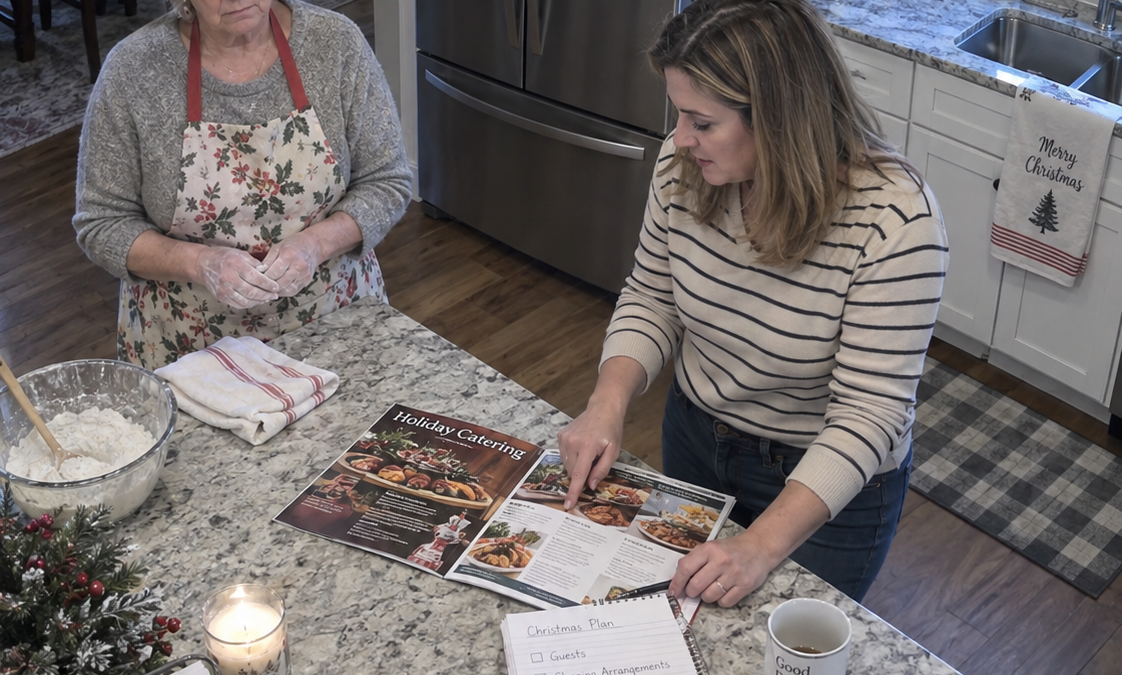
I was standing in my own kitchen when my daughter-in-law slapped a catering brochure onto my counter and said, “Twenty-five people. Christmas here. I already sent the invitations.”
She didn’t look up. She just kept flipping through the pages as though she were ordering takeout. And I stood there, sixty-five years old, flour still on my hands from the bread I’d been baking, and smiled. Not because I was happy, but because I had already made my decision three days earlier.
She thought she was planning Christmas at my house. She had no idea she was planning Christmas at an empty house.
For forty-one years, I had cooked every Thanksgiving turkey, wrapped every Christmas gift, decorated every room, and cleaned every dish. And I had done it all with a smile on my face because I genuinely believed that was what love looked like.
I believed that if I gave enough, worked hard enough, made myself useful enough, my family would see me. Not just what I produced, but me. The woman behind the apron. The woman who stayed up until two in the morning making sure the cranberry sauce was homemade because store-bought was never quite right for the people I loved.
I believed that love, if you gave it honestly and completely, always found its way back to you.
I was sixty-five years old before I realized I had been wrong.
And the moment I understood that, really understood it down to my bones, wasn’t some quiet Sunday morning with a cup of tea and time to reflect. It happened in the middle of my own kitchen on a Tuesday afternoon in early November, when Belle walked in without knocking, dropped a catering brochure on the counter I had just wiped clean, and said the words that changed everything.
“Good news. We’re doing Christmas at your place this year. I already told everyone. Twenty-five people.”
She said it exactly like that. Just like that.
Not, “Can we?”
Not, “Would you be okay with that?”
Not even a simple, “Hey, I have an idea.”
Twenty-five people. Christmas. Your place. Done.
She was already flipping through the brochure, running her finger down a column of appetizers, and she hadn’t even looked at me yet. It was as though I were already a background detail in a party she was planning, as though the only question left was whether to serve the stuffed mushrooms or the shrimp cocktail.
I remember the exact sound the brochure made when it hit my counter. That flat, sharp slap of glossy paper against clean granite.
I remember it because something happened inside me at that exact moment. Something I hadn’t felt in years.
Not anger. Not sadness.
Something quieter than that, and in some ways more powerful.
Clarity.
Like a window being wiped clean after years of fog.
But I didn’t show any of it on my face. I set down the dish towel I was holding, folded it into thirds the way I always did out of habit, and said, “That sounds wonderful, Belle.”
She finally looked up.
She smiled, clearly relieved, as though she’d been bracing for pushback and had gotten permission instead.
“Perfect. I knew you’d be on board. I’m thinking we do the main meal around two so people can get here in the morning and not rush. Some of them will probably want to stay over, so I was thinking the guest rooms upstairs, and maybe we could set up the pullout sofa in the den.”
She kept talking. I kept nodding.
And in the back of my mind, quiet as a prayer, I was thinking about a mountain cabin I’d seen advertised the week before.
A little place three states away, tucked into the hills, with a porch that looked out over nothing but trees and sky. A place where no one knew my name. A place with no guest rooms to prepare because no guests were coming.
A place where Christmas morning might just be me, a cup of coffee, and the sound of wind through pine trees.
I had already saved the listing. I just hadn’t booked it yet.
Belle was still talking, something about a signature cocktail and whether my oven could handle two turkeys at once.
I smiled and thought to myself, Book it tonight.
Now, to understand what happened next, I have to take you back. Not all the way. I won’t bore you with forty years of casseroles and carpools. But I need you to understand what kind of woman I was before that Tuesday afternoon, because that context matters.
The woman who stood in that kitchen, nodding along while Belle redesigned her holiday calendar, had a history. And that history is how we got here.
My name is Margaret Holloway. Maggie to people who knew me when I still laughed easily.
I grew up in a small town in Ohio, the oldest of four children, which meant I learned early that the person who stepped up was usually the person who got stepped on.
But you did it anyway, because that’s what family meant. You didn’t wait to be asked. You saw what needed doing, and you did it.
I carried that lesson into my marriage, into motherhood, into every Thanksgiving and Christmas and Easter and birthday party and graduation celebration for over four decades.
My husband, Robert, and I raised one child together, our son, Marcus. And if I’m being honest, Marcus was the great love of my life in the way that only a child can be.
I loved Robert deeply, and losing him six years ago to a heart attack broke something in me that hasn’t fully healed. But Marcus was the reason I got back up.
He was thirty-seven when his father died, already married to Belle, already living forty minutes away. He came to stay with me for two weeks after the funeral, and I remember thinking, We’re going to be okay. We’re going to find our way through this.
And we did.
But somewhere in the years that followed Robert’s death, something shifted. Something subtle. Something I didn’t notice at first because it happened so gradually.
The way a house settles. You don’t hear it happening. You just notice one day that the door doesn’t quite close right anymore.
Marcus had always been a good son. Thoughtful. The kind of man who called on Sundays and remembered to ask about my knee when I mentioned it was bothering me.
But Belle was a different kind of force entirely.
I want to be fair to her because fairness matters to me. It always has.
Belle wasn’t cruel. She wasn’t calculating in any obvious way. She was simply a person who had been raised to believe that efficiency and decisiveness were the highest virtues, and that if someone never said no, they were clearly saying yes.
She was the kind of woman who sent confirmation emails for casual dinners. The kind of woman who had a five-year plan in a spreadsheet. The kind of woman who, when she wanted something done, identified the most capable person available and deployed them.
And somewhere along the way, I don’t know exactly when, I became her most capable resource.
It started small.
“Would you mind watching the house while we travel?”
“Of course not.”
“Could you handle Thanksgiving this year? We’re just slammed with work.”
“Absolutely. Don’t even think about it.”
“Marcus mentioned you make the best Christmas dinner in the family. Would you want to host again?”
“I’d love to.”
Every single time, I meant it.
Every single time.
I was genuinely happy to help because that’s who I was. That’s who I’d been trained to be since I was nine years old and my mother handed me a dish towel and said, “The oldest one helps.”
But here’s what no one tells you about being the person who always says yes.
Eventually, they stop asking.
The request becomes a statement. The offer becomes an assumption. The gift becomes a given.
And the first time it happened, the first time someone in my family said, “We’re coming for Christmas,” instead of, “Can we come for Christmas?” I didn’t even notice.
Or maybe I noticed and told myself it didn’t matter.
Or maybe I just tucked it away in that deep drawer that all women like me have. The one where we store the things we decide not to feel because feeling them would make us seem difficult.
I had a very full drawer by the time Belle dropped that brochure on my counter.
Let me tell you about the Christmas before last, because that one matters.
It was two years ago. Marcus and Belle came with their two kids, my grandchildren, Tyler, who was eleven, and Sophie, who was eight.
And they are the bright lights of my life, those two. Don’t let what I’m about to say suggest otherwise.
They arrived on the twenty-third.
Belle had mentioned sometime in October that they were thinking about doing Christmas at my place again, and I had said, “Of course. I’d love that.”
And I genuinely had meant it.
I started planning in November. A new centerpiece for the table, homemade ornaments with the kids, a prime rib roast that I’d been perfecting for twenty years.
What Belle had not mentioned in October when she said, “Your place again,” was that she had also invited her sister Donna, Donna’s husband Carl and their three teenagers, her college roommate Janet, who was going through a divorce and needed somewhere to go, Janet’s two kids, Marcus’s old friend Davis, who was in town, and Davis’s girlfriend, whose name I didn’t catch.
Seventeen people.
I found out four days before Christmas when Belle sent a group text that included me.
I was standing in the grocery store, where I had just finished buying food for seven.
I remember standing in the cereal aisle, reading that text three times. Then I put my phone in my pocket, went back to the start of the store, and bought food for seventeen.
I didn’t say a word.
I didn’t want to be difficult.
I told myself it would be wonderful. More people meant more life in the house, and since Robert had gone, the house had been too quiet sometimes.
So I went home, and I cooked for two straight days.
The prime rib, two kinds of potatoes, four side dishes, three pies because Donna was gluten-intolerant and needed her own, homemade rolls because Tyler had once told me my rolls were his favorite.
And I still live for that kind of small devotion.
Christmas Day came.
Seventeen people filled my house. Children ran through the hallways. Football played on two different televisions simultaneously. Someone put their feet on my good ottoman without asking.
I cooked. I served. I refilled. I cleared.
I answered questions about where the bathroom was, where the extra blankets were kept, and whether there was more wine.
And I was happy, I think, in a tired, blurry way. The kind of happy you feel when you’re running so fast you don’t have time to feel anything else.
They left on the twenty-seventh.
I spent the twenty-eighth alone, cleaning.
On the twenty-ninth, I found a family photo on Instagram that Belle had posted at Christmas. She had captioned it “Our favorite gathering spot.”
Twenty-three comments, all variations of “Beautiful family” and “So much love.”
I stared at that photo for a long time.
I was in exactly two pictures, both taken by someone else, both showing me in the kitchen.
The gathering spot.
Not my home. Not Grandma’s house.
The gathering spot.
I closed the app, put my phone face down on the kitchen counter, and went to bed at eight because my feet and my back hurt. But something else hurt, too.
Something I didn’t have a word for yet.
I found the word later.
Invisible.
That was two years ago.
Last Christmas was worse.
By then, the pattern was so established that nobody even pretended to ask anymore.
Marcus called in September to let me know that Christmas would be at my place as usual and that Belle was coordinating the guest list.
I remember saying, “Sounds good, sweetheart,” hanging up the phone, and staring out the window at my backyard for a long time.
I cooked for twenty-one people that year.
I started three weeks in advance. Cookies during the first week of December. Pies the week after. The main dishes during the two days before Christmas.
Belle arrived on Christmas Eve afternoon and walked directly to my refrigerator. She opened it, surveyed the contents with the expression of someone reviewing a report, and said, “Did you get the good butter? I told you last year the cheap butter makes the potatoes taste different.”
I had bought the good butter.
I didn’t say that.
I just said I’d taken care of it.
Christmas dinner was what it always was: abundant and warm and full of the noise of people who were comfortable because someone had worked very hard to make them comfortable.
After dinner, the men watched football. The kids ran upstairs.
Belle and her sister Donna sat at my kitchen table drinking wine while I washed dishes twenty feet away.
I could hear their conversation clearly.
Donna said, “She really does go all out, doesn’t she?”
Belle said, “She loves doing it. It’s her thing.”
She loves doing it.
Her thing.
I turned off the water.
I stood very still for a moment.
Then I dried my hands, turned the water back on, and kept washing.
I went to bed that night at eleven, after everyone was settled, after the dishwasher had run twice, after I’d laid out the breakfast things for the morning because some guests were leaving early and would want coffee before they drove.
And I lay in the dark and thought, Is this love? Is this what love has become? A service I provide?
I didn’t have an answer.
But I kept coming back to the question.
So by the time Belle walked into my kitchen that Tuesday in November with her catering brochure, her twenty-five guests, and her certainty that I would simply absorb whatever was required of me, the drawer was full.
Something in me had quietly, without announcement, made a decision.
I just needed one more push.
Belle gave it to me about twenty minutes into that conversation.
She had moved on from the food and was now discussing sleeping arrangements. My house has four bedrooms, and she was working out on a notepad she’d produced from her purse how to distribute twenty-five people across four bedrooms, a pullout sofa, and apparently some air mattresses she planned to buy.
“What about my room?” I asked.
Not combatively. I was genuinely curious where I factored into her math.
She looked up briefly.
“You’ll be in your room, obviously. But if you don’t mind, we might need the closet in there for some of the overflow luggage. Some of these people are coming from far away, and they’ll have a lot of bags. In your closet, just for a few days. It’s not a big deal.”
She went back to her notepad.
I looked at her.
Sixty-five years old, standing in my own kitchen, being asked to move my belongings out of my own closet so her guests would have a convenient place to store their luggage in my house, for a party I hadn’t agreed to throw.
“Of course,” I said.
But what I was thinking was something else entirely.
I was thinking about that cabin.
I was thinking, Tonight. Book it tonight.
She finished her notes, tucked the catering brochure into her bag, and stood up.
“This is going to be so great. You’re a lifesaver, Maggie. Truly.”
She kissed me on the cheek and walked out.
I stood in my kitchen alone. I looked at the counter where the brochure had been. I picked up my dish towel and finished wiping the counter down.
Then I sat at my kitchen table, opened my laptop, found the listing for the mountain cabin three states away, and booked it for December twenty-second through January first.
Ten nights.
Just me.
And as the confirmation email arrived in my inbox—Thank you for your reservation, Miss Margaret Holloway—I felt something move through me that I hadn’t felt in years.
Not excitement exactly. Not relief exactly.
It was more like the feeling of putting down a very heavy bag that you’ve been carrying so long you forgot it was heavy.
My hands felt light. My shoulders dropped.
I closed the laptop, put on a pot of tea, and for the first time in as long as I could remember, I sat in my own kitchen in the quiet November afternoon and simply felt the particular pleasure of a decision made entirely for myself, by myself, with no one else’s feelings in the calculation.
I thought about what Marcus would say.
I thought about Belle’s face.
And then I thought, That’s the point. For once in your life, Maggie, think about your face.
I want you to understand something.
I have been asked by friends, by my sister Carol, and later by a therapist I started seeing in January, whether what I did was angry. Whether underneath the calm there was rage. Whether the whole plan was really just revenge dressed up as self-care.
I thought about that question seriously because I take it seriously.
And the honest answer is this.
There was anger in there. Of course there was.
You don’t spend years watching your generosity get reclassified as obligation and feel nothing about it.
You don’t hear “She loves doing it” while you’re washing dishes alone at eleven and feel nothing about it.
The anger was real, but it wasn’t the engine.
The engine was something quieter and more urgent.
It was the feeling of almost having disappeared completely.
When I booked that cabin, I wasn’t thinking, That’ll show them.
I was thinking, I still exist. I’m still a person. I still get to want things.
I was thinking about a woman I used to be before she became so useful that she stopped being a person.
A woman who used to read novels on winter afternoons. Who used to take solo day trips to antique markets and linger over coffee in towns where nobody knew her name. Who had opinions about how to spend her own holidays that nobody had thought to ask her in years.
I was thinking about getting her back.
And I only had one way to do it.
The days after I booked the cabin, I went about my life completely normally.
I did not tell Marcus. I did not tell Belle. I did not tell my sister Carol, who would have immediately started worrying about the fallout.
I went to the grocery store. I went to my water aerobics class on Thursday mornings. I had lunch with my neighbor Evelyn and listened to her talk about her daughter’s new apartment in Phoenix.
And inside, underneath all of it, I held my secret like a smooth stone in my pocket.
Every time I felt the old anxiety creeping in, the part of me that had been conditioned to manage everyone’s comfort, to smooth every surface, to make sure no one was inconvenienced, I reached into my pocket and held the stone.
December twenty-second.
Three states away.
Nobody needs anything from me.
One evening, Marcus called to check in, and at the end of the conversation, he said, almost offhandedly, “Belle tells me Christmas is going to be great this year. She’s really got it all planned out. Are you doing okay with all of it? The guest count?”
And I thought, There it is. There’s my son asking, finally, if I’m okay.
The trouble was, he wasn’t really asking.
The tone wasn’t Tell me honestly.
The tone was Tell me everything is fine so I don’t have to worry.
And once upon a time, I would have given him exactly that.
“Everything’s fine, sweetheart. Don’t worry about me.”
But I had a stone in my pocket now.
“You know,” I said carefully, “I’ve actually been thinking about my plans for the holidays.”
“Your plans? What do you mean?”
“I mean I’ve been thinking about what I want to do this Christmas. How I want to spend it.”
A pause.
“Mom, Belle’s already told everyone. People have made travel arrangements.”
“I know.”
Another pause.
“So, you’re going to be home? Everything’s good?”
I thought about the cabin, the porch, the pine trees.
“I’ll be in touch,” I said. “I love you, Marcus. Good night.”
I hung up.
My heart was beating fast, not with fear, but with the particular adrenaline of a woman who has just, for the first time in years, declined to manage somebody else’s anxiety for them.
It felt strange.
It also felt absolutely right.
By the first week of December, Belle had escalated.
She had started sending me logistical texts at the rate of two or three per day. The caterer she’d found for the appetizers. The rental company for extra folding chairs. A question about whether my oven was gas or electric and whether it had a convection setting.
A question about parking. Did I know if the Hendersons next door would be home? Because if their driveway was empty, there’d be more room for guests to park.
I answered some of them. The ones about the oven. The ones where a nonanswer would have looked strange.
But the deeper I got into December, the stranger I felt about the whole thing.
Not guilty. Not angry.
Just astonished.
Astonished that here was a full-scale operation being coordinated around my home, my kitchen, my life, and no one, at any point, had sat down with me and said, “Hey, Mom. Hey, Maggie. Is this what you want?”
My friend Evelyn knew something was going on. She could tell by the way I went quiet sometimes in the middle of a conversation.
One afternoon over lunch, she put her hand over mine and said, “You don’t have to do it, you know.”
“Do what?”
“Whatever it is you’ve got that look about.”
I laughed because Evelyn has always been able to see things I’m trying not to show.
“I’ve already made my decision,” I said.
“Good.”
She squeezed my hand.
“What is it?”
So I told her.
When I finished, she was quiet for a moment. Then she said, “Book the cabin, Maggie.”
“Already done.”
She started laughing. Genuine, delighted laughter. The kind that made the couple at the next table look over.
“Good,” she said. “Now order the expensive thing on the menu. You’ve earned it.”
I ordered the salmon.
It was the best meal I’d had in months.
I sat at my kitchen table with a simple cream-colored card and a pen, and I thought very carefully about what I wanted to say.
Not to wound. Not to punish.
Just to be clear.
I had printed out the group text Belle had sent in October, the one that said, “Christmas at Mom’s this year. Twenty-five people. Thanks in advance.”
I folded that printout and tucked it inside the card.
Then I wrote on the back:
“This home will be empty from December 22nd through January 1st. I hope everyone finds a beautiful place to celebrate.
Merry Christmas,
Maggie.”
That was all.
No explanation. No apology. No softening.
Just the truth.
Simply stated.
I put the card in an envelope, wrote Marcus and Belle’s names on the front, and placed it on the kitchen counter, propped against the fruit bowl where someone would see it.
Then I went upstairs.
I got out my suitcase, the good one, the blue canvas one Robert had given me for our thirtieth anniversary that I hadn’t used in three years.
I opened it on the bed and started to pack.
Not frantically. Not angrily. Slowly, thoughtfully. The way you pack when you have all the time in the world and nowhere to be except exactly where you’re going.
I packed my good sweaters, my comfortable jeans, and the mystery novel I’d been meaning to start for two months.
My favorite mug, the blue one with the small chip on the handle that I’d refused to throw away because Robert had bought it at a farmers market, and somehow I could still feel his fingerprints on it.
I packed my hiking boots.
I packed the small framed photograph of me and Robert from our last vacation together, a trip to the Oregon coast. His idea. His best idea.
The two of us on a cliff above the water, looking not at the camera, but at each other.
I zipped the suitcase, carried it to the top of the stairs, and left it there, ready for the morning.
When I came back down to the kitchen, the card was still there on the counter, propped against the fruit bowl.
I looked at it for a long moment.
Then I turned off the kitchen light and went to bed.
On December twenty-second, the alarm went off at six.
I showered. I dressed. I made one last pot of coffee in my kitchen.
The good coffee, the kind I bought from the small-batch place in town that was too expensive but worth it.
I drank it standing at the kitchen window, looking out at my backyard.
The yard Robert had landscaped himself twenty years ago. The hydrangeas that came back every summer without fail. The bird feeder he’d hung from the oak tree that I still filled every week because the birds didn’t know he was gone.
I had a moment standing there when I felt the full weight of everything.
Not regret, but weight.
The accumulated meaning of a life lived in a place.
I loved this house.
I loved this house.
And leaving it, even for ten days, even by choice, felt like something.
I let myself feel it.
Then I rinsed my mug, set it in the drying rack, and picked up my keys.
I turned off all the lights. I adjusted the thermostat down to forty-eight degrees, just enough to protect the pipes.
I walked through the kitchen one more time, past the card propped against the fruit bowl.
I picked up my suitcase and opened the front door.
The December air was sharp and cold and smelled like maybe snow later.
I locked the door, put the key in my coat pocket, and walked to my car.
I put the suitcase in the trunk, got into the driver’s seat, and started the engine.
I sat there for exactly thirty seconds.
Not because I was wavering, but because I wanted to feel the exact quality of that moment.
The particular silence of a decision fully made.
The strange lightness of a woman who was, for the first time in longer than she could remember, going somewhere nobody else had planned for her.
Then I put the car in reverse and drove away.
The drive out of my neighborhood took four minutes.
I know because I counted.
Four minutes past the Hendersons’ house, past the corner where the Millers had put up the same inflatable snowman every year since 2003, past the little brick church with the marquee sign that said “Peace on Earth.”
And then I was on the main road, my neighborhood was behind me, and the only thing in front of me was highway.
My phone was in the cup holder.
It didn’t ring for the first hour.
That surprised me, actually.
I had expected Marcus to call early. He was always an early riser, up by six, coffee by six-fifteen. The kind of person who front-loaded his day like it was a project with a deadline.
But the first hour was silent, and I drove through it with the radio playing low and the heater running warm, something loosening in my chest with every mile.
It was during the second hour that everything started.
The first call came from Belle.
I watched her name light up on the screen. I watched it ring four times. I watched it go to voicemail twenty seconds later.
She called again.
I let it ring.
She left a voicemail.
I didn’t listen to it.
Eleven minutes after that, Marcus called.
I had been waiting for Marcus.
His call felt different from Belle’s. Heavier, more complicated. The way anything involving your child feels heavier, no matter how old they get.
He was thirty-nine years old, and I still felt it in my sternum.
When I saw his name on my screen, I still wanted to answer.
Old instinct.
Deep programming.
I let it ring.
He called back four minutes later.
I let it ring again.
Then came the text messages.
I didn’t read them while I was driving, but at a gas station just past the state line, two and a half hours into the trip, I made my first stop.
I filled the tank, sat in the parking lot, and looked at my phone for the first time.
Nineteen messages.
Seven from Belle. Six from Marcus. Three from a number I didn’t immediately recognize, which turned out to be Belle’s sister Donna, whom I had met exactly four times in my life.
Two from a contact labeled simply “Davis,” Marcus’s friend, one of the twenty-five. A man I barely knew who was apparently already en route to my house and was texting the host to ask about parking.
I read through them in order, slowly, the way you read something you need to understand completely before you respond to any of it.
Belle’s first message, sent at 8:47 in the morning:
“Hey, just leaving the house. See you soon. Can you make sure the back door is unlocked? Some people are coming from that side.”
Belle’s second message, at nine:
“Actually, Maggie, I’m not seeing your car in the driveway. Are you out running errands? Please be back by 11. The caterer is dropping off the cold items, and someone needs to be home.”
Belle’s third message, at 9:52:
“Maggie, I found the card. What is this? Call me back right now.”
That was the one.
That was the message that had a different register.
The careful politeness stripped away. The coordinator voice dropped. Something raw underneath.
I found the card. What is this?
I read it twice, then kept going.
Marcus, 9:58:
“Mom, Belle just called me. She says she found a note saying the house is going to be empty. I don’t understand. Call me.”
Marcus, 10:14:
“Mom, I’m serious. Call me back. There are people already on their way.”
Marcus, 10:31:
“Mom, I’m coming over. I need to talk to you.”
I looked at the timestamp on that last one.
It had been sent forty minutes ago, which meant Marcus had very likely already arrived at my house, found it locked and dark and quiet, and was now either standing on my front porch or sitting in his car in my driveway, trying to figure out what had just happened to Christmas.
I sat with that image for a moment.
Not with guilt.
With something more complicated.
With the recognition that this was the most attention my son had paid to my specific whereabouts in years.
I put the phone in my bag, went inside the gas station, and bought a black coffee and a package of peanut butter crackers.
I got back in the car, adjusted the heater, pulled out of the parking lot, and kept driving north.
The phone rang again fourteen minutes later.
Marcus again.
I was on the highway, and the call came through the car speakers. I reached over and declined it with one finger.
The silence that followed felt enormous.
My heart was pounding.
Not because I was afraid, but because doing something you’ve never done before, declining your own son, choosing yourself over the roar of everybody else’s needs, feels physical.
It lives in your body.
Your pulse doesn’t know the difference between brave and dangerous. It just knows that something new is happening.
Something new was happening.
I turned the radio up a little.
Outside, the landscape was changing. More hills, more trees. The flat Ohio terrain of my hometown giving way to something with more texture, more variation.
I’d driven this road once before, twenty-two years ago, with Robert, on a trip we took the summer after Marcus started college.
We had driven with the windows down, and Robert had played old Springsteen the whole way. For three days, we had felt like ourselves again instead of somebody’s parents.
I thought about that trip.
I thought about Robert.
I thought about the way he used to say, whenever I started spiral-planning a family event weeks in advance, “Maggie, the people who love you will love you whether the rolls are homemade or not.”
I had never quite believed him.
But driving north on a December morning, with nineteen unread messages in my purse and a cabin waiting three states away, I was starting to think he might have been right.
By the time I stopped for lunch at a diner outside Columbus, with red vinyl booths and a menu laminated to a shine, the call count had reached thirty-one.
Thirty-one attempts to reach me in four hours.
I ordered the club sandwich and a cup of tomato soup, sat in the corner booth, and deliberately listened to Belle’s voicemails.
The first one, left at 9:26, was still in coordinator mode. Professionally frustrated, the way she sounded when a vendor was late.
“Maggie, hi. It’s Belle. I’m pulling up to the house, and I don’t see your car. I found your note on the counter, which I’m a little confused about, so can you call me back when you get a chance? The caterer needs access by noon, and I just want to make sure we’re on the same page. Thanks.”
The second voicemail, left at 10:03, was different.
The coordinator voice was gone.
“Maggie, I don’t… I don’t really understand what this card means. Marcus is trying to reach you, too. There are people coming from Georgia and from Michigan, and from… We have twenty-five people who made travel plans based on this event. If something has changed, I really need you to call me back immediately. This isn’t…”
A pause.
A sound that might have been her collecting herself.
“This is serious. Please call.”
The third voicemail, left at 10:48:
“I’m standing outside your house, and it’s locked, and Marcus is here, and nobody knows where you are. And I have a caterer calling me asking where to deliver the shrimp. The shrimp! And I don’t… I genuinely don’t know what to tell anyone right now. Maggie, I’m asking you to call me back. I’m asking you.”
I set the phone down on the table next to my soup.
The waitress came by to refill my coffee. She was a woman probably around my age, gray hair pulled back, with the practiced efficiency of someone who had been reading tables for a long time.
“You doing all right, hon?”
“Better than I’ve been in years,” I said.
She gave me a long look, the kind of look one woman gives another when she suspects a story she’d like to hear.
Then she refilled my coffee and moved on.
I ate my sandwich.
I thought about calling Marcus back.
I turned the idea over the way you turn something over with your foot to see what’s underneath it.
Part of me, the part that had been a mother for thirty-nine years, felt the pull of it like gravity.
He was upset. He was confused.
He was standing outside my locked house in December, trying to understand what had happened to his Christmas.
And the other part of me, the part that had been collecting evidence for years in that deep drawer, the part that had stood in a kitchen at eleven on some night washing dishes while women discussed how much I loved doing this, that part said, Let him be confused for a while. Being confused is not an emergency.
I left the diner and got back on the highway.
Four more calls came in during the next ninety minutes. One from Marcus, two from Belle, and one from a number I didn’t recognize that I later found out was Belle’s mother, Eleanor, who had apparently been briefed on the situation and felt compelled to weigh in.
Eleanor had always been cordial to me in the vague, arm’s-length way of a woman who was grateful someone else was doing the heavy lifting.
The idea of Eleanor calling me on Belle’s behalf struck me as so perfectly on brand for the whole situation that I almost pulled over just to appreciate it fully.
I didn’t pull over.
I drove.
By three, I had crossed into the next state.
The hills were more serious now. The trees thicker. The sky had gone that particular pewter color that means real winter, the kind that doesn’t fool around.
And I was feeling something I hadn’t expected to feel this early.
Peace.
Not the tired peace of exhaustion. Not the numb peace of avoidance.
The real kind.
The kind that comes from alignment, from your outside matching your inside for the first time in a long time.
My phone buzzed with a text.
I waited until the next stop. I pulled in, parked, and read it.
It was from Marcus.
And it was the longest text message my son had ever sent me.
I know that because I know my son, and Marcus typically communicated in five words or fewer when it came to text messages.
“On my way.”
“Be there at seven.”
“Thanks, Mom.”
That was Marcus’s native text language.
This was forty-seven lines.
I know because I counted those, too, sitting in a rest stop parking lot three states from home, with truckers idling nearby and Christmas music leaking from the rest stop building.
He started with logistics, which was pure Marcus. He couldn’t help himself.
He listed the people who were already en route. He listed the people who had called him asking what was happening.
He listed the fact that Davis had already checked out of his hotel because he’d assumed he was staying at my house and was now sitting in a Panera on the east side of Columbus with his girlfriend, eating a soup bowl and waiting for instructions.
Then the logistics stopped.
And something else started.
“Mom, I don’t understand this. I’m trying to understand this. Belle says she talked to you about it, and you said it was fine. Did we do something wrong? If we did something wrong, I need you to tell me because I can’t fix something if I don’t know it’s broken.
“I’m standing outside your house, and it’s locked, and I keep picturing you somewhere, and I don’t know where. And that scares me more than the Christmas thing.
“Honestly, the Christmas thing we can figure out. People can go to hotels. We can order food. It’s fine. I’m more scared about you. Where are you? Are you okay? Please just tell me you’re okay. I don’t need to know everything right now. I just need to know you’re okay. Please, Mom.”
I read that last paragraph three times.
The first time, I felt something crack open a little.
The second time, I understood what I was feeling.
He was scared.
My son was genuinely scared.
Not about the logistics. He said so himself.
About me. About where I was.
The third time I read it, I understood something else.
This was the most my son had said to me in a single message in years.
And it had taken me locking my house and driving away for him to say it.
I sat with that for a long moment.
Then I typed back just one line.
“I’m okay. I love you. I’ll explain soon.”
I sent it.
His response came back in forty seconds.
“Thank God. Okay, take your time. But we need to talk.”
I put the phone away and got back on the highway.
The sun was already going low. December sun doesn’t stay long, and the light through the windshield had that particular amber quality of late afternoon in winter, the kind that makes everything look more significant than it probably is.
But some things were as significant as they looked.
I had just made my son worry about me.
Not about what I could do for him.
About me specifically. My safety. My whereabouts. My state of mind.
And I’d replied with seven words.
And he had said, “Take your time.”
I can’t tell you how long it had been since anyone in my family had said those three words to me.
Take your time.
I almost laughed.
I kept driving.
By five-thirty, the messages had changed register again.
Belle had apparently shifted from crisis management into something harder to categorize, something that sat right at the intersection of hurt and accusation.
Her text, sent at 5:07, said:
“I want you to know that I’ve spent the last four hours making phone calls and arranging hotels and apologizing to twenty-three people who rearranged their schedules to be here. I am not asking for a thank you. I am asking you to understand the impact of what you’ve done.
“Some of these people drove twelve hours. Janet was really looking forward to this. Donna cried. I just think… I think you owe everyone an explanation, Maggie. At minimum.”
I read that twice.
The first time, I felt the old reflex, the lurch toward apology, the instinct to smooth, to soothe, to make the discomfort stop.
The second time, I noticed something different.
She had spent four hours calling people.
She had arranged hotels.
She had delivered explanations to twenty-three people.
Belle, who was capable of deploying a full logistical operation on my behalf without asking me once, was apparently capable of deploying the same operation to solve the problem my absence had created.
The machine ran just fine.
It turned out it just needed a different operator.
I didn’t respond to Belle’s text.
Not because I wanted to be cruel, but because I didn’t have anything to say to her yet.
And the old Maggie, the one who could not tolerate the discomfort of someone being upset with her, would have sent back a long message full of explanations and apologies just to make the discomfort stop, regardless of whether the apology was warranted.
The new Maggie, the one on the highway going north in the December dark, was learning to tolerate the discomfort.
It was harder than I expected.
It was also easier than I’d feared.
I arrived at the cabin at 7:43 in the evening.
The owner, a man named Gerald, who communicated exclusively through the rental app, had left a lockbox code and a brief welcome message saying the firewood was on the porch and the extra blankets were in the hall closet.
No fuss. No performance.
Just information clearly stated.
I stood in the dark on the porch with my suitcase and punched in the lockbox code.
The door swung open.
Inside, it was exactly what the listing had promised.
Small. Clean. A wood stove in the corner, unlit but ready. A kitchen just large enough for one person who planned to take her time with meals.
A reading chair by the window. A bedroom with a handmade quilt on the bed, patterned in deep blues and greens that reminded me of something Robert might have chosen.
No guest rooms.
No pullout sofas.
No extra closet space for anybody’s luggage.
Just exactly enough room for one woman who had driven seven hours to get there.
I set my suitcase down.
I stood in the middle of the room, and for the first time all day, I let myself cry.
Not the dramatic kind. Not the heaving-collapse kind.
Just the quiet release of someone who has been holding something for a very long time and has finally, in a private place with no one watching, allowed herself to put it down.
I cried for about four minutes.
Then I washed my face.
I found the matches on the shelf above the wood stove and lit the fire the way Robert had taught me a long time ago.
I made scrambled eggs in the small pan I found in the cabinet.
I ate them standing at the kitchen counter because I felt like it. Because there was no one to tell me that was bad for digestion or ask me why I wasn’t sitting at the table.
Then I took my mystery novel and my good mug, sat in the reading chair, and read for two hours.
I just read.
The phone was in my purse, and my purse was in the bedroom, and I couldn’t hear it buzz from where I was sitting.
And I did not go check it.
Around ten, I set the book down and looked at the fire.
I thought about Marcus. About whether he’d found somewhere to take everyone.
About Tyler and Sophie, my grandchildren, whom I had not spoken to about any of this, and who I imagined were confused and maybe a little frightened in the specific way children are frightened when the things they count on turn out to be movable.
That part hurt.
That part, I won’t pretend it didn’t.
My grandchildren were the innocent ones in all of this.
Sophie had probably been looking forward to my rolls. And Tyler had probably been planning to show me something on his phone, some video game thing I wouldn’t understand but would listen to him explain for forty-five minutes because watching him be enthusiastic about things was one of the genuine joys of my life.
I would call them.
Not tonight. Tonight was mine.
But tomorrow.
I would call Tyler and Sophie and explain, in whatever words worked for an eleven-year-old and an eight-year-old, that Grandma loved them completely and irrevocably.
And that Christmas, this particular Christmas, looked different because sometimes things needed to look different for a while.
I would figure out the words.
I was good with words when it mattered.
I went to bed at 10:35.
I slept for nine hours.
I cannot remember the last time I slept for nine hours.
When I woke up, it was light outside, and something small was moving in the branches of the tree I could see from the bedroom window.
I lay there for a full ten minutes just watching it.
Not doing anything. Not planning anything. Not calculating anything.
Then I got up, made coffee in the small percolator I found in the cabinet, and took it out to the porch.
December twenty-third.
Forty-eight hours ago, I had been standing in my kitchen wondering if the cabin had adequate heat.
Now I was sitting on the porch with my coffee, the cold air, and the silence in the trees, with absolutely nothing that needed doing.
My phone was inside.
I left it there.
I stayed on the porch until the coffee was gone and my hands were cold.
And when I went back inside and finally checked the messages, there were eleven new ones.
The one that stopped me was from Marcus.
It had been sent at 11:15 the night before.
“We’re at the Marriott by the airport. Belle got a block of rooms. It’s actually… it’s fine. And the kids think it’s an adventure.
“Tyler ordered room service for the first time in his life, and he’s never been more excited about anything. Sophie made friends with a girl in the elevator. I think they’re okay. I think we’re okay.
“I hope you’re okay. Good night, Mom. I love you.”
I read that three times.
The kids think it’s an adventure.
Tyler ordered room service.
Sophie made friends with a girl in the elevator.
I sat down at the small kitchen table and read it a fourth time.
And I thought about what my son had just described.
A family finding its own way. Solving its own problem. Discovering its own resilience.
Without me.
Without me managing it. Without me smoothing it. Without me absorbing the difficulty so no one else had to feel it.
And they were fine.
They were more than fine.
Tyler was experiencing room service for the first time, with the particular wonder that only eleven-year-olds can bring to something like room service.
Sophie was making friends in an elevator.
Marcus was texting his mother at 11:15 at night, not to demand anything, but to say, “I think we’re okay.”
I put the phone down.
I covered my mouth with my hand because what I was feeling in that moment was complicated and layered and not entirely comfortable. And I needed a second to let it exist at full size before I did anything with it.
Part of what I felt was vindication.
Part of what I felt was grief.
Part of what I felt was something I can only describe as a specific kind of sadness that arrives when you realize that the thing you spent years believing was necessary—your constant presence, your constant labor, your constant absorption of everyone else’s difficulty—maybe wasn’t necessary the way you thought.
That sadness is strange.
It doesn’t feel like relief, even when it is relief.
It feels like standing in a room where something used to be, and the room is perfectly fine without it, and you’re not sure if that makes you feel better or worse.
Both.
I decided it made me feel both.
I made a second cup of coffee, sat back down, and thought about what my next move was.
Not about Christmas.
Not about Belle and her logistical operation and her hotel block and her twenty-three people eating merrily at breakfast.
Not about who was upset and who needed what from me.
I thought about what I wanted.
Just that.
What did Maggie want?
I wanted to take a walk that morning in the cold air without my phone.
I wanted to read another hundred pages of my novel.
I wanted to call Tyler and Sophie and hear their voices.
I wanted to eventually, not today, not tomorrow, maybe have a real conversation with my son. Not a logistics call. Not a crisis call.
The kind we used to have when he was young and would sit at the kitchen table doing homework while I cooked, and we just talked because we were us.
I wanted to figure out what it looked like to love my family without losing myself inside of it.
I didn’t have that figured out yet.
But for the first time in a very long time, I had the space and the quiet and the nine hours of sleep required to actually start working on it.
I put on my boots. I put on my coat. I left the phone on the kitchen table.
And I opened the door and walked out into the cold December morning with nothing in my hands, nowhere to be, and no one waiting for me to appear.
The cold hit my face immediately.
I walked toward the trail, and I thought, This is what belonging to yourself feels like.
This exact thing. This cold air on my face, and this silence, and this ground under my boots, and this complete, uncomplicated, present-tense fact of being a woman in a body in a place that she chose.
I had been so many things to so many people for so long.
A mother. A caretaker. A host. A logistics solution. A gathering spot.
And underneath all of it, this whole time, I had still been Maggie.
The woman who liked cold air on her face.
The woman who could build a fire.
The woman who slept nine hours when nobody needed her before seven in the morning.
The woman who had, at sixty-five years old, finally done the one thing nobody in her family believed she was capable of.
She had left.
Not forever.
Just long enough.
Just exactly long enough.
I walked for forty minutes that morning.
No destination. No route planned.
Just my boots on the frozen ground and the cold pressing against my cheeks in the particular silence of a forest in winter, which is different from every other kind of silence I know.
It is not empty silence.
It is full silence.
The kind that has weight and texture and makes you feel, paradoxically, less alone than you do in a crowded room.
I was not thinking about Belle.
I was not thinking about the Marriott by the airport or the twenty-three people eating continental breakfast on someone else’s dime for once in their lives.
I was thinking about Robert.
I do that sometimes when I’m moving, when my body is occupied enough that my mind can slip the leash a little and go where it actually wants to go.
And where it wanted to go that morning was back.
Not all the way back.
Just to a specific evening, maybe twelve years ago, when Marcus had called us in a low-grade panic about something at work. Some project that had gone sideways. Some colleague who had undercut him.
Robert had listened to the whole thing, patient and quiet, and then said a few words I hadn’t thought about in years.
“Is this your problem, Marcus?”
Marcus had gone quiet on the other end.
And Robert had said it again, gently.
“I’m asking honestly. Is this your problem to carry, or did someone hand it to you?”
I had been in the doorway listening, not meaning to eavesdrop, and I remember thinking, That’s the question.
That’s the only question that matters.
Is this your problem, or did someone hand it to you?
I had spent forty-one years accepting problems that people handed me without stopping to ask that question.
Logistics. Emotional management. Family cohesion. The labor of making sure everyone was comfortable.
Someone had held it out, and I had taken it.
Every time.
Because I was the kind of woman who took things.
Robert had known that about me.
He had said it to me once directly, about two years before he died.
We were sitting on the back porch after a particularly exhausting Thanksgiving. Thirty people. My own planning. My own execution.
And I was tired in a way that went past physical.
He had put his hand over mine and said, “Maggie, you know you don’t have to do all of it.”
And I had said, “I know. I want to.”
He had looked at me with those careful eyes of his and said, “Do you? Or do you want to want to?”
I hadn’t known how to answer that then.
I was starting to understand the answer now, twelve years later, walking in the cold with nobody waiting for me and nobody’s comfort depending on the next thing I did.
The answer was that I didn’t know anymore what I actually wanted versus what I had trained myself to want.
Those two things had fused together so completely that I couldn’t find the seam between them.
Every choice I’d made had been processed through a filter of what everyone else needed first, and my own preferences had come after, in the small leftover space that remained.
If there was any space left at all.
Robert had seen that, and he had never been able to fix it for me because it wasn’t his to fix.
It wasn’t something you could fix from outside.
You had to walk away from your own kitchen and drive seven hours north and sleep nine hours and walk in the cold and feel the specific sensation of nobody needing anything from you.
You had to feel that before you could begin to understand what you actually were when you stripped all the usefulness away.
I turned back toward the cabin.
My hands were getting cold, and I was ready, for the first time, to make the call.
It was December twenty-third, 10:47 in the morning.
I sat at the kitchen table, held my phone in both hands for a moment, and called my son.
He answered on the first ring.
“Mom.”
Just that one word.
But the relief in it was so palpable that it was almost a physical thing, like I could feel it coming through the phone.
“Hi, sweetheart.”
“Are you okay? Where are you?”
“I’m okay. I’m somewhere safe. I’m warm, and I slept well, and I’m okay.”
I heard him exhale, long and slow.
“Okay. Good. That’s… okay.”
A pause.
“Can you tell me where?”
“Not yet. But soon.”
Another pause.
“Mom, I need to…” He stopped. Started again. “I’ve been trying to figure out how to say something to you since yesterday morning, and I keep not saying it right in my head.”
“Say it wrong, then.”
“What?”
“Say it wrong, Marcus. It’s just me.”
And he laughed.
This short, surprised sound.
And that laugh undid something in me because it was his real laugh, not the polished social laugh he’d developed somewhere in his thirties along with his professional vocabulary.
His real laugh.
The one I’d been listening to for thirty-nine years.
The one that started somewhere in his chest and came out a little too loud.
Then he said, “I think we’ve been treating you badly.”
The kitchen was very quiet.
“Tell me what you mean by that,” I said.
“I mean, Mom, Belle was up until midnight on the phone with hotels and people’s relatives, and she was stressed and frustrated, and she kept saying things like, ‘I don’t understand why she would do this,’ and ‘This is so irresponsible.’
“And I let her say those things for a while because I was frustrated, too. And then at some point, I stopped and thought, when was the last time anyone asked Mom what she wanted to do for Christmas?
“I waited, and I couldn’t remember. I couldn’t remember a single time in the last five, six, seven years when we asked you.
“But we just… we assumed. We always assumed you wanted to host because you always had, and at some point asking became pointless because it was already decided. And I let it become decided, and I’m sorry for that.”
He said it simply, without decoration, the way people say true things.
I closed my eyes.
“Thank you,” I said. “That matters a lot.”
“Are you… Mom, are you angry at me specifically?”
“Not angry. No. I was… I’ve been tired a long time.”
“Tired?”
“The kind of tired that isn’t about sleep.”
“I know that kind,” he said quietly.
“I know you do.”
Because he was my son, and I knew him.
“I wasn’t trying to punish anyone, Marcus. I want you to know that. I didn’t leave to make a point. I left because I’d finally made a decision about my own life, and I made it the same way decisions about my life had been made for years. Without consulting anyone first.”
A long pause on the line.
Then, “That’s… okay. Yeah. That lands.”
“Good.”
“Belle’s still pretty upset.”
“I know.”
“She’s not going to be easy to—”
“Marcus.”
I said his name the way I used to when he was sixteen and heading somewhere ill-advised.
“I love Belle, and I’ll talk to Belle, but I need you to hear me when I say that managing Belle’s feelings about this is not my job right now. It’s yours. You’re her husband. I’m her mother-in-law. Those are different roles.”
Silence.
Then, “Yeah. You’re right.”
“How are the kids?”
The shift in his voice when I asked about Tyler and Sophie was immediate and complete.
Something released.
The adult anxiety dropped away, and what was underneath it was just a father.
“They’re honestly… they’re having the time of their lives. Tyler figured out that if you call the front desk, you can request extra pillows, and he’s called three times. Sophie found a family with a girl her age in the room next door, and they’ve been running up and down the hallway since seven this morning. Belle’s not thrilled about the hallway running, but…”
He paused.
“They’re okay, Mom. They’re really okay.”
“Good,” I said. “That’s the only part that worried me. Can I call them later today?”
“They’d love that. Tyler’s been asking about you.”
“I’ll call at four.”
We talked for a few more minutes, carefully, the way you talk when you’re both trying to move through something without breaking it.
Before we hung up, Marcus said, “I meant what I said last night. Take your time. Whenever you’re ready to talk more, I’m here.”
I held the phone for a minute after the call ended.
My son had just told me to take my time.
My son, who had never once in the last decade considered whether I had time to give, had just told me to take mine.
Robert would have appreciated that.
I set the phone on the table, made myself a second cup of coffee, and allowed myself, quietly and privately, to feel the particular satisfaction of a conversation that had gone exactly the way it needed to go.
Then the text from Belle arrived.
I should have expected it.
Of course Marcus had told her we’d talked.
Of course she had composed something.
Belle always composed something.
This one was three paragraphs.
I will not recite all of it, but the center of it, the thing that made my chest do a slow, complicated tightening, was this:
“What you did put twenty-three people in an impossible situation two days before Christmas. I had to call Donna and her kids. I had to call Janet, who is already having the worst year of her life. I had to find hotels on December 22nd. Maggie, you know what hotel availability looks like on December 22nd?
“I’m not saying your feelings don’t matter. I’m saying there were better ways to communicate them. Adults communicate. They don’t just disappear.”
I read it.
I read it again.
And here was the thing about Belle’s message that was both completely wrong and not entirely wrong.
She wasn’t lying.
There were twenty-three people who had been inconvenienced.
Donna’s kids had probably been disappointed. Janet, who was having a rough year, had been thrown by the change.
All of that was real.
And none of it was the point.
The point was the word she had chosen.
Adults communicate. They don’t just disappear.
Adults communicate.
I had been communicating for years.
I had communicated every time I didn’t say, “Actually, this is too much,” when it was too much.
Every time I answered the phone on Christmas morning at seven to help coordinate arrivals.
Every time I cleaned up after twenty people alone.
Every time I said, “Of course,” when every molecule in my body was running low on of course.
That had all been communication.
She just hadn’t been listening.
I did not send that back to Belle.
I sat with it. I let it move through me.
And then I typed carefully.
“I understand you had a difficult two days. I’m sorry for the inconvenience to you and the guests. When I’m ready to talk, I’ll reach out.”
I hit send.
Her response came in three minutes.
“That’s it? After everything?”
I put the phone face down on the table.
I picked up my novel.
The chapter I was on involved a woman in her sixties who had just realized that the house she’d lived in for thirty years had never actually felt like home.
I had not planned that parallel.
The universe has a sense of humor sometimes.
I read for two hours.
At four exactly, I called Tyler.
He answered before the first ring finished.
“GRANDMA!”
Just like that, all capitals.
Somehow, even through a phone speaker, I could hear the pure, unguarded joy of an eleven-year-old who has not yet learned to modulate his enthusiasm for the people he loves.
“Hi, baby.”
“Where are you? Dad said you went on a trip.”
“I did. I’m somewhere with a lot of trees.”
“Are there bears?”
“It’s possible. I haven’t seen any yet.”
“You should get a bell. Bears don’t like bells. I saw it on a nature video.”
“I’ll look into that.”
“Grandma?”
His voice shifted slightly. The exuberance settled into something more careful.
“Are you okay? Sophie said you left because you were sad.”
My eight-year-old granddaughter had told her eleven-year-old brother that Grandma left because she was sad.
Our children see everything.
“I wasn’t sad. Not exactly,” I said. “I was… Do you know what tired means? Not sleepy tired. The other kind. Like when you’ve been doing something too long and your brain is full?”
“Exactly like that?”
“Exactly like that.”
“Oh.”
He thought about this seriously. I could hear him thinking.
“I get that after school sometimes.”
“What do you do when you get that?”
“I go to my room and play by myself for a while. No talking.”
“That’s exactly what I’m doing,” I said. “Just a bigger room.”
He was quiet for a moment.
“Then is it a nice room?”
“It’s a very nice room.”
“Okay.”
Fully satisfied.
The way children are satisfied when they’ve understood something and it makes sense.
“Grandma, can we still do cookies at Christmas? Not this Christmas, ’cause Mom says we’re at a hotel, but maybe after?”
“Yes,” I said. “Definitely, yes. I’ll make the good ones. The ones with the sprinkles.”
“The ones with the red and green sprinkles?”
“The exact ones.”
“Okay, hold on. Sophie wants to talk.”
A small voice.
“Grandma?”
“Hi, sweet girl.”
“Are you coming back?”
“Of course I’m coming back. I’m just taking a little trip.”
“Tyler said you might have bears.”
“Tyler is very concerned about the bears.”
She giggled.
Sophie’s giggle was approximately the best sound in the world. I had decided this years ago and had not revised the opinion.
“I made a friend,” she told me. “Her name is Avery, and she has a dog at home named Pretzel.”
“Pretzel is a wonderful name for a dog.”
“I know. Grandma, I miss you.”
“I miss you too, baby. I’ll see you soon. I promise.”
After I hung up, I sat at the table for a long time without moving.
This was the thing about children.
They were the innocent ones in all of it.
Sophie didn’t know about brochures and group texts and assumptions and invisible labor.
She knew that her grandmother was somewhere and she missed her.
And they had talked about a dog named Pretzel, and next time there would be cookies with red and green sprinkles.
That was her version of the story.
And somehow her version and my version were both completely true at the same time.
I thought about what I owed them, those kids.
Not in the sacrificial sense. Not in the martyr sense.
In the real sense.
What did I actually owe Tyler and Sophie?
My presence when I was present. My attention when I gave it. My love always and without condition.
Not my depletion.
Not my exhaustion.
Not a grandmother who had run herself to empty so many times that by the time she sat across from them at Christmas dinner, she was already mentally calculating tomorrow’s cleanup.
A full grandmother was better than an empty one.
I had needed ten days in a cabin to understand that, but I understood it now.
The next morning, December twenty-fourth, Christmas Eve, I woke up to a voicemail I hadn’t expected.
Not from Marcus. Not from Belle. Not from anyone in my immediate family.
From my sister Carol.
Carol was sixty-two, lived in Arizona, and was the only person in my life who had the particular gift of cutting directly to the center of something without bothering with the outside.
Her voicemail said, “Maggie, Marcus called me. Told me what happened. I’m not going to say I’m surprised because I’m not. And I’m not going to say it’s about time because that would be smug, even for me.
“I just want you to know that I’ve been watching you disappear for about six years, and I kept waiting for you to notice. I’m glad you noticed. Call me when you feel like talking. And Maggie, Merry Christmas. Have a drink. You’ve earned it.”
I listened to it twice.
Then I called her back immediately because Carol was one of the three people in my life I always called back immediately.
She answered on the second ring.
“There she is. The runaway grandmother.”
“Don’t make it sound dramatic.”
“It is dramatic. You locked your house and drove seven hours and left twenty-five people standing in your driveway. That’s extremely dramatic, Maggie.”
“Twenty-three. Two were still en route when I left.”
She laughed.
Full Carol laughter. Big. Unselfconscious. The laugh she’d had since she was twelve years old.
“How are you? Honestly.”
“Honestly, I feel better than I have in years. Which is either a sign that I did the right thing or a sign that something was deeply wrong before.”
“Both,” Carol said. “Obviously both. Those aren’t mutually exclusive.”
I had forgotten how good Carol was at this. At just seeing through things. She’d always had it.
When we were kids, she could tell when I was lying before I’d finished the lie. As adults, it had sometimes been irritating.
Right now, it felt like the most useful quality any person had ever possessed.
“Marcus called you to do what? Rally support?”
“I think he was trying to figure out if you were okay. He didn’t have the words to say he was worried, so he called me to have the words for him.”
That sounded exactly like Marcus.
“He’s always done that,” I said. “When he was fifteen and needed to tell us something hard, he’d tell you first, and then you’d tell me.”
“He told me about the car he dented when he was sixteen.”
“I know.”
“Did you know about the car?”
“Carol, I’ve always known about the car. I was just waiting for him to tell me himself.”
She started laughing again, and then so did I.
And we laughed together for probably thirty seconds.
That thirty seconds was the best thing that had happened in weeks.
“Belle called me, too,” Carol said once we’d settled.
I went still.
“When?”
“Yesterday afternoon. She was… I’m going to be honest with you because that’s what I do. She wasn’t calling to gossip. She was calling because she’s genuinely confused.
“She kept saying she thought you loved hosting. She thought you enjoyed it. She wasn’t being sarcastic, Maggie. I think she genuinely believed that.”
“I know she did.”
“That’s almost worse, isn’t it?”
“Yes,” I said. “That’s almost worse.”
Because it was.
If Belle had been calculating about it, if she had looked at me and thought, I can take advantage of this woman, that would have been simpler to be angry about.
Clean and simple.
Villain identified. Story resolved.
But what Carol was describing, what I had come to understand over the last two days, was messier than that.
Belle wasn’t cruel.
Belle was oblivious.
Belle had looked at a woman who never said no and assumed that a woman who never said no was a woman who always wanted to say yes.
She had misread the data.
But I had given her the wrong data for forty years.
We were both responsible for the story we’d written.
“What did you say to her?” I asked.
“I said that you loved your family and you loved hosting, and those two things were true. And I also said that love and want aren’t always the same thing, and that a person can love doing something and still need to stop doing it sometimes.
“And that maybe the two of you needed to talk.”
“And?”
“She cried.”
I had not expected that.
“She cried?”
“A little. Not dramatic. Just, you know, that sound people make when something is hard to hear because it’s true.”
I knew that sound.
“She said she didn’t know, Maggie. I believe her. I think she really didn’t know.”
I sat with that for a long moment.
Outside the cabin, the temperature had dropped since morning. I could feel the cold coming through the window glass without touching it.
Christmas Eve.
Somewhere forty minutes from here, there was probably a town doing all the Christmas Eve things. Last-minute shopping. Church services. Families driving around looking at lights.
And here I was in a cabin with my coffee and my sister’s voice in my ear, and the strange, complicated tenderness of understanding something about a person I’d been working hard to stay angry at.
“I’m not ready to talk to her yet,” I said.
“That’s fine.”
“But I will.”
“I know you will. You always do the hard thing, Maggie. You always have. That’s what makes you… That’s what got you here, honestly. You do the hard thing for everyone else. You’ll do it for yourself, too. Eventually.”
“I drove seven hours on a Tuesday.”
“My point exactly.”
After we hung up, I stood at the kitchen window for a long time.
Christmas Eve.
I was alone in a cabin three states from home, and my grandchildren were in a hotel, and my son was quietly doing something he should have done years ago, which was tending to the practical consequences of a life he’d made too comfortable at his mother’s expense.
My daughter-in-law had cried on the phone with my sister.
The twenty-three guests were presumably assembled somewhere, eating someone else’s food, living their lives, making their own Christmas work.
And I was here, choosing what I wanted for dinner.
No one was going to ask me.
No one was going to hand me a catering brochure.
No one was going to explain to me what budget I should stay within for a party in my own home.
I was going to have soup.
Tomato soup from a can, which was the first thing I had eaten purely for myself, without anyone else’s preferences factored in, in longer than I could calculate.
Robert had hated canned tomato soup.
Marcus was indifferent to it.
Belle served homemade everything, a quality I had always found admirable and occasionally exhausting.
But I loved it.
I had always loved it.
The simplicity of it. The particular comfort of something that asked nothing from you.
I made the soup.
I ate it standing at the kitchen counter because I kept doing that, and I kept liking it.
I tore bread directly from the loaf without cutting it.
And I felt absurdly like a free woman.
At nine that night, my phone buzzed with a name I hadn’t expected.
Belle.
Not a text.
A call.
I looked at it for four rings.
On the fifth ring, I answered.
Her voice was different from any of the previous messages.
The coordinator was gone. The aggrieved party was gone.
What was left was something quieter and more uncertain.
“Hi, Maggie.”
Silence.
Not uncomfortable exactly.
More like two people at either end of a very long rope, both trying to decide who was going to pull first.
Belle pulled.
“I talked to Carol.”
“I know.”
“She… she said some things that were hard to hear. Not because they were wrong.”
A pause.
“Because they weren’t.”
I didn’t say anything.
“I want to say something, and I need you to just let me say the whole thing before you respond because if I stop in the middle, I won’t finish it.”
“Okay.”
A breath.
“I think I’ve treated you like a… like a resource, not like a person. I think I’ve looked at everything you do and told myself it was because you loved it and you wanted to, and that was convenient for me to believe.
“So I believed it.
“And I think I’ve done the thing where, because you never said no, I stopped thinking of your yes as a choice. Like it was just the default. The setting you were on.”
Another breath.
“And I’m not like that with people I respect, Maggie. I know I’m not. And the fact that I was like that with you, with you of all people… I’m ashamed of that. I genuinely am.”
The cabin was so quiet I could hear the fire settling.
“That meant a lot,” I said. “The part about respect. That was the right word.”
“I meant it.”
“I know you did.”
“Are you okay? Where are you?”
“I’m safe. I’m warm. I had tomato soup for dinner, and I ate it standing up, and no one told me it was bad manners.”
A small sound.
Almost a laugh.
Not quite.
“Can I… can I ask you something?”
“Go ahead.”
“Did you plan this from the beginning? From the moment I came in with the brochure?”
I thought about how to answer that.
Honestly.
“Not the exact plan, but the decision, yes. The decision was made before you left my kitchen that day. I had already been thinking about it. You just made it easier to commit to.”
“The closet thing?”
“The closet thing,” I agreed.
Silence.
“I’m sorry about the closet thing.”
“I know.”
“Maggie, I need you to know Tyler and Sophie ask about you. Sophie prays for you at night. She’s been doing it since yesterday.”
My granddaughter was praying for me.
Eight years old, in a hotel room in Columbus, folding her small hands before bed and saying her grandmother’s name.
I pressed my hand to my mouth for a moment.
“She doesn’t need to pray for me,” I said when I could. “I’m fine. I’m good. Tell her I’m doing so well that the bears are scared of me.”
That time, Belle actually laughed.
Small. Real.
“I’ll tell her.”
“We’ll talk more face-to-face when I’m back. There’s a lot I want to say, and I want to say it looking at you.”
“Okay.”
A pause.
“Thank you for picking up.”
“Almost didn’t.”
“I know. Thank you for almost not picking up, but then picking up anyway.”
After she hung up, I sat with the phone in my lap and stared at the fire for a long time.
What I was feeling was not triumph.
I want to be very clear about that.
What was happening inside me was not the satisfaction of someone who had won something.
It was more complex and more important than that.
What I felt was grief for the years before this call.
For all the Christmases when the version of Belle who had just spoken to me, uncertain, accountable, genuinely remorseful, had not existed. Or had existed but had never been required to show up because I had never forced the confrontation that called her forward.
I had protected Belle from knowing who she was becoming.
By never saying no, I had never given her the chance to say sorry.
There was grief in that.
And there was also, underneath the grief, something hard to admit but true.
Relief.
Because the Belle on the phone just now was a Belle I could build something with.
A relationship I could actually live in instead of just service.
Not today. Not in one phone call.
But the door was there now.
The door had always been there.
I just hadn’t been willing to knock on it the way I’d knocked tonight.
By leaving.
Christmas Day arrived quietly.
I woke before the alarm, which I hadn’t set.
My body had apparently regulated itself to the rhythms of a woman with nowhere to be. Early enough to catch the light coming up, late enough to have actually rested.
I made coffee and brought it to the porch.
It was Christmas morning, and I was alone in a cabin in the mountains, and the cold was serious and real. The trees had frost on them, and somewhere below the tree line there was probably a hawk riding the thermals above the valley.
I had no gifts to open. I had no stockings to fill.
I had no turkey to manage and no seating chart to arrange and no guests to make comfortable.
I had a cup of coffee in both hands and the cold air on my face and the specific, remarkable sensation of a day that belonged entirely to me.
My phone was inside.
I had made one decision about Christmas morning before I arrived at the cabin.
One rule.
No phone until noon.
Christmas morning was mine, completely and without interruption, and I was going to spend it the way Maggie Holloway would spend it if Maggie Holloway had been asked, really asked, what she wanted.
I stayed on the porch until my coffee was gone.
Then I went inside and put on music.
Real music.
The kind I liked, which was Ella Fitzgerald and Nat King Cole and that particular brand of mid-century jazz Christmas that Robert had called the only Christmas music worth hearing.
I made pancakes from scratch.
Not because anyone was watching. Not because someone expected them.
Because I wanted them.
Because I was good at them.
Because the smell of butter and warm batter on Christmas morning was a pleasure I had always privately loved and had never, in forty years of hosting, had the luxury of experiencing without simultaneously managing twelve other things.
I ate the pancakes at the kitchen table with maple syrup and black coffee, in my pajamas, in complete silence except for Ella Fitzgerald singing about a white Christmas.
And I thought, Robert, I wish you could see this.
Not the cabin. Not the escape. Not the dramatic departure and the twenty-three inconvenienced guests and the hotel in Columbus.
Just this.
Just your Maggie at a table with pancakes in her pajamas on Christmas morning.
Not running toward anything or away from anything.
Just existing.
Just being a person.
Just being here.
I had forgotten somewhere in the last decade that existing was enough.
That being a person in a body in a room was its own complete and sufficient thing, not a preliminary to whatever service you were about to perform.
Robert had known that.
He had tried to tell me.
I had needed forty-one years and a mountain cabin and a catering brochure to understand it.
But I understood it now.
At noon, I picked up my phone.
There were seventeen messages.
The one I read first was from Marcus, sent at 8:02 in the morning.
“Merry Christmas, Mom. We’re having a nice time. Tyler is eating his body weight in room service waffles. Sophie has decided Avery is her new best friend. Belle is… Belle is trying. I love you.”
Three short words that said everything.
Belle is trying.
I sat at the table in my pajamas with maple syrup on my sleeve, and I read those three words until they stopped swimming.
Then I typed back.
“Merry Christmas, sweetheart. Tell Tyler room service waffles are the best kind. Tell Sophie I said hi to Avery. Tell Belle I know.”
I sent it.
Then I picked up my novel, settled back into the reading chair, and turned to the page where I’d left off.
Outside, the frost was starting to melt in the morning sun.
Inside, Ella Fitzgerald had moved on to something about love coming to those who wait.
I was sixty-five years old.
I had waited long enough.
And what was coming, what was already beginning to arrive, was not the tidy resolution that movies promise or the dramatic confrontation that stories require.
What was coming was something quieter and more durable.
The chance to rebuild.
Not from the beginning.
From a better foundation than we’d had before.
One that was honest about what I could give and honest about what I needed back.
That was the gift I had not known I was going to give myself when I locked my front door and drove away on the morning of the twenty-second.
Not escape. Not revenge. Not even rest, exactly, though the rest had been extraordinary.
The gift was clarity.
For the first time in forty years, I knew exactly who I was when I stripped away everything I did for other people.
I was Maggie.
I liked tomato soup and pancakes and Ella Fitzgerald and cold mornings and mystery novels and the sound of my grandchildren’s voices and real fire in a wood stove and the particular weight of a good mug in both hands.
I liked long drives in my own company and the feeling of a decision made entirely for myself.
I was a woman who had always been here.
She had just been standing behind everything she was carrying.
And now, for the first time in years, she had put it down.
And here she was.
Still here.
Exactly here.
The last few days at the cabin passed in a way I had almost forgotten time could pass.
Slowly. Purposefully. Without the particular anxiety of a schedule that belonged to someone else.
I finished my novel on December twenty-seventh, sitting in the reading chair with the last of the afternoon light coming through the window.
And when I turned the final page, I sat very still for a moment because the ending had surprised me.
The woman in the book, the one who’d spent thirty years in a house that never felt like home, didn’t find a new house.
She found a new relationship with the one she already had.
She cleared it out. She made space. She decided what stayed and what went.
And in the end, the house was the same house, but she was a different woman standing inside it.
I put the book face down on the arm of the chair.
I thought about my house.
My kitchen with the granite counter. The hydrangeas in the backyard. The bird feeder Robert had hung from the oak tree that I still filled every week.
The guest room upstairs that had spent the last six years housing other people’s needs.
The guest room.
I had been thinking about the guest room.
It had been a guest room for so long that I had stopped thinking of it as a room that could be anything else.
It simply was what it had become.
A place for other people’s luggage. Other people’s overnight stays. Other people’s temporary presence in a house where I lived permanently.
But I was a woman who used to paint.
Did you know that?
I had watercolors once.
Not in any serious way. I was never going to hang anything in a gallery.
But I spent two afternoons a week, when Marcus was in elementary school and Robert was at work, sitting at the table by the window in that room and painting badly and happily for no reason except that it made something in my chest feel open.
I had stopped when the guest room became necessary, which had been when, exactly?
Fifteen years ago?
Seventeen?
The paint was probably dry in the tubes.
But the room was still there.
On December twenty-eighth, I called Marcus.
He answered on the second ring.
His voice had been getting easier with each call. Less tense at the edges. Less careful about what he said.
We were finding our way back to something, slowly and without forcing it.
“How’s the cabin?”
“Perfect. I finished my book yesterday.”
“Was it good?”
“It was exactly what I needed.”
I paused.
“Marcus, I want to come home on the first. New Year’s Day.”
A beat of silence.
“Okay. Do you want us to… should we come over?”
“Not right away. I need a few days to settle back in. Just me in the house.”
I paused again.
“And then I’d like to have you all for dinner. Just you and Belle and the kids. Something small. Something I choose to do.”
He understood the weight of that last sentence.
I could hear it in how he took a half second before answering.
“That sounds really good, Mom. We’ll be there whenever you’re ready.”
“I’ll cook the rolls.”
“Tyler’s going to lose his mind.”
“Good. He should occasionally lose his mind about food. It’s one of life’s better pleasures.”
After I hung up, I sat at the small kitchen table and made a list.
Not a guest list. Not a menu for twenty-five.
A short, handwritten list of things I wanted to do differently when I went home.
Things I was claiming back.
Things I was setting down.
I wrote, Guest room: painting studio.
I wrote, No holiday plans made without my agreement first. In writing, if necessary.
I wrote, The bird feeder. Fill it on my schedule, not anyone else’s.
I wrote, Call Carol every Sunday.
I wrote, Say no at least once a month to something I don’t want to do. Practice.
That last one made me smile.
Practice.
As if saying no were a skill I had let atrophy from disuse, like a muscle that needed rehabilitation.
Which it was, exactly.
I folded the list and put it in my coat pocket.
I kept it there for the rest of my time at the cabin.
On New Year’s Eve, I did something I genuinely could not remember doing in years.
I spent it alone.
There had always been something. A family gathering, a quiet dinner with Robert, neighbors coming over, something that required my attention, my preparation, my performance of a person who was celebrating.
That night, I made pasta from scratch. Not for any particular reason except that I had found flour and eggs in the cabin’s pantry, and the process of making pasta, the methodical pressing and folding, the particular smell of fresh dough, had always been meditative for me in a way I had forgotten because I had not done it in years without simultaneously fielding questions about something else.
I made pasta for one person, and I ate it at eleven-thirty, which meant I finished eating approximately six minutes before the new year arrived.
I sat at the kitchen table with a glass of red wine and watched the clock on my phone tick from 11:59 to midnight.
“Happy New Year, Maggie.”
I said it out loud to myself, alone in a cabin three states from home.
And then I laughed because saying Happy New Year to yourself alone at midnight is objectively a little ridiculous, and I had spent enough of my life being too dignified to be ridiculous.
I raised my wine glass.
“To Robert,” I said. “And to the woman you always knew I was.”
I drank.
Then I washed my single dish, dried it, put it back in the cabinet, and went to bed.
January first.
I was up at six, packed by seven-thirty, and on the road before eight.
Seven hours home.
I had expected the drive back to feel different from the drive out. Heavier, maybe, or more complicated, the way a return always feels slightly more weighted than a departure.
But it didn’t feel that way.
It felt continuous, like the whole ten days had been one long motion, and this was just the next part of it.
Not a reversal.
I was not the same woman who had driven away on December twenty-second.
I knew exactly how I was different.
I had ten days of evidence.
The woman who left had been exhausted without knowing the full shape of her exhaustion. She had been running on the fuel of other people’s approval, which is a very poor fuel. It burns dirty, it runs out fast, and it leaves residue.
She had believed, somewhere deep and unexamined, that her worth was indexed to her usefulness.
That if she stopped being useful, she would stop being loved.
The woman driving home had tested that theory.
She had withdrawn the usefulness completely and without warning.
And what had happened?
Her son had said, “Take your time.”
Her daughter-in-law had said, “I’m ashamed of what I’ve become.”
Her granddaughter had prayed for her.
Her sister had said, “I’ve been watching you disappear for six years, and I’m glad you noticed.”
Not one of those responses had been, “We don’t love you anymore because you stopped being useful.”
The theory was wrong.
I had known it intellectually, of course.
I had read enough, lived enough, known enough women in enough various stages of the same reckoning to understand it in the abstract.
But understanding something in the abstract and understanding it in your body, in your chest, in the specific memory of your son’s voice saying, “Take your time,” those are two completely different kinds of knowing.
I knew it now, both ways.
I stopped for coffee and gas just past the state line, the same station I’d stopped at on the way out. The same parking lot, probably, though I couldn’t be certain of the exact spot.
I sat in the car with my coffee and called Evelyn.
She answered on the third ring, slightly breathless in the middle of something that turned out to be reorganizing her pantry.
“Maggie, where are you? Are you home?”
“On my way. I’m about four hours out.”
“How was it? Tell me everything.”
“It was the best ten days I’ve had in years, Evelyn.”
“I knew it! I knew it the minute you said you’d booked it. I said to myself, that woman is going to come back different.”
“You were right.”
“I’m always right. Roy will confirm this.”
“Roy!”
I could hear her calling for her husband in the background.
“Roy, Maggie’s coming home. I told you she’d be okay.”
From somewhere distant, Roy said something muffled.
“He says welcome back,” Evelyn translated. “And he says you’re braver than he is. Which is true. He’d never have done it.”
“To be fair, he’s never had to.”
She laughed, then went quieter.
“How are things with Marcus and Belle?”
“Better than I expected. Different than before.”
“Different how?”
I thought about how to say it accurately.
“Belle called me Christmas Eve. She apologized. Not the defensive kind. The real kind.”
Evelyn was quiet for a moment.
“Well, that’s something.”
“It is. It really is.”
I paused.
“I’m having them for dinner next week. Just the four of them.”
“And you’re cooking?”
“I’m cooking because I want to. That’s the difference.”
“That’s the whole difference,” Evelyn agreed. “That’s the whole entire thing right there.”
I got back on the highway.
Three and a half hours.
I drove through Ohio, which looked the same as it always did in early January. Gray and honest and flat. A landscape that had never bothered with pretense.
I had grown up here.
I had lived my whole life within a fifty-mile radius of where I was born.
And for the first time I could remember, that fact felt like a choice rather than a default.
I was here because I loved it here.
Because the flatness had its own beauty, the particular beauty of things that don’t strain to impress you.
Because my grandchildren were forty minutes from my house, and that was exactly the right distance.
Because Robert was buried in the cemetery at the edge of town, and I wasn’t ready to live far from that.
I was here on purpose.
That was new.
My neighborhood looked exactly the same when I turned onto my street at 2:47 in the afternoon.
The Hendersons’ house. The corner with the Millers’ inflatable snowman, now slightly deflated in the January cold. The little brick church whose marquee now said “Happy New Year” in the same black plastic letters.
My house.
I sat in my car in my driveway for a moment.
The house was exactly as I’d left it.
Nobody had broken in. Nobody had done anything dramatic to the exterior.
It was just a house, quiet and waiting.
The same house it had been when I locked the door ten days ago.
I got out, walked to the front door, and put my key in the lock.
The door swung open.
The smell of home hit me first.
That particular combination of old wood and the faint ghost of every meal ever cooked here, and something else that was just specifically this house, this air, this accumulated life.
I stood in the doorway for a moment, just breathing it.
Then I stepped inside.
I carried my suitcase upstairs without unpacking it, set it at the foot of the bed, and looked around my bedroom.
It was exactly as I’d left it because it was my room, and no one had needed the closet for their luggage after all.
I went back downstairs.
I went to the kitchen, made tea, and stood at my kitchen window with my tea, looking out at the backyard.
The hydrangeas dormant in January. The oak tree bare. The bird feeder empty and waiting.
And I felt something I had not felt in this house in a very long time.
Like it was mine.
Not the gathering spot. Not the logistics hub. Not the place where Christmas happened for twenty-five people who hadn’t asked.
Mine.
I looked at the bird feeder.
I found the seed in the garage, in the blue bin where it always lived, and went out into the January cold in my coat and my good boots.
I filled it properly.
Filled it to the top the way I always had.
The birds would find it by tomorrow morning.
They always did.
I came back inside, washed my hands, and then went upstairs and stood in the doorway of the guest room.
White walls.
A bed I rarely needed.
A dresser with nothing in it that belonged to me.
A closet full of spare towels and extra pillows and the particular furniture of other people’s comfort.
I looked at the window.
The light in this room in the afternoon was extraordinary.
I had always known that vaguely, the way you know things about spaces you pass through but never stop in.
The window faced west, and in the late afternoon, the light came through it at a low, golden angle that made everything look significant.
Painter’s light.
That was what Robert had called it once, years ago, when he’d come looking for me and found me standing in this doorway at exactly this time of day.
“Painter’s light, Maggie. You should do something with that.”
And I had said, “Maybe someday.”
Someday had been a useful word for a long time.
I was done with someday.
The next morning, January second, I drove to the art supply store I had not entered in approximately seventeen years.
The young man behind the counter was probably twenty-four, with paint under his fingernails and the easy confidence of someone who spent his days surrounded by people who created things.
“Can I help you find something?”
“Watercolors,” I said. “I used to paint. I haven’t in a long time. Show me what I need to start again.”
He looked at me for exactly one second, the kind of look that takes a person in quickly and completely.
And then he smiled.
“Absolutely. Follow me.”
I spent $217.
I drove home with tubes of paint, new brushes, watercolor paper, and a small wooden easel that folded up, along with a jar I would fill with clean water at the sink.
I carried everything upstairs and put the easel in the corner of the guest room where the light was best.
I did not paint anything that day.
I just set it up and stood back and looked at it.
A room that had been waiting seventeen years to be something had just become something.
That evening, Marcus called.
“Hey, Mom. Just checking in. You made it home okay?”
“I made it home. Everything’s fine.”
“Good. And we’re still on for dinner next Saturday?”
“Next Saturday. Five o’clock. Don’t bring anything.”
“We’re not bringing anything.”
“I’m cooking because I want to cook. I don’t need contributions. I need you to show up and sit down and let me feed you because I feel like it, not because I have to.”
A pause.
“That’s… yeah. We’ll just show up.”
“Tell Belle to dress however she’s comfortable. This isn’t a production.”
“She’ll be glad to hear that.”
“And tell Tyler I’m making the rolls.”
Marcus laughed.
“He’s going to spend the whole week thinking about rolls.”
“Good. The anticipation is half the pleasure.”
After we hung up, I made dinner for myself.
Nothing elaborate.
Just roasted chicken thighs and vegetables from what I found in the refrigerator.
I ate at my kitchen table with a television on in the background, something I had not done in years because there was always someone around who found it impolite.
I found it delightful.
Quiet.
Not the lonely kind of quiet.
The productive kind, the kind that has room in it for things.
I painted every morning.
Badly at first.
The first three attempts were embarrassing even to me, which was fine because no one was watching.
And then less badly.
And then one morning in the second week, I looked at what I’d made and thought, That’s actually something.
It was just hydrangeas.
The ones in my backyard, painted from memory because they were dormant now, and I knew them by heart.
The colors weren’t quite right, and the proportions were slightly off, but there was something in it.
Some quality of attention.
Some mark of a person who had looked at something closely and cared about what she saw.
I propped it up on the easel and looked at it for a long time.
Robert would have put it on the refrigerator.
I put it on the refrigerator.
The week before the dinner, Belle called me.
Not a crisis call. Not a damage-control call.
Just Belle, on a Tuesday afternoon, calling the way a person calls someone they are figuring out how to know differently.
“Is this an okay time?”
“It’s a fine time. I’m just… I’m painting, actually.”
“You paint?”
“I used to. I’m starting again.”
“I didn’t know that about you.”
A pause.
“I feel like there’s a lot I didn’t know about you.”
“There’s a lot I didn’t show,” I said. “That’s on both of us.”
I heard her take a breath.
“Maggie, I’ve been thinking about what I want to say to you when I see you Saturday. I’ve been thinking about it a lot, and I keep writing it out and then deleting it because it sounds wrong. Like I’m still trying to manage things.”
“Then don’t manage it. Just say it.”
“I think I’m afraid of what you’ll say back.”
“Belle.”
I set down my brush.
“What did I say when you called me Christmas Eve?”
“You said you’d talk to me face-to-face.”
“And have I given you any reason to believe I’m not going to do that?”
A pause.
“No.”
“Then trust the process. Come Saturday. Sit down. Let me cook for you because I chose to, and then we’ll talk. The two of us, like two adults who are trying to figure out how to be in each other’s lives in a way that works for both of us, not just for one of us.”
“Okay.”
“Okay.”
“Maggie?”
“Yes?”
“I saw that photo. The one I posted last year. ‘Favorite gathering spot.’ I didn’t realize until Carol mentioned it, and I…”
She stopped.
“I took it down after Carol and I talked. I went back and deleted the caption and reposted it as ‘Christmas at Maggie’s.’ I don’t know if that matters.”
It did matter.
It mattered more than she knew.
I had not seen the reposted photo. I had not been back on Instagram.
But the fact that she had done it, not because I asked, not because anyone demanded it, but because she had thought about it and decided it was the right thing, that mattered.
“Thank you,” I said. “That matters.”
“Good. I’m glad.”
We talked for eleven more minutes about genuinely nothing important.
Tyler’s obsession with room service had apparently transferred to hotel shower products, which he was now lobbying to have at home.
Sophie had drawn a picture of her new friend Avery and the dog named Pretzel and asked if she could mail it to them.
Belle said yes.
These were the ordinary details of the family I loved.
The family I had never stopped loving.
I just needed them to know, really know, not assume, not take for granted, that my love was a thing I chose.
Not a thing I owed.
Saturday arrived in the way important days always arrive when you’ve been preparing for them.
All at once, after what feels like a long approach.
I was in the kitchen at 3:30.
The rolls were already in their second rise. The chicken was in the oven. The table was set for five.
My kitchen table, the one that seated eight when extended, was pulled to its smaller configuration because five people didn’t need eight seats.
I had not pulled all the leaves out. I had not staged the dining room. I had not borrowed folding chairs or worried about table linens or consulted a catering brochure.
I had cooked what I wanted to cook for the people I wanted to feed, at the size that felt right.
The doorbell rang at 5:02.
I dried my hands and walked to the front door.
I opened it.
And there they were.
Marcus in his winter jacket, wearing the expression of a man who was trying very hard to be low-key about something that was not low-key.
Belle standing slightly behind him, wearing the particular expression of someone who had rehearsed this moment multiple times and was now setting the rehearsal aside because the real thing was different.
Sophie, who did not have any expression that required analysis because she launched herself at me from the porch the moment the door opened.
She wrapped both arms around my waist and said, “Grandma!” in the same register Tyler had said it through the phone two weeks ago.
I held her.
And she was warm and small and real and perfect.
Tyler, who was eleven and therefore doing his best to be cooler about it, but whose best wasn’t quite sufficient, came in behind his sister and gave me a quick, hard hug that lasted exactly three seconds longer than he probably intended.
I held them both in the doorway.
My front doorway.
The one I had walked out of on December twenty-second with my suitcase and my coat and my decision.
That doorway now had four people standing in it, coming in this time.
I stepped back to let them through.
“Come in,” I said. “Come in. It’s cold.”
They filed into my house.
Belle was the last one through the door.
She stepped inside and stopped.
We looked at each other.
The last time we’d been in the same room, she had been at my counter with a catering brochure telling me twenty-five people were coming to my house.
A lot had happened since then.
She didn’t say anything immediately.
Neither did I.
Then she stepped forward and hugged me.
Not the airy, brush-past hug of people who are performing warmth.
A real one.
Both arms. Real pressure.
The kind that means something because the person doing it has decided it means something.
I hugged her back.
Into my shoulder, she said very quietly, “Thank you for letting us come.”
And I felt something shift.
Something final and important, like a key turning in a lock.
“Go sit down,” I said. “The rolls need five more minutes.”
She pulled back.
Her eyes were bright.
She went and sat down.
I went back to my kitchen and checked the rolls.
Perfect.
I stood at my oven for a moment, alone in my kitchen, and breathed.
This was the thing I needed to understand completely, to hold clearly, before I carried that basket of rolls to my table and sat down with the people I loved.
This dinner was not a forgiveness ceremony.
It was not the conclusion of a lesson someone had learned.
It was not proof that everything was fixed.
It was a beginning.
A different kind of beginning from the ones we’d tried before, which had all assumed that I was the one holding everything up, the one absorbing everything, the one whose needs came after everyone else’s had been met.
This beginning assumed something different.
It assumed that Maggie was at the table, too.
Not behind it.
Not serving from it.
Not managing it.
At it.
With a plate of her own.
With a voice that was going to say, going forward, what she wanted and what she didn’t want, and what she was willing to do and what she wasn’t.
With boundaries, which was a word I had always found slightly clinical but was now beginning to understand as simply another word for self-respect.
And with the rolls, which were perfect.
Golden brown and warm and exactly what Tyler had been thinking about for two weeks.
I put them in the basket.
I picked up the basket and walked to my table.
“Okay,” I said. “Let’s eat.”
Dinner that Saturday night lasted three hours and forty minutes.
I know because Tyler, at some point around the two-hour mark, announced that this was the longest dinner he had ever sat through voluntarily, and then immediately clarified that voluntarily was the important word.
Then he asked if there were more rolls.
There were more rolls.
I had made extra specifically because I knew Tyler would ask, which is the kind of knowledge you accumulate over eleven years of paying close attention to a person.
I brought out the second basket.
He took three.
Belle watched him and said, “Tyler, one at a time.”
And Tyler said, “Grandma made them,” as though that were a complete legal defense, which in this kitchen it essentially was.
That made everyone laugh.
Real laughter, the kind that doesn’t need a reason beyond the moment that produced it.
I stood in my kitchen doorway for half a second, watching my family laugh at my table, and felt the particular texture of that moment.
Not the performance of a holiday I had manufactured for twenty-five people who treated my home like a venue.
This.
Five people. My table at its smaller size. The good chicken and the rolls and the wine Marcus had brought despite my instruction not to bring anything, which I had let pass because the wine was excellent and choosing your battles is a form of wisdom.
This was the thing.
This small, real, uncurated thing.
This was what I had been trying to find my way back to.
After dinner, after the dishes, which Marcus and Belle did together without being asked while Sophie helped me wrap the leftover rolls in foil and Tyler explained at length why hotel showers should be standard in all residential homes, after all of that, the kids migrated to the living room and Marcus followed them.
Belle and I were alone in my kitchen for the first time since the night everything changed.
She was drying a pan.
I was wiping down the counter.
The ordinary choreography of two women in a kitchen after a meal.
“I want to say something,” Belle said.
“Okay.”
“I’ve been practicing it all week.”
“You don’t have to practice things with me, Belle.”
“I know. That’s actually what I’ve been practicing.”
She set the pan down on the counter.
“I practice things when I’m afraid of the response. And I realized this week that I’ve been afraid of you for a long time. Not in a bad way. In the way where you’re so capable, Maggie. You’re so capable and so competent, and you never ask for anything.
“And somewhere along the way, I think I started finding that intimidating. And the way I dealt with the intimidation was to just use it. Like if I kept you busy enough with things that needed doing, I didn’t have to sit across from you and feel like the person who was never quite enough.”
I stopped wiping the counter.
I looked at her.
This was not what I had expected.
Not the apology for the inconvenience. Not the acknowledgment that she’d taken advantage.
I had expected those things, and I was prepared for them.
I was not prepared for this.
“Belle…”
“I know it sounds like I’m making this about me. I’m not trying to. I just… I wanted you to understand that it wasn’t malice. It was cowardice, which might be worse, actually.”
“It’s not worse,” I said. “It’s more honest.”
She looked at me.
“I spent forty years being useful,” I said, “because being useful felt safer than being seen. I understand cowardice that looks like capability. I invented it.”
Something moved across her face.
“I didn’t know that about you.”
“I didn’t know it about myself. Not completely. Not until I was sitting alone in a cabin on Christmas Eve eating tomato soup from a can and trying to figure out who Maggie Holloway was when she wasn’t being necessary.”
Belle was quiet for a moment.
Then she said, “Who is she?”
And I thought about it genuinely.
Not the practiced answer.
The real one.
“She’s a woman who paints badly and likes it. Who eats standing up sometimes and doesn’t apologize for it. Who fills the bird feeder because the birds need it and she loves them, not because anyone is watching. Who loves her family completely, without reservation, and is done disappearing into that love.”
Belle nodded slowly.
“I want to know that woman,” she said. “I mean that.”
“I know you do. I can tell.”
“How can you tell?”
“Because you’re standing in my kitchen drying pans you didn’t dirty. Instead of sitting in the living room, you stayed.”
She looked down at the pan in her hands.
Then she set it down and said, “What do we do now? Going forward, practically, what does this look like?”
And that was the question.
The real one.
Not the emotional reckoning.
We’d done that in stages over three weeks of phone calls and voicemails and one very honest conversation in a kitchen.
That part had happened.
The question was now what?
“We talk about things before they’re decided,” I said. “If there’s a family event, we discuss it. I have a voice in what happens in my home. I can say no, and it means no. Not ‘ask me again differently.'”
“Okay.”
“And I will say yes to things, Belle. I want you to know that I’m not going into some permanent state of refusal. I like cooking for people. I like having family in this house. I just need it to be my choice, not my assignment.”
“That’s fair. More than fair. It’s just basic.”
She almost smiled.
Not quite, but almost.
“I also want to say,” I continued, because I had things to say and I was done deferring them, “that what you said about being intimidated… I’m sorry I was never someone you felt you could be honest with. That’s partly on me. If I had been showing up as a full person instead of a function, maybe there would have been space for you to show up as a full person, too. Maybe we’d have figured this out ten years earlier.”
She blinked.
“I hadn’t thought of it that way.”
“Neither had I. Until recently.”
We stood in the kitchen for another moment.
Then she said, “Can I ask you something?”
“Go ahead.”
“Christmas next year. What do you want to do?”
And I laughed.
I laughed the real way, the full way, the way that surprised both of us.
“It’s January eighth.”
“I know. I’m an advanced planner.”
“I know you are. It’s one of your actual virtues, Belle. Even when it drove me insane.”
I took a breath.
“What I want for Christmas next year is to sit at a table with fewer than ten people and cook one dish that I choose, and have someone else bring everything else. And I want to be asked what I want at least ninety days in advance. Not told. Asked.”
“Ninety days?”
“Ninety days minimum.”
She nodded seriously, the way she nodded when she was filing information for actual use.
“Okay. I can do that.”
“I know you can. You’re extremely competent, Belle. You were just pointing it in the wrong direction.”
That was when she did smile.
Really smile.
“Carol said almost the exact same thing to me.”
“Carol’s a very smart woman.”
“She terrifies me a little.”
“She should. She terrifies me sometimes, and I’ve known her for sixty-two years.”
We finished cleaning the kitchen.
When we walked back into the living room, Tyler was showing Marcus something on his phone, and Sophie had fallen asleep on the couch with her shoes still on, curled into the corner cushion with her hair across her face.
Perfectly boneless, the way only children can sleep.
I stood in the doorway looking at her for a moment.
Eight years old.
Asleep on my couch.
Having prayed for me on Christmas Eve in a hotel room in Columbus because she was eight and she loved me, and that was what she knew to do for someone she loved.
I went and got the blanket from the armchair.
Robert’s old blanket.
The green one he’d had for thirty years.
I put it over her.
She didn’t wake up.
Marcus looked up from Tyler’s phone.
Our eyes met across the room.
He had his father’s eyes.
He’d always had his father’s eyes, that particular shade of gray-brown that looked different in every light.
And the expression in them right now was one I knew. The look of a man feeling something he didn’t have a word for and grateful he didn’t have to find one.
I went and sat in my chair.
Marcus came and sat on the ottoman across from me.
Tyler had wandered off to the kitchen, probably in search of another roll.
Belle sat at the end of the couch near Sophie’s feet, quiet in the comfortable way of someone who has said what they needed to say and is now simply present.
Marcus leaned forward, elbows on knees, and looked at me for a moment.
“Can I say something?”
“Always.”
“I’ve been trying to figure out when it happened. When we crossed the line from asking you to assuming. And I’ve been going over it, and I can’t find an exact moment. It was gradual. So gradual that I didn’t notice it happening.
“And I think I didn’t notice it because it was convenient not to notice. I know. I’m not going to make excuses for that.”
“I’m not asking you to.”
“I know you’re not. That’s part of what I’m saying.”
He paused.
“You never asked me to do better, and I never… I never wondered if you needed to.”
This was the heart of it.
This was the thing that had lived in the drawer for years, taking up the most space.
Not Belle’s brochure.
Not the caption on the Instagram photo.
Not the closet.
This.
My son, who loved me, who knew me, who called on Sundays and asked about my knee when it was bothering me.
My son had never once wondered whether I was okay with the life we had built around my willingness to disappear.
Because I had been so good at disappearing.
Because I had made it look effortless.
Because the best thing about the woman who never says no is that no one ever has to ask.
“Marcus,” I said, “I need you to hear me clearly.”
“I’m listening.”
“I’m not angry with you. I need you to believe that because I think you’re sitting there braced for something, and there’s nothing coming. I’m not angry. I was tired, and I was lonely in a specific way, which is the loneliness of being surrounded by people who need you and not one of them is looking at you.”
He held that.
Really held it.
“I see you now,” he said.
“I know you do. I think the difference is that now I’m requiring it. I should have required it years ago. That’s on me.”
“That’s not only on you.”
“No, it’s not only on me. But my piece of it is mine, and I own it.”
He was quiet for a moment.
Then he said, “What was it like?”
“The cabin?”
And just like that, the temperature of the room changed.
Dropped from reckoning into something more ordinary and more precious.
“It was quiet,” I said. “The right kind of quiet. I slept nine hours the first night.”
“Nine hours?”
“Nine hours. I cannot remember the last time I slept nine hours.”
“Mom…”
He said it with a kind of soft shock.
“I ate standing up. I made pasta at midnight because I felt like it. I painted. I’ve been painting again, Marcus. Did I tell you?”
“Watercolors?”
“Watercolors. I set up the easel in the guest room. The guest room’s a studio now.”
“The guest room is a studio now?”
He nodded slowly.
I watched something settle in him.
“Good,” he said. “That’s… yeah. That’s really good, Mom.”
Tyler came back from the kitchen with half a roll in his hand, surveyed the room, apparently decided the adult conversation was too advanced for his participation, and installed himself on the floor near the television.
He picked up the remote and looked at me.
“Can I watch something?”
“It’s your grandmother’s TV.”
“That’s a yes,” he told himself, and turned it on.
And just like that, we were a family in a living room on a January evening.
The ordinary miracle of it.
Sophie asleep under Robert’s blanket. Tyler on the floor negotiating streaming services. Marcus on the ottoman, more relaxed than he’d been when he walked in. Belle at the end of the couch with her legs pulled under her.
And me in my chair.
In my house.
On my terms.
In the February that followed, the new rhythms began establishing themselves slowly, the way new things always do.
Not in a single dramatic transformation, but in small, accumulating facts.
Belle texted me in February with a question rather than an announcement.
A genuine question, with a question mark at the end.
“Marcus has a work thing in March that conflicts with the kids’ spring break. Would you want to take them for a few days? Only if you want to.”
Only if you want to.
Four words.
I stared at them for a moment.
Then I typed back, “I’d love that. Let’s plan it together.”
We planned it together.
She asked what worked for me first. I told her. She built the schedule around that.
It was not complicated.
It had never needed to be complicated.
It had just needed both of us to be honest about the shape of the thing.
I took Tyler and Sophie for four days in March.
We made cookies, the ones with red and green sprinkles, which I had promised Tyler and which he ate seven of before I enforced a limit.
Sophie decorated hers with a level of artistic commitment that made me think maybe the painting gene had skipped a generation and landed with better precision.
We went to the nature center Tyler liked.
We watched three movies.
We argued about what to have for dinner every night in the cheerful, inconclusive way that means nobody actually cares. They just want to be part of the conversation.
On the last night, Sophie crawled into my lap even though she was technically too big for it.
I let her anyway because some rules deserve to be broken.
“Grandma?”
“Yeah, baby?”
“I’m glad you came back.”
“I was always coming back, Sophie.”
“I know. But I’m still glad.”
“Me too.”
She was quiet for a moment.
Then, “Grandma, why did you go?”
I had been waiting for this question.
I’d thought about how to answer it for a child who was eight and deserved an honest answer, and also deserved an answer in a language she could use.
“You know how sometimes at school you get tired? Like full-brain tired, where there’s too many people and too many things happening and you just need to be by yourself for a while?”
“Yeah. I go to the bathroom sometimes just to be alone.”
“Exactly like that. I went to the cabin because I needed to be alone for a while. And then when I wasn’t tired anymore, I came back.”
She considered this with the deep seriousness of an eight-year-old considering something important.
“The bathroom trick works,” she said. “You should know that for next time.”
“I’ll keep it in mind,” I said.
She seemed satisfied with that.
She went back to the movie, and I sat in my chair with my granddaughter’s weight in my lap and thought about next time.
There would be next times.
That was the thing I had accepted.
This was not a one-time reset, a dramatic gesture that fixed everything permanently and launched us all into a new golden era of perfect relationships.
Life was not structured that way.
People backslid.
Old habits had deep roots.
There would be moments when Belle’s advanced-planner instincts outran her new awareness. Moments when Marcus let comfort overtake attention. Moments when the easiest thing would be to let me absorb something that wasn’t mine to absorb.
And I would handle those moments differently than I had before.
Not with a seven-hour drive.
Probably, hopefully, with words first.
Clear words said at the moment they were needed instead of carried silently into the drawer that was already too full.
That was the actual change.
Not the cabin. Not the locked door. Not the card propped against the fruit bowl.
Those had been the emergency measure, the thing you do when the ordinary systems have broken down so completely that only something undeniable will create the space for the real work.
The real work was smaller and more daily.
It was saying, “I’d love to, but not this time.”
It was saying, “Let’s talk about this before it’s decided.”
It was saying, “That doesn’t work for me.”
Three phrases, approximately seventeen syllables between them, and I had spent forty years being unable to speak any of them.
I was speaking them now.
In April, Marcus and Belle asked me about Easter.
“What would you like to do?” Marcus asked on the phone, deliberately asking me first.
“I’d like to host,” I said. “Just us. No extended guests. I’ll cook what I want to cook, which will be ham and maybe one or two sides. And everyone else brings the rest. Dessert, bread, drinks, whatever they want.”
I paused.
“We cap it at eight people, including me.”
Another pause.
“Eight? Belle’s mom was hoping to—”
“Eight.”
“It is.”
We had eight people for Easter.
I made the ham.
Carol came from Arizona, which was the best decision because Carol at a table makes every table better.
Tyler ate approximately his body weight in deviled eggs.
Sophie found a robin’s egg in the backyard and was so reverent about it that everyone went out to look.
Belle brought dessert.
She made something from a recipe she’d found online, a layered cake with lemon curd.
She brought it into my kitchen, set it on the counter, and looked at me with a very specific expression.
Part pride.
Part question.
“It might be too lemony,” she said. “I wasn’t sure about the ratio.”
“Let’s see.”
We tasted it together, standing at the counter.
It was perfect.
“It’s not too lemony,” I said.
She exhaled.
“I was nervous about it.”
“Don’t be. You made something good.”
And she smiled at me.
The full, unguarded version.
Without the performance.
Without the management.
And I thought, There she is.
The person who was underneath all of it.
The one who was nervous about her lemon cake and needed someone to tell her it was good.
That person I could work with.
That person I was glad to know.
There is something I want to tell you because I have been telling you this story for a long time now, and I owe you the real ending.
Not the tidy one.
Not the one where everything healed perfectly and the family transformed overnight and nobody ever made a wrong assumption again.
The real one.
Six months after Christmas, I was sitting in my studio.
My studio.
In what used to be the guest room, with my easel in the corner and my paints on the shelf and my grandmother’s recipe box on the table, because I’d moved it there for reasons I couldn’t entirely explain except that it felt right.
I was sitting there on a June morning, working on a painting of the bird feeder because the birds were back in full summer force and I had been watching them from that window every morning for months.
My phone rang.
It was Evelyn.
“Are you busy?”
“I’m painting.”
“You’re always painting now.”
“I know. It’s wonderful. It really is.”
“Listen, my niece is in town. She’s going through a hard time. Her mother-in-law is one of those women who just…”
Evelyn stopped.
“Actually, she’s having the experience you had. The family obligation spiral. And I was telling her about you, and she’d love to talk. Would you be willing?”
I set down my brush.
I looked at the half-finished bird feeder on my paper.
“Yes,” I said. “Of course. Have her call me.”
Her name was Patricia.
She was fifty-eight.
She called me that afternoon.
I listened to her for twenty minutes without interrupting.
The things she described, the gradual shift from request to assumption, the invisible labor, the loneliness of being surrounded by people who needed her and none of them seeing her.
I knew every room in that house.
I had lived there.
When she stopped, I said, “I hear you. All of it.”
“You understand?”
“I understand exactly.”
And then I told her my story.
Not the version where I was wise and certain and knew exactly what to do.
The version where I stood in my kitchen for decades saying, “Of course,” and the drawer got full.
And the moment finally came when something in me said enough, quietly but completely.
She was crying a little by the end.
“What do I do?” she asked.
“Start with one thing,” I said. “One small thing. You stop saying yes to something low-stakes. Practice saying no. It feels the same in your body whether the stakes are small or large, but the small ones are safer to practice on.”
“And if they don’t understand?”
“Some people need time to adjust to a new version of you. And some people, the ones who love you and not just what you do for them, those people come around. And the ones who don’t come around tell you something important about what you are actually worth to them.”
She was quiet.
Then, “How long did it take before things were better?”
“They started being better the minute I made the decision. Not the minute anyone else changed. The minute I did.”
After we hung up, I sat in my studio for a long time.
I thought about the chain of it.
Robert saying, “Is this your problem, or did someone hand it to you?”
Carol watching me disappear for six years.
Evelyn saying, “You’ve earned it. Order the expensive thing.”
Patricia on the phone, fifty-eight years old, standing in the same kitchen I’d stood in.
This knowledge was supposed to move.
Not because I had done something heroic.
I hadn’t.
I had locked a door and driven seven hours and eaten soup from a can.
But sometimes the smallest acts of self-reclamation are the ones that matter most because they say the thing that needed to be said.
They say, “I exist. I am a person. My life belongs to me.”
Those were not complicated sentences.
They had just taken me sixty-five years to mean them completely.
In July, I finished a painting.
Not the bird feeder.
A different one.
I had started it in May without knowing what it was going to be.
Just color.
Just the pleasure of the brush.
And over six weeks, it had become something.
A woman at a window, seen from behind.
The window was open.
Outside the window, nothing specific.
Just light and the suggestion of something beyond.
I looked at it for a long time.
Then I took it downstairs.
I hung it in the hallway across from the front door.
It was the first thing you saw when you came into my house.
Marcus saw it the next time he came over.
He stopped in the hallway and looked at it for a long moment.
“Did you do this?”
“I did.”
“Mom.”
He turned to look at me.
“This is really good.”
“Thank you.”
“I mean it. This is actually… You should show this somewhere.”
“Maybe eventually. Right now, I’m just happy it’s here.”
He looked at it again.
“Who is she? The woman in the painting?”
I looked at her, too.
The woman at the window.
Back turned.
Looking out.
“That’s me,” I said. “From before.”
“Before what?”
“Before I turned around.”
He looked at me.
And in the full, quiet moment that followed, I felt something settle into its final position.
The way things do when they are done moving.
I was sixty-five years old.
I had a studio where a guest room used to be.
I had a painting in my hallway of the woman I used to be.
I had a family, imperfect, still learning, genuinely trying, who asked me things now instead of telling me.
I had rolls I baked when I felt like it and tomato soup from a can when I didn’t.
I had nine hours of sleep on the nights my body needed it.
I had Carol on Sunday mornings and Evelyn at lunch on Tuesdays.
I had the bird feeder full outside my window and the hydrangeas coming back every summer without being asked.
I had a voice.
I had been using it.
And I had learned, finally, completely, in the only way some lessons can be learned, which is by living all the way through them, that the most important thing I ever gave my family was not the forty years of saying yes.
It was the one December morning when I said, Not this time.
Because that morning cracked something open, and everything true that came after it walked through that crack.
I did not need twenty-five people in my house to feel loved.
I needed five people at my table who saw me.
And I had that now.
I had chosen it.
I had built it.
And I was never, not for a single moment, not for any brochure, not for any group text, not for any “gathering spot” caption on any photograph, I was never giving it back.
Thanks for watching. Subscribe to watch more videos like this. Take care of yourself. Good luck.








