My daughter was diagnosed with autism; my husband served me divorce papers at the hospital door, drained all our savings, and walked away without looking back; I was completely shattered, but my daughter found me on the floor, took my hand, ‘mommy, get up, come with me.’
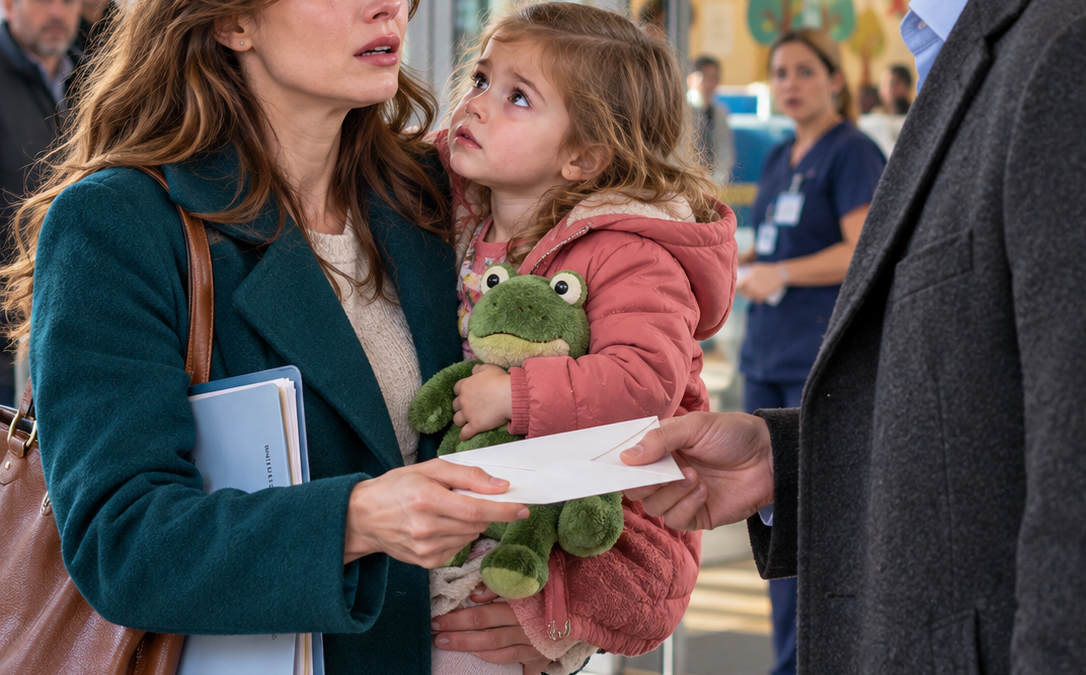
The morning my daughter was diagnosed with ADHD and autism spectrum disorder, my husband walked out of Boston Children’s Hospital, handed me a signed divorce petition on the front steps, and drove away in the car we had bought together. He didn’t look back. Not once.
I stood there on the sidewalk along Longwood Avenue with Maisie pressed against my hip, her small fingers twisted into the fabric of my coat, and I could not move. The November air hit like a wall of ice. Pigeons scattered across the concrete. A cab honked somewhere behind me, and I just stood there, holding my three-year-old daughter and a folder of clinical evaluation reports, watching the silver tail of my husband’s Audi disappear into the gray Boston traffic.
His name was Conrad. No, wait. I had promised myself I would stop starting sentences with his name. That was something my therapist told me six months later. But that morning on Longwood Avenue, Conrad was still the center of every thought I had, because he had been the center of my life for seven years. And now he was gone.
The specialist’s name was Dr. Patricia Huang. She had kind eyes and a soft, measured voice, the kind of voice designed to deliver news that breaks people apart without completely destroying them. She had spent forty minutes going through Maisie’s evaluations, the developmental screenings, the behavioral assessments, and the sensory processing profiles. Then she set the folder down, folded her hands, and told us, “Maisie presents with autism spectrum disorder, level two. She will benefit significantly from early and intensive intervention. ABA therapy, speech-language pathology, occupational therapy. The sooner you begin, the better her outcomes.”
I remember the exact texture of the chair cushion beneath my palms. Vinyl, navy blue, slightly sticky. I pressed my hands flat against it as though I were trying to hold myself to the surface of the earth. Beside me, Conrad had gone very still. I had felt the shift in the room, something cold moving through him, but I told myself it was shock. That he needed time. That he loved Maisie and simply needed a moment to absorb what we were being told.
Outside the consultation room, in the wide hallway with its polished floors and cheerful wall murals of trees and birds, Conrad stopped walking. He turned to me with an expression I had never seen on his face before. Not grief. Not fear. Something colder and more final than either.
“I can’t do this, Willa,” he said.
“What do you mean, you can’t do this?”
“I mean exactly what I said. I’ve been thinking about it for a while. This isn’t the life I planned. I need you to know that before we go any further.”
I thought I had misheard him. I actually put my hand on his arm, the way you do when you need someone to slow down because nothing they’re saying is making sense. But he stepped back. He reached into the inside pocket of his wool overcoat, produced a folded envelope, and placed it in my hand without meeting my eyes.
“That’s already filed with the Suffolk County Probate Court,” he said. “The petition. My attorney will be in touch.”
And then he was gone. Down the hallway, past the bird murals, through the automatic glass doors, and out into the city.
Maisie had watched him go. Her hazel eyes tracked him down the corridor with that particular quality of attention she always had. Intense, unblinking, focused on something the rest of the world couldn’t quite see. She didn’t cry. She never cried in public. She rarely cried at all, which the evaluations explained in clinical language, but which I had spent three years trying to understand with my whole heart.
I knelt down in the hospital hallway and held her against me, this small, warm, otherworldly child of mine. She smelled like the grape juice she’d had at breakfast and something underneath that, something sweet and indefinable that was simply Maisie. I pressed my face into her hair and breathed her in, and I told myself very quietly that we were going to be okay. I didn’t believe it yet, but I said it.
We took the Red Line home to Cambridge. Maisie sat pressed against the window of the T, watching the dark tunnel walls rush past with an expression of total absorption. She had her frog, a small, velvety green stuffed animal she called Pip, held in both hands, turning it over and over with practiced, rhythmic movements. She didn’t ask where Daddy was. She never asked where people were when they left. I had always attributed this to shyness. Now I understood it differently.
Our apartment was on the third floor of a triple-decker on Huron Avenue, the kind of building that smells like old wood and other people’s cooking and decades of Cambridge winters. I had always loved it. Conrad had called it temporary, a stepping stone, something we’d trade up from when his career took off. He was a financial analyst at a firm in the Financial District, the kind of job that came with a six-figure salary, a company credit card, and a particular brand of quiet, unspoken contempt for things that didn’t perform according to plan.
I was a part-time copy editor for a small academic press in Kendall Square. I had taken the reduced hours when Maisie was born, thinking I’d ramp back up when she started preschool. But preschool had become a rotating series of calls from teachers who didn’t know how to reach her, and I had stayed part-time, and time had passed.
I put Maisie down for her rest period. She didn’t nap anymore, hadn’t since she was two, but she would lie on her bed and arrange her stuffed animals in configurations that seemed to follow a logic entirely her own. Then I sat down at the kitchen table with the envelope Conrad had given me.
The divorce petition was twelve pages, clean, comprehensive, clearly prepared well in advance. It cited irreconcilable differences. It proposed an equal division of marital assets. It requested that I be designated the primary residential parent for Maisie, with Conrad having no scheduled visitation. He was asking to walk away entirely. Clean, like a contract termination.
I remember sitting very still for a long time. The refrigerator hummed. A pigeon knocked around on the fire escape outside. From the bedroom, I could hear the soft, repetitive sound of Maisie’s stuffed animals being repositioned against one another.
Then I opened my laptop and logged into our joint savings account.
The balance was $8.40.
I sat with that number for a moment, trying to make it make sense. Our joint account had held nearly $180,000 six months earlier, the result of seven years of combined savings, modest but disciplined, accumulated against the future we had planned together. A house. A yard for Maisie to run in. A buffer for emergencies.
I clicked through to the transaction history. Over the preceding four months, there had been a series of large, recurring transfers. Always late at night. Always to an external account I didn’t recognize. Seventeen of them in total, averaging between $8,000 and $12,000 apiece. The most recent had been three days earlier. $14,200, gone.
I checked the notification settings on the account. The SMS alerts had been changed. The number had been redirected to a device that wasn’t mine.
I sat at that kitchen table until the light went flat and gray outside the window, and I tried to find the bottom of what I was feeling. I couldn’t. It was like reaching down into dark water and finding no floor.
Maisie came out of her room at some point, silent in her socks, and stopped in the kitchen doorway. She looked at me with those grave, steady eyes. My face was wet. I hadn’t known I was crying until I saw the expression on her face change. Something shifted in those hazel eyes, something I had rarely seen before.
She crossed the kitchen floor, sat down in the chair beside mine, and placed Pip very deliberately on the table in front of me.
It wasn’t something she had ever done before. She guarded that frog fiercely. She had never once handed it to another person. I looked at the frog and then at her, and she was looking back at me with an expression that I can only describe as knowing.
That night was the worst of my life. I will not dress it up or narrate around it. There was an hour somewhere around two in the morning when the full weight of what had happened arrived all at once. The diagnosis. The empty account. The divorce petition on the table. The total, bewildering aloneness of it.
I sat on the bathroom floor and thought thoughts that I am not proud of. Thoughts about exits, about whether Maisie would be better cared for by my sister in Portland, by the state, by anyone other than a woman who had just had the floor pulled out from under her and could not find a single handhold.
I was still sitting on the bathroom floor when the door opened.
Maisie was standing there in her pajamas, Pip tucked under one arm. She had gotten out of bed on her own, which she almost never did at night. She looked at me on the floor, and she didn’t say anything for a long moment. She never rushed to fill silences the way other children did.
Then she crossed to where I was sitting, reached down, and took my hand in both of hers. Her grip was surprisingly firm.
“Mommy, up.”
That was it. Two words, but it was the most direct command she had ever given me. She tugged my hand gently but with unmistakable insistence. She wanted me to stand up.
“Mommy,” she said again. “Come.”
I got up.
I don’t know if it was the grip of her small hands, or the raw clarity in her voice, or simply the fact that she had gotten out of bed in the middle of the night and found me. But something shifted in that moment, some dial inside me turning from collapse toward the grinding, unglamorous machinery of survival.
I picked her up and carried her back to bed, and I lay beside her until she was asleep. Then I went back to the kitchen table and opened my laptop again.
I worked until dawn.
Conrad’s financial betrayal had been methodical and well planned, but he had made mistakes. He had used our joint account for the transfers, which meant the paper trail was entirely accessible to me. He had also used the same device to log into the account management portal that he used for his work email. It was a shared laptop we kept in the apartment, and I had physical possession of it.
Over the course of five hours, I downloaded every transaction record, cross-referenced the external account numbers against public business registries and forum posts I found on gambling addiction boards, and assembled a detailed picture of where $180,000 had gone.
Online sports betting platforms. An offshore poker site. Three wire transfers to what appeared to be a private loan broker operating out of a P.O. box in the Cayman Islands.
Conrad had a gambling problem.
I had seen the edges of it over the years. The late nights, the locked phone screen, the inexplicable moods. But I had interpreted it as stress, work pressure, the kind of thing men in high-stakes finance carried home and couldn’t set down. I had not understood what I was looking at. But I understood it now.
I also found, buried in a folder of old documents on the shared laptop, a draft email that Conrad had never sent. It was addressed to a real estate broker I didn’t recognize. It described our Cambridge apartment, our home, which we owned and which had been purchased partly with a $40,000 gift from my parents, as available for a quiet sale at a price that didn’t require my knowledge or signature.
The email included a note about the timeline.
“Need to move fast. Wife is distracted with the kid.”
My hands were steady when I copied everything to a thumb drive. Steadier than I expected. There was something clarifying about documentation, about evidence. It turned the formless catastrophe into a sequence of facts, and facts were things you could act on.
At seven in the morning, I called my sister, Dana, in Portland. Dana had always been the practical one. She answered on the second ring, heard my voice, and didn’t ask any questions. She just said, “Tell me everything.”
I told her. When I finished, she was quiet for three seconds, and then she said, “Okay. Here’s what we’re going to do.”
What followed was the longest six months of my life.
With Dana’s help, I found a family law attorney at a firm in Downtown Crossing, a woman named Gwen Castellano, who had fifteen years of experience in financial fraud cases within divorce proceedings. When I walked into Gwen’s office and spread the documentation across her desk, she looked at the transaction records, looked at the draft email, then looked up at me.
“He really did think he was dealing with someone who wouldn’t notice.”
Gwen filed a motion to freeze Conrad’s remaining personal assets within a week. She reported the financial fraud to the Massachusetts Attorney General’s Consumer Protection Division and the Financial Industry Regulatory Authority, given that Conrad’s misappropriation of marital funds had occurred while he was employed in a regulated financial role.
And she built the custody case around a single, incontrovertible fact: a man who drained his disabled daughter’s financial security to cover gambling debts had demonstrated precisely the kind of judgment and character that no family court judge in Suffolk County would ever reward with access to a child.
Conrad hired an attorney of his own. The attorney sent letters. Gwen responded to the letters. I stopped reading them.
I put my energy into Maisie instead.
Getting Maisie into an early intervention program was the most important thing I did, and it was also the most logistically grueling thing I had ever attempted. Boston has resources, but accessing them requires a kind of dogged, relentless navigation that no one prepares you for. I made more phone calls in January and February than I had made in the previous three years combined.
I sat on hold with the Department of Developmental Services. I appealed Maisie’s insurance preauthorization twice before it was approved. I drove her to evaluations at Franciscan Children’s Hospital in Brighton and to intake appointments at a speech therapy clinic in Newton Center.
And I worked.
I called the academic press and negotiated a switch to fully remote, full-time hours. The pay wasn’t enough, so I took on freelance copyediting on the side, working after Maisie was in bed. I sold the furniture Conrad had left behind: a very good leather sectional, an espresso machine, a bicycle he had ridden twice.
I called my parents, which was the hardest call, and accepted the loan they offered, which was the second hardest thing.
Maisie started with her therapist, a woman named Beth, in February. Beth worked out of a small clinic in Somerville, a bright, low-key space with foam flooring and weighted blankets and an entire cabinet devoted to sensory toys.
During the first session, Maisie sat in the corner and refused to engage with anything or anyone for forty minutes. During the second session, she sat in the corner for twenty minutes, then moved two feet closer to the table where Beth was playing with connecting blocks. During the third session, she sat down at the table.
Beth told me afterward, “She’s watching everything. She understands much more than she’s showing you. She’s just taking the measure of the space.”
I started to cry in the hallway. Not the desperate, drowning kind of crying from the bathroom floor in November. Something different. Relief and grief at once. The particular ache of seeing your child begin to come forward into the world.
In March, I got a call from Gwen’s office on a Tuesday afternoon. I was at my desk with headphones on, editing a manuscript about early modern cartography, and I almost didn’t answer because I didn’t recognize the number. But I did answer.
The news was this: Conrad’s firm had placed him on administrative leave pending an internal investigation triggered by FINRA’s inquiry. His personal accounts, when finally examined by the court-appointed forensic accountant, revealed not just the $180,000 diverted from our joint savings, but an additional $65,000 in personal funds lost to the same gambling accounts over the preceding two years.
The offshore loan broker, when subpoenaed, produced a loan agreement bearing Conrad’s signature for $120,000 at an interest rate that no legitimate lending institution would have offered. He owed people considerably more than he had. And some of the people he owed were not the kind who filed court motions.
This explained something that had puzzled me since November. Why Conrad had transferred the motorcycle he kept in the building’s garage to a street parking spot two blocks away the week before he served me the divorce petition. I had thought it was strange at the time. Now I understood.
He had known what was coming. He had been planning his exit for months, stripping the assets he could reach while leaving behind the complications he couldn’t outrun.
Three weeks after Gwen’s call, I was in the kitchen making Maisie’s lunch. Peanut butter, no jelly, crusts removed and separated into a small pile she would ignore, because the ritual of removing them was apparently the point. My phone buzzed with a local number I didn’t recognize, and I answered.
The voice on the other end was young, nervous, female. She introduced herself as Piper, and she said she needed to talk to me about Conrad.
“Why?” I asked.
“Because I was with him, and I didn’t know who he was. Not really. And I have things I think belong to you.”
Piper was twenty-six. She worked at a wellness studio in the South End. She had met Conrad at a bar in the Back Bay eight months earlier, when he had introduced himself as recently divorced, with no children, a senior analyst preparing to launch his own fund.
They had been together for six months before she found a photo on his phone. Maisie and me at a pumpkin patch the previous October. She had confronted him, and he had said it was old. She had believed him for another two months, until he disappeared without explanation the same week he had served me the divorce petition.
She found out the rest from a mutual acquaintance in Conrad’s social circle. That he had a wife. That he had a daughter with autism. That he had emptied the family account. That he had borrowed money from people with short patience and long arms. And that he had left town.
She came to meet Maisie and me at a café on Huron Avenue, a place called High-Rise that Maisie and I went to most Saturday mornings because the woman who worked the counter knew to give Maisie her hot chocolate with the marshmallows already dissolved.
Piper arrived ten minutes early and was sitting in the corner booth with her hands wrapped around a mug when we walked in. She looked at Maisie with an expression that made my chest ache, this mixture of sorrow and something like wonder. She was seeing the reality of the child Conrad had called a complication.
She put two things on the table. A printed screenshot of a text conversation from Conrad to someone she didn’t know, describing Maisie using language I won’t repeat here, and a USB drive.
“I collected everything I could from his personal laptop before he took it,” she said. “I knew you’d need it. I’m so sorry, Willa. I didn’t know. I need you to believe I didn’t know.”
I looked at her for a moment. She was very young, and she was clearly telling the truth, and she was not the person who had wronged me. I told her I believed her.
The USB drive contained Conrad’s personal transaction histories, his loan agreements, his correspondence with the gambling platforms, and, crucially, the fraudulent power of attorney he had drafted to liquidate our apartment, forging my signature before his legal situation made that impossible.
It was the missing piece. Gwen called it decisive.
The divorce proceedings concluded in June in the Suffolk County Probate and Family Court. Conrad appeared via Zoom. I later learned he was in Phoenix, or had been before that, too, became complicated.
The judge reviewed the forensic accountant’s report, the evidence of financial misconduct, the drafted but unfiled power of attorney with the forged signature, and the text screenshot Piper had printed.
Full legal and physical custody of Maisie was awarded to me without contest. Conrad was required to liquidate the remainder of his personal assets to partially offset the marital funds he had fraudulently transferred. He retained no equity in our home, and no visitation rights were established.
The judge noted, in language that was formally neutral but felt anything but, that “a parent who characterizes their minor disabled child in the terms evidenced in Exhibit 14 has provided the court with all necessary guidance regarding the question of access.”
We drove home on the Red Line, Maisie and I.
She had Pip, and she had a new book Beth had recommended, a picture book about a small bear who organizes his cave very carefully before winter. She sat beside me with her feet not quite reaching the floor, absorbed in the illustrations.
At Central Square, she turned the book to show me a page. The bear was arranging pinecones in a specific order along a shelf. Maisie pointed at the pinecones.
“He puts all the round ones first,” she said. “That’s right. The round ones need to be first.”
She said it with complete authority, as though this were a matter of objective fact.
“You’re absolutely right, Bug,” I told her. “The round ones go first.”
She nodded, satisfied, and went back to her book.
I looked out the window at Cambridge scrolling past, and I thought about the woman on the bathroom floor in November. I thought about the small hand gripping mine in the dark. The voice that had said “Mommy” and “up” and “come” as though it were the most obvious thing in the world.
My daughter had not understood what was happening in that hallway. Probably. She had not been able to articulate it if she had. But something in her had perceived that I needed to be pulled upright. And she had done the pulling.
The research, the court dates, the funding battles, the phone calls and the forms, and the nights after bedtime at the laptop. All of that was mine. I had done that.
But the first step, the step that made all the others possible, had been Maisie standing in the bathroom doorway with Pip under her arm and two words in her mouth, choosing to use them.
Summer came slowly to Cambridge.
Beth told me in July that Maisie had initiated a reciprocal conversation with another child at the clinic, unprompted, on her own terms, about the correct way to organize a set of magnetic tiles. It had lasted four and a half minutes. Beth had tears in her eyes when she told me.
Maisie, for her part, reported the event as follows.
“There is a boy there named Theo who doesn’t know that the squares go on the bottom layer. I told him.”
“How did he take it?” I asked.
She considered this.
“He said, ‘Okay,’” she told me. “So I think we are probably friends now.”
I enrolled in a caregiver support group at Cambridge Health Alliance that fall, something I had been told to do six months earlier and had resisted the way you resist things that require you to admit how much you are struggling.
The other parents in the group were a teacher from Medford, a construction foreman from Watertown, and a doctoral student from MIT. We sat in a circle on folding chairs and talked about IEP meetings and sensory triggers and the particular loneliness of loving someone who experiences the world in a way you are still learning to translate.
One evening, walking home from the group through the dark streets of Porter Square, I stopped at the corner of Mass Ave and just stood for a moment in the cold air.
Above me, the Orange Line train passed overhead on the elevated tracks, all lit up and rattling, going somewhere. Around me, the city moved in its usual indifferent way.
And I became aware, in a way I hadn’t expected, that I was not afraid.
Not right now. Not tonight.
The fear was still there. It was always there. The long, grinding worry about what Maisie would need and what I could provide and who would be there when I couldn’t be. That fear didn’t go away.
But I was carrying it differently. I had been carrying it long enough that my shoulders had reshaped themselves around the weight.
Six weeks later, Conrad’s attorney sent a letter through Gwen’s office.
Conrad had relocated to Scottsdale and was working in property management. He had not paid the court-ordered restitution. This was being dealt with through enforcement proceedings.
The letter was not about any of that.
It was brief. It said that Conrad’s mother, who lived in Concord, New Hampshire, had sent a money order to his P.O. box, designated specifically for Maisie’s therapy fund, and he was transmitting it as directed.
He had added a single line in his own handwriting at the bottom of the typed letter.
“I understand now what I walked away from. I know there is nothing to say.”
I held the letter for a moment. Then I deposited the money order, wrote a thank-you note to his mother, and did not respond to the rest.
On a Friday in November, exactly one year after the morning on Longwood Avenue, I picked Maisie up from Beth’s clinic, and we stopped at High-Rise on the way home.
Maisie had her hot chocolate, marshmallows dissolved. I had coffee.
She had brought Pip, as always, and she sat across from me at the small table by the window, holding him with one hand and holding her mug with the other, watching the street outside with those particular eyes of hers.
After a while, she said, “Mommy.”
“Yeah, Bug?”
“I remember when you were sat on the floor.”
“You do?”
“Yes. I came to get you up.”
“You got up?”
“I did,” I said. “I got up.”
She considered this in the way she considered things, fully, quietly, without rushing herself.
Then she said, “You can always get up.”
She said it the way she said everything that she knew to be true. With complete calm, with no decoration, with the unshakable authority of someone who has taken careful measure of the world and arrived at a fact.
I looked at my daughter across the small table in the warm light of the café on a cold November Friday in Cambridge.
She had Pip and her hot chocolate and her perfect certainty.
And I thought, this is who pulled me out of the dark.
Not in spite of everything the world had called her limitation, but because of the clarity that came from seeing straight through to what mattered.
I reached across the table and held her hand.
She let me.








