My daughter-in-law threw my late wife’s handwritten notebook into the fire and screamed: “she’s dead! how long are you going to hold on to this damn thing?” — so i sold the orchard she wanted to take, took everything back, and never returned!
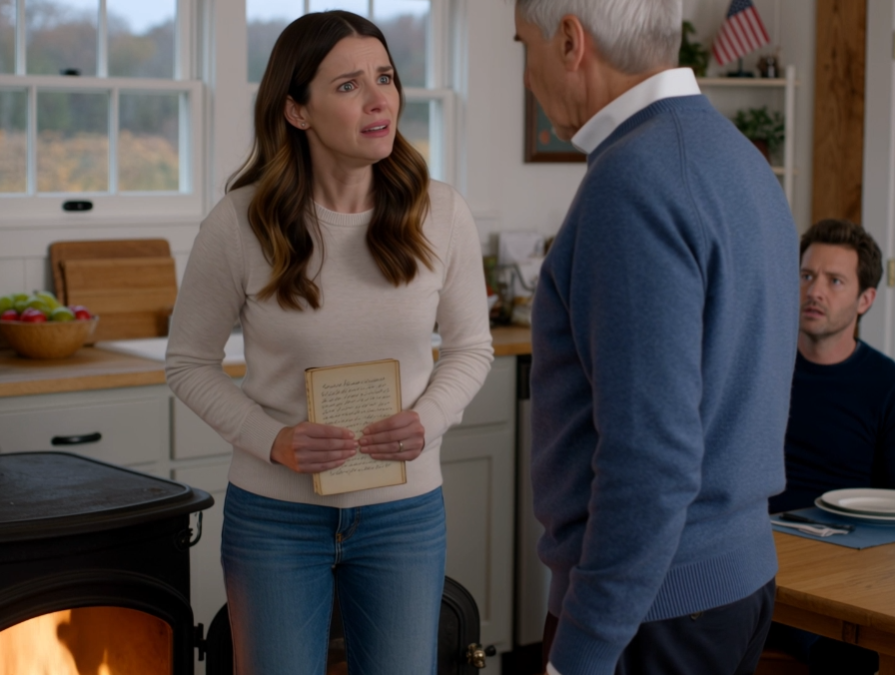
My wife’s handwritten notebook was burning in the wood stove, and I reached into the fire with both hands to save it.
I know how crazy that sounds. I’m 68 years old, but in that moment, I never thought about my hands. All I could see were the pages that had stayed with my wife for thirty years, curling up in the flames. She started that notebook in 1989. In it, she wrote down every season, every freezing morning, every branch she grafted, and every harvest number from the orchard we spent almost our whole lives keeping alive.
And the person who threw it into the fire was my daughter-in-law.
She stood only a few steps away, watching me pull the burning notebook out of the stove. Then she looked me straight in the eye and said each word slowly and hard.
“She’s dead, Rom. How much longer are you going to hold on to this damn thing?”
Maybe if you had only seen that one moment, you would think I was just an old man who couldn’t let go of the past. But to understand why an old notebook was worth my own two hands, I have to tell you about the woman who wrote every line inside it.
My name is Roman Kowalic. Everybody’s called me Rom since grade school. For forty-one years, I was an official court reporter for the circuit court in Green Bay, Wisconsin. Steno machine, twenty-two keys, 220 words a minute on a good day. Homicides, custody fights, medical malpractice, a whole lot of drunk driving. I sat six feet from the worst days of about 9,000 people’s lives, and I wrote down every single word they said without ever saying one of my own.
That’s a job that does something to a man over four decades. And I’ll come back to it, because it’s the whole reason any of this happened.
The orchard is in Door County, up the bayside north of Egg Harbor. Twenty-two acres, roughly 1,900 cherry trees, mostly Montmorency, with shoreline frontage on the water. My grandfather Felix bought the property in 1946 with his mustering-out pay because a man at the co-op told him cherries were the coming thing. They were, for about thirty years. Then they weren’t.
The house is a white farmhouse from 1931, with a porch that faces west. And if you stand on that porch in July at 8:40 at night, the whole bay goes the color of the inside of a peach.
My wife was Adela. Everybody called her Dell. She taught fourth grade at Gibraltar for twenty-nine years, and she ran that orchard on the side like it was nothing. She’s the reason it survived at all, because I sure didn’t do it. I was in a courtroom.
Dell got sick in 2014. She was sixty-one. Early-onset Alzheimer’s. Seven years of it.
If you’ve been near that disease, you know I don’t have to describe it. And if you haven’t, I’m not going to, because there is no version of describing it that isn’t cruel to somebody watching.
She died in the front room in March of 2021.
Now, here’s a thing about me that’s going to matter later. Because of my job, I’ve carried a small digital recorder in my coat pocket every day since 1991. Every day. It was a backup for the steno machine in case the equipment failed. After thirty years, it stopped being a decision and became something my hand did on the way out the door, like picking up my keys.
And when Dell started slipping, I left it running. Not for evidence. For me.
I have about ninety hours of my wife’s voice. Her telling me about a kid in her class. Her arguing with me about the gutters. Her singing something in Polish that her mother used to sing, a song she remembered in 2019 when she could no longer remember my name.
I have never once played those recordings back. They’re in a box. Someday.
Now, the book.
Dell kept an orchard ledger, a cloth-covered notebook about the size of a phone book. She started it in 1989 and filled it until her handwriting went. Frost dates, spray schedules, which rows got hit, harvest weights per block, what a bin brought at the co-op. And in the margins, other things, because she couldn’t help herself.
In the margin for June 1994, it says in her handwriting, “Rom came home from the Vanderstein trial and didn’t talk for two days. Made pierogi. He talked.”
In the margin for August 2003, it says, “Cass got into Whitewater. I sat down on the gravel.”
Thirty years of a marriage, written sideways in the margins of a farm ledger.
That’s the book.
My son is Casemir. Cass. He’s forty. He does IT contract work, remote network security, and he’s good at it. He married Brin six years ago. She’s thirty-seven. She’s from Kona, and she runs a wellness brand. Online supplements, a program, a podcast, 41,000 followers. The whole architecture.
Four months after Dell’s funeral, Cass called me.
“Dad, we’re upside down. Bad. Can we come up to the orchard for a while? Six months tops, till we’re square?”
I said yes before he finished the sentence. I told him to come, and I meant it. I’d do it again. And I want to be clear about that, because there’s no version of this story where I regret opening the door. That part I got right.
Six months became a year. A year became two. Two became five.
I never asked. Not once in five years did I ask when they were leaving. And I want to be honest with you about why.
It wasn’t generosity. I didn’t want them to leave.
I’d moved into a two-bedroom rental in Sturgeon Bay in 2022 because I could not sleep in the room where she died. The farmhouse had been empty, and every time I drove up there and saw lights on inside, some part of my chest let go a little. There were people in it. There was noise.
So no, I wasn’t being noble. I was being lonely, and I dressed it up as family. Those are two different things wearing the same coat.
Here’s the number, since it’s going to come up.
Property taxes on twenty-two acres of Door County waterfront run about $19,000 a year. Insurance, $4,100. The spray program, the pruning crew, the co-op contract, the well pump in 2023, the roof in 2024.
Five years. About $196,000.
All of it came out of my pension and my retirement account.
They paid nothing. Ever. Not one utility bill. I never asked them to. That’s on me, and I own it completely. I want you to hear me say that before you start feeling too sorry for me.
And there was one more thing.
In the third year, Cass called on a Tuesday night. His voice was doing something strange, tight and fast. He said Brin’s brand was about to scale. There was a fulfillment company, inventory to buy, and a launch window. He needed $52,000, and they’d have it back within a year.
I wired the money Thursday morning.
He was so grateful on that call that it embarrassed me. Brin got on the phone and said, “Thank you, Rom. This changes everything.”
And she cried.
I believe she meant it in that moment. I think she absolutely meant it.
The launch happened. It didn’t work.
Nobody ever mentioned that money again. Not once. Not in three years.
Which brings me to the fourteenth of October.
I had decided to give them the orchard.
I want to be clear that this wasn’t a whim. I’d been thinking about it for eighteen months. I’m sixty-eight. I’ve got a heart thing that requires a pill and a yearly conversation, and I did not want that place to go through probate and get chopped up by lawyers.
I wanted it handed over cleanly by a living man while I could watch it happen.
So I had a lawyer in Sturgeon Bay named Winnie Ailoon draw up the transfer documents. And I did something I thought was beautiful. I still think it was beautiful.
It turned out to be the single worst decision I’ve ever made in my life.
I folded the deed into Dell’s orchard book.
The idea was that Cass would open the book. He’d see his mother’s handwriting. He’d turn to the back, and there would be the deed. Then I’d say the thing I’d been practicing in the truck for three days.
What I was going to say was, “This isn’t land. This is your mother’s thirty years. Take care of it.”
I never got to say it.
I drove up on a Saturday. Cold and clear, with that hard blue Door County October sky. I’d stopped in Egg Harbor and bought a pie because I didn’t know how to arrive empty-handed.
Brin opened the door before I knocked, and she was warm. I want to say that. She hugged me, took the pie, and said, “Rom, we’re so glad. Come in.”
She’d lit the wood stove in the front room, and there were candles burning, and the house smelled like rosemary. In five years, she’d cooked for me twice.
The front room stopped me for a second.
New furniture. A big gray sectional where Dell’s green chair had been, one of those brass floor lamps that curves overhead, and the walls.
The walls were mostly empty.
Dell’s paintings from the galleries in Fish Creek were gone. In boxes somewhere, I found out later, because they didn’t fit the palette.
Cass came out of the kitchen, and he looked bad. Thin, gray under the eyes, his hair too long. He hugged me sideways and said, “Thanks for driving up, Dad.”
If I’d been paying attention, I’d have stopped everything right there and asked my son what was wrong with him.
I wasn’t paying attention. I had a speech in my pocket.
We ate at Dell’s table. Brin had made something with squash, and it was genuinely good. I waited until the plates were pushed back, then took the book out of my bag and set it on the table between us.
And Brin’s face did something.
I saw it, and I misread it completely.
I thought it was emotion. It was calculation.
There’s about a two-degree difference between those two expressions, and I’ve watched 9,000 people on a witness stand. I still got it wrong because it was my own kitchen.
“Cass,” I said. “Open it.”
He opened it. He turned it toward himself, put his hand flat on a page, and didn’t say anything for a while.
Then, quietly, he said, “That’s Mom’s writing.”
“Look in the back.”
He found the deed.
What happened next took about ninety seconds. And I have it word for word. I mean word for word. I’ll explain that in a minute.
Brin said, “Finally.”
Just that. Finally. Like a bus had come.
“I’m sorry?” I said.
She wasn’t even angry yet. That’s the thing. She was relieved.
“Rom, we have been waiting five years for this conversation. Five years. Do you have any idea what that’s like? Sitting in a place worth three million dollars and not being able to touch it?”
“Brin, I’m not giving you three million dollars. I’m giving you an orchard.”
She laughed.
“It’s the same thing.”
“No, it isn’t.”
Then she told me all of it, fast, like she’d been holding it in a jar.
There was a developer out of Green Bay. He’d walked the parcel in August.
August. Two months earlier. On my land, with my son.
Eleven waterfront lots along the shoreline frontage. The orchard cleared. The farmhouse torn down or sold off separately. $2.9 million, maybe more if the shoreline zoning went the way their guy said it would.
Lots.
Nineteen hundred trees.
I sat there, and I did the thing I have done in a courtroom 9,000 times.
Nothing.
My face did nothing.
Forty-one years of training, and it turns out the only real skill I ever developed was not reacting while someone destroys something.
“Cass,” I said, “you walked a developer through your mother’s orchard in August?”
My son said nothing.
He looked at the table, both hands flat against it, and he said nothing.
If you’ve ever been in a room where the one person who was supposed to speak for you chose the floor instead, you know that particular silence has a sound. It isn’t quiet. There’s a hum in it. And once you’ve heard it, you never mistake it for anything else again.
Then Brin said the sentence I’ve thought about more than any other sentence in this entire story.
“Rom, you’ve been paying for a museum and calling it a farm.”
And here’s the terrible part.
She wasn’t wrong.
That orchard hasn’t turned a profit since 2009. The tart cherry market has been getting strangled by imports for twenty years, and I’ve been writing checks into it for five years because my dead wife’s handwriting is in a book about it.
That is, objectively and financially, a museum.
She was right about the facts and wrong about every single thing that matters.
And that is the most dangerous kind of person to argue with.
I want you to remember that when we get to the end.
“I’m not signing this tonight,” I said.
That’s when it turned.
She stood up, and her voice went up about an octave, and everything reasonable went out of it.
“Of course you’re not. Of course. Because it was never actually about us, Rom. It’s about her. This whole house is a shrine. Her chair, her dishes, her paintings, her book. Her, her, her. And Cass and I have been living inside a dead woman’s museum for five years, waiting for you to let go of one single thing!”
She picked up the ledger off the table.
I said her name once, calmly.
She had it in both hands, and she was crying by then. Actually crying.
The stove door was open because she’d been feeding the fire all evening to make the room nice.
And she put the book in.
Now, I’ve replayed this several hundred times, and I want to give it to you accurately, because there’s a version of this where I’m heroic.
That version is a lie.
I did not think. There was no decision.
I went across that room, put both hands through the open door of a wood stove, took hold of a burning book, brought it out, and dropped it on the hearth. Then I put out the flames with a wool blanket off the back of the sectional.
Second-degree burns across both palms and the insides of all eight fingers.
The blister on my right hand came up while I was still standing there, and I felt nothing.
I want to be clear about that, too. I felt absolutely nothing at the time.
The pain came later, in the truck, and it came in like a train.
Here’s what I remember.
The smell.
Burning cloth and burning paper smell like nothing else. And the smell of my wife’s thirty years going up is something I still get in the back of my throat at random moments, in a grocery store at four in the afternoon, for no reason at all.
Nobody moved.
Brin was standing there with her hands over her mouth.
“Oh God. Oh God, I didn’t… I didn’t mean…”
And I believe that was true.
Cass, my son, got up out of his chair. He took two steps, then stopped. He stood in the middle of the room with his arms halfway raised, and he did not come to me.
Two steps.
That’s what I got.
I picked the book up off the hearth with the backs of my wrists because I couldn’t close my hands.
About the bottom third was gone.
Everything from 1989 through late 1996. Gone.
The rest was scorched and water-warped, and it is right now, tonight, on the shelf behind me.
I got my coat on with my elbows.
At the door, Brin was saying something about the hospital in Sturgeon Bay, about driving me. I heard her, and she meant it. I want that in the record, too, because I’m not going to make her into a cartoon.
“Don’t,” I said.
And I left.
I drove myself the forty minutes with my wrists on the wheel and the heat turned off because the heat hurt.
About ten miles south of Egg Harbor on Highway 42, with the bay black on my right, I felt something in my coat pocket pressing against my ribs.
And I understood what I had.
I pulled over onto the gravel.
Forty-one years. Every day. My hand does the same thing on the way out the door. It’s not a plan. It’s a tic. The same reason I can’t sit in a restaurant with my back to a room.
The recorder had been in my coat pocket at that table since I walked in.
Running.
Two hours and nine minutes.
Wisconsin is a one-party consent state. I know that the way you know your own address.
I sat on that gravel shoulder for a long time.
They stitched nothing at the ER in Sturgeon Bay because there’s nothing to stitch with burns. They just clean them, dress them, and give you the talk about infection. The physician assistant who treated me was about thirty. She asked how it happened, and I told her I’d reached into a stove for something.
“Must have been important,” she said.
“It was,” I told her.
That night, I sat in my rental with both hands wrapped like a boxer’s and played the file. All of it. Two hours and nine minutes.
Then I played it again.
And I’ll tell you what I heard the second time that I hadn’t heard the first, because this is the thing that changed the whole story.
I heard my son breathing.
There’s a stretch right after Brin says the museum line where nobody talks for about six seconds. On the recording, you can hear Cass breathing, and it’s wrong. It’s fast and shallow, and it catches. That is not the breathing of a man executing a plan.
That is the breathing of a man having something close to a panic attack at his mother’s kitchen table.
I found out later, much later and not from him, that my son had been on his second antidepressant in eighteen months. He’d been drinking most nights and hadn’t billed a client in eleven weeks.
He hadn’t chosen Brin over me.
He had stopped being able to choose anything at all about two years earlier, and she had simply filled the vacuum the way anybody would.
That’s not a defense.
He was forty years old. He watched his father burn his hands, and he took two steps. There’s no arithmetic that makes that all right.
But it’s the truth, and I promised you the truth.
Now, the next part is where a lot of people think I became a monster.
For three weeks, I couldn’t use my hands. So I sat. And on the twenty-second day, when I could hold things again, I did the only thing I’ve ever known how to do.
I sat down at my steno machine.
I still have it, a Stenura. I’ve had it since 1988. I put the recording on and transcribed the entire evening verbatim. Two hours and nine minutes. Every “um,” every overlap, every pause with its length marked.
It came to just over 14,000 words.
It took me nine hours across two days.
And at some point in the middle of the second day, I understood what I was actually doing. I had to stop and go stand outside in the cold, because for forty-one years, I had recorded other people’s worst moments and never said a word of my own.
Nine thousand times.
And here I was, doing it again. To my own family. In my own kitchen. On my own night.
My hands were doing the only thing they knew how to do with pain, which was turn it into a document.
That’s my flaw. That’s the one.
Not generosity.
I am a man who spent his whole life making perfect records of things he never said out loud.
I never told my son what that orchard was. Not once. Not in twenty years. Not in a sentence with a subject and a verb.
I assumed the book would say it for me. I assumed the trees would.
Trees don’t say anything.
If you’ve ever assumed that the people you love understand what something means to you because it’s obvious, because how could they not, I want you to sit with this for a second.
They don’t.
They cannot.
You have to say it out loud, in words, with your mouth. And you have to say it early, and almost nobody ever does.
I didn’t.
That’s the last thing I’ll say in my own defense, which is nothing.
Winnie Ailoon’s office is above an insurance agency on Third Avenue in Sturgeon Bay. She’s fifty-six, came up from Milwaukee, and handles elder law and land matters. She has a way of not filling silences that I respect enormously.
I put the transcript on her desk, along with the audio on a drive, five years of tax bills, the insurance records, the co-op invoices, and the wire record for the $52,000.
She read for about twenty minutes without saying anything.
Then she looked up.
“Roman, legally, this isn’t complicated. No lease, no written agreement, no rent, no improvements at their expense. In Wisconsin, they’re licensees. Twenty-eight days’ notice, and the sheriff’s department will handle it if it comes to that.”
Then she asked me, “What do you actually want?”
And that’s the question, isn’t it?
Nobody ever asks it. Everybody asks, “What do you want to happen to them?”
I said, “I want to make sure eleven houses never get built on that shoreline.”
She put her pen down.
“Then you’re not talking about an eviction. You’re talking about an easement.”
She explained it to me, and I want to explain it to you, because this is the actual ending.
You can put a permanent agricultural conservation easement on a parcel of land. It’s recorded against the property forever, and it runs with the deed no matter who owns it afterward.
It says the land stays farmland.
No subdivision. No development. Ever.
Not by me. Not by a buyer. Not by a buyer’s grandchildren.
And it destroys the development value.
Winnie was very careful.
“Roman, I need you to understand the number. As a development parcel, appraised, you’re at $2.8 million, maybe $2.9 million. Encumbered by a permanent easement, you’re looking at somewhere around $1.3 million to $1.4 million, depending on who wants an orchard. And not many people want an orchard.”
She let that settle.
“You would be voluntarily giving up roughly a million and a half dollars.”
“I know.”
“At sixty-eight.”
“I know.”
She looked at me for a while. Then she said something I’ve thought about ever since.
“I have to ask you this, and I’m not being unkind. Are you doing this because it’s right, or because it’s the one thing she can never undo?”
I sat there in that office above the insurance agency, and I gave her an honest answer.
“I don’t know yet. Ask me in a year.”
She nodded.
“Fair enough. Then we file.”
We filed the easement first. Six weeks. The land trust took it, and they were thrilled.
The whole thing was recorded at the register of deeds on the ninth of December, while Cass and Brin were still living in the house.
They had no idea.
Because there is no requirement on earth that you tell anybody what you record against your own property.
Then we listed the orchard.
Then I went and got Dell’s things.
Solveig Burn runs the orchard supply business out on County F. She’s sixty-four. She was Dell’s closest friend for thirty years, and she’s been dropping food at my rental every couple of weeks for five years while I’ve been saying thank you and not thinking about it.
I called her because I needed a truck and hands that worked.
“What time?” she asked.
That’s all she said.
We did it on a Tuesday when Cass and Brin were at a thing in Green Bay.
Dell’s paintings came out of the boxes in the garage. The green chair. Her mother’s crockery. The photo albums. Dell’s grandmother’s doughboard, which is a slab of maple worn into a dish in the middle by a hundred years of hands.
On the porch, while we were loading the last of it, Solveig stopped and looked at me.
“Rom, your hands.”
I still had dressings on my fingers.
“It’s fine,” I said.
“It isn’t.”
Then she put her hand flat on my back, between my shoulder blades, and left it there for about four seconds.
That’s it. That’s the whole thing.
Four seconds and a hand.
I nearly went down on that porch because it had been five years since anybody had touched me on purpose.
And I hadn’t known that.
I did not know that about my own life until a woman put her hand on my back on a porch in December.
Then we drove to her place, and she made coffee, and I told her everything. She listened the way she does.
At the end, she said one sentence about Brin that reorganized the whole thing for me.
“Rom, that girl isn’t greedy. That girl is scared out of her mind, and she’s been scared since she was nine.”
“How do you know?”
“Because Dell told me. Dell liked her.”
Dell liked her.
I hadn’t known that either.
The mediation was on the twenty-eighth of January.
That’s the climax, and I’m going to walk you through it slowly because that’s how it happened.
It took two hours and forty minutes, and it felt like a week.
Winnie had offered mediation instead of going straight to eviction. Cass and Brin had found a lawyer in Green Bay off the internet, a man named Dorian Whitlock, who charged $9,000 upfront and whose website had the word aggressive on it twice.
They’d paid him with a credit card.
The conference room was on the second floor of a building on Kentucky Street, with a window overlooking the parking lot. A long table, eight chairs, and a tray of pastries nobody touched. Not once in two hours and forty minutes.
The mediator was a retired family court judge named Halver Apprentice. Seventy-five, hearing aids, absolutely no interest in theater.
I sat with my back to the window, Winnie on my left.
My hands had healed by then, except for the right palm, which still had a raised pink mark across it, shaped like the spine of a book. It turns out that mark is going to be there permanently.
They came in eight minutes late.
Cass had cut his hair. He’d lost more weight. He wouldn’t look at me. He sat down and put both hands flat on the table, which is a thing he does, which is a thing I do, and which I had never noticed until that second.
Brin looked good. She’d dressed for it.
I watched her come in and take the room in, and I thought, She thinks this is a negotiation.
Whitlock went first, and he was fine at it.
Five years of occupancy. Detrimental reliance. Repeated oral assurances that the property would pass to his clients. Substantial contributions of labor and maintenance. Constructive tenancy.
He talked for eleven minutes.
Judge Apprentice looked at him.
“Mr. Whitlock, do you have anything in writing?”
“Family arrangements are frequently informal,” Whitlock said.
“That’s a no,” Apprentice replied.
Then Winnie took her turn.
She did not make a speech.
She put four things on that table, one at a time, and said what each one was.
Tax bills. Five years. All paid by me.
Insurance. Five years. All paid by me.
The wire record. $52,000. Three years old. No repayment.
And a 14,000-word certified transcript prepared by a licensed court reporter with forty-one years of standing, with an audio file attached, of a conversation that took place on the fourteenth of October.
I watched Brin’s face when Winnie said the date.
She didn’t know what it was yet. She just knew the date meant something.
“What conversation?” Whitlock asked.
“Wisconsin is a one-party consent state,” Winnie said. “My client is a career court reporter who has carried a recording device daily since 1991. It was in his coat pocket. Would you like to hear it, or would you like to read it?”
Nobody said anything.
Judge Apprentice spoke.
“Play it.”
Winnie had the recording cued to a specific spot, not the beginning.
She’d picked ninety seconds, and she’d picked them well.
A laptop speaker in a conference room in Sturgeon Bay played my daughter-in-law’s voice saying, “It’s the same thing.”
Then the developer. Then the eleven lots. Then $2.9 million.
Then, “You’ve been paying for a museum and calling it a farm.”
Then a six-second gap where you could hear my son breathing.
Then, “This whole house is a shrine.”
Then the sound of the stove door.
Then my voice saying her name once, evenly.
Then nothing for four seconds.
Then the sound.
And I’ll tell you, a book going into a firebox doesn’t sound like anything dramatic.
It’s a soft thump, and then a change in the way the fire is breathing.
That’s all.
Then my own voice on that recording, very quiet, saying, “Get back.”
Winnie stopped it.
The room.
I’ve been in a lot of rooms. I sat through the sentencing phases of two homicides.
I have never in my life been in a room like that room.
Whitlock had gone the color of a manila folder. He put his pen down and did not pick it up again for the rest of the session, which is its own kind of statement from a lawyer.
Judge Apprentice took off his glasses, set them on his notepad, and rubbed his eyes with his thumb and forefinger. He kept his hand there for a good five seconds.
Cass had his face turned toward the window.
And Brin…
Brin looked at me for the first time in five years.
That woman looked straight at me. Her chin was trembling, and her eyes were absolutely enormous.
“Rom, I didn’t know you had that.”
“I know you didn’t,” I said. “That’s the point.”
And here’s where it stops being a revenge story.
I need you to stay with me for this part, because it’s the only part that matters.
She started talking fast. Whitlock said, “Brin,” but she waved him off and kept going, and nobody stopped her.
“My mother lost our house twice. Twice. The second time, I was nine, and we lived in my aunt’s trailer in Kona for fourteen months. I slept on a couch that smelled like cats, and I have never in my life stopped being nine years old about it.”
She looked from one face to another, but nobody interrupted.
“And I have watched this family sit on three million dollars in trees that lose money for five years while my husband and I had nine hundred dollars in checking. And every single time I brought it up, I was the bad one. I was the outsider. I was the greedy one from Kona who didn’t understand.”
She kept talking.
“I ran those books for two years. Did anybody notice? I did the spray schedule in 2023. I did the co-op paperwork. I tried.”
Her voice was coming faster now.
“And then I looked at the actual numbers, and I realized nobody in this family has ever once cared whether it worked. They just cared that it existed. And I couldn’t do it anymore.”
Then she said the true one.
“I was so tired of being the only person in the room who was allowed to say the number out loud.”
I sat there because she was right about that, too.
Everybody in that family had been thinking about that money for years. Every single one of us.
I’d been thinking about it. Cass had been thinking about it. We just had the manners never to say it. We let her say it, and then we got to be disgusted with her for saying it.
That’s a real thing that happens in families constantly.
There’s always one person who says the ugly true thing out loud and gets to be the villain for everybody else’s private arithmetic.
She was still wrong.
Being scared does not give you the right to burn a dead woman’s handwriting. Being right about the money doesn’t make you right about the marriage or the trees or the man who let you live in his house for five years for free.
But I understood her completely for the first time.
And I want to be honest with you. It did not make me feel better.
It made everything worse.
Because a story where she’s just a bad person is a story I could put down.
Then Judge Apprentice put his glasses back on.
“Mr. Whitlock, do you want a recess?”
Whitlock spoke very quietly.
“We’re prepared to discuss a departure timeline.”
And that was it.
That was the whole legal fight.
It ended in a sentence.
Twenty-eight days. They’d be out by the twenty-fifth of February.
Then I said my piece.
It was four sentences, and I’d written them on a card in the truck.
“I’m not asking for the fifty-two thousand dollars. I’m not asking for the taxes. I want you out by the agreed date, and I want the paintings that are still in the garage.”
Then I said the fourth one.
“And I recorded a permanent agricultural conservation easement against that parcel on the ninth of December. It’s done. It’s recorded. Nobody is ever building eleven houses on that shoreline. Not you, not me, not anybody. Forever.”
Brin looked at me.
“What?”
And when it was explained to her in about forty seconds, in plain words, I watched it land.
This is the part I have to be honest about, and it does not reflect well on me.
When I saw that number go into her, when I watched her understand that the $2.9 million was gone permanently, structurally, and that it had been gone since December while she was sitting in my house making plans, some part of me was glad.
I was glad.
I’m sixty-eight years old, and I sat in a conference room and was glad to watch a frightened woman from Kona lose something.
There’s something in me that took pleasure in that. I found it that day. I hadn’t known it was there in fifty years of adult life, and it had been there the whole time.
That’s my honest answer to Winnie’s question.
I gave it to her in the parking lot afterward, and she said, “Yeah, that’s why I asked.”
And then Cass did the one thing.
We were all standing up, chairs sliding back, people gathering their papers.
My son came around the end of that table and stood in front of me.
He took my right hand, the bad one, and turned it over.
He looked at the palm.
He looked at it for maybe four seconds.
Then he said, “Dad.”
That’s all.
He couldn’t get anything else out.
His whole face came apart, and he couldn’t get one more word out of himself.
He let go of my hand and walked out of the room ahead of his wife.
Four seconds and a hand.
Same as Solveig on the porch.
I keep noticing that.
Here’s where everything landed.
The orchard sold in April.
Not to a developer. A developer wouldn’t touch it, which was the entire point.
It went to Mai and Tu Vang, a couple in their mid-thirties who’d been leasing eleven acres down near Forestville for six years and wanted their own ground.
They’re putting in hazelnuts and elderberries between the cherry rows, which Dell would have had opinions about. And they’re keeping about 1,200 of the trees.
The sale price was $1.38 million.
I gave up roughly a million and a half dollars.
And I want to tell you honestly that there are nights I think about that number, and there are nights I don’t.
The Vangs have two boys, seven and four.
In August, the seven-year-old fell off the porch railing. The same one Cass fell off in 1993. He broke his wrist in the same place.
Mai called to tell me. She thought I’d want to know.
I did.
Cass and Brin ended up in an apartment in De Pere.
They separated in June. I don’t know if it holds.
He’s in treatment for the drinking. Actually in it. Six months in as of last week.
And he called me on my birthday for the first time in four years.
We talked for nine minutes about nothing, which was the best nine minutes of my year.
We’re not fixed.
We might not get fixed.
He’s forty, and I’m sixty-eight, and the arithmetic on that is what it is.
But he called.
Brin sent me a letter in September.
Handwritten. Four pages.
I read it twice, then put it in the box with Dell’s recordings. I haven’t answered it.
I might.
I might not.
She apologized for the book. Specifically for the book. Not for anything else, which I actually respect.
I changed my will in March. Winnie did it.
I’m not going to tell you every line of it, but I’ll tell you the shape.
A piece goes to Cass in a trust he can’t touch the principal of until he’s fifty, because I love him and I’ve watched what a lump sum does.
A piece goes to the land trust that holds the easement.
And a piece goes to the Vang boys for school, which they don’t know about.
Solveig and I have supper four nights a week now.
We drove to Bayfield in July.
I’m not going to make more of it than it is.
But I will say that at sixty-eight, I did not expect to be nervous about anything ever again.
And I was nervous in that car.
It was ridiculous.
And it was the best I’d felt since 2014.
Now, let me tell you what I actually learned, and then I’ll let you go.
Everybody’s going to say the lesson here is don’t let people take advantage of you.
That’s not it.
That’s not even close.
The lesson is that I spent forty-one years making perfect records of other people’s words, and I never said my own.
I never once sat my son down and said, in a sentence with a subject and a verb, “This orchard is your mother’s thirty years of handwriting. And if it ever gets sold, I want it farmed, not built on.”
I thought the trees said it.
I thought the book said it.
I thought it was so obvious that it would have been strange to say.
It was not obvious.
It was invisible.
I handed my son a deed inside a ledger and expected the object to do the talking.
And the object could not talk.
And a woman who had never been told anything set it on fire.
So here’s the one thing I’d ask you to do this week.
It’s free, and it takes four minutes.
Pick the one thing in your life that carries the most meaning and the least explanation. The house, the ring, the workshop, the recipe, the boat, the photographs in the closet.
Then go tell one person, out loud and in plain words, what it actually is and what you want done with it.
Not in a will.
Not in a note for afterward.
Out loud, to their face, while you’re alive to see how they take it.
Because their reaction is information.
And you are allowed to have that information while you can still do something with it.
I got mine on the fourteenth of October in a wood stove, and it cost me both hands and five years of a family.
I’d have gotten the exact same information for free in a four-minute conversation in 2018 if I’d had the nerve.
And here’s the question I sit with most mornings at the window, with my coffee.
Not, What did they do to me?
The question is, What have I been assuming they understand?
Go find out.
It’s cheaper now than it will be later.
Now tell me something, because I read every one of these.
Comment one if you think I was right. If you think permanently destroying a million and a half dollars of my own land value to make sure those houses never got built was the correct thing to do.
Comment two if you think that was spite dressed up as principle, and that a man who does that to punish his daughter-in-law is lying to himself about his motives.
And honestly, some mornings you’d be right.
Comment three if you think the real failure happened years before any of it. That a father who never says out loud what a thing means to him has already lost it, and everything after that was just the paperwork.
That’s the one Solveig and I argue about.
She’s usually right, and I usually don’t admit it until the next day.
And tell me where you’re watching from tonight, and what time it is where you are.
Somebody wrote to me last month from Auckland. It was one o’clock in the afternoon there, and they’d read the whole thing on their lunch break, sitting in their car.
I thought about that for a week.
And if some version of this has happened to you, if someone destroyed a thing that had no price on it and then explained to you why you were unreasonable to care, put it in the comments.
You will not be the only one down there.
Not remotely.
If you stayed with me all the way through, hit subscribe before you go. That’s the only thing I’ll ask of you.
There’s a new one every week.
And underneath every single one of them, it’s the same question.
What do people do with the things they were trusted with?
Somebody’s always keeping a record.
I’d know.
Thanks for sitting with me tonight.
Go get some sleep.
I’ll see you next time.
This is a fictional story inspired by real emotional experiences, fully rewritten and reimagined in Sturgeon Bay, Wisconsin, to create original content. Any resemblance to real people or events is coincidental.








