My daughter-in-law texted me “too much trouble” after I drove 2 hours and 40 minutes for my grandson’s birthday. I sat in that parking lot 52 minutes, holding his wrapped gift, deciding whether to knock or just go home. Then the apartment manager called and asked: “when did anyone last see your son?” I couldn’t sit still any longer.
At 3:41 in the afternoon, a man whose name I had never heard called my phone and asked me exactly one question.
“Mr. Yarro, when was the last time anyone saw your son?”
I froze because, at that very moment, I was sitting in my pickup truck, parked ninety feet from my son’s front door. On the seat beside me was the birthday present I had wrapped myself for my grandson. A few minutes earlier, my son’s wife had sent me a text message.
“Don’t come today. You’re making everything harder than it needs to be. We need our space.”
She thought I had driven back to Chattanooga. She didn’t know I was still sitting in that parking lot. I had been there for fifty-two minutes, asking myself whether I should respect what she’d said, turn the truck around, and go home, or get out and find out why the story she was telling about my son didn’t line up with the timeline. I almost chose the first option. But if I had driven away that day, my son might have been dead before anyone found him.
My name is Emmett Yarro. I’m sixty-eight years old, and I live on the east side of Chattanooga, in a brick ranch house off Brainerd Road that my wife and I bought in 1986. I ran a small trucking outfit for thirty-six years. At our biggest, we had eight trucks. I started as an owner-operator and ended up sitting in a dispatch chair with three screens and a headset. That’s important to this story, so stay with me.
Thirty-six years of dispatching teaches you exactly one skill, and it isn’t what most people think. It isn’t about routes or weather. It’s about learning when a story doesn’t match its own clock. A driver tells you he’s held up in Cordell. Fine. But his truck pinged the yard in Perry forty minutes earlier, and Perry to Cordell isn’t a forty-minute drive. Somewhere in there, a man is telling you something that isn’t true. You don’t accuse him. You simply make a note of it and keep a quiet ledger in your head of all the gaps. That habit saved my son’s life. I’ll get to that.
My wife, Ruth Anne, died three years ago this coming June. She went in for a knee replacement she’d been putting off for four years. The surgery went fine, and she came home. Eleven days later, a blood clot moved, and that was it. Nine minutes, the doctor said. Maybe less. I was in the kitchen making her a plate of food.
I’m not going to sit here and open all of that up because this isn’t her story. But you need to understand what her death did to me. After forty-one years together, I went from being half of something to being a man alone in a house with the television on just for the noise.
And I had one son, Curtis.
Curtis is thirty-six. He’s quiet, the kind of man who keeps the peace. I used to think that was the best thing about him. Now I understand it’s also the very thing other people can use against him. He’s a civil drafter at an engineering firm, and he’s very good at what he does. Four years ago, he transferred down to their Birmingham office for a better title and about six thousand dollars more a year.
He married Kendall Rooker fourteen months after the move. I liked her at the wedding. She was warm and quick, remembered everybody’s name, and made a point of dancing with me. Ruth Anne had been gone eight months by then, so that gesture meant something to me.
Ruth Anne would have had opinions about Kendall. My wife had a phrase she used for certain people. She’d say, “That one’s all front porch.” And she would have been right about Kendall. But Ruth Anne had been wrong about people plenty of times, too, so I never let myself think too much about it.
They had Micah two Novembers later. I drove down for the birth, two hours and forty minutes on Interstate 59, then spent eleven hours in a waiting room drinking coffee from a machine that only took cards. I complained about that machine to a woman who was also waiting, and only later found out she was Kendall’s aunt.
Micah weighed seven pounds, four ounces. He was furious about the whole arrangement, the way newborns usually are. And when they put him in my arms, something in my chest that had been unplugged since Ruth Anne died came back on. I’m not going to dress that up with pretty words. I’d been sixty-five and hollow, and suddenly I wasn’t anymore.
People sometimes ask whether I wish I hadn’t gotten so attached to my grandson, knowing what came afterward. The answer is no. Not for one single day. The love was real first. That’s what makes the rest of it cut so deeply.
During that first year and a half, I drove down about every three weeks. Two hours and forty minutes each way, past Fort Payne, past Gadsden, with the radio tuned to whatever AM station would hold a signal. I brought groceries, not the fun things but the boring stuff young parents never seem to buy enough of. Paper towels, coffee filters, trash bags. And every time, I brought something small for Micah. Nothing extravagant. A wooden puzzle, a set of stacking cups, little things like that.
Kendall used to post pictures online with captions that said “Grandpa Day” and a little heart beside the words. Curtis would walk me out to the truck whenever I left, stand there beside the driver’s door, and say, “Thanks for coming, Dad.”
Every single time.
Hold on to that. I need you to remember what those visits were like before I tell you what happened next.
About sixteen months before that Tuesday, things started to change. Slowly, in ways so small that I couldn’t have pointed to any one of them and said, There. That’s where it began.
That’s the thing nobody tells you about being pushed out of someone’s life. It’s almost never a door slamming in your face. It’s more like a thermostat being turned down one degree at a time until you’re sitting there cold and can’t remember when the room stopped being warm.
Curtis and I had a standing Sunday phone call. Four o’clock every week, ever since Micah was born. Then Curtis started missing those calls. An hour later, I’d get a text.
“Sorry, crazy day. Talk soon.”
But soon never came.
I told myself that’s what thirty-six looks like when you’ve got a toddler and a full-time job. My own father used to say the same thing about me when I was running four trucks and never calling him back.
Then the visits started moving. Kendall would text a week before I was supposed to come, or sometimes the day before. Micah had a cold. They had something going on with her family. There was always a reasonable explanation.
One excuse lodged itself in my mind more than the others.
“The apartment’s kind of a wreck right now. Maybe next month.”
Four times in a row, it was next month.
I mentioned it to my sister, Vera. She’s seventy-three, lives out in Ooltewah, has buried one husband and divorced another, and possesses approximately no patience whatsoever. We were sitting at a meat-and-three restaurant off Lee Highway when I told her what had been happening.
She put her fork down and looked straight at me.
“Emmett, when a young wife starts deciding when a grandfather gets to see his grandbaby, that’s not a calendar problem. That’s a control problem.”
I told her she watched too much television.
“Call me in six months and tell me I’m wrong,” she said.
I never got to make that call.
If you’ve ever been slowly, politely edged out of somebody’s life, with never a fight, never a clear reason, just a hundred reasonable postponements, I want you to hear me when I say that you’re not necessarily being sensitive. Sometimes that’s a technique. It has a shape. And the shape is that, by the time you finally notice what’s happening, you’ve already gotten used to being gone.
Now, let me tell you about that Tuesday, because I’ve gone over it more times than I can count, and I want every piece of it in the right place.
It was a Tuesday in August. Micah’s fourth birthday party was scheduled for that Saturday. Two weeks earlier, I’d asked Curtis whether I could come down by myself a few days ahead of the party, just to have a quiet afternoon with him and Micah before the house filled up with four-year-olds and Kendall’s cousins.
“Come Tuesday, Dad,” he said. “I’ll cook out.”
I bought the boy a wooden fire truck from a shop on the North Shore. Forty-eight dollars, hand-painted, no batteries, nothing to break. I wrapped it myself in blue paper, and it looked exactly like a present wrapped by a man who’d spent his life around freight, which is to say it looked terrible.
I packed an overnight bag because Curtis had told me to stay over. I left Chattanooga at eleven that morning, stopped in Attalla for gas and a Diet Dr Pepper, and pulled into the Ashford Bend Apartments off Valleydale Road at ten minutes to two.
It was ninety-four degrees. I know because the temperature was showing on the sign at the bank across the road.
I sat there for a moment, looking at that badly wrapped fire truck on the passenger seat, feeling that particular kind of happiness that comes from knowing you’re about to walk into a room and see somebody’s face light up.
At 1:58, my phone went off.
“Don’t come today. Curtis has been down sick since Sunday. And honestly, Emmett, it’s just too much trouble right now. We need some space as a family. I’ll let you know about Saturday.”
Emmett.
Not Dad. Not Pop. Not even some little joke.
Emmett, like I was a vendor she was canceling an appointment with.
I sat there with the air conditioner running and read that message four times, the same way I’d read the one she’d sent the night before.
Now, here’s where I have to tell you what I did, and I’m not entirely proud of it.
I didn’t leave.
I backed the truck into a visitor’s space where I could see the building, put it in park, and sat there.
It wasn’t stubbornness. I want to make that clear, because stubbornness would have been easier to live with afterward. What kept me there was thirty-six years of dispatching and one sentence in that message.
Curtis had been down sick since Sunday.
But on Monday night, at 10:40, Curtis had texted me about the Braves game. Two messages. One of them had a typo, which he corrected in the next one. That’s the most Curtis thing in the world. A man who’s been seriously sick since Sunday doesn’t usually sit around at 10:40 on Monday night correcting a typo about a bullpen.
The story didn’t match its own clock.
That’s all it was. That’s the whole thing. It wasn’t intuition. It wasn’t some mysterious father’s sixth sense. It was a gap in a timeline that a man who’d spent more than three decades catching gaps in timelines couldn’t put down.
So I sat there for fifty-two minutes.
I want to tell you what those fifty-two minutes were actually like, because in my memory they’ve sometimes become this noble vigil, a father refusing to abandon his son. But that isn’t what they felt like at the time.
They were humiliating.
I sat in that parking lot in ninety-four-degree heat, feeling like an old fool who couldn’t take a hint. I had an entire conversation with myself about dignity.
She asked you not to come, Emmett. Are you really going to sit out here like some sad old man in a movie? Go home. Mail the present.
Twice, I put my hand on the gearshift.
And I want to say something right here, because it’s the closest thing I’ve got to a reason for telling this whole story. I’ll say it again at the end, but it matters enough to say twice.
The feeling that almost drove me out of that parking lot wasn’t doubt about the timeline.
It was pride.
She had made me feel like an imposition, and every instinct I possessed told me to withdraw with some dignity. That’s what a reasonable, self-respecting man does when his feelings have been hurt. He steps away. He doesn’t make a scene. He respects the other person’s wishes.
And if I had done that reasonable, self-respecting thing, my son would be dead.
At 3:41, my phone rang.
It was a Birmingham number I didn’t recognize. I answered, and a man spoke.
“Mr. Yarro, my name’s Devon Mabry. I manage Ashford Bend. I’ve got you down on the guarantor file for 3C.”
“Yes, sir.”
There was a pause. It was the kind of pause a decent man takes before saying something he’s been dreading having to say.
“Sir, can I ask you how long it’s been since anybody’s actually seen your son?”
I want to tell you what happens inside a person’s body at a moment like that. Everything becomes very loud and very far away at the same time. My hand went numb around the phone.
“I’m in your parking lot,” I said.
“Sir, can you come up? Building Three, second floor. I’ll meet you at the door.”
I left the fire truck on the passenger seat. I didn’t even lock the truck.
I don’t remember walking across the parking lot, and I don’t remember climbing the stairs. What I remember is a woman standing in the breezeway outside apartment 3D, her arms folded across her chest.
The expression on her face wasn’t worry.
It was fury with relief poured over it.
“You’re the granddaddy,” she said.
“Yes, ma’am.”
“Thank God. I have been trying to reach somebody in this family for four days.”
Four days.
Hold on to that number. Everything that happened afterward is built on it.
Her name was Odessa Piles. She was seventy-two years old and had driven a city bus in Birmingham for twenty-nine years. I need you to understand why that matters, because it’s the whole reason my son is alive.
A woman who drives the same route for twenty-nine years learns to read routines the way I learned to read timestamps. She knows what belongs where, what should happen at what time, and when something has changed that shouldn’t have.
Odessa explained it to me later, sitting at her own kitchen table with both hands flat against the wood.
“Curtis leaves at 7:20. Every morning, 7:20. Gray Elantra. He waves.”
She knew his habits. She knew the sound of his car, the time he went to work, the little things most people don’t bother noticing about the neighbors around them.
“He didn’t leave Monday. Didn’t leave Tuesday. The blinds hadn’t moved, and that mailbox out there was stuffed so full the little door wouldn’t shut.”
She’d knocked twice. Nobody answered.
Then she’d called the number the family had given the building for emergencies. It rang and rang before going to a voicemail box that hadn’t been set up. She called that number three times over three days, trying to find somebody who could help.
That number wasn’t mine.
I’ll come back to that, and when I do, you’re going to feel the same thing I felt when I found out why.
Devon Mabry met me at the apartment door with a master key already in his hand. He had the expression of a man who’d rehearsed a speech and hated every word of it.
“Sir, before we go in, Mrs. Piles put in a welfare concern Sunday. I can’t force entry on a neighbor’s say-so. It takes police or somebody on the lease or the guarantor. That’s you. I’ve been calling the contact on file since Sunday morning.”
“Nobody called me,” I said.
He looked at me, and I watched him do the math about half a second behind me.
Then he opened the door.
The blinds were shut in the middle of the afternoon, and the air inside that apartment was wrong. It was hot and still, with a smell like a place where nobody had opened anything or carried anything out in days.
I called for Curtis.
Nothing.
I called for Micah, and the silence that answered me from an apartment where a four-year-old was supposed to live was the worst sound I have ever heard in my life.
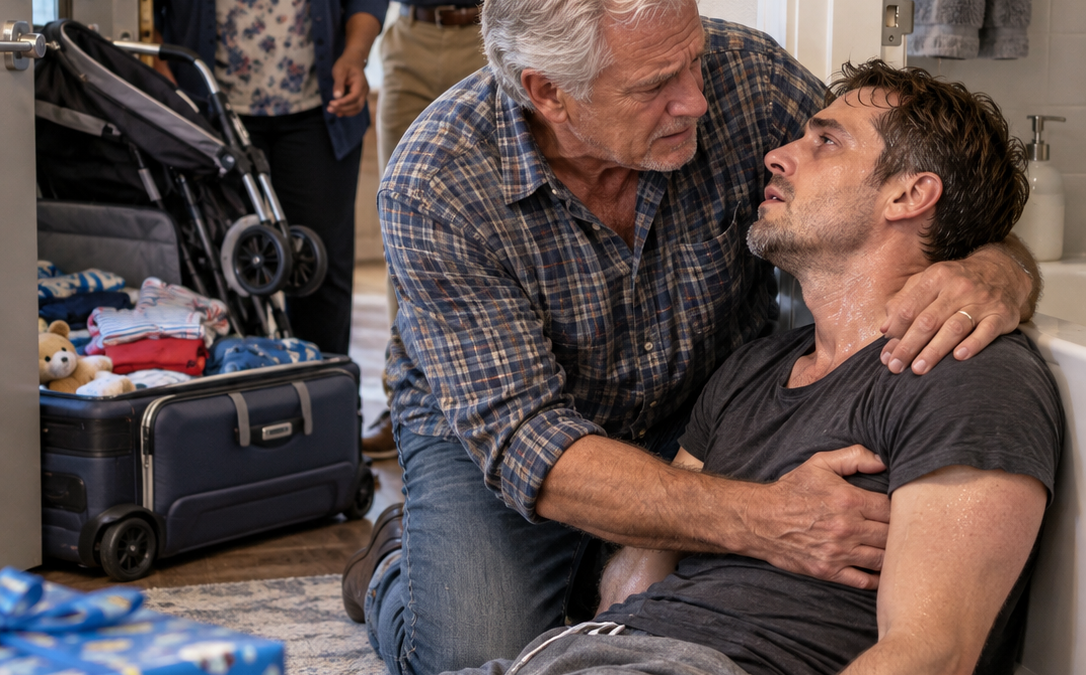
I found my son on the floor of the hall bathroom, wedged between the bathtub and the toilet. His T-shirt had gone dark with sweat. He was breathing, but he wasn’t really there.
Now, I need to tell you something about Curtis.
When he was twenty-four, he was diagnosed with Addison’s disease, a condition that causes adrenal insufficiency. His body doesn’t make enough cortisol, so he’s taken hydrocortisone every day of his adult life. He’s careful about it. In fact, he’s the most careful person I know.
But when somebody with Addison’s disease gets a stomach bug and can’t keep their medication down, they can go into what’s called an adrenal crisis. Their blood pressure falls. They vomit until there’s nothing left. They become confused, and without treatment, the condition can kill them.
That’s what the emergency injection kit is for. People with his condition are supposed to have one available.
Curtis’s kit wasn’t in that bathroom. It wasn’t anywhere he could reach.
It was in a suitcase by the front door.
A suitcase that wasn’t his.
It was packed with a four-year-old’s clothes, with a stroller strapped to the top, sitting on the mat as though it were waiting for a ride.
I got down on that bathroom tile beside my son. I’m sixty-eight years old, and my knees are what they are, but I got down there and lifted his head into my lap.
His skin was gray. His shirt was soaked. And he was so light.
He had lost weight I hadn’t been allowed to see him losing.
He opened his eyes about halfway. I still don’t know whether he recognized me.
I called 911 with a hand that wouldn’t stop shaking. Devon Mabry was already dialing from the doorway, and Odessa Piles came in behind us. She went straight into the kitchen and returned with a wet dish towel and a bottle of Gatorade she’d brought from her own refrigerator.
Nobody asked her to do any of that.
She told me later, “In my day, you didn’t stand around waiting to be told what a sick man needed.”
The paramedics arrived in nine minutes. A woman named Roselle was in charge of the team. They got an IV line into Curtis and started giving him steroids and fluids.
I stood in that hallway with my hands on my head, watching my son’s color slowly return, like a photograph developing before my eyes.
When Roselle stood up, she looked directly at me.
“Sir, I’d say another twelve hours, and we’re having a different conversation.”
A different conversation.
I want you to sit with those words the way I’ve had to sit with them.
That’s a sentence that reorganizes a man.
And Micah, my grandson, wasn’t in that apartment.
I asked Devon where the little boy was, but he didn’t know. He said he’d seen a rented SUV in the parking lot over the weekend. Odessa told me she’d watched Kendall carrying boxes down the stairs on Saturday, along with a car seat.
She also told me she’d heard Curtis’s voice raised through the wall on Friday night. In four years of living next to him, she’d never once heard him speak like that. He’d been asking Kendall where she thought she was taking his son.
So there I was, riding in the back of an ambulance, holding my son’s hand, with no idea where my four-year-old grandson was on this earth.
I have run a business through two recessions. I have buried my wife. I built an entire life around being the calm one on the radio when a truck went off the road at two in the morning.
That afternoon, I wasn’t calm.
That afternoon, the floor came out from under my world.
They admitted Curtis to a hospital off Highway 280. By seven that evening, Dr. Sonni came out and told me his electrolytes were improving, that he’d need to stay for two nights, and that we’d caught the crisis in time.
I sat in a vinyl chair beside his hospital bed and watched my grown son sleep with a tube in his arm.
Around nine o’clock, he surfaced enough to find my face. His eyes settled on me, and he spoke five words that told me everything I needed to know about the last year and a half.
“Dad, she’s got him. She’s gone.”
I didn’t sleep that night. I sat in that chair until the sun came up over the parking deck. Somewhere around one in the morning, I called the only man I know who can think straight when I can’t.
Lauren Patrick and I have known each other since 1991, back when he was an investigator in Hamilton County and I was hauling freight for a company he was looking into. Whatever he was investigating turned out to be nothing, but he and I stayed friends. He retired nine years ago, though I don’t believe a man ever really stops being an investigator once he’s spent his life doing that kind of work.
I told him everything. He listened without interrupting, then stayed quiet for a long while. He does that. He lets the silence sit until he’s worked through whatever needs working through.
Finally, he said, “Emmett, this did not happen over a weekend. You told me the visits started getting canceled about a year and a half back. That’s your start date. Whatever this is, she’s been laying track since then.”
Then he said the thing that mattered most.
“Don’t call her. Don’t call her people. Don’t put a word of this anywhere. Don’t tip a single card. You get Curtis stable, and you let me pull threads quietly. Can you do that?”
Every part of me wanted to drive to wherever that woman was and stand in her doorway. I wanted answers. I wanted to look her in the eye and ask how she could leave my son on a bathroom floor. But thirty-six years in business had already taught me what Lauren was reminding me of now. The man who reacts first loses. The man who collects his facts first wins.
I told him I could do it.
Lauren was at Ashford Bend by nine the next morning, and the first thread he pulled was the phone number.
The emergency contact on the lease file had been changed. Not when the lease was originally signed, but in April, four months before any of this happened. Somebody had gone into the leasing office and updated the guarantor contact information.
The number on that form wasn’t mine.
It was a number Kendall controlled.
It rang and rang and went nowhere.
So when Odessa Piles called that number three times over three days, trying to reach somebody who loved my son enough to come looking for him, nobody was ever going to answer.
That was the detail that moved the whole situation out of the category of a marriage falling apart and put it somewhere else entirely. Because a woman whose life is simply falling apart doesn’t drive to a leasing office in April and deliberately change an emergency contact number.
That’s not chaos. That’s engineering.
Lauren worked for four days with whatever a retired investigator could still get his hands on, along with what any determined man with a laptop can uncover when he knows where to look. By Saturday afternoon, he’d put enough together to lay the whole thing out on my kitchen table in Chattanooga.
Curtis was asleep upstairs in his old bedroom while Lauren and I sat downstairs going through what he’d found.
Kendall had been fired from her job as an office manager at a dental practice in Hoover sixteen months earlier.
She had never told my son.
For sixteen months, she’d gotten dressed every weekday morning, kissed her husband goodbye, and driven away as though she were going to work. Instead, she went to a Panera off Highway 280 and sat there.
She’d been collecting unemployment benefits, using a mailing address that led to a rented box in Pelham so nothing would arrive at the apartment and give her away.
Meanwhile, Curtis had been depositing half of every paycheck into what he believed was their household account. That money was supposed to cover rent, groceries, Micah’s preschool, and the ordinary expenses of raising a family.
Over sixteen months, roughly $27,400 had gone somewhere other than the household.
Some of it had been used to service two credit cards Curtis didn’t even know existed. Some of it had funded weekends in Nashville that Kendall told him she was spending with girlfriends from the office.
There were no girlfriends from the office.
There hadn’t been an office in over a year.
There was, however, a man named Grant Sheffield, somebody Kendall had known long before she ever met my son.
And there was a one-way trailer reservation, scheduled for pickup that Saturday morning, the morning of my grandson’s birthday party. There was also an apartment application already submitted to a complex in Franklin, Tennessee, nine minutes from Sheffield’s address.
Then there was the text thread.
Eleven days before Kendall sent me that message telling me not to come, she’d been exchanging texts with her sister. Lauren had obtained the conversation and printed it.
I read it sitting at my own kitchen table.
“Once we’re over the state line, it gets clean. Curtis will fight for about a month and then he’ll fold. He always folds. It’s his dad I have to keep away from this. He counts things.”
He counts things.
I sat there and read those words six or seven times.
Those fourteen words in a text telling me I was too much trouble had never really been about a Tuesday afternoon. They were about getting the one person who kept a ledger out of the room before the walls came down.
I want to stop here and be honest about something, because otherwise this whole story would be a lie.
Right up until I read that thread, some stubborn part of me was still trying to build a defense for Kendall. Maybe she was drowning in something I didn’t understand. Maybe there were circumstances I knew nothing about. Maybe I was just an old man who had never really liked his daughter-in-law and had finally found proof of something he’d decided years earlier.
Most of us keep that door open long past the point when we should close it. And it isn’t because we’re stupid. It’s because the alternative is admitting that somebody you welcomed into your family, somebody you drove two hours and forty minutes to bring groceries to, could stand in a room with your son lying helpless on the floor and do the arithmetic about whether helping him fit her schedule.
That’s a hard thing to make yourself believe about another human being.
Curtis read the messages, too.
It was eight days after I’d found him. He didn’t cry when he saw them. Not then. He just went very still.
I know that stillness. It’s the same stillness I felt in the hallway when the doctors came out and told me Ruth Anne was gone. It’s what happens to a person in that strange second before his entire understanding of his life gets rewritten.
“She heard me in there,” Curtis finally said, almost to himself. “Odessa heard everything through that wall. She heard me, and she kept loading the car.”
I put my hand on my son’s shoulder. I didn’t say anything because there was nothing I could have said that would make that fact any smaller than it was.
Now, I want to be fair to Kendall Rooker, because I said I’d tell this honestly, and fairness is part of that.
I don’t believe she wanted Curtis dead.
I’ve thought about that for two years, and I still believe it. Lauren agrees with me about what probably happened.
I think Kendall lost her job and was ashamed to tell her husband. She didn’t tell him that first night. The next day, telling him became harder. By the second week, the lie had become load-bearing. It was holding up the entire structure of her life, and she couldn’t figure out how to pull it out without everything collapsing.
So she built herself a whole second life rather than have one difficult conversation.
Her mother had stayed nineteen years with a man who ground her down to nothing. She stayed out of duty, and she died at sixty-one looking eighty. Kendall had told Curtis early in their marriage that she’d rather be a villain than be her mother.
He repeated that to me at my kitchen table as though he were trying to make sense of what she’d done.
And it does explain something. It doesn’t excuse anything, but it explains something about the way she thought.
On that Friday night, when she found my son on the floor, I believe she told herself he’d be fine. I believe she decided he would sleep it off. I believe she got into that car with a genuine, functioning story in her head about how everything she was doing was survivable for everybody involved.
And to me, that’s worse.
Do you understand why?
It’s worse because it means she weighed the consequences. She found a way to make what she was doing acceptable to herself, even with my son lying there helpless.
Understanding a person is not the same thing as excusing them. It never has been.
By the time we walked into court, I understood Kendall Rooker about as completely as I ever wanted to. I sat there and watched her lose custody of her son, and I didn’t feel one flicker of doubt about what needed to happen.
Micah had never been taken to Tennessee.
That was the part of the whole ordeal that had kept me from breathing properly for nine days. He’d been at Kendall’s sister Bridget’s house in Trussville the entire time.
He was safe. He was fed. He was watching cartoons. He was fine.
But he’d been deliberately placed out of his father’s reach while the rest of Kendall’s departure was being assembled.
We hired a family attorney in Birmingham named Aiza Nwango. The following Monday, she filed for emergency relief based on documented abandonment and endangerment. She included the hospital records, the medical injection kit packed into that suitcase, the altered emergency contact form, and Odessa Piles’s sworn statement about what she’d heard through the apartment wall.
Seventy-one hours later, the court granted Curtis temporary sole physical custody.
I drove to Trussville myself that afternoon, with a paralegal sitting beside me and holding the folder containing the court order.
When that front door opened and I saw my grandson’s face, still round, still carrying that little scab on his knee from falling off the porch back in June, I did something I hadn’t done in public since Ruth Anne’s funeral.
I got down on those front steps, wrapped my arms around that little boy, and came completely apart.
I didn’t care who was watching.
Micah pressed his face into my collar and spoke as though nothing unusual had happened anywhere in the world.
“Granddaddy, did you bring the fire truck?”
I had it.
It was still in my truck, wrapped in that same blue paper I’d done such a poor job of folding.
I took it out and gave it to him right there in the driveway in Trussville, Alabama.
And for about forty seconds, nothing else in this world was real.
Now, I want to tell you more about Odessa Piles, because a story like this isn’t worth telling if it’s only about what somebody lost.
A retired bus driver is the reason my son is alive.
Not me. Not a doctor. Not a lawyer.
A seventy-two-year-old woman who knew a gray Elantra was supposed to leave at 7:20 every morning and noticed when it didn’t. A woman who knocked on a neighbor’s door, then called an emergency number three separate times, not knowing somebody had deliberately arranged for those calls to go nowhere.
On the fourth day, Odessa walked down to the leasing office herself and told Devon Mabry she wasn’t leaving until he did something about it.
That’s the only reason Devon pulled my name from the guarantor file.
Because one woman stood in his office and refused to go home.
I asked Odessa months later why she’d gone to all that trouble for a neighbor she wasn’t even particularly close to. She looked at me as though I’d asked her something strange.
“Because that’s what you do,” she said. “You don’t stand around deciding whose job it is.”
Her roof had suffered hail damage two springs earlier, and her insurance company had denied the claim twice. That October, I arranged to have a crew come out and repair it. I paid for the work myself, and I didn’t ask her permission first because I already knew what she’d say.
She called me crying when she found out and wanted to know why I’d done it.
I told her the truth.
“You gave me my son. A roof is the smallest thing I own.”
I also put money into the benevolence fund at her church, the one that helps cover people’s power bills when they fall behind. I made the donation in Ruth Anne’s name.
Some things you can’t pay back. You can still try, though. And I think trying counts for more than people realize.
The final custody hearing wasn’t close.
Aiza presented the financial records, the fraudulent benefits claim tied to a false address, the hidden credit cards, and the altered emergency contact form. She submitted the medical testimony explaining what an adrenal crisis can do to a person by hour seventy-two, along with Odessa’s sworn statement and the text conversation that said more about Kendall’s intentions than any attorney ever could.
Curtis was awarded primary custody.
Kendall was permitted four days of supervised visitation each month through a facilitator, contingent on her attending counseling and completing a financial course.
She moved to Franklin about a month later.
I don’t take any joy in that. I want to say that plainly, because there’s a four-year-old child in the middle of everything, and no part of what happened to that family feels like a victory.
But I don’t apologize for it, either.
Somebody had to stand in that courtroom and tell the truth for a little boy who couldn’t speak for himself.
Curtis moved back to Chattanooga in November.
He didn’t move in with me. He wanted his own place, and I believe he was right to want that. He found somewhere about ten minutes from my house, off Shallowford Road, and transferred back to his old office with the same engineering firm.
He’s doing well at work. His numbers are good.
He keeps two emergency injection kits now, one at home and one in his car. He carries a medical information card in his wallet and wears a medical alert bracelet, something he’d always refused to do before. He wears it now.
Micah turned five last November.
We held his birthday party in my backyard, with strings of lights running along the fence the way Ruth Anne always used to do for birthdays.
Odessa drove up from Birmingham for the party. Two hours and forty minutes each way, at seventy-three years old, because I asked her to come and because, in her words, she wasn’t about to miss a party she helped make happen.
Vera brought a sheet cake. Curtis cooked out. The backyard was full of the ordinary sounds of people eating, talking, and enjoying themselves. It was the kind of evening Ruth Anne would have loved.
Around nine that night, Micah climbed into my lap on the porch swing. He was sticky all the way to his elbows, worn out from running around, and within minutes he was sound asleep against me, the way children fall asleep when they’ve used up every bit of energy they have.
I sat out there for a long time after everybody else had gone quiet.
And that brings me to what all of this taught me.
It isn’t simply trust your gut. I want to be careful about that because it’s the easy version of the lesson, and it isn’t true to what actually happened.
My gut had nothing to do with it.
A timestamp did.
The real lesson is about those fifty-two minutes in the parking lot.
During those fifty-two minutes, I wasn’t wrestling with whether something was wrong. I already knew something was wrong. The timeline had told me that.
What I was wrestling with was whether I had the right to be there after somebody had told me I wasn’t wanted.
That’s the trap. That’s the actual trap, and I need you to see it clearly.
Being unwanted and being unnecessary are two very different things.
And people who control access to somebody vulnerable are counting on you confusing the two.
Kendall didn’t need me to believe her story. She only needed me to feel like an imposition, because a man who feels like an imposition tends to remove himself.
He does it politely. He does it with dignity. He tells himself he’s respecting boundaries, being mature, giving a young family the space they’ve asked for.
My hurt feelings were going to do her work for her, for free.
And I would have called it maturity.
So I don’t believe the mistake most people make is failing to notice the warning signs. Sometimes we see them. We recognize them clearly enough.
The mistake is letting our own pride finish the job somebody else started.
Here’s the one thing I’d ask you to actually do this week. It’s small, a little unusual, and it’ll take you about ten minutes.
Think about somebody you’ve quietly drifted away from because another person made you feel like a bother. Maybe it’s a son, a daughter, a parent, a friend, or somebody you used to see all the time before the visits started getting postponed.
Don’t just send that person another text.
If somebody has been managing your access to them, another text may go through the same channel that’s already being controlled.
Instead, find one line of sight that doesn’t run through the person controlling the door. A neighbor. A coworker. A sibling. Somebody who physically sees that person and would notice if their routine changed.
Get that person’s phone number, put it in your contacts, and tell them, “If anything ever seems off, call me. I don’t care what time it is.”
One person. One route around.
That’s all I’m asking you to establish.
If I’d had Odessa Piles’s phone number in my pocket back in April, my son never would have spent four days on that bathroom floor.
And here’s the question I want you to sit with tonight.
It’s the same question I sat with on that porch swing, with my five-year-old grandson asleep against my chest.
If I vanished out of somebody’s life tomorrow, who would that be convenient for?
Sit with that.
Because that question has an answer, and you probably already know what it is.
Now, I’d like to hear what you think about what I did. I read the comments. I really do.
If you think I did the right thing by staying in that parking lot after Kendall asked me not to come, comment the number one.
If you think I should have driven straight up to the apartment door the moment I read her message, instead of sitting there for fifty-two minutes trying to decide what to do, comment two.
And if you think I should have listened to my sister sixteen months earlier and pushed harder when those visits first started disappearing, comment three.
I’ll be straight with you. I think three is the right answer, and I’ve never quite forgiven myself for not seeing it sooner.
Tell me where you’re watching from, too, and what time it is where you are. That still gets to me sometimes. The idea that a story about a parking lot off Valleydale Road in Birmingham can end up in somebody’s kitchen halfway around the world.
And if you’ve ever been slowly managed out of someone’s life, never a fight, never an explanation, just a long, polite string of promises about next month, I’d like to hear about that, too.
You don’t have to use your name.
Somebody scrolling past tonight might be fourteen months into the very same thing and desperately need to hear that what they’ve been noticing isn’t all in their head.
If any part of this story reached you, do me one favor before you go.
Subscribe.
Not because I need another number on a screen, but because there may be somebody listening to the next story who needs to understand that being told you’re too much trouble is not the same thing as being told the truth.
Sometimes, it’s simply the sound of somebody moving you out of the way.
Take care of your people.
And go get that one phone number.
This is a fictional story inspired by real emotional experiences, fully rewritten and reimagined in Chattanooga to create original content. Any resemblance to real people or actual events is entirely coincidental.








