My daughter-in-law stood up, went straight to my wife, and yelled at her: “get out of here right now!” I didn’t argue. I simply took my wife’s hand and walked straight out the front door. And in that moment, I saw her expression freeze as the most important guests quietly stood up and followed us.
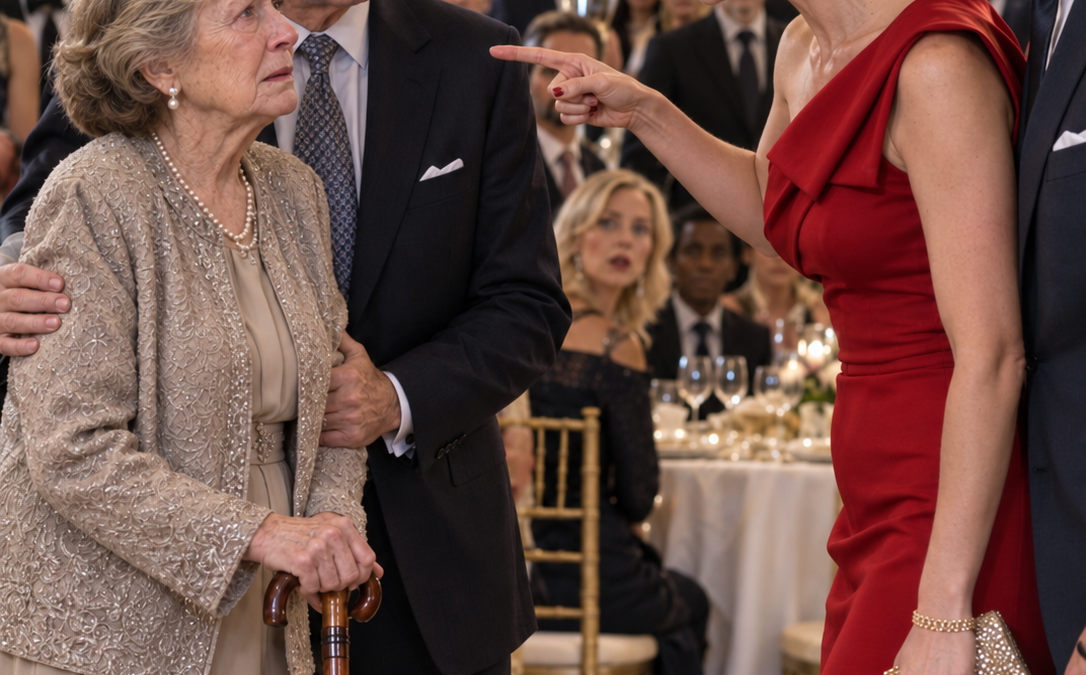
My daughter-in-law sprang to her feet, marched straight toward my wife, and shouted in her face, “Get out of here right now! That clacking sound is so annoying!”
That was how she chose to begin her own birthday party.
Welcome back to Dad’s Real Life Revenge. Grab a glass of water, find yourself something to snack on, and get comfortable. Remember, the people in these stories had every opportunity to do the right thing. They simply chose not to. Leave a comment with the number one so we can continue the story, and don’t forget to subscribe. You’re going to enjoy this one.
It was a warm summer evening in Manhattan. Magnificent chandeliers hung from the high ceilings of an elegant banquet hall, their golden light shimmering across crystal glasses and polished marble floors. Laughter and conversation filled the enormous room as wealthy guests mingled beneath the glittering lights. The atmosphere was one of effortless luxury, the kind of gathering where everyone seemed to know someone important and every conversation carried the possibility of another lucrative business deal.
My son, Ethan, stood proudly beside his wife, Mia. Both wore expensive, custom-tailored outfits that perfectly suited the glamorous surroundings. They smiled brightly as they welcomed influential figures from the business world, shaking hands, exchanging compliments, and posing for photographs. From a distance, they looked like the perfect young couple, successful, sophisticated, and entirely at ease among Manhattan’s elite. My wife, Megan, and I sat quietly at a table tucked away in a corner of the room, far removed from the attention surrounding our son and daughter-in-law.
Megan had recently endured a long and difficult illness that had left her legs considerably weaker than before. Walking even a short distance had become an exhausting effort, and she relied on an old wooden cane for support. That evening, as soft orchestral music drifted through the banquet hall, she quietly told me that she needed to use the restroom. Holding the edge of the table, she slowly pushed herself to her feet. Her hand tightened around the familiar wooden handle of her cane, and as she took her first careful step, its tip tapped against the marble floor.
The sound was faint but distinct, a gentle clacking that seemed strangely out of place amid the polished elegance of the celebration. Mia, who had been standing nearby, immediately turned toward us. Her eyes traveled over Megan’s outdated coat before settling on the wooden cane. Within seconds, the pleasant expression on her carefully made-up face disappeared. Her features hardened, and she hurried toward our table with an unmistakable look of irritation.
She stopped directly in front of my wife and raised her voice loudly enough for guests at three nearby tables to hear. She complained that Megan’s presence was ruining the group photographs with important business partners. To Mia, her own mother-in-law was nothing more than an embarrassing inconvenience, someone who did not belong in the sophisticated world she was so desperate to impress. And she made absolutely no attempt to conceal that contempt. In a harsh, commanding tone, she ordered my wife to leave the party immediately.
I had lived long enough to recognize ordinary rudeness, thoughtlessness, and youthful arrogance. But what I witnessed that evening was something far more disgraceful. It was a deliberate humiliation of an elderly woman who had done nothing wrong, carried out in front of people whose approval mattered more to Mia than the dignity of her own family.
Yet I did not turn toward my daughter-in-law. Instead, I looked directly at Ethan.
My son stood only a short distance away. He glanced at his watch, shifted his gaze toward the surrounding guests, and then looked away from his mother. He made no attempt to defend her. He did not tell his wife to lower her voice, nor did he offer Megan even a single word of comfort. Instead, he stepped closer to our table and spoke in a lowered voice, though the irritation in his expression was impossible to miss.
He told his mother that she should listen to Mia. According to him, she simply did not fit the sophisticated atmosphere of the evening. He suggested that we take a taxi home early rather than remain there and ruin everyone else’s good time. He delivered those words as casually as though he were discussing an inconvenient scheduling problem, not asking the woman who had raised him to disappear from his celebration.
Megan stood motionless beside the table, stunned by what she had just heard. Tears gathered in her eyes, and the hand gripping her cane began to tremble. The wrinkles across her face seemed to deepen beneath the weight of her hurt. She opened her lips slightly, as if searching for something to say, but no words came. She had always been that way, a woman who endured hardship quietly, who sacrificed her own comfort for her children and rarely complained about anything life demanded of her. Even now, confronted with such cruelty from the son she had brought into the world, she chose silence over an argument.
Watching her struggle to maintain her composure was more painful than anything Mia could have said to me personally. The ingratitude of the child we had raised struck at the dignity of both of us, but the deepest wound belonged to Megan. I knew how much she loved Ethan. I knew how many sleepless nights she had spent worrying about him, how much she had given without expecting anything in return, and how completely she had trusted that the boy she raised would grow into a decent man.
I remained seated.
I did not shout, slam my fist against the table, or confront the people who had humiliated my wife. I simply sat there in silence, the silence of a man who had already traveled through nearly all the seasons of his life and understood that some lessons could never be taught through anger alone. I looked directly into the eyes of my son and daughter-in-law, allowing them to see that I had heard every word. Neither of them understood what my expression meant. They could not possibly have known that, in those few quiet seconds, I had already made a decision that would change the course of their lives.
Slowly, I rose from my chair and straightened the collar of my suit jacket. Then I walked around the table to Megan’s side and gently took her frail arm. I supported her by the elbow as she leaned her weight against me, trusting me to guide her through the crowded room. Together, we began the slow walk toward the exit. Her old wooden cane struck the marble floor again and again, each measured tap carrying through the surrounding silence.
The entire banquet hall seemed to fall quiet as we passed. Conversations faded, laughter stopped, and heads turned in our direction. Everyone could see the two elderly people being quietly shown the door, but no one stepped forward to intervene. The uncomfortable silence followed us across the polished floor, broken only by the solitary rhythm of Megan’s cane.
Behind us, Mia wore a faint, satisfied smile. Triumph was unmistakable beneath her carefully applied makeup. Ethan released a long breath of relief, apparently convinced that the embarrassing situation had finally been resolved. Perhaps he thought that by sending his parents away, he had protected his standing among the wealthy people whose approval he valued so highly.
But both of them were terribly mistaken.
My silence had always carried a price, and when that price finally came due, it was rarely inexpensive.
At the central table, a distinguished older gentleman named Arthur slowly rose to his feet. He was the chairman of the largest investment firm in Manhattan, a man whose influence extended into some of the most powerful financial institutions in the country. Ethan had spent nearly three months practically begging for the opportunity to secure a private meeting with him. To my son, Arthur represented the kind of prestige and influence that could open doors no amount of ordinary ambition could unlock.
Arthur did not utter a single word. He calmly buttoned his suit jacket, stepped away from the table, and began walking across the banquet hall. He did not acknowledge Ethan or spare Mia so much as a glance. His attention remained fixed on me. Behind him, two other billionaires associated with the banking industry’s board of directors rose from their seats at almost the same moment and silently followed.
Something changed in the atmosphere of the room.
The quiet departure of those three powerful men seemed to draw the air out of the banquet hall. Conversations stopped altogether, and guests watched in disbelief as Arthur approached the two elderly people whom the hosts had just dismissed. Mia’s satisfied smile stiffened on her face. Ethan’s complexion turned noticeably pale. He called Arthur’s name, his voice stumbling over the words, but the chairman did not look back or acknowledge him.
Instead, Arthur and the two other men walked alongside Megan and me, silently protecting the dignity of the people who had helped establish the very foundations of the wealth surrounding that gathering. No dramatic announcement was necessary. Their actions spoke with an authority that no speech could have matched.
Arthur’s black limousine was already waiting outside the entrance, its engine running quietly beneath the evening lights. He personally opened the rear door for Megan, waiting patiently as I helped her settle into the comfortable leather seat. Only after my wife and I were safely inside did he look toward me, offer a small, respectful nod, and signal for the driver to take us home.
Throughout the journey, the interior of the limousine remained completely silent. Manhattan’s lights drifted past the tinted windows, their reflections stretching across the dark glass as the car moved through the city. Megan stared outside without speaking. She did not cry, but her hands were clasped so tightly in her lap that her knuckles had turned white. I reached across the seat and gently enclosed her cold fingers in mine.
I understood the depth of her pain. She had been humiliated by the very son she had brought into the world, the child for whom she had sacrificed so much. Ethan’s indifference had cut into her heart with the precision of a knife, leaving a wound that no public apology could easily repair.
As the first streaks of rain began tracing their way down the limousine window, I watched the city disappear into the darkness and allowed a small, calm smile to cross my face.
Ethan and Mia believed they had reached the very top of Manhattan society. They took enormous pride in their million-dollar apartment, their rapidly expanding company, and the wealthy circles into which they had managed to gain admission. They carried themselves as though every accomplishment had been earned entirely through their own brilliance and ambition. They looked down upon ordinary people, particularly the elderly, with the dismissive confidence of those who believed that money made them superior.
But there was one truth those two arrogant children did not know.
The foundation beneath their feet, the very structure supporting the privileged lives they were so proud of, had been built entirely by my own hands.
When the limousine finally stopped in front of our old house, I carefully helped Megan out of the car and escorted her inside. After making sure she was comfortable, I took out my phone and called our family’s private attorney. The rain was falling steadily outside, and the familiar rooms of our modest home were wrapped in the stillness of the late evening.
My voice remained calm, but there was an unmistakable sharpness beneath every word as I instructed the attorney to prepare all documents relating to the family’s secret trust fund.
For years, I had allowed Ethan and Mia to enjoy the benefits of a financial foundation they barely understood. I had remained in the shadows, satisfied to see my son prosper, even if he never knew the full extent of my contribution. But the events of that evening had made one thing painfully clear. My generosity had not taught gratitude. It had simply allowed arrogance to grow unchecked.
The time had come for those ungrateful children to discover what it felt like to lose the support they had always taken for granted.
Early the following morning, a confidential letter was delivered directly to Mia’s office. Inside was a secret with the power to destroy her entire career overnight.
The next morning, sunlight streamed through the windows of our old house, casting long, gentle shadows across the wooden floor. On the desk before me lay a thick stack of trust fund documents that my attorney had delivered earlier that morning. I sat quietly and turned the pages one by one, examining the familiar signatures, legal provisions, and financial records. Ethan’s and Mia’s names appeared clearly in the section identifying the beneficiaries, but the ultimate authority over the fund had never passed into their hands. That power still belonged to me.
For many years, I had deliberately chosen to remain in the background. I wanted my son to build a life of his own, to understand the value of hard work, and to experience the satisfaction that comes from achieving something through honest effort. I believed that offering quiet financial support while allowing him the freedom to make his own decisions would help him become a responsible man. Looking back, I realized how terribly mistaken I had been. What I had intended as generosity had gradually created an ungrateful monster.
The luxurious Manhattan apartment that Mia proudly displayed across her social media accounts had actually been purchased with money from the trust fund. The expensive furniture, breathtaking views, and carefully curated image of effortless success were all supported by resources she did not realize belonged to my family. Even her rapidly expanding media company, the enterprise she celebrated as proof of her exceptional business instincts, would have collapsed into bankruptcy three years earlier without the financial assistance I had quietly provided.
Ethan and Mia were living inside an illusion of their own making. They had convinced themselves that every dollar they possessed, every business connection they enjoyed, and every impressive accomplishment they displayed to the world had come entirely from their own talent. From the height of that imagined success, they looked down upon modest elderly people like Megan and me, treating us as though we were burdensome reminders of a past they had outgrown.
I lifted my cup of hot tea and took a slow sip. Its bitterness settled in my throat, strangely familiar to the bitterness I felt in my heart. A house may look magnificent from the outside, with towering walls and windows that shine beneath the sun, but if its foundation rests upon sand, even a gentle breeze can eventually cause it to sway. People are no different. When they forget their roots, when they lose respect for those who worked and sacrificed to make their success possible, their eventual collapse becomes only a matter of time.
While I sat studying those documents, photographs from Mia’s birthday celebration were beginning to appear across online news outlets. She had published a lengthy article boasting about an upcoming international project that her company was preparing to sign. The photographs showed elegant guests, expensive decorations, and carefully arranged business introductions. She had deliberately edited out every trace of Megan and me, removing us from the public version of the evening as completely as she had attempted to remove us from the party itself.
Ethan shared his wife’s post almost immediately, adding a few enthusiastic words of praise for her accomplishments. Together, they basked in the admiration pouring in from their followers, intoxicated by the attention of a world that knew only the image they had chosen to present.
What neither of them knew was that three of their most important business partners had already withdrawn their names from the guest list for the upcoming signing ceremony. Those men had witnessed enough at the birthday party to understand the character of the people with whom they were dealing. I might have been willing to endure a personal insult without complaint, but my old friends considered the humiliation of Megan something that could not simply be overlooked.
I closed the file, and its thick cover came together with a dry, decisive sound.
A moment later, Megan entered the room, leaning heavily on her wooden cane. Her hands still trembled slightly as she walked, and there was a sadness in her eyes that no amount of rest could erase. She looked at the documents on my desk and then at me. She understood more than she said. She did not ask me to forgive Ethan, nor did she urge me to punish him. She simply lowered herself into the chair across from mine and sat quietly.
The silence between us carried the weight of a lifetime together. We had survived difficult years, financial uncertainty, illness, and all the ordinary disappointments that come with raising a family. But the pain of being rejected by our own son was something neither of us had ever expected to face. We sat across from each other in that large, quiet room, surrounded by the familiar possessions of our modest home, and I felt as though we were waiting for a storm that had not yet reached us.
Then my phone began to vibrate against the desk.
My attorney’s number appeared on the screen. I answered immediately, expecting an update about the trust documents. Instead, I heard an unusual tension in his voice. He was a careful, experienced man who rarely allowed emotion to interfere with his professional judgment, yet this time his familiar calm was unmistakably absent.
He informed me that he had uncovered a deeply suspicious operation involving Mia’s family. Mia and her parents had been secretly carrying out a scheme behind our backs, and their target was not the trust fund alone. They were preparing to attack Megan herself, my loyal wife, the woman who had spent her life caring for others. What my attorney described was so calculated and cruel that, for a moment, I found it difficult to believe anyone in our family could have contemplated such an act.
His voice remained low as he explained what he had discovered, but every word reached me like a stream of ice water.
Mia’s parents had been attempting to gain access to the central hospital where Megan had undergone medical evaluations the previous month. They had used money and personal connections to approach an associate department chief, hoping to persuade him to alter my wife’s medical records. Their intention was to make it appear that Megan suffered from severe dementia and was no longer capable of exercising sound judgment over her own affairs.
I held the phone firmly against my ear. I did not interrupt the attorney or allow myself even a sharp intake of breath. Slowly, I rose from my chair and walked toward the window. Outside, in the small yard behind our house, Megan was carefully watering her rose bushes. Her movements were slow, and every step required attention, but she tended those flowers with the same gentle patience she had shown throughout our marriage.
I watched her standing among the roses, and an unbearable sadness passed through me. This was a woman who had spent her entire life trying to be kind, someone who would not willingly harm even an ant. Yet she had become the target of a ruthless scheme driven by the greed of her own son and daughter-in-law. The people who should have protected her were instead searching for a way to strip her of her independence, her dignity, and the assets legally belonging to her.
The purpose of the scheme was horrifyingly simple. If Megan could be declared legally incompetent, control over the assets registered in her name within the family trust would automatically transfer to Ethan. Mia understood that provision, and she intended to exploit it. Her behavior at the birthday party suddenly took on an even darker meaning. She had not merely been embarrassed by Megan’s wooden cane or outdated clothing. By publicly treating her mother-in-law as incapable of fitting into an ordinary social situation, Mia had been helping create the impression that Megan was no longer mentally competent.
The insult at the banquet hall had been more than an act of arrogance. It had been part of a calculated effort to shape how other people perceived my wife.
Greed had blinded them so completely that they no longer recognized the cruelty of their own actions. They did not simply want more money or greater control over the trust. They were willing to destroy the reputation and dignity of the woman who had brought Ethan into the world, all for the sake of adding more wealth to lives that were already extraordinarily comfortable.
When the attorney finished speaking, I ended the call and stood motionless beside the window. The phone felt cold in my hand.
I returned to my desk and found myself staring at a framed family photograph taken ten years earlier. Ethan was smiling in the picture, his face bright with the uncomplicated happiness of a boy who still believed that coming home meant being surrounded by people who loved him. I remembered how he used to rush toward Megan after school, throwing his arms around her before she even had time to ask about his day.
He had once been a good boy. I had never doubted his love for his mother.
Now, under the influence of the greed that had come to dominate his marriage, he had become a heartless accomplice in a plan designed to take advantage of her vulnerability. The contrast between the smiling boy in the photograph and the man he had become filled me with grief more profound than anger.
When a person allows the moral foundation of his life to rot away, he can eventually justify almost any act, no matter how cruel. That was what I had witnessed in my son. The boundaries that should have restrained him had disappeared beneath layers of ambition and entitlement, leaving him willing to participate in something he once would have considered unforgivable.
They wanted to test the strength of the foundation I had spent my life building. Very well. I would show them the weight of a structure that had taken more than forty years to establish.
I walked to a secure drawer, unlocked it, and removed a small voice recorder. It was the device my trusted assistant had used to capture an entire conversation between Mia’s father and the associate department chief at a discreet café. The recording preserved the details of their discussion, including the financial arrangements and the amounts of money involved. Every significant statement had been captured with a clarity that left little room for denial.
I held the recorder tightly in my palm, feeling the hard edges of the small device press against my skin. It was extraordinary how something so small could contain evidence of such enormous betrayal. When I finally spoke aloud, my own voice sounded sharp and chillingly calm in the empty room.
I would not allow them to destroy Megan.
Yet I did not immediately hand the evidence to the police. Nor did I call Ethan to warn him that his secret had been uncovered. I understood that people intoxicated by their own success rarely listen to reason. They believe themselves untouchable until the very moment the structure supporting them begins to crumble. A patient hunter waits until his prey reaches the height of its arrogance, when overconfidence makes escape almost impossible.
Mia’s company was scheduled to host the signing ceremony for its international resort project three days later. It was intended to be the most prestigious event in her company’s history, a public demonstration of financial strength and international influence. The ceremony would bring together wealthy investors, corporate representatives, and members of the press. Everything Ethan and Mia had worked so desperately to display would be concentrated in that single room.
That was where they planned to celebrate the greatest achievement of their lives.
And it was where I intended to bring their carefully constructed illusion to an end.
What I had not anticipated was that Ethan would arrive at our old house that very evening, carrying another sinister document in his hands.
I heard the engine of a luxury car approaching before it came to a stop outside. A moment later, the car door opened, and Ethan walked into the house wearing an impeccably tailored suit. His clothing was expensive and immaculate, but there were dark traces of exhaustion across his face that even his polished appearance could not conceal.
Megan sat beside the tea table, quietly knitting. She looked up when our son entered, but he barely acknowledged her presence. He offered no affectionate greeting, asked nothing about her health, and showed no concern for the distress he had caused at the birthday party. Instead, he walked directly toward me and placed a thick stack of documents on the table.
Speaking in the efficient, impatient tone of a busy executive, he explained that the papers contained an authorization agreement for asset management. According to him, transferring control over certain family assets would make investment in the new international project considerably more efficient. He presented the proposal as a practical business decision, something that responsible parents should naturally approve for the benefit of their children.
Then he introduced the real purpose of his visit.
He claimed that Megan’s health had declined so much in recent months that her memory could no longer be considered reliable. For the sake of the entire family, he argued, it would be better if the assets under her control were transferred to him. He spoke as though he were proposing a compassionate solution to a difficult medical problem, when I already knew the calculated scheme behind those words.
I looked down at the documents and then slowly raised my eyes toward my son. Within the space of a single minute, he checked his watch twice. His impatience was almost insulting in its transparency. Sitting in our old house, speaking to the parents who had raised and supported him, was apparently nothing more than an unpleasant interruption in his busy schedule. He wanted the signatures, the authority, and the money. Then he wanted to return as quickly as possible to the glamorous world in which he believed he belonged.
He pushed a pen toward me.
I did not touch it.
Instead, I sat quietly and allowed the silence to stretch between us. At first, Ethan waited with the confidence of someone accustomed to having his wishes granted. But as the seconds passed, his expression began to change. He shifted in his chair, glanced toward the documents, and launched into a hurried explanation of the enormous profits the International Resort Project would supposedly generate.
He talked about future expansion, business opportunities, and the extraordinary returns that awaited those who acted quickly. The more he spoke, the clearer it became that he was not interested in my judgment. He wanted my obedience.
I rose from my chair and walked toward Megan. Gently, I rested one hand on her frail shoulder. Beneath my palm, I felt a faint tremor pass through her body as she listened to the lies coming from our son. She kept her eyes lowered toward the knitting in her lap, but I knew she had heard every word.
I turned back to Ethan and looked directly into his eyes. In a steady voice, I told him to go home for the time being. I needed to examine the documents carefully before making any decision, and I would not sign anything that evening.
His displeasure was immediate. His jaw tightened, and the impatience he had tried to conceal became obvious. But he also understood that no amount of additional persuasion would change my answer. Reluctantly, he gathered the documents from the table, took back the unused pen, and stormed out of the house.
A few moments later, the engine of his luxury car roared to life. I remained where I was until the sound faded completely into the distance.
Then I turned on my computer.
Mia had just uploaded another photograph to social media. It showed a carefully framed corner of her luxurious office, accompanied by an arrogant caption celebrating financial freedom and self-made success. Admiring comments poured in beneath the post. Her followers praised her ambition, her independence, and her apparent ability to build an extraordinary life through sheer determination.
I read those comments without the slightest disturbance in my thoughts.
The people congratulating her knew nothing about the financial support that had kept her company alive. They did not know about the private trust fund, the investments made on her behalf, or the countless decisions that had protected her from the consequences of her own mistakes. Mia and Ethan had risen so high on money flowing from my fund that they genuinely believed they had reached the stars through their own efforts.
Their entire image of success depended upon a truth they had never bothered to investigate.
I shut down the computer, picked up my phone, and called the largest partner involved in the International Resort Project. He was the owner of a multinational construction corporation, a man whose company had the financial strength and experience to determine whether the development would move forward.
I did not threaten him or deliver a dramatic speech. I simply provided him with one essential piece of information concerning the true ownership structure behind Ethan’s company. I explained who ultimately controlled the capital guaranteeing the entire operation and where the final decision-making authority legally rested.
That brief conversation accomplished more than any angry confrontation could have done.
The legal documents were now being brought into their proper order, the ownership structure was becoming clear to the people who mattered, and every necessary piece of the final arrangement was moving into place.
The blueprint for the downfall of two arrogant people had been completed.
The upcoming international signing ceremony would be the moment when I stepped forward to reclaim what rightfully belonged to me. I intended to expose the truth openly, before the investors and business partners whose reputations Ethan and Mia had used to build their own prestige.
But there was one thing I still did not know. Mia had prepared another vicious move, one designed to prevent me from reaching the very people I needed to address.
When the day of the signing ceremony arrived, the event hall of a five-star hotel in the heart of Manhattan was overflowing with activity. Cameras flashed across the entrance as reporters photographed arriving executives, wealthy investors, and prominent figures from the business community. A grand display bearing the name of the International Resort Project signing ceremony stood prominently near the entrance, surrounded by elegant decorations intended to emphasize the importance of the occasion.
Ethan and Mia occupied the center of attention. Dressed in their finest clothes, each holding a glass of wine, they moved confidently among the guests, smiling for photographs and exchanging congratulations. They looked perfectly at home beneath the brilliant lights, surrounded by the admiration and prestige they had worked so hard to acquire. Their expressions carried the unmistakable confidence of people who believed that the greatest triumph of their lives was only moments away.
I entered through a side entrance.
I had chosen a simple black suit, without a flower on the lapel or any visible symbol of wealth or distinction. I carried myself quietly, drawing no attention as I passed through the hall. Instead of approaching the important guests or announcing my presence, I walked to the last row of seats and sat down.
Not a single camera turned toward me. No security officer stepped forward to offer a respectful greeting. To everyone who noticed me, I appeared to be nothing more than an elderly man who had somehow wandered into an exclusive gathering of wealthy businesspeople.
That anonymity suited me perfectly.
From the opposite side of the room, Mia eventually spotted me. I saw her expression change the moment she recognized my face. For a brief second, surprise interrupted her polished smile. Then she quickly regained control of herself and signaled to two large security guards standing nearby.
The guards approached my seat, and Mia followed close behind. She positioned herself carefully so that the reporters and photographers would not have a clear view of our conversation. Evidently, she had learned something from the embarrassment at her birthday party. This time, she wanted to remove me without creating a public scene.
Lowering her voice, she spoke in a sharp, threatening tone. She informed me that this was an international-level business event, not a casual family gathering, and that anyone without official business or the appropriate credentials was required to leave. Allowing unauthorized people to remain, she insisted, would damage the professional image of the occasion.
She went further, implying that I had come deliberately to embarrass her and Ethan because of what had happened at the birthday party. In her mind, my presence could only be an act of resentment by an old man who had failed to understand his proper place.
I remained seated.
I did not raise my voice, challenge the security guards, or display the anger she seemed eager to provoke. Instead, I looked directly into her eyes and offered a calm smile. I told her that before ordering me out, she should take another careful look at the list identifying the people who actually owned the project.
For a moment, Mia stared at me. Then she let out a contemptuous snort, turned away, and ordered the guards to remove me immediately.
The two men stepped closer, preparing to place their hands on my shoulders.
At that exact moment, the ceremony’s opening music filled the hall.
The powerful sound system carried the orchestral introduction through the room, drawing everyone’s attention toward the stage. The master of ceremonies appeared beneath the lights, welcomed the distinguished guests, and announced that the International Resort Project signing ceremony was officially beginning.
Ethan walked proudly onto the stage beside the representative of the multinational construction corporation. The audience erupted into applause. Camera flashes flickered across their faces as they took their positions near the signing table, where the carefully prepared contracts waited beneath the bright lights.
The master of ceremonies began his formal opening remarks.
With a voice full of professional enthusiasm, he began introducing the major investors and the financial institutions supporting the development. Then he announced that the audience would have the honor of welcoming the project’s largest shareholder, the individual who held ultimate decision-making authority through ownership of sixty percent of the entire resort project.
This individual, he explained, was also the true owner of the investment fund that had provided the financial backing for Ethan and Mia’s company.
A ripple of anticipation passed through the audience. Business executives leaned forward, reporters adjusted their cameras, and conversations faded into expectant silence. Everyone was waiting to hear the name of a powerful figure from the financial world, someone whose influence was great enough to control an investment of such magnitude.
Standing on the stage, Ethan smiled proudly and adjusted his tie. He appeared eager to welcome the billionaire whose involvement he believed would elevate his company to an entirely new level of prestige. Mia stood below the stage with the same satisfied confidence she had displayed throughout the morning.
Then the master of ceremonies announced my name.
The words echoed through the hall, amplified by the powerful sound system. Almost immediately, the spotlights began sweeping across the audience, moving from one section to another before settling directly on the last row, where I was still sitting.
For a moment, no one seemed to understand what was happening.
Then heads turned toward me. Hundreds of eyes followed the beams of light, searching for the man whose name had just been announced. Mia stood frozen, her face losing its color as she stared at the elderly man she had ordered removed only moments earlier. On the stage, Ethan stopped moving. The proud smile disappeared from his face, replaced by an expression of shock so complete that he seemed unable to comprehend what he had heard.
The truth unfolding before them was far beyond anything either had imagined.
The old man they had considered a burden, the father they had treated as an embarrassment, was the very person who controlled the financial foundation upon which their success depended.
I slowly rose from my seat beneath the spotlight.
The security guards stepped aside without another word. I straightened my jacket and began walking toward the stage. My leather shoes struck the wooden floor with a steady, measured rhythm, the dull sound carrying through a hall that had fallen almost completely silent.
Only minutes earlier, I had been dismissed as someone who did not belong among such distinguished guests. Now every camera and every pair of eyes followed my movements. I did not hurry. There was no reason to rush toward a truth that had waited so many years to be acknowledged.
Ethan remained motionless near the signing table. His face had turned deathly pale, and his hands trembled so violently that the expensive pen he had been holding slipped between his fingers. It struck the glass tabletop, rolled across the polished surface, and came to rest near the waiting contract.
Mia stood below the stage, her mouth slightly open and her eyes wide with fear. The carefully maintained confidence that had defined her public appearance was gone. She watched me approach as though the foundations of her world were collapsing beneath her feet, yet she still seemed unable to understand how completely she had misjudged the man standing before her.
I stepped onto the stage and approached the podium.
I did not look toward Ethan or Mia. Instead, I faced the board members, corporate representatives, and international investors gathered in the hall. These were serious people who had invested enormous resources and placed their reputations behind the project. They deserved to understand precisely what had been happening beneath the polished surface of the company they had been invited to trust.
I had no need to shout into the microphone. Decades of business experience had taught me that a calm voice, supported by irrefutable evidence, carried far more authority than anger.
I began presenting the facts one by one.
First, I publicly disclosed documents showing that Mia’s company had manipulated its financial records to conceal substantial bad debt. The figures presented to investors had not accurately reflected the company’s financial condition. Important liabilities had been hidden behind accounting arrangements designed to create the appearance of stability and growth.
Then I introduced evidence showing that money had been withdrawn from my family trust without the approval of its founder. Those transactions had taken place while Ethan and Mia continued presenting themselves as independent entrepreneurs whose success rested entirely upon their own resources.
With every document I presented, the atmosphere inside the hall became more strained.
Quiet murmurs spread among the investors. Board members leaned toward one another, exchanging uneasy glances as they examined the information. Several turned toward Ethan, their expressions hardening with anger. The confidence that had filled the room at the beginning of the ceremony was being replaced by disbelief and concern.
The representative of the multinational construction corporation rose abruptly from his seat. He reached for the contract that had been moments away from receiving the signatures of the participating companies and withdrew it from the table.
The signing ceremony had effectively come to a halt.
Panic overtook Mia.
She hurried toward the podium, her composure unraveling as she attempted to seize the microphone from my hands. Her voice shook while she accused me of lying. She claimed that I was a cruel father who had deliberately come to destroy his own children, a bitter old man using his wealth and influence to ruin the futures of the people closest to him.
I did not argue with her.
I simply remained silent and took one step backward, allowing the audience to witness her reaction for themselves. I had spent enough years dealing with dishonest people to know that an emotional confrontation would accomplish nothing when the evidence was already available for everyone to examine.
At that moment, my attorney walked onto the stage carrying another file.
He placed it carefully on the table before the investors. Inside were the records and recorded evidence relating to the scheme to falsify Megan’s medical history. The documents revealed the attempt to portray my wife as suffering from severe dementia so that control over assets registered in her name could be transferred to Ethan.
The recording captured the discussions surrounding the planned alteration of her medical records, including the money and connections involved in approaching the hospital official. What had begun as a financial revelation now exposed something far more disturbing: an attempt by members of my own family to exploit an elderly woman’s illness for personal gain.
A wave of outrage passed through the hall.
The investors who had been stunned by the accounting irregularities were now confronted with evidence of a calculated effort to deprive a vulnerable mother of her rights. Reporters immediately raised their cameras. Flash after flash illuminated Mia’s pale face as the scandal unfolded in front of the very audience she had spent months trying to impress.
The truth she had so carefully attempted to conceal was now being revealed in the most public setting imaginable.
I turned toward Ethan.
He stood beside the signing table, trembling, his eyes moving helplessly between me and the documents spread across the stage. For the first time that day, he seemed to understand that the money he had relied upon was not an entitlement, and that the father he had dismissed possessed the authority to end the financial support sustaining his company.
In a steady voice, I announced that I was withdrawing one hundred percent of the investment capital backing the company, effective immediately.
No threat was necessary. No angry speech followed. The decision was final.
The foundation supporting Ethan and Mia’s luxurious lives had been pulled away from beneath them.
Their collapse began almost instantly.
International partners withdrew from the project and turned their backs on the couple. Executives who had moments earlier been eager to pose for photographs now gathered their belongings and walked out. The prestigious signing ceremony, intended to announce a new era of international business success, had become one of the most humiliating corporate spectacles of the year.
Mia sank onto the stage floor, unable to maintain the appearance of dignity she had so carefully constructed. Tears streamed down her face, carrying streaks of expensive makeup across her cheeks. Her beautiful clothes, the flashing cameras, and the elegant decorations around her only made the scene more devastating. Everything she had once considered proof of her superiority had become part of the public record of her disgrace.
Ethan looked toward me, his lips trembling as though he wanted to beg for mercy. His eyes were filled with fear, disbelief, and something that might have been the beginning of regret.
But I had already turned away.
Without waiting for an apology or another explanation, I walked toward the exit, leaving my son and daughter-in-law to face the consequences of the choices they had made.
The hollow foundation beneath their success had finally given way. Yet the public humiliation and financial disaster of that afternoon were only the beginning. A far more devastating chain of consequences still awaited the two people who had forgotten the value of their own family.
If you have followed the story this far, perhaps it has already given you something to think about. Please take a moment to like and subscribe, and leave a comment with the number five so I know you have reached this point. Tell me how you think the story will end and see whether your prediction is correct. Many people watch without doing these small things, but they cost nothing and mean a great deal to us.
By the following morning, the scandal had spread throughout Manhattan.
Newspapers and online news outlets were filled with Ethan’s and Mia’s names. Only a few days earlier, those same names had appeared in flattering articles celebrating their achievements as successful young entrepreneurs. Now they were being discussed in connection with financial fraud, corporate misconduct, and the disgraceful treatment of elderly parents.
Their downfall unfolded with astonishing speed.
Once the financial backing from my trust fund was withdrawn, Mia’s company plunged into insolvency. The business had been sustained for years by capital that neither she nor Ethan truly controlled, and without that support, its apparent financial strength vanished. The banks reacted immediately, freezing accounts and seizing the remaining assets belonging to the couple.
There was no gradual decline, no extended opportunity to rearrange their affairs or preserve the image they had worked so hard to maintain. The institutions that had once welcomed their business moved swiftly to protect their own interests.
Just two days after the signing ceremony, their luxurious Manhattan apartment was sealed off.
I stood across the street that morning and watched quietly.
Ethan and Mia were standing on the sidewalk in the chilly air, surrounded by five cardboard boxes containing the few clothes and personal belongings they had been permitted to take with them. The magnificent apartment, the impressive furnishings, and the elegant rooms that had featured so prominently in Mia’s photographs were no longer theirs to enjoy.
Mia was not wearing any of her expensive designer outfits. She had pulled on a simple coat, and her usually immaculate hair hung in disheveled strands around her face. She held her phone tightly, repeatedly tapping numbers into the screen.
She was calling the same people who had praised her at exclusive gatherings, the people who had once surrounded her with flattering smiles and enthusiastic promises of friendship. But the calls went unanswered, or they ended abruptly when someone recognized her voice. One after another, the connections she had considered so valuable disappeared.
The indifference of high society toward those who have lost their money can be merciless. When someone appears powerful and successful, countless people are eager to be associated with them. They offer compliments, invitations, and assurances of loyalty. But when that wealth vanishes, the same people can turn away as though misfortune were something contagious.
Mia was learning that lesson with every unanswered call.
A short distance away, Ethan sat hunched over on one of the cardboard boxes. His face was buried in his hands, and his shoulders shook uncontrollably. He had lost his reputation, his career, his wealth, and the confidence that had once allowed him to look down upon others. Even his self-respect seemed to have disappeared beneath the weight of his humiliation.
Occasionally, he raised his head and glanced toward Mia, but neither of them appeared to know what to say. He would stare into the distance before lowering his face into his hands again.
The arrogance that had once defined him was gone. In its place was the misery of a man who had been stripped of every layer of protection and forced to confront a world that no longer offered him special treatment.
For the first time in their adult lives, Ethan and Mia understood what it meant to have no home, no financial security, and no influential friends willing to rescue them.
They had once been willing to cast aside an elderly mother simply because her wooden cane embarrassed them at a luxurious party. Now they stood outside their own former home, burdened with the consequences of treating human dignity as something that could be measured by wealth.
I watched for a little while longer, then turned away without offering assistance.
I felt no satisfaction in seeing my son reduced to such misery, but I could not pretend that the suffering before me had arrived without cause. A life constructed upon lies and ingratitude can remain impressive for years, but eventually the weight of those falsehoods becomes too great to bear.
They would have to learn how to rise from the ruins they had created themselves.
Over the following two weeks, Ethan and Mia disappeared completely from Manhattan’s elite social circles. No one seemed to know where they had gone. The people who had once followed their every move quickly found other successful personalities to admire, and the former young stars of the business world faded from the conversations they had once dominated.
But I understood that material punishment alone could never restore the conscience my son had lost.
Losing money, property, and social standing was painful, but those things could eventually be regained through hard work. The deeper punishment would come when Ethan realized he had thrown away something far more valuable than his fortune: the love and trust of the parents who had devoted their lives to him.
That realization would not come through a newspaper headline or a bank notice. It would come in the silence left behind after everyone else had abandoned him.
Then, one late afternoon, the largest thunderstorm of the year swept over the city.
Heavy rain poured across the rooftops, thunder rolled through the darkening sky, and strong winds battered the windows of our old house. Inside, Megan and I were sitting in our familiar places, surrounded by the quiet comforts of a home that had sheltered us for so many years.
I sat in my old wooden chair, holding a cup of tea that had long since begun to cool. Across from me, Megan was slowly knitting a sweater for the coming winter. Her movements were careful and unhurried, and the gentle rhythm of her knitting needles seemed to belong to a world entirely separate from the storm raging outside.
For a little while, there was peace.
Then a frantic pounding echoed through the house.
The knocking was forceful and desperate, carrying through the wooden door above the relentless noise of the rain. Beneath it, I could hear muffled sobs, the broken sounds of people calling from outside.
Megan flinched.
Her knitting stopped, and her frail hands froze in place. She looked toward the front door with an expression of sudden alarm. I gently rested my hand on her shoulder, signaling for her to remain seated, then slowly rose from my chair and walked toward the living room window.
I pulled back the curtain just enough to look through the rain-streaked glass.
What I saw outside was heartbreaking.
Ethan and Mia were kneeling on the wet ground in the middle of our yard. Their clothes were completely soaked, clinging to their bodies as rain poured over them. They had no umbrellas, no coats capable of keeping out the cold, and no shelter from the storm.
Mia bore almost no resemblance to the arrogant young woman who had ordered my wife out of her birthday celebration. Her hair hung in tangled strands around her face, and she was crying uncontrollably. Again and again, she lowered her forehead toward the concrete, overcome by humiliation and desperation.
Beside her, Ethan knelt in the rain, gripping the windowsill with both hands as he called out for his mother.
His voice broke between sobs. He apologized repeatedly, pleading with us to open the door and give them another chance. He begged his parents for help, saying that they had nowhere left to go. They had no money, no home, and no one willing to offer them a place to stay.
The storm swallowed parts of his words, but his desperation was unmistakable.
Megan moved toward the window and saw her son kneeling outside.
Her entire body seemed to tremble. Tears began rolling down her cheeks, tracing the lines that years of illness and hardship had left upon her face. She watched Ethan crying in the rain, and I could almost see the memories passing through her mind: the little boy who had once run into her arms after school, the child whose tears she had wiped away, the son she had loved through every difficult stage of his life.
Whatever he had done, he was still her child.
She began to rise from her chair.
I knew what she wanted. She wanted to open the door, bring him inside, wrap him in something warm, and hold him the way she had when he was small. A mother’s instinct does not disappear simply because her child has grown old enough to betray her.
But I stepped beside her and gently placed my hand on her shoulder.
Then I shook my head.
Neither of us spoke.
The silence between us carried an enormous weight, heavier than the sound of thunder outside. Megan looked at me through her tears, and I knew that she understood the decision I was making, even though it broke her heart.
I turned back toward the window and looked directly at Ethan, still kneeling beneath the storm.
I did not hate him.
What I felt was a sadness so deep that anger seemed almost insignificant beside it. This was the son I had once carried in my arms, the boy for whom I had worked and sacrificed, the young man I had hoped would become honorable and compassionate. Watching him reduced to such desperation offered me no pleasure.
But I had to confront the truth of what brought him there.
People often discover regret only after they have lost everything. They apologize when the consequences become unbearable, when the doors they once took for granted have closed, and when the people they considered unimportant are suddenly the only ones capable of offering them shelter.
I searched my son’s face for some sign that he truly understood what he had done to his mother.
What I saw was desperation born from loss.
His remorse, at least in that moment, did not appear to come from a genuine understanding of the cruelty he had inflicted upon Megan. It came from the need to escape the storm his own decisions had created. He wanted relief from suffering, protection from poverty, and a return to the security he had once enjoyed.
But I could not allow the pain of seeing him suffer to erase the truth of his actions.
I did not unlock the door.
I remained motionless behind the glass, watching the rain fall over the two figures in our yard. Their cries rose and faded beneath the relentless storm, until the wind and thunder seemed to swallow their voices entirely.
A thought passed quietly through my mind, calm and sharp as a blade.
Some foundations, once cracked beyond repair, cannot simply be rebuilt. Sometimes all that remains is to stand back and watch the structure collapse under the weight of what has already been done.
For Ethan and Mia, the chance to return to the lives they had once enjoyed was gone.
That night, after kneeling in the rain for what seemed an eternity, the two broken figures finally struggled to their feet. They staggered away through the storm, their bodies bent beneath the cold and their despair, until darkness and rain concealed them from view.
I watched them disappear.
By the time dawn arrived, our old house was nearly empty.
Megan and I had packed our belongings the previous night. The rooms where we had spent so many years together now stood quiet, their familiar furniture and possessions reduced to memories of another chapter of our lives.
We stepped outside into the fresh morning air and climbed into the waiting car. There was sadness in leaving a place that had witnessed so much of our family history, but there was also the quiet relief of knowing that we no longer had to remain surrounded by the pain of everything that had happened.
It was time to begin again.
Behind us, we were leaving one final legacy, something that would eventually earn the respect of Manhattan’s entire upper class. It would not be another company, another magnificent building, or another investment designed to increase our wealth.
It would be something far more meaningful.
Three months after that stormy night, Megan and I had settled in a peaceful coastal town.
The sound of ocean waves rolling gently onto the white sandy shore had replaced the traffic and constant noise of Manhattan. Soft breezes carrying the salty scent of the sea drifted across the porch of our new home. Life moved at a slower pace there, far removed from the expensive gatherings and endless competition for status that had once surrounded our family.
On a warm morning, sunlight flooded the small yard as Megan sat comfortably in a wicker chair. A peaceful smile had finally returned to her face, and the constant trembling in her hands had grown much less noticeable. She was flipping through photographs, looking carefully at images of people whose lives had been touched by an organization bearing her name.
Before leaving Manhattan, I had used every remaining dollar from the family trust fund to establish the Megan Foundation.
The foundation was dedicated to providing assistance and medical care for elderly people living alone, particularly fathers and mothers who had been abandoned by their children. Its purpose was to offer practical support, dignity, and compassion to people who had spent their lives caring for others, only to find themselves forgotten when they became old or physically vulnerable.
I wanted the pain our family had endured to become something meaningful beyond our own lives.
What happened to Megan had revealed a cruelty that I knew existed far beyond our household. Countless elderly parents had sacrificed their youth, health, and savings to raise children who eventually came to see them as inconvenient burdens. Some were left alone without adequate medical care. Others were made to feel ashamed of the very limitations that came with age.
I could not change every family or repair every broken relationship, but I could use the resources we had accumulated to help people who deserved better.
The foundation soon received generous contributions from members of Manhattan’s high society and many of my former business partners. People who had once known me primarily through financial investments began supporting the charitable work associated with Megan’s name. Their contributions helped the organization expand its ability to provide care and assistance to elderly people in need.
The respect they showed us was no longer based upon our wealth, the companies we controlled, or the influence we possessed.
It came from the moral legacy we had chosen to leave behind.
I walked onto the porch carrying two cups of warm tea. Megan looked up from the photographs as I approached, and I placed one cup gently into her hands. She smiled at me, the same quiet, sincere smile that had comforted me through decades of marriage.
I sat beside her, and together we looked out toward the distant sea.
The sunlight shimmered across the water, and the sound of the waves filled the peaceful space between us. For the first time in a long while, I felt that we were no longer waiting for another confrontation, another betrayal, or another painful conversation with our son.
We were simply living.
As I watched Megan holding her tea, I thought about the extraordinary power money had exercised over the lives of the people we loved. It could purchase the finest apartment in Manhattan, secure invitations to exclusive gatherings, and provide a seat at the most luxurious banquet table. It could create the appearance of success and surround a person with admirers who seemed endlessly impressed.
But money could never purchase genuine respect or love within a family.
Too many young people spend their lives chasing status, recognition, and the admiration of strangers. They become so consumed by the desire to appear successful that they begin to overlook the people who helped them reach adulthood. As their parents grow older, move more slowly, or require assistance, those same young people sometimes begin to regard them as obstacles to the lives they want to display.
They forget the sacrifices made in silence.
They forget the years when their parents worked beyond exhaustion, gave up personal ambitions, and endured hardships without complaint so their children could enjoy opportunities they themselves had never known.
What they fail to recognize is that the quiet figures standing in the shadows were often the very people who laid the first bricks in the foundation of their lives.
A mother leaning on an old wooden cane may appear unimportant to a room filled with wealthy executives. A father wearing a simple suit may seem out of place among powerful investors. But appearances reveal very little about the love, labor, and sacrifice that have shaped another person’s success.
The strongest foundations are not always the ones people can see.
If you have ever considered your aging parents a burden, it is worth remembering that their quiet presence may be part of what has kept your own life standing. The patience and sacrifices they offered may have supported your achievements long before you understood what success meant.
A house that loses its moral foundation will eventually crumble, no matter how tall or magnificent it appears.
Ethan and Mia paid an enormous price to learn that lesson.
Today, they are working long, difficult days on a farm in a remote rural area, earning barely enough money to survive. Their lives bear little resemblance to the world of luxury, influential connections, and constant admiration they once inhabited. The expensive clothes and elegant parties are gone, replaced by exhausting physical labor and the necessity of earning every dollar through their own efforts.
I have not given them another cent.
Some might consider that decision harsh, particularly from a father who spent so many years providing for his son. But I believe it is the only way Ethan and Mia can begin rebuilding the parts of themselves they allowed greed and arrogance to destroy. They must learn what it means to work without guaranteed protection, to live without the illusion of effortless success, and to understand the value of money that has been honestly earned.
More importantly, they must learn that respect and gratitude cannot be replaced by wealth.
I do not know whether the people they have become will ever fully understand the suffering they caused. I cannot know whether the hardships they now face will transform them into kinder, more responsible human beings. That is a choice they must eventually make for themselves.
What I do know is that Megan and I have finally found a measure of peace.
We have given our remaining years to something that honors the values we tried to teach our son. The foundation bearing my wife’s name continues to offer care and compassion to elderly people who might otherwise be left to face illness and loneliness alone. Through that work, the pain of our family’s betrayal has become a source of comfort for others.
And perhaps that is the only kind of victory that truly matters.
Thank you for staying with Dad’s Real Life Revenge until the end of this story. If it has given you something to think about, please consider liking, subscribing, and sharing it with others. Your support helps stories about respect, gratitude, and kindness reach people who may need to hear them.
As the morning breeze drifted across our porch, I reached for Megan’s hand and gently enclosed it within mine. She turned toward me, her eyes warm and peaceful, and rested a little closer to my side.
Together, we had weathered every storm life had placed before us. We had endured hardship, disappointment, illness, and the terrible pain of being betrayed by someone we loved more than ourselves. Yet after everything, we were still sitting beside each other, looking toward the same distant horizon.
There was no need for expensive celebrations or the approval of powerful strangers. We had spent enough years learning the difference between what merely appeared valuable and what truly was.
Now, at last, it was time to enjoy the peace we had earned.
In the end, the greatest happiness in life is not found in wealth, status, or the admiration of the world. It is found in growing old beside someone whose shoulder you can still lean on, knowing that after all the storms you have survived together, your heart can finally be calm, content, and free of regret.








