“Meet the family failure,” my brother introduced me to his fiancée’s parents; everyone laughed as i served drinks like the help; his fiancée gasped, staring at her phone, “is this you on forbes?” the laughter stopped instantly…
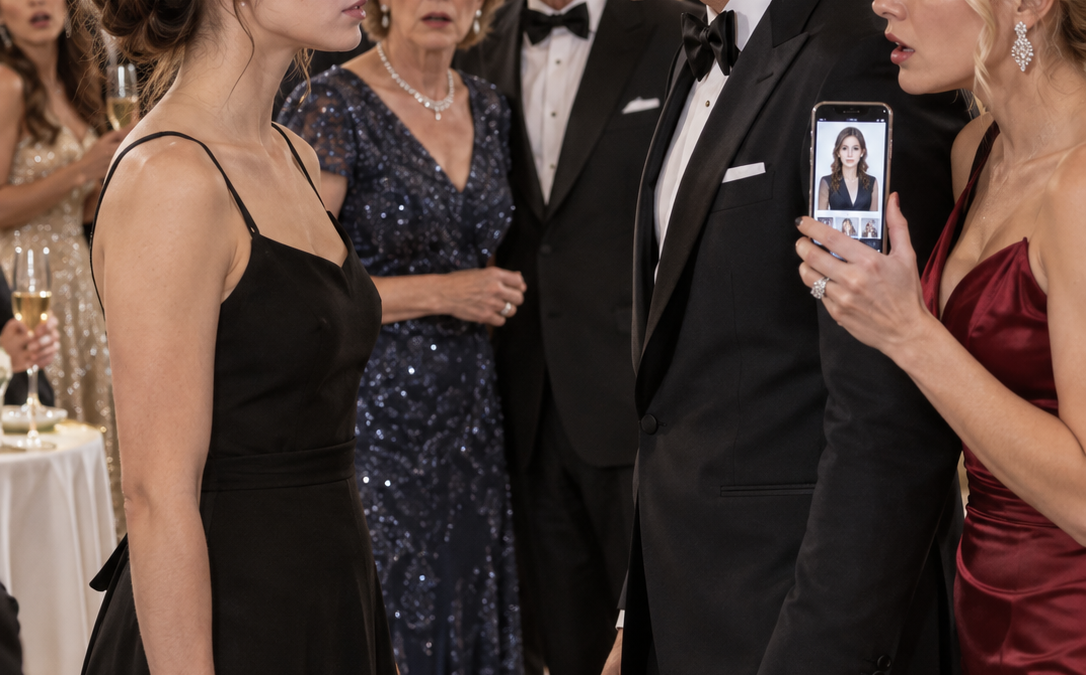
The crystal chandeliers in the Fairmont Hotel’s grand ballroom cast prismatic rainbows across the marble floors, where two hundred guests mingled in designer evening wear, champagne flutes catching the warm light. The engagement party for my brother David and his fiancée, Victoria, had cost more than most people’s annual salaries. Fresh orchids flown in from Thailand, a string quartet from the city’s symphony orchestra, and enough Dom Pérignon to float a small yacht. Every detail screamed luxury, from the hand-calligraphed place cards to the ice sculptures that would melt into memory by midnight.
I stood near the service entrance in my simple black dress, the same one I’d worn to job interviews three years ago, carefully pressed and paired with modest flats from a discount shoe store. While the other guests sparkled in diamonds and designer gowns, I blended into the background like furniture, invisible to everyone except the catering staff, who occasionally nodded at me with professional courtesy.
“Darling, everything looks absolutely perfect.”
I heard my mother’s voice carrying across the ballroom as she air-kissed Victoria’s mother. Both women were resplendent in their evening finery. Mom wore her newest Valentino gown, the one she’d bought specifically for tonight’s celebration, while her three-carat diamond earrings caught the light with every animated gesture.
“We’re so thrilled to welcome Victoria into our family. David has such wonderful taste.”
Dad stood nearby in his custom-tailored tuxedo, his Patek watch glinting as he gestured toward the bar setup.
“Only the finest for our boy,” he boomed to a group of his business associates. “Nothing’s too good for David’s special day. He’s always been our star. Full scholarship to Harvard Business School, youngest partner in his firm’s history, now marrying into one of the city’s finest families.”
The pride in his voice was unmistakable, the same tone he’d used at David’s graduation, his promotion celebration, his apartment-warming party in the penthouse downtown. It was a tone I’d never heard directed at me, not once in my twenty-eight years of existence.
David himself stood at the center of the ballroom like a peacock displaying his plumage, his arm wrapped possessively around Victoria’s waist as he regaled their guests with stories of their romantic getaway to the Maldives and their upcoming wedding at Martha’s Vineyard. His custom Tom Ford tuxedo probably cost more than I spent on rent for three months, and his confidence radiated outward like heat from a bonfire.
“The wedding’s going to be absolutely magical,” Victoria gushed to a cluster of her sorority sisters, her engagement ring—a five-carat emerald-cut diamond surrounded by smaller stones—catching the chandelier light as she gestured. “David spared no expense. We’ve booked the entire resort for the weekend, flying in guests from around the world. It’s going to be featured in Town & Country magazine.”
I remained by the wall, occasionally helping the catering staff when they looked overwhelmed, refilling champagne glasses and clearing empty plates. It wasn’t officially my job, but I’d learned long ago that staying busy at family events helped me avoid the awkward conversations about my career situation and my disappointing life choices.
“Sweetheart, why don’t you grab us some of those canapés?” Mom called to me across the room, pointing toward the passed appetizers with the casual expectation of someone addressing hired help. “The ones with the caviar. Victoria’s parents will love them.”
I nodded and moved toward the catering station, weaving between clusters of guests who were deep in conversation about stock portfolios, vacation homes, and their children’s acceptance letters to prestigious universities. None of them made eye contact with me. In my simple dress and modest appearance, I was effectively invisible in this crowd of wealth and status.
“Excuse me, miss.”
A woman in a beaded gown stopped me as I balanced a tray of canapés.
“Could you direct me to the ladies’ room?”
She assumed I was part of the catering staff, and I didn’t bother to correct her. It was easier than explaining that I was the groom’s sister, the family member who didn’t quite fit into this glittering world of privilege and accomplishment.
As I distributed appetizers and refilled drinks, I caught fragments of conversations about David’s success, his brilliant career trajectory, and his perfect match with Victoria. Their love story had all the elements of a fairy tale: Harvard Business School sweethearts, a proposal on a private beach in Santorini, and a future that promised continued wealth and social prominence.
“David’s always been exceptional,” I heard my aunt telling a group of Victoria’s relatives. “Even as a child, you could tell he was destined for greatness. Harvard MBA, partnership at twenty-nine, now this beautiful engagement. We’re so proud of how he’s turned out.”
The unspoken comparison hung in the air like expensive perfume.
David was the success story, the child who had fulfilled every parental expectation and social obligation. I was the cautionary tale, the sibling who had somehow failed to live up to the family standards despite having access to the same opportunities and resources.
Around nine o’clock, Victoria’s parents arrived fashionably late, making their entrance like visiting royalty. Richard Peton III was old money personified. His family had owned shipping companies for four generations, and his net worth was the kind that appeared in Forbes estimates rather than public records. His wife, Eleanor, dripped with inherited jewelry and the kind of understated elegance that money couldn’t buy, only breed.
“David, my boy!” Richard boomed, enveloping my brother in a hearty embrace. “You look magnificent. This whole affair is absolutely first class. Your parents have outdone themselves.”
“Thank you, sir,” David replied with the practiced charm he’d perfected in business school. “We wanted tonight to be special for Victoria. She deserves nothing but the best.”
Eleanor kissed Victoria on both cheeks with the refined affection of someone raised in boarding schools and finishing schools.
“Darling, you look radiant. That dress is stunning. Is it Vera Wang? Custom Marchesa?”
Victoria replied with obvious pleasure. “David insisted on flying us to New York to work with their design team personally. He said tonight had to be perfect.”
As the evening progressed, I continued my invisible service, refilling glasses and clearing plates while the celebration swirled around me like an elaborate dance I wasn’t invited to join. The conversations grew louder and more animated as the champagne flowed, filled with laughter, congratulations, and increasingly elaborate toasts to the happy couple’s future.
“Ladies and gentlemen,” David called out around ten o’clock, tapping his champagne flute with a silver spoon to get everyone’s attention. “If I could have your attention for just a moment.”
The ballroom gradually quieted as guests turned toward the center of the room, where David stood with Victoria, both of them glowing with happiness and champagne. The string quartet ceased playing, leaving only the gentle hum of conversation and the soft clink of crystal glasses.
“Victoria and I want to thank all of you for being here tonight,” David began, his voice carrying easily across the marble floors and high ceilings. “Your presence means the world to us as we celebrate this next chapter in our lives together.”
Applause rippled through the crowd, punctuated by enthusiastic cheers from David’s college friends and Victoria’s sorority sisters. I stood near the back of the room holding an empty champagne tray, watching my brother bask in the adoration of two hundred of the city’s most influential people.
“I also want to take this opportunity to introduce Victoria’s parents to some of our family members they haven’t met yet,” David continued, scanning the crowd until his eyes landed on me near the service station.
A smile spread across his face.
Not the warm, genuine smile he reserved for people he respected, but the condescending smirk he’d perfected during our childhood whenever he was about to demonstrate his superiority.
“Victoria, Richard, Eleanor,” he called out, gesturing for them to join him near where I stood. “I’d like you to meet my sister, Sophia.”
The three of them approached with polite smiles, clearly expecting to meet another successful family member who would fit seamlessly into their world of privilege and accomplishment.
Richard extended his hand with the confident charm of someone accustomed to making favorable impressions, while Eleanor appraised my appearance with the practiced eye of someone who could determine social status at a glance.
“Meet the family failure,” David announced with theatrical flair, his voice loud enough to carry to the nearby guests who had gathered to witness this introduction. “Sophia here has been exploring her options for the past few years. Still trying to figure out what she wants to be when she grows up.”
Laughter erupted from the surrounding crowd.
Not malicious, exactly, but the kind of amused chuckling wealthy people reserve for stories about other people’s misfortunes. David’s business-school friends nodded knowingly, having heard similar stories about underachieving siblings who couldn’t match their successful brothers’ accomplishments.
“Oh, David.” Victoria laughed, swatting playfully at his arm. “You’re terrible. I’m sure Sophia is wonderful.”
But her tone suggested she was merely being polite, going through the social motions expected of someone in her position.
Richard’s handshake became noticeably less firm as he processed David’s introduction, while Eleanor’s smile grew more strained. They were clearly recalculating their assessment of the family dynamics, probably wondering how David had managed to excel so dramatically while his sister had apparently achieved so little.
“Sophia’s been living in that tiny apartment downtown,” David continued, clearly enjoying his audience’s attention, “working various temporary positions. We keep telling her she should consider something more stable. Maybe administrative work or retail management, something with a steady paycheck, you know.”
More laughter rippled through the crowd, and I felt my cheeks burning with humiliation. Several guests had pulled out their phones to capture videos of David’s speech, probably planning to share highlights on social media later. I stood there holding my empty tray, feeling like an exhibit in a museum of family disappointment.
“She’s always been the artistic type,” Mom added helpfully from across the circle, her voice carrying the kind of fond exasperation parents use when discussing children who haven’t lived up to their potential. “Very creative, very idealistic. We thought she’d outgrow it eventually, but you know how some people are about following their dreams instead of being practical.”
Dad nodded sagely, as if my presence had reminded him of an ongoing family problem he’d been trying to solve.
“We’ve offered to help her get settled in something more traditional, maybe accounting or human resources. David has connections at several firms that might be willing to give her a chance despite her unconventional background.”
The condescension in their voices was suffocating.
Here I was being discussed like a charity case in front of two hundred of the city’s elite, my own family painting me as an object of pity and disappointment. The catering staff, I noticed, had stopped their work to listen, probably grateful that someone else was providing the evening’s entertainment.
“Well,” Eleanor said diplomatically, “everyone finds their path in their own time. I’m sure Sophia will discover what’s right for her eventually.”
Her tone suggested she thought that discovery was long overdue and unlikely to involve anything particularly impressive.
David was clearly enjoying himself, basking in the contrast between his own success and my apparent failure. This was his engagement party, his moment to shine, and he had effectively used me as a prop to make himself look even more accomplished by comparison.
“The thing is,” he continued, warming to his theme, “Sophia’s always been convinced she’s going to be special somehow. You know the type. Big dreams, unrealistic expectations. Meanwhile, the rest of us are out here in the real world building actual careers and contributing to society.”
Victoria’s sorority sisters nodded sympathetically, clearly familiar with stories about family members who couldn’t get their lives together. Several of David’s business colleagues exchanged knowing looks, probably thinking about their own disappointing relatives who had failed to achieve professional success.
“Maybe she’ll figure it out eventually,” Victoria said with the kind of charitable optimism wealthy people display when discussing less fortunate individuals. “Some people are just late bloomers, I suppose.”
The phrase late bloomer hung in the air like a diagnosis.
At twenty-eight, I was apparently still waiting for some kind of delayed maturation that would finally allow me to join the ranks of productive, successful adults like everyone else in this ballroom.
“Sophia’s always been a bit different,” David explained to Richard and Eleanor, as if my eccentricity were a mild mental health condition that the family had learned to manage. “Marches to the beat of her own drum, you might say. Never quite understood the value of conventional success or financial stability.”
As the laughter and condescending comments continued to flow around me, I noticed Victoria pulling out her phone to check something. The conversation had shifted to wedding planning and honeymoon destinations, with David describing their plans for a month-long tour of Europe’s most exclusive resorts.
“We’re thinking of starting in Monaco,” Victoria said, scrolling through what appeared to be travel websites or social media feeds. “David knows people who can arrange private yacht charters, and—”
She stopped mid-sentence.
Her eyes fixed on her phone screen with an expression of sudden confusion.
The animated chatter around us continued, but Victoria had gone completely still, staring at whatever had appeared on her device.
“What is it, darling?” Eleanor asked, noticing her daughter’s distraction. “You look like you’ve seen a ghost.”
Victoria’s eyes flicked from her phone screen to my face, then back to the screen, then to my face again. Her carefully applied makeup couldn’t hide the fact that all color had drained from her cheeks.
“Is this you?” she asked quietly, turning her phone screen toward me. “Is this you on Forbes?”
The laughter that had been rippling through our circle stopped as if someone had flipped a switch.
David, who had been in the middle of describing their planned suite at the Hôtel de Paris in Monte Carlo, fell silent mid-sentence. Richard and Eleanor leaned in to look at Victoria’s phone, while the guests who had gathered to witness my public humiliation suddenly focused their attention on the small screen that had somehow shifted the entire dynamic of the conversation.
I looked at the phone and saw exactly what Victoria was seeing.
The cover of that month’s Forbes magazine featured a photograph of me in a sleek business suit, standing in front of the floor-to-ceiling windows of a downtown corporate office.
The headline read:
“The Disruption Queen: How Sophia Martinez Built a $3.2 Billion AI Empire in Secret.”
The silence stretched for what felt like hours but was probably only seconds. Around us, the engagement party continued—the string quartet playing, champagne flowing, guests laughing and celebrating—but our little circle had become frozen in time, suspended in a moment of collective shock and disbelief.
“That’s…” David started, then stopped, his voice cracking slightly. “That’s not…”
“Sophia Martinez, founder and CEO of Quantum Solutions,” Victoria read aloud from her phone, her voice growing stronger as she processed the information. “Age twenty-eight. Net worth estimated at $4.7 billion. Named to Forbes’ list of America’s most innovative entrepreneurs for revolutionary advances in artificial intelligence and quantum computing.”
More silence.
I could see David’s mind racing, trying to process information that contradicted everything he thought he knew about me, everything he had just told two hundred guests about my failures and disappointments.
“Quantum Solutions went public six months ago,” Victoria continued reading, “with the largest IPO in tech-sector history. Martinez’s proprietary AI algorithms have revolutionized everything from medical diagnostics to financial trading, with major corporations paying millions for licensing agreements.”
Richard had gone completely pale, his confident businessman’s demeanor replaced by the expression of someone who had just realized he’d made a catastrophic error in judgment.
Eleanor was staring at me with the kind of shock typically reserved for natural disasters or major accidents.
“This says you’ve been featured on the cover of Time magazine, Wired, and Fortune,” Victoria continued, her voice barely above a whisper. “You were keynote speaker at last month’s Global Tech Summit. You own patents worth…”
She paused, apparently having trouble processing the number.
“Worth over two billion dollars.”
The circle of guests who had been laughing at David’s stories about my failures was now staring at me with expressions ranging from bewilderment to horror.
Someone’s champagne glass slipped from nerveless fingers and shattered on the marble floor, the sound echoing across the ballroom like a gunshot.
“There’s a whole article about your company’s latest acquisition,” Victoria said, still reading from her phone as if she couldn’t quite believe what she was seeing. “You just bought MedTech Industries for $1.8 billion cash. It says here that you’re planning to integrate their research facilities with your AI development programs.”
David’s mouth was opening and closing like a fish out of water.
His perfect composure, his confident superiority, his entire identity as the family’s golden child was crumbling in real time as the truth of my actual life became undeniable.
“Sophia,” Richard said slowly, his voice carrying the kind of respect he typically reserved for heads of state or fellow billionaires. “Is this… is this accurate?”
I looked around at the faces staring at me—some shocked, some confused, some calculating the social and financial implications of what they had just learned.
These were the same people who had been laughing at David’s stories about my failures just minutes earlier.
“Yes,” I said simply. “It’s accurate.”
The two words seemed to echo in the sudden quiet that had fallen over our section of the ballroom. Even the string quartet’s music seemed muted, as if the universe itself were holding its breath to see what would happen next.
“But…” Mom’s voice came from somewhere behind me, weak and uncertain. “You live in that little apartment. You take the bus. You…”
“I live simply by choice,” I explained calmly. “The apartment is convenient to my downtown office. Public transportation is more efficient than sitting in traffic. Material displays have never interested me much.”
Dad appeared at my elbow, his face flushed with what I assumed was embarrassment.
“Sophia, why didn’t you tell us? We had no idea you were…”
“I tried,” I said, my voice still calm despite the emotional storm building inside me. “For three years, I tried to share what I was working on. Every family dinner, every holiday gathering, every phone call. You told me I was wasting my time with computer nonsense and that I needed to get serious about my future.”
The memory of those conversations hung in the air between us.
All the times I’d attempted to explain my research, my business plans, my patent applications. All the times I’d been dismissed, interrupted, or simply ignored while the conversation turned to David’s latest promotion or achievement.
“We didn’t understand,” Eleanor said weakly, as if lack of understanding somehow excused three years of condescension and dismissal.
“You didn’t want to understand,” I corrected gently. “Understanding would have required listening, and listening would have required believing that I might actually be capable of something significant.”
Victoria was still scrolling through articles on her phone, her expression growing more stunned with each new piece of information she discovered.
“There’s a video interview with you on CNBC from last week,” she said. “And another one with Bloomberg from last month. How did we miss all of this?”
“Because you weren’t looking,” I said simply. “You decided three years ago that I was the family failure, and once you made that decision, you stopped paying attention to anything that might contradict it.”
David finally found his voice, though it came out as barely more than a whisper.
“Forbes estimates your net worth at $4.7 billion.”
“That’s conservative,” I replied. “It doesn’t include the value of my private holdings or the intellectual property portfolio that’s not directly tied to Quantum Solutions. The actual number is probably closer to six billion, but I don’t really track it that closely.”
Six billion dollars.
The number seemed to ricochet around our circle like a pinball, bouncing off shocked faces and confused expressions.
For reference, David’s annual salary at his prestigious firm was probably around $300,000. Respectable by most standards, but a rounding error compared to what I’d built.
“Your quantum-computing breakthrough,” Richard said, clearly trying to process the technical implications alongside the financial ones. “The articles say it could revolutionize everything from cybersecurity to pharmaceutical research, among other applications.”
“Yes,” I confirmed. “We’re currently working with twelve government agencies and forty-three Fortune 500 companies to implement various aspects of the technology. The medical applications alone could save hundreds of thousands of lives over the next decade.”
The engagement party continued around us, but our corner of the ballroom had become its own separate reality. Guests were starting to notice the commotion, pointing and whispering as word spread that something significant was happening near the Peton family’s table.
“Sophia,” Mom said, appearing beside Dad with tears starting to form in her eyes. “We’re so sorry. We had no idea. We’re so proud of you.”
The words I’d wanted to hear for three years, finally spoken at the worst possible moment.
Pride offered only after public humiliation had made it socially necessary.
Love expressed only when silence was no longer an option.
“Are you?” I asked quietly. “Are you proud of what I’ve accomplished? Or are you proud of what it means for the family’s social status?”
The question hung in the air unanswered because we all knew the truth.
If my net worth had been revealed as $50,000 instead of six billion, if my company had failed instead of succeeded, if my innovations had been ignored instead of revolutionizing entire industries, this conversation would not be happening.
“Both,” Dad said finally, with the honesty of someone who had been caught in an indefensible position. “I wish it were different, but both.”
Victoria’s phone buzzed with notifications as news of her discovery spread through social media. People were taking pictures of the Forbes article, sharing screenshots of my company’s stock price, posting videos of the moment when everything changed.
“There’s going to be a lot of attention on this,” she said, looking up from her screen with something approaching panic. “People are already posting about it. This is going to be everywhere by tomorrow.”
She was right.
By morning, the story would be viral:
Billionaire tech CEO served drinks at brother’s engagement party while family called her a failure.
The optics were devastating, not just for David and my parents, but for the Peton family as well. They had just publicly humiliated someone who could buy and sell their shipping empire without affecting her quarterly budget.
“I should go,” I said, setting down the empty champagne tray I’d been holding throughout this entire surreal conversation. “Congratulations on your engagement, David. Victoria, I hope you’ll be very happy together.”
“Wait,” David called out as I started to walk away. “Sophia, we need to talk. We need to figure out how to handle this situation.”
I stopped and turned back to face him one last time.
My brother, who had spent the entire evening using me as a prop in his performance of superiority, now looked smaller somehow, diminished by the revelation that everything he thought he knew about our family dynamics had been completely wrong.
“There’s nothing to handle,” I said. “You introduced me exactly as you see me—the family failure. The fact that your perception doesn’t match reality isn’t my problem to solve.”
“But people will think…” He started, then stopped, probably realizing that what people would think was entirely accurate: that he had publicly humiliated a sister who had achieved more in three years than he would accomplish in his entire career.
“People will think what they think,” I replied. “I can’t control that, and honestly, I don’t care anymore. I stopped caring about your opinion of me the day I realized that your approval was never actually available, regardless of what I achieved.”
As I walked toward the ballroom exit, I could hear the whispered conversations starting behind me. Guests who had witnessed the revelation were already pulling out their phones, searching for more information about Quantum Solutions and its mysterious founder.
The engagement party would be remembered not for celebrating David and Victoria’s future, but for the moment when everything they thought they knew turned out to be completely wrong.
Outside the hotel, I called my driver, something I’d started doing six months ago when the constant media attention made public transportation complicated.
As I waited for the car, I thought about the irony of the situation.
I had spent three years trying to earn my family’s respect through achievement, only to discover that respect offered after public humiliation felt hollow and meaningless.
My phone buzzed with a text from my assistant.
The CNBC interview got moved to tomorrow morning. They want to discuss the Forbes cover and the market reaction to your latest patent filings. Should I confirm?
I typed back:
Confirm the interview, and please schedule a meeting with our legal team tomorrow afternoon. We may need to discuss some personal matters that could affect the company’s public image.
As my car pulled up to the hotel entrance, I realized that tonight had been a gift, though not the kind anyone had intended.
For three years, I had carried the weight of my family’s disappointment, wondering if maybe they were right about my choices and priorities. Now I knew with absolute certainty that their opinion of my worth had never been based on my actual accomplishments or potential.
They hadn’t seen my success because they hadn’t wanted to see it.
They had needed me to be the failure in order for David to be the star.
My role in the family narrative had been predetermined, and no amount of achievement would have changed that dynamic until external forces made it impossible to maintain.
The drive back to my apartment gave me time to process what had happened and what would happen next.
By tomorrow, the story would be everywhere, dissected and analyzed by business journalists, social media commentators, and anyone who enjoyed watching privileged families implode in real time.
David’s engagement party, which was supposed to be his moment of triumph, would instead become a case study in how assumptions about success and failure could be completely divorced from reality.
Victoria would have to decide whether she wanted to marry into a family that had just demonstrated such spectacular failures of judgment in front of two hundred influential witnesses.
And I would continue building the future I’d been working toward for three years, but without the emotional burden of seeking approval from people who had never been capable of offering it authentically.
My phone rang as the car pulled up to my building.
The caller ID showed David’s number.
“Hello?” I answered.
“Sophia.” His voice was strained, desperate. “We need to talk. This whole thing tonight… it got out of hand. We can fix this. We’re family.”
“Are we?” I asked quietly. “Because for three years, I’ve been trying to figure out what family means to you. Tonight, I think I finally understand.”
“It means we stick together,” he said quickly. “It means we support each other. It means we work through problems instead of walking away.”
“Where was that philosophy when I was working sixteen-hour days to build my company?” I asked. “Where was that support when I was trying to share my excitement about breakthrough patents and revolutionary technology? Where was that family loyalty when you introduced me as the family failure to two hundred people?”
Silence on the other end of the line.
“I know we made mistakes,” he said finally. “But we can fix this. We can make it right.”
“Some things can’t be fixed, David,” I replied. “Some damage is permanent. Tonight wasn’t a mistake. It was the inevitable result of three years of choices you all made about how to treat me.”
“So what happens now?” he asked, and I could hear genuine fear in his voice. “What happens to us? What happens to the family?”
I looked up at my building, the tiny apartment that David had mocked, which was actually a penthouse I’d bought for cash because I preferred privacy to ostentation.
“I don’t know,” I said honestly. “I guess that depends on whether you’re capable of change or if tonight was just damage control.”
“Give us a chance,” he pleaded. “Give us a chance to show you that we can do better.”
“I’ve been giving you chances for three years,” I replied. “Tonight was your chance to see me clearly, without any agenda or ulterior motive. Instead, you chose to humiliate me in front of strangers for entertainment. That tells me everything I need to know about who you really are.”
I ended the call and rode the elevator to my penthouse, where floor-to-ceiling windows offered a panoramic view of the city’s skyline.
Down below, the lights of offices and apartments stretched to the horizon, representing millions of people pursuing their own versions of success and happiness.
For three years, I had built an empire while living in the shadows of my family’s expectations.
Tomorrow, that would change.
The Forbes cover had made my success impossible to ignore or dismiss. But it had also made something else clear.
The approval I’d been seeking was never worth having in the first place.
My phone buzzed with another text, this time from my head of public relations.
Twitter is exploding. #EngagementPartyReveal is trending. The stock is up 12% in after-hours trading. Should we issue a statement?
I set the phone aside without responding and looked out at the city lights.
Tomorrow would bring new challenges, new opportunities, and new questions about how to balance public success with private relationships.
But tonight, for the first time in three years, I felt completely free from the weight of other people’s opinions about my worth.
The family failure had become a billionaire tech mogul, and the only thing that had really changed was everyone else’s willingness to pay attention to what had been true all along.








